
Tag Archives: patriarchy

028 I Detra Thomas on Reclaiming Identity: A Journey from Patriarchal Faith to Personal Freedom

When Brandon Stanton of Humans of New York released a fifteen-part series telling Detra’s story in 2022, I was riveted. I kept refreshing HONY, cried tears of empathy and recognition, and couldn’t stop thinking about Detra long afterward. So I was delighted when she accepted my invitation to TBKB podcast to share her story with you.

In this episode, Detra Thomas shares her powerful journey of escaping a patriarchal, abusive marriage rooted in religious conditioning. Her story highlights the importance of faith, resilience, and finding one’s true foundation in God. If you’ve wondered how common The Pastor’s Wife story is, take it from Detra: she hears from women who have walked the same horrible path all the time. Patriarchal religion is DANGEROUS for women and children. The fruit is rotten and the tree needs to be removed from the roots up.

Visit detrasstory.com to read HONY’s series on Detra, and purchase her signature cigars! And be sure to follow Detra on Instagram as well.
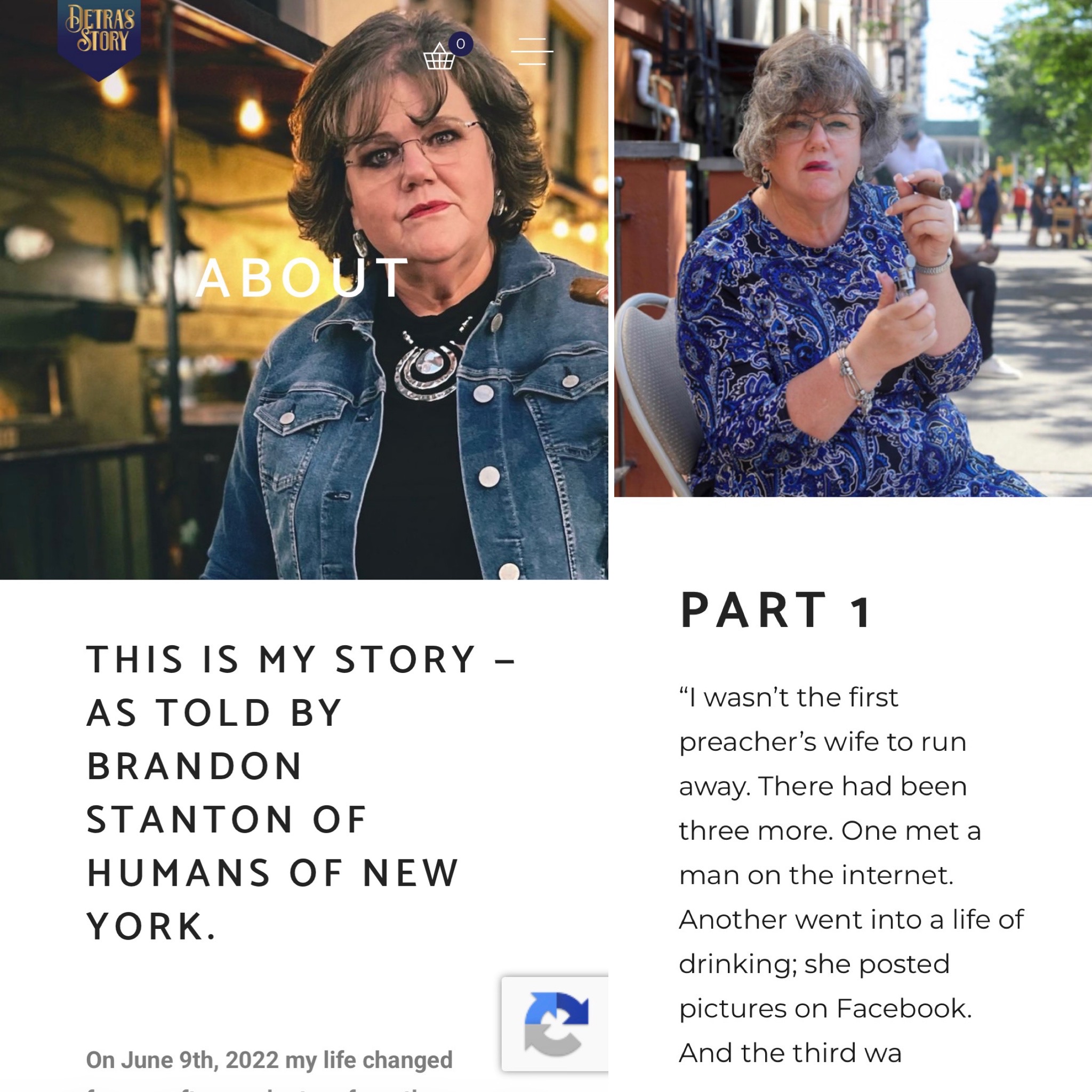
Please enjoy this episode of The Beautiful Kingdom Builders podcast on YouTube, Spotify, Apple Podcasts, Amazon Music, Substack, and more! 

TRANSCRIPT:

Rev. Ruth Perry (00:15)
My guest today is Detra Denise. She was featured by Brandon Stanton on Humans of New York four years ago. And I remember the day that your story was published, I kept refreshing Humans of New York and I was so impatient. I was spellbound by your story and just really astounded and amazed by it. And so I’m so thrilled that you would come on my podcast, Detra, today. Thank you so much for being here.

Detra Thomas (00:40)
Thank you for having me and thank you for reading the story. You’re not the first person that has said they kept hitting the refresh button and it always kind of makes me giggle inside because I always wondered if it’s the runaway pastor’s wife smoking a cigar in Harlem or just exactly what it was. and it wasn’t until he let me read the story like two or three days before it came out and I sat down and read it and I was bawling by the time I was done. And he was like, is it that bad? And I said, No, I had no idea I had done all that. because when you’re living it day to day, you’re just trying to get through. And so his story really gave me a perspective of, hey, I’ve been hard at work here, and I’ve been doing some good things. Yeah, I was tired and didn’t know if I was gonna make it, all that, but yeah, his story really helped me. But I always get tickled when people say, I was hitting the refresh button over and over and over just to see what was gonna happen next.

Rev. Ruth Perry (01:33)
It spoke to me on multiple levels, but I related to your story as a pastor’s daughter myself in the Baptist faith, a different denomination but similar backgrounds. And I related to a lot of the influences that you mentioned. And it related to me just the whole process of undoing patriarchal faith and building your own identity from scratch. And so I think a lot of people that follow my Facebook page and my blog and now my podcast have a similar background where they’re coming from a patriarchal faith and they’re reckoning with the damage of that and trying to heal from it. And I think sharing our stories is so important. So can you take us back to the beginning to Little Detra? And where did you

Detra Thomas (02:16)
Ha ha.

Rev. Ruth Perry (02:17)
grow up and what was your faith background and your childhood like?

Detra Thomas (02:21)
I was born in Arkansas and that’s where I lived until a little bit after I got married. We lived in Memphis, Tennessee, three and a half years, which is just right there by Arkansas. But Arkansas was where I was born and raised. And I’m the oldest of four children. My dad was a pastor, mom was stay at home. She worked very hard. She worked diligently to clothe us and feed us because, there wasn’t much money and she was as I got older and she began to teach me, my mother was incredible at finding deals. My favorite sweater came from Salvation Army. She paid a quarter for it. It was absolutely beautiful. But my mom wasn’t just trying to find an article of clothing to put on my body. She was trying to find something that complimented me. And she had that eye. So, I didn’t realize how poor we were till much later in life.

But I grew up in the church. I when I was fourteen, my dad assigned me a class to teach. He assigned me a bus route. I was, I would go type the letters to the visitors. I I would drive him on visitation, I would drive him to visit the hospitals. He hated being alone. He’s he is a narcissist. So that’s how I grew up was, in ministry. I had every church members’ phone number memorized, he’d snap, Detra, get so and so on the phone. I would call the number, usually the wife would answer and I’d say, hey, so and so. Daddy wants to talk to brother so and so, hand the phone.

And I remember when I went to college and I came back home after a few weeks, and I have a sister and two brothers under me, and he said, I really miss you. He said, I tried to get my sister to call somebody and she goes, Well, what is the number? And he goes, Well, it’s two four seven two what? Two what? And he just said, I’m just doing it myself. So I had that ability, so I was very involved in church work and loved it.

Went to college at a little bitty tiny Christian college and had a full scholarship to sing. And we practiced. We would show up a week before college and spend eight to ten hours a day rehearsing. And then we traveled in a van around Arkansas and some Texas, states that kinda touched and were close. We would travel every weekend.

So I carried 18 to 20 hours while doing 78 concerts a year. Plus, because I was so poor, I worked in the student center. So I was very, very occupied and still was in full-time ministry, even though I’m in college, it’s full-time ministry. And married a guy from that college. And what was interesting is all of our parents had gone to that college. So our moms and dads knew each other, his dad was a pastor.

So I just perpetrated the life I had had, and I was born to a man who pastored in the Baptist Missionary Association of America, the BMA of A, BMAA, but he was an independent Baptist at heart. So he would go to all the independent Baptist conferences, like Jack Hiles. and that was the mentality he had, authoritarian. So I’m a firstborn. Firstborns relate to authority. So I didn’t have any trouble with this, and just fingers were snapped and I did and jumped how high and that’s how I was raised.

So my mom and dad, when I was 10 years old, went to IBLP, Bill Gothard’s Seminar, Institute and Basic Life Principles. So I was raised under that. And even though for the scandal that that is, the horror that is, there are some nuggets of good things in there. And I managed to take some of those good things, that have helped me in my life. There are some horrible things.

So that’s how I was raised. A woman is born for the man, whether it’s her dad to be under his authority and do what he says, and then the man she marries, and I can’t do anything unless I have their permission and blessing. So it was that’s all I knew.

Rev. Ruth Perry (05:57)
So you had a deep purpose and meaning in your ministry of the church. And you love the church from an early age. And it sounds like you’re a real go-getter and a overachiever and a overperformer. And that’s the kind of personality of someone that attracts a narcissist, I think. They’re looking for those real bright lights that have so much to offer the world. But what did you want to be? When you went to college, what were you dreaming for your future?

Detra Thomas (06:23)
My plans were to go back and teach at this little Poduk ACE school, and and in fact, my third year, the the pastor of that church and the principal of that little school showed up at my college. I didn’t even know they knew where I was, to say, Detra, hey, we’re waiting on you. And I had just gotten engaged. I said, Well, I’m getting married. So that was my plan. I had no aspirations because I was told I couldn’t have any.

Rev. Ruth Perry (06:47)
Yeah.

Detra Thomas (06:47)
Anyway, that was it.

Rev. Ruth Perry (06:48)
So what was the courtship like with your husband?

Detra Thomas (06:51)
When I went to college my dad told me I could never be alone by myself with a guy. So there was no dating. and courtship wise, I mean he just came to me and a he well actually called my dad one summer and asked if if he could date me and my dad said, Well you’ll have to ask her.

And he knew that I couldn’t single date. And I worked in the student center. He’d already graduated. So he would bring chips and dip, and he’s a little black and white TV. We’d sit in the student center, eat chips and dip, watch TV and me taking care of people. And that was kind of our courtship, that there wasn’t any dating. There wasn’t any.

Rev. Ruth Perry (07:23)
And then how long between meeting him and getting married?

Detra Thomas (07:26)
I met him my freshman year. Well I met him actually on senior day in April of seventy-eight. And then we got married in eighty-one. So he was in his third year when I entered. And he finished college, went on to be on staff at a church. I got married after my third year. And then I took my last year. It took me two years to finish that last year, but three years.

Rev. Ruth Perry (07:49)
So you get married and how quickly does the mask fall?

Detra Thomas (07:53)
In three weeks I wanted it out. It didn’t take long. And I couldn’t put my finger on what was wrong. All I knew is everything in me was screaming. Everything in me was wanting to run. Everything in me was just like something. This isn’t right. The sentence I kept saying in my head is this isn’t what I signed up for.

And as I tell the story, I put my laundry basket on my hip. He’d come home for lunch, he went back to the church and I went to the central area to do laundry in our apartment division. And I was just I was like, God, I gotta figure out what to do ’cause, this is bad. I can’t handle it. And as I just pondered it out and focused on that entirely.

I just could, remember my dad telling me over and over, when you get married, you gotta marry somebody who can conquer you because you’re too strong. And I was a firstborn. I would ask questions. I never rebelled a day in my life, but when you’ve got a bullshit meter in you and you kind of cock your head and you’re like, something’s not right, and you just out of curiosity, not trying to be judgmental or critical, you ask a question. These type of men don’t like that.

And so that’s how I was raised. I couldn’t call my dad because he had told me I had to be conquered. And I believed every word that came out of my dad’s mouth. I haven’t spoken to my dad in eleven years, but I can tell you, I love my dad. I’m not mad at my dad. My dad is just who he is. And I’m not gonna be around who he is and what he does to me when I’m in his presence. So

And then, the week before I married, my mom told me, Hey, marriage is forever. And just so you know that if there’s trouble between the two of you, we’ll take him, but we won’t take you. And so I knew there was no reason to call for them to come get me. So, in my little worldview and praying about that, when I put everything together, the problem was me because scripture talks about submitting. And I realized, okay.

I just need to submit and be his wife, not a wife. He seemed to have some little nuances that were interesting. And I just thought I need to submit and be his wife. And so for 32 and a half years, that’s what I did. I gave it my all. I loved this man. I loved being his wife.

If you do a study on personalities and strength and weaknesses, we were almost 100% a perfect blend. My strengths were his weaknesses, his strengths were my weaknesses. And we were a great blend. We worked well together. We produced great things together. And I loved him. I loved the work in the church. I loved him.

The problem was in his mind there was never anybody but him. And when he would plan things, like at the church, he would plan things. He would just say, This is what we’re gonna do. And I said, Well, who’s gonna do that? Well, I don’t know. And I can remember one fourth of July, he decided that he wanted red, white, and blue bunting hung between all the columns in the church and the auditorium.

And I was like, well, and because I still wanted to make him a success, I said, well, let’s go to Walmart and buy the fabric. And on Saturday, I don’t remember, probably I made 10 buntings that were probably eight foot long apiece, and got the fabric cut, sewn together, and then he hung them. But that’s what I did because I loved him, and he was a creative. He had the ventriloquist puppets. He was a singer. He could play instruments. I felt so favored to be married to a man that creative. I didn’t know I was creative. I didn’t know I was talented. Because from a young age, my daddy snapped his fingers and said, Sing a special, play the piano, teach a class, run the bus route. It was what was in aid in me. I didn’t nobody ever told me I did a good job.

I did not know. So I assumed I was very favored to be married to this man and help him achieve what he would mouth but had no intentions of ever doing, if it wasn’t for me.

Rev. Ruth Perry (11:32)
I think that it’s so sad that you could have had a really beautiful marriage, but because of your theology and the theology that you grew up in, the culture that you both grew up in, it conditioned you to have this dynamic instead of a healthy dynamic. Not just that you were conditioned when men snapped their fingers that you would jump and ask how high, that was your training that you received, and that’s how you functioned. But then your husband was also conditioned in the same culture where men got to snap their fingers and got to expect people to jump.

Detra Thomas (12:03)
He was. Now his dad was totally different. The dynamic in his home was different. His mom was a school teacher, so she had a job outside of the home. They had a TV, we didn’t have a TV. So the kids could come in, watch TV, they got to go to the kitchen and fix whatever they wanted to fix. There was no snacking in my house and I’m not saying that in a negative way, but mom cooked three meals a day and and occasionally, she would fix us a snack, but we weren’t allowed free reign in the house. Our house was orderly.

And so we were raised both pastors’ kids and different, but still that I know his mom has told me she would find out that they were moving to another church because one Sunday he ran out from the pulpit, by the way, this is my last Sunday, we’re gonna be moving to Sunso. He never talked over anything with her. No, she and I did not discuss that much, she would just occasionally say something. And I loved my in laws. They didn’t like me. But I loved my in laws. She was very controlling and she was something.

And when I would go, my father in law, he would ask me the same three questions every time. When I got there, he would ask me the exact same three questions and when he I answered them, he was done with me. And for years, my first Christmas with them, I we had Thanksgiving with my family, Christmas with his, and we would rotate every year. Now all the other holidays, his mother required us to be at their house.

But the first Christmas I couldn’t wait, and they had this beautiful regular Christmas dinner, they had beautiful tree. My dad was a scrooge about Christmas, and I remember after the meal, his dad saying, Okay, I want a picture of my kids. Well, my house, when I got married, he was now my mom’s kid. That’s how that was, and we had already had that, so I got in the picture and he said, No, Detra, I said my kids.

And I remember I’d been married probably 10, 12, 15 years, and he was chairman of the Bible department at this little college. And I went and saw there were no pictures of me. There were pictures of my children, the man I was married to, everybody else in the family, but none of me. And I don’t know, I got real sassy one day. And I said, Let me tell you something. You either get a picture of me in this office, or I’m gonna pick out a picture of me and I’m gonna blow it up and frame it and put it in here. And the look on his face, he goes, No, sister, no, sister, don’t do that.

Don’t do that. But every year how he would frame it is I want all of my family under the tree and he would take pictures. And one year there was a guest there and the guest said, Hey Detra, he called. I said, I learned I’m not part of this family. So there he would take a picture of me and the man I was married to and my children, but I was not allowed to be in any pictures with anybody else.

Rev. Ruth Perry (14:35)
That’s so heartbreaking.

Detra Thomas (14:36)
It is, and I was just happy to be a part of, when I would go, what do you want me to do? How do you want it done? How do you want things in your kitchen handled? What can I do to help? All those type of things. I just look back and think, well, I’m not gonna tell you what I think because I’m gonna use New York language and I’m I’m not gonna say what I really think.

Rev. Ruth Perry (14:55)
We’ll fill in the blanks for you.

Detra Thomas (14:56)
Thank you. They’re a bunch of blankety blank blanks, that’s what they are. And just mean. Just mean. And there was no reason for it. The last words that she told me I kind of put my foot down and said, unless and things change, I’m not participating with them, I’m not inviting them to anything. But her words to me were, I don’t like how many children you’ve had. I don’t like that you homeschool them, but I don’t like that they’re on the road. If I had my way, things would be a whole lot different. And I was like, who do you think you are to think you get a say?

And how I raised my family. Was your mother-in-law in your business telling you how to raise your family? She wasn’t. Her mother-in-law was deaf. But I guarantee you, she would have told her to get lost, But it was just the constant gaslighting. And if you love me, this is what she said. If you love me, Detra, you will do this. And I would do it every time and tell her, mark me down as I love you.

I didn’t know what gaslighting was. But when you love so hard, and I’m happy with breadcrumbs, I really am, and I’m trying to change that. But when you’re happy with breadcrumbs and you look back and see they even didn’t want to throw you breadcrumbs. It is heartbreaking. It is heartbreaking.

Rev. Ruth Perry (16:02)
Yeah, as you were describing their family dynamic, I’m thinking to myself, Well, that doesn’t sound like the fruit of the spirit. These are

Detra Thomas (16:09)
No.

Rev. Ruth Perry (16:09)
Christians. Where’s the love? Where’s the joy? Where’s the peace and the patience and the kindness and the gentleness? None of that.

Detra Thomas (16:16)
Well, it was a pastor’s home, and I never heard God mentioned or talked about except for prayer before a meal. Never one time. And it was kind of crazy. I guess there was one time she mentioned a health issue and she did mention God one time. Other than that, there wasn’t. And that’s what he was raised in, so he was conditioned his own way, and then our Baptist ranks was very misogynistic, very misogynistic.

So he was going in the flow of what he was raised, plus he had his own nuances of… I don’t know that you can look it up then, but when I went and saw the lady after 32 and a half years of marriage, we talked, she mentioned sociopath, and I looked up sociopaths, and there’s two kinds. My dad was one and I married the other.

And so I would always think, I love that the man I’m married to is not like my dad. Well, they’re both sociopaths, but they’re one is my dad’s authoritarian. I married the charming one, the passive aggressive will kill you slowly day after day while smiling at you, so it was and then also the man I was married to, if you look up a psychopath, they have no emotions. They have no emotions for trauma or broken bones. He had none. And I would try to talk to him about that.

In fact, he had a full length mirror in his our walk-in closet and he was a cartoonist. And because I would talk to him so much about this, because I can’t comprehend this, I can’t comprehend that you don’t care about a broken bone or somebody hurt or you don’t care. In fact you get angry because it has now interfered with what you wanted to do. And I would have to walk a tight rope with him if the children got hurt.

He drew like two little bubbles coming out of his head, and in the big bubble it said, think about others. Because he couldn’t. He literally could not, except when he looked in that full-length mirror and had that bubble there. So

Rev. Ruth Perry (18:00)
Wow.

Detra Thomas (18:01)
And then you put the name of God in the middle of all that. It’s a recipe for a woman who’s naive, a woman who has been raised to enable, a woman who has been raised to believe that God will not bless her or protect her unless she obeys this man, a woman who is a firstborn who relates to authority, and a woman who, with her whole being, wants to please the Almighty. That is a recipe for total destruction.

And I look back and I don’t know how it all came to be, but I was begging God to show me, and it just happened that night. And was I trying to escape that night? No. But that’s what happened. And I’m grateful. I am grateful.

Rev. Ruth Perry (18:41)
This was after thirty two years of marriage. Is that right?

Detra Thomas (18:45)
Well, thirty two years I talked to somebody, but thirty four years when I escaped. Yeah.

Rev. Ruth Perry (18:49)
Can you name some more of the ways that you experienced abuse in your marriage before we talk about your escape? Because I think a lot of people still have misconceptions about what abuse is. We only understand if it’s violent. But there’s a way to be violent without bruising someone.

Detra Thomas (19:05)
Yeah. There were little things. We first got married, I’ve talked about this on many podcasts. He gave me a list of foods that he had to have snacks, a certain one, Monday, Tuesday, Wednesday. What we had on Monday was repeated on Thursday, Tuesday was repeated on Friday, and I had to sit beside him and eat, and I didn’t want to. And I would tell him I don’t want to. And he informed me that I was his wife and I would do what he said.

When I wanted to try a different hairstyle, my mom had always kept my hair really short. It started getting long because when you gonna cut your hair? I said, I thought I’d grow it out. He goes, You’ll wear your hair how I tell you to wear your hair. And then years later, like 20 years later, I asked him for permission to grow my hair out,

And I said, if I do it with a style, and he agreed. And I was pregnant with child number five. And so I’m I’m growing it out. And it’s probably about this length. And I really didn’t know much about styling hair, but I can fix it and it’s fine. And then it hits humidity and it starts doing all the curls.

Rev. Ruth Perry (19:57)
Yeah.

Detra Thomas (19:57)
And the church ladies were doing a baby shower for me. And so I was telling the women, I said, I’ve been trying to grow my hair because he he really likes it short. And no one thought a thing of it when I said he gave me permission to grow it long. Nobody batted an eyelash at this. And I said, but I’ve decided, I can’t keep it straight. See, I thought curls like this was simple.

That’s out of control, It means I can’t control my hair. I thought it was simple. And I said, So I think I’m gonna go back short. He just knows best. And the head deacon’s wife leaned in and said, We’ve been wondering what you were doing. So it wasn’t just you. Well, this solidified the fact that I don’t know what I’m doing. If my hair has a curl in it, it is simple and I have to obey him. So it wasn’t just him, it was along the way these churches had this mindset, so it was just crazy.

When I look back at it, my dad wasn’t trying to be abusive, He was doing best he could do with how he was raised. My mom willingly admitted all her neurosis, she would say, Detra, I have this, this, and this. But she would acknowledge and own it, and she worked on it, and so it was just this crazy hodgepodge of all these people, this worldview, this religious group weaving together something for someone who just wanted to make everybody happy, and that is I think you you coined me well, overachiever. I just wanted everybody to be happy. That’s all I wanted. So, you can die making everybody happy, and I almost did, yeah.

Rev. Ruth Perry (21:25)
Absolutely. I think they say eighty one percent of autoimmune diseases are in women, even though autoimmune diseases don’t impact one gender specifically. It’s just because women are carrying so much more stress and they’re absorbing the family stress, the stress of others.

Detra Thomas (21:40)
Okay, well, autoimmune, I’ve done a lot of research into that because I have several things. Best I can tell, it is repressed rage.

Rev. Ruth Perry (21:48)
Yeah.

Detra Thomas (21:49)
It’s an anger that you’re never allowed to express because you wouldn’t be a good Christian. All those things. It’s repressed rage. And I don’t think I’m an angry person at all because I swallow it all, but I have learned to forgive, but I think that it is your body creating signs to let you know you’re not handling this well. In other words, you had a fifty thousand dollar emotional event and you only give it fifty-five dollars. We’re telling you the rest of it’s coming due. And that’s what happens. You keep building up these emotional million dollar events and you don’t because you can’t. You’re a woman, one. You’re not a good Christian if you do, two. And three, you can’t do it because there’s nowhere to put it. Nobody’s gonna believe you. No one’s gonna believe you.

Rev. Ruth Perry (22:30)
So what was co parenting like with your ex husband?

Detra Thomas (22:33)
I would tell you it was good because we were a united front, which divided parents is when you get into a lot of trouble. And I liked order in the home and he followed that.

He was raised that there was order with the children, children obeyed, so that wasn’t an issue between us. And we did spank our children, they had to bend over the end of the bed and we spanked their rump.

I you would have to talk to my kids. I don’t think we we were abusive with with it at all. In fact, my second son told me with my baby girl, he goes, She did not get enough spankings, mama. She gets by with too much. But with the more children you have, if these children have learned to be obedient, they kind of follow in line. But I didn’t allow name calling. I didn’t allow kicking and hitting. Now if you want to wrestle, go outside and wrestle. And if someone taps out, you better be.

So we had this healthy playing and interaction and yeah, with seven kids. I had different personalities. I had one that was, kind of sneaky and come to find out he would cry and he’d be lying about stuff. But for the most part the kids got along. I I didn’t I didn’t

identify this horrible behavior, but co-parenting, we did well together, I thought was one of our strong suits. Now he did not like adult children at all. And I would have to step in and say, you can’t do that. Our oldest one joined the Marines and when he graduated from boot camp in San Diego, churches gave us money so the eight of us could fly out there.

So we flew out for family day and then graduation, and then he flew back with us the next day. And when I awoke, so by this time, the man I’m married to is in his 50s, and he couldn’t stand it if the children got any attention. And I would tell him, What? This doesn’t detract from us. Nobody’s taking anything away from you. You’re still an incredible man. I’m just building you’re an incredible man. But they’re adding to us, and he couldn’t handle it.

But the morning after we got back, I awoke to the bed empty and I could hear gut sobbing. Gut sobbing. And I run out to the living room. He’s on the couch, bent over, just sobbing. I think in 34 years, I may have seen him cry two or three times.

And I just ran over to him, I wrapped him up, and I’m like, what’s wrong? What is wrong? I mean, I’m fixing to go handle whatever it is. I said, What’s wrong? And he’s sobbing and he goes, I know this is wrong, which he knew it because I would tell him, what this is wrong. He said, But I’m crying because I didn’t get any attention yesterday, and Matthew got it all.

And I just felt a chill. I mean, I just literally a chill ran over me, and I let go of him. I’d run into this with him, but this was the first time it had been something of this magnitude, and I still cannot comprehend that this six foot six, fifty-something-year-old man is gut sobbing because his son, one of 400 graduates at a Marine, got all the attention and he didn’t get any. I don’t have I don’t have, I can’t…

Rev. Ruth Perry (25:18)
That’s mind blowing.

Detra Thomas (25:18)
It is mind-blowing. And it it is one of the examples of his complete narcissistic, whatever you want to add to that worldview where nobody is allowed to breathe. Nobody is allowed to breathe. And I am thrilled that I am away from that. I’m thrilled.

Rev. Ruth Perry (25:37)
Tell us how you got away.

Detra Thomas (25:39)
I went to see my doctor in Springdale, Arkansas. He was a doctor kind of outside the box, and I just believed God had him in my life for this particular reason. And I began to tell him a little bit about my marriage. I’d been seeing him for 20 years or so. And I said, I’m praying that God will just kill me. And then nobody has to know. None of these people in the churches, my mom and dad, my kids, nobody has to know. Because he didn’t treat everybody else the same.

And I remember my doctor saying, change your prayer. And I quickly looked up and I said, What? He goes, change your prayer. Now I thought I was being quite brilliant, intellectually, philosophical, spiritual, by asking God to just remove me. One move, and you solved the whole problem. And so I was quite shocked. And I said, Change my prayer. He said, Yeah, your body hears you.

And this was the first time I had a clue our words had power like that. And I said, Well, I am dying. I can tell that I’m dying. He said, Change your prayer. And so I left there and I was like, God, if there’s another way, I don’t know what it, I don’t know what it is. It didn’t occur to me to leave. And then as I began to talk to people, four people who had been married over 15, some over 25 years, never been divorced, said, get away from him.

Now, if you want to talk to people who’ve been divorced, get away. That’s another element. I’m not saying that would be wrong, but these are people who didn’t really, quote, believe in divorce, like me, and they’re saying, get away from him.

And so I prayed and I said, God, I don’t know how to leave. In fact, I had a plan in my mind that I was gonna take the suburban, he called that my vehicle, I was gonna put everything in the back I needed to survive, and I was gonna go to the police station and ask how long I could park my car in one spot and where were the best places in town. And I’d picked out parks that had showers where I could get a shower.

I was gonna have a cooler. I was gonna have my clothes. I was gonna sleep in the back seat with a pillow and a comforter so I could see my children. Now I look back at that and laugh because my kids would have been so embarrassed. my mom’s living in her car going around town. I just wanted to see my kids. that was it. I just wanted to see my kids, but I needed away from him. And that was my plan. That’s what I came up with.

And then I just said, God, if you’ll cause a fulcrum, I will do it. Because I can’t on my own. I don’t know how to walk away. I don’t know how to do this. Because there was so much at stake. And so we were driving back and he pulled one of his charming, passive-aggressive husband, pastor, get under my authority moves.

And I’ve been researching psychopaths, sociopaths, and religious abuse. And I was like, it’s just like all the blinders are falling off of my eyes and the fog is leaving my brain. And I’m like, Are you kidding me? And then I reverted back to a true firstborn who believes that God is true and faithful and who doesn’t put up with all these lies. And and I was like, and that’s when I looked at him and I said, You are a son of a bitch.

And I meant it contextuously. I meant it the son of a bitch. And I had had all I could handle. And in fact, I had told him at one time, I’m willing to give my life if you can figure out how mean you are. I’ll give my life. And what? He was willing to accept that. And when I figured out he knew what he was doing, he wasn’t gonna change, and I was like, I’m not giving my life for someone who’s willfully doing this.

This isn’t what God requires of me. So when I called him a son of the bitch, that was the fulcrum. And he was like, I’m fixing to pull over and tell you something. He finally had a sin he could nail on me. And so he was so happy. He pulled over, got in my face, and it was this just feeling inside, this is it. And I got my purse and got out, opened the door, started walking down the interstate.

And I was crying, I was praying, I I had all the emotions you could have, relief, fear, what’s gonna happen, all those things. And I just said, God, I need help. And there was a car pulled over, you know how long it takes to stop on the side of the interstate? Her brake lights were already off. And I saw the car in the distance, and I was like, God it’s probably a serial serial killer, but I don’t care.

That was literally my prayer. I was like, I don’t care. I’m getting in the car. I just wish I knew I could trust them. And when I said that the passenger door opened and this woman got out, and I could just tell she wasn’t a teenager. It was dusky dark, but her hair was past her shoulders, it was blown back in the wind, and she’s walking very purposefully towards me, and we have a distance to cover. The closer she gets, the harder I’m crying.

And she just meets me and turns and slides an arm around my waist and gets my hand. And ma’am, do you want to ride? I said, I do. And she said, God said to stop and pick you up. And I said, I told him I needed help. And for me and my journey with Christ, which has been strengthened so much more because of all of this, I knew that that was true because I had been begging God.

For a year and a half, you gotta show me what to do. And I would never have left. I wouldn’t have done any of these things. But she said, God said to stop and pick you up. I didn’t know this woman from Adam, I’ve never seen her. And she got me in the back and the reason she was walking purposefully is she could see him. He got out of the car when he saw her and he was running to get me. And when she opened the back door to put me in, I didn’t know he was coming. He grabbed me from behind, grabbed my arm. And I turned around and I just looked at him and I and I was done. And I said, I’m gonna call the police, let go of me.

And he goes, Well, I’m gonna call and he did this. I’m gonna call the police and tell them that you’re with somebody I don’t know. And I wanted to say, as usual, you don’t make sense. And I said, Call ’em, just call ’em. Let’s call the police. Let’s have this out here on the side of the interstate. You call the police, and I’m gonna tell them who you are. You call the police.

I don’t know. And he let go of me. She put me in, closed the door, and I am sobbing, distraught. Because it’s like, how am I a woman that’s on the side of the interstate getting away from my pastor husband that I’ve adored? Him trying to grab me. And he told them twice. He goes, She’s fine. We’ve had a fight, but she’s fine and she’s going with me.

And that’s when I said I was gonna call the police. So the woman got in the car and he he’s six foot six, like I said, she’s sitting in the passenger seat, and he bends down and he gets in front of her in her face, and he goes, I don’t even know who you are. And she just very calmly said, I’m a doctor with the Choctaw Nation. So she gives credentials, but she doesn’t tell her name. I look back on it, she was very smart, I’m a doctor with the Choctaw Nations. Those are credentials.

And he said, Well, I’m gonna follow you. She said, You do whatever you need to do. And he gets out, she closes the door, she tells her daughter to start driving. And I’ve since found this woman on the internet with help. I’ve been able to call her and thank her. Her daughter and I visited a little bit on the internet. I just remember when I could stop crying enough to pay attention to what was going on.

They had music playing. I don’t know if it was a CD, if it was the tape, if it was the radio, but it was quite unusual. It wasn’t any Christian music with the rock or the pop or anything. It was an old hymn. And I just remember the hymn that was playing was Jesus, Jesus, precious Jesus, how I’ve trust you or in or. Jesus, Jesus, precious Jesus. for grace to trust you more.

And for me, it was like an invitation. Teacher, you’ve trusted me this far. Keep trusting me. Now her daughter told me, What I remember about you is you sang in the car. And I said, I did what? I do not remember singing, but if it was hymns, that’s just what I do. I sing.

I was so embarrassed when she told me that. I was like, I don’t know how many songs I sang or hymns I sing. But they took me to a hotel. And what happened is he did follow us. And they said they needed gas. And so we pulled over to gas station. He pulled over. And then all of a sudden he just leaves really fast. What I found out later is he went home and began making phone calls and preparing.

One of the accounts I got is when one of the children walked in the house. He was just sitting on the sectional drinking a glass of iced tea, just as if nothing had happened. And anyway, they took me to a hotel. I called one of my sons. I knew his number by heart. I didn’t have my phone. And he said, Mom, I’m gonna get you a hotel. Because the kids had known for a year and a half it had been hellish. I got the blame for that, but it had been hellish.

So that was my escape. And my oldest son was in Oklahoma doing a job and he heard about it. He called, he goes, get in your car. You come to me. So he said, Nobody’s at home. Garrison’s gonna pick you up. He’s gonna get you some lunch, you get your clothes, you drive to me. And so I was with him in the hotel for a while and he lived in New York. He took me to New York.

It was supposed to be a few weeks. It’s been eleven years, but in that moment I lost everything I’d known except the foundation on which I built my life. And I had found that foundation to be unshakable. Unshakable. And people call it deconstruction. And I didn’t hear that term until I was in it. And then I was inundated with messages from people, all this stuff and I didn’t choose to join anything. I was like, I’m not interested in joining another group. But I began to hear the word deconstruction and I understand the concept, but for me, I wanted to say blow the shit up. Blow it up because what matters is your foundation. If you don’t have a foundation that’s solid, that’s where you start. Blow the rest of the shit up because what’s true is going to stay there.

It’s not gonna go anywhere. But it’s like a baseball, The rubber bands, one’s true, one’s a lie, are all melded together. when you try to pull one out, you’ve got a part of another one. So just blow it up and see what the foundation is. And if you’ve got a strong foundation, which I did, somehow it was built on the one true living God.

And then I just started building, and as I in New York prayed, God, can you protect me in 2020 when crime’s going up in Harlem? And, I said, God, I need to know if you can protect me. And these Harlem Cigar Men offered me protection. Who would have dreamed? Who would have dreamed that is how God would step in? And I remember I was somewhere

I’ve been in New York for several years and was at the Harlem Cigar Room. This was before the story, Humans of New York story came out. But I was smoking cigars and and I was at a art show. It was part of the homeless thing I’d been a part of and I’d been invited. I had somehow inspired this art show.

By a photographer who took a picture of me when I was homeless that changed my perspective of myself. And I told him, and he thought maybe I could use my skills in the homeless. And he did a whole art show of people who were homeless, and they were absolutely gorgeous. Smiling, and he invited me to the opening of that, and then I was a part of a panel. So I’m gonna I’m gonna say what I really think here. I’m sorry if it’s offensive, but there was some little Christian old woman who came up to me and

I call them little banny hens, I can’t believe you smoke cigars. That’s how she said it. And rather than knocking her out, I just literally wanted to take my fist and knock her out. I’m sorry, but this is the real. And I thought, how dare you sit in judgment?

Of what you think is best in life or best for me. how dare you? Especially after the journey I’ve had to walk and the prayers I’ve prayed and the answers that have come and this little snitty woman telling me that, with her little tag. I can’t believe he smoked cigars. And I decided to be nice. And I said, Well, let me tell you how I smoked my first cigar.

And I told her, 2020, almost died, the sidewalk cafes, I’m alone, I’ve been working from home, nobody. And my son is worried, crime’s going up in my prayer. And I said, I’m walking twice a week through the sea of men smoking cigars, and they start chatting. And one day they said, We want to offer you protection.

And I said, I called my son and I said, Hey, fly up here. He loves cigars. And I said, I smoked cigars, accepted the protection. And they told my son, you don’t worry about your mama. We’re going to take care of her. Nothing’s going to happen to her. And he started paying my membership. And I smoked cigars. When I got done, this lady, her whole demeanor changed. And she said, That’s one of the most beautiful stories I’ve ever heard.

And I decided to remain because she’s coming from the world, whatever she thinks, and what she’s raised. And I had never smoked anything until I smoked a cigar. I would have wouldn’t have been like her, I would have thought, if you want to smoke cigars, that’s fine. But it is one of the most beautiful stories. It is. And she changed. But I didn’t appreciate her little snide puckered mouth,

Standing in judgment. I can’t believe you smoke cigars attitude. Not even giving it a chance. Here’s my deal. Be curious to at least ask a question. Don’t assume that you know what the other person has been through or why they’re doing something. Ask. Say, well, I’ve never smoked a cigar. What led you to smoke your first cigar? Ask. Be open. Allow room for something other than what you think and your little shriveled up brain cells.

And that I think has been the biggest thing for my journey is as I’ve prayed and asked God, I need a step and watch these steps open up, I would even tell you the homeless shelter was part of that, the things I learned there. And plus, it was a volunteer in the homeless shelter that wrote Brandon. So if it wasn’t for that lowest point in my life, I wouldn’t be at my highest point right now.

So when you can step back and look back and see what I prayed, what has happened, it is a most incredible, crazy, arduous, beautiful journey of the intimacy of the Almighty saying, I’m looking for the heart that’s turned towards me. Her heart is, let me do this right here. And as a result, Brandon wrote the story and I can’t tell you the number of women who write and tell me one of my favorites is a woman wrote me and she said, Detra, my car is packed. And when I get through typing this, I’m gonna push send and I’m backing out and I’m leaving. And she wrote me a couple more times, and evidently a very powerful man, rich man. She was trying to escape doing different things, and we communicated a little bit. And then I wrote her and I didn’t hear from her for a year. And I thought she was dead. And she wrote after a year and she had made it.

Another woman wrote to me on Messenger, and she was a pastor’s wife from the world I knew. She said, Detra, I’m praying for you. And I’ve had some pastor’s wife write me, I need to know everything. And I was like, no, bitch, you don’t. I don’t even respond to them. But this one, I thought, I want to know what you’re praying. I figured I was on the prayer list of every church, across America there. And I said, Well, what are you praying? And she told me what she was praying strength for me, protection for me. It touched me. This woman was not being judgmental of me. She was asking God to bless me.

And then she said, I don’t have your courage, Detra. I don’t couldn’t live in a homeless shelter. And that’s when I began to get a glimpse of there were a lot more women from my world who wanted out and couldn’t. That woman is dead. I think about her often. She’s dead.

Another man wrote to me, and he said, Detra, I read your story, and he wrote a little novella about him and his siblings in the church. And when people write me, I at least do a red heart just to let them know I’ve seen your message. When it first happened, I couldn’t answer individual thousands of messages, but I’ve answered a lot. And his was so poignant, I messaged him.

And I said, listen, thank you for sharing your story. And I’m so sorry. I am so sorry for what happened to you and your siblings. And I said, but I want you to remember this. healing begins with one new thought. It’s not like New Year’s where you make all these resolutions. It begins with one new thought. So start with your one new thought.

And when I sent it, you could tell it was bubbling over here, and I waited, and he said, I cannot believe you’ve written back to me. I’m crying. And he said, I remember from your story you’re mess you’re missing several of your children. And I want you to know, I’m sorry for that, but you’re now mothering thousands of us. And I just started sobbing because I do so miss my five children. I so miss my five children.

And the fact that there are other children who need a mom, who has courage to say, I’m not putting up with this, means a lot to me. I get messages every day from all over the world. I get about 200 private messages a week, most of them from creepy men, let’s be honest, but from women all over the world and some men.

And I’ve just said, God, use my life to tell your story in a way that people know it was you. And that’s what I want, So this, me living in this hotel, I closed on my house Wednesday. I did not mean to become a sobbing mess. is a new season of

I want to show women don’t be afraid of fear. So many women write I got hurt, it was a pastor, da da da da. And they’re holed up somewhere, they’re scared. You can’t be afraid of fear. You just can’t. And the world thinks I’m so brave. I am not. I’m not. I’m just willing to keep my feet moving forward and not be afraid of fear. And so my plan is I’ve got a little bit of time here.

And I’m gonna record an album with my band. I want my original song so I can do a pop-up show when I travel. And I’m gonna pack the back of my truck in a way that I can travel. And then I wanna go visit different states for a month.

One to figure out where I want to live, but also to take the women with me and say, hey, we’re gonna go and right now the plan is Texas for the month of October. One of my followers, we’ve already talked about it. She’s got a place that wants me to do a show. There’s a cigar lounge there. She has a place, a two bedroom cottage, I can stay free for the month. Very interested in helping women like I am. And I will say in a month’s time, we’re gonna build a community.

And I’m not gonna go out on the sidewalks and say, Would you be my friend? We’re just gonna see what happens. I’m gonna go to coffee shops, I’ll go to cigar lounges, and people will just start conversations. And at the end of the month, I wanna have a dinner party with some of the people I’ve met. And just introduce them to each other because I seem to have this habit of meeting people who don’t know each other but are great matches, they just work well together.

And then go to another state and do the same thing and tell women, look, can’t be afraid of starting over. Is it scary? Yeah. Is it hard? Yeah. But it’s doable. And in the process, these adventures, my goodness, the most incredible people I’ve met. I have met the most beautiful, incredible souls and hearts that have just enriched me.

And let me tell you they’re not sitting on the pews of churches either. But they’re kind hearted, they’re generous, they’re honest, they’re authentic, they’re true. They’re not the gossipy little people sitting in the pews.

Rev. Ruth Perry (43:22)
You don’t have any patience with organized religion anymore, do you?

Detra Thomas (43:26)
No. I do not. I don’t have any patience with it. I don’t have any use for it. In fact, I did go to a church for nine months after I got here and was ministered to greatly, mainly because I’m going asking God to show me. Brandon mentioned that church. I didn’t want that church mentioned. He did it at the last minute when he sent that chapter out. He changed it. And I didn’t like that. And that church got a lot of messages. And I hated that.

But no, I so what I did is I I applied for work at Starbucks and they hired me, and they’re open seven days a week. But how simple it is to be open on Sundays. But I needed a job and I was just like, you know what, God, this is my whole lot, this is all I’ve known. And they want to know when I’m available and I’m just gonna tell them I’m available at all times. And I’m asking you in your omnipotence to set my schedule. Because I go to church, I don’t know, is it just because my heart wants to out of duty, what it is, but I need you to guide me through this. I’m yours. I’m not Starbucks’, so you set my schedule. I didn’t have a Sunday off for two years unless I asked for one.

And that’s when I was able to go, my goodness. God is more real to me than any pew. God is more real to me than any hymn. God is my foundation. And then when I would go to a church, I would be in bed with a migraine for two to three days at a time. Or this is too much information, but hey, I’m a I’m a crazy woman these days. My bowels would not move for three days. So would have migraines, my body couldn’t function. And I realized that my body was telling me, you can’t do this. You can’t do this. It just, it hurts me in ways.

So no, I don’t. The last time I was went to a church, I went to a funeral. One of my cigar guys, his sister was murdered. And I told myself, it’s fine, it’s it’s a funeral. I had to call off work the next day. I was in bed, couldn’t move just at a funeral. But Church buildings hold such memories for my body. And so no. But as far as the one true living God and his word and what he does in life is the most exciting, intimate, beautiful thing I’ve ever experienced.

Rev. Ruth Perry (45:26)
It’s really beautiful just hearing how God has been with you through this whole story and how real God is to you. And your story is just enthused with your prayer life and what a conversation looks like with God, that you can just tell God what’s going on and ask for help and God cares about you. And I think it’s so beautiful and I’m just so grateful that you shared your story with us today, Detra. If people go to your website, they can read Brandon Stanton’s Humans of New York posts there and they can find what you’re up to and recordings of you singing. Can you tell us what your website is?

Detra Thomas (45:59)
It is www.detrasstory.com. Detra has an S on it, detrasstory dot com. And I’ll get with my webmaster and try to become more active updating that now that I’m kind of gonna be on my own. I’m not really good with IT stuff. I’m gonna have to learn. I’m thinking about maybe in the States I’m in, I could find an intern, a kid who’s good with social media and IT, who could do social media for me where I am and pay them something. Because I hit record and talk and do that, that’s about all I know to do. And I really want to get back

Rev. Ruth Perry (46:31)
Yeah.

Detra Thomas (46:31)
to a writing post about people, but the last year has been so stressful for me trying to work and survive working. But I want to get back to writing about the journey and and just the people I meet. To me it is the treasures God has made that stands in front of us. And sometimes those treasures are so broken that they block all love. They can’t receive any love.

at all. And all that comes out of them is control and manipulation. And I just move on. I no longer feel obligated here. they’ve made their choices. I move on. But let me tell you, God has made such wonderful treasures who have been battered and broken. And they sometimes it’s just a smile or a kind word or a hug and that’s all they needed to go on for another day, And I think that’s what we are asked to do, provide that love and unconditional, hey, I think you’re an awesome treasure of God and just do those little things and it makes a big difference.

Rev. Ruth Perry (47:28)
Thank you, Detra, for sharing your story with us today and being a blessing to me and being a blessing to so many people. And I pray God’s blessings on you.

Detra Thomas (47:36)
Well thank you for having me. I’ve enjoyed meeting you. Thank you.

Rev. Ruth Perry (47:39)
God bless.

Detra Thomas (47:40)
All right.


Did you enjoy this episode? Please subscribe, rate or review us on YouTube, Spotify, Apple Podcasts, Amazon Music, Substack, and more! Your support means the world. God bless!


026 I Lydia Grace Kaiser: What if We Misread the Bible on Women?

Image of Lydia Grace Kaiser, author of 'Bible Truth About Women', featured as a guest on The Beautiful Kingdom Builders podcast, with a logo of the podcast and a link to her website.
Buy your copy of Bible Truth About Women and find more from Kaiser at lydiakaiser.com

In this latest episode of The Beautiful Kingdom Builders Podcast, author Lydia Grace Kaiser shares her journey from traditional complementarian views to a more egalitarian understanding of women in scripture. She discusses biblical translation, cultural context, and how Jesus elevated women, encouraging listeners to explore scripture deeply and embrace their calling. Be free!

You can find more about Lydia Grace Kaiser on her website, where there are links to her social media accounts as well. And I highly recommend buying Kaiser’s book and reading it for yourself. It is a treasure trove of insight on Scripture’s message to women.

Please enjoy this episode of The Beautiful Kingdom Builders podcast on YouTube, Spotify, Apple Podcasts, Amazon Music, Substack, and more! 

TRANSCRIPT:

Ruth Perry (00:17)
My guest today is Lydia Grace Kaiser. She wrote a really incredible book titled Bible Truth About Women, What They Don’t Tell You. And Lydia has a wonderful blog, lydiakaiser.com, that I highly recommend. Thank you so much for being here today, Lydia.

Lydia Grace Kaiser (00:34)
Thanks for having me, Ruth.

Ruth Perry (00:35)
Before we talk about your book, can we just go back and hear more about you and where you come from and especially about your faith journey, where it started to where you are now?

Lydia Grace Kaiser (00:45)
Okay, well, right now I’m fifty-nine years old. I have three adult children. I used to be able to say they’re all in their twenties, but the oldest one just turned 30. And I homeschooled my kids all the way through high school. And so that’s a big part of my education was that I, you know, got the education, the classical education that I never got before by teaching them. So it was a lot of work, but I’m grateful for it.

We have three grandboys. We live in rural Missouri with a little bit of acreage and chickens and bees. My education is I graduated from Pensacola Christian College in 1988. And I’ve been in ministry for four decades, mostly working with parachurch organizations because of the restrictions in church. I have done a lot of teaching, you know, training volunteers.

Administration, marketing, all of the admin stuff too, you know. And I have studied and taught the Bible all of my life, but in my 50s I became interested in this topic and realized that I did not have the research skills to study it adequately. I would read from this person, they would say this, and that person says that, and I’m like, I don’t know who’s right. You know, they say, well.

This Greek word or that Hebrew word, and how do I check that? You know, so I enrolled in seminary in my 50s. I

Ruth Perry (02:08)
That’s spectacular.

Lydia Grace Kaiser (02:09)
Yeah, well, I finally had the freedom to learn what I wanted to learn instead of worrying about what

I needed to teach everybody else around me, you know. So I just encourage people that it’s never too late. but my first class was hermeneutics. I went to Bethel Seminary in St. Paul, Minnesota.

Not to be confused with the other three Bethels, I think. But yeah, my first class was hermeneutics, and it was just mind blowing. My professor was a internationally renowned translator, which was just fantastic. But I was able to learn all of the challenges involved with translation. You know, all my life I had just, I had believed

That there could be a literal unquote word-for-word translation. And translators would say, well, I’m just giving you what the text says. I’m not interpreting. Oh yes, they are. You cannot translate without interpreting. I learned how to look up the Hebrew and Greek words for myself and check what people are saying and check different types of commentaries

with differing views and see how well they supported what they were saying. And that also helped me decide which theologian scholars I trust when I’m doing a deep dive into something, how to check their background and see really how much study they have in that particular topic. For example, Marg Mosco is my most cited scholar in my book.

Let me spell her name, M-O-W-C-Z-K-O, for those who want to look her up. But she’s not just a great translator, but someone who’s put in thousands of hours on these particular passages and issues, you know, comparing the passages and researching original documents. So she’s able to articulate the reasons for her conclusion that’s on a whole different level than, say, someone who’s also a great scholar, but they spend 99.2

Nine percent of their time on other topics or issues, you know? So yeah, people say, Well, I follow so-and-so, or I follow so-and-so. And I’m like, Great, I’m sure they’re a good scholar, but have they studied this topic like this? You know? So yeah, there is a little about

Ruth Perry (04:21)
Exactly.

Lydia Grace Kaiser (04:22)
me and my education.

Ruth Perry (04:24)
So just responding to that introduction, first of all, I’m a homeschool mom as well. I homeschooled three children. I had two boys and a girl.

Lydia Grace Kaiser (04:31)
Wow. Same here. Yeah.

Ruth Perry (04:33)
Were they two boys oldest and then a girl like me? Yeah.

Lydia Grace Kaiser (04:36)
No, the girl was in the middle. Yeah.

Ruth Perry (04:39)
Well, my oldest, he ended up going to public middle school. He didn’t love homeschooling. And so that worked out well for him. And then my next two homeschool through middle school, but then they went to high school because I was really burnt out by the time. It did so much work.

Lydia Grace Kaiser (04:55)
yeah, it’s a slog. It it really is a slog.

Ruth Perry (04:58)
So I commend you for that. How are they doing now?

Lydia Grace Kaiser (05:02)
Well, they’re all entrepreneurs. None of them felt the need to go to college, which made me feel like a failure because they didn’t just love education so much. But it turned out they just know how to teach themselves whatever they need to learn, and they’ve all

Ruth Perry (05:14)
Yeah.

Lydia Grace Kaiser (05:15)
been very successful in their chosen careers. I mean, some careers need advanced education and others don’t. And so, I guess we dodge three bullets without having to help out with, you know, higher education, but they’re all doing very well in their chosen fields. And, they’re all so different. The kids are different, you know, and it’s been fun

Ruth Perry (05:34)
Yeah.

Lydia Grace Kaiser (05:34)
to watch them blossom in their own ways.

Ruth Perry (05:36)
Secondly, you said you went to Pensacola. It’s Baptist, right?

Lydia Grace Kaiser (05:40)
No, but it’s Baptistic, very Baptistic. You could probably say it leans Reformed,

Ruth Perry (05:43)
Mm-hmm. And Bethel is too,

Lydia Grace Kaiser (05:47)
Bethel is from a old Swedish Baptist heritage, yes. The difference is they are a little broader. I don’t wanna speak for them. I wouldn’t say they leaned reformed, but you know, they’re in the same town as Bethlehem. Which was Pipers and and

Ruth Perry (06:03)
Yeah.

Lydia Grace Kaiser (06:04)
they’re not the same. I’ll just say that.

Ruth Perry (06:06)
Okay. That yeah, I was wondering if there was a relationship there.

Lydia Grace Kaiser (06:09)
So yeah, they’re different. They are also egalitarian. They have female professors and it was so refreshing to just engage with male professors that treated me so respectfully, honestly, and male students as well. It was a different experience than what I have felt in the past.

Ruth Perry (06:29)
So did you grow up believing that there were restrictions on w what roles and what things women could do in the church and the home?

Lydia Grace Kaiser (06:38)
Absolutely. And it was pretty much pounded into my my brain, you know, all these particular verses like Sarah called her Abraham Lord, and women need to be silent, and women are not to have any authority or teach. And so the practical outcome of that is that

All females really we knew not to give our opinion if it differed from the males in our presence. Especially my father who was a Baptist pastor, if any female gave her opinion in his presence, he would, say things about how she needed to shut her sassy mouth. I mean, he just really did not like to hear from women.

Ruth Perry (07:13)
So you’ve been on a journey in that regard too then changing your views.

Lydia Grace Kaiser (07:16)
Right, right. Well, and I have a high regard for scripture and it appears that there are some passages that do restrict women and so I’m just like, well, can’t argue with the Bible, you know, you just gotta use the plain reading of the word and so I thought that that’s what it said for the longest time, even though I looked around me and saw that it didn’t really work. I saw that men basically lost their partners, with this teaching and it’s harmful for men as well as women. They lose their partner and just everything is put on them. And the women are also taught, well, something doesn’t go right, it’s all his fault, because it ultimately, it’s on his shoulders. And so the women can just play along with that and like, well, it’s his fault, you know.

And so that’s is hard on him. He’s more likely to feel defensive or or just entitled. You know, he can go one way or the other and just become extreme in those feelings. And you know, no no person should feel like it’s all on them sink or swim. It should be we’re in this together, we’ll make these decisions together. And if it doesn’t go well, it’s on both of us, you know, and we

Ruth Perry (08:26)
Yeah.

Lydia Grace Kaiser (08:27)
We celebrate together and we mourn together. The practicalities of so called complementarian teaching are are just really devastating even for relationships.

Ruth Perry (08:38)
I also was a Baptist minister’s daughter and very

Lydia Grace Kaiser (08:42)
really?

Ruth Perry (08:43)
like grew up I wanna say like twenty something years I read the Bible through that patriarchal complementarian lens, never questioned it, it just made perfect sense and I didn’t recognize that I was culturally conditioned to accept it as making sense because that was the system I grew up in. Those were the gender norms and the cultural norms that I was used to. And so it was definitely a lens. Can you tell me about some of the things that started to create cognitive dissonance for you about complementarianism?

Lydia Grace Kaiser (09:15)
Sure. But before I forget, you’re talking about the cultural lens. I don’t know if you’re on Substack.

Ruth Perry (09:21)
Yeah.

Lydia Grace Kaiser (09:21)
Nick O’Brien just posted something about the culture and how the culture is very patriarchal. And so when these complimentarians say that we’re just giving into the culture, it’s not at all true. And he goes through every aspect of the culture and you know gives.

Hard stats. I mean, it’s just, it’s pretty amazing.

Ruth Perry (09:42)
I’ll look that up.

Lydia Grace Kaiser (09:43)
Yeah. Okay, so how did I first start getting feeling the dissonance? So I stumbled across a explanation for First Corinthians 14, 34 and 35, where you know someone just said something about how if this

Can be if if this is supposed to be taken at face value that women are to be silent in the church, well then it contradicts other scripture, like in this very same book, 1 Corinthians 11, where it says, when women are speaking and praying and prophesying in the church gathering, they should have their head covered. And I realized I have always been in circles it worried about whether we should have our heads covered, more so than the fact that.

Paul is nonchalantly mentioning that women are speaking and leading really in prayer and prophesying. And so, yeah, there, I had always been taught that the Bible doesn’t contradict itself. And I realized that every other topic out there, you know, biblical topic, if we see an apparent contradiction, we work really hard to resolve that.

You know, we look at all the possibilities, we do word studies, we have these long explanations for in order to reconcile that. But I’ve never seen that done with these passages about women. And the more I looked, I you know, I thought, well, if we’ve done that with that passage, what about the other passages? Have have we have we missed things or or failed to reconcile contradictions with those, but so I began looking more closely. I took my rose colored glasses off. Actually they weren’t rose colored, but I took those lenses off that you were talking about and just started reading a lot more critically and thought, there’s some issues here. I need to learn more. And then I started reading more broadly and that’s when I was like, I don’t know who to believe.

So there I went to seminary.

Ruth Perry (11:35)
Well the subtitle of your book is What They Don’t Tell You. What

Lydia Grace Kaiser (11:38)
Mm.

Ruth Perry (11:39)
are some of the biggest things that you believe Christians have not been told about women in scripture?

Lydia Grace Kaiser (11:44)
Okay, well, what I do with the book is I compiled 20 categories of misleading tactics used by translators and interpreters, you know, some by translators and more by interpreters. And I just number them in the introduction of the book, one through twenty. And then I go through all of the passages and explain which of those misleading tactics has been used with that passage. And then I summarize in a little sidebar. So if someone is just like, I’m not a book reader, well just flip through and read the sidebars and you’ll get the gist. But yeah, there’s 124 sidebars or examples. And sadly it’s it’s not exhaustive. But did I answer your question?

Ruth Perry (12:26)
That was helpful, but I was asking about the subtitle, what they don’t tell you. Yeah.

Lydia Grace Kaiser (12:30)
what they don’t tell you. Yeah. So like what I was explaining about challenges to translation, and the whole idea of plain reading, what I thought was that I could read my English Bible and those English words were, just as straight from heaven and straight from God as if those English translators were filled with the Spirit and led by the Spirit, just the same as the original authors. And yet I have also been told all my life that the Bible is inerrant in the original languages. And finally I thought, I haven’t been living that way. I have not been reading my English Bible as if it’s not completely inerrant.

I’ve been putting far too much weight on every one of those English words, every one of them. And so, what they don’t tell you is translators make a lot of decisions. For example, take a verse that talks about the word head. Ephesians 1:22 through 23. And he put all things under his feet and gave him as head over, you hear that preposition, over all things to the church, which is his body, the fullness of him who fills all in all. So the translator needs to put a preposition in there. And it’s up to them to decide which preposition to use. And they could use the word of, because there’s not a preposition, there’s not any indication of superiority or overness in the Greek there. But they, because of their ideology, they choose the word over. And now listen to how it sounds if they had chosen the word of. And he put all things under his feet and gave him as head of all things to the church, which is his body, the fullness.

Okay, here’s another thing that they don’t tell you is that some of these words that we take as a metaphor, such as head is a CEO or the boss, they didn’t have that same metaphor back then, the first century. It was coming in as a military term, but in ordinary usage, not so much, and especially prior to Paul’s writings, the idea of head, they thought that the head provided everything that the body needs. It was the source of provision. they even one of the philosophers even taught that the semen comes from the head, everything comes from the head.

So when you realize, okay, Paul wrote this to that audience, this is their understanding, this is what they would have understood when they read these words. then you see that this particular verse, and also in Ephesians 4, he says, We are to grow up in every way into him who is the head, into Christ, from whom the whole body, joined and held together by every joint, with which it is equipped, when each part is working properly, makes the body grow so that it builds itself up in love.

Do you see the source of provision that is being described? So this is how Paul uses the word. And then elsewhere, there’s a couple verses where it indicates more of he is the head of the whole universe, that sort of thing. But when he’s talking about the church, there’s an entirely different nuance there. And so understanding that the church doesn’t tell you that there are these nuances to translation and that these verses have other ways of being understood. So I’ll just leave it at that, although I could go on all day about even just this particular thing with with the head, you know.

Ruth Perry (15:55)
Yeah, it’s so true. there’s just a so much conditioning when you grow up in these complementarian churches that the people who aren’t coming to the same conclusions as you about the interpretation of the scriptures are playing fast and loose with scripture or they’re twisting

Lydia Grace Kaiser (16:10)
Well

Ruth Perry (16:11)
or cherry picking and all these things. But then you look

Lydia Grace Kaiser (16:13)
Yeah.

Ruth Perry (16:14)
at it deeply and you realize, well, wait a second. It’s not

Lydia Grace Kaiser (16:18)
And you know,

Ruth Perry (16:19)
the egalitarians doing that.

Lydia Grace Kaiser (16:20)
Yeah, and I hate to even use their word complimentarian because it’s such a misnomer. It’s one way complimenting is what’s happening. And they coined that word in the late 80s. Like I said, I graduated from college in eighty-eight. So as a young person, as I was just learning my deeper theology and hearing some of these words, I didn’t realize they were new words and that I was learning new teaching. This was not around before.

So really hierarchicalists are what they are, or the hierarchy, the hierarchical teaching is a more accurate term for what they are putting out there. And then as far as egalitarian, they’ve used that so pejoratively and then there are some egalitarians who are more extreme where their thinking is more androgynous, like there isn’t a difference between man and and woman, which of course I don’t believe. And so I really like the term mutualist, because what I’m looking for is mutual love and respect. You know, that that’s more of a partnership term.

I think believe that’s what God intended in Genesis, when he made Eve out of Adam’s body so that they would be of one flesh, one material, and then together gave them dominion over the earth. And then in First Corinthians 11, Paul says, yes, woman came from man, but then man comes from woman. And so, you know, everything comes from God. So stop making a big deal out of the fact that Eve came from Adam. Every other man has come from woman ever since, you know. So it was God’s way of showing that we’re equal and yet people have twisted that and just focused on one aspect of it.

Ruth Perry (17:59)
Yeah, absolutely. Can you tell us about the context of the Greco Roman culture and the Jewish culture and how they viewed women and the purity codes that were all enacted at the time that Jesus lived and then how Jesus countered those beliefs in his ministry and his treatment of women?

Lydia Grace Kaiser (18:19)
Sure. Now I go into the some in my book because it’s hard to say the culture was all like this. It was a very varied culture. It had the Greeks, even though we call it the Greco-Roman, the Greeks and the Romans were different in ways. You got your Jewish influence. And then even within the Jewish system, you have, the Sadducees and the Pharisees and the Zealots and the folks who followed Herod, the Hellenists. But there’s there’s just so many aspects of culture that you really can’t say, well, it was all like X.

So for example, I think it’s very interesting that Jesus came when he did, because in the Jewish culture, women were more oppressed, I think, than any time in history before that. You look at all the things that women were doing in the Old Testament, Deborah being both a judge and a prophet, Huldah being consulted by King Josiah. Even though there’s some other very famous prophets who were living at the time, she was his first pick. Did the church ever tell you that, by the way? No, you never heard that in church.

Ruth Perry (19:25)
No.

Lydia Grace Kaiser (19:27)
Yeah, kind of kicked Jeremiah and some others to the curb there to call on Huldah. So Jesus, when he came, when he started his ministry, he was baptized, you know, by John. And then he went out into the wilderness. And then he came back. And the very first thing he did was go to the synagogue. And they handed him the scroll of Isaiah. He turned to Isaiah 61 and he read that passage about the Spirit of the Lord has anointed me, and I’m come to give sight to the blind and freedom to the prisoner and the captives and declare the day of the Lord. And then he rolled it up and said, This day, this is fulfilled in your hearing.

So he kind of gave his manifesto for his ministry, for the start of his ministry. And from then on, he began healing people and treating women who were basically oppressed. I mean, the verse says that he’s bringing good news to the oppressed, he elevates women at every turn. And the Pharisees had come up with something like well, hundreds of extra laws. I think there might have been six hundred laws in the Torah, and they came up with an extra 400 or and a hundred of them restricted women in very specific ways, which really restricted them in society and their movement and their ability to economically and all those things. And so it’s interesting to me that he came at a time when women were more oppressed than at any other time.

But at the same time before the coming of Jesus, you had the new Roman women who were basically they were kind of doing the ancient bra burning type marches, you know. Feminism is very old. But Rome had tried to restrict women and what they could wear and what they could do, and so they wouldn’t have it. And so they marched and threw off everything and they were dressing very extravagantly. This is why in first Timothy it says, you know.

Dress modestly. They weren’t talking about not showing too much skin. They were talking about, not flaunting your wealth, basically. So then this was also affecting the Greek women. For example, in Ephesus, they had the Diana, or also, so there’s a Roman name and there’s a Greek name. So there’s Artemis and Diana are the same. And so you have women a lot more involved in civic affairs. Now, the men still dominated. We want to be clear about that. But the women were moving about much more freely. So you have women like Lydia and Phoebe, who were able to travel and you know, do commerce. I’m sure they had an entourage for safety and that sort of thing, but they were wealthy and in fact, these old Egyptian parchments show that in the first century around 25% of Greco-Roman households were headed by women.

Ruth Perry (22:14)
wow.

Lydia Grace Kaiser (22:15)
So you have a lot of changing power dynamics, but I think that the Jewish women were especially oppressed, and it was the religious people who were oppressing them. And I I feel like the same thing is happening today. We have this resurgence. The Baptists had the conservative resurgence. you have the the new

Ruth Perry (22:35)
Yeah.

Lydia Grace Kaiser (22:36)
Calvinists that are resurging that are very much about restricting women. And so I just wonder if we’re seeing history repeat itself here and if God is not intervening by exposing all of the corruption in today’s church and also helping us women with the with the new tools that we have, with the internet and the ability to call out sin and expose it on a national level. And not let these guys continue to just, go to another town and take another pulpit and, abuse a whole nother congregation of people. So I find all that very interesting. did I answer your question?

Ruth Perry (23:18)
Yeah, so that is the context and then how did Jesus treat women?

Lydia Grace Kaiser (23:23)
Okay, so I have a whole section of my book, part three, is all about the example of Jesus. And the point that I want to make is that we so often, at least in my background, they took the epistles in what they thought were clear passages and put that back on Jesus and held that as the highest standard. Whereas we need to remember that the authors of the epistles were followers of Jesus, you know, not the other way around. And so we really need to start with Jesus. What did he say? What did he do?

And it’s interesting, for example, Mark 15, names women who follow Jesus into Galilee and minister to him, and it references quote, Many other women who would come up with him to Jerusalem. And then of course you have Luke 8, 1 through 3 names women who traveled all the time with Jesus. And then also says, quote, many other unquote women. Now the really interesting thing in Mark 15 is that this word for for the women who follow him is Akalitheo, which is the language of discipleship.

So that is shocking in its first century Jewish context. And it confirms that unlike other rabbis, Jesus elevated women to the position of disciple. They were considered just as much a disciple as the Twelve or anyone else who was in the entourage. And then, of course, we have the story of Mary sitting at Jesus’ feet, and Jesus will not let that be taken from her.

So I’m sure that just threw the door open, and as many women as as could t took that posture. And we also want to remember that the first century posture there of someone who quote, sat at someone’s feet, was not just doing it to sit there in adoration. This is the picture I always had, you know, the woman

Ruth Perry (25:18)
Yeah.

Lydia Grace Kaiser (25:19)
was just sitting there, like, you know, hands folded, looking adoringly at Jesus. No. The the context here is that people would follow the master, the rabbi, in order to then turn around and have followers themselves. Now, of course, with Jesus, the followers should not think that they become greater, a greater teacher, you know, like you’ve got Socrates, Plato, and Aristotle, and they each tried to, perhaps eclipse the other. But this is a long tradition of choosing a rabbi or a master and following them and then continuing to teach. And, we totally missed that. I mean, again, have you ever heard that in church?

Ruth Perry (26:01)
No. No.

Lydia Grace Kaiser (26:03)
so yeah, we could go into all the stories where Jesus gave special attention to women touched them, commended them like the woman with the issue of blood; shouldn’t have even been out of her house while menstruating according to the Pharisaical laws, let alone touching a man’s clothing, you know. And yet Jesus had her say in front of everyone what she did and then commended her.

So the ways he interacted with women just were in your face to those who wanted to hold women back. I just gotta tell one more. Like when Jesus said to the Pharisees Simon, look at this woman. It could have been because some Pharisees wouldn’t even look at women. And he was making him look at her. Or it could just be that he was saying really look. Pay attention to this woman instead of dismissing her. Truly pay attention.

Ruth Perry (26:55)
What do you make of the people who want to say that Mary Magdalene and the women that witnessed the resurrection and were told to go and tell were just giving a testimony they weren’t preaching. Like what do you feel about the squabbling over the language of testifying or sharing versus preaching when it comes to women?

Lydia Grace Kaiser (27:14)
It is straining at a gnat in order to swallow a camel to use Jesus’ words.

Ruth Perry (27:20)
Amen. Yeah.

Lydia Grace Kaiser (27:22)
Because if you look at all of the language from all through the New Testament, for example, I was having a little debate with a man on Facebook due to one of my posts, you know, right?

Ruth Perry (27:33)
Yes.

Lydia Grace Kaiser (27:34)
If they if they stop being civil, I bid them, you know, adios. But this one, you know, was being respectful. And so we w we went back and forth probably 20, 25 times, you know, just and it was very interesting. And I I enjoyed the challenge because it helped me to look. And one of the things he said was, Well, when Priscilla taught Apollos, that word is more of an explaining word. It’s not the same authoritative.

You’re gonna hear that word a lot. Authoritative teaching that is used elsewhere in Acts, and that word was very much available to Luke. So he could have used the more authoritative word, but instead used this explaining word. so because of just having some basic skills, which any of your listeners can acquire, we have these wonderful tools like Bible Hub.

Where you go on there and you pick your passage, you you choose interlinear so that you have the Greek and the English next to each other. You find the English word, you see which words, word or words are are being used, where those English words came from in the Greek, could be one or more. You click on them, you can see everywhere else they’re used and where they come from and what the

core of the word is, what the prefixes and suffixes might be versus the root. And you can do your own word studies. You know, again, you gotta be careful not to draw big conclusions without checking with maybe some commentators. But you can at least do some exploring. So what I did was I just went to this so-called authoritative word, and then I discovered that, look, here it is in Colossians 3:16, where the entire congregation is being told to teach one another. Everyone in the congregation. So Paul uses these words, and Luke and all of them use these words very freely for all kinds of things. And so, all Luke was saying was, they sat down at length to explain because Apollos was teaching this and he wasn’t quite there yet, so they had to.

It says explain to him more fully. So this was a lot of teachings. That’s all he’s trying to do is say, this took some significant explaining. It wasn’t a ps come over here to the foyer for a second, you know. So yeah, this hair splitting about whether the women were just delivering some news or

bringing an authoritative message from Jesus. The big problem with all of this debate is a huge misunderstanding about authority. Let me get back to that for a minute, because

Ruth Perry (30:07)
Yeah.

Lydia Grace Kaiser (30:09)
when we start thinking that there’s a special kind of authority that people have, then I think that’s where we really get off the rails. I think we need to remember that it’s the word of God that has the authority, not the vessel who’s delivering the word. It’s the Holy Spirit that has the authority that gives me the word, that gives me a prophecy, you know, a word that I need to deliver to someone. I’m impressed to deliver that. It has nothing, really nothing to do about me except perhaps my level of surrender and a willingness to listen, willingness to obey. And we all know, we’ve heard the stories, I could name names of people, vile men that we know who delivered the truth, the word of God, and lives were changed.

Ruth Perry (30:58)
Yeah.

Lydia Grace Kaiser (30:58)
Millions around the globe. And then we find out, say after he’s dead, the horrific things he was doing. Did that particular man have authority? No, it was the word of God that had the authority, it was the Holy Spirit. And that’s

Ruth Perry (31:12)
Yeah.

Lydia Grace Kaiser (31:12)
the only comfort that I can take. Because so many people, they leave the church and they say it’s a bunch of hypocrites or it it doesn’t work because look at these people, they’re messing up and

You know, my own father was very abusive to my mother. And so for years I was like, How could he have the Holy Spirit? How could he be a Christian even? And when he was physically and verbally and emotionally and spiritually abusive, you know, in every way. And we have our besetting sins that we need to humbly address. But God will still use us when we deliver the truth from his word. And so it’s something to be cautious about in that we know that we we will not have reward in heaven if we didn’t do it with the right motive. Paul said some people preach out of jealousy.

Ruth Perry (32:03)
Yeah.

Lydia Grace Kaiser (32:03)
You know. and yet it’s also a comfort in that we know that with the right surrender and humility that God can still use us even though we’re not perfect and at all times holy, you know. So

Ruth Perry (32:19)
I like your point a lot better than the one I’ve heard a lot is well, God spoke through Balan’s document so he can use women too.

Lydia Grace Kaiser (32:27)
Yeah, that’s cute. but it’s still kind of putting down the vessel as if women are just one step above a donkey.

Ruth Perry (32:32)
Absolutely. Yeah.

Lydia Grace Kaiser (32:35)
And the fact is, we’re

created in God’s image exactly the same way men are. It says male and female, he created them in his image, he created them. And the hierarchalists will say, Well, sure, they’re ontologically equal, but just have different roles. But then here comes the so-called roles. One of them is to always be spiritually over and authoritatively over the other, only because they were born with the right physical, you know, is not at all logical, even. It’s just

Ruth Perry (33:08)
Yeah.

Lydia Grace Kaiser (33:09)
it is not obeying scripture, it is finding a way around scripture. Scripture couldn’t be, you know, okay, I shouldn’t use the word clear. I’m trying not to say clear, but they’re always saying clear. I could

Ruth Perry (33:20)
Yeah.

Lydia Grace Kaiser (33:21)
I could say it’s clear because God said, Look, I’m giving you dominion together. He had all these opportunities to say, man is the boss, man is overwoman, woman follow man. He never said any of those things. We’re just adding to scripture and assuming those things because that’s what people want to believe and assume. And then they flip it around and say that’s what we’re doing. It’s it’s it’s kind of maddening.

Ruth Perry (33:44)
Yeah, it really is. And I also really liked when you talked about Paul and the way that he spoke about people in ministry. And then how we turned those into

Lydia Grace Kaiser (33:51)
Right,

Ruth Perry (33:53)
titles. Can you tell us about that?

Lydia Grace Kaiser (33:55)
Yeah, again, all these words, he’s trying very hard to just use servant based egalitarian type words like co-worker. This this guy’s my coworker. You know, he doesn’t say I’m the senior elder and he is the junior elder, the assistant elder, or anything like that. It’s these diaconos servant, and co-worker type words, not titles, and yet this whole debate is based on titles. And now what functions supposedly go with those titles?

It’s getting to the point where it’s just untenable because how are we going to distinguish which functions are pastoral, when Al Moeller’s amendment said the pastoral functions, including preaching to the gathered assembly. Well, what are the other functions? You know, there’s a lot of things that are pastoral, and women are especially good at taking care of others and shepherding them. So where is it gonna end? It’s just so confusing. It is just unbiblical because yeah, Paul does not set up all these titles.

Ruth Perry (35:03)
Well, what would you say to somebody who is at the beginning of this journey of questioning complementarianism, but they have that fear of losing their community and their identity and you know, it’s a costly journey. What would you say to them?

Lydia Grace Kaiser (35:18)
Well, first I’d say read my book, because you really need to understand this inside and out and have deep conviction and not only conviction but excitement. I mean, the biggest tragedy in all of this is that our view of God has suffered. And so when you get a true and proper perspective of God through all this, and how actually God Himself is incredibly humble and what he’s done for us. It helps not only give courage, but it helps you to enter into that suffering with Jesus that is spoken of in Philippians, and you understand God’s heart, you feel his heart for you, and it helps you on that tough journey.

Because yeah, there will be a personal price to pay, more so for some people than others. But then you can know that Jesus is walking through this with you because he did it first. He was highly misunderstood, by family, especially, by people close to him and his community and the town that he grew up in, all the people that they knew his character, they knew he was a good, honest, hardworking businessman and took care of his widowed mother and siblings, and they knew all these things about his character. And yet they dismissed him. And, we’re told to expect the same. And sometimes we think that’s too hard. And sometimes we think, well, I’m not going to make that stand because I can’t bear to lose this that or the other. But what you don’t want to lose is Jesus. You don’t want to lose your relationship with Jesus. And this is so precious. I can’t even tell you how very, very precious it will be to you.

Ruth Perry (36:56)
I highly recommend your book. It was excellent. I really enjoyed reading it. I related and I learned new things. I’ve been on this journey myself for a long time, and I learned a lot from you. And so thank you for all the hard work that you’ve done. And I’m just so excited that God has led you into this study and that He’s gifted you so beautifully. And I pray that God uses you in amazing ways.

Can I give you the last word, Lydia, before we sign off? Is there anything else you’d like to share with my audience?

Lydia Grace Kaiser (37:23)
Well, thank you for that encouragement. I spent I think six years on the book. And no one but God knows, how much work that was and the price I’ve paid for coming out with it. And so just hearing that from you is really encouraging. I guess my last word is just that God is all about elevating and empowering others.

And I would like for each of your listeners to be free. Especially if you’re a woman who’s felt inhibited, who’s felt confused by why God would give you perhaps leadership or teaching abilities, but then tell you to hold back and wait for a man to do it. Just be free. Be free to say what God puts on your heart, with graciousness, of course, but with the same courage and conviction that any man would say it. Be free to dream and let God use you in big and small ways that you didn’t feel free to dream about before.

And be free to embrace the role of pastor, you know, to recognize that you’re a shepherd of those whom God has given you to disciple, even if it’s just a small group. Take that seriously and be a shepherd to those people. You don’t have to wait for someone to ordain you. You just do it. You have ordination from the Holy Spirit. And you could even consider starting and leading a small microchurch in your neighborhood or friend circle. And whatever dream God gives you. Find a common interest with some other people and bring the Lord into that and lead however God leads you. And I tell you what, let your life open up with all kinds of possibilities and it’ll be exciting.

Ruth Perry (38:57)
Amen and praise God. Yeah. Thank you for that good word and thank you for being here today. God bless.

Lydia Grace Kaiser (39:03)
Thank you for having me, Ruth.


Did you enjoy this episode? Please subscribe, rate or review us on YouTube, Spotify, Apple Podcasts, Amazon Music, Substack, and more! Your support means the world. God bless!

025 I Dr. Rob Dixon on Challenging God’s People to Embrace Gender Equality

Dr. Rob Dixon has written Allies in Ministry, Together in Ministry, and Penny Preaches. Click the links to add them to your library!

I was so delighted to meet my old friend, Dr. Rob Dixon, for a face-to-face conversation after being internet friends for close to fifteen years! In this insightful interview, we talked about Dr. Dixon’s new book, Allies in Ministry, and he shared his journey of advocating for women in ministry, biblical perspectives on gender equality, and practical steps for developing allies within the church. Listen to our conversation to discover how his research and personal experiences challenge traditional views and promote justice and mission expansion, through the full inclusion of women in ministry.

You can learn more about Dr. Rob Dixon on his website, drrobdixon.com, and find contact information there if you would like him to coach, train or speak with your organization.
You can also follow him on Instagram, Facebook, Twitter, LinkedIn, and Substack. 

Please enjoy this episode of The Beautiful Kingdom Builders podcast on YouTube, Spotify, Apple Podcasts, Amazon Music, Substack, and more! 

TRANSCRIPT:

Ruth Perry (00:15)
My guest today is Rob Dixon. He’s a writer, trainer, and consultant with over three decades of ministry experience, known for his work promoting equal partnership between men and women in ministry. And he is a distinguished scholar at Fuller Theological Seminary who teaches at Fresno Pacific University. And you’ve served on the Intervarsity Christian Fellowship staff for nearly 30 years. I feel like the way that I know you best is from your writing. I started reading your blog, Challenging Tertullian, many, many years ago. And

Rob Dixon (00:45)
Yeah, yeah.

Ruth Perry (00:47)
I also feel like I know you personally, but this is the first time that we’ve spoken. So I’m delighted to have you, Rob, and I’m delighted to talk about your work today. Thank you so much for being here.

Rob Dixon (00:57)
Thanks for having me. And boy, that’s a callback. The Challenging Tertullian blog of like, I don’t know, twenty fifteen, something like that, earlier maybe. So yeah, wow. Great to meet you in person, Ruth.

Ruth Perry (01:08)
I probably started following you right when you started doing that because I was devouring anything I could find about women in ministry at the time. I had been called by God to be in ministry, but I was in circumstances where I wasn’t getting that support. I didn’t have allies at the time. And so I was finding them online and I’m just really grateful that I found you and many other men who have been great allies and great sources of encouragement and information and scholarship. And one of the books that I have by you, I know you’ve written multiple books. Penny Preaches a great children’s book by Amy Dixon and Rob Dixon. It’s delightful. Highly recommend it. Get that for your kids, sons and daughters.

Rob Dixon (01:53)
Yeah, yeah, thank you. That’s a definitely a cherished you know, process writing that book with Amy, my wife. she’s a full-time picture book writer. And so if listeners like the storyline, that would be me. If they like anything else about the book, the characters, the dialogue, you know, that would be all Amy. So we had a great time working on that together. So yeah, it’s what’s been fun for me is to watch women who have been in ministry and have fought the battles, like I’m sure that you fought Ruth and have been through the the struggle to read that book and feel like you know, boy, I wish I’d had this when I was younger and coming up in ministry, but what a gift to the church. And so I hope so. I hope it pushes the conversation down to when we’re raising kids and we can talk about things that matter, like women in ministry. So yeah, thanks for thanks for the shout out for Penny.

Ruth Perry (02:44)
Well, I’m always really curious to know people’s faith journeys and their stories. Do you mind going back and telling us when you came to faith and how your faith has grown and have you always been an ally for women in ministry?

Rob Dixon (02:56)
Yeah, happy to happy to share about that. So yeah, I grew up in the church. I grew up in a church down in LA with my family. I mean, it was like what we did. It was it was the thing that marked or one of the things that marked the Dixon family was we were really involved in our church. In fact, when I joined the church, became a Christian, was baptized, joined the church, like my dad, my uncle, and my grandfather, I think were all on the session, the leadership team of the church and greeted me. So that was what we did as a family.

Interestingly for me, where I am now, hoping to be an ally to women in ministry, that did have its sort of sovereign foundations, I think would be a good word for it in my childhood experience. So as part of a church that endorsed the Ministry of Women, they weren’t perfect about it, but women were on the pastoral staff, women would preach from time to time. And then on top of that, in my family I’m not saying the men in my family were spiritual weaklings or something, but definitely the women in my family were the spiritual drivers in a lot of ways. So my grandma, both grandmas, super involved in in issues of faith. My grandma on my dad’s side was a prayer warrior. on my mom’s side, she had become a Christian later in life and her faith was vibrant. and then my mom as well. So I always identify with is it Timothy in 2 Timothy, who and when Paul reminds Timothy of his faith heritage that flowed through his mom and his grandma, Lois and Eunice, I think. And so I always think of that too for me. So yeah, I think I had a really good foundation to be where I am now based on some of those life experiences early on.

Ruth Perry (04:28)
So when was it that you realized this was an issue that you really cared about passionately enough that you would devote your life’s work to it?

Rob Dixon (04:36)
Yeah, great question. I I think coming out of that sovereign foundation phase, I carried a value for women in ministry and I would have said if you’d asked me, Should women be in ministry, absolutely, of course, why not? Let’s do it. but I think there’s a difference between and I see this in a lot of guys that I work with, there’s a difference between holding a value and then holding it as a conviction. and I think for men and for women too probably, we need to make that pivot from yeah, I endorse this, I have a value for it, but I’m I’m I’m actually now convicted of this because conviction, and this came out of my research for my doctoral work, conviction carries with it this value with an intent to act. There’s a the it’s a deeper thing.

And so for me that process of shifting from, yeah, sure, women should lead to, women should lead. That that shift happened when I first started in ministry, so I came on staff with Intervarsity in the what was this way back, Ruth, in the in the mid 90s, late 90s, I came on staff, and early on, I was ministering in a University’s college ministry, and I was ministering in a part of California that’s more conservative. The churches tend to be more conservative, and so this would flare up as an issue every year, sometimes more than once a year.

And I could tell a lot of stories, but at one point I had a pastor sit me down and tell me I was being a false teacher. And he just went deep. I mean he was on and on about being a false teacher and I was like, Why? And he goes, Well partly because you are allowing women to preach.

And at that point in my journey, I hadn’t done a ton of the theological study, the biblical work. but boy, after that experience of being called a false teacher, for about an hour, I mean it was really awkward. I just launched into this season of study and preparation. And I think that would be one moment of of several where I was really galvanized from, yeah, this is something we should care about too. we’re gonna care about this now.

And I actually emerged from that season kind of militant about things. Like if you weren’t an egalitarian, if you weren’t pro-women ministry, I was on the war path a little bit. And a mentor of mine finally at one point sat me down and said, Look, you need to learn how to hold your conviction with humility. And that’s been a good word for me then and it’s a good word for me now. Yeah.

Ruth Perry (06:48)
I was curious about if you like I knew that you had experienced the cost of your conviction because I experience it in a lot of microaggressions and in people outright telling me I don’t believe in women in ministry just as I meet people and go about my life and I’m a woman in ministry and people make sure that they let me know that they’re not okay with that. But

Rob Dixon (07:08)
So sad. Yep.

Ruth Perry (07:10)
I know that even for you being a man in ministry, having that view, I knew that there was a cost that you had.

Rob Dixon (07:17)
Yeah.

Ruth Perry (07:17)
Have you experienced that cost in other ways besides that one conversation?

Rob Dixon (07:22)
Sure, yeah. Yeah, so in my latest book, Allies in Ministry, I lay out a pathway for developing men into more effective allies to women in ministry and one of the steps is called The Pushback Step. And I I think in a lot of ways, as a guy I don’t think you can fully think of yourself as an ally until you’ve experienced some degree of pushback because of your convictions and because of your advocacy, your allyship. And so I think that comes with the territory a little bit. Sometimes when I’m talking with a guy who w would aspire to be an ally and I ask about pushback, no, I haven’t really done that yet. And then my question is, well, maybe you should be doing more to advocate or to be an ally to women in ministry.

I mean, there’s a lot of stories I could tell you. I mean, another one kind of in that same era where I had the false teacher conversation was I was working with a student who the year prior had been mentored by my wife Amy. This is what we did back then. We had up and coming leaders and we assigned them to Amy’s leadership and mentoring because she was so good at leading a Bible study and she could develop them and then after nine months they’d be prepared to lead their own small group.

And so at the end of that year prior, he had told Amy the thing that maybe all ministers want to hear. Like, I’ve thank you so much. I’ve grown so much under your leadership this year, more than ever in my life with God. I’m so grateful. It was like the thing that you put on the bulletin board, like for really tough ministry days, right?

And fast forward a few months, and he has been through this process with his church of discerning his theology on women and leadership, and he had emerged from that process in a more restrictive position, complementarian would be the term that gets used sometimes in theological circles. Anyway, he’s telling me about his journey, and he’s arrived in this place of conviction that women should not lead and develop men. And and at the end, I’m asking all these questions, and at the end of about an hour, Ruth, I ask him the question I’ve been waiting to ask him since the beginning, which is: hey, I know what you told Amy last year, that you grew more last year under her leadership than in any year prior in your life with God, and I want to know how you’re holding that in light of what you’re telling me now and he pauses for a second, he thinks about it, he looks at me and he says, That was God using Amy in spite of her disobedience.

And a lot of feelings went through me in that moment, right? I mean, you’re talking about my wife here, buddy, you know, and I think I had a lot of hostility in that initial response, but I think that story has, I mean, that was a story of sort of this became personal for me, right? Like this was again not some sort of theological conversation that’s happening in the abstract. Now your theology, I’m talking to the student, has forced you to conclude that my wife’s sacrificial, laying down her life kind of service was in some way sin. And so I think I mean it’s maybe not a story of personal pushback, but definitely a story of like I’m invested in this thing in a way that I wasn’t before. and that really was another galvanizing kind of moment for me as a young ally.

Ruth Perry (10:08)
Can you tell us how you would defend your view of women being in full equality in the church and the home from a biblical basis?

Rob Dixon (10:16)
Yeah. Yeah, sure. I mean I should clarify I’m not a theologian, right? So there are there are great books out there and I’m sure you’ve had people on your podcast over the years that have written great theological books. My my book, my first book, Together in Ministry, has a chapter on the theology of it all and it makes appearances at other points. But where I would start, I think, is actually to ask the question, Are you open to exploring the whole of the scriptures?

And what all of the scriptures have to say on the topic of women in ministry. I think so much of the conversation starts and sometimes ends with First Timothy two. That’s an important passage. it’s deserving of its place in the discussion. But if I can get someone, if I could convince someone to start in Genesis and work our way all the way through the old testament, look at Jesus and how Jesus interacts with women, and then get to the epistles and the praxis of the first church.

And the effects of the cross. I mean, if we can cover that whole gamut, I’m pretty confident that at least it will challenge someone’s perspective and it might even change it. Because I think someone sometimes we take a verse often out of context and we say, Well, this must be true. That verse, again, it’s important, but let’s look at it in the whole of the scriptures. Sometimes I use the metaphor, you know, scripture’s like a symphony, and every piece of scripture is playing on the same sheet music with the same beat and the same melody and all of that. I mean I have older kids now, but I remember when they were in orchestra and it didn’t sound so good, right? And the scripture shouldn’t sound bad. It should sound excellent. It should sound perfect. It should be integrated, right? And so I think let’s look at the whole piece of sheet music and not just one kind of measure, to use the metaphor.

Ruth Perry (11:55)
Especially when you’re talking about student orchestra which I was definitely in back in the day. We sounded better by our performance date, but yeah. You gotta work it out, right?

Rob Dixon (12:04)
Yes. Yes. You do. And I think just to say, I meet a lot of Christians that have a theology on women in ministry, but it’s something they picked up from their church, this the vibes in their church maybe, or a sermon a pastor preached once upon a time, or an article they read, or the family of origin.

But they haven’t done the actual work themselves in the text. And so one of the things I always try to encourage folks is to actually roll up your sleeves. Ideally with other people under the leadership of the spirit, get into the passages yourself and do your own work on this, right? Again, I think we breathe the air of whatever theological air we’re around. that’s not bad, but I think it’s better to do work in the scriptures on this yourself.

Ruth Perry (12:46)
And you really have to learn to recognize the power that the gatekeepers hold because I grew up in a complementarian tradition and I was always warned. I mean, it was specifically a warning to not read outside of your tradition and not listen to people outside of your tradition. And so I do think that that piece of learning the humility of listening to people who think differently than you is really impactful and powerful, but scary.

Rob Dixon (13:12)
Yeah. Yeah, I mean there’s Yeah, yeah. There’s your theology and then there’s how you hold your theology, which I think it’s almost as important, if not more important sometimes, is actually how you hold your theology, right? And I think I always want to be the kind of person, Lord may it be so, that is able to dialogue with people who think differently than I do, and learn. I mean, I think the point at which you think you’re fully arrived theologically is the point where you need to be careful.

Because there’s a group of guys in the New Testament that thought they were fully arrived and when Jesus came on the scene, and we talked about the Pharisees, right? When Jesus came on the scene, it was the wineskins passage. They burst. They couldn’t handle the new thing because they thought they had it all figured out. So just a a word to listeners, be careful, right, about that.

Ruth Perry (13:56)
Yeah, absolutely. I’m taking that word to heart too. It’s a constant reminder where we have to be humble. And there’s all those one another commands in the New Testament where we’re supposed to consider others before ourselves. And how often do we just hold our own views so tightly that we’re not able to do that?

Rob Dixon (14:12)
Yeah, that’s right. Yep. Amen.

Ruth Perry (14:14)
I really loved your language about allyship because that’s something that I’ve learned over the process of my own faith journey is to listen better to other people and listen about their experiences and then interrogate my views especially how my Christian tradition has played a part in a lot of harmful oppression of different groups of people.

And that word ally that you use in your book, it’s really beautiful, but it’s a trigger word, people get triggered by it like they do critical race theory or all these other hot topics. Can you describe why you chose the word ally for your framing of your book?

Rob Dixon (14:51)
Yeah. Yeah, it’s I mean language is interesting, isn’t it? Because over time it accrues baggage, I guess you’d say, or connotations, maybe. So you gotta it’s always important, I think, to define terms. I mean, I think even of the conversation in the women in ministry, like egalitarian, complementary I mean y maybe the place to start even before you get into the scriptures is like, Well, what are we talking about here? Like what what’s your definition of all of these things? So same thing with ally. I chose the word and first of all, I’d say I read there’s a lot of books written about allyship, mostly in the secular space. So I think a book about male allyship in the Christian arena is a gap. Which I was trying to fill a gap in the literary, you know, picture.

And I read a lot of books in the secular space and it’s really helpful to sort of point out different pieces of what it means to be an ally. What so empathy or the idea that allies function interpersonally but also systemically. Or the idea that an ally an ally involves wrestling with their privilege, or the idea that allies listen well to the marginalized community so that they’re not sort of acting in a way that’s actually contrary to what the marginalized community needs. There’s all these sort of themes about allyship that come out in the literature, and you can s you can read all about that in my book. The other thing I like about the term ally is I view it as an umbrella term. There’s not one way to be an ally.

And underneath the umbrella, there’s, I mean, her name’s Karen Catlin. She wrote a book called Better Allies, and she lists off seven different tools, I guess, or expressions of allyship. And I use them in my book. There’s a whole chapter on each of those seven tools, which I think are pretty crucial. And and they run the gamut from quieter expressions of allyship to louder expressions of allyship, right? I mean we think maybe of some of the louder ones like being an upstander, so intervening when there’s injustice, or advocacy, which is a know, I think oftentimes people see it as a synonym to ally, but it’s not, it’s it’s a form of allyship.

And then the quieter expressions would be more like a scholar. I mean, Catlin talks about you’re expressing allyship when you’re learning, or another one would be confidant. So when I’m working with a woman quietly, no one knows about it, but I’m supporting her, I’m giving her resources, I’m encouraging her, that’s being an ally, right? So I love that range because I think some of us as guys are wired to make a splash, maybe the louder end of the spectrum, but others of us we maybe need to start out more on the quieter end of the spectrum and I like the flexibility within that larger term of being an ally.

Ruth Perry (17:19)
Yeah, I think that is really beautiful. I appreciated that in your book because it’s true. No matter who you are, you’ve been given a different set of gifts and personality and experiences and it doesn’t help to compare yourself to others and play that game of am I doing enough? Like if you’re doing something, God sees that and it’s valuable. Yeah. Can you explain in your book you talked about three biblical examples of allies: Jesus, Paul and Boaz, could you talk us through those examples?

Rob Dixon (17:49)
Yeah. Sure, sure can. Yeah. I mean well it’s funny, the Sunday school answer, right? The classic when I was growing up in Sunday school, right, the answer if you answer Jesus, you were right almost all the time, right? With whatever question. I think that’s true with an ally. And if you look at Jesus, he’s I like a quote from Walter Wink, who’s a theologian. He says that in every encounter recorded with with women in the gospels, Jesus is doing something culturally wrong. I’m paraphrasing the quote, but he’s doing s he’s transgressing the culture in some way.

And I think that’s a really cool way to think about Jesus. He is a game changer for women, and he’s doing things. So you could look at all kinds of passages in the book. I talk about like the the hemorrhaging woman from Mark 5. I prefer to think of her as the faith-filled woman, right? She’s it’s that amazing story, right? He’s advocating for her, he’s healing her. you could talk about, you know, the John 4, the woman at the well, and Jesus empowers her for service. So, Jesus is a great example, but I also like to point out Paul and Peter in the New Testament, I think follow Jesus’ example. And Paul gets a lot of what’s the right way to put this?

Well if you Google Paul and Misogyny, there’s a lot of answers that come up, right? Based largely on Timothy two, but if you look more deeply at Paul’s practice, he is faithful to empower women, he’s faithful to commission women, he’s got women that he counts as dear friends and coworkers and in a lot of ways women are a natural part of the narrative for Paul as co-workers. And then Peter’s kind of the same way. Peter talks there’s a couple of passages where Peter really does step into a role as his role as an ally. I mean, I think of how he engages with in the after the crucifixion, I think of the speech he gives in is it Acts two? The Pentecost speech where he talks about women prophesying. So there’s a way in which Peter also fulfills that allyship.

But the original ally in the scriptures is Boaz, like you said, and Boaz, I mean you’re talking about a culture that is I mean what’s the right adjective for this? It’s flagrantly patriarchal. I mean there’s a way in which all power, all cultural power was held by men, and in that context, Boaz does an amazing job as an ally to Ruth and Naomi actually. So for one thing, two levels of that, for one thing, he follows the biblical command to allow widows to glean from his field, and he creates space for Ruth to do that. But he goes a step further and says to his men, be careful with her, like treat her well. Like he goes a step beyond what’s actually written in the Old Testament law.

And then of course the second way he expresses allyship is as the kinsman redeemer to Ruth and Naomi and ultimately he has his place in the genealogy of Jesus because of that, right? So yeah, I think of Boaz is kind of the original the original ally in the scriptures.

Ruth Perry (20:28)
It’s beautiful. Can you talk us through how you did your research for your book and then what the framework is of your book, Allies in Ministry?

Rob Dixon (20:37)
Yeah. So I’m a learner. I love learning new things. And so doing research is kind of my like I mean I I’m trained and d for my doctoral program how to do research, but that’s my natural inclination anyway. So when I have curiosity about something, I’m gathering people that I think have some degree of expertise in that and learning, asking questions. and so I did that with with Allyship. I don’t know how many men, I can’t remember off the top of my head how many men I actually sat with, but a number of one-on-one interviews and then I did focus groups, which are more enjoyable actually as a researcher, because you’re in a room full of people and you’re dialoguing together and people are bouncing off of each other with ideas and it’s just a joy to to do that.

So yeah I learned from a bunch of people and then I sifted all that data, which is the hard work of research I think, is to sit with everything you’ve received and discern what’s you know looking for themes and trends and things like that. And so what emerged from that was this seven-step pathway. The pathway is the language I use for it to get a guy from the starting position through what I call a disruptive encounter, something that shakes their kind of worldview, challenges their paradigms for how the world works, specifically around male privilege. So there’s an encounter that happens a disruptive encounter.

Then the third step is there’s a response to that disruption. So Whoa, what just happened? Let me synthesize that, let me process that. It’s one of the places on the pathway where men can opt out if they’re if they’re unwilling or unable to process that well. The fourth step would be trying stuff out. So initial attempts at allyship. That’s where men use those seven different tools I referenced earlier. Step five is pushback. Because of your allyship you receive pushback. Step six would be continued investment. So the allies’ work is never done. There’s ways to keep growing.

I think for example, I think men may start being familiar with one of the seven tools, but I think in step six you want to start becoming fluent in more of them. And ultimately in step seven, habitual allyship, it’s where you’re a you never want to say you’re a finished product, Ruth. Like I feel like people are always going to be growing. I’m always going to be learning and growing. But step seven would be this sort of place where you’re fluent in all s all seven of the skills. You’ve thought through things, you’re content. I think allies and this is hard for guys sometimes. I think we need to be content not being at the center of things. You know?

I mean Catlin makes this great comparison in her book. She talks about the contrast between being an ally and then being a knight in shining armor that swoops in to save the day and all the glory goes to the ally, right? Like like in step seven, you’re comfortable not being in that place. You’d actually prefer to not be in that place. And I think that’s a pivot for guys in a lot of ways. so anyway, those are my seven seven steps. And I I think the the beauty of the pathway is it my hope anyway is that it gives the church, Big C church, a roadmap. So if you want to be intentional about developing met developing men into more effective allies to women, there’s your here. There’s your roadmap to work with, right? to g to get men there and so I hope people use it that way.

Ruth Perry (23:38)
Yeah, I thought it was spectacular and brilliant the way you did that. It reminded me of like the Critical Journey book about spiritual maturity and that process of going from stages in your faith. And I think that it’s really important and powerful way to look at our maturity process to recognize where we are, first of all.

Rob Dixon (23:58)
Yeah, yeah.

Ruth Perry (24:00)
And where we need to go. I remember when I was in seminary, I’d read the book, Stages of Faith by James Fowler. And at the time I had never doubted anything about my faith. And so the whole book was kind of a puzzle to me. Like, I don’t understand this process at all. But then when I did have a period of time where I had gone through a lot of loss and grief and conflict and my faith was really shaken. Just having that framework from having read that book, I was like, my gosh, this is what’s happening to me. And so I would highly recommend people read your book even if

Rob Dixon (24:34)
Thank you.

Ruth Perry (24:34)
they haven’t really considered where they are on the path. I mean, it’s gonna illuminate things for them in ways that are really helpful. What is the problem with excluding women from ministry, do you think, Rob?

Rob Dixon (24:48)
What is the problem? I mean, where do you want me to start? I mean well, I think first of all, it probably needs to be said it’s contrary to scripture. I mean, if you look in Genesis 1, right, when God has the possibility of setting it all up free of sin, there’s no sin in the world, it’s God’s creation intent.

And you know, there’s these twin affirmations in Genesis one, right, where women and men share the image of God. It’s not like Adam has more of the image of God. You know. And then the second thing is the command to rule over the world and by extension God’s mission is given to women and men together. There’s no hierarchy, there’s no like, you know, Adam, why don’t you lead this process and Eve, give them the support he needs. It’s not like that. It’s this you together go and rule.

And I I think the rest of the scripture sits atop that foundation in Genesis one and confirms it repeatedly. Even when sin comes into the world, God’s intent still remains that women and men would share leadership. So I think the first problem with excluding women is it’s contrary to the scripture and to God’s heart. I mean, I could go on. A another problem for me anyway, as I think about things, I think a lot about mission. I want God’s mission to expand.

And the reality is the church has spent 2,000 plus years now with half the team on the bench, you know, relegated to the bench. And look, we’ve gotten so far with male leadership. Let’s try something different. And my personal conviction is that as women are empowered, released into service, able to use their callings and use their gifts, God’s mission will expand exponentially. And I’m invested in that project. I want that to happen, right?

Maybe a third thing, I’ll stop after this one, although I could keep going probably, but I think there’s a justice element here to me. Right? Women have been marginalized or worse, in the hands of the church for two thousand years. It’s unjust what has happened to women. Every time a woman is prohibited from using her gift, expressing her calling, that’s unjust. it just is. And so I think we have a God who is in the business of making unjust things just again.

And so I would love to see the church I mean, frankly, repent of how we’ve treated women for two thousand years and move in a different direction, which is what repentance entails, right? And so there’s a justice issue too. I again I could go on, but those would be three things. The scriptures, there’s the missional aspect of it, and then there’s the justice piece. Yeah. Thanks for coming to my TedTalk.

Ruth Perry (27:07)
Amen. I agree. Yeah. Was there anything that surprised you while you’re researching and writing your book?

Rob Dixon (27:18)
that’s a great question. I love that question. Yeah, I think what surprised me was the disruptive encounter. I mentioned that earlier. So that second step in the pathway. There’s your starting position and then there’s something that shakes the worldview or challenges the assumptions or paradigms. And I don’t know what I was expecting, but people told me stories that were pretty like intense. I mean back to where I started, I mean my own disruptive encounter was being called a false teacher for an hour. That’s one of many. The other one was having someone judge my wife’s sacrificial good leadership to be sinful.

I mean, those are those are moments that really shake men up in the in the context of male allyship. And I think that was surprising to me to hear some of those stories. Like you can reason with someone and try to convince them. I think that works for some men, but some men like me maybe need that experiential, emotional, earth shattering kind of experience, right? And I think that was surprising to hear that. The good news is I think sometimes disruptive encounters just happen, but I actually think in the church we can engineer them. So we can create disruptive encounters with a lot of pastoral work on the back end, right, to walk men through that disruptive encounter. And I think we should be thinking about that more proactively as a church.

Ruth Perry (28:32)
Something that I’ve learned because I’ve come a long way through my own pathway and I got really passionate like you describe in your book once you learned that this is an injustice, I got really passionate and I got really loud in my advocacy for women in ministry as a woman and I kind of believed I could make change because I changed. So I was really excited about helping other people see the light. Change their evil ways and turn back to God and yeah.

Rob Dixon (28:56)
Yeah. Yeah. Yeah.

Ruth Perry (29:00)
But something that I’ve learned is that, you know, as a woman who’s had these experiences of not having my voice valued or listened to and realizing too that because I had grown up in a complementarian culture that I didn’t know my own voice either and I had to find my voice. And just the process of that and never being centered and then realizing, we’re centering men and having these realizations. And for a little while I was at a church where I was really passionate about this, really loud about this, and they changed the pastor’s wife’s title from director of children’s ministries to pastor of children’s ministries. And I was so excited and so thrilled, like I’m making a big change.

But as I’ve moved into other situations, I’ve come to recognize that the people who are most impacted by a problem are the best ones to articulate and explain what’s happening. But they have the least power to make any change. And you have to have proximity to the people who have the power to make change.

Rob Dixon (30:02)
Right.

Ruth Perry (30:03)
And so I think that’s why your book is so important. Where more men need to realize that this is a dynamic and that this is impacting women negatively and it’s impacting all of us negatively, that we all do better when we’re using our gifts for the kingdom and for the common good. and so I just I’m really grateful to you for writing the book and what do you hope will come of the book?

Rob Dixon (30:27)
Yeah. appreciate you saying that. And amen to all of that too. I mean I tell a story in the book, but there’s a guy that I know who I was interviewing and he started to think he knew best. And there was this moment where he advocated for a woman and basically usurped her agency. And there was this sort of like, wait a second, I messed that up. I got too far out ahead, I thought I knew what was best.

So I appreciate that emphasis on learning from and being with sitting with the marginalized community. I think that’s a good word there. I I mean in terms of what I hope, again, I wanna see God’s mission move forward. I wanna see more people love Jesus, follow Jesus. I wanna see I mean that is my big picture hope. And I think releasing women to lead and serve is a step toward that larger end and a crucial step for the church in this season. And so, my hope would be that this book, that the other book, that Penny preaches, that all those books just help that, Challenging Tertullian even, that that that pushes us towards that larger end, right? To to release women, to empower women to lead so that more people will know Jesus, because I really believe that’s gonna happen.

So, yeah, I mean that’s my hope, is let’s move the conversation down the field. Let’s move the church in a helpful way. I’m very aware as I say all of this, right, that the patriarchy is strong. It’s it’s remains strong. I’m starting to think more and more of patriarchy less as a cultural condition and more as like a power principality to use some sort of spiritual warfare kinds of language and so I think we should expect pushback. We should expect the patriarchy to lash back. I mean as we’re talking the Southern Baptists are doing their thing and the patriarchy feels alive and well from the things I read on social media about that. So I think we should expect that and all the more reason to be praying. And all the more reason to be pushing as hard as we can to bring change. So I hope Allies and Ministry helps us with that process process.

Ruth Perry (32:22)
This is a great book to do with a small group and with other people. One like if you just do it with one other person, there’s questions for reflection. where else can people find your work, Rob? And how can they is this something that you come and you teach on if people wanted to engage you that way?

Rob Dixon (32:39)
Yeah, yeah. I love to I always use three words for it to coach. So like an individual leader that wants to be better about empowering women, I can help with that. Consult would be in a second one. So, you know, what’s going on in your organization? Let me help you try to pick places where you could change, be better around this. And then train would be the third one. So always happy to do that on Zoom or in person. People can go to my website.

Let me issue a disclaimer, Ruth. This website is perpetually in process. If you’re expecting like slick graphics you’re in the wrong place. So Rob is not a web designer, but I do dabble and so drrobdixon.com, D R R O B D I X O N dot com.

That’s where you can find me, there’s contact information there as well if you wanna reach out to me to involve me in something that you’re doing. I I always say this, wherever people are talking about the dynamics of women and men working together or allies or any of these things, I wanna be in that conversation. So if there’s a way for listeners to involve me in that, I’m happy to think about that. Yeah.

Ruth Perry (33:37)
I think something that a lot of people assume from me just because I advocate for women in ministry and for women’s equality that I don’t like men. But I have to say I love men, I love my husband, my sons, I love all the allies in ministry that I’ve encountered, I love your work and I’m just so grateful for you and for the many male friendships that I have. And I love men that disagree with me about this too. I want us all, I want the best for all of us. And so I’m just really grateful that you would come on the Beautiful Kingdom Builders today to share about your work. And I’m gonna link to your website in the show notes and to your books. And I hope people check those out. And I’m gonna give you the last word, Rob. Thank you for being here today.

Rob Dixon (34:25)
Yeah, well thanks for having me. You know, listeners obviously know the value of your work, Ruth, and what you do with the Beautiful Kingdom Builders podcast and the other stuff you do on social media. And I just would say blessings to you and may your tribe increase, right? We need more voices advocating for the full inclusion of women in the church. So thanks for all you do.

Ruth Perry (34:45)
Thank you so much. God bless.

Rob Dixon (34:47)
Yeah, you too.


Did you enjoy this episode? Please subscribe, rate or review us on YouTube, Spotify, Apple Podcasts, Amazon Music, Substack, and more! Your support means the world. God bless!