Tag Archives: domestic violence

030 I Sarah McDugal: Why Your Divorce Became High-Conflict: A Protective Parent’s Guide

A smiling woman with curly hair sitting against a neutral background, promoting her role as a guest on the Beautiful Kingdom Builders podcast, which focuses on high-conflict parenting and custody coaching.

This week, I spoke with Sarah McDugal, a Master Certified Professional Coach specializing high-conflict communication coaching for protective parents in divorce and custody court. Sarah shares her powerful journey from a conservative Christian upbringing to becoming an advocate for protective parents facing family harm. This episode explores the dynamics of abuse, faith, and the legal system, offering vital insights for anyone navigating these challenges.

We talked about Sarah’s personal story of escaping an abusive marriage, and how church culture and theology set her up for that and perpetuated the abuse by trapping her in the marriage. Sarah shares the four tools of abuse: isolation, deflection, manipulation, intimidation and the problem of moral injury in family harm cases. She shares the legal challenges faced by protective parents, resources for recognizing and responding to abuse, and the importance of language in understanding abuse.

Money quote: “Jesus wants you to be safe and loved.” This is the heart of Jesus for you.

Please enjoy this episode of The Beautiful Kingdom Builders podcast on YouTube, Spotify, Apple Podcasts, Amazon Music, Substack, and more!


TRANSCRIPT:

Rev. Ruth Perry (00:17)
My guest today is Sarah McDugal. Sarah is a master certified professional coach specializing in high conflict communication coaching for protective parents in divorce and custody court. And Sarah is trained in the Deceptive Sexual Trauma Model, the Association of Partners of Sex Addicts Trauma Specialist. She is a certified assessor for the Johns Hopkins Danger and Lethality Assessment.

And she’s co founder of Wilderness to Wild, Trauma Mamas, and Freedom Navigator. And so I’m very excited to have you on, even though the subject matter is heavy because it’s a necessary conversation. Thank you so much for being here today, Sarah.

Sarah McDugal/FREEDOMnavigator (00:58)
Thank you, Ruth. I’m excited to be here. I’ve been looking forward to this all summer since we talked about it. And also I’m gonna apologize to everyone in advance. I had this epic summer. We did this lifetime dream of visiting a bunch of national parks and everything this summer. I was fantastic at twelve thousand and fourteen thousand feet. I felt great and I have POTS and all kinds of funky autoimmune stuff. So I don’t always feel great.

While traveling or anytime. But I felt great at all those high elevations. And then now I get home, I got slammed with this upper respiratory infection, and I am still my voice is wonky. So I apologize in advance. If I just spin out vocally, you’ve been warned.

Rev. Ruth Perry (01:41)
Right now I’m feeling like your voice is perfect for radio. It sounds really good.

Sarah McDugal/FREEDOMnavigator (01:45)
Well, thank you. I can drop it into a lower register if I need to, but I it may also stop and cough like a maniac. So there’s that.

Rev. Ruth Perry (01:53)
Well, please do.

Sarah McDugal/FREEDOMnavigator (01:54)
Thank you. I appreciate it.

Rev. Ruth Perry (01:56)
So my podcast, I like to have conversations about gender, justice, abuse, and healing in the Christian faith specifically, because I think these are important conversations that the church tries to avoid generally and is uncomfortable with. And your work intersects in all four of those areas. And so I’m really hopeful that people will follow Sarah McDugal, your website is Wilderness to Wild. I just wanna say that right now. Wilderness to wild dot com. Like look this up, follow Sarah. Okay.

Sarah McDugal/FREEDOMnavigator (02:25)
I have two. I have two. If you’re trying to figure out if what you’re dealing with is normal or is more than just difficult, then wilderness to wild.com is your spot if you’re dealing with betrayal trauma. If your marriage is so difficult and it’s just not getting better and you’ve done everything you can to think of how to fix it, and maybe you’re thinking marriage is just meant to be difficult. Wilderness to wild is your spot.

And we start there with just helping you recognize red flags. Is this an abusive behavior pattern or is this someone being human and flawed? Now, if you have fled family harm and now you are forced to co-parent by the court system with the person who harmed your family, you need my other website.

And that is www.myfreedomnavigator.com. So those are the two. And they they speak to people in very different stages of life experience. Sometimes the people who start out at Wilderness to Wild end up needing my Freedom Navigator. And sometimes they don’t. But yeah, so those are the two that we can start with right straight off the bat.

Rev. Ruth Perry (03:31)
And I will put those links in the show notes. So be sure that you visit those places. Can we start with your story, Sarah? And just introducing you as a person of faith that I admire that has an important expertise and message for the church today. Where does Sarah start? Where do you…how much do you want to share about your own life?

Sarah McDugal/FREEDOMnavigator (03:53)
My well, like we were joking before we came online. Are we doing a one off or are we doing a series? Cause you know, we could be here a while. But I just a little bit of background.

I grew up in a very what we would now kind of refer to as fundy, conservative Christian home. A few caveats. My parents are loving, caring, wonderful people. Flawed humans and all of that, just normal humans, but deeply love Jesus and deeply loved us as kids. I was a missionary kid. And before and after being a missionary kid, I was also an army brat. And we did a lot of humanitarian aid work. We traveled a lot. We moved a lot. And we kind of joked that we were on a mission movement all the time.

Our family nucleus was the constant because we homeschooled, which meant we could pick up and move anywhere, and nothing got disrupted from our academic and educational point of view. so I grew up with this kind of looking back on it now, in kind of a bizarre mix, from the outside circles around us, I got a ton of influence from Gothard, extreme right evangelical influences. Even though we weren’t in ATI or the Gothards, you know, group necessarily, we were very much adjacent to that. The long denim skirts, the long hair, no makeup, no adornment, longer sleeves a lot of the time. My dad had a big old beard. Back then, when he wasn’t in the military, it was kind of weird. It was like either dress greens, clean shaven, or big ol’beard and suspenders is two completely different looks. And I’ve been to like 45 countries and territories. So I mean we traveled, we had this global mindset, this very much an awareness that, and and I think this is very, very healthy awareness that there are a thousand ways of doing things well.

Because people have culture and language and differences and distinctions and all of those things can be equally good. They’re just different from each other. and at the same time, I grew up in a theological and conservative fundy social environment where purity culture was strong. I mean, if you held hands with a boy, you were damaged goods. Nobody might ever want you for life. You know, kissing, that’s probably how you got pregnant. Not quite, but you know, just that whole environment.

Rev. Ruth Perry (06:20)
Yeah.

Sarah McDugal/FREEDOMnavigator (06:21)
I grew up reading the covers off of Passion and Purity by Elizabeth Elliott, and I kissed dating goodbye, and all of the things. Just all of those things. homeschooled through 10th grade. I played piano and guitar and violin and sang. The picture of the perfect conservative homeschool family, lived way out in the country, did gardens, we ate really healthy.

And now looking back, there’s so many things I’m so grateful for. I am a late diagnosed autistic adult woman. And I look back and realize that the calm, slow pace of living out in the country and having a lot of quiet time and a lot of time for reading and slow hobbies and low entertainment that was sensory overload, those were saving graces for my childhood. If I had had a fast-paced, hard-run, heavy sensory childhood, I would not be the same person and it would not be in a good way.

So it’s a mixed bag as I look back at it. I never doubted that my parents loved each other. I never doubted that my parents loved us, or that we were a secure, safe, connected, caring Christian home family unit. I genuinely thought that when people got married, they just talked about stuff and worked it out. I didn’t know divorced people. I didn’t know volatile family home life. I didn’t know what it would be like to have parents yell or fight or disagree or be physically reactive or violent. None of that was part of my worldview at all, except for maybe news stories. And most of my childhood we didn’t have a TV. So I didn’t watch a lot of news either.

So I had this very trusting and innocent and almost cozy idea of how marriage and home life was supposed to be. I thought you just talked, you worked it out, you both wanted the same things. Why how can this be so difficult? And then I got married.

I went to Bible college and did not date much at all. I I mean I didn’t have significant dating relationships, did not get physical with anyone. I did the whole purity culture, everything. And then I married a theology student who said he wanted to be a missionary and to be a pastor.

That’s what I wanted to do. I wanted to have four kids by the time I was thirty and be a missionary and go live like Marilyn Laszlo and I don’t know if you know who that is from from the Tyndale translation. She had gone off to Papua New Guinea and I’d grown up on everything from David Livingston to George Mueller to Amy Carmichael and you know, all of the greats.

And I just thought it was going to be very simple and straightforward. I married someone who had not come from that kind of home. And I did not know that I married a sex and porn addict who had a lifetime of compulsive deception and who was not the person that they presented themselves to be.

By one year in I knew in my bones that bringing children into this would be devastating to my children. And at the risk of being labeled a career woman instead of a family woman, I decided I wanted to wait on children. And it was because I was terrified to bring children into the home. I thought, hey, I chose this, right? So I’m stuck with it for life. I have to live with this, but I don’t have to choose to bring someone innocent into it. And I was not brave enough to state my reasons why that I felt like raising children with this person would be unsafe. And just bad all the way around.

I also didn’t have anyone talking to me. The ministries now that exist unraveling the harm from purity culture, the harm from pornified worldview, the harm of all of the traditional marriage books like Love and Respect and His Needs, Her Needs, that were considered the Bible in our home. And I I was one of the pastor’s wives that handed those out. God forgive me now and a thousand apologies to anyone who ever received one from me twenty five years ago or whatever.

So I was operating in this vacuum of knowing in my bones that things were not okay, but not having language, not understanding coercive control, not understanding betrayal trauma, not understanding deceptive sexual trauma, not understanding the escalating nature of sex and pornography addictions, especially when it’s operating in secret, in the dark and unchecked.

And so I pursued ministry work. I got a master’s degree, and I dealt with a lot of allegations from my then spouse that I just hated family and I just didn’t want to be a parent and I just didn’t have a motherly bone and whatever because I was scared to say I can’t raise kids with you. I think it will be harmful to children.

And then there came a time where the reproductive coercion was so strong that he told me straight up, if you don’t give me kids, I will divorce you and tell everyone that you were an unsubmissive wife. And I couldn’t think of anything worse at the time. So I felt that I had to go off birth control, and I had to try to get pregnant. And then it took a year and a half.

And I want to pause right now and state unequivocally that I would not trade my amazing and incredible children for anything in the world. They are the best part of my life. And I am so proud of them and everything that they have overcome and their incredible passion for life and for people and for caring for others and for learning. They’re amazing humans. And I’m so glad that I didn’t end up living my life without them. I mean, I’m so glad that I had them. But at the time it was very overwhelming because of the nature of the environment and the relational dynamics that made me feel so trapped.

And I don’t know if you’ve talked about moral injury much on the podcast, but a simplified description definition of moral injury is the injury to your soul when for example, if you’re a soldier and you’re following orders, so you’re doing the right thing, but the orders are to kill a child. So you’re doing the wrong thing. You’re doing the right thing, but you’re doing the wrong thing. And by doing the right thing, you do a wrong thing. And if you refuse to do the right thing, following orders, in order to avoid doing a wrong thing, killing a child, you’re stuck with the consequences of refusing to follow orders. You might be court-martialed, right? So you’re caught between doing a wrong thing to do a right thing and doing the right thing to do a wrong thing. And that is what they call moral injury.

Well, I find, so this is a little caveat because there’s this whole journey, obviously, that led me to what I do now, working with protective parents who have fled family harm, family violence, family betrayal. And then they’re now forced to share children with a person who is actively harming them and their children. There is a sense of moral injury that very often goes unnamed and unarticulated and unidentified when you are court-ordered to hand your children over to a person that you know is neglecting them, psychologically terrorizing them, sexually molesting them, physically harming them. You can’t prove it enough to override parental rights to their time. But if you don’t follow the court orders, you will lose your kids and the courts will flip custody to the other parent who is causing them harm. They’ll be there full-time instead of part-time. That causes moral injury to parents.

Back up to reproductive coercion. Feeling that in order to be a good wife, you must follow your husband’s directives to bring children into an already known abusive environment is a seed for moral injury because you’re being told that you’re doing the right thing by being submissive to his leadership, but in essence, you’re also by obeying, you’re doing the wrong thing by bringing a child into harm.

So these are heavy things to wrestle with, and it took me years to wrestle through. and so many parents don’t have someone to wrestle through these things with.

Just a quick caveat as well. I work primarily with women who are protective mothers, but there are times when the genders are flipped in these scenarios. And there are protective fathers who are up against the same dynamics in the system where they are fighting to keep their children safe and protected and not continue exposing their children to neglect and even overt harm. And the mom is the harming parent on the other side of it. And those dads need help and support and strategies to navigate toward freedom, just like protective moms do. So just throwing that out there, I recognize that there are both. And I do work with both when those cases are on the flip side.

But anyway, back to that, I ended up having two children, almost back to back. They’re 17 months apart. A son and then a daughter and for a while I believed that I must stay for the children. And then it came to a point where things came to a head and it was very clear that I must leave for the children.

And as those things, some simply harmful and others straight up criminal, came to light. it shattered our world as the pastor’s family. And my kids were not even in pre-K at that point. they were very little. And we started life over in went through four months of homelessness and joblessness for a a while, and Medicaid and food stamps and absolute uncertainty and CPS investigations because of things that had been done to my children and happened to them. And police investigations and legal processes and it took nearly a decade of custody litigation as a protective parent to finally stabilize an ongoing environment of safety for my children.

And just as a side note, they are now on the tail end of high school, touring colleges, planning careers, and thriving. And I couldn’t be prouder of them. But it’s been a long road. And the result of that was that I decided I didn’t want to see other protective parents going through what I went through.

And getting upside down in the court system and sh coming in hot as an activated mama bear protective parent, and not realizing that sometimes what makes the most sense to us as a protective parent, based on our parenting instincts, is actually what’s going to work heavily against us in a legal system where the person who tells the calmest and best story wins.

So now I work with those parents.

Rev. Ruth Perry (16:58)
Wow. Thank you so much for sharing your story, Sarah. That’s really it’s astounding what you have survived. And there’s just hearing it, I’m hearing two big aspects where you would think these institutions would be places that protect you and that

Sarah McDugal/FREEDOMnavigator (17:15)
Ha ha ha.

Rev. Ruth Perry (17:16)
are purveyors of justice and healing. So first the church where we learn our theology and we are formed in a culture. And then second, the court system where you would think they’re gonna look out for the most vulnerable and the victim. Can we start

Sarah McDugal/FREEDOMnavigator (17:30)
Right. Right.

Rev. Ruth Perry (17:32)
with talking about how your faith and your theology and your church trapped you in a painful and abusive marriage instead of liberated you from that.

Sarah McDugal/FREEDOMnavigator (17:43)
Sure. I mean, let me see if I can distill that down into a couple of main points because we could have a lot of wandering conversation on that, I’m sure. As as could many of our listeners, I’m sure. First of all, I was raised not so much in my home where my parents very much worked together on things and were Teammates, but in the church environment and youth groups and programs and books, I was raised very much in the mindset that the endowment of male genitalia empowered a human to make wiser, better, and more credible decisions than someone without male genitalia.

And I absorbed the idea that I needed to be compliant even with bad ideas for the sake of A submission or B good image. So that other people would not think that we are not something that we are.

Now I know that those who teach this concept intentionally often say, of course, any woman should obey Jesus rather than her husband, but those waters get very easily muddied when you’ve been taught to gaslight yourself out of all of your strong instincts. As an autistic woman, I have some pretty terrific superpower in pattern recognition.

But I was told for years that I was just being suspicious, that I was being prejudicial, that I was being judgmental, that I was not giving people the benefit of the doubt, that I was just catastrophizing, although not using that psych word, but just making things worse. And even though each of those times would come in the end where the pattern recognition had been accurate.

Anytime there was a new opportunity to anticipate what was likely coming, it was brushed off. And I was told to basically butt out and mind my own business. I also remember being told by a youth leader that had extreme prominence in my circles that I needed to make sure that I married someone essentially whose umbrella was bigger than mine. Because it was going to be very important that I be smaller than my husband. Theologically, psychologically, intellectually, emotionally, personality, et cetera.

And so I was I was overtly, bluntly, straight-forwardly instructed that I should not marry someone like my father. Now, in my childhood home, my dad is the quiet one, and my mom is the bubbly social one. My dad’s, I’m certain, on the autism spectrum. My mom got her formal ADHD diagnosis at the ripe old age of 73. And yes, you know, I was used to a home where it worked. Mom was socially engaging, dad was a quiet thinker.

I tend to be actually a lot like my dad, but also enjoy people. And I was told you can’t marry a shy or quiet person. You must marry someone bigger and louder than you. I was not taught to look at character.

Like so many girls in the 70s, 80s and 90s, I was taught to look for strong public leadership. Essentially, I was taught to imbibe the halo effect, where if someone is really good at a microphone, you assume that they must also have great integrity and great compassion and great follow-through and great service and work ethic because they’re very good at this one public thing.

And I believe that that did an entire generation of young people a disservice. So recap your question for me because I have rabbit trailed myself into forgetting your question.

Rev. Ruth Perry (21:19)
Well, you’re answering it beautifully. I asked about what was the theology and the church culture. Yeah.

Sarah McDugal/FREEDOMnavigator (21:24)
Yes. Okay. Okay. So that, pre-marriage and then post marriage, power of a praying wife. Shut up, say nothing, and pray. Don’t confront, don’t bring up issues, don’t have conversations about things, just get new lingerie, cook a great dinner, get naked, and be quiet. Along with love and respect. Emerson Eggrich’s stuff. Where he says, you know, don’t bring up anything negative to your husband. Don’t criticize. He gives the illustration of him leaving wet towels on the bed and is disrespectful for his wife to ask him to stop leaving molded towels on the bed. You know, don’t let the linens mold. She’s being a disrespectful wife.

The fact that his dad was in his sermons, you know, that his dad was physically violent to his mother and he blamed his mom instead of placing responsibility on his dad for attempted strangulation of his mom as he describes things. Things like Gary Thomas’s book, where he talks about making your no sound like a yes. And so all of these, I don’t know that we would have defined them as theologies, but they were relational maxims that were taught with such fervor that I think they would qualify as relational theologies. The theology of marriage was very much one of inequality and one that silenced half of the partnership in a systematic way.

I remember my little sister lived with us when we were newly wed, and having to mediate a massive argument between her and my husband. And it finally came out that the problem he had with her was that when she asked him a question that disagreed with him, she looked him in the eyes, and that was disrespectful. She should have looked down at the…

And I look back at stuff like that and I am just appalled at the impact, the negative impact that would have had on her.

I look back at the time that he was in seminary doing his grad degree, and I realized there was a massive tuition subsidy for seminary spouses. And I was like, hey, we’re here for another year. Can I get my master’s degree too? Like no one in my family’s gotten a master’s degree. I just, and I was down on the floor, sitting on the floor beside him at his desk, begging permission. To make the decision for myself as a twenty four year old adult to go back to school. And he made me promise that it would only be used for self fulfillment and never take me out of the home.

So all of those theologies of hard and rigid, gender-assigned roles, regardless of who is good at what, of recognizing or failing to recognize that the Holy Spirit speaks to both adults and honestly to children as well, that we should each have our own thriving, direct, connected relationship to God.

That we should each answer to our own consciences first and foremost before any other human. And that when Jesus said to call no man Lord but Him, that also includes the marriage relationship. Neither one is to Lord it over the other, and that goes in both directions.

I look back at those theological roots and I think that for me, the one thing I’m so grateful for is that my own childhood home lived out none of that crap. It gave me a glimpse of what could be, even though we were immersed and just swirling around us, was all of this other stuff that definitely gave me a negative impact. That I saw what mutually supportive, loving teamwork could actually look like.

And now what I teach my kids is it doesn’t matter who makes a decision. What matters is if both people are living with love, joy, peace, patience, kindness, goodness, faithfulness, gentleness, and self-control. If that isn’t there, there’s something very wrong, and you both need to get yourselves to some help. Focus on that. And like 99.9999% of everything else is going to work itself out if you are living each for the other with love, joy, peace, patience, kindness, gentleness, goodness, faithfulness, and self-control. The fruits of the spirit are what we should all be striving for. Be a good human.

Rev. Ruth Perry (25:28)
Amen.

Sarah McDugal/FREEDOMnavigator (25:29)
Vows don’t make a jerk human into a good partner. And vows aren’t, I’m not saying this against marriage. I’m just saying vows aren’t required to make a good human into a good person to live with. Whether that’s a roommate or a family member or a sibling or whatever. If you are working to allow Jesus to be central in your life in a way that does not lord it over anyone else, that controls yourself based on your conscience, and where all the power you have, in whatever way you have, is being lent to others to empower them wherever they are weak.

We’re gonna be okay. And our homes will be safe places for Jesus to be hanging out right there with us instead of hanging his head and crying at how we misuse his name.

Rev. Ruth Perry (26:15)
Amen. When you were sharing your story, you said that part of the reason why you didn’t recognize how dire your situation was is you didn’t have language for abuse. Can you share some of that language that is helpful to recognize

Sarah McDugal/FREEDOMnavigator (26:27)
Yeah.

Rev. Ruth Perry (26:28)
that you’re not living in a healthy relationship?

Sarah McDugal/FREEDOMnavigator (26:31)
Absolutely. So I’m going to, there are plenty of terms. Coercive control, betrayal trauma, infidelity, financial infidelity. There’s a lot of these catchphrases. But instead of just dwelling on those catchphrases, which could be interpreted many different ways, I would love to give you four tools.

So in an unhealthy relationship, you will see these four things. And this could be a church parishioner relationship, a parent adult child relationship, a sibling or friendship or a boss employee, or in a marriage. They span the options.

The first tool that an abusive person will use is isolation. This can be seen in triangulation, pitting people against each other, or pulling you away from the mainstream outside world, telling you that everyone else is dangerous except them, or telling you not to read books unless they’ve approved of them, don’t get knowledge from anywhere else, or dating relationship. Maybe it’s you and me against the world.

Baby, when I am angry like the Hulk, you are the only person that can calm me down. I can’t live without you. That isolation also often shows up in families that bounce from church to church. As soon as the isolated partner and the children start to make friends, the controlling partner will decide it’s time for a new church. They don’t like this pastor. There’s something wrong. We’re gonna move, we’re gonna go somewhere else or packing everyone up and moving them to the opposite side of the country away from support community, relatives, friends, people who would see through the rest of the relationship. So isolation comes first.

Second is deflection. And deflection is, don’t know if you’re if if your kids liked Star Wars or sci-fi,

Rev. Ruth Perry (28:12)
Yes, I do.

Sarah McDugal/FREEDOMnavigator (28:13)
but mine, big, big deal in our house. so deflection is like a shield that has a force field where everything slides off of it. It just bounces everything off. So all the bad stuff, when I have my when I have my deflection shield up, all the bad stuff slides off me and onto you.

Or anyone else. It’s quintessentially, you know, go back to the 1950s, the devil made me do it. But it can be if the child would have stopped crying when I told them to, I never would have hit them. Or if you hadn’t talked to me that way, I wouldn’t have shoved you into the wall. Or if my parents hadn’t beaten me as a child, I would be able to have conflict resolution conversations with you. But I can’t because childhood trauma. Because you whatever you did. Because I had a bad day at work. Because my mom is mad at me and I took it out on you. Because whatever.

The refusal to operate with self-control and then the deflection. That my reason for acting wrongfully is not because I chose to do the wrong thing. It is because you or someone else created an environment. So that was my only choice was to take it out on the vulnerable person or persons around me. So we have isolation, we have deflection.

The third one is manipulation. And it’s the exact opposite of that. You have a force field shield on deflection. Manipulation is all the good stuff comes to me. Everything comes to me. If we did a great job, I did it. If the family looks good at church today, I’m great. If you got a raise, I’m spending the money. If you know whatever it is, it creates this sense that no matter what negative thing happens, they’re the ones that come out smelling like roses.

So we have isolation, deflection, manipulation, and the fourth one is where we assume that abuse starts, and that’s intimidation. That’s the my way or else. And generally, there’s a fear-based operation under this. If we don’t do things the way the controlling person wants, there will be a price to be paid. Now, a lot of times you think of intimidation as, my goodness, you know, up in your face, physical violence, and it can include that.

But intimidation can also be I know that if I don’t clean up all of the children’s toys from the living room floor, there will be silent treatment through dinner and everyone will suffer. So I scramble to make sure the house doesn’t look lived in before my partner comes home, just so that they will talk to us between now and the kids’ bedtime. It can be the withholding of interaction. It can be refusing to cover bills. It can be whatever the fear-based punishment or cost is, even if it’s not violent or aggressive. That’s intimidation. And we usually think intimidation starts, I mean abuse starts down here where we start to see the intimidation, or it’s been going on so long privately that it’s now becoming public. But the abuse actually starts back here at isolation and then it’s not my fault. And then I’m the best. And now do it or else.

So those four tools are used in, you will see some mix of them, all or some, employed in any abusive relational dynamic. And when we look at abuse, I want to make sure that we point out that abuse is not an incident or an event. You may have a physical violence episode. And that may be someone you’ve never seen before and you will never see again. That’s not an abuse. That is an assault. It’s a crime. It may be a felony. It may need criminal prosecution. They should go to jail. Harm was done, but that’s not abuse. Abuse is the overarching pattern of one person using the power they have to coerce or control another person to their harm.

So it kind of shifts how we look at that. And when we are dealing with parents, especially godly, conscientious Christian parents who have decided that the only possible option that lies ahead of them is to file for divorce, to separate, to try to build a home that is safer and that is.

Free ideally of all of these things, we see those behaviors follow them into the court system. And the parent who has been so good at the public image presenting a glossy public presentation is also the one who is most skilled at presenting that continued glossy public presentation to the court system.

Then you have the protective parent who is exhausted, terrified, emotionally fragmented, trying to remember all the stuff that they have just put away in their minds in order to survive, in the process of losing support because their church doesn’t understand, their family may not understand, their friends are telling them they’re being crazy or they shouldn’t be doing this. They’re losing their community or what they thought was community.

Their kids are traumatized, and now, especially if they were a stay-at-home parent, they’re working one, two, three jobs trying to apply for state subsidies and supports and interventions. Their kids are now going back and forth, and they recognize that there are problems that are continuing, and they’re being painted as the problem parent because they fled for safety. And that creates so much, not only an insane level of legal expense on just the price ticket side of things, but also exhaustion, fatigue, anxiety, overwhelm for the protective parent.

Because these behaviors do not stop just because you exited the home. They will continue, they may morph and shape shift. But they continue. And it is so important to know if you are that kind of protective parent, especially if you’re the conscientious one. You’re showing up and you’re telling the truth and you’re just seeking safety and you’re thinking, why isn’t this justice system here to give me justice? And you don’t know what the system expects of you.

You don’t what they’re looking for. So you keep giving them what you think makes you look like a good parent because you are trying to do the right things by your children. And then it backfires against you. And we have countless conscientious, loving, exhausted, overwhelmed, protective Christian parents who waited longer to leave than any secular person might have because of their theology of the seriousness or permanence of marriage. And so when they finally decided that leaving is the better, safer, wiser option, they are going against everything they have ever been

Rev. Ruth Perry (34:39)
And then they’re faced with a justice system that’s more concerned about making you go away than caring for the vulnerable and caring for the victims of these abuses.

Sarah McDugal/FREEDOMnavigator (34:50)
Yes, exactly. Very much so.

Rev. Ruth Perry (34:52)
Well, I feel like we could keep talking forever that we’ve just scratched the surface on this. But what I really

Sarah McDugal/FREEDOMnavigator (34:57)
We have truly. It’s just a just a tiny little sliver.

Rev. Ruth Perry (35:00)
Yeah. And I hope that if anybody resonates with our conversation today, I do hope that they look you up, Sarah. And if they need coaching from you, please seek out Sarah. She’s a good person with a good heart. And

Sarah McDugal/FREEDOMnavigator (35:13)
You’re so sweet. Thank you.

Rev. Ruth Perry (35:15)
I am just really grateful that you would share your time today. I want to give you the last word and I also want you to express again where people can follow you and find your work. And make sure that they do that.

Sarah McDugal/FREEDOMnavigator (35:26)
So I guess I just want to say, whether you’re a mom or a protective dad, if you are facing this kind of journey, an unwanted divorce, an unwanted fracture in your family that you never wanted, but you have realized is necessary for safety and in order to be able to thrive with your children.

First of all, you’re not alone. And second, you can do this. It’s gonna be hard. It will be the hardest thing, it will be the second hardest thing that you’ve ever done. You’ve already done the hardest thing, and that is surviving in an abusive marriage in the first place. If you can survive living in one, you can survive leaving one. But you have to remind yourself of that quite a bit.

And if you are going through this and you are just twisted in knots with the expectations of the court system, wondering what to do next, how to protect your children, how to find a lawyer who genuinely fights for your kids, how to recognize the steps in the playbook that your co-parent keeps using so that you’re not blindsided and flattened by things that happen over and over again every single time. That is what Freedom Navigator is here for.

And I would be, I I will give Ruth a link for a free 15-minute consult. Anybody who’s dealing with this, I will give you a free 15-minute consult, hear a little bit about your case, and let you know whether you belong in our support group, our strategic support group that has weekly sessions and templates and tools and tactical guides for the court system, the whole works. Or if you need more one-to-one support because you’ve got a really gnarly case. Both of those options are available. And I’ll be happy to meet with you and no charge because I know that this kind of journey is also financially very, very stressful. So I will give Ruth that you can hop on my calendar and I will talk to you and help you figure out what is the best fit for what you need.

And also, if you are not at that spot, but something’s just not right, and you’re just not sure what it is, something’s not right. I want to invite you to go over to Wilderness to Wild and take our free explainer course. It’s a series of free videos that goes through 18 different areas of life. It talks about and it shows those the red flags of when something’s really unhealthy versus when it’s healthy.

In those different 18 areas of life. And I talk a lot more in depth about those four tools and another four relational dynamics that are present in any abusive relational system. So you can kind of dig into that. There’s the transcripts, all of it is free. It’s there for you at no charge. And you can dig in and see if you recognize yourself and what steps you may need to take.

In order to get good Christ-centered, faith-familiar, and evidence-based, data-driven help. If you’re a helper, a clergy member, a teacher, a counselor, or therapist, I’ll give you a link to that too.

I have a provider toolkit for those who are helpers to help you know how to support clients who are facing these kinds of situations. Because very often those are outside the scope of traditional counseling or traditional pastoral therapy. So I’ll give Ruth those.

And really, though, it just boils down to Jesus wants you to be safe. He wants you to be loving and to be loved. And he wants you to not have to live in fear in your own home. So whatever you need to do to reach that. Jesus is walking by you on the way.

Rev. Ruth Perry (38:57)
Amen. Thank you so much, Sarah. God bless you.

Sarah McDugal/FREEDOMnavigator (39:00)
Thank you.


Did you enjoy this episode? Please subscribe, rate or review us on YouTube, Spotify, Apple Podcasts, Amazon Music, Substack, and more! Your support means the world. God bless!

028 I Detra Thomas on Reclaiming Identity: A Journey from Patriarchal Faith to Personal Freedom

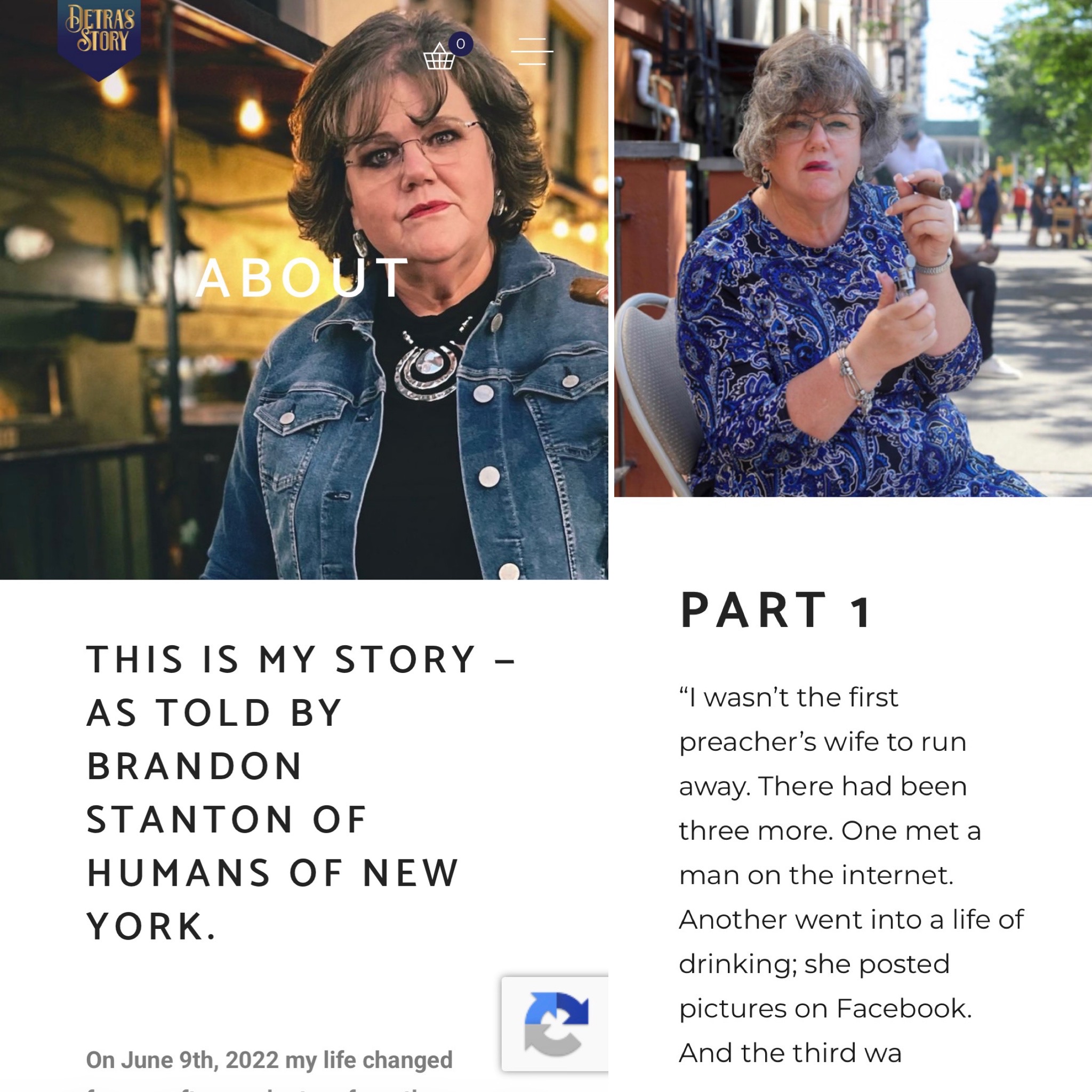
When Brandon Stanton of Humans of New York released a fifteen-part series telling Detra’s story in 2022, I was riveted. I kept refreshing HONY, cried tears of empathy and recognition, and couldn’t stop thinking about Detra long afterward. So I was delighted when she accepted my invitation to TBKB podcast to share her story with you.

In this episode, Detra Thomas shares her powerful journey of escaping a patriarchal, abusive marriage rooted in religious conditioning. Her story highlights the importance of faith, resilience, and finding one’s true foundation in God. If you’ve wondered how common The Pastor’s Wife story is, take it from Detra: she hears from women who have walked the same horrible path all the time. Patriarchal religion is DANGEROUS for women and children. The fruit is rotten and the tree needs to be removed from the roots up.

Visit detrasstory.com to read HONY’s series on Detra, and purchase her signature cigars! And be sure to follow Detra on Instagram as well.

Please enjoy this episode of The Beautiful Kingdom Builders podcast on YouTube, Spotify, Apple Podcasts, Amazon Music, Substack, and more! 

TRANSCRIPT:

Rev. Ruth Perry (00:15)
My guest today is Detra Denise. She was featured by Brandon Stanton on Humans of New York four years ago. And I remember the day that your story was published, I kept refreshing Humans of New York and I was so impatient. I was spellbound by your story and just really astounded and amazed by it. And so I’m so thrilled that you would come on my podcast, Detra, today. Thank you so much for being here.

Detra Thomas (00:40)
Thank you for having me and thank you for reading the story. You’re not the first person that has said they kept hitting the refresh button and it always kind of makes me giggle inside because I always wondered if it’s the runaway pastor’s wife smoking a cigar in Harlem or just exactly what it was. and it wasn’t until he let me read the story like two or three days before it came out and I sat down and read it and I was bawling by the time I was done. And he was like, is it that bad? And I said, No, I had no idea I had done all that. because when you’re living it day to day, you’re just trying to get through. And so his story really gave me a perspective of, hey, I’ve been hard at work here, and I’ve been doing some good things. Yeah, I was tired and didn’t know if I was gonna make it, all that, but yeah, his story really helped me. But I always get tickled when people say, I was hitting the refresh button over and over and over just to see what was gonna happen next.

Rev. Ruth Perry (01:33)
It spoke to me on multiple levels, but I related to your story as a pastor’s daughter myself in the Baptist faith, a different denomination but similar backgrounds. And I related to a lot of the influences that you mentioned. And it related to me just the whole process of undoing patriarchal faith and building your own identity from scratch. And so I think a lot of people that follow my Facebook page and my blog and now my podcast have a similar background where they’re coming from a patriarchal faith and they’re reckoning with the damage of that and trying to heal from it. And I think sharing our stories is so important. So can you take us back to the beginning to Little Detra? And where did you

Detra Thomas (02:16)
Ha ha.

Rev. Ruth Perry (02:17)
grow up and what was your faith background and your childhood like?

Detra Thomas (02:21)
I was born in Arkansas and that’s where I lived until a little bit after I got married. We lived in Memphis, Tennessee, three and a half years, which is just right there by Arkansas. But Arkansas was where I was born and raised. And I’m the oldest of four children. My dad was a pastor, mom was stay at home. She worked very hard. She worked diligently to clothe us and feed us because, there wasn’t much money and she was as I got older and she began to teach me, my mother was incredible at finding deals. My favorite sweater came from Salvation Army. She paid a quarter for it. It was absolutely beautiful. But my mom wasn’t just trying to find an article of clothing to put on my body. She was trying to find something that complimented me. And she had that eye. So, I didn’t realize how poor we were till much later in life.

But I grew up in the church. I when I was fourteen, my dad assigned me a class to teach. He assigned me a bus route. I was, I would go type the letters to the visitors. I I would drive him on visitation, I would drive him to visit the hospitals. He hated being alone. He’s he is a narcissist. So that’s how I grew up was, in ministry. I had every church members’ phone number memorized, he’d snap, Detra, get so and so on the phone. I would call the number, usually the wife would answer and I’d say, hey, so and so. Daddy wants to talk to brother so and so, hand the phone.

And I remember when I went to college and I came back home after a few weeks, and I have a sister and two brothers under me, and he said, I really miss you. He said, I tried to get my sister to call somebody and she goes, Well, what is the number? And he goes, Well, it’s two four seven two what? Two what? And he just said, I’m just doing it myself. So I had that ability, so I was very involved in church work and loved it.

Went to college at a little bitty tiny Christian college and had a full scholarship to sing. And we practiced. We would show up a week before college and spend eight to ten hours a day rehearsing. And then we traveled in a van around Arkansas and some Texas, states that kinda touched and were close. We would travel every weekend.

So I carried 18 to 20 hours while doing 78 concerts a year. Plus, because I was so poor, I worked in the student center. So I was very, very occupied and still was in full-time ministry, even though I’m in college, it’s full-time ministry. And married a guy from that college. And what was interesting is all of our parents had gone to that college. So our moms and dads knew each other, his dad was a pastor.

So I just perpetrated the life I had had, and I was born to a man who pastored in the Baptist Missionary Association of America, the BMA of A, BMAA, but he was an independent Baptist at heart. So he would go to all the independent Baptist conferences, like Jack Hiles. and that was the mentality he had, authoritarian. So I’m a firstborn. Firstborns relate to authority. So I didn’t have any trouble with this, and just fingers were snapped and I did and jumped how high and that’s how I was raised.

So my mom and dad, when I was 10 years old, went to IBLP, Bill Gothard’s Seminar, Institute and Basic Life Principles. So I was raised under that. And even though for the scandal that that is, the horror that is, there are some nuggets of good things in there. And I managed to take some of those good things, that have helped me in my life. There are some horrible things.

So that’s how I was raised. A woman is born for the man, whether it’s her dad to be under his authority and do what he says, and then the man she marries, and I can’t do anything unless I have their permission and blessing. So it was that’s all I knew.

Rev. Ruth Perry (05:57)
So you had a deep purpose and meaning in your ministry of the church. And you love the church from an early age. And it sounds like you’re a real go-getter and a overachiever and a overperformer. And that’s the kind of personality of someone that attracts a narcissist, I think. They’re looking for those real bright lights that have so much to offer the world. But what did you want to be? When you went to college, what were you dreaming for your future?

Detra Thomas (06:23)
My plans were to go back and teach at this little Poduk ACE school, and and in fact, my third year, the the pastor of that church and the principal of that little school showed up at my college. I didn’t even know they knew where I was, to say, Detra, hey, we’re waiting on you. And I had just gotten engaged. I said, Well, I’m getting married. So that was my plan. I had no aspirations because I was told I couldn’t have any.

Rev. Ruth Perry (06:47)
Yeah.

Detra Thomas (06:47)
Anyway, that was it.

Rev. Ruth Perry (06:48)
So what was the courtship like with your husband?

Detra Thomas (06:51)
When I went to college my dad told me I could never be alone by myself with a guy. So there was no dating. and courtship wise, I mean he just came to me and a he well actually called my dad one summer and asked if if he could date me and my dad said, Well you’ll have to ask her.

And he knew that I couldn’t single date. And I worked in the student center. He’d already graduated. So he would bring chips and dip, and he’s a little black and white TV. We’d sit in the student center, eat chips and dip, watch TV and me taking care of people. And that was kind of our courtship, that there wasn’t any dating. There wasn’t any.

Rev. Ruth Perry (07:23)
And then how long between meeting him and getting married?

Detra Thomas (07:26)
I met him my freshman year. Well I met him actually on senior day in April of seventy-eight. And then we got married in eighty-one. So he was in his third year when I entered. And he finished college, went on to be on staff at a church. I got married after my third year. And then I took my last year. It took me two years to finish that last year, but three years.

Rev. Ruth Perry (07:49)
So you get married and how quickly does the mask fall?

Detra Thomas (07:53)
In three weeks I wanted it out. It didn’t take long. And I couldn’t put my finger on what was wrong. All I knew is everything in me was screaming. Everything in me was wanting to run. Everything in me was just like something. This isn’t right. The sentence I kept saying in my head is this isn’t what I signed up for.

And as I tell the story, I put my laundry basket on my hip. He’d come home for lunch, he went back to the church and I went to the central area to do laundry in our apartment division. And I was just I was like, God, I gotta figure out what to do ’cause, this is bad. I can’t handle it. And as I just pondered it out and focused on that entirely.

I just could, remember my dad telling me over and over, when you get married, you gotta marry somebody who can conquer you because you’re too strong. And I was a firstborn. I would ask questions. I never rebelled a day in my life, but when you’ve got a bullshit meter in you and you kind of cock your head and you’re like, something’s not right, and you just out of curiosity, not trying to be judgmental or critical, you ask a question. These type of men don’t like that.

And so that’s how I was raised. I couldn’t call my dad because he had told me I had to be conquered. And I believed every word that came out of my dad’s mouth. I haven’t spoken to my dad in eleven years, but I can tell you, I love my dad. I’m not mad at my dad. My dad is just who he is. And I’m not gonna be around who he is and what he does to me when I’m in his presence. So

And then, the week before I married, my mom told me, Hey, marriage is forever. And just so you know that if there’s trouble between the two of you, we’ll take him, but we won’t take you. And so I knew there was no reason to call for them to come get me. So, in my little worldview and praying about that, when I put everything together, the problem was me because scripture talks about submitting. And I realized, okay.

I just need to submit and be his wife, not a wife. He seemed to have some little nuances that were interesting. And I just thought I need to submit and be his wife. And so for 32 and a half years, that’s what I did. I gave it my all. I loved this man. I loved being his wife.

If you do a study on personalities and strength and weaknesses, we were almost 100% a perfect blend. My strengths were his weaknesses, his strengths were my weaknesses. And we were a great blend. We worked well together. We produced great things together. And I loved him. I loved the work in the church. I loved him.

The problem was in his mind there was never anybody but him. And when he would plan things, like at the church, he would plan things. He would just say, This is what we’re gonna do. And I said, Well, who’s gonna do that? Well, I don’t know. And I can remember one fourth of July, he decided that he wanted red, white, and blue bunting hung between all the columns in the church and the auditorium.

And I was like, well, and because I still wanted to make him a success, I said, well, let’s go to Walmart and buy the fabric. And on Saturday, I don’t remember, probably I made 10 buntings that were probably eight foot long apiece, and got the fabric cut, sewn together, and then he hung them. But that’s what I did because I loved him, and he was a creative. He had the ventriloquist puppets. He was a singer. He could play instruments. I felt so favored to be married to a man that creative. I didn’t know I was creative. I didn’t know I was talented. Because from a young age, my daddy snapped his fingers and said, Sing a special, play the piano, teach a class, run the bus route. It was what was in aid in me. I didn’t nobody ever told me I did a good job.

I did not know. So I assumed I was very favored to be married to this man and help him achieve what he would mouth but had no intentions of ever doing, if it wasn’t for me.

Rev. Ruth Perry (11:32)
I think that it’s so sad that you could have had a really beautiful marriage, but because of your theology and the theology that you grew up in, the culture that you both grew up in, it conditioned you to have this dynamic instead of a healthy dynamic. Not just that you were conditioned when men snapped their fingers that you would jump and ask how high, that was your training that you received, and that’s how you functioned. But then your husband was also conditioned in the same culture where men got to snap their fingers and got to expect people to jump.

Detra Thomas (12:03)
He was. Now his dad was totally different. The dynamic in his home was different. His mom was a school teacher, so she had a job outside of the home. They had a TV, we didn’t have a TV. So the kids could come in, watch TV, they got to go to the kitchen and fix whatever they wanted to fix. There was no snacking in my house and I’m not saying that in a negative way, but mom cooked three meals a day and and occasionally, she would fix us a snack, but we weren’t allowed free reign in the house. Our house was orderly.

And so we were raised both pastors’ kids and different, but still that I know his mom has told me she would find out that they were moving to another church because one Sunday he ran out from the pulpit, by the way, this is my last Sunday, we’re gonna be moving to Sunso. He never talked over anything with her. No, she and I did not discuss that much, she would just occasionally say something. And I loved my in laws. They didn’t like me. But I loved my in laws. She was very controlling and she was something.

And when I would go, my father in law, he would ask me the same three questions every time. When I got there, he would ask me the exact same three questions and when he I answered them, he was done with me. And for years, my first Christmas with them, I we had Thanksgiving with my family, Christmas with his, and we would rotate every year. Now all the other holidays, his mother required us to be at their house.

But the first Christmas I couldn’t wait, and they had this beautiful regular Christmas dinner, they had beautiful tree. My dad was a scrooge about Christmas, and I remember after the meal, his dad saying, Okay, I want a picture of my kids. Well, my house, when I got married, he was now my mom’s kid. That’s how that was, and we had already had that, so I got in the picture and he said, No, Detra, I said my kids.

And I remember I’d been married probably 10, 12, 15 years, and he was chairman of the Bible department at this little college. And I went and saw there were no pictures of me. There were pictures of my children, the man I was married to, everybody else in the family, but none of me. And I don’t know, I got real sassy one day. And I said, Let me tell you something. You either get a picture of me in this office, or I’m gonna pick out a picture of me and I’m gonna blow it up and frame it and put it in here. And the look on his face, he goes, No, sister, no, sister, don’t do that.

Don’t do that. But every year how he would frame it is I want all of my family under the tree and he would take pictures. And one year there was a guest there and the guest said, Hey Detra, he called. I said, I learned I’m not part of this family. So there he would take a picture of me and the man I was married to and my children, but I was not allowed to be in any pictures with anybody else.

Rev. Ruth Perry (14:35)
That’s so heartbreaking.

Detra Thomas (14:36)
It is, and I was just happy to be a part of, when I would go, what do you want me to do? How do you want it done? How do you want things in your kitchen handled? What can I do to help? All those type of things. I just look back and think, well, I’m not gonna tell you what I think because I’m gonna use New York language and I’m I’m not gonna say what I really think.

Rev. Ruth Perry (14:55)
We’ll fill in the blanks for you.

Detra Thomas (14:56)
Thank you. They’re a bunch of blankety blank blanks, that’s what they are. And just mean. Just mean. And there was no reason for it. The last words that she told me I kind of put my foot down and said, unless and things change, I’m not participating with them, I’m not inviting them to anything. But her words to me were, I don’t like how many children you’ve had. I don’t like that you homeschool them, but I don’t like that they’re on the road. If I had my way, things would be a whole lot different. And I was like, who do you think you are to think you get a say?

And how I raised my family. Was your mother-in-law in your business telling you how to raise your family? She wasn’t. Her mother-in-law was deaf. But I guarantee you, she would have told her to get lost, But it was just the constant gaslighting. And if you love me, this is what she said. If you love me, Detra, you will do this. And I would do it every time and tell her, mark me down as I love you.

I didn’t know what gaslighting was. But when you love so hard, and I’m happy with breadcrumbs, I really am, and I’m trying to change that. But when you’re happy with breadcrumbs and you look back and see they even didn’t want to throw you breadcrumbs. It is heartbreaking. It is heartbreaking.

Rev. Ruth Perry (16:02)
Yeah, as you were describing their family dynamic, I’m thinking to myself, Well, that doesn’t sound like the fruit of the spirit. These are

Detra Thomas (16:09)
No.

Rev. Ruth Perry (16:09)
Christians. Where’s the love? Where’s the joy? Where’s the peace and the patience and the kindness and the gentleness? None of that.

Detra Thomas (16:16)
Well, it was a pastor’s home, and I never heard God mentioned or talked about except for prayer before a meal. Never one time. And it was kind of crazy. I guess there was one time she mentioned a health issue and she did mention God one time. Other than that, there wasn’t. And that’s what he was raised in, so he was conditioned his own way, and then our Baptist ranks was very misogynistic, very misogynistic.

So he was going in the flow of what he was raised, plus he had his own nuances of… I don’t know that you can look it up then, but when I went and saw the lady after 32 and a half years of marriage, we talked, she mentioned sociopath, and I looked up sociopaths, and there’s two kinds. My dad was one and I married the other.

And so I would always think, I love that the man I’m married to is not like my dad. Well, they’re both sociopaths, but they’re one is my dad’s authoritarian. I married the charming one, the passive aggressive will kill you slowly day after day while smiling at you, so it was and then also the man I was married to, if you look up a psychopath, they have no emotions. They have no emotions for trauma or broken bones. He had none. And I would try to talk to him about that.

In fact, he had a full length mirror in his our walk-in closet and he was a cartoonist. And because I would talk to him so much about this, because I can’t comprehend this, I can’t comprehend that you don’t care about a broken bone or somebody hurt or you don’t care. In fact you get angry because it has now interfered with what you wanted to do. And I would have to walk a tight rope with him if the children got hurt.

He drew like two little bubbles coming out of his head, and in the big bubble it said, think about others. Because he couldn’t. He literally could not, except when he looked in that full-length mirror and had that bubble there. So

Rev. Ruth Perry (18:00)
Wow.

Detra Thomas (18:01)
And then you put the name of God in the middle of all that. It’s a recipe for a woman who’s naive, a woman who has been raised to enable, a woman who has been raised to believe that God will not bless her or protect her unless she obeys this man, a woman who is a firstborn who relates to authority, and a woman who, with her whole being, wants to please the Almighty. That is a recipe for total destruction.

And I look back and I don’t know how it all came to be, but I was begging God to show me, and it just happened that night. And was I trying to escape that night? No. But that’s what happened. And I’m grateful. I am grateful.

Rev. Ruth Perry (18:41)
This was after thirty two years of marriage. Is that right?

Detra Thomas (18:45)
Well, thirty two years I talked to somebody, but thirty four years when I escaped. Yeah.

Rev. Ruth Perry (18:49)
Can you name some more of the ways that you experienced abuse in your marriage before we talk about your escape? Because I think a lot of people still have misconceptions about what abuse is. We only understand if it’s violent. But there’s a way to be violent without bruising someone.

Detra Thomas (19:05)
Yeah. There were little things. We first got married, I’ve talked about this on many podcasts. He gave me a list of foods that he had to have snacks, a certain one, Monday, Tuesday, Wednesday. What we had on Monday was repeated on Thursday, Tuesday was repeated on Friday, and I had to sit beside him and eat, and I didn’t want to. And I would tell him I don’t want to. And he informed me that I was his wife and I would do what he said.

When I wanted to try a different hairstyle, my mom had always kept my hair really short. It started getting long because when you gonna cut your hair? I said, I thought I’d grow it out. He goes, You’ll wear your hair how I tell you to wear your hair. And then years later, like 20 years later, I asked him for permission to grow my hair out,

And I said, if I do it with a style, and he agreed. And I was pregnant with child number five. And so I’m I’m growing it out. And it’s probably about this length. And I really didn’t know much about styling hair, but I can fix it and it’s fine. And then it hits humidity and it starts doing all the curls.

Rev. Ruth Perry (19:57)
Yeah.

Detra Thomas (19:57)
And the church ladies were doing a baby shower for me. And so I was telling the women, I said, I’ve been trying to grow my hair because he he really likes it short. And no one thought a thing of it when I said he gave me permission to grow it long. Nobody batted an eyelash at this. And I said, but I’ve decided, I can’t keep it straight. See, I thought curls like this was simple.

That’s out of control, It means I can’t control my hair. I thought it was simple. And I said, So I think I’m gonna go back short. He just knows best. And the head deacon’s wife leaned in and said, We’ve been wondering what you were doing. So it wasn’t just you. Well, this solidified the fact that I don’t know what I’m doing. If my hair has a curl in it, it is simple and I have to obey him. So it wasn’t just him, it was along the way these churches had this mindset, so it was just crazy.

When I look back at it, my dad wasn’t trying to be abusive, He was doing best he could do with how he was raised. My mom willingly admitted all her neurosis, she would say, Detra, I have this, this, and this. But she would acknowledge and own it, and she worked on it, and so it was just this crazy hodgepodge of all these people, this worldview, this religious group weaving together something for someone who just wanted to make everybody happy, and that is I think you you coined me well, overachiever. I just wanted everybody to be happy. That’s all I wanted. So, you can die making everybody happy, and I almost did, yeah.

Rev. Ruth Perry (21:25)
Absolutely. I think they say eighty one percent of autoimmune diseases are in women, even though autoimmune diseases don’t impact one gender specifically. It’s just because women are carrying so much more stress and they’re absorbing the family stress, the stress of others.

Detra Thomas (21:40)
Okay, well, autoimmune, I’ve done a lot of research into that because I have several things. Best I can tell, it is repressed rage.

Rev. Ruth Perry (21:48)
Yeah.

Detra Thomas (21:49)
It’s an anger that you’re never allowed to express because you wouldn’t be a good Christian. All those things. It’s repressed rage. And I don’t think I’m an angry person at all because I swallow it all, but I have learned to forgive, but I think that it is your body creating signs to let you know you’re not handling this well. In other words, you had a fifty thousand dollar emotional event and you only give it fifty-five dollars. We’re telling you the rest of it’s coming due. And that’s what happens. You keep building up these emotional million dollar events and you don’t because you can’t. You’re a woman, one. You’re not a good Christian if you do, two. And three, you can’t do it because there’s nowhere to put it. Nobody’s gonna believe you. No one’s gonna believe you.

Rev. Ruth Perry (22:30)
So what was co parenting like with your ex husband?

Detra Thomas (22:33)
I would tell you it was good because we were a united front, which divided parents is when you get into a lot of trouble. And I liked order in the home and he followed that.

He was raised that there was order with the children, children obeyed, so that wasn’t an issue between us. And we did spank our children, they had to bend over the end of the bed and we spanked their rump.

I you would have to talk to my kids. I don’t think we we were abusive with with it at all. In fact, my second son told me with my baby girl, he goes, She did not get enough spankings, mama. She gets by with too much. But with the more children you have, if these children have learned to be obedient, they kind of follow in line. But I didn’t allow name calling. I didn’t allow kicking and hitting. Now if you want to wrestle, go outside and wrestle. And if someone taps out, you better be.

So we had this healthy playing and interaction and yeah, with seven kids. I had different personalities. I had one that was, kind of sneaky and come to find out he would cry and he’d be lying about stuff. But for the most part the kids got along. I I didn’t I didn’t

identify this horrible behavior, but co-parenting, we did well together, I thought was one of our strong suits. Now he did not like adult children at all. And I would have to step in and say, you can’t do that. Our oldest one joined the Marines and when he graduated from boot camp in San Diego, churches gave us money so the eight of us could fly out there.

So we flew out for family day and then graduation, and then he flew back with us the next day. And when I awoke, so by this time, the man I’m married to is in his 50s, and he couldn’t stand it if the children got any attention. And I would tell him, What? This doesn’t detract from us. Nobody’s taking anything away from you. You’re still an incredible man. I’m just building you’re an incredible man. But they’re adding to us, and he couldn’t handle it.

But the morning after we got back, I awoke to the bed empty and I could hear gut sobbing. Gut sobbing. And I run out to the living room. He’s on the couch, bent over, just sobbing. I think in 34 years, I may have seen him cry two or three times.

And I just ran over to him, I wrapped him up, and I’m like, what’s wrong? What is wrong? I mean, I’m fixing to go handle whatever it is. I said, What’s wrong? And he’s sobbing and he goes, I know this is wrong, which he knew it because I would tell him, what this is wrong. He said, But I’m crying because I didn’t get any attention yesterday, and Matthew got it all.

And I just felt a chill. I mean, I just literally a chill ran over me, and I let go of him. I’d run into this with him, but this was the first time it had been something of this magnitude, and I still cannot comprehend that this six foot six, fifty-something-year-old man is gut sobbing because his son, one of 400 graduates at a Marine, got all the attention and he didn’t get any. I don’t have I don’t have, I can’t…

Rev. Ruth Perry (25:18)
That’s mind blowing.

Detra Thomas (25:18)
It is mind-blowing. And it it is one of the examples of his complete narcissistic, whatever you want to add to that worldview where nobody is allowed to breathe. Nobody is allowed to breathe. And I am thrilled that I am away from that. I’m thrilled.

Rev. Ruth Perry (25:37)
Tell us how you got away.

Detra Thomas (25:39)
I went to see my doctor in Springdale, Arkansas. He was a doctor kind of outside the box, and I just believed God had him in my life for this particular reason. And I began to tell him a little bit about my marriage. I’d been seeing him for 20 years or so. And I said, I’m praying that God will just kill me. And then nobody has to know. None of these people in the churches, my mom and dad, my kids, nobody has to know. Because he didn’t treat everybody else the same.

And I remember my doctor saying, change your prayer. And I quickly looked up and I said, What? He goes, change your prayer. Now I thought I was being quite brilliant, intellectually, philosophical, spiritual, by asking God to just remove me. One move, and you solved the whole problem. And so I was quite shocked. And I said, Change my prayer. He said, Yeah, your body hears you.

And this was the first time I had a clue our words had power like that. And I said, Well, I am dying. I can tell that I’m dying. He said, Change your prayer. And so I left there and I was like, God, if there’s another way, I don’t know what it, I don’t know what it is. It didn’t occur to me to leave. And then as I began to talk to people, four people who had been married over 15, some over 25 years, never been divorced, said, get away from him.

Now, if you want to talk to people who’ve been divorced, get away. That’s another element. I’m not saying that would be wrong, but these are people who didn’t really, quote, believe in divorce, like me, and they’re saying, get away from him.

And so I prayed and I said, God, I don’t know how to leave. In fact, I had a plan in my mind that I was gonna take the suburban, he called that my vehicle, I was gonna put everything in the back I needed to survive, and I was gonna go to the police station and ask how long I could park my car in one spot and where were the best places in town. And I’d picked out parks that had showers where I could get a shower.

I was gonna have a cooler. I was gonna have my clothes. I was gonna sleep in the back seat with a pillow and a comforter so I could see my children. Now I look back at that and laugh because my kids would have been so embarrassed. my mom’s living in her car going around town. I just wanted to see my kids. that was it. I just wanted to see my kids, but I needed away from him. And that was my plan. That’s what I came up with.

And then I just said, God, if you’ll cause a fulcrum, I will do it. Because I can’t on my own. I don’t know how to walk away. I don’t know how to do this. Because there was so much at stake. And so we were driving back and he pulled one of his charming, passive-aggressive husband, pastor, get under my authority moves.

And I’ve been researching psychopaths, sociopaths, and religious abuse. And I was like, it’s just like all the blinders are falling off of my eyes and the fog is leaving my brain. And I’m like, Are you kidding me? And then I reverted back to a true firstborn who believes that God is true and faithful and who doesn’t put up with all these lies. And and I was like, and that’s when I looked at him and I said, You are a son of a bitch.

And I meant it contextuously. I meant it the son of a bitch. And I had had all I could handle. And in fact, I had told him at one time, I’m willing to give my life if you can figure out how mean you are. I’ll give my life. And what? He was willing to accept that. And when I figured out he knew what he was doing, he wasn’t gonna change, and I was like, I’m not giving my life for someone who’s willfully doing this.

This isn’t what God requires of me. So when I called him a son of the bitch, that was the fulcrum. And he was like, I’m fixing to pull over and tell you something. He finally had a sin he could nail on me. And so he was so happy. He pulled over, got in my face, and it was this just feeling inside, this is it. And I got my purse and got out, opened the door, started walking down the interstate.

And I was crying, I was praying, I I had all the emotions you could have, relief, fear, what’s gonna happen, all those things. And I just said, God, I need help. And there was a car pulled over, you know how long it takes to stop on the side of the interstate? Her brake lights were already off. And I saw the car in the distance, and I was like, God it’s probably a serial serial killer, but I don’t care.

That was literally my prayer. I was like, I don’t care. I’m getting in the car. I just wish I knew I could trust them. And when I said that the passenger door opened and this woman got out, and I could just tell she wasn’t a teenager. It was dusky dark, but her hair was past her shoulders, it was blown back in the wind, and she’s walking very purposefully towards me, and we have a distance to cover. The closer she gets, the harder I’m crying.

And she just meets me and turns and slides an arm around my waist and gets my hand. And ma’am, do you want to ride? I said, I do. And she said, God said to stop and pick you up. And I said, I told him I needed help. And for me and my journey with Christ, which has been strengthened so much more because of all of this, I knew that that was true because I had been begging God.

For a year and a half, you gotta show me what to do. And I would never have left. I wouldn’t have done any of these things. But she said, God said to stop and pick you up. I didn’t know this woman from Adam, I’ve never seen her. And she got me in the back and the reason she was walking purposefully is she could see him. He got out of the car when he saw her and he was running to get me. And when she opened the back door to put me in, I didn’t know he was coming. He grabbed me from behind, grabbed my arm. And I turned around and I just looked at him and I and I was done. And I said, I’m gonna call the police, let go of me.

And he goes, Well, I’m gonna call and he did this. I’m gonna call the police and tell them that you’re with somebody I don’t know. And I wanted to say, as usual, you don’t make sense. And I said, Call ’em, just call ’em. Let’s call the police. Let’s have this out here on the side of the interstate. You call the police, and I’m gonna tell them who you are. You call the police.

I don’t know. And he let go of me. She put me in, closed the door, and I am sobbing, distraught. Because it’s like, how am I a woman that’s on the side of the interstate getting away from my pastor husband that I’ve adored? Him trying to grab me. And he told them twice. He goes, She’s fine. We’ve had a fight, but she’s fine and she’s going with me.

And that’s when I said I was gonna call the police. So the woman got in the car and he he’s six foot six, like I said, she’s sitting in the passenger seat, and he bends down and he gets in front of her in her face, and he goes, I don’t even know who you are. And she just very calmly said, I’m a doctor with the Choctaw Nation. So she gives credentials, but she doesn’t tell her name. I look back on it, she was very smart, I’m a doctor with the Choctaw Nations. Those are credentials.

And he said, Well, I’m gonna follow you. She said, You do whatever you need to do. And he gets out, she closes the door, she tells her daughter to start driving. And I’ve since found this woman on the internet with help. I’ve been able to call her and thank her. Her daughter and I visited a little bit on the internet. I just remember when I could stop crying enough to pay attention to what was going on.

They had music playing. I don’t know if it was a CD, if it was the tape, if it was the radio, but it was quite unusual. It wasn’t any Christian music with the rock or the pop or anything. It was an old hymn. And I just remember the hymn that was playing was Jesus, Jesus, precious Jesus, how I’ve trust you or in or. Jesus, Jesus, precious Jesus. for grace to trust you more.

And for me, it was like an invitation. Teacher, you’ve trusted me this far. Keep trusting me. Now her daughter told me, What I remember about you is you sang in the car. And I said, I did what? I do not remember singing, but if it was hymns, that’s just what I do. I sing.

I was so embarrassed when she told me that. I was like, I don’t know how many songs I sang or hymns I sing. But they took me to a hotel. And what happened is he did follow us. And they said they needed gas. And so we pulled over to gas station. He pulled over. And then all of a sudden he just leaves really fast. What I found out later is he went home and began making phone calls and preparing.

One of the accounts I got is when one of the children walked in the house. He was just sitting on the sectional drinking a glass of iced tea, just as if nothing had happened. And anyway, they took me to a hotel. I called one of my sons. I knew his number by heart. I didn’t have my phone. And he said, Mom, I’m gonna get you a hotel. Because the kids had known for a year and a half it had been hellish. I got the blame for that, but it had been hellish.

So that was my escape. And my oldest son was in Oklahoma doing a job and he heard about it. He called, he goes, get in your car. You come to me. So he said, Nobody’s at home. Garrison’s gonna pick you up. He’s gonna get you some lunch, you get your clothes, you drive to me. And so I was with him in the hotel for a while and he lived in New York. He took me to New York.

It was supposed to be a few weeks. It’s been eleven years, but in that moment I lost everything I’d known except the foundation on which I built my life. And I had found that foundation to be unshakable. Unshakable. And people call it deconstruction. And I didn’t hear that term until I was in it. And then I was inundated with messages from people, all this stuff and I didn’t choose to join anything. I was like, I’m not interested in joining another group. But I began to hear the word deconstruction and I understand the concept, but for me, I wanted to say blow the shit up. Blow it up because what matters is your foundation. If you don’t have a foundation that’s solid, that’s where you start. Blow the rest of the shit up because what’s true is going to stay there.

It’s not gonna go anywhere. But it’s like a baseball, The rubber bands, one’s true, one’s a lie, are all melded together. when you try to pull one out, you’ve got a part of another one. So just blow it up and see what the foundation is. And if you’ve got a strong foundation, which I did, somehow it was built on the one true living God.

And then I just started building, and as I in New York prayed, God, can you protect me in 2020 when crime’s going up in Harlem? And, I said, God, I need to know if you can protect me. And these Harlem Cigar Men offered me protection. Who would have dreamed? Who would have dreamed that is how God would step in? And I remember I was somewhere

I’ve been in New York for several years and was at the Harlem Cigar Room. This was before the story, Humans of New York story came out. But I was smoking cigars and and I was at a art show. It was part of the homeless thing I’d been a part of and I’d been invited. I had somehow inspired this art show.

By a photographer who took a picture of me when I was homeless that changed my perspective of myself. And I told him, and he thought maybe I could use my skills in the homeless. And he did a whole art show of people who were homeless, and they were absolutely gorgeous. Smiling, and he invited me to the opening of that, and then I was a part of a panel. So I’m gonna I’m gonna say what I really think here. I’m sorry if it’s offensive, but there was some little Christian old woman who came up to me and

I call them little banny hens, I can’t believe you smoke cigars. That’s how she said it. And rather than knocking her out, I just literally wanted to take my fist and knock her out. I’m sorry, but this is the real. And I thought, how dare you sit in judgment?

Of what you think is best in life or best for me. how dare you? Especially after the journey I’ve had to walk and the prayers I’ve prayed and the answers that have come and this little snitty woman telling me that, with her little tag. I can’t believe he smoked cigars. And I decided to be nice. And I said, Well, let me tell you how I smoked my first cigar.

And I told her, 2020, almost died, the sidewalk cafes, I’m alone, I’ve been working from home, nobody. And my son is worried, crime’s going up in my prayer. And I said, I’m walking twice a week through the sea of men smoking cigars, and they start chatting. And one day they said, We want to offer you protection.

And I said, I called my son and I said, Hey, fly up here. He loves cigars. And I said, I smoked cigars, accepted the protection. And they told my son, you don’t worry about your mama. We’re going to take care of her. Nothing’s going to happen to her. And he started paying my membership. And I smoked cigars. When I got done, this lady, her whole demeanor changed. And she said, That’s one of the most beautiful stories I’ve ever heard.

And I decided to remain because she’s coming from the world, whatever she thinks, and what she’s raised. And I had never smoked anything until I smoked a cigar. I would have wouldn’t have been like her, I would have thought, if you want to smoke cigars, that’s fine. But it is one of the most beautiful stories. It is. And she changed. But I didn’t appreciate her little snide puckered mouth,

Standing in judgment. I can’t believe you smoke cigars attitude. Not even giving it a chance. Here’s my deal. Be curious to at least ask a question. Don’t assume that you know what the other person has been through or why they’re doing something. Ask. Say, well, I’ve never smoked a cigar. What led you to smoke your first cigar? Ask. Be open. Allow room for something other than what you think and your little shriveled up brain cells.

And that I think has been the biggest thing for my journey is as I’ve prayed and asked God, I need a step and watch these steps open up, I would even tell you the homeless shelter was part of that, the things I learned there. And plus, it was a volunteer in the homeless shelter that wrote Brandon. So if it wasn’t for that lowest point in my life, I wouldn’t be at my highest point right now.

So when you can step back and look back and see what I prayed, what has happened, it is a most incredible, crazy, arduous, beautiful journey of the intimacy of the Almighty saying, I’m looking for the heart that’s turned towards me. Her heart is, let me do this right here. And as a result, Brandon wrote the story and I can’t tell you the number of women who write and tell me one of my favorites is a woman wrote me and she said, Detra, my car is packed. And when I get through typing this, I’m gonna push send and I’m backing out and I’m leaving. And she wrote me a couple more times, and evidently a very powerful man, rich man. She was trying to escape doing different things, and we communicated a little bit. And then I wrote her and I didn’t hear from her for a year. And I thought she was dead. And she wrote after a year and she had made it.

Another woman wrote to me on Messenger, and she was a pastor’s wife from the world I knew. She said, Detra, I’m praying for you. And I’ve had some pastor’s wife write me, I need to know everything. And I was like, no, bitch, you don’t. I don’t even respond to them. But this one, I thought, I want to know what you’re praying. I figured I was on the prayer list of every church, across America there. And I said, Well, what are you praying? And she told me what she was praying strength for me, protection for me. It touched me. This woman was not being judgmental of me. She was asking God to bless me.

And then she said, I don’t have your courage, Detra. I don’t couldn’t live in a homeless shelter. And that’s when I began to get a glimpse of there were a lot more women from my world who wanted out and couldn’t. That woman is dead. I think about her often. She’s dead.

Another man wrote to me, and he said, Detra, I read your story, and he wrote a little novella about him and his siblings in the church. And when people write me, I at least do a red heart just to let them know I’ve seen your message. When it first happened, I couldn’t answer individual thousands of messages, but I’ve answered a lot. And his was so poignant, I messaged him.

And I said, listen, thank you for sharing your story. And I’m so sorry. I am so sorry for what happened to you and your siblings. And I said, but I want you to remember this. healing begins with one new thought. It’s not like New Year’s where you make all these resolutions. It begins with one new thought. So start with your one new thought.

And when I sent it, you could tell it was bubbling over here, and I waited, and he said, I cannot believe you’ve written back to me. I’m crying. And he said, I remember from your story you’re mess you’re missing several of your children. And I want you to know, I’m sorry for that, but you’re now mothering thousands of us. And I just started sobbing because I do so miss my five children. I so miss my five children.

And the fact that there are other children who need a mom, who has courage to say, I’m not putting up with this, means a lot to me. I get messages every day from all over the world. I get about 200 private messages a week, most of them from creepy men, let’s be honest, but from women all over the world and some men.

And I’ve just said, God, use my life to tell your story in a way that people know it was you. And that’s what I want, So this, me living in this hotel, I closed on my house Wednesday. I did not mean to become a sobbing mess. is a new season of

I want to show women don’t be afraid of fear. So many women write I got hurt, it was a pastor, da da da da. And they’re holed up somewhere, they’re scared. You can’t be afraid of fear. You just can’t. And the world thinks I’m so brave. I am not. I’m not. I’m just willing to keep my feet moving forward and not be afraid of fear. And so my plan is I’ve got a little bit of time here.

And I’m gonna record an album with my band. I want my original song so I can do a pop-up show when I travel. And I’m gonna pack the back of my truck in a way that I can travel. And then I wanna go visit different states for a month.

One to figure out where I want to live, but also to take the women with me and say, hey, we’re gonna go and right now the plan is Texas for the month of October. One of my followers, we’ve already talked about it. She’s got a place that wants me to do a show. There’s a cigar lounge there. She has a place, a two bedroom cottage, I can stay free for the month. Very interested in helping women like I am. And I will say in a month’s time, we’re gonna build a community.

And I’m not gonna go out on the sidewalks and say, Would you be my friend? We’re just gonna see what happens. I’m gonna go to coffee shops, I’ll go to cigar lounges, and people will just start conversations. And at the end of the month, I wanna have a dinner party with some of the people I’ve met. And just introduce them to each other because I seem to have this habit of meeting people who don’t know each other but are great matches, they just work well together.

And then go to another state and do the same thing and tell women, look, can’t be afraid of starting over. Is it scary? Yeah. Is it hard? Yeah. But it’s doable. And in the process, these adventures, my goodness, the most incredible people I’ve met. I have met the most beautiful, incredible souls and hearts that have just enriched me.

And let me tell you they’re not sitting on the pews of churches either. But they’re kind hearted, they’re generous, they’re honest, they’re authentic, they’re true. They’re not the gossipy little people sitting in the pews.

Rev. Ruth Perry (43:22)
You don’t have any patience with organized religion anymore, do you?

Detra Thomas (43:26)
No. I do not. I don’t have any patience with it. I don’t have any use for it. In fact, I did go to a church for nine months after I got here and was ministered to greatly, mainly because I’m going asking God to show me. Brandon mentioned that church. I didn’t want that church mentioned. He did it at the last minute when he sent that chapter out. He changed it. And I didn’t like that. And that church got a lot of messages. And I hated that.

But no, I so what I did is I I applied for work at Starbucks and they hired me, and they’re open seven days a week. But how simple it is to be open on Sundays. But I needed a job and I was just like, you know what, God, this is my whole lot, this is all I’ve known. And they want to know when I’m available and I’m just gonna tell them I’m available at all times. And I’m asking you in your omnipotence to set my schedule. Because I go to church, I don’t know, is it just because my heart wants to out of duty, what it is, but I need you to guide me through this. I’m yours. I’m not Starbucks’, so you set my schedule. I didn’t have a Sunday off for two years unless I asked for one.

And that’s when I was able to go, my goodness. God is more real to me than any pew. God is more real to me than any hymn. God is my foundation. And then when I would go to a church, I would be in bed with a migraine for two to three days at a time. Or this is too much information, but hey, I’m a I’m a crazy woman these days. My bowels would not move for three days. So would have migraines, my body couldn’t function. And I realized that my body was telling me, you can’t do this. You can’t do this. It just, it hurts me in ways.

So no, I don’t. The last time I was went to a church, I went to a funeral. One of my cigar guys, his sister was murdered. And I told myself, it’s fine, it’s it’s a funeral. I had to call off work the next day. I was in bed, couldn’t move just at a funeral. But Church buildings hold such memories for my body. And so no. But as far as the one true living God and his word and what he does in life is the most exciting, intimate, beautiful thing I’ve ever experienced.

Rev. Ruth Perry (45:26)
It’s really beautiful just hearing how God has been with you through this whole story and how real God is to you. And your story is just enthused with your prayer life and what a conversation looks like with God, that you can just tell God what’s going on and ask for help and God cares about you. And I think it’s so beautiful and I’m just so grateful that you shared your story with us today, Detra. If people go to your website, they can read Brandon Stanton’s Humans of New York posts there and they can find what you’re up to and recordings of you singing. Can you tell us what your website is?

Detra Thomas (45:59)
It is www.detrasstory.com. Detra has an S on it, detrasstory dot com. And I’ll get with my webmaster and try to become more active updating that now that I’m kind of gonna be on my own. I’m not really good with IT stuff. I’m gonna have to learn. I’m thinking about maybe in the States I’m in, I could find an intern, a kid who’s good with social media and IT, who could do social media for me where I am and pay them something. Because I hit record and talk and do that, that’s about all I know to do. And I really want to get back

Rev. Ruth Perry (46:31)
Yeah.

Detra Thomas (46:31)
to a writing post about people, but the last year has been so stressful for me trying to work and survive working. But I want to get back to writing about the journey and and just the people I meet. To me it is the treasures God has made that stands in front of us. And sometimes those treasures are so broken that they block all love. They can’t receive any love.

at all. And all that comes out of them is control and manipulation. And I just move on. I no longer feel obligated here. they’ve made their choices. I move on. But let me tell you, God has made such wonderful treasures who have been battered and broken. And they sometimes it’s just a smile or a kind word or a hug and that’s all they needed to go on for another day, And I think that’s what we are asked to do, provide that love and unconditional, hey, I think you’re an awesome treasure of God and just do those little things and it makes a big difference.

Rev. Ruth Perry (47:28)
Thank you, Detra, for sharing your story with us today and being a blessing to me and being a blessing to so many people. And I pray God’s blessings on you.

Detra Thomas (47:36)
Well thank you for having me. I’ve enjoyed meeting you. Thank you.

Rev. Ruth Perry (47:39)
God bless.

Detra Thomas (47:40)
All right.


Did you enjoy this episode? Please subscribe, rate or review us on YouTube, Spotify, Apple Podcasts, Amazon Music, Substack, and more! Your support means the world. God bless!


Resource list: Abuse advocates and experts

Over the past few years with #churchtoo disclosures and allegations, as well as the tidal wave of prominent pastors’ “deeds of darkness” being exposed, it is clear that the evangelical church has an abuse problem. Perhaps even more tragically, when we respond poorly to abuse, we exacerbate the pain and trauma of the victims and enable the perpetrators, endangering others and harming the witness of the church. It is imperative that we learn how to respond in a way that ministers to victims, holds perpetrators accountable, and creates a safe, healthy environment for our faith communities.

I wanted to make this post as a resource for pastors, lay leaders, and abuse survivors to facilitate abuse education. For each of us, it is not a matter of if we will face abuse in our own community, but when. So I asked The Beautiful Kingdom Warrior Facebook community to help me compile a list of abuse advocates in this comment thread. Below, I have fleshed out our list with links to the advocates’ websites, books, and social media so that you can easily follow them and begin to learn more about the prevalence and dynamics of abuse. Be sure to pass this post along.

To begin, here is a link to a short article I wrote on the dynamics of abuse for my denomination’s digital magazine, and here are some useful images for familiarization with the dynamics of abuse:

Abuse Advocates and Experts (in alphabetical order):

*book links are to my Amazon Affiliate store: thebeautif017-20

Dr. Dan Allender – The Allender Center

Bio: Prominent Christian therapist, author, professor, and speaker focusing on sexual abuse and trauma recovery
Website: www.theallendercenter.org
Book: The Wounded Heart: Hope for Adult Victims of Childhood Sexual Abuse
Social media: Facebook, Instagram, Twitter, YouTube, Vimeo

Shahida Arabi – Self-Care Haven

Bio: Columbia U grad who studied bullying; best-selling author specializing in narcissism and self-care
Website: shahidaarabi.com, Self-Care Haven blog
Books: Becoming the Narcissist’s Nightmare; POWER: Surviving and Thriving after Narcissistic Abuse
Social Media: Facebook, Instagram, Twitter

Lundy Bancroft

Bio: 25 years experience in the fields of abuse, trauma and recovery; counseling, workshops and public speaking
Website: lundybancroft.com
Books: Why Does He Do That? Inside the Minds of Angry and Controlling Men; Should I Stay or Should I Go?
Social media: Facebook

Laura Barringer

Bio: Educator, Advocate and Co-Author of A Church Called Tov
Website: linktr.ee/laurabarringer
Book: A Church Called Tov: Forming a Goodness Culture That Resists Abuses of Power and Promotes Healing
Social media: Instagram, Twitter

Andrew J. Bauman

Bio: Christian Author, Therapist, & Abuse Advocate. Helping men become sexually healthy.
Website: andrewjbauman.com
Books: The Sexually Healthy Man, The Psychology of Porn, Stumbling Toward Wholeness
Social media: Facebook, Instagram, Twitter, YouTube, Podcast

Gretchen Baskerville – Life Saving Divorce

Bio: Christian Divorce Recovery Minister, Author and Abuse Advocate
Website: lifesavingdivorce.com
Book: The Life Saving Divorce: Hope for People Leaving Destructive Relationships
Social media: Facebook, Twitter, Vimeo

Nichole Braddock Bromley – One Voice

Bio: Author, International Speaker, Sexual Abuse Survivor, and Activist
Website: iamonevoice.com
Social media: Facebook, Twitter, Instagram, Podcast

Jeff Crippen – Unholy Charade

Bio: Pastor, Author and Abuse Advocate
Website: unholycharade.com
Books: A Cry for Justice; Unholy Charade
Social media: Twitter, Sermon Audio: 21 sermons on abuse

Chuck DeGroat

Bio: Professor of Pastoral Care and Christian Spirituality at Western Seminary; Therapist; Author
Website: www.chuckdegroat.net
Book: When Narcissism Comes to Church: Healing Your Community from Emotional and Spiritual Abuse
Social media: Facebook, Twitter, Instagram

Rachael Denhollander

Bio: Lawyer, first accuser of Larry Nassar; Abuse Advocate and Consultant
Website: rachaeldenhollander.com
Book: What is a Girl Worth?; How Much is a Little Girl Worth?
Social media: Facebook, Twitter

F. Remy Diederich

Bio: Pastor, Author – helps people overcome life’s hurts with God’s help
Website: readingremy.com
Books: Broken Trust, Healing the Hurts of Your Past
Social media: Facebook

Patrick Doyle

Bio: Abuse survivor, Coach for those affected by emotional abuse, Speaker
Website: patrickdoyle.life
Social media: Facebook, Instagram, YouTube

Ashley Easter – Courage 365

Bio: Founder of Courage 365, a catalyst to cultivate and empower a Justice Generation that resists abuse everywhere
Website: courage365.org
Social media: Facebook, Twitter, Instagram, YouTube

Bob & Helga Edwards

Bio: Christian Therapists and Public Speakers
Website: awakedeborah.com
Book: Addressing Domestic Violence in the Church
Social media: Facebook

Maureen Farrell Garcia

Bio: Christian Writer, Speaker, Instructor, and Abuse Victim-Survivor Advocate
Website: maureenfgarcia.com
Social media: Twitter

Give Her Wings

Mission: We serve, without judgment and with compassion, single mothers who have left abusive relationships. Our goal is to show them the community and body of the Church, when they otherwise are not finding it.
Website: giveherwings.com
Social media: Facebook, Twitter

GRACE – Godly Response to Abuse in the Christian Environment

Mission: Empowering Christian communities to recognize, prevent, and respond to abuse. Founded in 2004.

“With a combined experience of over 100 years of addressing abuse-related issues, GRACE has accumulated and organized a wealth of resources from mental health experts, former prosecutors, and theologians to give you and your organization a well-rounded, robust, and deep understanding of abuse and how to prevent it. We all can make a difference by learning about abuse, become equipped on how to recognize it, and committing to responding appropriately. Browse the categories below to learn more.”

Website: netgrace.org
Social media: Facebook, YouTube; founder Boz Tchividjian on Twitter

Natalie Hoffman – Flying Free Sisterhood

Bio: Author, Podcaster and Life Coach for women recovering from abusive marriages and churches
Website: flyingfreenow.com
Book: Is it me? Making sense of your confusing marriage
Social media: Facebook, Instagram, Twitter, Podcast

Kyle J. Howard

Bio: Christian Theologian, preacher, & trauma informed soul care provider; Survivor of racial and spiritual abuse
Website: kylejhoward.com
Social media: Facebook, Twitter

Mariam Ibraheem – Tahrir Alnisa Foundation

Bio: Survivor of Sudanese Prison and Domestic Violence; Director of Global Mobilization and Co-Founder of TAF
Website: tahriralnisa.org
Mission: “We empower women escaping abuse by assisting with housing, medical care, trauma recovery, and legal fees.”
Social media: Facebook, Twitter, Instagram, YouTube

Virginia Knowles

Bio: Practical Theologian researching authoritarian and/or aberrant religious movements, spiritual abuse and family dysfunction
Website: virginiaknowles.com
Forthcoming book: Burned: Rising from the ashes of spiritual crisis

Dr. Diane Langberg

Bio: Christian Psychologist with 50 years experience counseling trauma survivors; Speaker, Consultant, Author
Website: dianelangberg.com
Books: Suffering and the Heart of God, Redeeming Power: Understanding Authority and Abuse in the Church
Social media: Twitter

This video is an excellent discussion about Ravi Zacharias’ decades long deceit and abuse and the system that enabled him:


Bekah Legg – Restored

Bio: Director of Restored, “Working alongside churches to end violence against women”
Website: restored-uk.org, bekahlegg.com
Social media: Restored’s Facebook, Twitter, YouTube; Bekah’s Twitter

Sarah McDugal

Bio: Empowering women to recover from abuse in the faith community. Coaching + Courses + Groups
Website: wildernesstowild.com
Books: Safe Churches: Responding to Abuse in the Faith Community; Myths We Believe, Predators We Trust
Social media: Facebook, Twitter, Instagram, Pinterest, YouTube

Scot McKnight

Bio: Professor at Northern Seminary, Theology Blogger, Co-Author of A Church Called Tov
Website: Jesus Creed
Book: A Church Called Tov: Forming a Goodness Culture that Resists Abuse and Promotes Healing
Social media: Facebook, Twitter

Chris Moles – PeaceWorks University

Bio: Pastor, Speaker, Biblical Counselor addressing domestic violence
Website: chrismoles.com
Book: The Heart of Domestic Abuse: Gospel Solutions for Men Who Use Control and Violence in the Home
Social media: Facebook, Twitter, The Safest Place: Domestic Abuse and the Church FB group

Wade Mullen

Bio: M.Div Program Director at Capital Seminary & Graduate School, Author, Abuse Advocate
Website: wadetmullen.com
Book: Something’s Not Right: Decoding the Hidden Tactics of Abuse and Freeing Yourself from Its Power 
Social media: Facebook, Twitter

Julie Owens

Bio: Expert Consultant, Trainer and Keynote Speaker on violence against women and trauma
Website: domesticviolenceexpert.org
Social media: Facebook, Twitter

Naghmeh Abedini Panahi – Tahrir Alnisa Foundation

Bio: Iranian Church Planter and Domestic Violence Survivor; Executive Director and Co-Founder of TAF
Website: tahriralnisa.org
Mission: “We empower women escaping abuse by assisting with housing, medical care, trauma recovery, and legal fees.”
Social media: Facebook, Twitter, Instagram, YouTube

Brian Peck – Room to Thrive

Bio: Licensed Therapist, Trauma Coach, helping people resolve religious trauma and thrive after deconstruction
Website: roomtothrive.com
Social media: Facebook, Instagram, Twitter, YouTube

Sarah K. Ramsey – Toxic Person Proof

Bio: Toxic Relationship Specialist, Author, Podcaster, Consultant
Website: sarahkramsey.com
Book: Becoming Toxic Person Proof
Social media: Facebook, Twitter, Instagram, YouTube, Podcast

Dr. Anna Salter

Bio: Training, Consulting and Publications on Sex Abuse, Offenders, and Victimization
Website: annasalter.com
Book: Predators, Pedophiles, Rapists and Other Sex Offenders
Documentary: Predators

Dr. Christy Gunter Sim

Bio: Expert Training, Advising and Consulting on Domestic Violence, Sexual Assault, and Trauma Healing
Website: drchristysim.com
Book: Survivor Care: What Religious Professionals Need to Know about Healing Trauma
Social media: Facebook, Twitter, Instagram

Eric Skwarczynski – Preacher Boys

Bio: A podcast and upcoming documentary shedding light on decades of abuse within the Independent Fundamental Baptist movement
Website: preacherboysdoc.com
Social media: Facebook, Twitter (Preacher Boys), Twitter (Eric), Instagram, YouTube, Podcast

Julie Anne Smith – Spiritual Sounding Board

Bio: Blogger, Abuse Advocate and Survivor; “Out of our wounds flow compassion, understanding, & grace. May we all be ‘wounded healers’ who do no harm.“
Website: spiritualsoundingboard.com
Social media: Facebook, Twitter

Shanell T. Smith

Bio: Minister, Professor, Consultant, Author, Survivor
Website: shanelltsmithconsulting.com
Book: Touched: For Survivors of Sexual Assault Like Me Who Have Been Hurt by Church Fol…
Social media: Facebook, Twitter, Instagram, YouTube

Elaine Storkey

Bio: Writer, Broadcaster, Speaker, Author, Christian Feminist
Website: elainestorkey.com
Book: Scars Across Humanity: Understanding and Overcoming Violence Against Women
Social media: Twitter

Darby Strickland

Bio: Biblical Counselor, Speaker and Author
Website: darbystrickland.com
Book: Is it Abuse? A Biblical Guide to identifying domestic abuse and helping victims
Social media: Facebook, Instagram, Twitter

The Hope of Survivors

Mission: A non-profit dedicated to assisting victims of clergy sexual abuse and misconduct
Website: thehopeofsurvivors.org
Social media: Facebook, Twitter, YouTube

Shannon Thomas

Bio: Trauma Therapist, Author
Website: shannonthomas.com
Book: Healing from Hidden Abuse, Exposing Financial Abuse
Social media: Facebook, Instagram

Lori Anne Thompson

Bio: Registered Kinesiologist and expertise in the protection of people from the ravages of poverty, adverse childhood experience, and interpersonal violence. Survivor of Ravi Zacharias abuse.
Website: loriannethompson.com
Social media: Twitter

This interview is a must see. Lori Anne articulates the dynamics of abuse so profoundly and carefully with great expertise.

Dr. Ruth Tucker

Bio: Former Professor at Calvin Theological Seminary, Author
Website: ruthtucker.com
Book: Black and White Bible, Black and Blue Wife

Tom Vermillion

Bio: Pastor, Author
Website: tomvermillion.com
Book: Born To Be Free: Discovering Christ’s Power to Set You Free from a Painful Past
Social media: Twitter

Leslie Vernick

Bio: Speaker, Author, and Licensed Clinical Social Worker and Relationship Coach
Website: leslievernick.com
Books: The Emotionally Destructive Marriage
Social media: Facebook, Twitter, Instagram, YouTube

Who would you add? Let me know in the comments! Please share this important information!

*I am an Amazon Affiliate and may receive a percentage from books sales from the links above.