
When Brandon Stanton of Humans of New York released a fifteen-part series telling Detra’s story in 2022, I was riveted. I kept refreshing HONY, cried tears of empathy and recognition, and couldn’t stop thinking about Detra long afterward. So I was delighted when she accepted my invitation to TBKB podcast to share her story with you.
In this episode, Detra Thomas shares her powerful journey of escaping a patriarchal, abusive marriage rooted in religious conditioning. Her story highlights the importance of faith, resilience, and finding one’s true foundation in God. If you’ve wondered how common The Pastor’s Wife story is, take it from Detra: she hears from women who have walked the same horrible path all the time. Patriarchal religion is DANGEROUS for women and children. The fruit is rotten and the tree needs to be removed from the roots up.
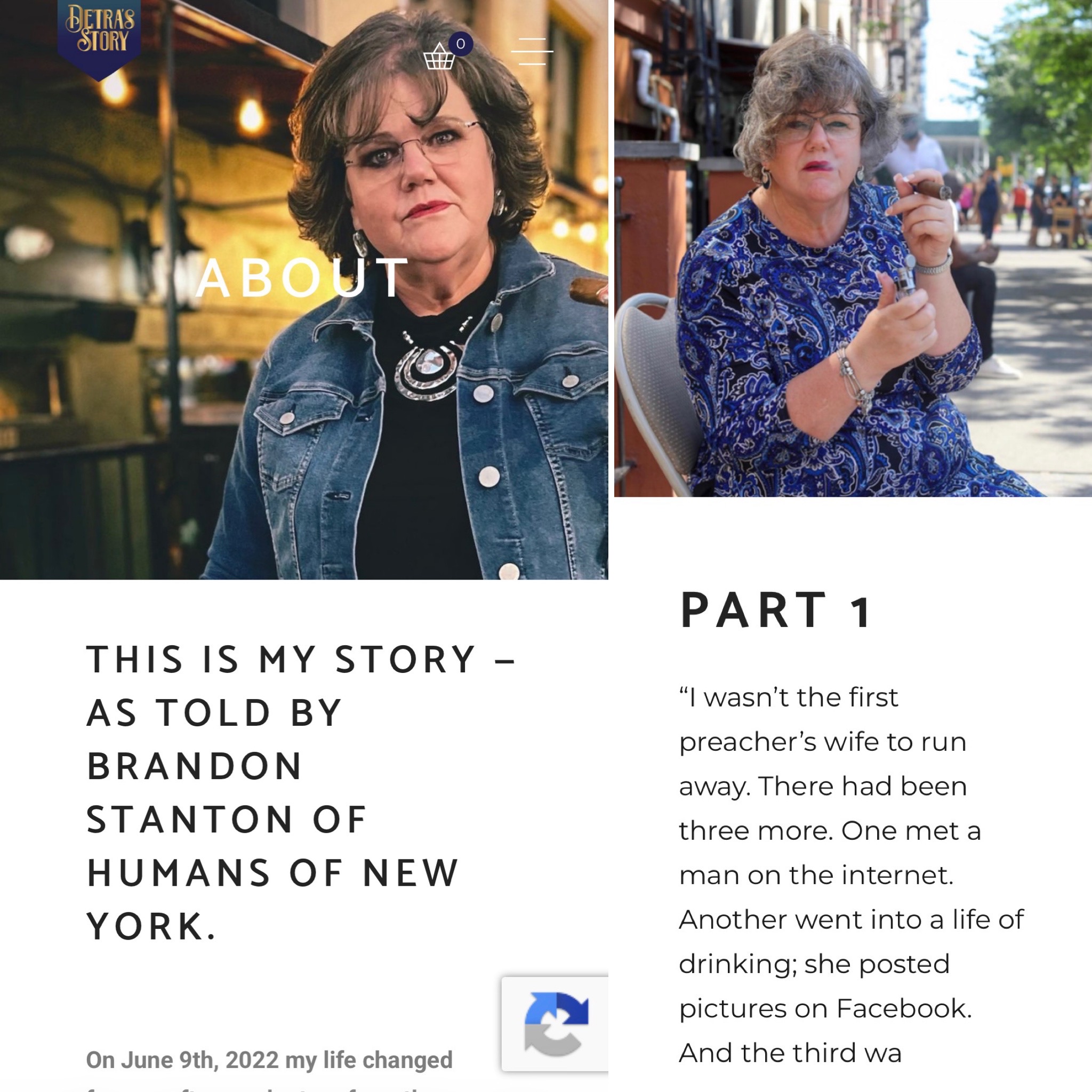
Visit detrasstory.com to read HONY’s series on Detra, and purchase her signature cigars! And be sure to follow Detra on Instagram as well.
Please enjoy this episode of The Beautiful Kingdom Builders podcast on YouTube, Spotify, Apple Podcasts, Amazon Music, Substack, and more!
TRANSCRIPT:
Rev. Ruth Perry (00:15)
My guest today is Detra Denise. She was featured by Brandon Stanton on Humans of New York four years ago. And I remember the day that your story was published, I kept refreshing Humans of New York and I was so impatient. I was spellbound by your story and just really astounded and amazed by it. And so I’m so thrilled that you would come on my podcast, Detra, today. Thank you so much for being here.
Detra Thomas (00:40)
Thank you for having me and thank you for reading the story. You’re not the first person that has said they kept hitting the refresh button and it always kind of makes me giggle inside because I always wondered if it’s the runaway pastor’s wife smoking a cigar in Harlem or just exactly what it was. and it wasn’t until he let me read the story like two or three days before it came out and I sat down and read it and I was bawling by the time I was done. And he was like, is it that bad? And I said, No, I had no idea I had done all that. because when you’re living it day to day, you’re just trying to get through. And so his story really gave me a perspective of, hey, I’ve been hard at work here, and I’ve been doing some good things. Yeah, I was tired and didn’t know if I was gonna make it, all that, but yeah, his story really helped me. But I always get tickled when people say, I was hitting the refresh button over and over and over just to see what was gonna happen next.
Rev. Ruth Perry (01:33)
It spoke to me on multiple levels, but I related to your story as a pastor’s daughter myself in the Baptist faith, a different denomination but similar backgrounds. And I related to a lot of the influences that you mentioned. And it related to me just the whole process of undoing patriarchal faith and building your own identity from scratch. And so I think a lot of people that follow my Facebook page and my blog and now my podcast have a similar background where they’re coming from a patriarchal faith and they’re reckoning with the damage of that and trying to heal from it. And I think sharing our stories is so important. So can you take us back to the beginning to Little Detra? And where did you
Detra Thomas (02:16)
Ha ha.
Rev. Ruth Perry (02:17)
grow up and what was your faith background and your childhood like?
Detra Thomas (02:21)
I was born in Arkansas and that’s where I lived until a little bit after I got married. We lived in Memphis, Tennessee, three and a half years, which is just right there by Arkansas. But Arkansas was where I was born and raised. And I’m the oldest of four children. My dad was a pastor, mom was stay at home. She worked very hard. She worked diligently to clothe us and feed us because, there wasn’t much money and she was as I got older and she began to teach me, my mother was incredible at finding deals. My favorite sweater came from Salvation Army. She paid a quarter for it. It was absolutely beautiful. But my mom wasn’t just trying to find an article of clothing to put on my body. She was trying to find something that complimented me. And she had that eye. So, I didn’t realize how poor we were till much later in life.
But I grew up in the church. I when I was fourteen, my dad assigned me a class to teach. He assigned me a bus route. I was, I would go type the letters to the visitors. I I would drive him on visitation, I would drive him to visit the hospitals. He hated being alone. He’s he is a narcissist. So that’s how I grew up was, in ministry. I had every church members’ phone number memorized, he’d snap, Detra, get so and so on the phone. I would call the number, usually the wife would answer and I’d say, hey, so and so. Daddy wants to talk to brother so and so, hand the phone.
And I remember when I went to college and I came back home after a few weeks, and I have a sister and two brothers under me, and he said, I really miss you. He said, I tried to get my sister to call somebody and she goes, Well, what is the number? And he goes, Well, it’s two four seven two what? Two what? And he just said, I’m just doing it myself. So I had that ability, so I was very involved in church work and loved it.
Went to college at a little bitty tiny Christian college and had a full scholarship to sing. And we practiced. We would show up a week before college and spend eight to ten hours a day rehearsing. And then we traveled in a van around Arkansas and some Texas, states that kinda touched and were close. We would travel every weekend.
So I carried 18 to 20 hours while doing 78 concerts a year. Plus, because I was so poor, I worked in the student center. So I was very, very occupied and still was in full-time ministry, even though I’m in college, it’s full-time ministry. And married a guy from that college. And what was interesting is all of our parents had gone to that college. So our moms and dads knew each other, his dad was a pastor.
So I just perpetrated the life I had had, and I was born to a man who pastored in the Baptist Missionary Association of America, the BMA of A, BMAA, but he was an independent Baptist at heart. So he would go to all the independent Baptist conferences, like Jack Hiles. and that was the mentality he had, authoritarian. So I’m a firstborn. Firstborns relate to authority. So I didn’t have any trouble with this, and just fingers were snapped and I did and jumped how high and that’s how I was raised.
So my mom and dad, when I was 10 years old, went to IBLP, Bill Gothard’s Seminar, Institute and Basic Life Principles. So I was raised under that. And even though for the scandal that that is, the horror that is, there are some nuggets of good things in there. And I managed to take some of those good things, that have helped me in my life. There are some horrible things.
So that’s how I was raised. A woman is born for the man, whether it’s her dad to be under his authority and do what he says, and then the man she marries, and I can’t do anything unless I have their permission and blessing. So it was that’s all I knew.
Rev. Ruth Perry (05:57)
So you had a deep purpose and meaning in your ministry of the church. And you love the church from an early age. And it sounds like you’re a real go-getter and a overachiever and a overperformer. And that’s the kind of personality of someone that attracts a narcissist, I think. They’re looking for those real bright lights that have so much to offer the world. But what did you want to be? When you went to college, what were you dreaming for your future?
Detra Thomas (06:23)
My plans were to go back and teach at this little Poduk ACE school, and and in fact, my third year, the the pastor of that church and the principal of that little school showed up at my college. I didn’t even know they knew where I was, to say, Detra, hey, we’re waiting on you. And I had just gotten engaged. I said, Well, I’m getting married. So that was my plan. I had no aspirations because I was told I couldn’t have any.
Rev. Ruth Perry (06:47)
Yeah.
Detra Thomas (06:47)
Anyway, that was it.
Rev. Ruth Perry (06:48)
So what was the courtship like with your husband?
Detra Thomas (06:51)
When I went to college my dad told me I could never be alone by myself with a guy. So there was no dating. and courtship wise, I mean he just came to me and a he well actually called my dad one summer and asked if if he could date me and my dad said, Well you’ll have to ask her.
And he knew that I couldn’t single date. And I worked in the student center. He’d already graduated. So he would bring chips and dip, and he’s a little black and white TV. We’d sit in the student center, eat chips and dip, watch TV and me taking care of people. And that was kind of our courtship, that there wasn’t any dating. There wasn’t any.
Rev. Ruth Perry (07:23)
And then how long between meeting him and getting married?
Detra Thomas (07:26)
I met him my freshman year. Well I met him actually on senior day in April of seventy-eight. And then we got married in eighty-one. So he was in his third year when I entered. And he finished college, went on to be on staff at a church. I got married after my third year. And then I took my last year. It took me two years to finish that last year, but three years.
Rev. Ruth Perry (07:49)
So you get married and how quickly does the mask fall?
Detra Thomas (07:53)
In three weeks I wanted it out. It didn’t take long. And I couldn’t put my finger on what was wrong. All I knew is everything in me was screaming. Everything in me was wanting to run. Everything in me was just like something. This isn’t right. The sentence I kept saying in my head is this isn’t what I signed up for.
And as I tell the story, I put my laundry basket on my hip. He’d come home for lunch, he went back to the church and I went to the central area to do laundry in our apartment division. And I was just I was like, God, I gotta figure out what to do ’cause, this is bad. I can’t handle it. And as I just pondered it out and focused on that entirely.
I just could, remember my dad telling me over and over, when you get married, you gotta marry somebody who can conquer you because you’re too strong. And I was a firstborn. I would ask questions. I never rebelled a day in my life, but when you’ve got a bullshit meter in you and you kind of cock your head and you’re like, something’s not right, and you just out of curiosity, not trying to be judgmental or critical, you ask a question. These type of men don’t like that.
And so that’s how I was raised. I couldn’t call my dad because he had told me I had to be conquered. And I believed every word that came out of my dad’s mouth. I haven’t spoken to my dad in eleven years, but I can tell you, I love my dad. I’m not mad at my dad. My dad is just who he is. And I’m not gonna be around who he is and what he does to me when I’m in his presence. So
And then, the week before I married, my mom told me, Hey, marriage is forever. And just so you know that if there’s trouble between the two of you, we’ll take him, but we won’t take you. And so I knew there was no reason to call for them to come get me. So, in my little worldview and praying about that, when I put everything together, the problem was me because scripture talks about submitting. And I realized, okay.
I just need to submit and be his wife, not a wife. He seemed to have some little nuances that were interesting. And I just thought I need to submit and be his wife. And so for 32 and a half years, that’s what I did. I gave it my all. I loved this man. I loved being his wife.
If you do a study on personalities and strength and weaknesses, we were almost 100% a perfect blend. My strengths were his weaknesses, his strengths were my weaknesses. And we were a great blend. We worked well together. We produced great things together. And I loved him. I loved the work in the church. I loved him.
The problem was in his mind there was never anybody but him. And when he would plan things, like at the church, he would plan things. He would just say, This is what we’re gonna do. And I said, Well, who’s gonna do that? Well, I don’t know. And I can remember one fourth of July, he decided that he wanted red, white, and blue bunting hung between all the columns in the church and the auditorium.
And I was like, well, and because I still wanted to make him a success, I said, well, let’s go to Walmart and buy the fabric. And on Saturday, I don’t remember, probably I made 10 buntings that were probably eight foot long apiece, and got the fabric cut, sewn together, and then he hung them. But that’s what I did because I loved him, and he was a creative. He had the ventriloquist puppets. He was a singer. He could play instruments. I felt so favored to be married to a man that creative. I didn’t know I was creative. I didn’t know I was talented. Because from a young age, my daddy snapped his fingers and said, Sing a special, play the piano, teach a class, run the bus route. It was what was in aid in me. I didn’t nobody ever told me I did a good job.
I did not know. So I assumed I was very favored to be married to this man and help him achieve what he would mouth but had no intentions of ever doing, if it wasn’t for me.
Rev. Ruth Perry (11:32)
I think that it’s so sad that you could have had a really beautiful marriage, but because of your theology and the theology that you grew up in, the culture that you both grew up in, it conditioned you to have this dynamic instead of a healthy dynamic. Not just that you were conditioned when men snapped their fingers that you would jump and ask how high, that was your training that you received, and that’s how you functioned. But then your husband was also conditioned in the same culture where men got to snap their fingers and got to expect people to jump.
Detra Thomas (12:03)
He was. Now his dad was totally different. The dynamic in his home was different. His mom was a school teacher, so she had a job outside of the home. They had a TV, we didn’t have a TV. So the kids could come in, watch TV, they got to go to the kitchen and fix whatever they wanted to fix. There was no snacking in my house and I’m not saying that in a negative way, but mom cooked three meals a day and and occasionally, she would fix us a snack, but we weren’t allowed free reign in the house. Our house was orderly.
And so we were raised both pastors’ kids and different, but still that I know his mom has told me she would find out that they were moving to another church because one Sunday he ran out from the pulpit, by the way, this is my last Sunday, we’re gonna be moving to Sunso. He never talked over anything with her. No, she and I did not discuss that much, she would just occasionally say something. And I loved my in laws. They didn’t like me. But I loved my in laws. She was very controlling and she was something.
And when I would go, my father in law, he would ask me the same three questions every time. When I got there, he would ask me the exact same three questions and when he I answered them, he was done with me. And for years, my first Christmas with them, I we had Thanksgiving with my family, Christmas with his, and we would rotate every year. Now all the other holidays, his mother required us to be at their house.
But the first Christmas I couldn’t wait, and they had this beautiful regular Christmas dinner, they had beautiful tree. My dad was a scrooge about Christmas, and I remember after the meal, his dad saying, Okay, I want a picture of my kids. Well, my house, when I got married, he was now my mom’s kid. That’s how that was, and we had already had that, so I got in the picture and he said, No, Detra, I said my kids.
And I remember I’d been married probably 10, 12, 15 years, and he was chairman of the Bible department at this little college. And I went and saw there were no pictures of me. There were pictures of my children, the man I was married to, everybody else in the family, but none of me. And I don’t know, I got real sassy one day. And I said, Let me tell you something. You either get a picture of me in this office, or I’m gonna pick out a picture of me and I’m gonna blow it up and frame it and put it in here. And the look on his face, he goes, No, sister, no, sister, don’t do that.
Don’t do that. But every year how he would frame it is I want all of my family under the tree and he would take pictures. And one year there was a guest there and the guest said, Hey Detra, he called. I said, I learned I’m not part of this family. So there he would take a picture of me and the man I was married to and my children, but I was not allowed to be in any pictures with anybody else.
Rev. Ruth Perry (14:35)
That’s so heartbreaking.
Detra Thomas (14:36)
It is, and I was just happy to be a part of, when I would go, what do you want me to do? How do you want it done? How do you want things in your kitchen handled? What can I do to help? All those type of things. I just look back and think, well, I’m not gonna tell you what I think because I’m gonna use New York language and I’m I’m not gonna say what I really think.
Rev. Ruth Perry (14:55)
We’ll fill in the blanks for you.
Detra Thomas (14:56)
Thank you. They’re a bunch of blankety blank blanks, that’s what they are. And just mean. Just mean. And there was no reason for it. The last words that she told me I kind of put my foot down and said, unless and things change, I’m not participating with them, I’m not inviting them to anything. But her words to me were, I don’t like how many children you’ve had. I don’t like that you homeschool them, but I don’t like that they’re on the road. If I had my way, things would be a whole lot different. And I was like, who do you think you are to think you get a say?
And how I raised my family. Was your mother-in-law in your business telling you how to raise your family? She wasn’t. Her mother-in-law was deaf. But I guarantee you, she would have told her to get lost, But it was just the constant gaslighting. And if you love me, this is what she said. If you love me, Detra, you will do this. And I would do it every time and tell her, mark me down as I love you.
I didn’t know what gaslighting was. But when you love so hard, and I’m happy with breadcrumbs, I really am, and I’m trying to change that. But when you’re happy with breadcrumbs and you look back and see they even didn’t want to throw you breadcrumbs. It is heartbreaking. It is heartbreaking.
Rev. Ruth Perry (16:02)
Yeah, as you were describing their family dynamic, I’m thinking to myself, Well, that doesn’t sound like the fruit of the spirit. These are
Detra Thomas (16:09)
No.
Rev. Ruth Perry (16:09)
Christians. Where’s the love? Where’s the joy? Where’s the peace and the patience and the kindness and the gentleness? None of that.
Detra Thomas (16:16)
Well, it was a pastor’s home, and I never heard God mentioned or talked about except for prayer before a meal. Never one time. And it was kind of crazy. I guess there was one time she mentioned a health issue and she did mention God one time. Other than that, there wasn’t. And that’s what he was raised in, so he was conditioned his own way, and then our Baptist ranks was very misogynistic, very misogynistic.
So he was going in the flow of what he was raised, plus he had his own nuances of… I don’t know that you can look it up then, but when I went and saw the lady after 32 and a half years of marriage, we talked, she mentioned sociopath, and I looked up sociopaths, and there’s two kinds. My dad was one and I married the other.
And so I would always think, I love that the man I’m married to is not like my dad. Well, they’re both sociopaths, but they’re one is my dad’s authoritarian. I married the charming one, the passive aggressive will kill you slowly day after day while smiling at you, so it was and then also the man I was married to, if you look up a psychopath, they have no emotions. They have no emotions for trauma or broken bones. He had none. And I would try to talk to him about that.
In fact, he had a full length mirror in his our walk-in closet and he was a cartoonist. And because I would talk to him so much about this, because I can’t comprehend this, I can’t comprehend that you don’t care about a broken bone or somebody hurt or you don’t care. In fact you get angry because it has now interfered with what you wanted to do. And I would have to walk a tight rope with him if the children got hurt.
He drew like two little bubbles coming out of his head, and in the big bubble it said, think about others. Because he couldn’t. He literally could not, except when he looked in that full-length mirror and had that bubble there. So
Rev. Ruth Perry (18:00)
Wow.
Detra Thomas (18:01)
And then you put the name of God in the middle of all that. It’s a recipe for a woman who’s naive, a woman who has been raised to enable, a woman who has been raised to believe that God will not bless her or protect her unless she obeys this man, a woman who is a firstborn who relates to authority, and a woman who, with her whole being, wants to please the Almighty. That is a recipe for total destruction.
And I look back and I don’t know how it all came to be, but I was begging God to show me, and it just happened that night. And was I trying to escape that night? No. But that’s what happened. And I’m grateful. I am grateful.
Rev. Ruth Perry (18:41)
This was after thirty two years of marriage. Is that right?
Detra Thomas (18:45)
Well, thirty two years I talked to somebody, but thirty four years when I escaped. Yeah.
Rev. Ruth Perry (18:49)
Can you name some more of the ways that you experienced abuse in your marriage before we talk about your escape? Because I think a lot of people still have misconceptions about what abuse is. We only understand if it’s violent. But there’s a way to be violent without bruising someone.
Detra Thomas (19:05)
Yeah. There were little things. We first got married, I’ve talked about this on many podcasts. He gave me a list of foods that he had to have snacks, a certain one, Monday, Tuesday, Wednesday. What we had on Monday was repeated on Thursday, Tuesday was repeated on Friday, and I had to sit beside him and eat, and I didn’t want to. And I would tell him I don’t want to. And he informed me that I was his wife and I would do what he said.
When I wanted to try a different hairstyle, my mom had always kept my hair really short. It started getting long because when you gonna cut your hair? I said, I thought I’d grow it out. He goes, You’ll wear your hair how I tell you to wear your hair. And then years later, like 20 years later, I asked him for permission to grow my hair out,
And I said, if I do it with a style, and he agreed. And I was pregnant with child number five. And so I’m I’m growing it out. And it’s probably about this length. And I really didn’t know much about styling hair, but I can fix it and it’s fine. And then it hits humidity and it starts doing all the curls.
Rev. Ruth Perry (19:57)
Yeah.
Detra Thomas (19:57)
And the church ladies were doing a baby shower for me. And so I was telling the women, I said, I’ve been trying to grow my hair because he he really likes it short. And no one thought a thing of it when I said he gave me permission to grow it long. Nobody batted an eyelash at this. And I said, but I’ve decided, I can’t keep it straight. See, I thought curls like this was simple.
That’s out of control, It means I can’t control my hair. I thought it was simple. And I said, So I think I’m gonna go back short. He just knows best. And the head deacon’s wife leaned in and said, We’ve been wondering what you were doing. So it wasn’t just you. Well, this solidified the fact that I don’t know what I’m doing. If my hair has a curl in it, it is simple and I have to obey him. So it wasn’t just him, it was along the way these churches had this mindset, so it was just crazy.
When I look back at it, my dad wasn’t trying to be abusive, He was doing best he could do with how he was raised. My mom willingly admitted all her neurosis, she would say, Detra, I have this, this, and this. But she would acknowledge and own it, and she worked on it, and so it was just this crazy hodgepodge of all these people, this worldview, this religious group weaving together something for someone who just wanted to make everybody happy, and that is I think you you coined me well, overachiever. I just wanted everybody to be happy. That’s all I wanted. So, you can die making everybody happy, and I almost did, yeah.
Rev. Ruth Perry (21:25)
Absolutely. I think they say eighty one percent of autoimmune diseases are in women, even though autoimmune diseases don’t impact one gender specifically. It’s just because women are carrying so much more stress and they’re absorbing the family stress, the stress of others.
Detra Thomas (21:40)
Okay, well, autoimmune, I’ve done a lot of research into that because I have several things. Best I can tell, it is repressed rage.
Rev. Ruth Perry (21:48)
Yeah.
Detra Thomas (21:49)
It’s an anger that you’re never allowed to express because you wouldn’t be a good Christian. All those things. It’s repressed rage. And I don’t think I’m an angry person at all because I swallow it all, but I have learned to forgive, but I think that it is your body creating signs to let you know you’re not handling this well. In other words, you had a fifty thousand dollar emotional event and you only give it fifty-five dollars. We’re telling you the rest of it’s coming due. And that’s what happens. You keep building up these emotional million dollar events and you don’t because you can’t. You’re a woman, one. You’re not a good Christian if you do, two. And three, you can’t do it because there’s nowhere to put it. Nobody’s gonna believe you. No one’s gonna believe you.
Rev. Ruth Perry (22:30)
So what was co parenting like with your ex husband?
Detra Thomas (22:33)
I would tell you it was good because we were a united front, which divided parents is when you get into a lot of trouble. And I liked order in the home and he followed that.
He was raised that there was order with the children, children obeyed, so that wasn’t an issue between us. And we did spank our children, they had to bend over the end of the bed and we spanked their rump.
I you would have to talk to my kids. I don’t think we we were abusive with with it at all. In fact, my second son told me with my baby girl, he goes, She did not get enough spankings, mama. She gets by with too much. But with the more children you have, if these children have learned to be obedient, they kind of follow in line. But I didn’t allow name calling. I didn’t allow kicking and hitting. Now if you want to wrestle, go outside and wrestle. And if someone taps out, you better be.
So we had this healthy playing and interaction and yeah, with seven kids. I had different personalities. I had one that was, kind of sneaky and come to find out he would cry and he’d be lying about stuff. But for the most part the kids got along. I I didn’t I didn’t
identify this horrible behavior, but co-parenting, we did well together, I thought was one of our strong suits. Now he did not like adult children at all. And I would have to step in and say, you can’t do that. Our oldest one joined the Marines and when he graduated from boot camp in San Diego, churches gave us money so the eight of us could fly out there.
So we flew out for family day and then graduation, and then he flew back with us the next day. And when I awoke, so by this time, the man I’m married to is in his 50s, and he couldn’t stand it if the children got any attention. And I would tell him, What? This doesn’t detract from us. Nobody’s taking anything away from you. You’re still an incredible man. I’m just building you’re an incredible man. But they’re adding to us, and he couldn’t handle it.
But the morning after we got back, I awoke to the bed empty and I could hear gut sobbing. Gut sobbing. And I run out to the living room. He’s on the couch, bent over, just sobbing. I think in 34 years, I may have seen him cry two or three times.
And I just ran over to him, I wrapped him up, and I’m like, what’s wrong? What is wrong? I mean, I’m fixing to go handle whatever it is. I said, What’s wrong? And he’s sobbing and he goes, I know this is wrong, which he knew it because I would tell him, what this is wrong. He said, But I’m crying because I didn’t get any attention yesterday, and Matthew got it all.
And I just felt a chill. I mean, I just literally a chill ran over me, and I let go of him. I’d run into this with him, but this was the first time it had been something of this magnitude, and I still cannot comprehend that this six foot six, fifty-something-year-old man is gut sobbing because his son, one of 400 graduates at a Marine, got all the attention and he didn’t get any. I don’t have I don’t have, I can’t…
Rev. Ruth Perry (25:18)
That’s mind blowing.
Detra Thomas (25:18)
It is mind-blowing. And it it is one of the examples of his complete narcissistic, whatever you want to add to that worldview where nobody is allowed to breathe. Nobody is allowed to breathe. And I am thrilled that I am away from that. I’m thrilled.
Rev. Ruth Perry (25:37)
Tell us how you got away.
Detra Thomas (25:39)
I went to see my doctor in Springdale, Arkansas. He was a doctor kind of outside the box, and I just believed God had him in my life for this particular reason. And I began to tell him a little bit about my marriage. I’d been seeing him for 20 years or so. And I said, I’m praying that God will just kill me. And then nobody has to know. None of these people in the churches, my mom and dad, my kids, nobody has to know. Because he didn’t treat everybody else the same.
And I remember my doctor saying, change your prayer. And I quickly looked up and I said, What? He goes, change your prayer. Now I thought I was being quite brilliant, intellectually, philosophical, spiritual, by asking God to just remove me. One move, and you solved the whole problem. And so I was quite shocked. And I said, Change my prayer. He said, Yeah, your body hears you.
And this was the first time I had a clue our words had power like that. And I said, Well, I am dying. I can tell that I’m dying. He said, Change your prayer. And so I left there and I was like, God, if there’s another way, I don’t know what it, I don’t know what it is. It didn’t occur to me to leave. And then as I began to talk to people, four people who had been married over 15, some over 25 years, never been divorced, said, get away from him.
Now, if you want to talk to people who’ve been divorced, get away. That’s another element. I’m not saying that would be wrong, but these are people who didn’t really, quote, believe in divorce, like me, and they’re saying, get away from him.
And so I prayed and I said, God, I don’t know how to leave. In fact, I had a plan in my mind that I was gonna take the suburban, he called that my vehicle, I was gonna put everything in the back I needed to survive, and I was gonna go to the police station and ask how long I could park my car in one spot and where were the best places in town. And I’d picked out parks that had showers where I could get a shower.
I was gonna have a cooler. I was gonna have my clothes. I was gonna sleep in the back seat with a pillow and a comforter so I could see my children. Now I look back at that and laugh because my kids would have been so embarrassed. my mom’s living in her car going around town. I just wanted to see my kids. that was it. I just wanted to see my kids, but I needed away from him. And that was my plan. That’s what I came up with.
And then I just said, God, if you’ll cause a fulcrum, I will do it. Because I can’t on my own. I don’t know how to walk away. I don’t know how to do this. Because there was so much at stake. And so we were driving back and he pulled one of his charming, passive-aggressive husband, pastor, get under my authority moves.
And I’ve been researching psychopaths, sociopaths, and religious abuse. And I was like, it’s just like all the blinders are falling off of my eyes and the fog is leaving my brain. And I’m like, Are you kidding me? And then I reverted back to a true firstborn who believes that God is true and faithful and who doesn’t put up with all these lies. And and I was like, and that’s when I looked at him and I said, You are a son of a bitch.
And I meant it contextuously. I meant it the son of a bitch. And I had had all I could handle. And in fact, I had told him at one time, I’m willing to give my life if you can figure out how mean you are. I’ll give my life. And what? He was willing to accept that. And when I figured out he knew what he was doing, he wasn’t gonna change, and I was like, I’m not giving my life for someone who’s willfully doing this.
This isn’t what God requires of me. So when I called him a son of the bitch, that was the fulcrum. And he was like, I’m fixing to pull over and tell you something. He finally had a sin he could nail on me. And so he was so happy. He pulled over, got in my face, and it was this just feeling inside, this is it. And I got my purse and got out, opened the door, started walking down the interstate.
And I was crying, I was praying, I I had all the emotions you could have, relief, fear, what’s gonna happen, all those things. And I just said, God, I need help. And there was a car pulled over, you know how long it takes to stop on the side of the interstate? Her brake lights were already off. And I saw the car in the distance, and I was like, God it’s probably a serial serial killer, but I don’t care.
That was literally my prayer. I was like, I don’t care. I’m getting in the car. I just wish I knew I could trust them. And when I said that the passenger door opened and this woman got out, and I could just tell she wasn’t a teenager. It was dusky dark, but her hair was past her shoulders, it was blown back in the wind, and she’s walking very purposefully towards me, and we have a distance to cover. The closer she gets, the harder I’m crying.
And she just meets me and turns and slides an arm around my waist and gets my hand. And ma’am, do you want to ride? I said, I do. And she said, God said to stop and pick you up. And I said, I told him I needed help. And for me and my journey with Christ, which has been strengthened so much more because of all of this, I knew that that was true because I had been begging God.
For a year and a half, you gotta show me what to do. And I would never have left. I wouldn’t have done any of these things. But she said, God said to stop and pick you up. I didn’t know this woman from Adam, I’ve never seen her. And she got me in the back and the reason she was walking purposefully is she could see him. He got out of the car when he saw her and he was running to get me. And when she opened the back door to put me in, I didn’t know he was coming. He grabbed me from behind, grabbed my arm. And I turned around and I just looked at him and I and I was done. And I said, I’m gonna call the police, let go of me.
And he goes, Well, I’m gonna call and he did this. I’m gonna call the police and tell them that you’re with somebody I don’t know. And I wanted to say, as usual, you don’t make sense. And I said, Call ’em, just call ’em. Let’s call the police. Let’s have this out here on the side of the interstate. You call the police, and I’m gonna tell them who you are. You call the police.
I don’t know. And he let go of me. She put me in, closed the door, and I am sobbing, distraught. Because it’s like, how am I a woman that’s on the side of the interstate getting away from my pastor husband that I’ve adored? Him trying to grab me. And he told them twice. He goes, She’s fine. We’ve had a fight, but she’s fine and she’s going with me.
And that’s when I said I was gonna call the police. So the woman got in the car and he he’s six foot six, like I said, she’s sitting in the passenger seat, and he bends down and he gets in front of her in her face, and he goes, I don’t even know who you are. And she just very calmly said, I’m a doctor with the Choctaw Nation. So she gives credentials, but she doesn’t tell her name. I look back on it, she was very smart, I’m a doctor with the Choctaw Nations. Those are credentials.
And he said, Well, I’m gonna follow you. She said, You do whatever you need to do. And he gets out, she closes the door, she tells her daughter to start driving. And I’ve since found this woman on the internet with help. I’ve been able to call her and thank her. Her daughter and I visited a little bit on the internet. I just remember when I could stop crying enough to pay attention to what was going on.
They had music playing. I don’t know if it was a CD, if it was the tape, if it was the radio, but it was quite unusual. It wasn’t any Christian music with the rock or the pop or anything. It was an old hymn. And I just remember the hymn that was playing was Jesus, Jesus, precious Jesus, how I’ve trust you or in or. Jesus, Jesus, precious Jesus. for grace to trust you more.
And for me, it was like an invitation. Teacher, you’ve trusted me this far. Keep trusting me. Now her daughter told me, What I remember about you is you sang in the car. And I said, I did what? I do not remember singing, but if it was hymns, that’s just what I do. I sing.
I was so embarrassed when she told me that. I was like, I don’t know how many songs I sang or hymns I sing. But they took me to a hotel. And what happened is he did follow us. And they said they needed gas. And so we pulled over to gas station. He pulled over. And then all of a sudden he just leaves really fast. What I found out later is he went home and began making phone calls and preparing.
One of the accounts I got is when one of the children walked in the house. He was just sitting on the sectional drinking a glass of iced tea, just as if nothing had happened. And anyway, they took me to a hotel. I called one of my sons. I knew his number by heart. I didn’t have my phone. And he said, Mom, I’m gonna get you a hotel. Because the kids had known for a year and a half it had been hellish. I got the blame for that, but it had been hellish.
So that was my escape. And my oldest son was in Oklahoma doing a job and he heard about it. He called, he goes, get in your car. You come to me. So he said, Nobody’s at home. Garrison’s gonna pick you up. He’s gonna get you some lunch, you get your clothes, you drive to me. And so I was with him in the hotel for a while and he lived in New York. He took me to New York.
It was supposed to be a few weeks. It’s been eleven years, but in that moment I lost everything I’d known except the foundation on which I built my life. And I had found that foundation to be unshakable. Unshakable. And people call it deconstruction. And I didn’t hear that term until I was in it. And then I was inundated with messages from people, all this stuff and I didn’t choose to join anything. I was like, I’m not interested in joining another group. But I began to hear the word deconstruction and I understand the concept, but for me, I wanted to say blow the shit up. Blow it up because what matters is your foundation. If you don’t have a foundation that’s solid, that’s where you start. Blow the rest of the shit up because what’s true is going to stay there.
It’s not gonna go anywhere. But it’s like a baseball, The rubber bands, one’s true, one’s a lie, are all melded together. when you try to pull one out, you’ve got a part of another one. So just blow it up and see what the foundation is. And if you’ve got a strong foundation, which I did, somehow it was built on the one true living God.
And then I just started building, and as I in New York prayed, God, can you protect me in 2020 when crime’s going up in Harlem? And, I said, God, I need to know if you can protect me. And these Harlem Cigar Men offered me protection. Who would have dreamed? Who would have dreamed that is how God would step in? And I remember I was somewhere
I’ve been in New York for several years and was at the Harlem Cigar Room. This was before the story, Humans of New York story came out. But I was smoking cigars and and I was at a art show. It was part of the homeless thing I’d been a part of and I’d been invited. I had somehow inspired this art show.
By a photographer who took a picture of me when I was homeless that changed my perspective of myself. And I told him, and he thought maybe I could use my skills in the homeless. And he did a whole art show of people who were homeless, and they were absolutely gorgeous. Smiling, and he invited me to the opening of that, and then I was a part of a panel. So I’m gonna I’m gonna say what I really think here. I’m sorry if it’s offensive, but there was some little Christian old woman who came up to me and
I call them little banny hens, I can’t believe you smoke cigars. That’s how she said it. And rather than knocking her out, I just literally wanted to take my fist and knock her out. I’m sorry, but this is the real. And I thought, how dare you sit in judgment?
Of what you think is best in life or best for me. how dare you? Especially after the journey I’ve had to walk and the prayers I’ve prayed and the answers that have come and this little snitty woman telling me that, with her little tag. I can’t believe he smoked cigars. And I decided to be nice. And I said, Well, let me tell you how I smoked my first cigar.
And I told her, 2020, almost died, the sidewalk cafes, I’m alone, I’ve been working from home, nobody. And my son is worried, crime’s going up in my prayer. And I said, I’m walking twice a week through the sea of men smoking cigars, and they start chatting. And one day they said, We want to offer you protection.
And I said, I called my son and I said, Hey, fly up here. He loves cigars. And I said, I smoked cigars, accepted the protection. And they told my son, you don’t worry about your mama. We’re going to take care of her. Nothing’s going to happen to her. And he started paying my membership. And I smoked cigars. When I got done, this lady, her whole demeanor changed. And she said, That’s one of the most beautiful stories I’ve ever heard.
And I decided to remain because she’s coming from the world, whatever she thinks, and what she’s raised. And I had never smoked anything until I smoked a cigar. I would have wouldn’t have been like her, I would have thought, if you want to smoke cigars, that’s fine. But it is one of the most beautiful stories. It is. And she changed. But I didn’t appreciate her little snide puckered mouth,
Standing in judgment. I can’t believe you smoke cigars attitude. Not even giving it a chance. Here’s my deal. Be curious to at least ask a question. Don’t assume that you know what the other person has been through or why they’re doing something. Ask. Say, well, I’ve never smoked a cigar. What led you to smoke your first cigar? Ask. Be open. Allow room for something other than what you think and your little shriveled up brain cells.
And that I think has been the biggest thing for my journey is as I’ve prayed and asked God, I need a step and watch these steps open up, I would even tell you the homeless shelter was part of that, the things I learned there. And plus, it was a volunteer in the homeless shelter that wrote Brandon. So if it wasn’t for that lowest point in my life, I wouldn’t be at my highest point right now.
So when you can step back and look back and see what I prayed, what has happened, it is a most incredible, crazy, arduous, beautiful journey of the intimacy of the Almighty saying, I’m looking for the heart that’s turned towards me. Her heart is, let me do this right here. And as a result, Brandon wrote the story and I can’t tell you the number of women who write and tell me one of my favorites is a woman wrote me and she said, Detra, my car is packed. And when I get through typing this, I’m gonna push send and I’m backing out and I’m leaving. And she wrote me a couple more times, and evidently a very powerful man, rich man. She was trying to escape doing different things, and we communicated a little bit. And then I wrote her and I didn’t hear from her for a year. And I thought she was dead. And she wrote after a year and she had made it.
Another woman wrote to me on Messenger, and she was a pastor’s wife from the world I knew. She said, Detra, I’m praying for you. And I’ve had some pastor’s wife write me, I need to know everything. And I was like, no, bitch, you don’t. I don’t even respond to them. But this one, I thought, I want to know what you’re praying. I figured I was on the prayer list of every church, across America there. And I said, Well, what are you praying? And she told me what she was praying strength for me, protection for me. It touched me. This woman was not being judgmental of me. She was asking God to bless me.
And then she said, I don’t have your courage, Detra. I don’t couldn’t live in a homeless shelter. And that’s when I began to get a glimpse of there were a lot more women from my world who wanted out and couldn’t. That woman is dead. I think about her often. She’s dead.
Another man wrote to me, and he said, Detra, I read your story, and he wrote a little novella about him and his siblings in the church. And when people write me, I at least do a red heart just to let them know I’ve seen your message. When it first happened, I couldn’t answer individual thousands of messages, but I’ve answered a lot. And his was so poignant, I messaged him.
And I said, listen, thank you for sharing your story. And I’m so sorry. I am so sorry for what happened to you and your siblings. And I said, but I want you to remember this. healing begins with one new thought. It’s not like New Year’s where you make all these resolutions. It begins with one new thought. So start with your one new thought.
And when I sent it, you could tell it was bubbling over here, and I waited, and he said, I cannot believe you’ve written back to me. I’m crying. And he said, I remember from your story you’re mess you’re missing several of your children. And I want you to know, I’m sorry for that, but you’re now mothering thousands of us. And I just started sobbing because I do so miss my five children. I so miss my five children.
And the fact that there are other children who need a mom, who has courage to say, I’m not putting up with this, means a lot to me. I get messages every day from all over the world. I get about 200 private messages a week, most of them from creepy men, let’s be honest, but from women all over the world and some men.
And I’ve just said, God, use my life to tell your story in a way that people know it was you. And that’s what I want, So this, me living in this hotel, I closed on my house Wednesday. I did not mean to become a sobbing mess. is a new season of
I want to show women don’t be afraid of fear. So many women write I got hurt, it was a pastor, da da da da. And they’re holed up somewhere, they’re scared. You can’t be afraid of fear. You just can’t. And the world thinks I’m so brave. I am not. I’m not. I’m just willing to keep my feet moving forward and not be afraid of fear. And so my plan is I’ve got a little bit of time here.
And I’m gonna record an album with my band. I want my original song so I can do a pop-up show when I travel. And I’m gonna pack the back of my truck in a way that I can travel. And then I wanna go visit different states for a month.
One to figure out where I want to live, but also to take the women with me and say, hey, we’re gonna go and right now the plan is Texas for the month of October. One of my followers, we’ve already talked about it. She’s got a place that wants me to do a show. There’s a cigar lounge there. She has a place, a two bedroom cottage, I can stay free for the month. Very interested in helping women like I am. And I will say in a month’s time, we’re gonna build a community.
And I’m not gonna go out on the sidewalks and say, Would you be my friend? We’re just gonna see what happens. I’m gonna go to coffee shops, I’ll go to cigar lounges, and people will just start conversations. And at the end of the month, I wanna have a dinner party with some of the people I’ve met. And just introduce them to each other because I seem to have this habit of meeting people who don’t know each other but are great matches, they just work well together.
And then go to another state and do the same thing and tell women, look, can’t be afraid of starting over. Is it scary? Yeah. Is it hard? Yeah. But it’s doable. And in the process, these adventures, my goodness, the most incredible people I’ve met. I have met the most beautiful, incredible souls and hearts that have just enriched me.
And let me tell you they’re not sitting on the pews of churches either. But they’re kind hearted, they’re generous, they’re honest, they’re authentic, they’re true. They’re not the gossipy little people sitting in the pews.
Rev. Ruth Perry (43:22)
You don’t have any patience with organized religion anymore, do you?
Detra Thomas (43:26)
No. I do not. I don’t have any patience with it. I don’t have any use for it. In fact, I did go to a church for nine months after I got here and was ministered to greatly, mainly because I’m going asking God to show me. Brandon mentioned that church. I didn’t want that church mentioned. He did it at the last minute when he sent that chapter out. He changed it. And I didn’t like that. And that church got a lot of messages. And I hated that.
But no, I so what I did is I I applied for work at Starbucks and they hired me, and they’re open seven days a week. But how simple it is to be open on Sundays. But I needed a job and I was just like, you know what, God, this is my whole lot, this is all I’ve known. And they want to know when I’m available and I’m just gonna tell them I’m available at all times. And I’m asking you in your omnipotence to set my schedule. Because I go to church, I don’t know, is it just because my heart wants to out of duty, what it is, but I need you to guide me through this. I’m yours. I’m not Starbucks’, so you set my schedule. I didn’t have a Sunday off for two years unless I asked for one.
And that’s when I was able to go, my goodness. God is more real to me than any pew. God is more real to me than any hymn. God is my foundation. And then when I would go to a church, I would be in bed with a migraine for two to three days at a time. Or this is too much information, but hey, I’m a I’m a crazy woman these days. My bowels would not move for three days. So would have migraines, my body couldn’t function. And I realized that my body was telling me, you can’t do this. You can’t do this. It just, it hurts me in ways.
So no, I don’t. The last time I was went to a church, I went to a funeral. One of my cigar guys, his sister was murdered. And I told myself, it’s fine, it’s it’s a funeral. I had to call off work the next day. I was in bed, couldn’t move just at a funeral. But Church buildings hold such memories for my body. And so no. But as far as the one true living God and his word and what he does in life is the most exciting, intimate, beautiful thing I’ve ever experienced.
Rev. Ruth Perry (45:26)
It’s really beautiful just hearing how God has been with you through this whole story and how real God is to you. And your story is just enthused with your prayer life and what a conversation looks like with God, that you can just tell God what’s going on and ask for help and God cares about you. And I think it’s so beautiful and I’m just so grateful that you shared your story with us today, Detra. If people go to your website, they can read Brandon Stanton’s Humans of New York posts there and they can find what you’re up to and recordings of you singing. Can you tell us what your website is?
Detra Thomas (45:59)
It is www.detrasstory.com. Detra has an S on it, detrasstory dot com. And I’ll get with my webmaster and try to become more active updating that now that I’m kind of gonna be on my own. I’m not really good with IT stuff. I’m gonna have to learn. I’m thinking about maybe in the States I’m in, I could find an intern, a kid who’s good with social media and IT, who could do social media for me where I am and pay them something. Because I hit record and talk and do that, that’s about all I know to do. And I really want to get back
Rev. Ruth Perry (46:31)
Yeah.
Detra Thomas (46:31)
to a writing post about people, but the last year has been so stressful for me trying to work and survive working. But I want to get back to writing about the journey and and just the people I meet. To me it is the treasures God has made that stands in front of us. And sometimes those treasures are so broken that they block all love. They can’t receive any love.
at all. And all that comes out of them is control and manipulation. And I just move on. I no longer feel obligated here. they’ve made their choices. I move on. But let me tell you, God has made such wonderful treasures who have been battered and broken. And they sometimes it’s just a smile or a kind word or a hug and that’s all they needed to go on for another day, And I think that’s what we are asked to do, provide that love and unconditional, hey, I think you’re an awesome treasure of God and just do those little things and it makes a big difference.
Rev. Ruth Perry (47:28)
Thank you, Detra, for sharing your story with us today and being a blessing to me and being a blessing to so many people. And I pray God’s blessings on you.
Detra Thomas (47:36)
Well thank you for having me. I’ve enjoyed meeting you. Thank you.
Rev. Ruth Perry (47:39)
God bless.
Detra Thomas (47:40)
All right.
Did you enjoy this episode? Please subscribe, rate or review us on YouTube, Spotify, Apple Podcasts, Amazon Music, Substack, and more! Your support means the world. God bless!