Tag Archives: patriarchy

032 I Dr. Bradley Jersak: Can Your Theology Heal You or Is It Hurting You?

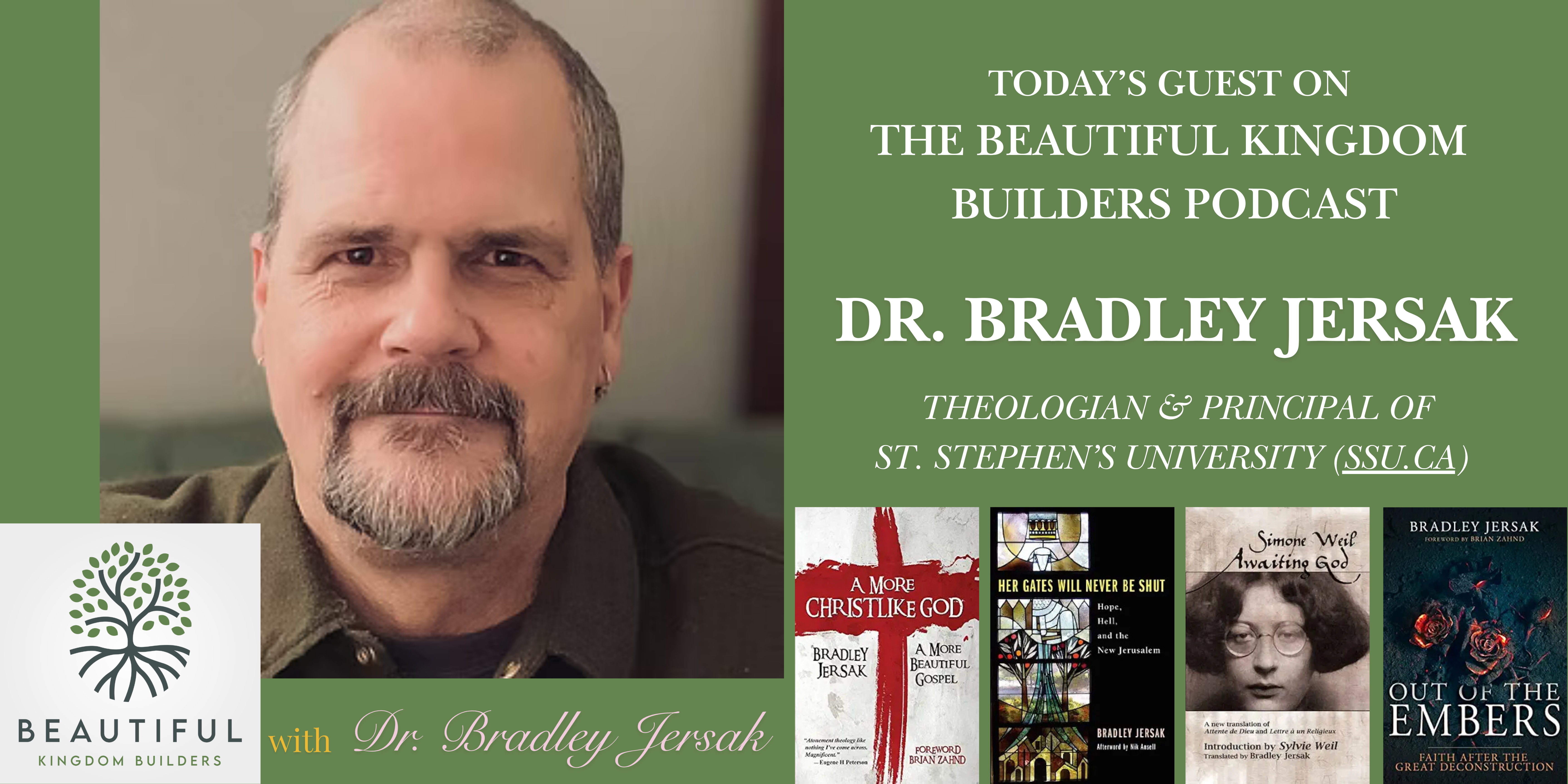
A promotional image for The Beautiful Kingdom Builders Podcast featuring Dr. Bradley Jersak, a theologian and principal of St. Stephen's University. The image includes a logo, a photo of Dr. Jersak, and covers of his published books.
Dr. Bradley Jersak has written multiple extraordinary books that will guide you to a more beautiful faith. Buy them here.

When I asked Dr. Bradley Jersak on my podcast, I didn’t know I was going to open up about a recent experience where my religious trauma was triggered. Our conversation was then about the theological doctrines and systems that perpetuate hierarchies and harm, and the good news of a theology of God’s love and healing.

In this episode, Jersak shares his journey through various Christian traditions, his views on theology, trauma, and justice, and how love and mercy shape his understanding of faith. He shared why certain unchristlike interpretations can contribute to personal distress and how we might move toward a more beautiful, Christlike, and trauma-informed faith. By re-evaluating these frameworks, we can find a clearer path to spiritual wholeness that aligns with the nature of God rather than fear-based systems.

From his website: “Bradley Jersak is an author and teacher based in Abbotsford, BC. He currently serves as the Principal of St. Stephen’s University (SSU.ca) in New Brunswick, where he continues as the Dean and faculty member of SSU’s School of Theology & Culture. He also teaches peace studies courses with JFI.SSU.ca and is a regular Open Table Conference crew lecturer. He is also part of the Plain Truth Ministries team, where he serves as Pastoral Scholar. He writes, edits, and does layout for CWR magazine, CWR press, and the CWRm blog. Through his books and seminars, Brad shares the good news that God is Love, perfectly revealed in Jesus Christ, and that God’s love heals wounded hearts and empowers us to heal this broken world.”

Please enjoy this episode, where we talk about:
Bradley’s journey through Baptist, Mennonite, Renewal, and Orthodox traditions,
and now the new Episcopal Church plant he is a part of.
The impact of trauma and deconstruction on faith
A critique of penal substitutionary atonement and hellfire preaching
The biblical vision of justice, mercy, and the love of God
The systemic issues in church hierarchy and patriarchy
The importance of inclusive leadership and gender equality
The role of scripture reading and interpretation in systemic change
The eschatological hope of the restoration of all things

Please visit www.bradjersak.com where you can subscribe to his Substack and find his social media links and more, and buy one of his books here or at your favorite local bookstore (as an Amazon Affiliate, I do receive a small commission for purchases from my links).

You can find this episode of The Beautiful Kingdom Builders podcast on YouTube, Spotify, Apple Podcasts, Amazon Music, Substack, and more!

TRANSCRIPT:

Rev. Ruth Perry (00:16)
Today I’m pleased to welcome Brad Jersak, or I should say, Reverend Doctor. Are you a Reverend?

Dr. Bradley Jersak – SSU.ca (00:21)
Yeah, but let’s go with Bradley, because I’m trying to be a lay person now.

Rev. Ruth Perry (00:25)
Alright, so I’m gonna start over and I’m gonna say I’m welcoming Bradley Jersak. Or should I say doctor? I just feel like

Dr. Bradley Jersak – SSU.ca (00:29)
That’s perfect. No.

Rev. Ruth Perry (00:31)
I should give you all the

Dr. Bradley Jersak – SSU.ca (00:32)
I don’t need it anymore. I’m just Bradley.

Part part of my history was was healing from the way titles become identities and measures of hierarchy that I’m not interested in at all. But okay. I did do some hard work to get there. So thanks for putting doctor in there. I am the principal of a university and I’m a professor there now. So my students call me Bradley or dear friend.

Rev. Ruth Perry (00:56)
All right.

Well now I’m gonna leave all of this in the podcast because that was beautiful.

Dr. Bradley Jersak – SSU.ca (01:01)
Perfect.

Rev. Ruth Perry (01:01)
So I’m pleased to welcome you and I’m really excited to talk about your work today with my audience and introduce them to you. I hope that they go down a Bradley Jersak rabbit hole like I did a few years ago and really soak in your theology because it’s been really healing to me and it’s really beautiful and it has the fragrance of the Spirit of God to me. And so I couldn’t tell you how excited I am that you accepted my invitation. And I’m really excited to introduce you to the Beautiful Kingdom Builders audience. Thank you for being here today.

Dr. Bradley Jersak – SSU.ca (01:34)
Thanks for having me and it’s good to meet you.

Rev. Ruth Perry (01:36)
Can you take us back and tell us your story? Like just as an

Dr. Bradley Jersak – SSU.ca (01:39)
All right.

Rev. Ruth Perry (01:40)
introduction to who you are and where you started from and how you got to where you are today.

Dr. Bradley Jersak – SSU.ca (01:44)
Sure, so that’s that’s a loaded question because I’m 62 now. This could take a moment. Distill, distill, distill. I grew up in a conservative Baptist family and church where I have loved Jesus since I learned his name on my mother’s lap. I have loved the scriptures since I first opened my Bible. And was able to read it on my own for the first time when I was six years old.

I have loved prayer since my mom taught me to pray for everyone in the family every night. And none of that has changed. I carry that part of my Baptist heritage very seriously. And I would even say conservative in this sense. My impulse is to conserve. And what do I want to conserve? The ancient faith of Jesus Christ. And sometimes that means backtracking to double check what that was in the for the first Christians.

So I grew up 22 years there, went off to an interdenominational, even more conservative, fundamentalist Bible college, where I met my wife Eden, and she was from a Mennonite family. And some think of the Mennonites like the old Mennonites look like Amish. Her church was more like a community church. And by the time I finished my master’s degree, I was hoping to be a teacher, but no doors were opening. And her church called me and said, Would you want to come and be associate pastor of youth, young adults and outreach? And I really didn’t want to, so I made it difficult on them to hire me. But the Lord opened that door and I just fell in love with the people I was working with.

And I also was immersed then and ordained in sort of that Anabaptist heritage of where we don’t just believe in Jesus, but we believe Jesus and his call to live according to the Sermon on the Mount. And that’s why Anabaptists or Mennonites are generally peace people, because they they take seriously the Jesus way of the Sermon on the Mount, especially of radical forgiveness and enemy love.

So I did that for 10 years, and I noticed how much more Mennonites tend to stay in the gospels, and that had an impact on me. By the time I left there, we were ready to plant a church. So my wife and I partnered up with Brian and Sue West, and we planted a little church called Fresh Wind. And our idea there was to be more open to Holy Spirit renewal stuff. So we were kind of open to that world. But the focus was actually on marginalized people.

And so imagine this: let’s say 150 people, one-third of them were people with disabilities in full-time care. Rows of wheelchairs, people with autism, people with Down syndrome on the stage in the worship team serving at the altar giving the communion and dedicating the babies, you name it. It and it was a glorious mess. And those folks began drawing addicts from the community, people with drug addiction, alcoholics and so on. And some of those were from unhoused people as well.

And they would come feeling like, this is like I’m at home and I’m safe here and I’m not the noisiest person in the room because someone’s having a grand mal seizure, you know. And so I co-led it for 10 years. So after 20 years total of pastoring, I had a massive meltdown in 2008, I really crashed. It wasn’t overwork, it was just trauma after trauma after trauma in that community. You know, within a year we had had someone abducted and abused for hours. We had someone else murdered with a hammer. we had had a whole bunch of people with disabilities that died tragically sometimes because their care was neglected.

I mean it just it built and then finally I had a meltdown. I didn’t know if I could trust God anymore. And I went in I went into my own addictive behaviors to cope with that. And I realized if I don’t trust God, we’re so vulnerable with all these traumas. I need to step back. That’s where my wife Eden stepped in and she led the church, brought them through a healing period, brought me through a healing period. And it was then I realized I can’t go back to pastoring.

And so I went off and I’m like, now I think I know the questions, especially around suffering. And did my PhD work around that stuff. And by the time I got finished that in 2012, I had an offer to start teaching. And so I teach Bible and theology now. I’m at St. Stephen’s University, where I’m I’m the principal of the graduate school of and I’m Dean of Theology and Culture there.

I’ve skipped some more church stuff though. So I had the Baptist era, the Mennonite era, and then this renewal kind of church for the marginalized era. None of that was just church hopping. I was all in doing, you know, serving in these churches, and I’ve collected all the gifts and treasures from those years, and I’ve not discarded any of them. I really appreciate it. But I also during you know, probably the 2000s, I came into contact with an old monk. He looks, he literally looks like Gandalf.

And in the Orthodox tradition, and so I’d visit his monastery and he began to show me how the Eastern Church, 350 million Christians in the world. How they approach the scriptures. And there was some things that were really in alignment with that sort of Mennonite version of the nonviolent God who’s revealed perfectly in Jesus. And some of your viewers I don’t know, I know you have, if you were to Google Jersak and Gospel in Chairs and Denver.

You’ll see a 30-minute presentation of what I learned from that monk, in fact. And I began attending there and the monastery would have weekend services, and it really became part of my recovery, where we heard the word mercy or merciful 154 times in two hours every Sunday as part of the liturgy. That’s what I needed. I needed a mercy bath.

More recently now I’m helping out with another church plant, an Episcopal Church that’s led by Ama, it’s like Mama, Cherith Fee Nordling. And so and what I love about that is I am an egalitarian at heart. I picked this up from the Mennonites, and that I believe women should be in every role that a man can be. And so I’ve really, really been spiritually thriving under female mentorship through the years. Which brings me to today. And here I am. Hello, Reverend Ruth.

Rev. Ruth Perry (07:42)
Hello. That’s such a beautiful story. And I really appreciate the appreciation you have for the different traditions you’ve experienced. Because

Dr. Bradley Jersak – SSU.ca (07:50)
yeah.

Rev. Ruth Perry (07:51)
I do think that, you know, we’re all expressing our revelation of God that we have and that we understand. And there’s a lot of beauty in all the different ways that people express that revelation of God.

Dr. Bradley Jersak – SSU.ca (08:03)
Yeah. Think about the body of Christ not just as individuals, but as these movements. And who

Rev. Ruth Perry (08:08)
Yes.

Dr. Bradley Jersak – SSU.ca (08:08)
are we to say we don’t need them, right? So I’m quite ecumenical that way, meaning I have learned to learn from those who have seen what I haven’t seen.

Rev. Ruth Perry (08:19)
Well, I appreciate that something I see in you, which is why I think your faith is beautiful, is that your spirit does show the fruit of the spirit love, joy, peace, patience, kindness, gentleness, self-control in ways that some of the spiritual authorities of my past don’t have those same fruit evident consistently. I mean I don’t know you consistently, but I get that from hearing your teachings and listening to your other podcast interviews you’ve been on. And I know I don’t know you, but I feel like I trust you and that your message has a lot of truth as my faith has grown, it does ring true to me. And I guess one of the things that I’m curious about

So this week in my context, I went to a local board meeting because we have some people in our community who want to revise our local library policies and procedures in a way that would create discrimination where we’re complying currently with non-discrimination laws and we’re receiving state funds because of that that would this would jeopardize. And there were a lot of people that came to the meeting to speak out and I came to speak out myself.

And I felt really triggered by the meeting because the chairperson who was really driving this effort reminded me so much of my upbringing in the conservative Baptist faith. And it was surprising to me how triggered I was by the meeting and by that experience and feeling really agitated and a lot of adrenaline pumping.

And something that I really appreciate about your book Out of the Embers is you talk so much about the trauma of deconstruction in a way that I haven’t heard other people speak of deconstruction and how painful the experience is. Can you speak to that just growing awareness of trauma and how it impacts us and to the experience of trauma in deconstruction.

Dr. Bradley Jersak – SSU.ca (10:09)
Yeah. That’s a great question. So let’s start with your story. You used the word triggered and you realized the meeting was the trigger, the man chairing, I’m assuming it was a man chairing, was the trigger, but the trigger indicates a earlier trauma. And and that was related to pastoral authority in in a church you’d experience.

Well, the the bad news about that is you it makes your heart pound and probably gives you a headache, and and and so you have to become super self-aware. I don’t think the solution to triggers is getting rid of all the people who trigger us. That’s been a silly kind of move that folks have made, even those who are looking for safe space. It’s like I want spaces where no one will trigger me.

Well, what if we looked at that? What if we went back and said, what was going on back there that is coming up now that still needs healing work? And so that’s where I would start. I would also want to be super compassionate about that because having trauma triggered means that trauma’s lodged in you somewhere and you didn’t put it there. And that requires gentleness, it requires healing. You don’t get to just say, don’t be triggered, right? And we’re not gonna be able to wait until all of our triggers are gone and all of our traumas are healed in order to speak truth to power. So sometimes that’s very uncomfortable and it it’s costly to you and your nervous system. And and so I honor you for stepping up anyway.

Further, it doesn’t justify the one triggering you either. You are identifying a pattern that needs addressing. So that’s a lot on the table, isn’t it? But if we could boil it down, to say yes, continue speaking for justice and goodness and mercy. Keep speaking in ways that resist, let’s say racism or sexism or homophobia or whatever, any kind of belittling or othering of those who aren’t like us. And while you do that, you’re noting how it’s impacting you. And I would attend to it.

And so that’s what I do. I mean I my nervous system was really damaged in two thousand eight. As far as I’m aware, it’s not fully recovered and I no longer expect that. So it just means I need a healing team around me. So I attend 12-step meetings for that. I see a spiritual director for that. I ad hoc will see a counselor for that, have it for a while. But I really firmly believe that doing that inner work, I can’t do it by myself. And it’s not about sucking it up.

I am nervous when self-care becomes our highest value. It makes us unhireable, actually. We have generations we may lose over that one. But we do self-care and we do it so that we’re more effective and that the impact on your religious PTSD, which by the way is a real thing. One of our master’s students just did her her thesis on that. And that religious PTSD.

Well, since you mentioned trauma, what she identified was the similarities between religious PTSD that comes from being raised with a retributive God, a punisher god, how similar the fruit is in that to women in recovery houses from domestic violence. And she said, based on the correlation of the bad fruit, she goes, I don’t need a a biblical or theological debate to demonstrate these doctrines are wrong. Because Jesus said, look at the fruit. And as the fruit of a doctrine looks like victimization by domestic violence, then we’ve got to push back. So that’s a lot, but it’s about you, you know, in terms of trauma. Does that kind of ring true or how how’s that landing for you?

Rev. Ruth Perry (13:45)
Yeah, absolutely. I have done some therapy and some EMDR therapy for religious trauma. It wasn’t something I was really aware that I had religious trauma until I had a similar kind of breakdown when I was 40. I’m 46 now.

Dr. Bradley Jersak – SSU.ca (14:01)
Mm-hmm.

Rev. Ruth Perry (14:02)
And my daughter watched the video of the meeting at the library and she told me, You were so nice to that man. I wish you hadn’t been so nice. And I could feel myself fawning, like having a traumatic response where I did, I fawned.

Dr. Bradley Jersak – SSU.ca (14:15)
Wow.

Rev. Ruth Perry (14:15)
I said it, I gave him a compliment before I made my peace.

Dr. Bradley Jersak – SSU.ca (14:18)
Yeah.

Rev. Ruth Perry (14:19)
And I wish I had said things more strongly. So it was kind of a jarring experience. We’re looking back where I feel like I’ve done a lot of healing work, but I guess I’m not there yet.

Dr. Bradley Jersak – SSU.ca (14:28)
That’s profound though, cause to distinguish Christ-like mercy from fawning when they can look alike, right? Look at the fruit of the Spirit you exhibited. And you know what? Maybe you did. But the shadow side of that is a traumatic fawning response. That’s quite a insight. I’m glad that you noticed, you know.

Rev. Ruth Perry (14:48)
Yeah, I didn’t mean to bring it up today, but I just feel like I’m in good hands. And so thank you for listening to that and giving some advice.

Dr. Bradley Jersak – SSU.ca (14:55)
Yeah, for sure.

Rev. Ruth Perry (14:57)
So what are the things about religious fundamentalism that do cause religious trauma?

Dr. Bradley Jersak – SSU.ca (15:02)
Okay, so I think some of it is doctrinal and some of it is around practice and and structures, systems, right? What do you want to cover first?

Rev. Ruth Perry (15:12)
Anything. Everything.

Dr. Bradley Jersak – SSU.ca (15:13)
Okay. So it could be a chicken and egg thing anyway, but I do think they correlate, as the great band ACDC once asked, who made who? So is it a nurture or nature thing and is it a doctrine or practice thing? And what I mean by that is sometimes we will generate God in our own image. And if that image arises from a culture that is punitive, that is exclusive, you just begin building in that image of God, and it’s absolutely an idol. Or, if you have a God you believe is retributive, the punisher God, the one who needs his wrath satisfied, all of that stuff, then that God will then have a trickle-down effect, you begin to emulate that God, and it’s a feedback loop.

I generate this violent God, this violent God shapes me. And so I’ll start with doctrine then. In the order I discovered things. First I began to question whether the cross was about satisfying God’s wrath through the punishment of his son. We called that penal substitutionary atonement. Penal as in punishment. Substitute is God has to punish somebody. He actually is not free to forgive. And he can either punish you or he can punish Jesus. Take your pick.

And so Jesus takes your punishment. And I defended that. I grew up with that. We call that an atonement theory now. I thought it was the gospel. And I did my Master of Arts thesis, a hundred and eighty page defense of that doctrine. So I promise you I’m not just making a caricature. But it’s about this satisfaction of wrath through violence. And it doesn’t take too much figuring out to see how that turns into retribution in our penal system. So instead of being a justice system, you end up with a penal system where wrath is satisfied through punishment.

But not just our penal system. It ends up in how we treat people, how we treat the other, even how we treat our children. I can’t just forgive. That’s not good parenting. I have to punish. And what we find out is how often that that is connected in both spousal cases and parental cases, that there is an abuse that happens because there’s anger attached to it. And they’re going, of course there is. It’s the wrath of God.

So that penal substitutionary atonement, people need to know that is not the only way to see the cross. In fact, that way is 500 years old. I’m a conservative. I want to conserve the gospel that we see in, let’s say, the book of Acts, where that never ever comes up once in any evangelistic sermon to Jews or Gentiles, individuals or groups. Never.

What is it about? The cross is a revelation that God is radically forgiving, self-giving, co-suffering love, and that He has poured that out into this world in a way that overcomes Satan’s sin and death. It is the love of God revealed on the cross, not his wrath. In fact, on the cross, God makes a specific no to wrath and yes to forgiveness.

So I start with the cross, and then that begins to trickle out. If God doesn’t have to punish, if God is free to forgive, based on the work of Christ, not in my faith, but by the grace of God, then we should double check this doctrine of eternal conscious torment. The idea of what I call infernalism, it’s about that hell is the never ending punishment of the sinners who didn’t say the right prayer because they didn’t grow up in the right community.

Something’s off about that. And what we found out is even in the evangelical world now, that’s not the only way to see it because we double checked the Bible. I wrote a book about it called Her Gates Will Never Be Shut. And yes, there’s judgment. Yes, we need a willing faith to response, but it’s restorative judgment, it’s restorative justice. So Jesus says, if I’m lifted up, and then John clarifies he was talking about the cross. I will draw all people to myself.

I think he’s right. I don’t believe Jesus was mistaken or lying, and he gives us as that as a promise. Well, then where does judgment fit in? It’s the means to that end, cleansing judgment. I wish I had heard less hellfire preaching and more soap preaching. But Malachi says he will come with a refiner’s fire that purifies the gold. And with launderer’s soap, which washes out the stains, right?

So, that’s where I went from there. Because a lot of the revivalists who traumatized me as a little boy, they held a smoking gun to our heads called hell and said, unless you pray this prayer, you’re going to hell forever. So I’d pray the prayer. Does that sound like a willing faith response, or is that a hostage situation, right?

And then the third one was then we began to look at the Old Testament texts and seeing all the even the call to genocide without mercy, which we have now somehow employed at times, the book of Joshua, book of Judges, First Samuel, and said, See, we can go and kill others in the name of God, our crusades, our crusades against the Muslim nations. They’re the enemy and we’re God’s servants and He’s on our side, all of that.

And Jesus comes along and he says, You’ve heard it said, but I’m telling you. And for me, then Jesus gets the final word. And he teaches us that the Old Testament was pointing to him. And when it points to him, he comes along and he says, I’m telling you. You don’t retaliate. You love your enemies. You pray for your enemies. You bless your enemies. You forgive your enemies, even if they crucify you.

And then he lives by what he says. So those are all doctrinal elements that I think have created horrendous religious trauma. And yet these other the major movements in the body of Christ have already seen that. So we don’t have to believe any of that stuff as if we’re being unfaithful.

I want to talk to structures and systems, but I want to pause first, see if you have any questions or comments about the doctrine.

Rev. Ruth Perry (21:04)
I was thinking about when I was growing up and praying for my grandparents who are United Methodists and now I’m serving in a United Methodist denomination. But I used to pray for their salvation ’cause I was so afraid that they were going to hell because they weren’t Baptists like me.

Dr. Bradley Jersak – SSU.ca (21:15)
Yeah. Yeah. Been there. And all you, you as a little child, you’re looking at all these people who are going to hell and you know it and you love them and you wonder, doesn’t God love them? Yes, God loves them and He doesn’t want them to go to hell. So you have to convince them or they will. And if you don’t, their blood’s on your hands. I mean it was it was pretty rank. And yeah, that’ll traumatize you.

Rev. Ruth Perry (21:38)
With religious fundamentalism there’s so much emphasis on, you know, don’t spare the rod or you’ll spoil the child and even like don’t hold your crying baby because you’ll spoil your baby and there’s so much of that the baby’s trying to manipulate you and I do see

Dr. Bradley Jersak – SSU.ca (21:52)
Good Lord.

Rev. Ruth Perry (21:52)
so much trauma from kids who have grown up with religious parents who I believe were well meaning and they were misled through authorities who had really tragic beliefs.

Dr. Bradley Jersak – SSU.ca (22:04)
Yeah. That is connected to doctrine as well. So in the Latin, there’s a Latin doctrine of original sin says that every baby is born inheriting the guilt of Adam, and therefore they’re born damned. And so you gotta make sure they get saved quickly, right? And that doctrine only began in about four hundred AD.

Up until then, they’re like, no, we’re all gifts from God. We bear his image. And yes, we’re thrown into a situation where stumbling will be inevitable. But because it’s inevitable and we’re moral toddlers bound to trip, God’s only just response is mercy, and that’s exactly what he gives us. But if you believe that every child is born damned, well, that’s terrifying. We did have a age of accountability thing. Well, they kinda God gives them a you know

Rev. Ruth Perry (22:50)
Little wiggle room there.

Dr. Bradley Jersak – SSU.ca (22:51)
A little, a little wiggle room. Back in our day, it’s like the first time they’re defiant. Okay, now so they’re two. now with Gen Z, you gotta make the age of accountability about 30, but that’s a joke.

Rev. Ruth Perry (23:03)
Can you explain more about justice and holiness in regards to God doctrinally then, if God is not punitive when we’re not just or holy?

Dr. Bradley Jersak – SSU.ca (23:14)
Yeah, very good. So we’ll hear that a lot, right? God is love, but he’s also holy. God is love, but he’s also just. God is love, but he’s also righteous. God is love, but but but. And we have to have a but removal surgery here. Here’s the nature of God according to First John. God is love. So think about nature, and I will say essence.

So essence would be who God is from all eternity, and that can’t change. That’s the core of who God is. That’s God’s essence. And then is God’s nature is then, in terms of good-natured person, right? Nature is how we interact, how we come into the world, how we’re experienced. So God’s essence and nature is love. Period. No, no buts. Think of that like let’s say a diamond.

And there’s no impurities in that diamond. That’s all the way down. So now if you take righteousness, justice, and holiness as something other than, but right, as over against love, well, the righteousness and holiness and justice that is not God’s love, that is not God’s nature, that’s the Pharisees who killed Jesus. That’s the fundamentalists who string up Black people in the lynching trees.

So then what is it? Well, so the righteousness, justice, and holiness of God are facets of that love, and that limits what they can look like. There can only be just love, righteous love, holy love. And if the nature of love is to restore, then restorative justice and a kind of holiness that Jesus in the Sermon on the Mount, both Matthew and Luke, he actually says that be holy or be perfect as the Heavenly Father is perfect, and then he describes it: invite everybody to the banquet. He because he is he is generous and kind to the righteous and to the wicked. So that’s holiness. We turned holiness, that is not love, into exclusion, the very opposite of Jesus’ own definition.

So I don’t have any problem with holiness, righteousness, and justice as long as they are always, ever, only facets of his divine nature. And that’s pretty simple from the scriptures. I can give you, I tell you, because I know Calvinism really well. I wore it for a while. The pushback on that is here’s what they do with it. They’re like, and I’ve heard Baptists say, God is not love. I’m like, okay, what? They’re like, God is only love to the elect.

I won’t even argue with that. The theological term for that is cuckoo. I know I’m enough of a biblicist to know when we’re violating scripture to say something like that. That is twisting scripture to fit some system that is a reflection of our own exclusion and prejudice. And it’s demonic, frankly. So whoo, I said that. But yeah.

Rev. Ruth Perry (25:56)
Yeah. Well, my experience growing up with that Calvinist worldview was that I was elect and I was in, I was a golden child of my church, of my family.

Dr. Bradley Jersak – SSU.ca (26:04)
Mm. Yep. Yep.

Rev. Ruth Perry (26:06)
And I received so much affirmation and love and support. But then when I hit that wall of deconstruction because of a church split and my family having issues going on and I was just really overwhelmed, that perfect image of my faith and my family was crumbling. I watched some Brennan Manning videos and I realized he was teaching that God loves me unconditionally.

Dr. Bradley Jersak – SSU.ca (26:29)
Wow, hey.

Rev. Ruth Perry (26:30)
And that was a brand new concept. I had never felt unconditionally loved. I had been striving and fearful and felt like I was a sinner in the hand of an angry God.

Dr. Bradley Jersak – SSU.ca (26:38)
Yeah.

Rev. Ruth Perry (26:39)
And it was such a tenuous situation for even someone who was just really killing it being a Christian.

Dr. Bradley Jersak – SSU.ca (26:44)
Yeah. Isn’t that interesting too that here this was our big critique as Protestants of the Catholics, that they believed in salvation by works. But here you were dying of striving, and then a Catholic comes along, Brennan,

Rev. Ruth Perry (26:59)
Yes.

Dr. Bradley Jersak – SSU.ca (26:59)
and says his love is unconditional. What a, how the, how that boat flipped over, I don’t know, but we’re grateful for his life in ministry and he really demonstrated that even a very broken man with his own addictions had come to the end of himself and he knew it’s the grace of God even in my relapses or it’s nothing at all. And now that’s a grace message, right?

Rev. Ruth Perry (27:21)
Yeah.

Dr. Bradley Jersak – SSU.ca (27:21)
We should talk about systems a little bit ’cause that’s the other side of your trauma and it’s coming up now.

Rev. Ruth Perry (27:24)
Yeah, that would be helpful.

Dr. Bradley Jersak – SSU.ca (27:26)
So what are some of the ways that religious systems perpetuate trauma? So there’s a kind of reading of scripture that is not like the early church read the Bible. I’ve written a I’ve written a book called A More Christlike Word, the Emmaus Way of Reading Scripture, where Jesus tells us how to read scripture, and the early church has left us documents that I share in my book, about here’s how you read the Bible.

We went into a weird kind of literalism, probably as a result of modernism, where we thought we could just have rules of interpretation where we’ll be certain what it means. And those are often very unchristlike and wooden literalism. That kind of way of reading scripture s seems then to generate hierarchies. So a hierarchy of who’s important, who’s unimportant, who can lead, who can’t lead. Who’s in and who’s out, and so those literalistic readings have created systems of well, first of all, domination style leadership that is a reflection of empire.

So domination taking over, and that can happen by when a pastor thinks they’re the king of the church, or even like if a power group gets control of the votes, right? But it’s about domination then. And that is the opposite of Philippians 2, where he says, have this mind in you that it was in Christ Jesus, that even though he, or even because he was equal with God, he didn’t think that equality with God was a thing you grasp and cling to but he humbled himself. He emptied himself.

Well that’s not hierarchy, that’s kenarchy, we call it. So kenarchy is the word there for emptied himself, kenosis. So it is servant leadership, basically, by laying your life down and washing the feet of your disciples. So the whole domination thing, it’s like, you know what? If that’s going on, probably you should flee that system because it will put its boot on your throat at some point.

Specific then to that, hierarchy tends to default into patriarchy, and that is male-only leadership through horrendous literalistic interpretations and translations of obscure scriptures compared to the very clear gospel texts that should be at the center in Christ. There is neither Jew nor Greek, male nor female, slave nor free, all of that. But anytime you have a hierarchy, so you will find a way to put women lower, you will find a way to put children lower, you will find a way to put the poor lower, you will find a way to put other races lower, the immigrant lower, everything but and of course who’s on the top? I am. I’m a straightish white guy. I say straightish because you know I’m very straight, but kind of have a crush on Brad Pitt, okay?

Rev. Ruth Perry (30:10)
Ha ha

Dr. Bradley Jersak – SSU.ca (30:11)
That was a joke. Okay, so anyway. But the like, so the straight white guys get the power and they hang on to it. And I just don’t believe in that. And so part of the reason that I’m part of this Episcopal Church plant, I’ve not left the Orthodox Church, but I don’t believe in all male leadership. I don’t believe in patriarchy. I don’t believe in hierarchy. That’s not the Jesus way. And so I’m very pleased that my priest is Cherith Fee Nordling, a wonderful woman mentor. And I’m very pleased that when she serves the Eucharist, even she says, We are here to express the radical hospitality of Jesus to his table, where everyone, without exception, is welcome. I mean, it’s a gospel moment, right?

And so, it would be sort of like, but what if they’re not Christians? Well, we’re serving his body and blood. If they want and need the body and blood of Christ, I guess that’s how some of them become Christians. So I do remember back in the day we had this Satanist guy, Ken. This Satanist started coming to our church Fresh Wind, right? And one day he shows up at the communion table and the people serving communion run over to me. It’s like, the Satanist wants communion.

And so I said, Say this to him. This is his body for your healing. Do you need it? Yes. This is his blood that washes away your sins, shame, and guilt. Do you need it? Yes. And then Ken received the healing, the cleansing, the forgiveness that is present in the Eucharist. And my goodness, we’d be in trouble with so many people. So then Ken became a Christian Satanist, I guess. And at the next Easter service, he was on our stage performing a rap that sounded like a prophetic utterance, right?

And yeah, it was risky, but my point is there’s this kind of that’s the kind of leveling of the playing field out of the hierarchy, even of the elect and non-elect, or Jesus saying in the Sermon on the Mount. Not everyone who says Lord Lord is in fellowship with me. So let’s be a little slow on our claims here. But those who do the will of my father. And that’s not about performing.

It’s just like someone calling themselves a Christian means almost nothing to me now. That brand is tainted. I want to see who’s following Jesus, you know, and not by performance, but by the fruit in their lives. All of that then undermines those systems of power and exclusion. Does that make sense?

Rev. Ruth Perry (32:41)
Yeah, I’m kind of curious what you would say about Genesis when God gave dominion. How do you explain what dominion looks like? Because I know some think that that means we have authority to conquer and conquest.

Dr. Bradley Jersak – SSU.ca (32:54)
Geez, How we got from dominion to conquest is quite a leap, isn’t it?

Rev. Ruth Perry (32:59)
Yeah.

Dr. Bradley Jersak – SSU.ca (32:59)
But I do really see it as stewardship. So dominion is being a gardener, after the pattern of the gardener. And what I love about it is in John, when John’s talking about Jesus’ arrest, he’s playing with that. He’s like starts the story: there was a garden. You’re like, yeah, there was a garden, wasn’t there? And then in a little while Jesus comes to Mary Magdalene and she thinks he’s a gardener. And I say she’s not mistaken.

And what does a gardener do, right? I’ve got some garlic and and some lavender that and some echinacea I planted outside. Whatever I’m doing to try to keep those flourishing and fruitful, doesn’t look like conquest. it looks like nurturing, it looks like watering, it looks it, it looks like tilling and all of the good things. So I I think, but you can see how that imperial mindset invades a scripture like that and then we end up dumping toxic waste into Lake Ontario

Rev. Ruth Perry (33:56)
Yes!

Dr. Bradley Jersak – SSU.ca (33:57)
and because the Lord’s gonna return in twenty years anyway. I mean it’s so awful. And then just one other thing then that reminds me then also we do have a dominant version of evangelical end times preaching that is looking to bring back Jesus by causing Armageddon. And we need to repent. Blessed are the peacemakers, they will be called children of God.

Well, guess what we did? We actually named handguns and missiles peacemakers. We stole that word from Jesus and turned it into destruction. I can’t think of many worse blasphemies. But we know what he means: that James tells us those who sow in peace will reap a harvest of justice or righteousness. You don’t sow violence to get peace. You sow peace to get justice. And that’s the Jesus way that I’m very interested in, but it seems now to be a minority report.

Troubling.

I do want to share a there I saw I have a friend, he’s a church growth and health consultant and he does a survey wherever he goes. Liberal churches, progressive churches, conservative churches, fundamentalist churches. He goes to all of them, right? And he goes to these things on weekends. So it’s not sort of your Sunday church goers or marginal attendees. It’s like people really invested in helping the church grow and be healthy.

So we’re talking about active members. He presents the Sermon on the Mount, the section on love your enemies, bless your enemies, pray for your enemies, invite everybody to your table. He presents that paragraph, and in his survey, 74%, and we’re talking thousands of people have done the poll. 74% considered that paragraph, if they were conservatives, as a compromise with unrighteousness. 72% of progressives. So even on the left, 72% complicity with injustice. So right and left, almost three-quarters of those who claim to be Christians reject the very words of Jesus when they’re presented like that.

But I believe Christ is bringing us all along, but I do wanna say it feels like following Jesus in what he actually said and called us to is a minority report and always has been. So I’m not too worried about that. It’s not we’re not having a vote if Jesus was right or not. But I do wanna be faithful and that’s kind of where I go back to to test it.

Rev. Ruth Perry (36:18)
So can you tell us what your end time view is?

Dr. Bradley Jersak – SSU.ca (36:22)
I used to know everything. You need to know this. I was 21 at the time, and I had all the graphs charted out. Probably the third or fourth time we got the dates wrong, I gave that up. And in moving toward a more Eastern theology, and I would say scripture focused, how can I summarize?

Well, first of all, the Nicene Creed, I’m a creedal Christian. That means, you know, all Catholics, all Orthodox, Anglican, and so on. Those who aren’t making up their own faith statement would cite the Nicene Creed. Here’s what it says about the end, and then I’ll tell you two opinions I’d have. So this would be dogma. He will come again with glory to judge the living and the dead. And we look forward to the resurrection of the dead and the life of the age to come. Period. Amen. Period. That’s it. That’s the whole thing.

And as I said before, that judgment will be restorative. But they didn’t put that in there because they also said, you know, if you don’t believe that, you could still affirm this. They were quite inclusive that way. I think messing with that dogma, adding stuff that you have to believe, is probably a formal heresy. ‘Cause we’ve got the dogma, you don’t toy with that.

That said, two things I see in the New Testament. One is if you want a picture of the end times, of the end, you look at the Mount of Transfiguration. That’s it right there. Christ transfigured, and you can already see Moses and Elijah are able to stand in the light and glory of his transfiguration. The disciples can’t yet, but I believe that the end game is the transfiguration of all things and all people.

That leads me to my other text. In Acts 3, Peter’s preaching about heaven is holding Jesus until. The restoration of all things and all people. I mean it just says the restoration of all. And he’s talking specifically of people, but I think it’s the whole cosmos. So if it’s the transfiguration and the restoration of all, I don’t know how we get there. So I won’t pretend I do. But it’s a glorious vision, and it’s a vision that I can sew into now.

So if I think that the end game is the restoration of all things, because that’s what he says, if I think that Jesus was right when he says he’ll draw all people to himself, how will I live today? I will treat everybody as somebody on that path. And I will sew whatever I can that will nourish their restoration. That’s why I’m a big fan of 12-step recovery, for example. They’ve done much more good, probably, than any other religious movement in the world in terms of seeing the power of restoration through surrender to the care of a loving God. Sign me up. And so I did. I’ve been hanging out with them since two thousand eight.

And even before actually a little bit, but I just feel like they’re on to something there. That God is a loving, caring, forgiving, healing, responsive, relational God, and what they don’t insist on is that you figure it out right away that that was revealed in Jesus. But I do, and I’m allowed to say that there. I think he revealed this in Jesus. So yeah. So there, there you’ve got my eschatology in a minute. It would it used to take hours.

Rev. Ruth Perry (39:28)
Well, that’s just a sign that you’ve done a lot of work.

Dr. Bradley Jersak – SSU.ca (39:31)
Distill and no less. Yeah.

Rev. Ruth Perry (39:33)
I’m going to ask you one more selfish question because I’m a local church pastor and in the lectionary, the gospel passage this week is the parable of the vineyard laborers who started at different times of the day.

Dr. Bradley Jersak – SSU.ca (39:45)
Yeah.

Rev. Ruth Perry (39:46)
And so I’ve been contemplating on that this week. And then just this morning, I saw a reflection of someone talking about reading that text through the lens of the five o’clock labors and comparing them to our Latino immigrants in America that we’re currently, you know, putting in for-profit detention centers and holding without due process and ripping families apart and sending people back to countries that they were never in before and back to violence and danger and the way we’re treating our Latino neighbors, by the vote of Christians largely, that these policies are in place.

And so today I’ve been reflecting on how do I, as a local church pastor who wants to preach the word of God as good news, also talk about justice for my Christian Latino, I mean not even just Christian, but I think we forget that we’re talking about largely Christian siblings in the faith and we’re allowing this to happen to them

Dr. Bradley Jersak – SSU.ca (40:42)
Yeah.

Rev. Ruth Perry (40:43)
in a context of a conservative culture that probably voted for it too.

Dr. Bradley Jersak – SSU.ca (40:48)
Yeah.

Rev. Ruth Perry (40:48)
What is your pastor to pastor advice?

Dr. Bradley Jersak – SSU.ca (40:51)
I would just say what you just said. That’s amazing. I love that. Preach. You know, and you can always get food stamps next week.

Rev. Ruth Perry (40:59)
Yeah.

Dr. Bradley Jersak – SSU.ca (41:00)
But, I will so first of all, I could not agree more strongly with everything you just said. So let’s start there. What I think you’re uncovering there is that a parable about unconditional grace actually brings about the justice we’re looking for, right? Because the complainers are the ones who are saying it’s an injustice. What’s the injustice? And he’s like, are you going to complain to me? This is my money here. I can pay whoever I want whatever I want. And if I give them the same at the end of the day as I gave you for that’s my call, not yours.

And so they’re complaining this isn’t fair. And maybe the way he’s coming at that complaint is that this is grace. Do you want to live by grace or do you want to live by fair? Because we could do that, couldn’t we? Are you sure you want to do that? Because if you’re sure you want to do that, then we’re going to talk about complicity and we’re going to talk about privilege and we’re going to talk about reparations and we’re going to talk. That’s what you so I don’t know. I think I would go with the grace. And so you’re just causing these thoughts in me now to sow the scandalous the scandalous grace that I would even call Indiscriminate.

Doesn’t feel fair. But it’s the only way you get to justice. And if instead you withhold to get to justice, so it will be done to you. The measure with which you judge, you will be judged. So you don’t get to live in the land of grace and keep someone else in the land of the law. That’s not how it works. But if you want to, it’s not even a threat from God. It’s just a natural spiritual law

You will be judged, even in this life by other people. Never mind God. Right? So that’s kind of some first thoughts I have about it. I’ll probably have to go do some journaling now because of you, thank you. Yeah, it’s a grace message that brings about justice. Hmm. Indiscriminate. That’s so scandalous. How could he? Glad he did. Glad he did.

Rev. Ruth Perry (42:58)
Amen.

Well, thank you so much for coming on my little podcast and being such a blessing to me and to my audience, I hope. And I’m gonna put lots of links in the show notes to send people to watch some of my favorite teachings you’ve done. And I wanna give you the last word. What would you want to say as the final message?

Dr. Bradley Jersak – SSU.ca (43:18)
Well, I do wanna give a invitation. Part of my deal is if people go to SSU.ca, there may be folks who would like to learn more. You could come study with me online or in person and we talk about the intersection of theology and culture and how we can transcend the r right left culture wars without exiting the world, still engaging with the work of justice. And we have peace and justice degrees, we have reconciliation studies degrees, and now we have a transformative leadership degree with a lot of voices from the global south helping us decolonize our theology. So if people want to look at su.ca, CA is for Canada, but we’re an international school with the travel modules to South Africa. Check in there. So that’s my pitch.

But my last message maybe for today would be like, mercy triumphs over judgment.

Rev. Ruth Perry (44:11)
Amen. Thank you so much, Bradley.

Dr. Bradley Jersak – SSU.ca (44:13)
Welcome,

Rev. Ruth Perry (44:13)
God bless.

Dr. Bradley Jersak – SSU.ca (44:14)
You too.


Did you enjoy this episode? Please subscribe, rate or review us on YouTube, Spotify, Apple Podcasts, Amazon Music, Substack, and more! Your support means the world. God bless!

030 I Sarah McDugal: Why Your Divorce Became High-Conflict: A Protective Parent’s Guide

A smiling woman with curly hair sitting against a neutral background, promoting her role as a guest on the Beautiful Kingdom Builders podcast, which focuses on high-conflict parenting and custody coaching.

This week, I spoke with Sarah McDugal, a Master Certified Professional Coach specializing high-conflict communication coaching for protective parents in divorce and custody court. Sarah shares her powerful journey from a conservative Christian upbringing to becoming an advocate for protective parents facing family harm. This episode explores the dynamics of abuse, faith, and the legal system, offering vital insights for anyone navigating these challenges.

We talked about Sarah’s personal story of escaping an abusive marriage, and how church culture and theology set her up for that and perpetuated the abuse by trapping her in the marriage. Sarah shares the four tools of abuse: isolation, deflection, manipulation, intimidation and the problem of moral injury in family harm cases. She shares the legal challenges faced by protective parents, resources for recognizing and responding to abuse, and the importance of language in understanding abuse.

Money quote: “Jesus wants you to be safe and loved.” This is the heart of Jesus for you.

Please enjoy this episode of The Beautiful Kingdom Builders podcast on YouTube, Spotify, Apple Podcasts, Amazon Music, Substack, and more!


TRANSCRIPT:

Rev. Ruth Perry (00:17)
My guest today is Sarah McDugal. Sarah is a master certified professional coach specializing in high conflict communication coaching for protective parents in divorce and custody court. And Sarah is trained in the Deceptive Sexual Trauma Model, the Association of Partners of Sex Addicts Trauma Specialist. She is a certified assessor for the Johns Hopkins Danger and Lethality Assessment.

And she’s co founder of Wilderness to Wild, Trauma Mamas, and Freedom Navigator. And so I’m very excited to have you on, even though the subject matter is heavy because it’s a necessary conversation. Thank you so much for being here today, Sarah.

Sarah McDugal/FREEDOMnavigator (00:58)
Thank you, Ruth. I’m excited to be here. I’ve been looking forward to this all summer since we talked about it. And also I’m gonna apologize to everyone in advance. I had this epic summer. We did this lifetime dream of visiting a bunch of national parks and everything this summer. I was fantastic at twelve thousand and fourteen thousand feet. I felt great and I have POTS and all kinds of funky autoimmune stuff. So I don’t always feel great.

While traveling or anytime. But I felt great at all those high elevations. And then now I get home, I got slammed with this upper respiratory infection, and I am still my voice is wonky. So I apologize in advance. If I just spin out vocally, you’ve been warned.

Rev. Ruth Perry (01:41)
Right now I’m feeling like your voice is perfect for radio. It sounds really good.

Sarah McDugal/FREEDOMnavigator (01:45)
Well, thank you. I can drop it into a lower register if I need to, but I it may also stop and cough like a maniac. So there’s that.

Rev. Ruth Perry (01:53)
Well, please do.

Sarah McDugal/FREEDOMnavigator (01:54)
Thank you. I appreciate it.

Rev. Ruth Perry (01:56)
So my podcast, I like to have conversations about gender, justice, abuse, and healing in the Christian faith specifically, because I think these are important conversations that the church tries to avoid generally and is uncomfortable with. And your work intersects in all four of those areas. And so I’m really hopeful that people will follow Sarah McDugal, your website is Wilderness to Wild. I just wanna say that right now. Wilderness to wild dot com. Like look this up, follow Sarah. Okay.

Sarah McDugal/FREEDOMnavigator (02:25)
I have two. I have two. If you’re trying to figure out if what you’re dealing with is normal or is more than just difficult, then wilderness to wild.com is your spot if you’re dealing with betrayal trauma. If your marriage is so difficult and it’s just not getting better and you’ve done everything you can to think of how to fix it, and maybe you’re thinking marriage is just meant to be difficult. Wilderness to wild is your spot.

And we start there with just helping you recognize red flags. Is this an abusive behavior pattern or is this someone being human and flawed? Now, if you have fled family harm and now you are forced to co-parent by the court system with the person who harmed your family, you need my other website.

And that is www.myfreedomnavigator.com. So those are the two. And they they speak to people in very different stages of life experience. Sometimes the people who start out at Wilderness to Wild end up needing my Freedom Navigator. And sometimes they don’t. But yeah, so those are the two that we can start with right straight off the bat.

Rev. Ruth Perry (03:31)
And I will put those links in the show notes. So be sure that you visit those places. Can we start with your story, Sarah? And just introducing you as a person of faith that I admire that has an important expertise and message for the church today. Where does Sarah start? Where do you…how much do you want to share about your own life?

Sarah McDugal/FREEDOMnavigator (03:53)
My well, like we were joking before we came online. Are we doing a one off or are we doing a series? Cause you know, we could be here a while. But I just a little bit of background.

I grew up in a very what we would now kind of refer to as fundy, conservative Christian home. A few caveats. My parents are loving, caring, wonderful people. Flawed humans and all of that, just normal humans, but deeply love Jesus and deeply loved us as kids. I was a missionary kid. And before and after being a missionary kid, I was also an army brat. And we did a lot of humanitarian aid work. We traveled a lot. We moved a lot. And we kind of joked that we were on a mission movement all the time.

Our family nucleus was the constant because we homeschooled, which meant we could pick up and move anywhere, and nothing got disrupted from our academic and educational point of view. so I grew up with this kind of looking back on it now, in kind of a bizarre mix, from the outside circles around us, I got a ton of influence from Gothard, extreme right evangelical influences. Even though we weren’t in ATI or the Gothards, you know, group necessarily, we were very much adjacent to that. The long denim skirts, the long hair, no makeup, no adornment, longer sleeves a lot of the time. My dad had a big old beard. Back then, when he wasn’t in the military, it was kind of weird. It was like either dress greens, clean shaven, or big ol’beard and suspenders is two completely different looks. And I’ve been to like 45 countries and territories. So I mean we traveled, we had this global mindset, this very much an awareness that, and and I think this is very, very healthy awareness that there are a thousand ways of doing things well.

Because people have culture and language and differences and distinctions and all of those things can be equally good. They’re just different from each other. and at the same time, I grew up in a theological and conservative fundy social environment where purity culture was strong. I mean, if you held hands with a boy, you were damaged goods. Nobody might ever want you for life. You know, kissing, that’s probably how you got pregnant. Not quite, but you know, just that whole environment.

Rev. Ruth Perry (06:20)
Yeah.

Sarah McDugal/FREEDOMnavigator (06:21)
I grew up reading the covers off of Passion and Purity by Elizabeth Elliott, and I kissed dating goodbye, and all of the things. Just all of those things. homeschooled through 10th grade. I played piano and guitar and violin and sang. The picture of the perfect conservative homeschool family, lived way out in the country, did gardens, we ate really healthy.

And now looking back, there’s so many things I’m so grateful for. I am a late diagnosed autistic adult woman. And I look back and realize that the calm, slow pace of living out in the country and having a lot of quiet time and a lot of time for reading and slow hobbies and low entertainment that was sensory overload, those were saving graces for my childhood. If I had had a fast-paced, hard-run, heavy sensory childhood, I would not be the same person and it would not be in a good way.

So it’s a mixed bag as I look back at it. I never doubted that my parents loved each other. I never doubted that my parents loved us, or that we were a secure, safe, connected, caring Christian home family unit. I genuinely thought that when people got married, they just talked about stuff and worked it out. I didn’t know divorced people. I didn’t know volatile family home life. I didn’t know what it would be like to have parents yell or fight or disagree or be physically reactive or violent. None of that was part of my worldview at all, except for maybe news stories. And most of my childhood we didn’t have a TV. So I didn’t watch a lot of news either.

So I had this very trusting and innocent and almost cozy idea of how marriage and home life was supposed to be. I thought you just talked, you worked it out, you both wanted the same things. Why how can this be so difficult? And then I got married.

I went to Bible college and did not date much at all. I I mean I didn’t have significant dating relationships, did not get physical with anyone. I did the whole purity culture, everything. And then I married a theology student who said he wanted to be a missionary and to be a pastor.

That’s what I wanted to do. I wanted to have four kids by the time I was thirty and be a missionary and go live like Marilyn Laszlo and I don’t know if you know who that is from from the Tyndale translation. She had gone off to Papua New Guinea and I’d grown up on everything from David Livingston to George Mueller to Amy Carmichael and you know, all of the greats.

And I just thought it was going to be very simple and straightforward. I married someone who had not come from that kind of home. And I did not know that I married a sex and porn addict who had a lifetime of compulsive deception and who was not the person that they presented themselves to be.

By one year in I knew in my bones that bringing children into this would be devastating to my children. And at the risk of being labeled a career woman instead of a family woman, I decided I wanted to wait on children. And it was because I was terrified to bring children into the home. I thought, hey, I chose this, right? So I’m stuck with it for life. I have to live with this, but I don’t have to choose to bring someone innocent into it. And I was not brave enough to state my reasons why that I felt like raising children with this person would be unsafe. And just bad all the way around.

I also didn’t have anyone talking to me. The ministries now that exist unraveling the harm from purity culture, the harm from pornified worldview, the harm of all of the traditional marriage books like Love and Respect and His Needs, Her Needs, that were considered the Bible in our home. And I I was one of the pastor’s wives that handed those out. God forgive me now and a thousand apologies to anyone who ever received one from me twenty five years ago or whatever.

So I was operating in this vacuum of knowing in my bones that things were not okay, but not having language, not understanding coercive control, not understanding betrayal trauma, not understanding deceptive sexual trauma, not understanding the escalating nature of sex and pornography addictions, especially when it’s operating in secret, in the dark and unchecked.

And so I pursued ministry work. I got a master’s degree, and I dealt with a lot of allegations from my then spouse that I just hated family and I just didn’t want to be a parent and I just didn’t have a motherly bone and whatever because I was scared to say I can’t raise kids with you. I think it will be harmful to children.

And then there came a time where the reproductive coercion was so strong that he told me straight up, if you don’t give me kids, I will divorce you and tell everyone that you were an unsubmissive wife. And I couldn’t think of anything worse at the time. So I felt that I had to go off birth control, and I had to try to get pregnant. And then it took a year and a half.

And I want to pause right now and state unequivocally that I would not trade my amazing and incredible children for anything in the world. They are the best part of my life. And I am so proud of them and everything that they have overcome and their incredible passion for life and for people and for caring for others and for learning. They’re amazing humans. And I’m so glad that I didn’t end up living my life without them. I mean, I’m so glad that I had them. But at the time it was very overwhelming because of the nature of the environment and the relational dynamics that made me feel so trapped.

And I don’t know if you’ve talked about moral injury much on the podcast, but a simplified description definition of moral injury is the injury to your soul when for example, if you’re a soldier and you’re following orders, so you’re doing the right thing, but the orders are to kill a child. So you’re doing the wrong thing. You’re doing the right thing, but you’re doing the wrong thing. And by doing the right thing, you do a wrong thing. And if you refuse to do the right thing, following orders, in order to avoid doing a wrong thing, killing a child, you’re stuck with the consequences of refusing to follow orders. You might be court-martialed, right? So you’re caught between doing a wrong thing to do a right thing and doing the right thing to do a wrong thing. And that is what they call moral injury.

Well, I find, so this is a little caveat because there’s this whole journey, obviously, that led me to what I do now, working with protective parents who have fled family harm, family violence, family betrayal. And then they’re now forced to share children with a person who is actively harming them and their children. There is a sense of moral injury that very often goes unnamed and unarticulated and unidentified when you are court-ordered to hand your children over to a person that you know is neglecting them, psychologically terrorizing them, sexually molesting them, physically harming them. You can’t prove it enough to override parental rights to their time. But if you don’t follow the court orders, you will lose your kids and the courts will flip custody to the other parent who is causing them harm. They’ll be there full-time instead of part-time. That causes moral injury to parents.

Back up to reproductive coercion. Feeling that in order to be a good wife, you must follow your husband’s directives to bring children into an already known abusive environment is a seed for moral injury because you’re being told that you’re doing the right thing by being submissive to his leadership, but in essence, you’re also by obeying, you’re doing the wrong thing by bringing a child into harm.

So these are heavy things to wrestle with, and it took me years to wrestle through. and so many parents don’t have someone to wrestle through these things with.

Just a quick caveat as well. I work primarily with women who are protective mothers, but there are times when the genders are flipped in these scenarios. And there are protective fathers who are up against the same dynamics in the system where they are fighting to keep their children safe and protected and not continue exposing their children to neglect and even overt harm. And the mom is the harming parent on the other side of it. And those dads need help and support and strategies to navigate toward freedom, just like protective moms do. So just throwing that out there, I recognize that there are both. And I do work with both when those cases are on the flip side.

But anyway, back to that, I ended up having two children, almost back to back. They’re 17 months apart. A son and then a daughter and for a while I believed that I must stay for the children. And then it came to a point where things came to a head and it was very clear that I must leave for the children.

And as those things, some simply harmful and others straight up criminal, came to light. it shattered our world as the pastor’s family. And my kids were not even in pre-K at that point. they were very little. And we started life over in went through four months of homelessness and joblessness for a a while, and Medicaid and food stamps and absolute uncertainty and CPS investigations because of things that had been done to my children and happened to them. And police investigations and legal processes and it took nearly a decade of custody litigation as a protective parent to finally stabilize an ongoing environment of safety for my children.

And just as a side note, they are now on the tail end of high school, touring colleges, planning careers, and thriving. And I couldn’t be prouder of them. But it’s been a long road. And the result of that was that I decided I didn’t want to see other protective parents going through what I went through.

And getting upside down in the court system and sh coming in hot as an activated mama bear protective parent, and not realizing that sometimes what makes the most sense to us as a protective parent, based on our parenting instincts, is actually what’s going to work heavily against us in a legal system where the person who tells the calmest and best story wins.

So now I work with those parents.

Rev. Ruth Perry (16:58)
Wow. Thank you so much for sharing your story, Sarah. That’s really it’s astounding what you have survived. And there’s just hearing it, I’m hearing two big aspects where you would think these institutions would be places that protect you and that

Sarah McDugal/FREEDOMnavigator (17:15)
Ha ha ha.

Rev. Ruth Perry (17:16)
are purveyors of justice and healing. So first the church where we learn our theology and we are formed in a culture. And then second, the court system where you would think they’re gonna look out for the most vulnerable and the victim. Can we start

Sarah McDugal/FREEDOMnavigator (17:30)
Right. Right.

Rev. Ruth Perry (17:32)
with talking about how your faith and your theology and your church trapped you in a painful and abusive marriage instead of liberated you from that.

Sarah McDugal/FREEDOMnavigator (17:43)
Sure. I mean, let me see if I can distill that down into a couple of main points because we could have a lot of wandering conversation on that, I’m sure. As as could many of our listeners, I’m sure. First of all, I was raised not so much in my home where my parents very much worked together on things and were Teammates, but in the church environment and youth groups and programs and books, I was raised very much in the mindset that the endowment of male genitalia empowered a human to make wiser, better, and more credible decisions than someone without male genitalia.

And I absorbed the idea that I needed to be compliant even with bad ideas for the sake of A submission or B good image. So that other people would not think that we are not something that we are.

Now I know that those who teach this concept intentionally often say, of course, any woman should obey Jesus rather than her husband, but those waters get very easily muddied when you’ve been taught to gaslight yourself out of all of your strong instincts. As an autistic woman, I have some pretty terrific superpower in pattern recognition.

But I was told for years that I was just being suspicious, that I was being prejudicial, that I was being judgmental, that I was not giving people the benefit of the doubt, that I was just catastrophizing, although not using that psych word, but just making things worse. And even though each of those times would come in the end where the pattern recognition had been accurate.

Anytime there was a new opportunity to anticipate what was likely coming, it was brushed off. And I was told to basically butt out and mind my own business. I also remember being told by a youth leader that had extreme prominence in my circles that I needed to make sure that I married someone essentially whose umbrella was bigger than mine. Because it was going to be very important that I be smaller than my husband. Theologically, psychologically, intellectually, emotionally, personality, et cetera.

And so I was I was overtly, bluntly, straight-forwardly instructed that I should not marry someone like my father. Now, in my childhood home, my dad is the quiet one, and my mom is the bubbly social one. My dad’s, I’m certain, on the autism spectrum. My mom got her formal ADHD diagnosis at the ripe old age of 73. And yes, you know, I was used to a home where it worked. Mom was socially engaging, dad was a quiet thinker.

I tend to be actually a lot like my dad, but also enjoy people. And I was told you can’t marry a shy or quiet person. You must marry someone bigger and louder than you. I was not taught to look at character.

Like so many girls in the 70s, 80s and 90s, I was taught to look for strong public leadership. Essentially, I was taught to imbibe the halo effect, where if someone is really good at a microphone, you assume that they must also have great integrity and great compassion and great follow-through and great service and work ethic because they’re very good at this one public thing.

And I believe that that did an entire generation of young people a disservice. So recap your question for me because I have rabbit trailed myself into forgetting your question.

Rev. Ruth Perry (21:19)
Well, you’re answering it beautifully. I asked about what was the theology and the church culture. Yeah.

Sarah McDugal/FREEDOMnavigator (21:24)
Yes. Okay. Okay. So that, pre-marriage and then post marriage, power of a praying wife. Shut up, say nothing, and pray. Don’t confront, don’t bring up issues, don’t have conversations about things, just get new lingerie, cook a great dinner, get naked, and be quiet. Along with love and respect. Emerson Eggrich’s stuff. Where he says, you know, don’t bring up anything negative to your husband. Don’t criticize. He gives the illustration of him leaving wet towels on the bed and is disrespectful for his wife to ask him to stop leaving molded towels on the bed. You know, don’t let the linens mold. She’s being a disrespectful wife.

The fact that his dad was in his sermons, you know, that his dad was physically violent to his mother and he blamed his mom instead of placing responsibility on his dad for attempted strangulation of his mom as he describes things. Things like Gary Thomas’s book, where he talks about making your no sound like a yes. And so all of these, I don’t know that we would have defined them as theologies, but they were relational maxims that were taught with such fervor that I think they would qualify as relational theologies. The theology of marriage was very much one of inequality and one that silenced half of the partnership in a systematic way.

I remember my little sister lived with us when we were newly wed, and having to mediate a massive argument between her and my husband. And it finally came out that the problem he had with her was that when she asked him a question that disagreed with him, she looked him in the eyes, and that was disrespectful. She should have looked down at the…

And I look back at stuff like that and I am just appalled at the impact, the negative impact that would have had on her.

I look back at the time that he was in seminary doing his grad degree, and I realized there was a massive tuition subsidy for seminary spouses. And I was like, hey, we’re here for another year. Can I get my master’s degree too? Like no one in my family’s gotten a master’s degree. I just, and I was down on the floor, sitting on the floor beside him at his desk, begging permission. To make the decision for myself as a twenty four year old adult to go back to school. And he made me promise that it would only be used for self fulfillment and never take me out of the home.

So all of those theologies of hard and rigid, gender-assigned roles, regardless of who is good at what, of recognizing or failing to recognize that the Holy Spirit speaks to both adults and honestly to children as well, that we should each have our own thriving, direct, connected relationship to God.

That we should each answer to our own consciences first and foremost before any other human. And that when Jesus said to call no man Lord but Him, that also includes the marriage relationship. Neither one is to Lord it over the other, and that goes in both directions.

I look back at those theological roots and I think that for me, the one thing I’m so grateful for is that my own childhood home lived out none of that crap. It gave me a glimpse of what could be, even though we were immersed and just swirling around us, was all of this other stuff that definitely gave me a negative impact. That I saw what mutually supportive, loving teamwork could actually look like.

And now what I teach my kids is it doesn’t matter who makes a decision. What matters is if both people are living with love, joy, peace, patience, kindness, goodness, faithfulness, gentleness, and self-control. If that isn’t there, there’s something very wrong, and you both need to get yourselves to some help. Focus on that. And like 99.9999% of everything else is going to work itself out if you are living each for the other with love, joy, peace, patience, kindness, gentleness, goodness, faithfulness, and self-control. The fruits of the spirit are what we should all be striving for. Be a good human.

Rev. Ruth Perry (25:28)
Amen.

Sarah McDugal/FREEDOMnavigator (25:29)
Vows don’t make a jerk human into a good partner. And vows aren’t, I’m not saying this against marriage. I’m just saying vows aren’t required to make a good human into a good person to live with. Whether that’s a roommate or a family member or a sibling or whatever. If you are working to allow Jesus to be central in your life in a way that does not lord it over anyone else, that controls yourself based on your conscience, and where all the power you have, in whatever way you have, is being lent to others to empower them wherever they are weak.

We’re gonna be okay. And our homes will be safe places for Jesus to be hanging out right there with us instead of hanging his head and crying at how we misuse his name.

Rev. Ruth Perry (26:15)
Amen. When you were sharing your story, you said that part of the reason why you didn’t recognize how dire your situation was is you didn’t have language for abuse. Can you share some of that language that is helpful to recognize

Sarah McDugal/FREEDOMnavigator (26:27)
Yeah.

Rev. Ruth Perry (26:28)
that you’re not living in a healthy relationship?

Sarah McDugal/FREEDOMnavigator (26:31)
Absolutely. So I’m going to, there are plenty of terms. Coercive control, betrayal trauma, infidelity, financial infidelity. There’s a lot of these catchphrases. But instead of just dwelling on those catchphrases, which could be interpreted many different ways, I would love to give you four tools.

So in an unhealthy relationship, you will see these four things. And this could be a church parishioner relationship, a parent adult child relationship, a sibling or friendship or a boss employee, or in a marriage. They span the options.

The first tool that an abusive person will use is isolation. This can be seen in triangulation, pitting people against each other, or pulling you away from the mainstream outside world, telling you that everyone else is dangerous except them, or telling you not to read books unless they’ve approved of them, don’t get knowledge from anywhere else, or dating relationship. Maybe it’s you and me against the world.

Baby, when I am angry like the Hulk, you are the only person that can calm me down. I can’t live without you. That isolation also often shows up in families that bounce from church to church. As soon as the isolated partner and the children start to make friends, the controlling partner will decide it’s time for a new church. They don’t like this pastor. There’s something wrong. We’re gonna move, we’re gonna go somewhere else or packing everyone up and moving them to the opposite side of the country away from support community, relatives, friends, people who would see through the rest of the relationship. So isolation comes first.

Second is deflection. And deflection is, don’t know if you’re if if your kids liked Star Wars or sci-fi,

Rev. Ruth Perry (28:12)
Yes, I do.

Sarah McDugal/FREEDOMnavigator (28:13)
but mine, big, big deal in our house. so deflection is like a shield that has a force field where everything slides off of it. It just bounces everything off. So all the bad stuff, when I have my when I have my deflection shield up, all the bad stuff slides off me and onto you.

Or anyone else. It’s quintessentially, you know, go back to the 1950s, the devil made me do it. But it can be if the child would have stopped crying when I told them to, I never would have hit them. Or if you hadn’t talked to me that way, I wouldn’t have shoved you into the wall. Or if my parents hadn’t beaten me as a child, I would be able to have conflict resolution conversations with you. But I can’t because childhood trauma. Because you whatever you did. Because I had a bad day at work. Because my mom is mad at me and I took it out on you. Because whatever.

The refusal to operate with self-control and then the deflection. That my reason for acting wrongfully is not because I chose to do the wrong thing. It is because you or someone else created an environment. So that was my only choice was to take it out on the vulnerable person or persons around me. So we have isolation, we have deflection.

The third one is manipulation. And it’s the exact opposite of that. You have a force field shield on deflection. Manipulation is all the good stuff comes to me. Everything comes to me. If we did a great job, I did it. If the family looks good at church today, I’m great. If you got a raise, I’m spending the money. If you know whatever it is, it creates this sense that no matter what negative thing happens, they’re the ones that come out smelling like roses.

So we have isolation, deflection, manipulation, and the fourth one is where we assume that abuse starts, and that’s intimidation. That’s the my way or else. And generally, there’s a fear-based operation under this. If we don’t do things the way the controlling person wants, there will be a price to be paid. Now, a lot of times you think of intimidation as, my goodness, you know, up in your face, physical violence, and it can include that.

But intimidation can also be I know that if I don’t clean up all of the children’s toys from the living room floor, there will be silent treatment through dinner and everyone will suffer. So I scramble to make sure the house doesn’t look lived in before my partner comes home, just so that they will talk to us between now and the kids’ bedtime. It can be the withholding of interaction. It can be refusing to cover bills. It can be whatever the fear-based punishment or cost is, even if it’s not violent or aggressive. That’s intimidation. And we usually think intimidation starts, I mean abuse starts down here where we start to see the intimidation, or it’s been going on so long privately that it’s now becoming public. But the abuse actually starts back here at isolation and then it’s not my fault. And then I’m the best. And now do it or else.

So those four tools are used in, you will see some mix of them, all or some, employed in any abusive relational dynamic. And when we look at abuse, I want to make sure that we point out that abuse is not an incident or an event. You may have a physical violence episode. And that may be someone you’ve never seen before and you will never see again. That’s not an abuse. That is an assault. It’s a crime. It may be a felony. It may need criminal prosecution. They should go to jail. Harm was done, but that’s not abuse. Abuse is the overarching pattern of one person using the power they have to coerce or control another person to their harm.

So it kind of shifts how we look at that. And when we are dealing with parents, especially godly, conscientious Christian parents who have decided that the only possible option that lies ahead of them is to file for divorce, to separate, to try to build a home that is safer and that is.

Free ideally of all of these things, we see those behaviors follow them into the court system. And the parent who has been so good at the public image presenting a glossy public presentation is also the one who is most skilled at presenting that continued glossy public presentation to the court system.

Then you have the protective parent who is exhausted, terrified, emotionally fragmented, trying to remember all the stuff that they have just put away in their minds in order to survive, in the process of losing support because their church doesn’t understand, their family may not understand, their friends are telling them they’re being crazy or they shouldn’t be doing this. They’re losing their community or what they thought was community.

Their kids are traumatized, and now, especially if they were a stay-at-home parent, they’re working one, two, three jobs trying to apply for state subsidies and supports and interventions. Their kids are now going back and forth, and they recognize that there are problems that are continuing, and they’re being painted as the problem parent because they fled for safety. And that creates so much, not only an insane level of legal expense on just the price ticket side of things, but also exhaustion, fatigue, anxiety, overwhelm for the protective parent.

Because these behaviors do not stop just because you exited the home. They will continue, they may morph and shape shift. But they continue. And it is so important to know if you are that kind of protective parent, especially if you’re the conscientious one. You’re showing up and you’re telling the truth and you’re just seeking safety and you’re thinking, why isn’t this justice system here to give me justice? And you don’t know what the system expects of you.

You don’t what they’re looking for. So you keep giving them what you think makes you look like a good parent because you are trying to do the right things by your children. And then it backfires against you. And we have countless conscientious, loving, exhausted, overwhelmed, protective Christian parents who waited longer to leave than any secular person might have because of their theology of the seriousness or permanence of marriage. And so when they finally decided that leaving is the better, safer, wiser option, they are going against everything they have ever been

Rev. Ruth Perry (34:39)
And then they’re faced with a justice system that’s more concerned about making you go away than caring for the vulnerable and caring for the victims of these abuses.

Sarah McDugal/FREEDOMnavigator (34:50)
Yes, exactly. Very much so.

Rev. Ruth Perry (34:52)
Well, I feel like we could keep talking forever that we’ve just scratched the surface on this. But what I really

Sarah McDugal/FREEDOMnavigator (34:57)
We have truly. It’s just a just a tiny little sliver.

Rev. Ruth Perry (35:00)
Yeah. And I hope that if anybody resonates with our conversation today, I do hope that they look you up, Sarah. And if they need coaching from you, please seek out Sarah. She’s a good person with a good heart. And

Sarah McDugal/FREEDOMnavigator (35:13)
You’re so sweet. Thank you.

Rev. Ruth Perry (35:15)
I am just really grateful that you would share your time today. I want to give you the last word and I also want you to express again where people can follow you and find your work. And make sure that they do that.

Sarah McDugal/FREEDOMnavigator (35:26)
So I guess I just want to say, whether you’re a mom or a protective dad, if you are facing this kind of journey, an unwanted divorce, an unwanted fracture in your family that you never wanted, but you have realized is necessary for safety and in order to be able to thrive with your children.

First of all, you’re not alone. And second, you can do this. It’s gonna be hard. It will be the hardest thing, it will be the second hardest thing that you’ve ever done. You’ve already done the hardest thing, and that is surviving in an abusive marriage in the first place. If you can survive living in one, you can survive leaving one. But you have to remind yourself of that quite a bit.

And if you are going through this and you are just twisted in knots with the expectations of the court system, wondering what to do next, how to protect your children, how to find a lawyer who genuinely fights for your kids, how to recognize the steps in the playbook that your co-parent keeps using so that you’re not blindsided and flattened by things that happen over and over again every single time. That is what Freedom Navigator is here for.

And I would be, I I will give Ruth a link for a free 15-minute consult. Anybody who’s dealing with this, I will give you a free 15-minute consult, hear a little bit about your case, and let you know whether you belong in our support group, our strategic support group that has weekly sessions and templates and tools and tactical guides for the court system, the whole works. Or if you need more one-to-one support because you’ve got a really gnarly case. Both of those options are available. And I’ll be happy to meet with you and no charge because I know that this kind of journey is also financially very, very stressful. So I will give Ruth that you can hop on my calendar and I will talk to you and help you figure out what is the best fit for what you need.

And also, if you are not at that spot, but something’s just not right, and you’re just not sure what it is, something’s not right. I want to invite you to go over to Wilderness to Wild and take our free explainer course. It’s a series of free videos that goes through 18 different areas of life. It talks about and it shows those the red flags of when something’s really unhealthy versus when it’s healthy.

In those different 18 areas of life. And I talk a lot more in depth about those four tools and another four relational dynamics that are present in any abusive relational system. So you can kind of dig into that. There’s the transcripts, all of it is free. It’s there for you at no charge. And you can dig in and see if you recognize yourself and what steps you may need to take.

In order to get good Christ-centered, faith-familiar, and evidence-based, data-driven help. If you’re a helper, a clergy member, a teacher, a counselor, or therapist, I’ll give you a link to that too.

I have a provider toolkit for those who are helpers to help you know how to support clients who are facing these kinds of situations. Because very often those are outside the scope of traditional counseling or traditional pastoral therapy. So I’ll give Ruth those.

And really, though, it just boils down to Jesus wants you to be safe. He wants you to be loving and to be loved. And he wants you to not have to live in fear in your own home. So whatever you need to do to reach that. Jesus is walking by you on the way.

Rev. Ruth Perry (38:57)
Amen. Thank you so much, Sarah. God bless you.

Sarah McDugal/FREEDOMnavigator (39:00)
Thank you.


Did you enjoy this episode? Please subscribe, rate or review us on YouTube, Spotify, Apple Podcasts, Amazon Music, Substack, and more! Your support means the world. God bless!

029 I Lisa Sharon Harper on The Very Good Gospel and Fortune

Portrait of Lisa Sharon Harper, a speaker, writer, activist, and artist. She is featured as a guest on The Beautiful Kingdom Builders podcast. Books by Harper, 'The Very Good Gospel' and 'Fortune,' are displayed in the image.
Buy Lisa Sharon Harper’s books! The Very Good Gospel and Fortune and find more resources at lisasharonharper.com

Several years ago, I read Lisa Sharon Harper’s book, The Very Good Gospel, and it rocked my world. She asked the simple question: was the evangelical gospel presentation good news to her enslaved great-great-great grandmother, who had lived a life of subjection and oppression, who had been repeatedly raped and whose children had been stolen from her, time and time again? Would hearing that she was a sinner and that God had to punish her for her sins, but Jesus took that punishment for her and if she believed that, she could go to heaven when she dies sound like good news to someone who had suffered so much in this life? And then Lisa Sharon Harper fleshed out very good news, of God’s plan of redemption and healing for all that was broken by the Fall, a vision of shalom and wholeness and peace for all of God’s creation. I highly recommend you read The Very Good Gospel!

So when Harper’s book, Fortune: How Race Broke My Family and the World–and How to Repair It All came out, I bought it immediately. But it sat on my nightstand for over a year as I worked up the nerve to be heartbroken for her family, and for all of the families that have been wrenched apart by racism in our country. It was another powerful read. Lisa Sharon Harper is a prophet of reconciliation and healing and I pray that those who have “ears to hear” will recognize that in our conversation.

In this episode, we talked about Harper’s faith background and journey to understanding justice. We talked about the biblical concept of shalom and its relevance today; about the historical roots of systemic racism in Christian theology, and how Plato and Aristotle have influenced Western theologians, leading to justification for colonization and slavery. And we talked about the biblical view of equality and justice in Paul’s writings, and the our future hope of reconciliation and new creation as Christians.

I hope you enjoy our conversation, and then be sure to follow Lisa Sharon Harper’s work and continue to learn from her.

Buy The Very Good Gospel and Fortune. Find more resources at https://lisasharonharper.com

Substack – Lisa Sharon Harper on Substack
Instagram – Lisa Sharon Harper on Instagram
Facebook – Lisa Sharon Harper on Facebook
LinkedIn – Lisa Sharon Harper on LinkedIn

Please enjoy this episode of The Beautiful Kingdom Builders podcast on YouTube, Spotify, Apple Podcasts, Amazon Music, Substack, and more!

TRANSCRIPT:

Rev. Ruth Perry (00:17)
My guest today is Lisa Sharon Harper, who has maybe more than anyone else, impacted my own faith as someone who I’ve read and followed for a long time. And so I’m just brimming with gratitude today that you would come on my podcast. And I just want to say right out from the gate that this is something that I know about you, is that you love people.

And that your ministry is coming from a good place. You’re a good person with a massive heart. And you coming here today is just another sign of the goodness of Lisa Sharon Harper. And so I’m thrilled that you would come on today so I can introduce you to my audience.

Lisa Sharon Harper (00:53)
O my goodness. Thank you so much, Reverend Perry. I mean, it’s actually a real honor to be with you and your community today. And I am honored to be a part of your story, any part of your story. Thank you so much for reaching out and I’m excited to be in conversation with you.

Rev. Ruth Perry (01:09)
Well, I had you on to tell your story, but let me just say why you’re such a big part of my story before we start. I’m probably the evangelical church’s golden child. I couldn’t have been a better evangelical. That was how I was raised. Not in the Bible belt, but very influenced by the evangelical culture in my formation years.

I went to a Christian college, Gordon College, to study music so I could do music ministry in the church because I didn’t think women could have this kind of ministry that I have today.

Lisa Sharon Harper (01:40)
Come on.

Rev. Ruth Perry (01:41)
And while I was at Gordon College, they advertised a spring mission trip to go build a house for Habitat for Humanity. And I signed up because I thought the student leader was really cute and maybe I’d get to know him. But they had too many people sign up, so they put half of us into a mission trip to Washington, DC to learn about racial reconciliation. And I did not know that I didn’t know so many things. And I’m continuing to learn. That was 24 years ago. White evangelicals do not know a lot. And one of the

Lisa Sharon Harper (02:11)
Yeah. Yeah.

Rev. Ruth Perry (02:12)
biggest lessons that I learned that week was to listen better. And I learned that most white evangelicals are only listening, of the people that they are friends with and following, one percent is non-white. And so the first

Lisa Sharon Harper (02:24)
Yeah.

Rev. Ruth Perry (02:24)
thing I did 24 years ago is I tried to diversify my algorithm. And I was just listening to all male pastors and book writers. And I started, I don’t remember exactly when I found your ministry, but I followed you and I devoured

The very good gospel in twenty sixteen. I just read Fortune this this summer.

Lisa Sharon Harper (02:48)
Good.

Rev. Ruth Perry (02:48)
But The Very Good Gospel really changed my theology in profound ways.

Lisa Sharon Harper (02:52)
Mm-hmm.

Rev. Ruth Perry (02:53)
And so welcome. Can you tell us, Lisa, a little bit about your faith background and I’m especially interested in hearing about where you came from and how you came to your first pilgrimage, because pilgrimage is a big part of what you do. So could we start there today?

Lisa Sharon Harper (03:07)
Well, that’s really great. First of all, I wanna say I see your Ruby Woo lipstick. Hello. Speaking of pilgrimages, we did this for those who don’t know. We used to do a pilgrimage called the Ruby Woo pilgrimage. It was a women’s empowerment pilgrimage for evangelical women. And we did three of them and they were amazing. And actually we were gonna keep it going, but then COVID happened and you know.

So but my story, I can’t start my story at myself. It has to begin with my ancestors. And the reason for that is because there’s a larger story than just my decision to follow Jesus at the altar in 1983, August 21st, around 9 30 PM at a Sunday evening camp church meeting. That’s where, white evangelicals will begin the story, right? Because that’s the date that I accepted Jesus as my Lord and Savior.

Or what I like to call the date I jumped the broom with Jesus. But if I’m honest, and also for us to appreciate that moment and what came after, we have to go back because my family is a black family in America. And we actually have a deep and long history with the Episcopal Church in America, the black Episcopal Church in America.

If you’ve read Fortune, Fortune Game McGee was born and raised in 1687 on the eastern shore of Maryland. And her family line goes in a few different directions, and one of those directions goes to two historians have traced her progeny to James Fourten, who changed his name to Fortin, we believe, when he went up north, in order to avoid slave catchers who were looking for Fortunes because they were usually escaped enslaved people. But he became one of the richest people in Philadelphia, regardless of race. He was one of the richest people in Philadelphia, and he helped to fund the abolitionist movement.

He also helped to start the black stream of the Episcopal Church, when Absalom Jones founded St. Thomas’s Episcopal African Episcopal Church here in Philadelphia, the church I now go to. And so he helped to put the seed money up for that. He was one of the founders of that church. And so our history in the Black Episcopal Church goes way back. So my mom, when she grew up, she grew up going to the Black Episcopal Church, to St. Simon’s Church, which is really just a few blocks down from where I live now, in in South Philadelphia. and that was one of the five major black Episcopal churches here in Philadelphia.

My great-grandmother went to St. Simon’s and then other black Episcopal churches. but my mom actually stopped going to church in the 1960s because she was so disillusioned. It was her job in the 60s, with SNCC, the Student Nonviolent Coordinating Committee, to organize churches, to get churches in Philadelphia to host Stokely Carmichael when he came into town. He was the leader of SNCC at the time, Student Nonviolent Coordinating Committee. And it was her job to get him pulpits to speak in. And nobody would have him speak after he spoke on black power. When he got up on the bed of that truck I think it’s Broad Street Park down in Mississippi, Money, Mississippi, near Money. And he said, We need to get us some black power. We need to be able to break any political machine that wants to come against us. White America took that as a existential threat. And the black church even in the United States at that time was not fully engaged in actually trying to stay out of trouble.

So when my mom was calling around to churches, there was only one church in all of Philadelphia that would take Stokely Carmichael and place him in the pulpit. And that I believe was the Church of the Ascension. And so my mom was disillusioned and she left the church. And really the Civil Rights Movement became her church. And so I didn’t grow up in church.

So when I found Jesus, I grew up asking the question of who is God and what is prayer and, Who’s this Jesus guy? I thought that Luke was the main man in the Bible because that is the name of the church that where I was I was baptized, Saint Luke. And we went there like every other Easter on a good year, you know. but obviously he’s not the main man. He did write one of the main texts, but he’s not the main man. And so it was in the context of a white evangelical parachurch ministry, Young Life.

And then subsequently a white evangelical little country church, Wesleyan Church in Cape May, New Jersey, where I began to go every week to the youth group and and they discipled me over the course of a year, where I began asking the question of who is Jesus? What is prayer? How do we touch God? How do we reach God? How do we communicate? And that was where I found Jesus. And I ended up walking down the aisle at a Sunday evening camp church service on August twenty first, nineteen eighty-three.

And very soon after that, was handed a tract that told me that I needed to vote for Reagan, even though I was only 14 years old, I couldn’t vote. Where am I who am I gonna vote for at 14 years old? So I got that tract and I took it home to my sister and I shared with her, you know, if Mondale wins, I think it was Mondale, We’re all gonna be rounded up into concentration camps, because that’s what the track said. Mondale is the Antichrist and he’s gonna round up all the children and put them in concentration camps. Well, you know, just come to think of it, there is a leader that we have right now that is rounding up children and putting them in concentration camps. Maybe we should think about the Antichrist in that direction. Hmm, somebody said, hm.

Rev. Ruth Perry (08:24)
Yep.

Lisa Sharon Harper (08:25)
So anyway, right. So I for a long period was deeply like yourself, deeply embedded in the white evangelical church. was in campus mostly parachurch ministries, but also the church. I mean, I went to a United Methodist church before quote before they said before they went liberal. The UMC went liberal.

And I was in Campus Crusade for Christ, back when it was called Campus Crusade for Christ in the 1980s. I was in Intervarsity in grad school and then went on staff with intervarsity in the 1990s. And so I was on staff with intervarsity for 10 years and deeply committed to that evangelical vision of the world.

I had no questions and no qualms, except that by that time I had begun to understand that this race thing is for real and we need to deal with it within the evangelical church. I had not done major reading on it. I’d only read, interestingly, evangelicals’ take on it, which obviously doesn’t give you the whole story. But it was the experience of pilgrimage in two thousand three that changed everything for me.

I had already been leading in racial reconciliation in Greater Los Angeles with Intervarsity, now on staff with them for several years. And we did a pilgrimage called The Pilgrimage for Reconciliation. And it retraced the Cherokee Trail of Tears for the first two weeks and the African experience in America for the last two weeks. We were on the road for a month. Most people don’t do that now. It was a million-dollar project, it was crazy.

And it was Intervarsity. Intervarsity did this. they made this investment because back in the 1990s they actually did get deeply invested in racial reconciliation, but they found that people were beginning to complain that it was pulling them away from the real work of Christianity, which is evangelism. And so they were trying to figure out what’s the relationship between the two. There is a relationship in scripture, and you see that most clearly in ironically, Luke.

Luke four, when Jesus shows up on the scene and it’s his inaugural address and he says, Why have I come? Here’s what I why I’ve come. And he reads from Isaiah sixty one, I have come to proclaim good news to the oppressed, to the captive, release for the captive. the blind will see and the year of the Lord’s favor, which is economic like an economic overturning. It’s where the high are brought low and those who are low are brought high. There’s an evening of the playing field economically in the Jubilee.

And so that was Jesus’s inaugural address. And so I was struck on this pilgrimage that this biblical concept of shalom incorporated that vision that we see in Luke. It held both. It held both the good news of Jesus and the reality that all things must be reconciled, not only back to God, but to each other. That the fall, the fall itself was not only a break between humanity and God, it was a break between all things. All things. And so God’s vision is not so small that he and she only imagines that only humans can be reconciled or should be reconciled to God. God’s vision is expansive. It is eternal. It is infinity. It is all things being reconciled to all things, including our relationship with God.

And and the relationship between the genders and the relationship between us and the rest of creation. No whales need to be saved. No manatee need to be saved. No elephants need to be rescued from zoos. No lions are emaciating in captivity. You hear what I’m saying? You hear what I’m saying?

Rev. Ruth Perry (12:00)
Yeah.

Lisa Sharon Harper (12:00)
And there’s no climate change because in that vision we are stewarding the wellness of all the relationships in creation and the wellness of the systems that govern us, all of us. They govern us in ways that bless all. There is no cursing on the first page of the Bible, which is where this is all grounded. And so that pilgrimage really challenged my simplistic, incredibly narrow view of the gospel that I inherited from Intervarsity and Campus Crusade, mostly Campus Crusade, that four spiritual laws, right? And it challenged it.

It blew it up. And that’s where for the next thirteen years I really wrestled in the scripture through this concept of shalom. And that’s where The Very Good Gospel was born. It was born out of that wrestling. And it was born out of me speaking on it for thirteen years in various ways. And then finally people just started in my last few years, they said, Where can I read this? Where can and I’d have to point them to like ten different books that I was getting it from.

And then finally I just heard God say, Write the book, it’s time for you to write the book. So I wrote it.

Rev. Ruth Perry (13:06)
I feel like the well, I don’t feel like the evangelical culture is individualistic and it does emphasize authority and give hierarchy to some and put others under other, you know.

Lisa Sharon Harper (13:19)
Yeah.

Rev. Ruth Perry (13:20)
And so reading The Very Good Gospel was the first time that I had all of those hierarchies plateaued and recognized where is the resistance in evangelical culture to caring for the planet? Like there’s so many things in evangelical culture that are contrary when you really think about caring for God’s good creation, where we would prioritize capitalism over caring for our vulnerable and marginalized and poor.

People in my area, they had a community wide revival this every year, but this past year the speaker, was talking about false gospels and the very first one is social justice. What is the resistance in evangelical culture to breaking down these hierarchies and to living with the ethic of shalom and abundance for all. Where does that come from, Lisa?

Lisa Sharon Harper (14:06)
Okay, let’s talk.

Rev. Ruth Perry (14:07)
Yeah.

Lisa Sharon Harper (14:08)
Well, that’s a great question, and there is a very clear answer to that. Where does it come from? Randy Woodley, another mentor of mine and dear friend, theologian and practitioner, he traces it back to Plato and Aristotle. And and actually now that I’m reading a bunch of scholars for my own dis p PhD work, a lot of people are doing that. They’re tracing it back to Plato and Aristotle. they had this thing called dualism, right? So Platonic dualism. And in a dualistic worldview, things are either/or. They are light or dark, they are good or evil, they are either or. There’s not gradations, there’s not story. and there’s not nuance.

Rev. Ruth Perry (14:45)
Nuance, complexity, yeah.

Lisa Sharon Harper (14:48)
There’s not flesh, it’s not human, it’s actually a very mechanized, a mechanized worldview. And so the way that dualism has worked, and what Randy talks about is that once you have a worldview where things are either or, and that is your central worldview, and you then apply that to all kinds of things, including the body and the spirit, right?

So there’s either body or spirit. There’s not gradations and there’s not nuance and there’s there’s not and and then you add to that Aristotle’s hierarchies of human belonging, where Aristotle was actually Plato’s student and his accolate. And ten years after Plato wrote The Republic, Aristotle writes on politics, which is actually a compilation of his various lectures right and and writings. But politics he actually says explicitly if you have been conquered you have proven that you were created to be enslaved.

He literally says this. So he is the one who takes that dualistic worldview and puts it on steroids and then begins to bifurcate humanity. Because before that, they were saying, well, humans are above the animals and da-da-da. But now you have some humans are above other humans, right? So the civilized are above the barbarians, right? That was what Aristotle was thinking. That’s the worldview.

They didn’t have a white-black worldview yet. That was the enlightenment period. But then you get down to the enlightenment period and they’re taking that thinking forward, and that’s where you get the Doctrine of Discovery, is in that period, right? So the quote enlightenment period is also from the perspective of those who were conquered in that time, it was the age of conquest, not the age of discovery. It was the age of conquest. And there were ways that the church was complicit in that, the doctrine of discovery.

comes from the church. It actually is founded in the Catholic Church that declared that taking the logic of Aristotle that gave permission for explorers who went out all over the world and discovered land, right, that had uncivilized, unchristian people on it, okay, you can go and take that land and you can enslave the people according to Aristotle. Not according to scripture. According to Aristotle.

And now you get scripture interpreted through the framework of Aristotle. And then you have to ask, all right, what is the authority here? What is the authority that that Pope, Pope Nicholas V, right? What’s the authority he was resting on? Well, he was resting on the authority of Aristotle in order to interpret the Scripture in a certain way, but you can’t when you just look at the basic makeup of that scripture, you can’t do that. Genesis was written by recently enslaved people.

You’re not going to get a justification for slavery from recently enslaved people. Jesus comes from a lineage of serially enslaved people. At the time that Jesus was born, the year that Jesus was born, 500 people were crucified per day, when a centurion marched through the Northern Galilee territory and cru s basically squashed an attempted uprising against Caesar because they were being occupied. So this general crucified five hundred people per day. Five hundred.

So that was happening the year Jesus was born because people were trying to rise up against the oppression, the imperial opp impression against them. And that comes down, it trickles down. Our lead authority then becomes secular philosophy, not actually the scripture, and certainly not Jesus, who proclaimed in Luke 4, this is why I came. And so now we’re interpreting Jesus through the lens of Aristotle, through the lens of of of Romanized Paul.

Right, who actually goes through his own, we see him go through kind of a conversion over the course of his life in terms of who he says is in and who’s out, right? So why does the church so complicit in it? Because the church is all up in it for like the last six hundred years. The church has been all up in it.

Rev. Ruth Perry (18:56)
Yeah. And I hear a lot of fear mongering because now I’ve moved to the South and I live in the Bible Belt. I think it’s nine years this month. Eight years ago I came to a Red Letter Christian revival that you came and spoke at and you prayed for me because I was having a hard time adjusting to living in this area where there’s a lot of Christianity but a lot of blindness. It seems to be, what’s the word? Like intentional blindness.

Lisa Sharon Harper (19:24)
Yeah.

Rev. Ruth Perry (19:24)
We’re in a community that has black neighbors. But how well do we know their story of being here in this town?

Lisa Sharon Harper (19:32)
Well, I think when you move it forward into the American context, particularly the American South. I did some research recently in the course of you know PhD studies on the history of the Southern Baptist Church. I’m no Southern Baptist Church scholar, but it doesn’t take much to do some basic history. And Reverend Richard Furman was the Southern Charleston Baptist Church, the first Baptist Church in Charleston, back in the 1840s. No, 1820s, 1821, 22, when Denmark VC attempted an insurrection. And it was going to be one of the largest rebellions in the South up to that point. There had actually, up to that point, been like a thousand possible attempted rebellions and rebellions across the South from the 1700s forward. This was not an unusual thing.

But Denmark VC was highly organized and he was going to have a major uprising. And it was squashed because someone, another black person actually ratted him out. And so he was beheaded along with the people who were rising up with him, and their heads were put on stakes all over South Carolina. And Richard Furman, the pastor, he went against the tide at the time. The tide at the time, in light of of DeMarc VC’s attempted insurrection, was to say, maybe we need to incrementally do away with this slavery thing. That was literally what people in South Carolina were saying. Maybe we shouldn’t have this anymore. Maybe we need to, you know, do away with this. Richard Furman, who had seven slaves of his own, he rose up and said, No, we need to entrench it further. We need to get more heinous with them.

Of course, he didn’t use that word, and he is actually one of the people who actually created the more heinous slave codes that came out as a result of that. And he gave the theological biblical exegesis or the argument support or apologetic for slavery. He gave that. And that ended up being the same apologetic that they then used during the Jim Crow era. So that one pastor gave america about about 150 years of evil. And it was only about 20 years that he convened the very first convention of the Baptist Church in the South, there in South Carolina.

And of course the Southern Baptist denomination was born about twenty years later, when the Northern Baptists were now saying, Well, wait a minute, we shouldn’t have this slavery thing and and no, you can’t send missionaries overseas if they hold slaves. And the Southern Baptists, armed with Furman’s theology said yes we can and so they broke off from the Baptists and actually in that period every single denomination in the country, every denomination experienced a split along the lines of slavery. Every denomination did and so when people say well they were just a person of their era no they weren’t they made a choice.

Because there were a good number of people who actually were not for it because of their faith. and the abolitionist movement, headed like spearheaded by the black church, was among them, right? So was leading that charge and and they understood clearly that you cannot you cannot enslave another human being you cannot subjugate the image of God on earth and then claim to follow God. You just can’t do that. So, how do we have what we have today? Richard Furman created this apologetic for slavery. And who did that benefit?

Who does that? It benefits the slaveholder. It benefits the slaveholder’s bank account. That’s what it benefited. They got to have free labor and justify it. And they didn’t only have free labor, they created slave farms. I mean they dug into, they got blood on their teeth for the depth of evil that they participated in. And they did it through the cover that they got from their theological apologetic for slavery. And with blood dripping from their mouths, they then went and preached the gospel in church. They never repented for that.

They went to war to protect it and lost. And then once the 13th, 14th, 15th Amendments were passed, they began to understand, you know, there’s consequences for what we’ve done. But then once the compromise of 1876-77 happens, what do they do? They bring back out Richard Furman’s theology.

And they used that as the theological cover for Jim Crow, which literally just continued the culture of the plantation, the white men walking into the homes of black men and and and black families and literally in front of the children and the husbands raping the wives at will. Stringing up and lynching nearly six thousand people over the course of ninety years, not even a hundred years. Six thousand people.

With impunity because it was the theology was so pervasive across the South that it permeated into the judicial system, into the policing, I mean police was actually created in order to entrench it. Right? So how do we have what we have right now? Like how is the church, especially in the South, willfully ignorant because they are doing what they’ve always done. They are spinning the story.

They have spun the story. They have omitted their evil. Why is it that most white people in Tulsa, Oklahoma have no idea that the Tulsa massacre ever happened? Because they were not taught it. They went silent on this day or several days when they went blood dripping from their mouths. And they never told their children that they did that. Now their children don’t know. And they’ve only picked up their politics and so they’re, you know, dedicated Republicans.

Rev. Ruth Perry (25:14)
And more upset about having to take down Confederate statues and the Confederate flag and more upset about transgender people. There’s so many inconsequential

Lisa Sharon Harper (25:22)
So stupid. Stupid stuff.

Rev. Ruth Perry (25:24)
things that they just stay angry about

Lisa Sharon Harper (25:26)
Yeah.

Rev. Ruth Perry (25:26)
so that they don’t have to face the truth. But the truth sets us free.

Lisa Sharon Harper (25:29)
Exactly. It’s like, why? What is it? Like, why can’t people just say, We were so wrong. We were just so wrong. And that’s okay. We’re not lesser human beings because we were wrong. We were just wrong. And we did wrong. And now, you know, things need to change.

I mean this is I think this is literally the big question of the day. But here’s what I think about that. I think that the reason why it is so hard for white Christians to face slavery, like really face it, what it really was, and the reality of it is because repentance is a small death. You know, I talk about that in The Very Good Gospel. It’s a small form of death. It’s death to self. It’s death to the rightness of the self. it’s death to ego. It’s it’s death to the vision of dominance.

And if you believe, which I do believe this this is a core belief of people of European descent, and I say that specifically European descent because i it’s not held within indigenous peoples around the world. But a core belief of people of European descent is that to be well you must dominate. And I think that comes from Aristotle, Plato.

Dualistic thinking, either/or winner/loser thinking. You know, everybody’s trying to figure out we how do we dig our way out of this? I really do believe the answer is in our faith. It is repentance, it is confession of the truth. And by repentance what I mean is not just saying I’m sorry, but to literally give reparations, to repair what was broken, to repair the imbalance of power, to share power.

But I think that there is this fundamental belief in people of European descent that power cannot be shared, that either you will dominate or you will be dominated. Because that was the experience in Europe for millennia, right? Like they literally did go for millennia, multiple millennia, dominating each other. That was the thing. But there are people groups, there are regions of the world like where domination was not necessarily the thing. It wasn’t the goal. It wasn’t it was just to live and to live in harmony actually. Again, that’s something that I learned from my mentor and friend, Randy Woodley, that the ethic of indigenous people is actually harmony. It’s not winning. It’s harmony. And so we can all learn from that. And by indigenous I don’t just mean

Native American, I mean people who are indigenous to their land all over the world. I mean the Sami people up in northern Europe, and the Celtic people, and people of every African nation, the Aeroba, the Igbo. I mean, these are ethics that are held almost nearly universally within indigenous peoples. And it is when you break the relationship with land, when you leave your land in order to go out and dominate the other, that’s when that is broken and that’s what Europe did. That’s why you I think Europe has a unique responsibility for people of European descent have a unique responsibility for the ethic of domination that permeates our world today. Because y’all won. You won.

Rev. Ruth Perry (28:43)
Yeah.

Lisa Sharon Harper (28:44)
Yeah.

Rev. Ruth Perry (28:44)
So good theology restores and reconciles and leads to abundance and healing and beautiful things? the fruit of poor theology is bad. And we can see the fruit. Today we see it in the concentration camps and the people being unlawfully detained and held and people dying in our streets, and we see it in USAID being cut and millions of people that are gonna die from that, and the Palestinians that have been genocided, and I mean there’s so many examples of ways that poor theology has led to death and destruction. And the

Lisa Sharon Harper (29:16)
Yeah.

Rev. Ruth Perry (29:16)
fruit is there to see if you can be open to seeing it and experiencing that death of repentance. Can you make a biblical case for Shalom and this theological framework of abundance and no hierarchies and all of The Very Good Gospel. Yeah.

Lisa Sharon Harper (29:31)
Yeah. Talk about The Very Good Gospel. I mean, here’s the thing is that, you know, one of what I’ve learned about Shalom is that as I talked about earlier, we were created for overwhelmingly good relationship and relatedness between all things. That’s what we were created for. And that meant that there was blessing and no cursing. And I believe that the scripture in the first chapter of Genesis is through an epic poem explaining to us what we were created for and how we were created to be in relationship with each other.

And we get another account of creation in Genesis two. It’s much more intimate. It’s God’s hands and the muck, right? It’s, you know, literally God creating human from the earth. And and we see a much more detailed, it’s not epic poetry anymore now, it’s story. And in that story, we see that the climax of the story is actually the flesh of my flesh and bone of my bone, and the first creation of community on Earth, which is Ish and Isha, and that the human now has community and we are bound to each other.

And then you see the fall. And in the fall, what happens is that each of those relationships that God had just declared overwhelmingly good, a chapter and a verse ago in chapter one are all torn down. That’s the fall. They fall down. Those relationships fall down. And they fall one by one, starting with the relationship between us and ourselves, when we run and we hide from God, that’s shame entering into the world and and our relationship with God falls in that same moment, you know, when we’re hiding from God. And then our relationship between the genders just crashes to the ground when the man points at the woman and says, She made me do it, right? And now the woman is going to yearn for her husband, even though being with her husband is going to make her come to near death and and death in some cases in childbirth, right?

And even after having that child and suffering all of that pain, she will forget the pain and still go back to her husband and have to have pain all over again. This is the fall. This is the natural consequence of when we come out from under the covering of God. When we come out from under the call to steward the overwhelming wellness of all the relationships on earth. And how did we do that? We didn’t listen to God.

God said, don’t eat of the fruit of this tree of the knowledge of good and evil. And I don’t necessarily think that this is something that happened in history. When I now read the scholars, they actually believe that there’s lots of different understandings of what that means and what were they trying to communicate? But one thing I do know is they were trying to communicate truth.

So it may not be fact the way we understand fact and history today. History didn’t exist back then. History is again an Enlightenment era discipline, the way we understand it today, the recording of things that happened as they happened, through you know a particular lens. But back then they were not trying to record what happened, they were trying to share truth.

That was the goal of these texts and the moment of telling the stories and songs and the poems. And so the question I’m asking then is what is the truth that is being communicated through that Genesis 2 and Genesis 3 account? Well, the truth that is communicated is that God is God and we are not. That we are created in relationship with God and each other and the earth.

And that that relationship is broken when we grab at our own peace at the expense of the others. When God said, don’t eat of the tree of the knowledge of good and evil, that knowledge was not just head knowledge. It’s literally kinetic in the body knowledge, experiential knowledge. So then I’m asking, how are they experiencing evil? How are they experiencing good and evil? Well, they’re experiencing it by not trusting God. First and foremost.

When God said, Don’t eat of the tree, that that command in itself gave them an opportunity to trust God and not eat of the tree or not trust God and eat of the tree. They chose not to trust God, and that broke relationship with God. And you can’t have shalom without God.

Because God is the author of Shalom. So after that, the natural consequence when we don’t trust God and God’s way to peace is that we lose peace. ‘Cause all that we can get for ourselves is broken peace because we are not God. So that’s when we see all of those relationships fall, and it’s like a snowball that grows like a becomes an avalanche, right? And it starts with that shame entering the world, but it ends with colonization and imperialism just fourteen chapters later.

Right, so you go from shame entering the world in chapter three to the relationship between humanity and creation and men and women and the agenders breaks and and then death enters the world and we’re driven from the garden and then the relationship between families breaks because of you. By the way, they are named Adornment and Shadow. So right there and it’s amazing, right? In Genesis 4, this is like what page 4

Rev. Ruth Perry (34:28)
man. Mm-hmm. Mm-hmm.

Lisa Sharon Harper (34:32)
of the Bible, patriarchy enters the world. And it’s a break. It’s so far from naked and unashamed and clinging to one another. Now you have adornment and shadow.

on the fourth page of the Bible. And that is not God’s prescription for goodness. That is the consequence of grabbing peace in our own way. And then you see the Tower of Babel and the confusion of languages, which leads to ethnic enmity. And just a couple of chapters later leads to colonization. One king trying to exact his will over several smaller kings. And that’s where you get the first mention of the word war.

First mention of war. You know, fourteen chapters after Tov Meod, very good. So Shalom, the biblical concept of Shalom is grounded in that first chapter and second chapter of Genesis, where we see what overwhelmingly good related in relationship looks like. And it is restored to us when we follow God and God’s way. It’s the ethic, it’s how we live in the world together. It’s whether we are living our lives in ways that mend the broken relationships rather than capitalizing on them.

Rev. Ruth Perry (35:45)
It’s so powerful. I’m just thinking about the journey you went on as you wrote Fortune and

Lisa Sharon Harper (35:47)
Fortunate. Yeah. Yep.

Rev. Ruth Perry (35:51)
looked into your family’s history here in America and in the South, and all the ways that the world was designed and the systems were constructed to keep those relationships broken and to keep people under oppression. What was the spiritual and emotional impact of that journey for you.

Lisa Sharon Harper (36:10)
My goodness. I have to tell you, it was incredibly hard to write that book. I mean, it was incredibly hard for multiple reasons. Number one, it took thirty years of research. and I did not start the research thinking I was gonna write a book. I was really started the research as a black woman just trying to figure out who am I. I didn’t know the names of my great grandparents, except for one. I knew the name of one great grandparent and met her, like knew her as a as a child. but didn’t know anything beyond that.

So started the research with my mom. My mom actually is the one who went to the National Archives and was searching for this person and that person. And then in the early 2000s, I started to join her in that effort and started asking questions in the early 90s, but really joined her as an as a genealogist for our family in the in the early 2000s. And I was just boom, like I was overtaken by, wow, this is incredible. You know, a Gen Xer, I am the first generation to be able to know where we come from as African Americans because of DNA. Like that is a science that my mom did not have, my grandmother did not have. They did not know that we come from the Yoruba people and the house of people of Nigeria. When you trace it back through my matrilineal line, my mom’s mom’s mom, going back a thousand years, that’s where we were. We were with The House of People in northern Nigeria. We were with the Yoruba people in southwestern Nigeria.

Like when I first did my DNA and and it came back, obviously the thing that’s a little bit ironic about the whole DNA thing is that that technology is advancing all the time. It’s getting better and better and better and crisper and crisper. And so, the DNA story that shows up in our little pie charts when you when you send away for it and it comes back, it it changes. It gets more and more detailed and and even corrected over time. But I’ll never forget the first day that I got mine. I got it and I wept because it was clear to me in my body.

In fact, I don’t think it was only me that was weeping. I think it was all the ancestors who make up me, who literally, literally are me. My DNA is their DNA. I think they wept with me in that moment because it was a deep, deep weeping, because it was the first time that we knew where we were from. There is a healing work that comes when you are able to be grounded on land, know what land you are from. Because in that you don’t only know the land, you know the story, you know part of your people’s story. So I don’t know the ancestors’ names that came over. I haven’t d deep enough research like, you know, Alex Haley to go back and find my Kunta Kente.

But I do know Hannah Reynolds is the farthest back I can go on my mom’s, mom’s, mom’s matrilineal line. And so her ancestors stretch back to the Yoruba and Hausa people. I do know what happened to Nigerians. And to the Senegalese, which are also mixed up in my in my DNA, that Sambo Game, Fortune’s father, was from Senegal and it shows in a DNA. There are several people in our line that were Senegalese.

So that’s a story. That’s actually a traceable story. I can learn what happened to the Senegalese. I can learn, what ships they were brought over on. We actually know that now.

And so without knowing their names and their micro stories, I can know the macro story of what happened to my people. And that grounds me. That can ground me. Because until then, and let me just say this is really important, until I had that story, my experience of being a black person in America is very similar, interestingly, in this way to being a white person. That my

value, my purpose is only defined then by my blackness or your whiteness. And whiteness and blackness were created in order to define who has power and who doesn’t. Who has the power to own land and who doesn’t? Who has the power? Who has the right not to be enslaved and who doesn’t?

Who has the right to vote and who doesn’t? Like who has the ability to exercise agency in the world and who doesn’t? And theologically then speaking, who is human and who isn’t? Because what it means to be human is to exercise agency. To exercise dominion in the world. That’s agency. And so as a black woman who wasn’t able to trace my family.

I then needed to prove my worth. I needed to prove my worth based on what I could produce. Because that was how black worth was delineated in a black-white construct. In the antebellum South and in the Jim Crow era, we became as valuable as we could produce. You could produce less, you are less valuable. Literally, you take less money in the trade.

And so to be a valuable black person, I needed to be able produce my bales of cotton per se, right? And for people of European descent, being named white meant that you were placed automatically by virtue of the color of your skin and your ancestry in Europe. Particularly northern Europe.

That you were dubbed of the noble class. In other words, you got the opportunity to become a member of the noble class based on how much money you could gather, how much money you could accumulate. And the way to do that here was by owning enslaved people, right? That was the explicit, like explicit understanding. And so.

The question of whether or not you are a worthy white person. Whether you’re living into your whiteness, living up to your whiteness, or are you a failure as a white person? You know? I think a lot of the people who were out there on the mall on January 6th in 2021 are people who have failed at whiteness.

Right? They are not the ruling class. And they resent that. And they are looking at the other to say, you’re the reason why I’m not the ruling class. I need to subjugate you so that I can rise. Because that’s the logic of domination that permeated Europe. And so when I was writing Fortune, it was hard to write because one, it’s hard to actually have access to these ancient histories, these ancient in our terms in America, hundreds of years, especially for black people. And so I had to find ways to get around that by legitimately studying the meta histories in order to understand at least the circumstances within which my ancestors lived. But it also was really hard the closer I got to my generations because the facts are there and you actually know what happened. And now I as a writer, in order to communicate them clearly to you, I almost have to relive them.

And so it was incredibly painful. It was just an incredibly painful time. I’ll never forget. I’ll never forget. And actually this is ironic ’cause it’s the first chapter. It’s not a latter chapter. And the first chapter as I was researching for it. I’ll never forget the moment when I was doing the research on Fortune and Sarah and their families and how Fortune had several daughters that were also indentured.

And so did Sarah. One of her daughters, she was indentured, and she had children who were also indentured. And it’s like, what’s there happening? Because the law didn’t say that that indentured servitude was supposed to be generational like that. The law was very specific. You’re indentured if you are a servant and you have sex outside of marriage with somebody and you have a child in your indenture. Then you are indentured for a further three to seven years and your children are indentured for XYZ time. And this shifted over the first maybe first decade of these laws being passed around 1700. But it eventually shook out to say that if the father was white then your child would be indentured for twenty one years. And if the father was black, like if if a servant got it on with a a black enslaved man, then her children would be indentured for thirty one years, right? And I started doing the math on

Fortune’s children and how long they were indentured, and then Sarah’s children and how long they were indentured, because they actually do turn up free eventually, right? And it’s like twenty-one years. Twenty one. Which meant they were being raped regularly by their indenturers in order to gain free labor for another twenty one years for the family.

So they were generationally raping and impregnating each generation. And I when I saw that, because I was like, why is Sarah surrounded by women and there are no men in her picture? Like, why is there never a husband? And she was taken to court to be indentured, and her children were also taken to court in each generation to be indentured. And

why are there never any men? Is she in a brothel? Like I really was like, what’s going on here? And then I just started really no, no, no, she’s not in a brothel. She is in like really distinguished homes. Like the Fuchs family on the eastern shore of Maryland. They were gentry class. Like they were literally with William the Conqueror back at the time ten sixty-six, when he came they were at his right hand at that point.

They were indenturing Sarah. Right? Then she has children and they are indentured for twenty one years.

And the DNA. I traced it like when you could do this, you can’t do this now. They actually stopped this right around the time I was doing my research. They connected us DNA wise to the Fuchs family. Like I had Fuchs DNA in me. And that’s when I realized, my God. Well now they capped it. You can only go back five generations now. Right. They won’t let you see beyond five generations of your DNA. Who does that benefit?

Who does that benefit? So it was emotionally difficult to do the research. But I just felt and knew this is necessary because you have to know the truth to tell the truth. You’ve gotta seek the truth to know the truth. So I had to keep going. And I’m glad I did. And what I found in that research was that the remedy

Is right there in the center of our faith. It is the resurrection, it is the cross, it is Jesus who gives us the power to reverse the fall. Jesus conquered death. Jesus began to reverse the relationships between men and women. And we see that even in Paul’s epistles, who in some cases is saying, Don’t let women speak, but actually, in most cases, he is

lifting up and championing the women who are in the ministry, naming them first between their husbands and it like the women were the leaders, actually. you know, he names Junia, who is an apostle, he names her as an apostle, a woman. What does that mean? It means that she was leading the church an entire city. Like that’s that is a reversal of Lamak with his two wives.

Right? We see Paul again, pushed by his faith in this Jesus, this this brown colonized man who beat death, he then writes to an enslaver telling him to free his slave because his slave Philemon is now equal.

He says in Galatians that if you have been baptized in Christ, there is no longer slave or free, male or female, Jew or Greek. In other words, your lens that empire has given you, really, the lens of dualism, the lens of either or, the lens of domination, it gets washed in the water of baptism. It gets washed away. And all you you see when you come up is the image of God, the call of each and every person to exercise stewardship of the world, to be able to exercise agency in the world. And that means that slavery must go. That means that subjugation must end. That means there is no longer Jew or Greek. There is no longer slave or free. There is no longer male or female. And that doesn’t mean that these people don’t exist. It means that the logics of domination do not exist within the kingdom of God. So you cannot be a citizen in the kingdom of God and operate according to the logics of domination.

You just can’t.

Rev. Ruth Perry (48:02)
And our hope is that Jesus is going to return and we’re gonna live in a new creation where all of the divisions have been healed and everything that the fall broke is going to be restored. And so we can get on board now in that ministry

Lisa Sharon Harper (48:15)
Come on.

Rev. Ruth Perry (48:16)
of reconciliation. Why wait? You know, this is what we look forward to. We don’t want to be at enmity with our neighbors. We want to love them and want for them what God wants for them.

Lisa Sharon Harper (48:24)
And let me just say, we don’t want to be at enmity with God.

Rev. Ruth Perry (48:27)
No.

Lisa Sharon Harper (48:27)
You don’t want to be at war with God. Because when you participate in the subjugation of the image of God on earth, you are actually waging war against the kingdom of God on earth. Because the image of the king in ancient times was a marker of where the king rules. And the image of God is in each of us.

So when you subjugate another human being, you are subjugating the image of God. I think that’s how God sees it. I think God understands that you are waging war against God. So what is it going to take then for us to lay down our arms against God? I think it’s gonna take repentance. It’s gonna take baptism.

Rev. Ruth Perry (49:05)
I think that’s where we need to end today. I want people to sit with that or reflect on that. I want people to read Fortune and The Very Good Gospel

Lisa Sharon Harper (49:10)
Yeah.

Rev. Ruth Perry (49:14)
and to follow you. Where’s the best way to follow you, Lisa?

Lisa Sharon Harper (49:17)
The best way to follow is on Substack.

Rev. Ruth Perry (49:19)
Okay.

Lisa Sharon Harper (49:20)
Now Substack will get you linked to everything else, right? So my Instagram page is also a great place to be. And also of course Facebook, all the socials, LinkedIn, all the rest. But Substack is where you’re gonna find my writing. It’s where you’re gonna find out about things that are happening and offers and so Substack at Lisa Sharon Harper and you’ll find everything you need there.

Rev. Ruth Perry (49:39)
Thank you so much for coming on my podcast and sharing such an important and powerful message today. God bless.

Lisa Sharon Harper (49:45)
God bless you. Thank you.


Did you enjoy this episode? Please subscribe, rate or review us on YouTube, Spotify, Apple Podcasts, Amazon Music, Substack, and more! Your support means the world. God bless!