Tag Archives: conditioning

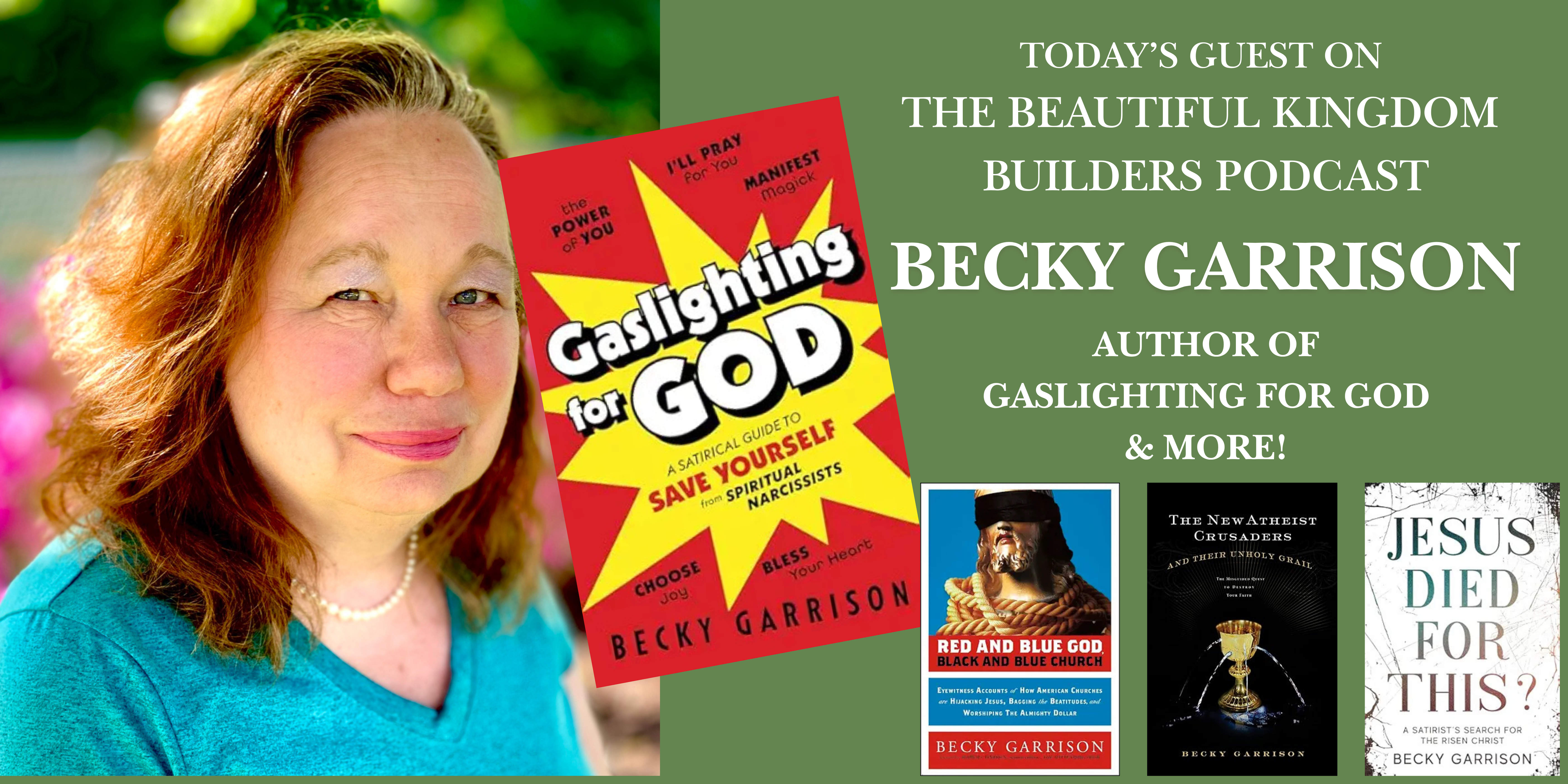
020 I Becky Garrison on Gaslighting for God: Recognizing Spiritual Narcissists and Cultures

Find all of Becky Garrison’s books on Amazon at this link.

I had a lot of fun and a lot of “A ha!” moments reading religious satirist Becky Garrison’s ninth book, Gaslighting for God: A Satirical Guide to Save Yourself from Spiritual Narcissists. Garrison formerly wrote for The Whittenburg Door, a Christian satire magazine. Her social commentary is so insightful. In our conversation, Garrison discusses the intersections of narcissism, gaslighting, and spiritual abuse within religious communities and broader culture. She shares personal experiences, critiques of religious and political figures, and offers guidance on recognizing and resisting narcissistic dynamics. This is a very timely resource and is well-researched and comes from deep expertise.

Key topics in this episode:
Narcissism and spiritual abuse in religious communities
The role of humor and satire in exposing narcissistic dynamics
Personal experiences with narcissistic family and church systems
Connections between political figures like Trump and broader cultural narcissism
Strategies for recognizing and resisting narcissistic manipulation

Here are links for you to follow Garrison’s work:
Buy Gaslighting for God
Becky Garrison Website
Becky Garrison on Substack
YouTube Channel of Becky Garrison

Please enjoy this episode of The Beautiful Kingdom Builders podcast on YouTubeSpotifyApple PodcastsAmazon MusicSubstack, and more

TRANSCRIPT:

Ruth Perry (00:15)
My guest today is author, journalist, and religious satirist, Becky Garrison, whose most recent book is titled, Gaslighting for God, a satirical guide to saving yourself from spiritual narcissists. Thank you so much for being here today, Becky.

Becky (00:26)
Thank you for having me, much appreciated.

Ruth Perry (00:32)
I just finished your book yesterday and I was really amazed by it. It was really powerful. It wasn’t what I was expecting in some ways and then it was so more deep and insightful than I was expecting in other ways. And so I highly God anyone who wants to learn more about gaslighting and narcissism and how this intersects with the Christian church in America. It’s really fantastic.

But as I was reading your book, one of the thoughts that I kept having was, have producers or writers of the show, Righteous Gemstones, reached out to you, Becky? I think you’d be a great writer!

Becky (01:05)
No, they have not and in fact, I mean that show my only quibble with that show is that in real life Prosperity Gospels would never swear in public. We use words like sugar instead of other words. So that that was my only quibble and I don’t think they would have been quite as sexually up But that’s the Danny McBride did. He likes to have men walking around doing things and he did that but other than that he really captured I think the essence of someone even Eli and even his wife, they were still so caught up in their own narcissism that even the sweet, precious, matriarch, she was still narcissistic as all get out. It was more overt versus covert. But there was clearly an evidence that they never really cared about their congregation. They cared about the numbers and the pews and that’s what I think the ultimate definition of a narcissist versus someone who’s self-absorbed. I mean, we all like attention.

You know to be it’s nice to be recognized. It’s nice to get validated. And sometimes when you have a book coming out or another project and you can get full of your own But you can get a little too full of yourself, but then someone can call you out and say hey, wait a minute knock it off. That could not happen with the Righteous Gemstones. They lack empathy. They lack compassion. They had no self-awareness whatsoever of how their actions were impacting others. There’s also a grandiose sense of self. I am better than you. I am a better human being than you. I am smarter than you. If it’s one of those mean girl things, I look better than you. Whatever it is, I am better than other people. Not just I’m for myself, but I’m full of myself a little bit on times.

Ruth Perry (02:36)
I did appreciate towards the end of your book, you did talk about how it is important for us to take some pride in our work and to enjoy the process of creating things and putting things out there and creating community. And because in the back of my mind, I always have this little niggling thing, like I don’t want to be narcissistic, And sometimes,

Like now starting this podcast, I feel really passionate about putting alternative narratives about Christianity out there rather than the toxic forms that are so pervasive. But I don’t want to be narcissistic. And so I really did appreciate that at the end of your book, how you talked about how taking some pride in your work and like enjoying that process is good.

Becky (03:09)
Mmm. Typically, if you’re asking yourself, am I narcissistic? Odds are you’re not. The kind of celebrity who humblebrags, we’re all a little narcissistic or, I just might be narcissistic about that. Yeah, that person’s a flaming narcissist trying to deflect. But a lot of us, it is something that you struggle with. And I think it’s a legitimate struggle. How do you have an open conversation and admitting your humanity? You might look at your podcast when we can go, damn, someone’s doing better than me.

That’s normal, that’s okay to do. It’s acknowledging, it’s an inability, not there’s another human being on the other end and that person matters and they don’t matter as someone who can give you volunteer hours, who can give you their money, who can give you whatever you need from them, the affirmation, the accolades, et cetera, et cetera. But we all have that it’s important. It’s called either high self-esteem healthy narcissism. That’s what gets me to keep going up and keep going. I believe in what I’m doing. I believe in my work. I believe in it passionately and I will defend it and that might maybe come off as a bit of an a-hole. But that’s the difference between that and a narcissist.

Like if someone’s being kind of rude to me and kind of a jerk and I’m a little bit rude back, that might be justified in my behavior. I’m still going to feel a little something. I hurt someone’s feelings. I feel bad and I should feel a little bad because I hurt someone’s feelings. And what am I going to do to make that better? So I can become more regulated so I don’t snap at someone.

Ruth Perry (04:45)
How do you employing humor impactful when you’re having difficult conversations like this?

Becky (04:52)
Well, there’s role of the satirist, if you think of it. He functions as the court jestor. We keep the king honest. I’m thinking, one of my childhood influences was Monty Python. I was a prenatal Episcopalian. My late father was an Episcopal priest and a sociology professor. Do the math, do the ecclesiology. Yep, I was prenatal Episcopalian.

And so the way in which they lampoon the lunacies, you all can laugh at something collectively. And once you can laugh at something and say, my God, this is absolutely ridiculous. It helps break the energy down. And it really gives us a chance to see, because the point of a satirist is if we can break the idol, smash the idol, you can then see the glimpses of God or goodness underneath, but you first must smash the idol. And we’re in a period right now of a lot of idol smashing and that’s where you’re getting a lot of the pushback is that from the most extreme fundamentalist to the most enlightened guru, everyone has their idol and they love it. I mean, the people would love it. The Wittenberg Door, the progressives. I say this in the book when I would satirize a televangelist, all of a sudden we would satirize Jim Wallace, Tony Campallo, Brian McLaren, the whole emergent church gang. And all of a sudden you would have thought that we committed Harry Carrey on.

You know, it was like, and that’s why I did not understand that versus someone like Jerry Jenkins. So I mentioned the book. We satirized him. How can you not satirize the Left Behind series? You have to do that. It is ripe. I we had the plumbers edition, the Cleft Behind, everything. And he wrote us back and said, Hey, this is funny. I’m open for an interview if you’re up for it. And I did it. And we do not agree on probably anything theologically.

Or very few things we would agree on. But we had one the most pleasant conversations because he was a decent human being. You know, he was not a narcissist. He was kind, he was generous. And we had a very pleasant interview. Other people that I’ve agreed with on almost everything, theologically, and then all of a sudden I’ll just critique them and you would have thought that I did something horrible to them. They just go absolutely like Tasmanian Devil Ballistic.

Until the research in the narcissism. I had no clue what was going on. And now I can watch the news I can watch certain progressive pastors and their conservative counterparts and go yep. That’s a narcissistic meltdown. Okay, I don’t have to take that person seriously because you cannot have a dialogue with a narcissist. You can enjoy their entertainment If there’s no abuse involved, I want to make that clear if there’s abuse you should not be supporting this. But if the person is just a full-blown narcissist and you happen to like their music, you like their performance, go see it. It’s enjoyable. Just don’t expect anything beyond the evening’s fun. I think that’s where especially Christians, we’re looking for a form of a community. You cannot have that with a narcissist. And that’s what you have to give up is the hope that you’ll ever have a community with this person.

Ruth Perry (07:40)
So you have developed a very finely tuned narcissism detector, it seems. And then you also say in your book that coupled with that, you have an intense desire to speak truth to pastoral power. So before we dive into the content of your book, I was curious if you would share what is your personal background and experiences that have shaped you in that way.

Becky (07:45)
Okay. I was born to a hippie father from a very old, genteel southern family. He was the black sheep, to put it kindly, who was, I later discovered in my teens was an alcoholic. I’ve now since realized he was also a narcissist. And I realized that the majority of my extended family were narcissists. He married an enabling earth mother type, both of them died from their addictions in the 1970s. And at that time, the research was not there for alcoholism. So there was a lot of blame, a lot of shame. These were the bad people. And the family was displacing them. And I was also the family white elephant spotter, so to speak, in that I would say, why is so-and-so drunk? Why is this happening? I’m seeing something. And I would continuously be told, you’re making that up. That isn’t true. No, you’re not.

So I now have through the research learned that often the oldest child is the one scapegoat, because they’re the ones who can see the truth. My younger brother was the golden child. My younger sister was the golden beauty and I was the loser dreamer. So I was scape. So this dynamic came from my childhood, but yet my father in his research, I mentioned this in the book, he was studying how to reach those on the fringes. He was researching why were some kids joining SDS and others joining JAPUZA. What was it that was attracting these kids to these radical movements? Neither one of which we now have learning was really proven to be very healthy, but why were kids drawn to wanting to make a better difference? And that put them up to be easily manipulated by people that had more nefarious agendas. So that got it started.

When I discovered the Wittenberg Door, was the perfect outlet for all the anger that I felt about the church I mean I did go to divinity school because there’s a side of silly me thought I wanted to be like my father. Until I realized had I done that I don’t think I’d be here today. The church would have crushed me. I see a lot of my friends that have a similar spirit to me and the institutional church just crushed them. They do so much better when they’re outside the church doing their own thing instead of trying to function within what I would say is a highly narcissistic institution that I’m convinced that the institutional church is dead. I think there’s some individual churches doing some great work, but I think their institutional structure is just too necrotic. And through the Wittenberg Door, we began to satirize that. And that led to a lot of things. I did a lot of the faith and politics stuff. I also started when God’s Politics blog became a best seller.

That’s when I started critiquing the progressives and all of a sudden all the progressives that loved the Door, they loved how we went after the conservatives, that’s when they started to hammer us. They could not accept the fact that there could be narcissism in their midst in a more covert form. As one who grew up with the frozen chosen, as you call the Episcopalies, I would say hell yes, it’s rampant.

Ruth Perry (10:47)
I had a friend on, maybe a month ago to share a story of being a survivor of a marriage with a narcissist and her husband is Benjamin L. Corey, a progressive Christian writer about peace and nonviolence. But then in his personal life, just super controlling and passive aggressive and very much a narcissistic sponge, feeding off of my friend. And I’m just at a loss of how does someone like my friend get any justice? For right now, she was alienated from her children because of litigation after their separation. She can’t even see her children. And so it’s such a frustrating situation.

Becky (11:24)
It is and I don’t have an easy answer. I’m not a lawyer. I can’t give legal advice. I did notice that what was interesting I’m thinking about Phillip Yancey, there’s another case that came into play and that was very frustrating in that revelations came out that he had an affair. There was something involving his assistant that sounded a little nefarious. I mean, she died kind of suddenly in a freak climbing accident in a gym.

Ruth Perry (11:33)
Yeah!

Becky (11:47)
Which if you’re an experienced climber, almost never happens. So I’m still, there’s something a little fishy there. I’m just saying, I think in that case, he would never accept your responsibility. He never, he just said, I’m so great. He viewed the women in his life as pawns. And I think the best we can do is you just speak your truth to power. And I’ve been in that situation that she’s been in. When I saw abuse within the US emergent church movement in 2006, I spoke out.

And I got hammered. I got doxxed. I got cyber bullied. I was not was a very unpleasant situation. And the more I learned, I taught myself what gaslighting was and what scapegoating was, I understood the dynamics of what was happening. I learned how to do gray rock. ‘Cause in the beginning. I appeared crazy.

I would be like, what the, you know, what do you mean? I am not jealous. I am simply pointing out the fact that you claim that you’re inclusive and you have one female speaker. And then once the female speaker got on board, she immediately became just like the men because she had to preserve her place of power. So I was simply saying, you’re promoting religionless Christianity. And there’s a hierarchy. There’s a lot of abuse within this system. There’s this private networks that are spreading all kind of stuff. And because I had not

done enough work on myself and my own trauma triggers, I came off as crazy. I’m not going to recreate how I came off, but it was not to my best interest. So the first thing I say to anybody is get your own self together by finding whatever somatic therapy works for you. For me, it was EMDR. If I had not had EMDR, I don’t think I could have written the book because I would have been too triggered by bringing up past traumas. And I think that’s the first thing I would say is have you done your oxygen mask, taking care of yourself. And the second is what did not exist in 2006 that exists now are support groups. When Tony Jones tried to re-emerge as another emergent church speaker, other people all of a sudden started calling his crap out. That did not happen in 2006. Everybody was still part of, I want to be part of the cool kids crap.

Your friend now has other women who have been through something similar. You know Tia Levings has an excellent list of trauma resources on her page. Her book I Belong to Me is coming out in May. I would give it to her as a gift, you know What do you need to do for yourself? And once you get to that point, I think you’ll be in a better place. Your kids are gonna see a different mother They may be so poisoned in top that that you can’t control but you can control your response to a situation and find other people to support. When I had an experience, my first revelation of the narcissism, I had gotten to a professional and personal relationship with a mindfulness therapist who I’d later discovered is a narcissist. A malignant narcissist at best may even have some psychopathic tendencies. I couldn’t tell if he enjoyed inflicting his pain or he just didn’t care.

But I joined a narcissistic support group and I realized, this is 2016, so the research was much newer than it is now. And I realized I’m not alone. Other women have the same experience. This is a pattern. I could not see the pattern because I believed in the promise of whatever this person was preaching. I believed in the goodness. I had a good heart. I’m an empath and my God, we’re magnets for narcissists.

I’m now narcissistic resistant. Narcissists don’t approach me like they used to. You can become narcissistic resistant. They will go to somebody else. And you have to also get over your fear of missing out. And I’m also over my hypervigilance. If I narcissist, someone that I know has extreme narcissistic tendencies, hurting someone else, I’ll just point it out, but I’m not going to try to rescue people. We’ve made so much progress.

We’re in the narcissistic research right now where alcoholism was in 1980. I started the recovery movement actually in 83. And it was very nascent. There wasn’t a whole lot out there, but we were starting to understand that alcoholism was not a mental illness. It was a very complex dynamic that impacted the entire family. And how was I impacted? Being raised in an extended family of alcoholics who I now realize are many of were narcissists, including the ones that aren’t alcoholics. I mean, it was pretty much, I can count on one hand, the number of extended family members I know that are not narcissists, to be honest. And I began to realize a lot of that. And I think for people, find other people, they exist and you’ll develop a network and you’ll discover you’re not alone.

And once you realize you’re not alone, that eliminates so much of the anxiety and pain that you’re feeling. At least that’s been my experience.

Ruth Perry (16:16)
It does seem like narcissism is such a systemic and widespread issue in our culture today. And just listening to you speak, I’m a pastor’s kid as well, although my parents were teetotalers because they both came from alcoholic families. But that same dynamic was still in the family. also ⁓ dynamic those in my family that you name in your book is manipulators and martyrs.

You were quoting Brad Sargent’s friend, Linda O: “Manipulators and martyrs go together in matched pairs,” and I was thinking about how women are conditioned in the church to make ourselves smaller and to be quiet and meek and gentle and so we’re just trained from a very early age to be the martyr. And then we end up in, a lot of us end up in relationships like this where there’s a manipulator. And part of that is the culture training men too, to be this way where they feel entitled to things and they feel special.

Becky (17:00)
Mm-hmm. And then there’s people like me that just push back from the get-go and we’re always excluded. And it’s taking me a long time to develop sympathy for what I call the mean girls. I’ve been thinking about this and I began to realize that, my sister was a classic mean girl. And what it was is she from the beginning was ranked based on her beauty. She was ranked based on her looks, her ability to present. She never did the beauty pageant cheerleader thing.

But that is one of the dynamics, is that we want our women to look a certain way. We want them to appeal to the male gaze. And if you don’t, in the 70s and 80s, you’d be called lesbian, you’d be called, worse, which was really absolutely horrible for women that actually preferred same-sex relationships. To me, to use that term as a slur is just absolutely god-awful. And I kept telling them, no, I’m not a lesbian. I just don’t want a guy that’s going to be like the husband you guys married kind of thing. You know, and you tell people that sometimes you make a conscious decision that given my family dynamics, I decided it was best that I remained unmarried and without children. just decided that is the best. I cannot give a kid a decent family life. And I also need to do a lot of work on myself so I can now find a lot healthier relationships.

And so I made a conscious decision not to involve innocent humans in my family’s dynamic, which was not an easy decision to make, but it was one that I realized I needed to do because it was not be fair to an innocent third party. I think with the me girls, I just realized they got ahead by using their sexuality. They’re the ones that Harvey Weinstein, Jeffrey Epstein, other women preyed on. They wouldn’t have preyed on me because they could tell by looking at me, I wasn’t going to be that compliant. My attraction to narcissism was more the spiritual guru promising this. That’s where I would be attracted to people. But in terms of just the whole mean girl persona, I I resented those women like crazy for quite a while because they could make your life miserable. If you were the little nerdy writer, those kind of women can just make life hell.

And even today, I encounter them sometimes. I’ll do spirits reporting and beer reporting. I’m often the only woman there, so it’s no big deal. But if I do wine reporting, some of those women can just be absolutely mean girl central. And some of the publicists, and and I used to be worried about that. I used to get really like, I don’t fit into these women. Now I realize we’re all going through something, even these women, these beauty queen patterns. You you see these 24 year olds that are dating 60, 70, 80 year olds, it’s not healthy, but they’re going through something on their gotta be something going on, because a lot of the mean girls are not happy. Because if you are really pleased and content with yourself, you don’t need to be an outraging bitch to other people. You don’t need to do that.

What is it about you that makes them feel like in order for them to affirm you, they have to put you down. And over time, I think these women develop a narcissistic core. I don’t know if my sister, she didn’t start out that way, but over time she became more and more self-centered because her looks, that was her currency.

Ruth Perry (20:08)
When I started reading, I thought that you’d talk a lot more about Trump. I was surprised that you didn’t. And the way that evangelical and conservative Christians have embraced him, even though he appears to many people to be a Machiavellian, like the worst kind of just really dark triad personality type narcissist. What connections do you see between spiritual gaslighting and broader cultural patterns in politics and patriarchy and nationalism and all of those intersections.

Becky (20:37)
I had an agent try to sell this book in 2018. The original book proposal was Trump focused. Publishers didn’t want it. They said, we’re done with Trump books. We have enough books. Steve Hassan did the case against Trump. There is the book, Dangerous Case, Bandy Lee edited a book on the dangerous case of Donald Trump, lays it out. She ended up getting fired, by the way, for diagnosing someone which was very questionable, but still you’re not supposed to diagnose.

I believe that Trump is a symptom. We’ve growing up as a kid. Do you remember Lyndon LaRouche? Do you remember these we’ve always had crackpots. We’ve always had nutcases. The question for me was why in 2016 when they were presented with a slate of reasonable Republican candidates The voters chose Trump that is the question that I wanted to answer it to me. That’s a deeper question that was you brewing for some time now. When you look through his story, we’ve had these church splits that have been simmering and simmering Trump is just when it look at 1979, that’s the year the Episcopal Church first ordained women.

It’s also the formation of the Moral Majority. And it was not founded on abortion. Abortion came out in 1973. Naveen Jeltsin did not give a hoot. Jerry Falwell was quoted, That’s a Catholic issue. But they were really upset about was interracial dating and that’s why they really formed. But they pretty soon had to do, we have to do a family-friendly thing because even in 79 you couldn’t say we’re the white party. You just could not say that and get elected in 79. So we had the Moral Majority.

And then you look at the year I started writing for the Wittenberg Door, 1994 was the year the Republicans took over Congress with the Christian Coalition. And we thought, wow, that’s going to be… And then you found Clinton in 96. In addition to the Monica Lewinsky scandal, he also formed the DLC, which really started to alienate a lot of progressives. You can see a lot of these shifts starting to happen in a lot of years.

We thought in 2008 when Obama was elected, he was the first president to acknowledge atheists at the National Prayer Breakfast. We thought we’re hitting this progressive revolution. in 2016, I was really excited. The DNC put up the most diverse list of candidates ever. We had people of color. We had a gay man, more women, this dynamic lineup. The DNC stacked the deck and gave us Hillary.

And that was the moment I said, we’re going to get President Trump. And my friends who are progressive said, you’re wrong. I said, no. The will of the people were ignored. You have enough Bernie bros that want change. They’re going to vote for change. They did. And that’s how we got Trump. And then in 2020, the Democrats again, had a pretty good lineup, not quite as diverse. They gave us Biden, who we did not want. I felt that the progressives kept stacking the deck and further frustrating. And when people get frustrated and they feel like no one’s listening to them, that’s when they’re susceptible to cult dynamics. That’s when they’re susceptible to saying to they’re not listening to you.

Because guess what? They weren’t. And if people feel that no one is listening to them, they will go to someone who is telling them exactly what they need to hear. That is the moment when people are the most susceptible to joining cults. I think that’s what happened in 2020. And then in 2024, well, we’re going to give you Biden again, even though you don’t really want him. And then at the last minute, we’re going to switch aroo and give you Kamala, who never won a primary, she was never the most popular candidate. And then boom, Trump gets elected again.

I’m looking at this from a broader perspective. I also think that people did not realize in 2024 how bad it was going to get. I think they thought they were taking a malignant narcissist who didn’t care about anybody, but he was going to keep America out of war. He was going keep America first. He was going do something with sensible immigrant. don’t know if sensible is not the word I’ve used, but I think people thought it was going be a continuation of the first term. I don’t think they thought that you could get worse than Sarah Huckabee Sanders. I don’t think they thought you could get worse than Jeff Sessions and Richard Barr. I don’t think they could get worse than whoever was his defense secretary. I mean, the moment Pete Hegsath and they changed his Department of War, this is when I felt it went from malignant narcissism to Machiavellianism. Because in the beginning, I do think there’s a sense that, and anybody who lives in New York City knows this, he does not care about anybody but himself. He’s mobbed up.

The media wanted this conflict circus. I think if we had investigated his ties to Roy Cohn, for example, really thoroughly, this was scary. Roy Cohn was Joseph McCarthy’s lawyer. That was Trump’s lawyer. Roy Cohn repped several mob families. He introduced him to these mob families. And the media didn’t investigate that because I think they wanted the Hillary Trump matchup. That was great for ratings.

putting Biden against Trump, that was hysterical. I mean, that was like watching a really bad Saturday Night Live sketch to watch those two men debate. I was watching this going, no matter who gets elected, we’re either going to be screwed or absolutely completely effed. And in 2024, when they did the switcheroo, I said, this is not, we’re going to get Trump again. And I just knew it. I didn’t know how bad it was going to be.

What people might want to realize is that there’s a difference between a malignant narcissist and full-blown cult. The distinction is a cult leader by nature is an extreme narcissist. They’re also a psychopath, meaning they enjoy what they’re doing. A narcissist doesn’t care a psychopath enjoys. That’s how I distinguish it. And the Machiavellian nature is they want to take over the world. They want domination over their entire universe.

Whereas in our society it just wants to be number one. They don’t feel the need to dominate. They need to be the center of attention, but there’s not this need for the world domination that you see now. And we’ve got ourselves into this pickle and I don’t see the Democrats and the progressives offering candidates that are really going to get us out of it. At least on the presidential level. On the local level, yes, that’s why I’m shifting my focus somewhat, I think we could help rebuild at the local level. How do we care for our neighbor? There’s a difference between Trump and MAGA, and I make that distinction. And where we go from here, I’m not gonna be a politician, I’m not gonna be a fortune teller, but that’s why I didn’t make it Trump specific because this is gonna continue when he’s gone. MAGA is gonna be here. And there are also ardent progressives.

And I think it would help to look at what were legitimate concerns that people had the progressives ignored. And that’s the beginning of a step of healing is to look at that component. Like how many women who were MAHA, they just wanted alternative treatments for their kids. A lot of them, they were not full blown MAGA, but all of sudden they felt the Big Pharma was telling them how to rule their lives.

The Big Pharma was calling them idiots or education was calling them idiots for wanting to homeschool their kids. They wanted to do alternative things that were legal and justified and they were not allowed to do it. You know, women were trying to give their little kid who has epilepsy, giving him CBD and discovering it worked and then being told they couldn’t give it. They had to give the kid pharma drug that A, they couldn’t afford and B, cause their kid to be sick. What would have happened if the women who were interested in natural health had been taken more seriously, would they have gone full blown? So you always have to think of what could you have done? Were you so full of your own hubris and your own self-righteousness that you didn’t listen to what other people were asking and demanding? And I think that’s where I’m seeing the progressive movement is, is are they willing to listen to alternative views?

There’s a large group of people that I think are dissatisfied with everything. What are they going to do about that dissatisfaction? Where can they put that?

Ruth Perry (28:17)
So what is it narcissistic personalities that both woo and wound people?

Becky (28:23)
I would call it the Jekyll-Hyde syndrome. They can be incredibly charismatic. They’re also very tuned into when you’re vulnerable. You see this with certain rather nefarious dating coaches is I will give you what you’re looking for. You’re looking for women empowerment. You’re looking to explore your female sexuality. You’re looking to do better your business. You’re looking to be a better mother. Whatever you are looking for that you’re not finding, they have the answer. And they will just love bomb you to bits. They will give you everything you want. And to the point where you don’t realize how much money you’re spending, how much time you’re spending, because you’re getting that fix. You’re getting that high. You’re getting that adrenaline rush, that oxycutin. You’re getting that, ooh, that dopamine hit. It feels so good to finally be recognized, especially if you come from a background where you haven’t been recognized.

And then the moment, the nanosecond, you disagree. The moment you say, I can’t afford to pay it this month, I need to take some time for myself, I need to step back a little bit. Whatever, you have just drained them of their narcissistic supply. The moment you cut it off, they will turn into to Mr. Hyde and do what is called narcissistic collapse. They will go completely irrational. I think for a lot of us, we do get disappointed. If someone cancels on you last minute, you’re going to be disappointed. But that’s different than someone going completely ballistic. It’s someone saying, I’m disappointed that we’re not making this projections right. What can we do to make this better versus I’m disappointed in you for failing?

After you have a narcissistic collapse hit you, you sit there going what the hell just happened? It’s not as simple like I need to have a talk with you about your work performance or we need to discuss you being a bit cleaner or bit whatever. It’s complete annihilation of you or all of sudden they get with a one out of you, you wrote those three articles I needed you to write to make me feel good, okay, bye, I’m gone. They took what they needed from you and then they left you. Just bye. And you’re starting going, what the hell just happened here? And their words don’t match their actions. And after a while, you start to find yourself going crazy, which is why I find it very helpful to identify the pattern because it keeps you from going crazy.

Now I can identify it and I go, okay, that person’s having narcissistic collapse. I’m going to treat him like a three year old, a toddler. Just walk away. I’m not going to engage. You cannot rationalize with a toddler. You cannot be reasonable. And if you give him his binky or his Nobel Peace Prize, it’s not going to solve anything. It’s a temporary, it’s like a pacifier situation. They’re going to continue to escalate. This is not going to stop until you walk away and then let them find somebody else. And over time, it starts to crumble. And that’s what you’re seeing now is the starting of the crumbling.

Maybe I’m too naive to think that, but I do believe, and I’m looking at the Epstein files to me as the beginning of a revelation of we’re finally starting to see a lot of stuff start to crumble. And that’s a good thing. I say, hallelujah.

Ruth Perry (31:14)
What is the connection to and sex abuse in these kind of high control groups?

Becky (31:20)
Because they can. I do not understand the attraction to children. I do not understand why any man would want to have a relationship with someone who’s not age appropriate. I don’t get it. And I think that some of it is these men do not want adult relationships. They want relationships they can control. Men have always wanted, some have wanted significant younger women, and there’s always women who are willing naive enough.

In the case of children, you start to tell a kid who comes from a very broken home who’s never had any kind of love. They’re so susceptible to being loved bombed. And all of a sudden they’ve never had anything. Wow, I got a couple hundred dollars just for doing this little act. Can’t be that bad. And then before they know it, they’ve been trafficked beyond their beliefs because they didn’t understand what was going on. They didn’t understand the dynamics. An older woman would walk into that and go, what the hell?

But then I’m dealing, like I’m looking into something, as you might have there was a UMC minister in Missouri and she the executive assistant and then the grounds manager for Epstein Island. claims she didn’t see anything. At the time she was studying to be a minister, as I understand And the UMC has suspended her pending investigation because they feel that her involvement this case went against the UMC’s code of ethics around treatment of women. Hallelujah for small victories. However, I’m very shocked that she claimed she saw nothing. I mean, you see the photos of the house. You didn’t think it was odd there was a dentist chair in there. You didn’t think it was odd there were photos of underage girls. There was like Lolita on steroids.

You’re a pastor and I don’t expect a pastor to be a complete intuitive, because we all have different personality types. But if you’re a pastor and you don’t think there’s something wrong with unaccompanied minors getting off of a plane to meet a group of old men, if your spidey sense doesn’t do anything and you claim you saw nothing, then you’re not qualified to be a minister because at a basic core. A minister needs to notice when something that serious is going on. I would expect a pastor to know that youth minister is getting a little too handsy. Yes, that volunteer is being inappropriate. If you can’t even see something as blatantly obvious as underage girls, unaccompanied often with a lot of older men, and you think this is just a pool party, you’re not qualified for ordained ministry.

And the fact that she got called out on it, I’m glad the UMC is doing the right thing. What no one has figured out is how did she meet I want to know how did a UMC minister from Missouri meet Jeffrey Epstein and get offered that job? So always interested in looking at the connections because Epstein has made some referrals. He referred Eric Metaxas’ book to somebody.

Ruth Perry (33:59)
Yeah.

Becky (34:02)
No, I take it back, Ken Starr referred Eric Metaxas’ book to him. And then there was an instance where he forwarded on Rick Warren’s newsletter. Well, okay, what is Ken Starr doing referring the book written by the guy who was one earliest Trump supporters? Eric Metaxas was supporting Trump before anybody else did, just about. So he was a key figure in helping Trump get elected. Why is Ken Barr recommending this Bonhoeffer book, the book is terrible. Every scholar said it’s terrible. Then you have other, references like that. Epstein recommended Dobson’s Dare to Discipline book to a young survivor who was having problems with her family. These are very evangelical books. How are they getting into that network? So far that’s the only Christian connection I’ve been able to find.

Deepak Chopra is another thing. He claims I didn’t do anything inappropriate. And you’re sitting here discussing how, you know, God is a construct, cute girls are real. And I would never go to a guru that said that. That is disgusting. I mean, that is just the way he’s discussing about girls. Like, did you bring me girls? Did you bring me girls? You’re a grown adult male who is responsible, thanks to Oprah in large part, for bringing in all of these concepts of the East to the West. Oprah basically, now that we’ve realized, was a walking show for predators. She gave us Dr. Phil, she gave us Dr. Oz, she gave us the anti-vax movement. She supported John of God. And if you Google John of God in Brazil, he is in jail bizarre medical experiments and pedophilia.

So I think we have to look at ourselves and why did we ever trust Oprah? She’s not trustworthy. Look at all the people she’s introduced us to. She never took any responsibility. She also introduced us to the secret of Dr. Lisa Rankin is someone that I would recommend your listeners check out. She’s one of the people that spoke on Deepak’s stage, one of the few people speaking out. All these people that stood and profited by being connected to Deepak have not spoken out. And yet she did. A few people are speaking out. There’s some outliers who are saying, I’m willing to risk my book contract. I’m willing to risk my speaking, my place on the center stage. I’m willing to do what needs to be done to make this right. Now, why they didn’t speak out before is another story, but they’re speaking out now. And I think this is similar to the Weinstein in the Cosby case. It takes a while to convince people that someone this powerful is this evil.

Ruth Perry (36:24)
I had a funny interaction. I met Eric Metaxas seven or eight years ago. I was homeschooling my children by day and waitressing by night. And I live in the vicinity of Liberty University. And he had a group of conservative influencers at dinner at the steakhouse. And they were there for some event at the Falkirk Center at Liberty. And after the dinner, Eric Metaxas was standing up and he asked me if I knew who he was. And I said, I do know who you are. And he said, that’s so nice. I’m going to let my wife know that you said that. What did I say?

Becky (36:57)
I interviewed him for The Door and this is before the Wilberforce book. He was anti post veggie tales, not quite the best selling author. And it was one of most worst interviews of my life. It’s just all the oxygen in the room was sucked out and he was incredibly full of himself.

But what I appreciate about that was that I could get it, I knew to stay away from it from get-go. It was the progressives. Like I was drawn in to Nadia Bolz Weber, Pete Rollins, that more progressive line of thought. And actually I endorsed some of their stuff in the beginning, because in the beginning it sounded really good. So then all of sudden the moment they became bestselling authors, or if not bestselling in the case of Rollins, the moment they got their little click going.

It was just all of a sudden, ooh, wow. I mean, they were just as obnoxious as Eric Metaxas, but in a slightly subtler way. And it can be really when someone writes something that you believe and then you meet them and you go, crap. And so I’m telling people, take what’s good. Okay, if they wrote something that you enjoy, acknowledge that. There’s nothing wrong with you for taking someone’s words and saying, that word’s really…

Move me but just know that person didn’t live out those teachings, you know and try to find people that did live out those teachings They exist. I mean Henri Nouwen, there was never anything about him and he’s someone that I continue to rely on yes, there were some abuses within the community for him, but it was after his death. He had nothing to do with that There are a lot of good spiritual thinkers that don’t engage in this. So the question is don’t kick yourself, but then look and say where can I find better fruit?

Where can I find fruit from people who like that? Which is why I continue to recommend Tia Leving. There’s a lot of people in the religious trauma field that I tell people, be careful. Similar to the recovery movement. There’s people out there wanting to make a name for themselves as deconstruction coaches, religious trauma coaches, whatever you want to help someone with their faith. And that’s why I say I’m a writer. I mean, have an MSW.

Actually clinical social work is going to be particular, but I’m not licensed right now and I am going to sell myself as a writer. I am not going to sell myself as a life coach. I’m gonna stay in my own lane, I’m gonna leave that up to qualified trauma therapists who are working currently in that field and I will provide the education to hopefully give people the awareness that yeah maybe that kind of help would be helpful for me. But there are, a lot of people out there trying to sell you their own shtick and there’s some really good solid voices. And it’s important to kind of distinguish between the two of them. And it takes a while. I mean, to me, one of the biggest things is do you get a sense of community around them? Do you get a sense of care?

Or it’s all about them and their accomplishments and what they can do and what their success rate And we’re kind of in this gray kind of new frontier. The research in the narcissism is only about 10 years old. You still have a lot of therapists that think religious trauma is BS. They don’t think that you get trauma from a religious experience. So there’s a lot of education that needs to happen. Similar to where I said where alcoholism was in the 1980s.

Ruth Perry (40:00)
I also had EMDR therapy because I realized been reading about religious trauma for a long and it didn’t ever occur to me that I had religious trauma. But then it kind of clicked in place after many years of like myself just trying to make sense of all the different things I had experienced in the church and often very painful and things and having that EMDR therapy was extremely helpful.

Becky (40:26)
Oh yeah, and it’s not the only form of therapy that could work. There are other somatic forms. There’s brain spotting, emotional isometrics, a lot of different treatments. And you find a therapist that works for you. How I chose my therapist for EMDR is I began to ask and see, did she really listen to me? Like I described to her that I didn’t want to get married. I didn’t want to have kids. And I was describing my relationship status and whatnot.

I look to see in her eyes, was she judging You know, is saying that whatever choices, if I make healthy legal lifestyle choices, those should be mine. Like if you want to legally choose to be a sex, if you want to become a sex worker, that’s your personal decision versus being coerced into something. So I’d say when you go to a therapist, how does that therapist treat you? Do you get any kind of a creepy vibe? Get the hell out of there.

Find another therapist. There’s plenty of therapists that do EMDR, that do somatic work. And a lot of that is for women. Your gut is such a good tool and we don’t use it. We kind of just say, I’m not feeling good. I’ll just go take some Pepto-Bismol. We don’t tune into why are you feeling that? No, don’t medicate that. Don’t drink it away. You don’t need a glass of wine to deal with this. Think of why you’re feeling this way.

And that tells you something isn’t quite right. Now, this therapist might be right for somebody else, but it’s not right for you. Not everything is narcissistic. But something just might not be right for you. The more you’re in tune with what you need and what you want, you’re not going to be coerced into just doing and going along with what everybody else says.

And you also don’t hear what the mean girls say, which for women, I think that’s something that we really need to focus on because a lot of the mean girls got ahead and those of us who weren’t mean girls didn’t get the job. But what I’m starting to realize now is they paid a price for getting that job. They have had to sacrifice their looks. I mean, we can make fun of Maro Lago face all we want, but those women had to subject whoever they are to so deep inside of them that it’s almost like there’s not a person there anymore. I don’t know if they were born that way, I don’t know a lot of their childhoods, but they’ve become an incredibly self-centered narcissistic person that can only think of themselves from their own lens of beauty. And they’re doing whatever they can do to maintain their place of power. That is clearly a narcissistic move. I don’t know how many of them started out that way.

I suspect it’s like my sister that they were told from a very young age, they’re beautiful. Were never told they were smart. Were never told they could do whatever they wanted to do. So they began to focus primarily on developing their looks. And as they got to be in their thirties and forties, it got even harsher. You know, they had to continue to maintain that persona.

Ruth Perry (43:02)
Well, your book is a very helpful guide, social commentary that you give and your insight and how well you understand what is going on and how well you describe all these terms mean. Narcissism, gaslighting, the echo chamber. There’s so many different things that you describe and explain and it seems like you’ve read a hundred books in the process of writing this book.

Becky (43:24)
Well, it helps to read all the research that’s out there. And in fact, a lot of the narcissism books, what I didn’t like about it was they were focusing on dating, or parenting, which I think is an important thing. But it was also having a black and white view. And I take a gray view, which is why I said, if something’s risen to the level of malignancy, like what I was finding in the U.S. Emergent Church world, then I feel it’s wrong to participate in that group’s activities because you’re supporting an abusive culture. But if someone is just a full blown self-centered narcissist, but yet you enjoy their comedy show, I we don’t evaluate musicians or actresses or we say we like the show. And I found that by looking at something like, okay, I like your show. It really changes how I feel because I’m not looking to form a community.

I’m looking to have an enjoyable evening enjoying the social lubricant because we all need some degree of social lubricant. We have a loneliness epidemic. But I’ve also learned it’s okay to be alone. It’s better to be alone than to be trying to get the approval of a narcissistic system, a narcissistic community. And I was one of these Uber volunteers. I love to help. And for me, just pulling back and saying, nope, not going to do it. That’s been life changing for me truly.

And you can find communities that care. I go to tasting rooms like Misara, this winery run by a Persian winemaker and have an incredibly connected experience. At Kristoff Farms, Nick Kristoff and his wife, they do cider and community building conversations through cider and their Pinot Noir wines. There ways, even though you can say, oh, this one aspect of the industry is very narcissistic and superficial and only cares about wine scores and who’s this and who’s that. There’s another side that’s really connective and really community and grounded in sustainability. And I tell people, my reporting, I look to do stuff that’s reporting on sustainability, community, spirituality. And I consciously look for things that have those elements. If they don’t have it, I might say, this is a nice evening. Nice dinner, nice glass of wine, nice music, nice show. But I’m not gonna expect that to be my community connective place. I’m gonna go to those community connective places that really care about me. And it’s life changing once you can learn to make that shift. And I wish the best for everybody. But take care of yourself, for your friend and find other people.

There are other people like you. This is emerging as more and more of us start to come to these awarenesses. We’re finding other support groups. Tons of podcasts. I’ve been on a number of them and you know, there’s a lot of conversations happening, how to find authenticity. I think people are searching for that in this world. And I don’t think you can find it at the national level, but I think you can find it at the grassroots level.

Ruth Perry (46:02)
Thank you so much for all the work you’ve done to be a guide to others into this more hopeful and healthy way to live. Where is the best place for people to find you online and find your work?

Becky (46:12)
Well, it’s available to any online, most online retailers. My sub stack is, you Google Becky Garrison or Gaslighting for God. It’s my sub stack. That’s where I post a number of pieces. I also have a Facebook author page, Becky Garrison writer, and then an Instagram is Becky underscore Garrison. I’m also on LinkedIn as Becky Garrison and there’s a YouTube channel. So, but I don’t use the latter two that frequently. I’m also moving more and more towards Substack because I find out can have more substantial conversations there. The noise in Meta Universe is just not helpful and I’m not going to pay to play with Mark Zuckerberg. He does not deserve my money.

Ruth Perry (46:49)
Well thank you so much for being here today Becky. Would you like to have the last word before we sign off?

Becky (46:53)
No, well, just thank you for the work that you’re doing as well. I have not lost my optimism that first drew me to narcissistic energies. I just am now being far more discerning. I would say to them, be an optimist, but also be a discerning optimist, not a naive.

Ruth Perry (47:09)
Alright, thank you so much. God bless, Becky.

Becky (47:11)
You too, thank you so much.


Did you enjoy this episode? Please subscribe, rate or review us on YouTubeSpotifyApple PodcastsAmazon MusicSubstack, and more! Your support means the world. God bless!

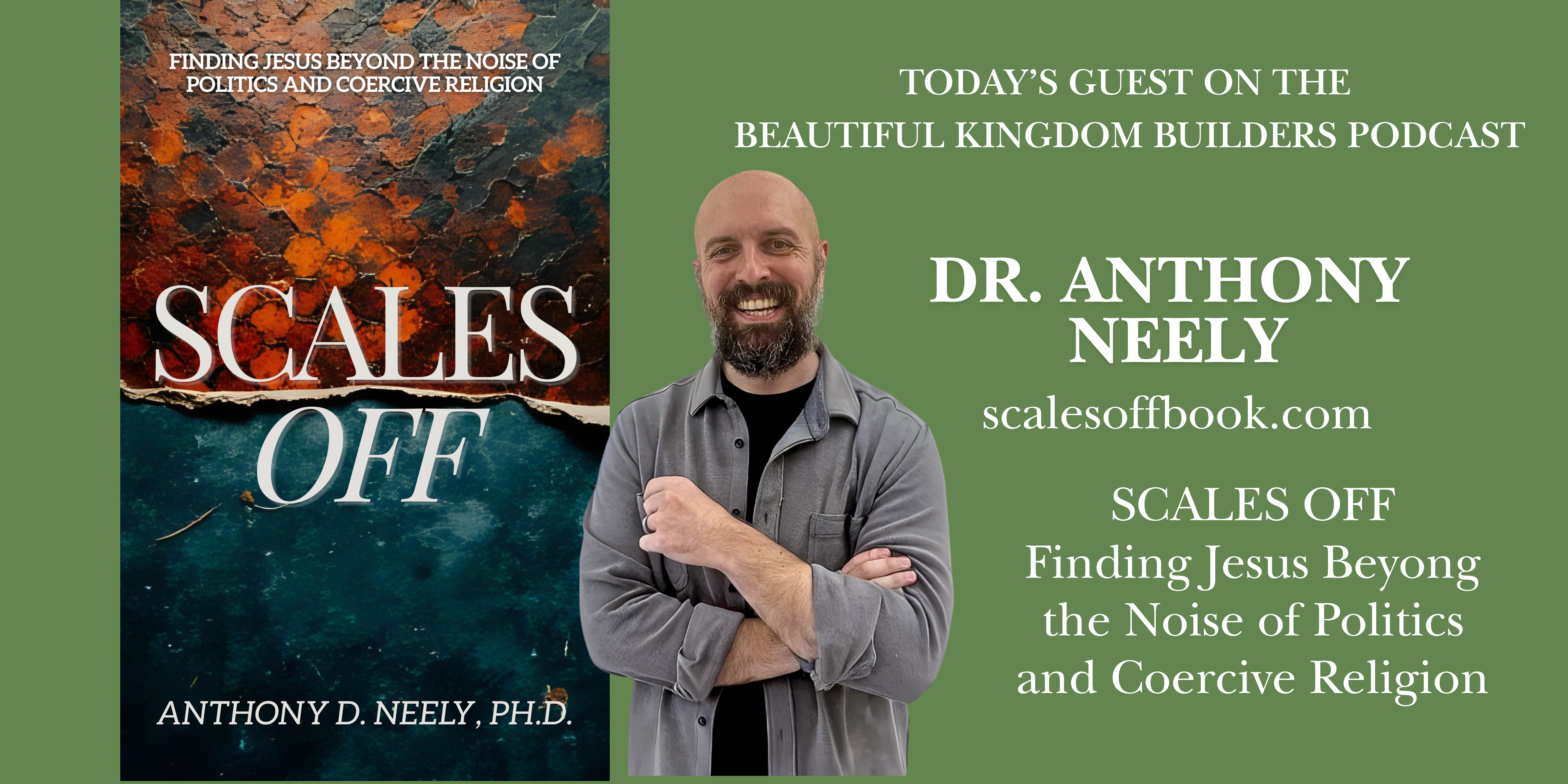
013 I Dr. Anthony Neely on Finding Jesus in a Noisy World

Find SCALES OFF: Finding Jesus Beyond the Noise of Politics and Coercive Religion on Amazon or ScalesOffBook.com

I am delighted to share this conversation with you with Dr. Anthony Neely (Tony) about his amazing book, Scales Off. In this conversation, Tony shares his journey of faith and explores the impact of coercive religion and Christian nationalism on his personal beliefs. He discusses the emotional experiences of recognition and reorientation, emphasizing the importance of re-centering on Christ and fostering healthy relationships within communities. Neely highlights the significance of vulnerability, grace, and the influence of figures like Rich Mullins and Brennan Manning in finding hope and wholeness amidst spiritual struggles.

I loved reading Tony’s book and found it to be extremely well-structured, enlightening and educational, pastoral, and most of all, hopeful. This is an important resource for Christians today who are trying to make sense of what happened to our faith. Tony includes questions and a reflection prayer at the end of each chapter, which would make this a great book group selection. And he ends his book with an appendix of resources, including a Spotify playlist that I can’t stop listening to.

Visit scalesoffbook.com to learn more about Tony’s book, reach out to Tony with any questions or comments, and he even graciously offered to send a free ebook to anyone who cannot afford to purchase it!! I cannot recommend this book enough to you. I nearly highlighted the whole book.

In our conversation, Tony recommends reading Andrew Whitehead and Tim Alberta on Christian Nationalism. And he mentioned his wife’s love of Martyn Lloyd Jones books.

You can listen to our conversation on The Beautiful Kingdom Builders Podcast on YouTubeSpotifyApple PodcastsAmazon Music, Substack, and more! If you find our conversation helpful, please share it with a friend, rate and review, and subscribe so you never miss an episode!

TRANSCRIPT:

Ruth Perry (00:15)
My guest today is Dr. Anthony Neely, who wrote the book Scales Off: Finding Jesus Beyond the Noise of Politics and Coercive Religion. I just finished Scales Off this week and it was a beautiful book that resonated with me so much with my own faith journey and I just highly recommend your work. Tony, right?

Anthony Neely (00:21)
Okay.

Ruth Perry (00:38)
So welcome to the Beautiful Kingdom Builders podcast, Tony.

Anthony Neely (00:41)
Yes ma’am. Yes ma’am.

Ruth, thank you so much for having me. It’s really, really kind the fact that the book resonated with you and kind of spoke to your own story. That means a lot to me.

Ruth Perry (00:47)
It, I mean, everything you wrote resonated. The whole book from start to finish. I just was really impressed with the language that you gave to this experience that I think a lot of people are going through right now with disillusionment with what the church has become in the last several decades and how that disillusionment can either leave us completely separated from our faith or we have to find a new way of imagining our faith and so this is just a perfect and beautiful guide to that and the whole tone of your book is very gracious and pastoral and so it casts a really beautiful vision of what could be and what ought to be the church and what Jesus’ heart is for his kingdom and his values and I just thank you. It was obviously a lot of work and a lot of experience and expertise behind this book and so I’m excited to get into it with you. But before we talk about it, first could you tell me more about yourself and your faith journey, Tony?

Anthony Neely (01:48)
Sure, faith journey, I grew up in a family that wasn’t very religious. In fact, I had an uncle and aunt who identify as Christians, everybody else in my family, it was just kind of be a good person. Wonderful, lovely, lovely people grew up, well-provided for. However, kind of understanding of faith was, you God is in charge of good things. Devil’s in charge of bad things. And very much so this kind of workspace mentality of there’s this giant scale. And if you have more good than bad, then, you know, one day you get to go to heaven and bad people go to hell. And it wasn’t until my family relocated from the Chicago area when I was a kid to middle Tennessee, I grew up in a small town in Cookville, Tennessee.

Down from me lived a guy named Bill Farrell. He just loved him some Jesus. Even as a middle school kid, he loved him some Jesus and was always inviting me to go to church with him and always trying to get me to come to his youth group. And I wasn’t really interested in it. And then he had convinced me to go to a Super Bowl party with him. And he was like, there’s gonna be free pizza. was like, I’m a fat kid at heart. So bring on all the pizza. And he also tricked me because he had said that there was a girl that he knew that I liked who was going to be there.

And so I was like, yeah, let’s go to the Super Bowl party. He didn’t tell me that the Super Bowl party was taking place at a church, so a little sneaky sneaky there, but we got in and halftime during the Super Bowl game Jeff Hall who was a kicker for the Tennessee Balls at the time got up and it was the first time in my life that I’d ever heard the gospel. And it resonated with me in such a way that I call it the working of the Spirit, call it whatever you want to call it from that point on. I was like, I want to follow this Jesus guy because this guy’s talking about in a way that I’ve never heard of it.

And so I think from then, like every person, you know, there have been mountain tops and there have been valleys and there have been struggles and there have been times like now, extreme cognitive dissonance and trying to work through this. But it’s been a beautiful, beautiful walk in this life. And God has been so incredibly kind and gracious to bless me with a lot of opportunities. I’m a musician, so I’ve been able to help lead worship all over the country and work with touring musicians and play at camps and be a recording artist.

He was gracious enough to allow me to become a teacher. And so I’ve been able to try to act out my faith and just loving the next generation and trying to encourage them to, you know, be good human beings. He’s given me a wonderful family and yeah, I’m more and more the older that guy. I just turned 40, just stopping to recognize just how kind God has been to me throughout my life and that just speaks a little bit to my experiences has just been this overwhelming kindness and graciousness that God’s me with hiccups of, I don’t know if I can say WTF on here, but like those moments of what in the world is going on and that’s kind of been where this book came from was about 10 years ago.

It was like this tradition that I had grown up in and come up in and had been discipled by and then, you know, loved so well, I started realizing things are changing. Things are happening. People are saying things. are identifying with things that in many ways are in direct opposition to what I had been taught about Jesus and what I had been showed and discipled to what it looks like to follow Jesus. And the idea of like scales falling off. Like, am I the only person who sees this? And for a long time, it felt that way. And so the book really comes from a place of just trying to unpack and understand what in the world is going on. What’s happening to, the body of Christ here in the United States?

Ruth Perry (05:54)
10 years ago, where were you in your ministry? I’m also curious to know what your education background is.

Anthony Neely (06:01)
So 10 years ago, I was still very active and am still very active worship. So I was still serving at a church, involved with small groups, wife and I helping out with kids ministry, things like that. So I mean, still very highly involved. When we went to graduate school in Texas, I can speak to that here in a second, but at one point I was, I think serving at three or four different churches.

So I was constantly engaged in service. So there was never this moment of, I’m de-converting, I’m falling away. Any of that, it was just, is anybody else seeing this? Why is everybody seem to be okay with what’s going on right now? And so as far as education background, I do have my PhD. So I have bachelor’s and secondary education, master’s in educational theory.

My doctorate in curriculum and structure is from the University of Texas at Pantoneo. Go runners. And so jokingly say I went to school to teach teachers how to teach. And my wife is a college professor. I always tell students I’m the chubby bald-bearded one. She’s the beautiful, brilliant Dr. Neely.

And so yeah, I kind of came from a background of research and writing and before this book I’d already published two other books but this was the first time that I had ever published something that was so heart on my sleeve, transparent, talking about my own faith journey and trying to help others in theirs.

Ruth Perry (07:23)
All right, let me see. So in your book, you organize it with a really beautiful framework of recognition, reorientation, relationships and community, and then wholeness and hope. And so I thought we could talk through your book, through that framework, and start with recognition. Can you tell us what recognition is in this Scales Off process?

Anthony Neely (07:46)
Yeah, absolutely. When you start realizing, like I mentioned a second ago, that things are adding up. I’ve been taught and told that following Jesus is supposed to look like X, but now everybody, not everybody, but a large swath of people seem to be caught up in the movement that’s saying that it’s actually this thing over here is Y. And that led to just a lot of trying to process how much of what I’ve been taught is actually based in the teachings of Jesus versus what I was taught as being essentially called Spade and Spade, a form of manipulation, a form of requiring adherence to a framework that doesn’t really have anything to do with Jesus at all.

And so the book itself really a, I’m joking to it’s 10 years of late night conversations between my wife and I after our kids were in bed and neither one of us can sleep and we’re talking through what’s going on. It’s lots and lots of text messages back and forth with friends. It’s diving in to book after book after book and podcast after podcast. Just trying to see the old adage, am I crazy or is everyone else crazy?

And I never intended to write this book. It actually started out as journaling and it started out as lots of voice notes in my phone of me just trying to process what was happening. And I mean, we’re beating around the bush here, obviously, the explosion of MAGA, the alignment of the American Evangelical Church with far-right Christian nationalism, all of this kind of coming together. And it started out from that journaling, I wrote a poem. Because I’m very much so a creative. Growing up in like the Southern Baptist tradition, I never really fit the mold of like, you know, hunting and the men’s wild game dinners. I’ve always been a hey, let’s go to a poetry reading and then the symphony or whatever. But it started out, I was like, okay, I have all these thoughts. have all these ideas.

Ruth Perry (09:48)
I would love to hear it!

Anthony Neely (09:49)
I’ll share that here in just a moment. And it scratched the itch of going through my own processing. This very much so was a therapeutic process for me. Because I was like, don’t want to leave Jesus behind. I don’t want to my faith. I do want to, I’m going to use the four letter word “deconstruct” some of these ideals that maybe aren’t necessarily aligned to the teachings of Jesus. And so I just kept writing and writing and writing and writing and writing and eventually what was largely stream of consciousness started to take on the form of the book itself. And so a lot of this came from just, again, me working through my own hang-ups with what I was seeing in the world.

And so, yeah, I’ll share this poem with you that is where the book was birthed from.

So the poem is called Come Home. So it says,

“Come Home” by Anthony D. Neely

I remember what it felt like
to belong.
To believe.
To sit beneath the steeple
with hands lifted high
and eyes closed tight,
certain that we were the light of the world.
Salt of the earth.
A city on a hill.

I still remember.

I remember Sunday mornings
when grace hung in the air like incense.
when we wept for the hurting
and we prayed for the lost —
and meant it.

But then…something changed.

You told me to love the least of these.
So I did.

And you called me a radical.

You taught me that every life is sacred.
So I said:
Yes. Amen. From womb to tomb.
That a child deserves more
than a heartbeat bill —
they deserve a full belly,
a safe school,
a mother with healthcare,
a father with a livable wage.

You said that made me
a leftist.
A socialist.

But I was just trying
to be consistent.

You raised me to be pro-life,
but only part of the way.
Only until the birth certificate was signed.
Only until the taxes got too costly.

You taught me to hold leaders
to higher standards.
To speak truth.
To seek righteousness.
Until the red hat came along.
And suddenly character didn’t count.
Suddenly truth was negotiable.
Suddenly I was the enemy
for not falling in line.

You sang, This world is not our home,
but then you clung to power
like it was a lifeboat.
Wrapped the gospel in a flag.
Put your hope in policies
and forgot the poor.

You told me my allegiance
was to a King and a Kingdom —
but condemned me when I said
His Kingdom isn’t built
on Capitol Hill.

Still —
I believe in repentance, new life, and resurrection.

So I’m holding out hope.
Hope that you’ll remember
the table is wide,
His yoke is easy,
and the burden —
is love.

And if you ever find yourself
tired of fighting,
tired of pretending,
tired of defending idols
in His name…

You don’t have to explain.
You don’t have to earn your way back.

Just listen.

There’s still a voice
in the quiet places
calling you —
and me —
and all of us —
to return.

Come home, come home.
Ye who are weary, come home.
Earnestly, tenderly, Jesus is calling,
Calling, O sinner, come home.

And so that’s where this kind of started was I got the poem written, but then it was like my brain still couldn’t turn off. I had so much more to say, so much more to get out. And I just kept writing.

Ruth Perry (12:49)
I’m so glad you read that poem. That was so powerful. I mean, it’s really beautiful just to hear that and that that’s the framework of your entire book too. That it ends with hope and with invitation and that there’s so much freedom and so much joy and so much available to us if we can allow ourselves to go through that painful process of letting the scales fall off and reimagining something better and new. And something old, actually. Something faithful.

Anthony Neely (13:18)
Yeah, I would say that it is incredibly painful to recognize that the worldview and the framework that you have developed is not at all what you claimed that it was. And there is struggle that comes with that. There’s relational struggle, there’s internal turmoil.

Honestly, I understand why so many people are leaving the church. I mean, the “Great Dechurching,” millions and millions of people leaving in mass because, you know, they feel they were duped. And for many of them, they were. And so, I tried to write this book, even though I’m not a pastor, I’m a teacher. I tried to write it from this point of I see you, I hear you, I recognize that you’re allowed to how you feel. I’m not going to tell you that you’re wrong in doing how you feel, but I do want you to know that he’s still worth your life. He still loves you more than you’ll ever understand, and let’s try to work through some of this together. And here’s how I’m working.

Ruth Perry (14:14)
You identify Christian nationalism and coercive religion as producing a counterfeit gospel that exalts tribe over truth, platform over service, and cultural dominance over Christ-like love. Could you explain what Christian nationalism is as a worldview on one hand, and then religion is on the other hand?

Anthony Neely (14:37)
Absolutely. Well, it’s hard to do them on one hand or the other because they have become still and it’s fine. If you want really nerdy, in-depth definitions, get into some of Andrew Whitehead’s books on Christian nationalism. I always point people to Tim Alberta’s book, The Kingdom of the Power and the Glory.

There’s phenomenal resources, but the way I think about it is Christian nationalism is the attempted fusion of national identity with divine authority. So it’s a blurring of lines between faith and state that has America as God’s chosen instrument for ushering in Christ’s second coming.

And what’s so dangerous about that is it replaces the way Jesus said that his kingdom would grow by trying to legislate transformation rather than trusting the spirit to do that work. And so it’s like from Capitol Hill, we’re going to put out these moral guidelines, moral standards that were going to try to fit you into this Christian box when that’s not at all how Jesus said his kingdom was going to be built. So you have that, you have the political element on one side that is trying to say we are God’s chosen nation, rather than seeing ourselves from what we really are a lot of times, which is basically a second Babylon, we view ourselves as this nouveau Jerusalem.

And on the other hand, you have this coercive element, this coercive religion, which is when beliefs are weaponized for the sake of controlling people or forcing adherence to some kind of set framework of what they believe it means to belong to that given faith tradition.

So essentially it’s a tactic intended to produce people as machine products that fit some kind of standard for communal belonging. So it’s trying to say, if you are one of us, if you’re going to belong, these are the things you do. You act this way, you talk this way, you speak this way, you listen to this, you watch this, and it reduces faith to a bunch of do’s and don’ts. However, it is hitting at our God-given desire for belonging, especially as we are wanting to belong and grow and earnestly grow into the image of Christ.

We trust these people in positions of authority over us as religious figures, and we assume they are guiding me to follow Jesus in this way. And so this must be the way to look at Jesus when a lot of times, again, just like with the political element, it’s more about asserting dominance and control rather than transforming us into the likeness of Jesus. And I want to say on both sides of that, there are people who do so in a loving and earnest way. It’s just like parents tend to parent the way they were parented. A lot of pastors and leaders within faith traditions and people running for political office are doing so because they believe that’s what it looks like to love and serve Jesus.

It makes me think, and I mentioned this in the book, that it makes me think of like the zealots of Jesus’ time. They loved God. They wanted to see his kingdom come. They wanted Rome overthrown so that God would be back at the political center of the universe. But the way that that manifested was so wrong and so counter to the flipped version of God’s economy or how God goes about building his kingdom.

Ruth Perry (17:51)
Yeah, and they do really emphasize spiritual authority in their religious systems and really teach the people who are part of those systems to submit and defer. And so that’s a real big part of the hierarchy of authority, isn’t it?

Anthony Neely (18:08)
Yeah, well, I mean, even now looking at, you know, people pointing to Romans 13, it’s like you don’t question the government because Romans 13; that’s not at all what Romans 13 is saying. It’s like, you know, what’s the old saying? A text without a context is a pretext to a proof text. It’s like you’re taking scripture outside of the context of what it’s talking about and saying that we are not allowed to question what our government’s doing, that we’re not allowed to exercise our rights of protest and freedom of speech against the government because your interpretation of the scripture says you can’t do that.

That’s not at all what it’s saying. We’re not told to blindly submit to authority. We’re told, you know, God gave us a mind. God gave us the ability to infer. God gave us the ability to ask questions. Jesus asked a heck of a lot more questions than he ever gave answers. And mean, following that model, I do think that we have this idea, I just have to submit, I just have to submit. I think that again, that’s coming from an earnest place of wanting to be more Christ-like. But that also leads us to a place where we can be easily taken advantage of and hurt.

Ruth Perry (19:14)
Yeah, that’s part of the saddest thing for me is growing up in this kind of religion, I know so dearly how sincere my siblings in the faith, what their faith is. I mean, it is very sincere and beautiful, and then it’s being corrupted.

Anthony Neely (19:31)
Well, and I think that’s one of hard things, especially within the realm of Christian nationalism, is there are political movements that are bastardizing scripture in order to pander to those people who are in love with Jesus. And they think, okay, this person is using the scripture. This person is using these words. This person is holding up a Bible or showing up at prayer breakfast or whatever, then they must really be one of us.

I had a discussion with my students about this the other day. And whether it’s within the church or whether it’s within social settings, I think a lot of that manipulative element is, just calling a spade a spade, is corporations who have built these algorithms who understand that we are going to be influenced by what we think most closely aligns with our worldview. We get boxed in, boxed in so that we get tunnel vision.

We start assuming that the voices that we’re being overwhelmed with in these social spaces are the right ones because if that’s all I’m seeing, if that’s all I’m hearing, that must be right. And then we move from it’s no longer us and them, it becomes us versus them. And if you don’t view the world that I do, then you must be an enemy.

And at the end, these algorithms, they’re not your friends. I had to this conversation with my kids yesterday at school. They’re not your friends. They’re not there to, you know, educate you or point you towards any kind of moral or ethical outcome. They’re there to keep you on these platforms as long as possible so that the people running these platforms can make as much money as possible.

You’re a pawn in the game and we as a faith community and we as a society or having to pay the price of the impact that these algorithms have had in further dividing us where we can’t even have conversations anymore without people assuming the worst in us or assuming enemies.

Disagreement’s no longer a disagreement. Disagreement is now an act of war. And that has done so much damage, not only for us as an electorate, but also us as a faith tradition, we show up on Sunday mornings and we sing these songs and we pray these prayers, but then we carry hate in our heart for our neighbor because we saw what they posted on Facebook yesterday. And so it’s like this weaponization of our sincere intent and our sincerity to love and grow in our pursuit of more like God, our sanctification, that is, you know, ultimately what’s causing a lot of this division to flourish.

Because if we’re only getting one view and shortening, shortening, then it becomes really easy to take advantage of us. And I think that’s what’s happened with so many devout, loving people is they spend way too much time watching their preferred news outlets. They’ve spent too much time being rage baited by certain podcasts or protests. This is on the left and the right. That the rest of us are on podcasts talking about how do we undo this world that we live in so that we can find Jesus beyond all of that noise.

Ruth Perry (22:34)
That is so true. And like you said, it’s on the right and the left. And it’s something that I personally have a real struggle with because I am addicted to my phone and I’m addicted to the algorithm. But I did go on a mission trip. I think it was 20 years ago. It was a racial reconciliation mission trip to Washington, DC with my college. There were 20 something of us and we got to go meet with congresspeople. We went to soup kitchens and a domestic violence shelter and had all these conversations and everywhere we went, we would say, what can we do? And they’re like, just listen to us. Just please listen to us. That was everywhere. Please listen to us.

And so I did, 20 years ago, I just started diversifying the people that I follow online. And now 20 years later, I can see like what an impact that’s made on my life, that I’ve had sources of information. And then on the other hand, I’ve also kind of woken up in recognizing or yeah, recognition. We’re talking about recognition right now.

I recognize that a lot of the people from my background that I listened to were angry. Even the preaching I listened to, it was so angry about everything. And that was just a part of the tone. And the message was anger and fear. Can you talk more about how anger and fear play into coercive religion?

Anthony Neely (23:55)
Yeah, so I think again, we all have this sense of belonging. also, you know, we don’t want to upset those to whom we look to as mentors, as leaders, as authority figures. And so we want to belong. We don’t want to rock the boat. And so we’re going to try to fit into whatever these molds are because we trust again that people who are, you know, carving out the path trying to teach us to follow Jesus are doing so in a bit biblically accurate way. And I think you take that along with the fact that rage sells, anger sells. There’s a reason that Happy Go Lucky podcasts that promote everything is amazing and here’s happy news this week aren’t the ones that are at the top of the chart.

We, there’s something about our nature, call it our depravity, call it our fall, whatever, that clings to anger. And so you take that with the fact that we live in a world right now where there’s lots of stuff to be angry about. It’s very easy to get caught up in anger, but, but as you recognize that there are, there are voices profiting off of my anger, that I am monetized in sharing these thoughts online. I am basically buying somebody another beach house every time I listen to their podcasts that encourage me to hate my neighbor and consider the least of these to be an enemy of the state.

When you start recognizing that, you’re like, that’s not Jesus at all. And why in the world is that spilling over in the pulpit? And so with that recognition comes, I would say, the dangerous element of starting to question because coercive systems don’t like being questioned.

If you look throughout history, I’ve been a social studies teacher for almost 20 years now. And if you look throughout history, normally the people who are taken out first, which Walter Brueggemann talks about this, in some of his writing. It’s normally the artist, the writers and anyone else who might question authority. Because if you start questioning, who’s profiting from this anger? Who’s profiting and being bulstered and lifted up? Who’s being emboldened by this? Then you bring danger to it because if you can point within Christian circles and say, you’re angry about this, but that thing that you’re so angry about, Jesus told us to embrace that.

You are so mad at this group of people. Jesus said, that’s the group of people that we need to lay down our lives to serve, to sacrifice for. Well, you’re starting to get in the way of their brand. And so there is this element both, you know, talk about a lot in the book is as you’re listening to these voices, as you are starting to question maybe some things you’re hearing in your faith tradition, consider whether or not they’re willing to answer your questions. Does asking questions make you come off as someone who’s sincere and trying to grow? Or do they vilify you for it? Do they start to ostracize you? Do you start feeling marginalized and othered because you’re asking questions? because what you’re being told doesn’t necessarily align with the scripture that you’re reading?

Ruth Perry (27:03)
Yeah, so that kind of brings us into the reorientation when you start seeing all of this, the recognition, and then you move into reorientation. What’s happening when the scales start to come off and what is the emotional experience of that?

Anthony Neely (27:16)
So as this scales start coming off, you have a few options. I mean, you can ignore it and just try to say, hey, I’m just going to bury my head in the sand and try to keep going. You can do, like we said, what many people have been doing during this period of great deterting. You can run away. You can flee and say, I’m done with this. And again, I understand people who have chosen that path.

Or you can say, God, I trust that you have allowed me to see this. And I’m going to ask you to just start revealing to me,
recognize that God has allowed me to see this and just pray that he is going to start tearing down those walls and how many of again using that naughty word deconstruct some of these issues. Complete side note, I don’t understand we in the evangelical world get so upset about the idea of deconstruction because deconversion and deconstruction are two completely different things.

Deconstruction ultimately is a form of repentance. The word to repent, you know, we always think of to turn around, but also means to think again, to change the way in which you’re thinking. So if you were building a house and you recognize that, you know, something is askew in your framing, you’re going to go back and you’re going to do away with, you’re going to deconstruct what was wrong in the construction process so that you can rebuild it so that it’s stronger. So I don’t really understand why we get so caught up in that term as a side note.

But as you are deconstructing and going through this very painful process so that you can rebuild your faith around Jesus, I can’t tell you that there’s any single, this is what you’re going to feel emotionally. Because for some people, it’s a sense of liberty and joy and freedom and excitement because they are seeing Jesus in ways that they’ve never experienced him before.

For others, it’s going to be painful and it’s going to hurt and you’re probably going to need some professional counseling and help to work through, you know, the feelings that you’re having and to process everything that you’re going through. For others, there may be the the issue of relational and communal separation, because you may get to a point where you say, need to seek out a new community. That my time here in this faith community has kind of come to an end. And so I need to find some place new.

And, you know, it’s hard to leave the, not just even tradition, but the friends that you’ve had and norms that you’ve had and the rhythms of like that you’ve had of this is just where I go and this is where I sit and here’s you know the Sunday school class I go to or whatever and so there can be there could be a lot of the struggle of starting over that comes along with that so it I would say for those who have recognized and those who are now going through the process of okay where do I go from here just know that whatever you’re feeling is okay to feel, how you’re feeling in that moment. God is big enough to handle whatever feelings you have, whatever questions you have, and all he asks is that we come to him in sincerity and honesty. And so if you need to scream into the sky, you scream into the sky. If you need to cry, if you need to laugh, if you need to get really, really angry, God’s big enough to handle those things.

Even though many of us, were brought up saying that you only talk to God in this very reverent tone. No, God welcomes us to come to him as we are. know, Hebrews, we’re told that we don’t have a high priest who can identify with us. There’s no emotion that we’re feeling that Christ himself didn’t feel. So he welcomes us to come to him. So whatever you’re feeling during that emotional element, just know that Jesus will walk with you through it as you are trying to figure out what your next steps are.

Ruth Perry (31:16)
I feel like I’ve had a lot of healing to do because of my background with coercive religion and just some spiritual trauma that I’ve been through with a church split that deeply impacted my family and also untangling myself from my patriarchal conditioning and trying to find my true authentic self under that conditioning. And I’ve had the financial barrier of not being able to afford therapy. And so I just, for years and years and years relied on books and reading online and finding people and listening to podcasts.

Then last year for a little while, I had enough extra income where I was able to afford EMDR therapy. And I’m like 15 or 16 years into my deconstruction process at this point. And it was really amazing to me how much trauma my body was holding and how effective being able to receive trauma therapy is. And so I had kind of that fresh like layer of anger at the world that we live in where these things are out of reach for so many people.

Anthony Neely (32:17)
No, absolutely. So just being, you know, transparent, part of my wife’s own faith journey is my wife is, always struggled with scrupulosity, which is basically religious OCD. The idea that everything that you do, which is very much so evangelical, you know, total depravity, all, everything you do is sin, blah, blah. Well, you take that somebody that already has some sort of dispositions in the way they think and they got to the point where my wife had stopped going to church.

And yeah, that process of recognizing the origins of your trauma and getting help for them. I’m glad that you got to a point where you’re able to go for the counseling and the EMDR. My wife was a compulsive reader and she found her solace, this entire bookshelf here is all Martin Lloyd Jones books. So her place of comfort, her solace was in reconstructing her faith through the writings of Martin Lloyd Jones. He has a book called Spiritual Depression and my wife has led some women’s book studies through it.

And I do think it’s interesting that you spoke to, you know, we as a society, political, whatever, we’re very quick to blame things on mental health, emotional health, but yet we’re constantly cutting funding and cutting access to those things because I’m so glad you were able to get now, but mercy, I wish you could have had that access 15 years ago, 20 years ago, and I’m so sorry that you didn’t.

Ruth Perry (33:54)
Yeah, I think just the difference in my nervous system being grounded and rooted versus like constantly being vigilant and on edge. It’s amazing.

Anthony Neely (33:59)
Yeah, it’s a physiological response. Yeah, and I talk about that in the book that it’s not just an emotional or spiritual response to, you know, coming, recognizing that you’ve been in a coercive system or going through autocracy. It’s physiological. Your heart rate increases, your anxiety spikes, your cortisol levels go through the roof, you lose sleep and, you know, God designed our bodies to send us messages.

And so, yeah, I just wish that within the church, my wife actually has, I got her a sweatshirt that says you can have Jesus in a therapist too. Because we, for some reason, we put up this wall between spiritual reformation and the mental and physical health element of it and when we are complete beings and all of it needs to be addressed and especially when you’re going through something as heavy as you know trying to work through the dissonance that comes from recognizing and trying to decide next steps of being in the coercive system or in the crazy political mess that we find ourselves in today.

Ruth Perry (35:12)
Another emphasis that you have under reorientation is on re-centering on Christ. What are some practices that help us strip away the layers of distortion and get back to Jesus?

Anthony Neely (35:22)
Yeah, so I know I put a lot of them in the book because again, this was like 10 years of what could we try? What can we do? I think it starts with revisiting scripture with fresh eyes. Do a slow reading. Look at Jesus and his dispositions. Who does he give attention to? What does he say to them? What accusations are thrown at him?

Because I think again, in this like, machismo, American Jesus kind of world that we live in right now, we have a very skewed, hyper-masculine view of Jesus that robs us from seeing that, you know, he was perfectly balanced. He would call, you know, abusive authority on the carpet, unflinchingly, but also he would welcome prostitutes and tax collectors. And he would spend time with these religious authorities, but then he also would be with, you know, the scum of the earth, basically, of his day. And so when we go back and we do a slow reading of scripture, I think that that helps us to better understand, you know, who we are and who he’s calling us to be and what it means to try to be more like Jesus.

I would say taking a break from social media or any kind of rage-based outlets is absolutely critical because if you just keep feeding the beast, the beast is going to want more and more and more. I say in the book that it’s really important to start finding God again in nature and I would also add to that in the arts.

Over and over over again, we see people in scripture, going into the wilderness, going, for lack of a better word, going on hikes, going on walks. And so I think that there’s something to be said as we’re walking through this, just being away from the hustle and bustle of the world and just being back in God’s creation. And with the arts element of that, our God is infinitely creative and I believe that all art reflects the beauty and the creativity of who God is.

And so for many traditions, you’re brought up being told that there’s this very hard line between the secular and the sacred. And I don’t necessarily buy into that. I believe that all art can reflect God’s creativity, whether the original artist it to or not. The other thing I would say is to rest. Part of, you know, the system is to be busy all the time. Busy, busy, busy, busy. To the extent that if for some reason you’re not knocking on doors on a Sunday afternoon or you’re not leaving Awanas on Wednesday night or whatever, then you’re taught that’s almost sinful. And so you get this mindset of

To be a Christian, to be, I have to do all of these things. And I have to be busy all the time. All that does is lead to resentment and burnout. So allow yourself the opportunity to just rest and get comfortable, become comfortable with the idea that Jesus took maps, you can too, it’s okay. Recognizing that what we see of people and scripture are very small snapshots of their lives. Most of their lives were very normal, going about doing their thing.

So you don’t have to be, know, doing crazy, pursuing crazy mountain top experiences every day, because again, you’re chasing experience. You’re not chasing after the person, the redemptive work of Jesus. With that though, I would also add in, for your service, try to be intentional about serving and spending time with people that your previous context had villainized or marginalized. Spend time with immigrants, spend time with the poor, spend time with the LGBTQ community, spend time in jail, spend time in all these places that you were told that a clean cut little shiny happy Baptist doesn’t go to and recognize that that’s where Jesus probably would be if he were here today.

I always tell people that if Jesus were walking around today, we’d probably be much more likely to find them in a trap house somewhere, talking to the drug dealers than at the country club, talking about their handicap and the next round of golf they’re playing. And so I think you were saying earlier, when we put ourselves in those positions and we can hear people’s when we rehumanize them after our traditions have tried to rob them of their senses, for whatever reason that I think we are becoming more in line with the heart of Christ.

Ruth Perry (40:02)
The next part of your book goes into our relationships and our community. And I think the most compelling part of that section for me was when you were talking about how to have fruitful conversations with people who have remained or having conversations that are gracious and merciful and loving instead of reactionary. I think that was really important. If you could just talk about that with my audience.

Anthony Neely (40:16)
Yeah.

Ruth Perry (40:26)
Because this is, think, the struggle for all of us is that we still have loved ones in coercive religion.

Anthony Neely (40:31)
The proverbial angry uncle at Thanksgiving dinner kind of… Yeah, so the way I talk about it in the book is trying to move from being an arsonist to being an architect. Do not… It’s so easy to do, but try not to become the progressive version of the far-right conservative thing that you’re trying to leave behind. Because it doesn’t really matter which end of the spectrum. If you’re constantly burning, you know, people with the sword that is your tongue, then that’s not going to lead to benefit for anybody. That’s not going to bring about reconciliation. That’s not going to bring about any kind of redemptive work. All it’s going to do is further divide.

And so, one of the things that I do is I have all kinds of notes in my phone where I just, have thoughts. I’m not denying I have thoughts where I just want to rip into people because they say something I’m just like, but I know that doesn’t benefit. So, I do have the space where in my phone I can just type those out and I have them there for myself rather than having to put them out on and using my platform, whatever it may be on social media or text or whatever, because all that’s going to do is serve as an arsonist. I’m just going to burn down. I’m going to cause more and more wedges because when we approach people with conflict, they’re going to dig their heels in.

So instead, I encourage in the book to practice a technique called motivational interviewing. Again, if you look at the life of Jesus, he asked a lot more questions than answers he ever gave. And so the whole point of motivational interviewing is, in sincerity, ask questions of people. You’re not trying to lead them. You’re not trying to get to some kind of predetermined outcome, but you’re trying to create space where people can maybe through the line of questioning that you give, they can consider and wrestle with what their beliefs are, why they hold to certain ideals.

And I think in doing so, if they know that you’re sincere, if they know that you are open to hearing their thoughts, if they know that you care about them, as a human even if you disagree with their ideas you care about them then they’re more likely to keep engaging with you. A good example of this is I have the SRO officer at my school. Wonderful guy. Love him. Such a cool guy. But he and I view some things in politics very differently.

And you know what? We will get together at lunch. You know all our kids are trying to keep them from throwing blueberries or whatever. And we will have wonderful conversations about these things where if people were doing it online, hiding behind the anonymity of a username and an avatar would be blasting each other. He and I walk away with fist bumps and, dude, this is so much fun. I’m glad we can talk.

And I think that’s what we need is to be able to approach each other as human beings saying, I disagree with your viewpoint. Let me ask some questions about why you hold yours. Not a got-you question, help me understand what you’re saying. And then the big thing that I’ve learned is always ask permission to share your thoughts. Don’t just barge in while I think blah, blah, blah, blah.

If you, no, if somebody says something then, they are much more welcoming to hear what you have to say if you would just say, is it okay if I share with you what I think about that? Is it okay if I tell you a time that I dealt with something like that? Because again, you are moving from arsonist to architect. You are tearing down those walls. You’re trying to break down people’s defenses so that you can have an actual conversation. Just like sharing the gospel with somebody, your goal is not conversion.

That is the spirit’s work. We have to trust the spirit to do what the spirit does, which is the transformation of people. What we are called to do is to love and engage. And when we move from arsonist to architect, we create those opportunities where maybe somebody walks away and they think, huh, you know, they referenced this book. Maybe I’m going to go check out that book.

You know, they were talking about how they used to follow that podcast, but they don’t follow that podcast anymore. Maybe I need to step away from it as well. And so just creating these spaces where you can have fruitful conversations is I think is ultimately what needs to be pursued. But we’re also human. And we understand that sometimes those conversations don’t need to be had. So I think there’s also an element of maturity in recognizing

that there’s some people that are ready to have those conversations and there’s some people who aren’t ready to have those conversations. And I think that’s why setting clear boundaries for yourself and being able to recognize this is robbing me of my peace, I’m trying to go on the offensive and having the courage and bravery to say, right now is not the time for us to have this conversation. You might make some people uncomfortable.

You might make some people upset, it’s also going to save you from saying something that ultimately could rip that relationship completely.

Ruth Perry (45:26)
And when you mess up, as we all inevitably do, when you’re living on this side coercive religion, you’re not going to go into a shame spiral or feel like a failure or internalize that kind of horrible feeling after. You can repent. You can apologize with sincerity and you can bask in God’s forgiveness and grace and mercy.

Anthony Neely (45:47)
Absolutely. And you know, I’m a big advocate for put your skeletons on display and let them dance. And so rather than pretending like you’re some kind of shiny, happy person who has everything perfect, like be vulnerable. It’s uncomfortable, but be vulnerable, be transparent and be able to say, I don’t know the answer to that. I don’t know. This makes me angry. I’m frustrated by this.

No, I don’t have an answer to the 47, you know, different podcasts quotes that you just threw at me. And, and not putting on this persona that I know everything, I have everything figured out. think that that’s freeing for us because we start realizing perfection was never the expectation for us that to quote Homer Simpson, I read this whole book and those people are really messed up except for this one guy.

And we started fighting, you know, freedom in understanding that we are flawed human beings and that can help us to hopefully move away from some of those shame spirals. When we learn to accept ourselves as Christ accepts us, then that can be a great stepping stone towards hopefully not beating ourselves up when we put our foot in our mouth or when we say or do something wrong because like he said, God loves us regardless.

God is infinitely and eternally delighted to call us his sons and daughters. God will never love us any more or any less than he does in this moment. And when we get to a point that we can start actually believing that, I don’t think we’ll ever fully comprehend it. But when we get to a point where we start believing

Ruth Perry (47:22)
Yeah, and this is going into the wholeness and the hope piece of your framework. I really liked when you spoke about Rich Mullins and Brendan Manning. Those are both people who have been really influential to me in finding my freedom in Christ. Can you speak to how they’ve been influential for you as spiritual guides?

Anthony Neely (47:40)
Sure, so I think Rich and Brennan did a couple things. If you guys don’t know Brennan Manning, he wrote Ragamuffin Gospel, which also was highly influential in Rich Mullen’s life. I think they both showed a couple things. One, is God loves to use a ragamuffin. We are screwed up, messed up people, but that’s exactly who God uses, I think shows that there’s power when they write there’s power in being transparent and sharing his story. Neither of them tried to hide the fact that they were rascals. I think we’re far enough removed from Rich now that we’ve started to like deify him. But Rich was very transparent. He was like, I like women. I like drinking. And a lot of times I’m a jerk but also I’m loved by Jesus and I’m called for his purposes and bring glory to his name.

And so I think understanding in their works that we are loved by a ridiculous amount of grace and mercy and that is what holds us, not us, but God’s ridiculous amount of grace and mercy what holds us brings that freedom and I think that’s one of things I’ve taken so much from not not just you know incredible song lyrics and incredible composition but the idea that God loves to use the people that everyone else thinks is gutter trash basically. That there is no person who is Too low down or too high up that God cannot use them in phenomenal ways. Brennan was an alcoholic, Rich, like I said, had all of his struggles, but here we are today and we’re still talking about their influence for the kingdom. We’re not talking about those things.

Ruth Perry (49:25)
Yeah, that’s really beautiful. And I just want to say how beautiful your book is. It’s really good news and really hopeful. the whole book is a beautiful resource for people who are going through this difficult journey of scales falling from their eyes and trying to reimagine a new faith or move forward. And I really love that you include questions at the end of each chapter and a prayer for reflection.

So you can use that individually or you can use it with a group. And then at the end of your book, you include a whole list of resources, including a Spotify playlist of people from, I agree, music has always been really important in my spiritual journey. it’s oftentimes God has like brought me a song or an artist in a time when I’m struggling that’s really ministered to me.

Anthony Neely (50:11)
Yeah, I put that playlist I’d actually had for myself for a couple years, because those were songs that were speaking exactly to what I was feeling, by left of center artists, primarily Christian artists. But they were just speaking to what in the world is going on politically, socially.

How in the world does this reflect Jesus? And I found so much comfort and solace. was like, it’s something I’m just going to link to in the book. I’m going to put it in the book because maybe somebody else is having a day of more news coming down the pipeline and more files being released of horrible, horrible things happening. And they’re just like, God, where are you in this? there’s some songs here that in a non-cheesy cliche way can remind me of that I’m not the only one feeling the way.

Ruth Perry (51:01)
If someone is on the brink of walking away from their faith, what would you say to that person?

Anthony Neely (51:06)
I see you. You’re allowed to feel how you feel. I have a sweatshirt that I wear. Not this one. This one says radicalized by basic decency. But I have a sweatshirt that I wear that says, I’m sorry the church hurt you. I think that’s the first thing that people need to hear is that their feelings are valid. And so I would start there and say, I see you. I hear you.

I would tell them that they’re loved, that they will never comprehend whether they keep going to church or stop going to church or take a break from the faith or whatever, that they’re eternally loved, that Jesus is big enough to handle their questions, to handle their doubts, and he welcomes them, he calls them his children.

I have a two-year-old and a six-year-old, and our two-year-old’s going through sleep regression right now. And about two o’clock every morning, he starts screaming, Daddy! Daddy! And I go in, and I take care of him, and it reminds me of a quote that I heard once that the only person who would ever dare wake a king from his sleep to ask for a drink is a son or a daughter. And so just to know that you can come to God with honesty and he welcomes you and it’s okay to get mad, to get angry, get frustrated because he’s big enough to take that and whichever path you decide to go, know that he loves you.

And I think that’s why I tell him. I’m not going to tell him, well you gotta do this, this, or this, or you need to just keep going, no, feel what you need to feel. Process it, recognize there’s people who want to walk through you with it, people that are feeling and have gone through the same thing as you reach out to them, find communities, be brave and ask the questions that you need to ask. And my hope is that they would find some solace in knowing that I wouldn’t be trying to force them to stay in a system that they have felt duped and abused by, but I do hope that they would walk away knowing that the God of all creation loves them so intimately.

Ruth Perry (53:16)
Amen. That was beautiful. Thank you. Where can people find your work, Tony?

Anthony Neely (53:19)
Absolutely. You can go to scalesoffbook.com. The book is available on Amazon in print and ebook form. And I always throw it out there. There used to be a Christian singer named Eli in the early 2000s. I always loved on the back of his CDs. It said, if you can’t afford the CD, call this number and we’ll send you a copy.

So my thing is always if you want to read the book I did not put the book out there to try to make money off of it Other things I’ve done is like these are lead Mac. There’s no lead magnet. There’s no course there’s no upsell and so I keep the ebook at like 99 cents. I Keep the the printed book on Amazon 9.99; if you can’t afford that there’s a contact page on my website. Click on that, send me a message, I’ll send you a PDF of the book. I just want to get as many hands of people as I can who are walking through a place of just being so frustrated with what they’re seeing, so hurt with what they’re seeing right now and trying to process it. And if it can be a resource to help them, shoot me a message and I’ll make sure you get a copy.

Ruth Perry (54:26)
That’s so amazing. Wow. Now nobody has an excuse not to read this book. It is well worth your time and your money. And I hope people do read it. And thank you so much for coming on the podcast today to talk about it. God bless you, Tony.

Anthony Neely (54:40)
Same to you, ma’am. Thank you so much for having me.


If you enjoyed this episode, would you share it with a friend? That would be amazing! You can subscribe to The Beautiful Kingdom Builders Podcast on YouTubeSpotifyApple PodcastsAmazon Music, Substack, and more! God bless!