Tag Archives: podcast

023 I Rev. Ruth Perry Reflects on Season One Lessons & Themes

Find The Beautiful Kingdom Builders podcast on YouTubeSpotifyApple PodcastsAmazon MusicSubstack, and more

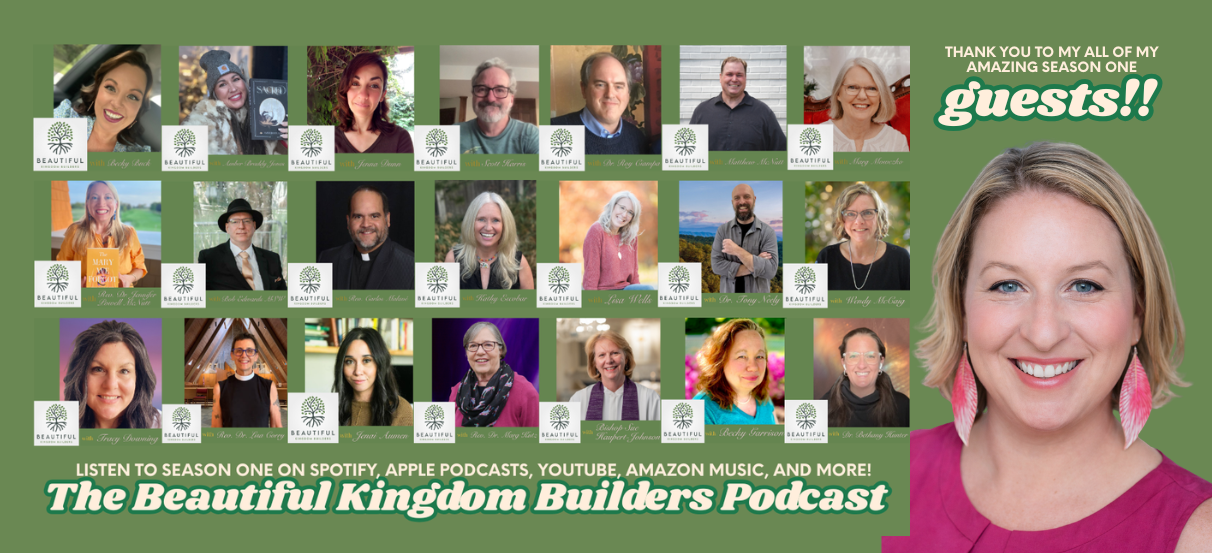
Today marks the final episode of Season One! I am filled with gratitude to everyone who has supported me in this project, by encouraging me to do it, giving me your time to be a guest or a listener, commenting, rating, reviewing, and sharing with others! You’ve made this project meaningful and worthwhile.

I am thankful especially to Wendy McCaig, my Episode 14 guest, for returning to have a conversation with me to help me reflect on my first season of podcasting, sharing lessons learned, impactful conversations, and future plans. Today’s episode offers insights into faith, community, and the power of listening. You can find quick links to all of my episodes here: The Beautiful Kingdom Builders Pod and I encourage you to stay in touch this summer, especially on Facebook and Instagram.

Please enjoy this episode of The Beautiful Kingdom Builders podcast on YouTubeSpotifyApple PodcastsAmazon MusicSubstack, and more

TRANSCRIPT:

Ruth Perry (00:15)
So today’s episode is going to be a little bit different. I’ve had 22 interviews now for season one and my 14th episode was with Wendy McCaig. She’s the executive director of Embrace Communities and she’s a global community catalyzer and one of her special skills is listening. And so Wendy offered to come back and ask me some questions that would help me to reflect on my first season of the podcast. And so I’m really grateful that you offered. This sounded like the perfect way for me to wrap up my first season. And so thank you for being here, Wendy, and being so generous.

Wendy McCaig (00:51)
Well, I enjoyed your podcast immensely. And the whole time you were doing them, I was like, I’m waiting till the end to ask you some of these questions, that learning, that gleaning, that what’s going to change next year. I’m on the edge of my seat waiting to find out. So.

Ruth Perry (01:08)
Me too. I don’t know what I’m going to say to you today.

Wendy McCaig (01:11)
Well, and I think having just a very casual conversation is kind of our goal today. And to start that process of reflecting on a lot, a lot of conversations. I’ve been quite impressed. So we’ll get started kind of with I’m always curious, what stood out to people when they start a new venture. What were those things that surprised you or maybe some things that popped out to you.

Ruth Perry (01:38)
Okay, so some of the things that have really stood out to me is just how unprepared I was for what is involved in making a podcast. And the learning curve that I’ve been on. It was something that I had on my heart that I wanted to do. I don’t know where that desire came from, but it wouldn’t go away. And I kind of held onto it for a couple of years and I would mention it to people here and there thinking that they would throw a little cold water on me and help me let it go. But every time I would bring it up, someone would be really encouraging and say, yeah, I think that’s a great idea. You should do it.

And so I just happened have let go of a day job. I’m a part time pastor and I felt like I had extra time and it was now or never. So I started my podcast and every single episode I was learning something new because I was making mistakes along the way. And I think that’s been surprising is just how fun it’s been, even though I’ve been making mistakes and sometimes I feel embarrassed to put an episode out. And then I get positive feedback from people telling me that they appreciated it when I feel like so scared about putting it there. And that’s really stood out to me.

Wendy McCaig (02:45)
Yeah, I started writing on Substack this year and I had that same apprehension and then the ones I’m most afraid of are the ones that people send me the kindest notes about. It’s funny. Yeah, that’s awesome. Did any themes emerge in those 22 conversations?

Ruth Perry (03:02)
Yeah, absolutely. I listened back to the little intro episode I did. I think it was less than two minutes long. And I haven’t revisited that all season. And I think I recorded that in September. And it was exactly what my podcast ended up being, those kind of conversations.

Like my tagline, I say that this is a place for redemptive conversations about gender, justice, abuse, and healing in the Christian faith. And I’ve had conversations about women’s experiences in the church, often traumatic and harmful, and just giving those kind of stories a platform, I think, is really important. We’ve had conversations about the rise of Christian nationalism and my episode with Carlos Malave, who’s the executive director of Latino Christian National Network. That was one of those episodes where I just had the most technical difficulties and I was so upset about how it came out. But one of my favorite episodes because it was so important to talk about the injustice that our Latino neighbors are experiencing right now.

I had a lot who are scholars or enthusiasts of the Bible share about living their faith in a way that is loving your neighbor and breaking down hierarchies and supremacy ideologies in our Christian faith so that we’re honoring one another, male and female and also like cisgender and LGBTQ. Having that conversation with Bishop Sue Haupert Johnson about the United Methodist church split, I felt was really impactful. And that was one of those surprising things where halfway through the podcast, I was starting to think, this is a lot of work. I don’t know if this is sustainable. So if this is my only *season who would I want to talk to? And I sent an email and I was just really shocked that she said she would come on.

Wendy McCaig (04:49)
Yeah, you had a lot of guests and I learned something from all of them. But I know I would see someone like, how did she connect with that person? How does she know that? I assume it’s just your boldness to reach out and say, would you do this? And it is so funny how each conversation you had, you said you really enjoyed it, was fun, like that how much fun it is. And I know being on the other side, it was fun for me.

Ruth Perry (05:12)
Yeah.

Wendy McCaig (05:17)
And I think that’s the energy of every single interview that you did. You could tell there was a gratitude for having the opportunity to share this story. And I felt that in the interview with Bishop Sue, there was this deep sense of, you know, some pain, that was a part of that but also some healing to get to share from her perspective of what that felt like. And for me, as kind of an outsider on the edges of all of that, it was healing for me to know the struggle that was happening in her world. I know one of your healing in the Christian, I experienced that as a listener, as I was listening to the podcast and gaining greater understanding.

So I love that what you set out to do. You feel like you did it. I think that’s really wonderful, great insight and clarity about about your calling toward that. So as you’re sitting here at the at the end of that first season, how are you feeling about being a podcaster and doing this. Where are you right now as you take a breath?

Ruth Perry (06:29)
Yeah. Well, I’ve really wrestled with whether or not podcasting is something that I should continue doing because it is a time intense thing to do. I’ve had six guests on where I’ve read a book before I’ve interviewed them, which was actually one of my goals, because when I turned 40 and I had had a hysterectomy and I started going through menopause, I stopped reading and I’ve always been a voracious reader. And it’s been really hard for me to pick up books again. And so during this podcast experience, I started reading again, which I’m really grateful for.

But yeah, that gratitude that you spoke of, have felt that every time anyone said yes, they would talk with me. I’ve just felt so grateful to them. And I felt that they were being so generous to give their time for this brand new baby little podcast. And I was kind of expecting on Facebook, I have a large following. But I’ve been frustrated on Facebook for years now about how shallow the conversations can be or how easy it is to offend when you can’t hear tone and you can’t, you kind of jump to conclusions about where someone is coming from. And you assign hate to their perspective because it’s different from your own. And so you’re immediately defensive and I wanted to have conversations where we could disagree or we could go a little bit deeper than Facebook or some kind of like one of these one dimensional platforms allows.

And I’ve just been thrilled, even though the Facebook audience, I don’t feel like has found the podcast yet, which that was one of the surprises. I don’t think I realized that social media and podcasts are such different entities. And I thought if people valued my Facebook page, they would probably be interested in my podcast. But I think part of the problem there is the algorithm. Facebook isn’t trying to get people to click out of their platform. And so they’re burying those posts that have a link off of Facebook. So part of it has felt really vulnerable starting new and then asking someone to give their time to something.

And in my brain, I’m still dealing with that imposter syndrome of my podcast is not worthy of my guests. I guess I need to work through that a little bit, but I have been bold in asking people, just putting it out there and then being surprised every time someone said yes.

Wendy McCaig (08:46)
Well, I think it’s a beautiful gift that you give to the guest because I know you asked me questions that I had never sat down and kind of given like, here’s the last 30 years of my life in, you know, five minutes or less. So it was nice to be able to share something with others that maybe didn’t know the whole journey. So I definitely felt like it was a gift to me and I’m sure others felt the same way. And there’s something different when you’re talking to a human. like when I’m writing, there’s, it just has a different vibe than conversation. So I think that it’s a needed form of communication.

I share your frustration with social media and how to like get the machine to privilege the information that you think it should privilege as a creator. yeah, I think assume a lot of people are going to relate to that. So as you’re thinking about all these conversations, I just wonder, you know, the importance of the conversations. Why do you think it’s important to capture these dialogues and share them publicly?

Ruth Perry (10:00)
I think one of the big lessons that I’ve learned in life is the importance of listening. When I was in college, I signed up to go build a house with Habitat for Humanity, but they had so many people sign up that they split half of us off randomly and sent us on a racial reconciliation trip to Washington, DC. And so at that time, I think I was 20 years old and just didn’t recognize that I had a cultural perspective on the world that was formed by the place where I stood socially and my family and my faith community and all these factors that were a part of how I viewed things and how I interpreted the Bible and how I interpreted events. And that was a really eye-opening trip.

And the thing that everybody said, we would go and we’d meet with all kinds of different people around DC and everybody said, please listen to us. When we’d say, what can we do? Please listen to us. And so I’m 45 now. That was 25 years ago. I diversified my algorithm and I listened to a lot of people that I wouldn’t have listened to if I hadn’t had that experience. And it’s shaped me in really profound ways where I’m a profoundly different person now, I think, than if I hadn’t had that one experience for one week.

And I just feel that sharing stories is so powerful. But before that, we need to learn how to listen to each other. And that’s something that I feel like the church has really lost, where we have these really tightly controlled systems in our faith communities. And the moment that you push against one of the norms of that community, you’re ejected. They might have coffee with you, but they’re not gonna really wrestle with it with you. They’re gonna say, you’re not part of us anymore. You don’t belong here. Maybe you should go somewhere else.

And I also feel like we can’t change that unless we’re close to the cultural power brokers. And so that’s been part of my journey is like, my eyes have opened. And so I’ve sought ways to make change and transformation in the communities that I really care about. And then met with a lot of rejection and ejection and just social punishment. And so my antennas are really up now when I experience and I see that happening in real time. And so it’s like a sensitivity that I have that I don’t know that everyone necessarily has. And me 15 years ago really needed to hear a podcast like this because I was really lonely as I was trying to make sense of my faith and how it was changing from the way that I was raised in the community that I belong to.

And so part of, I think, deep down, my podcast is like, know that there’s people out there that are currently like I was 15 years ago who are feeling lonely and they need to hear these stories. And I wish the whole church would listen to them. But I know that my podcast is not gonna resonate with the majority of people. It’s gonna resonate with the people who have been wounded or have some, rising awareness about how our ideologies and our culture are shaping us in ways that are malformed and different from the ways of Jesus. And so what I wanted to do on my podcast was invite people on whose faith I think looks like Jesus or represents Jesus in some way or tells a story that I think the church needs to hear because we’re not honoring those stories. We tried to cover them up or ignore them or just banish them so that we’re not made uncomfortable. But if we really loved each other, I think we would start by listening well.

Wendy McCaig (13:29)
I love that. There’s so many kind of streams in the the energy that comes through in the interviews and when you were talking about the listening and listening to those that are not the power brokers and those that look most like Jesus are the ones that are hanging out in spaces with those that the power brokers can’t see and how to amplify and put a microphone in the hands of those that the power brokers need to hear. I think, you know, thinking through all of the different layers of impact and so I kind of I heard a lot of that, especially like you were saying like Carlos’s interviews and others. But then there’s also that personal woundedness and I think most of the interviews that I resonated with had those stories of being cast out, being not accepted, being judged or labeled.

You’ve got both those streams running through here. And then I think this other kind of overarching theme of building these bridges between people who maybe would judge one another based on, and I’m guilty, ⁓ you know, I see a particular political sign or symbol or something and I’m automatically like think I know who you are, right?

Ruth Perry (14:43)
Me too, yes.

Wendy McCaig (14:51)
Like that is such in our waters right now and something we have to fight against. And I think your way of holding space is very genuine and gives people the comfort that you really are a bridge builder kind of connection to bring those pieces together. And how important that is in our current environment and how very very rare that is and especially in our social media environments where it feels like the ruder you are the the more viral your whatever’s gonna go. So yeah I love how well you recognize why it’s important to put these conversations out there.

What is your greatest hope? Now there’s 22 conversations and they’ll live on forever, Ruth. They’ll be there forever. Like, who knows what their long-term impact will be. But if you were to kind of summarize what you hope this little first class of of messengers, what their impact will be, how would you sum that up?

Ruth Perry (16:01)
I hope that the Holy Spirit will work through these episodes to speak to the people who listen to them, to challenge them to be more like Christ and embody Christ and Christ’s ways in the world, and that we’ll have a heart and greater empathy for each other, and that we won’t lose that command over and over in the New Testament to love each other.

And that that’s how people will know that we’re Christ’s disciples is by our love for each other. I think we’re really good at loving each other in our bubbles. I mean, I have people that don’t even recognize me as a Christian because I’m not in their particular form of Christianity. And I think that’s a failure of loving each other. I think every different tradition has something beautiful in its expression of their revelation of God that they have to share with the world and in their worship styles and in the different things that they bring to their worship and to their community. I mean, it’s beautiful. And that we should recognize that in each other and love that for each other, even if that’s not the tradition that we find ourselves in. I don’t think we should be so quick to expect that they’re going to hell.

Because that makes God very small, I think. And I think God is so much bigger than we ever hoped or imagined, and that God loves the world, and that God promised that he was going to overturn the curses of the fall, and he was going to save us. And so if we’re living in that kind of hope, like I hope that this little podcast plays a part in that redeeming work and that reconciling work of bringing us closer to God and closer to each other.

Wendy McCaig (17:37)
I love that. I think it’s already doing that. But I think that’s one thing about digital media is who knows? I think it’s a beautiful part. So what lessons have you learned from this series that will impact you as you think about next year? Is there a next year?

Ruth Perry (17:45)
I’m pretty committed to doing a second season. I think I’ll play it season by season and see how it goes. And in the seasons of my own life, maybe I’ll have to pause it for a longer period of time. Maybe doing once a week was too ambitious. Maybe I should scale that back. But I really, the actual having the conversations and reading the books and making the connections that I’m making is so much fun and so life-giving to me.

It’s kind of like, what is that Eric Little quote? Like when I’m running, I feel the joy of God or something. I messed that up, but I’m feeling really joyful in the process of making the podcast. So I want to make it, sustainable for myself to continue doing that. And I’m going to have to figure that out in some ways, because I’ve probably can’t sustain what I did this first season.

Maybe season two will be 12 episodes instead of 22. I don’t know. We’ll see. I have a long list of people that I would love to talk to. And I’m already setting up episodes to record during the summer. And I know that people are going to surprise me and reach out that I like, I didn’t know Tony Neely and I didn’t know Becky Garrison and they reached out to me and I had so much fun reading their books. I’m just blown away by what resources those two books were for the church. And I just look forward to what will come through this. What was the rest of the question?

Wendy McCaig (19:22)
Just what lessons and going forward that you want to carry forward.

Ruth Perry (19:27)
I’ve lost sight of slowing down, which was a theme that kind of happened with multiple conversations that I had. Like your spiritual practices really inspired me. Dr. Reverend Lisa Corry’s practices of quietness and Bishop Sue Haupert Johnson’s spiritual practices. And I need to develop more rhythms of quiet in my life.

And so that’s one of the big takeaways for me from season one is that I need to be more intentional about spending quiet time. And then another big takeaway for me was I was really surprised listening to the interviews and just hearing people’s faith stories. How often people came to faith because of a neighbor reaching out to them and inviting them to come to church or to an event, or just praying for them and loving them.

And I think in some ways the way our culture is so, we’re all so isolated from each other. We’re not very neighborly any longer. And maybe that’s a piece why 40 million people have left the church in the last couple of decades, that we need to be more neighborly. And it is something that’s really on my heart is that when Christ called us to love God and love our neighbors as ourselves, he wasn’t talking about how can we put people in our church pews and tithing into our church plates, but how can we leave the sanctuaries and go love our neighbors with no strings attached? And so I think that’s another area that the church really needs to work on.

Wendy McCaig (20:50)
Yeah, I think that being Christ in the world part, I’m watching and I don’t know if it’s just in our current political environment, but people who and there are certain circles where the word Christian or identifying as Christian doesn’t mean what it meant 20 years ago, especially in certain circles. When you talk about the 40 million that have left the church, a lot of people I know that walk the way of Christ more than the average person are in that category.

And it goes back to some of what you said about having to argue that you’re still part of the body when the rest of the body is trying to tell you you don’t belong because you think different. I think that is an interesting thing that I’m watching is, a follower of the way of Jesus and that word that label Christian, if it has a cultural meaning that’s not helpful, holding it differently. So I don’t know. don’t want to get in trouble here on your last podcast.

Ruth Perry (22:01)
No, I think it’s good trouble, Wendy. Yeah. Well, part of my kind of way that I’ve liked to look at the world is through that kind of cultural lens. And when I went to seminary, I got my master’s in education, but my focus was on cross-cultural ministry. And so I did a lot of reading on different cultures, and I had Bob Edwards on the podcast to talk about how quickly we jump to conclusions about things, like in a very tiny fraction of a second, we’ll have already interpreted something from our cultural lens.

And I think that that’s where a lot of us as American Christians are hung up. We don’t recognize that our perspective is American Christianity. It’s not Jesus Christianity. And that there’s some things that we need to unlearn and we need renew our minds about and repent from and turn from because they represent the values of our particular social place and not the values of Jesus Christ who was, you know, brown skin, Eastern Palestinian Jew living under Roman occupation. He was a marginalized person and he treated everyone he encountered with dignity and addressed the questions that they had in the place that they were.

And we’re really bad at that now. We can’t hear people if they have a perspective different than ours, immediately cast aspersions or demonize and literally use demonic language about people who vote differently than us or think differently than us. And that’s on the church. That’s church culture. And that’s what we need to repent of and turn from.

Wendy McCaig (23:32)
Yeah, I think in the season that we’re in, in terms of the society that we live in, such an opportunity for people of faith to be that healing balm that reweaves our social fabric and doesn’t continue the cutting us apart. And that requires tremendous resistance to the urge of conforming to the patterns of this world. And as you said, you know, being willing to transform our ways of being and be so countercultural.

I worry that that 40 million people that they didn’t leave the church left them or kicked them out and how heartbreaking that would be to the Father. You know, it’s like we’re all family, we’re all one, how do we embrace that in a in a way that is kind of that light, know, shine a light that’s different than the darkness that is lurking in the corners of the algorithm that takes off on Facebook. I’m seeing more and more courageous conversations and I feel like your podcast definitely falls into that category of people just boldly saying the things that need to be said in a time where we often feel silenced or encouraged to remain silent. So thank you so much for doing that.

Just final questions or anything else that you wanted to add to the conversation?

Ruth Perry (24:53)
I’m just thinking back on some of the conversations I had with different women about their experiences in the church with patriarchal theology and how harmful that has been. And I’m just very grieved. I think if we applied the one another commands from the New Testament and we loved our sisters in Christ as we love ourselves and kind of interrogated our theology on gender and on, I mean, not just women too, LGBTQ, how they’re treated in the church.

I think our theology is really consequential and that we should be working out our salvation and we should be working really hard on what we believe. And that if we’re making God smaller than God is, and we’re not imagining that God is actively healing our neighbors and loving our neighbors and that we just assume that if they’re not like us, they’re burning in hell. So what’s the point? And the world is burning. So what’s the point of caring for God’s beautiful creation?

I think our theology really matters. And so I’m grateful my faith has grown, my view of God has expanded and my hope is just, I’m such an optimist. Like I have so much faith that God is going to heal everything. I have faith that all of my loved ones who aren’t walking with the Lord are going to be saved and that we’re going to celebrate together and we’re going to bow our knees and worship Jesus.

I live with a lot of faith and I think that that’s why I want to have these kinds of conversations because I have faith that God is doing things. And when I encounter someone, they make assumptions about me and I make assumptions about them. But having these conversations, every time I talk with someone, I’m reminded about the good news of God’s kingdom. And I’m reminded to love my neighbors better. And so if I’m the only person that is growing closer to Jesus through this process, then I’m thankful for it.

And I’m all the more grateful for the people who’ve had conversations with me. But wrapping up season one, I’m just really grateful. And I really feel like we need to get back to love because God is love. And anyone who loves is born of God and knows God. And we need to love each other. We need to love our neighbors. We need to love our enemies. And that starts with listening. That’s the bare minimum. Learn to listen to each other.

Wendy McCaig (27:15)
Well, I appreciate that invitation to think about theology and is that theology life-giving? I remember in seminary, my vision of my professors really smashing every box we tried to cram the Divine into these tiny little boxes. And I remember one of my final papers was called Smashing the God Box, just that expanding, you know, and so if your, if your theology is one that is constricting and has these boundaries that you believe that God’s grace can’t work beyond that is limiting that power that that life-giving redemptive power so I I like that you know it’s not something you generally you know at the grocery hey how you working on your theology like it’s just but it’s not that we have that opportunity to kind of go on this journey with you of people and hearing about their struggles and their opportunities. I really also appreciated the question about spiritual practices. And I think maybe you could do some outtakes of here are seven spiritual practices while you’re out on your leave or I think that invitation,

Ruth Perry (28:29)
Yeah!

Wendy McCaig (28:35)
So much of it isn’t really in our head space on our theology. It’s how are we walking it out and how are we encountering that spirit in new ways that can open up new windows into the way we see the world, the way we see our neighbors, the way we see creation. I think that would be really interesting. Not that I’m adding anything to your plate for your summer. You should just breathe and

Ruth Perry (29:00)
I’m open to any ideas and suggestions.

Wendy McCaig (29:03)
Well, Ruth, it’s been great to be able to kind of catch up with you here at the end of this season. Glad to hear there’s another one percolating and that you’re already starting to like have some episodes in your back pocket before you start will hopefully give you more peace that on those those weeks or months when life just happens you have something in your back pocket so that’s a relief to hear that you’re going to keep it going it definitely is a gift and if you figure out how to crack the algorithm challenge on Facebook please share it with the rest of us but I know those who are enjoying it make a point of finding you even when Facebook doesn’t tell us we should.

Ruth Perry (29:43)
Thank so much, Wendy.


Thank you so much for visiting The Beautiful Kingdom Builders! You can find our podcast on YouTubeSpotifyApple PodcastsAmazon MusicSubstack, and more! May God bless you this week and always.

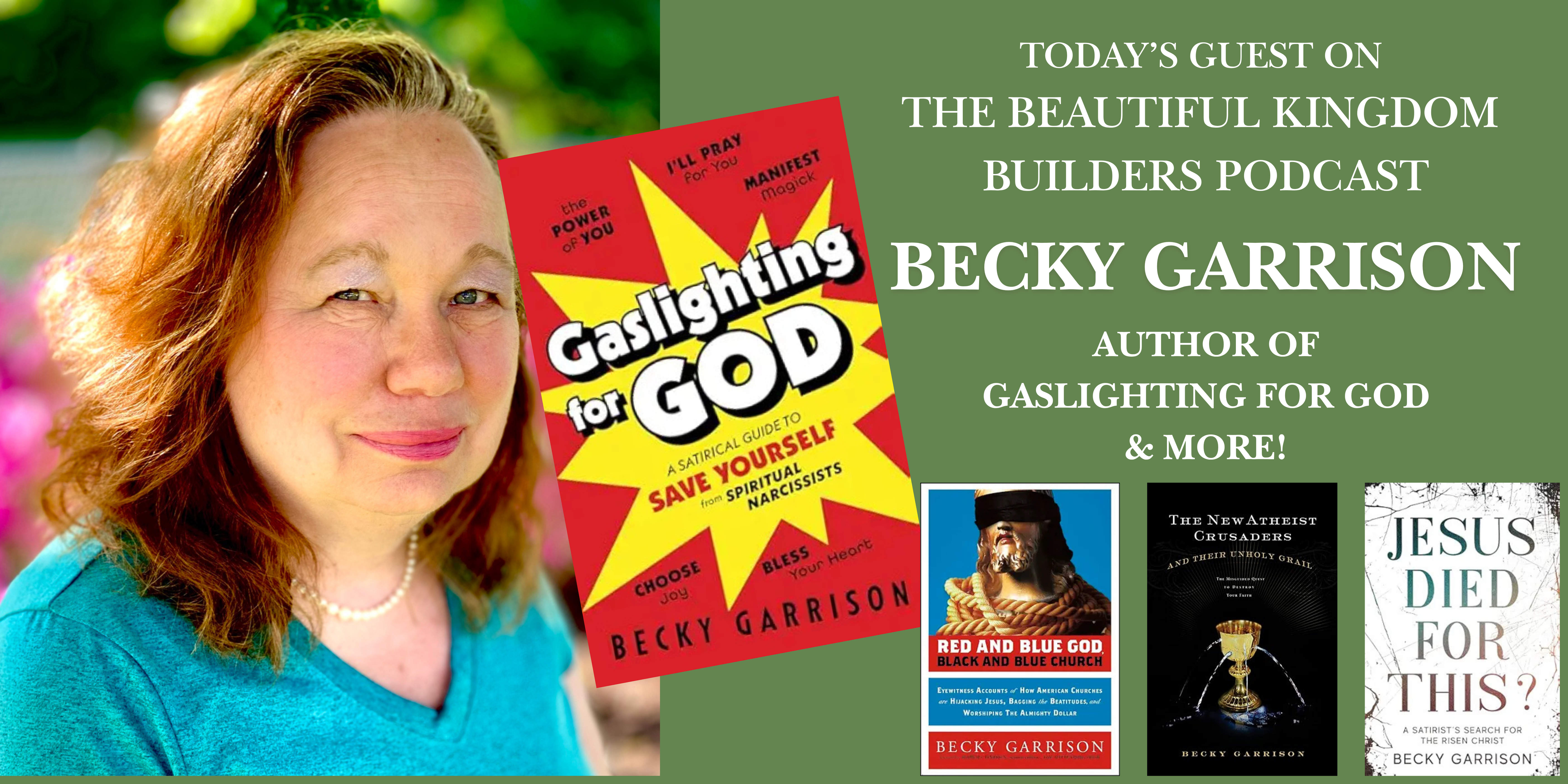
020 I Becky Garrison on Gaslighting for God: Recognizing Spiritual Narcissists and Cultures

Find all of Becky Garrison’s books on Amazon at this link.

I had a lot of fun and a lot of “A ha!” moments reading religious satirist Becky Garrison’s ninth book, Gaslighting for God: A Satirical Guide to Save Yourself from Spiritual Narcissists. Garrison formerly wrote for The Whittenburg Door, a Christian satire magazine. Her social commentary is so insightful. In our conversation, Garrison discusses the intersections of narcissism, gaslighting, and spiritual abuse within religious communities and broader culture. She shares personal experiences, critiques of religious and political figures, and offers guidance on recognizing and resisting narcissistic dynamics. This is a very timely resource and is well-researched and comes from deep expertise.

Key topics in this episode:
Narcissism and spiritual abuse in religious communities
The role of humor and satire in exposing narcissistic dynamics
Personal experiences with narcissistic family and church systems
Connections between political figures like Trump and broader cultural narcissism
Strategies for recognizing and resisting narcissistic manipulation

Here are links for you to follow Garrison’s work:
Buy Gaslighting for God
Becky Garrison Website
Becky Garrison on Substack
YouTube Channel of Becky Garrison

Please enjoy this episode of The Beautiful Kingdom Builders podcast on YouTubeSpotifyApple PodcastsAmazon MusicSubstack, and more

TRANSCRIPT:

Ruth Perry (00:15)
My guest today is author, journalist, and religious satirist, Becky Garrison, whose most recent book is titled, Gaslighting for God, a satirical guide to saving yourself from spiritual narcissists. Thank you so much for being here today, Becky.

Becky (00:26)
Thank you for having me, much appreciated.

Ruth Perry (00:32)
I just finished your book yesterday and I was really amazed by it. It was really powerful. It wasn’t what I was expecting in some ways and then it was so more deep and insightful than I was expecting in other ways. And so I highly God anyone who wants to learn more about gaslighting and narcissism and how this intersects with the Christian church in America. It’s really fantastic.

But as I was reading your book, one of the thoughts that I kept having was, have producers or writers of the show, Righteous Gemstones, reached out to you, Becky? I think you’d be a great writer!

Becky (01:05)
No, they have not and in fact, I mean that show my only quibble with that show is that in real life Prosperity Gospels would never swear in public. We use words like sugar instead of other words. So that that was my only quibble and I don’t think they would have been quite as sexually up But that’s the Danny McBride did. He likes to have men walking around doing things and he did that but other than that he really captured I think the essence of someone even Eli and even his wife, they were still so caught up in their own narcissism that even the sweet, precious, matriarch, she was still narcissistic as all get out. It was more overt versus covert. But there was clearly an evidence that they never really cared about their congregation. They cared about the numbers and the pews and that’s what I think the ultimate definition of a narcissist versus someone who’s self-absorbed. I mean, we all like attention.

You know to be it’s nice to be recognized. It’s nice to get validated. And sometimes when you have a book coming out or another project and you can get full of your own But you can get a little too full of yourself, but then someone can call you out and say hey, wait a minute knock it off. That could not happen with the Righteous Gemstones. They lack empathy. They lack compassion. They had no self-awareness whatsoever of how their actions were impacting others. There’s also a grandiose sense of self. I am better than you. I am a better human being than you. I am smarter than you. If it’s one of those mean girl things, I look better than you. Whatever it is, I am better than other people. Not just I’m for myself, but I’m full of myself a little bit on times.

Ruth Perry (02:36)
I did appreciate towards the end of your book, you did talk about how it is important for us to take some pride in our work and to enjoy the process of creating things and putting things out there and creating community. And because in the back of my mind, I always have this little niggling thing, like I don’t want to be narcissistic, And sometimes,

Like now starting this podcast, I feel really passionate about putting alternative narratives about Christianity out there rather than the toxic forms that are so pervasive. But I don’t want to be narcissistic. And so I really did appreciate that at the end of your book, how you talked about how taking some pride in your work and like enjoying that process is good.

Becky (03:09)
Mmm. Typically, if you’re asking yourself, am I narcissistic? Odds are you’re not. The kind of celebrity who humblebrags, we’re all a little narcissistic or, I just might be narcissistic about that. Yeah, that person’s a flaming narcissist trying to deflect. But a lot of us, it is something that you struggle with. And I think it’s a legitimate struggle. How do you have an open conversation and admitting your humanity? You might look at your podcast when we can go, damn, someone’s doing better than me.

That’s normal, that’s okay to do. It’s acknowledging, it’s an inability, not there’s another human being on the other end and that person matters and they don’t matter as someone who can give you volunteer hours, who can give you their money, who can give you whatever you need from them, the affirmation, the accolades, et cetera, et cetera. But we all have that it’s important. It’s called either high self-esteem healthy narcissism. That’s what gets me to keep going up and keep going. I believe in what I’m doing. I believe in my work. I believe in it passionately and I will defend it and that might maybe come off as a bit of an a-hole. But that’s the difference between that and a narcissist.

Like if someone’s being kind of rude to me and kind of a jerk and I’m a little bit rude back, that might be justified in my behavior. I’m still going to feel a little something. I hurt someone’s feelings. I feel bad and I should feel a little bad because I hurt someone’s feelings. And what am I going to do to make that better? So I can become more regulated so I don’t snap at someone.

Ruth Perry (04:45)
How do you employing humor impactful when you’re having difficult conversations like this?

Becky (04:52)
Well, there’s role of the satirist, if you think of it. He functions as the court jestor. We keep the king honest. I’m thinking, one of my childhood influences was Monty Python. I was a prenatal Episcopalian. My late father was an Episcopal priest and a sociology professor. Do the math, do the ecclesiology. Yep, I was prenatal Episcopalian.

And so the way in which they lampoon the lunacies, you all can laugh at something collectively. And once you can laugh at something and say, my God, this is absolutely ridiculous. It helps break the energy down. And it really gives us a chance to see, because the point of a satirist is if we can break the idol, smash the idol, you can then see the glimpses of God or goodness underneath, but you first must smash the idol. And we’re in a period right now of a lot of idol smashing and that’s where you’re getting a lot of the pushback is that from the most extreme fundamentalist to the most enlightened guru, everyone has their idol and they love it. I mean, the people would love it. The Wittenberg Door, the progressives. I say this in the book when I would satirize a televangelist, all of a sudden we would satirize Jim Wallace, Tony Campallo, Brian McLaren, the whole emergent church gang. And all of a sudden you would have thought that we committed Harry Carrey on.

You know, it was like, and that’s why I did not understand that versus someone like Jerry Jenkins. So I mentioned the book. We satirized him. How can you not satirize the Left Behind series? You have to do that. It is ripe. I we had the plumbers edition, the Cleft Behind, everything. And he wrote us back and said, Hey, this is funny. I’m open for an interview if you’re up for it. And I did it. And we do not agree on probably anything theologically.

Or very few things we would agree on. But we had one the most pleasant conversations because he was a decent human being. You know, he was not a narcissist. He was kind, he was generous. And we had a very pleasant interview. Other people that I’ve agreed with on almost everything, theologically, and then all of a sudden I’ll just critique them and you would have thought that I did something horrible to them. They just go absolutely like Tasmanian Devil Ballistic.

Until the research in the narcissism. I had no clue what was going on. And now I can watch the news I can watch certain progressive pastors and their conservative counterparts and go yep. That’s a narcissistic meltdown. Okay, I don’t have to take that person seriously because you cannot have a dialogue with a narcissist. You can enjoy their entertainment If there’s no abuse involved, I want to make that clear if there’s abuse you should not be supporting this. But if the person is just a full-blown narcissist and you happen to like their music, you like their performance, go see it. It’s enjoyable. Just don’t expect anything beyond the evening’s fun. I think that’s where especially Christians, we’re looking for a form of a community. You cannot have that with a narcissist. And that’s what you have to give up is the hope that you’ll ever have a community with this person.

Ruth Perry (07:40)
So you have developed a very finely tuned narcissism detector, it seems. And then you also say in your book that coupled with that, you have an intense desire to speak truth to pastoral power. So before we dive into the content of your book, I was curious if you would share what is your personal background and experiences that have shaped you in that way.

Becky (07:45)
Okay. I was born to a hippie father from a very old, genteel southern family. He was the black sheep, to put it kindly, who was, I later discovered in my teens was an alcoholic. I’ve now since realized he was also a narcissist. And I realized that the majority of my extended family were narcissists. He married an enabling earth mother type, both of them died from their addictions in the 1970s. And at that time, the research was not there for alcoholism. So there was a lot of blame, a lot of shame. These were the bad people. And the family was displacing them. And I was also the family white elephant spotter, so to speak, in that I would say, why is so-and-so drunk? Why is this happening? I’m seeing something. And I would continuously be told, you’re making that up. That isn’t true. No, you’re not.

So I now have through the research learned that often the oldest child is the one scapegoat, because they’re the ones who can see the truth. My younger brother was the golden child. My younger sister was the golden beauty and I was the loser dreamer. So I was scape. So this dynamic came from my childhood, but yet my father in his research, I mentioned this in the book, he was studying how to reach those on the fringes. He was researching why were some kids joining SDS and others joining JAPUZA. What was it that was attracting these kids to these radical movements? Neither one of which we now have learning was really proven to be very healthy, but why were kids drawn to wanting to make a better difference? And that put them up to be easily manipulated by people that had more nefarious agendas. So that got it started.

When I discovered the Wittenberg Door, was the perfect outlet for all the anger that I felt about the church I mean I did go to divinity school because there’s a side of silly me thought I wanted to be like my father. Until I realized had I done that I don’t think I’d be here today. The church would have crushed me. I see a lot of my friends that have a similar spirit to me and the institutional church just crushed them. They do so much better when they’re outside the church doing their own thing instead of trying to function within what I would say is a highly narcissistic institution that I’m convinced that the institutional church is dead. I think there’s some individual churches doing some great work, but I think their institutional structure is just too necrotic. And through the Wittenberg Door, we began to satirize that. And that led to a lot of things. I did a lot of the faith and politics stuff. I also started when God’s Politics blog became a best seller.

That’s when I started critiquing the progressives and all of a sudden all the progressives that loved the Door, they loved how we went after the conservatives, that’s when they started to hammer us. They could not accept the fact that there could be narcissism in their midst in a more covert form. As one who grew up with the frozen chosen, as you call the Episcopalies, I would say hell yes, it’s rampant.

Ruth Perry (10:47)
I had a friend on, maybe a month ago to share a story of being a survivor of a marriage with a narcissist and her husband is Benjamin L. Corey, a progressive Christian writer about peace and nonviolence. But then in his personal life, just super controlling and passive aggressive and very much a narcissistic sponge, feeding off of my friend. And I’m just at a loss of how does someone like my friend get any justice? For right now, she was alienated from her children because of litigation after their separation. She can’t even see her children. And so it’s such a frustrating situation.

Becky (11:24)
It is and I don’t have an easy answer. I’m not a lawyer. I can’t give legal advice. I did notice that what was interesting I’m thinking about Phillip Yancey, there’s another case that came into play and that was very frustrating in that revelations came out that he had an affair. There was something involving his assistant that sounded a little nefarious. I mean, she died kind of suddenly in a freak climbing accident in a gym.

Ruth Perry (11:33)
Yeah!

Becky (11:47)
Which if you’re an experienced climber, almost never happens. So I’m still, there’s something a little fishy there. I’m just saying, I think in that case, he would never accept your responsibility. He never, he just said, I’m so great. He viewed the women in his life as pawns. And I think the best we can do is you just speak your truth to power. And I’ve been in that situation that she’s been in. When I saw abuse within the US emergent church movement in 2006, I spoke out.

And I got hammered. I got doxxed. I got cyber bullied. I was not was a very unpleasant situation. And the more I learned, I taught myself what gaslighting was and what scapegoating was, I understood the dynamics of what was happening. I learned how to do gray rock. ‘Cause in the beginning. I appeared crazy.

I would be like, what the, you know, what do you mean? I am not jealous. I am simply pointing out the fact that you claim that you’re inclusive and you have one female speaker. And then once the female speaker got on board, she immediately became just like the men because she had to preserve her place of power. So I was simply saying, you’re promoting religionless Christianity. And there’s a hierarchy. There’s a lot of abuse within this system. There’s this private networks that are spreading all kind of stuff. And because I had not

done enough work on myself and my own trauma triggers, I came off as crazy. I’m not going to recreate how I came off, but it was not to my best interest. So the first thing I say to anybody is get your own self together by finding whatever somatic therapy works for you. For me, it was EMDR. If I had not had EMDR, I don’t think I could have written the book because I would have been too triggered by bringing up past traumas. And I think that’s the first thing I would say is have you done your oxygen mask, taking care of yourself. And the second is what did not exist in 2006 that exists now are support groups. When Tony Jones tried to re-emerge as another emergent church speaker, other people all of a sudden started calling his crap out. That did not happen in 2006. Everybody was still part of, I want to be part of the cool kids crap.

Your friend now has other women who have been through something similar. You know Tia Levings has an excellent list of trauma resources on her page. Her book I Belong to Me is coming out in May. I would give it to her as a gift, you know What do you need to do for yourself? And once you get to that point, I think you’ll be in a better place. Your kids are gonna see a different mother They may be so poisoned in top that that you can’t control but you can control your response to a situation and find other people to support. When I had an experience, my first revelation of the narcissism, I had gotten to a professional and personal relationship with a mindfulness therapist who I’d later discovered is a narcissist. A malignant narcissist at best may even have some psychopathic tendencies. I couldn’t tell if he enjoyed inflicting his pain or he just didn’t care.

But I joined a narcissistic support group and I realized, this is 2016, so the research was much newer than it is now. And I realized I’m not alone. Other women have the same experience. This is a pattern. I could not see the pattern because I believed in the promise of whatever this person was preaching. I believed in the goodness. I had a good heart. I’m an empath and my God, we’re magnets for narcissists.

I’m now narcissistic resistant. Narcissists don’t approach me like they used to. You can become narcissistic resistant. They will go to somebody else. And you have to also get over your fear of missing out. And I’m also over my hypervigilance. If I narcissist, someone that I know has extreme narcissistic tendencies, hurting someone else, I’ll just point it out, but I’m not going to try to rescue people. We’ve made so much progress.

We’re in the narcissistic research right now where alcoholism was in 1980. I started the recovery movement actually in 83. And it was very nascent. There wasn’t a whole lot out there, but we were starting to understand that alcoholism was not a mental illness. It was a very complex dynamic that impacted the entire family. And how was I impacted? Being raised in an extended family of alcoholics who I now realize are many of were narcissists, including the ones that aren’t alcoholics. I mean, it was pretty much, I can count on one hand, the number of extended family members I know that are not narcissists, to be honest. And I began to realize a lot of that. And I think for people, find other people, they exist and you’ll develop a network and you’ll discover you’re not alone.

And once you realize you’re not alone, that eliminates so much of the anxiety and pain that you’re feeling. At least that’s been my experience.

Ruth Perry (16:16)
It does seem like narcissism is such a systemic and widespread issue in our culture today. And just listening to you speak, I’m a pastor’s kid as well, although my parents were teetotalers because they both came from alcoholic families. But that same dynamic was still in the family. also ⁓ dynamic those in my family that you name in your book is manipulators and martyrs.

You were quoting Brad Sargent’s friend, Linda O: “Manipulators and martyrs go together in matched pairs,” and I was thinking about how women are conditioned in the church to make ourselves smaller and to be quiet and meek and gentle and so we’re just trained from a very early age to be the martyr. And then we end up in, a lot of us end up in relationships like this where there’s a manipulator. And part of that is the culture training men too, to be this way where they feel entitled to things and they feel special.

Becky (17:00)
Mm-hmm. And then there’s people like me that just push back from the get-go and we’re always excluded. And it’s taking me a long time to develop sympathy for what I call the mean girls. I’ve been thinking about this and I began to realize that, my sister was a classic mean girl. And what it was is she from the beginning was ranked based on her beauty. She was ranked based on her looks, her ability to present. She never did the beauty pageant cheerleader thing.

But that is one of the dynamics, is that we want our women to look a certain way. We want them to appeal to the male gaze. And if you don’t, in the 70s and 80s, you’d be called lesbian, you’d be called, worse, which was really absolutely horrible for women that actually preferred same-sex relationships. To me, to use that term as a slur is just absolutely god-awful. And I kept telling them, no, I’m not a lesbian. I just don’t want a guy that’s going to be like the husband you guys married kind of thing. You know, and you tell people that sometimes you make a conscious decision that given my family dynamics, I decided it was best that I remained unmarried and without children. just decided that is the best. I cannot give a kid a decent family life. And I also need to do a lot of work on myself so I can now find a lot healthier relationships.

And so I made a conscious decision not to involve innocent humans in my family’s dynamic, which was not an easy decision to make, but it was one that I realized I needed to do because it was not be fair to an innocent third party. I think with the me girls, I just realized they got ahead by using their sexuality. They’re the ones that Harvey Weinstein, Jeffrey Epstein, other women preyed on. They wouldn’t have preyed on me because they could tell by looking at me, I wasn’t going to be that compliant. My attraction to narcissism was more the spiritual guru promising this. That’s where I would be attracted to people. But in terms of just the whole mean girl persona, I I resented those women like crazy for quite a while because they could make your life miserable. If you were the little nerdy writer, those kind of women can just make life hell.

And even today, I encounter them sometimes. I’ll do spirits reporting and beer reporting. I’m often the only woman there, so it’s no big deal. But if I do wine reporting, some of those women can just be absolutely mean girl central. And some of the publicists, and and I used to be worried about that. I used to get really like, I don’t fit into these women. Now I realize we’re all going through something, even these women, these beauty queen patterns. You you see these 24 year olds that are dating 60, 70, 80 year olds, it’s not healthy, but they’re going through something on their gotta be something going on, because a lot of the mean girls are not happy. Because if you are really pleased and content with yourself, you don’t need to be an outraging bitch to other people. You don’t need to do that.

What is it about you that makes them feel like in order for them to affirm you, they have to put you down. And over time, I think these women develop a narcissistic core. I don’t know if my sister, she didn’t start out that way, but over time she became more and more self-centered because her looks, that was her currency.

Ruth Perry (20:08)
When I started reading, I thought that you’d talk a lot more about Trump. I was surprised that you didn’t. And the way that evangelical and conservative Christians have embraced him, even though he appears to many people to be a Machiavellian, like the worst kind of just really dark triad personality type narcissist. What connections do you see between spiritual gaslighting and broader cultural patterns in politics and patriarchy and nationalism and all of those intersections.

Becky (20:37)
I had an agent try to sell this book in 2018. The original book proposal was Trump focused. Publishers didn’t want it. They said, we’re done with Trump books. We have enough books. Steve Hassan did the case against Trump. There is the book, Dangerous Case, Bandy Lee edited a book on the dangerous case of Donald Trump, lays it out. She ended up getting fired, by the way, for diagnosing someone which was very questionable, but still you’re not supposed to diagnose.

I believe that Trump is a symptom. We’ve growing up as a kid. Do you remember Lyndon LaRouche? Do you remember these we’ve always had crackpots. We’ve always had nutcases. The question for me was why in 2016 when they were presented with a slate of reasonable Republican candidates The voters chose Trump that is the question that I wanted to answer it to me. That’s a deeper question that was you brewing for some time now. When you look through his story, we’ve had these church splits that have been simmering and simmering Trump is just when it look at 1979, that’s the year the Episcopal Church first ordained women.

It’s also the formation of the Moral Majority. And it was not founded on abortion. Abortion came out in 1973. Naveen Jeltsin did not give a hoot. Jerry Falwell was quoted, That’s a Catholic issue. But they were really upset about was interracial dating and that’s why they really formed. But they pretty soon had to do, we have to do a family-friendly thing because even in 79 you couldn’t say we’re the white party. You just could not say that and get elected in 79. So we had the Moral Majority.

And then you look at the year I started writing for the Wittenberg Door, 1994 was the year the Republicans took over Congress with the Christian Coalition. And we thought, wow, that’s going to be… And then you found Clinton in 96. In addition to the Monica Lewinsky scandal, he also formed the DLC, which really started to alienate a lot of progressives. You can see a lot of these shifts starting to happen in a lot of years.

We thought in 2008 when Obama was elected, he was the first president to acknowledge atheists at the National Prayer Breakfast. We thought we’re hitting this progressive revolution. in 2016, I was really excited. The DNC put up the most diverse list of candidates ever. We had people of color. We had a gay man, more women, this dynamic lineup. The DNC stacked the deck and gave us Hillary.

And that was the moment I said, we’re going to get President Trump. And my friends who are progressive said, you’re wrong. I said, no. The will of the people were ignored. You have enough Bernie bros that want change. They’re going to vote for change. They did. And that’s how we got Trump. And then in 2020, the Democrats again, had a pretty good lineup, not quite as diverse. They gave us Biden, who we did not want. I felt that the progressives kept stacking the deck and further frustrating. And when people get frustrated and they feel like no one’s listening to them, that’s when they’re susceptible to cult dynamics. That’s when they’re susceptible to saying to they’re not listening to you.

Because guess what? They weren’t. And if people feel that no one is listening to them, they will go to someone who is telling them exactly what they need to hear. That is the moment when people are the most susceptible to joining cults. I think that’s what happened in 2020. And then in 2024, well, we’re going to give you Biden again, even though you don’t really want him. And then at the last minute, we’re going to switch aroo and give you Kamala, who never won a primary, she was never the most popular candidate. And then boom, Trump gets elected again.

I’m looking at this from a broader perspective. I also think that people did not realize in 2024 how bad it was going to get. I think they thought they were taking a malignant narcissist who didn’t care about anybody, but he was going to keep America out of war. He was going keep America first. He was going do something with sensible immigrant. don’t know if sensible is not the word I’ve used, but I think people thought it was going be a continuation of the first term. I don’t think they thought that you could get worse than Sarah Huckabee Sanders. I don’t think they thought you could get worse than Jeff Sessions and Richard Barr. I don’t think they could get worse than whoever was his defense secretary. I mean, the moment Pete Hegsath and they changed his Department of War, this is when I felt it went from malignant narcissism to Machiavellianism. Because in the beginning, I do think there’s a sense that, and anybody who lives in New York City knows this, he does not care about anybody but himself. He’s mobbed up.

The media wanted this conflict circus. I think if we had investigated his ties to Roy Cohn, for example, really thoroughly, this was scary. Roy Cohn was Joseph McCarthy’s lawyer. That was Trump’s lawyer. Roy Cohn repped several mob families. He introduced him to these mob families. And the media didn’t investigate that because I think they wanted the Hillary Trump matchup. That was great for ratings.

putting Biden against Trump, that was hysterical. I mean, that was like watching a really bad Saturday Night Live sketch to watch those two men debate. I was watching this going, no matter who gets elected, we’re either going to be screwed or absolutely completely effed. And in 2024, when they did the switcheroo, I said, this is not, we’re going to get Trump again. And I just knew it. I didn’t know how bad it was going to be.

What people might want to realize is that there’s a difference between a malignant narcissist and full-blown cult. The distinction is a cult leader by nature is an extreme narcissist. They’re also a psychopath, meaning they enjoy what they’re doing. A narcissist doesn’t care a psychopath enjoys. That’s how I distinguish it. And the Machiavellian nature is they want to take over the world. They want domination over their entire universe.

Whereas in our society it just wants to be number one. They don’t feel the need to dominate. They need to be the center of attention, but there’s not this need for the world domination that you see now. And we’ve got ourselves into this pickle and I don’t see the Democrats and the progressives offering candidates that are really going to get us out of it. At least on the presidential level. On the local level, yes, that’s why I’m shifting my focus somewhat, I think we could help rebuild at the local level. How do we care for our neighbor? There’s a difference between Trump and MAGA, and I make that distinction. And where we go from here, I’m not gonna be a politician, I’m not gonna be a fortune teller, but that’s why I didn’t make it Trump specific because this is gonna continue when he’s gone. MAGA is gonna be here. And there are also ardent progressives.

And I think it would help to look at what were legitimate concerns that people had the progressives ignored. And that’s the beginning of a step of healing is to look at that component. Like how many women who were MAHA, they just wanted alternative treatments for their kids. A lot of them, they were not full blown MAGA, but all of sudden they felt the Big Pharma was telling them how to rule their lives.

The Big Pharma was calling them idiots or education was calling them idiots for wanting to homeschool their kids. They wanted to do alternative things that were legal and justified and they were not allowed to do it. You know, women were trying to give their little kid who has epilepsy, giving him CBD and discovering it worked and then being told they couldn’t give it. They had to give the kid pharma drug that A, they couldn’t afford and B, cause their kid to be sick. What would have happened if the women who were interested in natural health had been taken more seriously, would they have gone full blown? So you always have to think of what could you have done? Were you so full of your own hubris and your own self-righteousness that you didn’t listen to what other people were asking and demanding? And I think that’s where I’m seeing the progressive movement is, is are they willing to listen to alternative views?

There’s a large group of people that I think are dissatisfied with everything. What are they going to do about that dissatisfaction? Where can they put that?

Ruth Perry (28:17)
So what is it narcissistic personalities that both woo and wound people?

Becky (28:23)
I would call it the Jekyll-Hyde syndrome. They can be incredibly charismatic. They’re also very tuned into when you’re vulnerable. You see this with certain rather nefarious dating coaches is I will give you what you’re looking for. You’re looking for women empowerment. You’re looking to explore your female sexuality. You’re looking to do better your business. You’re looking to be a better mother. Whatever you are looking for that you’re not finding, they have the answer. And they will just love bomb you to bits. They will give you everything you want. And to the point where you don’t realize how much money you’re spending, how much time you’re spending, because you’re getting that fix. You’re getting that high. You’re getting that adrenaline rush, that oxycutin. You’re getting that, ooh, that dopamine hit. It feels so good to finally be recognized, especially if you come from a background where you haven’t been recognized.

And then the moment, the nanosecond, you disagree. The moment you say, I can’t afford to pay it this month, I need to take some time for myself, I need to step back a little bit. Whatever, you have just drained them of their narcissistic supply. The moment you cut it off, they will turn into to Mr. Hyde and do what is called narcissistic collapse. They will go completely irrational. I think for a lot of us, we do get disappointed. If someone cancels on you last minute, you’re going to be disappointed. But that’s different than someone going completely ballistic. It’s someone saying, I’m disappointed that we’re not making this projections right. What can we do to make this better versus I’m disappointed in you for failing?

After you have a narcissistic collapse hit you, you sit there going what the hell just happened? It’s not as simple like I need to have a talk with you about your work performance or we need to discuss you being a bit cleaner or bit whatever. It’s complete annihilation of you or all of sudden they get with a one out of you, you wrote those three articles I needed you to write to make me feel good, okay, bye, I’m gone. They took what they needed from you and then they left you. Just bye. And you’re starting going, what the hell just happened here? And their words don’t match their actions. And after a while, you start to find yourself going crazy, which is why I find it very helpful to identify the pattern because it keeps you from going crazy.

Now I can identify it and I go, okay, that person’s having narcissistic collapse. I’m going to treat him like a three year old, a toddler. Just walk away. I’m not going to engage. You cannot rationalize with a toddler. You cannot be reasonable. And if you give him his binky or his Nobel Peace Prize, it’s not going to solve anything. It’s a temporary, it’s like a pacifier situation. They’re going to continue to escalate. This is not going to stop until you walk away and then let them find somebody else. And over time, it starts to crumble. And that’s what you’re seeing now is the starting of the crumbling.

Maybe I’m too naive to think that, but I do believe, and I’m looking at the Epstein files to me as the beginning of a revelation of we’re finally starting to see a lot of stuff start to crumble. And that’s a good thing. I say, hallelujah.

Ruth Perry (31:14)
What is the connection to and sex abuse in these kind of high control groups?

Becky (31:20)
Because they can. I do not understand the attraction to children. I do not understand why any man would want to have a relationship with someone who’s not age appropriate. I don’t get it. And I think that some of it is these men do not want adult relationships. They want relationships they can control. Men have always wanted, some have wanted significant younger women, and there’s always women who are willing naive enough.

In the case of children, you start to tell a kid who comes from a very broken home who’s never had any kind of love. They’re so susceptible to being loved bombed. And all of a sudden they’ve never had anything. Wow, I got a couple hundred dollars just for doing this little act. Can’t be that bad. And then before they know it, they’ve been trafficked beyond their beliefs because they didn’t understand what was going on. They didn’t understand the dynamics. An older woman would walk into that and go, what the hell?

But then I’m dealing, like I’m looking into something, as you might have there was a UMC minister in Missouri and she the executive assistant and then the grounds manager for Epstein Island. claims she didn’t see anything. At the time she was studying to be a minister, as I understand And the UMC has suspended her pending investigation because they feel that her involvement this case went against the UMC’s code of ethics around treatment of women. Hallelujah for small victories. However, I’m very shocked that she claimed she saw nothing. I mean, you see the photos of the house. You didn’t think it was odd there was a dentist chair in there. You didn’t think it was odd there were photos of underage girls. There was like Lolita on steroids.

You’re a pastor and I don’t expect a pastor to be a complete intuitive, because we all have different personality types. But if you’re a pastor and you don’t think there’s something wrong with unaccompanied minors getting off of a plane to meet a group of old men, if your spidey sense doesn’t do anything and you claim you saw nothing, then you’re not qualified to be a minister because at a basic core. A minister needs to notice when something that serious is going on. I would expect a pastor to know that youth minister is getting a little too handsy. Yes, that volunteer is being inappropriate. If you can’t even see something as blatantly obvious as underage girls, unaccompanied often with a lot of older men, and you think this is just a pool party, you’re not qualified for ordained ministry.

And the fact that she got called out on it, I’m glad the UMC is doing the right thing. What no one has figured out is how did she meet I want to know how did a UMC minister from Missouri meet Jeffrey Epstein and get offered that job? So always interested in looking at the connections because Epstein has made some referrals. He referred Eric Metaxas’ book to somebody.

Ruth Perry (33:59)
Yeah.

Becky (34:02)
No, I take it back, Ken Starr referred Eric Metaxas’ book to him. And then there was an instance where he forwarded on Rick Warren’s newsletter. Well, okay, what is Ken Starr doing referring the book written by the guy who was one earliest Trump supporters? Eric Metaxas was supporting Trump before anybody else did, just about. So he was a key figure in helping Trump get elected. Why is Ken Barr recommending this Bonhoeffer book, the book is terrible. Every scholar said it’s terrible. Then you have other, references like that. Epstein recommended Dobson’s Dare to Discipline book to a young survivor who was having problems with her family. These are very evangelical books. How are they getting into that network? So far that’s the only Christian connection I’ve been able to find.

Deepak Chopra is another thing. He claims I didn’t do anything inappropriate. And you’re sitting here discussing how, you know, God is a construct, cute girls are real. And I would never go to a guru that said that. That is disgusting. I mean, that is just the way he’s discussing about girls. Like, did you bring me girls? Did you bring me girls? You’re a grown adult male who is responsible, thanks to Oprah in large part, for bringing in all of these concepts of the East to the West. Oprah basically, now that we’ve realized, was a walking show for predators. She gave us Dr. Phil, she gave us Dr. Oz, she gave us the anti-vax movement. She supported John of God. And if you Google John of God in Brazil, he is in jail bizarre medical experiments and pedophilia.

So I think we have to look at ourselves and why did we ever trust Oprah? She’s not trustworthy. Look at all the people she’s introduced us to. She never took any responsibility. She also introduced us to the secret of Dr. Lisa Rankin is someone that I would recommend your listeners check out. She’s one of the people that spoke on Deepak’s stage, one of the few people speaking out. All these people that stood and profited by being connected to Deepak have not spoken out. And yet she did. A few people are speaking out. There’s some outliers who are saying, I’m willing to risk my book contract. I’m willing to risk my speaking, my place on the center stage. I’m willing to do what needs to be done to make this right. Now, why they didn’t speak out before is another story, but they’re speaking out now. And I think this is similar to the Weinstein in the Cosby case. It takes a while to convince people that someone this powerful is this evil.

Ruth Perry (36:24)
I had a funny interaction. I met Eric Metaxas seven or eight years ago. I was homeschooling my children by day and waitressing by night. And I live in the vicinity of Liberty University. And he had a group of conservative influencers at dinner at the steakhouse. And they were there for some event at the Falkirk Center at Liberty. And after the dinner, Eric Metaxas was standing up and he asked me if I knew who he was. And I said, I do know who you are. And he said, that’s so nice. I’m going to let my wife know that you said that. What did I say?

Becky (36:57)
I interviewed him for The Door and this is before the Wilberforce book. He was anti post veggie tales, not quite the best selling author. And it was one of most worst interviews of my life. It’s just all the oxygen in the room was sucked out and he was incredibly full of himself.

But what I appreciate about that was that I could get it, I knew to stay away from it from get-go. It was the progressives. Like I was drawn in to Nadia Bolz Weber, Pete Rollins, that more progressive line of thought. And actually I endorsed some of their stuff in the beginning, because in the beginning it sounded really good. So then all of sudden the moment they became bestselling authors, or if not bestselling in the case of Rollins, the moment they got their little click going.

It was just all of a sudden, ooh, wow. I mean, they were just as obnoxious as Eric Metaxas, but in a slightly subtler way. And it can be really when someone writes something that you believe and then you meet them and you go, crap. And so I’m telling people, take what’s good. Okay, if they wrote something that you enjoy, acknowledge that. There’s nothing wrong with you for taking someone’s words and saying, that word’s really…

Move me but just know that person didn’t live out those teachings, you know and try to find people that did live out those teachings They exist. I mean Henri Nouwen, there was never anything about him and he’s someone that I continue to rely on yes, there were some abuses within the community for him, but it was after his death. He had nothing to do with that There are a lot of good spiritual thinkers that don’t engage in this. So the question is don’t kick yourself, but then look and say where can I find better fruit?

Where can I find fruit from people who like that? Which is why I continue to recommend Tia Leving. There’s a lot of people in the religious trauma field that I tell people, be careful. Similar to the recovery movement. There’s people out there wanting to make a name for themselves as deconstruction coaches, religious trauma coaches, whatever you want to help someone with their faith. And that’s why I say I’m a writer. I mean, have an MSW.

Actually clinical social work is going to be particular, but I’m not licensed right now and I am going to sell myself as a writer. I am not going to sell myself as a life coach. I’m gonna stay in my own lane, I’m gonna leave that up to qualified trauma therapists who are working currently in that field and I will provide the education to hopefully give people the awareness that yeah maybe that kind of help would be helpful for me. But there are, a lot of people out there trying to sell you their own shtick and there’s some really good solid voices. And it’s important to kind of distinguish between the two of them. And it takes a while. I mean, to me, one of the biggest things is do you get a sense of community around them? Do you get a sense of care?

Or it’s all about them and their accomplishments and what they can do and what their success rate And we’re kind of in this gray kind of new frontier. The research in the narcissism is only about 10 years old. You still have a lot of therapists that think religious trauma is BS. They don’t think that you get trauma from a religious experience. So there’s a lot of education that needs to happen. Similar to where I said where alcoholism was in the 1980s.

Ruth Perry (40:00)
I also had EMDR therapy because I realized been reading about religious trauma for a long and it didn’t ever occur to me that I had religious trauma. But then it kind of clicked in place after many years of like myself just trying to make sense of all the different things I had experienced in the church and often very painful and things and having that EMDR therapy was extremely helpful.

Becky (40:26)
Oh yeah, and it’s not the only form of therapy that could work. There are other somatic forms. There’s brain spotting, emotional isometrics, a lot of different treatments. And you find a therapist that works for you. How I chose my therapist for EMDR is I began to ask and see, did she really listen to me? Like I described to her that I didn’t want to get married. I didn’t want to have kids. And I was describing my relationship status and whatnot.

I look to see in her eyes, was she judging You know, is saying that whatever choices, if I make healthy legal lifestyle choices, those should be mine. Like if you want to legally choose to be a sex, if you want to become a sex worker, that’s your personal decision versus being coerced into something. So I’d say when you go to a therapist, how does that therapist treat you? Do you get any kind of a creepy vibe? Get the hell out of there.

Find another therapist. There’s plenty of therapists that do EMDR, that do somatic work. And a lot of that is for women. Your gut is such a good tool and we don’t use it. We kind of just say, I’m not feeling good. I’ll just go take some Pepto-Bismol. We don’t tune into why are you feeling that? No, don’t medicate that. Don’t drink it away. You don’t need a glass of wine to deal with this. Think of why you’re feeling this way.

And that tells you something isn’t quite right. Now, this therapist might be right for somebody else, but it’s not right for you. Not everything is narcissistic. But something just might not be right for you. The more you’re in tune with what you need and what you want, you’re not going to be coerced into just doing and going along with what everybody else says.

And you also don’t hear what the mean girls say, which for women, I think that’s something that we really need to focus on because a lot of the mean girls got ahead and those of us who weren’t mean girls didn’t get the job. But what I’m starting to realize now is they paid a price for getting that job. They have had to sacrifice their looks. I mean, we can make fun of Maro Lago face all we want, but those women had to subject whoever they are to so deep inside of them that it’s almost like there’s not a person there anymore. I don’t know if they were born that way, I don’t know a lot of their childhoods, but they’ve become an incredibly self-centered narcissistic person that can only think of themselves from their own lens of beauty. And they’re doing whatever they can do to maintain their place of power. That is clearly a narcissistic move. I don’t know how many of them started out that way.

I suspect it’s like my sister that they were told from a very young age, they’re beautiful. Were never told they were smart. Were never told they could do whatever they wanted to do. So they began to focus primarily on developing their looks. And as they got to be in their thirties and forties, it got even harsher. You know, they had to continue to maintain that persona.

Ruth Perry (43:02)
Well, your book is a very helpful guide, social commentary that you give and your insight and how well you understand what is going on and how well you describe all these terms mean. Narcissism, gaslighting, the echo chamber. There’s so many different things that you describe and explain and it seems like you’ve read a hundred books in the process of writing this book.

Becky (43:24)
Well, it helps to read all the research that’s out there. And in fact, a lot of the narcissism books, what I didn’t like about it was they were focusing on dating, or parenting, which I think is an important thing. But it was also having a black and white view. And I take a gray view, which is why I said, if something’s risen to the level of malignancy, like what I was finding in the U.S. Emergent Church world, then I feel it’s wrong to participate in that group’s activities because you’re supporting an abusive culture. But if someone is just a full blown self-centered narcissist, but yet you enjoy their comedy show, I we don’t evaluate musicians or actresses or we say we like the show. And I found that by looking at something like, okay, I like your show. It really changes how I feel because I’m not looking to form a community.

I’m looking to have an enjoyable evening enjoying the social lubricant because we all need some degree of social lubricant. We have a loneliness epidemic. But I’ve also learned it’s okay to be alone. It’s better to be alone than to be trying to get the approval of a narcissistic system, a narcissistic community. And I was one of these Uber volunteers. I love to help. And for me, just pulling back and saying, nope, not going to do it. That’s been life changing for me truly.

And you can find communities that care. I go to tasting rooms like Misara, this winery run by a Persian winemaker and have an incredibly connected experience. At Kristoff Farms, Nick Kristoff and his wife, they do cider and community building conversations through cider and their Pinot Noir wines. There ways, even though you can say, oh, this one aspect of the industry is very narcissistic and superficial and only cares about wine scores and who’s this and who’s that. There’s another side that’s really connective and really community and grounded in sustainability. And I tell people, my reporting, I look to do stuff that’s reporting on sustainability, community, spirituality. And I consciously look for things that have those elements. If they don’t have it, I might say, this is a nice evening. Nice dinner, nice glass of wine, nice music, nice show. But I’m not gonna expect that to be my community connective place. I’m gonna go to those community connective places that really care about me. And it’s life changing once you can learn to make that shift. And I wish the best for everybody. But take care of yourself, for your friend and find other people.

There are other people like you. This is emerging as more and more of us start to come to these awarenesses. We’re finding other support groups. Tons of podcasts. I’ve been on a number of them and you know, there’s a lot of conversations happening, how to find authenticity. I think people are searching for that in this world. And I don’t think you can find it at the national level, but I think you can find it at the grassroots level.

Ruth Perry (46:02)
Thank you so much for all the work you’ve done to be a guide to others into this more hopeful and healthy way to live. Where is the best place for people to find you online and find your work?

Becky (46:12)
Well, it’s available to any online, most online retailers. My sub stack is, you Google Becky Garrison or Gaslighting for God. It’s my sub stack. That’s where I post a number of pieces. I also have a Facebook author page, Becky Garrison writer, and then an Instagram is Becky underscore Garrison. I’m also on LinkedIn as Becky Garrison and there’s a YouTube channel. So, but I don’t use the latter two that frequently. I’m also moving more and more towards Substack because I find out can have more substantial conversations there. The noise in Meta Universe is just not helpful and I’m not going to pay to play with Mark Zuckerberg. He does not deserve my money.

Ruth Perry (46:49)
Well thank you so much for being here today Becky. Would you like to have the last word before we sign off?

Becky (46:53)
No, well, just thank you for the work that you’re doing as well. I have not lost my optimism that first drew me to narcissistic energies. I just am now being far more discerning. I would say to them, be an optimist, but also be a discerning optimist, not a naive.

Ruth Perry (47:09)
Alright, thank you so much. God bless, Becky.

Becky (47:11)
You too, thank you so much.


Did you enjoy this episode? Please subscribe, rate or review us on YouTubeSpotifyApple PodcastsAmazon MusicSubstack, and more! Your support means the world. God bless!

014 I Wendy McCaig on Embracing Community Development

Wendy McCaig is the founder and Executive Director of Embrace Communities, a nonprofit dedicated to strengthening neighborhoods through community development. She has her M.Div from Baptist Theological Seminary in Richmond, VA. In 2009, Wendy was trained in Asset Based Community Development (ABCD) and in 2021 was invited to become a steward (faculty) for the ABCD Institute.  She is the author of From the Sanctuary to the Streets and Power Shift: A Field Guide for Community Cultivators Everywhere which serves as the core curriculum for Embrace Communities’ ABCD training. 

Wendy has spent decades cultivating strong communities – initially within faith communities, then across Metro Richmond, and now through a global network. Since 2012, Wendy has been coaching and training institutions in how to strengthen communities from the inside out using ABCD. Wendy recently moved to my area in rural Virginia and I am excited to see how God uses her to catalyze my community into greater belonging and purpose together!

In this conversation, we dive deep into the inspiring journey of Wendy, from her infertility bargain with God to her path to ministry, and her unique experiences in ministry as a community developer. She describes the transformative power of building relationships in community work and emphasizes the need for churches to empower communities, release and support dreamers, and recognize hidden assets, as those closest to the problems are also closest to the solutions. And Wendy highlights the significance of spiritual disciplines in sustaining long-term commitment to justice and reconciliation work.

In an age of church decline and stark divisions, Wendy offers an important message about being the Kingdom of God outside of the walls of our sanctuaries, bringing salt and light to our neighbors and asking what our church can do to strengthen our communities. You can subscribe to Wendy on Substack to keep in touch with her apostolic vision for ministry today.

You can listen to our conversation on The Beautiful Kingdom Builders Podcast on YouTubeSpotifyApple PodcastsAmazon MusicSubstack, and more! If you find our conversation helpful, please share it with a friend, rate and review, and subscribe so you never miss an episode! I started a Pinterest Board as well, where I am putting any books that are mentioned on the podcast. Check that out here.

TRANSCRIPT:

Ruth Perry (00:15)
My guest today is Wendy McCaig, the founder and executive director of Embrace Communities, a faith-based nonprofit that strengthens low-income neighborhoods through an asset-based community development approach, which I’m excited to talk about today. Wendy holds a Master’s of Divinity from Baptist Theological Seminary in Richmond. And she is a prolific writer. She has a book called From the Sanctuary to the Streets, How the Dreams of One City’s Homeless Sparked a Faith Revolution. And she’s got writing on her website, wendymccaig.com. Thank you so much, Wendy, for being here today.

Wendy McCaig (00:50)
It’s great to be here.

Ruth Perry (00:52)
Before we talk about your ministry and your work, could you take us back and tell us about your faith background and the journey that you’ve had with Christ and how you found your spiritual giftings in your calling?

Wendy McCaig (01:04)
Actually your previous guest, Kathy Escobar and as I was listening to her journey, it mirrors mine a lot. I did not grow up in the church, but I was born and raised in a small town in central Texas, and it’s really hard to stay unchurched in the Bible Belt, but I managed to do it until I was in my late 20s. And I endured multiple miscarriages in my young adult years and that launched me on a journey.

My grandmother was a woman of faith and as I was grieving she said, well have you thought about praying about it? I always dismissed grandma, sorry grandma, but now it’s just like sure sure, but you know when you reach the bottom and nothing in your own power is seemingly helpful. I reached that place and just prayed a very, very simple prayer, and it was kind of like a bargain, like, okay, God, if you give me a baby, I will dedicate my life to you. Right?

And somehow even that twisted, manipulative way in which I was praying, God honored, and, the baby I was carrying, they had, determined that it was a non-viable pregnancy, but when we went in to go through the procedure, they found a heartbeat. So my eldest is a miracle, an absolute miracle.

And it was such a miraculous thing to have happen that I decided to honor my end of the equation and I had been drugged to church with a few friends, you know, through the years, but I had never committed to being a part of a faith community. And at that point I did. And I joined a ELCA Lutheran church in our little community and I started getting involved.

And I’d never owned a Bible, and I started going to everything. I went to Bible study, and they were people who’d been in the church their whole life. And so when the leader would say, turn to Leviticus, my heart would stop. I’m like, what is that? I had no idea. So I went to the pastor and I was like, look, you guys are all really nice and everything, but I have no idea what you were talking about. And they knew when to stand up and when to sit down and what words to say. And it was overwhelming to me.

And he said, well, what you really need is a small group. And this was in the early 90s. And I was like, what is that? And he was like, well, it’s a great place to really deepen your faith. And so he hosted this meeting and he invited the whole church to come and talk about this whole new idea of small groups. And he did this great pitch, if you want to grow, this is the way to do it. And I’m like, woo hoo, I’m so excited. Can’t wait to join this small group, right?

So then he gets to the end and he was like, okay, now who here is willing to lead this? And it was crickets. And I sat there and my heart just fell to the floor. I’m like, I guess I’ll never grow. I guess I’ll never have this chance. And then there’s this like stupid idea in my head. And before I knew it, like my hand was doing this. And here I am, the only person sitting in the room who’s never studied the Bible, had just gotten a brand new one from the pastor, didn’t know her way around anything. And all of a sudden I’m leading the first small group.

And the pastor looked out and he was like, Thanks, Wendy. I could tell he was like, you are not what I was fishing for. He turned to this other couple and he was like, Candy and Randy, y’all have been in the church a really long time. Would you help Wendy? that’s how I became a small group coordinator. I started the first small group. I absolutely loved it. I loved the interaction. I loved asking questions. I loved digging into stuff and things you can’t do in worship. It fed my soul and then Pastor Kerry was our pastor and he was like, Wendy, you’re really good at this.

I had been working as an auditor. That’s my training. I have a degree in accounting, but I really wanted to stay home with my baby. And so I quit my job in corporate America, went to work for a church, working 10 hours a week, making $10 an hour and was never happier. It was a huge leap of faith. And so I became their first small group coordinator and that’s my entry into ministry was through small group ministry.

From there we moved from Katy, Texas up to the Woodlands and I got involved in church leadership at that time. Now we’re talking like mid-90s, the whole like seeker movement had just really taken off and my pastor at the time invited me to go to Willow Creek and I read everything from The Purpose-Driven Church, The Purpose-Driven Life, I was gobbling up all of this kind of seeker movement because that was me, right?

Like I felt so weird in this liturgical church with no background and I wanted people to experience the depth without having to have the history of knowing when to do everything. So my father passed away. My father died by suicide. So that was definitely a turning moment for me. And for a season, I just wanted to disappear.

I was really active in the church at the time, but I just needed a space to heal. And so we found ourselves in a seeker church that went from 800 to 8,000 in the few years that we were there. And I could disappear. I mean, it’s pretty easy to disappear in a room of 800 to 8,000 people. But over time, I did get more involved in church leadership, started doing children’s ministry and all kinds of stuff. And that church was non-denominational, but if you scratched the surface you would discover Baptist. I didn’t understand really the difference until I was told as a woman I could never be called a pastor and that I better make sure that nobody confused me for one. And that was devastating because in corporate America, I never encountered that level of sexism and I didn’t grow up in the church. So this was really mind-blowing to me.

My husband used to work for Enron; that didn’t go so well. So we ended up in Virginia and that gave me an opportunity to go seminary because we’re in Richmond there was seminary I went to a Cooperative Baptist seminary and I discovered not all Baptists are created the same and really loved my seminary journey and that led me into the missional church movement. During that time period the missional church, Shane Claiborne’s book had just come out and it was really exciting time for me and I started volunteering with individuals experiencing homelessness.

That led me into the field of community development. I started the largest furniture bank on the Eastern Seaboard. I was involved in churches. It was just a lot of missional style work. And that led me to asset-based community development. And I started coaching and training churches in ABCD, doing inner city ministry, working in neighborhoods and did that for a decade or so.

But what I saw was congregations independently really were not sustaining the development efforts and often the inside out way of doing ABCD, which hopefully we’ll dive more into what that is really hard. It’s really, really, really hard for churches to get this mindset shift.

We were primarily training churches, then started training multi-sector groups, and I now coach and train folks who are doing this across the globe. And so my primary role is as a network weaver. So I work with grassroots community connectors, community cultivators, working in schools, working in neighborhoods, working in different affinity groups, cultivating community is my primary thing. I know when you read the intro you mentioned working in the inner city not not really I work everywhere and the principles of ABCD are applicable to any type of community.

So that’s kind of my journey from inside the walls to outside the walls to across large swaths of community.

Ruth Perry (09:12)
Yeah, I’m really delighted to have met you. You moved to my little rural area now, and I’m excited to see what the Lord does through you here. And your whole testimony is so moving and exciting. Your enthusiasm is beautiful. And I think that your coming to the church, being unchurched, definitely lends you to just naturally be more missional, I think, than those of us who grew up in the church who are just kind of stuck in our traditions and this is the way you do it and this is the way we’ve always done it. So coming with fresh eyes is probably a real gift that you bring to the church and to ministry.

Wendy McCaig (09:42)
I think it is in some ways helpful. I think it sometimes, you know, kind of a disconnect between those who think about the goal of the church as to grow the church. And I have always kind of looked at the role of the church is to strengthen the community and be kind of that salt and light in the world. And I understand that for many people, the church is their refuge. It’s a place of healing that’s very personal and meaningful and knocking down those walls or erasing the lines between the ones on the inside and the outside.

It’s not for everybody. It’s that apostolic calling, you know, that deep commitment to love of neighbor balanced with the love of, you know, loving God at the same time. That’s really not as easy as I naively thought it was going to be. When I read Toxic Charity, was like, woohoo! Everybody’s going to get this. Everybody’s going to embrace this. No, it’s not. And we keep snapping back to those old ways of doing things without ever really thinking about why and how we got to where we are, where we’re going and what the world looks like today.

Ruth Perry (11:12)
Yeah. This sounds like your language of living between two worlds. When you had suburban church life on one hand and then the realities of the inner city right there and your heart for that. What did standing on that bridge teach you about the gospel?

Wendy McCaig (11:14)
It’s a gift that sometimes feels like a curse. Yeah, when I think about it, you know, so much of my journey has been a kind of an expanding of seeing bigger thinking about that one side not just specifically, kind of the suburban church or the affluent church and those on the margins, which was kind of probably the way I described it in the early days. It’s more about those that see themselves as part of a dominant culture, a dominant narrative and everyone else. And in our current times, the everyone else category seems to be getting larger.

And those lines are getting so much firmer or they feel so much sharper to me and especially in parts of the Christian tradition right now that are leaning into these more exclusive definitions of who’s in and who’s out. And so that standing on the bridge, I feel I’ve always felt called to the middle of the bridge to try to bring people together in conversation. Like when I write, one of my principles is to write to unite. But increasingly that is hard to do. And I get criticism from those on both sides of the bridge.

Because a lot of people right now think the center of the bridge has collapsed and if they head toward it they’re going to fall into a chasm and we have this binary thinking right now that you’re either this or that and we can’t hold those tensions in a way that reestablishes the connection that bridge connection and it’s extremely challenging right now and for me personally.

When I was in Richmond, I lived in a community where I felt like my values were kind of the same as my neighbors, especially when I lived in an urban community. I don’t know that that’s, I think probably that’s true for the majority of my neighbors, I just visually get cues that it’s not, like the Confederate flags that fly all around us. It makes me wonder what narratives are playing out in my new community. And I’m so new that I don’t understand. And so I have to enter curious and willing to learn instead of ascribing my meaning, and then I blow up the bridge and I kind of get my own way. So I’m trying not to do that, but it’s challenging. It’s a really different culture. I grew up in small town Texas. So it’s really, I just have to remember my roots and that there’s good people everywhere. I haven’t found a whole lot behind Confederate flags, but I haven’t looked.

Ruth Perry (14:10)
Yeah. In your work, you also suggest that the richest expression of Christian faith often happens outside of Sunday worship. What does that look like,

Wendy McCaig (14:20)
So when we first started, I started working with individuals experiencing homelessness. I had a women’s ministry that I had started in Woodlake, which is an affluent middle-class community. And we had 70 women in seven small groups that were all gathering. And I started asking them, if you could do anything to change the world, what would you do? And the number one thing I heard was people saying, we have so much out here in the suburbs, but our neighbors in the city don’t. And so I had a chance encounter with a woman who was experiencing homelessness. She and I became friends. We started what became the largest furniture bank on the Eastern seaboard.

At the time we were gathering once a month, we would collect stuff in my garage. I would haul it and pick up trucks, me and my neighbors, down to this abandoned United Methodist Church in the middle of city. We would throw it all on the yard. We’d pray over it that it’d find a home. And we started networking with homeless shelters. So as people were exiting the shelter, they would come, they’re giant free yard sale and take what they needed.

We started inviting, started practicing this hospitality. Every person who came to receive assistance, I asked them, would you come back and help the next family in need? And about 20, 25 % did. And what I watched was those suburban neighbors who came to the city next my new friends from the city who were coming out of unsheltered status became friends.

And so we would sit around and eat fried chicken and pray for each other. And it was the most beautiful expression of what I imagined the kingdom could look like. Because in that act of serving together, everyone’s gifts counted. There was no giver, no receiver in that team. We were one. And what we learned about each other and each other’s journeys, most of us were moms.

And so we had this deep connection. Our kids would run around this old abandoned church. My daughter has so many memories of playing with kids and I mean, we were family and that was my first taste of it. And I was hooked from then on out. I was like, this is real church for me, for someone like myself.

After that I started working in a community called Hillside Court. So it’s a public housing complex. And what we saw was those that were coming through the experience of housing, a significant percentage at that time were losing their housing. And so they were coming back through to receive. And what we realized is that those individuals who were serving with us, when they went into housing, they had a family, they had us, if something went wrong, and let’s say they had an unexpected bill, medical bill or the car broke down or whatever. We were able with very low funds to keep people in housing.

And so we realized the stuff is nice, right? But it wasn’t changing the outcome. What was changing the outcome was people in relationship, authentic, deep relationship. So I spun the furniture bank off to Caritas, the largest homeless services provider in Richmond. And I started doing community development work in Hillside Court.

And it was remarkable. I mean, we just asking the community members if you could do anything to strengthen this community, what would you do? And the number one thing we heard was keep the children safe. Okay, what would you do to keep the children safe? Because there was gun violence, significant gun violence, people literally being gunned down in the street and then two teenagers were shot. And it was like, reached the point where the community had to do something.

And Lindsay Gulletly and Patrice Shelton, they said, if we could do anything, we would provide activities for young people. And so that launched a new community development effort around Keep the Kids Safe. And we had 10 resident-led initiatives that emerged over the next five years. And it became that same experience.

Once a month, we had Fellowship Day. We had church groups bring in the meat, like fried chicken or whatever it was and all the residents would cook. It was a big, giant, community-wide potluck dinner with hundreds of people. And we would baptize people with t-shirts if they volunteered. And so my understanding, if Jesus were here right now, what would this look like? You know, when Jesus is with people, He’s in their life, He’s in their world.

It’s not like, okay, today we’re going to feed the 5,000 come to the temple, we’re going to do it at the temple. You know, like that’s not what I see. It’s, it’s doing life where people are joining in where people are. And then inviting people to be a part of the solution. If you have some fish and some lows, let’s see what we can do with it. You know, it’s just that willingness to use what’s already there.

So Brooklyn Park was the next community I went to. I moved into that historically black community with a rich, rich history. Same thing happened. Moved from Brooklyn Park out here to middle of nowhere Virginia. And I would say it’s still a little early, but finding you and Kay and all of the folks in my backyard that care about this kind of thing. Stay tuned. I have no idea what will happen. And that’s what’s so fun. It’s a fun, fun thing to watch. When everybody gives what they have to achieve their wildest dreams for their community, cool stuff happens.

Ruth Perry (19:38)
Especially when you got a cool catalyzer like yourself that comes in and gets people together and gets them thinking. Can you explain what the asset-based community development approach is? What does that mean?

Wendy McCaig (19:51)
Yeah, so asset-based community development was developed by John McKnight and Jody Kretzman, and it actually got its naming more in academia. So they traveled across the country. They interviewed like 3000 communities about what made them strong and they identified six assets.

And so the official definition of ABCD is that ABCD considers the local assets as the primary building blocks for sustainable community, building on the skills, talents of the residents, and the power of local groups, supportive functions of associations. The way I like to think about it is simpler. Everyone has a gift. Everyone has a dream. If you discover the shared dream, people will invest their gift and bring that dream to life.

And so that’s pretty much the process is this discovery process that you go to. And ABCD is simply a tool for that. It’s a way of seeing the world. And when I wrote Power Shift, which is my second book that we use as the curriculum for my training, I wanted to kind of make it really easy to remember. So I love organic metaphors. So imagine you’re growing a tree, you know, that tree, what kind of tree you can grow depends on what kind of soil you have. And that soil is made up of particles of this bedrock of those rocks underneath. And so I really wanted to zoom in on four bedrock principles of ABCD.

And those bedrock principles are asset-based lenses, like how are we looking at the world? And I think Philippians 4.8 is the most helpful, that we are focusing on what is true, what is noble, what is right, what is pure, what is lovely, what is admirable, that’s asset-based lenses. So if we get in a room, and all we want to talk about is what we don’t have. We want to talk about how we need more children in the church and we need more tithers and we need more and we need more. All that does is suck the life out of the room. You can’t build on broken.

You’ve got to figure out what do you have? What are those building blocks? So asset-based lenses helps you see the world for what’s already there. And the role of a pastor in helping the church see its abundance is one of the greatest transformational practices.

The second is around hospitality. So the second bedrock principle is bond-building relationships. We have a lot of service providers that say that they’re building relationship, but they’re really not. It’s very transactional. If your church is doing a food pantry and during COVID you went through the line and somebody bags the groceries and gives it to you through your car window and that is not a relationship, that is a transaction. Transactions do not transform people the way relationships do.

And so bond building relationships are peer to peer connections and the practice of hospitality. When you look at Jesus, like he was always at parties and dinners and like he was having fun with people, like hanging out, doing life. That is our core practice for ABCD is, you know, people are like, well, how do you get started? Throw a party, like invite people over.

Go out for coffee. Like It’s not rocket science, but it’s that presencing. It’s that willingness to sit and be and listen and discover stories. Like, So that bond building relationship is critical. The third is community driven action. And what, what that principle is about is don’t expect the outside group to come in and do for your community. Be the body.

You’ve got all the parts. I believe that in every single community, the spirit has assembled. It’s kind of like those dry bones and they’re all spread out all over the place. How do we bring those bones together? How is that breath of life breathed in? Those relationships are like the tendons that hold those bones together. So thinking about community-driven action is us living into our purpose. And the final principle is developmental impact. So we’re not just bringing the body together and saying, okay, body, let’s go lay on a beach and soak up the sun. It’s like, why? What is our why? What is our purpose? What is our shared calling? What is it that spirit is doing in this place at this time?

And so that grows out of community listening. So that’s our first capacity building process that I teach churches and others to do. In the church we call it holy listening and you’re going to be a part of an experiment. So I’m going to try doing holy listening with a whole church, now granted it’s very small church, with a whole church in a few weeks to discover what are their gifts, what is their shared dream. And to start to imagine if those two pieces came together, what would that make possible? So that’s ABCD in what, five minutes or less? I don’t know.

Ruth Perry (25:01)
Good job. That’s really, really compelling. Yeah, I love all of it. How does seeing people as asset holders rather than problems change ministry relationships?

Wendy McCaig (25:12)
Yeah, so a lot of times to help people understand this practice of hospitality, I read this book in seminary and right now it’s escaping me. But she talked about how hospitality is reciprocal and that when we only see one half of the equation where we’re the givers and I think sometimes faith language is problematic because we see ourselves as servants and servant leadership. I’ve gotten to where I don’t use that language because it it’s missing the reciprocal.

The last chapter in John McKnight’s first book, talks about Jesus saying, no longer do I call you servants, I call you friends. That idea of friending, of mutuality, of exchange, that doesn’t happen until people see the gifts of others. And so one of the ways I help into my trainings for people to get this is I would have two people face each other, volunteers. One puts their arms out wide and the other has Velcro on their hands and they have to stand like a board. And then the one with their arms out gives the other one a big hug.

And then I ask them what that felt like, and the person who goes to give the hug you know always says it felt weird because the other person couldn’t give back. They couldn’t hug back. if you’ve ever, if you have a teenager like mine, you’ve experienced the one way hug, right? Like it’s just part of mothering a teenager and it is, there’s just something wrong about it. It just really feels weird because we are hardwired, We are just, it’s in our nature to want to give back and the greatest need of

anybody, any community is the need to be needed. And when we don’t invite people to give whatever gift they have, it could be a smile, it could be a kind word. Like everybody has a gift to give. If we don’t invite that, we are telling people they have nothing to contribute to this. We got it. We got this. You go sit down. You do nothing. Let me serve you.

Sometimes people are in crisis and that’s what they need, right? But not everyone all the time. And so it’s that reciprocal nature that it makes possible. And that is transformative for everyone in the equation. Not just those who have come to receive something. If they get to give, then somebody else is receiving. And within the church, what I found is people have a really hard time receiving.

Church members who their whole life pride themselves on being a servant and serving others really struggle with receiving. So that’s one of the homework assignments that I like to give out when I’m training in churches. And I’ve heard some amazing stories of how the gift of receiving gave the gift of giving to someone else.

Ruth Perry (28:02)
That is so true. I was just talking with one of my elderly parishioners and she’s still, in her mid 80s, still doing, doing, for her children and her grandchildren and doesn’t like to receive any care from them. And she prays to God that they’ll never have to take her in and care for her. And I think it’s that need to just be the servant and not receive.

And I’m also thinking about how you grew up in the, or you didn’t grow up, but you experienced the Baptist Church. And that was the tradition that I grew up in. And so I had that idea that God had an order to things. And this idea of hierarchies. And it was really transformative for me to realize looking back in Genesis and never seeing it before, but God gave dominion to Adam and Eve, both of them.

I think reading Lisa Sharon Harper’s The Very Good Gospel is where I had the recognition that God didn’t just give Adam and Eve dominion, he gave every human being dominion. We all have the capacity to have dominion. And I’ve realized as a woman undoing patriarchy that women are the best guides out of patriarchy. And so the poor are the best guides out of poverty. We should look to the people on the margins to be our leaders in these areas where there are hierarchies that need to be taken down.

Wendy McCaig (29:16)
Absolutely. So ABCD operates under the principle of subsidiarity, which basically says the individual closest to the challenge is closest to the solution. And listening and centering the voices of those who are most impacted by whatever decisions get made. I think a lot of our current, well, yeah, we’ll have an advisory circle, right? But they don’t have the power.

And so in Power Shift, we really focus on how do we transfer decision-making power. And if you can get bond building and you can start building relationships, then you have to start asking yourself, who made the decision on what day our food, meat feeding ministry is happening? Who made the decision on what food gets, but you know, who made the decision on how long it like, like the transferring of decision-making power is exceptionally difficult especially in high control religion.

And yeah it’s a journey for a lot of different faith communities to start to lean into these principles little by little and and I’m kind of a dive into the deep end of the pool kind of girl. And a lot of my friends that were born and raised in the church are like, what’s the kiddie pool version? You’re not going to get them jumping off the high dive, Wendy. You need to like give people a way to acclimate to the waters. so I’m over the years recognize that about myself. I tend to coach and train people who really want to make a big splash, you know, off the high dive. But then they’re then coaching and training individuals who can help shepherd people to that end to the pool. It’s really not my greatest strength. And I recognize that as one of my limitations.

Ruth Perry (31:06)
You can’t be good at everything. So what are some common mistakes that well-intentioned churches make when they’re trying to help communities in poverty, Wendy?

Wendy McCaig (31:15)
It goes back to what I said a little bit ago about the need to be needed. When we deprive people of the gift of giving, we don’t see it as a kind of selfish act, but in many ways it is. Like so many of what we term our missions, you know, kind of outreach is really driven by our need to be needed internally and there’s tremendous resistance to undoing that way of thinking.

I had this experience with a church that I went to talk to and I was talking about this process. Oh yes, we’ve been serving the homeless for 45 years and we’re really good at it. And I said, really? You just hosted Caritas, right? Did you meet John? Did you meet Rudy? Because I knew the people who were there and the church members were like, we don’t learn their names.

And I was like, okay, I just made the only point I’m going to make. I didn’t have to say anything. I’m just like, there’s a difference between what you’re doing and what I’m trying to get you to do. Simply learning people’s names, learning their story, that willingness to be in relationship. That’s the greatest

missed opportunity. You know, it’s not that just handing out food and not learning names is bad, but it’s a deeply missed experience of mutuality and giving people dignity along with the bag of groceries. Like, can we do both? I often get criticized. People think I’m saying, Don’t do these things. I’m just saying do it different. Do it with the input of those that you say you’re seeking to serve. Yeah, so I think that’s my soapbox that I probably should get off now.

Ruth Perry (33:08)
Can you share a story where recognizing hidden assets in a community changed the outcome entirely?

Wendy McCaig (33:14)
Yeah, so Hillside Court, mentioned it earlier, they had had a number of murders. So there were three separate murders in the first three weeks of, I think it was 2010. And then those two teenagers were hit by a stray bullet. So in my brain, I’m like, my God, we need to get the cops in here. We need to have a community wide meeting and we need the police to come tell us what we should be doing.

So I hosted this meeting for my key leaders or about a dozen key leaders from the community and I invited the police to come in and talk to us and we walked out and there’s a guy we all call Big John and Big John said, don’t you ever do that to me again. He said, if my neighbors see me walking out of here, with that cop in there, I’m going to be branded a snitch and there is no good that can come out of what you just did.

John was a big teddy bear. Like he never ever said anything to me like that before. He was scared and it really rattled me. And at the time I was being coached by an ABCD person who did for me what I do for others. And he asked me, said, whose idea was that, Wendy? And I said, it was mine. And it was me and the outsiders. Like, that’s what I would do with my neighbor. And he said, you never, you need to let the community tell you what would be most helpful.

And so a few weeks later, we hosted a big pizza party. We invited anybody who wanted to come, no cops, no outside officials, no government reps, nobody but the community and I asked the question, if you could do anything to strengthen Hillside, what would you do? And these voices about keeping the kids safe, the motivation for action. Most people like Big John, they knew what to do. They knew if they heard gunfire, where to go. They felt like they were navigating it but it was the fact that they were locking their children inside their apartments and they couldn’t play outside.

That was devastating to the whole community, those with and without children. And so I asked who in this room would be willing to be a part of the solution. I don’t live here. When the guns are going off, I’m 30 minutes away. And Patrice Shelton raised her hand and said, I’ll do it. And as soon as she did, Lindsay Gallet-Lee raised her hand and those two built a team, interviewed parents and said, if we could do anything to keep our children safe, what could we do.

And that is how that development effort really took off. And so Lindsay used to be a cheerleading coach and she said, well, what if we offered activities here at the rec center? So the rec center had been shut down. It was like a community room that had been shut down for a decade. And so they wouldn’t give the keys to the community, but they’d give it to me because I had a million dollar liability insurance. And so I gave the key to the residents and they started organizing activities for kids. we had cheerleading and football, then all kinds of stuff grew out of how do we keep our children safe?

I would never have thought that cheerleading would be the pathway to community safety. The wisdom of how to best address what is going on in a community lies with the community members themselves. The other thing I learned through this, so they started gathering parents, largely single moms and many of them very young, together for a family support group. And when I learned from this circle, where were the gunmen coming from? They were not residents. They were people taking advantage of very young moms. They were men coming in, living in the community with these women against all the rules, you know.

And the way that the community responded to that was a block by block support structure where we had block captains across the community that worked with their block to help people feel safe and to help those young girls who were being taken advantage of find other alternatives and to liberate them from that oppressive situation. I wouldn’t have thought of that. So when you listen deeply and you allow the community itself to think about what it has and how it can be a source of solution to its own problems, the power that creates, that sense of efficacy and agency that grow out of that cannot come from the outside. It has to come from the inside lived experience of making a difference. And that power grows over time until they can take on systems. I saw all kinds of things happen in Hillside Court. So that’s, yeah. That’s kind of a long story, but I hope it illustrates the point.

Ruth Perry (38:05)
Yeah, You use the phrase dream-releasers. that I like. What does it mean to cultivate leaders rather than create dependency?

Wendy McCaig (38:13)
Yeah, and that story with Hillside, so we had a cheerleading team, so Lindsay’s husband’s name was Tony. And Tony was like, well, you have cheerleaders, you need a football team, but it was gonna cost like several thousand dollars for them to join this league. And we formed a dream team at a local church. And we said, your job dream team, is to support the dreamers in Hillside Court. Tony’s dream is to have a football team that is led by residents. Here’s what you can do to support the team. And they did it. Versus going to this suburban affluent community and saying, what do y’all want to do for the residents?

We took Tony and Lindsay to the church and said, these are your missionaries. Like they are the ones making a difference in their community. What can you, how can you come alongside? And so miraculous things happen, too many to name in a podcast. But the thing I most appreciate and did not expect were these very long-term relationships that formed between folks who otherwise would never have met each other. But deep, deep, deep, deep, deep friendships that have lasted decades. That’s the real fruit of that long-term connection.

Ruth Perry (39:32)
That’s beautiful. What spiritual disciplines sustain you, in your long-term justice and reconciliation work?

Wendy McCaig (39:39)
So I guess through the years I’ve kind of like developed my own like phrasing around spiritual disciplines. I Every morning I get up, I get my coffee, I get my journal and I position myself where I can watch the sunrise and I try to capture, I love Mary Oliver’s instructions for living, it’s like, pay attention, be astonished, tell about it. And so my journal is really about capturing what is astonishing me in this moment. And then speaking it back to the divine, to the universe, to the sacred and saying thank you.

Thank you for this conversation with Ruth. Thank you for this opportunity to join in where your spirit is already moving in my backyard. So my facing the dawn practice is both about recognizing and being fully present in my own experience, but the facing of the dawn is leaning into the possibility. What is this new day? These fragments of awe that I’m bringing from yesterday, what are they pointing toward for this new day? And when what happened the day before is not so beautiful and it happens, right? We have bad days. It’s like, wow, it’s a newness here. There’s a new emerging right in front of me. So facing the dawn has been a practice of mine for forever.

Following beauty for me is a practice that emerged during my time in seminary. So I took a course in Celtic spirituality and Dr. Brocklow would have us go into the forest. He would tell us to get lost and go talk to trees. And we were to come back 45 minutes later and tell him what the frog said. It was this incredibly liberating kind of experience and it was also stretching for me, the accountant, to lean into the contemplative and mystical side of the Christian tradition. And that practice of spending quality, deep time in the wild led us to buy our property. We have 23 acres of heavily forested land and that’s how I ended up in Ruth’s backyard. Always dreamed that one day we would move out here and that’s where I am and I want this place to be a place where people can experience that. That magical, mysterious spirit that roams around like a fairy in my forest.

So following beauty and probably the last one I’ll share is kind of a new or something I’m learning to do. And that is standing in the darkness. I’ve been through multiple seasons where it felt like the light went out. When I had the three miscarriages, when my dad passed away, I went through a really hard time in 2017, 18, multiple things happened. And then again, more recently, and every time I I was able to pause and the last two I took sabbaticals and was able to just stand with the darkness, not run from it, not lay under it and just give up, but just stand in it and to feel it and to be present to it.

I think a lot of people would tell me, you what’s the lesson? Okay. Sometimes there is no lesson. I don’t understand a lot of it. And I think that is part of our growth is to not have to make sense of it all. Sometimes senseless things are just senseless things. But in that we can be held. We can find the ground of our being and it’s the only thing helping us stand. And that is a, I’m a fix it kind of girl. And that was a really hard, really hard for me to stand, just stand still with it. So those are the ones that are kind of daily reminding myself of and trying to practice.

Ruth Perry (43:43)
Yeah, you have to fill up to pour out, If every church embraced the vision that you describe, how would cities look different? And rural communities like ours, how would they look different 10 years from now?

Wendy McCaig (43:55)
think that the main thing around this vision is really about people coming alive. And so I love Howard Thurman’s quote, don’t ask what the world needs, ask what makes you come alive and go do that. Because what the world needs is people who have come alive. When we discover our own gifts, when we help other people find their gift, and then we bring all of it together, not just those in the church doing for those outside, but the whole community coming to a common place, a common table, investing our gifts, watching our communities really thrive. What do all communities really need during this time?

And there’s two things that are in my experience, invaluable. One is belonging. We live in a season of life where loneliness is an epidemic. Our individual tendencies, individualistic tendencies have led us to this place and we need to get back to recognizing we’re all connected. We all belong together.

So belonging and the second is around purpose. I see a lot of hopelessness. I see a lot of apathy, especially among our young people for whom the promises that were delivered to our generation that motivated us just don’t hold water. And finding purpose, finding something more than a promise of a 401k is really what our world hungers for. It can’t just be about that physical world of stuff. There’s something so much deeper. And so if people embrace this vision for coming alive and are willing to give their gifts, that’s what I see is a world marked by belonging and purpose. And the walls that separate and divide us will disappear and we will see ourselves in one another and the spirit moving and binding all of us together when we’re willing to do that.

Ruth Perry (46:07)
May it be so. Well, we should probably wrap up our conversation, Wendy. I’ve kept you long enough. Is there anything else that you want to share before we sign off?

Wendy McCaig (46:17)
No, I’ve just so enjoyed this conversation and thinking through all the different questions. I think you did a lovely job of guiding us through what my career as a minister of community cultivator of 50 years, it feels like, in one hour. So thank you. You’re very, very good at this. I appreciate it.

Ruth Perry (46:42)
Everyone should visit wendymcaig.com, and is it embracecommunities.com as well, or is it something else?

Wendy McCaig (46:49)
embracecommunities.org. And I will just add currently that WordPress site wendymccaig.com, I’m about to point it over to the Substack but if you want to see 10 years of content, just go look at it real quick. to be pointing to the news space. Yes.

Ruth Perry (47:05)
So they can find you on Substack then. So what is your Substack, Wendy McCaig?

Wendy McCaig (47:09)
Wendy McCaig and you can either search for me, Wendy McCaig, or Walking with Wildflowers is the publication, and that’s where I’m capturing a lot of what’s emerging today, what’s growing out of these cultivating efforts, and a lot of my own personal journey trying to figure this out in this weird time we live in. So I would recommend the Substack.

Ruth Perry (47:32)
Well, thank you so much for being here today, Wendy. I’m super pumped and excited for what God is gonna do through you here in this area, and I’m grateful to be your friend now. God bless you.

Wendy McCaig (47:42)
Yeah, I’m excited. Thank you.


If you enjoyed this episode, would you share it with a friend? That would be amazing! You can subscribe to The Beautiful Kingdom Builders Podcast on YouTubeSpotifyApple PodcastsAmazon MusicSubstack, and more! God bless!