
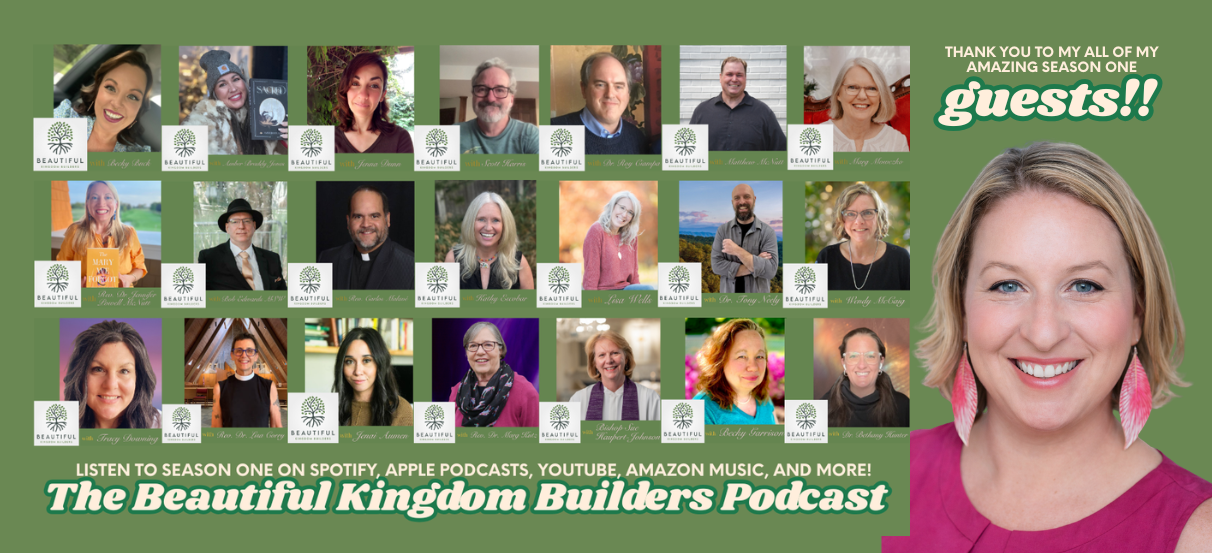
Today marks the final episode of Season One! I am filled with gratitude to everyone who has supported me in this project, by encouraging me to do it, giving me your time to be a guest or a listener, commenting, rating, reviewing, and sharing with others! You’ve made this project meaningful and worthwhile.
I am thankful especially to Wendy McCaig, my Episode 14 guest, for returning to have a conversation with me to help me reflect on my first season of podcasting, sharing lessons learned, impactful conversations, and future plans. Today’s episode offers insights into faith, community, and the power of listening. You can find quick links to all of my episodes here: The Beautiful Kingdom Builders Pod and I encourage you to stay in touch this summer, especially on Facebook and Instagram.
Please enjoy this episode of The Beautiful Kingdom Builders podcast on YouTube, Spotify, Apple Podcasts, Amazon Music, Substack, and more!
TRANSCRIPT:
Ruth Perry (00:15)
So today’s episode is going to be a little bit different. I’ve had 22 interviews now for season one and my 14th episode was with Wendy McCaig. She’s the executive director of Embrace Communities and she’s a global community catalyzer and one of her special skills is listening. And so Wendy offered to come back and ask me some questions that would help me to reflect on my first season of the podcast. And so I’m really grateful that you offered. This sounded like the perfect way for me to wrap up my first season. And so thank you for being here, Wendy, and being so generous.
Wendy McCaig (00:51)
Well, I enjoyed your podcast immensely. And the whole time you were doing them, I was like, I’m waiting till the end to ask you some of these questions, that learning, that gleaning, that what’s going to change next year. I’m on the edge of my seat waiting to find out. So.
Ruth Perry (01:08)
Me too. I don’t know what I’m going to say to you today.
Wendy McCaig (01:11)
Well, and I think having just a very casual conversation is kind of our goal today. And to start that process of reflecting on a lot, a lot of conversations. I’ve been quite impressed. So we’ll get started kind of with I’m always curious, what stood out to people when they start a new venture. What were those things that surprised you or maybe some things that popped out to you.
Ruth Perry (01:38)
Okay, so some of the things that have really stood out to me is just how unprepared I was for what is involved in making a podcast. And the learning curve that I’ve been on. It was something that I had on my heart that I wanted to do. I don’t know where that desire came from, but it wouldn’t go away. And I kind of held onto it for a couple of years and I would mention it to people here and there thinking that they would throw a little cold water on me and help me let it go. But every time I would bring it up, someone would be really encouraging and say, yeah, I think that’s a great idea. You should do it.
And so I just happened have let go of a day job. I’m a part time pastor and I felt like I had extra time and it was now or never. So I started my podcast and every single episode I was learning something new because I was making mistakes along the way. And I think that’s been surprising is just how fun it’s been, even though I’ve been making mistakes and sometimes I feel embarrassed to put an episode out. And then I get positive feedback from people telling me that they appreciated it when I feel like so scared about putting it there. And that’s really stood out to me.
Wendy McCaig (02:45)
Yeah, I started writing on Substack this year and I had that same apprehension and then the ones I’m most afraid of are the ones that people send me the kindest notes about. It’s funny. Yeah, that’s awesome. Did any themes emerge in those 22 conversations?
Ruth Perry (03:02)
Yeah, absolutely. I listened back to the little intro episode I did. I think it was less than two minutes long. And I haven’t revisited that all season. And I think I recorded that in September. And it was exactly what my podcast ended up being, those kind of conversations.
Like my tagline, I say that this is a place for redemptive conversations about gender, justice, abuse, and healing in the Christian faith. And I’ve had conversations about women’s experiences in the church, often traumatic and harmful, and just giving those kind of stories a platform, I think, is really important. We’ve had conversations about the rise of Christian nationalism and my episode with Carlos Malave, who’s the executive director of Latino Christian National Network. That was one of those episodes where I just had the most technical difficulties and I was so upset about how it came out. But one of my favorite episodes because it was so important to talk about the injustice that our Latino neighbors are experiencing right now.
I had a lot who are scholars or enthusiasts of the Bible share about living their faith in a way that is loving your neighbor and breaking down hierarchies and supremacy ideologies in our Christian faith so that we’re honoring one another, male and female and also like cisgender and LGBTQ. Having that conversation with Bishop Sue Haupert Johnson about the United Methodist church split, I felt was really impactful. And that was one of those surprising things where halfway through the podcast, I was starting to think, this is a lot of work. I don’t know if this is sustainable. So if this is my only *season who would I want to talk to? And I sent an email and I was just really shocked that she said she would come on.
Wendy McCaig (04:49)
Yeah, you had a lot of guests and I learned something from all of them. But I know I would see someone like, how did she connect with that person? How does she know that? I assume it’s just your boldness to reach out and say, would you do this? And it is so funny how each conversation you had, you said you really enjoyed it, was fun, like that how much fun it is. And I know being on the other side, it was fun for me.
Ruth Perry (05:12)
Yeah.
Wendy McCaig (05:17)
And I think that’s the energy of every single interview that you did. You could tell there was a gratitude for having the opportunity to share this story. And I felt that in the interview with Bishop Sue, there was this deep sense of, you know, some pain, that was a part of that but also some healing to get to share from her perspective of what that felt like. And for me, as kind of an outsider on the edges of all of that, it was healing for me to know the struggle that was happening in her world. I know one of your healing in the Christian, I experienced that as a listener, as I was listening to the podcast and gaining greater understanding.
So I love that what you set out to do. You feel like you did it. I think that’s really wonderful, great insight and clarity about about your calling toward that. So as you’re sitting here at the at the end of that first season, how are you feeling about being a podcaster and doing this. Where are you right now as you take a breath?
Ruth Perry (06:29)
Yeah. Well, I’ve really wrestled with whether or not podcasting is something that I should continue doing because it is a time intense thing to do. I’ve had six guests on where I’ve read a book before I’ve interviewed them, which was actually one of my goals, because when I turned 40 and I had had a hysterectomy and I started going through menopause, I stopped reading and I’ve always been a voracious reader. And it’s been really hard for me to pick up books again. And so during this podcast experience, I started reading again, which I’m really grateful for.
But yeah, that gratitude that you spoke of, have felt that every time anyone said yes, they would talk with me. I’ve just felt so grateful to them. And I felt that they were being so generous to give their time for this brand new baby little podcast. And I was kind of expecting on Facebook, I have a large following. But I’ve been frustrated on Facebook for years now about how shallow the conversations can be or how easy it is to offend when you can’t hear tone and you can’t, you kind of jump to conclusions about where someone is coming from. And you assign hate to their perspective because it’s different from your own. And so you’re immediately defensive and I wanted to have conversations where we could disagree or we could go a little bit deeper than Facebook or some kind of like one of these one dimensional platforms allows.
And I’ve just been thrilled, even though the Facebook audience, I don’t feel like has found the podcast yet, which that was one of the surprises. I don’t think I realized that social media and podcasts are such different entities. And I thought if people valued my Facebook page, they would probably be interested in my podcast. But I think part of the problem there is the algorithm. Facebook isn’t trying to get people to click out of their platform. And so they’re burying those posts that have a link off of Facebook. So part of it has felt really vulnerable starting new and then asking someone to give their time to something.
And in my brain, I’m still dealing with that imposter syndrome of my podcast is not worthy of my guests. I guess I need to work through that a little bit, but I have been bold in asking people, just putting it out there and then being surprised every time someone said yes.
Wendy McCaig (08:46)
Well, I think it’s a beautiful gift that you give to the guest because I know you asked me questions that I had never sat down and kind of given like, here’s the last 30 years of my life in, you know, five minutes or less. So it was nice to be able to share something with others that maybe didn’t know the whole journey. So I definitely felt like it was a gift to me and I’m sure others felt the same way. And there’s something different when you’re talking to a human. like when I’m writing, there’s, it just has a different vibe than conversation. So I think that it’s a needed form of communication.
I share your frustration with social media and how to like get the machine to privilege the information that you think it should privilege as a creator. yeah, I think assume a lot of people are going to relate to that. So as you’re thinking about all these conversations, I just wonder, you know, the importance of the conversations. Why do you think it’s important to capture these dialogues and share them publicly?
Ruth Perry (10:00)
I think one of the big lessons that I’ve learned in life is the importance of listening. When I was in college, I signed up to go build a house with Habitat for Humanity, but they had so many people sign up that they split half of us off randomly and sent us on a racial reconciliation trip to Washington, DC. And so at that time, I think I was 20 years old and just didn’t recognize that I had a cultural perspective on the world that was formed by the place where I stood socially and my family and my faith community and all these factors that were a part of how I viewed things and how I interpreted the Bible and how I interpreted events. And that was a really eye-opening trip.
And the thing that everybody said, we would go and we’d meet with all kinds of different people around DC and everybody said, please listen to us. When we’d say, what can we do? Please listen to us. And so I’m 45 now. That was 25 years ago. I diversified my algorithm and I listened to a lot of people that I wouldn’t have listened to if I hadn’t had that experience. And it’s shaped me in really profound ways where I’m a profoundly different person now, I think, than if I hadn’t had that one experience for one week.
And I just feel that sharing stories is so powerful. But before that, we need to learn how to listen to each other. And that’s something that I feel like the church has really lost, where we have these really tightly controlled systems in our faith communities. And the moment that you push against one of the norms of that community, you’re ejected. They might have coffee with you, but they’re not gonna really wrestle with it with you. They’re gonna say, you’re not part of us anymore. You don’t belong here. Maybe you should go somewhere else.
And I also feel like we can’t change that unless we’re close to the cultural power brokers. And so that’s been part of my journey is like, my eyes have opened. And so I’ve sought ways to make change and transformation in the communities that I really care about. And then met with a lot of rejection and ejection and just social punishment. And so my antennas are really up now when I experience and I see that happening in real time. And so it’s like a sensitivity that I have that I don’t know that everyone necessarily has. And me 15 years ago really needed to hear a podcast like this because I was really lonely as I was trying to make sense of my faith and how it was changing from the way that I was raised in the community that I belong to.
And so part of, I think, deep down, my podcast is like, know that there’s people out there that are currently like I was 15 years ago who are feeling lonely and they need to hear these stories. And I wish the whole church would listen to them. But I know that my podcast is not gonna resonate with the majority of people. It’s gonna resonate with the people who have been wounded or have some, rising awareness about how our ideologies and our culture are shaping us in ways that are malformed and different from the ways of Jesus. And so what I wanted to do on my podcast was invite people on whose faith I think looks like Jesus or represents Jesus in some way or tells a story that I think the church needs to hear because we’re not honoring those stories. We tried to cover them up or ignore them or just banish them so that we’re not made uncomfortable. But if we really loved each other, I think we would start by listening well.
Wendy McCaig (13:29)
I love that. There’s so many kind of streams in the the energy that comes through in the interviews and when you were talking about the listening and listening to those that are not the power brokers and those that look most like Jesus are the ones that are hanging out in spaces with those that the power brokers can’t see and how to amplify and put a microphone in the hands of those that the power brokers need to hear. I think, you know, thinking through all of the different layers of impact and so I kind of I heard a lot of that, especially like you were saying like Carlos’s interviews and others. But then there’s also that personal woundedness and I think most of the interviews that I resonated with had those stories of being cast out, being not accepted, being judged or labeled.
You’ve got both those streams running through here. And then I think this other kind of overarching theme of building these bridges between people who maybe would judge one another based on, and I’m guilty, ⁓ you know, I see a particular political sign or symbol or something and I’m automatically like think I know who you are, right?
Ruth Perry (14:43)
Me too, yes.
Wendy McCaig (14:51)
Like that is such in our waters right now and something we have to fight against. And I think your way of holding space is very genuine and gives people the comfort that you really are a bridge builder kind of connection to bring those pieces together. And how important that is in our current environment and how very very rare that is and especially in our social media environments where it feels like the ruder you are the the more viral your whatever’s gonna go. So yeah I love how well you recognize why it’s important to put these conversations out there.
What is your greatest hope? Now there’s 22 conversations and they’ll live on forever, Ruth. They’ll be there forever. Like, who knows what their long-term impact will be. But if you were to kind of summarize what you hope this little first class of of messengers, what their impact will be, how would you sum that up?
Ruth Perry (16:01)
I hope that the Holy Spirit will work through these episodes to speak to the people who listen to them, to challenge them to be more like Christ and embody Christ and Christ’s ways in the world, and that we’ll have a heart and greater empathy for each other, and that we won’t lose that command over and over in the New Testament to love each other.
And that that’s how people will know that we’re Christ’s disciples is by our love for each other. I think we’re really good at loving each other in our bubbles. I mean, I have people that don’t even recognize me as a Christian because I’m not in their particular form of Christianity. And I think that’s a failure of loving each other. I think every different tradition has something beautiful in its expression of their revelation of God that they have to share with the world and in their worship styles and in the different things that they bring to their worship and to their community. I mean, it’s beautiful. And that we should recognize that in each other and love that for each other, even if that’s not the tradition that we find ourselves in. I don’t think we should be so quick to expect that they’re going to hell.
Because that makes God very small, I think. And I think God is so much bigger than we ever hoped or imagined, and that God loves the world, and that God promised that he was going to overturn the curses of the fall, and he was going to save us. And so if we’re living in that kind of hope, like I hope that this little podcast plays a part in that redeeming work and that reconciling work of bringing us closer to God and closer to each other.
Wendy McCaig (17:37)
I love that. I think it’s already doing that. But I think that’s one thing about digital media is who knows? I think it’s a beautiful part. So what lessons have you learned from this series that will impact you as you think about next year? Is there a next year?
Ruth Perry (17:45)
I’m pretty committed to doing a second season. I think I’ll play it season by season and see how it goes. And in the seasons of my own life, maybe I’ll have to pause it for a longer period of time. Maybe doing once a week was too ambitious. Maybe I should scale that back. But I really, the actual having the conversations and reading the books and making the connections that I’m making is so much fun and so life-giving to me.
It’s kind of like, what is that Eric Little quote? Like when I’m running, I feel the joy of God or something. I messed that up, but I’m feeling really joyful in the process of making the podcast. So I want to make it, sustainable for myself to continue doing that. And I’m going to have to figure that out in some ways, because I’ve probably can’t sustain what I did this first season.
Maybe season two will be 12 episodes instead of 22. I don’t know. We’ll see. I have a long list of people that I would love to talk to. And I’m already setting up episodes to record during the summer. And I know that people are going to surprise me and reach out that I like, I didn’t know Tony Neely and I didn’t know Becky Garrison and they reached out to me and I had so much fun reading their books. I’m just blown away by what resources those two books were for the church. And I just look forward to what will come through this. What was the rest of the question?
Wendy McCaig (19:22)
Just what lessons and going forward that you want to carry forward.
Ruth Perry (19:27)
I’ve lost sight of slowing down, which was a theme that kind of happened with multiple conversations that I had. Like your spiritual practices really inspired me. Dr. Reverend Lisa Corry’s practices of quietness and Bishop Sue Haupert Johnson’s spiritual practices. And I need to develop more rhythms of quiet in my life.
And so that’s one of the big takeaways for me from season one is that I need to be more intentional about spending quiet time. And then another big takeaway for me was I was really surprised listening to the interviews and just hearing people’s faith stories. How often people came to faith because of a neighbor reaching out to them and inviting them to come to church or to an event, or just praying for them and loving them.
And I think in some ways the way our culture is so, we’re all so isolated from each other. We’re not very neighborly any longer. And maybe that’s a piece why 40 million people have left the church in the last couple of decades, that we need to be more neighborly. And it is something that’s really on my heart is that when Christ called us to love God and love our neighbors as ourselves, he wasn’t talking about how can we put people in our church pews and tithing into our church plates, but how can we leave the sanctuaries and go love our neighbors with no strings attached? And so I think that’s another area that the church really needs to work on.
Wendy McCaig (20:50)
Yeah, I think that being Christ in the world part, I’m watching and I don’t know if it’s just in our current political environment, but people who and there are certain circles where the word Christian or identifying as Christian doesn’t mean what it meant 20 years ago, especially in certain circles. When you talk about the 40 million that have left the church, a lot of people I know that walk the way of Christ more than the average person are in that category.
And it goes back to some of what you said about having to argue that you’re still part of the body when the rest of the body is trying to tell you you don’t belong because you think different. I think that is an interesting thing that I’m watching is, a follower of the way of Jesus and that word that label Christian, if it has a cultural meaning that’s not helpful, holding it differently. So I don’t know. don’t want to get in trouble here on your last podcast.
Ruth Perry (22:01)
No, I think it’s good trouble, Wendy. Yeah. Well, part of my kind of way that I’ve liked to look at the world is through that kind of cultural lens. And when I went to seminary, I got my master’s in education, but my focus was on cross-cultural ministry. And so I did a lot of reading on different cultures, and I had Bob Edwards on the podcast to talk about how quickly we jump to conclusions about things, like in a very tiny fraction of a second, we’ll have already interpreted something from our cultural lens.
And I think that that’s where a lot of us as American Christians are hung up. We don’t recognize that our perspective is American Christianity. It’s not Jesus Christianity. And that there’s some things that we need to unlearn and we need renew our minds about and repent from and turn from because they represent the values of our particular social place and not the values of Jesus Christ who was, you know, brown skin, Eastern Palestinian Jew living under Roman occupation. He was a marginalized person and he treated everyone he encountered with dignity and addressed the questions that they had in the place that they were.
And we’re really bad at that now. We can’t hear people if they have a perspective different than ours, immediately cast aspersions or demonize and literally use demonic language about people who vote differently than us or think differently than us. And that’s on the church. That’s church culture. And that’s what we need to repent of and turn from.
Wendy McCaig (23:32)
Yeah, I think in the season that we’re in, in terms of the society that we live in, such an opportunity for people of faith to be that healing balm that reweaves our social fabric and doesn’t continue the cutting us apart. And that requires tremendous resistance to the urge of conforming to the patterns of this world. And as you said, you know, being willing to transform our ways of being and be so countercultural.
I worry that that 40 million people that they didn’t leave the church left them or kicked them out and how heartbreaking that would be to the Father. You know, it’s like we’re all family, we’re all one, how do we embrace that in a in a way that is kind of that light, know, shine a light that’s different than the darkness that is lurking in the corners of the algorithm that takes off on Facebook. I’m seeing more and more courageous conversations and I feel like your podcast definitely falls into that category of people just boldly saying the things that need to be said in a time where we often feel silenced or encouraged to remain silent. So thank you so much for doing that.
Just final questions or anything else that you wanted to add to the conversation?
Ruth Perry (24:53)
I’m just thinking back on some of the conversations I had with different women about their experiences in the church with patriarchal theology and how harmful that has been. And I’m just very grieved. I think if we applied the one another commands from the New Testament and we loved our sisters in Christ as we love ourselves and kind of interrogated our theology on gender and on, I mean, not just women too, LGBTQ, how they’re treated in the church.
I think our theology is really consequential and that we should be working out our salvation and we should be working really hard on what we believe. And that if we’re making God smaller than God is, and we’re not imagining that God is actively healing our neighbors and loving our neighbors and that we just assume that if they’re not like us, they’re burning in hell. So what’s the point? And the world is burning. So what’s the point of caring for God’s beautiful creation?
I think our theology really matters. And so I’m grateful my faith has grown, my view of God has expanded and my hope is just, I’m such an optimist. Like I have so much faith that God is going to heal everything. I have faith that all of my loved ones who aren’t walking with the Lord are going to be saved and that we’re going to celebrate together and we’re going to bow our knees and worship Jesus.
I live with a lot of faith and I think that that’s why I want to have these kinds of conversations because I have faith that God is doing things. And when I encounter someone, they make assumptions about me and I make assumptions about them. But having these conversations, every time I talk with someone, I’m reminded about the good news of God’s kingdom. And I’m reminded to love my neighbors better. And so if I’m the only person that is growing closer to Jesus through this process, then I’m thankful for it.
And I’m all the more grateful for the people who’ve had conversations with me. But wrapping up season one, I’m just really grateful. And I really feel like we need to get back to love because God is love. And anyone who loves is born of God and knows God. And we need to love each other. We need to love our neighbors. We need to love our enemies. And that starts with listening. That’s the bare minimum. Learn to listen to each other.
Wendy McCaig (27:15)
Well, I appreciate that invitation to think about theology and is that theology life-giving? I remember in seminary, my vision of my professors really smashing every box we tried to cram the Divine into these tiny little boxes. And I remember one of my final papers was called Smashing the God Box, just that expanding, you know, and so if your, if your theology is one that is constricting and has these boundaries that you believe that God’s grace can’t work beyond that is limiting that power that that life-giving redemptive power so I I like that you know it’s not something you generally you know at the grocery hey how you working on your theology like it’s just but it’s not that we have that opportunity to kind of go on this journey with you of people and hearing about their struggles and their opportunities. I really also appreciated the question about spiritual practices. And I think maybe you could do some outtakes of here are seven spiritual practices while you’re out on your leave or I think that invitation,
Ruth Perry (28:29)
Yeah!
Wendy McCaig (28:35)
So much of it isn’t really in our head space on our theology. It’s how are we walking it out and how are we encountering that spirit in new ways that can open up new windows into the way we see the world, the way we see our neighbors, the way we see creation. I think that would be really interesting. Not that I’m adding anything to your plate for your summer. You should just breathe and
Ruth Perry (29:00)
I’m open to any ideas and suggestions.
Wendy McCaig (29:03)
Well, Ruth, it’s been great to be able to kind of catch up with you here at the end of this season. Glad to hear there’s another one percolating and that you’re already starting to like have some episodes in your back pocket before you start will hopefully give you more peace that on those those weeks or months when life just happens you have something in your back pocket so that’s a relief to hear that you’re going to keep it going it definitely is a gift and if you figure out how to crack the algorithm challenge on Facebook please share it with the rest of us but I know those who are enjoying it make a point of finding you even when Facebook doesn’t tell us we should.
Ruth Perry (29:43)
Thank so much, Wendy.
Thank you so much for visiting The Beautiful Kingdom Builders! You can find our podcast on YouTube, Spotify, Apple Podcasts, Amazon Music, Substack, and more! May God bless you this week and always.


