Category Archives: Uncategorized

023 I Rev. Ruth Perry Reflects on Season One Lessons & Themes

Find The Beautiful Kingdom Builders podcast on YouTubeSpotifyApple PodcastsAmazon MusicSubstack, and more

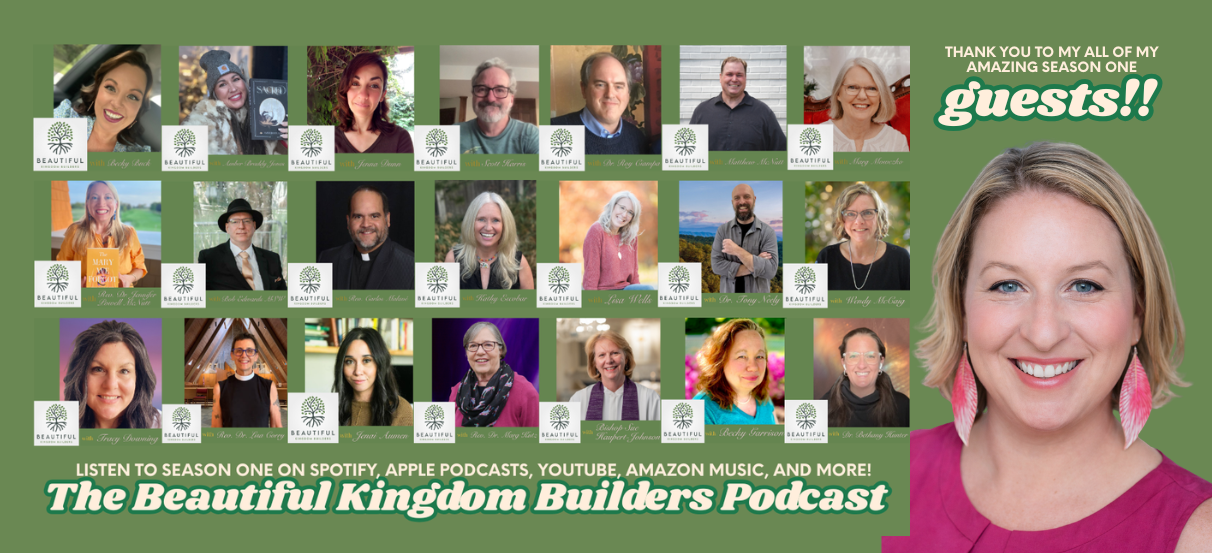
Today marks the final episode of Season One! I am filled with gratitude to everyone who has supported me in this project, by encouraging me to do it, giving me your time to be a guest or a listener, commenting, rating, reviewing, and sharing with others! You’ve made this project meaningful and worthwhile.

I am thankful especially to Wendy McCaig, my Episode 14 guest, for returning to have a conversation with me to help me reflect on my first season of podcasting, sharing lessons learned, impactful conversations, and future plans. Today’s episode offers insights into faith, community, and the power of listening. You can find quick links to all of my episodes here: The Beautiful Kingdom Builders Pod and I encourage you to stay in touch this summer, especially on Facebook and Instagram.

Please enjoy this episode of The Beautiful Kingdom Builders podcast on YouTubeSpotifyApple PodcastsAmazon MusicSubstack, and more

TRANSCRIPT:

Ruth Perry (00:15)
So today’s episode is going to be a little bit different. I’ve had 22 interviews now for season one and my 14th episode was with Wendy McCaig. She’s the executive director of Embrace Communities and she’s a global community catalyzer and one of her special skills is listening. And so Wendy offered to come back and ask me some questions that would help me to reflect on my first season of the podcast. And so I’m really grateful that you offered. This sounded like the perfect way for me to wrap up my first season. And so thank you for being here, Wendy, and being so generous.

Wendy McCaig (00:51)
Well, I enjoyed your podcast immensely. And the whole time you were doing them, I was like, I’m waiting till the end to ask you some of these questions, that learning, that gleaning, that what’s going to change next year. I’m on the edge of my seat waiting to find out. So.

Ruth Perry (01:08)
Me too. I don’t know what I’m going to say to you today.

Wendy McCaig (01:11)
Well, and I think having just a very casual conversation is kind of our goal today. And to start that process of reflecting on a lot, a lot of conversations. I’ve been quite impressed. So we’ll get started kind of with I’m always curious, what stood out to people when they start a new venture. What were those things that surprised you or maybe some things that popped out to you.

Ruth Perry (01:38)
Okay, so some of the things that have really stood out to me is just how unprepared I was for what is involved in making a podcast. And the learning curve that I’ve been on. It was something that I had on my heart that I wanted to do. I don’t know where that desire came from, but it wouldn’t go away. And I kind of held onto it for a couple of years and I would mention it to people here and there thinking that they would throw a little cold water on me and help me let it go. But every time I would bring it up, someone would be really encouraging and say, yeah, I think that’s a great idea. You should do it.

And so I just happened have let go of a day job. I’m a part time pastor and I felt like I had extra time and it was now or never. So I started my podcast and every single episode I was learning something new because I was making mistakes along the way. And I think that’s been surprising is just how fun it’s been, even though I’ve been making mistakes and sometimes I feel embarrassed to put an episode out. And then I get positive feedback from people telling me that they appreciated it when I feel like so scared about putting it there. And that’s really stood out to me.

Wendy McCaig (02:45)
Yeah, I started writing on Substack this year and I had that same apprehension and then the ones I’m most afraid of are the ones that people send me the kindest notes about. It’s funny. Yeah, that’s awesome. Did any themes emerge in those 22 conversations?

Ruth Perry (03:02)
Yeah, absolutely. I listened back to the little intro episode I did. I think it was less than two minutes long. And I haven’t revisited that all season. And I think I recorded that in September. And it was exactly what my podcast ended up being, those kind of conversations.

Like my tagline, I say that this is a place for redemptive conversations about gender, justice, abuse, and healing in the Christian faith. And I’ve had conversations about women’s experiences in the church, often traumatic and harmful, and just giving those kind of stories a platform, I think, is really important. We’ve had conversations about the rise of Christian nationalism and my episode with Carlos Malave, who’s the executive director of Latino Christian National Network. That was one of those episodes where I just had the most technical difficulties and I was so upset about how it came out. But one of my favorite episodes because it was so important to talk about the injustice that our Latino neighbors are experiencing right now.

I had a lot who are scholars or enthusiasts of the Bible share about living their faith in a way that is loving your neighbor and breaking down hierarchies and supremacy ideologies in our Christian faith so that we’re honoring one another, male and female and also like cisgender and LGBTQ. Having that conversation with Bishop Sue Haupert Johnson about the United Methodist church split, I felt was really impactful. And that was one of those surprising things where halfway through the podcast, I was starting to think, this is a lot of work. I don’t know if this is sustainable. So if this is my only *season who would I want to talk to? And I sent an email and I was just really shocked that she said she would come on.

Wendy McCaig (04:49)
Yeah, you had a lot of guests and I learned something from all of them. But I know I would see someone like, how did she connect with that person? How does she know that? I assume it’s just your boldness to reach out and say, would you do this? And it is so funny how each conversation you had, you said you really enjoyed it, was fun, like that how much fun it is. And I know being on the other side, it was fun for me.

Ruth Perry (05:12)
Yeah.

Wendy McCaig (05:17)
And I think that’s the energy of every single interview that you did. You could tell there was a gratitude for having the opportunity to share this story. And I felt that in the interview with Bishop Sue, there was this deep sense of, you know, some pain, that was a part of that but also some healing to get to share from her perspective of what that felt like. And for me, as kind of an outsider on the edges of all of that, it was healing for me to know the struggle that was happening in her world. I know one of your healing in the Christian, I experienced that as a listener, as I was listening to the podcast and gaining greater understanding.

So I love that what you set out to do. You feel like you did it. I think that’s really wonderful, great insight and clarity about about your calling toward that. So as you’re sitting here at the at the end of that first season, how are you feeling about being a podcaster and doing this. Where are you right now as you take a breath?

Ruth Perry (06:29)
Yeah. Well, I’ve really wrestled with whether or not podcasting is something that I should continue doing because it is a time intense thing to do. I’ve had six guests on where I’ve read a book before I’ve interviewed them, which was actually one of my goals, because when I turned 40 and I had had a hysterectomy and I started going through menopause, I stopped reading and I’ve always been a voracious reader. And it’s been really hard for me to pick up books again. And so during this podcast experience, I started reading again, which I’m really grateful for.

But yeah, that gratitude that you spoke of, have felt that every time anyone said yes, they would talk with me. I’ve just felt so grateful to them. And I felt that they were being so generous to give their time for this brand new baby little podcast. And I was kind of expecting on Facebook, I have a large following. But I’ve been frustrated on Facebook for years now about how shallow the conversations can be or how easy it is to offend when you can’t hear tone and you can’t, you kind of jump to conclusions about where someone is coming from. And you assign hate to their perspective because it’s different from your own. And so you’re immediately defensive and I wanted to have conversations where we could disagree or we could go a little bit deeper than Facebook or some kind of like one of these one dimensional platforms allows.

And I’ve just been thrilled, even though the Facebook audience, I don’t feel like has found the podcast yet, which that was one of the surprises. I don’t think I realized that social media and podcasts are such different entities. And I thought if people valued my Facebook page, they would probably be interested in my podcast. But I think part of the problem there is the algorithm. Facebook isn’t trying to get people to click out of their platform. And so they’re burying those posts that have a link off of Facebook. So part of it has felt really vulnerable starting new and then asking someone to give their time to something.

And in my brain, I’m still dealing with that imposter syndrome of my podcast is not worthy of my guests. I guess I need to work through that a little bit, but I have been bold in asking people, just putting it out there and then being surprised every time someone said yes.

Wendy McCaig (08:46)
Well, I think it’s a beautiful gift that you give to the guest because I know you asked me questions that I had never sat down and kind of given like, here’s the last 30 years of my life in, you know, five minutes or less. So it was nice to be able to share something with others that maybe didn’t know the whole journey. So I definitely felt like it was a gift to me and I’m sure others felt the same way. And there’s something different when you’re talking to a human. like when I’m writing, there’s, it just has a different vibe than conversation. So I think that it’s a needed form of communication.

I share your frustration with social media and how to like get the machine to privilege the information that you think it should privilege as a creator. yeah, I think assume a lot of people are going to relate to that. So as you’re thinking about all these conversations, I just wonder, you know, the importance of the conversations. Why do you think it’s important to capture these dialogues and share them publicly?

Ruth Perry (10:00)
I think one of the big lessons that I’ve learned in life is the importance of listening. When I was in college, I signed up to go build a house with Habitat for Humanity, but they had so many people sign up that they split half of us off randomly and sent us on a racial reconciliation trip to Washington, DC. And so at that time, I think I was 20 years old and just didn’t recognize that I had a cultural perspective on the world that was formed by the place where I stood socially and my family and my faith community and all these factors that were a part of how I viewed things and how I interpreted the Bible and how I interpreted events. And that was a really eye-opening trip.

And the thing that everybody said, we would go and we’d meet with all kinds of different people around DC and everybody said, please listen to us. When we’d say, what can we do? Please listen to us. And so I’m 45 now. That was 25 years ago. I diversified my algorithm and I listened to a lot of people that I wouldn’t have listened to if I hadn’t had that experience. And it’s shaped me in really profound ways where I’m a profoundly different person now, I think, than if I hadn’t had that one experience for one week.

And I just feel that sharing stories is so powerful. But before that, we need to learn how to listen to each other. And that’s something that I feel like the church has really lost, where we have these really tightly controlled systems in our faith communities. And the moment that you push against one of the norms of that community, you’re ejected. They might have coffee with you, but they’re not gonna really wrestle with it with you. They’re gonna say, you’re not part of us anymore. You don’t belong here. Maybe you should go somewhere else.

And I also feel like we can’t change that unless we’re close to the cultural power brokers. And so that’s been part of my journey is like, my eyes have opened. And so I’ve sought ways to make change and transformation in the communities that I really care about. And then met with a lot of rejection and ejection and just social punishment. And so my antennas are really up now when I experience and I see that happening in real time. And so it’s like a sensitivity that I have that I don’t know that everyone necessarily has. And me 15 years ago really needed to hear a podcast like this because I was really lonely as I was trying to make sense of my faith and how it was changing from the way that I was raised in the community that I belong to.

And so part of, I think, deep down, my podcast is like, know that there’s people out there that are currently like I was 15 years ago who are feeling lonely and they need to hear these stories. And I wish the whole church would listen to them. But I know that my podcast is not gonna resonate with the majority of people. It’s gonna resonate with the people who have been wounded or have some, rising awareness about how our ideologies and our culture are shaping us in ways that are malformed and different from the ways of Jesus. And so what I wanted to do on my podcast was invite people on whose faith I think looks like Jesus or represents Jesus in some way or tells a story that I think the church needs to hear because we’re not honoring those stories. We tried to cover them up or ignore them or just banish them so that we’re not made uncomfortable. But if we really loved each other, I think we would start by listening well.

Wendy McCaig (13:29)
I love that. There’s so many kind of streams in the the energy that comes through in the interviews and when you were talking about the listening and listening to those that are not the power brokers and those that look most like Jesus are the ones that are hanging out in spaces with those that the power brokers can’t see and how to amplify and put a microphone in the hands of those that the power brokers need to hear. I think, you know, thinking through all of the different layers of impact and so I kind of I heard a lot of that, especially like you were saying like Carlos’s interviews and others. But then there’s also that personal woundedness and I think most of the interviews that I resonated with had those stories of being cast out, being not accepted, being judged or labeled.

You’ve got both those streams running through here. And then I think this other kind of overarching theme of building these bridges between people who maybe would judge one another based on, and I’m guilty, ⁓ you know, I see a particular political sign or symbol or something and I’m automatically like think I know who you are, right?

Ruth Perry (14:43)
Me too, yes.

Wendy McCaig (14:51)
Like that is such in our waters right now and something we have to fight against. And I think your way of holding space is very genuine and gives people the comfort that you really are a bridge builder kind of connection to bring those pieces together. And how important that is in our current environment and how very very rare that is and especially in our social media environments where it feels like the ruder you are the the more viral your whatever’s gonna go. So yeah I love how well you recognize why it’s important to put these conversations out there.

What is your greatest hope? Now there’s 22 conversations and they’ll live on forever, Ruth. They’ll be there forever. Like, who knows what their long-term impact will be. But if you were to kind of summarize what you hope this little first class of of messengers, what their impact will be, how would you sum that up?

Ruth Perry (16:01)
I hope that the Holy Spirit will work through these episodes to speak to the people who listen to them, to challenge them to be more like Christ and embody Christ and Christ’s ways in the world, and that we’ll have a heart and greater empathy for each other, and that we won’t lose that command over and over in the New Testament to love each other.

And that that’s how people will know that we’re Christ’s disciples is by our love for each other. I think we’re really good at loving each other in our bubbles. I mean, I have people that don’t even recognize me as a Christian because I’m not in their particular form of Christianity. And I think that’s a failure of loving each other. I think every different tradition has something beautiful in its expression of their revelation of God that they have to share with the world and in their worship styles and in the different things that they bring to their worship and to their community. I mean, it’s beautiful. And that we should recognize that in each other and love that for each other, even if that’s not the tradition that we find ourselves in. I don’t think we should be so quick to expect that they’re going to hell.

Because that makes God very small, I think. And I think God is so much bigger than we ever hoped or imagined, and that God loves the world, and that God promised that he was going to overturn the curses of the fall, and he was going to save us. And so if we’re living in that kind of hope, like I hope that this little podcast plays a part in that redeeming work and that reconciling work of bringing us closer to God and closer to each other.

Wendy McCaig (17:37)
I love that. I think it’s already doing that. But I think that’s one thing about digital media is who knows? I think it’s a beautiful part. So what lessons have you learned from this series that will impact you as you think about next year? Is there a next year?

Ruth Perry (17:45)
I’m pretty committed to doing a second season. I think I’ll play it season by season and see how it goes. And in the seasons of my own life, maybe I’ll have to pause it for a longer period of time. Maybe doing once a week was too ambitious. Maybe I should scale that back. But I really, the actual having the conversations and reading the books and making the connections that I’m making is so much fun and so life-giving to me.

It’s kind of like, what is that Eric Little quote? Like when I’m running, I feel the joy of God or something. I messed that up, but I’m feeling really joyful in the process of making the podcast. So I want to make it, sustainable for myself to continue doing that. And I’m going to have to figure that out in some ways, because I’ve probably can’t sustain what I did this first season.

Maybe season two will be 12 episodes instead of 22. I don’t know. We’ll see. I have a long list of people that I would love to talk to. And I’m already setting up episodes to record during the summer. And I know that people are going to surprise me and reach out that I like, I didn’t know Tony Neely and I didn’t know Becky Garrison and they reached out to me and I had so much fun reading their books. I’m just blown away by what resources those two books were for the church. And I just look forward to what will come through this. What was the rest of the question?

Wendy McCaig (19:22)
Just what lessons and going forward that you want to carry forward.

Ruth Perry (19:27)
I’ve lost sight of slowing down, which was a theme that kind of happened with multiple conversations that I had. Like your spiritual practices really inspired me. Dr. Reverend Lisa Corry’s practices of quietness and Bishop Sue Haupert Johnson’s spiritual practices. And I need to develop more rhythms of quiet in my life.

And so that’s one of the big takeaways for me from season one is that I need to be more intentional about spending quiet time. And then another big takeaway for me was I was really surprised listening to the interviews and just hearing people’s faith stories. How often people came to faith because of a neighbor reaching out to them and inviting them to come to church or to an event, or just praying for them and loving them.

And I think in some ways the way our culture is so, we’re all so isolated from each other. We’re not very neighborly any longer. And maybe that’s a piece why 40 million people have left the church in the last couple of decades, that we need to be more neighborly. And it is something that’s really on my heart is that when Christ called us to love God and love our neighbors as ourselves, he wasn’t talking about how can we put people in our church pews and tithing into our church plates, but how can we leave the sanctuaries and go love our neighbors with no strings attached? And so I think that’s another area that the church really needs to work on.

Wendy McCaig (20:50)
Yeah, I think that being Christ in the world part, I’m watching and I don’t know if it’s just in our current political environment, but people who and there are certain circles where the word Christian or identifying as Christian doesn’t mean what it meant 20 years ago, especially in certain circles. When you talk about the 40 million that have left the church, a lot of people I know that walk the way of Christ more than the average person are in that category.

And it goes back to some of what you said about having to argue that you’re still part of the body when the rest of the body is trying to tell you you don’t belong because you think different. I think that is an interesting thing that I’m watching is, a follower of the way of Jesus and that word that label Christian, if it has a cultural meaning that’s not helpful, holding it differently. So I don’t know. don’t want to get in trouble here on your last podcast.

Ruth Perry (22:01)
No, I think it’s good trouble, Wendy. Yeah. Well, part of my kind of way that I’ve liked to look at the world is through that kind of cultural lens. And when I went to seminary, I got my master’s in education, but my focus was on cross-cultural ministry. And so I did a lot of reading on different cultures, and I had Bob Edwards on the podcast to talk about how quickly we jump to conclusions about things, like in a very tiny fraction of a second, we’ll have already interpreted something from our cultural lens.

And I think that that’s where a lot of us as American Christians are hung up. We don’t recognize that our perspective is American Christianity. It’s not Jesus Christianity. And that there’s some things that we need to unlearn and we need renew our minds about and repent from and turn from because they represent the values of our particular social place and not the values of Jesus Christ who was, you know, brown skin, Eastern Palestinian Jew living under Roman occupation. He was a marginalized person and he treated everyone he encountered with dignity and addressed the questions that they had in the place that they were.

And we’re really bad at that now. We can’t hear people if they have a perspective different than ours, immediately cast aspersions or demonize and literally use demonic language about people who vote differently than us or think differently than us. And that’s on the church. That’s church culture. And that’s what we need to repent of and turn from.

Wendy McCaig (23:32)
Yeah, I think in the season that we’re in, in terms of the society that we live in, such an opportunity for people of faith to be that healing balm that reweaves our social fabric and doesn’t continue the cutting us apart. And that requires tremendous resistance to the urge of conforming to the patterns of this world. And as you said, you know, being willing to transform our ways of being and be so countercultural.

I worry that that 40 million people that they didn’t leave the church left them or kicked them out and how heartbreaking that would be to the Father. You know, it’s like we’re all family, we’re all one, how do we embrace that in a in a way that is kind of that light, know, shine a light that’s different than the darkness that is lurking in the corners of the algorithm that takes off on Facebook. I’m seeing more and more courageous conversations and I feel like your podcast definitely falls into that category of people just boldly saying the things that need to be said in a time where we often feel silenced or encouraged to remain silent. So thank you so much for doing that.

Just final questions or anything else that you wanted to add to the conversation?

Ruth Perry (24:53)
I’m just thinking back on some of the conversations I had with different women about their experiences in the church with patriarchal theology and how harmful that has been. And I’m just very grieved. I think if we applied the one another commands from the New Testament and we loved our sisters in Christ as we love ourselves and kind of interrogated our theology on gender and on, I mean, not just women too, LGBTQ, how they’re treated in the church.

I think our theology is really consequential and that we should be working out our salvation and we should be working really hard on what we believe. And that if we’re making God smaller than God is, and we’re not imagining that God is actively healing our neighbors and loving our neighbors and that we just assume that if they’re not like us, they’re burning in hell. So what’s the point? And the world is burning. So what’s the point of caring for God’s beautiful creation?

I think our theology really matters. And so I’m grateful my faith has grown, my view of God has expanded and my hope is just, I’m such an optimist. Like I have so much faith that God is going to heal everything. I have faith that all of my loved ones who aren’t walking with the Lord are going to be saved and that we’re going to celebrate together and we’re going to bow our knees and worship Jesus.

I live with a lot of faith and I think that that’s why I want to have these kinds of conversations because I have faith that God is doing things. And when I encounter someone, they make assumptions about me and I make assumptions about them. But having these conversations, every time I talk with someone, I’m reminded about the good news of God’s kingdom. And I’m reminded to love my neighbors better. And so if I’m the only person that is growing closer to Jesus through this process, then I’m thankful for it.

And I’m all the more grateful for the people who’ve had conversations with me. But wrapping up season one, I’m just really grateful. And I really feel like we need to get back to love because God is love. And anyone who loves is born of God and knows God. And we need to love each other. We need to love our neighbors. We need to love our enemies. And that starts with listening. That’s the bare minimum. Learn to listen to each other.

Wendy McCaig (27:15)
Well, I appreciate that invitation to think about theology and is that theology life-giving? I remember in seminary, my vision of my professors really smashing every box we tried to cram the Divine into these tiny little boxes. And I remember one of my final papers was called Smashing the God Box, just that expanding, you know, and so if your, if your theology is one that is constricting and has these boundaries that you believe that God’s grace can’t work beyond that is limiting that power that that life-giving redemptive power so I I like that you know it’s not something you generally you know at the grocery hey how you working on your theology like it’s just but it’s not that we have that opportunity to kind of go on this journey with you of people and hearing about their struggles and their opportunities. I really also appreciated the question about spiritual practices. And I think maybe you could do some outtakes of here are seven spiritual practices while you’re out on your leave or I think that invitation,

Ruth Perry (28:29)
Yeah!

Wendy McCaig (28:35)
So much of it isn’t really in our head space on our theology. It’s how are we walking it out and how are we encountering that spirit in new ways that can open up new windows into the way we see the world, the way we see our neighbors, the way we see creation. I think that would be really interesting. Not that I’m adding anything to your plate for your summer. You should just breathe and

Ruth Perry (29:00)
I’m open to any ideas and suggestions.

Wendy McCaig (29:03)
Well, Ruth, it’s been great to be able to kind of catch up with you here at the end of this season. Glad to hear there’s another one percolating and that you’re already starting to like have some episodes in your back pocket before you start will hopefully give you more peace that on those those weeks or months when life just happens you have something in your back pocket so that’s a relief to hear that you’re going to keep it going it definitely is a gift and if you figure out how to crack the algorithm challenge on Facebook please share it with the rest of us but I know those who are enjoying it make a point of finding you even when Facebook doesn’t tell us we should.

Ruth Perry (29:43)
Thank so much, Wendy.


Thank you so much for visiting The Beautiful Kingdom Builders! You can find our podcast on YouTubeSpotifyApple PodcastsAmazon MusicSubstack, and more! May God bless you this week and always.

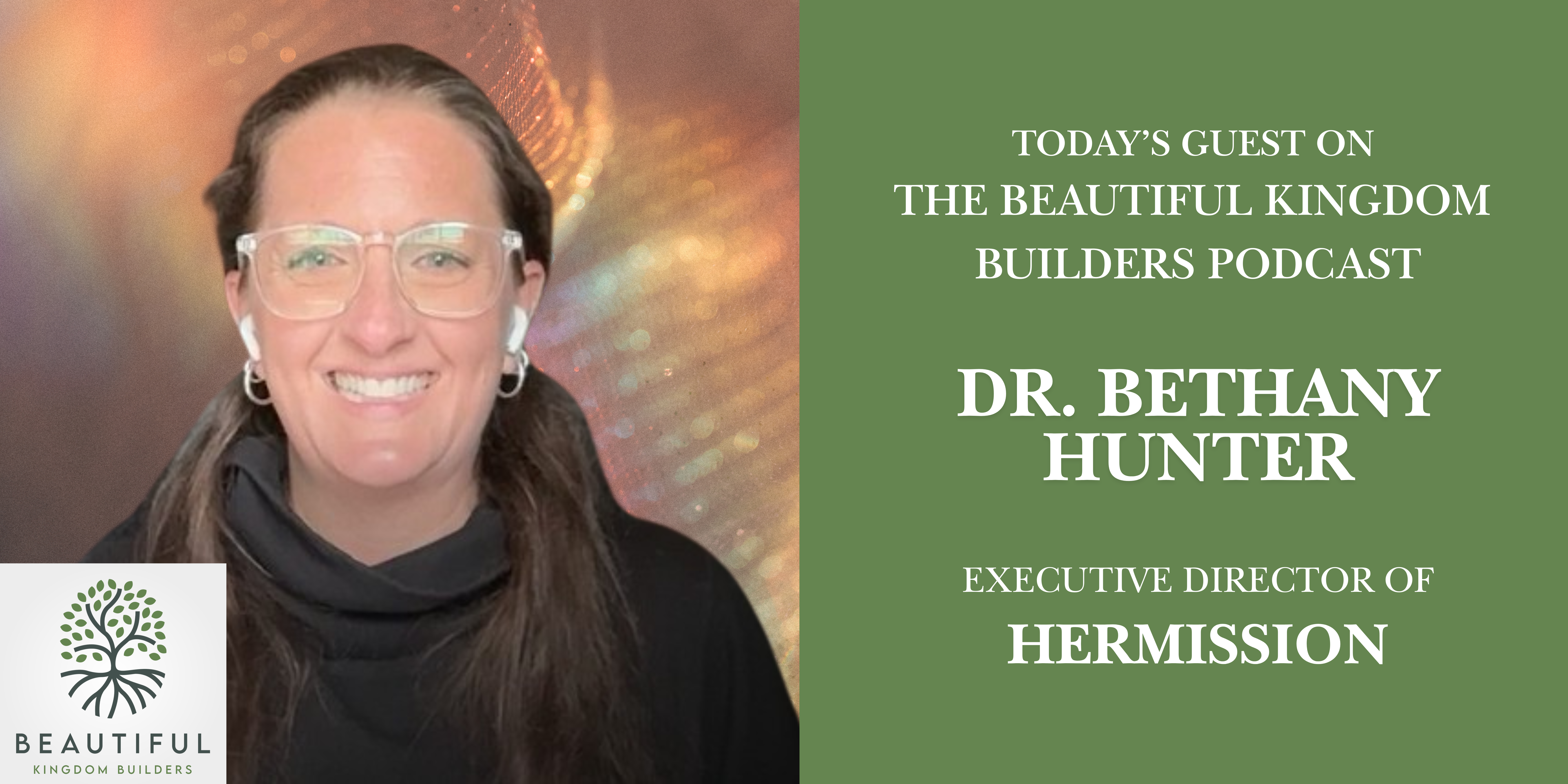
022 I Dr. Bethany Hunter on Empowering Christians to Live a Mission-Driven Life Wherever They Are

My guest today is Dr. Bethany Hunter, the Executive Director and Treasurer of HerMission, an historic ministry that goes back to the 1870’s. Bethany is passionate about women’s and the church’s empowerment for mission work. We discussed how equipping the Church is essential for fostering a more inclusive and equitable Christian community, and that missions begins with meeting the physical needs of our neighbors before we approach their spiritual needs. We can live a life of mission and service no matter where we are! Dr. Hunter shares her personal journey from growing up as a pastor’s kid to a twenty-year long career in the education world, to her recent big shift into ministry life, and how she is balancing it all as a mom of three.

If you are in Virginia, you can connect with HerMission at ⁠onhermission.org⁠ to learn more about their ministries and get plugged into the Kingdom work they are doing! And follow them on Facebook and Instagram.

Please enjoy this episode of The Beautiful Kingdom Builders podcast on YouTubeSpotifyApple PodcastsAmazon MusicSubstack, and more

TRANSCRIPT:

Ruth Perry (00:15)
My guest today is Dr. Bethany Hunter. She is the executive director of HerMission, which is a movement of women on mission here in Virginia since 1874. HerMission’s mission is equipping the entire church to be on mission with God. And Bethany and I go back several years now. I used to work at the church that Bethany attends here locally. And not just attend, you’re leader in your church here and now you’re a leader in the state. And I’m just really excited that you’re here to talk about your mission and your ministry. Bethany, thank you for being on the podcast.

Bethany Hunter (00:48)
Yes, I am so excited to be here.

Ruth Perry (00:50)
Can you take us back just to start and tell us your testimony Bethany?

Bethany Hunter (00:55)
So I have been in the church since I was just a few days old. My dad was the minister of a church here in the small community where I live and presented me to the church when I was about a week old and have been going to church regularly since. I have always just naturally gravitated towards having a relationship with the church and with God that allows me to serve others and be a good person without necessarily passing judgment, I guess, on others. I’ve always participated in children’s and youth activities in my current church. I was ordained as a deacon, but not currently serving as a deacon with my other responsibilities.

I still do some other things at church, but I always did missions trips with my youth group and then as a college student participated in several missions trips with my campus ministry groups. And there were two occasions in my life where I had very big decisions to make and in both cases, one to transfer colleges and one to make a job change. I didn’t want to make the hard decision and did, and when I did, felt very affirmed, felt at peace, felt that I was making the choice that was gonna keep me in God’s will, but I’ve never been out of touch with the church and with my relationship with Christ, so.

Ruth Perry (02:26)
I’m also a Baptist minister’s kid, so I recognize it’s a tough job. And I think it’s really beautiful that you’ve just always stayed connected to the church because that’s not always the case with pastors’ kids.

Bethany Hunter (02:31)
It’s a tough job.

Agreed, and I think especially for women who grew up in the Baptist church that there’s a lot of variability there in their experiences, you church that I spent most of my formative years in was in Franklin, Virginia. And so I was there right before I turned three and my parents were there through my first couple of years of college and this was at a huge transition time in Baptist life and the church I was in just kind of naturally gravitated towards women in leadership and women can wear pants to church and women can be deacons and women can be ushers. And so it was never a battle in our church. And so I didn’t realize, I think at that time the larger battle that was happening outside of the church in especially in Baptist life. So I was very fortunate to be insulated from that.

Ruth Perry (03:29)
That is true. What are some of your favorite things about being Baptist? What do you about your tradition?

Bethany Hunter (03:38)
One of the Baptist pillars is the separation of church and state. And I believe very strongly in that. I think that, while our country was founded with deist ideals and the idea of being a good person, I think our country was started because people wanted freedom from state religion. And so I believe that we should continue to support freedom from state religion. And I think that not being in a church where I’m told how to vote or who to vote for, I think is very important to me. I like that ideal of Baptist life. So that’s probably one of my favorite things about being a Baptist.

Ruth Perry (04:17)
Yeah, I noticed in the HerMission materials that I looked at, they use the Frederick Buechner quote, “The place where your deep gladness meets the world’s deep hunger.” So I wanted you to finish the sentence, where does the place your deep gladness, where does that meet the world’s hunger?

Bethany Hunter (04:22)
So I think that comes from our desire as an organization and just kind of our theology of mission that you can’t tell people about Christ’s love if they’re hungry or if they don’t have anywhere to shelter at night or if they have a mental illness that is untreated or uncared for. And so we want to serve the needs, the physical needs, the and mental needs of our neighbors, whoever our neighbor is. And in doing so, we then an avenue to speak blessings that we have and how Christ has loved us and how Christ loves others. But those needs have to be met first. And so that’s where our joy comes from is just serving others and seeing how that service transforms in the form of Christ’s love, I think.

Ruth Perry (05:28)
That’s beautiful. Yeah, my son Benjamin wanted me to talk to you what you did your dissertation on. said, you gotta get Dr. Hunter to talk about her dissertation because it’s fascinating.

Bethany Hunter (05:34)
It’s probably not. So my dissertation, so I at the time was teaching seventh grade social studies when I started my dissertation and this was an EDD, so a more practical degree and so we real projects for our research. And so I wanted to see how organizing students who had IEPs, 504 plans into classes affected their grades, their attendance, their state test scores. Sometimes we had a big group of special education students with a small group of regular students all in a classroom and those special education students would just group together from one class to the next. And then we started to split them up a little bit more so there were fewer of them in those classes. Sometimes they had a co-teacher, sometimes they didn’t, sometimes they were receiving outside services, sometimes they didn’t.

We just wanted to track those students over several years to see how those different styles of classes impacted their performance. Ultimately, I had a whole lot of research and my conclusions were inconclusive. Like there were too many variables, there were individual variables attendance and all of those things.

Different teachers, everything. Everything is just too, too mixed up to really come to a conclusion about one specific style of instruction. But it was very, very interesting to follow those kids and see how they performed and, you know, just to do the back research on special education and how it’s changed over time. So that was good. And it’s done.

Ruth Perry (07:25)
Yeah, so you were teacher and then a school administrator. do you carry over your experiences in the school system and in your education into your ministry now?

Bethany Hunter (07:35)
Yes, when I was considering applying for the position and I was talking to the previous executive director treasurer, she, I said, you know, my background is in education and administration. This is not, this is not my thing. She said, you wouldn’t believe. And she was right. So a lot of the organizational piece of it. Personnel management, budget management, supervising people, working on people’s evaluations, making sure everybody’s kind of doing their tasks. Those carry over. To some extent, working with people who can become escalated, like my high school students do from time to time, So having hard conversations is important. Learning to just take things as they come. Just maintain a level of calm and peace and control in any kind of situation, think is all of those things are valuable and experiences that I had worked on before I came into the organization. So I do feel good about the background that I had.

And then I’ll answer another question, things that I still feel like I need to work on. Nonprofit organization is very different from a public school organization. And so I’m still, you know, I take like online low classes to understand how nonprofits work and how you can keep them going. I’ve met with other people in nonprofits, especially on the fundraising end, because that’s definitely an area of weakness for me. And then also just in Christian leadership. And so I grew up in the church and I’m not unfamiliar with scripture, but I do a lot of speaking, preaching, and I’m not prepared for that like I want to be. And so I am actually.

I am gonna enroll in a seminary in the fall to do a brief Masters of Christian Leadership. It doesn’t require a thesis at the end. It’s a 36 credit hour program but just to give me a little bit more background in foundational theology. The ability to write my own sermons. The public speaking piece isn’t difficult. The writing the sermon piece is difficult. So I want to do that better.

Ruth Perry (09:49)
That’s really cool that you have a plan for your leadership development, huh?

Bethany Hunter (09:53)
Well, I really thought in 2017 when I got that EDDthat I was done, but apparently I wasn’t. God’s plans are not my plans.

Ruth Perry (10:01)
Well, I think about what you said about your dissertation, it seems like that really correlates well with ministry because people don’t fit into little boxes. You have to approach them on a one-person basis and it’s not convenient. It’s not uniform. It’s not fast. It requires investment and care beyond just what is the most efficient. Okay, here’s a thought that I was wondering about because the church that you’re involved in is multi-generational, but probably majority older. Since you’ve worked with all different ages, and I think that there’s some challenges between intergenerational work.

So what are some challenges that you’ve experienced working with different generations, and then what are the positive things that you see that different generations bring to church ministry?

Bethany Hunter (10:50)
So our organization particularly has a broad range, right, of people that we serve. So we recently had our Mom and Me event, which is girls K through six and their mom or mom figures. A month ago we had our Teen Girls event. In November we have our adult event, our women’s event. And so it’s amazing to see some of the differences, what those different groups expect out of worship, what those groups expect as far as just the activities that they participate in, what those groups expect out of their accommodations, you know, when we’re having those events.

I think the thing about the church where we are is, are some things that we all agree on as far as how we worship, our expectations of the past or separation of church and state, those types of things. And there are things that we don’t necessarily worry about. Being with the little girls and the youth girls keeps me young. I think it helps me stay in touch. part of, I’ve never had that kind of disconnect because I’ve been with high schoolers or middle schoolers. And even with my own children, they keep me kind of in touch with what’s going on in that generation and what they’re facing, what their challenges are.

But for our ministry, we’re just trying to do our best to serve each of those groups as they need to be served. And so figuring out what their needs are at each level is really important for us.

Ruth Perry (12:28)
Do you know how many people throughout Virginia are involved in HerMission groups?

Bethany Hunter (12:33)
No, so we don’t have an individual membership count. We have groups in churches and we have people who attend events that aren’t necessarily members. So there is a voting membership, but again, it’s not an individual membership. It’s based on church giving. And so if a church has the certain type of giving, then they are allowed to have voting members. And really, anybody in that church can be a voting member if they’re giving to our state missions offering. Consistently, we have, you know, two to 300 at and girls event. Our teen event is a little bit less, usually between 50 and 100.

Across the state of Virginia, we have about 700 churches that give to the state missions offering, but we definitely don’t have that many HerMission groups. Most of our groups are central around the Richmond area because that’s where it started. That’s where the home base is. Any church in Virginia who has a history of WMU has the opportunity to have groups. I just haven’t been connected with all of them or been invited to be at all of them just yet. Most of them around the Richmond area though.

Ruth Perry (13:51)
Yeah. Can you tell us about the formation? It was the Women’s Mission Union of Virginia, right? WMUV and then, yeah, tell us the history.

Bethany Hunter (13:59)
Sure. Right, so in the 1870s, Lottie Moon had just gone to China. And there was a group of women in the Richmond area churches who wanted to raise money to support her and her sister to find housing. because they were there on their own, they didn’t have husbands, know, they were just there because they had a heart for the people of China.

And so the women in those churches started collecting money to send to Lottie Moon through the, at the time, the Foreign Mission Board, it became the International Mission Board. And so that was kind of the first iteration of the Women’s Missionary Union of Virginia. It didn’t actually get called the Women’s Missionary Union until 1888 when it formed at a national level. And so in Virginia, it existed before it existed at the national level. So the Women’s Missionary Union is still an auxiliary of the Southern Baptist Convention at the national level. Annie Armstrong was the first executive director of the national organization. One of our Virginia titans in WMU, Alma Hunt, who we’ve named our state offering after, was an executive director at the national level as well.

And so, that organization over time exists to help people learn about missions, pray about missions, give to missions, and do missions. Those are the focuses. And that has come a long way. In many cases, churches give to the Lottie Moon Christmas offering that goes to the International Mission Board, the National North American Mission Board gets the Annie Armstrong Easter offering and then each state has their state missions offering ours is Alma hunt and that goes to us and the Baptist General Association of Virginia we we split that there’s a percentage and we split that But it’s I mean it’s a long-running program but at the state level in each state. It does look a little bit different from state to state than it does at the national level.

Ruth Perry (16:06)
So kind of rebranding as HerMission is a continuation of the same ministry of WMUV, but then it also feels kind of like a re-imagination. Would you say that’s right?

Bethany Hunter (16:09)
Sure, yes. So I was on the board of trustees as just a member at large when we decided to bring that change to the membership as a whole. And there was some resistance, of course, as there always is with change. But after 150 years, we really felt you didn’t already know what WMU was, then it was like this club that you just couldn’t be a part of. And we wanted to make it look new, make it sound new, so that we could broaden our audience and broaden it to younger people, younger women, broaden it outside of the Baptist Church.

And so that’s part of our goal is to connect with other church and parachurch groups to do missions in their communities or in a larger way, not just the WMU as it always has been. Because it will die. And we said that. When I go to WMU groups who said, well, we’re still going to call ourselves WMU, I can guarantee you that most of the ladies in that group are over the age of 65 or 70. They’re not getting new members because the new members don’t know what WMU means. So we’ve tried to rebrand that a little bit, refresh.

Ruth Perry (17:36)
Yeah, yeah, that’s good. You’ve been shaped the WMU ministries like Mission Friends and Girls in Action from a young age yourself and going to camp. Looking back, when did you first begin to sense that God was calling you into some kind of mission?

Bethany Hunter (17:44)
I have never not done missions. When I was kind of finishing up my second year at college, my parents said, you need to have a marketable degree when you finish your first four years of college. And so I didn’t know what that was going to be. I had studied medicine for a year and that was, not for me and I studied religious studies and Spanish for a year and my parents said, what are you gonna do with that? So I didn’t know.

And they suggested that go ahead and get an education degree. And when I started that, that was one of those two kind of life-changing decisions that was the right thing to do. And I told my parents, I was like, I would love to go to a foreign country to teach English. and they were supportive of that. But they also encouraged me and there are people, there are kids right here in our public education system that need someone like you to just be a good role model, to have expectations for good character, to help them learn, to help them break cycles of dropping out or drug abuse or like your mission field can be wherever you are.

And that really spoke to me. I didn’t have to go somewhere else to do missions as I always had. I could be at home and do missions or be wherever and do missions. And so I took that on very seriously and really worked in the public schools. Not to break rules, not to convert kids, not to indoctrinate kids, because I don’t believe in that, but to just be a good role model and to have expectations for kids’ character so that I could minister to them in that way without necessarily saying Jesus or God.

Ruth Perry (19:44)
I think that’s really important. I think a lot of Christians, we lose sight of caring for people. Or we spiritualize all of Jesus’ life and ministry and we miss that he was actually meeting physical needs of people and caring for people where they were. And oftentimes not evangelizing them in the way that we think or we’re told that we’re supposed to live as Christians. Yeah, I think that’s really good.

Bethany Hunter (19:53)
Mm-hmm. Right.

Ruth Perry (20:07)
So on top of being a leader, you’re also a mom of three and a wife. And you have a large family that all lives close by that you’re involved with. So how do you navigate your personal life and your calling and all the challenges of managing all of that as a woman?

Bethany Hunter (20:13)
Yes. Mm-hmm. My calendar is color-coded by child because we don’t have anyone driving yet. No, I am very intentional about the time that I spend with the people that I love. So, if it’s a week or a month, this month has been nutso. I have done a lot of traveling, but the times that I am at home and with my kids. I am at home and with my kids. I am not working or distracted by emails or phones. I really do take time to give each of my kids individual and group attention. Same for my husband. I haven’t forgotten about him either.

It’s really helpful to have a village of people. So having my sister and her husband and my mom and my in-laws close by helps when I go out of town because I know my kids are cared for and they’re gonna all get where they need to go because I’ve got a village of people that are taking care of them. It also helps that they’re a little older now and I feel like, you know, we’ve gotten through the hard, you know, really super formative young years.

I’ve got a couple of teenagers and a young preteen and so we still have lots of very important conversations about character and we still sometimes make poor decisions. you know, dad and I work through that together with the, with each child, but, I have, you know, I have a great partner and he’s very supportive of what I’m doing, which is helpful as well. But I’ve just got a good village that helps me take care of my kids. But when I’m here, I’m here and I’m all in. Yep.

Ruth Perry (22:04)
Do your kids have, did they prefer it when you were working in the school system or now in ministry?

Bethany Hunter (22:10)
No. The high schooler especially, like he had to have a year of me at school and there were, there was like a slight transition period where he’s like, where am going to put my bag? Or, you know, like can’t come to me when you need lunch money in the middle of the day, that kind of thing. But for the most part, they are all very excited for me not to be in the school system anymore because they don’t feel like they’re being watched all the time. They feel like they have a little bit of individuality and I think that’s important for them too, to have a semi-normal experience without their mom around all the time.

Ruth Perry (22:49)
I know that my kids appreciated you at the school a lot. And my daughter this year, she was like, I don’t know who I’m going to approach when I need help because I used to go see Dr. Hunter. And so I just, I do think you were a light in the school system and I appreciate what you did there. And so I want to thank you for that.

Bethany Hunter (22:53)
Aww. Thank you. Yeah, that always feels nice. Thank you.

Ruth Perry (23:11)
So you talked about how you appreciate how Hermission is involved in physical and mental health needs neighbors. Where do you see the church as being invited to grow or repent when it comes to doing justice work, especially for women and marginalized communities or those on the margins?

Bethany Hunter (23:31)
So. I think that churches have a great opportunity to stop abusing the generosity of their women without recognizing their leadership. And what I mean is when you go into a church, typically, not all the time, but typically, when there is a meal, who’s in the kitchen, when there is a nursery, who is in the nursery, when there are Sunday school classes, who’s leading the Sunday school classes, you know?

And I think that in a lot of cases, we tell women, we need you to do everything except lead the church, right? And that’s where lot of that trauma comes from for a lot of women who have either exited the church or, you know, where that all of that Baptist kind of chaos in the late 90s came from, you know, women who were done being told that they could do everything but, right? And so I think churches have a great opportunity to honor everyone’s call to leadership and service.

But women also need to feel empowered to say, I can do this, but I don’t have to do it all. And so each woman needs to say to herself like, Sure, I can bake and cook and keep the nursery and teach kids Sunday school, but I don’t have to do all of it. Maybe if I stop doing some of this, other people will step up and do some of this as well.

Ruth Perry (24:53)
Yeah, there’s a great reliance women’s labor. And then it doesn’t really make sense to exclude them from the table to have the conversations of like keeping a thumbprint on how the church is doing spiritually because women are deeply connected and involved in the spiritual leadership of the church whether they’re given any voice or not.

Bethany Hunter (24:56)
Absolutely, absolutely. And I think churches are, there are churches that are moving beyond that. But they still seem few and far between. And so, I love to see more of that where women have a seat at the table. This past Friday, we had our Virginia Baptist Women in Ministry feast where women in church leadership are able to get together and talk about what it is to be a church leader. And that group actually meets online once a month to either chat or have a specific informational session about different things. But it’s a great networking opportunity for women who are in leadership to be able to lean on one another.

Ruth Perry (25:58)
It does seem like even with the rise tradwives online and more of a conservative resurgence once again, that women are kind of like if we’re using our gifts and our callings, it seems like there’s a harsher criticism right now than maybe there has been even in recent years. And so I’m just curious about like, how do we overcome that for younger women who have gifts and callings, but they maybe don’t feel the comfort of stepping into that because of the influence of biblical womanhood conversations and the ideas of male headship and there’s a lot of conversations now about feminine energy that we’re supposed to be in our feminine energy. And I think that that’s really interesting.

Bethany Hunter (26:48)
Yeah, you know, my dad used to use a term and I know that this is a church pastor term. He doesn’t like sheep stealers. He doesn’t like when pastors are intentionally going to other church members and trying to get them to come into their church. And so I don’t think that that is the answer. I don’t think that women going into other churches and like creating these subversive secret groups to work with women.

I think it’s just having opportunities for women from different churches to get together and talk with one another because I think those types of events open up conversations about all things ministry, all things service, all things leadership. And I think those conversations happen naturally. That’s one of the beauties of our organization, HerMission, is that we have a very broad spectrum of women and their backgrounds in our organization. And so when they do come together, there is a little bit of that discussion. You know, nobody wants to just like come out right and say, you’re right, you’re wrong, which is good. It’s beautiful. Everybody’s very careful about respect, but those conversations do happen. And I think that that gives, I think that gives a lot of opportunity for women who might not even realize what they are in to be able to think more broadly about women’s role in the church and in the kingdom really.

Ruth Perry (28:24)
So what gives you hope about the church and its future in mission work?

Bethany Hunter (28:28)
That it’s still happening, that there are churches and in a lot of cases churches are doing so much mission work even outside of HerMission or any other real structure churches are going into their communities they are they have food pantries they have clothing closets they are organizing hot meals I think that that gives me hope that people want to serve one another. And so as long as I think people have a heart for their neighbor and that Christ’s love is ruling their heart, that the church has hope for the future.

Ruth Perry (29:12)
Do you have any spiritual practices or hobbies or things that fill your cup for you in ministry so you can pour out?

Bethany Hunter (29:20)
That’s a great question. Spiritual practices. I do read my Bible every day. I have a one-year Bible that, you know, breaks up the scripture into old and new and Proverbs and Psalms. And I enjoy keeping up with that. It actually has word art in it so I can color a little bit in addition to my reading, which seems wasteful, it was relaxing. I really like it. I read a lot. enjoy reading. I enjoy being outside. Being outside just in general fills my cup. Going for a walk with the dogs, being outside with the kids, those types of things fill my cup. But that’s pretty much all I have time for.

Ruth Perry (30:00)
So where could people find out more about Hermission and get involved?

Bethany Hunter (30:05)
Yes, so we have we are on Facebook and Instagram at join HerMission and we’re on the internet onHerMissiondotorg and all of those places will have information. There’s an opportunity to sign up for we do a bi-monthly digital newsletter and there’s an opportunity there to sign up for that just to find out about the ministries that we’re doing, the resources that we have, and the events that we have. We would love for anybody who isn’t necessarily in a church or in a Baptist church, it’s still, there are so many ways to get involved without being in the organization, so to speak, officially, or get started, get a permission group started in your local community. There’s ways to do that without being in a church or a Baptist church.

Ruth Perry (30:53)
And it’s not just for women and girls too. You have a program for men and boys, right?

Bethany Hunter (30:57)
Correct. We do have a men and boys, his mission. Primarily that’s stemmed from the Royal Ambassadors curriculum for young men, but we do have also a men and boys retreat that we do in the fall. And so that’s an opportunity for men and their sons to get involved with just growing into great Christian young men.

Ruth Perry (31:23)
Well, thank you so much for being on the Beautiful Kingdom Builders podcast today, Bethany. And thank you for being a part of building God’s kingdom and being on mission for God. I think it’s so important that we not just be a part of a church, but we also understand that we’re the priesthood of all believers and that we’re all called and sent by God to follow in the example of Jesus and that we need to love God. And we also need to love our neighbors as ourselves and that that involves more than thoughts and prayers. It involves boots on the ground, boots on the ground.

Bethany Hunter (31:52)
Absolutely. Absolutely. No, Ruth, thank you so, so much for the opportunity. I’ve really enjoyed being here with you and talking with you.

Ruth Perry (32:01)
Well, God bless you as you continue leading and also start a seminary degree on top of that. That’s going to be a lot. So I’m proud of you. Keep up the good work. Thank you so much. God bless.

Bethany Hunter (32:07)
Yeah. Thanks. Thank you. Thank you. I appreciate it.


Did you enjoy this episode? Please subscribe, rate or review us on YouTubeSpotifyApple PodcastsAmazon MusicSubstack, and more! Your support means the world. God bless!

021 I Jenna Dunn on Seven Scriptures to Prove Complementarianism is Wrong

In this episode, Jenna Dunn of Ezer Bible returns to the podcast to revisit her journey from complementarianism to egalitarianism, exploring key Biblical passages and challenging traditional interpretations of gender roles in the Church. This episode offers deep insights into how we read Scripture, translation issues, and the theological basis for gender equality in Christian ministry.

You can read the Bible passages we discuss here: Romans 16, Genesis 2, and Genesis 3:16, 1 Corinthians 11, 1 Corinthians 14, 1 Timothy 2:12, and 1 Timothy 3.

Here are links to where you can follow Jenna Dunn and her Ezer Bible ministry:
Jenna’s Website: Ezer Bible
Ezer Bible on Facebook
Ezer Bible on Instagram
Ezer Bible on YouTube

Please enjoy this episode of The Beautiful Kingdom Builders podcast on YouTubeSpotifyApple PodcastsAmazon MusicSubstack, and more

TRANSCRIPT:

Ruth Perry (00:15)
My guest today is Jenna Dunn from Ezer Bible. You were my very first interview when I started this podcast. Even though I released our conversation as my third were my very first. When I listened to our episode back, I was like, Oh, I should have asked her so many other questions. And I just really appreciate you being my guinea pig. And I appreciate you coming back on and being gracious enough to do that again. So thank you, Jenna.

Jenna (00:38)
Thank you, Ruth. I’m really happy to be here. It’s been really amazing to get to see all the people you’ve interviewed. loved our conversation last time, but yeah, I’m excited to talk seven passages that I mentioned before.

I remember telling you the backstory about how I had these seven passages bookmarked in a Bible that I always carried with me. And I put together an online guide that’s a video, but I’m always thinking that maybe it’s better to just talk to people who want to know the Bible for themselves and they’re already curious. Maybe other women or couples who are in a complementarian church and they’re like well, I want to know how to explain what’s wrong with that position or what the Bible really says because I noticed if you try to talk directly to somebody who’s really invested in complementarianism or if you’re going to a church and that’s part of their doctrinal statement, you can’t really change people’s minds easily and maybe you shouldn’t. Maybe you should find a different place to fellowship.

I think for myself it was really destructive in my life to think that you can convince somebody and it’s tempting too because you’re like, well we all believe in the Bible. Just show them what it says in the Bible and that was definitely my mindset. I had these seven passages bookmarked and I’ll just show them, this is what it says. It’ll be so easy. They’ll just agree. But there’s almost like a spiritual resistance to people who are upholding that worldview, right? It’s not even just, Oh, the Bible says men need to do this and women need to do this. It’s so much beyond that. It’s their political framework. It’s how they’re interpreting scripture, it’s a whole framework that’s imposed onto the Bible. It’s how they’re doing relationships.

Ruth Perry (02:18)
I think it’s like the parable of the soils; some soil is receptive and some is really hard. And the people who are most considering that maybe complementarianism isn’t the way is the person who has had a bad experience and they’ve realized that the fruit of complementarianism isn’t good. And so they’re experiencing some cognitive dissonance. And that could have been either in their relationship at church or in the home.

Or perhaps they’ve felt a call from God. And so now they’re trying make sense of that because they’re a woman. That can’t be right. And so it seems like the people who are the receptive hearers of egalitarianism, if they’re coming from a complementarian background, they’re in a spiritual season of, that’s not working, I need to find a better way. But if it is working for them, they’re just gonna ignore you. They’re gonna cast you out as heretical. They’re gonna warn themselves about you and others.

Jenna (03:13)
Yeah, and I have to say too, when you’re in a complimentarian church and you haven’t really questioned that mindset or that framework at all, it seems like it’s not that big of a deal. So some women feel called to teach or pastor. What’s the big deal? They can teach and pastor women and children. There’s plenty of opportunities. Nobody should be feeling bad. And it really just doesn’t seem like it’s that important.

And it isn’t, you can still do a lot. I would have been perfectly happy just doing children’s ministry. I was writing Sunday school curriculum and I loved it. I never wanted to teach men. So the only reason why it was an issue is that what was being taught to everybody was not what the Bible said. So that’s the issue is that you have a framework people who are different in some way, like they’re female, they bring truth to the light. They can’t call somebody into repentance. They can’t even make positive change in their marriage, right? It’s the whole framework where only men the leadership capabilities and the ability to tell everybody this is why you need to repent. This is what the Bible actually says. So that’s the issue is that women can’t come against that framework. They can’t question that doctrine. They have to go along with it.

I remember there was another situation where I brought up to leadership that there’s not any women in positions of authority so what if I as a woman was in a dangerous situation like an abusive marriage or I had something very personal and I needed to get counseling or help or advice from a woman they were like well pastors wives, ministry wives, look at all these women and you don’t understand you can’t go to a woman who’s married to one of the leaders and say, I think that the way that Ephesians 5, the way the pastor talked about it, was really bad because there’s women in the church that are in abusive marriages. You can’t question anything, you can’t change anything, and there’s no women that have a rightful authority, right? Following their place in the pyramid structure, right? Trying to keep their position.

That’s not a healthy dynamic, although the issue is not, well, women can’t teach men, and they’re just not happy only teaching other women. It’s really that what’s being taught is not able to be questioned, and men are only called into repentance by other men. So they have a whole blind spot, you know? And they’re only interpreting scripture according to this narrow framework of what other men have said it says, and you can’t question it.

And a lot of times, a Sunday morning teaching will not even have a very healthy perspective, it’s very narrow minded. I remember one example was seeing a male pastor teach about the woman at the well. And it just drove me crazy because his bias was so visible. So there’s all these passages in the Bible that are really about women and they are the words and theology and conversations of women and the stories of women and then only men can teach it and they don’t understand, they don’t see, they don’t ask the right things.

I think it took women to start saying Bathsheba was raped. So many male pastors taught that story. And then it was women that came along and they’re like, was she able to say no? Did she have to if the king comes and says, you have to go with me? Did she have an option? Women think to ask that. And the Bible is not just this rule book and it’s not stories of only men. There’s all these really personal stories of women and it makes sense to have women help with that translation and interpretation.

So it’s not about, well, women want to be able to do all these things that men do because they’re not happy being a woman. No, men aren’t doing things good. And how is that going to get fixed? If you silence the people that are really given by God as gifts to help his body. That is what the leadership positions in the church are supposed to be, is people that are given by Jesus to his bride to teach and to lead and to preach and to evangelize. If you only have men doing those things, it’s not going to be as good as it could be.

Ruth Perry (07:17)
I also think of the value that you bring to this conversation and that I bring to this conversation is that we up complementarian. And so we’ve read the Bible through that lens, and then we’ve rediscovered the Bible through a new lens. And just having that insight of both perspectives, I think, is really valuable. And I know growing up complementarian, the way that complementarians spoke of egalitarians. I would say it was not according to the New Testament one another commands that we’re supposed to love one another and consider others better than ourselves. But rather, there was a lot of demeaning language and writing off and just assuming that egalitarians were playing fast and loose with scripture and that they weren’t taking it seriously and that they were letting their culture influence the way that they read the Bible. And as I’ve met egalitarians and read egalitarians, that couldn’t be further from the truth.

Jenna (08:08)
Yeah. Yeah, who’s doing mental gymnastics? The people trying to make it fit the most common social structure we’ve had throughout the world, throughout time is patriarchy and trying to make the Bible fit that, trying to make the Bible prescribe patriarchy. I think that that’s really pandering to the culture.

Even the name complementarian, I find slightly deceptive because nobody is saying that men and women are the same. Both sides think that male and female were created by God to complement each other so it’s not even being honest about what their position is. Their position is not just that men and women are different and compliment each other, but that there must be this hierarchy between them. But if you say, well, they’re hierarchalists, they don’t love that. And if you say, you’re advocating for patriarchy, they don’t really love that either.

But being complementarian, it’s a weird thing for them to name the movement, but also just the fact that everything came out as a response, right? It was a very reactionary movement. It only makes sense in America and it only makes sense since the 70s and it only makes sense as a reaction to feminism. And so there’s these bigger issues that are hard to bring up and I think one of the strategies is to ask the right questions and to help them bigger ideas in scripture. So one of the first things that I think is really important to bring up is Romans 16.

So the seven passages are Romans 16 and then Genesis 2 and then look at Genesis 3:16 and then you get into the First Corinthians 11, First Corinthians 14 and First Timothy 2. So everybody starts the other way around with first Timothy 2, and I actually think that’s the least relevant passage But I also think it’s important to look at the whole chapter.

So, those seven chapters, I think you can give people an overview of what that passage is talking about and the big picture and it’ll all fit in. And hopefully it illuminates all of scripture and it doesn’t just feel like this disconnected framework. And I think that’s one of the things that really bothered me about complementarianism is that they will make a list of something like, nine proofs of male headship or, the true woman manifesto. There’s also the biblical manhood and womanhood. It’s kind of like a manifesto, but they’ll make 10 points, like 10 sentences, and then they’ll just be like three scriptures to support that statement.

And the scriptures are different genres of the Bible. They’re just a hodgepodge and then the scriptures don’t support the statement, or they’ll be saying something slightly different. They’ll say, well, Paul is quoting the created order. And then you go and you look at where they’re saying Paul’s saying that, but Paul’s never using the phrase created order.

I don’t see egalitarians use the Bible that way, right? There’s more respect. There’s more providing context and explaining who’s saying that and who their audience is and why they might be saying it. There’s a need for that because I think using the Bible like it’s just a rule book or a blueprint for how to have a good family or how to have a good marriage or how everybody should act according to their gender, it’s just a weird way to use scripture.

And so with those seven passages, kind of the crux of the issue is the complementarian idea of created order that they get from Genesis, right? Because the verses that they’re using from Paul, they think that he’s quoting Genesis. So looking at Romans 16 first to say, what did the early church look like? And Romans 16 not only gives you a list men and women working together, it does list one married couple in ministry, Priscilla and Aquila, but it lists a lot of women with no statement about who they’re married to or whose wife they are. It also gives women titles of respect. It shows that they’re set over others. You know, even listing churches that they are set over. You have Phoebe presiding over the Church of Centrea.

So just the amount of women and the way women are listed and then how Paul is commending them. So it doesn’t only just tell you how the church looked and what people were doing, but what Paul thought about it. And everything else that you talk about after that, every other part of the Bible that you read, would Paul really be contradicting himself if he’s commending women for leading? Is he later telling them to be silent?

If he’s calling them coworkers and partnering with them and even having women over him as a man, is he later going to say, yeah, I don’t want any women to exercise authority over men? The conversation has to start with that. You get this picture of the early church as being very diverse the women that are commended are not all somebody’s wife and somebody’s mother. It’s not like when you are at a pastor’s conference by The Resurgence or by The Gospel Coalition and the only mention of women is so-and-so’s wife. It’s a very different feel.

The early church movement had a lot of women and maybe their husbands weren’t saved. Maybe their husbands weren’t with them and maybe they weren’t married and there was a lot of householders that were women. And they impose this 1950s Leave it to Beaver family model onto the text and it’s just not in the text.

And also, a lot of these things that they think Paul is saying are much worse. He’s not just saying women ask your husbands at home and be respectful and show deference to male leadership. He’s not saying that. He’s saying the voice of a woman shameful or filthy. So you either think he’s quoting a different idea or that he believes that and that somehow makes sense when you see Romans 16 and it doesn’t make sense, right?

So I think starting with Romans 16, that’s the biggest thing. If you have two seconds to talk to a complementarian, ask them if they read Romans 16 what they think about it. If you’re reading the ESV, some of these passages are interpreted in such a way, like it’ll say, well known to the apostles, right?

Ruth Perry (14:09)
Hmm. Yeah, I was going to ask you about how can away from Junia?

Jenna (14:13)
Yeah, well, it was Junius for a while and then they realized there’s no way it was a man’s name. And so then they changed the other words in the sentence. So you see, not only is the actual scripture important to look at, but that history of how we’ve translated it. Also, it reveals that there’s been a historic bias against female leadership.

And so I think that’s important to recognize because it’s not just people being difficult or politically correct because of feminism now. It’s not just our modern culture. Women have always been discriminated against and they’ve always been trying to serve the Lord. They’ve always been full of the Holy Spirit and trying to do what they’re called to do and there’s always been a historic bias there in translation and we have a history of how it’s been translated. The end result is nobody thinks that it could possibly be Junius. Everybody knows it’s Junia.

And so that should cause you to also doubt the other things that the ESV tries to get away with in modern times. Like they still try to, say, not deacon to say servant. None of the other places where men are called deacons do they try to say servant. And you actually have the church that she’s presiding over listed. So yeah, I think that that is an obstacle, the translation issues. And unfortunately, that is one of the reasons why people continue to be complementarian is just cause they’re reading the ESV. And so they’re not seeing what scripture really says. And that’s too bad. ⁓

Ruth Perry (15:37)
It’s interesting how people say, well, there’s no women pastors in the Bible, but there’s no one in the Bible that has the title pastor. It is deacon or servant or shepherd or some other term.

Jenna (15:41)
No pastors. Yeah, and the bigger picture of that though is that there aren’t offices. There’s not these elite titles, right? The fact that Paul is like, I’m going to call the people that are in charge servants. It’s so Jesus-like. It backs up the whole ethic of Jesus, to say, don’t be like the Gentiles who lord it over one another.

Whoever is going to be the greatest among you is going to be your servant. So to not try to seek to be the greatest. I love all of the stories where the male disciples are arguing about who’s greatest among them. There’s one where they’re like outside arguing and they come into the house and Jesus knows what they were arguing about, and he’s like, what were you talking about back there? You know? I see that feeling in the whole nine proofs of male headship that they get from Genesis, right? Like the whole concept of created order. This is their whole argument in those bullet point checklists.

The man was created first, the woman sinned first. And it’s just this childish, immature framework of who did what first, who is greatest, who’s not greatest. It’s just a weird way to look at the Bible and it goes against the bigger picture of everything Jesus said. And then you see Paul really running with the exact same ethic, setting up churches and just saying, we’re gonna call everybody who leads a servant.

And even the five-fold ministry titles, those are all things you’re doing. You’re a teacher, you’re an evangelist, you’re a shepherd. It’s not about this official title.

Ruth Perry (17:24)
I think it is a little bit of projection, the way they talk about women who are trying to follow their callings in the church. They’re like, well, you just want power. But I feel that reveals what their perspective is, that those positions are power. And it’s about authority and lording over others rather than service and servanthood.

Jenna (17:37)
Yeah. Yeah, I do see the projection too. It’s really interesting being told that you just want attention when you’re a woman in the church, that was really odd for me. It’s so not my personality and I can’t think of anything I’ve done that would warrant somebody saying, well, you just want attention. Their view of womanhood and what I should want and what I should be is so narrow and small that it’s like anything outside of that is oh, you want all these things.

Yeah, it takes empathy, I think, for somebody coming from that framework to imagine what that must feel like. You get saved and you get baptized and you start learning about the Bible and then you get filled with the Holy Spirit. And for some people, they really feel called to teach or to lead or to even preach, to call people into repentance. And then if you’re a woman, you’re supposed to show this special respect. You can’t be in any sort of authority position where you’re telling a man what to do or criticize him. You can’t tell him that he’s teaching the Bible wrong or that he’s not seeing things. I’m not saying that you would ever do it in a disrespectful way, but it’s just not allowed in any way.

And so what do you do if you really want to build community and be a part of a community? There’s just not a way do it in a healthy way, I don’t think. And it also is really destructive for a lot of marriages. If you are married and you’re in leadership in that type of environment, there’s just a lot of ways that your marriage is going to be attacked because especially if you’re the woman thinking that the Bible is freeing towards women and opens the mouths of women and is empowering for women and then you’re in a complementarian culture, it’s going to be hard not only socially, it’s going to be hard to actually to be honest with people and to be in community. And then if you’re in a marriage that’s disjointed that way, it’s really hard.

I wish it was just a matter of saying, well, we all have the same Lord. We read the same Bible. We have the same Spirit. Let’s just open up the Bible and just see what it says. But unfortunately, there’s a lot more to it. But yeah, Romans 16 is good. I think the next thing to focus on is the whole creation account, mainly Genesis two, because everything in complementarian theology hinges on them establishing male headship before the fall.

Everybody agrees as soon as the fall happens and he’s gonna rule over her, that’s Bad. It’s, you know, what do you think before that, you think God instituted a form of patriarchy or a good male headship hierarchy, right? That’s the crux of the issue and I think the fact that you have new language to prove that is a good indicator that it’s not just obvious in scripture. Phrases like, God’s design, created order, order of creation.

Even male headship is kind of a questionable phrase. The Bible definitely talks about men being the head of their wife, but I see all the time people are reading a scripture and every place that says head, they say headship and sometimes they’ll even just say authority. I’m like wow, that’s a crazy metaphor, authority in a body. That’s not even a metaphor anymore, right? You’ve just completely changed a word. But yeah, people will say Paul said and then say something that’s not even in the Bible and not what he said.

And this idea equal, but different roles, even the idea of roles or gender roles, that’s all really modern stuff. It like the sixties? They started talking about gender roles. That’s a social construct. It’s a weird thing to impose onto the Bible.

Once you see how weird it is, once you start questioning it, you’re like, this is really a whole way of looking at things and actually taking a story and saying, God instituted a certain design or order and then the sin in the Garden of Eden is a reversal of that. At that point you’re redefining sin as not acting like your gender or not following your role. Try to find another story in the Bible where that’s what the sin is. Not following, not staying in your place.

That really struck me the other day, how it’s all hinging on a really modern idea. And now you’re taking a story in the Bible that is foundational to understanding the rest of scripture and you’re saying, it’s about not staying in your place. Have you seen what I’m talking about where the chain of command is supposed to be, God, Jesus, man, woman, and then the reversal is the serpent, woman, man, God, you know what I mean? But that idea is sticky.

Ruth Perry (22:05)
This is really where we read our culture into the Bible because we are conditioned in a patriarchal culture where there are roles, and we call them traditional values. So it feels old, just using that language of this is the traditional view. It feels like this is the right way to view things, but it really is the culture of the world and we’re supposed to be renewed and not conform to the culture of the world, but conform to the values of the kingdom of God, which I feel like Genesis 1 and 2 really lays out a beautiful vision of partnership between men and women in having dominion. They were both given the same job description to have dominion and care for God’s beautiful creation, and they were connected with God and they were connected with each other. And the sin creates disconnection and harm between our relationship with each other and with God.

But your ministry is called Ezer Bible. So I’m obviously wanting to hear from you about how you understand that word helpmeet because that sounds, in the King James Version that people love to read, it says that the woman is a helpmeet or in the ESV helper. And we just read that through our modern English lens as subordinate and that there’s hierarchy inherent in that. That that’s what God’s created order is. That we’re assisting the man in his calling and his dominion. So can you explain how to better understand that word helper?

Jenna (23:21)
Yeah, that was actually world-changing for me. I think that that was the thing that caused me to leave complementarian theology. And I’ve noticed that some of the different well-known complementarian bloggers or authors, they’ve changed that list. It used to be like the second point was that the woman’s called ezer was actually one of their proofs of male headship. Which is crazy because you know if it was the other way around where God created the man to rescue the woman from being alone, that God calls himself ezer. And it would be a proof of male headship.

And then, to even have it say, equal to or facing him, like on his level. So she’s a rescue, a deliverer, but on his level. I think it’s really difficult to get subservience out of that word and when I really looked up that word and I saw the other places it was used I actually felt it elevated, I mean, I know it’s equal to but I was thinking wow, that’s really an elevating title for the first woman to be called, and the fact that God’s like, I’m gonna make an ezer like this..

I think that the takeaway that complementarians get about like, he was created first, she sinned first. It’s a really weird takeaway when you see the story as it is, how everything is done in such a way that they can’t not be interdependent. She’s built from his body. So, can you say that he existed first if, the materials that she’s built with are his body? It’s done in such a way that I think what you’re supposed to take away is wow, they’re really interconnected.

That’s the idea that eventually leads to marriage is that she’s taken out of him, so then he’s going to leave his family and cleave to her because he’s seeking that wholeness. That seems like the bigger thing to take away from that story but also isn’t that story all about Jesus? There are so many things in that story that go against the natural world that we know. We all know that every human came out of the body of a woman. This is the natural order of things and this story is flipping a lot of that on its head and Paul uses all of that in the New Testament to show interdependence and connection, not to show a hierarchy.

I think that another huge thing to point out is that Paul doesn’t say that the man is created first so to stop putting words in his mouth, to stop misquoting him is huge. Because then you have to be thinking, what is Paul saying? He’s not saying that the man was created first. It literally doesn’t say that word in there. And take the phrase created order and to start imposing that onto how you’re interpreting the Bible. Paul says the man is formed first. And then you have to look at the formation going on.

That there’s a completely different word for the idea of taking something that already existed in chapter one and molding it like clay and then breathing life into it and then taking part of the bone and the flesh off and building a woman. I don’t know if you’ve heard something that was kind of new to me that I heard from Tim Mackey was that the word ezer is just one little dot different from the word city.

So like this idea of building an ezer, it’s like an architecture word. It’s like how you’d build an altar, or you’d build a house, or you’d build a city. You look in the New Testament and you have the New City that’s prepared like a bride. There’s some really interesting spiritual stuff going on in this story, right? The natural order shows us that we all got our life from a woman. And so maybe there’s some respect and honor due to women that we all are born of a woman and then this story maybe gives men this idea well everything came from a man, he was first and I think that they really glom onto that as sort of a projection of male superiority but I don’t think that that’s why God gave us that story.

And I actually think the entire creation account is about the Creator. I see Jesus in every in every part of that and Paul does too. In fact, most of what Paul is talking about whenever he’s quoting the creation account, he’s talking about that interconnection. He’s talking about two become one, a head and a body, make He’s talking about the fact that the woman is made, is built from his body and just the same thing with Jesus and his church. The church is being built from the broken body of Jesus and the church is a bride and the church is like a city.

But the big thing to make complementarians, look at it different, it’s just to make them look at what it actually says. You can see that these phrases their framework is dependent on don’t exist in Scripture. I think too it’s important to not misquote Paul. There’s a lot of things that they say Paul is saying and then you look at it and that’s not what he’s saying.

You know, like I talked about the quote, that’s called like the quote refutation view where he’s quoting, I think, the Jewish oral law. But when you look at what he’s actually quoting, if you want to try to make that his actual opinion, it’s pretty extreme. It’s actually a really mean thing to say. I actually just walked away from Christianity when I did a word search I think it’s verse 34, it says something like, the voice of a woman is shameful. And I was like, I’m sure it doesn’t say shameful. Like, I don’t recommend looking up that word, It says the voice of a woman is filthy.

It’s not just saying, women maybe aren’t educated at this time in history and they just need to hush down a little bit and just ask their husbands at home and stay in their place. It’s saying something about the quality of her voice, no matter what she’s saying.

Ruth Perry (29:08)
It’s deragatory.

Jenna (29:09)
Yeah, and to say something’s filthy or shameful is hinting at the idea which was prevalent in the first century, that the voice of a woman is sensual, which you know you still see that in other cultures today. Some of the Muslim majority countries have laws against women speaking in public, because they think it’s immodest. The idea that that’s representative of Paul, I think just doesn’t fit with the rest of his story.

It does fit with who he was before he encountered Christ on the road to Damascus. So you see him confronting his past worldview. You’ve seen Galatians 3.28, he says that there’s neither slave or free, or male or female, or Jew or Gentile. That is almost verbatim a prayer. So he’s refuting what he probably used to pray when he was a Pharisee. So you see him come against the world view that he used to hold to. I think it’s very unlikely that he’s out of nowhere just going back to being a Pharisee.

But I think that sometimes people who don’t power of the gospel, they just kind of synchronize everything in his life. They’re like, oh, well, he was a Pharisee. So he believed that. And they sync that together with who he was as a Christian in Christ. No, he did a 180. Before he was rounding up all the Jesus followers and locking them up and killing them.

You can’t synchronize that with who he is in Christ. He had a conversion experience. Whereas he used to follow those ideas, now he’s partnering with women. Now he’s learning for women. And I think the idea that he’s saying that is just, I think it’s so out of line with everything else that his ministry is about. And I think it’s perfectly in line that he would say that and refute it. There is a quote Rabbi Eliezer that says the voice of a woman is filthy nakedness, and there is also the quote that says little woman know nothing but the use of her distaff like her spitting, so there’s things that are really similar to that idea in the Talmud, but at that time they could have just been Jewish oral laws or slogans and I think it’s very likely that he’s, quoting them and saying, what? Did the Word of God come from you or did it come to you only?

I think that with that passage, just getting people to really look at what it says and to not say that it says something it doesn’t. That was the way it was presented to me. This is about headship. Same with 1st Timothy 2. It’s about headship. It’s about the created order. Paul’s quoting the created order. Well, he’s not. That phrase isn’t being used. And what he’s saying, that the voice of a woman is filthy is nothing to do with the created order. you know? And that’s actually not one of them that he’s quoting the creation account. It’s the 1 Timothy 2 and 1 Corinthians 11 where Paul, specifically quotes the creation account.

So, you you’ve got like this circle where how they’re interpreting the creation account is influencing their view of these two verses and then how they’re interpreting those two verses is influencing their creation account idea. And so it’s like, how do you break that loop? It’s a negative feedback loop. How do you get them to see both sections correctly? You can’t just fix one, right? But the crux of the issue is they don’t see the creation account accurately. They’re convinced that it’s about something different than it’s about, they don’t read that story and think, this is about how men and women were rule together. They were created in a way that they’re interdependent on each other.

Ruth Perry (32:42)
This might be a tangent, but I also think Calvinists don’t start in Genesis 1 and 2. They like to start in Genesis 3 at the fall where we are, you know, original sin, that we are filthy and just totally unworthy of anything from God. Everything is a free gift, which Armenians would agree. Everything is a free gift from God.

But Armenians would start with Genesis 1 and 2 about common grace and the creation of God and the dignity and value of every human life, the very goodness of human beings. But there could be patriarchal Armenians too. And they might allow women to use their gifts in the church, but then they’ll still want that order in the home of male headship and women’s submission.

Jenna (33:21)
Yeah, I’ve seen that. Yeah, I’ve been really intrigued by that. I came across that pretty recently where I was listening to somebody who said, yeah, I believe in male headship in the home, but not in the church. And I had to think about that for a second because that means that you still hold to the idea of the created order in Genesis. But that means it’s only applicable to a man and a woman in marriage. I think a lot of that has to do with how you’re interpreting all the head-body metaphor.

You’re either reading the head-body metaphor as a metaphor about connection and interdependence, or you’re breaking that metaphor and replacing that word with a different word. Headship and authority, those are the same thing, but the metaphor is not a headship and a body. That’s like saying, let’s hike up this trail, meet me at the authority of the river. You’d be like, no, that doesn’t even make sense. So there’s no other place where we use words that way, you know?

And actually, the word in Greek, we have the perfect match in English, the word head in English. It has the same meanings. It can mean your literal head. It can mean authority, like a CEO. And it could mean source, like the head of a river. So it really is like the perfect English word. Usually you don’t have an exact match, it really is head is head. If I’m saying to you, take that hat off your head, I’m not saying take the hat off your authority.

I just don’t understand how people break that metaphor and then think that they’re reading the Bible correctly. I mean, I know what happens is they’re like, well, Jesus is the head of the church. And those are similar things, but can’t you see you can use the same word in different contexts. You can say that Jesus is head over the church, because that’s also true. But that doesn’t mean that men take on every single thing that’s true about Jesus. It’s only in the context of a marriage that a man is a head of a body.

You can’t have more than one of each for that metaphor to work. If you’ve ever seen the umbrellas, the umbrellas are crazy. You can have five umbrellas under one umbrella. If it’s just about authority, there’s not one of each, right? You can’t have two becomes one. It like completely breaks the metaphor.

Ruth Perry (35:14)
That’s not how umbrellas work. You only need one. Yeah.

Jenna (35:26)
Maybe that’s even just like a language issue that people don’t understand where the Bible is using a metaphor. You know, maybe people wanting to be very literal with the way they read the Bible. They’re trying to be literal with the metaphor. But yeah.

Ruth Perry (35:38)
You would also think, if Jesus is head of the church in the way that they want to be head of their church or their wife, then we wouldn’t have 40 something thousand different denominations. We would all be submitted to Christ and look the same, right?

Jenna (35:52)
Yeah, I actually think that the complementarian position’s a little bit more about the unwillingness to let something be less structured than we would like. The unwillingness to sort of hold things with an open hand and say, we are all submitted to Jesus. Jesus is the head of his church. Jesus is building his church. But instead we want to create a structure that looks like the world. We want something hierarchal so that everybody knows what they’re supposed to do. We want to be able to follow rank and have this certain structure that makes sense to us.

And I think, the Bible just doesn’t really give us that. I don’t think that what you see in Romans 16 shows that that’s what there was, at that time. the fact is not even after a lot of persecution that you get a really structured church. And even at that point, you still see women doing that complementarians say that women can’t do today. That’s another thing that’s crazy to me. Just if you look at the history of the church, women have always been trying to do stuff. So this idea that it’s just only women today because of feminism. It’s only women now that are trying to do things that they shouldn’t do. Like throughout history women have just been completely satisfied serving men.

Yeah, there’s there’s so many different aspects that go into it that show it’s not just about what does the bible say because if we could all just like read the same bible and say well you know it says this it doesn’t say this that would be simple right but yeah people are bringing a lot of baggage into the whole discussion

Ruth Perry (37:04)
Yeah. So back to your seven passages, then you move to Genesis 3:16 and you talk about the fall. What do you say about that?

Jenna (37:25)
Yeah, so I think that the major thing to take away from Genesis is just the idea of created versus formed, and to see that the phrase created order needs to be examined, to see what’s actually there. But the Genesis 3:16, it’s crazy how one verse has so much baggage.

But the quickest, easiest thing to take away from that verse without going into the whole history of how it’s been mistranslated is that Paul read it a certain way. It’s different than what you see in most translations today. For the vast majority of church history, I think like for 1500 years, it said turning. It didn’t say, it didn’t even say desire.

Ruth Perry (38:08)
This is where it says your desire will be for your husband and he will rule over you.

Jenna (38:12)
Yeah, and also if you look at a Septuagint it says, she will be turning towards her husband. He will rule over her. And it’s a prediction, It’s just saying this is what’s going to happen. It’s not saying that he has to rule over her. I think the 2016 ESV actually changed it to your desire will be to control your husband or something like that. And then in the more recent, I think it’s 2025 or 2026, they updated it and went back to desire.

So I think almost every translation today says your desire will be for your husband and he will rule over you. And I think that’s fine, but you miss out on the parallelism. if you notice, if you leave it as turning, which is how Paul read it, there’s a reciprocal thing going on where he’s returning to the ground, which is where he came from. That’s what he was formed from. And she is turning towards where she came from.

So you get this idea of repentance almost. Now that there’s sin in the world, now there’s sin and death, the temptation for men and women is to turn back to where they came from, which is turning away from God. And the idea of repentance, at least in the Old Testament, the Hebrew shove, is like you’re turning. You turn to God and you turn away from sin. So, I’m a huge advocate for the idea that that should say turning. I was really moved when I realized that that’s definitely what Paul was looking at. And for most of church history, it has said that. But even if we leave it as desire, that is a crucial verse because complementarians are using that to say that he needs to rule over her. Prescriptive, not in a descriptive way.

And so you have to point that out that God’s not prescribing men to rule over women. That’s the product of the fall. That’s a negative thing. And the other reason why that verse is really important, I have a gigantic ESV study Bible and so it has a lot more footnotes than most Bibles do. But when I was reading the whole passage in First Corinthians 14 and it says, as the law says, my footnote in my ESV had reference to Genesis 3:16. So that means they were interpreting that passage as Paul quoting Genesis 3:16 to silence women.

I don’t know how prevalent that idea is among other complementarians, but it’s something to point out. Really, you think Paul’s quoting Genesis 3:16 and telling women to be silent or to be subject to men? I don’t know. I think that’s a crazy cross-reference.

Ruth Perry (40:37)
Yeah, on this side of the resurrection, we’re supposed to be living a new life and in a new kingdom. And, all of the results of the fall have been defeated.

Jenna (40:40)
Yeah. Yeah, my feeling is that that’s not that common of a view. I think most complementarians, would say, well, there’s headship before, but now it’s a distortion. He’s ruling over her and that’s a negative thing, not a positive thing. I mean there’s so many things that the ESV translation team did that were really a stretch, but to me that, to think that Paul’s quoting that, which means you’re making Genesis 3:16 a law.

And I think it is worthwhile to start with Romans 16, to see this is a really good representation of what was happening, what women did. Like we’re going to talk about women in ministry, let’s look at the passage that has a bunch of women doing ministry and then see what Paul is saying about it and how he seems to feel about it. And then to look at some of these other verses, that are quoting the creation account where they’re getting the idea of created order. Because if you go to interpret 1st Corinthians 11 or 1st Timothy 2, but you think that there was headship before the fall, you’re not gonna see what Paul’s saying, right?

Both of those passages tend to be the only ones that people talk about when they talk about women in ministry. And so many times that you’ll have a woman teaching or preaching or a video explaining the egalitarian position and there’ll just be a comment that is, say first Timothy 2:12. It’s basically like saying, shut up, but it’s a Bible verse reference used like a slap in the face, like a weapon to silence a woman. I don’t think you can really make headway with somebody that has that mentality, but it shows how contagious that idea was, is that Paul basically said women can’t exercise authority over a man. That idea became very contagious.

So I think the most succinct thing to bring up is does that word say exercise authority? And you can actually go to some of the older translations. So the King James version says usurp authority. I think there’s a translation that says domineer. So that’s the crux of the issue is was the woman doing a positive or a negative, because exercise authority is a positive thing throughout. That’s what you’re saying is men exercise authority if they’re a pastor or a leader in the church or exercising authority over men and women. So that’s a positive, but you’re just saying a woman’s not allowed to do that.

So you’re assuming authentein is positive. It’s not used anywhere else in the Bible, first of all, but I think to think that it’s a positive word, of course the ESV needed to translate it “exercise authority” in order to uphold their position. But the fact that they are not able to uphold their position using the older Bible translations should make you wonder. You couldn’t argue for a complementarian worldview just using the King James Version, at least not with this passage, because you’re like, yeah, of course a woman can’t usurp authority. Of course a woman shouldn’t domineer. Of course, nobody should authentein anybody.

Ruth Perry (43:36)
There’s a hermeneutical rule where you don’t make a blanket rule for the church from one verse or from one word like that. You should be able to verify it through the whole testimony of scripture.

Jenna (43:44)
Right, yeah, I have a list that’s like the 10 rules of Bible interpretation and I think I can’t remember the first name, but Gundry, or, there’s a list of scholars that put together a list and that sounds like one of the main points, but yeah, basically you’re not gonna argue for something using something obscure. And so just the simple fact that that word is not used anywhere else in the Bible noteworthy. I’ve never really heard complementarians give a good response to that.

Ruth Perry (44:18)
Or they’ll turn that into a rule for all times and all places, but then say, well, we don’t have to greet each other with a kiss for all times and all places though. Yeah.

Jenna (44:24)
Right? Right, yeah, Paul is giving a lot of personal advice, like bring my cloak back and drink a little wine for your stomach. And there’s all these like personal things and we don’t make doctrine out of it. But also the bigger picture of why is Paul writing to Timothy? What’s going on in Ephesus? Why does he feel the need to make sure this young pastor what these men and women need to be doing in worship because there’s directions for men and there’s directions for women and why in the world would you need to tell women that they’re going to be safe during childbirth? Like in Ephesus in the first century what could he possibly be talking about?

I think that the complementarian position is just so unsatisfactory for interpreting the entire passage because they give you no context. You know, why does Paul feel the need to point out that Adam’s formed first and it was the woman who was deceived. Why is he pointing that out? Is he talking about some women who are deceived? Is he talking about this idea that there’s somebody who’s superior because they were first, they were born first? So it’s like, what’s going on in Ephesus in the first century?

That verse needs to be in context of the whole thing about how the women are dressing and how they’re worried about dying and childbirth. And so, yeah, I think the way complementarians pluck it out and put it in this bullet point list of the nine proofs that men are in charge and to just lump it together with their statement about Paul says that the man was created first, which is them saying that he said something he didn’t. And it is mental gymnastics. It’s also just a really disrespectful way to use scripture.

Ruth Perry (46:05)
So we’ve talked about Romans 16, Genesis 2, and 316. We’ve talked about 1 Corinthians 11, 1 Corinthians 14, 1 Timothy 2:12. That’s six passages. That’s all I wrote down. What was the seventh passage?

Jenna (46:19)
This is probably the hardest one and it’s usually the one that I would bring up last, but you have to get into the whole one woman man thing. It’s in Titus, but I just focus on 1 Timothy 3. You’re already talking about Paul giving advice to Timothy, but there’s a whole section that usually has the chapter heading qualifications for leaders or qualifications for elders or overseers.

And you got this whole list of character qualities. And you have the sentence structure saying, whosoever. And then you’ve got all these male pronouns added in. And the only reason why they add the he’s in there is because they translate the idiom “one woman man” to “husband of one wife.” And that’s a terrible translation because those are different things, right? An idiom, an expression, like a one-horse town is an idiom.

If you told me you know that such and such town is a one horse town and I went there and I came back and I said there’s no horses there. You’d be like, we’re just saying it’s a small town. It’s the same idea. A one woman man is somebody who’s faithful, it’s a character quality and it fits in with that list that’s all character qualities.

And so because they translate that to one woman man, then they start adding in the male pronouns and make that entire passage about men when it’s whosoever. If anyone desires the office of bishop, if anybody stretches out their hand be a leader, that’s a good thing to desire. That is actually the Holy Spirit in you calling you to ministry. And so that passage is for men and women. A one woman man is a woman. So there is another scripture that talks about women like widows or single women. Sometimes I think in the New Testament, widow is not literally to mean that your husband’s dead. It can just mean that you are a single woman.

But there’s a passage that talks about the women who are one men women. So that would be useful to use that phrase, that idiom, if you were only referring to a group of women. But as soon as you’re referring to a group that’s men and women, you have to say a one woman man. That includes everybody. So part of the problem with interpreting this wrong, is not only does it disqualify a lot of people in the New Testament who were not married, and it makes Paul contradict himself, right? Because he actually has a few statements where, especially for women, he’s like, it might be better for you to stay single because you can serve the Lord with your whole heart. You won’t be having to take care of your husband.

I think in some ways, Paul encourages celibacy, especially for ministry, and ministry during persecution. this to like, now you have to be married. And then the idea that people were actually practicing polygamy, you have this culture in Rome where men were having sex with a lot of different people but they only had one wife. He’s not trying to say in order to be a leader you have to not be a polygamist. He’s not saying you have to be married, he’s saying you have to be faithful. And when you look at like the modern church in America there’s a lot of men who are in ministry and, look at the scandals that are coming out weekly, right? So-and-so cheated on their wife. So-and-so was, you involved in some kind of assault situation. According to the ESV’s interpretation of this passage none of these men are one woman man, but they’re all husbands of one wife. They’re all just married to one woman. So they’re qualified for ministry. You know, they’re not.

We should, as a church, interpret this correctly and understand that there is a character that is demanded of people who say, hey, I want to be set over others. I want to be in charge. I want to lead others. Like there needs to be a certain level of character that’s proven there and it’s not about gender.

Ruth Perry (49:57)
Yeah, I mean, it’s really weird just if you think about it, it’s really weird that people would be eligible for leadership because of their body and their equipment. That’s the least of our concerns. It is character and maturity and a life that displays the fruit of the Spirit. And that can be a man or a woman. We all have the Holy Spirit. We’ve all been given gifts. Your sons and your daughters will prophesy.

So if you’re a woman who’s grown up with this complimentarian point of view, but God has called you to something different, I just encourage you to explore more and read more and start at Jenna’s ministry, Ezer Bible. What is your website, Jenna?

Jenna (50:36)
It’s ezerbible.com and there’s a bunch of video courses that I’m putting together. I’m putting together basically guides that you can just print and use on your own, but you can also come into the community and go through a video course that has worksheets and printables and different resources. And the idea is that you would learn and then talk to other people.

I really wanted to learn from other people that are called to be teachers, but also people who are prophetic or evangelists or people who are pastoring. I guess I really view the people in the church as being the gifts, and so I want to be able connected with other people and community. So yeah, I really would like people to come and either follow me on social media or sign up for the free community and just get to know me better and get to learn the Bible better.

One of the things with the New Testament that I’ve put together over the years is that there’s all these things that women are, and they’re not things that women are really told. So like women are one woman men. Women are sons in the New Testament. And this gets into translation stuff, but I actually think you should leave it as sons and not make it sons and daughters. But the idea of sonship is is a huge principle in the New Testament. But women are men of God in the New Testament too, because the word men is anthropoid, it’s human of God. Women are fishers of men. There’s all these things.

I made a list one time of all the things women are in the New Testament. And it’s unfortunate that the way Christianity is presented to so many women is leaving out all these very deep theological concepts, even just the concept of where we have brothers, like the word Adelphoi in the New Testament. There’s some translations that just translate it to brothers and then some say brothers and sisters, but that Greek basically means, from the same womb. You have Christians who are all part of the community all born-again believers, they’re all of the same Spirit, they’re all following the same God. There is this word of unity that is used and I think that that’s been the biggest thing for me as a woman is just seeing all the things that the New Testament calls me that I normally would have excluded myself from.

Ruth Perry (52:42)
That’s awesome. That’s a great place to end for today, Jenna. Thank you so much for all your hard work and sharing your wisdom and your resources with us. And God bless.

Jenna (52:52)
God bless, thank you.


Did you enjoy this episode? Please subscribe, rate or review us on YouTubeSpotifyApple PodcastsAmazon MusicSubstack, and more! Your support means the world. God bless!