
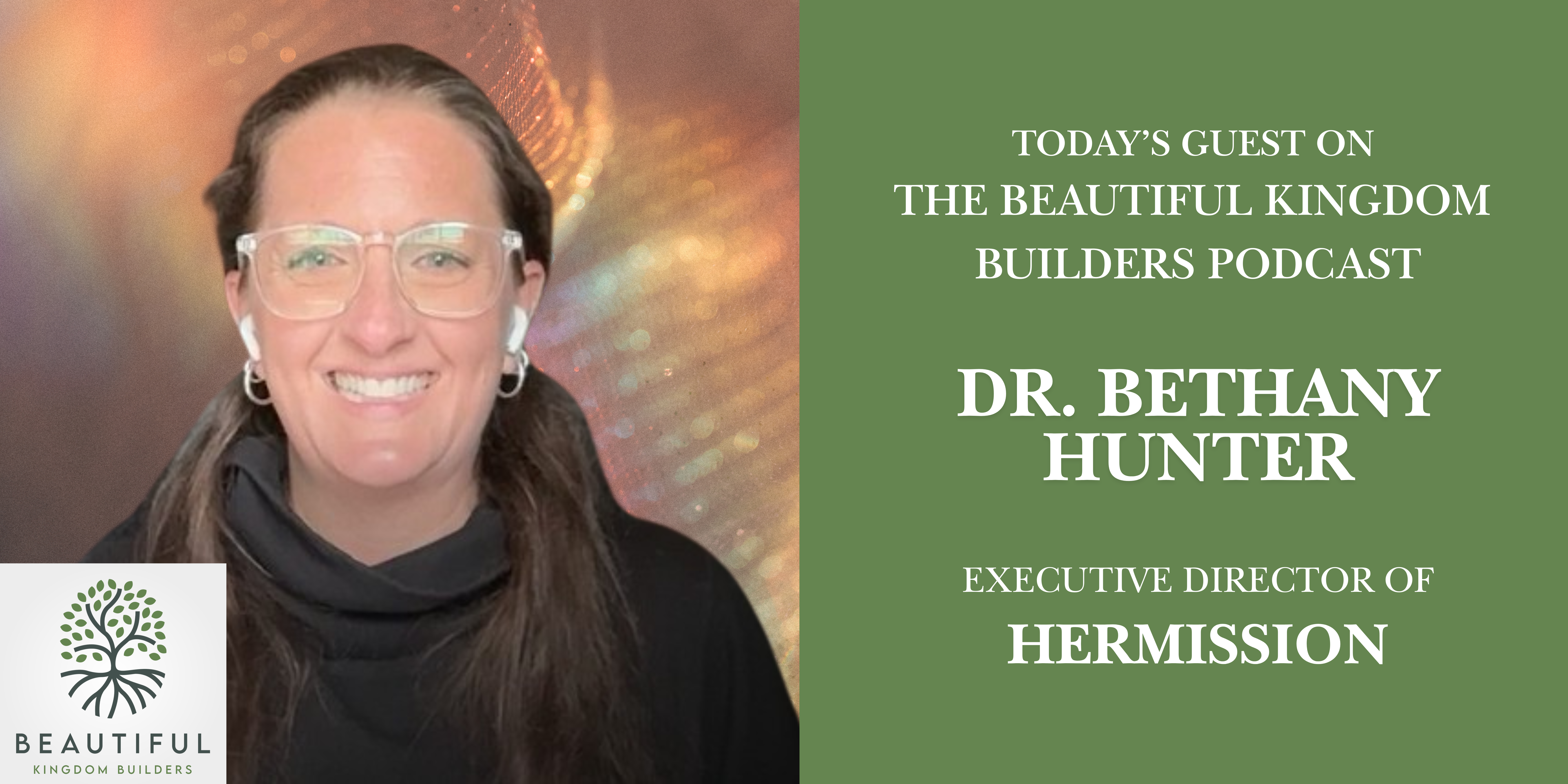
My guest today is Dr. Bethany Hunter, the Executive Director and Treasurer of HerMission, an historic ministry that goes back to the 1870’s. Bethany is passionate about women’s and the church’s empowerment for mission work. We discussed how equipping the Church is essential for fostering a more inclusive and equitable Christian community, and that missions begins with meeting the physical needs of our neighbors before we approach their spiritual needs. We can live a life of mission and service no matter where we are! Dr. Hunter shares her personal journey from growing up as a pastor’s kid to a twenty-year long career in the education world, to her recent big shift into ministry life, and how she is balancing it all as a mom of three.
If you are in Virginia, you can connect with HerMission at onhermission.org to learn more about their ministries and get plugged into the Kingdom work they are doing! And follow them on Facebook and Instagram.
Please enjoy this episode of The Beautiful Kingdom Builders podcast on YouTube, Spotify, Apple Podcasts, Amazon Music, Substack, and more!
TRANSCRIPT:
Ruth Perry (00:15)
My guest today is Dr. Bethany Hunter. She is the executive director of HerMission, which is a movement of women on mission here in Virginia since 1874. HerMission’s mission is equipping the entire church to be on mission with God. And Bethany and I go back several years now. I used to work at the church that Bethany attends here locally. And not just attend, you’re leader in your church here and now you’re a leader in the state. And I’m just really excited that you’re here to talk about your mission and your ministry. Bethany, thank you for being on the podcast.
Bethany Hunter (00:48)
Yes, I am so excited to be here.
Ruth Perry (00:50)
Can you take us back just to start and tell us your testimony Bethany?
Bethany Hunter (00:55)
So I have been in the church since I was just a few days old. My dad was the minister of a church here in the small community where I live and presented me to the church when I was about a week old and have been going to church regularly since. I have always just naturally gravitated towards having a relationship with the church and with God that allows me to serve others and be a good person without necessarily passing judgment, I guess, on others. I’ve always participated in children’s and youth activities in my current church. I was ordained as a deacon, but not currently serving as a deacon with my other responsibilities.
I still do some other things at church, but I always did missions trips with my youth group and then as a college student participated in several missions trips with my campus ministry groups. And there were two occasions in my life where I had very big decisions to make and in both cases, one to transfer colleges and one to make a job change. I didn’t want to make the hard decision and did, and when I did, felt very affirmed, felt at peace, felt that I was making the choice that was gonna keep me in God’s will, but I’ve never been out of touch with the church and with my relationship with Christ, so.
Ruth Perry (02:26)
I’m also a Baptist minister’s kid, so I recognize it’s a tough job. And I think it’s really beautiful that you’ve just always stayed connected to the church because that’s not always the case with pastors’ kids.
Bethany Hunter (02:31)
It’s a tough job.
Agreed, and I think especially for women who grew up in the Baptist church that there’s a lot of variability there in their experiences, you church that I spent most of my formative years in was in Franklin, Virginia. And so I was there right before I turned three and my parents were there through my first couple of years of college and this was at a huge transition time in Baptist life and the church I was in just kind of naturally gravitated towards women in leadership and women can wear pants to church and women can be deacons and women can be ushers. And so it was never a battle in our church. And so I didn’t realize, I think at that time the larger battle that was happening outside of the church in especially in Baptist life. So I was very fortunate to be insulated from that.
Ruth Perry (03:29)
That is true. What are some of your favorite things about being Baptist? What do you about your tradition?
Bethany Hunter (03:38)
One of the Baptist pillars is the separation of church and state. And I believe very strongly in that. I think that, while our country was founded with deist ideals and the idea of being a good person, I think our country was started because people wanted freedom from state religion. And so I believe that we should continue to support freedom from state religion. And I think that not being in a church where I’m told how to vote or who to vote for, I think is very important to me. I like that ideal of Baptist life. So that’s probably one of my favorite things about being a Baptist.
Ruth Perry (04:17)
Yeah, I noticed in the HerMission materials that I looked at, they use the Frederick Buechner quote, “The place where your deep gladness meets the world’s deep hunger.” So I wanted you to finish the sentence, where does the place your deep gladness, where does that meet the world’s hunger?
Bethany Hunter (04:22)
So I think that comes from our desire as an organization and just kind of our theology of mission that you can’t tell people about Christ’s love if they’re hungry or if they don’t have anywhere to shelter at night or if they have a mental illness that is untreated or uncared for. And so we want to serve the needs, the physical needs, the and mental needs of our neighbors, whoever our neighbor is. And in doing so, we then an avenue to speak blessings that we have and how Christ has loved us and how Christ loves others. But those needs have to be met first. And so that’s where our joy comes from is just serving others and seeing how that service transforms in the form of Christ’s love, I think.
Ruth Perry (05:28)
That’s beautiful. Yeah, my son Benjamin wanted me to talk to you what you did your dissertation on. said, you gotta get Dr. Hunter to talk about her dissertation because it’s fascinating.
Bethany Hunter (05:34)
It’s probably not. So my dissertation, so I at the time was teaching seventh grade social studies when I started my dissertation and this was an EDD, so a more practical degree and so we real projects for our research. And so I wanted to see how organizing students who had IEPs, 504 plans into classes affected their grades, their attendance, their state test scores. Sometimes we had a big group of special education students with a small group of regular students all in a classroom and those special education students would just group together from one class to the next. And then we started to split them up a little bit more so there were fewer of them in those classes. Sometimes they had a co-teacher, sometimes they didn’t, sometimes they were receiving outside services, sometimes they didn’t.
We just wanted to track those students over several years to see how those different styles of classes impacted their performance. Ultimately, I had a whole lot of research and my conclusions were inconclusive. Like there were too many variables, there were individual variables attendance and all of those things.
Different teachers, everything. Everything is just too, too mixed up to really come to a conclusion about one specific style of instruction. But it was very, very interesting to follow those kids and see how they performed and, you know, just to do the back research on special education and how it’s changed over time. So that was good. And it’s done.
Ruth Perry (07:25)
Yeah, so you were teacher and then a school administrator. do you carry over your experiences in the school system and in your education into your ministry now?
Bethany Hunter (07:35)
Yes, when I was considering applying for the position and I was talking to the previous executive director treasurer, she, I said, you know, my background is in education and administration. This is not, this is not my thing. She said, you wouldn’t believe. And she was right. So a lot of the organizational piece of it. Personnel management, budget management, supervising people, working on people’s evaluations, making sure everybody’s kind of doing their tasks. Those carry over. To some extent, working with people who can become escalated, like my high school students do from time to time, So having hard conversations is important. Learning to just take things as they come. Just maintain a level of calm and peace and control in any kind of situation, think is all of those things are valuable and experiences that I had worked on before I came into the organization. So I do feel good about the background that I had.
And then I’ll answer another question, things that I still feel like I need to work on. Nonprofit organization is very different from a public school organization. And so I’m still, you know, I take like online low classes to understand how nonprofits work and how you can keep them going. I’ve met with other people in nonprofits, especially on the fundraising end, because that’s definitely an area of weakness for me. And then also just in Christian leadership. And so I grew up in the church and I’m not unfamiliar with scripture, but I do a lot of speaking, preaching, and I’m not prepared for that like I want to be. And so I am actually.
I am gonna enroll in a seminary in the fall to do a brief Masters of Christian Leadership. It doesn’t require a thesis at the end. It’s a 36 credit hour program but just to give me a little bit more background in foundational theology. The ability to write my own sermons. The public speaking piece isn’t difficult. The writing the sermon piece is difficult. So I want to do that better.
Ruth Perry (09:49)
That’s really cool that you have a plan for your leadership development, huh?
Bethany Hunter (09:53)
Well, I really thought in 2017 when I got that EDDthat I was done, but apparently I wasn’t. God’s plans are not my plans.
Ruth Perry (10:01)
Well, I think about what you said about your dissertation, it seems like that really correlates well with ministry because people don’t fit into little boxes. You have to approach them on a one-person basis and it’s not convenient. It’s not uniform. It’s not fast. It requires investment and care beyond just what is the most efficient. Okay, here’s a thought that I was wondering about because the church that you’re involved in is multi-generational, but probably majority older. Since you’ve worked with all different ages, and I think that there’s some challenges between intergenerational work.
So what are some challenges that you’ve experienced working with different generations, and then what are the positive things that you see that different generations bring to church ministry?
Bethany Hunter (10:50)
So our organization particularly has a broad range, right, of people that we serve. So we recently had our Mom and Me event, which is girls K through six and their mom or mom figures. A month ago we had our Teen Girls event. In November we have our adult event, our women’s event. And so it’s amazing to see some of the differences, what those different groups expect out of worship, what those groups expect as far as just the activities that they participate in, what those groups expect out of their accommodations, you know, when we’re having those events.
I think the thing about the church where we are is, are some things that we all agree on as far as how we worship, our expectations of the past or separation of church and state, those types of things. And there are things that we don’t necessarily worry about. Being with the little girls and the youth girls keeps me young. I think it helps me stay in touch. part of, I’ve never had that kind of disconnect because I’ve been with high schoolers or middle schoolers. And even with my own children, they keep me kind of in touch with what’s going on in that generation and what they’re facing, what their challenges are.
But for our ministry, we’re just trying to do our best to serve each of those groups as they need to be served. And so figuring out what their needs are at each level is really important for us.
Ruth Perry (12:28)
Do you know how many people throughout Virginia are involved in HerMission groups?
Bethany Hunter (12:33)
No, so we don’t have an individual membership count. We have groups in churches and we have people who attend events that aren’t necessarily members. So there is a voting membership, but again, it’s not an individual membership. It’s based on church giving. And so if a church has the certain type of giving, then they are allowed to have voting members. And really, anybody in that church can be a voting member if they’re giving to our state missions offering. Consistently, we have, you know, two to 300 at and girls event. Our teen event is a little bit less, usually between 50 and 100.
Across the state of Virginia, we have about 700 churches that give to the state missions offering, but we definitely don’t have that many HerMission groups. Most of our groups are central around the Richmond area because that’s where it started. That’s where the home base is. Any church in Virginia who has a history of WMU has the opportunity to have groups. I just haven’t been connected with all of them or been invited to be at all of them just yet. Most of them around the Richmond area though.
Ruth Perry (13:51)
Yeah. Can you tell us about the formation? It was the Women’s Mission Union of Virginia, right? WMUV and then, yeah, tell us the history.
Bethany Hunter (13:59)
Sure. Right, so in the 1870s, Lottie Moon had just gone to China. And there was a group of women in the Richmond area churches who wanted to raise money to support her and her sister to find housing. because they were there on their own, they didn’t have husbands, know, they were just there because they had a heart for the people of China.
And so the women in those churches started collecting money to send to Lottie Moon through the, at the time, the Foreign Mission Board, it became the International Mission Board. And so that was kind of the first iteration of the Women’s Missionary Union of Virginia. It didn’t actually get called the Women’s Missionary Union until 1888 when it formed at a national level. And so in Virginia, it existed before it existed at the national level. So the Women’s Missionary Union is still an auxiliary of the Southern Baptist Convention at the national level. Annie Armstrong was the first executive director of the national organization. One of our Virginia titans in WMU, Alma Hunt, who we’ve named our state offering after, was an executive director at the national level as well.
And so, that organization over time exists to help people learn about missions, pray about missions, give to missions, and do missions. Those are the focuses. And that has come a long way. In many cases, churches give to the Lottie Moon Christmas offering that goes to the International Mission Board, the National North American Mission Board gets the Annie Armstrong Easter offering and then each state has their state missions offering ours is Alma hunt and that goes to us and the Baptist General Association of Virginia we we split that there’s a percentage and we split that But it’s I mean it’s a long-running program but at the state level in each state. It does look a little bit different from state to state than it does at the national level.
Ruth Perry (16:06)
So kind of rebranding as HerMission is a continuation of the same ministry of WMUV, but then it also feels kind of like a re-imagination. Would you say that’s right?
Bethany Hunter (16:09)
Sure, yes. So I was on the board of trustees as just a member at large when we decided to bring that change to the membership as a whole. And there was some resistance, of course, as there always is with change. But after 150 years, we really felt you didn’t already know what WMU was, then it was like this club that you just couldn’t be a part of. And we wanted to make it look new, make it sound new, so that we could broaden our audience and broaden it to younger people, younger women, broaden it outside of the Baptist Church.
And so that’s part of our goal is to connect with other church and parachurch groups to do missions in their communities or in a larger way, not just the WMU as it always has been. Because it will die. And we said that. When I go to WMU groups who said, well, we’re still going to call ourselves WMU, I can guarantee you that most of the ladies in that group are over the age of 65 or 70. They’re not getting new members because the new members don’t know what WMU means. So we’ve tried to rebrand that a little bit, refresh.
Ruth Perry (17:36)
Yeah, yeah, that’s good. You’ve been shaped the WMU ministries like Mission Friends and Girls in Action from a young age yourself and going to camp. Looking back, when did you first begin to sense that God was calling you into some kind of mission?
Bethany Hunter (17:44)
I have never not done missions. When I was kind of finishing up my second year at college, my parents said, you need to have a marketable degree when you finish your first four years of college. And so I didn’t know what that was going to be. I had studied medicine for a year and that was, not for me and I studied religious studies and Spanish for a year and my parents said, what are you gonna do with that? So I didn’t know.
And they suggested that go ahead and get an education degree. And when I started that, that was one of those two kind of life-changing decisions that was the right thing to do. And I told my parents, I was like, I would love to go to a foreign country to teach English. and they were supportive of that. But they also encouraged me and there are people, there are kids right here in our public education system that need someone like you to just be a good role model, to have expectations for good character, to help them learn, to help them break cycles of dropping out or drug abuse or like your mission field can be wherever you are.
And that really spoke to me. I didn’t have to go somewhere else to do missions as I always had. I could be at home and do missions or be wherever and do missions. And so I took that on very seriously and really worked in the public schools. Not to break rules, not to convert kids, not to indoctrinate kids, because I don’t believe in that, but to just be a good role model and to have expectations for kids’ character so that I could minister to them in that way without necessarily saying Jesus or God.
Ruth Perry (19:44)
I think that’s really important. I think a lot of Christians, we lose sight of caring for people. Or we spiritualize all of Jesus’ life and ministry and we miss that he was actually meeting physical needs of people and caring for people where they were. And oftentimes not evangelizing them in the way that we think or we’re told that we’re supposed to live as Christians. Yeah, I think that’s really good.
Bethany Hunter (19:53)
Mm-hmm. Right.
Ruth Perry (20:07)
So on top of being a leader, you’re also a mom of three and a wife. And you have a large family that all lives close by that you’re involved with. So how do you navigate your personal life and your calling and all the challenges of managing all of that as a woman?
Bethany Hunter (20:13)
Yes. Mm-hmm. My calendar is color-coded by child because we don’t have anyone driving yet. No, I am very intentional about the time that I spend with the people that I love. So, if it’s a week or a month, this month has been nutso. I have done a lot of traveling, but the times that I am at home and with my kids. I am at home and with my kids. I am not working or distracted by emails or phones. I really do take time to give each of my kids individual and group attention. Same for my husband. I haven’t forgotten about him either.
It’s really helpful to have a village of people. So having my sister and her husband and my mom and my in-laws close by helps when I go out of town because I know my kids are cared for and they’re gonna all get where they need to go because I’ve got a village of people that are taking care of them. It also helps that they’re a little older now and I feel like, you know, we’ve gotten through the hard, you know, really super formative young years.
I’ve got a couple of teenagers and a young preteen and so we still have lots of very important conversations about character and we still sometimes make poor decisions. you know, dad and I work through that together with the, with each child, but, I have, you know, I have a great partner and he’s very supportive of what I’m doing, which is helpful as well. But I’ve just got a good village that helps me take care of my kids. But when I’m here, I’m here and I’m all in. Yep.
Ruth Perry (22:04)
Do your kids have, did they prefer it when you were working in the school system or now in ministry?
Bethany Hunter (22:10)
No. The high schooler especially, like he had to have a year of me at school and there were, there was like a slight transition period where he’s like, where am going to put my bag? Or, you know, like can’t come to me when you need lunch money in the middle of the day, that kind of thing. But for the most part, they are all very excited for me not to be in the school system anymore because they don’t feel like they’re being watched all the time. They feel like they have a little bit of individuality and I think that’s important for them too, to have a semi-normal experience without their mom around all the time.
Ruth Perry (22:49)
I know that my kids appreciated you at the school a lot. And my daughter this year, she was like, I don’t know who I’m going to approach when I need help because I used to go see Dr. Hunter. And so I just, I do think you were a light in the school system and I appreciate what you did there. And so I want to thank you for that.
Bethany Hunter (22:53)
Aww. Thank you. Yeah, that always feels nice. Thank you.
Ruth Perry (23:11)
So you talked about how you appreciate how Hermission is involved in physical and mental health needs neighbors. Where do you see the church as being invited to grow or repent when it comes to doing justice work, especially for women and marginalized communities or those on the margins?
Bethany Hunter (23:31)
So. I think that churches have a great opportunity to stop abusing the generosity of their women without recognizing their leadership. And what I mean is when you go into a church, typically, not all the time, but typically, when there is a meal, who’s in the kitchen, when there is a nursery, who is in the nursery, when there are Sunday school classes, who’s leading the Sunday school classes, you know?
And I think that in a lot of cases, we tell women, we need you to do everything except lead the church, right? And that’s where lot of that trauma comes from for a lot of women who have either exited the church or, you know, where that all of that Baptist kind of chaos in the late 90s came from, you know, women who were done being told that they could do everything but, right? And so I think churches have a great opportunity to honor everyone’s call to leadership and service.
But women also need to feel empowered to say, I can do this, but I don’t have to do it all. And so each woman needs to say to herself like, Sure, I can bake and cook and keep the nursery and teach kids Sunday school, but I don’t have to do all of it. Maybe if I stop doing some of this, other people will step up and do some of this as well.
Ruth Perry (24:53)
Yeah, there’s a great reliance women’s labor. And then it doesn’t really make sense to exclude them from the table to have the conversations of like keeping a thumbprint on how the church is doing spiritually because women are deeply connected and involved in the spiritual leadership of the church whether they’re given any voice or not.
Bethany Hunter (24:56)
Absolutely, absolutely. And I think churches are, there are churches that are moving beyond that. But they still seem few and far between. And so, I love to see more of that where women have a seat at the table. This past Friday, we had our Virginia Baptist Women in Ministry feast where women in church leadership are able to get together and talk about what it is to be a church leader. And that group actually meets online once a month to either chat or have a specific informational session about different things. But it’s a great networking opportunity for women who are in leadership to be able to lean on one another.
Ruth Perry (25:58)
It does seem like even with the rise tradwives online and more of a conservative resurgence once again, that women are kind of like if we’re using our gifts and our callings, it seems like there’s a harsher criticism right now than maybe there has been even in recent years. And so I’m just curious about like, how do we overcome that for younger women who have gifts and callings, but they maybe don’t feel the comfort of stepping into that because of the influence of biblical womanhood conversations and the ideas of male headship and there’s a lot of conversations now about feminine energy that we’re supposed to be in our feminine energy. And I think that that’s really interesting.
Bethany Hunter (26:48)
Yeah, you know, my dad used to use a term and I know that this is a church pastor term. He doesn’t like sheep stealers. He doesn’t like when pastors are intentionally going to other church members and trying to get them to come into their church. And so I don’t think that that is the answer. I don’t think that women going into other churches and like creating these subversive secret groups to work with women.
I think it’s just having opportunities for women from different churches to get together and talk with one another because I think those types of events open up conversations about all things ministry, all things service, all things leadership. And I think those conversations happen naturally. That’s one of the beauties of our organization, HerMission, is that we have a very broad spectrum of women and their backgrounds in our organization. And so when they do come together, there is a little bit of that discussion. You know, nobody wants to just like come out right and say, you’re right, you’re wrong, which is good. It’s beautiful. Everybody’s very careful about respect, but those conversations do happen. And I think that that gives, I think that gives a lot of opportunity for women who might not even realize what they are in to be able to think more broadly about women’s role in the church and in the kingdom really.
Ruth Perry (28:24)
So what gives you hope about the church and its future in mission work?
Bethany Hunter (28:28)
That it’s still happening, that there are churches and in a lot of cases churches are doing so much mission work even outside of HerMission or any other real structure churches are going into their communities they are they have food pantries they have clothing closets they are organizing hot meals I think that that gives me hope that people want to serve one another. And so as long as I think people have a heart for their neighbor and that Christ’s love is ruling their heart, that the church has hope for the future.
Ruth Perry (29:12)
Do you have any spiritual practices or hobbies or things that fill your cup for you in ministry so you can pour out?
Bethany Hunter (29:20)
That’s a great question. Spiritual practices. I do read my Bible every day. I have a one-year Bible that, you know, breaks up the scripture into old and new and Proverbs and Psalms. And I enjoy keeping up with that. It actually has word art in it so I can color a little bit in addition to my reading, which seems wasteful, it was relaxing. I really like it. I read a lot. enjoy reading. I enjoy being outside. Being outside just in general fills my cup. Going for a walk with the dogs, being outside with the kids, those types of things fill my cup. But that’s pretty much all I have time for.
Ruth Perry (30:00)
So where could people find out more about Hermission and get involved?
Bethany Hunter (30:05)
Yes, so we have we are on Facebook and Instagram at join HerMission and we’re on the internet onHerMissiondotorg and all of those places will have information. There’s an opportunity to sign up for we do a bi-monthly digital newsletter and there’s an opportunity there to sign up for that just to find out about the ministries that we’re doing, the resources that we have, and the events that we have. We would love for anybody who isn’t necessarily in a church or in a Baptist church, it’s still, there are so many ways to get involved without being in the organization, so to speak, officially, or get started, get a permission group started in your local community. There’s ways to do that without being in a church or a Baptist church.
Ruth Perry (30:53)
And it’s not just for women and girls too. You have a program for men and boys, right?
Bethany Hunter (30:57)
Correct. We do have a men and boys, his mission. Primarily that’s stemmed from the Royal Ambassadors curriculum for young men, but we do have also a men and boys retreat that we do in the fall. And so that’s an opportunity for men and their sons to get involved with just growing into great Christian young men.
Ruth Perry (31:23)
Well, thank you so much for being on the Beautiful Kingdom Builders podcast today, Bethany. And thank you for being a part of building God’s kingdom and being on mission for God. I think it’s so important that we not just be a part of a church, but we also understand that we’re the priesthood of all believers and that we’re all called and sent by God to follow in the example of Jesus and that we need to love God. And we also need to love our neighbors as ourselves and that that involves more than thoughts and prayers. It involves boots on the ground, boots on the ground.
Bethany Hunter (31:52)
Absolutely. Absolutely. No, Ruth, thank you so, so much for the opportunity. I’ve really enjoyed being here with you and talking with you.
Ruth Perry (32:01)
Well, God bless you as you continue leading and also start a seminary degree on top of that. That’s going to be a lot. So I’m proud of you. Keep up the good work. Thank you so much. God bless.
Bethany Hunter (32:07)
Yeah. Thanks. Thank you. Thank you. I appreciate it.
Did you enjoy this episode? Please subscribe, rate or review us on YouTube, Spotify, Apple Podcasts, Amazon Music, Substack, and more! Your support means the world. God bless!


 The Beautiful Kingdom Builders