
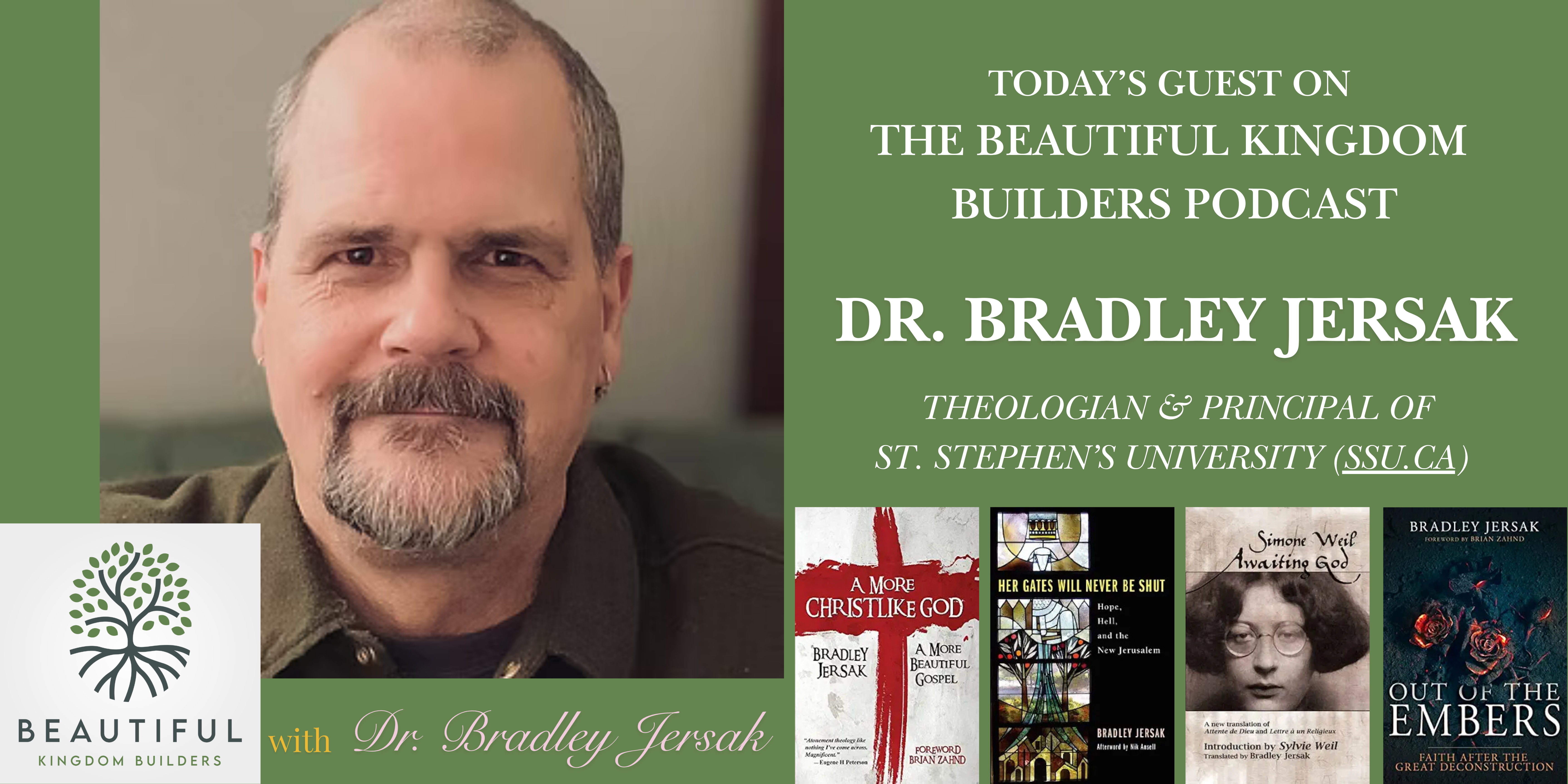
When I asked Dr. Bradley Jersak on my podcast, I didn’t know I was going to open up about a recent experience where my religious trauma was triggered. Our conversation was then about the theological doctrines and systems that perpetuate hierarchies and harm, and the good news of a theology of God’s love and healing.
In this episode, Jersak shares his journey through various Christian traditions, his views on theology, trauma, and justice, and how love and mercy shape his understanding of faith. He shared why certain unchristlike interpretations can contribute to personal distress and how we might move toward a more beautiful, Christlike, and trauma-informed faith. By re-evaluating these frameworks, we can find a clearer path to spiritual wholeness that aligns with the nature of God rather than fear-based systems.
From his website: “Bradley Jersak is an author and teacher based in Abbotsford, BC. He currently serves as the Principal of St. Stephen’s University (SSU.ca) in New Brunswick, where he continues as the Dean and faculty member of SSU’s School of Theology & Culture. He also teaches peace studies courses with JFI.SSU.ca and is a regular Open Table Conference crew lecturer. He is also part of the Plain Truth Ministries team, where he serves as Pastoral Scholar. He writes, edits, and does layout for CWR magazine, CWR press, and the CWRm blog. Through his books and seminars, Brad shares the good news that God is Love, perfectly revealed in Jesus Christ, and that God’s love heals wounded hearts and empowers us to heal this broken world.”
Please enjoy this episode, where we talk about:
Bradley’s journey through Baptist, Mennonite, Renewal, and Orthodox traditions,
and now the new Episcopal Church plant he is a part of.
The impact of trauma and deconstruction on faith
A critique of penal substitutionary atonement and hellfire preaching
The biblical vision of justice, mercy, and the love of God
The systemic issues in church hierarchy and patriarchy
The importance of inclusive leadership and gender equality
The role of scripture reading and interpretation in systemic change
The eschatological hope of the restoration of all things
Please visit www.bradjersak.com where you can subscribe to his Substack and find his social media links and more, and buy one of his books here or at your favorite local bookstore (as an Amazon Affiliate, I do receive a small commission for purchases from my links).
You can find this episode of The Beautiful Kingdom Builders podcast on YouTube, Spotify, Apple Podcasts, Amazon Music, Substack, and more!
TRANSCRIPT:
Rev. Ruth Perry (00:16)
Today I’m pleased to welcome Brad Jersak, or I should say, Reverend Doctor. Are you a Reverend?
Dr. Bradley Jersak – SSU.ca (00:21)
Yeah, but let’s go with Bradley, because I’m trying to be a lay person now.
Rev. Ruth Perry (00:25)
Alright, so I’m gonna start over and I’m gonna say I’m welcoming Bradley Jersak. Or should I say doctor? I just feel like
Dr. Bradley Jersak – SSU.ca (00:29)
That’s perfect. No.
Rev. Ruth Perry (00:31)
I should give you all the
Dr. Bradley Jersak – SSU.ca (00:32)
I don’t need it anymore. I’m just Bradley.
Part part of my history was was healing from the way titles become identities and measures of hierarchy that I’m not interested in at all. But okay. I did do some hard work to get there. So thanks for putting doctor in there. I am the principal of a university and I’m a professor there now. So my students call me Bradley or dear friend.
Rev. Ruth Perry (00:56)
All right.
Well now I’m gonna leave all of this in the podcast because that was beautiful.
Dr. Bradley Jersak – SSU.ca (01:01)
Perfect.
Rev. Ruth Perry (01:01)
So I’m pleased to welcome you and I’m really excited to talk about your work today with my audience and introduce them to you. I hope that they go down a Bradley Jersak rabbit hole like I did a few years ago and really soak in your theology because it’s been really healing to me and it’s really beautiful and it has the fragrance of the Spirit of God to me. And so I couldn’t tell you how excited I am that you accepted my invitation. And I’m really excited to introduce you to the Beautiful Kingdom Builders audience. Thank you for being here today.
Dr. Bradley Jersak – SSU.ca (01:34)
Thanks for having me and it’s good to meet you.
Rev. Ruth Perry (01:36)
Can you take us back and tell us your story? Like just as an
Dr. Bradley Jersak – SSU.ca (01:39)
All right.
Rev. Ruth Perry (01:40)
introduction to who you are and where you started from and how you got to where you are today.
Dr. Bradley Jersak – SSU.ca (01:44)
Sure, so that’s that’s a loaded question because I’m 62 now. This could take a moment. Distill, distill, distill. I grew up in a conservative Baptist family and church where I have loved Jesus since I learned his name on my mother’s lap. I have loved the scriptures since I first opened my Bible. And was able to read it on my own for the first time when I was six years old.
I have loved prayer since my mom taught me to pray for everyone in the family every night. And none of that has changed. I carry that part of my Baptist heritage very seriously. And I would even say conservative in this sense. My impulse is to conserve. And what do I want to conserve? The ancient faith of Jesus Christ. And sometimes that means backtracking to double check what that was in the for the first Christians.
So I grew up 22 years there, went off to an interdenominational, even more conservative, fundamentalist Bible college, where I met my wife Eden, and she was from a Mennonite family. And some think of the Mennonites like the old Mennonites look like Amish. Her church was more like a community church. And by the time I finished my master’s degree, I was hoping to be a teacher, but no doors were opening. And her church called me and said, Would you want to come and be associate pastor of youth, young adults and outreach? And I really didn’t want to, so I made it difficult on them to hire me. But the Lord opened that door and I just fell in love with the people I was working with.
And I also was immersed then and ordained in sort of that Anabaptist heritage of where we don’t just believe in Jesus, but we believe Jesus and his call to live according to the Sermon on the Mount. And that’s why Anabaptists or Mennonites are generally peace people, because they they take seriously the Jesus way of the Sermon on the Mount, especially of radical forgiveness and enemy love.
So I did that for 10 years, and I noticed how much more Mennonites tend to stay in the gospels, and that had an impact on me. By the time I left there, we were ready to plant a church. So my wife and I partnered up with Brian and Sue West, and we planted a little church called Fresh Wind. And our idea there was to be more open to Holy Spirit renewal stuff. So we were kind of open to that world. But the focus was actually on marginalized people.
And so imagine this: let’s say 150 people, one-third of them were people with disabilities in full-time care. Rows of wheelchairs, people with autism, people with Down syndrome on the stage in the worship team serving at the altar giving the communion and dedicating the babies, you name it. It and it was a glorious mess. And those folks began drawing addicts from the community, people with drug addiction, alcoholics and so on. And some of those were from unhoused people as well.
And they would come feeling like, this is like I’m at home and I’m safe here and I’m not the noisiest person in the room because someone’s having a grand mal seizure, you know. And so I co-led it for 10 years. So after 20 years total of pastoring, I had a massive meltdown in 2008, I really crashed. It wasn’t overwork, it was just trauma after trauma after trauma in that community. You know, within a year we had had someone abducted and abused for hours. We had someone else murdered with a hammer. we had had a whole bunch of people with disabilities that died tragically sometimes because their care was neglected.
I mean it just it built and then finally I had a meltdown. I didn’t know if I could trust God anymore. And I went in I went into my own addictive behaviors to cope with that. And I realized if I don’t trust God, we’re so vulnerable with all these traumas. I need to step back. That’s where my wife Eden stepped in and she led the church, brought them through a healing period, brought me through a healing period. And it was then I realized I can’t go back to pastoring.
And so I went off and I’m like, now I think I know the questions, especially around suffering. And did my PhD work around that stuff. And by the time I got finished that in 2012, I had an offer to start teaching. And so I teach Bible and theology now. I’m at St. Stephen’s University, where I’m I’m the principal of the graduate school of and I’m Dean of Theology and Culture there.
I’ve skipped some more church stuff though. So I had the Baptist era, the Mennonite era, and then this renewal kind of church for the marginalized era. None of that was just church hopping. I was all in doing, you know, serving in these churches, and I’ve collected all the gifts and treasures from those years, and I’ve not discarded any of them. I really appreciate it. But I also during you know, probably the 2000s, I came into contact with an old monk. He looks, he literally looks like Gandalf.
And in the Orthodox tradition, and so I’d visit his monastery and he began to show me how the Eastern Church, 350 million Christians in the world. How they approach the scriptures. And there was some things that were really in alignment with that sort of Mennonite version of the nonviolent God who’s revealed perfectly in Jesus. And some of your viewers I don’t know, I know you have, if you were to Google Jersak and Gospel in Chairs and Denver.
You’ll see a 30-minute presentation of what I learned from that monk, in fact. And I began attending there and the monastery would have weekend services, and it really became part of my recovery, where we heard the word mercy or merciful 154 times in two hours every Sunday as part of the liturgy. That’s what I needed. I needed a mercy bath.
More recently now I’m helping out with another church plant, an Episcopal Church that’s led by Ama, it’s like Mama, Cherith Fee Nordling. And so and what I love about that is I am an egalitarian at heart. I picked this up from the Mennonites, and that I believe women should be in every role that a man can be. And so I’ve really, really been spiritually thriving under female mentorship through the years. Which brings me to today. And here I am. Hello, Reverend Ruth.
Rev. Ruth Perry (07:42)
Hello. That’s such a beautiful story. And I really appreciate the appreciation you have for the different traditions you’ve experienced. Because
Dr. Bradley Jersak – SSU.ca (07:50)
yeah.
Rev. Ruth Perry (07:51)
I do think that, you know, we’re all expressing our revelation of God that we have and that we understand. And there’s a lot of beauty in all the different ways that people express that revelation of God.
Dr. Bradley Jersak – SSU.ca (08:03)
Yeah. Think about the body of Christ not just as individuals, but as these movements. And who
Rev. Ruth Perry (08:08)
Yes.
Dr. Bradley Jersak – SSU.ca (08:08)
are we to say we don’t need them, right? So I’m quite ecumenical that way, meaning I have learned to learn from those who have seen what I haven’t seen.
Rev. Ruth Perry (08:19)
Well, I appreciate that something I see in you, which is why I think your faith is beautiful, is that your spirit does show the fruit of the spirit love, joy, peace, patience, kindness, gentleness, self-control in ways that some of the spiritual authorities of my past don’t have those same fruit evident consistently. I mean I don’t know you consistently, but I get that from hearing your teachings and listening to your other podcast interviews you’ve been on. And I know I don’t know you, but I feel like I trust you and that your message has a lot of truth as my faith has grown, it does ring true to me. And I guess one of the things that I’m curious about
So this week in my context, I went to a local board meeting because we have some people in our community who want to revise our local library policies and procedures in a way that would create discrimination where we’re complying currently with non-discrimination laws and we’re receiving state funds because of that that would this would jeopardize. And there were a lot of people that came to the meeting to speak out and I came to speak out myself.
And I felt really triggered by the meeting because the chairperson who was really driving this effort reminded me so much of my upbringing in the conservative Baptist faith. And it was surprising to me how triggered I was by the meeting and by that experience and feeling really agitated and a lot of adrenaline pumping.
And something that I really appreciate about your book Out of the Embers is you talk so much about the trauma of deconstruction in a way that I haven’t heard other people speak of deconstruction and how painful the experience is. Can you speak to that just growing awareness of trauma and how it impacts us and to the experience of trauma in deconstruction.
Dr. Bradley Jersak – SSU.ca (10:09)
Yeah. That’s a great question. So let’s start with your story. You used the word triggered and you realized the meeting was the trigger, the man chairing, I’m assuming it was a man chairing, was the trigger, but the trigger indicates a earlier trauma. And and that was related to pastoral authority in in a church you’d experience.
Well, the the bad news about that is you it makes your heart pound and probably gives you a headache, and and and so you have to become super self-aware. I don’t think the solution to triggers is getting rid of all the people who trigger us. That’s been a silly kind of move that folks have made, even those who are looking for safe space. It’s like I want spaces where no one will trigger me.
Well, what if we looked at that? What if we went back and said, what was going on back there that is coming up now that still needs healing work? And so that’s where I would start. I would also want to be super compassionate about that because having trauma triggered means that trauma’s lodged in you somewhere and you didn’t put it there. And that requires gentleness, it requires healing. You don’t get to just say, don’t be triggered, right? And we’re not gonna be able to wait until all of our triggers are gone and all of our traumas are healed in order to speak truth to power. So sometimes that’s very uncomfortable and it it’s costly to you and your nervous system. And and so I honor you for stepping up anyway.
Further, it doesn’t justify the one triggering you either. You are identifying a pattern that needs addressing. So that’s a lot on the table, isn’t it? But if we could boil it down, to say yes, continue speaking for justice and goodness and mercy. Keep speaking in ways that resist, let’s say racism or sexism or homophobia or whatever, any kind of belittling or othering of those who aren’t like us. And while you do that, you’re noting how it’s impacting you. And I would attend to it.
And so that’s what I do. I mean I my nervous system was really damaged in two thousand eight. As far as I’m aware, it’s not fully recovered and I no longer expect that. So it just means I need a healing team around me. So I attend 12-step meetings for that. I see a spiritual director for that. I ad hoc will see a counselor for that, have it for a while. But I really firmly believe that doing that inner work, I can’t do it by myself. And it’s not about sucking it up.
I am nervous when self-care becomes our highest value. It makes us unhireable, actually. We have generations we may lose over that one. But we do self-care and we do it so that we’re more effective and that the impact on your religious PTSD, which by the way is a real thing. One of our master’s students just did her her thesis on that. And that religious PTSD.
Well, since you mentioned trauma, what she identified was the similarities between religious PTSD that comes from being raised with a retributive God, a punisher god, how similar the fruit is in that to women in recovery houses from domestic violence. And she said, based on the correlation of the bad fruit, she goes, I don’t need a a biblical or theological debate to demonstrate these doctrines are wrong. Because Jesus said, look at the fruit. And as the fruit of a doctrine looks like victimization by domestic violence, then we’ve got to push back. So that’s a lot, but it’s about you, you know, in terms of trauma. Does that kind of ring true or how how’s that landing for you?
Rev. Ruth Perry (13:45)
Yeah, absolutely. I have done some therapy and some EMDR therapy for religious trauma. It wasn’t something I was really aware that I had religious trauma until I had a similar kind of breakdown when I was 40. I’m 46 now.
Dr. Bradley Jersak – SSU.ca (14:01)
Mm-hmm.
Rev. Ruth Perry (14:02)
And my daughter watched the video of the meeting at the library and she told me, You were so nice to that man. I wish you hadn’t been so nice. And I could feel myself fawning, like having a traumatic response where I did, I fawned.
Dr. Bradley Jersak – SSU.ca (14:15)
Wow.
Rev. Ruth Perry (14:15)
I said it, I gave him a compliment before I made my peace.
Dr. Bradley Jersak – SSU.ca (14:18)
Yeah.
Rev. Ruth Perry (14:19)
And I wish I had said things more strongly. So it was kind of a jarring experience. We’re looking back where I feel like I’ve done a lot of healing work, but I guess I’m not there yet.
Dr. Bradley Jersak – SSU.ca (14:28)
That’s profound though, cause to distinguish Christ-like mercy from fawning when they can look alike, right? Look at the fruit of the Spirit you exhibited. And you know what? Maybe you did. But the shadow side of that is a traumatic fawning response. That’s quite a insight. I’m glad that you noticed, you know.
Rev. Ruth Perry (14:48)
Yeah, I didn’t mean to bring it up today, but I just feel like I’m in good hands. And so thank you for listening to that and giving some advice.
Dr. Bradley Jersak – SSU.ca (14:55)
Yeah, for sure.
Rev. Ruth Perry (14:57)
So what are the things about religious fundamentalism that do cause religious trauma?
Dr. Bradley Jersak – SSU.ca (15:02)
Okay, so I think some of it is doctrinal and some of it is around practice and and structures, systems, right? What do you want to cover first?
Rev. Ruth Perry (15:12)
Anything. Everything.
Dr. Bradley Jersak – SSU.ca (15:13)
Okay. So it could be a chicken and egg thing anyway, but I do think they correlate, as the great band ACDC once asked, who made who? So is it a nurture or nature thing and is it a doctrine or practice thing? And what I mean by that is sometimes we will generate God in our own image. And if that image arises from a culture that is punitive, that is exclusive, you just begin building in that image of God, and it’s absolutely an idol. Or, if you have a God you believe is retributive, the punisher God, the one who needs his wrath satisfied, all of that stuff, then that God will then have a trickle-down effect, you begin to emulate that God, and it’s a feedback loop.
I generate this violent God, this violent God shapes me. And so I’ll start with doctrine then. In the order I discovered things. First I began to question whether the cross was about satisfying God’s wrath through the punishment of his son. We called that penal substitutionary atonement. Penal as in punishment. Substitute is God has to punish somebody. He actually is not free to forgive. And he can either punish you or he can punish Jesus. Take your pick.
And so Jesus takes your punishment. And I defended that. I grew up with that. We call that an atonement theory now. I thought it was the gospel. And I did my Master of Arts thesis, a hundred and eighty page defense of that doctrine. So I promise you I’m not just making a caricature. But it’s about this satisfaction of wrath through violence. And it doesn’t take too much figuring out to see how that turns into retribution in our penal system. So instead of being a justice system, you end up with a penal system where wrath is satisfied through punishment.
But not just our penal system. It ends up in how we treat people, how we treat the other, even how we treat our children. I can’t just forgive. That’s not good parenting. I have to punish. And what we find out is how often that that is connected in both spousal cases and parental cases, that there is an abuse that happens because there’s anger attached to it. And they’re going, of course there is. It’s the wrath of God.
So that penal substitutionary atonement, people need to know that is not the only way to see the cross. In fact, that way is 500 years old. I’m a conservative. I want to conserve the gospel that we see in, let’s say, the book of Acts, where that never ever comes up once in any evangelistic sermon to Jews or Gentiles, individuals or groups. Never.
What is it about? The cross is a revelation that God is radically forgiving, self-giving, co-suffering love, and that He has poured that out into this world in a way that overcomes Satan’s sin and death. It is the love of God revealed on the cross, not his wrath. In fact, on the cross, God makes a specific no to wrath and yes to forgiveness.
So I start with the cross, and then that begins to trickle out. If God doesn’t have to punish, if God is free to forgive, based on the work of Christ, not in my faith, but by the grace of God, then we should double check this doctrine of eternal conscious torment. The idea of what I call infernalism, it’s about that hell is the never ending punishment of the sinners who didn’t say the right prayer because they didn’t grow up in the right community.
Something’s off about that. And what we found out is even in the evangelical world now, that’s not the only way to see it because we double checked the Bible. I wrote a book about it called Her Gates Will Never Be Shut. And yes, there’s judgment. Yes, we need a willing faith to response, but it’s restorative judgment, it’s restorative justice. So Jesus says, if I’m lifted up, and then John clarifies he was talking about the cross. I will draw all people to myself.
I think he’s right. I don’t believe Jesus was mistaken or lying, and he gives us as that as a promise. Well, then where does judgment fit in? It’s the means to that end, cleansing judgment. I wish I had heard less hellfire preaching and more soap preaching. But Malachi says he will come with a refiner’s fire that purifies the gold. And with launderer’s soap, which washes out the stains, right?
So, that’s where I went from there. Because a lot of the revivalists who traumatized me as a little boy, they held a smoking gun to our heads called hell and said, unless you pray this prayer, you’re going to hell forever. So I’d pray the prayer. Does that sound like a willing faith response, or is that a hostage situation, right?
And then the third one was then we began to look at the Old Testament texts and seeing all the even the call to genocide without mercy, which we have now somehow employed at times, the book of Joshua, book of Judges, First Samuel, and said, See, we can go and kill others in the name of God, our crusades, our crusades against the Muslim nations. They’re the enemy and we’re God’s servants and He’s on our side, all of that.
And Jesus comes along and he says, You’ve heard it said, but I’m telling you. And for me, then Jesus gets the final word. And he teaches us that the Old Testament was pointing to him. And when it points to him, he comes along and he says, I’m telling you. You don’t retaliate. You love your enemies. You pray for your enemies. You bless your enemies. You forgive your enemies, even if they crucify you.
And then he lives by what he says. So those are all doctrinal elements that I think have created horrendous religious trauma. And yet these other the major movements in the body of Christ have already seen that. So we don’t have to believe any of that stuff as if we’re being unfaithful.
I want to talk to structures and systems, but I want to pause first, see if you have any questions or comments about the doctrine.
Rev. Ruth Perry (21:04)
I was thinking about when I was growing up and praying for my grandparents who are United Methodists and now I’m serving in a United Methodist denomination. But I used to pray for their salvation ’cause I was so afraid that they were going to hell because they weren’t Baptists like me.
Dr. Bradley Jersak – SSU.ca (21:15)
Yeah. Yeah. Been there. And all you, you as a little child, you’re looking at all these people who are going to hell and you know it and you love them and you wonder, doesn’t God love them? Yes, God loves them and He doesn’t want them to go to hell. So you have to convince them or they will. And if you don’t, their blood’s on your hands. I mean it was it was pretty rank. And yeah, that’ll traumatize you.
Rev. Ruth Perry (21:38)
With religious fundamentalism there’s so much emphasis on, you know, don’t spare the rod or you’ll spoil the child and even like don’t hold your crying baby because you’ll spoil your baby and there’s so much of that the baby’s trying to manipulate you and I do see
Dr. Bradley Jersak – SSU.ca (21:52)
Good Lord.
Rev. Ruth Perry (21:52)
so much trauma from kids who have grown up with religious parents who I believe were well meaning and they were misled through authorities who had really tragic beliefs.
Dr. Bradley Jersak – SSU.ca (22:04)
Yeah. That is connected to doctrine as well. So in the Latin, there’s a Latin doctrine of original sin says that every baby is born inheriting the guilt of Adam, and therefore they’re born damned. And so you gotta make sure they get saved quickly, right? And that doctrine only began in about four hundred AD.
Up until then, they’re like, no, we’re all gifts from God. We bear his image. And yes, we’re thrown into a situation where stumbling will be inevitable. But because it’s inevitable and we’re moral toddlers bound to trip, God’s only just response is mercy, and that’s exactly what he gives us. But if you believe that every child is born damned, well, that’s terrifying. We did have a age of accountability thing. Well, they kinda God gives them a you know
Rev. Ruth Perry (22:50)
Little wiggle room there.
Dr. Bradley Jersak – SSU.ca (22:51)
A little, a little wiggle room. Back in our day, it’s like the first time they’re defiant. Okay, now so they’re two. now with Gen Z, you gotta make the age of accountability about 30, but that’s a joke.
Rev. Ruth Perry (23:03)
Can you explain more about justice and holiness in regards to God doctrinally then, if God is not punitive when we’re not just or holy?
Dr. Bradley Jersak – SSU.ca (23:14)
Yeah, very good. So we’ll hear that a lot, right? God is love, but he’s also holy. God is love, but he’s also just. God is love, but he’s also righteous. God is love, but but but. And we have to have a but removal surgery here. Here’s the nature of God according to First John. God is love. So think about nature, and I will say essence.
So essence would be who God is from all eternity, and that can’t change. That’s the core of who God is. That’s God’s essence. And then is God’s nature is then, in terms of good-natured person, right? Nature is how we interact, how we come into the world, how we’re experienced. So God’s essence and nature is love. Period. No, no buts. Think of that like let’s say a diamond.
And there’s no impurities in that diamond. That’s all the way down. So now if you take righteousness, justice, and holiness as something other than, but right, as over against love, well, the righteousness and holiness and justice that is not God’s love, that is not God’s nature, that’s the Pharisees who killed Jesus. That’s the fundamentalists who string up Black people in the lynching trees.
So then what is it? Well, so the righteousness, justice, and holiness of God are facets of that love, and that limits what they can look like. There can only be just love, righteous love, holy love. And if the nature of love is to restore, then restorative justice and a kind of holiness that Jesus in the Sermon on the Mount, both Matthew and Luke, he actually says that be holy or be perfect as the Heavenly Father is perfect, and then he describes it: invite everybody to the banquet. He because he is he is generous and kind to the righteous and to the wicked. So that’s holiness. We turned holiness, that is not love, into exclusion, the very opposite of Jesus’ own definition.
So I don’t have any problem with holiness, righteousness, and justice as long as they are always, ever, only facets of his divine nature. And that’s pretty simple from the scriptures. I can give you, I tell you, because I know Calvinism really well. I wore it for a while. The pushback on that is here’s what they do with it. They’re like, and I’ve heard Baptists say, God is not love. I’m like, okay, what? They’re like, God is only love to the elect.
I won’t even argue with that. The theological term for that is cuckoo. I know I’m enough of a biblicist to know when we’re violating scripture to say something like that. That is twisting scripture to fit some system that is a reflection of our own exclusion and prejudice. And it’s demonic, frankly. So whoo, I said that. But yeah.
Rev. Ruth Perry (25:56)
Yeah. Well, my experience growing up with that Calvinist worldview was that I was elect and I was in, I was a golden child of my church, of my family.
Dr. Bradley Jersak – SSU.ca (26:04)
Mm. Yep. Yep.
Rev. Ruth Perry (26:06)
And I received so much affirmation and love and support. But then when I hit that wall of deconstruction because of a church split and my family having issues going on and I was just really overwhelmed, that perfect image of my faith and my family was crumbling. I watched some Brennan Manning videos and I realized he was teaching that God loves me unconditionally.
Dr. Bradley Jersak – SSU.ca (26:29)
Wow, hey.
Rev. Ruth Perry (26:30)
And that was a brand new concept. I had never felt unconditionally loved. I had been striving and fearful and felt like I was a sinner in the hand of an angry God.
Dr. Bradley Jersak – SSU.ca (26:38)
Yeah.
Rev. Ruth Perry (26:39)
And it was such a tenuous situation for even someone who was just really killing it being a Christian.
Dr. Bradley Jersak – SSU.ca (26:44)
Yeah. Isn’t that interesting too that here this was our big critique as Protestants of the Catholics, that they believed in salvation by works. But here you were dying of striving, and then a Catholic comes along, Brennan,
Rev. Ruth Perry (26:59)
Yes.
Dr. Bradley Jersak – SSU.ca (26:59)
and says his love is unconditional. What a, how the, how that boat flipped over, I don’t know, but we’re grateful for his life in ministry and he really demonstrated that even a very broken man with his own addictions had come to the end of himself and he knew it’s the grace of God even in my relapses or it’s nothing at all. And now that’s a grace message, right?
Rev. Ruth Perry (27:21)
Yeah.
Dr. Bradley Jersak – SSU.ca (27:21)
We should talk about systems a little bit ’cause that’s the other side of your trauma and it’s coming up now.
Rev. Ruth Perry (27:24)
Yeah, that would be helpful.
Dr. Bradley Jersak – SSU.ca (27:26)
So what are some of the ways that religious systems perpetuate trauma? So there’s a kind of reading of scripture that is not like the early church read the Bible. I’ve written a I’ve written a book called A More Christlike Word, the Emmaus Way of Reading Scripture, where Jesus tells us how to read scripture, and the early church has left us documents that I share in my book, about here’s how you read the Bible.
We went into a weird kind of literalism, probably as a result of modernism, where we thought we could just have rules of interpretation where we’ll be certain what it means. And those are often very unchristlike and wooden literalism. That kind of way of reading scripture s seems then to generate hierarchies. So a hierarchy of who’s important, who’s unimportant, who can lead, who can’t lead. Who’s in and who’s out, and so those literalistic readings have created systems of well, first of all, domination style leadership that is a reflection of empire.
So domination taking over, and that can happen by when a pastor thinks they’re the king of the church, or even like if a power group gets control of the votes, right? But it’s about domination then. And that is the opposite of Philippians 2, where he says, have this mind in you that it was in Christ Jesus, that even though he, or even because he was equal with God, he didn’t think that equality with God was a thing you grasp and cling to but he humbled himself. He emptied himself.
Well that’s not hierarchy, that’s kenarchy, we call it. So kenarchy is the word there for emptied himself, kenosis. So it is servant leadership, basically, by laying your life down and washing the feet of your disciples. So the whole domination thing, it’s like, you know what? If that’s going on, probably you should flee that system because it will put its boot on your throat at some point.
Specific then to that, hierarchy tends to default into patriarchy, and that is male-only leadership through horrendous literalistic interpretations and translations of obscure scriptures compared to the very clear gospel texts that should be at the center in Christ. There is neither Jew nor Greek, male nor female, slave nor free, all of that. But anytime you have a hierarchy, so you will find a way to put women lower, you will find a way to put children lower, you will find a way to put the poor lower, you will find a way to put other races lower, the immigrant lower, everything but and of course who’s on the top? I am. I’m a straightish white guy. I say straightish because you know I’m very straight, but kind of have a crush on Brad Pitt, okay?
Rev. Ruth Perry (30:10)
Ha ha
Dr. Bradley Jersak – SSU.ca (30:11)
That was a joke. Okay, so anyway. But the like, so the straight white guys get the power and they hang on to it. And I just don’t believe in that. And so part of the reason that I’m part of this Episcopal Church plant, I’ve not left the Orthodox Church, but I don’t believe in all male leadership. I don’t believe in patriarchy. I don’t believe in hierarchy. That’s not the Jesus way. And so I’m very pleased that my priest is Cherith Fee Nordling, a wonderful woman mentor. And I’m very pleased that when she serves the Eucharist, even she says, We are here to express the radical hospitality of Jesus to his table, where everyone, without exception, is welcome. I mean, it’s a gospel moment, right?
And so, it would be sort of like, but what if they’re not Christians? Well, we’re serving his body and blood. If they want and need the body and blood of Christ, I guess that’s how some of them become Christians. So I do remember back in the day we had this Satanist guy, Ken. This Satanist started coming to our church Fresh Wind, right? And one day he shows up at the communion table and the people serving communion run over to me. It’s like, the Satanist wants communion.
And so I said, Say this to him. This is his body for your healing. Do you need it? Yes. This is his blood that washes away your sins, shame, and guilt. Do you need it? Yes. And then Ken received the healing, the cleansing, the forgiveness that is present in the Eucharist. And my goodness, we’d be in trouble with so many people. So then Ken became a Christian Satanist, I guess. And at the next Easter service, he was on our stage performing a rap that sounded like a prophetic utterance, right?
And yeah, it was risky, but my point is there’s this kind of that’s the kind of leveling of the playing field out of the hierarchy, even of the elect and non-elect, or Jesus saying in the Sermon on the Mount. Not everyone who says Lord Lord is in fellowship with me. So let’s be a little slow on our claims here. But those who do the will of my father. And that’s not about performing.
It’s just like someone calling themselves a Christian means almost nothing to me now. That brand is tainted. I want to see who’s following Jesus, you know, and not by performance, but by the fruit in their lives. All of that then undermines those systems of power and exclusion. Does that make sense?
Rev. Ruth Perry (32:41)
Yeah, I’m kind of curious what you would say about Genesis when God gave dominion. How do you explain what dominion looks like? Because I know some think that that means we have authority to conquer and conquest.
Dr. Bradley Jersak – SSU.ca (32:54)
Geez, How we got from dominion to conquest is quite a leap, isn’t it?
Rev. Ruth Perry (32:59)
Yeah.
Dr. Bradley Jersak – SSU.ca (32:59)
But I do really see it as stewardship. So dominion is being a gardener, after the pattern of the gardener. And what I love about it is in John, when John’s talking about Jesus’ arrest, he’s playing with that. He’s like starts the story: there was a garden. You’re like, yeah, there was a garden, wasn’t there? And then in a little while Jesus comes to Mary Magdalene and she thinks he’s a gardener. And I say she’s not mistaken.
And what does a gardener do, right? I’ve got some garlic and and some lavender that and some echinacea I planted outside. Whatever I’m doing to try to keep those flourishing and fruitful, doesn’t look like conquest. it looks like nurturing, it looks like watering, it looks it, it looks like tilling and all of the good things. So I I think, but you can see how that imperial mindset invades a scripture like that and then we end up dumping toxic waste into Lake Ontario
Rev. Ruth Perry (33:56)
Yes!
Dr. Bradley Jersak – SSU.ca (33:57)
and because the Lord’s gonna return in twenty years anyway. I mean it’s so awful. And then just one other thing then that reminds me then also we do have a dominant version of evangelical end times preaching that is looking to bring back Jesus by causing Armageddon. And we need to repent. Blessed are the peacemakers, they will be called children of God.
Well, guess what we did? We actually named handguns and missiles peacemakers. We stole that word from Jesus and turned it into destruction. I can’t think of many worse blasphemies. But we know what he means: that James tells us those who sow in peace will reap a harvest of justice or righteousness. You don’t sow violence to get peace. You sow peace to get justice. And that’s the Jesus way that I’m very interested in, but it seems now to be a minority report.
Troubling.
I do want to share a there I saw I have a friend, he’s a church growth and health consultant and he does a survey wherever he goes. Liberal churches, progressive churches, conservative churches, fundamentalist churches. He goes to all of them, right? And he goes to these things on weekends. So it’s not sort of your Sunday church goers or marginal attendees. It’s like people really invested in helping the church grow and be healthy.
So we’re talking about active members. He presents the Sermon on the Mount, the section on love your enemies, bless your enemies, pray for your enemies, invite everybody to your table. He presents that paragraph, and in his survey, 74%, and we’re talking thousands of people have done the poll. 74% considered that paragraph, if they were conservatives, as a compromise with unrighteousness. 72% of progressives. So even on the left, 72% complicity with injustice. So right and left, almost three-quarters of those who claim to be Christians reject the very words of Jesus when they’re presented like that.
But I believe Christ is bringing us all along, but I do wanna say it feels like following Jesus in what he actually said and called us to is a minority report and always has been. So I’m not too worried about that. It’s not we’re not having a vote if Jesus was right or not. But I do wanna be faithful and that’s kind of where I go back to to test it.
Rev. Ruth Perry (36:18)
So can you tell us what your end time view is?
Dr. Bradley Jersak – SSU.ca (36:22)
I used to know everything. You need to know this. I was 21 at the time, and I had all the graphs charted out. Probably the third or fourth time we got the dates wrong, I gave that up. And in moving toward a more Eastern theology, and I would say scripture focused, how can I summarize?
Well, first of all, the Nicene Creed, I’m a creedal Christian. That means, you know, all Catholics, all Orthodox, Anglican, and so on. Those who aren’t making up their own faith statement would cite the Nicene Creed. Here’s what it says about the end, and then I’ll tell you two opinions I’d have. So this would be dogma. He will come again with glory to judge the living and the dead. And we look forward to the resurrection of the dead and the life of the age to come. Period. Amen. Period. That’s it. That’s the whole thing.
And as I said before, that judgment will be restorative. But they didn’t put that in there because they also said, you know, if you don’t believe that, you could still affirm this. They were quite inclusive that way. I think messing with that dogma, adding stuff that you have to believe, is probably a formal heresy. ‘Cause we’ve got the dogma, you don’t toy with that.
That said, two things I see in the New Testament. One is if you want a picture of the end times, of the end, you look at the Mount of Transfiguration. That’s it right there. Christ transfigured, and you can already see Moses and Elijah are able to stand in the light and glory of his transfiguration. The disciples can’t yet, but I believe that the end game is the transfiguration of all things and all people.
That leads me to my other text. In Acts 3, Peter’s preaching about heaven is holding Jesus until. The restoration of all things and all people. I mean it just says the restoration of all. And he’s talking specifically of people, but I think it’s the whole cosmos. So if it’s the transfiguration and the restoration of all, I don’t know how we get there. So I won’t pretend I do. But it’s a glorious vision, and it’s a vision that I can sew into now.
So if I think that the end game is the restoration of all things, because that’s what he says, if I think that Jesus was right when he says he’ll draw all people to himself, how will I live today? I will treat everybody as somebody on that path. And I will sew whatever I can that will nourish their restoration. That’s why I’m a big fan of 12-step recovery, for example. They’ve done much more good, probably, than any other religious movement in the world in terms of seeing the power of restoration through surrender to the care of a loving God. Sign me up. And so I did. I’ve been hanging out with them since two thousand eight.
And even before actually a little bit, but I just feel like they’re on to something there. That God is a loving, caring, forgiving, healing, responsive, relational God, and what they don’t insist on is that you figure it out right away that that was revealed in Jesus. But I do, and I’m allowed to say that there. I think he revealed this in Jesus. So yeah. So there, there you’ve got my eschatology in a minute. It would it used to take hours.
Rev. Ruth Perry (39:28)
Well, that’s just a sign that you’ve done a lot of work.
Dr. Bradley Jersak – SSU.ca (39:31)
Distill and no less. Yeah.
Rev. Ruth Perry (39:33)
I’m going to ask you one more selfish question because I’m a local church pastor and in the lectionary, the gospel passage this week is the parable of the vineyard laborers who started at different times of the day.
Dr. Bradley Jersak – SSU.ca (39:45)
Yeah.
Rev. Ruth Perry (39:46)
And so I’ve been contemplating on that this week. And then just this morning, I saw a reflection of someone talking about reading that text through the lens of the five o’clock labors and comparing them to our Latino immigrants in America that we’re currently, you know, putting in for-profit detention centers and holding without due process and ripping families apart and sending people back to countries that they were never in before and back to violence and danger and the way we’re treating our Latino neighbors, by the vote of Christians largely, that these policies are in place.
And so today I’ve been reflecting on how do I, as a local church pastor who wants to preach the word of God as good news, also talk about justice for my Christian Latino, I mean not even just Christian, but I think we forget that we’re talking about largely Christian siblings in the faith and we’re allowing this to happen to them
Dr. Bradley Jersak – SSU.ca (40:42)
Yeah.
Rev. Ruth Perry (40:43)
in a context of a conservative culture that probably voted for it too.
Dr. Bradley Jersak – SSU.ca (40:48)
Yeah.
Rev. Ruth Perry (40:48)
What is your pastor to pastor advice?
Dr. Bradley Jersak – SSU.ca (40:51)
I would just say what you just said. That’s amazing. I love that. Preach. You know, and you can always get food stamps next week.
Rev. Ruth Perry (40:59)
Yeah.
Dr. Bradley Jersak – SSU.ca (41:00)
But, I will so first of all, I could not agree more strongly with everything you just said. So let’s start there. What I think you’re uncovering there is that a parable about unconditional grace actually brings about the justice we’re looking for, right? Because the complainers are the ones who are saying it’s an injustice. What’s the injustice? And he’s like, are you going to complain to me? This is my money here. I can pay whoever I want whatever I want. And if I give them the same at the end of the day as I gave you for that’s my call, not yours.
And so they’re complaining this isn’t fair. And maybe the way he’s coming at that complaint is that this is grace. Do you want to live by grace or do you want to live by fair? Because we could do that, couldn’t we? Are you sure you want to do that? Because if you’re sure you want to do that, then we’re going to talk about complicity and we’re going to talk about privilege and we’re going to talk about reparations and we’re going to talk. That’s what you so I don’t know. I think I would go with the grace. And so you’re just causing these thoughts in me now to sow the scandalous the scandalous grace that I would even call Indiscriminate.
Doesn’t feel fair. But it’s the only way you get to justice. And if instead you withhold to get to justice, so it will be done to you. The measure with which you judge, you will be judged. So you don’t get to live in the land of grace and keep someone else in the land of the law. That’s not how it works. But if you want to, it’s not even a threat from God. It’s just a natural spiritual law
You will be judged, even in this life by other people. Never mind God. Right? So that’s kind of some first thoughts I have about it. I’ll probably have to go do some journaling now because of you, thank you. Yeah, it’s a grace message that brings about justice. Hmm. Indiscriminate. That’s so scandalous. How could he? Glad he did. Glad he did.
Rev. Ruth Perry (42:58)
Amen.
Well, thank you so much for coming on my little podcast and being such a blessing to me and to my audience, I hope. And I’m gonna put lots of links in the show notes to send people to watch some of my favorite teachings you’ve done. And I wanna give you the last word. What would you want to say as the final message?
Dr. Bradley Jersak – SSU.ca (43:18)
Well, I do wanna give a invitation. Part of my deal is if people go to SSU.ca, there may be folks who would like to learn more. You could come study with me online or in person and we talk about the intersection of theology and culture and how we can transcend the r right left culture wars without exiting the world, still engaging with the work of justice. And we have peace and justice degrees, we have reconciliation studies degrees, and now we have a transformative leadership degree with a lot of voices from the global south helping us decolonize our theology. So if people want to look at su.ca, CA is for Canada, but we’re an international school with the travel modules to South Africa. Check in there. So that’s my pitch.
But my last message maybe for today would be like, mercy triumphs over judgment.
Rev. Ruth Perry (44:11)
Amen. Thank you so much, Bradley.
Dr. Bradley Jersak – SSU.ca (44:13)
Welcome,
Rev. Ruth Perry (44:13)
God bless.
Dr. Bradley Jersak – SSU.ca (44:14)
You too.
Did you enjoy this episode? Please subscribe, rate or review us on YouTube, Spotify, Apple Podcasts, Amazon Music, Substack, and more! Your support means the world. God bless!


