
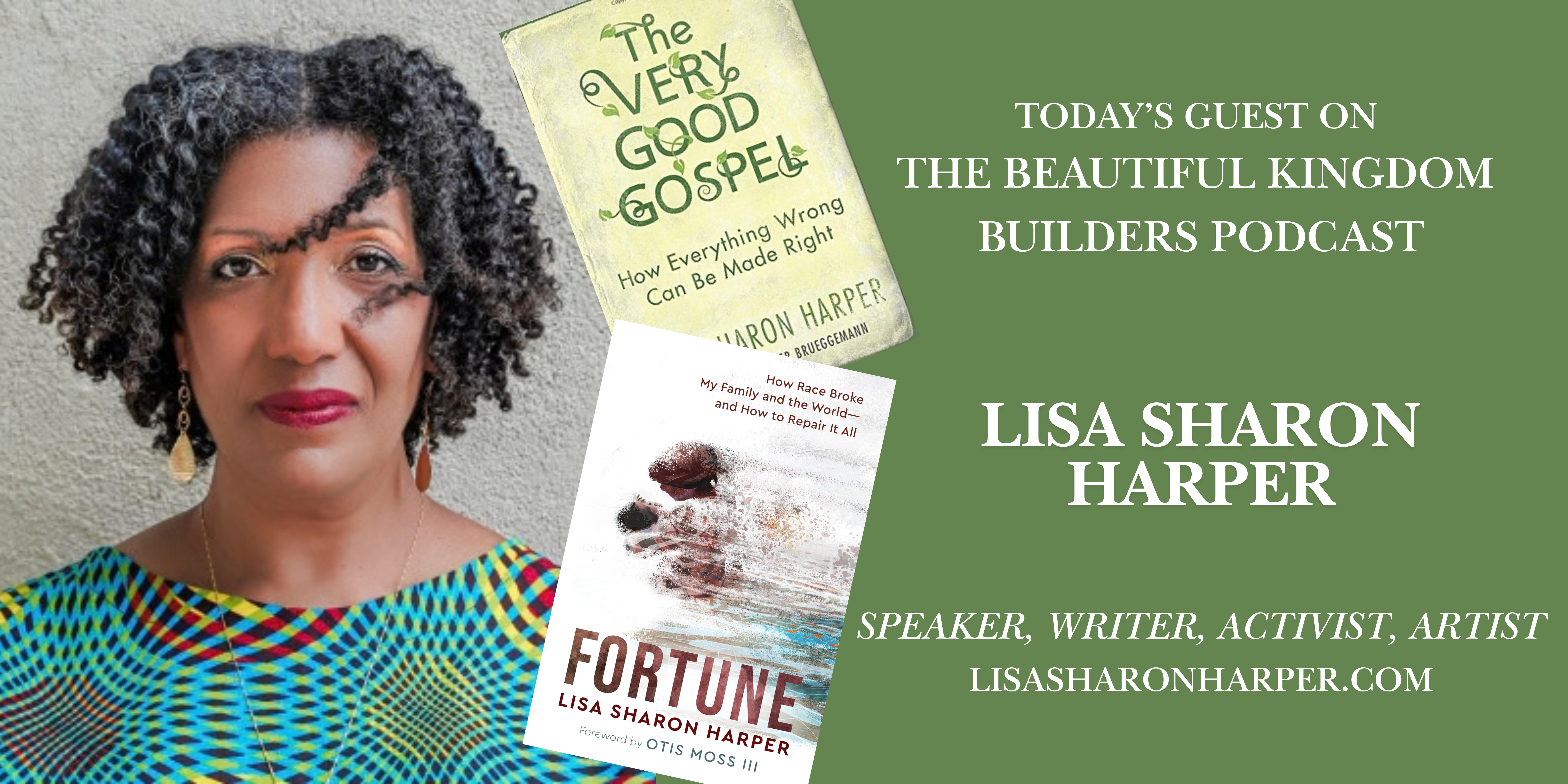
Several years ago, I read Lisa Sharon Harper’s book, The Very Good Gospel, and it rocked my world. She asked the simple question: was the evangelical gospel presentation good news to her enslaved great-great-great grandmother, who had lived a life of subjection and oppression, who had been repeatedly raped and whose children had been stolen from her, time and time again? Would hearing that she was a sinner and that God had to punish her for her sins, but Jesus took that punishment for her and if she believed that, she could go to heaven when she dies sound like good news to someone who had suffered so much in this life? And then Lisa Sharon Harper fleshed out very good news, of God’s plan of redemption and healing for all that was broken by the Fall, a vision of shalom and wholeness and peace for all of God’s creation. I highly recommend you read The Very Good Gospel!
So when Harper’s book, Fortune: How Race Broke My Family and the World–and How to Repair It All came out, I bought it immediately. But it sat on my nightstand for over a year as I worked up the nerve to be heartbroken for her family, and for all of the families that have been wrenched apart by racism in our country. It was another powerful read. Lisa Sharon Harper is a prophet of reconciliation and healing and I pray that those who have “ears to hear” will recognize that in our conversation.
In this episode, we talked about Harper’s faith background and journey to understanding justice. We talked about the biblical concept of shalom and its relevance today; about the historical roots of systemic racism in Christian theology, and how Plato and Aristotle have influenced Western theologians, leading to justification for colonization and slavery. And we talked about the biblical view of equality and justice in Paul’s writings, and the our future hope of reconciliation and new creation as Christians.
I hope you enjoy our conversation, and then be sure to follow Lisa Sharon Harper’s work and continue to learn from her.
Buy The Very Good Gospel and Fortune. Find more resources at https://lisasharonharper.com
Substack – Lisa Sharon Harper on Substack
Instagram – Lisa Sharon Harper on Instagram
Facebook – Lisa Sharon Harper on Facebook
LinkedIn – Lisa Sharon Harper on LinkedIn
Please enjoy this episode of The Beautiful Kingdom Builders podcast on YouTube, Spotify, Apple Podcasts, Amazon Music, Substack, and more!

TRANSCRIPT:
Rev. Ruth Perry (00:17)
My guest today is Lisa Sharon Harper, who has maybe more than anyone else, impacted my own faith as someone who I’ve read and followed for a long time. And so I’m just brimming with gratitude today that you would come on my podcast. And I just want to say right out from the gate that this is something that I know about you, is that you love people.
And that your ministry is coming from a good place. You’re a good person with a massive heart. And you coming here today is just another sign of the goodness of Lisa Sharon Harper. And so I’m thrilled that you would come on today so I can introduce you to my audience.
Lisa Sharon Harper (00:53)
O my goodness. Thank you so much, Reverend Perry. I mean, it’s actually a real honor to be with you and your community today. And I am honored to be a part of your story, any part of your story. Thank you so much for reaching out and I’m excited to be in conversation with you.
Rev. Ruth Perry (01:09)
Well, I had you on to tell your story, but let me just say why you’re such a big part of my story before we start. I’m probably the evangelical church’s golden child. I couldn’t have been a better evangelical. That was how I was raised. Not in the Bible belt, but very influenced by the evangelical culture in my formation years.
I went to a Christian college, Gordon College, to study music so I could do music ministry in the church because I didn’t think women could have this kind of ministry that I have today.
Lisa Sharon Harper (01:40)
Come on.
Rev. Ruth Perry (01:41)
And while I was at Gordon College, they advertised a spring mission trip to go build a house for Habitat for Humanity. And I signed up because I thought the student leader was really cute and maybe I’d get to know him. But they had too many people sign up, so they put half of us into a mission trip to Washington, DC to learn about racial reconciliation. And I did not know that I didn’t know so many things. And I’m continuing to learn. That was 24 years ago. White evangelicals do not know a lot. And one of the
Lisa Sharon Harper (02:11)
Yeah. Yeah.
Rev. Ruth Perry (02:12)
biggest lessons that I learned that week was to listen better. And I learned that most white evangelicals are only listening, of the people that they are friends with and following, one percent is non-white. And so the first
Lisa Sharon Harper (02:24)
Yeah.
Rev. Ruth Perry (02:24)
thing I did 24 years ago is I tried to diversify my algorithm. And I was just listening to all male pastors and book writers. And I started, I don’t remember exactly when I found your ministry, but I followed you and I devoured
The very good gospel in twenty sixteen. I just read Fortune this this summer.
Lisa Sharon Harper (02:48)
Good.
Rev. Ruth Perry (02:48)
But The Very Good Gospel really changed my theology in profound ways.
Lisa Sharon Harper (02:52)
Mm-hmm.
Rev. Ruth Perry (02:53)
And so welcome. Can you tell us, Lisa, a little bit about your faith background and I’m especially interested in hearing about where you came from and how you came to your first pilgrimage, because pilgrimage is a big part of what you do. So could we start there today?
Lisa Sharon Harper (03:07)
Well, that’s really great. First of all, I wanna say I see your Ruby Woo lipstick. Hello. Speaking of pilgrimages, we did this for those who don’t know. We used to do a pilgrimage called the Ruby Woo pilgrimage. It was a women’s empowerment pilgrimage for evangelical women. And we did three of them and they were amazing. And actually we were gonna keep it going, but then COVID happened and you know.
So but my story, I can’t start my story at myself. It has to begin with my ancestors. And the reason for that is because there’s a larger story than just my decision to follow Jesus at the altar in 1983, August 21st, around 9 30 PM at a Sunday evening camp church meeting. That’s where, white evangelicals will begin the story, right? Because that’s the date that I accepted Jesus as my Lord and Savior.
Or what I like to call the date I jumped the broom with Jesus. But if I’m honest, and also for us to appreciate that moment and what came after, we have to go back because my family is a black family in America. And we actually have a deep and long history with the Episcopal Church in America, the black Episcopal Church in America.
If you’ve read Fortune, Fortune Game McGee was born and raised in 1687 on the eastern shore of Maryland. And her family line goes in a few different directions, and one of those directions goes to two historians have traced her progeny to James Fourten, who changed his name to Fortin, we believe, when he went up north, in order to avoid slave catchers who were looking for Fortunes because they were usually escaped enslaved people. But he became one of the richest people in Philadelphia, regardless of race. He was one of the richest people in Philadelphia, and he helped to fund the abolitionist movement.
He also helped to start the black stream of the Episcopal Church, when Absalom Jones founded St. Thomas’s Episcopal African Episcopal Church here in Philadelphia, the church I now go to. And so he helped to put the seed money up for that. He was one of the founders of that church. And so our history in the Black Episcopal Church goes way back. So my mom, when she grew up, she grew up going to the Black Episcopal Church, to St. Simon’s Church, which is really just a few blocks down from where I live now, in in South Philadelphia. and that was one of the five major black Episcopal churches here in Philadelphia.
My great-grandmother went to St. Simon’s and then other black Episcopal churches. but my mom actually stopped going to church in the 1960s because she was so disillusioned. It was her job in the 60s, with SNCC, the Student Nonviolent Coordinating Committee, to organize churches, to get churches in Philadelphia to host Stokely Carmichael when he came into town. He was the leader of SNCC at the time, Student Nonviolent Coordinating Committee. And it was her job to get him pulpits to speak in. And nobody would have him speak after he spoke on black power. When he got up on the bed of that truck I think it’s Broad Street Park down in Mississippi, Money, Mississippi, near Money. And he said, We need to get us some black power. We need to be able to break any political machine that wants to come against us. White America took that as a existential threat. And the black church even in the United States at that time was not fully engaged in actually trying to stay out of trouble.
So when my mom was calling around to churches, there was only one church in all of Philadelphia that would take Stokely Carmichael and place him in the pulpit. And that I believe was the Church of the Ascension. And so my mom was disillusioned and she left the church. And really the Civil Rights Movement became her church. And so I didn’t grow up in church.
So when I found Jesus, I grew up asking the question of who is God and what is prayer and, Who’s this Jesus guy? I thought that Luke was the main man in the Bible because that is the name of the church that where I was I was baptized, Saint Luke. And we went there like every other Easter on a good year, you know. but obviously he’s not the main man. He did write one of the main texts, but he’s not the main man. And so it was in the context of a white evangelical parachurch ministry, Young Life.
And then subsequently a white evangelical little country church, Wesleyan Church in Cape May, New Jersey, where I began to go every week to the youth group and and they discipled me over the course of a year, where I began asking the question of who is Jesus? What is prayer? How do we touch God? How do we reach God? How do we communicate? And that was where I found Jesus. And I ended up walking down the aisle at a Sunday evening camp church service on August twenty first, nineteen eighty-three.
And very soon after that, was handed a tract that told me that I needed to vote for Reagan, even though I was only 14 years old, I couldn’t vote. Where am I who am I gonna vote for at 14 years old? So I got that tract and I took it home to my sister and I shared with her, you know, if Mondale wins, I think it was Mondale, We’re all gonna be rounded up into concentration camps, because that’s what the track said. Mondale is the Antichrist and he’s gonna round up all the children and put them in concentration camps. Well, you know, just come to think of it, there is a leader that we have right now that is rounding up children and putting them in concentration camps. Maybe we should think about the Antichrist in that direction. Hmm, somebody said, hm.
Rev. Ruth Perry (08:24)
Yep.
Lisa Sharon Harper (08:25)
So anyway, right. So I for a long period was deeply like yourself, deeply embedded in the white evangelical church. was in campus mostly parachurch ministries, but also the church. I mean, I went to a United Methodist church before quote before they said before they went liberal. The UMC went liberal.
And I was in Campus Crusade for Christ, back when it was called Campus Crusade for Christ in the 1980s. I was in Intervarsity in grad school and then went on staff with intervarsity in the 1990s. And so I was on staff with intervarsity for 10 years and deeply committed to that evangelical vision of the world.
I had no questions and no qualms, except that by that time I had begun to understand that this race thing is for real and we need to deal with it within the evangelical church. I had not done major reading on it. I’d only read, interestingly, evangelicals’ take on it, which obviously doesn’t give you the whole story. But it was the experience of pilgrimage in two thousand three that changed everything for me.
I had already been leading in racial reconciliation in Greater Los Angeles with Intervarsity, now on staff with them for several years. And we did a pilgrimage called The Pilgrimage for Reconciliation. And it retraced the Cherokee Trail of Tears for the first two weeks and the African experience in America for the last two weeks. We were on the road for a month. Most people don’t do that now. It was a million-dollar project, it was crazy.
And it was Intervarsity. Intervarsity did this. they made this investment because back in the 1990s they actually did get deeply invested in racial reconciliation, but they found that people were beginning to complain that it was pulling them away from the real work of Christianity, which is evangelism. And so they were trying to figure out what’s the relationship between the two. There is a relationship in scripture, and you see that most clearly in ironically, Luke.
Luke four, when Jesus shows up on the scene and it’s his inaugural address and he says, Why have I come? Here’s what I why I’ve come. And he reads from Isaiah sixty one, I have come to proclaim good news to the oppressed, to the captive, release for the captive. the blind will see and the year of the Lord’s favor, which is economic like an economic overturning. It’s where the high are brought low and those who are low are brought high. There’s an evening of the playing field economically in the Jubilee.
And so that was Jesus’s inaugural address. And so I was struck on this pilgrimage that this biblical concept of shalom incorporated that vision that we see in Luke. It held both. It held both the good news of Jesus and the reality that all things must be reconciled, not only back to God, but to each other. That the fall, the fall itself was not only a break between humanity and God, it was a break between all things. All things. And so God’s vision is not so small that he and she only imagines that only humans can be reconciled or should be reconciled to God. God’s vision is expansive. It is eternal. It is infinity. It is all things being reconciled to all things, including our relationship with God.
And and the relationship between the genders and the relationship between us and the rest of creation. No whales need to be saved. No manatee need to be saved. No elephants need to be rescued from zoos. No lions are emaciating in captivity. You hear what I’m saying? You hear what I’m saying?
Rev. Ruth Perry (12:00)
Yeah.
Lisa Sharon Harper (12:00)
And there’s no climate change because in that vision we are stewarding the wellness of all the relationships in creation and the wellness of the systems that govern us, all of us. They govern us in ways that bless all. There is no cursing on the first page of the Bible, which is where this is all grounded. And so that pilgrimage really challenged my simplistic, incredibly narrow view of the gospel that I inherited from Intervarsity and Campus Crusade, mostly Campus Crusade, that four spiritual laws, right? And it challenged it.
It blew it up. And that’s where for the next thirteen years I really wrestled in the scripture through this concept of shalom. And that’s where The Very Good Gospel was born. It was born out of that wrestling. And it was born out of me speaking on it for thirteen years in various ways. And then finally people just started in my last few years, they said, Where can I read this? Where can and I’d have to point them to like ten different books that I was getting it from.
And then finally I just heard God say, Write the book, it’s time for you to write the book. So I wrote it.
Rev. Ruth Perry (13:06)
I feel like the well, I don’t feel like the evangelical culture is individualistic and it does emphasize authority and give hierarchy to some and put others under other, you know.
Lisa Sharon Harper (13:19)
Yeah.
Rev. Ruth Perry (13:20)
And so reading The Very Good Gospel was the first time that I had all of those hierarchies plateaued and recognized where is the resistance in evangelical culture to caring for the planet? Like there’s so many things in evangelical culture that are contrary when you really think about caring for God’s good creation, where we would prioritize capitalism over caring for our vulnerable and marginalized and poor.
People in my area, they had a community wide revival this every year, but this past year the speaker, was talking about false gospels and the very first one is social justice. What is the resistance in evangelical culture to breaking down these hierarchies and to living with the ethic of shalom and abundance for all. Where does that come from, Lisa?
Lisa Sharon Harper (14:06)
Okay, let’s talk.
Rev. Ruth Perry (14:07)
Yeah.
Lisa Sharon Harper (14:08)
Well, that’s a great question, and there is a very clear answer to that. Where does it come from? Randy Woodley, another mentor of mine and dear friend, theologian and practitioner, he traces it back to Plato and Aristotle. And and actually now that I’m reading a bunch of scholars for my own dis p PhD work, a lot of people are doing that. They’re tracing it back to Plato and Aristotle. they had this thing called dualism, right? So Platonic dualism. And in a dualistic worldview, things are either/or. They are light or dark, they are good or evil, they are either or. There’s not gradations, there’s not story. and there’s not nuance.
Rev. Ruth Perry (14:45)
Nuance, complexity, yeah.
Lisa Sharon Harper (14:48)
There’s not flesh, it’s not human, it’s actually a very mechanized, a mechanized worldview. And so the way that dualism has worked, and what Randy talks about is that once you have a worldview where things are either or, and that is your central worldview, and you then apply that to all kinds of things, including the body and the spirit, right?
So there’s either body or spirit. There’s not gradations and there’s not nuance and there’s there’s not and and then you add to that Aristotle’s hierarchies of human belonging, where Aristotle was actually Plato’s student and his accolate. And ten years after Plato wrote The Republic, Aristotle writes on politics, which is actually a compilation of his various lectures right and and writings. But politics he actually says explicitly if you have been conquered you have proven that you were created to be enslaved.
He literally says this. So he is the one who takes that dualistic worldview and puts it on steroids and then begins to bifurcate humanity. Because before that, they were saying, well, humans are above the animals and da-da-da. But now you have some humans are above other humans, right? So the civilized are above the barbarians, right? That was what Aristotle was thinking. That’s the worldview.
They didn’t have a white-black worldview yet. That was the enlightenment period. But then you get down to the enlightenment period and they’re taking that thinking forward, and that’s where you get the Doctrine of Discovery, is in that period, right? So the quote enlightenment period is also from the perspective of those who were conquered in that time, it was the age of conquest, not the age of discovery. It was the age of conquest. And there were ways that the church was complicit in that, the doctrine of discovery.
comes from the church. It actually is founded in the Catholic Church that declared that taking the logic of Aristotle that gave permission for explorers who went out all over the world and discovered land, right, that had uncivilized, unchristian people on it, okay, you can go and take that land and you can enslave the people according to Aristotle. Not according to scripture. According to Aristotle.
And now you get scripture interpreted through the framework of Aristotle. And then you have to ask, all right, what is the authority here? What is the authority that that Pope, Pope Nicholas V, right? What’s the authority he was resting on? Well, he was resting on the authority of Aristotle in order to interpret the Scripture in a certain way, but you can’t when you just look at the basic makeup of that scripture, you can’t do that. Genesis was written by recently enslaved people.
You’re not going to get a justification for slavery from recently enslaved people. Jesus comes from a lineage of serially enslaved people. At the time that Jesus was born, the year that Jesus was born, 500 people were crucified per day, when a centurion marched through the Northern Galilee territory and cru s basically squashed an attempted uprising against Caesar because they were being occupied. So this general crucified five hundred people per day. Five hundred.
So that was happening the year Jesus was born because people were trying to rise up against the oppression, the imperial opp impression against them. And that comes down, it trickles down. Our lead authority then becomes secular philosophy, not actually the scripture, and certainly not Jesus, who proclaimed in Luke 4, this is why I came. And so now we’re interpreting Jesus through the lens of Aristotle, through the lens of of of Romanized Paul.
Right, who actually goes through his own, we see him go through kind of a conversion over the course of his life in terms of who he says is in and who’s out, right? So why does the church so complicit in it? Because the church is all up in it for like the last six hundred years. The church has been all up in it.
Rev. Ruth Perry (18:56)
Yeah. And I hear a lot of fear mongering because now I’ve moved to the South and I live in the Bible Belt. I think it’s nine years this month. Eight years ago I came to a Red Letter Christian revival that you came and spoke at and you prayed for me because I was having a hard time adjusting to living in this area where there’s a lot of Christianity but a lot of blindness. It seems to be, what’s the word? Like intentional blindness.
Lisa Sharon Harper (19:24)
Yeah.
Rev. Ruth Perry (19:24)
We’re in a community that has black neighbors. But how well do we know their story of being here in this town?
Lisa Sharon Harper (19:32)
Well, I think when you move it forward into the American context, particularly the American South. I did some research recently in the course of you know PhD studies on the history of the Southern Baptist Church. I’m no Southern Baptist Church scholar, but it doesn’t take much to do some basic history. And Reverend Richard Furman was the Southern Charleston Baptist Church, the first Baptist Church in Charleston, back in the 1840s. No, 1820s, 1821, 22, when Denmark VC attempted an insurrection. And it was going to be one of the largest rebellions in the South up to that point. There had actually, up to that point, been like a thousand possible attempted rebellions and rebellions across the South from the 1700s forward. This was not an unusual thing.
But Denmark VC was highly organized and he was going to have a major uprising. And it was squashed because someone, another black person actually ratted him out. And so he was beheaded along with the people who were rising up with him, and their heads were put on stakes all over South Carolina. And Richard Furman, the pastor, he went against the tide at the time. The tide at the time, in light of of DeMarc VC’s attempted insurrection, was to say, maybe we need to incrementally do away with this slavery thing. That was literally what people in South Carolina were saying. Maybe we shouldn’t have this anymore. Maybe we need to, you know, do away with this. Richard Furman, who had seven slaves of his own, he rose up and said, No, we need to entrench it further. We need to get more heinous with them.
Of course, he didn’t use that word, and he is actually one of the people who actually created the more heinous slave codes that came out as a result of that. And he gave the theological biblical exegesis or the argument support or apologetic for slavery. He gave that. And that ended up being the same apologetic that they then used during the Jim Crow era. So that one pastor gave america about about 150 years of evil. And it was only about 20 years that he convened the very first convention of the Baptist Church in the South, there in South Carolina.
And of course the Southern Baptist denomination was born about twenty years later, when the Northern Baptists were now saying, Well, wait a minute, we shouldn’t have this slavery thing and and no, you can’t send missionaries overseas if they hold slaves. And the Southern Baptists, armed with Furman’s theology said yes we can and so they broke off from the Baptists and actually in that period every single denomination in the country, every denomination experienced a split along the lines of slavery. Every denomination did and so when people say well they were just a person of their era no they weren’t they made a choice.
Because there were a good number of people who actually were not for it because of their faith. and the abolitionist movement, headed like spearheaded by the black church, was among them, right? So was leading that charge and and they understood clearly that you cannot you cannot enslave another human being you cannot subjugate the image of God on earth and then claim to follow God. You just can’t do that. So, how do we have what we have today? Richard Furman created this apologetic for slavery. And who did that benefit?
Who does that? It benefits the slaveholder. It benefits the slaveholder’s bank account. That’s what it benefited. They got to have free labor and justify it. And they didn’t only have free labor, they created slave farms. I mean they dug into, they got blood on their teeth for the depth of evil that they participated in. And they did it through the cover that they got from their theological apologetic for slavery. And with blood dripping from their mouths, they then went and preached the gospel in church. They never repented for that.
They went to war to protect it and lost. And then once the 13th, 14th, 15th Amendments were passed, they began to understand, you know, there’s consequences for what we’ve done. But then once the compromise of 1876-77 happens, what do they do? They bring back out Richard Furman’s theology.
And they used that as the theological cover for Jim Crow, which literally just continued the culture of the plantation, the white men walking into the homes of black men and and and black families and literally in front of the children and the husbands raping the wives at will. Stringing up and lynching nearly six thousand people over the course of ninety years, not even a hundred years. Six thousand people.
With impunity because it was the theology was so pervasive across the South that it permeated into the judicial system, into the policing, I mean police was actually created in order to entrench it. Right? So how do we have what we have right now? Like how is the church, especially in the South, willfully ignorant because they are doing what they’ve always done. They are spinning the story.
They have spun the story. They have omitted their evil. Why is it that most white people in Tulsa, Oklahoma have no idea that the Tulsa massacre ever happened? Because they were not taught it. They went silent on this day or several days when they went blood dripping from their mouths. And they never told their children that they did that. Now their children don’t know. And they’ve only picked up their politics and so they’re, you know, dedicated Republicans.
Rev. Ruth Perry (25:14)
And more upset about having to take down Confederate statues and the Confederate flag and more upset about transgender people. There’s so many inconsequential
Lisa Sharon Harper (25:22)
So stupid. Stupid stuff.
Rev. Ruth Perry (25:24)
things that they just stay angry about
Lisa Sharon Harper (25:26)
Yeah.
Rev. Ruth Perry (25:26)
so that they don’t have to face the truth. But the truth sets us free.
Lisa Sharon Harper (25:29)
Exactly. It’s like, why? What is it? Like, why can’t people just say, We were so wrong. We were just so wrong. And that’s okay. We’re not lesser human beings because we were wrong. We were just wrong. And we did wrong. And now, you know, things need to change.
I mean this is I think this is literally the big question of the day. But here’s what I think about that. I think that the reason why it is so hard for white Christians to face slavery, like really face it, what it really was, and the reality of it is because repentance is a small death. You know, I talk about that in The Very Good Gospel. It’s a small form of death. It’s death to self. It’s death to the rightness of the self. it’s death to ego. It’s it’s death to the vision of dominance.
And if you believe, which I do believe this this is a core belief of people of European descent, and I say that specifically European descent because i it’s not held within indigenous peoples around the world. But a core belief of people of European descent is that to be well you must dominate. And I think that comes from Aristotle, Plato.
Dualistic thinking, either/or winner/loser thinking. You know, everybody’s trying to figure out we how do we dig our way out of this? I really do believe the answer is in our faith. It is repentance, it is confession of the truth. And by repentance what I mean is not just saying I’m sorry, but to literally give reparations, to repair what was broken, to repair the imbalance of power, to share power.
But I think that there is this fundamental belief in people of European descent that power cannot be shared, that either you will dominate or you will be dominated. Because that was the experience in Europe for millennia, right? Like they literally did go for millennia, multiple millennia, dominating each other. That was the thing. But there are people groups, there are regions of the world like where domination was not necessarily the thing. It wasn’t the goal. It wasn’t it was just to live and to live in harmony actually. Again, that’s something that I learned from my mentor and friend, Randy Woodley, that the ethic of indigenous people is actually harmony. It’s not winning. It’s harmony. And so we can all learn from that. And by indigenous I don’t just mean
Native American, I mean people who are indigenous to their land all over the world. I mean the Sami people up in northern Europe, and the Celtic people, and people of every African nation, the Aeroba, the Igbo. I mean, these are ethics that are held almost nearly universally within indigenous peoples. And it is when you break the relationship with land, when you leave your land in order to go out and dominate the other, that’s when that is broken and that’s what Europe did. That’s why you I think Europe has a unique responsibility for people of European descent have a unique responsibility for the ethic of domination that permeates our world today. Because y’all won. You won.
Rev. Ruth Perry (28:43)
Yeah.
Lisa Sharon Harper (28:44)
Yeah.
Rev. Ruth Perry (28:44)
So good theology restores and reconciles and leads to abundance and healing and beautiful things? the fruit of poor theology is bad. And we can see the fruit. Today we see it in the concentration camps and the people being unlawfully detained and held and people dying in our streets, and we see it in USAID being cut and millions of people that are gonna die from that, and the Palestinians that have been genocided, and I mean there’s so many examples of ways that poor theology has led to death and destruction. And the
Lisa Sharon Harper (29:16)
Yeah.
Rev. Ruth Perry (29:16)
fruit is there to see if you can be open to seeing it and experiencing that death of repentance. Can you make a biblical case for Shalom and this theological framework of abundance and no hierarchies and all of The Very Good Gospel. Yeah.
Lisa Sharon Harper (29:31)
Yeah. Talk about The Very Good Gospel. I mean, here’s the thing is that, you know, one of what I’ve learned about Shalom is that as I talked about earlier, we were created for overwhelmingly good relationship and relatedness between all things. That’s what we were created for. And that meant that there was blessing and no cursing. And I believe that the scripture in the first chapter of Genesis is through an epic poem explaining to us what we were created for and how we were created to be in relationship with each other.
And we get another account of creation in Genesis two. It’s much more intimate. It’s God’s hands and the muck, right? It’s, you know, literally God creating human from the earth. And and we see a much more detailed, it’s not epic poetry anymore now, it’s story. And in that story, we see that the climax of the story is actually the flesh of my flesh and bone of my bone, and the first creation of community on Earth, which is Ish and Isha, and that the human now has community and we are bound to each other.
And then you see the fall. And in the fall, what happens is that each of those relationships that God had just declared overwhelmingly good, a chapter and a verse ago in chapter one are all torn down. That’s the fall. They fall down. Those relationships fall down. And they fall one by one, starting with the relationship between us and ourselves, when we run and we hide from God, that’s shame entering into the world and and our relationship with God falls in that same moment, you know, when we’re hiding from God. And then our relationship between the genders just crashes to the ground when the man points at the woman and says, She made me do it, right? And now the woman is going to yearn for her husband, even though being with her husband is going to make her come to near death and and death in some cases in childbirth, right?
And even after having that child and suffering all of that pain, she will forget the pain and still go back to her husband and have to have pain all over again. This is the fall. This is the natural consequence of when we come out from under the covering of God. When we come out from under the call to steward the overwhelming wellness of all the relationships on earth. And how did we do that? We didn’t listen to God.
God said, don’t eat of the fruit of this tree of the knowledge of good and evil. And I don’t necessarily think that this is something that happened in history. When I now read the scholars, they actually believe that there’s lots of different understandings of what that means and what were they trying to communicate? But one thing I do know is they were trying to communicate truth.
So it may not be fact the way we understand fact and history today. History didn’t exist back then. History is again an Enlightenment era discipline, the way we understand it today, the recording of things that happened as they happened, through you know a particular lens. But back then they were not trying to record what happened, they were trying to share truth.
That was the goal of these texts and the moment of telling the stories and songs and the poems. And so the question I’m asking then is what is the truth that is being communicated through that Genesis 2 and Genesis 3 account? Well, the truth that is communicated is that God is God and we are not. That we are created in relationship with God and each other and the earth.
And that that relationship is broken when we grab at our own peace at the expense of the others. When God said, don’t eat of the tree of the knowledge of good and evil, that knowledge was not just head knowledge. It’s literally kinetic in the body knowledge, experiential knowledge. So then I’m asking, how are they experiencing evil? How are they experiencing good and evil? Well, they’re experiencing it by not trusting God. First and foremost.
When God said, Don’t eat of the tree, that that command in itself gave them an opportunity to trust God and not eat of the tree or not trust God and eat of the tree. They chose not to trust God, and that broke relationship with God. And you can’t have shalom without God.
Because God is the author of Shalom. So after that, the natural consequence when we don’t trust God and God’s way to peace is that we lose peace. ‘Cause all that we can get for ourselves is broken peace because we are not God. So that’s when we see all of those relationships fall, and it’s like a snowball that grows like a becomes an avalanche, right? And it starts with that shame entering the world, but it ends with colonization and imperialism just fourteen chapters later.
Right, so you go from shame entering the world in chapter three to the relationship between humanity and creation and men and women and the agenders breaks and and then death enters the world and we’re driven from the garden and then the relationship between families breaks because of you. By the way, they are named Adornment and Shadow. So right there and it’s amazing, right? In Genesis 4, this is like what page 4
Rev. Ruth Perry (34:28)
man. Mm-hmm. Mm-hmm.
Lisa Sharon Harper (34:32)
of the Bible, patriarchy enters the world. And it’s a break. It’s so far from naked and unashamed and clinging to one another. Now you have adornment and shadow.
on the fourth page of the Bible. And that is not God’s prescription for goodness. That is the consequence of grabbing peace in our own way. And then you see the Tower of Babel and the confusion of languages, which leads to ethnic enmity. And just a couple of chapters later leads to colonization. One king trying to exact his will over several smaller kings. And that’s where you get the first mention of the word war.
First mention of war. You know, fourteen chapters after Tov Meod, very good. So Shalom, the biblical concept of Shalom is grounded in that first chapter and second chapter of Genesis, where we see what overwhelmingly good related in relationship looks like. And it is restored to us when we follow God and God’s way. It’s the ethic, it’s how we live in the world together. It’s whether we are living our lives in ways that mend the broken relationships rather than capitalizing on them.
Rev. Ruth Perry (35:45)
It’s so powerful. I’m just thinking about the journey you went on as you wrote Fortune and
Lisa Sharon Harper (35:47)
Fortunate. Yeah. Yep.
Rev. Ruth Perry (35:51)
looked into your family’s history here in America and in the South, and all the ways that the world was designed and the systems were constructed to keep those relationships broken and to keep people under oppression. What was the spiritual and emotional impact of that journey for you.
Lisa Sharon Harper (36:10)
My goodness. I have to tell you, it was incredibly hard to write that book. I mean, it was incredibly hard for multiple reasons. Number one, it took thirty years of research. and I did not start the research thinking I was gonna write a book. I was really started the research as a black woman just trying to figure out who am I. I didn’t know the names of my great grandparents, except for one. I knew the name of one great grandparent and met her, like knew her as a as a child. but didn’t know anything beyond that.
So started the research with my mom. My mom actually is the one who went to the National Archives and was searching for this person and that person. And then in the early 2000s, I started to join her in that effort and started asking questions in the early 90s, but really joined her as an as a genealogist for our family in the in the early 2000s. And I was just boom, like I was overtaken by, wow, this is incredible. You know, a Gen Xer, I am the first generation to be able to know where we come from as African Americans because of DNA. Like that is a science that my mom did not have, my grandmother did not have. They did not know that we come from the Yoruba people and the house of people of Nigeria. When you trace it back through my matrilineal line, my mom’s mom’s mom, going back a thousand years, that’s where we were. We were with The House of People in northern Nigeria. We were with the Yoruba people in southwestern Nigeria.
Like when I first did my DNA and and it came back, obviously the thing that’s a little bit ironic about the whole DNA thing is that that technology is advancing all the time. It’s getting better and better and better and crisper and crisper. And so, the DNA story that shows up in our little pie charts when you when you send away for it and it comes back, it it changes. It gets more and more detailed and and even corrected over time. But I’ll never forget the first day that I got mine. I got it and I wept because it was clear to me in my body.
In fact, I don’t think it was only me that was weeping. I think it was all the ancestors who make up me, who literally, literally are me. My DNA is their DNA. I think they wept with me in that moment because it was a deep, deep weeping, because it was the first time that we knew where we were from. There is a healing work that comes when you are able to be grounded on land, know what land you are from. Because in that you don’t only know the land, you know the story, you know part of your people’s story. So I don’t know the ancestors’ names that came over. I haven’t d deep enough research like, you know, Alex Haley to go back and find my Kunta Kente.
But I do know Hannah Reynolds is the farthest back I can go on my mom’s, mom’s, mom’s matrilineal line. And so her ancestors stretch back to the Yoruba and Hausa people. I do know what happened to Nigerians. And to the Senegalese, which are also mixed up in my in my DNA, that Sambo Game, Fortune’s father, was from Senegal and it shows in a DNA. There are several people in our line that were Senegalese.
So that’s a story. That’s actually a traceable story. I can learn what happened to the Senegalese. I can learn, what ships they were brought over on. We actually know that now.
And so without knowing their names and their micro stories, I can know the macro story of what happened to my people. And that grounds me. That can ground me. Because until then, and let me just say this is really important, until I had that story, my experience of being a black person in America is very similar, interestingly, in this way to being a white person. That my
value, my purpose is only defined then by my blackness or your whiteness. And whiteness and blackness were created in order to define who has power and who doesn’t. Who has the power to own land and who doesn’t? Who has the power? Who has the right not to be enslaved and who doesn’t?
Who has the right to vote and who doesn’t? Like who has the ability to exercise agency in the world and who doesn’t? And theologically then speaking, who is human and who isn’t? Because what it means to be human is to exercise agency. To exercise dominion in the world. That’s agency. And so as a black woman who wasn’t able to trace my family.
I then needed to prove my worth. I needed to prove my worth based on what I could produce. Because that was how black worth was delineated in a black-white construct. In the antebellum South and in the Jim Crow era, we became as valuable as we could produce. You could produce less, you are less valuable. Literally, you take less money in the trade.
And so to be a valuable black person, I needed to be able produce my bales of cotton per se, right? And for people of European descent, being named white meant that you were placed automatically by virtue of the color of your skin and your ancestry in Europe. Particularly northern Europe.
That you were dubbed of the noble class. In other words, you got the opportunity to become a member of the noble class based on how much money you could gather, how much money you could accumulate. And the way to do that here was by owning enslaved people, right? That was the explicit, like explicit understanding. And so.
The question of whether or not you are a worthy white person. Whether you’re living into your whiteness, living up to your whiteness, or are you a failure as a white person? You know? I think a lot of the people who were out there on the mall on January 6th in 2021 are people who have failed at whiteness.
Right? They are not the ruling class. And they resent that. And they are looking at the other to say, you’re the reason why I’m not the ruling class. I need to subjugate you so that I can rise. Because that’s the logic of domination that permeated Europe. And so when I was writing Fortune, it was hard to write because one, it’s hard to actually have access to these ancient histories, these ancient in our terms in America, hundreds of years, especially for black people. And so I had to find ways to get around that by legitimately studying the meta histories in order to understand at least the circumstances within which my ancestors lived. But it also was really hard the closer I got to my generations because the facts are there and you actually know what happened. And now I as a writer, in order to communicate them clearly to you, I almost have to relive them.
And so it was incredibly painful. It was just an incredibly painful time. I’ll never forget. I’ll never forget. And actually this is ironic ’cause it’s the first chapter. It’s not a latter chapter. And the first chapter as I was researching for it. I’ll never forget the moment when I was doing the research on Fortune and Sarah and their families and how Fortune had several daughters that were also indentured.
And so did Sarah. One of her daughters, she was indentured, and she had children who were also indentured. And it’s like, what’s there happening? Because the law didn’t say that that indentured servitude was supposed to be generational like that. The law was very specific. You’re indentured if you are a servant and you have sex outside of marriage with somebody and you have a child in your indenture. Then you are indentured for a further three to seven years and your children are indentured for XYZ time. And this shifted over the first maybe first decade of these laws being passed around 1700. But it eventually shook out to say that if the father was white then your child would be indentured for twenty one years. And if the father was black, like if if a servant got it on with a a black enslaved man, then her children would be indentured for thirty one years, right? And I started doing the math on
Fortune’s children and how long they were indentured, and then Sarah’s children and how long they were indentured, because they actually do turn up free eventually, right? And it’s like twenty-one years. Twenty one. Which meant they were being raped regularly by their indenturers in order to gain free labor for another twenty one years for the family.
So they were generationally raping and impregnating each generation. And I when I saw that, because I was like, why is Sarah surrounded by women and there are no men in her picture? Like, why is there never a husband? And she was taken to court to be indentured, and her children were also taken to court in each generation to be indentured. And
why are there never any men? Is she in a brothel? Like I really was like, what’s going on here? And then I just started really no, no, no, she’s not in a brothel. She is in like really distinguished homes. Like the Fuchs family on the eastern shore of Maryland. They were gentry class. Like they were literally with William the Conqueror back at the time ten sixty-six, when he came they were at his right hand at that point.
They were indenturing Sarah. Right? Then she has children and they are indentured for twenty one years.
And the DNA. I traced it like when you could do this, you can’t do this now. They actually stopped this right around the time I was doing my research. They connected us DNA wise to the Fuchs family. Like I had Fuchs DNA in me. And that’s when I realized, my God. Well now they capped it. You can only go back five generations now. Right. They won’t let you see beyond five generations of your DNA. Who does that benefit?
Who does that benefit? So it was emotionally difficult to do the research. But I just felt and knew this is necessary because you have to know the truth to tell the truth. You’ve gotta seek the truth to know the truth. So I had to keep going. And I’m glad I did. And what I found in that research was that the remedy
Is right there in the center of our faith. It is the resurrection, it is the cross, it is Jesus who gives us the power to reverse the fall. Jesus conquered death. Jesus began to reverse the relationships between men and women. And we see that even in Paul’s epistles, who in some cases is saying, Don’t let women speak, but actually, in most cases, he is
lifting up and championing the women who are in the ministry, naming them first between their husbands and it like the women were the leaders, actually. you know, he names Junia, who is an apostle, he names her as an apostle, a woman. What does that mean? It means that she was leading the church an entire city. Like that’s that is a reversal of Lamak with his two wives.
Right? We see Paul again, pushed by his faith in this Jesus, this this brown colonized man who beat death, he then writes to an enslaver telling him to free his slave because his slave Philemon is now equal.
He says in Galatians that if you have been baptized in Christ, there is no longer slave or free, male or female, Jew or Greek. In other words, your lens that empire has given you, really, the lens of dualism, the lens of either or, the lens of domination, it gets washed in the water of baptism. It gets washed away. And all you you see when you come up is the image of God, the call of each and every person to exercise stewardship of the world, to be able to exercise agency in the world. And that means that slavery must go. That means that subjugation must end. That means there is no longer Jew or Greek. There is no longer slave or free. There is no longer male or female. And that doesn’t mean that these people don’t exist. It means that the logics of domination do not exist within the kingdom of God. So you cannot be a citizen in the kingdom of God and operate according to the logics of domination.
You just can’t.
Rev. Ruth Perry (48:02)
And our hope is that Jesus is going to return and we’re gonna live in a new creation where all of the divisions have been healed and everything that the fall broke is going to be restored. And so we can get on board now in that ministry
Lisa Sharon Harper (48:15)
Come on.
Rev. Ruth Perry (48:16)
of reconciliation. Why wait? You know, this is what we look forward to. We don’t want to be at enmity with our neighbors. We want to love them and want for them what God wants for them.
Lisa Sharon Harper (48:24)
And let me just say, we don’t want to be at enmity with God.
Rev. Ruth Perry (48:27)
No.
Lisa Sharon Harper (48:27)
You don’t want to be at war with God. Because when you participate in the subjugation of the image of God on earth, you are actually waging war against the kingdom of God on earth. Because the image of the king in ancient times was a marker of where the king rules. And the image of God is in each of us.
So when you subjugate another human being, you are subjugating the image of God. I think that’s how God sees it. I think God understands that you are waging war against God. So what is it going to take then for us to lay down our arms against God? I think it’s gonna take repentance. It’s gonna take baptism.
Rev. Ruth Perry (49:05)
I think that’s where we need to end today. I want people to sit with that or reflect on that. I want people to read Fortune and The Very Good Gospel
Lisa Sharon Harper (49:10)
Yeah.
Rev. Ruth Perry (49:14)
and to follow you. Where’s the best way to follow you, Lisa?
Lisa Sharon Harper (49:17)
The best way to follow is on Substack.
Rev. Ruth Perry (49:19)
Okay.
Lisa Sharon Harper (49:20)
Now Substack will get you linked to everything else, right? So my Instagram page is also a great place to be. And also of course Facebook, all the socials, LinkedIn, all the rest. But Substack is where you’re gonna find my writing. It’s where you’re gonna find out about things that are happening and offers and so Substack at Lisa Sharon Harper and you’ll find everything you need there.
Rev. Ruth Perry (49:39)
Thank you so much for coming on my podcast and sharing such an important and powerful message today. God bless.
Lisa Sharon Harper (49:45)
God bless you. Thank you.
Did you enjoy this episode? Please subscribe, rate or review us on YouTube, Spotify, Apple Podcasts, Amazon Music, Substack, and more! Your support means the world. God bless!


