
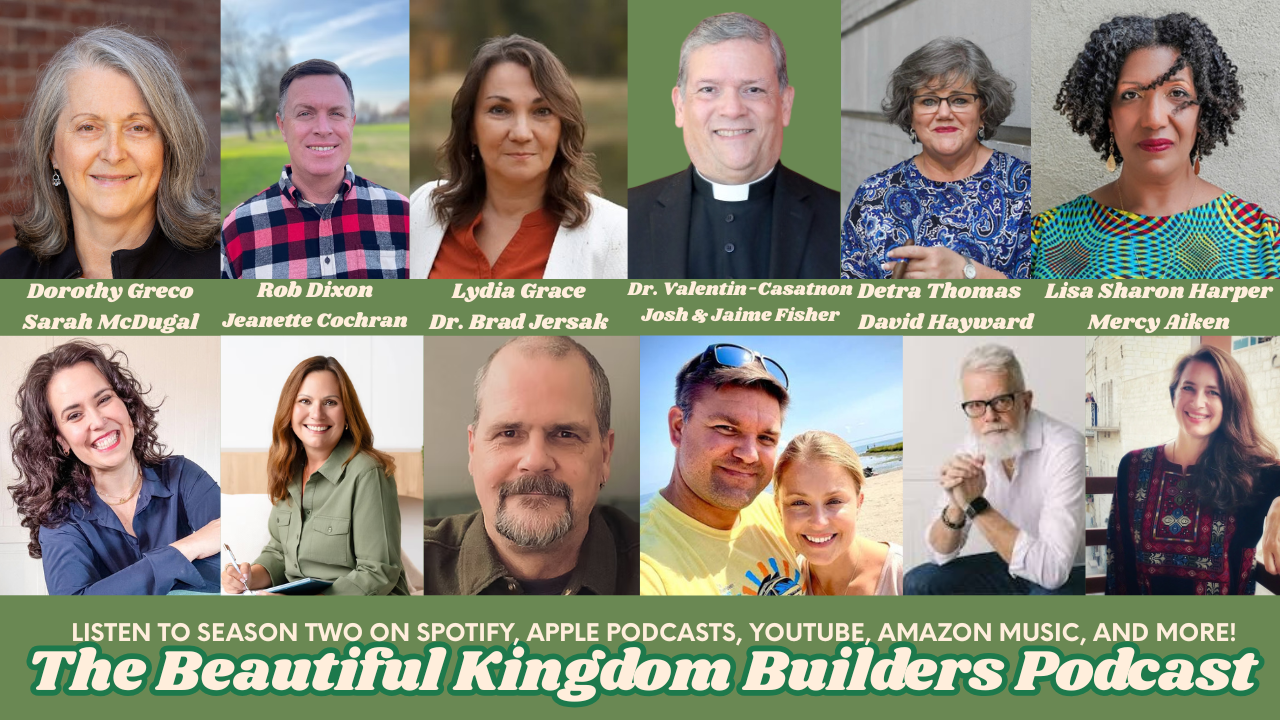
I’m wrapping up another season, and am feeling so grateful for the generosity of my guests in sharing their stories and wisdom with me and with us. After looking back through the Season Two episodes, I think a number of powerful themes emerged. Season One explored a lot of the harm that can happen within Christian communities, particularly around gender, abuse, exclusion, and unhealthy church systems. Season Two seems to have moved further into the question: What does healing, liberation, and transformation look like?
My conversation partners this season were:
024 I Dorothy Littell Greco: For the Love of Women, Uprooting and Healing Misogyny in America
025 I Dr. Rob Dixon on Challenging God’s People to Embrace Gender Equality
026 I Lydia Grace Kaiser: What if We Misread the Bible on Women?
027 I Is Your Theology Liberating or Oppressive? A Deep Dive with Dr. Eliezer Valentín-Castañón
028 I Detra Thomas on Reclaiming Identity: A Journey from Patriarchal Faith to Personal Freedom
029 I Lisa Sharon Harper on The Very Good Gospel and Fortune
030 I Sarah McDugal: Why Your Divorce Became High-Conflict: A Protective Parent’s Guide
031 I Jeanette Cochran on Empowering Women in Ministry: Breaking Limiting Beliefs
032 I Dr. Bradley Jersak: Can Your Theology Heal You or Is It Hurting You?
033 I Healing from Patriarchy: Jaime and Josh’s Journey from Marriage is Happening
034 I David Hayward, aka The Naked Pastor, on Faith, Doubt, and the Power of Love
035 I Mercy Aiken: Can You Believe in God While the World is Burning?
Some themes from Season TWO:
1. We cannot build the kingdom of God on systems that diminish human beings.
One of the strongest threads running through Season Two is the examination of patriarchal theology and the ways it has shaped Christian institutions, marriages, relationships, and individual identities. Nearly all of my conversations this season touched on the theology and impact of patriarchal systems, and though each conversation approached the issue from different directions, they share an important conviction: God does not call women to diminish themselves in order to accommodate someone else’s understanding of biblical authority.
Several important lessons emerged:
- Patriarchy is not simply an individual attitude; it is a system of beliefs and practices that can become embedded in theology, church structures, marriage, and culture.
- We need to examine not only what we believe about women but also the fruit those beliefs produce.
- Biblical interpretation matters. Sometimes the problem isn’t Scripture itself but the assumptions and cultural frameworks we bring to it.
- Equality isn’t a concession the church makes to modern culture. It is consistent with the dignity and worth of every human being created in God’s image.
- Women need encouragement, opportunity, and freedom to exercise their gifts and leadership.
A particularly important question from this season: Is our theology producing freedom, flourishing, and abundant life, or is it producing shame, fear, subordination, and oppression? That’s a question worth asking about virtually everything we teach in the church.
2. Deconstruction can be the beginning of a more authentic faith.
Several conversations this season explored the difficult journey of questioning and dismantling inherited beliefs. My conversations with Detra Thomas, Dr. Bradley Jersak, and Jaime and Josh Fisher particularly illustrate different dimensions of this journey.
Detra’s story of escaping a controlling patriarchal marriage and rebuilding her life is a powerful reminder of the courage required to reclaim one’s identity after religious and domestic abuse.
Dr. Brad Jersak’s reflections on faith, fundamentalism, religious trauma, and discovering a more Christlike understanding of God invite us to consider what might emerge when we begin questioning the theological frameworks we inherited.
And Jaime and Josh Fisher’s willingness to examine their marriage and dismantle the patriarchal and purity-culture expectations they inherited offers an important reminder that even well-intentioned Christian teachings can produce unhealthy relationships.
Some lessons:
- Deconstruction isn’t necessarily the abandonment of faith. Sometimes it is the necessary work of separating Jesus from the religious systems that have misrepresented him.
- We can love people who sincerely believe things that have caused harm while still challenging those beliefs.
- Losing certainty can be frightening, but it can also open the door to curiosity, compassion, and spiritual maturity.
- We don’t have to reconstruct our faith using the same materials that contributed to its destruction.
One of the most important questions underneath these conversations is: What if the Jesus we discover on the other side of deconstruction is more beautiful, loving, and trustworthy than the Jesus we were taught to fear?
3. Healing requires us to tell the truth about harm.
My conversations this season also demonstrate the importance of giving people space to tell stories that have often been silenced. Detra Thomas’s story, Jaime and Josh’s conversations about patriarchal marriage, and Sarah McDugal’s work with protective parents navigating high-conflict divorce all reveal the complicated intersection of faith, power, abuse, and recovery.
These conversations remind us that:
- Abuse can be spiritual, emotional, psychological, sexual, and physical.
- Religious language can be weaponized to maintain control and discourage people from speaking up.
- Good intentions do not erase harmful outcomes.
- Leaving an abusive situation does not necessarily mean the abuse immediately ends.
- Survivors need practical resources, supportive communities, and people who believe them.
- Forgiveness should never be used as a tool to pressure someone into returning to an unsafe situation.
I think an especially important lesson is that reconciliation without truth, accountability, and changed behavior is not genuine reconciliation. The church has sometimes been much more concerned with preserving marriages, reputations, and institutional stability than protecting vulnerable people. These conversations challenge us to reconsider what faithfulness actually looks like. Sometimes the most faithful thing a person can do is leave an unhealthy environment and begin rebuilding their life.
4. Justice isn’t separate from the gospel. It is part of the gospel.
I was so excited to talk with Lisa Sharon Harper about The Very Good Gospel, perhaps my very favorite book ever, and also her newer memoir and family history, Fortune. Her work challenges the tendency to separate personal salvation from the larger biblical vision of shalom. The gospel isn’t simply about individuals getting right with God. It is about God’s desire to reconcile and restore all creation.
This includes:
- Racial reconciliation and confronting systemic racism.
- Recognizing the historical ways Christianity has been used to justify oppression.
- Repentance, reparations, and restoration.
- Recovering the importance of land, ancestry, and belonging.
- Understanding that justice and right relationships are central to God’s vision for humanity.
I was also excited to have a conversation with Mercy Aiken about her work with Peace Catalyst International in Israel, Palestine, and Jordan extends this conversation into the difficult territory of international conflict. Her experiences challenge listeners to consider how personal relationships across political, religious, and cultural divisions can reshape our understanding of conflict.
A central lesson emerges: We cannot claim to love our neighbors while remaining indifferent to the injustice and suffering they experience.
The biblical vision of shalom is much bigger than personal peace or the absence of conflict. It involves right relationships with God, one another, our communities, and creation. This is an important corrective to versions of Christianity that emphasize personal morality while neglecting systemic injustice.
5. We need to evaluate Christianity by the fruit it produces.
This may be the thread that connects almost every conversation in Season Two. Whether we were discussing women’s leadership, biblical interpretation, marriage, abuse, racism, or international conflict, we kept returning to an important question: What kind of people are our religious beliefs forming us to become?
Are we becoming more loving, compassionate, courageous, humble, and just?
Or are we becoming more fearful, judgmental, controlling, self-protective, and dismissive of people who are different from us?
This question is particularly important when examining teachings that have traditionally been defended as biblical or orthodox. A belief doesn’t become life-giving simply because someone attaches a Bible verse to it. And a religious system doesn’t become healthy simply because it has good theology on paper.
Jesus consistently challenged religious leaders who prioritized rules, status, and institutional authority over mercy, justice, and human dignity.Perhaps one of the most important lessons from this season is that orthodoxy without love is a distortion of the gospel.
6. Women need to stop waiting for permission to answer God’s call.
This theme is the original vision behind The Beautiful Kingdom Builders and continues to be at the heart of my work. My conversations with Dorothy Littell Greco, Rob Dixon, Lydia Grace Kaiser, and Jeanette Cochran all contributed to this conversation this season.
Women have spent generations being told, explicitly or implicitly, that their voices, gifts, leadership, and influence are somehow secondary to men’s. Even women who have moved beyond explicitly complementarian theology may continue to carry internalized beliefs that limit their willingness to lead.
Jeanette Cochran’s work with women in ministry particularly highlights the ways fear, perfectionism, people-pleasing, and limiting beliefs can keep women from fully embracing their callings.
Some important lessons:
- We don’t need to wait until we feel completely qualified to begin using our gifts.
- Confidence often develops through practice rather than preceding it.
- Women need other women who encourage, mentor, and advocate for them.
- Men have an important role in challenging systems that exclude women.
- The church loses something when it fails to recognize and empower the gifts of half its members.
What might the church look like if we stopped debating whether women are allowed to lead and started celebrating what God can accomplish through their leadership?
I think for season three, I will try to focus on the fact that being a Beautiful Kingdom Builder isn’t simply about recognizing what’s broken. It’s about participating in God’s work of making things beautiful again. We challenge injustice, nurture healing, empower others, tell the truth, build bridges, and create communities where people can experience the love and freedom of Christ, because that is our calling as followers of King Jesus, and participants in building His Kingdom on earth as it is in heaven. Building God’s kingdom isn’t about protecting the power and privilege of the church. It’s about participating in God’s restoration of the world, and being the hands and feet of Jesus, continuing his earthly ministry.
Thank you to everyone who has joined me for Season Two. Thank you to my guests for their vulnerability, wisdom, courage, and willingness to engage in these conversations. And thank you to everyone listening who is doing the difficult, sometimes messy, but deeply meaningful work of building something more beautiful.
May we keep becoming the kind of people who make God’s kingdom a little more visible wherever we go.
My friend Wendy McCaig joined me for a conversation about my season two conversations! Wendy is the director of Embrace Communities (listen to season one episode 014 I Wendy McCaig on Embracing Community Development to hear all about her work!) and she writes at Walking with Wildflowers on Substack. We spent a good bit of our conversation reflecting on our work together with a new youth-led community building initiative, and some unwanted but necessary activism we’ve engaged in to protect our local library.
You can find this episode of The Beautiful Kingdom Builders podcast on YouTube, Spotify, Apple Podcasts, Amazon Music, Substack, and more!
Did you enjoy this episode? Please subscribe, rate or review us on YouTube, Spotify, Apple Podcasts, Amazon Music, Substack, and more! Your support means the world. God bless!


