
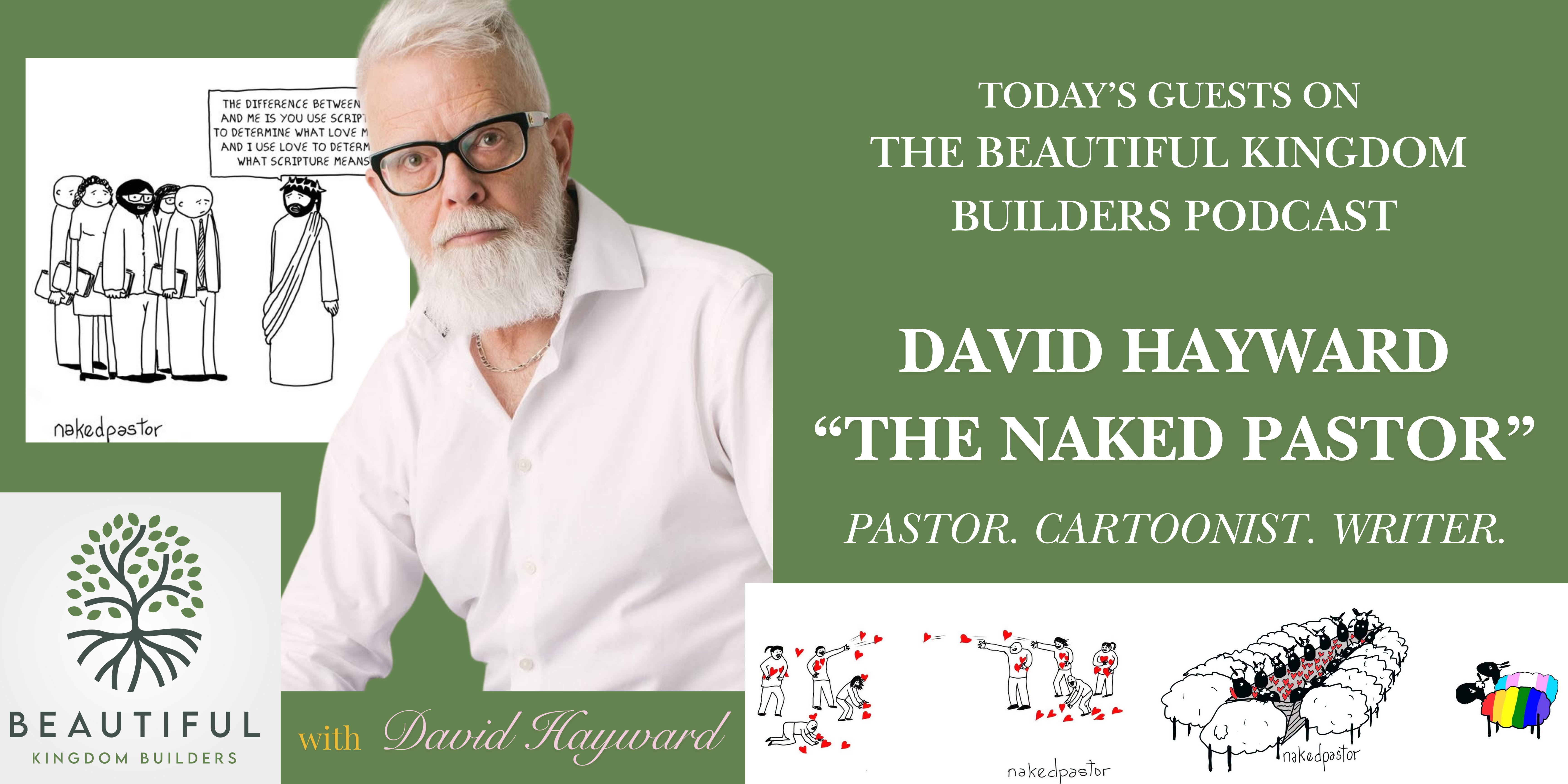
In this episode, I spoke with David Hayward, a.k.a. “the Naked Pastor”, exploring his journey from traditional ministry to a provocative cartoonist challenging church culture, theology, and love. We talked about faith deconstruction, the nature of love, and the impact of evangelical culture. I especially appreciated how Hayward explained the importance of LGBTQ inclusivity as the authentic expression of God’s love, and the expansion of our lives through faith shifts and growth, not in a way that should make us look down on previous versions of ourselves, but in a way that absorbs and includes those versions.
Visit nakedpastor.com to read Hayward’s blog, and to purchase some prints for your home office and gifts!
And follow Naked Pastor on Facebook, X, Instagram, TikTok, Pinterest, and YouTube.
You can find this episode of The Beautiful Kingdom Builders podcast on YouTube, Spotify, Apple Podcasts, Amazon Music, Substack, and more!
TRANSCRIPT:
Rev. Ruth Perry (00:15)
My guest today is David Hayward, the Naked Pastor.
David Hayward (00:19)
Yeah.
Rev. Ruth Perry (00:20)
I’m really excited to have a conversation with you today. David, I’ve been following your work for a very long time. And on my podcast, I like to have conversations about gender, justice, abuse, and healing in the Christian faith.
And the Beautiful Kingdom Builders started as a place to talk about women in ministry and inclusion of women in the church because I grew up fundamentalist and had to rethink all that when God called me to ministry. But then as dominos started falling and I started talking about more and more things on my page. And so now I feel like everything that I care about, I see cartoons made by the Naked Pastor.
David Hayward (00:53)
Yeah.
Rev. Ruth Perry (00:54)
And I’m just really excited to hear your story and dive in today.
David Hayward (00:57)
Thank you.
Rev. Ruth Perry (00:58)
Thank you for being here.
David Hayward (00:59)
Yeah, my pleasure. Thanks for inviting me on your podcast.
Rev. Ruth Perry (01:02)
Well, it would be a miracle if anybody hasn’t seen your cartoons before, but if they haven’t, can we go back and hear your story?
David Hayward (01:09)
Yeah. Yeah. So maybe right off the bat I’ll explain the name Naked Pastor. It was back in two thousand and five or something. I was running a blog and it was like I can’t even remember the name. Maybe it was David Hayward.ca. C A stands for Canada. I’m from Canada, But I wanted a dot com name and everything. Then
I got the name churchpundit.com and then that sounded a little bit pretentious. So I was a pastor at the time of a church, and there were a lot pastors in the blogosphere at that time blogging and so I thought I want mine to be really different. I want it to stand out, I want people to really see what goes on in the life of a pastor, what goes on behind the scenes in a church, not just all the good things, but the struggles as well, the conflicts, the financial struggles, you know, all this kind of stuff.
And and so I thought Naked Pastor, meaning I’m gonna reveal everything about what goes on. I’m gonna pull back the curtain and just show everybody what what goes on in the church and in my life, you know, not only my strengths, but my weaknesses, my doubts, my questions, my struggles. And so that’s where the term Naked Pastor came from. As you can see, I’m fully clothed.
Rev. Ruth Perry (02:20)
Thank you for that.
David Hayward (02:22)
Yeah, yeah. And I’m I’m a very modest guy, but I’m also very honest. So that’s where the name Naked Pastor came from. And I started that back in 2005. I can’t believe I’ve been going 21 years now.
And I don’t know, about a few months in, I decided, because I’d I’d been painting and things like that on the side while being a pastor for so many years. I thought, I’m gonna try cartooning, see what happens. And I gave I challenged myself to try it to draw a cartoon every day until I ran out of ideas. And I thought I would last a couple weeks, maybe or whatever. But here I am, you know, 21 years later, still drawing cartoons every day.
I’ve got thousands of cartoons and and and they just took off. So that’s what Naked Pastor sort of became known as is a cartoonist talking about those things you mentioned, spiritual abuse, women in ministry, women in general, feminism, LGBTQ plus community, racism, theology, the Bible, etc., church stuff.
And it’s resonated with a lot of people around the world. So I had no idea my cartoons would be seen by so many people. But I love what I do and many people appreciate it. People ask me if I’m retired and I’m like, I’ll never retire. I’ll do this as long as I can.
Freedom funeral. That’s what I call my retirement package. So I left the ministry, the the official ministry in 2010. And I’d been serving the church for about 30 years at that point as a pastor. And now I really feel like I’m doing the same kind of work, but online with people.
Helping people move on in their spiritual journeys and so on. And just encouraging and uplifting and edifying and encouraging and validating people on their journeys. That seems to be what I’m doing, which is what I did as a pastor of real churches. So I kept the name, Naked Pastor, and here we are today.
Rev. Ruth Perry (04:08)
Yeah, you definitely have a pastor’s heart and you just show so much love and light on the internet. I think a lot of times the people who have ministry on the internet get a lot of crap from people who look down. But in order to create the cartoons you create, you’re condensing a lot of theological education and pastoral ministry and deep awareness being raised and conditioned and you know formed in this culture. So you’re speaking very profoundly in these images. Can you share about like the way you were raised and what your theological education is and your experience?
David Hayward (04:46)
Yeah. Yeah. So I was raised in a Christian home. My mom and dad, before I was born, got saved at a Billy Graham Crusade in Toronto. And I don’t remember really us going to church together as a family a whole lot. My dad was a cop and we moved around quite a bit. He was transferred quite a bit in in Ontario, Canada. And so we went to whatever church was convenient.
But then when I was around 16, I joined a Baptist youth group and ended up getting born again, again. I was already baptized as an infant in the Anglican church, which is equivalent to your Episcopal pretty much. So we soon all as a family were going to this church and then we switched to Pentecostal. And then, I was in the Pentecostal church for years, went to a Pentecostal Bible college in Springfield, Missouri. That’s where I met my wife Lisa.
Then I went to a seminary, Gordon Conwell, in Boston, got my master’s in New Testament studies, years of Greek, years of Hebrew, even Aramaic, started studying for my PhD at Toronto University in New Testament studies. we ended up getting pregnant. We could no longer continue just because of finances and life and everything. And I ended up being invited to be ordained in the Presbyterian Church in Canada, ended up becoming a Presbyterian minister and serving the Presbyterian Church for many years.
And then after a while, I got bored with that and we switched to Vineyard, which is a mixture of Pentecostal and evangelical theology. And that’s where I ended up serving the rest of my time as a pastor, basically. That’s a long story short, but so you can see I’ve been around the block. I call myself my own ecumenical movement because I’ve been in so many denominations.
My first spiritual director too, she was a Roman Catholic nun. I’ve been heavily influenced by people like Thomas Merton and Henri Nowen and so on. So not only do I have Anglican, Presbyterian, Reformed, Calvinistic stuff, but Roman Catholic mysticism, Baptist, Pentecostal, independent. So I’ve had all those experiences and and all that education as well. I got my MDiv as well on top of that.
And so it’s like you say, all this stuff and all this experience distills itself down into these cartoons. I have a lot to say. because I’ve seen a lot what goes on in the church and what goes on in theology and what goes on inside the life of these people who associate themselves with Christianity and the church, and maybe even people who are what we call deconstructing, questioning their beliefs and, questioning their relationship with the church or religion in general, God, the whole, buffet.
And so all this stuff interests me because bottom line is, I really want to help people on their spiritual journeys get from their point A to their point B, whatever I can do to help. And a lot of people have to deal with not only theological questions, they have to deal with complications with the church and feeling controlled or coerced or manipulated in the church, maybe even abused. They’re having to deal with sexism in the church, maybe even misogyny. They’re having to deal with maybe racism in Christianity, you know, anti-LGBTQ issues and stuff. So I’ve got a lot to talk about. There is a lot to talk about.
And I found that I could write a 1,000-word blog post, or I could draw a cartoon. And I found my cartoons way more effective at getting my ideas across. And so that’s what I seem to be spending most of my time doing now is drawing cartoons trying to say what I want to say.
Rev. Ruth Perry (08:15)
Yeah, I think that you really found a powerful medium because that’s what I’ve noticed. I’ve been doing the Beautiful Kingdom Builders Facebook page for maybe eleven years now. So not as long. But people definitely engage with images far more than reading a long post or clicking on a link to read an article. And that’s part of the reason why I started this podcast is because I wanted to have more nuanced conversations with people.
But I do think that what you’re doing with the cartoons is really impactful and really powerful. And it’s really
David Hayward (08:45)
Thank you.
Rev. Ruth Perry (08:46)
bothered me how much culture warring, Christianity, and this kind of need to control and dominate has infected the church in a way that has perpetuated a lot of harm. And the people who put themselves in positions of power and authority over others are impervious to hearing about the harm. They just can’t hear it. But then the people that are experiencing it are just leaving the church or leaving the faith, or they’re going on a really painful deconstruction journey, questioning their faith.
David Hayward (09:16)
Yeah.
Rev. Ruth Perry (09:16)
I guess what my first question would be, I remember when I was in college, my friend from high school had become a Christian and then we were at different schools and she messaged me one day that she was doubting her faith. And I remember just falling on my bed and weeping as though she had died. I couldn’t understand doubt at all.
And then later on, I’ve had my own doubts and I’ve had my own questions and started to go through that process. But it was really painful for me to hear that someone was doubting. I didn’t have any tools as a I I mean, I’d been a Christian for 20 years in the church and but I didn’t have tools to understand where she was coming from. So what might be like some of the missing tools in the tool belt of a Christian to hear someone who has a different perspective from them?
David Hayward (09:57)
Yeah. Well, I wonder what’s happened to your friend now.
Rev. Ruth Perry (10:00)
She well, actually she tragically died of a pulmonary embolism at 21 years old.
David Hayward (10:06)
Oh dear.
Rev. Ruth Perry (10:06)
And for me, that was the first faith crisis I had, where I blamed myself that I did not speak directly to her doubt. And I was carrying her salvation and her eternal conscious torment on my shoulders because I was a Calvinist and I believed, you know,
David Hayward (10:19)
Wow. Yeah.
Rev. Ruth Perry (10:21)
if she didn’t express faith in Jesus Christ in this lifetime, then she was burning in hell for all eternity. And so I was angry at myself and I was angry at God. And that was my senior year of college.
David Hayward (10:32)
Yeah, yeah, profound. Wow. That’s what I have found is most of us in fact everybody I know of and and including myself is these questions don’t just happen out of nowhere. It’s often a crisis precipitates our questioning or our doubt or our deconstruction, it’s like I’ve known l several people who are vehemently anti LGBTQ, but as soon as their son comes out, then that’s a crisis. I have seen some people harden themselves and reject their own child. But many I’ve seen their heart softens because the question.
It’s when we experience a personal crisis that these important life moments like deconstruction or doubt or whatever they they can happen under that kind of a condition. They I don’t think they just sort of just happen out of nowhere. Often it’s some kind of a crisis, a serious question or an experience or a loss or or something.
Rev. Ruth Perry (11:32)
What was your first crisis of faith?
David Hayward (11:34)
My first crisis of faith, I remember it very, very distinctly. And this was what launched my deconstruction, the beginning, the very beginning of my deconstruction. So I was at seminary. I was studying Master’s New Testament studies. I was all done. I had already gotten my grades. I was graduating cum lade and I was getting ready for the graduation ceremony. I had my robe on and my cap, everything, and getting ready to go.
And I was freaking out inside because I had just realized I wasn’t sure about the inspiration of scripture. So now it wasn’t because of seminary, because that was an evangelical seminary. Though there was no question about the sovereignty of God or inspiration of scripture. I call them the three eyes. It’s inspired, infallible, and inerrant.
I had believed that my whole Christian life. I was a Bible, Bibleic or whatever you call it. Yeah, I was I was in deep. I was totally committed. I was all in. But I suddenly realized the truth is I read a book that really, really challenged my belief about the inspiration, infallibility, and inerrancy of scripture.
Now, I’m going to tell you the book because people are going to ask you, and I get asked all the time, what’s the book? And and really, it’s not about the book. Although it’s a good book, I still have it. it’s I read it every once in a while, and it’s called The Silence of Jesus by James Breach. He was a New Testament scholar at York University in Toronto. It was just a little book, and just the way he wrote it and what he said it made me realize I don’t know if I believe in the inspiration of scripture. And that to me was traumatic.
I compare it to a Jenga block tower, and the block from the bottom that was holding it all together was pulled out and the whole thing started crumbling. Or it’s like the rug being pulled out from under me. It was like everything I believed in depended on the Bible being inspired.
And so I remember the moment. And I was with my wife Lisa, I was like freaking out. And she like grabbed me by the shoulders. She says, You have to go to your graduation ceremony. You know, I had to get there early, and she was gonna be coming along and sitting in the audience, but I was freaking out. So that was the beginning of my deconstruction. and I
I compare my deconstruction to a glacial melt or corrupt code being inserted into my theological brain and just corrupting my code. It took decades, decades to finally resolve it all. So my deconstruction was a long, long process and some people it’s overnight, not me. It took a long, long time. And I was in ministry that whole time. So, you know, it was a challenge for sure. But that was the beginning of it. That was when it was hatched.
Rev. Ruth Perry (14:13)
I actually went to Gordon Conwell also.
David Hayward (14:16)
Did you really?
Rev. Ruth Perry (14:17)
And my husband, yeah, and I went to Gordon College. So I was in that area for seven years.
David Hayward (14:21)
Wow.
Rev. Ruth Perry (14:22)
The theology department, had they had had some kind of conflict between different theological points of views at some point. Were you there before that or after that?
David Hayward (14:31)
I was at while that was happening.
Rev. Ruth Perry (14:34)
Fun.
David Hayward (14:34)
So my I studied under Dr. Gordon Fee, who’s the world-renowned text critic, New Testament scholar. And then David Scholler was there and who was the New Testament scholar. He wrote a book about Jesus. I can’t remember the name of the book, and I can’t remember his name either, but I loved him and he was great. I’d remember it if I gave myself a moment. But the point of his book was that Jesus’ understanding, his self-awareness sort of grew and dawned on him. It wasn’t like he knew who he was the
whole time. And that was heretical, according to other scholars there.
And that’s when he was dismissed. And Dr. Gordon Fee left. And that’s when Gordon-Conwell, right after I left, took a very strong right turn and became more conservative, you know. So it was tragic, too bad, because it was a great school.
I graduated from there in eighty three, I think. And so it was way back then. That was a long time ago.
Rev. Ruth Perry (15:33)
I graduated in 2005. So
David Hayward (15:35)
Okay.
Rev. Ruth Perry (15:36)
a little bit of time difference there. But
David Hayward (15:38)
Yeah. Yeah.
Rev. Ruth Perry (15:39)
For me, some of conservative complementarian beliefs were really challenged in seminary. I took a class on Ephesians, and the professor was egalitarian. And then I’d had a lot of women mentors and professors in college and seminary, but I was really latched on to complementarianism. And so even though I’d had reasons to doubt and question it, I did not question anything until I was thirty years old and pregnant
David Hayward (16:05)
Right.
Rev. Ruth Perry (16:05)
with my third child. And our church had split. We were being socially shunned by our church because my dad had been the pastor and so we were experiencing another crisis, emotional faith crisis. And I had thought that my, faith background and my family were both perfect and they were imploding. And so I encountered Brennan Manning videos on YouTube and I heard his message of God is grace and mercy and his love for you is unconditional. And it really hit home because my heart was hurting and I realized I had been living with a conditional idea of God’s love all this time. And I’m 30 years old now. Always been taught that God loved me, but always striving to belong and fit in.
And so it was after that experience of deciding that God’s love for me was unconditional. That was what gave me the freedom to then go back and consider the things that I had been confronted about egalitarianism versus complementarianism. And start to rethink my faith in a lot of different areas. But it does seem looking back now, reading the Bible through a different lens.
David Hayward (17:12)
Yes.
Rev. Ruth Perry (17:12)
It seems like there the another thing I’ve learned a lot about is dynamics of abuse and domestic violence and you know the abuse wheel is all about power and control.
David Hayward (17:24)
Yes.
Rev. Ruth Perry (17:25)
And now looking back, I can see that so much of the culture that I grew up in in conservative evangelical Christianity was about power and control and gatekeeping, who I read and listened to. And I lived with such fear of people outside of my circle of belonging. Can we talk about what evangelical culture is like and wh why it doesn’t really show the fullness and the abundance of life that Christ wants for us?
David Hayward (17:52)
I often compare it to parents raising their children and they are really fearful about their kids straying away f like they they want their kids close to them, they want them safe, and they want them forever. And the the only way you can do that is if you have very strong boundaries and very strong ethos and and very strong values and beliefs. And and so the way many parents parent then is high control and making sure that their kids, you know, think and live the right way. Because this is the only way we’re going to be able to stay together and be a little family or a tribe or whatever.
And then when the children get to the age when they start doubting or questioning or even rebelling or resisting or challenging, then it it it threatens the the the network and threatens it with possible division and breakup and so on. And so the parents just double down and you know get stricter and more controlling and so on. And they really do believe it’s for the unity of the family to keep it together and keep the kids safe and, you know, whatever.
And I think many churches are the same way and and the church in general. It’s it’s a way to keep it’s crowd control. It it’s just it’s crowd control and and it’s keeping keeping the flock a flock you know keeping it together and and and so on but when it comes down to it though I think that’s evangelical church culture you know very very strong beliefs and very very regulated behavior and that’s how it’s gonna work. And if everybody signs up for this, then it’s easy. It’s great.
But if anybody challenges it, then it messes the up the whole, charade. And you know, it’s that’s why a lot of I think a lot of evangelical or conservative churches and so on have very cult like qualities. And maybe even some our cults, you know, just that very strong top-down control, manipulation, coercion, and it it resembles very much a cult. So and and that’s why I think people who question are I think they’re very brave and very courageous to allow those questions to rise.
For example, your friend way back when she said, I’m beginning to question my faith. At such a young age, that’s quite a courageous thing to do. And to share that with somebody is even braver. And we’re seeing that more and more nowadays, where people are willing to let the doubts emerge and even for them to express them. That’s a very courageous thing to do. Because it used to be that you would be done, in the church. That you’d be finished. And but people are willing to take that risk now.
Rev. Ruth Perry (20:39)
Yeah, I’m thinking about a situation in my local town right now, which our town has a history of churches splitting over the issue of LGBTQ inclusion.
David Hayward (20:51)
Mm-hmm.
Rev. Ruth Perry (20:51)
And I would say the vast majority of our town believes an unaffirming perspective where they would call it the gay lifestyle is a choice that someone makes and it’s sin and that God condemns it and so they’re you know they’re condemned but then I think there is a way to hold your convictions and still love your neighbor but what I see is that this point of view, the fruit of that tends to be a lot of harm and homophobia. And families will just cut children off or feel so much shame if their child comes out. and the people who are questioning their sexuality they’re feeling a lot of shame. Those are the kids that are getting bullied in the schools.
David Hayward (21:36)
Mm-hmm.
Rev. Ruth Perry (21:36)
There’s more violence against them, there’s higher suicide rates. And so we could see that there’s so much harm being done through homophobia in our culture. And how can we speak to people who have biblical convictions about holding those in a way that don’t cause harm.
David Hayward (21:55)
Well, I’m I’m not sure it’s possible, but there’s there’s a couple things I have to say about that. There’s two approaches to the Bible and at the LGBTQ community. So one is the biblical scholar approach. and so when people say they they pull out the clobber verses, we call them the clobber verses, the verses that condemn, apparently condemn the gay lifestyle or homosexuality or whatever. Or you know, I don’t permit a woman to wear, a man to wear woman’s clothing or what you know, whatever. Those verses. They pull them out.
But there’s a lot of scholarship now that questions the traditional interpretation of those passages. And there’s some really good scholars, some of them friends of mine I highly respect, who really are casting doubt on the conservative, anti-LGBTQ homophobic interpretations of those passages and the way they’ve been translated, even. And you know, so for example.
Verses that talk about homosexuality in Romans or whatever, I do not permit a man to sleep with a man or whatever those verses often is referring to temple sexual use of boys, for example, you know, in temple ceremonies and things like that. So, you know, there’s that whole biblical approach.
Where it they’re they’re casting new and fresh interpretations and light on those passages. So there’s that route. And and so when when somebody says, What about the Bible though? What the Bible says isn’t that? I said, Well, you know, go read this person, Dan McClellan, for example, or you know, Brandon Robertson, or these people who are scholars in their own right. New Testament scholars, Old Testament scholars, and are casting new light on these biblical passages.
That’s one route. The other route is there’s a lot of passages in the Bible that we clearly do not think pertain to us anymore. You know, so the women covering their hair or not eating lobster or shrimp or shellfish of any kind or mixing your garment cloth, you know, with nylon, with wool or whatever. There’s a lot of passages that we we no longer really abide by, including, and Pentecost I remember in the Pentecostal church where if you were divorced, you could not lead. You could not be a leader of in the church. You could not pastor for sure, but you couldn’t be an elder or anything if you were divorced. Well they’ve relaxed that. It’s like that’s impossible. 50% of marriages end up in divorce. It’s, you know, we’d lose half our pastors and leaders if, you know, we so they they adjust. We adjust over time. And you know, the same with women in ministry. There’s more and more churches are starting to relax because we need pastors. And so they relax that.
And so it’s the same with the LGBTQ community. It’s like you can go the biblical route and debate over the biblical passages, or you can say, you know what, if that’s what they were saying, that was thousands of years ago, no longer applies. and and you know, we need to relax that a little bit, and and recognize something. So that that’s my two-pronged answer to a lot of people who I feel are sincerely curious about what I think about the LGBTQ theology.
But here’s here’s the most fundamental problem, in my opinion, is when a church or anyone excludes, marginalizes, dismisses, rejects a gay person, let’s say gay person or trans person. They’ve revealed a fundamental misunderstanding of what love is, in my opinion. Love, again, in my opinion, is not selective. It’s indiscriminate in a positive way. It’s completely indiscriminate. It’s not sentimental or romantic or Hollywood or based on opinion or taste or desire or preference. It’s love is completely indiscriminate. It’s like Jesus was to have said, it justice is for everyone. It’s like rain falls on everyone, the sun shines on everyone. It’s indiscriminate. Love is the same way. Gravity’s the same way. Gravity’s not selective. Gravity pulls us all in.
And so I think love is that same kind of force. It’s indiscriminate. And everyone is included in this force field of love. And I think that’s what, if you believe in God or not, I think that’s the glue that holds us all together. and and that everybody is included. Yeah, we gotta deal with evil and how that fits, but that’s another issue. For me, love is this all-inclusive indiscriminate power or force or whatever that’s not based on feelings.
And one of my favorite little parables is the sower. And so Jesus is with his disciples and he says, like look at the sower. The kingdom of God is like the sower, and he’s casting his seed, and it goes everywhere. It falls on the rocks, it falls on the path that falls in the weeds, it falls, on good soil, everywhere, right? I think that’s the point of the parable.
That’s the point, not birds come, that’s the devil’s, in the weeds, that’s bad theology, in the whatever. I think that’s secondary. Primarily, it’s the casting of the seed everywhere indiscriminately. He doesn’t go and plant it here and here and here, seed by seed. It’s just like throws it everywhere. And it’s like I do with my grass seed every spring. I go out in the front yard and I just throw it.
And I think that’s what love is. And and so that includes you, me, my gay friends, my trans friends, my black friends, my women friends, my everyone, my atheist friends, my Buddhist friends, my Muslim friends, everybody gets some, you know, to quote what’s her name?
Rev. Ruth Perry (27:29)
Ha ha
David Hayward (27:29)
Everybody gets some. so it’s yeah, to me that’s what love is. And when when people try to exclude groups, then that’s a fatal misunderstanding of what love is. And that’s why I’m continuing to fight on that hill. Because there’s a fundamental misunderstanding of what love is. Oprah Winfrey said everybody gets some. Yeah.
Rev. Ruth Perry (27:48)
Yeah, I totally agree with you. That’s what the further along I get in my faith journey, the more I understand that, it fundamentally is about loving God and loving your neighbor as you love yourself. And love means wanting for my neighbor what I want for myself. And who is my neighbor? It’s everybody else.
David Hayward (28:08)
Yeah.
Rev. Ruth Perry (28:08)
And my first insight into this was that begins with being willing to listen to them, to understand them, instead of imposing my own labels and my own diagnoses and my own understanding of what their situation or their deal is on them. But just to begin by listening to someone’s story and taking their word that they understand themselves far better than I do. And then wanting for them what I would want for myself.
David Hayward (28:35)
Yep. When I post about this quite a bit, cartoon about this quite a bit, but when and then somebody will come on and say, Yeah, but what what is love? Or or they’ll say, Yeah, but what about Muslims, or what about the Haitians who are eating their cats and whatever? And it’s like, That sounds to me like who is my neighbor when when Jesus told the parable, love your neighbor as yourself. And then the religious people are like, Yeah, but who’s my neighbor? And that’s their way of saying, I want to love who I I want to love or should love, like, but like who is that? They fatally misunderstood already. It’s like love is your neighbor, it’s everybody around you.
And I find it interesting that the way Jesus frames the parable he could have said you know the religious people going to the temple and so on and they found a Samaritan in the ditch and helped the Samaritan because there he could have done that but what did he do he switched roles and it was the Samaritan who was the good guy and he was the good Samaritan and how the Samaritan saw that everybody was his neighbor, anybody who was near him or around him at the time. And so I think that’s really fundamental to our understanding of love is it’s everyone. And as soon as you say, yeah, but who exactly, then you’ve taken on the religious mindset, who is my neighbor? And it’s fatal, it’s wrong, it’s divisive.
Rev. Ruth Perry (29:56)
There’s also those who say, well, I’m loving by correcting them and speaking the truth to them.
David Hayward (30:03)
Yeah. Rebranding. I know, I get that all the time, where people just change the definition. You know, where they I’m loving you by, you know. It it sounds like the Inquisitors, the Spanish Inquisitors, the the Inquisitors of the Spanish Inquisition, you know.
Where they’re torturing people for heresy and they’re like, We’re doing this to love you and to save you, you know. So people are, you know, I see the the same attitude these days. Sometimes it really makes me question the idea of progress. Like, have we really progressed, you know, where people are willing to cause people to suffer because of their beliefs? Or lack of beliefs or because of their different lifestyle or whatever. Apparently yeah. So it’s kinda discouraging and demoralizing to see that, how much have we really changed? Even to the point of restoring public executions,
Rev. Ruth Perry (30:56)
Yeah.
David Hayward (30:56)
You know, it’s it’s like, okay, how is this progress? Alarming, wouldn’t you say?
Rev. Ruth Perry (31:01)
Yeah. Or we want to be great again and so then you have to interrogate, well, when were we great? Was it when we had slaves? Was it when women couldn’t vote? Was it, when we were genociding Native Americans? When were we great?
David Hayward (31:14)
Yeah, well there’s many leaders and thought leaders who are suggesting that. And they have a lot of influence, you know, like Hegseth’s spiritual advisor, I forget his name, who believes that
Rev. Ruth Perry (31:25)
Doug Wilson.
David Hayward (31:27)
Doug Wilson, he doesn’t believe women should vote. They should be in the home, you know, etc. etc. I’m not sure what he thinks about LGBTQ, but I can guess. I’m not sure what he thinks about race, but I can guess, you know. It’s almost like, I remember somebody I liked, and we went out, a bunch of us to dinner to a restaurant and everything, and I thought this person was a wonderful person. And then the way they treated the serving staff was like, What? Like so rudely and condescendingly and privilegy and snooty, and I was like, Whoa.
And that wasn’t just that’s just one little aspect. That to me revealed something deeply wrong, deeply wrong with with the person, you know? It’s not just a a little tick or whatever. Something deeply wrong. And it’s the same with Doug Wilson or whoever else, who say, yeah, women shouldn’t vote. Okay, that’s not just a a random idea. This is a peek into something deeply, deeply wrong with their mind,
And so that’s why, like with the LGBTQ it could be the most loving person on the planet, but they’re like, no, LGBTQ aren’t going to heaven. It’s like, whoa, wait, whoa, something deeply wrong there. Something deeply wrong. Disturbingly wrong, you know. So that’s why I keep fighting on this battlefield. I think it’s important. It’s not like some fringe, issue. It’s a fundamental issue, I think.
Rev. Ruth Perry (32:51)
Yeah, I think so too. And one of the most heartbreaking things about it is the moment you say LGBTQ inclusion and those words come out of your mouth, people just shut down and write you off. And that’s a fundamental failure to love. If you can’t even listen to a contrary opinion.
David Hayward (33:08)
Yeah. Yeah. And I don’t bother arguing. Arguing to me is a waste of time. most people who are trying to start a fight with me or argue or whatever, I almost all of them I don’t respond to. Once in a while though, I can tell by the way they’re asking the question that they are genuinely curious. and I’ll I’ll respond to them.
But most people I can tell they just want to start a fight and prove their point. And you know, Jesus was the same way. When he was asked questions, he often responded with a question or slipped away through the crowd. because I think, answering these questions are more like bait. And I’m not gonna bite.
So, but there’s there’s been some moments in my life where they’re like, I really need to understand where you’re coming from because whatever, and then we’ll have a conversation and maybe that will have an impact on them. I don’t know. sometimes it has. So, but most of the time it’s like, I’m not biting, sorry, go fish somewhere else.
Rev. Ruth Perry (34:04)
Yeah, I have a few friends that I have never cut off because I like to extend bridges and keep relationships that constantly message me about my Beautiful Kingdom Builders posts with questions like where is Christ in your work? And like you don’t care that women are being abused in churches. You don’t care that children are being abused in churches. I feel like Christ cares about that. That that’s important ministry, that we not, that we’re hating on the church, but we’re purifying, there ought to be accountability for harm. And we ought to be able to have hard conversations about where the church isn’t meeting the mark or where the church is,
David Hayward (34:45)
Right.
Rev. Ruth Perry (34:46)
you know, not being good news to people.
David Hayward (34:48)
Yeah, I think the spirit of Jesus is present in all that work without the need of having to say the name, I get that a lot too. I just even yesterday, some guy was like, I I already knew where you were coming from when I don’t see Christian in your bio, and okay, whatever. If everybody has to say, hey, I’m a Christian before they start to have a relationship with you.
That’s very interesting to me. But it was I remember learning, I think it was from Eugene Peterson, that in the life of David in the Old Testament, there’s not one miracle. And yet his life, according to Scripture, was miraculous in many ways. I don’t I know David’s on the hot seat because of rape, murder, all that stuff, serious, serious stuff, and we need to look at that seriously. But the whole point of his life sounding or feeling miraculous without any miracles.
And it was the same kind of revelation I had when I realized in Lord of the Rings. There’s no mention of God. There’s no sense of divinity at all in the whole story. And yet it feels full, it feels full of divinity without having to say it. And Tolkien, Charles Williams, C. S. Lewis, and all the they were all Christians. And their work was imbued with divinity or sacredness or whatever, right? Without having to say it. So I would rather remind people of Jesus with my life than me saying Jesus, Jesus, Jesus, Jesus all day long.
Rev. Ruth Perry (36:15)
Exactly. And something that I appreciate that you talk about is your desire for authenticity because I’ve recognized like I was not authentic before I started to go through deconstruction. I was a people pleaser and I was codependent and I was telling people what I thought they wanted to hear. And I was doing what I thought I was supposed to do and using scripts that had been written for me and that weren’t coming from my own understanding or beliefs.
And so that process of deconstructing and then reconstructing your faith is so beautiful but arduous. And I think it’s really important that we celebrate that when people start that process and start making faith their own, even if it means maybe they lose their faith in the process, but they’re having an authentic spiritual journey.
David Hayward (37:02)
Yes. you were authentic at that time. We can look back, hindsight’s always twenty twenty, right? But I used to think of growth as kind of linear. We’d move along a line and we’d leave our old stuff behind and kind of like a snail trail, you know? And it would dry up and wither and blow away.
And then I used to think of it as stages where we go up the stages of faith or whatever, and we kind of look down on our previous self and realize we’ve ascended and we’re improved. but that no longer made sense either. So now I think of growth as spatial, where we grow outward, kind of like rings on a tree. And, you know, all those rings are important. You can’t go in and rip out a ring or two or three. They’re all a part of the package, they’re all a part of who you are.
And so, you know, way back when I was in the Pentecostal church and in the Vineyard church and then the Reformed, Presbyterian church and all that kind of stuff. All that’s a part of who I am now. I wouldn’t be who I am now unless I was who I was then. It’s all a part of my story. And I can look back and say, wow, I wasn’t very authentic. At that time I thought I was, though. And I was trying my best to be my best self, but it took some growth to happen.
And so now I’m a larger person, I feel, which includes all my previous stuff, and my job is to somehow integrate that all into my self-understanding, without shame, without guilt, without, you know, whatever, looking back and seeing how all that stuff that I’ve been through and experienced and thought and did.
It’s helped make me who I am today. it’s the culture out of which I’ve grown, And so all those rings of in a tree, like the a couple weeks ago, Elish and I went for a hike and there were some down trees. And I said, I wonder how old that tree is. And so I looked, it was cut across to clear the path. And I could count the rings. And I guess this tree’s about 88 years old. I could tell from the rings.
And some rings are thin and some rings are thicker, depending on the harsh weather or climate or whatever. And but all those rings are an important part of that tree’s history. And it’s the same with you and your story and me and my story. All those rings are important and play a role. And we need to figure out, okay, why was I who I was then? You know, and try to figure out the underlying things and integrate that understanding of ourselves. And, I think it’s a healthy way to look at growth and to process ourselves, you know, and become an individuated adults mature.
Rev. Ruth Perry (39:31)
That’s really beautiful and I think we’re out of time for today, but I really hope that people follow Naked Pastor on social media and go to nakedpastor.com. They can buy prints of your beautiful paintings as well as cartoons.
David Hayward (39:44)
Yeah. Yeah.
Rev. Ruth Perry (39:46)
And I’ll give you the last word today.
David Hayward (39:48)
Well, thanks for having me on and all the best to you and and your church and the your ministry. I love talking with pastors. I was one for thirty years, so it’s really cool to be in touch with people who are doing their best to help make the world a better place. So thank you.
Rev. Ruth Perry (40:04)
Well, I really appreciate your pastor heart and that you’re still serving with so much love and grace. Thank you so much. God bless.
David Hayward (40:10)
You too, Ruth. Thank you.
Did you enjoy this episode? Please subscribe, rate or review us on YouTube, Spotify, Apple Podcasts, Amazon Music, Substack, and more! Your support means the world. God bless!


