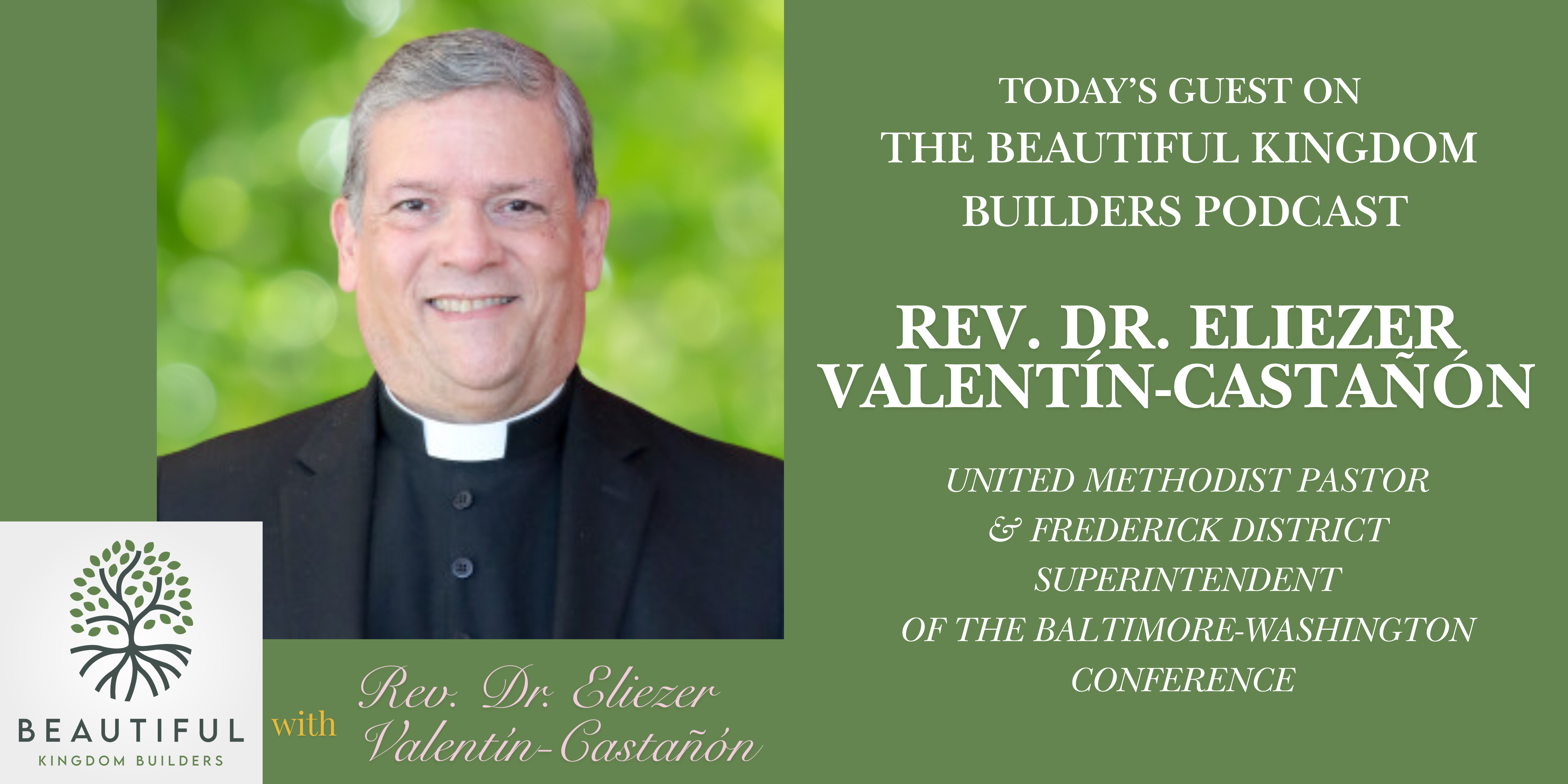
I took a Biblical Exegesis class this past April with Rev. Dr. Eliezer Valentín-Castañón, who is a United Methodist Church minister and scholar, currently appointed as Frederick District superintendent in the Baltimore-Washington Conference. He has had a long career in ministry and advocacy. I was delighted when Professor Eliezer accepted my invitation to speak with me about his personal journey of faith, from a Puerto Rican teenaged Pentecostal preacher to a mainline denominational leader, known for his commitment to justice, scholarship and community engagement.
In our conversation, we discussed the lengthy process of training and vetting that UMC pastors go through, and the importance of that process in light of low trust in clergy these days (see: https://news.gallup.com/poll/700736/nurses-continue-lead-honesty-ethics-ratings.aspx ).
Professor Eliezer also sent me these links to resources that help people rethink church and faith:
*Wendland-Cook Program in Religion and Justice
This is an interdisciplinary program located at Vanderbilt University Divinity School. It focuses on issues of justice that arise at the intersection of religion, economics, and ecology.
*The Bible for Normal People
They believe in a world where people engage with the Bible freely, without fear or guilt—where questions are welcome and scholarship is accessible.
*Dan McClellan YouTube Channel
Dan is an American biblical scholar who is well known for his activities on social media, creating and sharing videos on religious topics from a historical-critical perspective.
*Misquoting Jesus Podcast
This is a six-time New York Times bestselling author and world-renowned Bible scholar, Bart Ehrman. He uncovers the many fascinating, little-known facts about the New Testament, the historical Jesus, and the rise of Christianity.
*Homebrewed Christianity
Their goal is to bring the wisdom of the academy’s ivory tower into people’s earbuds. Most episodes center around an interview with a different scholar, theologian, or philosopher.
And books that impacted his faith journey during his early years of theological awakening (with TBKB affiliate links):
- Samuel Silva Gotay. Pensamiento Cristiano Revolucionario de América Latina y el Caribe.
- Gustavo Gutiérrez. A Liberation Theology.
- Leonardo Boff. Jesus Christ Liberator.
- Clodovis Boff. Theology and Praxis.
- Jose Severino Croato. Biblical Hermeneutics.
- José Miguez-Bonino. Doing Theology in a Revolutionary Situation.
- José Porfirio Miranda. Marx and the Bible.
Please enjoy this episode of The Beautiful Kingdom Builders podcast on YouTube, Spotify, Apple Podcasts, Amazon Music, Substack, and more!
TRANSCRIPT:
Rev. Ruth Perry (00:16)
My guest today is Reverend Dr. Eliezer Valentín-Castañón, although you’re originally from Puerto Rico, so could you say your name for me without the American accent?
Eliezer ValentínCastañón (00:26)
Sure, sure. This is Eliezer Valentín-Castañón.
Rev. Ruth Perry (00:29)
I met you this spring in my first course of study class. I’m a local licensed pastor in the United Methodist Church, so I’m going through a course of study and my first one was Biblical Exegesis, with you. And you were amazing. The class was amazing. And throughout the class, as we’re talking about the Bible you would drop little tidbits about your personal story, about where you came from theologically and how you’ve changed, and it was very intriguing to me. I’m so pleased that you said you would come on and share your story with my audience today. Thank you so much.
Eliezer ValentínCastañón (00:59)
Absolutely. Thank you, Ruth, for the invitation. As you know, I had some professors in my life and when we met with friends and family, they will always say, and he was one of my best students. So I’m gonna repeat that in this context. And Ruth, you were one of my best students. Thank you for being in that class.
Rev. Ruth Perry (01:18)
Thank you so much. That’s very kind of you to say.
Eliezer ValentínCastañón (01:22)
Absolutely. It is indeed a blessing, when you explore things together with pastors, right? And as I said in the class, you most likely will be the only theologian in residence that people will have in their churches. The only biblical scholar that people will have in their churches. And that’s why this is so serious, right? This is such an important thing and has such a value.
I measure things for the value that they have for me and in my life, how they help me to be a better Christian. But I also believe that, when you take this seriously as a pastor, then you really see the importance of your preparation in relation to how this is going to help your folks in the church.
So I am glad that you took the course. I am glad that we were able to explore some of the things the Bible teaches but also the tools we have at our disposal today to study scripture in a way that is going to be more helpful to the current reader, right? To the present reality where we live today.
Rev. Ruth Perry (02:19)
I would love to talk with you as part of our conversation about the material of that class because it was really powerful and impactful and I learned so much. It was a short class because you were teaching pastors in ministry and so the expectation isn’t that we’re full time students. But the material was really helpful to me in my ministry and I’m grateful that I had that. And
Eliezer ValentínCastañón (02:41)
Praise be.
Rev. Ruth Perry (02:42)
So you wear many hats. You’re a district superintendent in the United Methodist Church for the Baltimore-Washington region, and you’re a seminary professor and a former pastor. How many churches are you district superintendent of now?
Eliezer ValentínCastañón (02:55)
Right now I have ninety seven churches under my supervision. Yeah.
Rev. Ruth Perry (02:59)
So what does being a district superintendent involve?
Eliezer ValentínCastañón (03:02)
Mostly working with encouraging people, encouraging churches, encouraging pastors, and once in a while trying to extinguish fires. This is part of the deal with district superintendents. I have to say, sister in all honesty, it’s an incredible ministry. It’s an incredible ministry when you’re working with congregations and you’re working with, pastors and they’re different situations and different needs.
It’s a different work, as I tell my pastors, this is not pastoral ministry as pastors do in the local church. This is indeed something having to do with some administration, but from my experience is a lot of holding people responsible for what’s happening in the local church, but also encouraging them to continue to further their education, further the work that they’re doing, continue to pursue the things that they like. and as our Bishop Easterling says, is dream big, don’t be afraid of dreaming and pursuing the things you believe are important to pursue.
I think that that’s something that I also like to promote among my pastors and and also for the local churches because it’s a dream of the pastor but it’s also a dream of the local church and my hope is always that the two of them come together, so that you’re working in tandem with each other, pursuing the same goals for ministry. And at the same time for pastors, it’s the business about also challenging their congregations not only to do pastoral ministry, but also what I understand to be the extension of that pastoral ministry, which takes place in the community, that is not necessarily the folks that meet in the church building, right?
So it’s that extension of ministry, that extension of what it means to be a pastor in the church, especially in the United Methodist Church, where our pastors we are not called just to serve in a building, we’re called to serve in a location, and that location implies the entire community where the church happens to be. I have to say it’s been a real blessing. It has a lot of challenges, as you can imagine, but it’s just been a blessing. It’s a lot of conversations, a lot of hurt.
As you know, Ruth, we all make mistakes. And it’s just no way to avoid that. We just need to be humble about that and then accept also that when we do something wrong, that we’re willing and open to ask for forgiveness and have the humility to be able to admit that, we messed up. I think that this is all part of that ministry of the district superintendent. There is a lot of authority, but more important than the authority that is given to a DS is also the importance of recognizing our own failures and our own brokenness in this journey. So that we’re related to our folks like they are, so are we.
We’re not better than anybody else. We’re not above anybody else. We just have been called to special ministry in the life of the church. And so for me again, it’s been a blessing. It’s been a blessing also to see how things work, at this level of the life of the church. Usually pastors feel that they’re alone, that they’re isolated. And I can tell you, my sister, that being a district superintendent makes you feel that even more. Yeah.
Rev. Ruth Perry (06:00)
Oof. Well part of my background is that I grew up in a Baptist church that was independent of any kind of denominational structure. We were part of a denomination, but it was essentially in name only. My dad was the pastor. I don’t know that he ever went to any conferences in our denomination or had any communications from anyone in our denomination. And there was a terrible church split in our church. And I just felt the absence of a district superintendent and the absence of a bishop, that support that would come in when there’s a fire. And so it was just a really horrific experience. And this is something that drew me to being a part of the United Methodist Church is having the support of that structure in place and also just the high standards that you have for your ministers that you require education and you require so many steps and so much accountability and training.
Eliezer ValentínCastañón (06:48)
Yeah.
Rev. Ruth Perry (06:48)
I think it’s really important.
Eliezer ValentínCastañón (06:49)
Well I tell those who are aspiring to be pastors, you are coming into the ministry of the United Methodist Church and this is not for the faint of heart. We want to have the best pastors, best prepared folks that we can. So that the people we’re serving have the best that they can, the best that we can offer. and so it is sometimes a lengthy process, sometimes it’s a very taxing process.
If you want to be a pastor in our church, it’s because you want to be the best you can be as a disciple of Jesus Christ, so that you can give the best you can to your people. If you’re not willing to do that, then this is not for you.
I was telling my son the other day, my son is considering ministry in a different denomination. We’ll leave that too for another day. But he was asking me, so dad, how does the process work in the United Methodist Church to be ordained?
And I said, Well, you know, baby, you spend three years in seminary. Then in our conference, you spend three more years as a provisional member. And before you can be a provisional member, you have an examination done by the Board of Ordained ministry, a bunch of pastors and lay folks who are part of the Board of Ordained ministry who will examine your theology, will examine your biblical knowledge. And we’ll examine your polity knowledge. So, how well versed are you with our theology, our history, and our polity? And once you pass that, and it requires three-quarters of the members of the Board of Artine Ministry to actually vote for you. So if you don’t get the three-quarter requirement, you will not be moved forward to provisional membership.
But let’s say you did, right? You passed the examination and now you’re moving forward and so you’re gonna be now serving for three more years as a provisional member. Then you’re gonna be now going to another interview, another examination. Of which time you’re gonna have to prepare a written document that expresses your theology and your biblical understanding and your polity understanding and so on and so forth. And I said, and that is going to be evaluated. So the written material is gonna be evaluated, your sermon is gonna be evaluated, your Bible study is gonna be evaluated. If you fail in any of those, you will not move forward.
If you don’t pass the examination, you may be able to come back in the following year after you correct some of the things that they will tell you you did not do right. But let’s say you pass and it was great. Then you will be going before the Annual Conference. Specifically you will go before the executive meeting, which is the all the clergy in the annual conference, and then they have to vote for you. And if anything happens that somebody brings an issue about your candidacy at that level you might not actually be able to move forward.
But let’s say that all that passed then of course comes the consecration of the individual. So you have a bachelor’s degree, you have now a master’s degree, so that’s between eight, nine years maybe of study. And then you spent three more years waiting as a provisional member and that’s if you just follow the three years, right? Well the people take a little bit longer. and now you, enter into the process to be considered for elders’ orders. And I said, so this is how long our process is. It takes years. And he couldn’t believe it.
He said, and you had to do all this? And I said, Yeah, that’s what elders in the United Methodist Church have to do. And he was just surprised. And then of course I explained a little bit that also about, local pastors and the difference between local pastors and elders. I said, local pastors have this, course of study program and it’s this long and so on and so forth. And for a local pastor who wants to be ordained, I said you go through the five years of basic course of study, then you do another three years of advanced course of study, and then you might be able to apply or request to be ordained. But you need to meet other criteria before you can get to that point, because there are some educational criteria that are part of this. And I said to him, and with all this, all these roadblocks, so to speak.
And we still have pastors who should not be pastors in the ministry of the local church. So that it’s not for lack of effort. It’s not for lack of effort to get the best people we can. We still will find people who should not have been ordained or moved forward as pastors in the church. But this is precisely because we want the best for our people.
We want the best, most prepared folks we can have to serve our churches so that our people are served by folks who are from their own congregations, but who have decided that they want to serve the people of God and provide the best care and the best knowledge and the best education to the people that they’re serving. I said, this is who we are, this is what we do.
Rev. Ruth Perry (11:22)
There’s a Gallup poll from several years ago. I can’t remember what year it was, but it was ranking the trust that the population has in different career paths. And for clergy I think it was only thirty six percent.
Eliezer ValentínCastañón (11:35)
Yeah, yeah, yeah.
Rev. Ruth Perry (11:36)
And so I think this is really important that denominations do have high standards for their clergy and a lot of accountability and support. But also the training too. And there’s a lot of support within the denomination to help assist and provide for clergy as they go through this process, which is wonderful.
Eliezer ValentínCastañón (11:54)
Yeah, yeah. I think the denomination is also committed to helping and providing resources to folks to be able to do that. And we also encourage churches where people are serving as pastors to also support their pastors in this process, right? Because, you know, by supporting their pastors they’re also benefiting themselves, because as you bless these pastors and as you help them in their journey, when they move from your congregation to the next church they’re going to be pastoring, you are being part of the process of blessing that other congregation and blessing the denomination, right?
I think again, as much as it’s challenging, as much as it’s difficult it’s also a wonderful opportunity for all of us to make sure that we’re doing the best we can to serve our people and to be as committed to doing the right thing as we can and always again with the humility of realizing that even so we may not have everybody who’s supposed to be in this ministry and doing the right thing. But again, we don’t know what is in people’s hearts and minds. So we do what the best we can and that’s why we are so demanding on our clergy.
Rev. Ruth Perry (13:03)
So you did not grow up United Methodist and you were originally ordained as a teenager. Can you take us back to your background
Eliezer ValentínCastañón (13:09)
Yeah, that’s exactly right.
Rev. Ruth Perry (13:11)
and tell us about your beginnings?
Eliezer ValentínCastañón (13:13)
Yeah, yeah. I started my journey of faith first in the Catholic Church, as most people in Puerto Rico did, well, at least at my age. I became a Baptist for a little bit and then I joined an independent fundamentalist Pentecostal church. That’s the church that I became a pastor when I was 18.
And as a Pentecostal church, of course, we were, led by the Spirit and the idea was that if you know your Bible, meaning if you can quote scripture left and right, you are definitely able to be a pastor in the church, because you know, somehow it seemed to me that the biggest requirement to be a pastor in my church was that you know your Bible. So that you can call the Bible for every occasion in any situation. And so I did.
I learned my Bible and I quoted scripture left and right. And so I served as a pastor for a few years in that church. In my church, different from the Methodist church and some other denominations, we had several pastors. So I was not the lone pastor. I was a part of a team and we called our team a group of elders. Imagine that at eighteen you were the elder.
I remember going to a to a Pentecostal, another Pentecostal church looking for some assistance for a member of our congregation. And the young man who made the contact with the pastor of this church, the pastor was not going to help this young man because he was a young man, and he said if I bring an elder, from my church, would you be able to, he said, So yeah, bring an elder and so and there I come I was even younger than the guy who was making the first connection with the pastor and the pastor look at me and says and you’re the elder?
All that simply to say we had a lot of fun and many challenges but that experience also shaped me, shaped who I am as a pastor today, shaped my experience as a Christian until this day. There are many things that remain with me from my from that early experience. And there are some things that I just realized were not right. And those things I have left behind.
And it’s one of those wonderful journeys. As I listen to stories of people who have a similar experience than I had growing up in a Pentecostal fundamentalist church, and and they’re now in deconstruction. You know, interesting because when I was going through that process in my life, there was no deconstruction. This is just what you do as a Christian who’s actually maturing in faith, right? Now we call it deconstruction. So when I hear the testimonies of people I realize what an amazing experience. Because all these folks who are currently in this journey of deconstructing, is simply encountering their faith in a deeper fashion and just simply gaining an even richer understanding of who the God that they believe in is and then seeking to serve to be part of that community of believers but now with this new understanding of what it means to be a Christian in today’s world.
I remember one point in that process, we used to do a lot of street preaching. And we were in one of our towns in Puerto Rico doing that, which we did every week. And I was just in that process asking God for guidance. I said, there are things that we do in our church that I just cannot understand how we can sustain these things as gospel.
And I’m a pastor in that church and I’m asking questions of how can we sustain these actions as gospel teachings, and I ask God for a community of people that can share the experience of questioning and also growing. And a few weeks later I made that first connection with one other Christian who was also in a similar journey from another Pentecostal church. And we started a group of Christians, and part of what we did was we took time to study the Bible, but also studying then, things that people were reading. And so we started to engage in conversation. And that was one of the best times as a young Christian, discovering also more about my faith and and what God is seeking to do with us and through us in the world.
Rev. Ruth Perry (17:20)
What did the gospel sound like when you were preaching it at eighteen years old?
Eliezer ValentínCastañón (17:24)
Well, this was one of the challenges that I had, right? I had a very interesting situation where the people in my church and other pastors in my congregation were preaching this gospel of condemnation. You know, you need to do X, Y, and Z. I remember going to the leadership of the church and saying, What do we mean by this? I said, we are telling people that they need to have faith and to accept the gift of God by grace.
But then that is followed by, but if you don’t come to church, then you’re not a believer. And so I said, how do we sustain this message? How can we seriously say to people that what is required here is your faith and accepting God’s grace? And then on the other hand, telling them, but if you don’t come to church, then you’re not a believer, then you’re going to hell.
Let me just say, we send so many people to hell. It’s not even funny. We were so hard. We were hard on ourselves, and we were hard on people, period. And as pastors, we were very hard. Because we wanted to have the most consecrated and the most holy people we could have in our congregation. Just to give you an example, we had a church gathering to judge one of our members. Like a trial.
And the trial was because this individual spent too much time studying; he was in college and he wanted to do good in school and he was not spending enough time in church so we expelled him from church because he was an idolater. He dedicated more time to the god of school than to the God of the gospel. That should give you an idea of how my church was that I grew up in.
There were many other examples, of the things we did to people. And I will say the things that I did to people because from my vast experience and knowledge at eighteen, nineteen, I thought that that was the right thing to do, to help people really become deeply connected and committed to Christ.
Just to realize that no, this is not God’s will. For me at least. I came to the point in which, after seeing all the things we have done to people, and all our contradictions, that were part of our faith community, coming to realize, no, this is not right. This is not how church is supposed to be. And if we speak about a gospel of grace, let’s live into that reality and what it means then to follow Christ within that context of grace. So a few years down the road, I was about, 24. my church divided. It was between me and another pastor. And I said, I could not divide the church. And so I re signed. Different from many other people, right? That says, I’ll take my people and I started my own church, right?
Rev. Ruth Perry (19:55)
Yeah.
Eliezer ValentínCastañón (19:56)
I decided, no, that’s not the will of God. That’s not how this is supposed to work either. And so I resigned and I stay in the church as long as I could. And I got involved in social justice ministries, I got involved in justice advocacy, and got engaged a in a strike.
As part of all that journey, and I kept challenging my church. I said, if we speak of justice, if we believe that God is a just God that calls us to do justice, How could we not do justice? How can we not support people who are struggling to have a better life and to gain access to better pay and to better health care and so on and so forth.
And so of course, one of the things that happened in my church is that I became the communist. I was like, well, this is great. So this is damn if you do and damn if you don’t. And I finally said to folks in my church, especially in leadership, I said, if you consider this to be my actions and my joining a strike for the betterment of people in our community, then I guess that I am a communist, if that is what it means to be a communist. I said, but I’m doing this because I believe that this is what God ordains, that this is what God desires, that we all get involved in this and support our brothers and sisters who are struggling for better compensation, and so on.
And I realized, I cannot stay in this congregation because I’m gonna be just a sore person for everybody because, nobody wanted to discuss with me. I will be quoting scripture left and right. And so people didn’t want to be told that the scripture actually does indeed sustain what I’m doing. So I decided, this is not helpful to them and it’s certainly not helpful to me.
So the community that I mentioned earlier that I have prayed to the Lord and the Lord provided became very much a community of faith for me and and we became a community for each other. When I finished college, I came to the US. And when I came to the US is when I started then exploring other churches, and then I became a member of the United Methodist Church in New York and the rest is history.
Rev. Ruth Perry (22:00)
For me, I started questioning the patriarchal theology I’d been taught and I got labeled a feminist, which I hadn’t been reading any feminists. It was the Bible. So that’s how people use those labels to push people out really who are questioning and rocking the boat and making others experience some discomfort with the system that they have in place. So who are some of the theologians and activists and writers and thinkers that influenced you as your faith was changing?
Eliezer ValentínCastañón (22:26)
At the time when all this change was taking place, especially as I was still part of that church, interestingly enough, I didn’t have a whole lot of theologians who were supporting my my ideas, right? I remember reading, Francis Schaeffer that is sort of the theologian of the of the 70s, right? That every good conservative Christian was reading. My systematic theology was shaped by Louis Burkhoff, which was a theologian from the early 20th century. His book was the book on systematic theology. I was reading people like him and Francis Schaeffer and whatnot but like you said I found this reading the Bible.
I did not enter into this political process because I read this theologian or that theologian or that biblical scholar. No, I enter this journey because I read the Bible. And the Bible was challenging me to do something different and to respond differently to the world in which we live. It was the scripture that actually motivated me, because I gather from the scripture the idea that God is a God of justice and therefore we are called to do justice, right? If we are called just and justified, then my conclusion, was then we should be doing justice too, right?
And it was after I engage in this process of coming to do works of justice in the community. That’s when I started reading and encountering other theologians. And we had a wonderful Baptist pastor who was a professor at the university. And as we were exploring what the Bible says, he brought a copy of his doctoral dissertation, which he was working to publish. He just made a copy of the eighth chapter, he says, this might be helpful. And it was a chapter on biblical hermeneutics.
And since I liked the guy and I thought the guy was, an upstanding Christian man, I read the thing and it just blew my mind. It was a chapter specifically on liberation hermeneutics, and it just blew my mind. I said, how could it be that we that I’ve been in church all this time and we have never read anything like this. That was a very pro prolific writer in Puerto Rico. His name is Samuel Silva Gottai. He teaches on sociology of religion. And from then on I wanted to read other folks, and so I read Gustavo Gutiérrez, because of course I also wanted to read something that had to do with my cultural reality, right? The roots of where I am from, and in this case Latin America.
And so I started reading folks from Latin American context and little by little gaining access to these folks and these writers was an endeavor. Because you know, in the circles, my Christian circles where I was growing up, none of that was available. So you had to actually go out and find some of these folks. I of course read Moltmann. I also liked philosophy. So I was reading Nietzsche. I was reading Kierkegaard. I was reading, the classics of existentialism in the 19th and 20th century. Folks asking questions and challenging preconceived ideas, right? And it was just this wonderful moment of discovery.
And as a Christian in the 20th century, reading back into the nineteenth century and seeing these folks have been questioning, this is a journey. It’s been around us all the time. And we have been told that, no, this is a lineal thing, right? I mean, we started 2,000 years ago, and it just keeps going. And then seeing this reality of all these Christians challenging and questioning theology and biblical studies, that’s when I started to, awaken in me this idea that we had not been given all the information. We have not been even offered all the information about what’s available out there.
I was a Pentecostal fundamentalist, and the best theology that I had was given to me by Scofield in the Scofield Bible. That was the thing that every good fundamentalist will have. So I was a premillennial. I read all the things having to do with the second coming of Christ. That’s what we taught, that’s what we preached. It was our bread and butter.
But then starting to move away from not thinking that Jesus was not coming, simply thinking, there is more right to Jesus coming. And it is fine to, teach about Jesus’ returning, but what do we do in between? And when I started asking those questions, this is what everybody got extremely uncomfortable. But my readings really began after my discovery that the Bible had a whole lot more to teach than we have been taught.
Rev. Ruth Perry (26:50)
So now you’ve been in ministry for decades. I won’t say how many.
Eliezer ValentínCastañón (26:54)
Yeah, not counting the time that I was a pastor in the Pentecostal church, I was ordained in nineteen eighty nine. I started my first appointment was in nineteen ninety. and I’ve been serving the church since then.
Rev. Ruth Perry (27:06)
So how do you articulate the gospel now?
Eliezer ValentínCastañón (27:09)
Well, the gospel of Jesus Christ simply for me is a liberating gospel. The teachings of Jesus made clear his demand for the proclamation of the values of the kingdom of God. So if we hold truth to the values of the kingdom of God, which we find in Jesus’ teachings and throughout the New Testament, that’s what it means to live according to the gospel, right? That gospel that calls us to live a holy life.
With that understanding that holiness is not about how much I pray and how much I fast and how much I read the Bible, but actually holiness is based precisely on the idea that I love the other, right? That love is the thing that actually makes me truly a holy person when I love the other human being that is next to me, because our holiness is precisely inspired by God’s holiness.
A holiness that is based on the idea that God loves humankind and therefore is open to receive and welcome everyone. And so when I understood God’s holiness from that perspective and I understood what the gospel is requiring folks to do, is when I realized, this is about preaching the good news of the kingdom of God and living a holy life. And as John Wesley taught and then the Wesleyan movement have taught is that to be a holy person is to be a person who loves.
And if you spend your life in a monastery, which to each its own, but when I was doing my doctorate, and I was in a class on Christian spirituality. Some of the folks in the class were, district superintendents, and I was just a humble pastor. and these, pastors, these district superintendents talking about, the spiritual life of going to the mountain and spending months at a time or going on a year sabbatical and spending time in the monastery and praying and doing all those things. And I said, that’s nice. And once you do that, what do you do? What’s next? Because for me, holiness is to be people who love each other and that’s true holiness, people who are willing to sacrifice for each other. And if we teach the values of the kingdom of God, and help people to connect with the values of the kingdom of God, then it will lead us indeed to live a holy life.
As Christians, we cannot proclaim a message of salvation and the message of the good news without being willing to sacrifice in love for those whom God has called us to love and to serve. My doctoral dissertation was precisely on Wesleyan theology and its commitment to the poor or to the impoverished. The first part of my dissertation was the biblical foundation, right?
As a good fundamentalist, biblical foundation and then the rest of the stuff comes later. That’s what I have found is that this is the way we come to be closer to the message of Jesus Christ is when we indeed do what he called us to do. Live the way he called us to live and love each other the way he loved us. If we’re able to do that, then we certainly live a life of holiness and in the will of God. And, part of this is that because we accept that in humility, we also accept that, we’re going to fail.
This is not gonna be a straight line, if you do the following steps, one leads to two, two leads to three, and so on and so forth, and you’re gonna get it to ten. No, the reality is that it’s not like that. We don’t live in a lineal world, we live in a time in which the reality is more complex, and so we know that God is present through it all.
But we are indeed limited. And so accepting our limitations in that humility, we also accept that we’re gonna fail and we’re gonna mess up. But the important thing is that we are willing to redo, to retake, to redouble the effort to do the right thing. And the right thing can only be a right thing if we are able and willing to love each other the way that God has loved us, even to the point of death. So, it’s not a popular message. People don’t like the idea of suffering and giving up their lives.
But at the end of the day, this is what Jesus lived, and this is what he taught his disciples, and this is what we see in Paul, and we see throughout the New Testament. Anything that speaks about becoming, rich or wealthy, or anything that is about us gaining power and serving power so that we can dominate other people and we can bring everybody to their knees to praise our God missed the point. They missed the point. This is not about subjugation, this is not about oppression, this is not about showing that we are right and you are wrong, and therefore you need to come to my side.
No, this is about us being able to work with each other and then that loving of each other, realizing that we’re in this together, and God intervened in human history so that we can actually work with each other. And if Jesus died on the cross for all of us as we proclaim in the gospel, then it must be because God loves everyone. And so, how can the God who loves everyone not love the one who’s next to me? And who is different from me, who thinks differently than me? Well, it might be that that is the case, but it’s also the case that God indeed place me in this space so that I can be a part of that person’s life.
And I have to say in that humility is how much I have learned from other people of different faiths. How much I have learned from people that I did not think they were Christians and they have taught me what it means to be a Christian. And again, for me, it’s simply just accepting that we are not in control for God’s sake. I can’t control the results. if I could, the world will be a complete different place, right? But we cannot. And every time we try to do that, we simply show that what we’re looking for is to shape our church, to shape our society in our own image.
And that’s why we’re having so much trouble in the church and in society, right? Because we want to shape our society in our own image. And that goes across the board. I mean, this is something that applies to Christians and Jews and Muslims and anybody else. When you want the other to be just like you and on your terms, then oppression ensues. And the thing is, in the last two thousand years, we have changed.
Biblical studies have changed, understanding of the Bible has changed, understanding of our theology has changed. and it’s just amazing to think that there are people who still want to have a theology and a biblical understanding that is based on the first century. Even the people from the second century didn’t agree necessarily with what happened in the first century and so on.
But thinking that we can actually hold time and that things are gonna be just the way they were, and that that’s the only way that this is gonna be a godly experience, is denying the reality of the divine, and it’s imposing on God our will, our desires, right? Our our own understanding of what God is supposed to be about without allowing God to be God. Which again goes into the the same thing we do with each other. We want other people to just be like we are, to believe like we do, without allowing people their own agency, their own experience, and accepting the fact that, God is working on everybody. And so if we open ourselves to God, that it means that we can meet the folks where they are so that we can be pastors of the people where they are and we can provide the guidance that they need. And in that journey, even we might be able to learn a thing or two.
That’s that’s where I am, sister. That’s where I am.
Rev. Ruth Perry (34:46)
Well, I wanna ask one more question before we sign off.
Eliezer ValentínCastañón (34:49)
Sure.
Rev. Ruth Perry (34:49)
So you’re coming from a background in the Pentecostal denomination and Pentecostalism and Charismatic churches are growing in a time when a lot of denominations are in decline and they emphasize the Holy Spirit. But then on the other hand there’s that whole seasoning of condemnation and building walls around the theology instead of building bridges towards people and loving neighbors of all kinds. So I’m curious, how do you see the Holy Spirit manifesting itself in mainline denominations like the United Methodist Church?
Eliezer ValentínCastañón (35:20)
Well, that’s a great question, Ruth. I see the Holy Spirit in the mainline churches, and specifically in the United Methodist Church, when we have come to that point of discovering that thing called humility, right? That we we we need to be humble. And therefore accepting also the possibility that God is working in spite of us, right? I think in all honesty, and this of course will be a point for debate for many folks, but I think that when we have opened ourselves to be an inclusive church, and I don’t mean simply gay and lesbian people, right? This is the inclusive church means how do we welcome everybody? Just by talking about the idea that we are a church that is welcoming those who have been rejected and despised and marginalized, I see the Holy Spirit working in our church through that.
When I see how leadership has increased in diversity. And I see the values of the diverse leadership we have in our churches and how they are helping us to grow. And I mean growth spiritually. I see the Holy Spirit moving in our church in that process. When I see churches that decide that they need to close their doors so that they can, turn their buildings into community centers because the community where they are need a community center more than they need a church and they realize that if they do that they will be a blessing to their community. I see the Holy Spirit working in them through that. I see the Holy Spirit working in the church and working in our denomination when we are willing to accept that we have sinned when we have tried to keep people out of our churches, that we have tried to tell people where they belong or not. And I see the Holy Spirit when I see churches that are opening themselves to experience the other fully, right? I see the Holy Spirit’s work on that.
Perhaps I just have also a little bit of a a discrepancy with the idea that Pentecostal churches are growing, at least not in my book. They’re not growing. They’re just experiencing the same things we’re experiencing in our churches, which is, people are not coming. And interestingly enough, it’s like the church, where I live, used to be a church that held between nine and a thousand people on worship on Sundays. And by the time I became their pastor they were a hundred and fifty to two hundred people on Sundays.
And they saw themselves in this, decline process, right? We see the Presbyterians and we see everybody just having issues with membership, right? One of the things that I learned is also counting who’s going to these other churches, independent churches, Pentecostal churches, what have you. Many of the folks who have left my church have gone to that other church. But even then is not the increase in conversions, right? It’s simply movement from one church to the other because I’m looking for a church that is more in line with my views than the one that I was at. And not necessarily that I found the Lord and you know and it’s just booming with people proclaiming that they have found the Lord.
You know, what I’m seeing right now in the US, is simply everybody is struggling with membership, or retaining membership. Even Joel Osteen’s church is losing members and some of the other mega churches that we have known from the nineties.
Even conservative churches are losing members. So this is just an ongoing reality that we are seeing in the US and in the American churches, and we just don’t want to sort of admit to that reality. And so we’re trying to give excuses, right? In some cases it’s well, as I was told in a church that I visited last year.
Our church is not growing, but the Pentecostal church down here, the independent church down there, and the non-denominational churches, they’re growing. And I challenged them. I said, Go and look and tell me if they’re actually growing, or if it’s because, people are moving from one church to this church.
And so they have more people because people have moved to this other church but not necessarily because they have gained new members, meaning people who were not church connected. In my experience, consistently, that’s what usually have happened in those communities.
We haven’t had the desire to actually look into what is it that we’re doing or not doing that is not inspiring people to connect with the Christian message. Until we’re willing to do that, we are going to continue losing members in our churches because more and more people don’t find the meaning of why do we need to go to church? Besides the fact that this is what we have been doing for the past 100 years. But if that’s all there is, and only takes a pandemic to send people back to their homes, and then they don’t want to go back to church. I can watch it on TV.
And so we’re having this interesting experience right now where we are decreasing in church attendance and it’s going to continue. When you see that the percentage of people that are part of the nones has increased to 35 percent of the US population.
These are not atheists, necessarily. And when you count the atheists and the agnostics and so on, the number is a little bit higher. But you have this huge number of people who decided they don’t need church anymore. It doesn’t mean necessarily that they’re atheists, it simply is that they’re not interested in church.
So when you look at that, it’s like, what are we going to be talking about? Why are people not interested in church? Which implies that we are going to be doing a self-examination of ourselves. What is it that we’re teaching? What is it that we are telling folks about the good news of the gospel of Jesus Christ that is not jiving with people’s stories?
That is not making an impact, an inroad in people’s lives. I can say, I’ve been in prison ministry, I’ve been in different types of ministry in the life of the church, and I see the appeal when you are in deep crisis in your life, and how church can certainly be a wonderful place for people to become part of a community that welcomes them and sustains them and provides support for them. And those are part of our experiences. But you know, a lot of our people are not in that place. They’re not drug addicts, they’re not people who are in prison or coming out of prison. Most of our people happen to be regular Joes on the street. And they’re not interested in church.
And it’s not that they’re anti-religious, right? But it’s just church is no longer something that appeals to them, it’s not speaking to them. And what is it that we are saying and preaching and teaching that is not appealing to people on the street to help them make a connection, that what we preach and teach about this good news we proclaim is good news for them because they can’t see it.
And so, it becomes this really challenging experience right now, where we are living in this time, where we’re finding it really hard for folks to make a connection with the church. And we so we’re devising programs and we want to appeal to young people by having a contemporary service, right? I was watching last night the Elvis movie, Change of Habit, I think is the name of the movie.
This is the movie where Elvis is in New York, he’s a doctor and he’s working in this Puerto Rican community of all places, right? He’s working in the Puerto Rican community in New York as a doctor, and he’s committed to helping folks and a wonderful example of this message of, that commitment is exactly what makes a difference. This is in the sixties, so this is after Vatican II and nuns came into the community and they took off their habits. And they get involved in the community and in trying to make a difference, by being committed to working with the folks in the community.
At the end of the movie, the church was filled, and Elvis was singing in the front, was leading the congregation in singing and they have congas, they have drums and guitars, they have a great band and a backup singers, on the side. And I was telling my wife, look, that is an amazing ensemble in the church. And of course my cynicism is, and this is what we think is going to bring people to church.
If we change our way of doing things by bringing this new stuff, right? That is going to to help people make the connection. If you have better music in the church, the pews will be filled, right? This is sister act. You sing it and they will come, right? It’s not the message of the gospel. It’s not the teachings of the church. It’s just having something that is flashy that is going to bring people to church. And we have been struggling with this idea for over fifty years. We’ve been trying to do that again and again and again and the results are the same. It’s not working. And so, again, this is the challenge we’re finding as we try to engage the world. But we’re not engaging the world by even asking ourselves what is wrong with our message.
What is it that we’re not doing? What is it that we’re not saying to the world in which we live, where the world is not seeing a need for church? And by that same token, what is the need of us church? What is the purpose of us being a faith community? And what is it that we’re supposed to accomplish in this society in which we live? Is it simply or solely for the purpose of bringing us Christians into the church? Or is it something deeper, which is what my contention is? You know, if we’re talking about the mission of the United Methodist Church, to make disciples of Jesus Christ for the transformation of the world. So, how are we working this out? Because right now we’re seeing a whole lot of things that are not transforming the world and is transforming the world, but not in the direction we were hoping for.
Rev. Ruth Perry (44:47)
Yeah.
Eliezer ValentínCastañón (44:48)
And that is our biggest challenge right now.
Rev. Ruth Perry (44:50)
Yeah, I think that that’s so true that it’s about better theology, not better music or better presentation. But I think people are turned off of the culture warring and the fundamentalism and the condemnation and the judging and the good news of Jesus Christ, a God that’s love and that God loves them is what really is needed and appealing to people. And we need to get back to
Eliezer ValentínCastañón (45:12)
Amen.
Rev. Ruth Perry (45:13)
being a ministry of God’s love to our neighbors. So thank you so much, Pastor Eliezer, for becoming on the Beautiful Kingdom Builders podcast and speaking with me about your story and about your faith. And it’s really beautiful and I’m so glad that you were willing to share it. Thank you. Let me give you the last word before we sign off.
Eliezer ValentínCastañón (45:31)
Ruth, thank you so much for doing this. As I’ve been hearing too many podcasts in the last several years, I’m feeling that this is a wonderful way of communicating something different that is not about how do we go back to the past because the past is always the best time, right? But actually how do we move to live into the future that God has installed for us? To me that is the most important thing. Just a recommendation for you.
Vanderbilt School of Theology has a wonderful program that is led by George Rieger and is precisely bringing the gospel of Jesus Christ into a different conversation today, by challenging the church, by challenging the institution to actually speak to the theology of the church. And I mean the theology of a church that is a tradition, right? This is a theology is not something that happened last year or the year before, 50 years ago.
Our theology is millennial. We have a history of theology that is exactly what we are just carrying over, right? And so one of the things that this institute at Vanderbilt is trying to do is to pursue that, is to speak about theology, but also to engage people in living
into what it means to be disciples of Jesus Christ. And there are a few other places around the country that are doing something similar. And the name of the organization, I’ll email it to you
Rev. Ruth Perry (46:49)
Yeah. I can put it in the show notes with a link so people can find that easy.
Eliezer ValentínCastañón (46:54)
Again, as you were asking about, where I see the movement of the Holy Spirit. Well, I see the movement of the Holy Spirit in a group like that. I see the movement of the Holy Spirit in people who are teaching Bible on YouTube and in podcast. The Bible for Normal People has done a phenomenal job for the last 10 years helping folks to understand what the Bible is all about and what the Bible actually is teaching instead of what we have been taught for so many years that is misleading and is oppressive and so on. I see the Holy Spirit in many of those places, right? Because I see how people engage with those programs and I hear their testimonies, how God has used these platforms to strengthen their connections to the divine, but now in a non-oppressive fashion. And I think that, for me that is the Holy Spirit moving.
Rev. Ruth Perry (47:42)
This has been a delight. Thank you so much and God bless you.
Eliezer ValentínCastañón (47:45)
Thank you, Ruth. God bless.
Did you enjoy this episode? Please subscribe, rate or review us on YouTube, Spotify, Apple Podcasts, Amazon Music, Substack, and more! Your support means the world. God bless!