
Welcome back to The Beautiful Kingdom Builders Podcast for Season Two!!! I have incredible conversations in store for The Beautiful Kingdom Builders audience, and cannot wait to share each episode with you this fall.
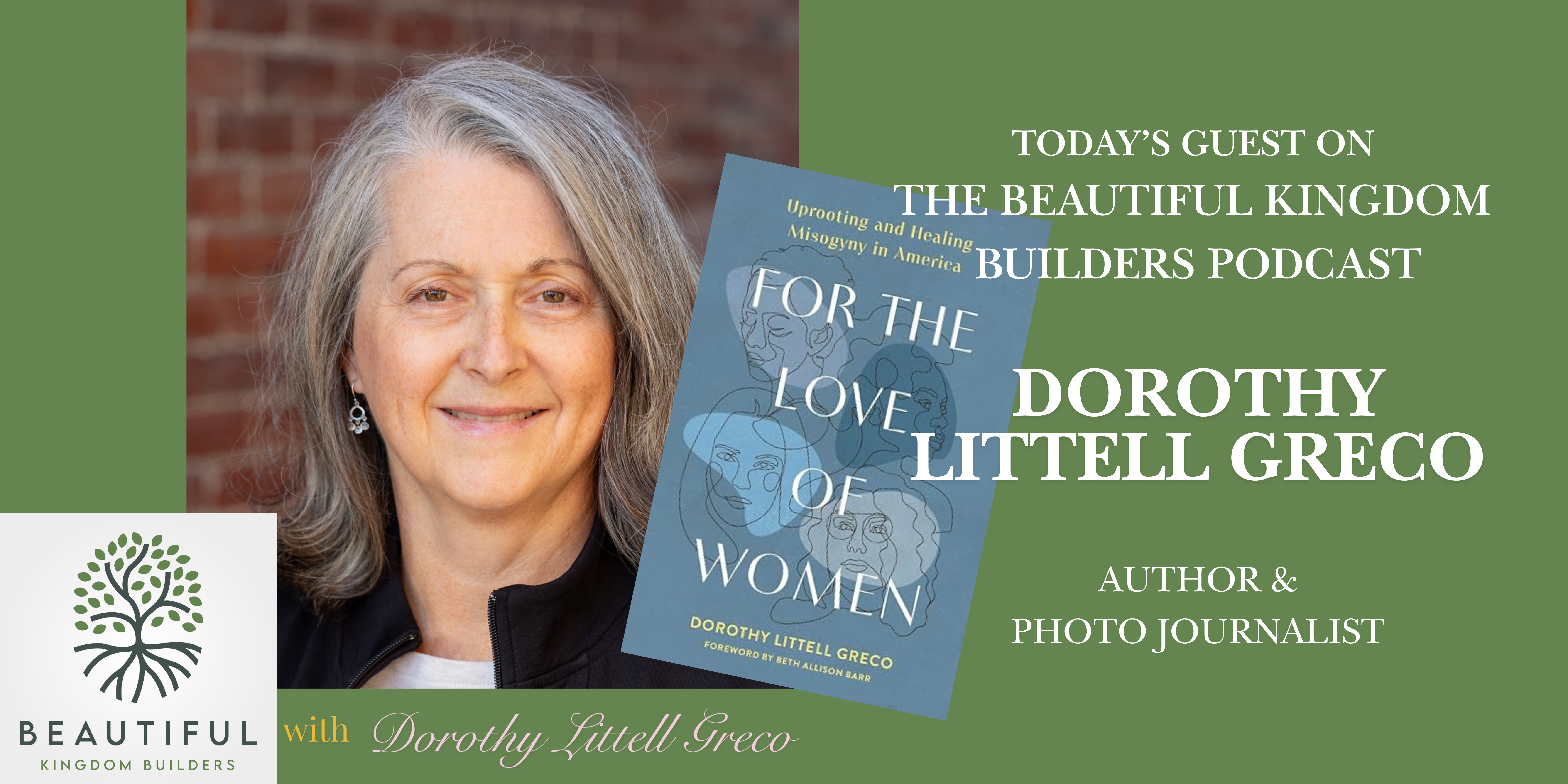
In this season opener, I am thrilled to share my conversation with Dorothy Littell Greco about her book ‘For the Love of Women,’ exploring misogyny’s systemic presence in society and the church. She shares personal stories, biblical perspectives, and practical steps towards healing and empowering women within Christian communities.
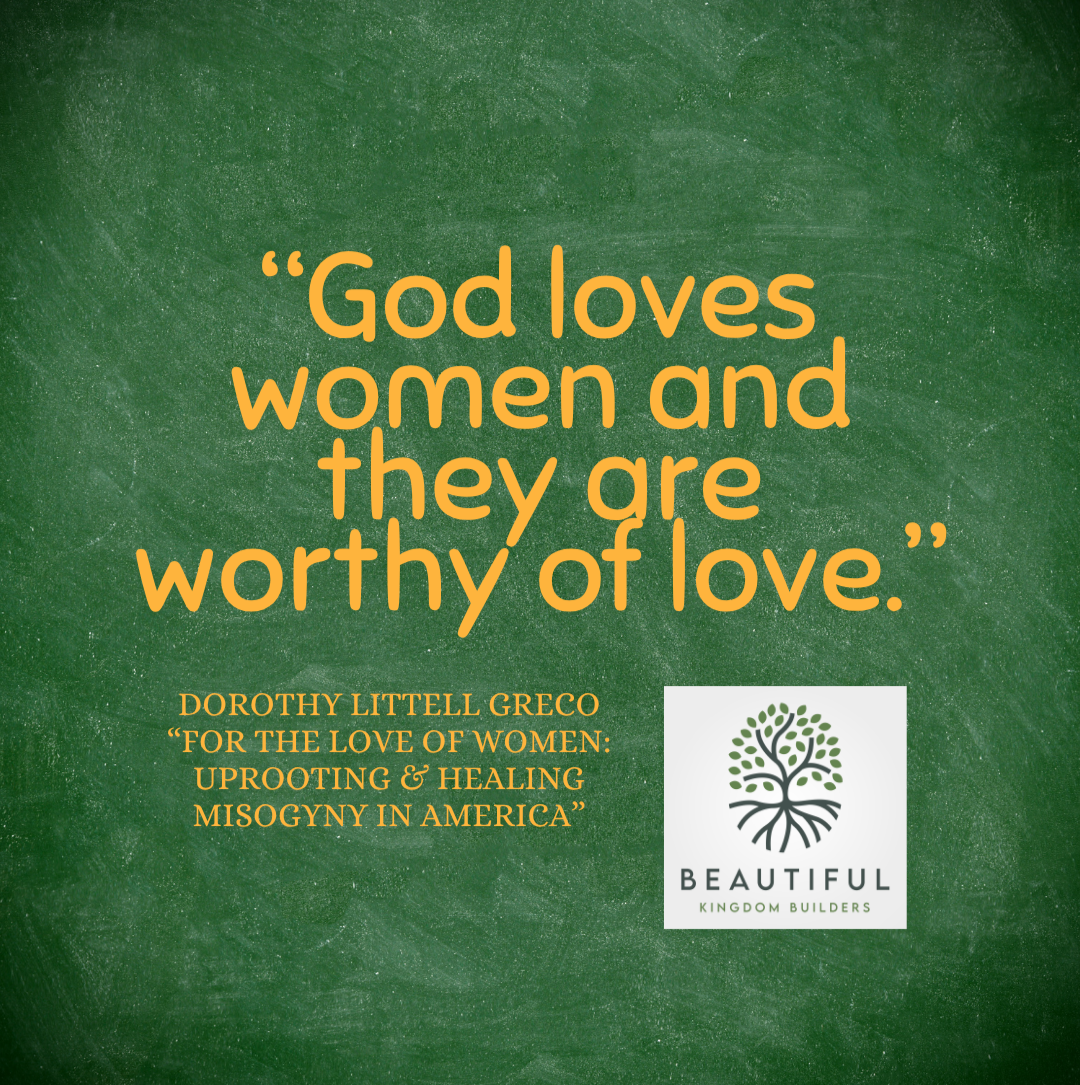
As Christians, we are called to love our neighbors as we love ourselves. Misogyny is ultimately a failure to love women. Addressing Christian misogyny is essential for faith communities.
You can learn more about Greco and her work on her website,
and follow her on Facebook and Instagram and Substack. Her book is essential reading
for anyone who purports to love women.
Please enjoy this episode of The Beautiful Kingdom Builders podcast on YouTube, Spotify, Apple Podcasts, Amazon Music, Substack, and more!
TRANSCRIPT:
Ruth Perry (00:15)
My guest today is Dorothy Littell Greco, who wrote the amazing book, For the Love of Women, Uprooting and Healing Misogyny in America, which I devoured. My copy looks like it’s been through the wringer because I was twisting it all sorts of ways so that I could write and take notes and I just loved
Dorothy Greco (00:32)
That’s great.
Ruth Perry (00:32)
it so much. It really spoke to me. I know that women who read it will really speak to them because we know this and I hope that men will take the time to read it as well and really engage with the subject matter because it really matters that Christians love our women and girls and care for them really well. And so just to start off, what compelled you to write this book and how has your own spiritual journey shaped the tone and vision of this book, Dorothy?
Dorothy Greco (00:58)
It does. Yeah, so I have, since the time that I can remember as a three to four year old little girl have not been sort of the typical feminine little girl. Like I wasn’t into Barbies. I wasn’t really into dress ups. I really loved to be off in the woods, exploring, investigating. I love sports. I started competitive sports when I was five, if you can believe that, and played Division 1 college field hockey all the way through all four years.
And then after graduation, I found myself in a very male-dominated field. I worked as a photojournalist primarily doing professional sports. So it was often me and maybe two or three other women sitting around the court of Boston Celtics while there were 20 or 30 men, or at football games or baseball games. So I had to figure out what does it mean to be a woman?
I was never sad or grieved that I was a woman, but…What does it mean to be a woman and to exist as a woman in a world that is dominated by so many men and often led poorly by those men? When I became a Christian in college, I think it was really disorienting to me because my initial time in church or parachurch organizations, they were more complementarian, meaning that there were very defined gender roles for men and for women.
And so here I was someone who felt a great deal of agency and autonomy and then was being told like actually you have to really get smaller and submit yourself to the men in your life. I, you know, there weren’t any men in my life at that time as a single woman. So I had to work out like how does the gospel really, what does it mean to me? What does it mean to be a woman? What does it mean to walk in my gifts?
So there was all that personal stuff. And then coming into the last probably 10 years in American culture, it just feels like there’s a misogyny epidemic. There’s so many examples of the ways that misogyny is playing out. Everything from the abuse of the American gymnasts by Dr. Larry Nasser to the women who have been abused within the Southern Baptist denomination. The ways that the current president is maligning women publicly, calling reporters piggies and I won’t say the word because I don’t know whether that’ll get us in trouble, but witches with a different first letter.
And I thought this can’t be what it’s supposed to be like. This can’t be what it’s supposed to be like, particularly for those of us who are following Jesus. So I felt like there was an invitation in a sense from God. It wasn’t like an audible invite with a here’s an RSVP, but there was a sense of the Lord drawing me in and saying, I think that you have something to say here and would you like to partner with me in writing this book because I think you could do it. So it really was just saying yes to that inspiration and that invitation and wanting to speak into the ways that I think that women are devalued and not loved, in the ways that I think that the Lord would have them be valued in love.
Ruth Perry (03:50)
Can you share what your definition of misogyny is that you start your book out with?
Dorothy Greco (03:55)
Yeah, I felt like I needed to stretch out the book definition and the definition that, you know, we can find in the dictionary is simply the hatred of women. And that feels way too narrow because it’s easy for men to say, well, I love my wife or I love my daughters. I love my mom. I love my sisters. Therefore, misogyny, this conversation about misogyny doesn’t apply to me and then just move on. And that just feels way too easy.
So I wanted to be able to define it in a way that stretches it out and makes us more aware of the systemic nature of misogyny because it’s not just an individual thing. There are systems that keep it in place. So this is how I define it in the book. Misogyny is a persistent, insidious belief that men’s ideas, wants, needs, and experiences are more important than women’s, and that legal, religious, and social systems, as well as intimate relationships, should uphold this principle. This belief system subsequently influences the laws, policies, practices, and ethos of a given culture.
Ruth Perry (04:50)
Yeah, that’s so good. And you emphasize that this isn’t just a women’s issue. That misogyny is also a men’s issue. Why should men care deeply about this?
Dorothy Greco (05:00)
Yeah, I think that they should care about it on several fronts. One is misogyny harms them too. You know, I’m the mom of three sons and there were so many times when we’re in a public setting or in a church religious setting and all of our kids were very emotionally attuned. Both my husband and I think of a pretty high emotional intelligence. So obviously that was important that we teach that to our kids. And there were situations where you know, our son would be crying about something that was legitimate. And somebody would say, stop crying, boys don’t cry.
So that kind of constraining of male emotions, in particular, vulnerable emotions, emotions that are around hurt or pain or sadness, really makes their emotional palette quite narrow. And oftentimes then the feelings come out as anger, like because that’s the only acceptable emotion in American culture for men, they can be angry and they can be really angry, but they can’t cry. So we think that there’s that component which really harms men. But also being in relationships where there’s equality rather than hierarchy is just better for everybody because if it’s a hierarchical relationship then the one on top always has to be exerting energy to control the person underneath of him.
While that clearly has some payoff, some benefits to it, in the long run, it’s exhausting. And there’s a lack of true intimacy that happens in those kind of relationships. So I think for those very personal reasons, men need to care about misogyny. And for those men for whom they would say that they are followers of Jesus, it’s pretty clear in scripture that they are called to love women and that they’re called to serve, they’re called to treat others with kindness and with dignity and with compassion. So there’s that, larger, I think, ask that scripture makes of us.
Ruth Perry (06:47)
Yeah, and I also think what happened at the fall was that we became disconnected from that intimate relationship that we had with God and with each other, and that we all do better when we all do better. I think our culture is so independent and individualistic that we can think that we can be an island of one. But we really do depend on each other and need each other and when we care for each other and we are all doing well, we all do better.
Dorothy Greco (07:15)
Yeah, the goal should be mutual flourishing, like organizing our lives, organizing the world, organizing our churches so that we’re paying attention and helping everyone to flourish rather than just the people at the top.
Ruth Perry (07:27)
How does misogyny intersect with power and nationalism and then the fear that we see in public discourse today?
Dorothy Greco (07:33)
Yeah, that’s a big topic and we could spend an entire hour just talking about that. Lots of people have written about that. I haven’t written a whole lot about it, but I do talk some of it, about some of it in the book. think in David Fitch has a great book, Reckoning with Power, and he talks about two kinds of power, worldly power and godly power. And the former, worldly power, is finite. It’s very prone to abuse. It’s exerted over top of others.
And godly power is infinite and it is never used to force or to coerce or to manipulate anyone. So if men are relying on worldly power, and it is mostly men, not only, but mostly men, are relying on worldly power to get what they want, to influence, to coerce, to control, to manipulate, to be in charge, there is a limited amount of that kind of power and they fear losing it.
And I think that’s why we see the fear flare up like what happened in Washington on January 6th. Those folks were afraid that they were going to lose their power, their connection to power. So they abused their power in an attempt to protect their status. In my opinion, nationalism is a lot about fear, fear and pride, like the sense that we are better than other people. White folks are better than other people.
So there’s a fear of losing the majority, a fear of not having the kind of privileges that they’ve had. And that obviously plays out within the church, it plays out within marriages, it plays out through misogynistic systems where one person is afraid that they will lose control and so then they double down to try to make sure that they can get what they want.
Ruth Perry (09:08)
Yeah, that really resonated with me when you talked about worldly power versus Godly power. So then you systematically break down and with great research show how misogyny is present in so many aspects of our life from healthcare to the workplace to government, media and entertainment, sexual relationships and in the church.
As I was reading that first chapter about healthcare, I mean, I could spend an hour just telling you different ways that I’ve experienced misogyny in healthcare. And most recently, in October, I was bit by a black widow spider three times. And I felt it bite me. I had red welts where it happened. And I went to my local doctor’s office and showed the bites and said, I was bitten by something. I didn’t see the spider, so I didn’t know what it was and she told me I was having a panic attack. It took my body nine days to get all that venom out and I was in excruciating pain. But she just saw a woman, and I told her I’m in excruciating pain, and she told me I was having a panic attack.
Dorothy Greco (10:06)
Wow, wow, I’m so sorry. I’m sorry to say that that is not uncommon. That kind of treatment is not uncommon.
Ruth Perry (10:10)
But I thought it was particularly important that we talk about how misogyny in healthcare especially affects women of color and poor women and marginalized women. Could you share some of that?
Dorothy Greco (10:21)
Yeah, the word that’s often used here is intersectionality. both misogyny and racism sort of overlap each other in this space. Women of color are often seen in our culture as less than, as not credible witnesses, even to their own lives and their own experiences. So when they come into the ER, for instance, they’re more likely to be ignored or mistreated.
And I could share multiple stories that friends have shared with me, women of color, but it’s not simply anecdotal. Like there are stats that back this up. And I’ll just share a couple: that the US has one of the highest maternal mortality rates among all industrialized wealthy nations. Three women die every day of causes that could be avoided just here in the US. That’s not worldwide, that’s just here. And the rate for black women is three times higher than for white women.
Black women are more likely to be refused pain medication when they need it because there’s this appalling myth that somehow they should be able to endure more pain than white women. Black women over the age of 55 are twice as likely as white women to develop diabetes and that’s a complicated issue, right? There’s genetics, there’s the ways that poverty factors in and there’s not as much good food oftentimes for folks of color.
But then there’s often the reality that they’ll go in with symptoms, just like you did when you had your spider bite, and say, this happened to me, this is a real thing, this is an experience that I’m having. And then the response is to dismiss them, to ignore them, to tell them they’re lying even. And as a result, if you don’t treat diabetes early on, the consequences are horrifying. Loss of limbs, and even loss of life.
So yeah, there’s just so many examples of how women of color within the healthcare system in the United States get even worse treatment than other women.
Ruth Perry (12:11)
I also thought it was pretty shocking how many more studies they do and research they do into erectile dysfunction versus PMS, which affects 90 % of women and just the horrible experiences of women with endometriosis. I know a lot of my personal friends have that and how painful that is.
Dorothy Greco (12:29)
Yes, and the fact that they haven’t prioritized funding to research that. Apparently it can take between eight to 10 years to get a proper diagnosis, and then there’s no protocol for how to treat it. How is that even possible that there are so many women who suffer from this, and yet it’s not bumped up high on the list as something that needs to be studied? Yeah, it’s tragic.
Ruth Perry (12:50)
One of the more vulnerable sections of the book was about sexuality and relationships. How has misogyny distorted the way that many Christians understand intimacy and consent and mutuality? And then what would a healthy mutual honoring relationship between a man and a woman look like in a Christian perspective that would differ from that experience?
Dorothy Greco (13:09)
I opened that chapter, which I think is chapter six, with a very vulnerable verbatim story from a young couple. And he, the husband, entered the marriage still struggling with pornography. Had made progress, but it was still an issue for him. And perhaps more significantly, having been taught that once he got married and was able to have sex with his wife, that he wouldn’t have a pornography addiction anymore.
And this led to a tremendous amount of pain for his wife in particular, and ultimately for him once he began to realize the cost of his entitlement, the cost of demanding sex whenever he had the anxiety that would promote him or that would push him towards pornography use, right? Because the woman is not the answer to the problem of a pornography or any addiction. Like that goes way deeper than being able to have a sexual release.
So the entitlement that’s often part of marriages where there is misogyny is so toxic. It’s that sense that the man is more important, that his needs are more important, that he has the right to expect sex, he has the right to expect his wife to do whatever it is that he feels like he needs in that moment. That includes a lack of consent.
This goes way back to ancient English law. think it was in the 1600s that there was something called coverture that was established and then it became part of the American legal system whereby when a woman said, do, she was giving up all her rights to say no to her husband’s sexual advances. And that’s part of why it wasn’t until I think the end of the 20th century, beginning of the 21st where intramarital rape was actually a crime in all 50 states. So it’s shocking to me that that took so long for the legal system to realize that no, wives can be raped by their husbands as well.
And all of that contradicts so clearly what the gospel is all about, right? Which is not to elevate men and to diminish women, but that we are all equal before the Lord, right? That’s what Galatians 3 is talking about.
And so in a marriage where both the wife and the husband are seeking to follow Jesus, they’re gonna endeavor to create a mutual relationship. Yes, sexually, but in all facets. They’ll be asking questions like, there anything I can do to help you to flourish? Is there anything else that you need from me so that you can really thrive as opposed to the husband being the only one who matters, like his dreams, his desires are elevated over the wife.
In a marriage where there is mutuality, there is a lack of hierarchy and a lack of control, which is just so much better for everybody involved, particularly the children. When they can see that kind of equality and that kind of respect that’s going back and forth between their mothers and their fathers, then they begin to have a healthy understanding of what a marriage looks like that is a place where people flourish and where they love each other deeply.
Ruth Perry (16:01)
Your chapter on the church may be especially painful for many readers. Why do you think can become deeply entrenched in Christian spaces?
Dorothy Greco (16:09)
Yeah, and I’ll just add that that chapter was the most painful chapter for me to write. I was alternating between tears and anger as I did research for that. There is a very long, I don’t even remember how many parts it was, five, six parts, the Houston Chronicle did on the abuse that happened within the Southern Baptists. And to read through that whole series was infuriating. Just the level and the depth of abuse and the cover-ups that happened were appalling. So it was a very, very difficult chapter for me to write.
And you know, it’s very complicated, it’s multifaceted, and if we’re honest, we can say that men and women working together to lead, to pastor, serving alongside someone who sees the world very differently than you do is more work, right? That requires more compromises, more listening, more slowing down, more empathy, more kindness.
And like one of the things that I was considering, think about parenting a two to three year old. I don’t know if you have any kids, but in that timeframe, I can remember we lived in New England, that there were times when we were getting ready to go outside in the snow. And it was excruciating for me, who tends to move quickly, to wait for them to put their own boots and coats and mittens and hat on. Like I wanted to just do it. I wanted to force them into it so that we could get outside more quickly.
And I think that that’s just like a picture of how we often look at the American church. Like we’re so driven by particular metrics and the metrics. are all connected to the size, how many people are sitting in the church, what is the collection, what’s happening with the collection, how many people raised their hand to get saved.
And those sort of things, I’m not saying that they’re unimportant, but if we rush into what it means to be a Christian, if we imagine that the only thing that matters is how many people come to church or how much money is being given, then we’re not necessarily focusing on what does it mean to mature? What does it mean to become Christ-like? What does it mean to really love each other like Paul wrote about in 1 Corinthians 13?
Like all those things should be every bit as important, if not more important than how big the church is getting. So there’s that. And then there’s also the church systems, denominations, individual pastors who function as if what the Bible is saying is that men are supposed to be the leaders and women are supposed to submit. And it’s all flattened out into that, you know, sort of sound bite.
Then, you know, the Mark Driscoll’s, the Joel Webbins, the Doug Wilsons, et cetera, who believe that women, their primary goal is to support their men and to have babies. Then that really reduces and shrinks what women’s lives are to be all about. And what about the single women?
You know, what about the women who are divorced or the women who have lost their husbands? Like there’s not even an option of how they’re supposed to live their life. And then layer on top of that, the fact that scripture does talk about dying to self and being sacrificial. So if you have a, if you have men who were entitled and then a system that’s both patriarchal and misogynistic, and then teaching that elevates being sacrificial and dying to yourself, I think it’s just a fertile environment for the abuse of women and children. And so women who don’t have confidence in their own understanding of scripture, women who were raised in a high authoritarian church culture and believe that it is their role to submit, then wow, I mean, that is just a total setup for an abusive system. And that’s what we’ve seen again and again and again.
Ruth Perry (19:46)
I’m reminded, I was just recently having coffee with a friend who’s a woman evangelist and someone that she knew sat down next to us but they didn’t know each other in church relationship and so my friend said she was an evangelist but she wasn’t a feminist. She wanted to clarify that she wasn’t a feminist. She felt like God called her to that but that’s not the kind of woman she was.
And then the woman that she was speaking with started talking about how much damage militant feminists have done, really turning off men towards wanting have equal rights with women. And she was saying, that’s why men were further behind. And I just interjected, but it is a problem that the most dangerous place for a woman is in her home.
Dorothy Greco (20:29)
Yeah.
Ruth Perry (20:29)
And she was like, well, I can’t even talk about that because I have personal experience, so don’t mention that, please. And I was like, where’s the disconnect where we’d be more angry about feminists than we would be about the abuse that occurs?
Dorothy Greco (20:41)
Right, right. And that is exactly how things played out like in the Southern Baptists, where when the women started to come forward and to say, this is what happened to us, they were vilified. I mean, the people who were the men who were the head of the Southern Baptists, the things that they said about those women, they called them demonic, they called them satanic, as opposed to being horrified about what happened to them, as opposed to saying, my gosh, I’m so terribly grieved that you had that experience in our church denomination. Like that wasn’t happening. And to me, that is really telling because that’s about entitlement, that’s about worldly power, that’s about men somehow believing that their sexual needs are greater than a woman’s autonomy and a woman’s right to an existence. Like it’s so warped from what the scripture really says.
Ruth Perry (21:33)
Yeah, it seems like once you see it, it’s hard to not see it, but it’s really hard to your brain around not seeing it. Although I was there myself, so I get it. What are some misogyny waste messages that women absorb when they’re in Christian spaces?
Dorothy Greco (21:47)
Mmm, there’s a lot. So where to start?
That you don’t belong here. I think that gets communicated both verbally and non-verbally. When it’s all male-led and there’s no seats at the table for any women, that’s a pretty clear communication. That your needs don’t matter, that your gifts don’t matter, that you don’t belong here, that in God’s created order, you’re not as important, you’re secondary, and that if you want to lead or if you have an opinion that’s different from your husband or from the male pastor that you’re in sin, like all of those kind of things are so wrong, but also they so mess with women, particularly those who have callings where they should be teaching and they should be preaching and they should be leading. Yeah, it’s very damaging.
Ruth Perry (22:39)
How have patriarchal church structures impacted not just women but men and then the broader body of Christ as well?
Dorothy Greco (22:46)
Well, I think the sense that when there’s so much control and there’s so much hierarchy and there is the message that women are less than, I think that that gives men a buy for growing up. It somehow allows them to feel like, I don’t have to do the hard work of maturing and the hard work of figuring out what does it mean to be a co-equal? How do I really listen to my wife or to my daughter or to my co-leader?
And pay attention to the experiences she’s had and the things that she wants to bring to the table. It’s much easier to just try to control someone, though in the end you will be exhausted and you won’t have the kind of intimacy that I think we were created for. Like I really believe that God wants us to be known. He wants us to be fully known by the people who are trustworthy in our lives. And so if men institute the system where they’re the ones who can call the shots and the women are less than,
And if that carries over into their marriage relationships, they’re going to lose out on what true intimacy really means. You know, the men who feel like they should have the right to be able to have sex whenever they want. I can pretty much guarantee you that at least most of those wives are not enjoying their sexual relationship with their husbands. And if they were willing to give up control and if they were willing to give up entitlement, and they cared about women’s experiences.
I think women would probably enjoy their sexual relationships more, which would benefit the man, but they’re not doing that work to get that far.
Ruth Perry (24:15)
I was also curious if you could distinguish the difference between honoring scripture and weaponizing scripture. Can you talk about how that happens on this issue?
Dorothy Greco (24:24)
Yeah, and I feel like I have to be really careful of this too. You know, anytime I have the opportunity to speak or to teach, I don’t want to use that platform as a bully pulpit. I don’t want to, you know, pluck out certain sections of scripture that support my argument or my beliefs and not pay attention to the other ones.
So for me, if we look at like the full arc of scripture from the beginning in Genesis all the way to the end in Revelation, what it’s talking about is redemption. What it’s talking about is reconciliation. What it’s talking about is us really being able to love again in the way that Paul wrote about in 1 Corinthians 13. That’s what it’s all about. That’s what we’re being called to. We’re not being called to hierarchies. We’re not being called to racism. We’re not being called to Christian nationalism. We’re being called to love passionately, sacrificially in a way that is actually quite difficult.
So whenever I have conflicts with somebody about what scripture is saying, it feels really important to me to be able to be mindful of the whole. Like not just this one particular passage, but what is the whole, what is the redemptive hermeneutic of the entire scripture? And how can I apply that to whatever conversation happening? So when I consider the words of Joel Webbon or Mark Driscoll, those sort of men who I do believe weaponized scripture. I do believe that the folks in the 1800s, the American Christians who were using the scripture to defend racism, I think they were weaponizing scripture. They were taking it out of context. We know that slave owners cut sections of the scripture out so that their slaves would not have any understanding of the ways that the Bible really does speak of freedom.
It speaks of not of slavery, but of freedom and of equality. So I really don’t think that if somebody is serious about their faith, that they can use the Bible to say women are less than, women are not equal to men, or people of color are less than white folks. Like that is weaponizing scripture. And I think they’re gonna have to answer to the Lord for those choices that they’ve made.
Ruth Perry (26:30)
Amen, absolutely. If the church truly embraced the gifts and leadership and wisdom and voices of women, how do you think that it would change our witness in the world?
Dorothy Greco (26:39)
I think we’d be a lot more believable. Yeah, so my husband and I happen to be in relationship with a fair number of people who would not consider themselves to be Christians. And when we’ve had conversations about why my husband and I are, their main complaint is like, if Christianity was real, then more people would act like Christians, to which we would say, yeah, we feel the same way. So I think it’s when people take the scripture seriously, take Jesus’ call seriously, take it seriously to really be changed people, to be transformed people, to be transformed into the image of Christ. That’s when the gospel gains traction in the world.
It’s not simply the talk, it’s not simply what kind of worship you have on Sunday morning, it’s how radically are you loving people. Our little church is very connected to the local government’s foster care system. So we have an unusually high number of families who foster in our church. And to me, I don’t think I could ever do that. I don’t. I have too many control issues and not enough empathy at this point in my life. Cause it is hard.
Like we have walked with these folks and to say that is really hard work, but that’s just one of the ways that they’re seeing. I have this capacity. We have space in our house. I have space in my heart. I see that the Lord cares about these children, so what can we do? And those kind of witnesses to the truth of the gospel, to me, are very impactful.
Ruth Perry (28:09)
Well, what I really appreciate about your book is that you don’t stop at just naming the problem. You also talk about healing. What does healing from misogyny actually look like for individuals and for communities?
Dorothy Greco (28:21)
Yeah, first I think it is individual in terms of what we as women have to deal with, have to walk through if we have been harmed by misogyny. And most of us have, and there’s a spectrum from those who have been raped or repeatedly faced abuse within the context of their marriage versus other women who maybe have just had a boss who was verbally abusive or have been catcalled as they’re walking down the street.
But I think first we have to name it. We have to be willing to say this happened and then to call it for what it is rather than dismissing it or rather than simply saying, you know, that happened a long time ago, so it’s not a factor for me. As they do research, you know, we’re learning how much our bodies carry the traumas in them. It may have happened a long time ago, but our bodies still remember and our bodies know what happened to us and they carry it until we’re able to process it and it’s not move beyond it, but move through it, I guess is the best way to talk about it.
So first is reckoning with what happened, talking about what happened with trusted people, whether that’s a professional therapist or friends who have been through the similar situations who can really listen and who can be empathetic witnesses. It’s grieving. There’s a lot of grief involved. When I was writing this book, I did a lot of grieving both for myself and the ways that I’ve suffered from misogyny, but corporately as a whole, the way women have been so deeply, deeply wounded by misogyny. Paying attention to our anger.
For women in the church settings in particular, people don’t like it when we get angry. We are silenced and shushed and criticize when we express anger, but anger is really important to this process. We have to really understand what is the anger trying to teach us. So I think that that’s an important component for healing and then being willing to move towards forgiveness and that is a very organic process for each one of us.
And I don’t think it’s ever one and done. I really believe that the seven times 70 that Jesus talked about is true for all of us, that we forgive, we make the conscious choice to forgive, but then there are so many different layers that come up as we’re triggered or as we remember things that happened. And we have to then just revisit and say, okay, I guess that I have more work to do here.
And then for men, for those of us have perpetuated misogyny, it’s different for them. I think it’s really important that they acknowledge the ways that they have harmed women. And I think that that acknowledgement should be both to the woman, if it’s an individual woman, and also corporate. I really would like to see more pastors from the front saying, I have been thinking about the ways that we as a church have been maybe a little bit misogynistic and here I’m gonna name them and I want to take responsibility for that. That would really go a long way, I think, for women to feel seen and heard and for the experiences that they’ve had to be named because so often it’s denied and we then have to just think like, did that really happen? Is that what happened in that situation? But when somebody can name it and own it, I think that that really is very useful to us.
And then men being willing to say, I am going to do whatever it takes to make sure that the women in my congregation are thriving. And I want to have a conversation. I’m going to invite you women to come and have lunch with me after church for the next four weeks. And I want to hear what you have to say about the ways that you have been shut down or the ways that you have not been invited in. I’ve been going to church for 45 years and nobody has ever done that, ever, and I would love to see it. All you pastors out there, I’d love to see that.
Ruth Perry (31:59)
I think it was 12 years ago my husband and I went through a church planting assessment with Converge. And I was the only female candidate. Everyone else there was just the male was going to be the pastor and then the wife was there to support. And
Converge at the time was, you know, women could be pastors too, but they were partnering with Acts 29. And so the experience of that weekend was like, I’m the odd duck around here.
And I remember them asking me if women using their gifts in ministry was a hill that I wanted to die on. And I said no at the time. It wasn’t. That was 12 years ago. But as I’ve experienced these obstacles in me fulfilling my calling, I’ve come to realize that it absolutely is abuse when you don’t let women use their gifts, and be who they are and who God made them to be. If you’re trying to stuff them into boxes that fit your norms for your community and that’s all they can be, that is abuse as well, I believe.
Dorothy Greco (32:55)
Yes, and it can lead to religious trauma.
Ruth Perry (32:58)
Yeah, yeah. I did get some EMDR therapy recently and I realized I have religious trauma. It hadn’t occurred to me, but it was really helpful to go through that therapy.
Dorothy Greco (33:08)
Yeah, yeah, I did some EMDR last summer too as I was writing the book because there were so many things coming up for me.
Ruth Perry (33:15)
For women who have experienced harm and trauma in the church because of misogyny, what would you want them to hear the most?
Dorothy Greco (33:21)
Hmm. I think that healing is possible. It’s totally a journey and it’s gonna take work, but healing is possible and Maybe more importantly that God loves women like I believe that with all of my heart that the Lord loves women I think when we look at the ways that Jesus treated women the ways he listened to women the way he respected women the way he invited women in. The ways that he healed women. I can’t come to any other conclusion other than the fact that you know he was portraying God’s heart to women. And I really believe that if the church and if the culture treated women in those ways, that there would be just an incredible amount of healing and an incredible amount of joy that we could experience as a culture if that was in fact how we were treating women.
Ruth Perry (34:10)
How can women begin reclaiming their voices and gifts after years of being told to stay small?
Dorothy Greco (34:15)
Yeah, that’s hard work, isn’t it?
Ruth Perry (34:17)
Yeah.
Dorothy Greco (34:17)
I think that that is part of the healing journey and then being willing to start to take risks, you know, to start to push back. I think a number of years ago when our senior pastor was preaching a sermon about David and the way he phrased it was that David and Bathsheba’s affair. And I remember just in that moment thinking like, whoa, that was not an affair. An affair is consensual, an affair is mutual. And so rather than just sit on those feelings, you know, I had a conversation with him. Didn’t do it right after the sermon, because I understand how vulnerable people are when they preach, but waited a couple days and then just wrote a very thoughtful email to say, here’s some research, here’s some things that I’ve learned over the years, and I don’t think it’s really fair to call it an affair. I think that it was rape. It seems pretty clear to me that it was rape.
So taking, like finding the courage in those moments, to do just little pushbacks I think makes a difference. It gives us a sense of empowerment and voice, which is not to say that all of those conversations will go well or will be heard. But then really I think reckoning with am I in a space that is going to allow me to thrive and to flourish? And if not, is it time to think about finding a different church? Obviously that’s a much more complicated question when it’s marriage, right?
But for some women that is the story that if their partner is unwilling to listen, he’s unwilling to hear, if he’s unwilling to value, if there’s ongoing abuse, then I think that that is a question that’s worth asking is do I need to leave in order to be able to speak and in order to be able to find my voice. think Tia Leving’s book, The Well-Trained Wife and her new book as well, which is I Belong to Me, I haven’t finished that one yet, but she talks a lot about what what it’s like as a woman who is clearly super smart, very articulate, to be in a system that routinely shut her down, that routinely said she had no right to speak. And so both of her books talk about what it’s been like for her to find her voice and to journey out of those oppressive systems.
Ruth Perry (36:20)
Let me just ask a couple more questions before we close. What does the phrase, For the love of women, mean to you now, after writing and discussing this book with readers?
Dorothy Greco (36:28)
Yeah, originally the title was Love the Women. And then as we were working on both title and subtitle, was about a year and a half ago now, my main editor, Kyle, said, you know, I think that a more invitational title is for the love of women.
And I agreed with them. I thought yes, you’re right. I think that that that is a better title So I think when we consider what are the things that need to happen in order for women to feel valued respected loved in order to thrive I think it it really is about for the love of women like what can we do for the love of women? How can we change systems and cultures and churches for the love of women? So it is an invitation and I think that
This is only going to change if a lot of people are willing to come alongside of those who have these feelings and who have the level of conviction so that we can move forward. When you think back to the ways that racism had one of its falls, certainly it’s still there and we’re seeing that a lot within the Christian nationalist movement.
There was some real clear movement that happened in the 1960s. And I think that there was just like a groundswell of people who said enough, like I am just so tired of seeing this, of experiencing this. And then that collaborative effort, and there was a lot of prayer. I mean, there was a lot of prayer that happened during that time. So it has to come through a desire for transformation, both personally and corporately and there has to be a sense of it’s time. It’s time for us as a culture to stop oppressing women and to figure out what it looks like to really love them so that they can thrive and flourish.
Ruth Perry (38:13)
Yeah, I just think that’s such a profound and simple thing. But as Christians, we’re called to love God and love our neighbor as ourselves. And are you truly loving someone if you’re controlling them and dominating them and having expectations for them? Yeah. And then I think of all the one another commands throughout the New Testament. If we applied that to our relationships with women in the church, would we treat them the way that we’re treating them now?
Dorothy Greco (38:37)
Right? Right?
Ruth Perry (38:38)
If readers walk away remembering only one thing from this book, what do you hope that it is?
Dorothy Greco (38:43)
I think it just goes back to that last question is that God loves them and they are worthy of being loved. There is nothing faulty about them because they’re women. We have gotten that message again and again and again that we’re less than, that we should be smaller, that we should be quiet, that we shouldn’t get in the way. And I don’t think that that’s truthful. think honestly, if I’m really being honest, I would say that’s a lie from the pit of hell.
That’s exactly what the enemy would want. The enemy would want us to make women subservient, to make them less than, to keep them down because if women are fully themselves and fully thriving, watch out.
Ruth Perry (39:20)
Well, thank you so much. Your book is For the Love of Women by Dorothy Littell Greco. Your website is DorothyGreco.com, and where else can people find you?
Dorothy Greco (39:29)
Yeah, so Substack is a great place and I’m under What’s Faith Got to do With It. I don’t post a ton, like maybe twice a month, but really solid articles in there, sometimes excerpts, and then I’m also on Instagram.
Ruth Perry (39:43)
You have two marriage books as well, right?
Dorothy Greco (39:45)
Yeah. The first one is Making Marriage Beautiful and that was published in 2017 by David C. Cook and then Marriage in the Middle, which is really about marriage in the years of between like 40 to 70 in terms of our age, not the number of years married. And that one, I really love that book. There’s nothing like it out there. It really talks very honestly about the challenges that we face in midlife as we’re married.
Ruth Perry (40:09)
Well, I’m 45 so I’m gonna pick it up. Thank you so much for being here today talking with me, Dorothy. Let me give you the last word before we sign off.
Dorothy Greco (40:18)
Yeah, just am appreciative that you care about this and my hope is that more and more people will read the book and will share it with other folks and the conversations will snowball so that we can really make some progress on figuring out what it looks like to love women.
Ruth Perry (40:33)
It’s a really amazing book. I highly recommend it. Thank you so much. God bless.
Dorothy Greco (40:37)
Thank you.
Did you enjoy this episode? Please subscribe, rate or review us on YouTube, Spotify, Apple Podcasts, Amazon Music, Substack, and more! Your support means the world. God bless!


