Author Archives: Ruth Perry

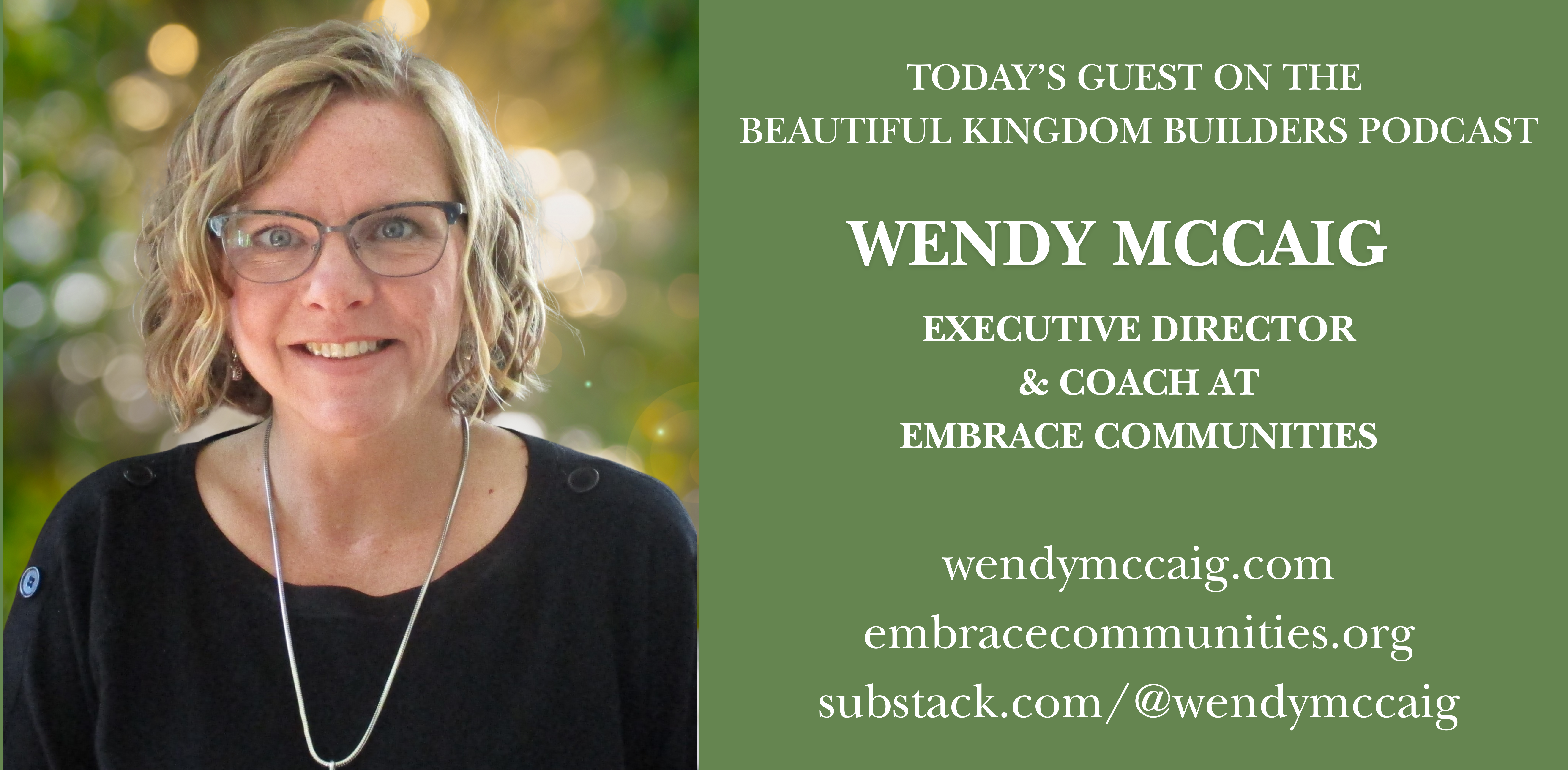
014 I Wendy McCaig on Embracing Community Development

Wendy McCaig is the founder and Executive Director of Embrace Communities, a nonprofit dedicated to strengthening neighborhoods through community development. She has her M.Div from Baptist Theological Seminary in Richmond, VA. In 2009, Wendy was trained in Asset Based Community Development (ABCD) and in 2021 was invited to become a steward (faculty) for the ABCD Institute.  She is the author of From the Sanctuary to the Streets and Power Shift: A Field Guide for Community Cultivators Everywhere which serves as the core curriculum for Embrace Communities’ ABCD training. 

Wendy has spent decades cultivating strong communities – initially within faith communities, then across Metro Richmond, and now through a global network. Since 2012, Wendy has been coaching and training institutions in how to strengthen communities from the inside out using ABCD. Wendy recently moved to my area in rural Virginia and I am excited to see how God uses her to catalyze my community into greater belonging and purpose together!

In this conversation, we dive deep into the inspiring journey of Wendy, from her infertility bargain with God to her path to ministry, and her unique experiences in ministry as a community developer. She describes the transformative power of building relationships in community work and emphasizes the need for churches to empower communities, release and support dreamers, and recognize hidden assets, as those closest to the problems are also closest to the solutions. And Wendy highlights the significance of spiritual disciplines in sustaining long-term commitment to justice and reconciliation work.

In an age of church decline and stark divisions, Wendy offers an important message about being the Kingdom of God outside of the walls of our sanctuaries, bringing salt and light to our neighbors and asking what our church can do to strengthen our communities. You can subscribe to Wendy on Substack to keep in touch with her apostolic vision for ministry today.

You can listen to our conversation on The Beautiful Kingdom Builders Podcast on YouTubeSpotifyApple PodcastsAmazon MusicSubstack, and more! If you find our conversation helpful, please share it with a friend, rate and review, and subscribe so you never miss an episode! I started a Pinterest Board as well, where I am putting any books that are mentioned on the podcast. Check that out here.

TRANSCRIPT:

Ruth Perry (00:15)
My guest today is Wendy McCaig, the founder and executive director of Embrace Communities, a faith-based nonprofit that strengthens low-income neighborhoods through an asset-based community development approach, which I’m excited to talk about today. Wendy holds a Master’s of Divinity from Baptist Theological Seminary in Richmond. And she is a prolific writer. She has a book called From the Sanctuary to the Streets, How the Dreams of One City’s Homeless Sparked a Faith Revolution. And she’s got writing on her website, wendymccaig.com. Thank you so much, Wendy, for being here today.

Wendy McCaig (00:50)
It’s great to be here.

Ruth Perry (00:52)
Before we talk about your ministry and your work, could you take us back and tell us about your faith background and the journey that you’ve had with Christ and how you found your spiritual giftings in your calling?

Wendy McCaig (01:04)
Actually your previous guest, Kathy Escobar and as I was listening to her journey, it mirrors mine a lot. I did not grow up in the church, but I was born and raised in a small town in central Texas, and it’s really hard to stay unchurched in the Bible Belt, but I managed to do it until I was in my late 20s. And I endured multiple miscarriages in my young adult years and that launched me on a journey.

My grandmother was a woman of faith and as I was grieving she said, well have you thought about praying about it? I always dismissed grandma, sorry grandma, but now it’s just like sure sure, but you know when you reach the bottom and nothing in your own power is seemingly helpful. I reached that place and just prayed a very, very simple prayer, and it was kind of like a bargain, like, okay, God, if you give me a baby, I will dedicate my life to you. Right?

And somehow even that twisted, manipulative way in which I was praying, God honored, and, the baby I was carrying, they had, determined that it was a non-viable pregnancy, but when we went in to go through the procedure, they found a heartbeat. So my eldest is a miracle, an absolute miracle.

And it was such a miraculous thing to have happen that I decided to honor my end of the equation and I had been drugged to church with a few friends, you know, through the years, but I had never committed to being a part of a faith community. And at that point I did. And I joined a ELCA Lutheran church in our little community and I started getting involved.

And I’d never owned a Bible, and I started going to everything. I went to Bible study, and they were people who’d been in the church their whole life. And so when the leader would say, turn to Leviticus, my heart would stop. I’m like, what is that? I had no idea. So I went to the pastor and I was like, look, you guys are all really nice and everything, but I have no idea what you were talking about. And they knew when to stand up and when to sit down and what words to say. And it was overwhelming to me.

And he said, well, what you really need is a small group. And this was in the early 90s. And I was like, what is that? And he was like, well, it’s a great place to really deepen your faith. And so he hosted this meeting and he invited the whole church to come and talk about this whole new idea of small groups. And he did this great pitch, if you want to grow, this is the way to do it. And I’m like, woo hoo, I’m so excited. Can’t wait to join this small group, right?

So then he gets to the end and he was like, okay, now who here is willing to lead this? And it was crickets. And I sat there and my heart just fell to the floor. I’m like, I guess I’ll never grow. I guess I’ll never have this chance. And then there’s this like stupid idea in my head. And before I knew it, like my hand was doing this. And here I am, the only person sitting in the room who’s never studied the Bible, had just gotten a brand new one from the pastor, didn’t know her way around anything. And all of a sudden I’m leading the first small group.

And the pastor looked out and he was like, Thanks, Wendy. I could tell he was like, you are not what I was fishing for. He turned to this other couple and he was like, Candy and Randy, y’all have been in the church a really long time. Would you help Wendy? that’s how I became a small group coordinator. I started the first small group. I absolutely loved it. I loved the interaction. I loved asking questions. I loved digging into stuff and things you can’t do in worship. It fed my soul and then Pastor Kerry was our pastor and he was like, Wendy, you’re really good at this.

I had been working as an auditor. That’s my training. I have a degree in accounting, but I really wanted to stay home with my baby. And so I quit my job in corporate America, went to work for a church, working 10 hours a week, making $10 an hour and was never happier. It was a huge leap of faith. And so I became their first small group coordinator and that’s my entry into ministry was through small group ministry.

From there we moved from Katy, Texas up to the Woodlands and I got involved in church leadership at that time. Now we’re talking like mid-90s, the whole like seeker movement had just really taken off and my pastor at the time invited me to go to Willow Creek and I read everything from The Purpose-Driven Church, The Purpose-Driven Life, I was gobbling up all of this kind of seeker movement because that was me, right?

Like I felt so weird in this liturgical church with no background and I wanted people to experience the depth without having to have the history of knowing when to do everything. So my father passed away. My father died by suicide. So that was definitely a turning moment for me. And for a season, I just wanted to disappear.

I was really active in the church at the time, but I just needed a space to heal. And so we found ourselves in a seeker church that went from 800 to 8,000 in the few years that we were there. And I could disappear. I mean, it’s pretty easy to disappear in a room of 800 to 8,000 people. But over time, I did get more involved in church leadership, started doing children’s ministry and all kinds of stuff. And that church was non-denominational, but if you scratched the surface you would discover Baptist. I didn’t understand really the difference until I was told as a woman I could never be called a pastor and that I better make sure that nobody confused me for one. And that was devastating because in corporate America, I never encountered that level of sexism and I didn’t grow up in the church. So this was really mind-blowing to me.

My husband used to work for Enron; that didn’t go so well. So we ended up in Virginia and that gave me an opportunity to go seminary because we’re in Richmond there was seminary I went to a Cooperative Baptist seminary and I discovered not all Baptists are created the same and really loved my seminary journey and that led me into the missional church movement. During that time period the missional church, Shane Claiborne’s book had just come out and it was really exciting time for me and I started volunteering with individuals experiencing homelessness.

That led me into the field of community development. I started the largest furniture bank on the Eastern Seaboard. I was involved in churches. It was just a lot of missional style work. And that led me to asset-based community development. And I started coaching and training churches in ABCD, doing inner city ministry, working in neighborhoods and did that for a decade or so.

But what I saw was congregations independently really were not sustaining the development efforts and often the inside out way of doing ABCD, which hopefully we’ll dive more into what that is really hard. It’s really, really, really hard for churches to get this mindset shift.

We were primarily training churches, then started training multi-sector groups, and I now coach and train folks who are doing this across the globe. And so my primary role is as a network weaver. So I work with grassroots community connectors, community cultivators, working in schools, working in neighborhoods, working in different affinity groups, cultivating community is my primary thing. I know when you read the intro you mentioned working in the inner city not not really I work everywhere and the principles of ABCD are applicable to any type of community.

So that’s kind of my journey from inside the walls to outside the walls to across large swaths of community.

Ruth Perry (09:12)
Yeah, I’m really delighted to have met you. You moved to my little rural area now, and I’m excited to see what the Lord does through you here. And your whole testimony is so moving and exciting. Your enthusiasm is beautiful. And I think that your coming to the church, being unchurched, definitely lends you to just naturally be more missional, I think, than those of us who grew up in the church who are just kind of stuck in our traditions and this is the way you do it and this is the way we’ve always done it. So coming with fresh eyes is probably a real gift that you bring to the church and to ministry.

Wendy McCaig (09:42)
I think it is in some ways helpful. I think it sometimes, you know, kind of a disconnect between those who think about the goal of the church as to grow the church. And I have always kind of looked at the role of the church is to strengthen the community and be kind of that salt and light in the world. And I understand that for many people, the church is their refuge. It’s a place of healing that’s very personal and meaningful and knocking down those walls or erasing the lines between the ones on the inside and the outside.

It’s not for everybody. It’s that apostolic calling, you know, that deep commitment to love of neighbor balanced with the love of, you know, loving God at the same time. That’s really not as easy as I naively thought it was going to be. When I read Toxic Charity, was like, woohoo! Everybody’s going to get this. Everybody’s going to embrace this. No, it’s not. And we keep snapping back to those old ways of doing things without ever really thinking about why and how we got to where we are, where we’re going and what the world looks like today.

Ruth Perry (11:12)
Yeah. This sounds like your language of living between two worlds. When you had suburban church life on one hand and then the realities of the inner city right there and your heart for that. What did standing on that bridge teach you about the gospel?

Wendy McCaig (11:14)
It’s a gift that sometimes feels like a curse. Yeah, when I think about it, you know, so much of my journey has been a kind of an expanding of seeing bigger thinking about that one side not just specifically, kind of the suburban church or the affluent church and those on the margins, which was kind of probably the way I described it in the early days. It’s more about those that see themselves as part of a dominant culture, a dominant narrative and everyone else. And in our current times, the everyone else category seems to be getting larger.

And those lines are getting so much firmer or they feel so much sharper to me and especially in parts of the Christian tradition right now that are leaning into these more exclusive definitions of who’s in and who’s out. And so that standing on the bridge, I feel I’ve always felt called to the middle of the bridge to try to bring people together in conversation. Like when I write, one of my principles is to write to unite. But increasingly that is hard to do. And I get criticism from those on both sides of the bridge.

Because a lot of people right now think the center of the bridge has collapsed and if they head toward it they’re going to fall into a chasm and we have this binary thinking right now that you’re either this or that and we can’t hold those tensions in a way that reestablishes the connection that bridge connection and it’s extremely challenging right now and for me personally.

When I was in Richmond, I lived in a community where I felt like my values were kind of the same as my neighbors, especially when I lived in an urban community. I don’t know that that’s, I think probably that’s true for the majority of my neighbors, I just visually get cues that it’s not, like the Confederate flags that fly all around us. It makes me wonder what narratives are playing out in my new community. And I’m so new that I don’t understand. And so I have to enter curious and willing to learn instead of ascribing my meaning, and then I blow up the bridge and I kind of get my own way. So I’m trying not to do that, but it’s challenging. It’s a really different culture. I grew up in small town Texas. So it’s really, I just have to remember my roots and that there’s good people everywhere. I haven’t found a whole lot behind Confederate flags, but I haven’t looked.

Ruth Perry (14:10)
Yeah. In your work, you also suggest that the richest expression of Christian faith often happens outside of Sunday worship. What does that look like,

Wendy McCaig (14:20)
So when we first started, I started working with individuals experiencing homelessness. I had a women’s ministry that I had started in Woodlake, which is an affluent middle-class community. And we had 70 women in seven small groups that were all gathering. And I started asking them, if you could do anything to change the world, what would you do? And the number one thing I heard was people saying, we have so much out here in the suburbs, but our neighbors in the city don’t. And so I had a chance encounter with a woman who was experiencing homelessness. She and I became friends. We started what became the largest furniture bank on the Eastern seaboard.

At the time we were gathering once a month, we would collect stuff in my garage. I would haul it and pick up trucks, me and my neighbors, down to this abandoned United Methodist Church in the middle of city. We would throw it all on the yard. We’d pray over it that it’d find a home. And we started networking with homeless shelters. So as people were exiting the shelter, they would come, they’re giant free yard sale and take what they needed.

We started inviting, started practicing this hospitality. Every person who came to receive assistance, I asked them, would you come back and help the next family in need? And about 20, 25 % did. And what I watched was those suburban neighbors who came to the city next my new friends from the city who were coming out of unsheltered status became friends.

And so we would sit around and eat fried chicken and pray for each other. And it was the most beautiful expression of what I imagined the kingdom could look like. Because in that act of serving together, everyone’s gifts counted. There was no giver, no receiver in that team. We were one. And what we learned about each other and each other’s journeys, most of us were moms.

And so we had this deep connection. Our kids would run around this old abandoned church. My daughter has so many memories of playing with kids and I mean, we were family and that was my first taste of it. And I was hooked from then on out. I was like, this is real church for me, for someone like myself.

After that I started working in a community called Hillside Court. So it’s a public housing complex. And what we saw was those that were coming through the experience of housing, a significant percentage at that time were losing their housing. And so they were coming back through to receive. And what we realized is that those individuals who were serving with us, when they went into housing, they had a family, they had us, if something went wrong, and let’s say they had an unexpected bill, medical bill or the car broke down or whatever. We were able with very low funds to keep people in housing.

And so we realized the stuff is nice, right? But it wasn’t changing the outcome. What was changing the outcome was people in relationship, authentic, deep relationship. So I spun the furniture bank off to Caritas, the largest homeless services provider in Richmond. And I started doing community development work in Hillside Court.

And it was remarkable. I mean, we just asking the community members if you could do anything to strengthen this community, what would you do? And the number one thing we heard was keep the children safe. Okay, what would you do to keep the children safe? Because there was gun violence, significant gun violence, people literally being gunned down in the street and then two teenagers were shot. And it was like, reached the point where the community had to do something.

And Lindsay Gulletly and Patrice Shelton, they said, if we could do anything, we would provide activities for young people. And so that launched a new community development effort around Keep the Kids Safe. And we had 10 resident-led initiatives that emerged over the next five years. And it became that same experience.

Once a month, we had Fellowship Day. We had church groups bring in the meat, like fried chicken or whatever it was and all the residents would cook. It was a big, giant, community-wide potluck dinner with hundreds of people. And we would baptize people with t-shirts if they volunteered. And so my understanding, if Jesus were here right now, what would this look like? You know, when Jesus is with people, He’s in their life, He’s in their world.

It’s not like, okay, today we’re going to feed the 5,000 come to the temple, we’re going to do it at the temple. You know, like that’s not what I see. It’s, it’s doing life where people are joining in where people are. And then inviting people to be a part of the solution. If you have some fish and some lows, let’s see what we can do with it. You know, it’s just that willingness to use what’s already there.

So Brooklyn Park was the next community I went to. I moved into that historically black community with a rich, rich history. Same thing happened. Moved from Brooklyn Park out here to middle of nowhere Virginia. And I would say it’s still a little early, but finding you and Kay and all of the folks in my backyard that care about this kind of thing. Stay tuned. I have no idea what will happen. And that’s what’s so fun. It’s a fun, fun thing to watch. When everybody gives what they have to achieve their wildest dreams for their community, cool stuff happens.

Ruth Perry (19:38)
Especially when you got a cool catalyzer like yourself that comes in and gets people together and gets them thinking. Can you explain what the asset-based community development approach is? What does that mean?

Wendy McCaig (19:51)
Yeah, so asset-based community development was developed by John McKnight and Jody Kretzman, and it actually got its naming more in academia. So they traveled across the country. They interviewed like 3000 communities about what made them strong and they identified six assets.

And so the official definition of ABCD is that ABCD considers the local assets as the primary building blocks for sustainable community, building on the skills, talents of the residents, and the power of local groups, supportive functions of associations. The way I like to think about it is simpler. Everyone has a gift. Everyone has a dream. If you discover the shared dream, people will invest their gift and bring that dream to life.

And so that’s pretty much the process is this discovery process that you go to. And ABCD is simply a tool for that. It’s a way of seeing the world. And when I wrote Power Shift, which is my second book that we use as the curriculum for my training, I wanted to kind of make it really easy to remember. So I love organic metaphors. So imagine you’re growing a tree, you know, that tree, what kind of tree you can grow depends on what kind of soil you have. And that soil is made up of particles of this bedrock of those rocks underneath. And so I really wanted to zoom in on four bedrock principles of ABCD.

And those bedrock principles are asset-based lenses, like how are we looking at the world? And I think Philippians 4.8 is the most helpful, that we are focusing on what is true, what is noble, what is right, what is pure, what is lovely, what is admirable, that’s asset-based lenses. So if we get in a room, and all we want to talk about is what we don’t have. We want to talk about how we need more children in the church and we need more tithers and we need more and we need more. All that does is suck the life out of the room. You can’t build on broken.

You’ve got to figure out what do you have? What are those building blocks? So asset-based lenses helps you see the world for what’s already there. And the role of a pastor in helping the church see its abundance is one of the greatest transformational practices.

The second is around hospitality. So the second bedrock principle is bond-building relationships. We have a lot of service providers that say that they’re building relationship, but they’re really not. It’s very transactional. If your church is doing a food pantry and during COVID you went through the line and somebody bags the groceries and gives it to you through your car window and that is not a relationship, that is a transaction. Transactions do not transform people the way relationships do.

And so bond building relationships are peer to peer connections and the practice of hospitality. When you look at Jesus, like he was always at parties and dinners and like he was having fun with people, like hanging out, doing life. That is our core practice for ABCD is, you know, people are like, well, how do you get started? Throw a party, like invite people over.

Go out for coffee. Like It’s not rocket science, but it’s that presencing. It’s that willingness to sit and be and listen and discover stories. Like, So that bond building relationship is critical. The third is community driven action. And what, what that principle is about is don’t expect the outside group to come in and do for your community. Be the body.

You’ve got all the parts. I believe that in every single community, the spirit has assembled. It’s kind of like those dry bones and they’re all spread out all over the place. How do we bring those bones together? How is that breath of life breathed in? Those relationships are like the tendons that hold those bones together. So thinking about community-driven action is us living into our purpose. And the final principle is developmental impact. So we’re not just bringing the body together and saying, okay, body, let’s go lay on a beach and soak up the sun. It’s like, why? What is our why? What is our purpose? What is our shared calling? What is it that spirit is doing in this place at this time?

And so that grows out of community listening. So that’s our first capacity building process that I teach churches and others to do. In the church we call it holy listening and you’re going to be a part of an experiment. So I’m going to try doing holy listening with a whole church, now granted it’s very small church, with a whole church in a few weeks to discover what are their gifts, what is their shared dream. And to start to imagine if those two pieces came together, what would that make possible? So that’s ABCD in what, five minutes or less? I don’t know.

Ruth Perry (25:01)
Good job. That’s really, really compelling. Yeah, I love all of it. How does seeing people as asset holders rather than problems change ministry relationships?

Wendy McCaig (25:12)
Yeah, so a lot of times to help people understand this practice of hospitality, I read this book in seminary and right now it’s escaping me. But she talked about how hospitality is reciprocal and that when we only see one half of the equation where we’re the givers and I think sometimes faith language is problematic because we see ourselves as servants and servant leadership. I’ve gotten to where I don’t use that language because it it’s missing the reciprocal.

The last chapter in John McKnight’s first book, talks about Jesus saying, no longer do I call you servants, I call you friends. That idea of friending, of mutuality, of exchange, that doesn’t happen until people see the gifts of others. And so one of the ways I help into my trainings for people to get this is I would have two people face each other, volunteers. One puts their arms out wide and the other has Velcro on their hands and they have to stand like a board. And then the one with their arms out gives the other one a big hug.

And then I ask them what that felt like, and the person who goes to give the hug you know always says it felt weird because the other person couldn’t give back. They couldn’t hug back. if you’ve ever, if you have a teenager like mine, you’ve experienced the one way hug, right? Like it’s just part of mothering a teenager and it is, there’s just something wrong about it. It just really feels weird because we are hardwired, We are just, it’s in our nature to want to give back and the greatest need of

anybody, any community is the need to be needed. And when we don’t invite people to give whatever gift they have, it could be a smile, it could be a kind word. Like everybody has a gift to give. If we don’t invite that, we are telling people they have nothing to contribute to this. We got it. We got this. You go sit down. You do nothing. Let me serve you.

Sometimes people are in crisis and that’s what they need, right? But not everyone all the time. And so it’s that reciprocal nature that it makes possible. And that is transformative for everyone in the equation. Not just those who have come to receive something. If they get to give, then somebody else is receiving. And within the church, what I found is people have a really hard time receiving.

Church members who their whole life pride themselves on being a servant and serving others really struggle with receiving. So that’s one of the homework assignments that I like to give out when I’m training in churches. And I’ve heard some amazing stories of how the gift of receiving gave the gift of giving to someone else.

Ruth Perry (28:02)
That is so true. I was just talking with one of my elderly parishioners and she’s still, in her mid 80s, still doing, doing, for her children and her grandchildren and doesn’t like to receive any care from them. And she prays to God that they’ll never have to take her in and care for her. And I think it’s that need to just be the servant and not receive.

And I’m also thinking about how you grew up in the, or you didn’t grow up, but you experienced the Baptist Church. And that was the tradition that I grew up in. And so I had that idea that God had an order to things. And this idea of hierarchies. And it was really transformative for me to realize looking back in Genesis and never seeing it before, but God gave dominion to Adam and Eve, both of them.

I think reading Lisa Sharon Harper’s The Very Good Gospel is where I had the recognition that God didn’t just give Adam and Eve dominion, he gave every human being dominion. We all have the capacity to have dominion. And I’ve realized as a woman undoing patriarchy that women are the best guides out of patriarchy. And so the poor are the best guides out of poverty. We should look to the people on the margins to be our leaders in these areas where there are hierarchies that need to be taken down.

Wendy McCaig (29:16)
Absolutely. So ABCD operates under the principle of subsidiarity, which basically says the individual closest to the challenge is closest to the solution. And listening and centering the voices of those who are most impacted by whatever decisions get made. I think a lot of our current, well, yeah, we’ll have an advisory circle, right? But they don’t have the power.

And so in Power Shift, we really focus on how do we transfer decision-making power. And if you can get bond building and you can start building relationships, then you have to start asking yourself, who made the decision on what day our food, meat feeding ministry is happening? Who made the decision on what food gets, but you know, who made the decision on how long it like, like the transferring of decision-making power is exceptionally difficult especially in high control religion.

And yeah it’s a journey for a lot of different faith communities to start to lean into these principles little by little and and I’m kind of a dive into the deep end of the pool kind of girl. And a lot of my friends that were born and raised in the church are like, what’s the kiddie pool version? You’re not going to get them jumping off the high dive, Wendy. You need to like give people a way to acclimate to the waters. so I’m over the years recognize that about myself. I tend to coach and train people who really want to make a big splash, you know, off the high dive. But then they’re then coaching and training individuals who can help shepherd people to that end to the pool. It’s really not my greatest strength. And I recognize that as one of my limitations.

Ruth Perry (31:06)
You can’t be good at everything. So what are some common mistakes that well-intentioned churches make when they’re trying to help communities in poverty, Wendy?

Wendy McCaig (31:15)
It goes back to what I said a little bit ago about the need to be needed. When we deprive people of the gift of giving, we don’t see it as a kind of selfish act, but in many ways it is. Like so many of what we term our missions, you know, kind of outreach is really driven by our need to be needed internally and there’s tremendous resistance to undoing that way of thinking.

I had this experience with a church that I went to talk to and I was talking about this process. Oh yes, we’ve been serving the homeless for 45 years and we’re really good at it. And I said, really? You just hosted Caritas, right? Did you meet John? Did you meet Rudy? Because I knew the people who were there and the church members were like, we don’t learn their names.

And I was like, okay, I just made the only point I’m going to make. I didn’t have to say anything. I’m just like, there’s a difference between what you’re doing and what I’m trying to get you to do. Simply learning people’s names, learning their story, that willingness to be in relationship. That’s the greatest

missed opportunity. You know, it’s not that just handing out food and not learning names is bad, but it’s a deeply missed experience of mutuality and giving people dignity along with the bag of groceries. Like, can we do both? I often get criticized. People think I’m saying, Don’t do these things. I’m just saying do it different. Do it with the input of those that you say you’re seeking to serve. Yeah, so I think that’s my soapbox that I probably should get off now.

Ruth Perry (33:08)
Can you share a story where recognizing hidden assets in a community changed the outcome entirely?

Wendy McCaig (33:14)
Yeah, so Hillside Court, mentioned it earlier, they had had a number of murders. So there were three separate murders in the first three weeks of, I think it was 2010. And then those two teenagers were hit by a stray bullet. So in my brain, I’m like, my God, we need to get the cops in here. We need to have a community wide meeting and we need the police to come tell us what we should be doing.

So I hosted this meeting for my key leaders or about a dozen key leaders from the community and I invited the police to come in and talk to us and we walked out and there’s a guy we all call Big John and Big John said, don’t you ever do that to me again. He said, if my neighbors see me walking out of here, with that cop in there, I’m going to be branded a snitch and there is no good that can come out of what you just did.

John was a big teddy bear. Like he never ever said anything to me like that before. He was scared and it really rattled me. And at the time I was being coached by an ABCD person who did for me what I do for others. And he asked me, said, whose idea was that, Wendy? And I said, it was mine. And it was me and the outsiders. Like, that’s what I would do with my neighbor. And he said, you never, you need to let the community tell you what would be most helpful.

And so a few weeks later, we hosted a big pizza party. We invited anybody who wanted to come, no cops, no outside officials, no government reps, nobody but the community and I asked the question, if you could do anything to strengthen Hillside, what would you do? And these voices about keeping the kids safe, the motivation for action. Most people like Big John, they knew what to do. They knew if they heard gunfire, where to go. They felt like they were navigating it but it was the fact that they were locking their children inside their apartments and they couldn’t play outside.

That was devastating to the whole community, those with and without children. And so I asked who in this room would be willing to be a part of the solution. I don’t live here. When the guns are going off, I’m 30 minutes away. And Patrice Shelton raised her hand and said, I’ll do it. And as soon as she did, Lindsay Gallet-Lee raised her hand and those two built a team, interviewed parents and said, if we could do anything to keep our children safe, what could we do.

And that is how that development effort really took off. And so Lindsay used to be a cheerleading coach and she said, well, what if we offered activities here at the rec center? So the rec center had been shut down. It was like a community room that had been shut down for a decade. And so they wouldn’t give the keys to the community, but they’d give it to me because I had a million dollar liability insurance. And so I gave the key to the residents and they started organizing activities for kids. we had cheerleading and football, then all kinds of stuff grew out of how do we keep our children safe?

I would never have thought that cheerleading would be the pathway to community safety. The wisdom of how to best address what is going on in a community lies with the community members themselves. The other thing I learned through this, so they started gathering parents, largely single moms and many of them very young, together for a family support group. And when I learned from this circle, where were the gunmen coming from? They were not residents. They were people taking advantage of very young moms. They were men coming in, living in the community with these women against all the rules, you know.

And the way that the community responded to that was a block by block support structure where we had block captains across the community that worked with their block to help people feel safe and to help those young girls who were being taken advantage of find other alternatives and to liberate them from that oppressive situation. I wouldn’t have thought of that. So when you listen deeply and you allow the community itself to think about what it has and how it can be a source of solution to its own problems, the power that creates, that sense of efficacy and agency that grow out of that cannot come from the outside. It has to come from the inside lived experience of making a difference. And that power grows over time until they can take on systems. I saw all kinds of things happen in Hillside Court. So that’s, yeah. That’s kind of a long story, but I hope it illustrates the point.

Ruth Perry (38:05)
Yeah, You use the phrase dream-releasers. that I like. What does it mean to cultivate leaders rather than create dependency?

Wendy McCaig (38:13)
Yeah, and that story with Hillside, so we had a cheerleading team, so Lindsay’s husband’s name was Tony. And Tony was like, well, you have cheerleaders, you need a football team, but it was gonna cost like several thousand dollars for them to join this league. And we formed a dream team at a local church. And we said, your job dream team, is to support the dreamers in Hillside Court. Tony’s dream is to have a football team that is led by residents. Here’s what you can do to support the team. And they did it. Versus going to this suburban affluent community and saying, what do y’all want to do for the residents?

We took Tony and Lindsay to the church and said, these are your missionaries. Like they are the ones making a difference in their community. What can you, how can you come alongside? And so miraculous things happen, too many to name in a podcast. But the thing I most appreciate and did not expect were these very long-term relationships that formed between folks who otherwise would never have met each other. But deep, deep, deep, deep, deep friendships that have lasted decades. That’s the real fruit of that long-term connection.

Ruth Perry (39:32)
That’s beautiful. What spiritual disciplines sustain you, in your long-term justice and reconciliation work?

Wendy McCaig (39:39)
So I guess through the years I’ve kind of like developed my own like phrasing around spiritual disciplines. I Every morning I get up, I get my coffee, I get my journal and I position myself where I can watch the sunrise and I try to capture, I love Mary Oliver’s instructions for living, it’s like, pay attention, be astonished, tell about it. And so my journal is really about capturing what is astonishing me in this moment. And then speaking it back to the divine, to the universe, to the sacred and saying thank you.

Thank you for this conversation with Ruth. Thank you for this opportunity to join in where your spirit is already moving in my backyard. So my facing the dawn practice is both about recognizing and being fully present in my own experience, but the facing of the dawn is leaning into the possibility. What is this new day? These fragments of awe that I’m bringing from yesterday, what are they pointing toward for this new day? And when what happened the day before is not so beautiful and it happens, right? We have bad days. It’s like, wow, it’s a newness here. There’s a new emerging right in front of me. So facing the dawn has been a practice of mine for forever.

Following beauty for me is a practice that emerged during my time in seminary. So I took a course in Celtic spirituality and Dr. Brocklow would have us go into the forest. He would tell us to get lost and go talk to trees. And we were to come back 45 minutes later and tell him what the frog said. It was this incredibly liberating kind of experience and it was also stretching for me, the accountant, to lean into the contemplative and mystical side of the Christian tradition. And that practice of spending quality, deep time in the wild led us to buy our property. We have 23 acres of heavily forested land and that’s how I ended up in Ruth’s backyard. Always dreamed that one day we would move out here and that’s where I am and I want this place to be a place where people can experience that. That magical, mysterious spirit that roams around like a fairy in my forest.

So following beauty and probably the last one I’ll share is kind of a new or something I’m learning to do. And that is standing in the darkness. I’ve been through multiple seasons where it felt like the light went out. When I had the three miscarriages, when my dad passed away, I went through a really hard time in 2017, 18, multiple things happened. And then again, more recently, and every time I I was able to pause and the last two I took sabbaticals and was able to just stand with the darkness, not run from it, not lay under it and just give up, but just stand in it and to feel it and to be present to it.

I think a lot of people would tell me, you what’s the lesson? Okay. Sometimes there is no lesson. I don’t understand a lot of it. And I think that is part of our growth is to not have to make sense of it all. Sometimes senseless things are just senseless things. But in that we can be held. We can find the ground of our being and it’s the only thing helping us stand. And that is a, I’m a fix it kind of girl. And that was a really hard, really hard for me to stand, just stand still with it. So those are the ones that are kind of daily reminding myself of and trying to practice.

Ruth Perry (43:43)
Yeah, you have to fill up to pour out, If every church embraced the vision that you describe, how would cities look different? And rural communities like ours, how would they look different 10 years from now?

Wendy McCaig (43:55)
think that the main thing around this vision is really about people coming alive. And so I love Howard Thurman’s quote, don’t ask what the world needs, ask what makes you come alive and go do that. Because what the world needs is people who have come alive. When we discover our own gifts, when we help other people find their gift, and then we bring all of it together, not just those in the church doing for those outside, but the whole community coming to a common place, a common table, investing our gifts, watching our communities really thrive. What do all communities really need during this time?

And there’s two things that are in my experience, invaluable. One is belonging. We live in a season of life where loneliness is an epidemic. Our individual tendencies, individualistic tendencies have led us to this place and we need to get back to recognizing we’re all connected. We all belong together.

So belonging and the second is around purpose. I see a lot of hopelessness. I see a lot of apathy, especially among our young people for whom the promises that were delivered to our generation that motivated us just don’t hold water. And finding purpose, finding something more than a promise of a 401k is really what our world hungers for. It can’t just be about that physical world of stuff. There’s something so much deeper. And so if people embrace this vision for coming alive and are willing to give their gifts, that’s what I see is a world marked by belonging and purpose. And the walls that separate and divide us will disappear and we will see ourselves in one another and the spirit moving and binding all of us together when we’re willing to do that.

Ruth Perry (46:07)
May it be so. Well, we should probably wrap up our conversation, Wendy. I’ve kept you long enough. Is there anything else that you want to share before we sign off?

Wendy McCaig (46:17)
No, I’ve just so enjoyed this conversation and thinking through all the different questions. I think you did a lovely job of guiding us through what my career as a minister of community cultivator of 50 years, it feels like, in one hour. So thank you. You’re very, very good at this. I appreciate it.

Ruth Perry (46:42)
Everyone should visit wendymcaig.com, and is it embracecommunities.com as well, or is it something else?

Wendy McCaig (46:49)
embracecommunities.org. And I will just add currently that WordPress site wendymccaig.com, I’m about to point it over to the Substack but if you want to see 10 years of content, just go look at it real quick. to be pointing to the news space. Yes.

Ruth Perry (47:05)
So they can find you on Substack then. So what is your Substack, Wendy McCaig?

Wendy McCaig (47:09)
Wendy McCaig and you can either search for me, Wendy McCaig, or Walking with Wildflowers is the publication, and that’s where I’m capturing a lot of what’s emerging today, what’s growing out of these cultivating efforts, and a lot of my own personal journey trying to figure this out in this weird time we live in. So I would recommend the Substack.

Ruth Perry (47:32)
Well, thank you so much for being here today, Wendy. I’m super pumped and excited for what God is gonna do through you here in this area, and I’m grateful to be your friend now. God bless you.

Wendy McCaig (47:42)
Yeah, I’m excited. Thank you.


If you enjoyed this episode, would you share it with a friend? That would be amazing! You can subscribe to The Beautiful Kingdom Builders Podcast on YouTubeSpotifyApple PodcastsAmazon MusicSubstack, and more! God bless!

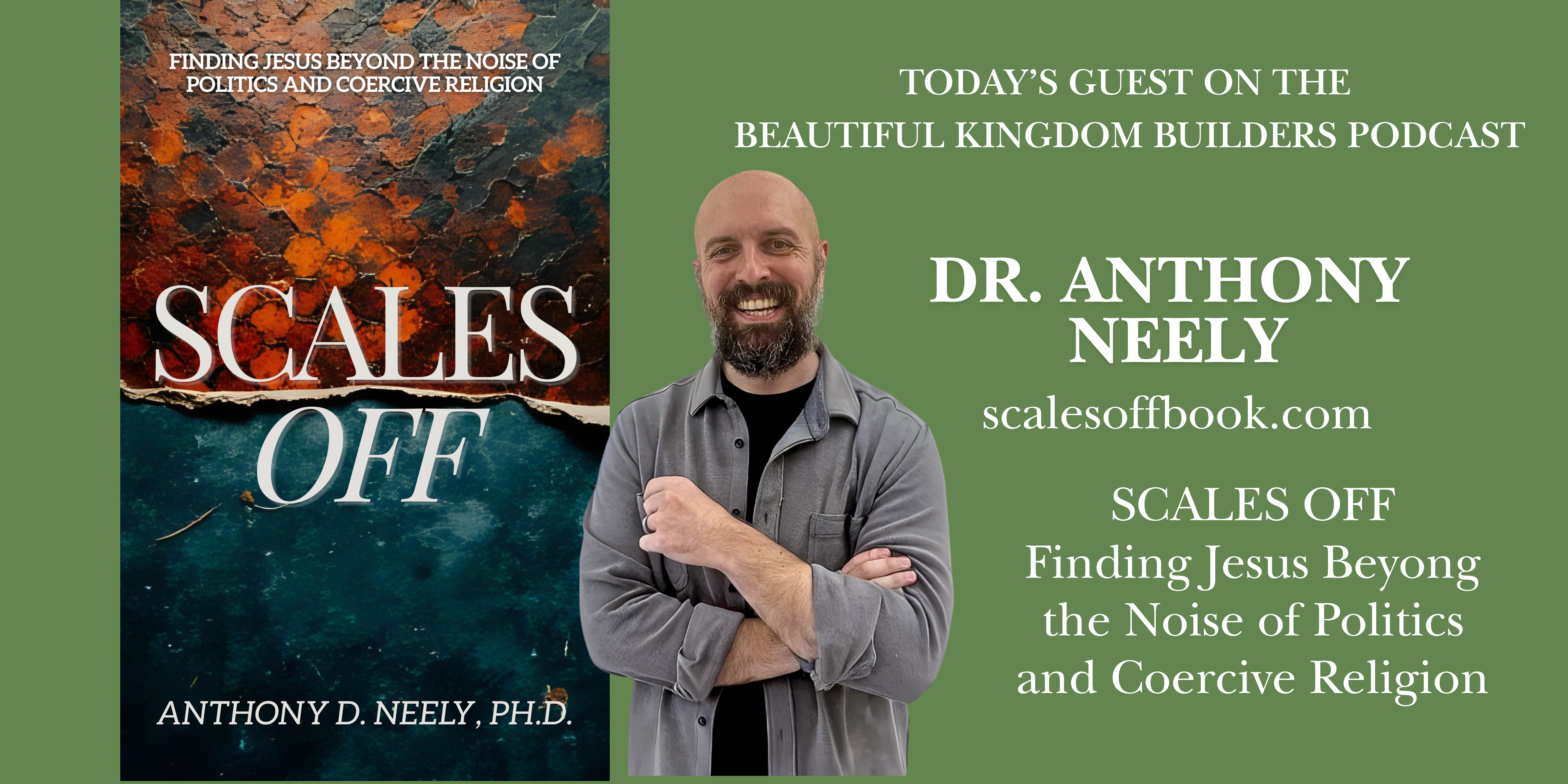
013 I Dr. Anthony Neely on Finding Jesus in a Noisy World

Find SCALES OFF: Finding Jesus Beyond the Noise of Politics and Coercive Religion on Amazon or ScalesOffBook.com

I am delighted to share this conversation with you with Dr. Anthony Neely (Tony) about his amazing book, Scales Off. In this conversation, Tony shares his journey of faith and explores the impact of coercive religion and Christian nationalism on his personal beliefs. He discusses the emotional experiences of recognition and reorientation, emphasizing the importance of re-centering on Christ and fostering healthy relationships within communities. Neely highlights the significance of vulnerability, grace, and the influence of figures like Rich Mullins and Brennan Manning in finding hope and wholeness amidst spiritual struggles.

I loved reading Tony’s book and found it to be extremely well-structured, enlightening and educational, pastoral, and most of all, hopeful. This is an important resource for Christians today who are trying to make sense of what happened to our faith. Tony includes questions and a reflection prayer at the end of each chapter, which would make this a great book group selection. And he ends his book with an appendix of resources, including a Spotify playlist that I can’t stop listening to.

Visit scalesoffbook.com to learn more about Tony’s book, reach out to Tony with any questions or comments, and he even graciously offered to send a free ebook to anyone who cannot afford to purchase it!! I cannot recommend this book enough to you. I nearly highlighted the whole book.

In our conversation, Tony recommends reading Andrew Whitehead and Tim Alberta on Christian Nationalism. And he mentioned his wife’s love of Martyn Lloyd Jones books.

You can listen to our conversation on The Beautiful Kingdom Builders Podcast on YouTubeSpotifyApple PodcastsAmazon Music, Substack, and more! If you find our conversation helpful, please share it with a friend, rate and review, and subscribe so you never miss an episode!

TRANSCRIPT:

Ruth Perry (00:15)
My guest today is Dr. Anthony Neely, who wrote the book Scales Off: Finding Jesus Beyond the Noise of Politics and Coercive Religion. I just finished Scales Off this week and it was a beautiful book that resonated with me so much with my own faith journey and I just highly recommend your work. Tony, right?

Anthony Neely (00:21)
Okay.

Ruth Perry (00:38)
So welcome to the Beautiful Kingdom Builders podcast, Tony.

Anthony Neely (00:41)
Yes ma’am. Yes ma’am.

Ruth, thank you so much for having me. It’s really, really kind the fact that the book resonated with you and kind of spoke to your own story. That means a lot to me.

Ruth Perry (00:47)
It, I mean, everything you wrote resonated. The whole book from start to finish. I just was really impressed with the language that you gave to this experience that I think a lot of people are going through right now with disillusionment with what the church has become in the last several decades and how that disillusionment can either leave us completely separated from our faith or we have to find a new way of imagining our faith and so this is just a perfect and beautiful guide to that and the whole tone of your book is very gracious and pastoral and so it casts a really beautiful vision of what could be and what ought to be the church and what Jesus’ heart is for his kingdom and his values and I just thank you. It was obviously a lot of work and a lot of experience and expertise behind this book and so I’m excited to get into it with you. But before we talk about it, first could you tell me more about yourself and your faith journey, Tony?

Anthony Neely (01:48)
Sure, faith journey, I grew up in a family that wasn’t very religious. In fact, I had an uncle and aunt who identify as Christians, everybody else in my family, it was just kind of be a good person. Wonderful, lovely, lovely people grew up, well-provided for. However, kind of understanding of faith was, you God is in charge of good things. Devil’s in charge of bad things. And very much so this kind of workspace mentality of there’s this giant scale. And if you have more good than bad, then, you know, one day you get to go to heaven and bad people go to hell. And it wasn’t until my family relocated from the Chicago area when I was a kid to middle Tennessee, I grew up in a small town in Cookville, Tennessee.

Down from me lived a guy named Bill Farrell. He just loved him some Jesus. Even as a middle school kid, he loved him some Jesus and was always inviting me to go to church with him and always trying to get me to come to his youth group. And I wasn’t really interested in it. And then he had convinced me to go to a Super Bowl party with him. And he was like, there’s gonna be free pizza. was like, I’m a fat kid at heart. So bring on all the pizza. And he also tricked me because he had said that there was a girl that he knew that I liked who was going to be there.

And so I was like, yeah, let’s go to the Super Bowl party. He didn’t tell me that the Super Bowl party was taking place at a church, so a little sneaky sneaky there, but we got in and halftime during the Super Bowl game Jeff Hall who was a kicker for the Tennessee Balls at the time got up and it was the first time in my life that I’d ever heard the gospel. And it resonated with me in such a way that I call it the working of the Spirit, call it whatever you want to call it from that point on. I was like, I want to follow this Jesus guy because this guy’s talking about in a way that I’ve never heard of it.

And so I think from then, like every person, you know, there have been mountain tops and there have been valleys and there have been struggles and there have been times like now, extreme cognitive dissonance and trying to work through this. But it’s been a beautiful, beautiful walk in this life. And God has been so incredibly kind and gracious to bless me with a lot of opportunities. I’m a musician, so I’ve been able to help lead worship all over the country and work with touring musicians and play at camps and be a recording artist.

He was gracious enough to allow me to become a teacher. And so I’ve been able to try to act out my faith and just loving the next generation and trying to encourage them to, you know, be good human beings. He’s given me a wonderful family and yeah, I’m more and more the older that guy. I just turned 40, just stopping to recognize just how kind God has been to me throughout my life and that just speaks a little bit to my experiences has just been this overwhelming kindness and graciousness that God’s me with hiccups of, I don’t know if I can say WTF on here, but like those moments of what in the world is going on and that’s kind of been where this book came from was about 10 years ago.

It was like this tradition that I had grown up in and come up in and had been discipled by and then, you know, loved so well, I started realizing things are changing. Things are happening. People are saying things. are identifying with things that in many ways are in direct opposition to what I had been taught about Jesus and what I had been showed and discipled to what it looks like to follow Jesus. And the idea of like scales falling off. Like, am I the only person who sees this? And for a long time, it felt that way. And so the book really comes from a place of just trying to unpack and understand what in the world is going on. What’s happening to, the body of Christ here in the United States?

Ruth Perry (05:54)
10 years ago, where were you in your ministry? I’m also curious to know what your education background is.

Anthony Neely (06:01)
So 10 years ago, I was still very active and am still very active worship. So I was still serving at a church, involved with small groups, wife and I helping out with kids ministry, things like that. So I mean, still very highly involved. When we went to graduate school in Texas, I can speak to that here in a second, but at one point I was, I think serving at three or four different churches.

So I was constantly engaged in service. So there was never this moment of, I’m de-converting, I’m falling away. Any of that, it was just, is anybody else seeing this? Why is everybody seem to be okay with what’s going on right now? And so as far as education background, I do have my PhD. So I have bachelor’s and secondary education, master’s in educational theory.

My doctorate in curriculum and structure is from the University of Texas at Pantoneo. Go runners. And so jokingly say I went to school to teach teachers how to teach. And my wife is a college professor. I always tell students I’m the chubby bald-bearded one. She’s the beautiful, brilliant Dr. Neely.

And so yeah, I kind of came from a background of research and writing and before this book I’d already published two other books but this was the first time that I had ever published something that was so heart on my sleeve, transparent, talking about my own faith journey and trying to help others in theirs.

Ruth Perry (07:23)
All right, let me see. So in your book, you organize it with a really beautiful framework of recognition, reorientation, relationships and community, and then wholeness and hope. And so I thought we could talk through your book, through that framework, and start with recognition. Can you tell us what recognition is in this Scales Off process?

Anthony Neely (07:46)
Yeah, absolutely. When you start realizing, like I mentioned a second ago, that things are adding up. I’ve been taught and told that following Jesus is supposed to look like X, but now everybody, not everybody, but a large swath of people seem to be caught up in the movement that’s saying that it’s actually this thing over here is Y. And that led to just a lot of trying to process how much of what I’ve been taught is actually based in the teachings of Jesus versus what I was taught as being essentially called Spade and Spade, a form of manipulation, a form of requiring adherence to a framework that doesn’t really have anything to do with Jesus at all.

And so the book itself really a, I’m joking to it’s 10 years of late night conversations between my wife and I after our kids were in bed and neither one of us can sleep and we’re talking through what’s going on. It’s lots and lots of text messages back and forth with friends. It’s diving in to book after book after book and podcast after podcast. Just trying to see the old adage, am I crazy or is everyone else crazy?

And I never intended to write this book. It actually started out as journaling and it started out as lots of voice notes in my phone of me just trying to process what was happening. And I mean, we’re beating around the bush here, obviously, the explosion of MAGA, the alignment of the American Evangelical Church with far-right Christian nationalism, all of this kind of coming together. And it started out from that journaling, I wrote a poem. Because I’m very much so a creative. Growing up in like the Southern Baptist tradition, I never really fit the mold of like, you know, hunting and the men’s wild game dinners. I’ve always been a hey, let’s go to a poetry reading and then the symphony or whatever. But it started out, I was like, okay, I have all these thoughts. have all these ideas.

Ruth Perry (09:48)
I would love to hear it!

Anthony Neely (09:49)
I’ll share that here in just a moment. And it scratched the itch of going through my own processing. This very much so was a therapeutic process for me. Because I was like, don’t want to leave Jesus behind. I don’t want to my faith. I do want to, I’m going to use the four letter word “deconstruct” some of these ideals that maybe aren’t necessarily aligned to the teachings of Jesus. And so I just kept writing and writing and writing and writing and writing and eventually what was largely stream of consciousness started to take on the form of the book itself. And so a lot of this came from just, again, me working through my own hang-ups with what I was seeing in the world.

And so, yeah, I’ll share this poem with you that is where the book was birthed from.

So the poem is called Come Home. So it says,

“Come Home” by Anthony D. Neely

I remember what it felt like
to belong.
To believe.
To sit beneath the steeple
with hands lifted high
and eyes closed tight,
certain that we were the light of the world.
Salt of the earth.
A city on a hill.

I still remember.

I remember Sunday mornings
when grace hung in the air like incense.
when we wept for the hurting
and we prayed for the lost —
and meant it.

But then…something changed.

You told me to love the least of these.
So I did.

And you called me a radical.

You taught me that every life is sacred.
So I said:
Yes. Amen. From womb to tomb.
That a child deserves more
than a heartbeat bill —
they deserve a full belly,
a safe school,
a mother with healthcare,
a father with a livable wage.

You said that made me
a leftist.
A socialist.

But I was just trying
to be consistent.

You raised me to be pro-life,
but only part of the way.
Only until the birth certificate was signed.
Only until the taxes got too costly.

You taught me to hold leaders
to higher standards.
To speak truth.
To seek righteousness.
Until the red hat came along.
And suddenly character didn’t count.
Suddenly truth was negotiable.
Suddenly I was the enemy
for not falling in line.

You sang, This world is not our home,
but then you clung to power
like it was a lifeboat.
Wrapped the gospel in a flag.
Put your hope in policies
and forgot the poor.

You told me my allegiance
was to a King and a Kingdom —
but condemned me when I said
His Kingdom isn’t built
on Capitol Hill.

Still —
I believe in repentance, new life, and resurrection.

So I’m holding out hope.
Hope that you’ll remember
the table is wide,
His yoke is easy,
and the burden —
is love.

And if you ever find yourself
tired of fighting,
tired of pretending,
tired of defending idols
in His name…

You don’t have to explain.
You don’t have to earn your way back.

Just listen.

There’s still a voice
in the quiet places
calling you —
and me —
and all of us —
to return.

Come home, come home.
Ye who are weary, come home.
Earnestly, tenderly, Jesus is calling,
Calling, O sinner, come home.

And so that’s where this kind of started was I got the poem written, but then it was like my brain still couldn’t turn off. I had so much more to say, so much more to get out. And I just kept writing.

Ruth Perry (12:49)
I’m so glad you read that poem. That was so powerful. I mean, it’s really beautiful just to hear that and that that’s the framework of your entire book too. That it ends with hope and with invitation and that there’s so much freedom and so much joy and so much available to us if we can allow ourselves to go through that painful process of letting the scales fall off and reimagining something better and new. And something old, actually. Something faithful.

Anthony Neely (13:18)
Yeah, I would say that it is incredibly painful to recognize that the worldview and the framework that you have developed is not at all what you claimed that it was. And there is struggle that comes with that. There’s relational struggle, there’s internal turmoil.

Honestly, I understand why so many people are leaving the church. I mean, the “Great Dechurching,” millions and millions of people leaving in mass because, you know, they feel they were duped. And for many of them, they were. And so, I tried to write this book, even though I’m not a pastor, I’m a teacher. I tried to write it from this point of I see you, I hear you, I recognize that you’re allowed to how you feel. I’m not going to tell you that you’re wrong in doing how you feel, but I do want you to know that he’s still worth your life. He still loves you more than you’ll ever understand, and let’s try to work through some of this together. And here’s how I’m working.

Ruth Perry (14:14)
You identify Christian nationalism and coercive religion as producing a counterfeit gospel that exalts tribe over truth, platform over service, and cultural dominance over Christ-like love. Could you explain what Christian nationalism is as a worldview on one hand, and then religion is on the other hand?

Anthony Neely (14:37)
Absolutely. Well, it’s hard to do them on one hand or the other because they have become still and it’s fine. If you want really nerdy, in-depth definitions, get into some of Andrew Whitehead’s books on Christian nationalism. I always point people to Tim Alberta’s book, The Kingdom of the Power and the Glory.

There’s phenomenal resources, but the way I think about it is Christian nationalism is the attempted fusion of national identity with divine authority. So it’s a blurring of lines between faith and state that has America as God’s chosen instrument for ushering in Christ’s second coming.

And what’s so dangerous about that is it replaces the way Jesus said that his kingdom would grow by trying to legislate transformation rather than trusting the spirit to do that work. And so it’s like from Capitol Hill, we’re going to put out these moral guidelines, moral standards that were going to try to fit you into this Christian box when that’s not at all how Jesus said his kingdom was going to be built. So you have that, you have the political element on one side that is trying to say we are God’s chosen nation, rather than seeing ourselves from what we really are a lot of times, which is basically a second Babylon, we view ourselves as this nouveau Jerusalem.

And on the other hand, you have this coercive element, this coercive religion, which is when beliefs are weaponized for the sake of controlling people or forcing adherence to some kind of set framework of what they believe it means to belong to that given faith tradition.

So essentially it’s a tactic intended to produce people as machine products that fit some kind of standard for communal belonging. So it’s trying to say, if you are one of us, if you’re going to belong, these are the things you do. You act this way, you talk this way, you speak this way, you listen to this, you watch this, and it reduces faith to a bunch of do’s and don’ts. However, it is hitting at our God-given desire for belonging, especially as we are wanting to belong and grow and earnestly grow into the image of Christ.

We trust these people in positions of authority over us as religious figures, and we assume they are guiding me to follow Jesus in this way. And so this must be the way to look at Jesus when a lot of times, again, just like with the political element, it’s more about asserting dominance and control rather than transforming us into the likeness of Jesus. And I want to say on both sides of that, there are people who do so in a loving and earnest way. It’s just like parents tend to parent the way they were parented. A lot of pastors and leaders within faith traditions and people running for political office are doing so because they believe that’s what it looks like to love and serve Jesus.

It makes me think, and I mentioned this in the book, that it makes me think of like the zealots of Jesus’ time. They loved God. They wanted to see his kingdom come. They wanted Rome overthrown so that God would be back at the political center of the universe. But the way that that manifested was so wrong and so counter to the flipped version of God’s economy or how God goes about building his kingdom.

Ruth Perry (17:51)
Yeah, and they do really emphasize spiritual authority in their religious systems and really teach the people who are part of those systems to submit and defer. And so that’s a real big part of the hierarchy of authority, isn’t it?

Anthony Neely (18:08)
Yeah, well, I mean, even now looking at, you know, people pointing to Romans 13, it’s like you don’t question the government because Romans 13; that’s not at all what Romans 13 is saying. It’s like, you know, what’s the old saying? A text without a context is a pretext to a proof text. It’s like you’re taking scripture outside of the context of what it’s talking about and saying that we are not allowed to question what our government’s doing, that we’re not allowed to exercise our rights of protest and freedom of speech against the government because your interpretation of the scripture says you can’t do that.

That’s not at all what it’s saying. We’re not told to blindly submit to authority. We’re told, you know, God gave us a mind. God gave us the ability to infer. God gave us the ability to ask questions. Jesus asked a heck of a lot more questions than he ever gave answers. And mean, following that model, I do think that we have this idea, I just have to submit, I just have to submit. I think that again, that’s coming from an earnest place of wanting to be more Christ-like. But that also leads us to a place where we can be easily taken advantage of and hurt.

Ruth Perry (19:14)
Yeah, that’s part of the saddest thing for me is growing up in this kind of religion, I know so dearly how sincere my siblings in the faith, what their faith is. I mean, it is very sincere and beautiful, and then it’s being corrupted.

Anthony Neely (19:31)
Well, and I think that’s one of hard things, especially within the realm of Christian nationalism, is there are political movements that are bastardizing scripture in order to pander to those people who are in love with Jesus. And they think, okay, this person is using the scripture. This person is using these words. This person is holding up a Bible or showing up at prayer breakfast or whatever, then they must really be one of us.

I had a discussion with my students about this the other day. And whether it’s within the church or whether it’s within social settings, I think a lot of that manipulative element is, just calling a spade a spade, is corporations who have built these algorithms who understand that we are going to be influenced by what we think most closely aligns with our worldview. We get boxed in, boxed in so that we get tunnel vision.

We start assuming that the voices that we’re being overwhelmed with in these social spaces are the right ones because if that’s all I’m seeing, if that’s all I’m hearing, that must be right. And then we move from it’s no longer us and them, it becomes us versus them. And if you don’t view the world that I do, then you must be an enemy.

And at the end, these algorithms, they’re not your friends. I had to this conversation with my kids yesterday at school. They’re not your friends. They’re not there to, you know, educate you or point you towards any kind of moral or ethical outcome. They’re there to keep you on these platforms as long as possible so that the people running these platforms can make as much money as possible.

You’re a pawn in the game and we as a faith community and we as a society or having to pay the price of the impact that these algorithms have had in further dividing us where we can’t even have conversations anymore without people assuming the worst in us or assuming enemies.

Disagreement’s no longer a disagreement. Disagreement is now an act of war. And that has done so much damage, not only for us as an electorate, but also us as a faith tradition, we show up on Sunday mornings and we sing these songs and we pray these prayers, but then we carry hate in our heart for our neighbor because we saw what they posted on Facebook yesterday. And so it’s like this weaponization of our sincere intent and our sincerity to love and grow in our pursuit of more like God, our sanctification, that is, you know, ultimately what’s causing a lot of this division to flourish.

Because if we’re only getting one view and shortening, shortening, then it becomes really easy to take advantage of us. And I think that’s what’s happened with so many devout, loving people is they spend way too much time watching their preferred news outlets. They’ve spent too much time being rage baited by certain podcasts or protests. This is on the left and the right. That the rest of us are on podcasts talking about how do we undo this world that we live in so that we can find Jesus beyond all of that noise.

Ruth Perry (22:34)
That is so true. And like you said, it’s on the right and the left. And it’s something that I personally have a real struggle with because I am addicted to my phone and I’m addicted to the algorithm. But I did go on a mission trip. I think it was 20 years ago. It was a racial reconciliation mission trip to Washington, DC with my college. There were 20 something of us and we got to go meet with congresspeople. We went to soup kitchens and a domestic violence shelter and had all these conversations and everywhere we went, we would say, what can we do? And they’re like, just listen to us. Just please listen to us. That was everywhere. Please listen to us.

And so I did, 20 years ago, I just started diversifying the people that I follow online. And now 20 years later, I can see like what an impact that’s made on my life, that I’ve had sources of information. And then on the other hand, I’ve also kind of woken up in recognizing or yeah, recognition. We’re talking about recognition right now.

I recognize that a lot of the people from my background that I listened to were angry. Even the preaching I listened to, it was so angry about everything. And that was just a part of the tone. And the message was anger and fear. Can you talk more about how anger and fear play into coercive religion?

Anthony Neely (23:55)
Yeah, so I think again, we all have this sense of belonging. also, you know, we don’t want to upset those to whom we look to as mentors, as leaders, as authority figures. And so we want to belong. We don’t want to rock the boat. And so we’re going to try to fit into whatever these molds are because we trust again that people who are, you know, carving out the path trying to teach us to follow Jesus are doing so in a bit biblically accurate way. And I think you take that along with the fact that rage sells, anger sells. There’s a reason that Happy Go Lucky podcasts that promote everything is amazing and here’s happy news this week aren’t the ones that are at the top of the chart.

We, there’s something about our nature, call it our depravity, call it our fall, whatever, that clings to anger. And so you take that with the fact that we live in a world right now where there’s lots of stuff to be angry about. It’s very easy to get caught up in anger, but, but as you recognize that there are, there are voices profiting off of my anger, that I am monetized in sharing these thoughts online. I am basically buying somebody another beach house every time I listen to their podcasts that encourage me to hate my neighbor and consider the least of these to be an enemy of the state.

When you start recognizing that, you’re like, that’s not Jesus at all. And why in the world is that spilling over in the pulpit? And so with that recognition comes, I would say, the dangerous element of starting to question because coercive systems don’t like being questioned.

If you look throughout history, I’ve been a social studies teacher for almost 20 years now. And if you look throughout history, normally the people who are taken out first, which Walter Brueggemann talks about this, in some of his writing. It’s normally the artist, the writers and anyone else who might question authority. Because if you start questioning, who’s profiting from this anger? Who’s profiting and being bulstered and lifted up? Who’s being emboldened by this? Then you bring danger to it because if you can point within Christian circles and say, you’re angry about this, but that thing that you’re so angry about, Jesus told us to embrace that.

You are so mad at this group of people. Jesus said, that’s the group of people that we need to lay down our lives to serve, to sacrifice for. Well, you’re starting to get in the way of their brand. And so there is this element both, you know, talk about a lot in the book is as you’re listening to these voices, as you are starting to question maybe some things you’re hearing in your faith tradition, consider whether or not they’re willing to answer your questions. Does asking questions make you come off as someone who’s sincere and trying to grow? Or do they vilify you for it? Do they start to ostracize you? Do you start feeling marginalized and othered because you’re asking questions? because what you’re being told doesn’t necessarily align with the scripture that you’re reading?

Ruth Perry (27:03)
Yeah, so that kind of brings us into the reorientation when you start seeing all of this, the recognition, and then you move into reorientation. What’s happening when the scales start to come off and what is the emotional experience of that?

Anthony Neely (27:16)
So as this scales start coming off, you have a few options. I mean, you can ignore it and just try to say, hey, I’m just going to bury my head in the sand and try to keep going. You can do, like we said, what many people have been doing during this period of great deterting. You can run away. You can flee and say, I’m done with this. And again, I understand people who have chosen that path.

Or you can say, God, I trust that you have allowed me to see this. And I’m going to ask you to just start revealing to me,
recognize that God has allowed me to see this and just pray that he is going to start tearing down those walls and how many of again using that naughty word deconstruct some of these issues. Complete side note, I don’t understand we in the evangelical world get so upset about the idea of deconstruction because deconversion and deconstruction are two completely different things.

Deconstruction ultimately is a form of repentance. The word to repent, you know, we always think of to turn around, but also means to think again, to change the way in which you’re thinking. So if you were building a house and you recognize that, you know, something is askew in your framing, you’re going to go back and you’re going to do away with, you’re going to deconstruct what was wrong in the construction process so that you can rebuild it so that it’s stronger. So I don’t really understand why we get so caught up in that term as a side note.

But as you are deconstructing and going through this very painful process so that you can rebuild your faith around Jesus, I can’t tell you that there’s any single, this is what you’re going to feel emotionally. Because for some people, it’s a sense of liberty and joy and freedom and excitement because they are seeing Jesus in ways that they’ve never experienced him before.

For others, it’s going to be painful and it’s going to hurt and you’re probably going to need some professional counseling and help to work through, you know, the feelings that you’re having and to process everything that you’re going through. For others, there may be the the issue of relational and communal separation, because you may get to a point where you say, need to seek out a new community. That my time here in this faith community has kind of come to an end. And so I need to find some place new.

And, you know, it’s hard to leave the, not just even tradition, but the friends that you’ve had and norms that you’ve had and the rhythms of like that you’ve had of this is just where I go and this is where I sit and here’s you know the Sunday school class I go to or whatever and so there can be there could be a lot of the struggle of starting over that comes along with that so it I would say for those who have recognized and those who are now going through the process of okay where do I go from here just know that whatever you’re feeling is okay to feel, how you’re feeling in that moment. God is big enough to handle whatever feelings you have, whatever questions you have, and all he asks is that we come to him in sincerity and honesty. And so if you need to scream into the sky, you scream into the sky. If you need to cry, if you need to laugh, if you need to get really, really angry, God’s big enough to handle those things.

Even though many of us, were brought up saying that you only talk to God in this very reverent tone. No, God welcomes us to come to him as we are. know, Hebrews, we’re told that we don’t have a high priest who can identify with us. There’s no emotion that we’re feeling that Christ himself didn’t feel. So he welcomes us to come to him. So whatever you’re feeling during that emotional element, just know that Jesus will walk with you through it as you are trying to figure out what your next steps are.

Ruth Perry (31:16)
I feel like I’ve had a lot of healing to do because of my background with coercive religion and just some spiritual trauma that I’ve been through with a church split that deeply impacted my family and also untangling myself from my patriarchal conditioning and trying to find my true authentic self under that conditioning. And I’ve had the financial barrier of not being able to afford therapy. And so I just, for years and years and years relied on books and reading online and finding people and listening to podcasts.

Then last year for a little while, I had enough extra income where I was able to afford EMDR therapy. And I’m like 15 or 16 years into my deconstruction process at this point. And it was really amazing to me how much trauma my body was holding and how effective being able to receive trauma therapy is. And so I had kind of that fresh like layer of anger at the world that we live in where these things are out of reach for so many people.

Anthony Neely (32:17)
No, absolutely. So just being, you know, transparent, part of my wife’s own faith journey is my wife is, always struggled with scrupulosity, which is basically religious OCD. The idea that everything that you do, which is very much so evangelical, you know, total depravity, all, everything you do is sin, blah, blah. Well, you take that somebody that already has some sort of dispositions in the way they think and they got to the point where my wife had stopped going to church.

And yeah, that process of recognizing the origins of your trauma and getting help for them. I’m glad that you got to a point where you’re able to go for the counseling and the EMDR. My wife was a compulsive reader and she found her solace, this entire bookshelf here is all Martin Lloyd Jones books. So her place of comfort, her solace was in reconstructing her faith through the writings of Martin Lloyd Jones. He has a book called Spiritual Depression and my wife has led some women’s book studies through it.

And I do think it’s interesting that you spoke to, you know, we as a society, political, whatever, we’re very quick to blame things on mental health, emotional health, but yet we’re constantly cutting funding and cutting access to those things because I’m so glad you were able to get now, but mercy, I wish you could have had that access 15 years ago, 20 years ago, and I’m so sorry that you didn’t.

Ruth Perry (33:54)
Yeah, I think just the difference in my nervous system being grounded and rooted versus like constantly being vigilant and on edge. It’s amazing.

Anthony Neely (33:59)
Yeah, it’s a physiological response. Yeah, and I talk about that in the book that it’s not just an emotional or spiritual response to, you know, coming, recognizing that you’ve been in a coercive system or going through autocracy. It’s physiological. Your heart rate increases, your anxiety spikes, your cortisol levels go through the roof, you lose sleep and, you know, God designed our bodies to send us messages.

And so, yeah, I just wish that within the church, my wife actually has, I got her a sweatshirt that says you can have Jesus in a therapist too. Because we, for some reason, we put up this wall between spiritual reformation and the mental and physical health element of it and when we are complete beings and all of it needs to be addressed and especially when you’re going through something as heavy as you know trying to work through the dissonance that comes from recognizing and trying to decide next steps of being in the coercive system or in the crazy political mess that we find ourselves in today.

Ruth Perry (35:12)
Another emphasis that you have under reorientation is on re-centering on Christ. What are some practices that help us strip away the layers of distortion and get back to Jesus?

Anthony Neely (35:22)
Yeah, so I know I put a lot of them in the book because again, this was like 10 years of what could we try? What can we do? I think it starts with revisiting scripture with fresh eyes. Do a slow reading. Look at Jesus and his dispositions. Who does he give attention to? What does he say to them? What accusations are thrown at him?

Because I think again, in this like, machismo, American Jesus kind of world that we live in right now, we have a very skewed, hyper-masculine view of Jesus that robs us from seeing that, you know, he was perfectly balanced. He would call, you know, abusive authority on the carpet, unflinchingly, but also he would welcome prostitutes and tax collectors. And he would spend time with these religious authorities, but then he also would be with, you know, the scum of the earth, basically, of his day. And so when we go back and we do a slow reading of scripture, I think that that helps us to better understand, you know, who we are and who he’s calling us to be and what it means to try to be more like Jesus.

I would say taking a break from social media or any kind of rage-based outlets is absolutely critical because if you just keep feeding the beast, the beast is going to want more and more and more. I say in the book that it’s really important to start finding God again in nature and I would also add to that in the arts.

Over and over over again, we see people in scripture, going into the wilderness, going, for lack of a better word, going on hikes, going on walks. And so I think that there’s something to be said as we’re walking through this, just being away from the hustle and bustle of the world and just being back in God’s creation. And with the arts element of that, our God is infinitely creative and I believe that all art reflects the beauty and the creativity of who God is.

And so for many traditions, you’re brought up being told that there’s this very hard line between the secular and the sacred. And I don’t necessarily buy into that. I believe that all art can reflect God’s creativity, whether the original artist it to or not. The other thing I would say is to rest. Part of, you know, the system is to be busy all the time. Busy, busy, busy, busy. To the extent that if for some reason you’re not knocking on doors on a Sunday afternoon or you’re not leaving Awanas on Wednesday night or whatever, then you’re taught that’s almost sinful. And so you get this mindset of

To be a Christian, to be, I have to do all of these things. And I have to be busy all the time. All that does is lead to resentment and burnout. So allow yourself the opportunity to just rest and get comfortable, become comfortable with the idea that Jesus took maps, you can too, it’s okay. Recognizing that what we see of people and scripture are very small snapshots of their lives. Most of their lives were very normal, going about doing their thing.

So you don’t have to be, know, doing crazy, pursuing crazy mountain top experiences every day, because again, you’re chasing experience. You’re not chasing after the person, the redemptive work of Jesus. With that though, I would also add in, for your service, try to be intentional about serving and spending time with people that your previous context had villainized or marginalized. Spend time with immigrants, spend time with the poor, spend time with the LGBTQ community, spend time in jail, spend time in all these places that you were told that a clean cut little shiny happy Baptist doesn’t go to and recognize that that’s where Jesus probably would be if he were here today.

I always tell people that if Jesus were walking around today, we’d probably be much more likely to find them in a trap house somewhere, talking to the drug dealers than at the country club, talking about their handicap and the next round of golf they’re playing. And so I think you were saying earlier, when we put ourselves in those positions and we can hear people’s when we rehumanize them after our traditions have tried to rob them of their senses, for whatever reason that I think we are becoming more in line with the heart of Christ.

Ruth Perry (40:02)
The next part of your book goes into our relationships and our community. And I think the most compelling part of that section for me was when you were talking about how to have fruitful conversations with people who have remained or having conversations that are gracious and merciful and loving instead of reactionary. I think that was really important. If you could just talk about that with my audience.

Anthony Neely (40:16)
Yeah.

Ruth Perry (40:26)
Because this is, think, the struggle for all of us is that we still have loved ones in coercive religion.

Anthony Neely (40:31)
The proverbial angry uncle at Thanksgiving dinner kind of… Yeah, so the way I talk about it in the book is trying to move from being an arsonist to being an architect. Do not… It’s so easy to do, but try not to become the progressive version of the far-right conservative thing that you’re trying to leave behind. Because it doesn’t really matter which end of the spectrum. If you’re constantly burning, you know, people with the sword that is your tongue, then that’s not going to lead to benefit for anybody. That’s not going to bring about reconciliation. That’s not going to bring about any kind of redemptive work. All it’s going to do is further divide.

And so, one of the things that I do is I have all kinds of notes in my phone where I just, have thoughts. I’m not denying I have thoughts where I just want to rip into people because they say something I’m just like, but I know that doesn’t benefit. So, I do have the space where in my phone I can just type those out and I have them there for myself rather than having to put them out on and using my platform, whatever it may be on social media or text or whatever, because all that’s going to do is serve as an arsonist. I’m just going to burn down. I’m going to cause more and more wedges because when we approach people with conflict, they’re going to dig their heels in.

So instead, I encourage in the book to practice a technique called motivational interviewing. Again, if you look at the life of Jesus, he asked a lot more questions than answers he ever gave. And so the whole point of motivational interviewing is, in sincerity, ask questions of people. You’re not trying to lead them. You’re not trying to get to some kind of predetermined outcome, but you’re trying to create space where people can maybe through the line of questioning that you give, they can consider and wrestle with what their beliefs are, why they hold to certain ideals.

And I think in doing so, if they know that you’re sincere, if they know that you are open to hearing their thoughts, if they know that you care about them, as a human even if you disagree with their ideas you care about them then they’re more likely to keep engaging with you. A good example of this is I have the SRO officer at my school. Wonderful guy. Love him. Such a cool guy. But he and I view some things in politics very differently.

And you know what? We will get together at lunch. You know all our kids are trying to keep them from throwing blueberries or whatever. And we will have wonderful conversations about these things where if people were doing it online, hiding behind the anonymity of a username and an avatar would be blasting each other. He and I walk away with fist bumps and, dude, this is so much fun. I’m glad we can talk.

And I think that’s what we need is to be able to approach each other as human beings saying, I disagree with your viewpoint. Let me ask some questions about why you hold yours. Not a got-you question, help me understand what you’re saying. And then the big thing that I’ve learned is always ask permission to share your thoughts. Don’t just barge in while I think blah, blah, blah, blah.

If you, no, if somebody says something then, they are much more welcoming to hear what you have to say if you would just say, is it okay if I share with you what I think about that? Is it okay if I tell you a time that I dealt with something like that? Because again, you are moving from arsonist to architect. You are tearing down those walls. You’re trying to break down people’s defenses so that you can have an actual conversation. Just like sharing the gospel with somebody, your goal is not conversion.

That is the spirit’s work. We have to trust the spirit to do what the spirit does, which is the transformation of people. What we are called to do is to love and engage. And when we move from arsonist to architect, we create those opportunities where maybe somebody walks away and they think, huh, you know, they referenced this book. Maybe I’m going to go check out that book.

You know, they were talking about how they used to follow that podcast, but they don’t follow that podcast anymore. Maybe I need to step away from it as well. And so just creating these spaces where you can have fruitful conversations is I think is ultimately what needs to be pursued. But we’re also human. And we understand that sometimes those conversations don’t need to be had. So I think there’s also an element of maturity in recognizing

that there’s some people that are ready to have those conversations and there’s some people who aren’t ready to have those conversations. And I think that’s why setting clear boundaries for yourself and being able to recognize this is robbing me of my peace, I’m trying to go on the offensive and having the courage and bravery to say, right now is not the time for us to have this conversation. You might make some people uncomfortable.

You might make some people upset, it’s also going to save you from saying something that ultimately could rip that relationship completely.

Ruth Perry (45:26)
And when you mess up, as we all inevitably do, when you’re living on this side coercive religion, you’re not going to go into a shame spiral or feel like a failure or internalize that kind of horrible feeling after. You can repent. You can apologize with sincerity and you can bask in God’s forgiveness and grace and mercy.

Anthony Neely (45:47)
Absolutely. And you know, I’m a big advocate for put your skeletons on display and let them dance. And so rather than pretending like you’re some kind of shiny, happy person who has everything perfect, like be vulnerable. It’s uncomfortable, but be vulnerable, be transparent and be able to say, I don’t know the answer to that. I don’t know. This makes me angry. I’m frustrated by this.

No, I don’t have an answer to the 47, you know, different podcasts quotes that you just threw at me. And, and not putting on this persona that I know everything, I have everything figured out. think that that’s freeing for us because we start realizing perfection was never the expectation for us that to quote Homer Simpson, I read this whole book and those people are really messed up except for this one guy.

And we started fighting, you know, freedom in understanding that we are flawed human beings and that can help us to hopefully move away from some of those shame spirals. When we learn to accept ourselves as Christ accepts us, then that can be a great stepping stone towards hopefully not beating ourselves up when we put our foot in our mouth or when we say or do something wrong because like he said, God loves us regardless.

God is infinitely and eternally delighted to call us his sons and daughters. God will never love us any more or any less than he does in this moment. And when we get to a point that we can start actually believing that, I don’t think we’ll ever fully comprehend it. But when we get to a point where we start believing

Ruth Perry (47:22)
Yeah, and this is going into the wholeness and the hope piece of your framework. I really liked when you spoke about Rich Mullins and Brendan Manning. Those are both people who have been really influential to me in finding my freedom in Christ. Can you speak to how they’ve been influential for you as spiritual guides?

Anthony Neely (47:40)
Sure, so I think Rich and Brennan did a couple things. If you guys don’t know Brennan Manning, he wrote Ragamuffin Gospel, which also was highly influential in Rich Mullen’s life. I think they both showed a couple things. One, is God loves to use a ragamuffin. We are screwed up, messed up people, but that’s exactly who God uses, I think shows that there’s power when they write there’s power in being transparent and sharing his story. Neither of them tried to hide the fact that they were rascals. I think we’re far enough removed from Rich now that we’ve started to like deify him. But Rich was very transparent. He was like, I like women. I like drinking. And a lot of times I’m a jerk but also I’m loved by Jesus and I’m called for his purposes and bring glory to his name.

And so I think understanding in their works that we are loved by a ridiculous amount of grace and mercy and that is what holds us, not us, but God’s ridiculous amount of grace and mercy what holds us brings that freedom and I think that’s one of things I’ve taken so much from not not just you know incredible song lyrics and incredible composition but the idea that God loves to use the people that everyone else thinks is gutter trash basically. That there is no person who is Too low down or too high up that God cannot use them in phenomenal ways. Brennan was an alcoholic, Rich, like I said, had all of his struggles, but here we are today and we’re still talking about their influence for the kingdom. We’re not talking about those things.

Ruth Perry (49:25)
Yeah, that’s really beautiful. And I just want to say how beautiful your book is. It’s really good news and really hopeful. the whole book is a beautiful resource for people who are going through this difficult journey of scales falling from their eyes and trying to reimagine a new faith or move forward. And I really love that you include questions at the end of each chapter and a prayer for reflection.

So you can use that individually or you can use it with a group. And then at the end of your book, you include a whole list of resources, including a Spotify playlist of people from, I agree, music has always been really important in my spiritual journey. it’s oftentimes God has like brought me a song or an artist in a time when I’m struggling that’s really ministered to me.

Anthony Neely (50:11)
Yeah, I put that playlist I’d actually had for myself for a couple years, because those were songs that were speaking exactly to what I was feeling, by left of center artists, primarily Christian artists. But they were just speaking to what in the world is going on politically, socially.

How in the world does this reflect Jesus? And I found so much comfort and solace. was like, it’s something I’m just going to link to in the book. I’m going to put it in the book because maybe somebody else is having a day of more news coming down the pipeline and more files being released of horrible, horrible things happening. And they’re just like, God, where are you in this? there’s some songs here that in a non-cheesy cliche way can remind me of that I’m not the only one feeling the way.

Ruth Perry (51:01)
If someone is on the brink of walking away from their faith, what would you say to that person?

Anthony Neely (51:06)
I see you. You’re allowed to feel how you feel. I have a sweatshirt that I wear. Not this one. This one says radicalized by basic decency. But I have a sweatshirt that I wear that says, I’m sorry the church hurt you. I think that’s the first thing that people need to hear is that their feelings are valid. And so I would start there and say, I see you. I hear you.

I would tell them that they’re loved, that they will never comprehend whether they keep going to church or stop going to church or take a break from the faith or whatever, that they’re eternally loved, that Jesus is big enough to handle their questions, to handle their doubts, and he welcomes them, he calls them his children.

I have a two-year-old and a six-year-old, and our two-year-old’s going through sleep regression right now. And about two o’clock every morning, he starts screaming, Daddy! Daddy! And I go in, and I take care of him, and it reminds me of a quote that I heard once that the only person who would ever dare wake a king from his sleep to ask for a drink is a son or a daughter. And so just to know that you can come to God with honesty and he welcomes you and it’s okay to get mad, to get angry, get frustrated because he’s big enough to take that and whichever path you decide to go, know that he loves you.

And I think that’s why I tell him. I’m not going to tell him, well you gotta do this, this, or this, or you need to just keep going, no, feel what you need to feel. Process it, recognize there’s people who want to walk through you with it, people that are feeling and have gone through the same thing as you reach out to them, find communities, be brave and ask the questions that you need to ask. And my hope is that they would find some solace in knowing that I wouldn’t be trying to force them to stay in a system that they have felt duped and abused by, but I do hope that they would walk away knowing that the God of all creation loves them so intimately.

Ruth Perry (53:16)
Amen. That was beautiful. Thank you. Where can people find your work, Tony?

Anthony Neely (53:19)
Absolutely. You can go to scalesoffbook.com. The book is available on Amazon in print and ebook form. And I always throw it out there. There used to be a Christian singer named Eli in the early 2000s. I always loved on the back of his CDs. It said, if you can’t afford the CD, call this number and we’ll send you a copy.

So my thing is always if you want to read the book I did not put the book out there to try to make money off of it Other things I’ve done is like these are lead Mac. There’s no lead magnet. There’s no course there’s no upsell and so I keep the ebook at like 99 cents. I Keep the the printed book on Amazon 9.99; if you can’t afford that there’s a contact page on my website. Click on that, send me a message, I’ll send you a PDF of the book. I just want to get as many hands of people as I can who are walking through a place of just being so frustrated with what they’re seeing, so hurt with what they’re seeing right now and trying to process it. And if it can be a resource to help them, shoot me a message and I’ll make sure you get a copy.

Ruth Perry (54:26)
That’s so amazing. Wow. Now nobody has an excuse not to read this book. It is well worth your time and your money. And I hope people do read it. And thank you so much for coming on the podcast today to talk about it. God bless you, Tony.

Anthony Neely (54:40)
Same to you, ma’am. Thank you so much for having me.


If you enjoyed this episode, would you share it with a friend? That would be amazing! You can subscribe to The Beautiful Kingdom Builders Podcast on YouTubeSpotifyApple PodcastsAmazon Music, Substack, and more! God bless!

012 I Lisa Wells on a Journey From Heartache to Healing

My guest this week is my friend and former pastor, Lisa Wells! In this beautiful and vulnerable conversation, we explored Lisa’s journey through ministry, the challenges she faced, and her growth as a leader. We discussed the impact of complementarianism in her life, the importance of community, and the healing that comes from navigating difficult experiences. Lisa shares how Ignatian Spirituality and contemplative imagination played a particularly powerful role in her healing journey. It was a painful season that led Lisa to coaching herself and she has a passion for serving women now in their healing journeys. Stay to the end to hear what Lisa has recently learned in her doctorate program about the unique stressors of pastors’ wives and women in ministry. If you’re in that boat and struggling, it is no wonder.

Lisa is a very gifted and wise coach (I can personally attest to this as a recipient of her holy listening and prodding). You can request a free call with Lisa to explore coaching for yourself on her website: lisawellscoaching.com
Lisa also provides options for group coaching, “married in ministry” support, and group contemplative practice.

In our conversation, I mention this article: Stages of Faith–A Map for the Spiritual Journey as a helpful resource for those who have hit a spiritual “wall” and are in a stage of falling apart, doubting, questioning, sinking, etc. This stage is precipitated by a crisis and is very painful, and unfortunately, most churches are not safe or equipped to meet people in this stage of their faith, which adds to the pain and isolation of this experience.

You can listen to our conversation on The Beautiful Kingdom Builders Podcast on YouTubeSpotifyApple PodcastsAmazon Music, or more! If you find our conversation helpful, please share it with a friend, rate and review, and subscribe so you never miss an episode!

TRANSCRIPT:

Ruth Perry (00:15)
I am so delighted to have my very dear friend Lisa Wells on the podcast today. Welcome, Lisa.

Lisa (00:23)
Thank you. I’m so glad to be here.

Ruth Perry (00:25)
Lisa was one of my pastors, for five or six years in Maine, and a close friend and now she’s my coach. And so I’m just really excited to talk with you today about your faith journey, about your walk with the Lord and the different seasons of ministry that you’ve been in, what it’s like to be a person in ministry as a woman.

The different expectations and obstacles and hardships you faced because of that. And then also just the good things that the Lord has done in your life through your ministry. And so let’s just dive in first going back about little Lisa. Where do you come from, Lisa? What has your journey with the Lord been like in those formative years?

Lisa (01:08)
Yeah, thank you. I’m so glad to be here and I’m so proud of you launching this podcast. Thank you so much for the invite. What a treat. So little Lisa, you know, the truth is I’m still getting to know her and still befriending her, but kind of some facts about her journey. I was born into a home that my mom was Catholic, but not really practicing. My dad was agnostic.

And so I was baptized Catholic, but my parents didn’t go to church for the first year of my life, didn’t really have an active faith. And then they moved and the house they moved into, their neighbors had been praying for them before they moved in, had been mowing their lawn and taking care of their yard. And so they just went over to say thank you when they moved in and that began a relationship. And that’s when both my parents came to what they call like their personal faith decision.

So from one years old on, I was raised in a family that really prioritized faith. And we were at church every time the doors were open. I went to a Christian school. I really said my first yes to Jesus around the age of four after coming home from Sunday school. just being in Christian school and being in church every time the doors were open, I had a lot of opportunity to learn about the person of Jesus, and I always felt drawn to him, always. I loved hearing his word expounded. I loved being in spaces where he was being worshiped and talked about.

And all of those environments were complementarian. And so my initial kind of understanding of what faith in Jesus is about was pretty gendered. And I was just aware as a young one that there were roles and opportunities that were available to me and there were roles and opportunities that weren’t available to me. As we moved from Rochester, New York to Columbus, Ohio when I was in middle school, that was kind of a hard transition. Middle school is a hard time to start over socially and in a new community that was tricky, but they had a youth group that was really important for me.

I ended up feeling really connected and called there and my first ministry role was the intern. I became a youth ministry intern and I just loved getting like this up close and personal vision and view of the nuts and bolts of daily ministry was really fun for me. I’m so grateful to my youth pastor and his wife for creating that role and allowing me to fill it. And I have these memories during high school, again, Christian high school, where I would have these study hall periods and I was doing word studies in scripture. I bought this Bible that had a Hebrew and Greek lexicon, it was giant. It was way too big. But I just felt so excited to dig in and really understand the word and explore it for myself.

I remember my first awareness of my calling into ministry happened at a church service and I was sitting in the auditorium and I could see my youth pastor and his wife, they were talking to somebody, they were close enough that I could really see the conversation unfold, but not close enough that I could hear anything. And I watched as my youth pastor’s wife really was probably the most animated in that conversation and was, just reaching out to this person and really being a pastoral presence to them. And I remember looking at her and thinking, that’s what I want to do. And I think I had that recognition because that was the most pastoral, interaction that I had seen from a female and it just felt like, okay, there is a path to utilize pastoral gifts. It just happens to be by being married to a pastor. So I made that decision then that I was gonna try to pursue ministry through being married to somebody in ministry.

After I graduated high school, I wanted to kind of spread my wings a little bit, try a different church community. And I had a friend from high school who was going to a church plant in Columbus. And he invited me along. And that’s where I met my husband who was currently working as a pastor. I didn’t target him, though one might think I would.

It’s like, hey, there’s my opportunity. But, you know, we just, started a friendship and as things unfolded, you know, really got excited about being in a relationship together and got married. Unfortunately, that church was not very healthy. So we had to extract ourselves from that situation very early into our marriage. And we ended up.

a little bit north where my husband was going to seminary anyway. And that’s where I started kind of my academic journey. Ended up going to undergrad at the same school where he was doing seminary and studied religion and philosophy and absolutely loved that. And at that point all of my ministry involvement was volunteer or it was alongside things that he had been doing. But the more I had experiences in those environments, the more I thought, okay, yes, ministry is what I want to do.

We had the opportunity to go more of an academic route. Dan, for a while, was thinking about getting a PhD, and I thought about furthering my education in that same direction, but neither one of us felt drawn to the academy the same way we felt drawn to the church. So we ended up getting involved in several church plants in Ohio and loved being a part of church communities from the ground up. What a gift that is to really kind of, build things and see what unfolds from that.

So we had the opportunity to become church planters and I remember being very affirmed when we did a very intense four-day interview that involved a lot of personality inventories and profiling and that kind of thing. And I remember learning that I had the most common Myers-Briggs personality type as what most pastors have. And I felt like, okay, like maybe.

There’s something to this that isn’t just the sidekick, right? E.N.F.J. Yeah, yeah, what’s yours?

Ruth Perry (07:31)
What is your Myers-Briggs?

cool!

I’m an INFP and Logan is the exact opposite. He is an ESTJ. What is Dan? Do you remember? Yeah. So between Logan and I, we got it all covered,

Lisa (07:41)
Okay.

He’s an INFP. He’s an INFP too. Yeah. Yeah. That’s so funny.

I love it. Yeah. So that was so affirming and you know, that’s what started our church planting journey is going through that assessment process and being confirmed to church plant, at which point we moved to Maine and that’s where I met you. rest is history.

Ruth Perry (08:09)
That’s right. That’s right. I’m kind of curious to know. I feel like my parents were first generation. Well, actually, they had both gone to church, but they became born-again Christians as and they had that fire of the Lord in them. And I kind of wonder if that’s where I got my love for the church that I hear in your story too, as a very young person. Do you think having
new to the faith parents influenced your love for the church in that way.

Lisa (08:39)
It probably did. That’s such a great lens on it. I’ve never thought of it that way. But yeah, they weren’t nominal. They really loved the Lord and loved being with people who loved the Lord. And yeah, there’s something to that.

I’m thinking of a Donald Miller quote in his book, Blue Like Jazz. He describes watching a jazz musician play jazz piece on the street. And this person’s just their eyes are closed and they’re so one with the music and up until that point I guess Donald Miller didn’t like jazz he said sometimes have to watch somebody love something in order to learn how to love it yourself There’s something to that.

Ruth Perry (09:24)
I’m also thinking about you seeing that pastor’s wife ministering and that that was how you came to imagine yourself in ministry. And for me, I grew up in the church and loved the church with the same kind of fervor that you did as a child and always imagined myself serving God in some capacity, but I had only seen women as missionaries or as And so I went to college to be a musician.

Lisa (09:49)
Wow, yes.

Ruth Perry (09:50)
And you, you’re a musician, you have that jack of all trades in your ministry toolbox. I feel like women are asked to do so much in the church that we wide set of skills that serve the church really well.

And then I’m thinking about how you seem like someone who does everything with excellence. Like that’s a core value to you. Is that true, Lisa?

Lisa (10:14)
That is so interesting, Ruth, because I have had such a journey in the last handful of years, probably five years, with allowing myself to be less excellent. There is something, wow, really tricky about excellence because it can become an end in itself, right, trying to seek that. And it can become idolatrous, I think, you know, where it becomes yeah, maybe not just an end in itself, but a means for like self-glorification and needing to be approved, needing to be affirmed.

And there’s something so just deliciously delightful about giving oneself the permission to be flawed, to be okay, something without being excellent at it. Yeah, I think excellence drove me for a my ministry life and it’s been sweet for the last five years to find a softer way. Excellence can be really a harsh master and a demanding master to kind of just soften into the reality that I’m limited, I’m flawed has been such a gift.

Ruth Perry (11:31)
And as a woman in a complementarian denomination, the excellence piece, I think, comes from wanting to be taken seriously and be valued and accepted for your gifts and the value that your gifts have to the building up of the church. And it’s not inherently there. And so the striving for perfection is one of those costs that we pay for being in a patriarchal system.

So we need to learn to have grace and to undo that piece. But it has probably also served you well.

Lisa (12:03)
It has, it has, right, like most things, upside and a downside. Yeah.

Ruth Perry (12:08)
So when I met you, we had gone through a lot of church hurt and we were living in Boothbay, Maine. And the church that you and Dan planted was in Topsham, Maine called North Harbor Community Church. But we met at an ecumenical Bible study first. A friend of mine, Melissa, brought me to Collette Pekar’s Bible study at the Seventh Day Adventist Church in Brunswick.

And you were participating in it so I got to know you as a peer and as a friend before I started attending your church. And coming from a pastor’s family myself I’ve always had more of a peer perspective on pastors and pastor’s wives and pastor’s families and understood that they’re not a commodity. They’re human beings.

Lisa (12:53)
Yes.

Ruth Perry (12:54)
I’m kind of curious about when you came and you started church planting and you probably had a lot of high expectations for what God was going to do through you and through your family. What was the honeymoon period like? Let’s start there.

Lisa (13:01)
Before the crash and burn? Yes. Let’s start at the honeymoon period. Yeah. The honeymoon phase. It’s interesting. I’ve been reflecting a lot on how God utilizes even our weaknesses, right? To help us and help others. It’s just a miracle how he weaves such goodness out of all things.

The honeymoon period I think for church planting, at least for me as a church planter, really had a lot to do with I held myself in really high esteem and I thought you know the thing that Maine hasn’t seen yet is Dan and Lisa Wells. Like that’s what Maine needs you know is Dan and Lisa in ministry.

And I look back on that and I think, honey, there was just a lot of hubris. And I think to a certain extent, when you’re starting something, anything entrepreneurial, right? Not to say that church is a business, but that spirit of starting something from scratch, there does need to be a high level of belief in yourself, in the outcome you’re going for.

You know, we, had been through that assessment. And so we had the backing of a denomination. This wasn’t just us, making up that we were ready to do this. Others had affirmed that for us as well. And so that honeymoon period really is just marked by that high belief of God’s doing something and we’re going to go there and join God in whatever God is doing.

And so, I look back on that time fondly, almost like the early parenting stages, when there’s just, you don’t know what you don’t know, but because of that, all is good. I do look back on it fondly and, the connections that I made. I don’t know how North Harbor drew the people that it drew, but we had such an incredible group of people whose roots ran deep with the Lord. They were open to true community with each other. They were okay with being inventive of like, all right, let’s try church a little differently. What might that be like? And so it was just a lot of fun to serve with people like that.

That’s right about the time when I was discovering, too, my excitement for kids ministry, which is so funny also because, I told the Lord in my heart, OK, I’ll do this. I’ll church plant. I’ll go serve in ministry alongside my husband. But, don’t have me in these stereotypical pastor’s wives roles. I’m not going to learn how to play the organ. I’m not going to be in kids ministry and come to find out.

I really, really got passionate and excited about kids ministry and youth ministry. That’s something that kind of marked the beginning of that journey too, is just this awareness and understanding that our kids are the church as well. They’re not our future church, they’re our present church and their experiences matter, their faith journeys matter. And so how to show up to them and minister to them as if that’s true, because it is was all part of that journey for me too.

Ruth Perry (16:10)
Well, as a family that was drawn to North Harbor, I’ll tell you that the kids ministry was a big piece of that because we had already seen a lot of unhealthy church environments and really wanted a safe place where my kids would learn a orthodox, beautiful picture of Jesus Christ. And your passion made the ministry at North Harbor superb. And also I love to see how everybody banded together to serve in kids ministry. You had so many volunteers and everybody was taking their ministry really seriously because you trained them really well.

Lisa (16:43)
Yes.

Ruth Perry (16:48)
To be in service at North Harbor. You did safety training. You did like a vision for what ministry to children is all about. And you taught theology to your volunteers. And so everything was well organized and missional and built for impact. And it has impacted my children. All of my children had that foundation. And I’m just really grateful to you, Lisa, for all that you poured into kids ministry at North Harbor, thank you so much.

Lisa (17:16)
Wow, thank you so much Ruth. I mean, one person can’t do it, right? I can share the vision, I can rally the troops, but if people aren’t willing to use their actual time, their actual bodies, their actual resources to do the work, it can’t be done. So yeah, I was blown away with how many people said yes to being on the inside of that journey. It was a beautiful time.

Ruth Perry (17:40)
And that team spirit wasn’t just in kids ministry, it was also in had rotating worship teams, you had different people preaching. It wasn’t just Dan up there all the time. I loved it when you preached, Lisa, you were always excellent. And I just loved hearing all the different voices and all the different people participating together. And then they had the technical team was just excellent in managing. You had to set up a church in a school building every Sunday and tear it down and leave everything in perfect spotless condition all the time. And you had just created this well-oiled machine that worked together to glorify the Lord and it was really beautiful. And so all the little pieces of North Harbor, it was really attractive for us as a young family, even as a family with a lot of church hurt.

It did feel like a safe place and a really diverse place that celebrated people’s gifts and gave people a place to contribute to the work of the church. It was unique. It was really cool. And so I’m just really grateful that we got to be a part of North Harbor for a while. We were there, five or six years before we moved here to Virginia. And I was heartbroken to leave. That was really painful because I felt like your family, all the other families at North Harbor, they were like family to me when we left. And so that was a pretty big grief to leave North Harbor.

Lisa (19:03)
Yeah, that was a hard goodbye. Thank you for saying all of that. It’s beautiful to experience something you love through the eyes of someone else, you know? So yeah, thank you for that little trip down memory lane.

Ruth Perry (19:20)
I do want to talk to you more for the Beautiful Kingdom Builders audience. I think a lot of people come to my page because they are women coming from complementarian backgrounds and they’re trying to find the freedom to use their gifts in the church and to fulfill their callings that God has given to them. And so I do want to hear more from you about your experience as a woman in ministry as you’re deconstructing your complementarian background. Tell me more about how you’ve grown in that area, Lisa.

Lisa (19:49)
Yeah, think, I mean, I was very staunchly complementarian for quite a long time. I, when I had a reorientation to faith as an older teenager, I had the opportunity to be baptized by a mentor of mine who’s female and I requested not to be. I thought that it would be better to be baptized by the male pastor. And I look back on that now with grief. know,

It’s so common that we end up repeating the patterns that we were given as kids until we look at them in a more thoughtful way. so, yeah, I think honestly, getting married to my husband, who is an egalitarian, was a big part of what started to open my eyes, which is so ironic, right? Because I was inhabiting this role as married to a pastor in a way that was limiting to me at first, and it ended up being the very thing that broke those limits.

And then also study, I ended up going on to John Carroll University in Cleveland and getting a Master of Arts in Religious Studies, and now I’m enrolled in a doctoral program at Gordon-Conwell in spiritual formation for ministry leaders. The more I read, the more I look at the witness of scripture, it’s just very clear that there has always been. It’s not a recent addition. Since the beginning of the human family, since the beginning of the church, there has always been a very clear invitation to women to use their gifts just like there is to men.

And I have been personally so impacted by the stories in the gospels of Jesus interacting with women. A couple of the ones that kind of rise to the top for me are the story of Mary and Martha. I have such a heart for Martha. She, in John 11, has a statement of faith that is right up there with the declaration of Peter in sharing the identity of Christ, right? You are the Messiah. And I’ve heard so many sermons over my life on Jesus’s declaration to Peter that on this rock I will build my church, right? When Peter says that Jesus is the Messiah.

But I don’t think I’ve ever heard a sermon on Martha’s declaration. And it’s the same, essentially, right? She’s saying you’re the Messiah. You’re the one who is to come. so, yeah, I just have such a heart for her, especially with the Luke passage and how she’s been tsk, tsked into, a better homemaker, a hospitality provider kind of role. And there’s just so much more going on in that passage than people have sometimes given her credit for. So I love that interaction. I also have been deeply impacted, especially in the last handful of years, by the Jairus passage that is sandwiching the woman with the hemorrhage.

Goodness, as someone who has three girls who have struggled, and that’s been part of my journey too. It’s been a really impactful part of my journey actually. I really have been so ministered to by Jairus’ faith and the faith of his wife. By the way that Jesus prevents the crowds from witnessing the little girl’s healing, right? It’s just Jairus, his wife and his three disciples that get to see that. Such a affirmation from Jesus that sometimes even in a religious leaders family there are certain things that are only need to know. And even if you’re living in a fishbowl in ministry Jesus sees all the hidden, all the inner, all of the stuff that feels too tender and too painful, he sees that and he’s willing to heal in private if that’s what we need.

And he’s willing to not heal in private if that’s what we need. think about the woman with the hemorrhage and how right in the middle of the Jairus story, she interrupts their journey and he’s willing to be interrupted and not only to allow power to go out from him to heal her, but he essentially hands her a microphone and he refuses to let her just slink away into the dark corners where she must have been living for the last 12 years. And she gets to say the why and the how of her healing.

So stories like that have been really powerful for me in appreciating that Jesus didn’t just invite women tangentially to be a part of the team. He saw them in their individual humanity and gave them an opportunity to be the fullest version of who they are. And that’s the work that I get to do now as a coach, which is such a gift.

Ruth Perry (24:39)
Before we talk about your coaching, I don’t know what you want to share about how you and Dan came to leave North Harbor after, how many years was it that you were in ministry at North Harbor?

Lisa (24:50)
It was 18 years.

Ruth Perry (24:52)
After 18 years. We moved away in 2017 and so far I’ve been able to get back to Maine once a year to see my family that’s there. And I went to worship one time when North Harbor was outside during COVID And I went to North Harbor when they were in a little church in Topsham. So I’ve kind of got to see North Harbor now and then and hearing from you and Dan that you struggling. I don’t know what you want to share on a public podcast, but whatever you want to share about how you and Dan ended up coming to leave North Harbor.

Lisa (25:30)
Thank you, Ruth. Yeah, it is still a story that I hold close to my heart and my chest because it involves my kids, right? But I can share just in general terms. They’ve given me permission to do that. So COVID, I mean, being a church leader through COVID was really, really hard. We were meeting in a school, so that was obviously not available to us. Even when people kind of went back to public services, masked and that kind of thing, like we were just not allowed back into the space, which makes total sense and was challenging. So we were online for a while, and then as you said, we met outside for a whole summer, which was really beautiful and kind of a wonderful way to have a sense of place as a church in Maine, you know, to meet on a beach. So that was really cool. And then, yeah, we found a temporary spot and then from there ended up moving into a lease of a smaller building. But that was just it was a lot of transition.

We ended up we had a staffing change that wasn’t very popular right in the early stages of COVID. And that was really hard. We had some people leave over that. But I think what was most challenging is the family dynamics that we were navigating at home. Having kids that were teens in the heart of COVID was really challenging. They were facing a lot of struggles that we were not honestly very prepared as parents to help them through.

Additionally, the way that Dan and I were handling the stress of the struggles at home, along with the stress at church with all these transitions and, you know, staffing changes and location changes and all the financial changes that happen when, you know, people leave. It was really, really hard and we did not have a very well developed tool belt for how to handle that stress and so my MO was to just try to get tighter with control and push everything through and we’re gonna make it and it’s gonna be okay and sometimes when there’s too much of a pushing and tightness, this desire to rein in the control, it can really backfire. And for sure, I can appreciate how it did not help the dynamics at home.

So yeah, we just got to a place where it was like crisis after crisis after crisis and we felt like we were at the end of our natural reserves and we needed to really shut everything else down except for what was most important, kind of like our bodies do, when we’re triaging some critical injury, It’s like all the non-essential things just get let go and it’s the survival that gets prioritized.

And so, Dan’s decision to resign really was that. It was the decision that our kids needed to come first, our own mental health needed to come first. Like many seasons of suffering, it illuminates how there are, certain things that were never really working well, but because situations were, a little lighter or, circumstances were less chaotic, those things didn’t come to light, right?

But once we right in the heart of this real life or death struggle for our family, all of our maladaptive coping skills just came right to the surface. And so, yeah, there were just a lot of things that we needed to work on that being in ministry while working on those would not have been fair to the people we were serving, certainly not to our kids and definitely not to ourselves and the Lord.

So, divesting ourselves from that role, right, of being in ministry leadership, definitely for Dan, because at that point he was the paid staff member. I was not in a paid staff role at that time, but still was very involved, in the ministry of the church. So stepping away from that was really, really hard, really, really hard. I think part of it was the identity crisis that it precipitated, because, when you see yourself in a role, that is aligned with your employment and then that employment is no longer there. It’s like, well, who am I? Am I still this person who’s been called to ministry?

I think another thing that made it really challenging is when you’re a person in ministry and you need to leave your church for any reason, those people are not just the people you’re serving professionally. Your parishioners often become your dear friends. And to extract myself from the very relationships that I needed at that point for support and love and care, that was really challenging. I felt like in the middle of it, I lost my family. And I’m sure they felt a sense of loss too and probably lose family in the middle of everything.

So just hurt, a lot of hurt and some of it was for sure unavoidable, but it doesn’t make it any easier to walk through, right? And then for our kids, grieving the loss of a church family for them.

Yeah, there was so much hard about that season. I remember being incredibly angry, with God because I felt like I had this narrative in my head, which is such bad theology, but it’s just what I was living with in the in the back of my mind, this narrative in my head that if I was faithful, that my family would be OK. And I was living in the middle of a family that was not okay, in a major way.

And I felt so disoriented by that, so angry at the Lord because it felt like, here we moved to Maine to start this church and it was, a sacrificial journey in some ways. In other ways, it was, really filling our cup more than emptying it. But when I looked back and I thought, if this ends up costing me my family? It felt so tenuous. Everything felt like it was falling apart. And the deep anguish that comes from not only not being at home with your church family, but not being at home in the same way with your biological family.

And then to add on that, not feeling at home in this identity and this faith that I had built for decades, not knowing is God even good? It was really, really hard and yeah, kind of a dark night.

Ruth Perry (32:22)
I’m so sorry, Lisa. That’s so heavy. And I think people even who haven’t been in ministry, I think that’s a relatable experience. It sounds like you hit a wall. And there’s this article that describes the book, The Critical Journey. And I send it to people whenever they’re like, I’m in this really dark spot. What can I do?

It’s a summary of the book, The Critical Journey, and it just describes what that wall experience is like. I’ve read that like 80 % of Christian churches are made up of people who haven’t gotten to that stage in their faith yet. And so their faith is still just very clear. hasn’t really been tested. And so when people do come to that wall experience, is so disorienting and painful and everything goes black or just gets really foggy and you just, you don’t know which way to go.

And the church doesn’t know how to respond to people in that situation. And so people do just leave. Maybe you could help us out with a little bit of insight into how your family got out of that. What was the process past that experience, Lisa?

Lisa (33:29)
That’s such a good question. Thank you for that. And thank you for naming what I think a lot of us experience in church circles, which is that there’s really good intent there, but there’s not always safety. And so for us to be able to hold this experience that, I want this to be the safest place, right?

But the version of me before all of this real struggle and trial was just not able to be present with other people’s suffering the same way. And so, yeah, I don’t hold that against anyone, but it’s just, it’s just true. Yeah, thank you for naming that.

Okay, how did we make it through? Still happening. There’s so much that is just, I don’t even know the word Ruth, I feel like relief, so much relief on this side of those events, but for sure the healing is still occurring. So I’ll kind of point to a couple of things that were key in the beginning and then maybe we can talk about how those are still unfolding for me.

In the very year that we walked away from professional ministry at the church we had planted, I signed up for certification through my coaches program. So I had found Dr. Edie Wadsworth with Life Mentoring School. She’s out of Tennessee and her program had been really helpful to me for learning tools that I didn’t know I didn’t know. Really important kind of basic human flourishing things that I just never learned. Things like how to manage my thoughts.

Scripture talks about this, right, about meditating and what is true and what is noble and what is good. It talks about renewing our minds, taking thoughts captive. But I loved all those scriptures, but I don’t think I understood the how of how to do that. And so, mindset management was a huge blessing to me when I started learning how to not just accept and go along with every thought that popped into my head, right?

And then also alongside that, and this was probably even more powerful for me, is learning emotional regulation and emotional processing tools. These are things that now we teach our kindergartners in public school systems with different kinds of emotional regulation, emotional processing curricula, but I never had that right and so I I didn’t know how to really be with my own emotions what I had learned from the church was how to not trust my emotions because they’re fickle and really, I needed to trust the facts, right?

So it was all about like replacing a lie with truth, which for sure truth is important. But what I never knew before I started this coaching journey is that our feelings do tell the truth. It’s what they tell the truth about. That’s what people sometimes are looking to them to tell the truth about circumstances. They don’t tell the truth about circumstances, but they do tell the truth about what we believe, about how we are experiencing something.

And so to be able to learn how to sit with anger, to learn how to sit with grief, and to befriend it actually, not to push it or control it or resist it. So that was really powerful. And then there were some other action taking tools that were also powerful from that coaching program. So I was just like, I need more of this. So I signed up to become certified and in certification, it was a deeper dive into all of those skills.

And so that came in clutch when I to walk out my faith and live with integrity as everything around me was burning. Being able to talk to myself with compassion, being able to sit with the rage and the despair, those were priceless skills. So that was one way that I was able to support myself that ended up blessing my family as well, going through that certification program and becoming a coach.

And then also, at the same time, I signed up for a program called A Retreat at Home through the Ignatian Spirituality Partnership of Maine. So I mentioned that I had gone to grad school in Cleveland at a school called John Carroll. That is a Jesuit school. That is where back in the early 2000s, I was first introduced to Ignatian spirituality. And I did my first eight-day silent retreat and was hooked.

Ignatian spirituality emphasizes something called imaginative contemplation of scripture. Which is where we use our imaginations to experience the person of Christ in Scripture. And it’s interesting, even though I knew Scripture really well coming from a very churched and Christian school background, I found that I was much more acquainted with Paul than I was with Jesus.

And in that time at John Carroll, I spent more time in the Gospels than I had ever spent before. I mean, just falling in love with the Jesus that is presented there. mean, what’s not to love? The power, the compassion, the speaking truth to power, all of that, I was gobsmacked by it.

And so this practice of imaginative contemplation where I was imagining these Gospel encounters that Jesus has. And I was, you know, either a character in the story in my imagination, or I was an unnamed character, or I was hovering over everything in a narrator perspective. But it gave me personal encounters with Jesus that I had never had up until that point in my more evangelical approach to scripture, which is for me anyway was more focused on study, which I still love and think is amazing and have wonderful experience with too. But this was just, it was involving my emotions. It was involving my imagination. It was involving this other part of my

And so doing that retreat at home and having daily experiences of imaginative contemplation was really important. When families are struggling, and parents are just playing whack-a-mole with crises, it’s just so critical that we are being poured into, that we are receiving in some way. And this practice of coming to Jesus broken, angry, bitter, all the things and just letting Him love me through what transpired in that practice of imaginative contemplation is life-changing.

I had a couple of experiences in particular, one that kind of really rises to the top, that Jesus just really served me and loved me in my hour of greatest need. So there is John 1 where just past the passage that everyone’s familiar with about “In the beginning was the Word and the Word is with God.” Right after that, Jesus calls his disciples. And there’s this interaction between Jesus and a couple of John the Baptist’s disciples. Because John points Jesus out, this is the one that I’ve been telling you about, the one who’s sandals I’m not worthy to untie, and they get curious and follow him as Jesus is going on his way and he turns around and he asks them, what do you want?

That’s amazing. Like just to let that question stand on its own and to ask it of myself as if Jesus were asking it of me. What do I want? And that was so powerful to sit with that and also to imagine it and imagine them answering it, right? And they do, they answer it and they say, we want to see where you’re staying. Where are you staying? And he says, come and see.

And in my imagination, it didn’t stop there. I was like, well, where would he have led them after that? So I’m picturing this whole thing unfold. And our imaginations are not Scripture. This is not divinely inspired in the same way that Scripture is. However, it was so personally meaningful to me because as I followed Jesus to where he was going and where he invited me to come and see.

He took me to this janky 70s apartment building where he was living on the bottom floor in this little apartment. And I followed him in and he gestured for me to sit down at this kitchen table. And he went, this is all wordless now. He went to the kitchenette and he started cooking. And I just sat at that kitchen table and he was cooking and I could start to smell what was being cooked. It smelled so delicious. And I kind of just felt myself like melt back into the chair. And then when the food was ready, he brought it over and he served me and he just sat with me while I ate.

And I just lost it when I told my spiritual director about that encounter. Because at that time it was at the height of everything going wrong. My kids seemed like we couldn’t go four days without some sort of major crisis scenario. And I was trying to buckle down and control. Dan was as well. We were both not our best selves, not our best parenting selves. And we were so exhausted.

And for Jesus to cook for me in the middle of that when I felt like everybody needed something from me at all times and there was never enough for me for him to just say with his actions, no words, I see you, I love you, let me cook you dinner. It just felt like love in a way that no propositional truth could have met me or communicated to me. So that practice of imaginative contemplation,

I actually now lead a group that practices this. We meet a couple times a month and the group is called Come and See from that passage in John 1. It’s just that’s continued to be formative for me.

So yeah, there’s the spiritual formation piece, to my healing, my feeling loved and treasured and not forgotten or discarded. You know, one of the lies that I was repeating over myself as things were all going wrong was that this is such a waste. This whole church plant was such a waste. And not only did it not amount to anything for Dan and I, it ended up hurting our kids.

And I think that imaginative experience at the table was the first time that I began to really receive His love. And gosh, there’s so much goodness and beauty that he can bring out of the worst possible scenarios. And when I was able to receive his goodness and his love and his provision for me in the middle of all of that is when I started to maybe kind of release that narrative that everything had been a waste.

And I look back on it now, our kids are doing so much better. Dan and I are both practicing ministry in a new way. Me as a coach and he as a spiritual director, we’re both in this spiritual formation program, doctor ministry program. There’s just so much good that God is bringing out of that time.

I do remember going to my coach in the middle of, just the struggling time in this certification program and my family’s, bleeding out. And I was basically questioning, can I even do this? And I was coming to her just basically saying, I don’t think I have the time management skills or the willingness to be visible or all the things that you need in order to thrive as a coach.

And she asked me some thoughtful questions. We got down to the place that I felt like I wasn’t sure that going through what we’ve been through and really stepping away from this church that we planted, I wasn’t sure that I had anything positive to give. Because here we had walked away from ministry and now I’m trying to help people in ministry? And she basically helped me question that and said, what do you have? Which is a question that Jesus asks to the disciples at the feeding of the 5,000, right? When they’re like, we don’t have enough. And he says, what do you have?

And I told her, said, I have a place in me that has been hollowed out by suffering. A place where I invite other women to come and be sad or be angry or be afraid. And to have that space held for them where they can just be honest about where they actually are. And that that ends up being the first glimmer of hope and healing sometimes. And she smiled and she said, that’s what people need. They don’t need a coach with great time management skills or who does everything with excellence. We need a place to be welcomed when we’re struggling, a place to be honest about what hurts, to dare to hope that maybe, just maybe not everything is wasted.

Ruth Perry (47:02)
There’s so much I want to respond to, Lisa. Oh my goodness. Man, it’s just such a beautiful picture of God’s redemption that He turned this thing that was so ugly and so hard into your new calling and your new ministry. And it’s just so beautiful. I’m also thinking about how often when we are broken open by something, that’s where God’s light comes in and God’s love comes in. And so these times of brokenness, we can look back and be grateful for them that they were actually a gift because of the redemption and the healing that we received through that. And in all the ways that we didn’t know we needed.

And I’m thinking about when you were going through your certification to be a coach and you offered some free coaching and I took you up on that offer. I had no idea what coaching was. And I don’t remember if we did it one time or two times, but for me, just having that conversation, you helped me to work through my imposter syndrome and my self-doubt and all the reasons I would give myself for not doing more with the Beautiful Kingdom Builders so that I had the courage to step out in faith and start this podcast. And so I need to thank you for that, Lisa.

Lisa (48:19)
Wow.

Ruth Perry (48:20)
I signed up for your group coaching. You have a monthly group coaching right now. And it’s just started in January. So it’s only been two times and both times I came to the group meeting, not knowing that I needed something just completely disembodied from what my life experience is, that’s one of the things that I feel is a carryover from growing up female in complementarianism because we do just cut off all our own needs. We’re focused on meeting everybody else’s needs. And even though I started this process of detangling from patriarchy 15 years ago, I’m still learning all the ways that it’s still in here ⁓ and just needing that push from you to have the courage to do this. And so thank you for that. And I just want to hear more about what your heart is for your ministry and coaching now.

Lisa (48:56)
Yeah, thank you so much and praise God. I’m so happy that any space I created for you ended up resulting in this. I mean, this is such a gift, what you’re doing. Thank you.

So I coach everybody and anybody, but really my focus of my outreach is focused on Christian women and specifically Christian women in ministry and in leadership roles. And that really comes from so much experience myself on that path. And so I feel like I can speak to people who are working through some of the challenges and some of the joys of being in ministry and what that can mean for our own personal faith and well-being.

I feel like one of the things that encapsulates what I do is really teaching people how to speak to themselves the way Jesus speaks to them. I think it is a lost area of discipleship. That very often we focus on, especially in church planting, it’s all about reaching the unreached, obviously very important. It’s all about this outward external focus on growth.

And what I’m discovering is that there’s a lot of people currently in the church and currently leading the church who have not fully embodied and integrated and aligned with the methods of Jesus in how they lead themselves and others. So if the way that we talk to ourselves would not sound at home in the mouth of Jesus, then we shouldn’t be using those words and those tones.

And just from my own personal experience, again, this whole idea of excellence and perfectionism, it’s actually something that plagues women in ministry leadership in particular to have a very high standard of expectations, not only externally, but internally. And so when we’re not allowed to be human, when we don’t allow ourselves to make mistakes.

Really, we just are encouraging a bifurcation of public and private life because nobody doesn’t make mistakes. We all make mistakes, right? And so what that perfectionism does is it forces a very harsh disparity between public and private. And then there’s so much shame that can thrive in all the private hidden places about the ways that we do fail and the ways that we do, miss the mark, which is what sin actually means.

So it’s just my honor and pleasure to get to help, specifically women in ministry, really learn how to use the voice and the tone and the words of Jesus as they speak to themselves. You know, we talked earlier about befriending the little version of me. There’s been so much healing and goodness that has come from that.

And so many of us, even in ministry, are expecting the fruit of the kingdom of God, but using the methods of the accuser, being really hard on ourselves, being really hard on others. Jesus says, like house divided against itself, a kingdom divided against itself will not stand. So I love doing this work of helping women really just gain the skill and then the practice of treating themselves the way Jesus treats them.

Ruth Perry (52:27)
It felt really holy, the times that I’ve experienced your coaching, just your skill at listening really well and digging into the issues, under the issues, and also just being seen by somebody. I think in our culture, we’re just all moving too fast, but as Christians who are called to love our neighbors. The practice of seeing people and just being present to them is really beautiful. And I think that’s what the church needs more of. And so where can people find your website and where are you on social media, Lisa?

Lisa (53:02)
Yeah, I’m on Facebook and Instagram at Lisa Wells Coaching and my website is lisawellscoaching.com and I would love to hear from your listeners. Reach out.

Ruth Perry (53:12)
I recommend they do. Yeah. And I thank you for all your time today, Lisa. Is there anything else you’d like to share before we say goodbye?

Lisa (53:20)
Yes, actually. I would love to talk a little bit about some research that I’ve done recently connected to my doctor ministry program. I took a class called Ministering to Women in Pain, and that class was incredible. And we each had the opportunity to choose a topic for research. And I chose the topic of loneliness and isolation in clergy spouses.

And it was so raw reading this research that had been done. Clergy spouses are an understudied population, but the studies that are out there do show some significant stressors that people married to clergy face. And it’s interesting because, I think this came through in my story. I certainly felt a calling to ministry. So my role in the church was not simply, mediated by my connection to Dan. And yet my connection to Dan did impact how I related to my role, how I related to the church body. So there were still some overlap there in how that all played out.

And so as I did this research, the stressors that really just kind of jumped off the page for me were obviously social isolation. That was a primary one. Perfectionistic expectations, that pressure for excellence always and boundary ambiguity was another one.

Then we’ve got some of the more contextual stressors of financial pressure and mobility, so moving from community to community. I know that depending on what denominational affiliation you have and what the requirements are for moving or what the compensation packages look like, those last two can really vary very widely from ministry family to ministry family.

But those first three, the social isolation, the perfectionistic expectations, and the boundary ambiguity are really in common among almost all clergy spouses. And the impact of those is particularly challenging for women because of some of the stresses that we hold even just as members of society. Some of the expectations that we hold, right, in the home and in the workplace and in third spaces in our communities, how our voices are welcome or not welcome.

So, I started to really peel back and look at what does the research say about what it means to carry a role that doesn’t have a job description. You know, there’s no professional development available to clergy spouses because it’s not a profession.

When the church goes through really challenging times, very often the person who’s employed as the pastor has some sort of network, whether it’s denominational or just other local pastors but the pastor’s spouse very often doesn’t have those connections, or at least not in the same way.

So it kind of amps up the struggle that they’re facing. So the social isolation can also be impacted by power dynamics. Well-meaning, relational connection that’s happening in the church is a layered reality because anything that we share about our kids, about our marriage, about our own faith and our own doubt and our own misgivings things that can come back and impact our spouse’s employment. So being very guarded sometimes about what we’re willing to share.

The social isolation of being left to do childcare duties during late night meetings or weekend responsibilities. If there’s kids in the home, that often is an intense reality for women who are married to pastors or women who are pastors who are married. They’re often expected to carry two full-time responsibilities.

And gosh, the fuzzy boundaries that really spoke to me too. This idea that is the church purchasing my husband’s attention and availability? And does that mean that he can’t turn off? Is the church purchasing my attention and availability? And does that mean that I can’t say no? Really just holding the complexities of these roles and trying to support now as a coach, as someone who is designing environments for women in ministry leadership, really just holding space for women to, first of all, unburden, say what’s true, talk about how these multiple stressors are impacting them in their actual physical bodies, their health, their mental health, their well-being.

We talked a little bit earlier about how we talk to ourselves. That’s where those perfectionistic expectations really come into play. You know, if we’re not allowed to be fallible, to have things that we wish we would do differently and not being able to be real with people about that can be really isolating and really challenging.

So as I’ve done that research, I just want to share with your audience, if you are a woman married to a pastor or if you are a woman pastor, it makes so much sense why so much of the role that you’re in, so much of the responsibilities and the challenges that go with that feel heavy sometimes. And part of my heart as a coach is to come alongside and give women opportunity to process that, to be seen, to be heard, to meet other women in ministry leadership who are also seeking a deeper connection with God and themselves and with others.

So I just wanted to make sure that research was something that I got to share a little bit with the people who listen to your podcast because it’s something that I wasn’t aware of as a pastor’s spouse and even as someone that was in ministry myself, Irrespective of my marriage.

It just, it’s a lot to carry and we need each other. We need support. So that’s something that I’m so privileged and honored to be able to provide as a coach. So thank you so much for this conversation and for asking these thoughtful questions and giving me space to share. It’s been a treat.

Ruth Perry (59:51)
It’s been amazing. mean, your research, how fascinating. That’s really valuable that you’ve looked into that and now you’re meeting that need. So thank you, Lisa, for being generous with your time today and many blessings to you in your ministry to women. God bless.

Lisa (1:00:08)
Thank you, Ruth, you too.


If you enjoyed this episode, please Subscribe to The Beautiful Kingdom Builders Podcast on YouTubeSpotifyApple PodcastsAmazon Music, or more! God bless!