Tag Archives: Women in leadership

Saeed Abedini bares his misogyny for all to see

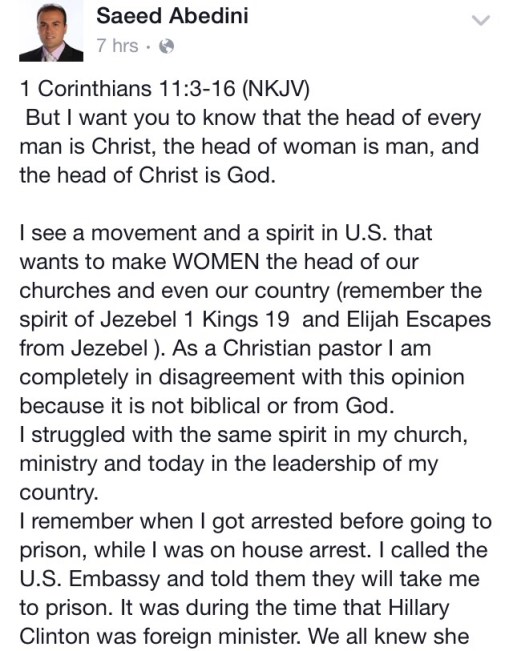
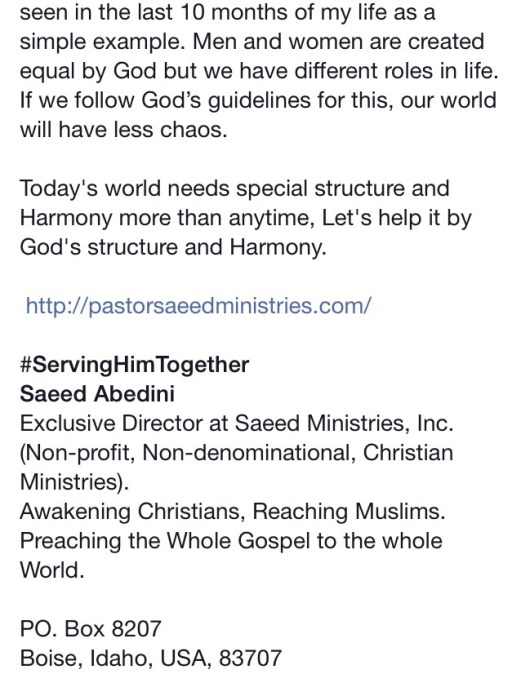
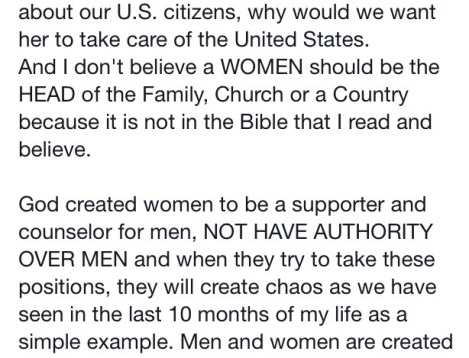
Early this morning (around 3 a.m.), Pastor Saeed Abedini posted an anti-Hillary rant on Facebook that centered around his personal views on male headship and women’s submission to that authority.

imageimageimage

Those were the pictures I took around 10:30 this morning.  Since then, Saeed has edited the second-to-last paragraph to emphasize the point of his message:

image

Not surprisingly, this post has incited some lively discussion.  In the past 22 hours, there have been 182 reactions, 154 comments and 44 shares. And just now, as I am typing this, I tried to look at the post again and see this:

image

Evidently, I’ve been blocked!

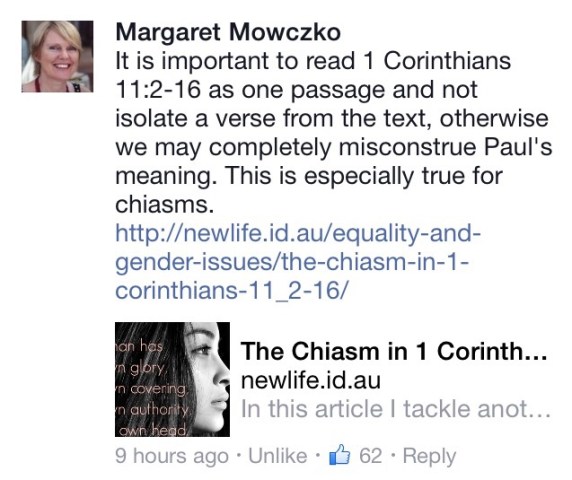
There were some really lovely comments made by egalitarians in response to Saeed’s post, and now I wish I had captured more screenshots.  Marg Mowzcko, the scholar behind the egalitarian exposition of Scripture at newlife.id.au, left several powerful comments.  This was my favorite:

image


The Chiasm in 1 Corinthians 11:2-16

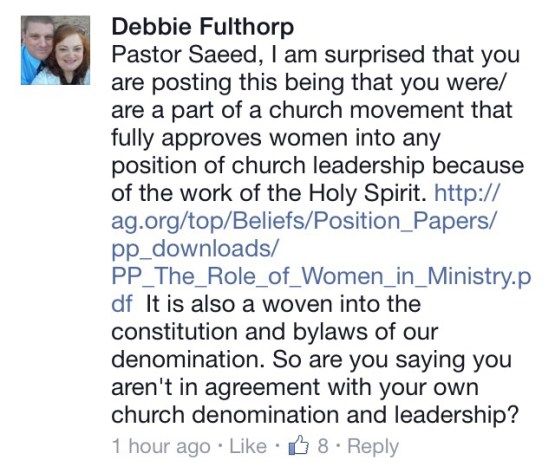
And Debbie Folthorp made an important observation:

image

AG – The Role of Women in Ministry

I replied to a couple comments and left one of my own:

image

I am hopeful that others are also responding to Pastor Saeed’s incorrect and damaging views on women in leadership.  It is important that examples of blatant cherry-picking of Scripture and patriarchal interpretation be publicly refuted and challenged so that those who may not otherwise hear another view may perhaps question these teachings.

If you are unfamiliar with Pastor Saeed Abedini beyond his 3.5 years of imprisonment in Iran and the powerful movement among Evangelicals to have him freed, Spiritual Sounding Board and A Cry for Justice have many excellent posts and links to articles explaining his history of marital abuse and questionable character.  We also posted about The Courageous and Wise Naghmeh Abedini and abuse in marriage, which is important for the Church at large to be educated on, as victims of abuse are almost always further victimized in the process of protecting the celebrity figures and reputation of the organization at large.

May we continue to pray for healing in the Abedini family.


 You can “Like” The Beautiful Kingdom Warriors on FB if you would like more articles about gender and Christianity in your newsfeed.

January Link-Up

Here are the best of the best articles dealing with gender issues within Christianity that we have shared on our Facebook page this month.  I had to narrow it down to the posts that we marked with either “Fantastic!” or “Excellent!”.  If you want more, check our FB feed.  Happy reading!  🙂

The Junia Project – “No Representation and No Invitation: To Be Asked the Question”

At the end of the day, we simply want this: to be asked the question.

Rather than ushering us off to the nursery before learning that we have absolutely zero knack with or passion for children, or assuming our appropriate role is on the coffee or hospitality team before realizing that we can’t even boil water; ask us the appropriate questions before stuffing us into a mold that quite frankly doesn’t fit.

The questions are simple:

“What are your God-given, Spirit-breathed gifts?”
“What makes you come alive?”
“How can your great gifts meet a great need within the body and broader community?”

And then, perhaps even more importantly:

“What can we do to equip you, as an image bearer, to fulfill your calling; to optimize your gifts for the sake of the Kingdom? “

You can join The Junia Project on Saturday, February 14th for a half-day conference to celebrate women in leadership!  Check it out here.

Christianity Today – “My First Sexuality Sermon”

So maybe it’s time for a woman’s take on sexuality from the pulpit. But what should that be? Is it my place to talk about pornography to the men in my congregation? I’m not sure I feel comfortable with that. Or maybe it’s time to add a woman’s perspective? There have been voices lately that have introduced the possibility that lust is not unique to men. And pornography is not only viewed by men. So is it my task to admit to my own desires in this Sex Sermon? Male preachers have received a lot of flak lately for calling their wives “hot.” The complaint was over the sexualization of their wives and the way it made other women in the congregation feel. If I stood before my congregation and called my husband “hot,” the problem might be a little different. Regardless of how a woman looks, for a woman to be sexually interested is for a woman to be sexually interesting. As a pastor, I work very hard to be publicly sexually uninteresting.

CBE International – “A Partner, Not a Patriarch:  10 Types of Men to Marry”

Seems like every few days, the Christian blogosphere produces a new article on the 5, 7, or 10 people Christians should avoid marrying. Some lists are great, but others are patriarchal beyond the point of absurdity. So my husband, Tim, and I made our own list.

If you’re a woman looking for a partner, not a patriarch, here are some men to look for…

1.       Nobody

Jesus wasn’t married. Why should you be? Single Christian women have been changing the world for millennia!  ….

Rachel Heston Davis – “Strachan’s views on male leadership: It’s all about the women!  No, really!”

So women flourish in this system because their husbands engage in self-sacrifice, bless them, treat them gently, and die to their own wishes to benefit them.

You know what? None of that sounds particularly bad. And it seems accurate when held up against Ephesians 5:28, which tells husbands to “love their wives just as they love their own bodies.” Sounds like a prioritization of women’s needs to me.

But if you could pick a word to sum all that up, what would it be? Servanthood? Caring? Sacrifice?

Yet the word complementarians always, always, always return to, is “leadership.” Strachan says that men who don’t understand this system aren’t “virtuous leader[s].” The blog and Twitter posts he referenced from Gavin Peacock define complementarianism as husband “leader”ship in no uncertain terms.

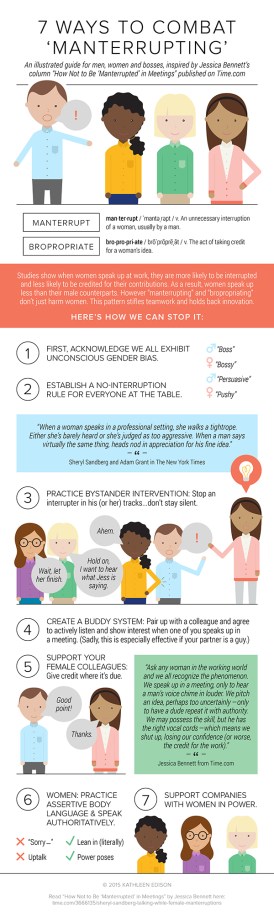
Behance – “7 Ways to Combat Manterrupting”

ff4bbd9d6494a7bcd22abf3740ca6e56

Fast Company – “How We Can Help Young Girls Stay Assertive”

Girls lose their voice for a variety of reasons—it’s mostly because of their self-esteem and is culture-based, says Martha Mendez-Baldwin, a psychologist who specializes in child and adolescent behavior, and an assistant professor of psychology at Manhattan College. Navigating the world between being children and women leave them unsure of how to act. When that uncertainty is met, combined with the pressure to fit in with peers and high expectations of parents, girls are often reluctant to assert themselves, she says.

In addition, girls receive tremendous pressure from society and media to adhere to a feminine role, says Linda Hoke-Sinex, a senior lecturer in the department of psychology and brain sciences at Indiana University in Bloomington, Indiana. The message is to be passive and nice—that it’s preferable to keep the peace than to speak up with an opinion that might be unpopular.

Nate Pyle – “Seeing a Woman: A conversation between a father and son”

There are two views regarding a woman’s dress code that you will be pressured to buy into. One view will say that women need to dress to get the attention of men. The other view will say women need to dress to protect men from themselves. Son, you are better than both of these. A woman, or any human being, should not have to dress to get your attention. You should give them the full attention they deserve simply because they are a fellow human being. On the other side, a woman should not have to feel like she needs to protect you from you. You need to be in control of you.

The Junia Project – “They Say the Church is Too Feminine”

Yes, this statement bothers me, because it shows how little we are actually evaluating the situation and because it is offensive, but most importantly it bothers me because  it is completely false.

The Barna Group has been studying Church trends over the last 20 years and they have found that women actually represent the biggest shift away from the Church. They also found that the gap between unchurched men and women is no longer a significant one. “It remains true that churchless people are somewhat more likely to be men than women, but the gap is not huge and has been steadily closing…the gap between men and women has plummeted from 20 points in 2003 to just 8 points currently.” And this is not just in protestant churches. Findings coming out of the Catholic Church do not look much different,according to the Association of Religion Data Archives.

All of this makes me want to ask those who claim that the Church is “too feminine” what churches they are going to. Are men really walking into churches and becoming overwhelmed with female presence? The idea that the church is “too feminine” goes against the majority of my experiences in church. In fact, as I visited churches on three continents over the last 6 years of my life, I have noticed that the majority of those churches presented the same experience to me, and it doesn’t come close to being feminine.

The Junia Project – “5 Reasons Not to Use Gender-Based Jokes in the Pulpit”

Don’t get me wrong, I understand the intention.

Humor is good. So is connecting with your audience by relating to real life experiences.

But there are ways to do that without using gender-based humor.

There are ways to do that that don’t deepen the gender brokenness, further entrench the stereotypes and, possibly, alienate people from the church and from a deeper walk with God.

In the end, we need to be creating meaningful venues where congregations can talk constructively about male/female relationships and partnerships. Maybe a place to start would be the content of this post. Agree? Disagree? Either way, it would be great to host a conversation in your church about it.

The bottom line is that until we figure out ways to take gender seriously in the church, the joke will be on us.

Christianity Today – “What Happens When We See Women Teach the Bible”

Sometimes I wonder how many women in the church have the gift of teaching, but will never use it, or even entertain the possibility of possessing it. When roughly 90 percent of evangelical pastors and 80 percent of evangelical seminarians are men, it can be hard for gifted women to find role models in the church. With such a void, do some women even consider the thought?

As a college student, I was confused about the direction of my call and the place of my gifts. At my church, women mostly occupied administrative positions. Even in my college parachurch organization, we rarely had a woman speak. Given the scarcity of female role models, I wasn’t sure where to turn.

However my life was forever changed when, in my early 20s, I attended the annual Passion conference, a popular worship and teaching gathering founded by pastor Louie Giglio. Beth Mooretook the stage, and though I was only vaguely familiar with her at the time, I won’t ever forget that moment. When she opened up her Bible, she taught the Word like I had never heard a woman teach it before. She spoke with power, competency, conviction, and most of all, anointing. I would never be the same again.

Around the Web – Posts on Spanking, Domestic Violence, Patriarchy and More

With the departure of summer, “people from away” are slowly filtering out of Maine and life is balancing out once again for those of us whose livelihood is impacted by the tourism industry.  The last four months have been insanely busy for me and Becky.  There hasn’t been the space in our lives to write, but that will change over this fall and winter.  We look forward to getting back in the swing of blogging and vlogging for you!

I promised to share my Imago Dei presentation from our women’s retreat earlier this month, and I will get to that later this week hopefully.  I am always checking in with my favorite blogs and keeping track of important conversations that are happening, so today I want to share some links with you to posts that have had me thinking.  I’m whetting your appetite with a quote from each post, and I hope you are able to read some of these in their entirety.

ON SPANKING

Why Jesus Wants You to Stop Spanking Your Kids – Benjamin Corey (also, you can listen to Ben talk about spanking, domestic violence and ISIS on That God Show: Episode 7)

When one considers the fact that studies overwhelmingly show that spanking is seriously harmful to children, that it damages their brains, lowers their IQ’s, reduces their ability to make good choices, increases their aggression/violence, and leads to a pattern of negative behaviors that simply require more violence on the part of the parent, the scientific evidence against spanking should be clear. When a Christian couples that scientific evidence with the nonviolent teachings of Jesus from the New Testament, along with a warning from Jesus himself that it would be better to be thrown into the sea than to harm a child, there aren’t many arguments left to support the old way of doing things.

I love you, therefore I hit you…er, SPANK you. {How Christians conflate love with violence} – Elizabeth Esther

Now, let’s talk about “hostile attribution bias.” This means you live your life expecting people to be mean to you. UM. WHOA. Hi, self. My ingrained response to the world is that people are mean and scary and out to get me. I am constantly surprised when people love me–and I have to repress the urge to be suspicious when they are kind.

Here’s my default thought process: What do they want from me? Why are they being nice? They must have an ulterior motive! Don’t they know I’m a bad person? I can’t trust them! BLOCK THEM OUT.

The hardest thing for me to do is receive love. There, I said it. I have a huge fear of intimacy because I just don’t trust people. This is my trauma wound.

I can’t go back and change my past. But I can change my future. I don’t have to perpetuate the cycle of violence. I can do something different. You can, too. Our children deserve it.

In which I talk about spanking – Sarah Bessey (she lists great resources for further reading)

The short list of why I don’t spank

  1. Personally, I believe it’s morally wrong to strike a child. Also, it isn’t Biblical.
  2. Hitting teaches hitting as a solution.
  3. It creates an adversarial relationship between parents and children – Us vs. Them.
  4. It can easily lead to abuse.
  5. It doesn’t work over the long term.
  6. It promotes anger or gives place to anger in both the parent and the child.
  7. It doesn’t teach inner discipline.
  8. It creates a behavioural response out of fear instead of love.

ON GENDER EQUALITY IN THE CHURCH

women, men & church: what hurts, what helps – Kathy Escobar (here are her “what helps,” but you should really read the whole post and consider “what hurts.”)

Here are some tangible and practical “best practices” that can help us move toward greater equality in the church:

  • Friendship. This is a core practice that opens doors to equality. We’ve got to find ways to practice being true friends together.
  • Be intentional about inviting, including, empowering, and releasing women into all levels of leadership. It won’t drop out of the sky so needs to be clear and strong message–“we need you, we want you, and here’s how we can make this happen.
  • Pay properly and equally. Period. Figure it out.
  • Avoid gender-biased comments (on both sides) about looks, athleticism, feelings, and other stereotypical ways of viewing both sexes.
  • Create intentional and brave conversations about gender in our communities–places to share, evaluate, process, adopt new practices together.
  • Ask at every table of leadership: how can we make room, make this table more balanced, who’s missing?
  • Recognize the realities of childbearing and honor it completely. That means keeping positions open, building flexible schedules, re-thinking the plans for advancement in churches & ministries.
  • The older generation of both men and women mentoring, supporting, encouraging, calling-out the younger generation of female leaders. Not just women supporting women but men and women supporting men and women.
  • Consider how to support women practically and tangibly through seminary and then ministry related to childcare help, books, mentorship, and financial support.
  • Start naming the elephant in the room before certain meetings and planning sessions get started–“We know women haven’t had an equal voice in this before. How can we shift that dynamic in here right now so everyone is heard?
  • Conference organizers and local have a solid and clear list of female speakers to draw from and use them; intentionally work toward balance.
  • Men showing up for gender equality conversations as much as women do (I added this one).

Women Like Me Are Abused Worldwide.  Here’s Why. – Anne Graham Lotz

If you doubt that sin is the root of the discrimination of women, look at Jesus. He was raised in a religious culture where people were taught that women, at the very least, were much less then men. As a rabbi (as his disciples called him), he should have discriminated against women as every other man did. But there was a significant difference between Jesus and everyone else. He had no sin in his heart.

As a result, we see him. . .

honoring women as he did when Mary anointed him with oil during a dinner in Simon’s home,

singling women out for praise as he did the widow who placed her “mite” in the temple treasury,

caring for women as he did the desperately ill woman who reached out to touch the hem of his garment,

protecting women as he did the one caught in adultery who was in danger of being stoned to death,

giving women new purpose and elevated status as he did the ones who were the first to encounter him after his resurrection and were commissioned by him to go tell the men what they had seen and experienced.

The New Wine of the Kingdom: Equality in the Church – Brian Wiele

You drink what the host is pouring… but unfortunately, within a short period of time after the New Testament era, church leadership rudely refused to drink what the host had poured, and declared, just as Jesus had predicted, that the old wine of patriarchal dominance would serve the church just fine.

Catholic, Orthodox, Evangelical Protestant – the majority of the distinctive church families have continued to trot out their preferred vintage – sometimes with new labels on it like complementarian – and then audaciously decreed it to be the blend that Jesus preferred and recommended. They control the cellar, and their hierarchical vintage is thus the only one poured. As a result, anyone advocating that the church drink of the new spirit of equality is at best considered suspicious and liberal, and at worst divisive and heretical.

I’m convinced that Jesus poured a new wine – men and women, both created in his image – into new wineskins, a Trinitarian model of shared leadership.  Throw whatever labels you like at me, the refreshing blend of gender equality will continue to be served in my congregation. I’m drinking what was poured for me in order to honor the one who poured it, Jesus Christ.

ON MISOGYNY, DOMESTIC VIOLENCE AND PATRIARCHY

Changing the Culture that Enabled Mark Driscoll: 6 Ways Forward – Rachel Held Evans (read Rachel’s fantastic elaboration on these 6 ways forward:)

1.  We must educate Christians about abuse, bullying, and misuse of power in church settings.
2. We must value and preserve accountability.
3.   We must take misogyny and homophobia seriously.
4.  We must measure “success” by fruit of the Spirit, not numbers.
5.   We must protect people over reputations.
6.  We must treat our pastors and church leaders as human beings–flawed, complex, and beloved by God.

The Spin of Patriarchy – a podcast with Aimee Byrd and Rachel Miller (with links to related posts).  They discuss these questions:

On the surface, Patriarchy families may look very harmless and even attractive. Everyone wears a smile, they tend to have a quiverfull of obedient children that they homeschool, and they present to you a formula for success. But what exactly does the husband and father’s “authority” entail? Should a husband be a mediator for the family, acting as a priest between them and the Lord? Is a college education wasted on daughters, because they are being raised to be homemakers? What’s the deal with stay-at-home daughters? Can women work outside of the home, alongside other men? What happens if you don’t have a happy disposition that reflects positively on your father or husband? Is a woman’s worth tied to the number of children she has? Do you believe that women are always prone to rebellion and satanic deceit and therefore need to be directed into submission? Is it a sin to educate your child through a different avenue than homeschool? And how does this all play out politically?

Why I Won’t Watch #RayRice – Angela Denker

Biblical traditionalists often forget to mention that the language of submission in the Bible is grounded in mutuality. For each instruction to women, Paul has an instruction to men as well. Relationship—love–is meant to be sacrificing, loving, and kind. Violence, vengeance, of any kind is condemned from the Old Testament to the New. Vengeance is mine, says the LORD.

Jesus himself says this, in his first sermon: “The Spirit of the Lord is upon me, because he has anointed me … to proclaim liberty to the captives … to set the oppressed free,” (Luke 4:18-19, quoting Isaiah).

Jesus died so that no person might lose her personhood. So that no one would be controlled, manipulated, and abused. The love Jesus practiced and preached was a love that lifted up those who were brought low; a love that set people free from the roles society gave them and left them identified by an eternal life, an eternal light that could never be extinguished.

Domestic violence puts out that light. As Janay Rice-Palmer crumples to the ground in that video, she is reduced to something less than human.


Thanks for visiting us today!  We share articles like these daily on our Facebook page.  “Like” us there if you’d like to read more!