Tag Archives: Christian

010 I Rev. Carlos Malavé on The Church’s Witness in Immigration Enforcement

When I started my podcast, my hope was to amplify voices whose message is needed by the Church today. I am overwhelmed with gratitude for my friend, Rev. Carlos Malavé after our conversation about the current inhumanity and cruelty our immigrant neighbors are facing.

This conversation explores the intersection of immigration and spirituality, emphasizing the need for compassion and understanding towards immigrants. Rev. Malavé shares personal stories and insights on the contributions of immigrants in the church and U.S., the impact of current immigration policies, and the church’s responsibility to advocate for justice and mercy. The discussion highlights the psychological trauma faced by immigrant communities and calls for prayer and action to support those affected by immigration enforcement.

Rev. Malavé is the founder and President of The Latino Christian National Network, advocating for immigration reform and humane immigration policies. You can find resources and more information about his organization’s work at ⁠LCNN.org⁠. You can find Rev. Malave on ⁠Facebook⁠ and ⁠Instagram⁠.

I was especially moved when I ask Rev. Malavé how we can support his work, he asked sincerely for our prayers:
Please help me spread this important conversation by sharing this post or a link to my podcast from your favorite platform, YouTubeSpotifyApple PodcastsAmazon Music, or more! Thank you for taking the time to listen. My apologies for the technical difficulties with the video recording. Thankfully, you should not notice anything on the audio platforms, but after twenty minutes, Rev. Malavé’s video cut out.

TRANSCRIPT:

Ruth Perry (00:15)
Our topic today is immigration enforcement, and not just as a pressing political topic, but as a deeply spiritual one. This is a conversation about people, not just policy, and what love of neighbor looks like on the issue of immigration. And I’m honored today to be joined by Reverend Carlos Malavé, founder and president of the Latino Christian National Network. Reverend Malavé brings both a national leadership lens and a pastoral lens to this conversation. Carlos and I are both pastors in the same region of Virginia. And we’ve been meeting weekly for two years in a lectionary group, so he’s a friend of mine. Thank you so much for being on the Beautiful Kingdom Builders podcast today, Carlos.

Carlos L (00:58)
Ruth, it’s really an honor to be with you in this capacity. Obviously, you mentioned we know each other in all the other different places, but I’m very excited. First place for you and the podcast, and I look forward to continue to hear good things about how you succeed in reaching out to people with good messages and obviously also I look forward to engage with you in this critical conversation. And I like the way you put it, that it’s not just about policy, but it’s also about people, about human beings and how what is happening affect the lives of real people.

Ruth Perry (01:36)
I keep thinking about how to start a conversation and I just keep coming back to Jesus’ teaching about the two greatest commandments being love God and love your neighbor as yourself and that if you follow those commands you will fulfill all of the law. But like the expert in the law, a lot of us want to justify ourselves in who we love and I think it’s easiest for Christians to love our neighbors on a micro level, the ones that we personally know and are in relationship with. And then that doesn’t always naturally extend to people we don’t know. And so I wanted to start on that micro level with you today, Carlos, because I know you on a personal level. You’re my friend. And I know you as a very proud and loving husband, father, and grandfather. And so I wanted to ask you, what are your hopes for your Latino family in America?

Carlos L (02:24)
Thank you. That’s a very personal question, Ruth. And I really appreciate it to go to that level. I’ll answer your question, but let me preface it by saying this that happened to me three days ago, four days ago, my son, my middle son, his name is Josh. He has my three grandkids, the only three grandkids I have. And he sent me a text message a few days ago and saying, do you want to make an investment in your grandchildren? And I was beginning immediately to wonder, okay, what is he going to ask? And then he asked, would you be willing to pay for the passports for the three children? And that took me aback.

Obviously, he’s a teacher. He doesn’t have a large salary and so on. And sometimes he come and he knows that I can do it. I want to do everything I can for my grandchildren, so he knows the spot. But he did took me aback. And because the reason he said is I want to have a passport for them because I’m even wondering if at some point they will be or I will be racially profiled. And I want to have a proof that they are citizens. That really took me aback.

And so let me add to say that most of my ministry, and especially my ministry that has to do with national issues and so on, it’s informed by my family in this particular case with my grandkids. And so when I engage in my ministry and my work, to large extent, everything I do, I do it with them in the back of my mind. And I really truly think about this all the time. I am committed and I want to do whatever I can to help create an environment, a country where when I leave, I will know that my grandchildren will be in a place that it’s nurturing, that respect them and where they can thrive as human beings. Honestly, that’s in my mind all the time. I need to do everything I can to give my grandchildren the opportunity to thrive and to really experience life to the fullness, like John 10:10 tells us.

Ruth Perry (04:40)
Because I am called to love my neighbors as I love myself, I want for your family, Carlos, what I want for my family. And then I’m also thinking about how our Latino American immigrants are our Christian siblings in the faith largely. And even immigrants from other parts of the world, we’re talking about our siblings. And so familial love when we talk about immigration is so important, I think.

Carlos L (04:47)
Thank you.

Yeah, this is one of the most important things we must keep in mind when we think about the situation with immigrants and immigration in our country. Something that we know is true for a long time now is that the influx of immigrants, not only Latino, but all kind of immigrants from Africa and Asia in our country, in the US.

One thing that that has done for us is to revitalize the life of the church. To the extent that I am one who believe, and my belief is not just based on my hunches, but it’s based on data, on hard data, to believe that engine behind the church today, it’s immigrants.

To the point that we know that it is the immigrant church, the one that is keeping alive the church. Because we know that for the most part, the church is decreasing in membership. So we can see very clearly that from the mainline churches. But now we even have data that says that even the evangelical and the Pentecostal churches are not growing and are slowing in their growth considerably, but the only ethnic group or group of Christians and people who are growing are Latinos. And that is true for evangelicals and Pentecostals too, for major mainline and also, the Catholic Church. I mean, the reason why the Catholic Church is still alive and strong in our country is because of the large, large numbers of immigrant Catholics who are coming to this country.

So immigrants are the, as I said before, the life and the engine of the Church today, and to large extent, it’s the future of the Church also.

Ruth Perry (06:46)
How is immigration enforcement different today than it has been in the past? And how are Latino Americans experiencing that expansion of ICE and Border Patrol that’s happening?

Carlos L (06:57)
That’s a very good question Ruth and I have so many folks who who lean towards more fundamentalist, conservative side and many of them who are my brothers and sisters that tend to support the policies that are promoted by the Republican party. They remind me all the time, say, you look at the facts and you will notice that during the Obama administration, we had a larger number of people that were, deported. The Obama administration deported a larger number of people. I really haven’t gone there and looked for the numbers that they talk about four million people. I don’t know, it’s not actually the truth or not, it could be.

And I have no issue with the fact that the Obama administration deported, let’s say, four million people. The truth is that we, me and other Christian leaders who are working today with immigrants, we don’t oppose the upholding of our laws and the deportation of people that come to our country in a way that it’s not necessarily legal. We’re not against that.

The truth is that what we’re seeing today is a far cry from what we believe should be the heart of this country and who we are. And so the interesting thing when they tell me that is that if the Obama administration deported four million people, we didn’t even notice. We didn’t even notice. They uphold the law, they did what they need to do, and that’s it. But today is a whole different situation. And so this is where the big problem is.

It’s not necessarily that we don’t believe that we should uphold our laws and protect our borders, which we should do. But it is how the current administration is conducting, how it is implementing and the policies they are using and the attitude that they’re using, which I could talk for a long time, but it’s simply degrading the humanity of our brothers and sisters. And so that is the big, big difference.

And let me add that I mean, we should have never come to this point. I mean, what is happening in our country, it is really, really tragic. The way we are dehumanizing human beings, our brothers and sisters, and we should not have come to this point. Why do I say that? I say that because for almost 30 years, people like me and other leaders, many, people in our country, not only Christians, but all kinds of leaders have been advocating and asking our government, our federal government to enact immigration reform so that we can deal in an orderly way, in a kind and merciful way with the reality that we have living among us millions of people who have made this country their home and they have children and live here and are contributing to our economy, contributing to our culture, are contributing to the life of the church. And so we’ve been asking for 30 years, can the government do something to fix this?

And I have to tell you, because it is true, there has not been the political will, not when we had Democratic administration nor when we have Republican administrations. And so it has not happened. And we’ve been advocating for that for 30 years. And so when we see what is happening today, it is devastating to us because we ask can we come to this place? How are we being so barbaric in the way that we treat this neighbors of ours that are contributing to the life of this country? We should do better. And I think we can do better. But that’s not where we are at this point.

Ruth Perry (10:42)
You and I both pastor in a rural community in the Bible Belt. And so I’m kind of curious how this issue feels different to you as a pastor rooted in local ministry versus your work on the national stage and how those two different ministries inform each other.

Carlos L (10:57)
Yeah, thank you for this question Ruth. May tell you two things about that. One is that the area where we live, I mean, you know the area better than me, but there’s not a large presence of immigrants in this area. The presence we have is primarily Latinos. We barely have immigrants from other other areas or countries. So you will find here and there Latinos in our area, but they’re not that present. And so I think that fact has to do with the very little that our church members know about that culture and that community. They don’t necessarily, in a daily basis, have to deal with people who are different. And so our region, our area is pretty much homogeneous, more or less. I mean, obviously we do have people who are African-Americans, but the largest sector of people here are white Americans.

And so one thing that I’ll say about that and I have given thought to this and even share with a few people is that when it comes to understanding an issue like immigration, the members of our church are so disconnected from that reality and from the needs, the challenges, the daily life of immigrants that they are very ill prepared to really think about what does it mean to be an immigrant. The other aspect inside of that is that I find, and I say this with all respect, it’s just my analysis. And that is that most people in our region, they live well. They have the daily challenges that most of us have, family challenges and maybe some financial challenges, some of them. But for the most part, people in our area live well. They are, I don’t know, middle class. Some of them have a little more than middle class, but they live well. They don’t have big, big issues in their lives. Many of them have land. They have their nice house that they have for generations. And they have built a life that it’s a nice life.

They just deal with some of the daily challenges that we all do, but they live well. And so in a way, this is my perception, they’re very disconnected from the realities of people who live in poverty, who have to face poverty, or people who are immigrants and come from other countries and have the very particular challenges that they have. So when they think about this issue or even when they speak about this issue, they are analyzing it and speaking from a very privileged position and they don’t understand what these people are going through. They don’t necessarily understand the true politics of it, the whole human situation of people moving because of all the the problems they face in their country. All that, they kind of alien to that. And they simply make up their minds and give opinions based on what they watch in the 6 p.m. news on TV. And especially they listen or watch some particular very biased news in TV.

Ruth Perry (14:16)
Yeah, I think that’s true. I want you to keep your pastor cap on for a moment and let’s speak then to the church in our community and the broader church in America. Beyond the teaching of Jesus to love our neighbors as we love ourselves, what are some other teachings in Scripture that tell Christians how we ought to think about immigrants?

Carlos L (14:21)
Okay. I think that when we look particularly at the Old Testament, I mean, I’m not the person, Ruth, that can quote you verses from top of my head, neither in English, neither in Spanish either. But when you look at the Old Testament, you look at the Psalms, even when you look at Leviticus and some other passages from the scriptures.

I appreciate that you quote the New Testament because I mean, from my perspective, Jesus could not be more clear on this. But even when we look to many, many passages in the Old Testament, we see again and again, particularly also the prophets, calling the people of Israel to task when it comes to welcoming the strangers in the midst.

And so we have this very well-known text, again, which I cannot quote for you, but basically that says, when a stranger come into your doors, into your town, into your home, treat them as you will treat one of your own. And that is the general sense of the Old Testament, that we must see ourselves as one human family.

And let me add something here that I thought about sharing with you before. And that is that before I talk and I said that I do believe we need to uphold our laws and we need to protect our voters. The faith, the kind of faith that I have and the faith that that I have learned from Jesus, teach me that borders are things that one day we will get rid of. And the reason why one day we will get rid of borders is because God has no borders. Because for God, we are all members of his loving human family that he loves.

And so if we go to the bottom line and you ask me about borders, I don’t believe in borders. I mean, I do believe in the sense that I’m a citizen of this country and I need to uphold the laws and I cannot pick and choose laws. I need to abide by all of them, but I don’t believe in borders. I believe that we must learn slowly and progressively to see each other as just one human family.

And let me go a little bit even deeper. I believe we can ask the question, why do we have borders? The reason why we have borders is because we want to protect our power and we want to protect our economy. And so for us, our power and our economy are more important than our fellow human beings. That’s what we protect.

And so let me finish by saying then that the reason I don’t believe in borders is because I believe that we must work towards a humanity where all resources are shared equally, where everyone has access to live the life that Jesus desired for all of us. And one day, hopefully, we will get rid of all divisions and all borders, physical borders that divide humanity.

Because that’s coming. It’s just that we resist it. We want to resist it. We rather keep living separate. But one day, the gospel, I believe, says, we will all live together without borders. I happen to believe that. And so I happen to have that mindset. Other brothers and sisters of mine, for some reason, want to perpetuate those divisions. But God will get rid of those divisions one day, one way or another.

Ruth Perry (17:58)
Yeah, I agree with you. I’m thinking about how God created the world and he loves the world and he’s provided enough for everybody. He’s the Great Provider. We live with abundance, but we allow people to hoard it and we allow poverty and we allow systems of oppression and we allow a lot through this scarcity mindset and fear and greed rather than living in the faithful trust that God has provided enough for everybody. And so

Carlos L (18:22)
Yeah, yeah, no, that’s completely, that’s completely true. I’m sorry to interrupt you Ruth, that’s so true. And then let me ask one little aspect of this, and that is that somehow some people think that immigrants to this country are taking advantage of the system. That is not true. That is categorically not true. The contributions that immigrants make to this country are far beyond what they receive. If we talk about the economy, taking the economic contributions of the Latino members of our country, it’s just mind-boggling.

The economic capacity and the contributions that we as Latino, just talking about Latino, not about others, make to this country is just huge. And then one other little point, and that is that even immigrants who are undocumented in our country, they are making huge contributions to our economy, not only by even the taxes that they pay and even the contributions they make to social security, the majority of them that they will never collect. They’re just contributing that to the system. But also the economic capacity and what the buying power that they have. And so the contributions we make to the economy of our country, if we just look at that aspect, it’s just huge.

Ruth Perry (19:46)
In 2023, immigrants contributed $652 billion in taxes, including $90 billion from undocumented immigrants.

Carlos L (19:54)
Wow, there’s the number.

Ruth Perry (19:55)
And then we’ve also 5% of our armed forces are immigrants who cannot vote, but they’re willing to lay down their lives for our country. And we have 7 million jobs that need to be filled by people, but we’re going to deport 13 million people instead. And we don’t think that that’s going to hurt our economy? I think it’s just one way that misinformation is not only hurting our Latino American neighbors, but it’s also hurting all of us.

Carlos L (20:20)
Yeah, and we saw, I mean, for the last several months, in places throughout the center of our country, I’m trying to think of states here like Idaho, Montana, all those states, there’s been a pushback from farmers with the administration because they are losing the manpower to run their farms and the processing plants for chicken or beef or animals or whatever. They have been alarmed of how they are losing the workers to sustain their their industries. And so it’s been a great concern for many, many farmers throughout the country.

Ruth Perry (20:59)
Another bit of misinformation that I hear all the time is this immigration enforcement push for mass deportation is about safety and that they’re just removing the worst of the worst, but then their own data shows that less than 5 % of those that are being detained are violent criminals. And most of supposed crimes that guilty of might be just their immigration status. And then so people say, well, they should just come the right way. But can you explain how that phrase doesn’t really match the reality of our immigration system?

Carlos L (21:31)
Yeah, thank you Ruth for asking that. That’s one of the most sensitive questions for me and for us. Because, and I can tell you, I’ll tell you two quick stories, real people. I will not name names, but I’ll give you insights into this. There is, one Latino Christian national leader, whom I know personally, who for years has been a very vocal and strong supporter of this administration and of our president. At this point, he doesn’t know what to do. And he’s trying to keep the dance that he doesn’t offend the administration because he supported them, but he’s been very quiet for the last six, seven months because he doesn’t have the face to talk to his people and accept the reality that you just described. Interestingly enough, tomorrow evening, this person has invited pastors from Minneapolis to meet with him. I don’t know what he’s going to share with them.

But because I know already know that many of them are pushing back on him because he keeps supporting what is happening. And then the other other story is of a pastor in Minneapolis. I don’t know if you know, but you probably know that we went with two other leaders to Minneapolis two weeks ago and had the opportunity to spend two days with pastors there. It was a powerful, powerful experience going to Minneapolis.

And so there is one pastor there who is doing an incredible work. He has converted his church into a distribution center for groceries primarily. And to this point, I think he has served probably 30,000 families already who are primarily Latinos, but also Somalis and other members of other communities of immigrants, who are so scared to death to come out of their houses. And his whole church is converted basically to a distribution center and he has probably 900 volunteers from the community, mostly white, who are there working in organizing all this distribution of food to people.

But my point with this is that even this pastor, I heard him say a few days ago, and I was so grieved by this, because he said, and I’m very respectful now, mentioned the president, this is not what the president said he was going to do. He said he was going to deport criminals.

Hey, when I heard that, Ruth, I don’t know what I thought because I was so, so upset. Because I believe that we knew from the very beginning that this was coming. And somehow people just want to have made believe or I don’t know what they’re thinking that they thought that this is not coming. This is coming. This was coming. This was very clear from the very beginning.

And I think if I heard well what you mentioned, Ruth, one of the saddest parts of this is that they are not only deporting and focusing on all people, very little of criminals, which we are fine. If they deport criminals, that’s fine. Perfectly fine.

But that what we see now, which is worse, is the racial profiling. And even this pastor, who actually, by the way, he also supported the administration and the president. Now he has a change of heart, at least in what it has to do with this issue. He has even used the words ethnic cleansing. And he has to explain, he used those words, even was interviewed by CNN.

And he used those words and he has to explain what he mean by that. But the reality and the truth is that what we’re seeing simply and truly is that particularly the Latino community, also communities like the Somalis, the administration is just going after people who have a particular color skin, they speak particular languages.

And those are the people that they raiding and those are the people that they are deporting. So it is really tragic that in our country, we have a decision from the Supreme Court that truly support racial profiling. That was tragic that the Supreme Court made that decision. And we are seeing that every day, every day in the streets of our country.

Let me just mention one quick thing and this is that this week we were praying for the Haitian community in Springfield, Ohio because we knew that the administration has removed the protection, what is called TPS, temporary protection status. They have removed that from the Haitian community. And so in Springfield, Ohio, we know that there are probably 10, 12,000 Haitians who are living there. And why we know this? Well, we know this because we learned this in the election cycle because they became the mock of many in our country, that particular community. And so the administration removed the protection. And on February 4, we knew that ICE was getting ready to begin the push in Springfield, Ohio to begin to remove 10,000 Haitians. And with the rhetoric, they are saying that it was perfectly fine for them to go back to Haiti because Haiti is fine, it’s safe.

The only thing you can do about that is just laugh. Who can say that Haiti is a safe place to live? And they are ready to send these families back to the mayhem that regrettably is happening in Haiti. Thanks God that a judge, a federal judge, stopped that for now. We don’t know what’s going to happen, but at least for now, the court order is protecting Haitians in Springfield, Ohio and anywhere else we have large Haitian communities in Miami area and southern Florida and so on.

Ruth Perry (27:27)
In many ways, our country has enticed people to immigrate and then we have a convoluted system where they’re coming the right way. But the process can take decades and a lot of money. And ICE is targeting people when they’re at their court appointments, going through the process. They’ve removed the legal status of 1.6 billion immigrants last year or million. 1.6 million.

And it’s clearly people are not paying attention or they’re not seeing that aspect if they think that everything is above board. Because ICE is clearly working unconstitutionally, we’re denying people due process, detaining people illegally. And as Christians, we ought to be morally outraged, but we’re the demographic most likely to support this.

Carlos L (28:13)
Yeah, that is heartbreaking. I mean, it’s heartbreaking because many people find between the sword and the rock. That’s how the saying goes, between the sword and the rock. Because if they don’t present themselves to the courts, they can very easily, immediately be deported. But then if they go to the court doing the right thing, then their rights are violated right there and they are deported. I mean, that’s one of the most heartbreaking experiences that we have seen, how people who want to play the right way and want to abide to laws in this process are being played around with and their lives have no meaning. And the fact that they want to abide by the law doesn’t mean anything to the administration; that is really, really sad.

Ruth Perry (28:57)
I think it’s important information for Christians to know that this is a massive financial boon for the private prison industry that is profiting off of these detentions. The CEO of the GEO group said that “This is an unprecedented opportunity.” And the CEO of CoreCivic said “This is truly one of the most exciting periods in my career with the company.” And then Palantir is another private prison industry that’s profiting right now. And they were all funding Trump’s campaign.

And Christians were obviously not noticing all the white supremacy language, the great replacement theory, a white supremacy theory. It’s a fear that white people will become the minority in our country. But that’s racism. It shouldn’t be a part of the Christian worldview. We should see the dignity and the value of every human life, not their skin tone.

Carlos L (29:47)
Yeah.

Ruth Perry (29:48)
And so I think that this is impacting the church’s witness. And it’s contributing to the decline in Christianity. You know, we’ve seen 40 million people leave the church in the last 25 years, and they cite hypocrisy and bigotry as two of the primary reasons for leaving Christianity. And I saw recently Dr. Robert Jones from the Public Religion Research Institute said that he cannot phrase a question about immigration enforcement too horrifically for evangelical Christians to not support it or to change their position on the issue. How do you think Christian support for ICE and mass deportation is hurting the church’s witness?

Carlos L (30:24)
I’ll answer your question, Ruth. Let me just quickly go back to a point that I wanted to make on the previous question. And that is that we know that our country in the past, I mean, we have a very imperfect country. There is no perfect country in the world. But we have done a lot of good. Even with the things that we failed as a country, we have done a lot of good to the world throughout years and years. And so the whole thing about immigration has been one of the light spots of our country because we have been for years a welcoming country that out of our, I want to believe, out of our kind hearts, we have provided opportunity for people all over the world who are living in dire circumstances because of many, many different issues. And we have opened the doors of our country to provide people with opportunities to rebuild their lives and in the way of rebuilding their lives, making contributions to our country.

And so we have been known because of that. And the best symbol for that we know is the Statue of Liberty in the entrance of New York. It symbolizes what we have been through our years and years and years. And so now we come full circle. We come full circle where we have completely closed our borders. We’re not even accepting refugees.

We’re going, we have gone farther. We have now more than 75 countries in the world that we don’t allow people to come here or make it so difficult for people to come here, even as visitors. And so we are taking a position where we are alienating ourselves from the world. That’s not what the U.S. have been. That’s not what we have been. We have been a beacon to the world and we have been a blessing to the world.

And so now we’re just making a full circle and closing ourselves to the world. And I don’t know how that can be a benefit to our country. Going back to your question, the question about the church. This is something that my response in part to your question has to do with younger generations. And that is that I can fully understand why we are losing young people in the church. I can fully understand why our younger generations are giving back to the church. And that is simply because we, we taught them how we as Christians are loving and merciful people who welcome everyone.

But I don’t know, we have some kind of a niche now, what is happening to us, even what is happening to the church, where we kind of forgot who we were or somehow we have a change of heart. And so the younger generations look at the church and they basically say, I don’t want to be part of that. For two reasons, one, because those who were Christians, are saying that was not what we were taught. And even those who are not Christian are saying, why do we, want to be part of something like that.

Because the truth Ruth is that even though we’re sinners and we say of ourselves we’re sinners, there’s a lot of good in our hearts. And even someone who might not know Jesus and is not a member of a church, even that person know, they know good from bad. They know what is to be a decent human being. They know what is to be someone who care for the dignity of people. And they are not seeing that in how our country is behaving today. And they’re not even seeing that in the church witness today. And so no, it’s not surprised to me why we’re losing young people in the church.

It’s simply because they cannot swallow what they see today in the church. They want nothing to do with that. So we have a lot of work to do. We have a lot of work to do to repair the damage that we have done to the witness of the church. And that is not going to be repaired in a short period of time.

It’s going to take 20, 25, 30, 40 years to repair the damage that we’re doing to the gospel of Jesus Christ and the witness of the church. And it’s, it’s on us. It’s on us.

Ruth Perry (34:46)
Yeah, I keep thinking about Jesus separating the righteous from the unrighteous in Matthew 25. And he’s identifying himself with the least of these, the people who are hungry, the poor, the thirsty, the sick, the imprisoned, and the stranger. And the righteous say, when were you a stranger? And we welcomed you as he’s inviting them into heaven. And then as he’s dismissing the unrighteous, they ask, when were you a stranger? And we didn’t welcome you.

And I feel like it’s so important for pastors to preach this message today to their churches because this is what Jesus taught about Judgment Day. This is the teaching directly from Jesus about how we should treat people. And we should be keeping our mind on this, on things above, not on things below. And what is of greatest eternal value to God? It’s human beings, our neighbors. It’s not our 401k or our taxes or our borders or the things that may feel like pressing issues to us in this time, but we have to come back to what’s of eternal value. It’s our neighbors. It’s the least of these in our community. We ought to have so much love for our neighbors that we rise up when we see injustice instead of being the force behind it, supporting it.

Carlos L (36:00)
Yeah, I wrote yesterday, I sent an email to a group of pastors in Minneapolis, and in my message, I did quoted Matthew 25. And the reason I quoted Matthew 25 was because I told them that my ministry, what I do and the way in which I and our network are relating to them is because of Matthew 25 and I mentioned to them there’s going to be one day when Jesus is going to call us into task and the Matthew 25 says some will be in one side, in the right side and the other will be in the left and I mentioned to them I didn’t brag about this I know I’m going to be in the right side.

But I mentioned to them, I want to be in the right side. I want to be among those who Jesus says to come and enter into the kingdom because you did the right thing. Because you did the right thing. it’s not been mistaken. To do the right thing is to do what Jesus told us in Matthew 25. I mean, there’s so many of my fellow pastors and leaders today who, they don’t know what to do with that text. They rationalize it. They explain it in some ways. Some of them even say this just only applied to the church. We’re talking about Christians here. That’s not true. That’s not true. We will have to give an account of what we did with what we knew was true.

And because Jesus not only taught that but Jesus lived that way. So it’s unmistakable what is the truth in regards to how do we live together as human beings. And I want to be on the right side. And so that’s everything I do. It’s because of that because I don’t want to risk that.

Ruth Perry (37:46)
How can people support the Latino Christian National Network, Carlos, and your work?

Carlos L (37:51)
Thank you for asking that, Ruth. You can go to our website. It’s LCNN.org. LCNN.org. And you can go there and look at the things that we are doing. We have resources there. The website obviously is in English for the most part. And we have resources in English for churches to use primarily in the area of immigration, some other areas too, but primarily in the area of immigration. You’re talking financially, yeah, they can contribute financially. They can do that right there. But God is blessing us. And so I’m not saying that we do need funding, but if someone wants to partner with us, everybody’s welcome to do that.

But the most important thing and here, this is not cliché. Sometimes I think we use this as cliché. I’m not going to use this as cliché. Pray with us. Pray with us. I think that’s the most important thing we can do today. You know why? Because, and this is, I think, very important. Because our community, the Latino community, is living in terror.

Many of them, they don’t even dare to go to the market or you know I saw yesterday in social media, something that it was so sad. And this is a young man who is a US citizen, but he’s come from a Latino community, from a Latino family. And he works in a restaurant. And the only thing he does in the restaurant is that he care for the door. The door is locked. And he’s only there looking that there’s no ICE agents around and when clients come, he opened the door for clients and then he closed the door again so people could come and get the food. That was heartbreaking.

Let me tell you one more thing and I hope that I can come back again to prayer. And that is that it’s trauma. Because of the terror that has been inflicted in our community. There is a lot of psychological and spiritual trauma that this is causing on people. We know for a fact that in 10 years, 15 years, we will have to deal with the trauma inflicted in our young people today. And immigrants, young people who are citizens of our country and happen to be daughters and sons of immigrants, they are traumatized and they’re going to bring that trauma to their twenties and so on. And so that is something that we will have to deal with. So as you can see, Ruth, that’s why I say we need to pray.

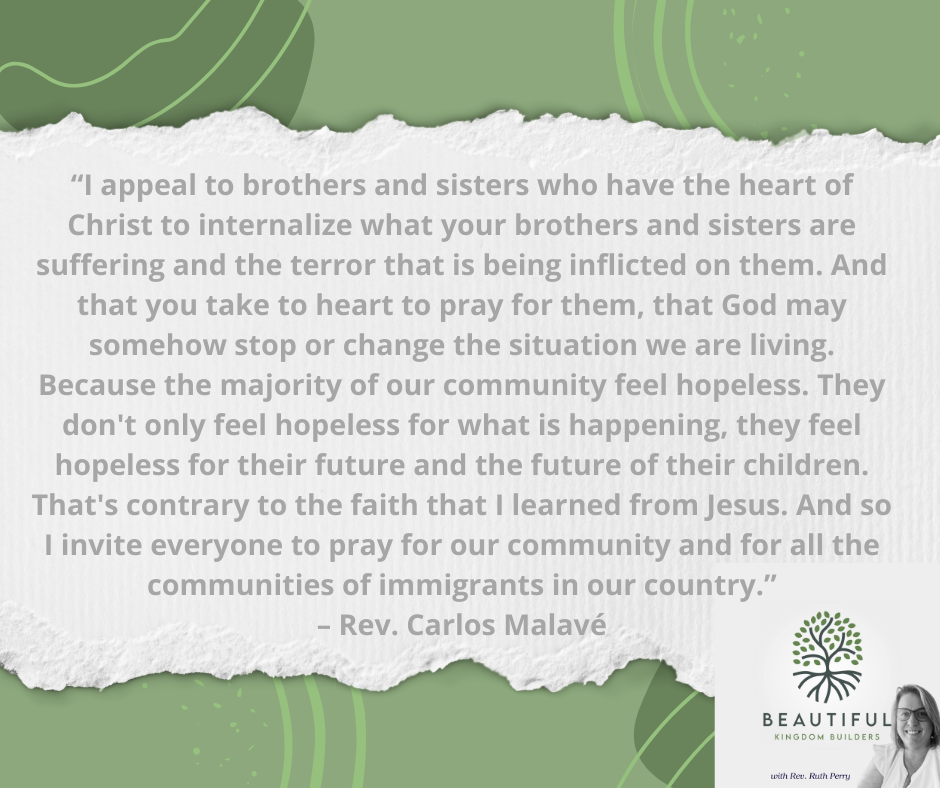
Yes, there are many things we need to do to address all these issues. But let’s begin with praying. As we know, if I’m talking to someone right now, Ruth, who is a believer, and these days I’m kind of going back to use the word and the phrase born again Christian. If we’re talking to a born again Christian, someone that has the heart of Christ. I appeal to brothers and sisters who have the heart of Christ to internalize what your brothers and sisters are suffering and the terror that is being inflicted on them and that you take to heart to pray for them, to pray that God may somehow stop or change the situation we are living because that’s what is happening with our community is that honestly Ruth, the majority of our community feel hopeless. They feel hopeless. They don’t only feel hopeless for what is happening, they feel hopeless for their future and the future of their children.

That’s not, that’s not what I as a born-again Christian, which I consider myself a born-again Christian, what I harbor in my heart. That’s contrary to the faith that I learned from Jesus. And so I invite everyone to pray for our community and for all the communities of immigrants in our country.

Ruth Perry (41:32)
And I hope people will look you up on social media and follow you, Reverend Malavé. On Facebook, Carlos L. Malavé. On Instagram, you’re Rev Malavé. Check out lcnn.org. And also follow other Latino voices, because I think that loving our neighbors starts with listening well, listening to understand and not to defend ourselves and our own perspective on things. But we can expand our perspective if we learn to listen to our neighbors and love them well.

And I’ve been thinking about, as you’re talking about the terror and the trauma that our Latino Christian siblings in the faith are experiencing right now. When my family moved to Bolivia, I was nine years old. And one of my first memories there is some women suspected of pickpocketing on the bus and the police dragged them off and just began beating them in the street, denying them due process, being militarized and violent there. And it was a traumatic experience for me at nine years old. And I never would have imagined that I would see something like that here in America.

But as I’ve listened well to my Christian siblings and others, know, black and brown bodies here in America have been treated like that systemically, historically all along. And so we need to learn to listen to our neighbors well. And we ought to be grieved by that as Christians and we ought to be fighting for justice. Do you have any last words you’d like to share with us, Carlos, before we sign off?

Carlos L (43:00)
Thank you again for this opportunity to share with you today and to be able to share with your audience. And I encourage everybody to continue supporting Ruth’s Podcasts because I know your faith will be enhanced and even challenged. And that’s a good thing.

And so I appreciate this opportunity. And just last thing I’d like to say is to my brothers and sisters who are listening to us, please open your heart. Open your heart to the Spirit of God and ask for wisdom. If there’s one thing that I pray today and I invite and encourage my fellow leaders and pastors is let’s seek wisdom. Let’s seek wisdom together.

Wisdom that comes from above. I often feel that we have lost a sense of wisdom. But even worse than that, that we have exchanged God’s wisdom for the wisdom of the world. And we will be, as we are right now, in deep troubles if we rather follow the wisdom of the world, the worldly wisdom, and not the wisdom that comes from the Holy Spirit.

That’s my prayer for all of you who listen to open your heart to the Word of God that even comes directly to us through the wisdom that the Holy Spirit brings to us. Thank you, Ruth.

Ruth Perry (44:20)
Thank you so much, Carlos. God bless.

Carlos L (44:22)
Amen.


If you enjoyed this episode, please Subscribe to The Beautiful Kingdom Builders podcast on your favorite platform, rate and review it, and share it with a friend! Every little bit of encouragement helps! You can watch our episode on YouTube or find it on SpotifyApple PodcastsAmazon Music, and more

Find Rev. Carlos Malave on Facebook, Instagram, and at lcnn.org.

009 I Bob Edwards, MSW Explains Socialization and Its Impact on Faith

My guest on the podcast today is Bob Edwards, MSW. Bob holds degrees in Religious Education, Social Development Studies and Social Work. Bob has been a Social Worker since 1996, providing psychotherapy, and he was the Director of Counseling Studies at a multi-denominational Bible College, teaching courses in Psychology, Sociology and Counseling. Bob and his wife, Helga Edwards, MSW, have a ministry together called Awake Deborah, in which they use their gifts and training to help people experience freedom and wholeness in their lives and relationships. Helga Edwards has many helpful teachings posted on her YouTube channel, and they had a podcast together at awakedeborah.podbean.com

Bob is another friend I’ve made in my fifteen years long online search for beautiful examples of Christianity. I asked Bob to explain social conditioning for the podcast because it was revolutionary for me to learn from him how this process had contributed to my own patriarchal worldview, and has been impactful in my healing from that. I’m so excited to share this episode with you all today and hope you find it enlightening and beautiful.

Here is the YouTube video I referenced in our conversation: The Origins of Male Authority in the Church, in which Bob describes the process of social conditioning at greater length, and draws historical examples of theologians interpreting the Bible through patriarchal cognitive lenses.

I wrote detailed notes from his video in this post: Bob Edwards’ Fascinating Discussion on the Origins of Male Authority in the Church.

Other works I’d like to recommend from Bob and Helga Edwards:

I read Bob’s excellent book, A God I’d Like to Meet: Separating the Love of God from Harmful Traditional Beliefs, in 2014, and reviewed it here. Edwards’ book explains how Christian theologians, specifically Calvinists, have been influenced by ancient Greek philosophy, which has warped the way they view God. You probably could not find a Christian who would disagree with the statement that “God is love” (1 John 4:8), but how many Christians live as though they are a bug under the thumb of God? This is a really helpful book especially for those who have experienced spiritual trauma or abuse and are looking to heal their image of God.

I also really enjoyed reading Bob’s work of historical fantasy, Keeper of Relics which imagined a harshly matriarchal ancient world in which a young woman challenged oppressive tradition.

Bob and Helga together wrote The Equality Workbook: Freedom in Christ from the Oppression of Patriarchy to help readers identify and remove patriarchal bias from Bible translations. They demonstrate that patriarchy is a human tradition rooted in prejudice and they help women recover from the harmful effects of patriarchy.

Bob is currently working on a series called God Decolonized, exploring historical examples of people in power using the Bible to justify oppression and exploitation. I’m currently reading Issue 3, in which he threads the link from Puritan theocracy to Christian nationalism today. Some of the Puritan quotes are distressingly hateful!

If you enjoy this episode, please Subscribe to The Beautiful Kingdom Builders podcast on your favorite platform, rate and review it, and share it with a friend! Every little bit of encouragement helps! You can watch our episode on YouTube or find it on SpotifyApple PodcastsAmazon Music, and more! Here is the video of our podcast recording:

TRANSCRIPT:

Ruth Perry (00:16)
Today’s conversation is one that feels deeply personal to me because we’re talking about something most of us don’t even realize is happening inside us, socialization, and more specifically gender socialization and how it shapes the way we see the world, the church, and even scripture itself. My guest is Bob Edwards, a social worker and psychotherapist with degrees in Religious Education, Social Development Studies, and Social Work.

Bob has been practicing since 1996, and formerly served as Director of Counseling Studies at a multi-denominational Bible college where he taught psychology, sociology, and counseling. And he and his wife, Helga Edwards, also a social worker, lead a ministry called Awake Deborah, where they help people experience freedom and wholeness in their lives and relationships.

In this episode, Bob helps us understand how the norms of our culture get inside us, how they become automatic, invisible lenses through which we interpret everything. We talk about how patriarchal socialization can shape the way we read the Bible, the split-second judgments our brains make before even aware of them, and the real spiritual and emotional cost when people, especially women, are told their God-given gifts don’t belong.

I’m grateful especially that Bob was willing to have this conversation as he is dealing with long COVID since 2021. We kept our conversation brief to accommodate his health limitations. But if you want to learn more about this topic, there is a link to an older and much longer teaching from Bob on this topic in the show notes and on my blog, thebeautifulkingdombuilders.com. This is a conversation about unlearning, about healing, and about removing some of the stones that have stood in the way of people fully walking toward Jesus.

Ruth Perry (02:12)
Thank you so much for being on the podcast today, Bob. Let’s just dive right in. My first question for you is what is socialization generally and gender socialization specifically?

Bob Edwards (02:15)
Okay, well, socialization is really the process by which groups convey their norms to its members. You know, there’s lots of examples we could think of, everyday examples. One would be table manners, you know. When I was growing up, in our household we learned that when you cut your food you held your fork in your left hand.

But then you had to switch to the right hand before you ate the food. Apparently that was in etiquette books from the 1920s and the 1950s. yeah, Another everyday example of socialization is just like rules of the road. North America, you drive on the right. And Great Britain, drive on the left.

And maybe there was a reason for it at one point, but it’s just a custom and gender socialization relates to how different, you know, each gender functions in a social group, what the norms are, norms and customs for that gender.

Ruth Perry (03:20)
How does that socialization process happen?

Bob Edwards (03:23)
Yeah, well there’s essentially three processes that happen. One is overt instruction. So like I mentioned the etiquette books, you’ll be instructed how to function in a society. The other is role modeling, where people just act as if certain things are true, certain things are a given.

And the third process is really called reinforcement. So if you do what the group expects of you, there’s different ways you can be rewarded. And if you don’t do what the group expects of you, there’s different ways you can be punished is probably the best way to say it. You know, if I would eat with the wrong hand, for example, one of the adults at the table would give me the look, you know. And the look is a form of reinforcement. And if you drive on the wrong side of the road, you’re likely to get immediate feedback from your environment of a variety of kinds, from natural consequences to law enforcement. So, yeah, those are essentially the three processes that help us be socialized into a group’s set of norms.

Ruth Perry (04:28)
So your group will socialize you and then how does that become internalized?

Bob Edwards (04:32)
Yeah, that’s a good question. So at some point, these external messages, we take ownership of them ourselves. And really, you can tell when that has happened by how you feel when you see somebody eating with the wrong hand. If it’s like I see a person taking a bite and the fork is still in their left hand and it feels wrong to me, then I know that I’ve internalized that. What used to be an external message is now something that’s coming from within.

Ruth Perry (05:01)
How does this create a cognitive lens which affects our automatic perception?

Bob Edwards (05:05)
Yeah, so it’s interesting. Psychologists refer to it as automatic appraisal. So it’s like, again, the example of the fork in the wrong hand. My experience will be that I just see that as wrong. You know, I just I’m watching it and it’s wrong. And it feels to me that the wrongness is coming from outside. But in reality, the sense of wrongness is coming from inside. It’s coming from the norms that I’ve internalized through the socialization process. And so in a way it affects how we’re interpreting the world around us constantly. You know, it’s just like a mental lens is another way of saying it that interprets everything that we see. And we think we’re just seeing the world as it is, but in reality we’re seeing the world as we’ve been socialized to see it, if that makes sense.

Ruth Perry (05:55)
It does well. So then how does that impact our view of the world around us more specifically?

Bob Edwards (06:00)
Well that’s, yeah, so it’s interesting. You know, with this driving example, I was just watching a clip recently of, I’m like a motorsports enthusiast. My dad used to sponsor races and stock cars and things like that when I was growing up, so that’s always been a part of my life.

And I remember when I was quite young, was in the mid 70s, and we went to see a drag race because he sponsored a drag racer back then. And there was a big deal about one of the drivers named Shirley Maldowney. So don’t know if you’ve heard of her, but she won the Top Fuel Drag Racing Championship which is sort of the highest level of competition three times and drove this beautiful pink dragster and at the time I didn’t realize why that was such a big deal but she was the first woman that was allowed to compete like women were banned from the sport they weren’t legally licensed and she really broke through that and so she’s kind of a hero of mine for doing that. It’s interesting that whole subculture, that drag racing motorsport subculture, they would look at men and see drag racers, people who can drive well and they would just look at women and think, nope, that’s not for you. You can’t do that.

And it becomes a little bit more serious in other cultures, although in a similar way. For example, Saudi Arabia didn’t allow women to period, until I think it was 2018. And there’s a province in Afghanistan currently where women are banned legally from driving, can’t get licenses. you know, the reasoning given for that is that they’re taught religiously that women are incapable of learning the skill of driving a vehicle. And in Saudi Arabia, they thought it was mixing genders for women to drive in a way that would lead to moral corruption.

So, you know, and, unfortunately we have things like that in our culture as well. We have, you know, women can drive, thankfully, but there’s lots of things in some churches that women can’t do. And most of those things are related to teaching, preaching, and leadership. And people have these lenses. And I don’t think they understand that they have these lenses many times. And I don’t think they know where they came from either. But they just look at women and think, you know, things come to mind like servant, helper, right? We’ve heard that term help meet, which is sort of bad English translation of something in Genesis. That language in Hebrew and even later in Greek just isn’t there. It’s an English invention. And these things really impact men and women every day in the Church and in the world.

Sometimes people look at the Bible and they think they see this gender hierarchy. But if you look very carefully at the text, especially in its original languages and context, the hierarchy isn’t coming from the text. It’s coming from the person who’s reading it. It’s coming from their cognitive lenses. It’s coming from their gender socialization.

Ruth Perry (09:18)
I relate to all of that because I was raised in a patriarchal culture. I’m assuming that most people are. And so for the first 30 years of my life, I read the Bible through a patriarchal lens. And it just made sense. It made so much sense that that was how the world worked and that that’s what God meant. And so, yeah, I can totally get how that happens.

You’ve talked about these automatic responses with our cognitive lens, how quickly it happens. Can you explain how quickly we draw these conclusions?

Bob Edwards (09:49)
Sure, yeah, for us it feels instant. So we don’t recognize that the meaning is coming from our lenses at all. We think we’re just seeing the world as it is. But we’re really not. We’re seeing the world as we’ve been socialized to see the world.

And I remember I was reading one neuropsychology text many years ago and the time was measured in millionths of seconds. So actually I think it was a fraction of a millionth of a second that our brain assigns those meanings. In fact it’s called stimulus coding. And one of the reasons we don’t realize it’s coming from inside is because it happens so quickly.

But also because it’s subconscious. We don’t do it on purpose. Our brains do it automatically, subconsciously, and almost instantly. So, it’s tricky.

Ruth Perry (10:39)
So that an example of that then would be seeing a woman behind the pulpit and just immediately saying no.

Bob Edwards (10:45)
Yeah, I’ve seen that, unfortunately, where I was at a Bible college teaching for many years. And there was an occasion at a chapel where a woman was speaking and teaching and preaching and to men and women. And one of the male students from a denomination that is very patriarchal just stood up and walked out and you know spoke to him afterwards and that was his reaction to seeing a woman teaching men. And that was very eye opening to me. And of course then there are so many other denominations represented who didn’t have that reaction because that wasn’t part of their training, it wasn’t part of their socialization.

Yeah, and when I was teaching there, you know, I saw and heard a lot of things that really broke my heart, to be honest with you. Women who felt called to express their spiritual gifts, which come from God, right? Like our spiritual gifts come from God, they don’t depend on anything from us. At least of all our gender, you know, that’s not where the power of God, the love of God, the grace of God comes from. We’re just the vessel, We’re clay vessels and all that grace and love and spiritual power comes from God. yeah, women were being told by some of their male classmates that their call to ministry must come from the devil.

That was one of the worst things I think I heard. And they got reinforcement, like negative reinforcement sometimes from their peer group anytime they would try to express their gifts. And I remember praying about that because it was so disturbing to me. And you know, God, what do we do with this?

And I had this really powerful vision while I was praying. It was so vivid, know, it kind of like I was dreaming, but I was awake. And I saw Jesus with his arms open, inviting all these women to come to him, you know, and on the path to Jesus were all these sharp stones and the women were cutting their feet on these sharp stones and some were still limping towards him. Sorry.

But others left the path altogether and were just sitting down bleeding in tears. And so in that experience I just ask God, what can I do?

I haven’t thought about this in a while, sorry. It’s like when I think about it I relive it.

He just said, Bob, you can remove some of the stones. Just start picking up stones. Right? And so, you know, I said, okay, yeah, I will do my best. I don’t do it perfectly. But God helping me, that’s what I feel like He’s asked me to do, you know, is to remove the stones. So, know, Helga and I have done that together. That’s my wife and I try to do that, again by example and through teaching, you know, and through encouragement. yeah, I felt like God really met me there, gave me some direction.

Ruth Perry (13:53)
What a powerful vision and what a powerful calling. That was a calling from God and you’ve certainly been fulfilling it. And you’ve moved some stones for me, Bob, that I’m really grateful for because it’s quite the process trying to unlearn that conditioning. And I didn’t realize just how powerful my background was in my life until I encountered

Bob Edwards (14:05)
Thank God. Yeah, for sure.

Ruth Perry (14:16)
your work about conditioning and I’m really grateful. I’m going to share a YouTube video in the show notes where you talk about this in length and you go into different theologians who and translating scripture through a patriarchal cognitive lens. And that’s just really important for us to know how does awareness of our socialization and our cognitive lenses weaken or strength and our faith, do you think Bob?

Bob Edwards (14:40)
Well, So I do want to touch on one of those theologians, you know, because it’s been so prolific in his writing and his influences, Saint Augustine. And he’s very open in Confessions, he writes something called Confessions, about the influence of Neoplatonism on his theology. And he had a mentor named Ambrose who introduced him to this.

So he had a role model that embraced it and then he had instruction, you know, and he got all kinds of positive reinforcement for choosing this path. And he says that he made sense of the Bible and God through the lens of this ancient Greek philosophy. And unfortunately, that particular ancient Greek philosophy is extremely patriarchal.

And just to give you, for instance, when he read Genesis, where Adam says of Eve, this is bone of my bones, flesh of my flesh, you know, meaning, at last somebody like me, right? Somebody comparable to me. Augustine didn’t see it that way. And he writes about this in one of his letters and says, so here we see woman stands for flesh.

Therefore the man must stand for the spirit. Therefore, just as the flesh must be subordinate to the spirit, women must be subordinate to men.” So that’s what he saw when he read that passage. But that’s not what the passage says. That’s not what’s there. But he evidently didn’t recognize his lens, which is so often the case.

And so you ask like, can it does this strengthen or weaken our faith when we explore these things? And I mean, for me, it was a tremendous encouragement to my faith because some like our culture is is fallen. Like humanity has fallen into sin and it is our cultures are are filled with injustices and biases and prejudice and fear and a felt need for control. And we can project that onto the Bible, start calling things like that God’s will. Sometimes we’re even seeing that today, even at a national level, things we’ve seen in the church and been speaking out against, now seeing in government.

But when we do this kind of work, right, with humility and prayer and study, we can begin to peel away these layers of bias, prejudice and injustice that are those sharp stones that stand between us and God. So I do believe it can strengthen our faith and I think it’s God’s work.

Ruth Perry (17:03)
Amen. Thank you so much for being faithful to that calling, you and your wife.

Bob Edwards (17:07)
I’m so thankful

I could be and I’m glad I could do this today. Thanks so much for having me.

Ruth Perry (17:13)
God bless.

Bob Edwards (17:14)
God bless you too.


If you enjoy this episode, please Subscribe to The Beautiful Kingdom Builders podcast on your favorite platform, rate and review it, and share it with a friend! Every little bit of encouragement helps! You can watch our episode on YouTube or find it on SpotifyApple PodcastsAmazon Music, and more!

oo5 I Dr. Roy Ciampa on Paul’s Household Instructions in Ephesians 5

My guest this week is my former Gordon-Conwell Theological Seminary professor, Dr. Roy Ciampa, whose transformative class, Ephesians in Depth, has stayed with me over the years as my faith has grown and changed. In this conversation, we discuss the theological implications of Paul’s writings, the cultural context of the Greco-Roman world, and the significance of mutual submission in relationships. Dr. Ciampa shares insights from his academic background and teaching experiences, emphasizing the importance of understanding scripture in its historical context. The dialogue highlights the beauty of God’s love and grace, encouraging listeners to reflect on their own faith journeys and the role of women in ministry.

I think my favorite thing Dr. Ciampa said to me, was that Ephesians was “written in the key of worship.”

Dr. Ciampa mentions a document he compiled to help students understand first century Greco-Roman views of women and marriage, beginning with Old Testament and Classical Greek texts up through the time of the New Testament, so that NT texts might be better understood in light of the developing contexts. You can read that insightful document here. And find more of Dr. Ciampa’s scholarly writings on his website, viceregency.com.

You can watch our conversation on YouTube, or stream it on Spotify, Apple Podcasts, Amazon Music, and more–find all those links on Podlink! Please like, subscribe, rate and share with a friend if you found this interview helpful!

Transcript:

Ruth Perry (00:16)
This is a new thing for me and I appreciate you being one of my very first guests, Dr. Ciampa.

Roy Ciampa (00:22)
Well, I’m honored to be invited and hope this will be helpful to people.

Ruth Perry (00:26)
What I’m hoping to share on my podcast for my first season is I’m going to go back and have conversations with people who helped me as my faith has shifted and changed over the last 20 years. Because my background is very conservative, complementarian, traditional, But it’s changed a lot over the years through crises of faith and through cognitive dissonance that’s happened and different things that have gone on. And I’m just really grateful that my faith has remained strong because I’ve encountered people like you who’ve helped me to reimagine my faith and think about things differently.

Roy Ciampa (01:04)
That’s nice to hear.

Ruth Perry (01:04)
And so at the time that I had you as a professor, I was a complementarian student, pretty committed to that perspective. And I was an educational ministries student at Gordon-Conwell Theological Seminary. And I think that I took Ephesians as one of my core theology classes. And it’s the only class that I encountered you as a professor. But looking back on my seminary experience, I really loved that class so much and the book of Ephesians has just remained my favorite book of the Bible.

And I’m really grateful that I had that experience because I didn’t have to learn Greek or Hebrew in seminary as an education student. And this was the only class where we really went through word by word and you taught how to parse Paul’s Greek into English and how to make sense of his run on sentences and you taught the importance of understanding the context of the passage. And I just learned so much from you. And so I’m really excited to talk about that with you today. But I thought before we get into that, I would like to know more about you. I don’t really know what your faith formation was like, your background, where you’re coming from. If you’d like to just go back and tell us a little bit about your own spiritual journey.

Roy Ciampa (02:15)
Sure, I’d be happy to. I grew up in an nominal Christian family. We went to church about once a year because my grandmother wanted us to. I was confirmed in a Congregational church when I was, I suppose, a young teenager. But it didn’t really mean much. I never really understood anything about the Bible.

I came to faith when I was in my first year of college, I owe it, a large part of it, I owe, I think, to next door neighbors who moved in when I was in middle school. Wonderful, dedicated Christians, the Monk family, and they had two sons, one a year older than me and one a year younger, Robert and Stuart. And the whole family just modeled for me, a wonderful Christian faith and love. And so they took me to evangelistic events.

But I didn’t think that I thought I was a Christian. I remember sitting during one, in a roller skating rink while somebody was speaking and we had our heads down and I’m saying that this isn’t for me. I’m already Christian. They’re not talking about me. I’m a Christian. Anyway, it was my first year of college. Some guys shared the gospel with me and I realized that this was the message that had transformed their lives and their family and I realized it was true and I was in need of it and so I trusted in the Lord and I was baptized, came to faith, I was discipled.

But I was in a very conservative context. I was listening to the guys that discipled me had me listening to some fundamentalist preachers. John R. Rice wrote a book I Am a Fundamentalist and after a year I felt like God was calling me into ministry and I went to Jerry Falwell’s school at the time was called Liberty Baptist College for a year. And then after a year there I transferred to Gordon College where I did my undergraduate degree.

By the time I graduated from Gordon College, well certainly I was no longer a fundamentalist, was I would say mainstream evangelical and probably still conservative on women’s issues but very open to other ways of understanding that issue.

I don’t really remember at what point, if it was near the end of my college experience or beginning of my seminary experience, I went to Denver Seminary, had some great mentors there. And I know while I was at Denver Seminary, I became a convinced egalitarian.

And that came out of various kinds of experiences. Part of it was coming to have a much better understanding of the world in which the New Testament was written, and especially Paul, in the context of his letters and the things that he says about women, among other things. And part of it was just understanding more broadly what theology would say about how I should relate to my own wife and other women as well.

But maybe we’ll get around to that later. After seminary, my wife and I were appointed to go overseas and we had two kids by then and we took our kids and we went to Portugal where I trained pastors. And overall, our time in Portugal span about 12 years, and in the middle of that, I spent a couple of years in Scotland doing my PhD.

I had wonderful time training pastors and Christian leaders in Portugal, worked with the Bible Society there to help with their contemporary Portuguese translation of the Bible. And then I was invited to go teach at Gordon-Conwell in 2001. So I taught the New Testament studies at Gordon-Conwell from 2001 to 2014. At a certain point became the Chair of the Division of Biblical Studies there.

And then after or 13 years there, I went and worked for four years for American Bible Society, training Bible translators and Bible translation consultants around the world. I still taught for Gordon Conwell on weekends while I was doing that, but my main gig was training Bible translators and Bible translation consultants. So that was a great experience, but I missed the full-time academic community.

So in 2018 I accepted the invitation to take on the role of Chair of the Religion Department which soon became the Department of Biblical and Religious Studies at Samford University in Birmingham, Alabama. But.

In 2024, I retired and moved back to New Hampshire, which is where my wife and I had had a place for a while, and it’s our happy place. And so I’m now a professor emeritus at Stanford University, and I teach a course a semester for Gordon Conwell. I’m teaching Interpreting the New Testament for Gordon Conwell on Thursdays right now. So I mean, that’s that’s more than you wanted, probably, but that’s kind of the overview.

Ruth Perry (06:38)
No, that’s great. Congratulations on retiring and then continuing your work.

Roy Ciampa (06:44)
Thank you. Well, there’s lots of what I’ve done that I love. I’m still writing books and articles and teaching one day a week scratches that itch. so it’s fun.

Ruth Perry (06:53)
I’m a Gordon College graduate myself. I was a music major there and the reason why I decided to study music was because I loved the church and I wanted to be in ministry and that’s where I saw women serving in the church. So I studied music and then I decided to go to Gordon Conwell in 2003 when I graduated from Gordon College because I still loved learning so much and I wanted to continue learning and in my conception of my ministry life, I always conceived myself as just being in volunteer ministry in the church. And that I would be a pastor’s wife, likely, or a missionary’s wife. I really wanted to live overseas. I went backpacking through Europe while I was in college, and Portugal was my favorite. I loved Portugal.

Roy Ciampa (07:41)
It’s a great country.

Ruth Perry (07:41)
And so I would have liked to have been a missionary or a musician, but those were really the only two ideas that I had in my brain that a woman could do in the church. I knew that I loved the church more than anything and I really wanted to serve the church. So that’s what brought me to Gordon-Conwell and brought me to your classroom. And it sounds like it was early on in your teaching there.

Roy Ciampa (08:00)
Yeah, it was early on at Gordon-Conwell. I taught for a number of years in Portugal, but that was in my early years at Gordon-Conwell, yes. And I remember that course called Ephesians in Depth, as I recall.

Ruth Perry (08:09)
It was in depth for sure. Yes. I remember we went word by word and we would, I can’t even remember how to explain what you did with us in the class. I was trying to find my class notes because I know that they’re in my basement somewhere. But I remember we parsed every sentence and figured out what the structure was. And you really brought it.

Roy Ciampa (08:29)
Ha

Ruth Perry (08:37)
It was hard work and it brought the book to life for me.

Roy Ciampa (08:41)
That’s so kind of you to say. I’m grateful to hear that.

Ruth Perry (08:43)
And it’s such a beautiful book. Ephesians, it just, the words that come to mind when I think about Ephesians is, Paul keeps talking about peace and love and unity and the power of the Holy Spirit and all the blessings that we’ve received from God. And it’s just such a beautiful theological grounding of then why we should follow Christ and live in a way worthy of the calling we’ve received.

And so I don’t know how much you want to talk about Ephesians itself before we get to the household codes in Ephesians 5. But what I really want to talk with you too for my Beautiful Kingdom Builders audience is the context of the book of Ephesians and what was going on in the cultural world at that time that would have helped the people who are hearing Paul’s message in that day understand it maybe differently than we understand it today.

Roy Ciampa (09:35)
Well, yeah, there’s a lot to talk about. So many different aspects of it. And I think one of the things, actually in our church, we’re in a small group right now that’s going through Ephesians. And so it’s been kind of fun to do that in a church Bible study again. But one of the things I think that’s key to Ephesians, you just have this joyful, kind of, I would say worshipful kind of tone to the whole thing.

Many people have pointed out that the letter has a different style than most of Paul’s letters. It has these kind of run-on sentences and these kind of complicated sentences. There’s lots of what we call pleonasms where you could say something simply, but in a pleonasm you could put up two or three different ways of saying it within the same sentence. So over and over again Paul will say we have kind of this blessing of redemption, the forgiveness of our sins. And it’s like, well, those are two different ways of talking about the same thing, or he’ll talk about within one line, he does this a couple of times in the opening part of Ephesians, that everything’s happened according to God’s purpose and his will and his choice. It’s like, well, those are just three different ways of saying God did what he wanted to do.

And I’m reminded that, We find examples of this in various contexts. We find it in poetry and we find it in worship music. An example I typically use is the song Majesty, Worship His Majesty. And if you go through that song over and over again, it finds different ways to say the same thing in new words. Kingdom authority, majesty, kingdom authority, so exalt, lift up on high. Those are two different things, they’re not. Exalt, lift up on high, the name of Jesus. Magnify, come glorify. What’s the difference between magnifying, it’s all the same thing.

Singing this is just a worshipful, excited, rich, different way of expressing yourself. And Paul begins the letter with what’s called a Jewish Baruchah, which in Hebrew would be blessed, be like Baruch HaTah, Adonai Eloheinu, blessed as the Lord our God. he starts out, blessed is the…

God and Father of our Lord Jesus Christ has blessed us in the heavenly realms with every blessing in Christ. And so I think the style is different and I think it’s different for a purpose because Paul’s wanting to express his theology in a very worshipful almost liturgical kind of way.

And it’s remarkable that he’s doing that while he’s under arrest. He says he’s in chains, which reminds us of Acts of course, when they’re imprisoned in Philippi and they end up singing songs and praising God in prison. And here Paul is, he’s in prison and he writes a letter and he writes it in the key of worship. And partly that’s because just who Paul is and partly because he’s writing to readers who are Gentiles, who are so far away from where Christianity began in Jerusalem and Judea. And they’ve got to be thinking as Gentiles, like their spiritual leader is now in prison and could lose his life.

What does this mean? Have they gotten themselves messed up with something they shouldn’t have? Has a train gone off the rails and they’ve got to be concerned about Paul. They’ve got to be concerned about what all this means. And here’s Paul, he writes from prison, he’s like, God’s plan is working itself out in this wonderful way and it’s such a blessing to me to be a part of this. let’s praise God for all the blessings that we have. And let me just list off some of these blessings for you.

And it really is, I think, meant to reassure the readers that… the train hasn’t gone off the rails, that God is in charge, that everything that they’ve experienced is part of God’s plan of redemption and of reconciling Jews and Gentiles together and to God, and that Paul is not at all, know, fretting or depressed or himself concerned that something’s gone wrong because he’s in prison, but he sees God’s hand in all of this. So I think that’s a, for me, that’s a very important part of the background.

And then you have to be careful because I’m tempted to try and lecture my way through a whole semester’s worth of stuff on Ephesians in one little conversation. But I do think, you know, that most people recognize that two halves of the letter have different tones and sometimes they describe the first half as doctrine and the second as practical teaching.

But an important key is that it’s not just that Paul decided to talk and discuss theology for a while and then look at his watch and said, well, that’s maybe enough theology for them. Maybe I should give them some practical stuff. And so let me talk practical stuff for a while. But the theology underwrites the practical part. That is, the theology, the first part is there to support everything he’s going to tell the church that they ought to be doing.

And the second part, they are organized organically related to each other. And the whole first part is about God’s grace, his mercy, his love, how he hasn’t treated us the way we deserve when we were, you know, children of wrath by nature. He hasn’t treated us that way, but he’s shown us love and mercy and grace and blessing upon blessing upon blessing. And then we get in the second half of the letter. And in my understanding, the second half of letter is primarily all about imitating God.

And so we get that theme early on how we should be imitators of God. We shouldn’t live like the Gentiles live. That’s one of the themes. But we should be imitators of God. And then he talks about how God has shown his love to us in Jesus Christ who gave himself for us and his love for us. And so we have sections that talk about how we should be one, united together as one body.

And then we have material talking about how we should and love and we should walk in the light and then later how we should walk in wisdom and then finally the last part is where we should put on the full armor of God and we look at those things they come what do these things have in common being one walking in love and light and wisdom well love and light are two main attributes of God God is love God is light

And then wisdom is another very well-known attribute of God, the all-wise one. And there’s large sections of scripture dedicated to wisdom and Proverbs 8 and elsewhere. And that’s understood to be an attribute of God. And then you think,

When we walk in love, we’re imitating God. When we walk in light, we’re imitating God. When we walk in wisdom, we’re imitating God and His wisdom. And then you realize that the full armor of God we’re supposed to put on is not just armor that God gives us, but the Old Testament background tells us this is the armor that God puts on. He puts on a helmet of salvation. He puts on a breastplate of righteousness. When he goes and he fights spiritual battles for his people. So even when we put on our spiritual armor, we’re still imitating God.

That earlier part about being one, it’s like, that’s right, God is one. So when we’re one, you there’s one God, one Lord, one baptism, and when we act as one, we’re also imitating God. So one of the greatest ways we imitate God then, when you understand the relationship between the first half of the letter and the second half, is by treating other people the way he’s treated us.

He hasn’t treated us as he could have, but he treated us with love, with mercy, with grace, over and over again. And this ends up becoming very important for, as you referred to, the household codes, because they’re a main theme is about how people in charge with authority treat people that in that culture were under them, wives were under their husbands and children under the parents and slaves under their masters. And so one of the main themes that comes out there is, again, the emphasis tends to be on the person with power, treating the one with less power with grace and mercy and not being harsh with them. But I mean, that raises all kinds of other questions about why do we have household codes and what’s this about?

We’re talking about household codes, we’re talking about slaves and masters. And we don’t have slaves and masters in our household. We think of those as something outside the family. You get your family, and then you get your employees or other people. But of course, that was part of the family. But hey, I’ve been going on for a while now, Ruth, so maybe feel free.

Ruth Perry (18:02)
No, you’re cooking. I’m enjoying it immensely. I was thinking about back to your class, I remember that before we got into the household codes, you started that passage in Ephesians 5.18, be filled with the Holy Spirit, singing songs and hymns and spiritual songs to each other, making music in your heart to the Lord and always giving thanks to God the Father for everything in the name of our Lord Jesus Christ and submitting to each other out of reverence for Christ. That all of those things were under that same heading of be filled with the Holy Spirit.

Roy Ciampa (18:42)
Yes, it is. And being filled with the Holy Spirit is under the heading of walking in wisdom. So, because it’s one of the things is if you look for the term walking, which is often translated as live, like live in love or live according to light. The metaphor is walking in the light and walking in love and walking in children of light or walk wisely. And then the wisdom part underneath that is all the stuff about being filled with the spirit and submitting to one another.

And then so all that stuff about husbands and wives and parents and children and masters and slaves comes under the submitting to one another part, which comes under the being filled with the Holy Spirit part, which comes under the walking in wisdom part.

And it’s Paul providing his readers with wisdom about how to live in family in the first century Ephesian or, you know, Greco-Roman context. And of course, it’s important that context is radically different from ours.

Ruth Perry (19:44)
Can you describe that context for us.

Roy Ciampa (19:47)
Sure. Well, in a few different ways. Maybe one way to start is by, just as we were already kind of hinting at…

that when we talk about a household code, we do talk about husbands and wives and parents and children and masters and slaves because the household was very differently structured than we think of it today. That many households, they had slaves within the household and they’d have also freed men and free women in some cases in the household as well. And so we think of a household typically as, you know, parents and their children and nuclear family.

And sometimes we think of the extended family as well. Maybe there are grandparents around or something. But we don’t think of parents and children and slaves and freed men and women as part of a household. But that is a part of what a fairly well-to-do or a somewhat well-to-do household would have all those components. And then, you know, we realize

When people preach through Ephesians, when they get to the stuff about slaves and masters, they realize what we don’t approve of masters and slaves today. And so if they’re to preach on that, they kind of adapt it and say, well, this might apply to like employees and employers and that sort of thing. And so here we can get some wisdom for how we can relate to each other as employees and employers. And maybe there’s it’s OK. But it’s really important to point out that employees are not slaves and employers are not masters. And so you have to make adaptations.

You can’t just say all the employers shouldn’t treat the employees the way Paul thought, you know, masters should treat slaves. And we have to be reminded that Paul’s not endorsing slavery, but early Christians were living in a world where this is just part of the social fabric. They weren’t put in charge. They weren’t asked to take over the social fabric and restructure it. They had to learn how can they live as Christians within that social fabric and within these institutions. And so Paul provides wisdom for those who are in these situations.

But as I was saying, when we get to that stuff about masters and slaves, people say, we have to make adjustments. We can’t just apply that to employees and employers because that’s not the same thing. But when we preach about husbands and wives, people look around and say, I know husbands and wives, and many of us will say, well, I’m a husband or I’m a wife and I have a wife or a husband. And so they’re all around us. So when he starts talking about husbands and wives, we’re like, okay, we know what he’s talking about.

This is something very familiar to all of us, except that it isn’t because marriage has evolved in many ways. And so to go back and realize that in the Greco-Roman world, Men didn’t typically marry until they were 28 to 30 years old. And partly because there was no expectation with the double standard that’s typical in all of history, the double standard with regard to sex is that men weren’t expected to remain pure or virgins until marriage. They had access to prostitutes and household slaves and other sexual outlets and that wasn’t considered a problem by most people in the Greco-Roman world. Whereas women were expected to be married shortly after going through puberty.

When I was in class, I have like a 40 page document, you may or may not recall of this kind of material from the Old Testament and quotes from the Greco-Roman world and different sources where people are talking about husbands and wives and it talks about age at marriage and it talks about, you know, the understanding that it’s good if a woman or girl can know how to carry on a conversation and maybe do a little bit of sewing, a little bit of cooking, but that’s about it because she’s supposed to learn everything she learns from her husband that she’s supposed to be like a tabla rasa, she’s supposed to be like a blank slate on whom the husband can leave his impressions.

I was just reading, reviewing again because something came up on social media. I don’t remember what it was anymore, but it was about, that’s what it was, this woman’s book recently. A woman wrote a book on misogyny in America and the publisher accidentally put out an ad or an email inviting people to submit for exam copies. whoever prepared the text for that forgot to replace the name of the author from a previous book they must have worked on. And so they had the title of the book in the book cover, but the author’s name was a man who hadn’t written anything like this, who writes in very different subjects.

So here’s a book on misogyny in the church, and the publisher puts out something that attributes it to a man instead of the woman who wrote it, and reminded me of this ancient… thing about somebody who’s talking about some man’s wife who’s a man who’s great at poetry and he’s presented some poetry from his wife and he claims that his wife wrote this wonderful poetry and this person’s saying it’s great poetry but you know I’m not sure if his wife really wrote it but either way the husband deserves the credit because either he’s the one who really wrote it or He’s the one that taught her.

So whatever the woman produces, it’s always back to the man. Because again, she’s expected to have learned whatever she knows through her husband, a woman getting married right after puberty and a man not marrying until he’s 28 or 30 years old. There’s a huge difference, not only in age, but maturity, knowledge of the world and in the Greco-Roman world, the extent to which women were expected to be more or less confined to the home, whereas men could go anywhere and could have a greater education so their knowledge of the world is different. Their human development at marriage and then throughout marriage. You might say, 10 years later it’ll be different. Well, 10 years later they still, they would have already formed a kind of relationship where he’s practically like a parent.

The husband’s practically a parent or Ben Witherington describes it as almost an uncle-niece relationship between a husband and wife at that time. And that changes a lot. I mean, that helps you understand all kinds of things in the New Testament when people are talking about how husbands and wives should relate to each other. It’s a significant thing in terms of submission if the wife has always only been kind of tutored by her husband and taught by him and mentored by him.

You know, three stages of human development behind him, then it’s natural that the man’s going to be treated as though he’s more knowledgeable, wiser, more experienced, better able to provide any kind of leadership needed, and that that’s the role that he should have. Which brings us back to that whole thing about love and mercy.

One of things that I realized when I started looking through these texts and thinking about it more was if one of the main themes of the letter is that we should treat each other as Christ and God has treated us, if my wife is my peer, which is something that just was not normally ever the case in the Greco-Roman world, right? We were just talking about that. But my wife is more or less my age. She has the same experience of the world. She hasn’t been cooped up at home. She’s got college education. She has, a master’s degree. She’s wiser than I am on many things and just as intelligent as I am. If she’s my peer in every way, does Jesus, does God really want us to pretend as though I’m much wiser and more knowledgeable than she is and better able to lead in every situation than she is?

Because that was the traditional slot of a wife in first century Ephesus and the slot of a husband in first century Ephesus or should I actually treat her for who she really is? And to recognize her strengths and her knowledge and her wisdom and her abilities. And this relates to something I’ve sometimes referred to as the mapping of identities. That is, we look at women today and we map onto them the identity we find of a wife in the first century Ephesus. We look at a husband today and we map onto them the identity of a husband in first century Ephesus. And we do that in other ways as well. I have an whole article about ways in which this mapping of identities can create real problems.

But I don’t think I should ask my wife to try and fill a slot from a different culture and time, asks her to treat me and asks me to treat her as though we are so different, as though we are as different as the first century Greco-Roman husband and wife, when in fact we’re actually peers. And then I’d go back and realize that if this whole second part is about learning how to treat other people…as God has treated us, and I realize, well, even if you look at the household code, the instructions to husbands and wives aren’t exactly the same as the husbands to parents and children, and neither of those are the same as the instructions to slaves and masters. So Paul recognized that although we’re all supposed to be Christ-like and treat others in Christ-like ways, the nature of the relationship is going to impact what that looks like.

And so the first century Greco-Roman husband-wife relationship is different from the parent-child relationship is different from the slave-master relationship. So Paul provides different instructions. So then I begin to think and realize, well, then we can treat this as a case study.

We have at least three case studies and what it means to apply Christ-like, God-like love and mercy and grace to other people. And it’s one thing in the marriage, one thing with the children, another thing with masters and slaves. Maybe it would be something else if it was with a spouse who is my peer and who is as intelligent and wise and able to lead and do other things as I am, as my same age, same experience of the world, what would it then mean for me to treat her in a Christ-like way and for her to treat me in a Christ-like way and not try to fit them into some…

You know, I’m reminded we have a two and a half year old granddaughter, you know, those cubes you get that have the different shapes, there’s the triangle and there’s the square and the rectangle and the star and you have the blocks, you’re trying to fit them through the right shapes, you know, and I feel like lots of times they’re taking, you know, modern men and women who are very different shapes and we’re trying to fit them into the shapes of the first century husband and wife, male and female.

And those pieces just don’t fit. And the key question still comes back to, if I’m looking at the second half of Ephesians, I’m learning how to walk wisely in acting in Christ-like ways towards people around me.

And so there lots of different relationships. There’s the student athlete relationship. There’s the police officer citizen relationship. There’s the teacher student relationship. There’s the husband wife relationship. There’s the employee employee employee relationship. And all of these we learn how to treat each other in loving ways. But we don’t have to find some first century Greco-Roman slot to fit people into to make that relationship match the one we have.

Ruth Perry (31:02)
I feel like the way my brain works is that I have a sieve inside my brain and when I go to class I learn the information and it all goes away. But for some reason I really latched on to all of that that you taught 20 years ago and then I went off and I got married the next year and it just fell completely into traditional rules because that’s what I grown up with and that’s what had been modeled to me and same for my husband. And so it was just natural to not even think about how we’re going to relate to each other. We just fell into the traditional rules that we had been taught through example and direct teaching. And almost immediately for me as the woman, I could recognize that my voice was diminished, my importance was diminished, and it created some cognitive dissonance for me. But I didn’t, I just tolerated it. I didn’t really rock the boat any.

And then we had another experience early on in our marriage. I’m thinking maybe three or four years after we got married, our church had a really terrible conflict and split. My dad was a pastor and so it was deeply personal. And you’re teaching again on the book of Ephesians. I looked at that experience and it was a traditional church structure with men in leadership. And it was clear as day to me that if the women had a voice and a place at the table in that conflict, things wouldn’t have been as ugly as they were and as destructive and terrible. And so those two things, like my early marriage years and walking through that church conflict,

The importance of your teaching on the book of Ephesians really snapped into place for me crystal clear that if we are walking in a manner worthy of the calling we’ve received, we’re going to submit to one another, male, female, slave, free, Gentile. Like there’s no distinctions that if we’re truly living in the way that God has called us to live, that we’re going to love each other. And that means we’re going to listen to each other’s voices, that every voice has a place and has value.

And we’re going to submit the mutual submission piece that we often gloss straight over and go into, OK, but wives, you’re submitting, and then the husband is the head.

Roy Ciampa (33:12)
Mm-hmm. Right, yes. No, it really, it ends up being, and I hate to say it, but in many cases, not a loving sort of thing, but a very obedience, command-centered sort of thing, which kind of is pushing them back against the grain of the letter as a whole, and the way I understand the theology of the letter as a whole.

By the way, one of the key texts that I think is helpful for thinking about this is in 1 Corinthians chapter 14, where Paul has that part that says, and some people think that this doesn’t belong in the Bible, and I don’t know what you think, but I think verses 34 and 35 are supposed to be there. But it’s the part that says women should remain silent in the churches, they’re not allowed to speak, but must be in submission, as the law says.

They want to inquire about something, they should ask their own husbands at home, for it is disgraceful for a woman to speak in the church. Now Paul had already taught that both men and women could pray and prophesy, right, back in chapter 11. And that’s remarkable in itself because a lot of people look at 1 Corinthians 11, they think, because it starts off about who’s the head of who, who’s the head you know, God is the head of Christ, who’s the head of the man, who’s head of the woman. it sounds like, okay, yeah, very much what sort of subordination here and all this sort of thing.

But when he actually gets into it, he talks about ministry in just two terms, prayer and prophecy. Gordon Fee has suggested, and I think he’s probably right, that those are like big terms for discourse directed to God. That’s prayer and discourse directed at the congregation, which is prophecy. But in any case, those are the only two things he talks about. And he says both men and women can do it. They just have to dress appropriately when they’re doing it. So there’s nothing in there about any kinds of ministries that men can do that women can’t.

But anyway, so he’s already said that they can pray and prophesy. So what’s this all about? They should remain silent. And so obviously he’s not speaking about speaking in general. He has certain kinds of speaking. And in that very passage, he says, if they want to inquire about something, they should ask their own husbands at home. Well, that may be the hint that what he’s talking about is women who don’t understand something that’s going on.

Again, remember the women would have less education, less experience of the world, less knowledge of what’s going on around them. And if they don’t know what’s going on and they’re asking questions that are interrupting them in the church, and in that culture, for a woman to ask another man, somebody else’s husband their question, would be really offensive and would raise all kinds of concerns. Anyway, so.

If that’s what’s going on, Paul says if they have things they should inquire of their own husbands at home. Now, you know, I may have said this when I taught you in class, but I mean, I’ve been teaching since, you know, a full-time teacher since I suppose I started in 1991. And I don’t know how many times I could have said, having both a husband and a wife in my class, I could have said to the husband, if you’re not getting all this, you might ask your wife to explain it to you when you get home.

I’ve very often had husbands and wives in the class and it’s not unusual for the wife to understand things better than to be more academically strong than the husband is. I could never say, you know, if any of the women here don’t understand what I’m talking about, why don’t you ask your own husband at home? not that I couldn’t just say it because it wouldn’t be politically correct, but it would just be stupid.

And I’m not saying Paul’s stupid, The expression assumes a culture and a context where the husband can be virtually guaranteed to know more and understand things better than their wife, which is perfectly reasonable for the Greco-Roman context of Corinth that Paul’s speaking to, not Corinth and Ephesus and the whole world in which Paul’s speaking because of this age and education and experience gap that we talked about at the beginning of our conversation. So a verse like that makes perfectly good sense in that context, but would make absolutely no sense in a world where men and women can both be educated and experienced And so again, I think it really is a problem of, I think, very harmful biblical interpretation when

We end up trying to act as though we are living in roles that were filled by first century people. And we’re gonna figure out how to treat each other in those roles as opposed to treating people for who they actually are. And that’s at the core of love, isn’t it? To know someone, to respect them for who they are, for what they bring to the table, and to learn from each other and to submit to each other.

And that’s really a large part of what effusions is about.

Ruth Perry (38:10)
I think from my background being very conservative, there was a lot of warning against listening to people who didn’t share traditional values because they were being influenced by the culture around them or they were playing fast and loose with scripture and they weren’t taking the word of God seriously or this or that. Like there were so many warnings against listening to someone who might suggest mutual submission or sharing authority between men and women in ministry and in the home.

And in my experience, just with my encounter of you, Dr. Ciampa and since you, many other egalitarian scholars and pastors, they’ve all taken the word of God seriously, and their life has shown the fruit of the Spirit in ways that isn’t always readily witnessed in other people’s lives who are really clinging to the authority structures and having power over others. And so I’m really grateful that I took this Ephesians class with you 20 something years ago and that I remembered all the information even though I compartmentalized it at the time and filed it away and went on with my traditional ways. I’m grateful that it was accessible when I needed it and when things started falling apart. And so then I didn’t just say Well, if this is what Christianity is, I don’t want it. But I could imagine a more beautiful Christianity because of what you had taught me.

Roy Ciampa (39:42)
That’s very kind, but I think that it is very sad to see people turning away from Christianity because the presentation they’ve received is not wholesome, it’s not healthy, it’s not edifying. And too often it is, as you said, very much about power and who can have power. And so it’s very sad to see large parts of a whole generation are more that are turning away from the church because of the way the church in Christianity has been presented, which is sad. And we do think it’s such a beautiful thing. The truth of God’s grace and the grace that he teaches us to live by ought to be something that ought to attract people from all over the globe to this great God of love and grace and mercy who’s worthy of all our praise.

Ruth Perry (40:30)
the message of Ephesians is speaking to us today. And I pray we all have ears to hear.

Where can we find your papers and your writing? Dr. Ciampa, do you have a website or do you have the online presence?

Roy Ciampa (40:43)
I have a website. Yeah, actually, but it’s not it’s just a purely pedagogical sort of thing. And I, and I’ve spent hundreds of hours, if not thousands, thousands in the heyday of my career. So I have a I have a website called viceregency.com And the.com is a joke, because I’ve never done any commercial stuff with it. should be a.org. But I have vice regency.com. And then it’s it’s all links to different things you can learn from and

Maybe I’ll go there and add a link to this paper. I’ll tell you what, I’ll send it to you in case there’s some place you want to post it on, on anything you’re doing.

Ruth Perry (41:20)
I have a Facebook page called the Beautiful Kingdom Builders. I will put it there and I want to give you the last word before we sign off.

Roy Ciampa (41:31)
Well, thank you for having me. It’s been a blessing to be with you and it is anything I can do to help people see how great and marvelous, as Paul was trying to say in Ephesians, how beyond anything we can imagine is the love of God, how deep and high and wide, and in every dimension you can imagine this love of God that we find in Jesus Christ and the mercy and love that it teaches us to express towards others.

May God advance that through the knowledge of Jesus Christ. So thanks for having me.

Ruth Perry (42:02)
Thank you so much. Amen. Have a great time in your retirement and as you continue to teach. Thank you so much. Bye.

Roy Ciampa (42:08)
Thank you very much. Bye bye.


Thanks for visiting The Beautiful Kingdom Builders and listening to this podcast episode. You can subscribe by email here up on the far right of this blog, and find TBKB on all your favorite podcasting and social media platforms. God bless!