Tag Archives: feminism

An egalitarian and a complementarian walk into a blog…

I noticed that our post, “The Theology of Empowering Women: Part 1,” which is a transcription of a Kris Vallotton sermon, gets a fair amount of traffic, so I was scrolling down taking a fresh look at it this morning and saw in the comments section this interaction I had with a complementarian.  I want to share it in its own post because it seems to cover a broad spectrum of differences of perspective between the two ideologies, and also the misconceptions that complementarians have of egalitarians.

Your commentary is flawed in several areas.

  • Thank you for your comment, Jed. Can you show us how? This is a transcription, not my own commentary. I welcome yours.:)

    • The first and most obvious is that the author seems to distinguish between the extent of inspiration of Paul’s writings and the writings recorded about Christ.

    • He never says anything about inspiration. He talks about context. Paul was writing letters to specific congregations with unique cultural contexts. He is not suggesting that Paul’s words were uninspired. His words were just what those churches needed to hear – the intended audience for his letters was narrow, not larger like the Old Testament books of law, etc.

    • To generally make Paul’s writings only temporary and cultural has the same effect as destroying their authority which is gained from their inspiration. If one can dismiss Paul’s teaching about headship as only cultural and because of male dominance then the impact of the headship teaching is destroyed.

    • Yes, absolutely. But I wouldn’t say that Paul’s teaching is destroyed…only an incorrect interpretation of his meaning. Which is a good thing, if you’re misunderstanding someone’s meaning, to come to a right understanding.

    • Of course, there is the rub. What did Paul actually mean? Did he mean what thousands of people, hundreds of commentators over centuries have taught, or did he mean what some recent reinterpretation, in my opinion, diminution, of his teaching is now propounded. Modern reinterpretation is not necessarily better, indeed it could be argued to be worse, than is traditional teaching. If women should now be elders, in spite of hundreds of years of other teaching, then inherent to that teaching is the assumption that all of those commentators and all of those men and women over the centuries have been wrong. That seems to me to be a bit bordering on, if not outright, egotistical. “We now know better than did all those poor uneducated, culturally enslaved, predecessors of ours.”

    • I believe that highly educated people can be predisposed to see something from a culturally socialized perspective. we have deeply ingrained beliefs that stem from our environment and what has been modeled/taught to us. I’m learning that to see an issue from another perspective takes humility, not pride. Here is an excellent explanation of how this happens:https://thebeautifulkingdomwarriors.wordpress.com/2014/06/20/bob-edwards-fascinating-discussion-on-the-origins-of-male-authority-in-the-church/

    • While I don’t have the time now to respond in detail, what I do see is that the question Pilate asked, “What is truth?’ is still very much with us. If when Eve was created God did not intend for her to be a “helpmate” (older English) to her husband, why did the author of Genesis write it that way. If the Holy Spirit inspires God’s word through human authors, then He knows the future and the cultures of the future. He gave a trans-cultural principle in the creation of Eve. She was a helper to her husband. That in itself does not define male dominance, but it does speak to the Christian husband/wife relationship. Sorry, don’t have time right now for more. I do see a very dangerous slippery slope away from truth and inspiration to re-definition from a modern cultural perspective.

    • JN, I really appreciate you taking time to interact with me. I understand your concern. I come from a complementarian background myself, interpreting the Bible through that lens for nearly 30 years, as well as through my seminary years. I have only been studying this issue for the past four years after I was baffled by a call from God to co-pastor with my husband. Here is an egalitarian explanation of our understanding of “helpmate” that I found to be very ‘helpful’:). Again, thank you so much for your comments. I am enjoying our conversation!http://newlife.id.au/equality-and-gender-issues/a-suitable-helper/

    • The following Stott commentary gives a deep sense of the Biblical intention of the husband/wife relationship. The stereotypical condemnation of those of us who see equal value but differing roles is unfair and consequently without merit. One needs only to look at the human body to see the differences. If biologically we are different then emotionally, sociologically and spiritually we are different. Why to women want to be men or women want men to become women, as seems to be the case with some feminists and even some Christian feminists? For husbands to fulfill their God-given responsibilities they must be different than their wives. This by definition is complementarian. I know the Stott comment is long but I believe it will be helpful to keep this discussion Biblical not so strongly cultural. There is much more to be said, but this is already too long.

      THE MESSAGE OF EPHESIANS. A Commentary by John Stott.
      Ephesians 5:21-33 Summary.

      Taking the husband first, what Paul stresses is not his authority over his wife, but his love for her. Rather, his authority is defined in terms of loving responsibility. To our minds the word ‘authority’ suggests power, dominion and even oppression. We picture the ‘authoritative’ husband as a domineering figure who makes all the decisions himself, issues commands and expects obedience, inhibits and suppresses his wife, and so prevents her from growing into a mature or fulfilled person. But this is not at all the kind of ‘headship’ which the apostle is describing, whose model is Jesus Christ. Certainly, ‘headship’ implies a degree of leadership and initiative, as when Christ came to woo and to win his bride. But more specifically it implies sacrifice, self-giving for the sake of the beloved, as when Christ gave himself for his bride. If ‘headship’ means ‘power’ in any sense, then it is power to care not to crush, power to serve not to dominate, power to facilitate self-fulfilment, not to frustrate and destroy it. And in all this the standard of the husband’s love is to be the cross of Christ, on which he surrendered himself even to death in his selfless love for his bride. Dr. Lloyd-Jones has a striking way of enforcing this truth, ‘How many of us’, he asks, ‘have realized that we are always to think of the married state in terms of the doctrine of the atonement? Is that our customary way of thinking of marriage?… Where do we find what the books have to say about marriage? Under which section? Under ethics. But it does not belong there. We must consider marriage in terms of the doctrine of the atonement.’
      As for the wife’s duty in the marriage relationship, it surprises me how unpopular this passage is among many women. When it is read at a wedding and it provokes a feminine outcry, I find myself wondering how carefully it has been read and in particular whether it has been read in its total context. Let me spell out five points which will, I hope, demonstrate that it is not the blueprint for oppression which many think, but rather a charter of genuine liberty.

      a). The requirement of submission is a particular example of a general Christian duty.
      That is, the injunction ‘wives submit’ (verse 22) is preceded by the requirement that we are to ‘submit to one another’ (verse 21). If, therefore, it is the wife’s duty as wife to submit to her husband, it is also the husband’s duty as a member of God’s new society to submit to his wife. Submissiveness is a universal Christian obligation. Throughout the Christian church, including every Christian home, submissiveness is to be mutual. For Jesus Christ himself is the paragon of humility. He emptied himself of his status and his rights, and humbled himself to serve. So in the new order which he had founded he calls all his followers to follow in his footsteps. ‘Clothe yourselves, all of you, with humility towards one another.’ (1 Pet.5:5). Should not the wife even rejoice that she has the privilege of giving a particular demonstration in her attitude to her husband of the beauty of humility which is to characterize all members of God’s new society?
      This is specially so when it is seen that her self-humbling is not coerced but free. It must have been very obvious in the ancient world. The wife had no status and few rights, as we have seen. Yet the apostle addresses her as a free moral agent and calls upon her not to acquiesce in a fate she cannot escape, but to make a responsible decision before God. It is this which ‘begins the revolutionary innovation in the early Christian style of ethical thinking.’ Voluntary Christian self-submission is still very significant today. ‘Jesus Christ demonstrates rather than loses his dignity by his subordination to the Father. When a person is voluntarily amenable to another, gives way to him, and places himself at his service, he shows greater dignity and freedom than an individual who cannot bear to be a helper and partner to anyone but himself. Ephesians 5 supports anything but blind obedience or the breaking of the wife’s will. Rather, this chapter shows that in the realm of the crucified Servant-Messiah, the subjects respect an order of freedom and equality in which one person assists another – seemingly by renouncing rights possessed, actually in exercising the right to imitate the Messiah himself…A greater, wiser, and more positive description of marriage has not yet been found in Christian literature.’
      ________________________________________
      The John Stott Bible Study is taken from The Message of Ephesians: God’s New Society. The Bible Speaks Today John Stott. Used by permission of Inter-Varsity Press UK, Nottingham. All rights reserved.

      If you would no longer like to receive our e-mail updates, please click here.

    • I think it is important to note that the earliest copies of Ephesians do not repeat the word “submit” in verse 22. Paul wrote in vs. 21 to all Christians to submit to one another, and goes on to describe what that would look like in marriage. There were also no verse numbers or titles when Paul wrote his letters, so vs. 21 and following were more clearly connected thoughts. The injunction, “wives submit” was edited later on and does not come from Paul. I agree with Stott’s commentary about mutual submission, which I think this passage in Ephesians is fleshing out.

      I would also like to say that I do not condemn complementarians. I respect your viewpoints and I understand your heart in the matter – you love Jesus! You love God’s Word! You are here talking with me because you care about truth. It would be unjust of me to think poorly of you and not give you the benefit of the doubt.

      And I don’t think the idea is to make men women and make women men. Feminism is about equality between men and women. Egalitarianism is a worldview that believes God’s heart on the matter of gender roles is that there is no more male or female, we are all one in Christ. Not that biologically we are not different, but spiritually God gives gifts and callings regardless of gender, and leadership in the Church is open to women.

    • No male nor female clearly is not a statement of redefinition of cultural roles or Paul would be denying himself. The matter of value is the issue. Men never were more valuable spiritually before the Lord, but you cannot read Scripture and not distinguish role differentiations. You have not Biblical basis to say that all Scripture was tainted by culture and is therefore invalid when the culture changes.

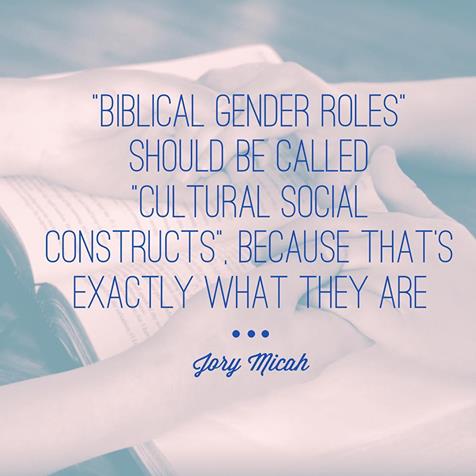
    • I never said Scripture was “tainted” by culture, or that it is invalid when the culture changes. I said you have to consider culture when you are interpreting the meaning of a particular passage. We all read Scripture through a cultural lens, interpreting according to our deeply ingrained cultural associations.

      What would Paul be denying himself of? I don’t think Paul’s spiritual authority came from his maleness. It came from God.

    • Paul cannot both say there is not difference in everything in one place and there is a difference in other aspects in another place.

    • There is the question that first bothered me as a complementarian. If male-only authority is the rule, then why are there so many exceptions to that rule throughout the Bible?

    • What exceptions? If you are referring to the female judge, she herself was reluctant to exert that authority. Almost every principle has a few exceptions. Is there ever a time to lie? The pretend beggars with worn clothes and dried bread lied. The mothers of Egypt lied when they hid their male babies. So, obviously there are exceptions to good principles.

      The clear historical teaching of Scripture is the male headship of the home. The male eldership in Israel. The male eldership in the church. Why does the modern feminist movement believe it has the right to contradict the Bible. Male leadership is not male dominance nor female subservience at its core, it is order. The human body has a head. The visible church in the world has a head (the group of male elders). Why does anyone think that what God prescribed in the Old Testament and described in the New Testament is less acceptable now because we have feminism demanding “equality.” There is no such thing as equality in function. Equal value, yes, but never equal function.

    • Here are some more exceptions: http://newlife.id.au/equality-and-gender-issues/the-propriety-of-women-with-authority/. This article talks more about N.T. female church leaders:http://godswordtowomen.org/pastors.htm. And this is an excellent post about women’s leadership in the early church:http://www.christianitytoday.com/ch/1988/issue17/1706.html.

      I would highly recommend reading this article by Dr. Walk Kaiser, former president of Gordon-Conwell Theological Seminary, on the Biblical teaching on women:http://www.cbeinternational.org/files/u1/resources/14-kaiser-pdf.pdf.

      And here is an article on Paul’s main point in Ephesians 5:21-33: http://newlife.id.au/equality-and-gender-issues/pauls-main-point-in-eph-5_22-33/.

      Also, this article on “Kephale and Male Headship in Paul’s Letters.: http://newlife.id.au/equality-and-gender-issues/kephale-and-male-headship-in-pauls-letters/

      I strongly disagree with you that Egalitarians (this is not a feminist movement) believe they have a right to contradict the Bible. People have had different views on many issues since the beginning of Christianity. Egalitarians are not demanding “equality” because of a new cultural viewpoint on the Bible, they are demanding equality because they strongly believe God’s design is not hierarchical, that hierarchy is a result of the fall. They are trying to work with God towards reconciling the world, abolishing the effects of sin. I am sharing these articles to demonstrate the Egalitarian perspective. It doesn’t come from an agenda but from an interpretation of Scripture. Both complementarians and egalitarians have a high view of Scripture. In fact, we have a whole lot in common. Just not the idea of male-only authority.

    • Dr. Walt Kaiser is a fine scholar. I however do not agree with his interpretation of the Genesis passage. Without that interpretation his extended arguments are much weaker, if indeed they can be maintained at all. The fact still remains that all the elders of the OT and the NT were men. All the description of responsibilities in the NT are for men. Paul does not say the elderess should be the wife of but one husband. He does say the elder should be the husband of one wife (technically, a one-woman man and not a one-man woman).

    • As you said, it comes down to interpretation. We can continue to go back and forth, but we are coming from very different perspectives and it is unlikely that either one of us is going to change our mind today. I was hoping more than anything to demonstrate that egalitarians are sincere followers of Jesus and that this is not a matter of rebellion towards God and His design. Jesus prayed that we would have a spirit of unity, and I believe that you and I can still affirm each other as brother and sister in Christ and go on with genuine love for each other despite our differences. I appreciate your interaction here on the blog and hope you continue to be a reader.

    • I have no problem with fellowship as open doors make such possible.

      What I do have a problem with is that there seems to be a willingness on the part of egalitarians to assume that we complementarians have a low regard for women. I don’t think that is fair nor do I think that women who are complementarians are in any way, for that reason, limiting themselves.

      The matter of headship is not only a Biblically correct thing, it is a freeing thing. As Christ is the head of the church, we are freed to respect his responsibilities toward us. As the husband is the head of the wife, she is freed to allow him his role. If his role is filled with love, it is not an onerous thing. It does bring order to the home as the head brings order to the body and as Christ being head brings order to the church body. If she “reverences” her husband, he will be strengthen and able to lead in a humble godly way as he should.

      But as you say, we will not likely persuade each other. Minds that are made up are hard to change.

    • I wholeheartedly agree that we shouldn’t assume negative things about other people. Egalitarians should not assume complementarians have a low view of women, and complementarians should not assume egalitarians have a low view of Scripture. Because you know what happens when you assume something? You make an “ass out of you and me.”:)

      Thanks again and God bless.

    • URW


      Please Follow our blog if you enjoy learning about gender issues in the Christian Church, and “Like” us on FB for related posts from around the web.

      Also, I had to Google “URW” – in case you are also unsure what that means, it is “You’re welcome.”  I appreciated having this very civil conversation with JN!

The Beauty of Womanhood

tumblr_m6jj46ZG9n1qak0uxo1_500

Desiring God has a new post on their blog today written by Abigail Dodds on “The Beauty of Womanhood” (I am curious to know what percentage of their blog posts are on “biblical manhood and womanhood”?).  Dodds’ writing is lovely but her description of ideal womanhood is a one-dimensional picture of privilege that diminishes the beauty of women who do not fit the complementarian mold, and is also disparaging of men who practice gender equity.  Rather than celebrating the multi-faceted, diverse beauty that exists in global expressions of womankind, Dodds places middle- to upper-class 1950’s-esque Westerners on a pedestal of “blinding beauty.”  I am certain that her intent was not to be unkind or dehumanising to others, but that is essentially what occurs when fundamentalists create firm boundaries around what a woman or man may or may not do.  Those who do not conform are less-than, or in Dodds’ words, “grotesque.”

Dodds describes a woman’s influence as “found primarily in the soil of the home,” and glorious feminine beauty as being found in a woman “who presides over her domain with strong arms and resourcefulness (Proverbs 31); daughters that are corner pillars, whose strong support could only be matched by their exquisiteness (Psalm 144:12).”  Dodds suggests that it is our culture (liberalism!  feminism!  egads!) that draws women away from the home to run on a treadmill of expectations in pursuit of rewards “that don’t require diapering.”  Let’s not mention the treadmill of expectations that come with complementarianism!


And what does it offer in return? Women who strive against themselves, at war with the seeming redundancy of two X chromosomes, in a competition we were never made for, and in our hearts, don’t really want to win. For when a woman sets herself up alongside a man — as made for the same things and without distinction — the result is not uniformity, but rather, a reverse order. Indeed, in order for her to become like a man, he becomes less and less like one. And that’s something that most women, even the most ardent feminists, recoil at in their heart. Not because femininity is detestable, but because on a man, it is grotesque.

But wait, there is more!  Dodds says that women who “forsake our feminine glory in pursuit of the uniqueness that belongs to men…become usurpers, persistently insisting that our uterus and biology are equal to nothing, irrelevant.”  Women are meant to “make good men great.”  We mimic our Savior by submitting to another’s will (many complementarians believe in the heretical doctrine of Eternal Subordination of the Son.  I don’t know if that is what Dodds is referring to here, but I wonder if women are to mimic our Savior by submitting, what are men to do?).

God’s design outlined in the Scriptures is a vision for womanhood that is not just right and to be obeyed, it is experientially better than all the world has to offer. And it doesn’t just apply those who are married or mothers. Single women of any age are meant for full godly womanhood. To be a mother in the deepest sense — that is, spiritually — nurturing and growing all God’s given her.

Complementarians will often say that living a patriarchal life is the most wonderful way to live, without truly listening to non-complmentarians about their life experiences or to complementarian women who suffer in their subjugation (read this! and this!).  It is a black and white issue for them and anyone who believes differently has been influenced by “the world” and could not possibly have acceptable reverence for God’s Word which clearly subordinates women.  I do not know Abigail Dodds personally, but methinks she may not have any direct experience living outside of a complementarian context.  I would guess that she was raised in a patriarchal culture and socialized to see the world through a patriarchal lens.  It makes sense to her, she has a great marriage and a lovely faith community (with male leadership, of course), and she wants others to live as well as she does.  Staying home is financially possible for her family and she does not recognize that this is not the case for most families, that this is privilege and not biblical womanhood.  Her motivation for writing a piece like this is commendable and her heart is pure, but frankly, complementarianism’s rigid gender roles limit both men and women from exercising their full humanity and spirituality and from mutual flourishing.

87640share

I myself fit Dodds’ description of “blinding beauty” for most of my life.  Complementarianism is all that I ever knew and I believed it 100%.   Six years ago, while I was still complementarian, God spoke to me clear as day, calling me to pastoral ministry.  I was blown away.  I knew without a doubt that I had heard directly from God but his call directly contradicted my patriarchal world-view.  That day, the chapel dean from my college days posted a link to “How I Changed My Mind About Women in Ministry” on Facebook, so I ordered it and began my journey to egalitarianism.  For six years, I have been reading on a nearly daily basis from scholarly works defending egalitarianism (e.g. this one or this one) and articles depicting the plight of women living in patriarchal cultures (like this one).  I post what I am reading to The Beautiful Kingdom Warriors FB page. Listening, listening, listening.  Learning to pay attention to the least of these, who have no privilege and power, describe the consequences of patriarchy in their life.  An article like Dodds’ seems benign until you consider it in the larger context of the suffering of women and girls around the world.  President Jimmy Carter’s book, “A Call to Action,” is an excellent place to begin acknowledging the plight of disenfranchised and powerless women.  In my review of his book, I said,

President Carter’s book is a “call to action” to reverse the widespread gender violence that is a result of patriarchal systems that devalue women, an epidemic touching every nation.  He makes a case that denying women equal rights has a devastating effect on economic prosperity and causes unconscionable human suffering that affects us all.

The world’s discrimination and violence against women and girls is the most serious, pervasive, and ignored violation of basic human rights…Women are deprived of equal opportunity in wealthier nations and “owned” by men in others, forced to suffer servitude, child marriage, and genital cutting.  The most vulnerable, along with their children, are trapped in war and violence…A Call to Action addresses the suffering inflicted upon women by a false interpretation of carefully selected religious texts and a growing tolerance of violence and warfare.  Key verses are often omitted or quoted out of context by male religious leaders to exalt the status of men and exclude women.  And in nations that accept or even glorify violence, this perceived inequality becomes the basis for abuse. [dust-jacket description]

So what do I believe is beautiful about women?  The Imago Dei in them.  By that alone they are astoundingly, blindingly beautiful.  Is it grotesque when my husband diapers the children or supports my work and ministry life?  Not at all.  His love for me and our family is astoundingly, blindingly beautiful.  Our mutual love and submission to each other is what I would wish for other marriages.

You know what I think is grotesque?  Pharisaical, prescribed gender roles.


Thanks for visiting TBKW!  “Like” us on FB if you’d like to read similar articles from around the web!

Egalitarians on Twitter using #CBMW16

The Council on Biblical Manhood and Womanhood just wrapped up their T4G (Together 4 the Gospel) conference yesterday.  The conference was headlined by prominent Evangelical pastors and there was a separate women’s conference headlined by prominent complementarian women.  The theme was “The Beauty of Complementarity” and sessions included “God’s Design for Women,” “Bound for Life: Following Your Husband Through Life’s Challenges,” “Raising Godly Sons,” “Fitted for Flourishing: How the Bible Creates a Happy Home,” “Workers at Home: The Temptation to be ‘Mom Plus,'” etc.  According to CBMW, their hashtag #CBMW16 was used 2.4 million times throughout the conference, as attendees live-tweeted quotes and reflections…

…and as egalitarians responded with challenges to complementarian theology.  I am sure it was frustrating to the CBMW that they could not control the Twitter-sphere the way they could control the mic at their patriarchal conference.  Here are some of my favorite egalitarian tweets:

https://twitter.com/April_Kelsey/status/719873845402935296

https://twitter.com/sarahbessey/status/719892676200411137


https://twitter.com/tim_fall/status/720010543205974017


Thanks for visiting TBKW blog!  “Like” us on Facebook and on Twitter if you’d like to see more articles from around the web on gender issues in the Church and world.