Tag Archives: Egalitarian

The Egalitarian World of the Kingdom

I am always googling “Egalitarian” to see what I can come up with for new insights and resources.  Yesterday, I listened to a Jesus for Everyone podcast episode from Herb Montgomery of Renewed Heart Ministries on the Egalitarian nature of God’s Kingdom.

Herb Montgomery, director of Renewed Heart Ministries, is an author and adult religious re-educator. For over fifteen years, Herb and his wife, Crystal, have shared Jesus’ teachings with others in cities and communities across the United States. Herb’s presentations are transparent, relevant, relationally responsible, and intellectually honest. He has an unusual gift for making complex theological and sociological concepts accessible for the people he speaks to. He especially enjoys presenting to groups possessing wide and diverse “belief” spectrums yet with a common focus on compassion and justice. (RHM website)

As with many resources we share on The Beautiful Kingdom Warriors blog, this particular teaching is relevant to our discussions on gender equality in the Church.  I am unfamiliar with the scope of Montgomery’s views, but can wholeheartedly agree with this particular podcast.  You can listen here:

https://renewedheartministries.com/podcasts/83egalitarian.mp3

On the Renewed Heart Ministries website, Montgomery also shares his podcast transcript.  I am editing it down some, but you can access the full transcript here:

The Egalitarian World of the Kingdom

This week, I want to take a look at Jesus’ words in Matthew 23.8-12. The phrase I want to zero in on is, “Nor are you to be called instructors, for you have one instructor, the Messiah.” What Jesus is commissioning us to put on display is a community characterized by humble egalitarian relationships rather than hierarchical ones. In all actuality, Jesus was death to any person using hierarchical authority over another: “But Jesus called them to him and said, ‘You know that the rulers of the Gentiles lord it over them, and their great ones are tyrants over them. It will not be so among you; but whoever wishes to be great among you must be your servant.’” (Matthew 20.25-26)

According to the Hebrew creation narrative, hierarchical relationships are a fruit of the relational schisms that took place in the garden; they are not reflective of original creation (Genesis 1.26 mentions authority over creation, but not authority over others.) Even in a perfect state, the narrative seems to hint at humanity’s inability to exercise authority over one other. Nor are they reflective of the new creation that has come through Jesus. (See 2 Corinthians 5.17, NIV.)

The early followers of Jesus understood this vision. Notice Paul’s description of how the church that met in Corinth functioned: “When you come together, each of you has a hymn or a word of instruction, a revelation, a tongue, or an interpretation.” (1 Corinthians 14.26, emphasis added) The gatherings of the early church, historical scholars agree, were not ones where the majority sat passively silent while the same person taught every week. These were communities that embraced the priesthood of all believers, each one possessing a gift to share that would contribute to and build up the body. They saw themselves as having only one teacher (the Messiah), and they were are all humble students, together, showing each other what Jesus was teaching them. These were communities where following the “one-anothers” of the New Testament could be practiced as well as put on display for the world around them to see.

The early followers of Jesus believed that together, they equally became a dwelling place for God. (See Ephesians 2.22, where the “you” is plural, not singular, and 1 Peter 2.4-8.) They believed that together, they were functioning here on Earth as the visible “body of Christ,” with only Christ as their “head” (Ephesians 4.15)—not “lording” authority over each other, but humbly and lovingly serving one another. In this way, they, as a community, believed that together, they were partaking of the “divine nature” (see 2 Peter 1.4) and that “all of them” were “one,” just as the Father was in Christ and as Christ was in the Father. “They” saw themselves in Them. (See John 17.20-21.)

The body metaphor used by Paul is especially telling when taken with Jesus’ words in Matthew 23. When our head signals to our hands, it doesn’t first signal the arm to tell the hands to move; neither must the hand submit to the arm in order for it to obey the head. The brain sends direct signals to those body parts it seeks to influence; consequently, the head controls all of the body’s parts immediately and directly. It doesn’t pass its impulses through a chain-of-command scheme invoking other body parts along the way.

The proper application of the body metaphor preserves the unvarnished truth that in the world changed by Jesus, there is no hierarchical authority practiced by Jesus’ followers over other of His followers. There is only one source of authority in the church: Jesus Christ.

It is mutual submission (i.e., being submitted to one another and then together to Christ), not hierarchical submission (i.e., being submitted to someone else as they are submitted to someone else who has submitted themselves to Christ), that engenders the proper coordination of the body of Christ.

We are not called to put on display simply a religious version of the corporate structures of this world. On the contrary, Jesus is inviting us to experience (and then to put on display) a world where, rather than exercising power over others, we—together, as a community—come under His authority , each of us together learning how to listen to Him. And instead of “lording” power or position over each other, we learn what it means and what it looks like to serve each other with humble servant love.


Thanks for visiting The Beautiful Kingdom Warriors!  “Like” us on Facebook if you would like daily links to articles about gender equality in the Church and world.

Francis Chan, the NEO House Church Network, and Women in Leadership

sb10065601aa-001

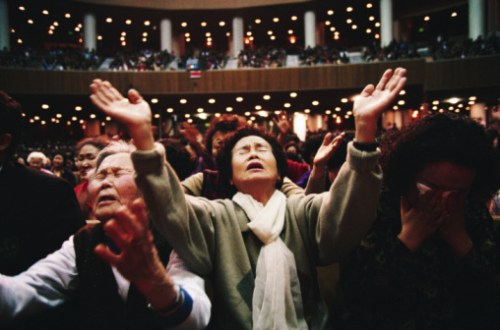
Getting Images: Yoido Full Gospel Church members praying

I recently listened to Francis Chan on the Phil Vischer Podcast, episode 227, sharing about his current ministry, the NEO House Church Network:

Popular author and preacher Francis Chan walked away from his megachurch to try something completely different – a series of tiny house churches in inner city San Francisco.  Why the change?  And what can we learn from his big experiment in going “small?”  This week on the podcast with Francis Chan – is the future of the church tiny??

At the end of the podcast, he mentioned that the NEO House Church Network is complementarian, reserving pastoral leadership to men.  It is a part of The Christian & Missionary Alliance (complementarian) and is also affiliated with The Gospel Coalition, which holds complementarianism as a key doctrine.

I love what Chan is doing, building a house church network that gives thousands of people the opportunity to minister in intimate and committed small communities. Mobilizing the priesthood of all believers should be the ultimate goal of a pastor.  And Chan is an amazing minister of the Gospel that I admire.  So I thought he would benefit from this quick story about a pastor that mobilized the women in his church to start house churches and they grew to be the largest church in the world.

“Don’t be afraid to empower women,” says the pastor of the world’s largest church.  Churches are wrong not to let women become spiritual leaders, David Yonggi Cho told church leaders at a “Discipling a Whole Nation” conference in Italy.  “If you ever train the women, and delegate your ministry to them, they will become tremendous messengers for the Lord.”

Most leaders at Cho’s Yoido Full Gospel Church in Seoul, Korea, are women.  The 700,000-member congregation is divided into 50,000 cell groups that meet in homes, and about 47,000 cell leaders are women, he said.  Of the church’s 600 associate pastors, 400 are women.  “In ministry they are equal with men,” he said.  “They are licensed.  They are ordained.  They become deaconesses and elders.”

Cho adopted the cell church principle in 1964 after he collapsed from exhaustion trying to minister to his then 3,000-member congregation.  His male leaders balked when he told them to divide the congregation into cells that meet in their homes.  “They said, ‘Fine, but we are not trained to do that and we are not paid to do that.  Why don’t you have a long vacation?’ This is the Korean way of saying ‘Why don’t you resign from the church?’ ”

When he asked the women leaders to do it, they said, “Teach us, pastor.  We will do anything for you,” he said.  The church grew from 3,000 to 18,000 in the next five years.  The cell churches started new cell churches and more lay leaders got involved in ministry, Cho said.  “It is the will of God to have a growing church.”

Source: https://godswordtowomen.org/empower.htm

Over time, using this cell principle, Cho’s church grew to over 1 million people.  Sadly, Cho has been convicted of embezzling from his church.  It is common for one person holding much power to be corrupted.  This should not diminish the impact of Cho’s female cell church pastors though!

Matthew 7:16 tells us, “You will know them by their fruit.”  The fruit of empowering women in ministry at Yoido Full Gospel Church in South Korea was unprecedented growth.  Church planters like Francis Chan should take note and include women in leadership.


Further reading:
The Junia Project has a great article on Why Women Make Great Church Planters.

The MissioAlliance has several must-read articles on Women in Church Planting.


Thank you for visiting The Beautiful Kingdom Warriors, where we fight for our rightful place beside our brothers in Christ’s reconciling and redeeming work on Earth. “Like” us on Facebook if you’d like to read links from around the web each day on gender issues in the Church and world.

Best of Summer Link-Up

We have a lot of catching up to do, Beautiful Kingdom Warriors!  Once again, it has been a busy summer here in Vacationland.  Thank you for being patient and sticking with Becky and me even when our lives are overflowing with non-blog-related activity.  Every day, we post great links on our Facebook page, and I have just scrolled through to share my favorites here from July and August.  But first, feast your eyes on the scenery around my home in Maine.  Then you’ll understand why it’s such a popular destination!

~  On Biblical interpretation  ~
6 reasons 1 Timothy 2:12 is not as clear as it seems
“A broad principle we might derive from 1 Timothy 2:12 is “bad or bossy teaching is not permitted.”

Indispensible: Women Who Plant Churches “It’s hard to imagine a stronger affirmation of women as indispensable church planters than Paul gives the women of Philippi. Church planting efforts multiplied because he broke with tradition to partner with his sisters in Christ.  The mission Jesus entrusted to his church is demanding, so demanding that it requires a Blessed Alliance of men and women working together. In this challenging post-Christian world, we are learning afresh of God’s desire for the partnered ministry of women and men in seeing the gospel embodied and advanced through the planting of new churches. We must reclaim the biblical and apostolic conviction of the indispensability of women in church planting!

~  On how patriarchy hurts men and women  ~
How the Christian ‘masculinity’ movement is ruining men
“The Christian Bible paints for us a view of manhood that is much more complex than these simple stereotypes allow. For every biblical reference to warriors like Samson or Saul, we read of characters like young David, a harpist, who through no power of his own defeated a giant. We meet Simeon, known for patiently waiting decades to see God’s promise revealed. Jesus himself notably refused to fight back, even giving up his life and physical body in a history-making display of spiritual strength.  A closer reading suggests that the Bible’s heroes aren’t meant to be models of outward toughness but exemplars of inner fortitude. So why have so many Christians accepted secular standards of masculinity as the basis for biblical manhood?”

No, Focus on the Family, I do not want to civilize a barbarian
“I think our problem is a society that encourages men to be violent, not that women should be whatever-definition-Glenn-T.-Stanton-has-for-feminine so they can motivate men out of being a malignant cancer. If appreciating a woman’s opinion is life-changing, let men and boys, single and married, respect women and their opinions in every sphere of society – including in politics, in church, in the home, at work and in social settings.”

Why Donald Trump is Good for Evangelicals
“Kinder-gentler versions of manhood and calls for men to ‘man-up!’ and take charge that thunder from evangelical pulpits and appear in books addressing men merely situate evangelicals on the cultural manhood continuum. Such definitions are woefully inadequate and run the risk that men, like Trump, will take things too far. Worse still, they fail to offer men and boys the indestructible identity, dignity, meaning, and purpose that their Creator intended when he bestowed the imago dei on all his sons and daughters.”

Its Not OK, and We’re Not Alright
“Just because not everyone experiences the fallout of an oppressive system in the same way does not mean that the oppressive system does not exist. When someone reduces all the harm, damage, and trauma of purity culture down to something “weird” or calls our responses “melodramatic,” they are erasing us and dismissing our legitimate grievances. This happens because they have had the privilege of living in an oppressive system and not being significantly harmed by it.”

~  On abuse and protecting your children  ~
The Courage Conference – Lynchburg, VA   October 28-29
“Did you know that 1 in 4 women and 1 in 7 men will experience abuse in their lifetime, including those in church? And, for the last five years, child sexual abuse has been the number one reason Churches or Religious Organizations have ended up in court.  The Church is often the first place victims of abuse go to seek help and healing. If we are not educated and equipped to properly serve these hurting individuals, we can unintentionally neglect or even re-victimize them. This is why we created The Courage Conference. 

Black and White Bible, Black and Blue Wife –  A Review “Reading this book also requires a willingness to reconsider one’s view of marriage. This is no simple task because her story raises questions regarding deeply held beliefs about marriage roles, male headship, and female submission that many evangelical Christians consider sacred and nonnegotiable. Yet the “silent epidemic” of domestic abuse that concerns Tucker is so dangerous and life-threatening within Christian circles, and so easily concealed, we cannot afford to brush her off and refuse to listen.”

5 Phrases That Can Help Protect Your Child From Sexual Abuse
“That’s your vulva.”
“Stop.”
“No secrets.”
“Did you feel safe?”
“High five, wave, or hug?”

5 everyday ways to teach your kids about consent.
1. Ask for their consent often.
2. Teach them that their “no” matters.
3. Model to your child that “yes” can become “no” at any time.
4. Seek to understand.
5. Keep “regard” at the forefront of your mind.

~  On the complementarian vs. egalitarian debate  ~
Someone mansplain complementarianism to me (ormen, what is wrong with us?)
“Because ironically, the greatest argument against this elevated religious view of men—is men. We’ve created a historical body of work reprehensible enough to make Complementarianism laughable. If the abhorrent behavior of men is trying to make an argument for moral superiority, we ain’t looking’ that good, fellas. I think we need to make room at the table and the pulpit and the office, and realize that it’s been a long time coming and it’s a really good thing.” 

5 False Assumptions about Egalitarians
1. Egalitarians don’t respect Scripture.
2. Egalitarians are wishful thinkers when it comes to the Bible.
3. Egalitarians don’t understand complementarianism.
4. Egalitarians deny that men and women are different.
5. Egalitarians undermine the church.

History of Complementarianism – Part 1 and Part 2
TWW Commenters Weigh In On Complementarianism
A FUN read full of gems like this John Piper spin-off:

“If a complementarian man finds himself being taught by, or under the authority of a woman, I think he should endure it for a season.”

Mary Kassian Compares Women Who Teach Men in Church to Fornicators
“Kassian’s boundaries are difficult to follow since it appears that she finds loopholes for just about anything so long as she is doing it.”

safe_image

~  On sexism  ~
Are U.S. Millenial Men Just as Sexist as Their Dads?
“Taken together, this body of research should dispel any notion that Millennial men ‘see women as equals.'”

9 Non-Threatening Leadership Strategies for Women
Let’s finish this link-up with a bit of humor.  It’s funny because it’s true. 🙂