

Tag Archives: control

015 I Tracy Downing Shares Her Story of Narcissistic Abuse by Her Progressive Christian Ex-Husband

In this episode, my friend Tracy Downing shares her profoundly painful journey through narcissistic abuse in her marriage to and divorce from Progressive Christian writer and speaker, Benjamin L. Corey. Post-separation litigation and parental alienation have been especially devastating for Tracy. I believe sharing stories like Tracy’s is very important, because abuse is rampant in patriarchal churches and families, and awareness of what abuse looks like is low.

It’s difficult to share a story like Tracy’s, with so many layers and contributing factors, without taking the time to label behaviors and name impact. So I wanted to share some more about narcissistic and post-separation abuse in this post for those who may have recognized their own relationship in Tracy’s story.

Tracy spoke about being labelled rebellious in her Independent Pentecostal Church, being called a “bad apple” that needed to be “plucked” before she ruined her sisters, of having five or six men attempt to exorcise demons from her. This was not only traumatic spiritual abuse, this conditioning in her high-control religious upbringing contributed to Tracy being in an abusive relationship as an adult. She was taught to be a “good girl,” to shut herself off from her own feelings and experience in order to please others, to question her own voice and to be disempowered so that men can be centered and deferred to. Her nervous system never felt safe and secure, she was always striving to be more and do more in order to be accepted. This resulted in her being a high-achieving person as well as being disembodied from herself. She was also primed by religious conditioning to make her marriage work, at any cost.

During Tracy’s separation from Ben, her therapist told her she had experienced extreme narcissistic abuse. We cannot say definitively that Benjamin L. Corey is a narcissist without a formal diagnosis, but I believe a very strong case could be made. Let me define narcissism and highlight behaviors that fit into the categorization of narcissistic abuse:

Narcissism is a personality trait characterized by a long-term pattern of grandiosity, an excessive need for admiration, and a profound lack of empathy for others. Narcissism is found in more males than females. Narcissists are pre-occupied with power and success and believe they are superior than others and deserving of special treatment. Core traits include self-centeredness, vanity, and high levels of entitlement. Common behaviors include manipulation, gaslighting, exploitation of others, and intense reactions to criticism. It is either an inability or an unwillingness in narcissists to recognize the needs and feelings of others. They rather tend to be very critical and envious of others. They have difficulty managing their emotions and behaviors, especially dealing with stress and adapting to change. Narcissists are often depressed and moody. And underlying their grandiosity is deep shame, insecurity and fear of being exposed.

Emotional abuse can be just as painful and destructive as physical abuse. Often times, an emotionally abused woman will wish her husband would hit her, so that she could leave the marriage with a clear conscious. Emotional abuse is disorienting and debilitating. When Tracy questioned Ben’s behavior or they disagreed about anything, he employed the classic abuser’s response: DARVO (Deny, Attack, Reverse Victim and Offender). In a healthy relationship, you can bring an issue to the table and work it out in a meaningful and constructive way. In a relationship with an abuser, every issue you bring up gets turned back on you. You learn it is easier to put up with the toxic behaviors rather than be punished for expressing any of your own needs.

Ben’s utilization of DARVO has been especially impactful in the aftermath of their divorce, as he has used the court system to attack Tracy and to paint himself and their daughters as her victims. Here is an excellent resource Tracy sent me about post-separation abuse and parental alienation, High Conflict Education and Resources. I compiled a list of abuse resources that you can find here. Dr. Diane Langberg, Chuck DeGroat, and Natalie Hoffman are great advocates for victims of abuse. If you recognize your own relationship in Tracy’s story, I pray you find healing and safety.

Tracy wrote to me some key things to note about Narcissists:
1. Losing control over you–Their biggest fear is you thinking for yourself. You surrounding yourself with better people. You focusing on other things. When you stop being predictable or emotionally available, they feel threatened because control is the only way they know how to feel “safe.”
2. Being exposed for who they really are–Narcissists work hard to maintain a perfect image. The idea that someone could reveal their cruelty, lies, or manipulation is terrifying, it threatens the entire persona they built to hide their insecurity.
3. Being ignored–Narcissists love attention (you’ve probably noticed this). When you ignore them or act indifferent, their entire sense of power collapses. To them it feels like abandonment, and they panic the moment they can’t get a response out of you.
4. Someone seeing through their lies–They depend on confusion to stay in power. Your confusion, so that they can keep manipulating and gaslighting you. So when you show clarity, self-awareness, and emotional distance, they know they can’t twist reality anymore…and trust me, that makes them anxious.
5. You healing and moving on–Your healing means they no longer have emotional access to you. They’re terrified of you becoming strong enough to no longer need them, miss them, or react to them.

People are not always what they appear to be. Narcissists can be charming and project many admirable characteristics publicly. But who we are behind closed doors matters. We should be the same person with our family as we are with the public. Benjamin L. Corey is a popular writer and speaker in the Progressive Christianity space. Sadly, Progressives often repeat the fundamentalist systems they think they have rejected. To be truly Christlike is to consider others before yourself, lay down your life and interests for others, love patiently and kindly, without keeping a record of wrongs. God is love, and anyone who truly knows God is loving. As Dwight L Moody said, “If a man doesn’t treat his wife right, I don’t want to hear him talk about Christianity.”

You can listen to our conversation on The Beautiful Kingdom Builders Podcast on YouTubeSpotifyApple PodcastsAmazon MusicSubstack, and more! If you find our conversation helpful, please share it with a friend, rate and review, and subscribe so you never miss an episode!

TRANSCRIPT:

Ruth Perry (00:17)
There’s a quote from Dwight L. Moody that says, “If a man doesn’t treat his wife right, I don’t want to hear him talk about Christianity.” Today I’m talking with Tracy, who was married to popular progressive Christian writer and speaker, Benjamin L. Corey. In our conversation, Tracy shares parts of a decades long story that carries many layers and deep emotional trauma. It’s impossible to unpack everything in less than an hour, but Tracy offers a powerful glimpse into the realities that she has endured.

Before we begin, I want to acknowledge that abuse is often hidden and insidious. Silence protects abusers, not victims. And so this isn’t an easy topic, but real lives are harmed when abuse goes unaddressed and we’re called to bring light into darkness. When someone speaks up about abuse, it usually comes after tremendous courage and it deserves to be taken seriously.

After listening, you can go visit thebeautifulkingdombuilders.com for show notes, where I’ll highlight key aspects of Tracy’s story and include resources for anyone who may recognize similar dynamics in their own life. Without further ado, here is today’s episode.

Ruth Perry (01:26)
My guest today is Tracy Downing, a leadership coach and grief coach and a personal friend of mine from living in Maine. And so I’m so pleased to have you here today, Tracy.

Tracy (01:36)
Thank you. Thank you, Ruth. So good to be here with you.

Ruth Perry (01:40)
This is a conversation abuse and about coming out from conditioning in conservative Christianity and then reliving those patterns marriage. Your story has so many layers that I think people are gonna relate to sadly. And the best place to start is at the very beginning. So where did you grow up Tracy? And what was your faith background?

Tracy (02:03)
Well, I grew up in Maine, small town in Maine. I was part of the Pentecostal movement from, I think, birth and ended up in a Independent Pentecostal church, meaning it was its only kind. It had no sister churches or, you know, home church, if you will.

Ruth Perry (02:21)
Similar to Independent Baptist probably culturally, but different worship style for sure.

Tracy (02:26)
Different worship style, yes. And it wasn’t like, I think like Assembly of Gods, or like the Catholic Church, or the Vineyard. This was just a one and done church.

Ruth Perry (02:35)
So I met you in Maine as an adult, so way beyond little Tracy. And the way that I met you was I reached out to your husband online because I had found his website, Formerly Fundy, I think was the name of it at the time. Benjamin L. Corey is a pretty well-known writer and speaker now as a progressive Christian.

And when I was kind of beginning my deconversion from fundamentalist Christianity and rethinking my faith, I found his website and I really enjoyed reading his writing. And so I reached out because you guys were in Maine. And we ended up meeting and having a couple of meals together. And I really connected with you. But how did you and Ben meet each other, Tracy?

Tracy (03:24)
Yeah, so he’s my former husband now and we met actually at one of his family members weddings. We met there and it was a small wedding. And so he was doing the photography at the time and we struck up a conversation and very quickly landed on the topic of adoption and found that we both had a desire to adopt in our future.

Ruth Perry (03:47)
So that was the primary thing that you connected over, adoption?

Tracy (03:50)
It was the primary thing we connected over and you know the the idea to care for the orphan and the stranger and you know the love your neighbor and all of those things were sort of secondary but the command to care for the orphan was really forefront at that time.

Ruth Perry (04:08)
And how long did you know each other before you got married?

Tracy (04:10)
We knew each other for two years and that, interestingly enough, that dating time, looking back now, had what one might call red flags. But for my nervous system, it felt familiar.

Ruth Perry (04:22)
How old were you and Ben married?

Tracy (04:26)
So yes, sometimes these parts are embarrassing because I was 32. And so, you know, from a logical standpoint, should have known better.

Ruth Perry (04:34)
Well, how can you? I mean, it seems to me like when I started unraveling things, it was because things weren’t working. And so a marriage is a great place to find out the way that you’ve been taught isn’t working, isn’t it?

Tracy (04:48)
Well, yes, and interestingly enough, you know, I think this is an important part of my story. It comes up later and it’s really it was a really a gift. so I had met him shortly after a breakup. I had been a good girl, you know, gone to church and done the things and followed all of the rules and spoke openly about my struggles, got in a lot of trouble when I was younger for asking too many questions, pointing out discrepancies. I was labeled rebellious, which if you know anything about the Pentecostal movement and maybe even just conservative Christians, that’s rebellious is equivalent to witch craft.

And so I had been sent to the Christian school of the church one year because I was a bad apple in a bag of good ones in my family. And the elders had instructed my, particularly my mother, that I needed to be plucked out to save the family. So lots of that kind of talk, they tried to pray demons out of me and they wouldn’t come out. And of course, that was my fault.

I had done all of the things, tried following all the rules, pondered what it would look like, how to help people see my heart and not find me to be rebellious or the villain that my heart’s desire was to love God and to be a good Christian girl. And I just didn’t get it right.

At 26, I was at a conference, a two-day conference, and with a colleague slash friend, and there was a lawyer there. She worked with him. She had a couple of shared clients with him. So we had lunch with him. We sat with him. We had lunch with him and I thought he was hilarious. And on day two in the afternoon, my heart started racing and I thought, I think he might be flirting with me. I think he might be interested.

And Christian men weren’t particularly interested in me. I was pretty bold and asked lots of questions and I didn’t come across as meek and mild and submissive. Not because I was a bully, but because I was just bold. I asked questions and that was not acceptable. So when I had this experience with him, I was like, my goodness. And I, I remember going to the ladies room. I still go to this place at the Augusta Civic Center and you know where that is.

I’ve been there like three times and I go there and I get the flutters. I remember getting up and going to the ladies room. I could still show you which one it was and looking in the mirror like to see myself. And I thought, is this real? And I’m 26 years old and lo and behold, the afternoon goes on and he asks my colleague and I if we would like to go for appetizers after at the end of the day.

And I had just started, I had already had a master’s degree, but I had just started my master’s work in clinical counseling. And I had a class on Friday afternoons via webinar. And so I declined, we declined. I said, I have class. And he’s like, just skip. And I was like, no, you know, good girl, follow the rules. Got to go to class. And he ended up calling me the following week and asking me on a date.

And I was so scared. Because I thought, my goodness, what if he’s not a Christian? What am I gonna do? But I didn’t know how to say no. I didn’t wanna hurt his feelings. And so I was like, okay, I’ll just go on one date. And then I found myself on a second date and I was worried about how to do this because he was a kind guy, I really liked him. And then I, you know, was right away clear that he was not a Christian and didn’t know what to do with that. And then, you know, a few dates led to a few dates.

And I was like, okay, well, here I am. And what do I do with this? And I thought, okay, well, I’ll try to convert him. Let me just try to convert him. So I can date him with the intention of converting him. And when that didn’t happen, five years later, he ended up moving back to his home state for a job. And I didn’t move with him because we were not married.

We were not married because we had different beliefs and he was very gracious and respectful. I would say he lives his life like I understand a Christian’s life should look like. He was kind, he cared for people, he was gracious, he was forgiving, he was loving and we weren’t of the same faith and that ultimately ended our relationship.

Ruth Perry (08:46)
Yeah.

Tracy (08:57)
And then shortly thereafter, I met Ben. During that relationship, I had many friends concerned about us being unequally yoked and that I was living in sin, that I was dating him, was an affront to God, and that I knew better. And so when I met Ben, and he was a Christian, and he was interested, it was, you know, if I was obedient, God would honor, he would bless me. And so it appeared I was being blessed for obedience.

Ruth Perry (09:23)
I just can’t get over that they tried to exorcise demons. That is some severe spiritual trauma you’ve experienced. I’m so sorry. And I bet they were calling you like a Jezebel spirit and stuff too, huh?

Tracy (09:38)
Yes, and I was on the ground. There was five or six men. I was on the ground on my belly. The carpet was blue, but I don’t think it had any padding under it. And they were like, you know, asking for the spirit of rebellion and another one to come out of me, as well as rejection, rebellion, rejection, and another one. I can’t remember.

Ruth Perry (09:56)
I have married a Pentecostal. My husband grew up Pentecostal. And so I’ve been to a of Pentecostal churches and we went to a Charismatic Church for a little while after our third child was born. so I believe there are healthy expressions of every kind of faith denomination and then there’s very unhealthy expressions. And it’s just interesting.

We should, especially a Pentecostal you would think would be living in the freedom of their salvation in Christ and living freely, but they were like shoving you into this little box or this little shape that you didn’t fit into violently. And they did so much harm to you. And it’s heartbreaking.

Tracy (10:35)
Mm-hmm. As well as the teachings of Dr. James Dobson, but we won’t get into that today.

Ruth Perry (10:41)
Yeah, yep, he was playing in my household every day too. Lots of factors. All right, so you get married to Ben. What is the early days like? What is your marriage like initially?

Tracy (10:48)
Mm-hmm. So we got married, we moved in together. He became a, some of the details become a little bit fuzzy, but in the time that we were engaged till the time of our wedding, he lost his job and became a student. So he was a student and I was in the mental health space. I was in leadership and climbing the ladder of leadership quite fast.

And it became apparent to me that I felt like we were in competition and I couldn’t understand that. And he at the time had an associate’s degree from the military and was working to finish his bachelor’s with a goal of going to seminary. And so wWithin the first six months well, gosh, it started on our honeymoon. If you really want the truth, I started thinking, this is marriage? And thinking my expectations were too high, thinking that I just needed to practice being a good wife. Like all the things just started coming right there for me.

And within the first six months of marriage, he had written to his second wife, his first wife. I gave him that she had cheated on him per his report now that she cheated when he was at boot camp. He married her right out of college. And the reason that they were married for a couple of years was because he was in the military. I no longer know if that is the truth or not.

But it gave him that marriage. as his second wife, the story of his second wife was that she actually tried to kill him. She was a nurse in the military and that she had tried to kill him. And because she did not want to live as a Christian any longer. I see why now. I don’t know if that is true either. Because what I know now is that as his third wife that as things began to end, well, as things ended, that he started to construct that I abuser and that our children were in danger. So there’s a pattern there.

But within those first six months, he had written to that wife who tried to kill him for his report and told her he regretted the divorce and that he had learned a lot from me around grief and she actually sent it to me on Facebook and we were sitting on the couch nearby when I saw it and he and I was like what is this and there ensued a physical altercation for him to get my computer away from me and at that point he blamed that he had had one too many to drink the night before.

And that had also been an issue. He would not come to bed with me because he needed time alone because he was an introvert. But that introvert time was resulting in a lot of beer cans. And I was married and for the long haul. And so I shared one thing of my concern and then he accused me of breaking our vows and not respecting him. And that resulted in a lot of me needing to be back in his good graces. Somehow it turned on me and I lost that message. He deleted it and I was never able to respond to her.

But she was gracious enough to let me know that that was what he was doing in his free time and he did blame her and say she was just doing that because she had emailed him for money and that that was her thing and so the chaos ensued and I was alone in my story.

Ruth Perry (14:02)
So right off the bat, honeymoon, wow. I mean, that is the typical story when you’re married to an abuser, that just, the mask falls away. The energy that they were putting into keeping that mask on during the courtship and the dating and engagement and all of that, at some point, if they’re a person with a maladaptive personality type, they were exerting a lot of energy to hide that. And so it just goes away.

Tracy (14:29)
Well, when we dated for the couple of years, there were a couple of breakups. I had broken up with him initially, which ended up getting back together. And he broke up with me because I wasn’t Christian enough. And I cannot remember the Scriptures that he quoted. He knew the Bible inside out. And so there was never going to be a day where I could sort of keep up with him or out argue him on a Scripture. And that was really him tapping into the spiritual abuse.

And it’s when he started to identify suddenly he had grown up in a cult. Surprising family members. He did not grow up in a cult, but suddenly taking my experiences and becoming his own. And that was what he was leaning into to hook me, that shame of I wasn’t enough, I wasn’t Christian enough, right? The very things that I had been trauma bonded with the church around for my lack of faith or my too many questions or my inability to release demons became the very tool that he used to then further hook me in to being with him.

Ruth Perry (15:26)
So how long had you been married when you started pursuing adoption together?

Tracy (15:30)
So, well, despite that incident, and I was married and there was an apology and the number of other things, we ended up moving after nine months to Massachusetts for him to go get his M.Div. That was the original plan. And so the plan was to adopt at some point and then he really became eager about that and to say, you know, if we were going to adopt, why do we have to have biological children first?

And so I started researching the countries of how long you needed to be married and where you could adopt and what their criteria was. So during that adoption process, you have to answer a litany of questions and I really struggled with those questions in the home study and I asked him, how do I answer these questions? It feels like I’m lying. And I don’t want to lie. And there was a lot of contortion around that and reasons why it wasn’t that I was lying. It was that I had been mean or I had been prickly or I had been

Ruth Perry (16:25)
I don’t want to skip anything up until this point. Are tracking your story well, Tracy?

Tracy (16:28)
Yeah, we’re tracking the story. Yeah, we moved to Massachusetts. He started seminary. He started coming in. I remember him coming in one night from class. I was in the shower and he came in and he started asking me what I believed about you know, this or that. And I just told him that I believed option A and he’s like, why? And I was like, because, and he’s like, well, why not B? And I, you know, I shared and he’s like, well, you can’t, you can’t cherry pick. And I was like, well, I guess I am. And he’s like, you can’t do that. And I was like, well, I am. And those kinds of sort of putting my feet in the ground and not being swayed. I didn’t realize that at that point in time, but those were just things that were stacking up against me for later.

Ruth Perry (17:14)
He was keeping a record of wrongs, huh?

Tracy (17:17)
Yes!

Ruth Perry (17:17)
Yeah, all of this story is not love. This is not what love does.

Tracy (17:22)
No, but the nervous system recognizes the chaos and the not enough and the coming back and the trying, right? This is what I tried to do with God, right? Show God that I was enough, that I did wanna be a Christian, that I did wanna follow his ways. so this nervous system activity, what I know now, looking back like, yeah, right? It’s like that love bombing and that making up and then that like always going after to please. I was well conditioned to be a pleaser even though I was bold and vocal, I was well conditioned as a pleaser.

Ruth Perry (17:56)
And I’m kind of curious how your education to become a clinical counselor, was there any kind of dissonance in yourself as you’re learning about how the brain functions and emotions and everything? Were you really keying in at all yet on how your background was malformative in those areas?

Tracy (18:17)
It’s interesting. I did clinical counseling in education. And so I was already a clinician when I met and married him. But the focus of the clinical work is what does it mean to be a clinician and learning a lot about the process and the ethics and practicing counseling skills. It’s very little on diagnosis and treatment. In fact, you take one class and it’s more focused on at the time, giving away my age, Axis I, right? Anxiety, depression, some of the the bipolar, you know, but the Axis II, which is really where back back in the day, that’s what it was called. That’s where the personality disorders lived was not really, it was sort of like glossed over.

So it wasn’t anything that I had on my radar in terms of I had worked in hospitals with sociopaths and it didn’t look exactly the same and also that dissonance for me of what it meant to be with somebody who was constantly telling me my reality wasn’t real, that I was confused, that didn’t happen. You were misremembering. Those became lines that were on repeat.

And sometimes you’re lying or you lied. And I didn’t identify as a liar. And so there was a lot of trying to recall situations and give the benefit of doubt of what was my part. Always what was my part? How could it have been misinterpreted? How could it have been interpreted? What could I have done better?

But I wasn’t on the wavelength until actually Ruth, until we were divorced or in the divorce process when I went to a therapist and she was an older woman. She probably could have been my mom and I was sharing some of what was happening for me in In those moments, in those days and she leaned forward and she said, may I? And she put her hands on my knees and she said, I’m not here to diagnose anybody. I cannot diagnose anybody that I don’t see that is not my patient. But what I can tell you is what I’m witnessing right now in your story is aligned with narcissistic abuse. And it’s of the rather severe kind. And I just burst into tears because it was the first time those words had been used. And I knew it was true.

Ruth Perry (20:48)
And you’re exactly the type of person that a narcissist is attracted to because you’re nurturing and caring and you would take ownership of your own part and question your own ownership of problems and want to do better and be better. And you’re such an overachiever and such an amazing person. And narcissism is kind of like leeching off of that.

Tracy (21:11)
You know, family members stopped reading his blog because they said, that’s not him, that’s what Tracy would say. Or he’s just, you know, lifting up Tracy’s words and taking credit for it and they felt anger. But of course I was on the Ben train trying to support him, encouraging him. Another interesting piece that I lived with in that marriage was that another way that he had used to control me was suicide. So he had experienced a family member’s completed suicide when he was 17 and had done his research. And so anytime something wasn’t going as he desired, he would say, I need space. I’m not feeling safe or I’m feeling suicidal.

You know, I grew up with forgive and forget, forgiveness, forgiveness, forgiveness. I did not grow up with forgiveness being two separate things. First you forgive and then you assess if reconciliation can occur. I learned that when I started doing my grief work around you know, wow, that’s what happened. It wasn’t forgiveness and reconciliation, it’s forgiveness. And then there’s a choice around reconciliation.

So there was never opportunity for reconciliation because I was always put on the back burner or he needed a break or he needed space and it was often indefinite with a looming suicide worry hanging over. And of course I was a clinician and you believe people. And so he was always just this side of an attempt per his words.

Ruth Perry (22:38)
So when he started to leave fundamentalism and embrace a more open and loving faith, did his life transform in loving and beautiful ways, Tracy?

Tracy (22:49)
Interesting enough, when the breakup happened, we had been about an hour away and we were, think we’d gone on a nature walk or something. And something was said about being a fundamentalist. And I was like, I am not a fundamentalist. I am not a fundamentalist. I am not. I was not giving. I said, bring me home. I was like, no, bring me home. I was clear I was not going down that, because that word for me had a very strong connotation.

And we ended up chatting later, because fundamentalism didn’t mean that. Who knows now, right? But the conversation became, we had different definitions of what fundamentalism meant. This is what I meant. Okay, so we ended up getting back together. See red flags in hindsight potentially.

Well, let me back up for a minute, because you had asked me about about school when I was in school. I had come a long way from you know, I had left the religious organization I grew up in at like 16. And although I left the church, obviously a lot of those beliefs were just in me and I didn’t recognize which ones were which.

So we went to seminary, you know, he would have just taken like every class and it was very kind of disorganized. So I’m very organized and offered to help. And I said, Biblical Global Justice, this man needs this class. He was racist and he was deep in the patriarchy. And so he took the class and it was life changing for him.

But much like anything, when he would change, he’d go from here, whoop, way over here. And in that process, what I came to learn, a lot of what I learned about his own process came from me reading his blog later. I wasn’t allowed to comment on his blog. I wasn’t allowed to interact with any of his followers. But I would find out things and eventually said to him like, Hey, before you tell the world, can you, can you tell me? Like, can we talk about some of these things that you’re sharing? Like they include me or the family. I’d like to have some consent and he said, well, I’m a writer and this is my creative authority. And I was like, I understand, but if you’re going to talk about us in there, I’d like to have a level of comfort and awareness and consent.

That didn’t go over well. So what that did was just sort of when he moved away from fundamentalism into progressivism, what I learned very quickly was that there was fundamental progressives. You probably encountered that too. Yeah. And so I did not swing with him that way. My thing was more about love God, love your neighbor, care for the poor, the sick, the stranger. That had become my faith. I left kind of everything else behind. I didn’t really care about any of the rules. I didn’t care about if you were a pacifist or a Calvinist or any of those, all those things like that. It didn’t matter to me. It was like, if I spend the rest of my life loving others, my plate’s full. I don’t need to decide on any of this other stuff because it’s hurt, hurtful, harmful and divisive, quite frankly.

So that became the place where, he was interacting with other people and making friends with Matthew Paul Turner’s and those people became their circle. And those people were individual in nature. They didn’t include their spouses. So it didn’t look odd that I was kind of very on the outskirts.

Ruth Perry (26:18)
What would happen if you did comment or interact with his works?

Tracy (26:22)
So I didn’t I didn’t interact because by that point I was just you know I was looking for ways to keep peace. Sometimes I would read it and be like hey there’s a typo. But you know I was I was thinking okay. I’m just being respectful. This is his work. I Always felt like he didn’t want me to be known he didn’t want me to take the spotlight from him.

In fact, we were first married that first year, he was doing photography and I was his second photographer. And he stopped having me as his second photographer because his clients loved me. We’d leave every wedding and he would just be stone cold silent. And I was like, what did I do? What did I do wrong? And I could never get an answer. He would just say, you know what you did.

And I was like, I thought that went well. I was helping to, you know, the wedding parties after the wedding, everybody’s happy and everybody’s going their own way. And I’m corralling people and people appreciated that, especially brides really appreciated that I was thinking of them and the details. But it took the limelight off him. And in hindsight, I realized that. But he ended up in Massachusetts, hiring a seminarian friends that he met, his wife. And that is actually how I found out I was getting divorced.

I was actually in our room and he always had his computer. Everything was always locked down. For some reason he had left that day and I was picking up the floor and his his sound was on very loud and he got a ping and the sound went off and the computer lit up and it was Amanda and she and I just kind of turned naturally and looked and I saw that it was Amanda so I looked and he had said I’m actually getting divorced as well. So I was like, okay, all right. And she had written, I’m so sorry to hear that. And I just kept it to myself.

Ruth Perry (28:03)
How long were you married?

Tracy (28:04)
Well, we were married and living in the same space for 10 years. We were, by the time we got divorced, it was more like 14. And a month after we got divorced, he moved on the next street over. A month after our divorce, our daughter’s senior year, using his veteran status and her disabilities as a way to sway the the homeowners to sell the home to him because he was a disabled vet and she needed to be close to walk between parents.

Ruth Perry (28:33)
What do you want to share about your adoption journey, Tracy?

Tracy (28:36)
Yeah, that’s a story. I’ve always struggled with sharing that story because it involves my daughters and their consent. But we adopted older children. It was difficult from the get-go.

The truth is that he wanted to leave our oldest in country, but the country said you’ve got to take both of them. She ended up having some significant issues that they did not disclose. And he really attached to the idea of our youngest. He had targeted her from photos. In fact, I remember him saying she’s going to be my little girl. And I remember when he said that I was like, they’re both going to be your girls.

And so our youngest had a lot of needs, a lot of needs, way more than I would have ever imagined. And I spent years doing tests and advocacy and therapies and treatments and behaviors and he was present. But I did the mornings, I did the nights, I did the appointments, I did the advocacy. IEP meetings were really hard. If you know anybody or have ever been a parent with a child with an IEP, the school really has a responsibility to follow very basic needs and her needs were significant, which left me in the position of having to really kind of lobby and advocate hard. Not just for, well, you typically give speech one time a week, like, no, no, no. Like she needs speech three times a week for 30 minutes and here’s why, and here’s why an outsider evaluator.

And the way that an IEP is supposed to work is that you’re supposed to vote. And so for the very nature, I needed him to come with me for numbers purposes. And after every single IEP, we’d have a fight. And he would tell me, I don’t know why you have to fight. I don’t know why you have to do this. And I was like, because we gotta give her the best fighting chance in life. And I understand this process. I did this for other kids before I met you.

But they were too long, the meetings were too long, and they took his time, and he didn’t like it. He also did not use his own voice there, he just sat there quietly. And at one point I had asked him, this is so much to study the law and to understand the nuances and to the diagnoses, could you help me? And he had said, no, we can’t both be tied up doing this, somebody has to work. Thank you very much. Somebody has to work.

Ruth Perry (30:49)
So I was just listening to the Mel Robbins podcast this morning and she was talking to a divorce lawyer and I was really surprised that he said the vast majority of divorces are easy and amicable and that when you have a challenging divorce it’s because there’s someone in the process with malintent. Would you say that your divorce has been easy or difficult Tracy?

Tracy (31:14)
Well, I’ll say this. I was what is considered a protective parent. I advocated hard. And what I’ll say to you is we waited till she was 18 to get divorced. I walked away with absolutely nothing. I never saw one red cent of any of his book monies. He had royalties that came in. He had a big chunk for his second book that came in. He had that in separate accounts. I never saw any of that money, but I walked away with nothing, none of his military retirement or disability. I walked away with absolutely zero, nada, nothing. Because she was 18 and I just needed it to just be over and I needed to not be accused.

Now, having said that, I learned a couple years ago that my daughters believe I’m living in his home and that it’s a home he bought, which is not true. But what’s classic in divorce is post-separation abuse. I didn’t know about this. But it’s where the abuser takes you back to court for frivolous things because they’re now out.

When he has a supply, when he’s had a girlfriend, had a girlfriend when we were separating. It was his, he had, he, was a student, but she was his, the person he interviewed for a big part of his doctoral work and I found out from my daughter that she helped him graduate seminary and finish his second book. She said, mom, weren’t you married? And I said, yes, yes, we were married. She said, isn’t that wrong? And I said, yes, that’s wrong. But I knew when we went out to California for his, for his graduation and I kept saying we should, we should have dinner with her or whatever. And he’s like, no big deal. Was not biting on it. And then at his graduation, I basically did a photo shoot and he didn’t ask me to be in one photo.

And then it was a couple months later where I saw that to Amanda. So I started putting, you obviously pieces to the puzzle together. So when he had her, it was okay because he had a supply. But when they broke up or he wasn’t dating, that post-separation abuse really, it’s the control and it’s the using the children. And although our youngest was by age, not an adult, emotionally, mentally about six was still a child. So he had that child attachment. So even though she was 18, she was still going back and forth and there was some communication and I cut that off finally. I just couldn’t do it and that had its ramifications and when all that sort of started to go away he really, he took me to court for the house.

But he lied on the court paper saying he was a veteran with no housing. He had a house in my backyard. Like really blatant things. During that time, he moved my daughter’s, she was in a special program at a college for people like her. And I’m trying to stay vague for her purposes of respect. And he had moved, he had forged her name and moved money from an account, the account that she was managing for school to his own, telling her that I was stealing her money and that he was doing to protect her, but he forged her name. He’s committing crimes.

And so many things were happening and then took me back to court again for the house. That time he took me to court with a lawyer and the paperwork said that I could or didn’t have to attend. So I was like, I’m not attending. And he still lost that case. And it came back to me, know, so he had paid a lawyer and he still lost the case. In fact, the house is mine and I paid for it. And we did get an initial loan under his veteran stuff. But that was all worked out.

So the post separation abuse has been terrible and the worst part happened about a year and a half ago. Really maybe two years ago when my daughter came home from his house crying. And she very clearly said, she ran in my door and I was like, what are you doing here? What’s the matter? She’s like, I can’t do this anymore. I can’t live in my father’s fantasy land. And I was like, okay, well what happened? And I followed the parenting rules to, you know, don’t talk bad about the other parent. You always encourage them. And hindsight is 20-20. What I since learned once I realized what was happening and my reality was that.

You have to be honest with kids when bad things, maladaptive things are happening. You have to point them to truth. I did engage in bring her to counselors and tell other people the stories, but it’s so disorienting for somebody like myself. I can only imagine what it’s like for one a child and then a person with pretty significant disabilities.

So I sent her right to her counselor and he worked with her and she would tell him things. And one of the things was she was very concerned about his suicidality and he would tell her. And that was concerning and the therapist told her that that was not for her and that’s not something he should be telling her.

And then eventually she started to talk to him. She came home and I didn’t realize. During that time he had sent me a suicide letter, a very gruesome, very detailed, blaming me, accusing me, telling me very few people and that I had the power over her to change her in one second. And it just went on and on and I sent the email to my sister and I was like, this is a suicide letter and it has intent and it has a plan and I’m not gonna respond to him, right? I hadn’t been responding to him and I wasn’t going to use a suicide letter as an attempt. So she called the police and the police went and checked on him.

And they let my sister know. We checked on him. We did a well-being check and he’s fine. And she said, you need to read this letter and then tell me he’s fine. And so she emailed it to the officer and they made him go to the hospital. And I was like, I am in for it. This is not gonna go well for me. But I couldn’t sit on a suicide letter in my email box. And he was saying basically the blood is gonna be on your hands.

And so I knew I was in trouble. I knew. And sure enough, it didn’t take long when she came home from her program in May and she saw him for his birthday. She said, my dad wants to see me. And I said, sometimes when people are reconciling, they’ll say, well, I’ll go to dinner, and I’ll do it in public. And so I was trying to give her tools, encourage that relationship. And.

Long story short, he started having her over there more and I was trying to get her some work and I was always the one that was sort of like the heavy hand. You’ve got to go see Voc Rehab. You’ve got to do this. You know, was kind of dragging her along. He was always blaming, you know, well, they didn’t do this and they didn’t do that. No, we’ve got to help her set her up for success as an independent adult.

And what really happened was that he became the easier parent. He also became the parent where it’s common for kids to side with the abusive parent is really what it’s called under this behavior because they’re fearful for that parent and they turn on the what’s called protective parent. And that’s exactly what happened. And he wrote a four page accusation against me.

And she was angry at me for making her go to Roke Rehab. She left my house on foot and I was calling to her and I explained to her, you’re an adult and you get to make adult choices, but you have to be responsible for those choices and you can’t just move, you know, move back and forth between mom and dad’s house. If you move to dad’s house, you’re going to move to dad’s house. You don’t just get to get back when you’re upset with dad. Right. That’s your choice. But if you go, you’re going to go. And that day she’s like, I’m moving out with my father. And I was like, OK, but that will be your final choice. There’s no coming back. I could not do that with him.

So she went over. And I decided to… She had been very foul, her language. She spoke to me like she’d never spoken to me before. And I decided I’m going to get in my car and follow her. And I did over to her father’s house to see her there and he wrote in, sorry this is so hard to tell. He wrote in the report that she was afraid I was going to kill her.

He wrote a very long four page, this is a girl who can’t write a two sentence text. And so you had a very elaborate four page, Mr. Writer, a four page complaint. The fourth page, by the way, was well outlined as a diagnosis for post-traumatic stress disorder. And all she had to tell the court was that she was afraid I was gonna kill her with my car.

And I said, yes, I followed her. And the court definition of protection from abuse is if someone fears of bodily harm. And because if I had had guardianship of her and followed her, that would have been OK. But because she was an adult with a disability, who I managed all aspects of her life, it didn’t matter. And then they gave her an opportunity to choose how long and the longest being two years And she chose two years. She doesn’t have a concept of two weeks and there it is, two years, in around the two years.

My heart has had to say it’s, you have a funeral for a living person, living people, my children. I had seen that he had been working on our older daughter for a long time. That relationship I helped to mend. Lots of lies. And so when I would talk to her, I would be very careful, very careful because everything was going back. So it’s hard to have a relationship.

The same thing with my youngest. I see now based on the things she would say, she would say, my dad says you abused me. Why does my dad say that? And I would say, well, what did you tell him? And then in the summer when she had taken some space from him because he was trying to adopt his step sister’s daughter who was an adult and he was trying to get my daughter to help him tell her, you should let my dad adopt you. And she just thought that was, she just couldn’t do it.

So when that all happened, she would say like my dad told me this family member was scary and my dad told me. So now when I look back, I wasn’t the first person, I was actually the last person he turned. So she lost, not only is she an orphan once, his actions have caused her to lose a second, like whole family. And when she was not wanting to talk to her dad because he was demanding things and telling her things and continuing to tell her, I’m not the one who abuses you. She was, you know, open with trying to relate with his family, but they wouldn’t see her without him. They were, you know, and that was not the case. You know, like nobody’s protecting me.

Her speech therapist, said to her, know, hey, are you going to be here? Are you going to be your mom or your dad’s on Wednesday or whatever? And she said, I’m not going to be at my mom’s. she said, oh, why? And the therapist was asking because she would miss sessions when she was at her father’s and she was always consistent when she was with me. At 22, she was still in speech three times a week. That tells you the level of disability that I was advocating for and managing.

She said, I’m not gonna be at my mother’s house for a long time, she’s an abuser. And the speech therapist was aghast and said her name and she said, what are you talking about? She’s like, you love your mother. And that was the last time she ever went to speech. He pulled her from speech just like that. And the speech therapist kept saying, I don’t know, this must be just a teenage thing. She’s like, she has always just loved you. She’s been frustrated with her dad. Just hold on, just give her a week. And I was like, no. And she kept checking in six months later and she was like, I feel so bad. She lost her services. She’s like, was so shocked.

Many people have said the same thing, I deferred my hope for other people to hold that. But as far as I hope, I will probably never see my children unless he dies.

Ruth Perry (42:14)
It is so heartbreaking and as a mom, I just can’t imagine what you’ve gone through and I am so sorry, Tracy. I’m so sorry.

Tracy (42:22)
Thanks. Thanks. It’s important from a grief perspective. I do, you for 20 plus years, although I left the mental health world and I’m in leadership coaching and I do lots of change management and high level leaders. I have a specialty in grief and I sit with lots of leaders in grief, right? We grieve more than 40 things in life.

And that’s been a really difficult thing to reconcile because how you move through grief when somebody is alive and you’re constantly feeling, it doesn’t end, the grief doesn’t It’s been hard to know how to navigate through grief, to live grief and to be in the isolation that is grief.

Ruth Perry (42:59)
When you Google Benjamin L. Corey, you learn that he is a writer known for his view about nonviolence. But the story that you’ve told me is about severe violence against you and against his daughters and his other family members and former relationships. I mean, it is just inconceivable what a double life that is and how dishonest that is. And it’s heartbreaking and it’s not an uncommon story. I read an anonymous Substack a couple of weeks ago about someone talking about a man in the progressive Christian faith who really scared her in advances towards her that she wasn’t expecting. She was looking at him as a safe person that she looked up to. And then there’s a story of Tony Jones and his separation from Julie McMahon and the progressive world just swarming to protect the abuser.

Tracy (43:59)
Yes, yes, yes, that happened here.

Ruth Perry (44:02)
You can relate to that story, Tracy?

Tracy (44:04)
In fact, I have a story about that. When Julie’s story first broke, his first response was, can you believe it? And total disbelief, my thing was, people don’t make up stories like that, right? And there’s a risk. But it was then that I realized I was in trouble. I still wasn’t identifying as someone who was being abused because that was cognitive dissonance for me. But I remember him, the antics that he played and the storyline that he chose and of course he believed the abuser. But also he let me know all the people that he had on his side, that nobody would ever believe me. Noted, duly noted.

Ruth Perry (44:52)
I’ve always believed you, just from knowing you both personally and him for a very short period of time, but just feeling like when I met you and met Ben, I connected with you as an in-person relationship. It was genuine and authentic and sincere. And you do have a faith that is really beautiful and does show the fruit of the spirit.

And I just want to let you know, Tracy, I believe you and I’m very, very heartbroken and sorry for you that this is what your wild and precious life has had to experience. I thank God that justice rolls down one day, that, you know, we all have to face up to what we’ve done with our life. And what you’ve done with your life is love people and care for people and advocate for people and go out of your way and sacrifice. And you have a beautiful Christianity that I look up to, Tracy, and a beautiful life and you’re just a beautiful person. And I hope that if people need a leadership coach or a grief coach that they’ll reach out to you. How can they get in touch with you, Tracy?

Tracy (46:03)
Yes, while I’m doing a relaunch, tracy at tracydowning.com is my email. And you know, my reason really for sharing this story and there was, we went off on some tangents and we didn’t circle back. But my reason for, you know, when we chatted for sharing this was that if my story helps one person feel less alone, then I have served well in the world that we live in of injustice and silence in the face of injustice, that my story being my own and if somebody else is to feel as isolated and as alone as I have, sharing my story means they feel a little less alone than I’ve done that. So tracy at tracydowning.com is the best way to reach me. You know, grief is more than death, it’s religious abuse and it’s the normal and natural reaction to loss or change of any kind. And I sit with people in grief from a professional and personal experience.

Ruth Perry (46:59)
Thank you so much for sharing your story here today, Tracy. God bless you.

Tracy (47:03)
Thank you, God bless you too.


Thanks for being here for this important conversation. Believe survivors.
You can Subscribe to The Beautiful Kingdom Builders Podcast on YouTubeSpotifyApple PodcastsAmazon MusicSubstack, and more! If you find our conversation helpful, please share it with a friend, rate and review, and subscribe so you never miss an episode!

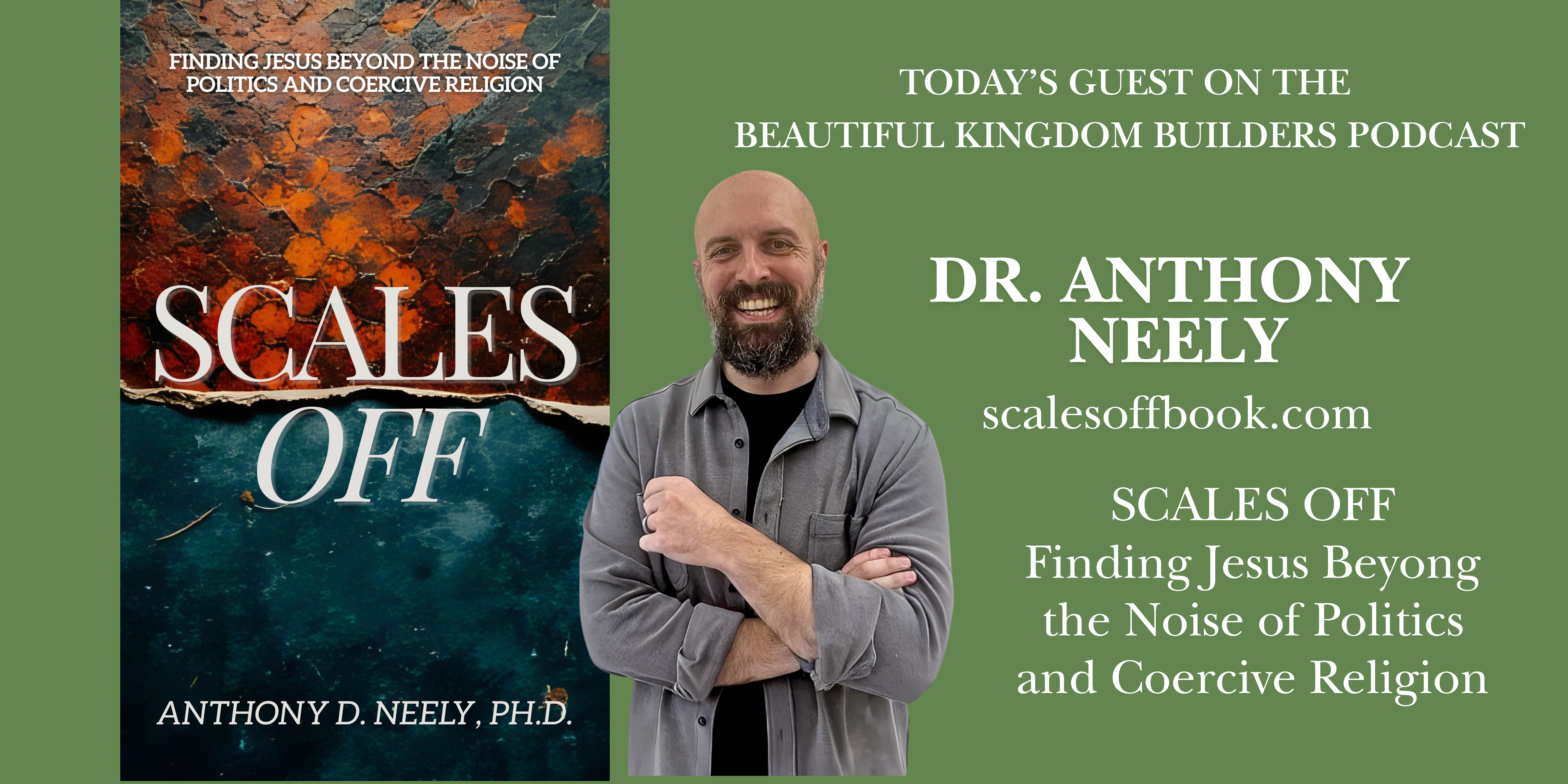
013 I Dr. Anthony Neely on Finding Jesus in a Noisy World

Find SCALES OFF: Finding Jesus Beyond the Noise of Politics and Coercive Religion on Amazon or ScalesOffBook.com

I am delighted to share this conversation with you with Dr. Anthony Neely (Tony) about his amazing book, Scales Off. In this conversation, Tony shares his journey of faith and explores the impact of coercive religion and Christian nationalism on his personal beliefs. He discusses the emotional experiences of recognition and reorientation, emphasizing the importance of re-centering on Christ and fostering healthy relationships within communities. Neely highlights the significance of vulnerability, grace, and the influence of figures like Rich Mullins and Brennan Manning in finding hope and wholeness amidst spiritual struggles.

I loved reading Tony’s book and found it to be extremely well-structured, enlightening and educational, pastoral, and most of all, hopeful. This is an important resource for Christians today who are trying to make sense of what happened to our faith. Tony includes questions and a reflection prayer at the end of each chapter, which would make this a great book group selection. And he ends his book with an appendix of resources, including a Spotify playlist that I can’t stop listening to.

Visit scalesoffbook.com to learn more about Tony’s book, reach out to Tony with any questions or comments, and he even graciously offered to send a free ebook to anyone who cannot afford to purchase it!! I cannot recommend this book enough to you. I nearly highlighted the whole book.

In our conversation, Tony recommends reading Andrew Whitehead and Tim Alberta on Christian Nationalism. And he mentioned his wife’s love of Martyn Lloyd Jones books.

You can listen to our conversation on The Beautiful Kingdom Builders Podcast on YouTubeSpotifyApple PodcastsAmazon Music, Substack, and more! If you find our conversation helpful, please share it with a friend, rate and review, and subscribe so you never miss an episode!

TRANSCRIPT:

Ruth Perry (00:15)
My guest today is Dr. Anthony Neely, who wrote the book Scales Off: Finding Jesus Beyond the Noise of Politics and Coercive Religion. I just finished Scales Off this week and it was a beautiful book that resonated with me so much with my own faith journey and I just highly recommend your work. Tony, right?

Anthony Neely (00:21)
Okay.

Ruth Perry (00:38)
So welcome to the Beautiful Kingdom Builders podcast, Tony.

Anthony Neely (00:41)
Yes ma’am. Yes ma’am.

Ruth, thank you so much for having me. It’s really, really kind the fact that the book resonated with you and kind of spoke to your own story. That means a lot to me.

Ruth Perry (00:47)
It, I mean, everything you wrote resonated. The whole book from start to finish. I just was really impressed with the language that you gave to this experience that I think a lot of people are going through right now with disillusionment with what the church has become in the last several decades and how that disillusionment can either leave us completely separated from our faith or we have to find a new way of imagining our faith and so this is just a perfect and beautiful guide to that and the whole tone of your book is very gracious and pastoral and so it casts a really beautiful vision of what could be and what ought to be the church and what Jesus’ heart is for his kingdom and his values and I just thank you. It was obviously a lot of work and a lot of experience and expertise behind this book and so I’m excited to get into it with you. But before we talk about it, first could you tell me more about yourself and your faith journey, Tony?

Anthony Neely (01:48)
Sure, faith journey, I grew up in a family that wasn’t very religious. In fact, I had an uncle and aunt who identify as Christians, everybody else in my family, it was just kind of be a good person. Wonderful, lovely, lovely people grew up, well-provided for. However, kind of understanding of faith was, you God is in charge of good things. Devil’s in charge of bad things. And very much so this kind of workspace mentality of there’s this giant scale. And if you have more good than bad, then, you know, one day you get to go to heaven and bad people go to hell. And it wasn’t until my family relocated from the Chicago area when I was a kid to middle Tennessee, I grew up in a small town in Cookville, Tennessee.

Down from me lived a guy named Bill Farrell. He just loved him some Jesus. Even as a middle school kid, he loved him some Jesus and was always inviting me to go to church with him and always trying to get me to come to his youth group. And I wasn’t really interested in it. And then he had convinced me to go to a Super Bowl party with him. And he was like, there’s gonna be free pizza. was like, I’m a fat kid at heart. So bring on all the pizza. And he also tricked me because he had said that there was a girl that he knew that I liked who was going to be there.

And so I was like, yeah, let’s go to the Super Bowl party. He didn’t tell me that the Super Bowl party was taking place at a church, so a little sneaky sneaky there, but we got in and halftime during the Super Bowl game Jeff Hall who was a kicker for the Tennessee Balls at the time got up and it was the first time in my life that I’d ever heard the gospel. And it resonated with me in such a way that I call it the working of the Spirit, call it whatever you want to call it from that point on. I was like, I want to follow this Jesus guy because this guy’s talking about in a way that I’ve never heard of it.

And so I think from then, like every person, you know, there have been mountain tops and there have been valleys and there have been struggles and there have been times like now, extreme cognitive dissonance and trying to work through this. But it’s been a beautiful, beautiful walk in this life. And God has been so incredibly kind and gracious to bless me with a lot of opportunities. I’m a musician, so I’ve been able to help lead worship all over the country and work with touring musicians and play at camps and be a recording artist.

He was gracious enough to allow me to become a teacher. And so I’ve been able to try to act out my faith and just loving the next generation and trying to encourage them to, you know, be good human beings. He’s given me a wonderful family and yeah, I’m more and more the older that guy. I just turned 40, just stopping to recognize just how kind God has been to me throughout my life and that just speaks a little bit to my experiences has just been this overwhelming kindness and graciousness that God’s me with hiccups of, I don’t know if I can say WTF on here, but like those moments of what in the world is going on and that’s kind of been where this book came from was about 10 years ago.

It was like this tradition that I had grown up in and come up in and had been discipled by and then, you know, loved so well, I started realizing things are changing. Things are happening. People are saying things. are identifying with things that in many ways are in direct opposition to what I had been taught about Jesus and what I had been showed and discipled to what it looks like to follow Jesus. And the idea of like scales falling off. Like, am I the only person who sees this? And for a long time, it felt that way. And so the book really comes from a place of just trying to unpack and understand what in the world is going on. What’s happening to, the body of Christ here in the United States?

Ruth Perry (05:54)
10 years ago, where were you in your ministry? I’m also curious to know what your education background is.

Anthony Neely (06:01)
So 10 years ago, I was still very active and am still very active worship. So I was still serving at a church, involved with small groups, wife and I helping out with kids ministry, things like that. So I mean, still very highly involved. When we went to graduate school in Texas, I can speak to that here in a second, but at one point I was, I think serving at three or four different churches.

So I was constantly engaged in service. So there was never this moment of, I’m de-converting, I’m falling away. Any of that, it was just, is anybody else seeing this? Why is everybody seem to be okay with what’s going on right now? And so as far as education background, I do have my PhD. So I have bachelor’s and secondary education, master’s in educational theory.

My doctorate in curriculum and structure is from the University of Texas at Pantoneo. Go runners. And so jokingly say I went to school to teach teachers how to teach. And my wife is a college professor. I always tell students I’m the chubby bald-bearded one. She’s the beautiful, brilliant Dr. Neely.

And so yeah, I kind of came from a background of research and writing and before this book I’d already published two other books but this was the first time that I had ever published something that was so heart on my sleeve, transparent, talking about my own faith journey and trying to help others in theirs.

Ruth Perry (07:23)
All right, let me see. So in your book, you organize it with a really beautiful framework of recognition, reorientation, relationships and community, and then wholeness and hope. And so I thought we could talk through your book, through that framework, and start with recognition. Can you tell us what recognition is in this Scales Off process?

Anthony Neely (07:46)
Yeah, absolutely. When you start realizing, like I mentioned a second ago, that things are adding up. I’ve been taught and told that following Jesus is supposed to look like X, but now everybody, not everybody, but a large swath of people seem to be caught up in the movement that’s saying that it’s actually this thing over here is Y. And that led to just a lot of trying to process how much of what I’ve been taught is actually based in the teachings of Jesus versus what I was taught as being essentially called Spade and Spade, a form of manipulation, a form of requiring adherence to a framework that doesn’t really have anything to do with Jesus at all.

And so the book itself really a, I’m joking to it’s 10 years of late night conversations between my wife and I after our kids were in bed and neither one of us can sleep and we’re talking through what’s going on. It’s lots and lots of text messages back and forth with friends. It’s diving in to book after book after book and podcast after podcast. Just trying to see the old adage, am I crazy or is everyone else crazy?

And I never intended to write this book. It actually started out as journaling and it started out as lots of voice notes in my phone of me just trying to process what was happening. And I mean, we’re beating around the bush here, obviously, the explosion of MAGA, the alignment of the American Evangelical Church with far-right Christian nationalism, all of this kind of coming together. And it started out from that journaling, I wrote a poem. Because I’m very much so a creative. Growing up in like the Southern Baptist tradition, I never really fit the mold of like, you know, hunting and the men’s wild game dinners. I’ve always been a hey, let’s go to a poetry reading and then the symphony or whatever. But it started out, I was like, okay, I have all these thoughts. have all these ideas.

Ruth Perry (09:48)
I would love to hear it!

Anthony Neely (09:49)
I’ll share that here in just a moment. And it scratched the itch of going through my own processing. This very much so was a therapeutic process for me. Because I was like, don’t want to leave Jesus behind. I don’t want to my faith. I do want to, I’m going to use the four letter word “deconstruct” some of these ideals that maybe aren’t necessarily aligned to the teachings of Jesus. And so I just kept writing and writing and writing and writing and writing and eventually what was largely stream of consciousness started to take on the form of the book itself. And so a lot of this came from just, again, me working through my own hang-ups with what I was seeing in the world.

And so, yeah, I’ll share this poem with you that is where the book was birthed from.

So the poem is called Come Home. So it says,

“Come Home” by Anthony D. Neely

I remember what it felt like
to belong.
To believe.
To sit beneath the steeple
with hands lifted high
and eyes closed tight,
certain that we were the light of the world.
Salt of the earth.
A city on a hill.

I still remember.

I remember Sunday mornings
when grace hung in the air like incense.
when we wept for the hurting
and we prayed for the lost —
and meant it.

But then…something changed.

You told me to love the least of these.
So I did.

And you called me a radical.

You taught me that every life is sacred.
So I said:
Yes. Amen. From womb to tomb.
That a child deserves more
than a heartbeat bill —
they deserve a full belly,
a safe school,
a mother with healthcare,
a father with a livable wage.

You said that made me
a leftist.
A socialist.

But I was just trying
to be consistent.

You raised me to be pro-life,
but only part of the way.
Only until the birth certificate was signed.
Only until the taxes got too costly.

You taught me to hold leaders
to higher standards.
To speak truth.
To seek righteousness.
Until the red hat came along.
And suddenly character didn’t count.
Suddenly truth was negotiable.
Suddenly I was the enemy
for not falling in line.

You sang, This world is not our home,
but then you clung to power
like it was a lifeboat.
Wrapped the gospel in a flag.
Put your hope in policies
and forgot the poor.

You told me my allegiance
was to a King and a Kingdom —
but condemned me when I said
His Kingdom isn’t built
on Capitol Hill.

Still —
I believe in repentance, new life, and resurrection.

So I’m holding out hope.
Hope that you’ll remember
the table is wide,
His yoke is easy,
and the burden —
is love.

And if you ever find yourself
tired of fighting,
tired of pretending,
tired of defending idols
in His name…

You don’t have to explain.
You don’t have to earn your way back.

Just listen.

There’s still a voice
in the quiet places
calling you —
and me —
and all of us —
to return.

Come home, come home.
Ye who are weary, come home.
Earnestly, tenderly, Jesus is calling,
Calling, O sinner, come home.

And so that’s where this kind of started was I got the poem written, but then it was like my brain still couldn’t turn off. I had so much more to say, so much more to get out. And I just kept writing.

Ruth Perry (12:49)
I’m so glad you read that poem. That was so powerful. I mean, it’s really beautiful just to hear that and that that’s the framework of your entire book too. That it ends with hope and with invitation and that there’s so much freedom and so much joy and so much available to us if we can allow ourselves to go through that painful process of letting the scales fall off and reimagining something better and new. And something old, actually. Something faithful.

Anthony Neely (13:18)
Yeah, I would say that it is incredibly painful to recognize that the worldview and the framework that you have developed is not at all what you claimed that it was. And there is struggle that comes with that. There’s relational struggle, there’s internal turmoil.

Honestly, I understand why so many people are leaving the church. I mean, the “Great Dechurching,” millions and millions of people leaving in mass because, you know, they feel they were duped. And for many of them, they were. And so, I tried to write this book, even though I’m not a pastor, I’m a teacher. I tried to write it from this point of I see you, I hear you, I recognize that you’re allowed to how you feel. I’m not going to tell you that you’re wrong in doing how you feel, but I do want you to know that he’s still worth your life. He still loves you more than you’ll ever understand, and let’s try to work through some of this together. And here’s how I’m working.

Ruth Perry (14:14)
You identify Christian nationalism and coercive religion as producing a counterfeit gospel that exalts tribe over truth, platform over service, and cultural dominance over Christ-like love. Could you explain what Christian nationalism is as a worldview on one hand, and then religion is on the other hand?

Anthony Neely (14:37)
Absolutely. Well, it’s hard to do them on one hand or the other because they have become still and it’s fine. If you want really nerdy, in-depth definitions, get into some of Andrew Whitehead’s books on Christian nationalism. I always point people to Tim Alberta’s book, The Kingdom of the Power and the Glory.

There’s phenomenal resources, but the way I think about it is Christian nationalism is the attempted fusion of national identity with divine authority. So it’s a blurring of lines between faith and state that has America as God’s chosen instrument for ushering in Christ’s second coming.

And what’s so dangerous about that is it replaces the way Jesus said that his kingdom would grow by trying to legislate transformation rather than trusting the spirit to do that work. And so it’s like from Capitol Hill, we’re going to put out these moral guidelines, moral standards that were going to try to fit you into this Christian box when that’s not at all how Jesus said his kingdom was going to be built. So you have that, you have the political element on one side that is trying to say we are God’s chosen nation, rather than seeing ourselves from what we really are a lot of times, which is basically a second Babylon, we view ourselves as this nouveau Jerusalem.

And on the other hand, you have this coercive element, this coercive religion, which is when beliefs are weaponized for the sake of controlling people or forcing adherence to some kind of set framework of what they believe it means to belong to that given faith tradition.

So essentially it’s a tactic intended to produce people as machine products that fit some kind of standard for communal belonging. So it’s trying to say, if you are one of us, if you’re going to belong, these are the things you do. You act this way, you talk this way, you speak this way, you listen to this, you watch this, and it reduces faith to a bunch of do’s and don’ts. However, it is hitting at our God-given desire for belonging, especially as we are wanting to belong and grow and earnestly grow into the image of Christ.

We trust these people in positions of authority over us as religious figures, and we assume they are guiding me to follow Jesus in this way. And so this must be the way to look at Jesus when a lot of times, again, just like with the political element, it’s more about asserting dominance and control rather than transforming us into the likeness of Jesus. And I want to say on both sides of that, there are people who do so in a loving and earnest way. It’s just like parents tend to parent the way they were parented. A lot of pastors and leaders within faith traditions and people running for political office are doing so because they believe that’s what it looks like to love and serve Jesus.

It makes me think, and I mentioned this in the book, that it makes me think of like the zealots of Jesus’ time. They loved God. They wanted to see his kingdom come. They wanted Rome overthrown so that God would be back at the political center of the universe. But the way that that manifested was so wrong and so counter to the flipped version of God’s economy or how God goes about building his kingdom.

Ruth Perry (17:51)
Yeah, and they do really emphasize spiritual authority in their religious systems and really teach the people who are part of those systems to submit and defer. And so that’s a real big part of the hierarchy of authority, isn’t it?

Anthony Neely (18:08)
Yeah, well, I mean, even now looking at, you know, people pointing to Romans 13, it’s like you don’t question the government because Romans 13; that’s not at all what Romans 13 is saying. It’s like, you know, what’s the old saying? A text without a context is a pretext to a proof text. It’s like you’re taking scripture outside of the context of what it’s talking about and saying that we are not allowed to question what our government’s doing, that we’re not allowed to exercise our rights of protest and freedom of speech against the government because your interpretation of the scripture says you can’t do that.

That’s not at all what it’s saying. We’re not told to blindly submit to authority. We’re told, you know, God gave us a mind. God gave us the ability to infer. God gave us the ability to ask questions. Jesus asked a heck of a lot more questions than he ever gave answers. And mean, following that model, I do think that we have this idea, I just have to submit, I just have to submit. I think that again, that’s coming from an earnest place of wanting to be more Christ-like. But that also leads us to a place where we can be easily taken advantage of and hurt.

Ruth Perry (19:14)
Yeah, that’s part of the saddest thing for me is growing up in this kind of religion, I know so dearly how sincere my siblings in the faith, what their faith is. I mean, it is very sincere and beautiful, and then it’s being corrupted.

Anthony Neely (19:31)
Well, and I think that’s one of hard things, especially within the realm of Christian nationalism, is there are political movements that are bastardizing scripture in order to pander to those people who are in love with Jesus. And they think, okay, this person is using the scripture. This person is using these words. This person is holding up a Bible or showing up at prayer breakfast or whatever, then they must really be one of us.

I had a discussion with my students about this the other day. And whether it’s within the church or whether it’s within social settings, I think a lot of that manipulative element is, just calling a spade a spade, is corporations who have built these algorithms who understand that we are going to be influenced by what we think most closely aligns with our worldview. We get boxed in, boxed in so that we get tunnel vision.

We start assuming that the voices that we’re being overwhelmed with in these social spaces are the right ones because if that’s all I’m seeing, if that’s all I’m hearing, that must be right. And then we move from it’s no longer us and them, it becomes us versus them. And if you don’t view the world that I do, then you must be an enemy.

And at the end, these algorithms, they’re not your friends. I had to this conversation with my kids yesterday at school. They’re not your friends. They’re not there to, you know, educate you or point you towards any kind of moral or ethical outcome. They’re there to keep you on these platforms as long as possible so that the people running these platforms can make as much money as possible.

You’re a pawn in the game and we as a faith community and we as a society or having to pay the price of the impact that these algorithms have had in further dividing us where we can’t even have conversations anymore without people assuming the worst in us or assuming enemies.

Disagreement’s no longer a disagreement. Disagreement is now an act of war. And that has done so much damage, not only for us as an electorate, but also us as a faith tradition, we show up on Sunday mornings and we sing these songs and we pray these prayers, but then we carry hate in our heart for our neighbor because we saw what they posted on Facebook yesterday. And so it’s like this weaponization of our sincere intent and our sincerity to love and grow in our pursuit of more like God, our sanctification, that is, you know, ultimately what’s causing a lot of this division to flourish.

Because if we’re only getting one view and shortening, shortening, then it becomes really easy to take advantage of us. And I think that’s what’s happened with so many devout, loving people is they spend way too much time watching their preferred news outlets. They’ve spent too much time being rage baited by certain podcasts or protests. This is on the left and the right. That the rest of us are on podcasts talking about how do we undo this world that we live in so that we can find Jesus beyond all of that noise.

Ruth Perry (22:34)
That is so true. And like you said, it’s on the right and the left. And it’s something that I personally have a real struggle with because I am addicted to my phone and I’m addicted to the algorithm. But I did go on a mission trip. I think it was 20 years ago. It was a racial reconciliation mission trip to Washington, DC with my college. There were 20 something of us and we got to go meet with congresspeople. We went to soup kitchens and a domestic violence shelter and had all these conversations and everywhere we went, we would say, what can we do? And they’re like, just listen to us. Just please listen to us. That was everywhere. Please listen to us.

And so I did, 20 years ago, I just started diversifying the people that I follow online. And now 20 years later, I can see like what an impact that’s made on my life, that I’ve had sources of information. And then on the other hand, I’ve also kind of woken up in recognizing or yeah, recognition. We’re talking about recognition right now.

I recognize that a lot of the people from my background that I listened to were angry. Even the preaching I listened to, it was so angry about everything. And that was just a part of the tone. And the message was anger and fear. Can you talk more about how anger and fear play into coercive religion?

Anthony Neely (23:55)
Yeah, so I think again, we all have this sense of belonging. also, you know, we don’t want to upset those to whom we look to as mentors, as leaders, as authority figures. And so we want to belong. We don’t want to rock the boat. And so we’re going to try to fit into whatever these molds are because we trust again that people who are, you know, carving out the path trying to teach us to follow Jesus are doing so in a bit biblically accurate way. And I think you take that along with the fact that rage sells, anger sells. There’s a reason that Happy Go Lucky podcasts that promote everything is amazing and here’s happy news this week aren’t the ones that are at the top of the chart.

We, there’s something about our nature, call it our depravity, call it our fall, whatever, that clings to anger. And so you take that with the fact that we live in a world right now where there’s lots of stuff to be angry about. It’s very easy to get caught up in anger, but, but as you recognize that there are, there are voices profiting off of my anger, that I am monetized in sharing these thoughts online. I am basically buying somebody another beach house every time I listen to their podcasts that encourage me to hate my neighbor and consider the least of these to be an enemy of the state.

When you start recognizing that, you’re like, that’s not Jesus at all. And why in the world is that spilling over in the pulpit? And so with that recognition comes, I would say, the dangerous element of starting to question because coercive systems don’t like being questioned.

If you look throughout history, I’ve been a social studies teacher for almost 20 years now. And if you look throughout history, normally the people who are taken out first, which Walter Brueggemann talks about this, in some of his writing. It’s normally the artist, the writers and anyone else who might question authority. Because if you start questioning, who’s profiting from this anger? Who’s profiting and being bulstered and lifted up? Who’s being emboldened by this? Then you bring danger to it because if you can point within Christian circles and say, you’re angry about this, but that thing that you’re so angry about, Jesus told us to embrace that.

You are so mad at this group of people. Jesus said, that’s the group of people that we need to lay down our lives to serve, to sacrifice for. Well, you’re starting to get in the way of their brand. And so there is this element both, you know, talk about a lot in the book is as you’re listening to these voices, as you are starting to question maybe some things you’re hearing in your faith tradition, consider whether or not they’re willing to answer your questions. Does asking questions make you come off as someone who’s sincere and trying to grow? Or do they vilify you for it? Do they start to ostracize you? Do you start feeling marginalized and othered because you’re asking questions? because what you’re being told doesn’t necessarily align with the scripture that you’re reading?

Ruth Perry (27:03)
Yeah, so that kind of brings us into the reorientation when you start seeing all of this, the recognition, and then you move into reorientation. What’s happening when the scales start to come off and what is the emotional experience of that?

Anthony Neely (27:16)
So as this scales start coming off, you have a few options. I mean, you can ignore it and just try to say, hey, I’m just going to bury my head in the sand and try to keep going. You can do, like we said, what many people have been doing during this period of great deterting. You can run away. You can flee and say, I’m done with this. And again, I understand people who have chosen that path.

Or you can say, God, I trust that you have allowed me to see this. And I’m going to ask you to just start revealing to me,
recognize that God has allowed me to see this and just pray that he is going to start tearing down those walls and how many of again using that naughty word deconstruct some of these issues. Complete side note, I don’t understand we in the evangelical world get so upset about the idea of deconstruction because deconversion and deconstruction are two completely different things.

Deconstruction ultimately is a form of repentance. The word to repent, you know, we always think of to turn around, but also means to think again, to change the way in which you’re thinking. So if you were building a house and you recognize that, you know, something is askew in your framing, you’re going to go back and you’re going to do away with, you’re going to deconstruct what was wrong in the construction process so that you can rebuild it so that it’s stronger. So I don’t really understand why we get so caught up in that term as a side note.

But as you are deconstructing and going through this very painful process so that you can rebuild your faith around Jesus, I can’t tell you that there’s any single, this is what you’re going to feel emotionally. Because for some people, it’s a sense of liberty and joy and freedom and excitement because they are seeing Jesus in ways that they’ve never experienced him before.

For others, it’s going to be painful and it’s going to hurt and you’re probably going to need some professional counseling and help to work through, you know, the feelings that you’re having and to process everything that you’re going through. For others, there may be the the issue of relational and communal separation, because you may get to a point where you say, need to seek out a new community. That my time here in this faith community has kind of come to an end. And so I need to find some place new.

And, you know, it’s hard to leave the, not just even tradition, but the friends that you’ve had and norms that you’ve had and the rhythms of like that you’ve had of this is just where I go and this is where I sit and here’s you know the Sunday school class I go to or whatever and so there can be there could be a lot of the struggle of starting over that comes along with that so it I would say for those who have recognized and those who are now going through the process of okay where do I go from here just know that whatever you’re feeling is okay to feel, how you’re feeling in that moment. God is big enough to handle whatever feelings you have, whatever questions you have, and all he asks is that we come to him in sincerity and honesty. And so if you need to scream into the sky, you scream into the sky. If you need to cry, if you need to laugh, if you need to get really, really angry, God’s big enough to handle those things.

Even though many of us, were brought up saying that you only talk to God in this very reverent tone. No, God welcomes us to come to him as we are. know, Hebrews, we’re told that we don’t have a high priest who can identify with us. There’s no emotion that we’re feeling that Christ himself didn’t feel. So he welcomes us to come to him. So whatever you’re feeling during that emotional element, just know that Jesus will walk with you through it as you are trying to figure out what your next steps are.

Ruth Perry (31:16)
I feel like I’ve had a lot of healing to do because of my background with coercive religion and just some spiritual trauma that I’ve been through with a church split that deeply impacted my family and also untangling myself from my patriarchal conditioning and trying to find my true authentic self under that conditioning. And I’ve had the financial barrier of not being able to afford therapy. And so I just, for years and years and years relied on books and reading online and finding people and listening to podcasts.

Then last year for a little while, I had enough extra income where I was able to afford EMDR therapy. And I’m like 15 or 16 years into my deconstruction process at this point. And it was really amazing to me how much trauma my body was holding and how effective being able to receive trauma therapy is. And so I had kind of that fresh like layer of anger at the world that we live in where these things are out of reach for so many people.

Anthony Neely (32:17)
No, absolutely. So just being, you know, transparent, part of my wife’s own faith journey is my wife is, always struggled with scrupulosity, which is basically religious OCD. The idea that everything that you do, which is very much so evangelical, you know, total depravity, all, everything you do is sin, blah, blah. Well, you take that somebody that already has some sort of dispositions in the way they think and they got to the point where my wife had stopped going to church.

And yeah, that process of recognizing the origins of your trauma and getting help for them. I’m glad that you got to a point where you’re able to go for the counseling and the EMDR. My wife was a compulsive reader and she found her solace, this entire bookshelf here is all Martin Lloyd Jones books. So her place of comfort, her solace was in reconstructing her faith through the writings of Martin Lloyd Jones. He has a book called Spiritual Depression and my wife has led some women’s book studies through it.

And I do think it’s interesting that you spoke to, you know, we as a society, political, whatever, we’re very quick to blame things on mental health, emotional health, but yet we’re constantly cutting funding and cutting access to those things because I’m so glad you were able to get now, but mercy, I wish you could have had that access 15 years ago, 20 years ago, and I’m so sorry that you didn’t.

Ruth Perry (33:54)
Yeah, I think just the difference in my nervous system being grounded and rooted versus like constantly being vigilant and on edge. It’s amazing.

Anthony Neely (33:59)
Yeah, it’s a physiological response. Yeah, and I talk about that in the book that it’s not just an emotional or spiritual response to, you know, coming, recognizing that you’ve been in a coercive system or going through autocracy. It’s physiological. Your heart rate increases, your anxiety spikes, your cortisol levels go through the roof, you lose sleep and, you know, God designed our bodies to send us messages.

And so, yeah, I just wish that within the church, my wife actually has, I got her a sweatshirt that says you can have Jesus in a therapist too. Because we, for some reason, we put up this wall between spiritual reformation and the mental and physical health element of it and when we are complete beings and all of it needs to be addressed and especially when you’re going through something as heavy as you know trying to work through the dissonance that comes from recognizing and trying to decide next steps of being in the coercive system or in the crazy political mess that we find ourselves in today.

Ruth Perry (35:12)
Another emphasis that you have under reorientation is on re-centering on Christ. What are some practices that help us strip away the layers of distortion and get back to Jesus?

Anthony Neely (35:22)
Yeah, so I know I put a lot of them in the book because again, this was like 10 years of what could we try? What can we do? I think it starts with revisiting scripture with fresh eyes. Do a slow reading. Look at Jesus and his dispositions. Who does he give attention to? What does he say to them? What accusations are thrown at him?

Because I think again, in this like, machismo, American Jesus kind of world that we live in right now, we have a very skewed, hyper-masculine view of Jesus that robs us from seeing that, you know, he was perfectly balanced. He would call, you know, abusive authority on the carpet, unflinchingly, but also he would welcome prostitutes and tax collectors. And he would spend time with these religious authorities, but then he also would be with, you know, the scum of the earth, basically, of his day. And so when we go back and we do a slow reading of scripture, I think that that helps us to better understand, you know, who we are and who he’s calling us to be and what it means to try to be more like Jesus.

I would say taking a break from social media or any kind of rage-based outlets is absolutely critical because if you just keep feeding the beast, the beast is going to want more and more and more. I say in the book that it’s really important to start finding God again in nature and I would also add to that in the arts.

Over and over over again, we see people in scripture, going into the wilderness, going, for lack of a better word, going on hikes, going on walks. And so I think that there’s something to be said as we’re walking through this, just being away from the hustle and bustle of the world and just being back in God’s creation. And with the arts element of that, our God is infinitely creative and I believe that all art reflects the beauty and the creativity of who God is.

And so for many traditions, you’re brought up being told that there’s this very hard line between the secular and the sacred. And I don’t necessarily buy into that. I believe that all art can reflect God’s creativity, whether the original artist it to or not. The other thing I would say is to rest. Part of, you know, the system is to be busy all the time. Busy, busy, busy, busy. To the extent that if for some reason you’re not knocking on doors on a Sunday afternoon or you’re not leaving Awanas on Wednesday night or whatever, then you’re taught that’s almost sinful. And so you get this mindset of

To be a Christian, to be, I have to do all of these things. And I have to be busy all the time. All that does is lead to resentment and burnout. So allow yourself the opportunity to just rest and get comfortable, become comfortable with the idea that Jesus took maps, you can too, it’s okay. Recognizing that what we see of people and scripture are very small snapshots of their lives. Most of their lives were very normal, going about doing their thing.

So you don’t have to be, know, doing crazy, pursuing crazy mountain top experiences every day, because again, you’re chasing experience. You’re not chasing after the person, the redemptive work of Jesus. With that though, I would also add in, for your service, try to be intentional about serving and spending time with people that your previous context had villainized or marginalized. Spend time with immigrants, spend time with the poor, spend time with the LGBTQ community, spend time in jail, spend time in all these places that you were told that a clean cut little shiny happy Baptist doesn’t go to and recognize that that’s where Jesus probably would be if he were here today.

I always tell people that if Jesus were walking around today, we’d probably be much more likely to find them in a trap house somewhere, talking to the drug dealers than at the country club, talking about their handicap and the next round of golf they’re playing. And so I think you were saying earlier, when we put ourselves in those positions and we can hear people’s when we rehumanize them after our traditions have tried to rob them of their senses, for whatever reason that I think we are becoming more in line with the heart of Christ.

Ruth Perry (40:02)
The next part of your book goes into our relationships and our community. And I think the most compelling part of that section for me was when you were talking about how to have fruitful conversations with people who have remained or having conversations that are gracious and merciful and loving instead of reactionary. I think that was really important. If you could just talk about that with my audience.

Anthony Neely (40:16)
Yeah.

Ruth Perry (40:26)
Because this is, think, the struggle for all of us is that we still have loved ones in coercive religion.

Anthony Neely (40:31)
The proverbial angry uncle at Thanksgiving dinner kind of… Yeah, so the way I talk about it in the book is trying to move from being an arsonist to being an architect. Do not… It’s so easy to do, but try not to become the progressive version of the far-right conservative thing that you’re trying to leave behind. Because it doesn’t really matter which end of the spectrum. If you’re constantly burning, you know, people with the sword that is your tongue, then that’s not going to lead to benefit for anybody. That’s not going to bring about reconciliation. That’s not going to bring about any kind of redemptive work. All it’s going to do is further divide.

And so, one of the things that I do is I have all kinds of notes in my phone where I just, have thoughts. I’m not denying I have thoughts where I just want to rip into people because they say something I’m just like, but I know that doesn’t benefit. So, I do have the space where in my phone I can just type those out and I have them there for myself rather than having to put them out on and using my platform, whatever it may be on social media or text or whatever, because all that’s going to do is serve as an arsonist. I’m just going to burn down. I’m going to cause more and more wedges because when we approach people with conflict, they’re going to dig their heels in.

So instead, I encourage in the book to practice a technique called motivational interviewing. Again, if you look at the life of Jesus, he asked a lot more questions than answers he ever gave. And so the whole point of motivational interviewing is, in sincerity, ask questions of people. You’re not trying to lead them. You’re not trying to get to some kind of predetermined outcome, but you’re trying to create space where people can maybe through the line of questioning that you give, they can consider and wrestle with what their beliefs are, why they hold to certain ideals.

And I think in doing so, if they know that you’re sincere, if they know that you are open to hearing their thoughts, if they know that you care about them, as a human even if you disagree with their ideas you care about them then they’re more likely to keep engaging with you. A good example of this is I have the SRO officer at my school. Wonderful guy. Love him. Such a cool guy. But he and I view some things in politics very differently.

And you know what? We will get together at lunch. You know all our kids are trying to keep them from throwing blueberries or whatever. And we will have wonderful conversations about these things where if people were doing it online, hiding behind the anonymity of a username and an avatar would be blasting each other. He and I walk away with fist bumps and, dude, this is so much fun. I’m glad we can talk.

And I think that’s what we need is to be able to approach each other as human beings saying, I disagree with your viewpoint. Let me ask some questions about why you hold yours. Not a got-you question, help me understand what you’re saying. And then the big thing that I’ve learned is always ask permission to share your thoughts. Don’t just barge in while I think blah, blah, blah, blah.

If you, no, if somebody says something then, they are much more welcoming to hear what you have to say if you would just say, is it okay if I share with you what I think about that? Is it okay if I tell you a time that I dealt with something like that? Because again, you are moving from arsonist to architect. You are tearing down those walls. You’re trying to break down people’s defenses so that you can have an actual conversation. Just like sharing the gospel with somebody, your goal is not conversion.

That is the spirit’s work. We have to trust the spirit to do what the spirit does, which is the transformation of people. What we are called to do is to love and engage. And when we move from arsonist to architect, we create those opportunities where maybe somebody walks away and they think, huh, you know, they referenced this book. Maybe I’m going to go check out that book.

You know, they were talking about how they used to follow that podcast, but they don’t follow that podcast anymore. Maybe I need to step away from it as well. And so just creating these spaces where you can have fruitful conversations is I think is ultimately what needs to be pursued. But we’re also human. And we understand that sometimes those conversations don’t need to be had. So I think there’s also an element of maturity in recognizing

that there’s some people that are ready to have those conversations and there’s some people who aren’t ready to have those conversations. And I think that’s why setting clear boundaries for yourself and being able to recognize this is robbing me of my peace, I’m trying to go on the offensive and having the courage and bravery to say, right now is not the time for us to have this conversation. You might make some people uncomfortable.

You might make some people upset, it’s also going to save you from saying something that ultimately could rip that relationship completely.

Ruth Perry (45:26)
And when you mess up, as we all inevitably do, when you’re living on this side coercive religion, you’re not going to go into a shame spiral or feel like a failure or internalize that kind of horrible feeling after. You can repent. You can apologize with sincerity and you can bask in God’s forgiveness and grace and mercy.

Anthony Neely (45:47)
Absolutely. And you know, I’m a big advocate for put your skeletons on display and let them dance. And so rather than pretending like you’re some kind of shiny, happy person who has everything perfect, like be vulnerable. It’s uncomfortable, but be vulnerable, be transparent and be able to say, I don’t know the answer to that. I don’t know. This makes me angry. I’m frustrated by this.

No, I don’t have an answer to the 47, you know, different podcasts quotes that you just threw at me. And, and not putting on this persona that I know everything, I have everything figured out. think that that’s freeing for us because we start realizing perfection was never the expectation for us that to quote Homer Simpson, I read this whole book and those people are really messed up except for this one guy.

And we started fighting, you know, freedom in understanding that we are flawed human beings and that can help us to hopefully move away from some of those shame spirals. When we learn to accept ourselves as Christ accepts us, then that can be a great stepping stone towards hopefully not beating ourselves up when we put our foot in our mouth or when we say or do something wrong because like he said, God loves us regardless.

God is infinitely and eternally delighted to call us his sons and daughters. God will never love us any more or any less than he does in this moment. And when we get to a point that we can start actually believing that, I don’t think we’ll ever fully comprehend it. But when we get to a point where we start believing

Ruth Perry (47:22)
Yeah, and this is going into the wholeness and the hope piece of your framework. I really liked when you spoke about Rich Mullins and Brendan Manning. Those are both people who have been really influential to me in finding my freedom in Christ. Can you speak to how they’ve been influential for you as spiritual guides?

Anthony Neely (47:40)
Sure, so I think Rich and Brennan did a couple things. If you guys don’t know Brennan Manning, he wrote Ragamuffin Gospel, which also was highly influential in Rich Mullen’s life. I think they both showed a couple things. One, is God loves to use a ragamuffin. We are screwed up, messed up people, but that’s exactly who God uses, I think shows that there’s power when they write there’s power in being transparent and sharing his story. Neither of them tried to hide the fact that they were rascals. I think we’re far enough removed from Rich now that we’ve started to like deify him. But Rich was very transparent. He was like, I like women. I like drinking. And a lot of times I’m a jerk but also I’m loved by Jesus and I’m called for his purposes and bring glory to his name.

And so I think understanding in their works that we are loved by a ridiculous amount of grace and mercy and that is what holds us, not us, but God’s ridiculous amount of grace and mercy what holds us brings that freedom and I think that’s one of things I’ve taken so much from not not just you know incredible song lyrics and incredible composition but the idea that God loves to use the people that everyone else thinks is gutter trash basically. That there is no person who is Too low down or too high up that God cannot use them in phenomenal ways. Brennan was an alcoholic, Rich, like I said, had all of his struggles, but here we are today and we’re still talking about their influence for the kingdom. We’re not talking about those things.

Ruth Perry (49:25)
Yeah, that’s really beautiful. And I just want to say how beautiful your book is. It’s really good news and really hopeful. the whole book is a beautiful resource for people who are going through this difficult journey of scales falling from their eyes and trying to reimagine a new faith or move forward. And I really love that you include questions at the end of each chapter and a prayer for reflection.

So you can use that individually or you can use it with a group. And then at the end of your book, you include a whole list of resources, including a Spotify playlist of people from, I agree, music has always been really important in my spiritual journey. it’s oftentimes God has like brought me a song or an artist in a time when I’m struggling that’s really ministered to me.

Anthony Neely (50:11)
Yeah, I put that playlist I’d actually had for myself for a couple years, because those were songs that were speaking exactly to what I was feeling, by left of center artists, primarily Christian artists. But they were just speaking to what in the world is going on politically, socially.

How in the world does this reflect Jesus? And I found so much comfort and solace. was like, it’s something I’m just going to link to in the book. I’m going to put it in the book because maybe somebody else is having a day of more news coming down the pipeline and more files being released of horrible, horrible things happening. And they’re just like, God, where are you in this? there’s some songs here that in a non-cheesy cliche way can remind me of that I’m not the only one feeling the way.

Ruth Perry (51:01)
If someone is on the brink of walking away from their faith, what would you say to that person?

Anthony Neely (51:06)
I see you. You’re allowed to feel how you feel. I have a sweatshirt that I wear. Not this one. This one says radicalized by basic decency. But I have a sweatshirt that I wear that says, I’m sorry the church hurt you. I think that’s the first thing that people need to hear is that their feelings are valid. And so I would start there and say, I see you. I hear you.

I would tell them that they’re loved, that they will never comprehend whether they keep going to church or stop going to church or take a break from the faith or whatever, that they’re eternally loved, that Jesus is big enough to handle their questions, to handle their doubts, and he welcomes them, he calls them his children.

I have a two-year-old and a six-year-old, and our two-year-old’s going through sleep regression right now. And about two o’clock every morning, he starts screaming, Daddy! Daddy! And I go in, and I take care of him, and it reminds me of a quote that I heard once that the only person who would ever dare wake a king from his sleep to ask for a drink is a son or a daughter. And so just to know that you can come to God with honesty and he welcomes you and it’s okay to get mad, to get angry, get frustrated because he’s big enough to take that and whichever path you decide to go, know that he loves you.

And I think that’s why I tell him. I’m not going to tell him, well you gotta do this, this, or this, or you need to just keep going, no, feel what you need to feel. Process it, recognize there’s people who want to walk through you with it, people that are feeling and have gone through the same thing as you reach out to them, find communities, be brave and ask the questions that you need to ask. And my hope is that they would find some solace in knowing that I wouldn’t be trying to force them to stay in a system that they have felt duped and abused by, but I do hope that they would walk away knowing that the God of all creation loves them so intimately.

Ruth Perry (53:16)
Amen. That was beautiful. Thank you. Where can people find your work, Tony?

Anthony Neely (53:19)
Absolutely. You can go to scalesoffbook.com. The book is available on Amazon in print and ebook form. And I always throw it out there. There used to be a Christian singer named Eli in the early 2000s. I always loved on the back of his CDs. It said, if you can’t afford the CD, call this number and we’ll send you a copy.

So my thing is always if you want to read the book I did not put the book out there to try to make money off of it Other things I’ve done is like these are lead Mac. There’s no lead magnet. There’s no course there’s no upsell and so I keep the ebook at like 99 cents. I Keep the the printed book on Amazon 9.99; if you can’t afford that there’s a contact page on my website. Click on that, send me a message, I’ll send you a PDF of the book. I just want to get as many hands of people as I can who are walking through a place of just being so frustrated with what they’re seeing, so hurt with what they’re seeing right now and trying to process it. And if it can be a resource to help them, shoot me a message and I’ll make sure you get a copy.

Ruth Perry (54:26)
That’s so amazing. Wow. Now nobody has an excuse not to read this book. It is well worth your time and your money. And I hope people do read it. And thank you so much for coming on the podcast today to talk about it. God bless you, Tony.

Anthony Neely (54:40)
Same to you, ma’am. Thank you so much for having me.


If you enjoyed this episode, would you share it with a friend? That would be amazing! You can subscribe to The Beautiful Kingdom Builders Podcast on YouTubeSpotifyApple PodcastsAmazon Music, Substack, and more! God bless!

Twitter sheds light on non-physical forms of abuse

The Twitter handle #MaybeHeDoesntHitYou, started by the BBC, has given victims of emotional, spiritual, financial and other forms of abuse a platform to share a glimpse into their experiences.

Often, the pain and trauma of non-physical abuse is dismissed or ignored.  Because the bruising to a victim’s psyche and soul are not visible, they do not receive the help and healing needed or the support to leave.  Slowly, they are beaten down to a place of low self-esteem and self-doubt and they begin to believe the lies of their abuser.  They experience symptoms of PTSD or anxiety or other conditions from their distress and this gives their abuser the added ammunition to claim they are the crazy one, they are the cause of the abuse.

Sadly, these types of abuse are very common in patriachal, fundamentalist religions, and pastors typically respond poorly, disbelieving the “allegations” and giving preference to the man’s reputation over the woman’s well-being.  Women in abusive marriages are urged to remain with their abusers rather than escape the abuse and begin the journey to healing and wholeness.  For example, John Piper, a prominent leader in Evangelicalism, gave this advice to an abused woman:

John Piper first giggles at the question, then diminishes the severity of non-physical abuse.  I can only imagine how the abuse would ramp up if this wife turned to her church leadership to intervene.  Abusers insist on keeping the family dynamic a secret.  Therefore, she would rather remain silent so that the abuse does not escalate, as she will not be given the support needed to leave the relationship.  “Emotionally abusive people are very concerned with their public image,” counselor Amanda Perl is quoted in the BBC article. “They are often extremely charming to the outside world in order to undermine any case you might have to discredit them or bring a spotlight on their behaviour.”

And don’t even get me started on sexual abuse in Christian marriage, where a woman’s body is not her own and she is taught to never say no, to submit in everything.

There are some excellent resources on the internet for Christian women in abusive relationships.  I recommend the blogs A Cry for Justice and Spiritual Sounding Board as well as the books and blog by Leslie Vernick.

Here are a few examples of #MaybeHeDoesntHitYou tweets:

https://twitter.com/MskittyCatTrina/status/730954290060251136

https://twitter.com/April_Kelsey/status/731080424844361733

And my own contribution:

EDIT:  After receiving the following excellent comment, I changed “non-violent” to “non-physical” throughout this post.

I take exception to labeling these actions as “non-violent.” I think that specific mislabeling is part of why these forms of abuse are dismissed out of hand.

These forms of abuse are not *physical*, but they are very violent. If I hold someone at gunpoint and take his money but never lay a hand on him, my actions will be called “ASSAULT with a deadly weapon.” The tongue is also a potential weapon, and anyone who thinks it cannot be deadly should research how many suicide notes mention something someone *said* (not did) to the victim before he or she chose suicide.


Thank you for visiting The Beautiful Kingdom Warriors blog!  We share lots of resources and links on our Facebook page, so if you’d like to learn more about gender issues in the Christian Church, “Like” us there!

#GodHatesAbuse #AbuseIsGroundsForDivorce #YouAreWorthyOfLove