Tag Archives: clergywomen

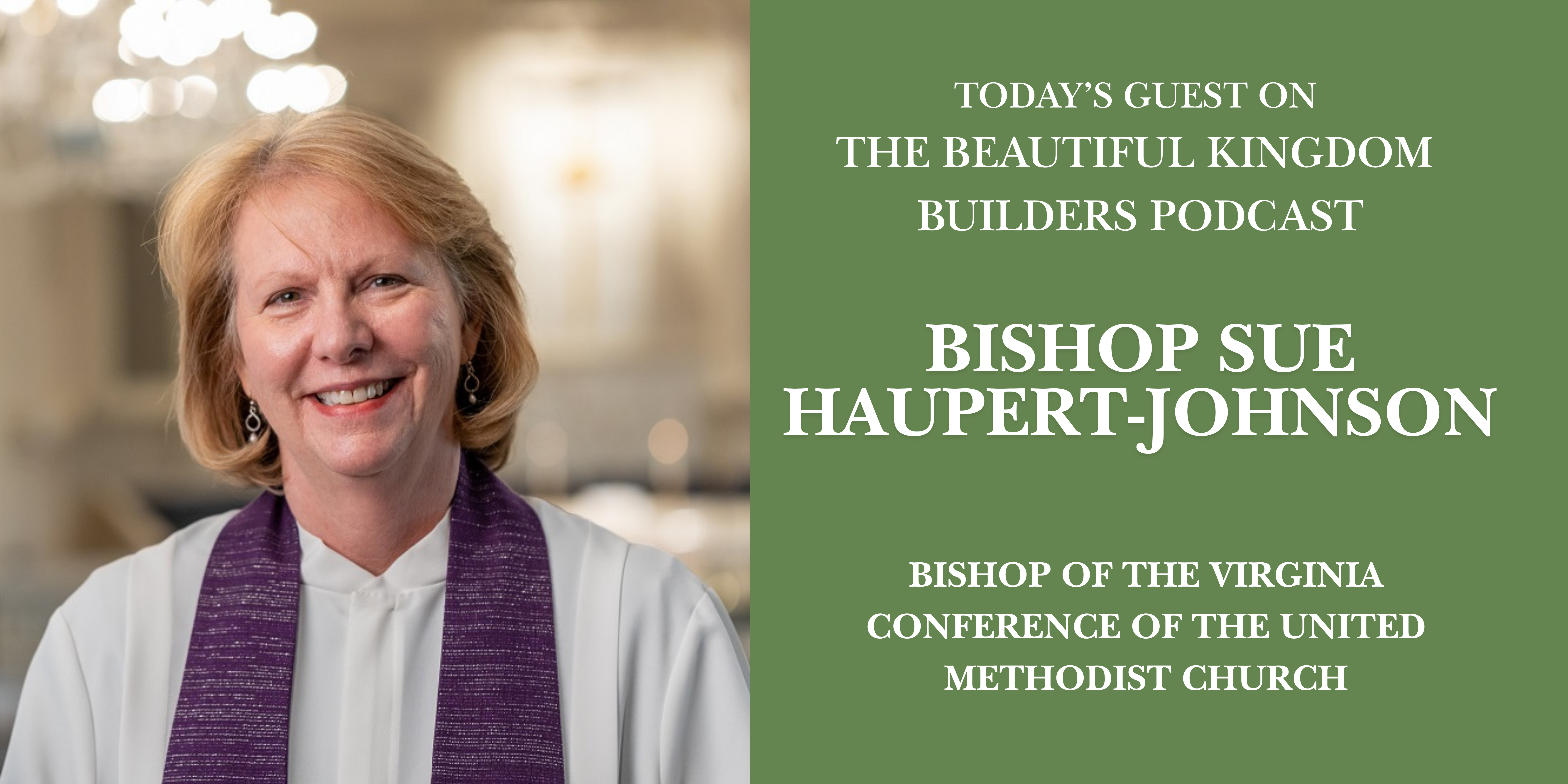
019 I Bishop Sue Haupert-Johnson: Can the Church Heal Its Deepest Divisions?

In Season 1, Episode 19 of The Beautiful Kingdom Builders, I had the honor of sitting down with Sue Haupert-Johnson, Bishop of the Virginia Conference of the United Methodist Church. Our conversation explored not only her personal story and spiritual practices, but also what it means to lead with courage and faith in a season of deep conflict within the Church.

Bishop Sue shared about her early faith journey, the influences that shaped her call to ministry, and the ways her experiences—as a woman, a mother, and a leader—have informed her pastoral voice. Grounded in Wesleyan theology, she spoke of a vision for the Church that prioritizes connection over hierarchy and invites both clergy and laity into shared ministry.

At the heart of our conversation was the reality of navigating disaffiliation within the UMC. For many congregations and leaders, this has been a painful and divisive time. And yet, Bishop Sue pointed to the possibility of faithfulness even in disagreement—of a Church that listens, holds tension, and refuses to abandon love.

This season of change culminated in a historic moment at the 2024 General Conference of the United Methodist Church, where the denomination removed exclusionary language from the Book of Discipline, fully including LGBTQ people in the life of the Church. For many, this marked not just a policy shift, but a theological and spiritual turning point—an embodiment of God’s expansive grace.

The Virginia Annual Conference sessions in 2024 and 2025 became a powerful witness to what it looks like to stay at the table through disagreement. Through initiatives like the Journey in Understanding, the conference has sought to foster dialogue, healing, and deeper connection across differences.

What emerged from our conversation is a hopeful vision for the future of the Church—one rooted in authenticity, justice, and the leadership of the next generation. Even in the midst of conflict, the Spirit continues to move, calling us toward a more inclusive and compassionate community.

Please visit this link to see what a journey in understanding looks like: journey | VAUMC. It was a beautiful example of listening to understand, not necessarily to agree, and to go forward in unity despite disagreement.

In our conversation, Bishop Sue recommended two books: J.B. Phillip’s book, Your God is Too Small and Amanda Ripley’s High Conflict.

Please enjoy this episode of The Beautiful Kingdom Builders podcast on YouTubeSpotifyApple PodcastsAmazon MusicSubstack, and more

TRANSCRIPT:

Ruth Perry (00:15)
I am so delighted to have Bishop Sue Haupert-Johnson today, the Bishop of the Virginia Conference of the United Methodist Church. Thank you so much for being here today, Bishop Sue!

Sue Haupert-Johnson (00:25)
My pleasure. I’m delighted to be here.

Ruth Perry (00:27)
Just laying it out there to begin with, I’d really like to talk with you about disaffiliation and leading through conflict. Because in my background, I very church experience in a local church where my dad was the and my brother was the associate pastor. And it got so ugly and just the fallout of that situation has been decades long now. I had two big lessons that I took away from going through that. Number one, it was a patriarchal church culture. And this was causing cognitive dissonance for me about that worldview because I realized if the women of the church had had a place at the these conversations, then the outcome would have been very different.

And then the other thing that I realized was this was independent church kind of separated from any denominational structure. So we didn’t have anyone to come in and help. And so those two lessons have come with me since then. And I was invited to pastor in the United Methodist Church three years ago. So my very first Annual Conference was the 2024 Annual Conference in Hampton.

And there was some tension there, to say the least. And even thinking back on in the last week, as I’ve anticipated our conversation, it just makes me emotional because it was such beautiful and Holy-Spirit filled experience, I feel, going to the 2024 Annual Conference and then seeing what came of it in 2025 at the Annual Conference.

And so I’m hoping I don’t get emotional talking to you today, it was just really beautiful and I really appreciated your leadership and I wanted to talk to you today. But before we get into that, can you go and tell us about the beginning of your story a little bit about your faith journey?

Sue Haupert-Johnson (02:02)
Yeah. Yeah, I grew up in a very large United Methodist Church. My family joked that we passed five United Methodist Churches to get to our church, but in some ways it was providential. It was a church where the bishop usually attended, so I knew all the bishops in Florida. A lot of the conference staff went to the church there, so I knew them. I was very involved as a youth and a young adult, especially in the music programs of the church. I consider the church as integral to my life early on in the sense that I learned all the Bible stories, that I knew the framework of the story, that I knew.

I don’t think I’ve ever doubted the presence of God in my life or the power of Jesus and the Holy Spirit, but I had increasing issues as I went to college with the institutional church and just, I think I had to find faith for myself and the relevance of it. I was laughing, I was reading the piece this week about how don’t make fun of Christmas and Easter Christians on Christmas and Easter because how are you hospitable if you’re judging them? And I really am grateful that the 10 years I was out of the church, when I returned, I was welcomed with open arms.

And really, I had a profound experience of Christ, a profound experience. The Gospel of Luke will always mean a lot to me because I had achieved everything I wanted to in my secular life and was miserable. And I realized, you know, Jesus… Well, my experience of Him was He said, why don’t we try things my way now? Which to me was a very gracious presence in my life, you know, that, I’ll use what’s past, I’ll use what’s happened in your life. And I always say that to local pastors and folks who come to their calling later in life, that everything that happens to us, God uses in our ministry, in our increasing knowledge and love of God.

And so I ended up when I was about 28 going back to church and went to Hyde Park in Tampa and had a really good experience And it wasn’t the pastor, it was mostly the older women of the church, Ruth, the saints of the church who had such powerful faith. I mean, they had lost husbands, they had lost children, they had seen everything in the world, and they still were just pillars of faith. And I often say I would kill to go back and prepare Communion again with Grace Spear. She was a 90-year-old woman who just tended to me, shepherd me. You know, when you talk about being discipled, and I think that’s the ideal way to learn the faith is to be discipled by people and to model. I mean, that’s what Jesus did with the disciples. And Grace did that for me.

And so those older women in the church, and I get mad at the ageism in the church because, man, those women have carried the church for a long time. And so I ended up realizing that my secular life was not rewarding and that I was being called to something more. And I ended up going to seminary fully intending on teaching theology, because who would want to serve in a church? And then I had a senior pastor at my home church who invited me, the staff parish committee invited me to come back to be on staff for a year. And I fell in love with it. And so, you know, 30 years later, here I am.

But people say to me all the time, they rag on the church and they talk about the ugliness in the church. I’m like, you know what? Multiply everything you’ve seen by a million and I’ve seen it. But I can honestly say that the beauty of the church that I’ve seen outweighs any of that. And when you glimpse the kingdom of God and when you glimpse a people of God working together as the body of Christ, that’s the hope of the world. And so rather than throw rocks at it and complain about it, my goal in life is to help create healthy, loving, welcoming communities that are out to serve the least and the lost.

And I get so frustrated when the church, I mean, this whole Christian nationalism movement is insane. God doesn’t align with the wealthy and the powerful. I love in the Magnificat, which I pray daily, where Mary sings, the poor God will fill with good things and the rich will be sent empty away. And I think that the church has got to really be a force for the voiceless and the weakest. And so when we lose track of that…

And I think the disaffiliation kind of reflected the politics of our time, right? We want our property, it just, I think it reflected everything that Jesus most despised. To use the church for your own political ends or to have your way or to promulgate a lot of misinformation and lies. I just would pray at night, God show me how these ends justify the means because I don’t get it. I still don’t get it. I’ll never get it.

Because I had lived in the church being against what I believed for most of my ministry, right? I’ve always been for LGBTQ inclusion. And so for them to say to me, well, the church left me. I’m like, the church didn’t leave you. I mean, come on, seriously? I lived in the church. You know, it doesn’t mean that I have to agree with it. There’s some basics we have to agree on, but there’s a lot of leeway and John Wesley realized that. So anyhow, I have little patience and I think back to those days and I still just shake my head, and go, boy, they lost themselves.

Ruth Perry (07:21)
I think a lot of people like myself, because I grew up very conservative, evangelical, and going back to that church conflict, that was really the first domino falling, where I started rethinking things. But I think dominoes have been falling for a lot of people who grew up evangelical like myself. And I’m just sick and tired of culture wars and I’m tired not being able to wrestle ideas that are like, I don’t want to be spoon-fed what to believe. I want to wrestle with it and really weigh both sides and determine for myself. And so I want some leeway in that process of maybe exploring something that someone thinks is heretical.

Sue Haupert-Johnson (07:46)
Right, right. Well, you know, and just when you think you’ve got it figured out and everything is neatly lined up, God, you know, meets a persecutor of the Jews on the road to Damascus. God totally messes with our certainty all the time. And so, yeah, you can think you’ve got it figured out, but then God’s gonna come to you in a way that you just can’t fathom, right? That’s the whole of gospel. And in the most unlikely of ways. So, yeah.

Ruth Perry (08:27)
So for 10 years you were pursuing a secular path for a career, what was that in, Bishop Sue?

Sue Haupert-Johnson (08:34)
Well, I went to law school and I think if I wasn’t in the church, I’d be a judge. I love justice. I love the intellectual part of law. I love weighing arguments and coming down to the just outcome. What I didn’t like about the practice of law was the business.

You know, at the end of the day, it was about making a buck and I wish somebody had clued me in how miserable life is when you have to bill somebody for every six minutes of your time. And that was that was the reality. And I just don’t care enough about money. I mean, I didn’t want to spend my life moving money from one person or one corporation to another. And don’t get me wrong. I am very grateful for people who do that and love it.

I am very grateful for good lawyers and I have good lawyers and I know good lawyers. But it was not my calling and nothing is worse to be working outside your calling. I don’t care whether it’s a church calling, well the vocation, right? To be in the wrong vocation I think is a hard thing. So there’s nothing worse than a miserable job. And I had a miserable job and I realized that God was not leading me down that path.

You know, do I wish I’d been passionate about it? Do I wish I loved it? Yeah, it was pretty lucrative. But it wasn’t for me.

Ruth Perry (09:48)
Do you ever put your lawyer hat in ministry?

Sue Haupert-Johnson (09:52)
All the time. You know, I think what I appreciate now and how God uses, I think I would love it if everybody went to law school. I think it teaches you how to think, teaches you how to be logical, although it’s kind of a curse in the church, because a lot of argument in the church is emotional, right? And so sometimes I’m sitting with somebody going, yeah, that makes no sense. But it’s, you know, so.

Sometimes to be a logical person in the church is like a new lesson in frustration. But I’m grateful that I understand the law. I’m grateful that I understand how the business world works. I’m grateful that I’ve had clients. I’m grateful to know their lives. I’m grateful to just have a basic understanding. I mean, my undergraduate degree was in finance. So, economics, all of that stuff, I’m glad I’m grounded in it. Every day in my work it helps and certainly the legal part helps because a lot of our assessment is, is this right? Is this lawful? Is this being done in above board manner? In personnel, is this being done fairly? And so all of that, yeah, I think it was a valuable education.

Ruth Perry (10:57)
And how has your motherhood impacted your ministry?

Sue Haupert-Johnson (10:58)
Tremendous, you know. I think I’m a much kinder, gentler person since I was a mother because I realized when Samantha was a baby how easy it would be to mess one of these up. And so I started looking at my parishioners and anybody in general as, you have some bad parenting. And then if you throw in addiction and sexual abuse and just physical abuse and trauma. It doesn’t take much to really mis-wire a human being. And so I think I have a lot more empathy.

At the time I was pregnant, there was an unsheltered homeless man named Leland. And sometimes in churches they would have the pastor pretend to be homeless, we didn’t have to pretend; Leland showed up. To my church’s credit, they were lovely to Leland. And Leland was a regular part of our community. And he would call me so often and my assistant would be like, oh God, it’s Leland again. I’m like, you know what? I realize I’m the only human being he talks to. And I value our friendship. And so anyhow, I remember when I found out I was pregnant.

And I told Leland and he was crying with joy for me because we had gone through a lot of fertility stuff and it was hard fought. And Leland said, you know, Pastor Sue, I wish I was your baby. And and I said, Leland, no, you don’t, because I would kick your butt. But, I think to know people like that, that’s why I get so frustrated.

To speak badly about unsheltered people or to speak badly about immigrants or just you’re just showing your ignorance and you’re showing you don’t have contact with them on a daily basis because if you do your heart breaks and you realize my reality is not everybody’s reality and there’s some reality that I am very grateful I mean my last prayer before I go to bed every night is God thank you that I have a place and a name and that’s an old Jewish saying a place and a name but I thank you that I’m not a refugee or fleeing from a country with only the clothes on my back dragging my I mean with no assurance of safety or I don’t know how you can be cruel to people like that and I think that is the distortion of our times and the distortion of the faith and I’m pretty tired of it at this point so yeah.

Ruth Perry (13:07)
So you’ve already mentioned that you pray the Magnificat every day. And this nighttime prayer. What other spiritual practices do you have that sustain you?

Sue Haupert-Johnson (13:11)
Yeah. Yeah, I’ve long prayed the daily office. I pray the evening, the morning if I remember, but always the evening. And to me, there’s something about the regular immersion in Scripture, day in and day out. And the Psalms, certainly pray the Psalms often. To me, they’re especially powerful in these days we’re living in. And I worship weekly. Sometimes online if I’m observing a pastor that I want to see how they preach or how the service is going.

But to me the beauty of the faith and the heart of the Wesleyan understanding of things is we have a method. And so to me there’s something very reassuring about having a pattern of life, having a foundation, so that I do these things in good times or easy times so that I have them just to fall back on on harder times. And so it’s kind of the safety net, the fabric, the ground of my being that I rely on. And that’s been, I think the people of great faith that I know, that’s the hallmark of their lives. There’s a method.

Ruth Perry (14:19)
A lot of the audience that I have is ecumenical, so all kinds of denominations. What are the distinctives of Wesleyan theology and practice that most

Sue Haupert-Johnson (14:24)
Great. Yeah. Right.

Yeah, I appreciate, I think that sanctification or the notion that I as a human being am always a work in progress. And I think that’s valuable and that the goal is not to be in heaven sitting on a cloud with a harp. The goal is not my individual salvation. God is at work to save the whole world and is using me in that story. And so, I don’t sit around and guess who’s going to heaven and who’s not. I think God’s desire is, we all will. And my focus is, my every day becoming more perfect in love of God and neighbor.

And for John Wesley, the whole goal of the human life is perfection in love, so that I have perfect love for God and neighbor. And obviously that’s a lifetime task and it’s the work of the Holy Spirit in my life every day. But what John Wesley saw is that when we die, he thought most people were perfected in love on their death beds, which makes sense, right? Because you’re perfected and then you meet Christ face to face and Christ sees himself when you get there. That’s the ongoing sense of I’m a work in progress.

Why I’m not Calvinist. I think there’s too much emphasis on when I was converted. You know, like it all happens at once? I don’t think so. You know, the day I came back to the church and that I count as my conversion time was just the beginning. Like my husband says, you know, it’s like if you stop there, it’s like getting to Disney World and just cheering when you get inside the turnstiles, but you don’t explore the whole Magic Kingdom. And so to me, the beauty of the Christian life is the

Ruth Perry (15:47)
Yeah.

Sue Haupert-Johnson (16:07)
day to day, becoming more like Christ. And you know, I hope I’m more like Christ now than I was 10 years ago. And if I’m not, then that’s when I have to really lean into the method because I should be. And I say when I preach in churches all the time, because there are usually older folks in them if you haven’t noticed.

I’ll say if you’ve been in United Methodist Church for 30, 40, 50 years, you should be darn near close to perfection and love. So I don’t know why you’re being so mean petty or unchangeable and rooted in the past because God’s always, making all things new and I think we all need to be made new. So that’s to me the Wesleyan theology in a nutshell, is that through the method, through these practices, through connection with the Holy Spirit, the Holy Spirit works in us day to day until we become like Christ. And that’s a much richer, more beautiful understanding.

And God’s doing that in the world too, right? That God is trying to transform the whole world and all of creation is groaning for the new heaven and new earth. And so instead of like sitting around and talking about who’s going to heaven and who’s going to hell, I think my better job is to love people and to introduce them to Christ so that they become all that they can be. And that’s to me the challenge.

Ruth Perry (17:29)
Yeah, we tend to make God so small.

Sue Haupert-Johnson (17:43)
Well, if you want to read a great book, it’s a classic. J.B. Phillips wrote a book called Your God is Too Small. And he’s dead on in that book because every chapter is about how we how we make God in our own image and how God, a lot of times, God reflects our parents. However you’re parented has a huge impact on how you see God, I think.

Ruth Perry (17:53)
Another question I people would if they’re like me coming from different background than the Methodist Church is about all the hierarchy and even like what is a bishop and how do you describe your role?

Sue Haupert-Johnson (17:58)
Right. I think rather than thinking about it as a hierarchy, connection is better. Connection, because we can do more things together than we can alone. If we pool our resources. I just was in a meeting all morning with global ministries and, when people put their resources together, we can do amazing things.

A connection that nobody’s alone. If you’re clergy in the United Methodist Church and you’re feeling alone, then the connection is failing you and we’ve got to do what we can to shore it up. And, you know, I really didn’t think of it this way until I was on a panel with Nadia Bolz Weber. And she said to me, you know, Bishop, I am Lutheran because I need a bishop. I need somebody to hold me accountable.

And I think that’s, like you said, you had all of that nightmarish experience in the church, in the conflict, and nobody was around. And sadly, churches don’t really benefit or really see the beauty of our connection unless they get into trouble. But I’ve had churches where there’s been embezzlement. I’ve had churches where there’s been sexual misconduct. You’ll have a pastor the next week, and you will have a whole team come in to help answer questions, do pastoral care.

So I like the connection better than the hierarchy, but that said, I remember meeting a pastor’s widow years ago and she said, this is the first time I’ve come back to United Methodist Church because my ex-husband who just died was a pastor and he did untold… No, he wasn’t United Methodist. He was another denomination. And she said, he got away with a ton of stuff that he never would have gotten. He wasn’t properly vetted. He wasn’t properly supervised. And she said, I will never go to a church that’s not a United Methodist church because I know that you vet your pastors, that you have a standard for pastors, and that you take action when pastors do things that are inappropriate or unlawful.

And so, I mean, I’m not Pollyannish enough to think that it’s perfect, but I think that we do our darndest to make sure that our churches are safe, to make sure that our clergy are not doing harm. And I can honestly tell you, if it hits my desk, it’s dealt with. So I get great satisfaction out of that. So and you know I’ve told the cabinet, I’ve said, you guys, if somebody brings you a complaint and I don’t get it, because that’s where it dies down. I mean, I’ve seen it in the past where things get pushed under the rug and I said heck, if I find out that you didn’t give me a complaint, I’ll file a complaint against you because we have got to know when stuff is is being reported or lifted up or brought to our attention. So I don’t mess around with that. I guess that’s my legal background too. But yeah, no, don’t turn a blind eye to anything.

Ruth Perry (20:51)
I very much appreciate that. And I will say, just three years in the denomination for me now, the connection has been so strong and I’ve felt so supported and encouraged and uplifted in so many different ways by so many different people. And I’ve met so many really wonderful, kind people. And I love my little congregations too.

Sue Haupert-Johnson (20:53)
Yeah. Good. And you know Ruth, I would say, you know, and anytime I have a pastor who’s like, I just don’t feel connected, I feel like, I’m like, you know what? You do something about it, right? If I’m not feeling connected, I always was the first one to call a new pastor in town and say, and not just United Methodist, I think it’s incumbent upon us to create community and to create community that’s not our church members, right? So I always had excellent ecumenical friends, clergy from all denominations, rabbis, imams, because there’s a unique kind and those are colleagues that you need.

So I would say if you’re feeling alone, now if it’s depression or mental illness or something causing that, we’ve got to address that. But if it’s not, you hold the keys, right? You have a phone. You can go visit. So you take the initiative and create connection. I love clergy and laity who create connection because I think that’s how we model Christ.

Ruth Perry (22:10)
I was in a day of training for the Living Waters District in January, and I was in a lay servant leader class, and one of the ladies said that she met you in the restroom at the Annual Conference. And then she said, you introduced yourself, and she introduced herself and said, I’m just a lay person. And your response to her was you are not just a lay person, that we’re partners in ministry, and she was just really touched by that. How would you describe the relationship between clergy and laity?

Sue Haupert-Johnson (22:31)
Right. Yeah. You know what? I wouldn’t even make that distinction. I love that our English word for vocation comes from the Latin for call, right? So any of us who have a vocation is called. And I think God gives us unique gifts and calls us to different things. In fact, when I graduated from seminary, one of my professors was really annoyed that I was pursuing ordination because he said, man, I wish you’d go back and be a lawyer because people don’t expect lawyers to talk about Jesus. So I think that laity are called by God and put in places.

I’ve been thinking a lot about Miss Kerry. Miss Kerry was an administrative assistant in the federal courthouse when I worked in the federal courthouse in Tampa. And she was called to be an administrative assistant and she was Jesus Christ agent in that federal courthouse. If you had a problem, if you were grieving, if you needed a word of encouragement or support, people flocked to Miss Kerry like moths to flame. And I know God called her to be there. So I don’t divide clergy and laity. I think that we’re all called to something. And if you happen to be called into representative ministry, I don’t think it’s because you’re any better.

I think it’s just, you know, God chooses weird people for weird things. If you read the Bible, you know, I’ve always loved Jesse who Samuel comes looking for the anointed one and Jesse’s bringing out all his, older and better sons, right? And Samuel’s like, no, no, no. And then, you know, David, he’s like, I got this other kid. And sometimes I think, God calls us not because we’re the best or the brightest, or the most, certainly not the most holy, if clergy are the most holy. I’ve met a lot of laity who are more holy than clergy. But I think that when you start seeing people as called by God into all arenas, then you don’t privilege representative ministry over any other.

And one thing that whenever I talk to a group of laity, who are exploring a call to ministry, say, you know, I think one of the grievous mistakes the church has made is when somebody gets really involved in a church and has done everything every office a lay person can do in the church. Well, it’s time for you to be a pastor. And that’s just not the case. So I think God is calling people to be excellent lay people. And any pastor knows, gosh, you’re so reliant on those folks.

And I have had tremendously gifted laity who have… They’re the backbone of the church, certainly not the clergy person as it should be. so no, let’s get rid of the laity clergy distinction and just talk about what has God called you to do in this world to bring the kingdom about. So don’t ever walk up to me if you’re a lay person and say I’m just a lay person.

Ruth Perry (25:19)
So can take us back to the season of disaffiliation I think pretty much everybody has heard about it or something about probably a skewed telling of it So just from someone who’s been there and seen it and been part of the leadership. What was the season of disaffiliation about in the United Methodist Church?

Sue Haupert-Johnson (25:40)
Yeah, I think it was about, you know, I had a DS, she said, this is just a property grab. I think it was, I think the time was ripe for it. I think that the rise of the conservative in the political realm really fueled the conservative part of the church to rise up. I think that what I lament was there wasn’t a lot of, let’s talk about this. Let’s reason about this together. Let’s hold each other as, you know, siblings in Christ and honor Christ in each other. That kind of went out the window.

And I know that there was probably poor behavior on both sides, but I experienced it mostly from those who really poisoned a lot of our churches with really radical claims. I can understand if you disagree with me about human sexuality. Certainly not an essential of the faith. Certainly not anything Jesus talked about. You know, and there’s always been, it seems like the… When one controversy dies, another arises. I know until 1971 every bishop was asked if they would support integration. And if you answered yes, you might not get elected in the South. And then the next issue of the day was LGBTQ. And in 1971, that kind of started being the litmus test for bishops.

So I think a lot of it, if you look at it, a lot of it was in the South. And I think that the Bible has always been looked to to support, to condone slavery, to condone segregation, to make… The huge issue in the early 1990s was divorce. And so it just seems like we’ve always got to be arguing about something. But what I appreciated about the United Methodist Church was because we had a trust clause and because we understood that every United Methodist Church is an outpost for our denomination in that town, that that preserved it through a lot of these controversies.

You know, other denominations, I always thought we were so much better, because every Baptist church would split 10 or 20 times in 100 years. No, we had a trust clause. And that said, you know what? This will be, no matter what controversy rises, no matter how much we disagree, this will still be a United Methodist church in this community. And we’re thinking seven generations down the road, and we’re not gonna let whatever the argument du jour is separate us. And that is held. And so I really, don’t think we ever should have abandoned the trust clause.

I think we should have said, and if I had been, if I had had any control, I would have said, you are welcome to leave. If you disagree with the church, you are welcome to leave, but you are not welcome to stir up everybody to go with you, and you were not free to take the property. And, you know, I stayed in the United Methodist Church when LGBTQ rights were not recognized, because I did not see that as an essential of the Church. And if I thought it was, I would have left. I would have not taken anybody with me. I would have not created any kind of… Because I value the body of Christ.

And anytime you come to a vote, anytime you come to, and we saw that at Annual Conference, you know, the year you talked about, you bring it to a vote. If you’ve read, there’s a great book by Amanda Ripley called, Real Conflict, I think it’s a conflict book. But she says, the problem is it becomes all about winning and losing and you lose sight of the controversy at hand.

And it, you know, if you’ve read James, the tongue is a fire and it burns and it burns to the gates of hell and that’s what happened. I mean, to hear churches that disaffiliated because they were told the United Methodist Church no longer believed in Jesus or the resurrection. To be told that the United Methodist Church, that all we want are drag queens. I mean, every little, every one situation was blown, you know, the

It just… And I wish that there have been wiser minds and I wish the denomination had held strong and said, you know what, you are free to go. But you aren’t free to take our property and you aren’t free to create war zones out of our churches. And unfortunately, that’s what happened. And I don’t know how you live with yourself if you do that. I mean, there are some points where you’re just like… And it was hard.

I know I told my cabinet in North George, I’m like, If I say something that does not reflect Christ well, if I, you know, stoop to that level, call me on it. But I just was amazed at what was said and what was written, what I received, to be called like, what was it they always called me? Apostate. She’s apostate. And then the gender stuff came in like, the Jezebel, the evil woman, because something about women’s leadership, especially the far right, and you see that in our politics too, is threatening and must be destroyed, right? I mean, don’t think Pam Bondi was just let go. It’s no mistake that the first two fired out of the cabinet were women because even the religious leaders that they’re looking to denigrate women and…

I just, it just got out of hand. And I think it’ll take a long time. I know I’ve got a lot of scars. I know you have scars. We all have scars because, we should have been better and that the body of Christ deserves better. And, you know, I just, I was amazed because I had so many talks and so many discussions and tried to, I worked so hard and then I realized, they really don’t want to work this out. They want what they want and I can’t, I can’t fight that. So.

And you know, move on. It’s time to say, we need a more excellent way. We don’t need to ever let this happen again. And a part of it was we lost our identity. What is the Methodist identity? United Methodist identity. And how do we be Christ-like in all things, right? I mean, Jesus said, love your enemies and pray for those who persecute you. I think he meant it. But I just watched slicing and dicing in the worst form.

Ruth Perry (31:42)
So you’re someone who takes the Bible seriously. You read it every day. You’re doing your best to be a faithful disciple of Jesus Christ. And yet you’re failing this litmus test, Bishop Sue, on this very important issue. How do you defend your perspective?

Sue Haupert-Johnson (31:45)
Yeah, right. Yeah. You know, I think this is why I appreciate tradition and experience. I mean, if you’re a real student of the Bible and not just verses in the Bible, you see God’s… I mean, there’s a great passage where God talks about, will give identity to the eunuch. They weren’t allowed in the temple and God says, I will restore them. You see God work through the unlikely. You see God include the Gentiles, right?

And to me, the miracle was that the Jerusalem church said, yes, right? We do see there’s a wideness in God’s mercy. We saw that. so it came through my experience in the church, and dear friends of mine who came out after I knew them well, right? It was like, everything I’ve been told by our culture about LGBTQ folks is not born out in my experience. Some of my best friends, some of the most loving and giving people. And also I came out of seminary at the height of the AIDS epidemic. And so I watched as so many loved ones were taken off life support, watched men sob at the loss of their loved, you know, another man.

So I saw the depth of love. And if all love comes from God, how do you make sense of that? Right? And some of the most faithful, devout, really lovely followers of Jesus Christ were LGBTQ. And so I had to say, you know what? If all of sin, and I’m not sure why that, you know, gets special sin, I had so many people yell at me full of pride and anger and ugliness. I’m like, I don’t understand how this sin is any different from what you’re calling sin and LGBTQ folks.

And so I think that my experience of the depth of their faith and truly faithful people who I know are so connected to God that if for one second they sensed that God disapproved of them loving somebody of the same gender, they would have renounced that. But they never got that sense. I just had to start, you know, and if I’m wrong, I’m wrong, right? And Jesus, thou art full of mercy.” And so at some point a friend of mine said this well, he said, if I have to meet my Maker and I have to meet Jesus Christ face to face, I think I’m going to err on the side of I was too loving and too open then the other way.

And so I just had to learn that everything I had been told to hate and to ridicule and to mock about LGBTQ folks was absolutely wrong and misguided. And that just came from knowing them. Same with the homeless people, right? Everything I’ve been told about them, Leland dispelled. Everything I’ve been told about divorced people, right? Because we grew up, my goodness.

God works through that. So I think it’s having a little more openness to mystery and that God does work in weird ways and that, you know, it’s time to let everybody be faithful. I, you know, and I may be wrong. Anytime I talk to somebody and they can’t say I may be wrong, I am eternally frustrated. But I don’t think I am. Yeah.

Ruth Perry (35:10)
I appreciate John Wesley’s rules for living. Do good, do no harm, stay in love with God. And I think the church, like all denominations, the church in America has done a lot of harm, whether they were well-intentioned or not. It’s hard to believe it was all well-intentioned because the harm has been just extraordinarily heartbreaking ⁓ that families would disown children. That suicide rates would be so high, that we shame and other, and we don’t see the belovedness of God LGBTQ. All of that is very harmful. And so at the Annual Conference in 2024, a college minister came forward with a resolution. Is that the right word, resolution? Suggesting that the Virginia Annual Conference make an apology for harm done to LGBTQ.

Sue Haupert-Johnson (35:34)
Right.

Ruth Perry (35:57)
after the General Conference had removed the exclusionary language. And so for three days, the Virginia Conference of United Methodists, from different perspectives, talked about this. Speeches for and against. As I was in my hotel, I would hear people talking about it, passing through the halls, people were talking about it. It was just, the air was buzzing and the conflict was palpable. And so, for me having that church conflict background, I’m a little keyed up but worried about things. And that last business session, when a group of pastors came forward and suggested rather than taking a vote because it would be so divided, it would have been close to 50-50, they suggested a commission be put together kind of like a truth and reconciliation

Sue Haupert-Johnson (36:34)
Mm hmm. Right. It was, I think. Yeah.

Ruth Perry (36:43)
that would take time to think and work more deeply on this and hear from people from all perspectives. I just remember, it felt like the whole room just kind of everybody’s shoulders relaxed. And the Holy Spirit, was palpable, that that was the right thing, most God honoring path forward. How was that conference behind the scenes for the Bishop of the Virginia Annual Conference. What was your experience?

Sue Haupert-Johnson (37:09)
Right, right. Well, I remember, you know, we even have people stand up and the vote was that even. And I realized I got to just buy myself some time so that we could talk about this until morning, right? So, and we had to have ballots made anyhow. So, that’s what I was thinking to begin with. And I think it was an affirmation from the Holy Spirit that three clergy walked up to me. Two of them were, well, one was very pro LGBTQ and one was totally against. And they said, what if we just talked about this? What if we created a group to talk about this and see where we end up? And I said, that’s exactly what we need. And clearly the Annual Conference wanted a third way, a more excellent way.

Because you know, one thing that bugged me about the whole disaffiliation thing, if I was ever in a church, like if we had a capital campaign or a building campaign and the vote failed 55 to 45, we wouldn’t go ahead with it. We would, you know, let’s talk about this. Because clearly there’s, there’s nothing that is helpful about an up or down vote because if you’re on the losing side you feel like crap, right? And so what we did was we created this commission and we had folks who were LGBTQ. Interesting to me how often they’re left out of the conversation on that commission as well as very conservative folks. And the beauty is over a year they sat together and they grew to love one another.

And so it really, you know, they might vote opposite, but they both want each other in the church. And so let’s get rid of the votes and just realize that if, you know, if we have the essentials, we have the rules, the general rules for a reason, right? That’s the orthodoxy. And we can argue all day long about other things, but at the end of the day, we need to stay together.

And so, you know, heck, I don’t agree with my whole family around the Thanksgiving table. And to me, I don’t want a church full of Sues. How do I learn and grow? It’s difference that has brought me along the journey. And so I think that if we can agree, well, one of the best, I can’t even remember who said this, but somebody said, you know, if you have one hand on the cross, you’re pretty close to one another. So why can’t we just all have a hand on the cross and, you know, in the non-essentials, think and let be and let Jesus sort it out, right? I always like Paul’s, you know, in Corinthians, we see through a glass darkly, but then we’ll see face to face. So let’s just acknowledge we’re seeing through a glass darkly.

And at the end of the day, I think Jesus wants us just to love one another and to respect each other and to defend each other. And, you know, and I went hasten that I’m part of a family and man, we disagree and we’ll fight each other. But man, if you’re on the outside and you say something against one of us.

You’re getting the whole group against so, you know, why can’t the church be more like that? If you’re messing with an undocumented person or you’re messing with somebody who’s weaker and doesn’t have status, if you’re messing with somebody who’s mocked because of their sexuality, the whole family should be standing up for you just because you’re a child of God and you’re my sibling in Christ. So I don’t understand why we’ve lost that. But we’ve got to reclaim that the church isn’t going to survive.

Ruth Perry (40:36)
I’m going to post video of the report at the 2025 this commission gave (vaumc.org/journey/). I’m going to post that in the show from what you just said, what gives you hope now as the United Methodist Church moves forward?

Sue Haupert-Johnson (40:40)
Good. You know, increasingly the church is finding its voice. And increasingly, and I’m talking about the church that defends the poor and the, and I’m hopeful, I’m hopeful, my 24 year old gives me hope that younger generations are longing for relevance and longing for a better world and a better future for all people, not just for themselves. And they think much more communally.

And certainly my daughter does not think in terms of race and ethnicity. You know, it’s a different world. And I’m hopeful that we can turn it over to them and let them move the church in beautiful new ways. Because we’ve held onto the past far too long. We’re way too rigid. And we need to follow where Christ is leading.

And I think it’s new in different ways, which should be exciting, but for a lot of folks it’s threatening. So I’m hopeful we can take their lead and follow them into a better future.

Ruth Perry (41:47)
If you could speak directly to those who have felt hurt or excluded by the church, what would you want them to hear?

Sue Haupert-Johnson (41:53)
That the church is not Jesus. That the church, you know, ideally when it’s in its most beautiful form, it is the body of Christ. But human beings are sinful and broken. And so any human organization is going to be broken. So I plead with you to not write off Jesus because of what you’ve experienced in the church, and to ask God to show you and to send you people in your life who truly represent Christ and to go with them and to not assume that just because you’ve had one bad experience or a lifetime of bad experience in one church, but that you open your eyes and heart to the possibility that God can work through a group of people and you just need to find that group.

So that’s what I would say. Because I mean, I’ve been hurt by the church too. think that, it’s not, you know, I can’t even say the church. It’s individuals in the church. It’s people who weren’t, they weren’t being faithful to the method, right? They weren’t open to their own growth. heck, think Saturday Night Live nailed it with the church lady, right? When you’re just a pinched old woman who’s judgmental, that’s really not a good representative of the church.

I think back when I was a kid there were two missionary women and we called them the buzzard sisters because all they did was sit in the church. never showed the love and the grace of Christ. They were just the hall monitors. And if that’s your experience of people in the church, luckily there were many others who showed me a better way and showed me Christ. But don’t presume that everybody who calls themselves Christian represents Christ.

Ruth Perry (43:24)
I want to thank you so much for being on the Beautiful Kingdom Builders podcast today, Bishop Sue.

Sue Haupert-Johnson (43:28)
My pleasure. Thanks. I’m so glad you’re doing this, Ruth. And greetings to everybody out there. And I hope our paths cross one day.

Ruth Perry (43:35)
Would you like to have the last word? Is there anything else that we haven’t covered today?

Sue Haupert-Johnson (43:40)
You know, I think my last word is as we approach Easter, I love the account where the angels at the head and the foot say to the disciples, Jesus has gone on ahead and he’ll meet you in Galilee. And I’ve always thought about, know, Jesus is already ahead of us. He’s out there and he is still waiting for us, and he is in the least… the places we least expect to see him with, the people we least expect to see them… least expect to see him with. But he’s out there and so I invite you to join in the journey of going and finding him. And that is what life is all about. So join us in that journey.

Ruth Perry (44:21)
Amen. Thank you so much. God bless.

Sue Haupert-Johnson (44:22)
Amen. Thanks a lot. Blessings on Easter and thanks again. Appreciate it. Bye bye.


Did you enjoy this episode? Please subscribe, rate or review us on YouTubeSpotifyApple PodcastsAmazon MusicSubstack, and more! Your support means the world. God bless!

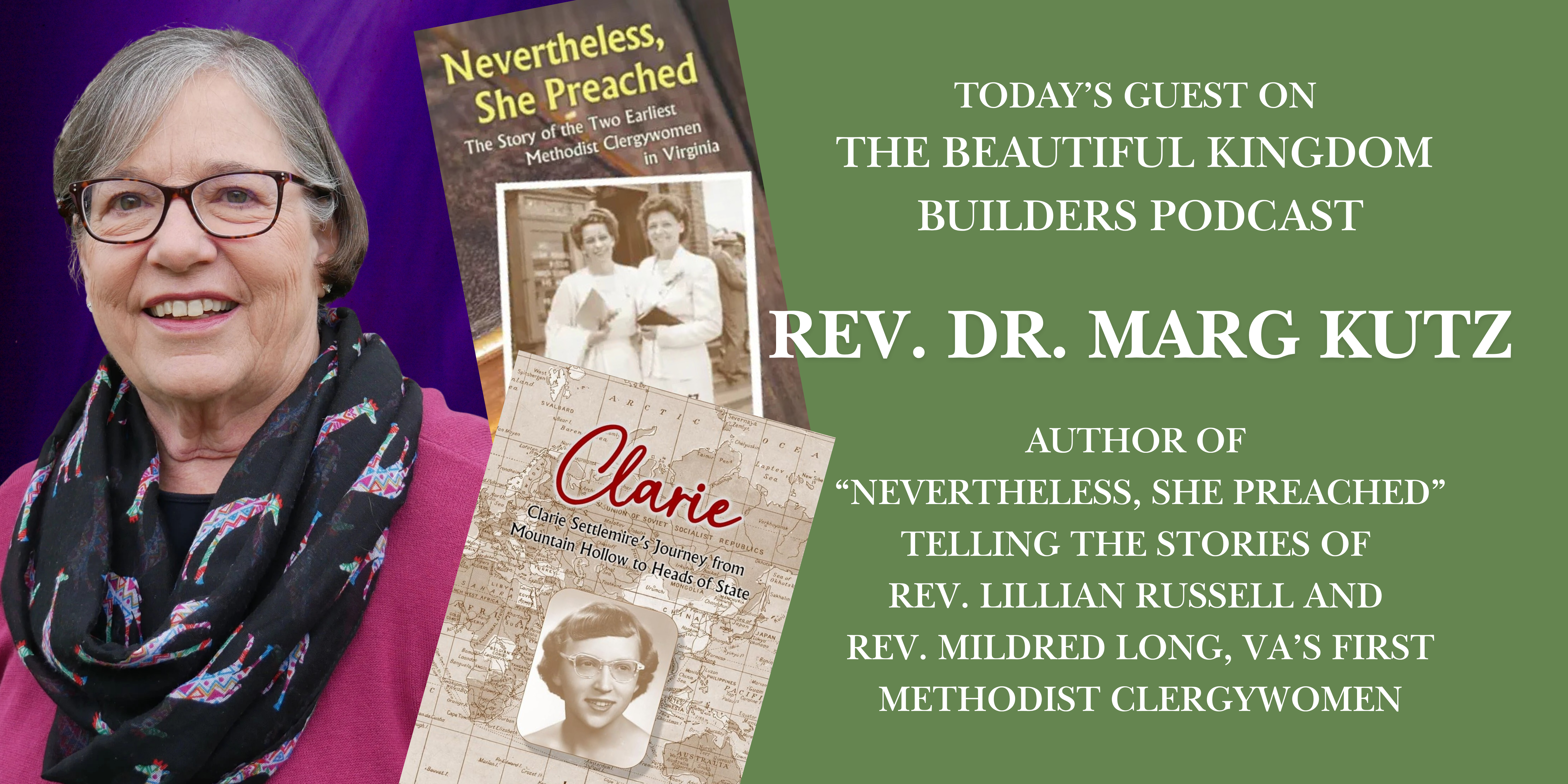
018 I Rev. Dr. Marg Kutz on Stories that Propel Us Forward

I was delighted to talk with my Virginia United Methodist Church candidacy mentor, Rev. Dr. Marg Kutz, about her book “Nevertheless, She Preached“, which tells the story of the two first Virginia Methodist clergywomen and all of the obstacles and barriers they smashed in their ministry, paving the way for women to come after them. Marg herself was in the next generation of clergywomen and broke many barriers in her 39 years of pastoral ministry.

Marg’s process of researching and writing the book alone was fascinating to hear about. The Virginia UMC historical records say very little about the contributions and milestones of Rev. Lillian Russell and Rev. Mildred Long in their years of ministry, so it was really important for Marg to take her insider knowledge and experience to fully flesh out their contributions and the impact they had on their denomination.

Our conversation is saturated with stories that will amaze you. If you would like to have Marg speak with your church or book group, please contact her through her website, Nevertheless She Preached. She just released a brand new book about a Western Pennsylvania clergywoman, Clarie Settlemire. You can purchase her books here.

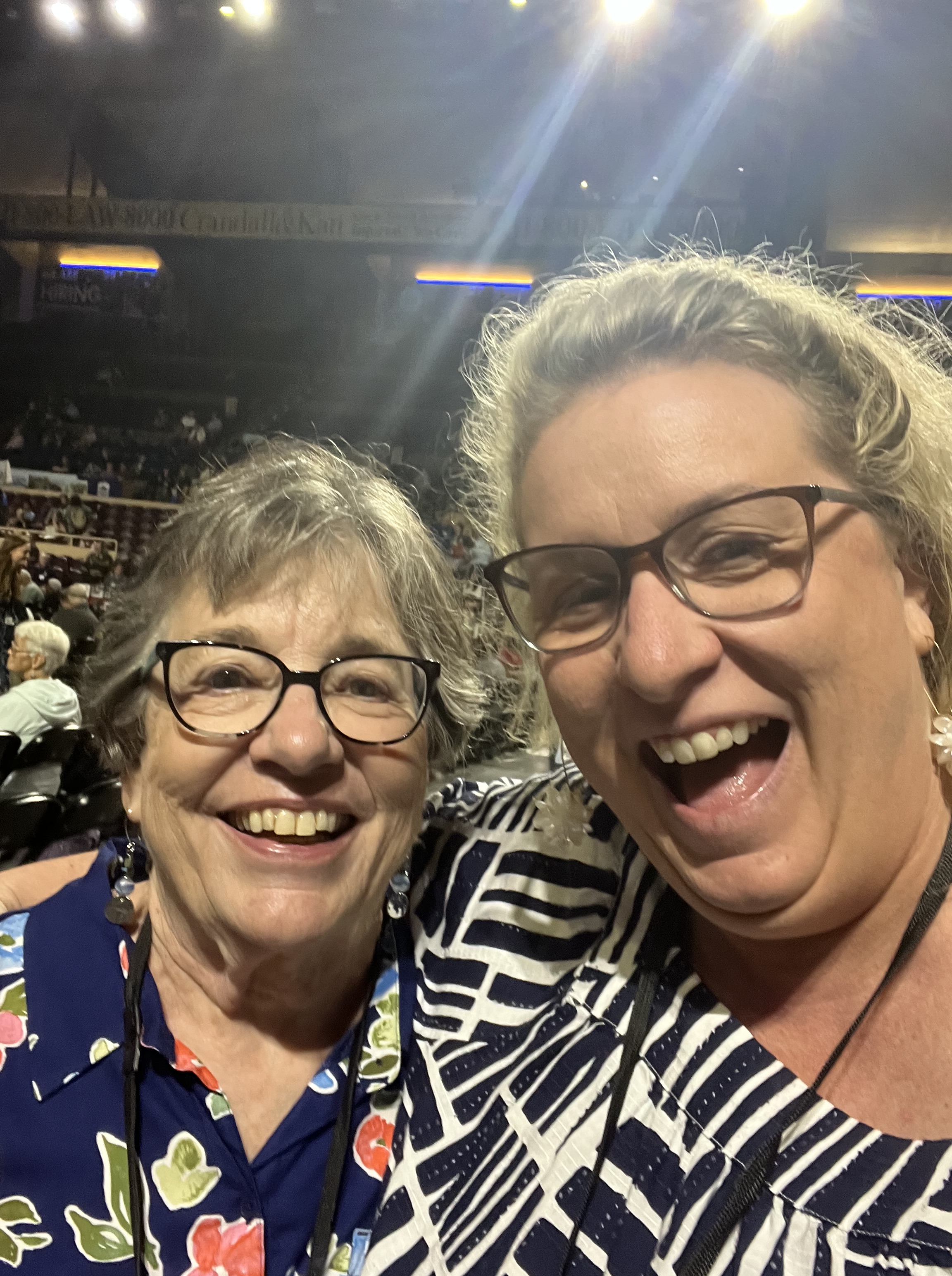
Here’s a snapshot of us at the 2025
VA UMC Annual Conference–

Please enjoy this episode of The Beautiful Kingdom Builders podcast on YouTubeSpotifyApple PodcastsAmazon MusicSubstack, and more

TRANSCRIPT:

Ruth Perry (00:16)
My guest today is Reverend Dr. Margaret Kutz, a retired elder in the Virginia Conference of the United Methodist Church and my mentor for the VAUMC candidacy process. Welcome, Marg.

Marg (00:27)
Thank you. Thanks for having me this morning, Ruth.

Ruth Perry (00:30)
I’m delighted to have you. And I am so honored that they gave you as a mentor to me. In our conversation today, we’re going to talk about the book you wrote, “Nevertheless, She Preached” about the two earliest clergy women in the Virginia Conference their story and all of the barriers that they overcame in ministry. But one thing that really stood out to me as I was reading it and as I’ve known you just for a little bit and I’m new to United Methodist Church, I feel coming from the Baptist Church, which is so far behind even where the Methodist Church is, it’s been so amazing to me to just feel the lack of barriers. So I’m just really grateful reading this story, how far the UMC has come since not that many decades ago.

Marg (01:11)
Yes. Right? Yeah, it is good.

Ruth Perry (01:15)
Before we talk about your book, I don’t want you to jump to the parts of your story in your book, but can you take me back through your story, your faith journey as a child and into when you were called to ministry.

Marg (01:30)
I come from a large family. I have four brothers and two sisters, so there were seven of us. And my mother wanted us to grow up in the church, so she made sure we got to Sunday school when we were little. And then as we got older, that we also went to worship. So I had that early upbringing in the church. And I always liked church. I liked being there. There was a time in about sixth grade that I wanted to go to Sunday school, but I didn’t want to go to worship. So I went through that period about six months, but by and large, I enjoyed going.

And my earliest memory is really of, I was about three and I just remember having a conversation with God. So I guess, at the time I didn’t really know what I was doing. So I think that’s pretty significant if your earliest memory is of God. There must be some kind of path for you.

And then I was set on being a missionary. I felt called to be a teaching missionary in Africa and that didn’t happen because I met and fell in love with a man that wasn’t going to work with. So instead, I went to seminary and then became a pastor and did that for 39 years. And I eventually did become a teaching missionary in Africa, but it took me till 65 to do that. That’s another story for another day.

My ministry really comes through that call to missionary work, because then when it looked like it wasn’t going to work, then what was I called to, to sort of clarify that. And so the local church pastor felt like a fit. And I began to meet on campus some other women who were pastors. And that became more of a reality. In addition, in my own home church, there was one other person who came out of that congregation who went to seminary and went on to be ordained. And that was a woman named Clarie Settlemire. And I just finished a book about her. So I had that model as well. Somebody that was about a generation older than me, 17 years older than me, who had gone into the ministry, finished college and seminary and out of this little rural place that we both were from. And so that was a strong emphasis and for me as well.

Ruth Perry (03:27)
Can you tell my audience a little bit about struggle you had deciding between to the mission field and marriage to your husband?

Marg (03:36)
I can do that. We dated for some time and then we were engaged had the wedding, the date planned all of reconcile the two. So I just postponed the wedding and felt that was unfair. So then I gave the ring back. So it broke the engagement. And then I was a school teacher at the time. I finished college and was teaching school, because both the Peace Corps and the Mission Board said, get some experience in United States first teaching and then come back to us and apply again. So I was in the process of doing that.

I remember it was a morning and it was a snowy day, which it is in Western Pennsylvania. And I was driving to school and I heard an audible voice that said, “Marry Bob.” And I thought for sure it was coming from the back seats. Of course there was nobody there. And that’s the only time I’ve heard an audible voice from God. I felt nudgings and had calls in my sleep and such, but that was the first time in the daytime I heard that. So I waited two weeks, did the pros and the cons, and it just felt like, this is stupid. It just doesn’t make any difference. So I called Bob and said, you know, I had this, he said, well, I’ve been trying to tell you that for two years. So that was in February. We were married April 1st that year.

You know, once we got that sorted out, because we knew we cared about each other and wanted to spend the rest of our lives together, but I just couldn’t reconcile the other. So then I still had to figure out, so I did this, God, now what happens? And like I say, it was really in seminary that that became clearer to me that that’s what I was to do. And so did that. We’re married and still married, we’re coming up on 54 years. And we have two kids and four grandchildren.

Ruth Perry (05:14)
I love that story so much. And I thought as I was reading your book, Nevertheless She Preached, both and Mildred Long were unmarried. And it’s kind of sad that that was necessary for them to fulfill God’s call in their lives. And then I think there are a lot of challenges now for women to manage both a call from God and a family, we don’t have to regret that we didn’t have that opportunity either.

Marg (05:38)
It’s interesting to me, Ruth, that for a male clergy, it’s an asset to be married and In fact, a lot of churches don’t want to take a man who’s never been married. That just seems rather strange to them. So that’s an asset for them. But for women, it’s better to never married, no children. That worked better. And I would say it’s probably still very similar to that actually. Churches still prefer a man’s coming to be married with children and a woman not to have so many with family. So many commitments gets in a way.

Ruth Perry (06:09)
Can you introduce us to Reverend Lillian Russell and where she came from and how she came be a minister?

Marg (06:16)
Okay. Lillian was from Richmond and her family was really active in the church. I mean, that they sort of lived and breathed their church. So she grew up in that and, after she preached one time, a minister in the area said he had seen her do things with the youth. So a lot of youth would come and she would speak to them. And so he said, would you speak at my church? And she did. And then she was asked to speak at a revival. And that was going to be, you know, four or five sermons in a row to do that. And she did that at age 17 and people loved it because here was this teenage girl, petite little thing. I don’t know that Lily never weighed more than 120 pounds and she had this voice and this presentation, something to say.

So then she started being invited a lot and she became a full-time evangelist. Well, she wasn’t officially that, but she really was an evangelist in the Methodist church. And had preached for 17 years all over Virginia, Maryland, West Virginia, Pennsylvania, North Carolina, and she never drove. So her family had to support her in all of this and take her places and such. And I don’t know that she ever felt like she was going to pastor a local church, but there was a shortage of ministers with the war and she got a call from her district superintendent to go to a little church in Petersburg and to be the pastor there. She learned later that she sent there because they thought the church was going to close and they didn’t really want to waste that on a man.

So they gave it to this little petite evangelist, Lillian, to do it. Well, she stayed and she stayed and she stayed. She did her whole career there and the church grew and it became a really a vital church. Now they grew in numbers and in ministry and in passion for Christ. It was quite a ministry that she had there. And they came to absolutely love her.

Ruth Perry (08:03)
And then what is Mildred Long’s story?

Marg (08:07)
Mildred, came from a large family as did Lillian, but I think that wasn’t terribly unusual back then for people to have larger families before birth control and such. But Mildred came out of North Carolina and was looking for work and found a job at the mills in Dan River. And so she went to work there and they had it all set up for women to come in and have special places for them to live. And it was really interesting to learn more about that. I could have done three chapters on that, just the life there. And I think that really shaped her a lot. She was there for several years. And then somebody there spotted in her potential and they actually paid for her to go to college. So she dropped out of work with the Dan River mills and, and went back to college and she never quite finished. I couldn’t get all of the story on that, but my guess it had something to do with the war and things that were going on in her family, some deaths and that sort of thing. Anyways, so she came back to work at the mills and while she was there, she was real involved in the local church there and did a whole variety of things. Pastors there seemed to be really open to her knowing lots of things. she did that and she was noticed by her pastor, I think, not the district superintendent.

So he started a new church and then he asked Mildred to help him with that. And so he said, you know, as I move into another church, a logical person to appoint to this church plant, they didn’t call it that back then, but this church plant would be Mildred Long. So she got an appointment there. It was there about two years and then she got an appointment to another church. You know, people just began to see her ability. Now they were very different from each other, Ruth. They were both strong and Lillian could be fierce, but Mildred was fierce. And she ruffled some feathers. Lillian tended to sort of calm things, but Mildred was more likely to confront things. And their friendship meant a lot to them because they were the same age, born the same year, but Lillian was about 10 years in experience ahead of Mildred. So Mildred leaned on Lillian’s experience and they became friends through all of that. they were the only two.

Ruth Perry (10:12)
Do you feel you have anything in common with Lillian or Mildred, Marg?

Marg (10:16)
You know, I connected more with Mildred. There was a, I don’t know, there was a spiritual, both innocence and powerhouse in Lillian that I really admired, but I don’t see in myself. There was fierceness and a determination in both of them, but the way it got acted out in Mildred, I think, was more like how I acted out. A little more upfront.

Ruth Perry (10:37)
So you knew of them when you were coming into ministry and you had contacted them, which you write about, they actually retired the year that you were ordained, is that correct?

Marg (10:48)
They retired a couple years after I was ordained. I think in 79 and I was ordained in 77. So yes, two years. But I had never met them. And I wanted to get together of the clergy at conference for lunch. So I looked to see who all the clergy women were. I think there were five of us. so I asked, this was all written, know, and typed. And it was when we had carbon paper behind it. So it wasn’t, I shot an email out to them, but actually, you know, typed up a letter and sent it out to women to invite them. And it was Mildred that responded back to me and said that she had talked to Lillian and they decided not to come, that they really hoped that our experience would be different from theirs. And they didn’t want their experience to color or influence our own experience.

So I was sorry about that. Because at the time I was sort of peeved. then as I look back, particularly as I researched for this book, I was really sorry that I didn’t know them. And I think it really would have made a difference for all of the clergy women at that time to have known them, even if we had to hear their stories and all the things that happened to them. Once they retired, they sort of set it aside. They were interviewed by a woman, Kathy Morgan, who wrote the history of the United Methodist Women’s Society in Virginia. It was just a little booklet. So it’s maybe 50 pages, if it’s even that. And she had two pages on Mildred and Lillian. And how she did that was she interviewed them by mail. So she wrote them a letter with some questions and then they wrote back with their And they talked as if nothing of any consequence, there wasn’t wasn’t any blowback or pushback on them of any consequence. And I think that by that time they had gotten to the point was like, just letting this go. I don’t need to carry this banner anymore about the prejudice. But it was there. It was clearly there when you read their history. They may not have said it, but they lived it.

Ruth Perry (12:43)
You wrote your book in the genre of historical fiction, which was so beautiful because it really captured not just the facts of what happened, but the emotion and the impact in a really powerful way, I think, and really beautifully captured the culture of their age. Just the little particular things about their own personalities that I think wouldn’t have been conveyed as well, as So I really appreciated your approach to writing the book. And you said in the introduction, that God led you to write this through a dream. Can you tell me about that?

Marg (13:16)
This time I was retired and I had been thinking about writing my own story. People had encouraged me to do that. And so I was sort of thinking about that. Well, I have time now that I’m retired, maybe I could do this. I had a dream and the dream was to tell the story of Lillian Russell and Mildred Long. I mean, it was just plain and I knew even when I was having it that this was from God and that I was going to do this.

And I knew nothing about writing. I did learn that I’m not a good writer. But critique groups helped me tremendously. They were very patient with me. I was definitely the worst writer in the group. And they just sort of brought me in. The first chapter became the first three chapters. And then the first of those chapters, I took to the group three times. And the third time I said, now, when I say make these edits, you want me to bring it back to you again? And they said, no, they were tired of it. Move on. And I had started it as sort of a biography and then I didn’t like it. So then I made it biography combined with historical fiction. And the group said, you got to make up your mind. You can’t write a book that’s both. It’s got to be one or the other. And like you said, as I got to know the women, I wanted people to know them as people and not just the facts of their life. So that’s the reason I made it fiction so I could tell the conversations.

And oftentimes it would be either something I read or something that somebody told me in interview about them, either something that happened or a trait they had in their personality. And then I would create a scene or a story that would help convey that rather than just to write it in a paragraph or in a sentence. And that was fun to think about that. OK, so I know this about them. Like I know that Lillian Russell had to appear before the committee. So what must that have been like? What did people wear? Where would they have been? How would she be feeling? What was going on? And I could sort of refer back to my own experience as part of it, because even though I was a generation behind them, my experience, particularly early on in those first five to 10 years, was almost identical to theirs. Things had not changed much at all in that time period. And then they changed rapidly in the 70s and 80s with the women’s movement.

But up until then, really my experience was very similar to theirs. So I could fall back on my own experience and think about how I felt and what happened and what I saw in the men, either obvious or subtle.

Ruth Perry (15:35)
You clearly worked very hard, and I think you wrote excellently. I was just talking college minister in a previous episode and she quoted GK Chesterton, “Anything worth doing is worth doing poorly.” But I don’t think you did it poorly at all. I think it’s amazing and I really enjoyed reading it.

Marg (15:39)
Thank you. Yeah. I hear what you’re saying though. Yeah.

Ruth Perry (15:55)
I mean, their story is so important.

Marg (15:57)
It is, it is. And I think what makes the book interesting is them. It’s not the way I told it. It’s them. They were amazing people. And I came to what I felt sort of know them, you know, through all of this. And there were times, I remember one night my critique group met about 45 minutes from where I live. And on the north side of Richmond, and I live in the south side.

And so as I was coming back home, I was thinking about this because one of the men in the group said, as he was critiquing, they would read 10 pages and tell you what they thought. And he sort of pushed the paper back. He said, look, you don’t have a lot to work with here. So if this is going to be good, it’s got to be written really well. And it’s not. He said, I was like…

Ruth Perry (16:40)
Brutal!

Marg (16:44)
It was brutal. So when I went home that night, I was driving home talking to God saying, you know, these people deserve a really good book. So either I need to get out of the way for somebody else to write it, or I need to get out of the way for you to help me write it. So help me with this, God, if you really want me to do this, help me, because I want this to be a good book for them, because, you know, they really do deserve this. So it’s just a sort of a conversation, you know, if you I don’t know how people pray and listen to God, but I felt like God was trying to tell me how she was informing me and was sort of, listen harder and wait longer. Because I’d be like, why don’t I just do that and then to go forward with it. And she was saying to me, wait a little longer and listen a little harder. And then as I thought about it, I thought, that is true.

Because sometimes what the critique people tell me is exactly what I was thinking when I was writing it but I didn’t stop writing long enough to stop and listen and then to write as I was directed. So I thought God really is directing me in this. I’m just moving forward too fast and not listening enough. I don’t pretend that this is the Bible, but but it did cause me to think, I wonder what it’s like for the Bible writers, particularly like Paul or even the gospel writers telling a story. And we think about them being directed by God. And I just wondered if they had critique groups, you other disciples, you know, sort of this is what I remember how it happened. And maybe you should add this so the reader will see this. And so anyways, just thinking about how God has led people to write all kinds of things over the years from the heights, you know, the Bible to historical fiction and how that works. So I think God still words that are inspired by God, whether they be sermons or books or poems or hymns.

Ruth Perry (18:27)
Absolutely. Part of my own experience now in the United Methodist Church is that I came in completely blind. I knew nothing about polity. I knew some Wesleyan theology because I had already been licensed in another Wesleyan denomination. But I was brand new to all of the language of the Methodist Church, the structure, the politics of it, and it was very overwhelming coming in. So was grateful that they gave me mentors to help. But can you give a little bit of a crash course on the process of becoming a clergy person in the Methodist Church?

Marg (19:01)
So it starts with the local church. And if the person feels a nudging or a call, he or she talks to the pastor. And there’s some resources they can use, some books and such, to sort of walk through it. And if the pastor feels person has thought it through adequately, and it might take a week, it might take two years, and working through some of the resources.

Then has the person go before what’s called the Staff Parish Relations Committee. It’s sort of the personnel committee at the local church. And then they recommend or not recommend for the next step. And if they do recommend, then it goes to the church’s charge conference, which is sort of a group of their leaders. And if they recommend, then the next level, so now it’s done by the local church, the person who knows that person best.

And then it goes on to the district level, which is what the district superintendent overseas. And if they are approved for that, and there’s a lot of papers to write and interviews, and so it’s a long process for that, then they can recommend them for ordination. I guess it’s consecration and becoming a provisional member. When I came in, was ordination as a deacon and probationary membership. And now it’s provisional, but what’s the other? not a deacon anymore.

Ruth Perry (20:12)
Associate.

Marg (20:14)
Yes, associate. And when they’re brought into provisional membership, then they still cared for by the district, but then they’re eligible to be recommended to the annual conference. And then ultimately they’re on by a clergy session. So all the ministers in the conference vote on who gets to come in. And if they’re voted in, then they’re ordained and brought into full membership.

It’s quite a process, as you know. So there’s that polity side, but then there’s a whole education piece, know, with college and seminary or lay licensing school and all those in addition to this approval process through the ranks.

Ruth Perry (20:40)
So it’s good, they definitely equip their ministers, which is great. So and very affirmed in their local church their gifts were obvious had opportunities to local pastors that supported them. But what were some of the barriers that they started to encounter as wanted go through the steps of increasing their status in the United Methodist Church.

Marg (21:14)
Along with that, I found out through reading newspaper articles and Mildred was more likely to tell some of her story and as she was being interviewed, Lillian a little less so, but you could tell from they came through. For instance, when Lillian was appointed to the first church, it was because they thought she was going to close it.

And then when she went to seek some kind of status, because then she was just lay supply, which means at any moment that she could be out of there. There was no guarantee or security really in that position. So as she sought to have some level of status beyond lay supply, she needed to appear before the district committee. And what I read was that she was in the Richmond district and she was approved in a Rappahannock district. Now that didn’t make any sense because you would always be approved by your home district. And then they have the pastors listed for each of the districts, she was listed in the Richmond district. But the newspaper said that she was approved in the Rappahannock. So this is just one case that I did some investigation. And without the newspaper article, I wouldn’t have known any of this had happened.

But with that, then I went to a retired minister named Raymond Wren, who had been around then and knew Lillian Mildred. And at this point, he was over a hundred years old, but he had a really, really good memory. And so he talked to me about that. He didn’t know so much the particular stories of Lillian Mildred, although he knew of them and had met them. But he said, tell me who two district superintendents were. And I told him, and he said, yes.

So she had to leave her district to go to another district in order to find a district superintendent who would even allow her to appear before his committee. So she did, she was approved. And I remember going through those ropes young woman. And so again, I was able to sort of describe her experiences based on my own, how the men were, how their behavior was, what her response was, or trying to read the room. When I first came in, they wanted the minister’s wives to come with them for the interview. Now that just seems archaic now.

But that was standard then and my husband did go with me when I was first interviewed on the district for a deacon So when Lillian went she would have taken her father And her father was a big deal on the district, but now they’re on a different district. They’re not on the home district So he didn’t carry quite as much weight there as he had But just trying to navigate all of that as a young woman.

It was quite remarkable what she did and quite disappointing how the church was, just how much more it had to grow. I also found out, Ruth, that even though it was in the Discipline, it was not enforced. It was sort of like, well, you know, not all of us are on board with you girls, so you can go to this district because this DS thinks it’s okay to have a girl in ministry.

So there were some of that and that was happening in Mildred when she wanted to be brought into full connection, ordained an elder and brought into full connection. She was on one district. I think she was still in Danville then I’m not sure. But anyways but then she had to move and this was something she had written had shared in an interview for a newspaper article. That’s where I read that. The bishop moved her to a different district.

And my take on it was when she couldn’t get the DS to allow her to come and appear before the district committee, that Mildred probably called the bishop. That would be my guess, knowing what I know about Mildred. And the bishop said, let me move you this year. So she moved to a different district where the bishop knew there would be a district superintendent with who more amenable. So they didn’t enforce the rules. They just sort of worked around them because it was a boys club.

They didn’t want to come at each other. They wanted to do the right thing, but they didn’t want to hurt each other. So they just found other ways to do it. It was really hard for Lillian and Mildred and other women in the days that I came in to feel supported by the hierarchy. It just wasn’t there. The very first appointment I had when superintendent called me to tell me where I was going.

It was Round Hill and I said, well, where is that? He said, get a map and look it up. huh. So then he talked a little bit about it and then not much. And, cause I had been out of town and he said, I’ve been trying to call you. And this is, know, before voicemail and all that long time ago. and, and I said, well, I was in California. You shouldn’t travel during appointment season.

And I thought to myself, I didn’t even know there was an appointment season. But see, these were things that the men knew because they mentored each other. the women were totally kept out of those kinds of things. So I was scolded for that. And then he said, glad I’m going off the cabinet this year because I don’t ever want to have to appoint another woman again.

Yeah. So there were district superintendents, even though we were in there as, when I came in being eligible for Deacon, Elder and full connection, just all the rights and privileges the men had the district superintendents for not kept in line with the, with the same book that we all shared and they made a commitment to when they were ordained that they would support and uphold that Book of Discipline. And they, didn’t, and they weren’t held accountable to it. And the people that suffered were a lot of people, but

I was aware of the clergy women as separate as a result of that. The first district I went on was the Winchester district and Lee Schaefer was the district superintendent there. And he was brand new in that position. And I found out that really he made my appointment. He was invited as the new district superintendent to come in and sit on some of the appointment things. And, this is a story. They thought they were all done.

Now they use laptops, but then they had books, their appointment books. And so everybody had closed it up and Bishop Goodson said, well, I guess that’s it. Because it was long, know, our long arduous project process. And the district superintendent, the outgoing retiring district superintendent from that district raised his hand said, Bishop, I still have one church without a pastor. So they don’t open up their books. And so at that point, they’re thinking about appointing somebody that’s retired because it looks like everybody’s taken. And it was Lee Schaefer that says, Bishop, where’s Margaret Kutz gone? And he said, well, she’s going to go to Graham Road part time. And I was going to be part time there because they didn’t want me working after dark. It was just one of those things that’s like when the streetlights come on, all the kids and the associate pastor have to come inside because they’re not allowed out.

Anyways, so I was going to be part-time at a church because I couldn’t be out night and was going to my senior pastor told me a nice guy, but he told me said I don’t know really what I think about women in ministry, but my wife thinks it’s a good idea. So I thought I’d give it a chance. Anyways, so I knew there wasn’t going to be a lot of support there. So when Lee Schaefer found out where I was appointed part-time, he said, well, what about her? No, they would never take a woman. He said, well, let’s ask them.

So they called and they gave him a choice, apparently. I figured one was dead and the other one was nearly dead, or me. I don’t know if that really was true, but anyways, probably two retired people or me. And they said, well, we’ll take that woman. It was the president of the local bank that was chairing the committee, Mr. Cooley. As I came to know him, I thought I can see him being open to that. So that’s how I got that appointment. My district superintendent who supposedly made the appointment. I was the only woman he’d ever appointed and he didn’t want to have to do it again. Hard to believe, isn’t it?

Ruth Perry (28:21)
It really is. So at the end, the last few chapters of this book, you share pieces of your own journey you talk about a minister and pregnant and some of the terrible things that people thought about that, that they didn’t want to see someone behind the pulpit and know that they had done it.

Marg (28:32)
Yeah. Yeah. Yes, you can just tell she did it. And there’s teenagers in the congregation and they’ll know she did it. You know, that and women are naughty.

Ruth Perry (28:38)
and just archaic ideas. So I was thinking about Lillian being posted at a church that they thought only had about two years before it would close. And the idea of the glass cliff that oftentimes when an organization is sinking, that’s when they give a woman an opportunity. And it’s not just an opportunity to lead, but it’s also kind of like putting the woman in a scapegoat position where they can criticize her and blame her. Yeah.

Marg (29:07)
See, we told you. Yes, yeah, we told you. I remember one time I went to a district superintendent saying, I’d like to be considered as a church planter, know, a pastor who would be particularly trained to start new churches. I always thought that a lot of work, but I thought it would be a lot of fun. And he said, I don’t know. He said, you know, we had a woman try it and it didn’t go well. When I knew who she was, I’d went on to seminary with her and a fine minister, really gifted. Anyways, and I said, So if you ever have a male minister try to start a church and fail and he said, yes. And I said, well, what are you going to do if you can’t ask men and you can’t ask women? He was like, Because he’d do such a broad brush for women and a little tiny hair brush for the man. So there was all of that, what you’re talking about send her to the place that is almost impossible. And then say, see, we told you not only that she can’t do it, any of her kind can’t do it. The whole broad brush thing.

Ruth Perry (30:04)
So can you tell me a little bit about the 1979 annual conference how that was a pivotal of mantle passing between Lillian and Mildred and future generations?

Marg (30:13)
Mm-hmm. Mm-hmm. Lillian Mildred born the same year, but they didn’t come into ministry the same year because Lillian was the head of Mildred. But they retired the same year, 1979. They were both 65 and retired in 1979. And so when I went back and looked The Advocates of the historical records, the magazine for the annual conference, I looked at what was going on that year. And it really was a pretty big year for several levels, but the year that they retired should have been noted that the two earliest clergy women are retiring and there was of course nothing. But then it listed the people that were ordained that year. And that was also the year that they elected delegates to general and jurisdictional conference.

So it tends to be a really heated session, very competitive and the way it works and you have caucuses that, you know, supporting different people and And the clergy women were just trying to figure out how to influence that vote. We hadn’t quite figured it all out yet, but we did eventually. And truly we changed the face of General Conference from the Virginia side totally. And did it for some years, which really puzzled and frustrated other people who thought they knew how to do this. But anyways, we came up with a different strategy and overcame the biases.

So that year people were contesting for General Conference and they needed one more delegate from Virginia for General Conference. You had to have a majority, but there were three that were elected on the last vote. Usually they reduced how many were needed to elect as they went on. They were trying to wrap up annual conference. They would say, okay, now you only have to have so many to be elected.

So these were these three people. One of them was Jim Turner, the guy that told me, you know, I’m glad I don’t have to point another woman. But anyways, he was elected to General Conference. But the person that really stood out for me was Leigh and Teen Kelly. She was an African American woman, a whole generation older than me. She was just a year younger than my mother. And Leigh and Teen, and she was ordained the same night I was, you know, in order, Kelly and then Kutz.

But anyways, Leontine Kelly, then she went on not only to represent Virginia at General Conference, but she went on and was elected a bishop. She was not elected from the Southeast. They would not elect her. So she got on a plane out of, out of North Carolina and, flew to a place out West. can’t remember now the name of the city where they were having their own. jurisdictional conferences they were all held at the same time. And she was elected there. These people didn’t even know her.

But they knew of her and she went from group to group, you know, and introduced herself, talked about they asked her questions. And so when it was time to vote, they voted for this woman who had just showed up at their jurisdictional conference. It was it was truly an act of God, truly an act of God. So so there was that with Lillian teen Kelly and they probably didn’t even know her. And then Cynthia Corley was ordained that night and she was the first

female district superintendent appointed in Virginia and in the whole Southeast. There were three of them appointed the same year. So she was one of the three first. And none of us knew that this was how it was going to play itself out. But you know, Elisha asked for a double portion of Elijah’s. And I think that was what it was. It was two of them and they both gave a double portion. And here we had two history making things happening as they passed that mantle. So you think about the power that they carried in their mantle. And when they passed it on, the power that then was spread and shared with the, what do you call your blog, the peaceful kingdom kind of thing.

Ruth Perry (33:47)
Yeah, the beautiful kingdom.

Marg (33:48)
Beautiful kingdom. and they they became part of that. So lots of times we are part of what the Spirit’s doing and have no idea Have no idea that what I’ve what we done and they didn’t know they were retiring. They didn’t know they were doing anything, but they did. And the spirit took that and wrapped it up, their mantle up, parted the waters, and through they came.

Ruth Perry (34:11)
Praise God. And then you were the first woman that served on the Board of Ordination. Can you describe what that experience was like, Marg?

Marg (34:20)
It was really hard. It was really hard. The only time in my life that I actually had allergic reaction to anxiety was there. Something had happened in one of the interviews that was totally wrong and it happened to a friend of mine and as a result of that she wasn’t approved and they had there was.

confidential information that wasn’t true, confidential information that wasn’t true that they went and intentionally told each of the committees before she got there. So each time that she went into one of the interview committees, they confronted her with something that was none of their business. It was confidential and wasn’t true. And then they wondered why she came across as sort of angry and she wasn’t approved. And

I wanted so much, because she was a friend in particular, but it was awful that I couldn’t help her. And I didn’t know how to do it. It was so much bigger than me. I remember leaving, going back to my room, they had a birthday party for one of the guys and they wanted me to bring in a cake and they one of Dolly Parton’s songs. And it was the whole thing was just, you know, the men are hooting and.

with this old guy that I don’t know, he’s celebrating his 70th birthday or something. Anyways, because I was young, so everybody seemed old to me then. So there was all this guy stuff going on, and I was just carrying this burden for my friend. And I remember going up to my room and crying and calling her after I knew that she had been informed to apologize to her that I didn’t know how to make it right. And then I went directly from there to a clergywoman’s retreat.

And every time I tried to tell the story, I couldn’t breathe. I had to stop talking. Like I said, was the first time I’ve had an allergic reaction like that. I was just closed up and I couldn’t talk. I was made mute.

So that was the worst thing that happened, but it was difficult. We didn’t require inclusive language then. In fact, most of the guys didn’t know what it was. But if somebody came through, a candidate came through and they had used inclusive language in their paper, I just thanked them for it. I said, I noticed you did that and just want to let you know I appreciate that. And some of the other guys on my interview team would apologize for me.

And I said, you don’t have to apologize for me. If they used it, clearly they appreciate it. So you don’t have to say anything, you know? But by the time I left, I had made a motion to require inclusive language in all papers. So I thought, OK, this is a test to how well I did here, see if this passes. And the chair said, Margo, I really want this to pass. I think you need to make it recommend rather than require. I said, mm-mm. I’m going with require.

Let’s just see what happens. And it was approved, not unanimously, but it was approved to require inclusive language on all papers. And I thought, okay, I have come and I found a place for myself and I’ve made a difference and now I’m leaving. I’ve been here seven years and I’m going to leave. But that was an affirmation that I’ve done a few things right anyways. Had earned some crud on the board.

Ruth Perry (37:11)
Where do you see that Virginia needs to continue advancing in their inclusion and treatment of women and minorities? And where do you think we need to improve?

Marg (37:21)
Mm-hmm. I do think that ethnic women in particular really need some attention. There was a time when we had very few Korean pastors, male or female, in the conference. And then just a whole lot came to the board of ordained ministry. And my thinking was that we needed to look to see what God was doing to say, you know, why are all these Koreans coming out? Why is God sending them to the Virginia conference?

And is there supposed to be a specialized ministry that we’re supposed to be doing? Because also a lot of Koreans were moving to Virginia. But instead of doing that, they tried to find a way for them to fit into what we already have. You know, how do we how do we appoint them? Well, let’s just point them with no bias, just as if they’re Anglo. Let’s just move forward with that. So there was no preparation for the pastors nor for the congregations because I think they thought the best way to avoid bias is to pretend there isn’t any. And so it was really difficult. And the women really struggled because in their own Korean culture, they were a step behind the women, I would say, in the United States in terms of recognition. So they had their own bias coming out of their own culture. And then coming into the church and being both female and Korean, they were really hurting and felt really invisible. So that one, and I also think Hispanic and African-American.

The race issue becomes secondary every time another one comes up. So when it women and, you know, race came second and then other things happen. Now it’s LGBTQ and then race is second. And so we’ve made great strides and with women and some ethnic groups and certainly great strides with LGBTQ plus, but we still have a ways to go, I think, with our ethnic groups. the women’s movement has notoriously been about white women. And we need to change that. And I think the women need to come together and the white women need to sort of shut up and do more listening to our sisters who are Black, Latino, Asian, and listen to what they have to say and see if there’s some way that we can back them up and help.

Ruth Perry (39:31)
So on Wednesday, I was participating in a Zoom talk about your book that you were invited to do at the conference. And it was striking that no men signed up to participate and hear from you. Have you experienced a lot of feeling ignored or accepted by your male colleagues or has that mostly been a marginal experience for you?

Marg (39:52)
I think, no, there have been some that have read the book and most of them are acquaintances. So I think they read it as much because a friend of theirs wrote it. But I’ve been invited to a lot of groups to speak about the book, know, women’s circles are, but it’s all always either been the whole church, the whole congregation, like on a Sunday morning, or it’s been just a women’s group. have yet to be invited to a men’s group.

I was invited to one clergy group and I asked, it was Drew Colby that did this and I asked Drew if he would do it. I wanted to see what happened. And so he brought them together. had not read the book, but anyways, it was a good discussion. That’s the only one I’ve had, but that was because I asked somebody to do it.

Somehow history, just history, which is really history that the white men write. And I don’t mean anything against white men, but that’s just sort of the reality that we live in. That that’s for everybody. But then if you have Black history, that’s only for Blacks to hear about. And if you have women’s history, that’s just for women to hear about it. But we need to hear the whole history.

I don’t know what you do with that, Ruth.

Ruth Perry (40:52)
Absolutely. Well, I think calling it out is a place to start and just bringing awareness that we need to listen to each other.

Marg (41:00)
Mm-hmm.

Ruth Perry (41:00)
I was kind of sad towards the end of the book reading about Lillian and Mildred’s retirement years. Lillian especially seemed very lost without her ministry. And just the contrast between their retirement and your own retirement, you’ve never stopped. You’re still going, going, going, and you’ve had amazing opportunities. Can you tell us about the school in Africa that you, and you finally made it to your missionary dream.

Marg (41:25)
Yeah. I heard the call at 18 and finally at 65 was there. So when I was at a church in Williamsburg, Wellspring in the 1990s, we sponsored two of the Lost Boys of Sudan. It was actually the year 2000. And then when I moved from Williamsburg over to another appointment near Richmond in 03, kept my relationship with them, but particularly with one of them named Angelo. And it was amazing what he did with his life. He got his GED and his associate’s degree and his bachelor’s degree and eventually his master’s degree. He got married and he and Stephanie have three children. And so there was all these things that he had accomplished, but one of the things he always wanted to do was to reach back. He always wanted to go back home and help the people there.

And he knew that he was saved. He would say this, I would say for a purpose bigger than myself. And he knew that it was about helping the people in South Sudan. So we organized a team and then it became a committee and then it became a nonprofit. And for a while it was part of the conference and now it’s not, it’s a separate nonprofit. And the idea was to start a school. And so we hired somebody over there to do it it just wasn’t getting done. wasn’t getting done. And I just knew that I needed to go and I know nothing about this. So I don’t know why I thought I was the person that needed to go there, but I did and went with a good friend. Well, she wasn’t a good friend at the time. I barely knew her, Bev Neeland. We’re good friends now, but she and I went together with Angelo. He stayed two weeks and then we stayed almost three months while we were there. And we went back to his home community called Roombaek and the director was there. His name was Philip.

And what’s amazing, Ruth, is that we were in Roombaek for a week and the Monday of the second week we were in a classroom teaching. Now, no human being can do that. That’s the thing of God, because people would say, well, how did you do that? I said, I have no idea. We just showed up and God did the rest. So there I was teaching in Africa, finally.

And I’ve had people say, wasn’t that like sort of a glorious angel singing, moment, you know, with that happening. And I said, no, was so freaking hot. The sweat was just dripping off my chin. I didn’t feel any angels at all. It was fun, you know, but it was really hot. Yeah, too hot to know the angels. It felt more like, I think angels like air-dishing. I think it’s the other end that likes the heat. But anyways, but it was, to me, I guess the phrase that kept coming back to me was, God remembered. Well, it’s sort of like, of course God remembered, but to me it was like, God remembered that word to me. Anyways, it was powerful for me in that sense, that all those years that God honored that, all I had to do was show up and that God gave me an opportunity to teach.

We taught for awhile and then we hired some teachers and they were way better than us, partly because they could understand them and teachers could understand the students. And then we set about setting up a school, you know, doing what we needed to do. Set that up and then we came back home so we could raise money to pay the teachers that we had just hired. And now this school is called Bukloi, which in the native language of Dinka, it means yes, we can. We started with about 35 students and now we have over 700. And it’s considered one of the best schools in South Sudan and one of the largest.

Ruth Perry (44:46)
Wow.

Marg (44:48)
Yeah, pretty amazing. And I’m totally out of it now. I mean, I, you know, continue to support it, but I’m on on the border. I don’t go anymore. I made my last trip when they celebrated their 10th anniversary when they began. But there were many years where we had enough to pay people for a month if we spent everything we have. So we did. We just spent it all and just hope the next month somehow more money would come in to pay the teachers again for another.

Ruth Perry (44:49)
Congratulations, that’s amazing.

Marg (45:15)
We had months that we didn’t have enough and we paid the teachers what we could and told them we probably will never make this up because we’re running really tight. But they hung in there and they stayed with us. And we still have, I think, one teacher from that very beginning time. Maybe two, I think it’s just one now. Pretty amazing.

Ruth Perry (45:33)
Marg, can you put your mentor hat on and speak to young women like myself who are starting out in ministry and give us some of your best from your decades in ministry ahead of us?

Marg (45:44)
If this is what you’re called to do, there is no greater life than you can live to do this. I mean, there’s times that it’s just frustrating and demoralizing and makes you angry. But in the end, it’s amazing what God lets us do. I think about that we get to proclaim the good news of Jesus to people who are sitting there and listening. And we get to do that.

And then when we visit people, they open up their lives to us and tell us things that we get to enter into people’s stories and to walk with people through all of that. It’s to me, it’s just such a wonderful privilege. Certainly it comes with all the challenges and but but to never lose sight of the beauty of what we do and a power of it. Not just political power, but spiritual power and the life power. That’s what I would say, Ruth

Ruth Perry (46:32)
Where can people find information about your fiction?

Marg (46:38)
Okay, I have a website called neverthelessshepreached.net .com and dot org were taken. I got dot net. Nevertheless, she preached dot net and you can get a hold of me through that and I’d be glad to speak with your group. If you want me to do it in person, I can do that or I could do it via zoom or whatever. I have had some book clubs read the book and then I would come in. I’m in a book club and I think it’s wonderful to be able to have the author come in and be able to ask questions and share stories and such with that person. So anyways, I’d be glad to do that or speak to a group of those like me to do that.

Ruth Perry (47:14)
Thank you so much for all the time that you’ve spent with me. I think you were to be my mentor for a year and a half, and we spoke monthly. And you were just always so generous and encouraging and uplifting. And always felt affirmed in my calling by you. And I can’t tell you how and impactful that was for me. And so thank you for that.

And I just want to give you the last word before we sign off.

Marg (47:38)
Praise be to God, we worship an amazing God.

Ruth Perry (47:42)
Amen. Thank you so much for coming on the podcast today Reverend Marg.

Marg (47:47)
Okay, thank you Ruth. And you are an amazing pastor, very gifted, and you have much to contribute to the the reign of God.

Ruth Perry (47:55)
Aw, thank you. Blessings to you.


Did you enjoy this episode? Please subscribe, rate or review us on YouTubeSpotifyApple PodcastsAmazon MusicSubstack, and more! Your support means the world. God bless!