Tag Archives: God

Thomas Jefferson on Freedom

I recently came across these words from Thomas Jefferson:

“Freedom is the right to choose: the right to create for oneself the alternatives of choice. Without the possibility of choice, and the exercise of choice, a man is not a man but a member, an instrument, a thing.”

Freedom is the right to choose.

Without the possibility of choice…a man is not a man but a member,

an instrument,

a thing.

A THING.

WOW.  That really struck me.  How dehumanizing.  It has been said that the essence of sin is to dehumanize another.

Our world is full of women who are denied the right to choose their destiny.  To differing degrees depending on our country, family or faith community.  In parts of the world today, girls are aborted or killed as infants, are denied education, adequate food and healthcare, are sold to traffickers or married off as children, are mistreated by chauvinistic husbands, are paid little and are unable to own land.  In the United States, women are still battling a patriarchal system that objectifies our bodies, a culture that shames victims of rape and sexual abuse, we are given unequal pay and promotions, and we only hold 11% of governmental offices.
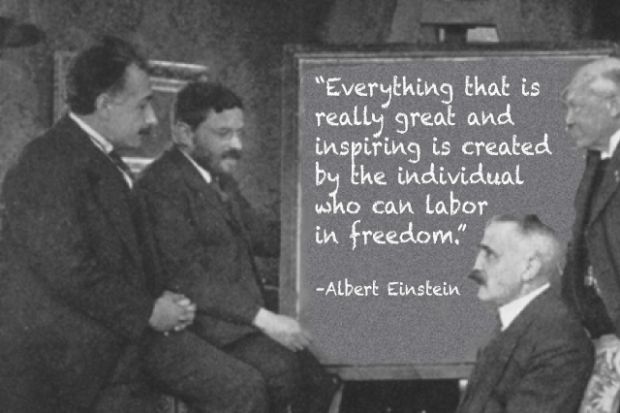
einstein

And in many faith communities, women are relegated to separate roles from men that limit their choices.  Complementarians believe that it is in these roles that true freedom is found.  From the complementarian perspective, “Biblical manhood and womanhood” is God’s design, and the path to righteousness, peace and joy is in following God’s design.  Just as with the hundreds of other commandments in the Bible, we are in right relationship with God and with others when we submit to God’s will.  Ultimately, we are all submitting to roles designated by God, and it is a rebellious spirit that rejects God’s omniscient design.  We may not, in our finite capacity, be able to understand why it is God’s will for men to hold authority and women to submit, but it is clearly God’s will and we will be blessed by our obedience.

I believe that they are mistaken about God designing a hierarchy of male headship and female submission.

I believe that complementarians are blind to the dehumanizing of women in this interpretation of Scripture.
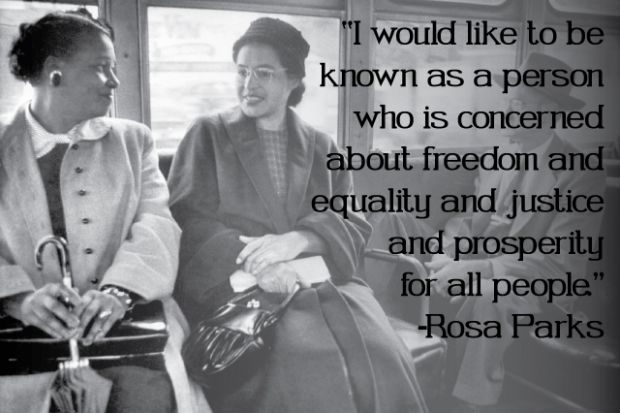
rosaparks

Freedom is the right to choose.

Without the possibility of choice…a man is not a man but a member,

an instrument,

a thing.

A THING.
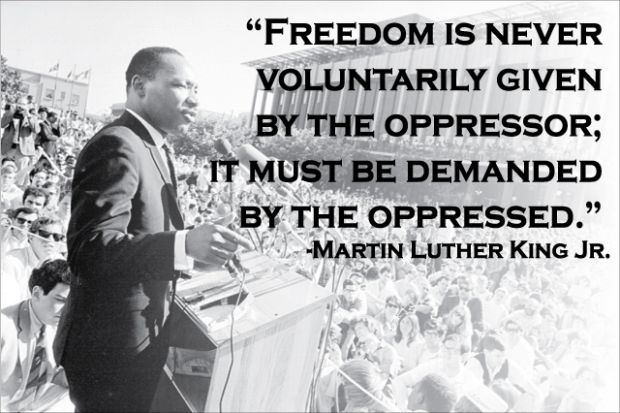
Christianity has a long history of great theologians who have given us amazing insight into God’s Word and nature…and have also subjugated women to a lesser role than men.  Theologians like Thomas Aquinas, John Calvin, St. Augustine, and many more, including today’s leading complementarian advocates, like Mark Driscoll and John Piper.  I’ve long wondered how these great men could say what they have said about women.

I believe they were and are blind to the dehumanizing of women in this system.

Freedom is the right to choose.

Without the possibility of choice…a man is not a man but a member,

an instrument,

a thing.

A THING.

MLK_0

I began to wonder why Thomas Jefferson could see this reality when it applied to men, but could not see that about the women of his day and also the slaves that he kept.

How is it possible to be so right and simultaneously so blind?

So I Googled “Thomas Jefferson on Women” and found this fantastic article by Thomas O. Jewett.  It goes in-depth on Jefferson’s views on women and I highly recommend the read.  I would like to pull a few quotes for you that demonstrate how this advocate for the freedom of men, who has remained an oracle of wisdom throughout following generations, could subjugate women to a lesser, subservient role.

In Jefferson’s aristocratic Virginia, wives did not normally show a great deal of independence in thought. They were taught to accept the domination of their husbands…

…Jefferson admired women who were soft, passive, modest, and chaste, and who possessed such artistic talents as made them ornaments of a masculine world. As mothers and housekeepers they were domestic workhorses, but as sexual objects they must be delicate and beautiful, living works of art existing in an imaginative world of romantic love. This view of women reduces them to either ladies or sluts. (McLaughlin, 1988, p. 195).

Like most men of his age, Jefferson believed women’s interests were to be confined chiefly to housekeeping and childbearing. (In ten years of marriages, he fathered six children, several at times when his wife’s health should have precluded pregnancy. But Jefferson was unwilling as any male of his class to deny himself the pleasures of the marital bed because of his wife’s poor health.) The two sexes had separate functions to which they were genetically adapted and should not mix. In particular, he thought women should keep out of politics.

Since women were not called upon even to discuss politics, Jefferson saw no reason to give them the vote…

Women thus excluded from public affairs, no effort need be made to educate them in any subjects which did not seem likely to be useful in their place as wives and mothers…

…He felt strongly that women had a single purpose in life, marriage and subordination to a husband. To his oldest daughter, at her nuptials, he wrote: “The happiness of your life now depends on the continuing to please a single person. To this all other objects must be secondary, even your love for me.” (As cited in Nock, 1996, p. 58).

…He, like his eighteenth century, male, aristocratic, contemporaries saw women in a tightly regimented role. For them to break out of these imposed boundaries was repugnant. “In the United States, during Jefferson’s presidency, a female politician was said to be only slightly less disgusting than a female infidel.” (Miller, 1995, p. 181).

So, Jefferson was not atypical in his views on women. But, we have come to expect more from our oracle. It is difficult to understand the dichotomy of an individual who believed in supreme personal liberty and the equal creation of all men, to put such boundaries on women. (The same ambivalence can be seen in Jefferson’s writings and actions toward slavery.)

Freedom is the right to choose.

Without the possibility of choice…a man is not a man but a member,

an instrument,

a thing.

A THING.

Lincoln

I think there is value in comparing Thomas Jefferson with Christian theologians and complementarians today who have limited women’s choices by reading Scripture through a lens that is informed by patriarchy and sexism.  We are all merely human.  It is to be expected that even the wisest among us will be wrong about many things.  The impact of patriarchy and sexism is a result of the fall in the Garden of Eden, where Satan was pitted against woman.  Christ reversed the results of the Fall through His death and resurrection, and in his life and interaction with women we see equality and rejection of hierarchy and patriarchal roles and rules.  John 8:36 says, “So if the Son sets you free, you will be free indeed!”

I do not equate the Thomas Jefferson quote with Scripture, but I see the truth in it.  When we think of people as other than us, we can dehumanize them in giving them lesser value.  Jefferson was able to justify the subjugation of women and slaves while also being the greatest and most enduring advocate for the freedom of men, because women and slaves were other than men.  Paul says that in God’s Kingdom, “There is neither Jew nor Gentile, neither slave nor free, nor is there male and female, for you are all one in Christ Jesus” (Galatians 3:28).

Freedom is the right to choose.

Without the possibility of choice…a man is not a man but a member,

an instrument,

a thing.

A THING.


Image Credit:  all from: http://www.takepart.com/photos/quotes-celebrate-freedom-independence-day/nelson-mandela


Thank you for visiting TBKW!  Please “like” us on Facebook!

Searching Where It Cannot Be Found

looking for love
 
I love this Henri Nouwen quote from The Return of the Prodigal Son (Nouwen’s insights into Rembrandt’s painting of the same name):

Searching Where It Cannot Be Found

“At issue is the question: ‘To whom do I belong? To God or to the world?’ Many of my daily preoccupations suggest that I belong more to the world than to God. A little criticism makes me angry, and a little rejection makes me depressed. A little praise raises my spirits, and a little success excites me. It takes very little to raise me up or thrust me down. Often I am like a small boat on the ocean, completely at the mercy of its waves. All the time and energy I spend in keeping some kind of balance and preventing myself from being tipped over and drowning shows that my life is mostly a struggle for survival: not a holy struggle, but an anxious struggle resulting from the mistaken idea that it is the world that defines me.

“As long as I keep running about asking: ‘Do you love me? Do you really love me?’ I give all power to the voices of the world and put myself in bondage because the world is filled with ‘ifs.’ The world says: ‘Yes, I love you if you are good-looking, intelligent, and wealthy. I love you if you have a good education, a good job, and good connections. I love you if you produce much, sell much, and buy much.’ There are endless ‘ifs’ hidden in the world’s love. These ‘ifs’ enslave me, since it is impossible to respond adequately to all of them. The world’s love is and always will be conditional. As long as I keep looking for my true self in the world of conditional love, I will remain ‘hooked’ to the world — trying, failing, and trying again. It is a world that fosters addictions because what it offers cannot satisfy the deepest craving of my heart.

” ‘Addiction’ might be the best word to explain the lostness that so deeply permeates contemporary society. Our addictions make us cling to what the world proclaims as the keys to self-fulfillment: accumulation of wealth and power; attainment of status and admiration; lavish consumption of food and drink, and sexual gratification without distinguishing between lust and love. These addictions create expectations that cannot but fail to satisfy our deepest needs. As long as we live within the world’s delusions, our addictions condemn us to futile quests in ‘the distant country,’ leaving us to face an endless series of disillusionments while our sense of self remains unfulfilled. In these days of increasing addictions, we have wandered far away from our Father’s home. The addicted life can aptly be designated a life lived in ‘a distant country.’ It is from there that our cry for deliverance rises up.

“I am the prodigal son every time I search for unconditional love where it cannot be found. Why do I keep ignoring the place of true love and persist in looking for it elsewhere? Why do I keep leaving home where I am called a child of God, the Beloved of my Father? I am constantly surprised at how I keep taking the gifts God has given me — my health, my intellectual and emotional gifts — and keep using them to impress people, receive affirmation and praise, and compete for rewards, instead of developing them for the glory of God. Yes, I often carry them off to a ‘distant country’ and put them in the service of an exploiting world that does not know their true value. It’s almost as if I want to prove to myself and to my world that I do not need God’s love, that I can make a life on my own, that I want to be fully independent. Beneath it all is the great rebellion, the radical ‘No’ to the Father’s love, the unspoken curse: ‘I wish you were dead.’ The prodigal son’s ‘No’ reflects Adam’s original rebellion: his rejection of the God in whose love we are created and by whose love we are sustained. It is the rebellion that places me outside the garden, out of reach of the tree of life. It is the rebellion that makes me dissipate myself in a ‘distant country.’

“Looking again at Rembrandt’s portrayal of the return of the younger son, I now see how much more is taking place than a mere compassionate gesture toward a wayward child. The great event I see is the end of the great rebellion. The rebellion of Adam and all his descendants is forgiven, and the original blessing by which Adam received everlasting life is restored. It seems to me now that these hands have always been stretched out — even when there were no shoulders upon which to rest them. God has never pulled back his arms, never withheld his blessing, never stopped considering his son the Beloved One. But the Father couldn’t compel his son to stay home. He couldn’t force his love on the Beloved. He had to let him go in freedom, even though he knew the pain it would cause both his son and himself. It was love itself that prevented him from keeping his son home at all cost. It was love itself that allowed him to let his son find his own life, even with the risk of losing it.

“Here the mystery of my life is unveiled. I am loved so much that I am left free to leave home. The blessing is there from the beginning. I have left it and keep on leaving it. But the Father is always looking for me with outstretched arms to receive me back and whisper again in my ear: ‘You are my Beloved, on you my favor rests.’ “

You can purchase your own copy of this book here.

Image credit

Now I Become Myself

Now I Become Myself
by Mary Sarton

Now I become myself. It’s taken
Time, many years and places;
I have been dissolved and shaken,
Worn other people’s faces,
Run madly, as if Time were there,
Terribly old, crying a warning,
“Hurry, you will be dead before–”
(What? Before you reach the morning?
Or the end of the poem is clear?
Or love safe in the walled city?)
Now to stand still, to be here,
Feel my own weight and density!
The black shadow on the paper
Is my hand; the shadow of a word
As thought shapes the shaper
Falls heavy on the page, is heard.
All fuses now, falls into place
From wish to action, word to silence,
My work, my love, my time, my face
Gathered into one intense
Gesture of growing like a plant.
As slowly as the ripening fruit
Fertile, detached, and always spent,
Falls but does not exhaust the root,
So all the poem is, can give,
Grows in me to become the song,
Made so and rooted by love.
Now there is time and Time is young.
O, in this single hour I live
All of myself and do not move.
I, the pursued, who madly ran,
Stand still, stand still, and stop the sun!

“Now I Become Myself” by May Sarton, from Collected Poems 1930-1993. © W.W. Norton, 1993. (buy now)

Excerpt from Let Your Life Speak
by Parker Palmer

“We arrive in this world with birthright gifts—then we spend the first half of our lives abandoning them or letting others disabuse us of them. As young people, we are surrounded by expectations that may have little to do with who we really are, expectations held by people who are not trying to discern our selfhood but fit us into slots.  In families, in schools, workplaces, and religious communities, we are trained away from true self towards images of acceptability; under social pressures like racism or sexism our original shape is deformed beyond recognition; and we ourselves, driven by fear, too often betray true self in order to gain the approval of others.  Only when I give something that does not grow within me do I deplete myself and harm the other as well, for only harm can come from a gift that is forced, inorganic, unreal.”

Palmer, Parker in Let Your Life Speak, © Jossey-Bass Publishers, 1999.
(buy now)

imagesS2T7WE7S

Ask yourself today – Who has God created you to be?  What good works has God planned for  you to do?  Ephesians 2:10 – “For we are God’s masterpiece. He has created us anew in Christ Jesus, so we can do the good things he planned for us long ago” (New Living Translation).

Image credit