Tag Archives: God

Book Review: Faith Shift by Kathy Escobar

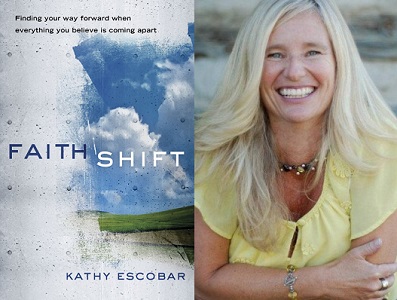
Oh man, oh man, do I love me some Kathy Escobar!Faith-Shift

I started reading Kathy’s blog a couple years ago, and I was hooked.  I don’t have too many blogs that I read EVERY.POST.THEY.EVER.POST.  But I wouldn’t miss anything from Kathy!  Her stuff is pure gold.

In late 2014, she published a book, “Faith Shift: Finding Your Way Forward When Everything You Believe is Coming Apart”.  I had it on my wish list for a long time, finally purchased it with birthday money in September, and FINALLY had a chance to read it a couple weeks ago.  I devoured it.

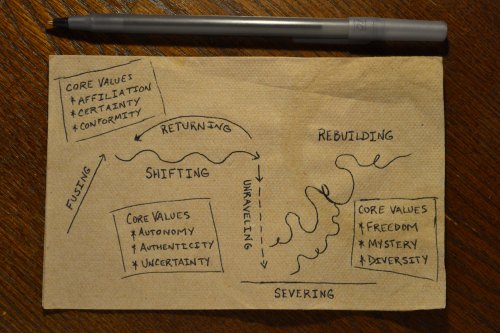
“Faith Shift” is a book of hope for “spiritual refugees, church burnouts, and freedom seekers.”  In it, Kathy maps out stages of a faith shift, giving language to the painful experience of fundamentally changing from a faith that is certain and features strong affiliation and conformity with your faith community, to a faith that is freer, more mysterious and diverse.

Kathy’s stages, Fusing-Shifting-Returning or Unraveling-Severing-Rebuilding, resonated deeply with my own experiences over the past several years, as well as my long-time love of stage theory and psychology.  In Evangelical Christianity, there is a skepticism with secular fields of psychology, sociology, etc.  There is a push towards Biblical Counseling rather than listening to liberal, humanistic psychobabble.  I made sure to read the two negative reviews of “Faith Shift” on Amazon to see what concerns others may have with this book, and they were primarily along those lines.

If I hadn’t been so focused on becoming a missionary or church musician when I went to college, I probably would have studied psychology.  In hindsight, I realize I hadn’t even considered other pathways to ministry because of the complementarian church culture that I was raised in.  Deep down, I wanted to do Kingdom work.  The only women I had seen doing Kingdom work (that was OK and celebrated in my tradition) were missionaries, musicians, and Women’s Bible Study authors and speakers.  Oh, and let’s not forget mothers, the hands that rock the cradles.

During my freshman year at Gordon College, I took Psych 101 as an elective and loved it.  A lot of my college education is a blur now, but I remember what I learned in that entry-level Psychology class.  So I made sure to take the Psychology elective offered when I was in seminary.  We read a book by James Fowler, “Stages of Faith: The Psychology of Human Development and the Quest for Meaning“.  This is one of my favorite books from my seminary education.  Fowler maps faith development in similar ways as Kathy, from assimilation and certainty to “the wall” to a more open, gracious, loving perspective on faith and others.  In a similar vein, I often send an article to friends by Rich Vincent, “Stages of Faith: A Map for the Spiritual Journey“, when I feel they are struggling and need some perspective that they are in process, that it will all turn out OK.  Shorter and easier to read than a book!

As much as I have appreciated Stage Theory and how Christian authors have related this theory to faith development, I could never personally relate to the middle stage, “the journey inward,” or “the wall,” the season of doubt.  My faith had been strong and sure most of my life.  My Fusing stage lasted about 28 years, I would say, and Affiliation, Certainty and Conformity describe those years beautifully.  There were bumps in the road, like when I was afraid that my faith would not mature if I continued to have a “perfect” life, so I prayed for hardship.  Soon one of my best friends died at age 21 and I felt responsible and walked through a deep depression.

Then some more bumps came.  Pretty traumatic ones.  My home church chewed my family up and spit us out (at least that’s what it felt like).  I was rejected by the people who were so much a part of my identity.  My “perfect” family was imploding. God called me (a complementarian!) to pastoral ministry.  I began reading about women in ministry and was warned about the “slippery slope” that I was on.  My affiliation, certainty and conformity were being compromised!

I was Shifting and I didn’t know it.  I wanted people to be real (Authentic), I was baffled to learn that my favorite theologians had said misogynistic, sexist things while I was beginning to see God’s vision for equality and partnership between the sexes, which led me to be uncomfortable with authority figures (Autonomy), and I felt like I needed to study EVERYTHING.FOR.MYSELF (Uncertainty), while again, being real about my struggles and weaknesses–no more projection of perfection.  I became an Ex-Good-Christian-Woman (my FAVORITE Kathy Escobar post!!!).

The way that Kathy writes is utterly gracious.  She never categorizes any part of a faith journey as bad, or better than, or wrong, or anything.  She just lays it out.

Are you experiencing this?  Here is some language to help you understand.
You are not going crazy and you are not alone.   

There was a profound change in the way that I saw God a few years ago while I was watching Brennan Manning preach on YouTube.  I wept as he poured out God’s love and grace in his message that God loves us just as we are, not as we should be.  I have always believed that God is love.  But I think Affiliation, Certainty and Conformity were chains that kept me from experiencing God as love.  There were always rules and expectations and pressures and systems that kept me in check, that made God’s love seem conditional.

Because God’s love is unconditional, I can ask questions without fear or guilt.  I utterly Severed from my Fused faith as I let Brennan Manning confer a God of grace and freedom to me.  I am Rebuilding my faith around this new understanding and am seeing things through this new lens.  I expect to make mistakes and to be a work in progress.  I am full of gratitude to God for being bigger than any box that I had ever put Him in, for loving me and pursuing me and holding me safe.

And I am thankful for Kathy Escobar’s writing and this book in particular, that has helped me to understand my faith development and trust that change is a natural part of being in relationship with God.  Kathy closes “Faith Shift” by saying,

Trust the path ahead, even though you aren’t sure exactly where it will take you.  You’re not lost.  In fact, you’re on a road toward a bigger, better relationship with God, others, and yourself that will continue to develop.

The world doesn’t need more fear-filled, insecure Jesus followers.  It needs more peace-filled, secure ones.  It doesn’t need more people deciding who’s in and who’s out on earth and in eternity.  It needs more men and women who are passionate about drawing everyone toward the love of God.

Throughout the years, I have seen over and over again how this path leads to new beginnings, not endings, if we just keep walking.

______________________________________________________

Thank you for visiting TBKW!  If you are interested in “Liking” us and learning more, we post articles on our Facebook page everyday, dealing with the good, the bad and the ugly news regarding women’s place in the world and Church.

The Courageous and Wise Naghmeh Abedini

Abedini_Statesman_Jones

“I have come that they may have life and that they may have it more abundantly.” – Jesus

Emotional abuse systematically degrades, diminishes, and can eventually destroy the personhood of the abused.  Most people describe emotional abuse as being far more painful and traumatic than physical abuse.  One only has to read reports of prisoners of war to begin to understand the traumatic effects of psychological warfare using emotionally abusive tactics–and this is when the behavior is perpetrated by one’s enemy.  When the abusive behavior is perpetrated by someone who promises to love and cherish you, it is even more devastating and destructive.

Leslie Vernick, “The Emotionally Destructive Marriage”

Naghmeh Abedini, wife of Saeed Abedini, campaigned vigorously for three and a half years for the release of her husband from an Iranian prison.  She has always displayed tremendous grace and a brave, beautiful spirit.  Saeed’s imprisonment was unjust, cruel and horrifying, and thousands were praying and advocating for him.  Iran finally released Saeed on January 16th and early this week he was back home in Idaho and has been reunited with his parents and children.

But not Naghmeh.

In November, Naghmeh wrote a personal email to prayer partners explaining that she would be halting her advocacy of Saeed on grounds of emotional and sexual abuse and his addiction to pornography.  Her confidential message was leaked to the press and suddenly their marriage has been put under the glare of public scrutiny.  I have been following this story all along and have seen support and love expressed to Naghmeh on her personal Facebook page, and also disgusting, cruel comments on articles from unsympathetic Christians who are disappointed that Saeed’s reputation has been tarnished.  Even ugly speculations that she has fabricated this story so that she could move on to another romantic relationship.

I am so proud of Naghmeh.

It is not easy for a victim of abuse to speak up.  I can only imagine that she has brought her abuse to the attention of others from time to time over the years only to receive minimal or no help.  She was not trying to “out” Saeed as an abuser.  She was desperate for relief from the emotional torture.

Sadly, much of Christendom continues to operate under the oppressive system of patriarchy.  Men are given privilege and women are subjugated and the conditions become ripe for abuse.  Yesterday, Wheaton College professor Michael Mangis said, “I have stated publicly and in my classes that white patriarchy reigns virtually unchallenged in cultural evangelicalism….Patriarchy has evolved to maintain and protect the illusion, for men, that we are entitled to be obeyed and served.”

In Rachel Held Evan’s post, “Is patriarchy really God’s dream for the world?”, she says,

If scripture is not enough to convince you that patriarchy is a result of sin, you need only look at the world to observe its effects.

  • Worldwide, women ages fifteen to forty-four are more likely to be maimed or die from male violence than from cancer, malaria, traffic accidents, and war combined.
  • Every 9 seconds, a woman  in the US is assaulted or beaten. Around the world, at least one in every three women has been beaten, coerced into sex or otherwise abused during her lifetime. I wish I could say that all complementarians categorically condemn female submission to male violence, but John Piper has said that, in order to model godly submission, a woman may need to quietly “endure verbal abuse for a season” or “getting smacked one night” before “seeking help from the church.” (He says nothing about contacting authorities). Similarly, in Created to Be His Help Meet, Debi Pearl advises a woman whose husband pulled a knife on her to “stop complaining” and focus instead on not “provoking” her husband’s anger. This is destructive advice and reveals something of an assumption that the preservation of male hierarchy is more important than preservation of a woman’s dignity.
  •  At least 3 million women and girls are enslaved in the sex trade.
  • Study after study shows that societies characterized by the subjugation of women are more violent, more impoverished, and more unjust than societies that empower women.  In their excellent book Half the Sky, Nicholas Kristof and Sheryl WuDunn argue that “in this century the paramount moral challenge will be the struggle for gender equality in the developing world.”  Empowering women increases economic productivity, reduces infant mortality, contributes to overall improved health and nutrition, and increases the chances of education for the next generation. Several studies from UNICEF suggest that when women are given control over the family spending, more of the money gets devoted to education, medical care, and small business endeavors than when men control the purse strings. Similarly, when women vote and hold political office, public spending on health increases and child mortality rate declines. Many counterterrorist strategists see women’s empowerment as key to quelling violence and oppression in the Middle East, and women entering the workforce in East Asia generated economic booms in Malaysia, Thailand, and China. (You can find all of these studies cited and analyzed in Half the Sky, which I highly recommend.)

There are women in your church who are victims of domestic violence.  If your church doesn’t talk about domestic violence, it is probably even more prevalent.  Is your church a safe place where victims are heard, violence is condemned, and brothers and sisters in Christ are encouraged to love and submit to each other mutually?  Would Naghmeh receive support or shame if Saeed’s abuse came to light in your faith community?

Are you being abused by your partner?  You are worthy of safety and sanity.  Please look to Naghmeh’s courage and follow her example of seeking the help that you need.  It is not on you to protect your abusive spouse from the consequences of his sin.  It is not on you to hold a marriage together that has already been broken by abuse.

Yesterday, Naghmeh released this statement that is both gracious and honest:

Dearest Friends,

Saeed landed in Boise yesterday and had a wonderful reunion with the children. They will be spending more and more time together in the coming days. I am so happy for this long waited reunion and for the joy that I see in my children and in Saeed. Nothing can make me happier than seeing those whom I love be happy and free from the pain that they had been under for the last 3.5 years.

I am so thankful for the thousands of people who have responded to my pleas… and helped work toward Saeed’s release. His imprisonment was unjust, and was an extremely difficult ordeal for him and all of us who sought for his release. I worked tirelessly night and day toward that end for three-and-a-half years. Nothing has made me happier than seeing Saeed freed from his chains and in American soil. Thank you for all of you who stood with us and made this happen.

Tragically, the opposite has occurred. Three months ago Saeed told me things he demanded I must do to promote him in the eyes of the public that I simply could not do any longer. He threatened that if I did not the results would be the end of our marriage and the resulting pain this would bring to our children.

I long more than anyone for reconciliation for our family and to be united as a family. Since Saeed’s freedom I have wanted nothing more than to run to him and welcome him home It is something I dreamed about the last 3.5 years. But unfortunately things did not work out that way and our family has to work through reconciliation. I want our reconciliation to be strictly based on God’s Word. I want us to go through counseling, which must first deal with the abuse. Then we can deal with the changes my husband and I must both make moving forward in the process of healing our marriage.

In very difficult situations sometimes you have to establish boundaries while you work toward healing. I have taken temporary legal action to make sure our children will stay in Idaho until this situation has been resolved. I love my husband, but as some might understand, there are times when love must stop enabling something that has become a growing cancer. We cannot go on the way it has been. I hope and pray our marriage can be healed. I believe in a God who freed Saeed from the worst prisons can hear our plea and bring spiritual freedom.

I love you all. God will see us through. Thank you for your prayers and support. We need them more than ever.

Love

Naghmeh

Please pray for Naghmeh as she walks this difficult path to healing and freedom.  Jesus came that we might have life and have it more abundantly (John 10:10).  As Saeed has broken free from the chains of an Iranian prison cell, may Naghmeh break free from the chains of emotional abuse and move forward into living an abundant life with Christ.

_____________________________________________________

If your marriage is emotionally destructive and you need “to establish boundaries as you work toward healing,” here are some resources:

Immediate Help:
National Domestic Violence Hotline: 1-800-799-7233.  Crisis help or to develop a safety plan.
Family Renewal Shelter: 1-253-475-9010 (24-hour crisis line) or 1-888-550-3915 (toll free).  A Christian resource for crisis help and assistance developing a safety plan.
American Association of Christian Counselors

Support Resources:
Document the Abuse: Assists women who fear for their safety in developing an Evidentiary Abuse Affidavit.
Women’s Law: Provides state-specific legal information and resources.
VINE (Victim Information and Notification Everyday): Allows crime victims to obtain timely and reliable information about criminal cases and the custody status of offenders.
Lighthouse Network: 1-877-562-2565.  Assists individuals and their loved ones in finding effective treatment for drug, alcohol, psychological or emotional struggles, 24/7.

Books:
The Emotionally Destructive Marriage: How to Find Your Voice and Reclaim Your Hope – Leslie Vernick
Why Does He Do That?  Inside the Minds of Angry and Controlling Men – Lundy Bancroft

Other:
The Emotionally Destructive Marriage:  Free resource page
Self Centered Spouse:  Series of blogs by Brad Hambrick
A Cry for Justice: A blog addressing the needs of the evangelical church to recognize and validate the reality of abuse in the Christian home.
______________________________________________________

Thank you for visiting TBKW!  Please “Like” our Facebook page if you are interested in reading more articles addressing gender issues in the church and world.

The Ragamuffin Gospel: Chapter 1 – Something is Radically Wrong

As I promised on our Facebook page, we will blog ragamuffin gospelalong with our small group discussions of Brennan Manning’s book, “The Ragamuffin Gospel,” Amazon’s number one best-seller under the category of Christian Discipleship.  Now is the perfect time to pick up a copy – it is on sale!  Last April, I blogged about listening to Brennan Manning’s sermons during Lent and how I was impacted by his message of God’s unconditional love.  You can read that post here.  Our group is meeting the first and third Fridays of the month, slowly discussing “The Ragamuffin Gospel” chapter by chapter.  So April 3rd we talked about chapter 1, “Something is Radically Wrong.”

This chapter in a nutshell is talking about American Christianity’s tendency to talk grace but walk works.  We preach a Gospel of grace – “the total sufficiency of the redeeming work of Jesus Christ on Calvary” (pg. 15) – but our lives tell a different story.  We have “twisted the gospel of grace into religious bondage and distorted the image of God into an eternal, small-minded bookkeeper” (pg. 16).  We are all striving, striving, striving for approval from God and from our faith communities, emphasizing personal effort over grace.  There are different classes of Christians, where some are given special status because of their works and charisma while others are ignored altogether for their ordinariness.  We hide our darker side from each other and live in a constant state of “existential guilt…[and] Sooner or later we are confronted with the painful truth of our inadequacy and insufficiency.  Our security is shattered and our bootstraps are cut” (pg. 17).

GUILTragamuffin guilt 1

This was the word that we danced around the most in our conversation, and I have been keenly aware of its presence in conversations with others over the past week.  Guilt is a huge issue for men and women alike, but from a woman’s perspective, I see how guilt has become a perpetual state of being for many of us.  Yet our feeling of guilt–that we are not doing enough as Christians, as parents, as spouses, as family members, as employees, as citizens of the world–is a blatant rejection of the gospel of grace.  The solution is to admit our “shadow side” and accept that there is nothing we can earn by works.  All is a gift.  We must find our identity in our acceptance and love from God and not in how we perform.  Manning expresses this beautifully in this quote from page 25:

When I get honest, I admit I am a bundle of paradoxes.  I believe and I doubt, I hope and get discouraged, I love and I hate, I feel bad about feeling good, I feel guilty about not feeling guilty.  I am trusting and suspicious.  I am honest and I still play games.  Aristotle said I am a rational animal; I say I am an angel with an incredible capacity for beer.

To live by grace means to acknowledge my whole life story, the light side and the dark.  In admitting my shadow side, I learn who I am and what God’s grace means.  As Thomas Merton put it, “A saint is not someone who is good but who experiences the goodness of God.”

The gospel of grace nullifies our adulation of televangelists, charismatic superstars, and local church heroes.  It obliterates the two-class citizenship theory operative in many American churches.  For grace proclaims the awesome truth that all is gift.  All that is good is ours, not by right, but by the sheer bounty of a gracious God.  While there is much we may have earned–our degree, our salary, our home and garden, a Miller Lite, and a good night’s sleep–all this is possible only because we have been given so much: life itself, eyes to see and hands to touch, a mind to shape ideas, and a heart to beat with love.  We have been given God in our souls and Christ in our flesh.  We have the power to believe where others deny, to hope where others despair, to love where others hurt.  This and so much more is sheer gift; it is not reward for our faithfulness, our generous disposition, or our heroic life of prayer.  Even our fidelity is a gift.  “If we but turn to God,” said St. Augustine, “that itself is a gift of God.”  My deepest awareness of myself is that I am deeply loved by Jesus Christ and I have done nothing to earn it or deserve it.

ragamuffin guilt 2

Let me leave this post with a few more quotes:

“Justification by grace through faith” is the theologian’s learned phrase for what Chesterton once called “the furious love of God.”  He is not moody or capricious; He knows no seasons of change.  He has a single relentless stance toward us: He loves us.  He is the only God man has ever heard of who loves sinners.  False gods–the gods of human manufacturing–despise sinners, but the Father of Jesus loves all, no matter what they do” (pg. 20).

The kingdom is not an exclusive, well-trimmed suburb with snobbish rules about who can live there.  No, it is for a larger, homelier, less self-conscious caste of people who understand they are sinners because they have experienced the yaw and pitch of moral struggle (pg. 23).

As a sinner who has been redeemed, I can acknowledge that I am often unloving, irritable, angry, and resentful with those closest to me.  When I go to church I can leave my white hat at home and admit I have failed.  God not only loves me as I am, but also knows me as I am.  Because of this I don’t need to apply spiritual cosmetics to make myself presentable to Him.  I can accept ownership of my poverty and powerlessness and neediness (pg. 23).

Never confuse your perception of yourself with the mystery that you really are accepted (pg. 28).

Often I have been asked, “Brennan, how is it possible that you became an alcoholic after you got saved?”  It is possible because I got battered and bruised by loneliness and failure; because I got discouraged, uncertain, guilt-ridden, and took my eyes off Jesus.  Because the Christ-encounter did not transfigure me into an angel.  Because  justification by grace through faith means I have been set in right relationship with God, not made the equivalent of a patient etherized on a table” (pgs. 30-31).