Tag Archives: equality

January Link-Up

Here are the best of the best articles dealing with gender issues within Christianity that we have shared on our Facebook page this month.  I had to narrow it down to the posts that we marked with either “Fantastic!” or “Excellent!”.  If you want more, check our FB feed.  Happy reading!  🙂

The Junia Project – “No Representation and No Invitation: To Be Asked the Question”

At the end of the day, we simply want this: to be asked the question.

Rather than ushering us off to the nursery before learning that we have absolutely zero knack with or passion for children, or assuming our appropriate role is on the coffee or hospitality team before realizing that we can’t even boil water; ask us the appropriate questions before stuffing us into a mold that quite frankly doesn’t fit.

The questions are simple:

“What are your God-given, Spirit-breathed gifts?”
“What makes you come alive?”
“How can your great gifts meet a great need within the body and broader community?”

And then, perhaps even more importantly:

“What can we do to equip you, as an image bearer, to fulfill your calling; to optimize your gifts for the sake of the Kingdom? “

You can join The Junia Project on Saturday, February 14th for a half-day conference to celebrate women in leadership!  Check it out here.

Christianity Today – “My First Sexuality Sermon”

So maybe it’s time for a woman’s take on sexuality from the pulpit. But what should that be? Is it my place to talk about pornography to the men in my congregation? I’m not sure I feel comfortable with that. Or maybe it’s time to add a woman’s perspective? There have been voices lately that have introduced the possibility that lust is not unique to men. And pornography is not only viewed by men. So is it my task to admit to my own desires in this Sex Sermon? Male preachers have received a lot of flak lately for calling their wives “hot.” The complaint was over the sexualization of their wives and the way it made other women in the congregation feel. If I stood before my congregation and called my husband “hot,” the problem might be a little different. Regardless of how a woman looks, for a woman to be sexually interested is for a woman to be sexually interesting. As a pastor, I work very hard to be publicly sexually uninteresting.

CBE International – “A Partner, Not a Patriarch:  10 Types of Men to Marry”

Seems like every few days, the Christian blogosphere produces a new article on the 5, 7, or 10 people Christians should avoid marrying. Some lists are great, but others are patriarchal beyond the point of absurdity. So my husband, Tim, and I made our own list.

If you’re a woman looking for a partner, not a patriarch, here are some men to look for…

1.       Nobody

Jesus wasn’t married. Why should you be? Single Christian women have been changing the world for millennia!  ….

Rachel Heston Davis – “Strachan’s views on male leadership: It’s all about the women!  No, really!”

So women flourish in this system because their husbands engage in self-sacrifice, bless them, treat them gently, and die to their own wishes to benefit them.

You know what? None of that sounds particularly bad. And it seems accurate when held up against Ephesians 5:28, which tells husbands to “love their wives just as they love their own bodies.” Sounds like a prioritization of women’s needs to me.

But if you could pick a word to sum all that up, what would it be? Servanthood? Caring? Sacrifice?

Yet the word complementarians always, always, always return to, is “leadership.” Strachan says that men who don’t understand this system aren’t “virtuous leader[s].” The blog and Twitter posts he referenced from Gavin Peacock define complementarianism as husband “leader”ship in no uncertain terms.

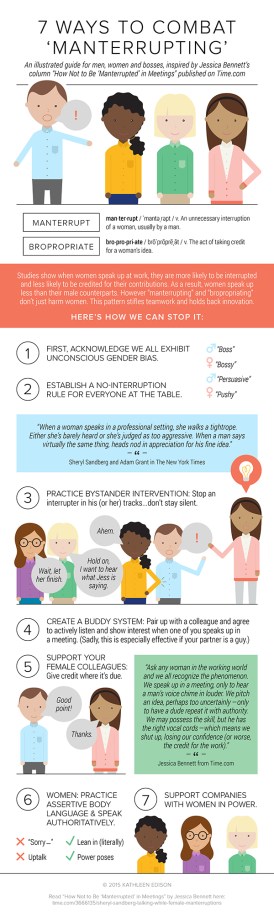
Behance – “7 Ways to Combat Manterrupting”

ff4bbd9d6494a7bcd22abf3740ca6e56

Fast Company – “How We Can Help Young Girls Stay Assertive”

Girls lose their voice for a variety of reasons—it’s mostly because of their self-esteem and is culture-based, says Martha Mendez-Baldwin, a psychologist who specializes in child and adolescent behavior, and an assistant professor of psychology at Manhattan College. Navigating the world between being children and women leave them unsure of how to act. When that uncertainty is met, combined with the pressure to fit in with peers and high expectations of parents, girls are often reluctant to assert themselves, she says.

In addition, girls receive tremendous pressure from society and media to adhere to a feminine role, says Linda Hoke-Sinex, a senior lecturer in the department of psychology and brain sciences at Indiana University in Bloomington, Indiana. The message is to be passive and nice—that it’s preferable to keep the peace than to speak up with an opinion that might be unpopular.

Nate Pyle – “Seeing a Woman: A conversation between a father and son”

There are two views regarding a woman’s dress code that you will be pressured to buy into. One view will say that women need to dress to get the attention of men. The other view will say women need to dress to protect men from themselves. Son, you are better than both of these. A woman, or any human being, should not have to dress to get your attention. You should give them the full attention they deserve simply because they are a fellow human being. On the other side, a woman should not have to feel like she needs to protect you from you. You need to be in control of you.

The Junia Project – “They Say the Church is Too Feminine”

Yes, this statement bothers me, because it shows how little we are actually evaluating the situation and because it is offensive, but most importantly it bothers me because  it is completely false.

The Barna Group has been studying Church trends over the last 20 years and they have found that women actually represent the biggest shift away from the Church. They also found that the gap between unchurched men and women is no longer a significant one. “It remains true that churchless people are somewhat more likely to be men than women, but the gap is not huge and has been steadily closing…the gap between men and women has plummeted from 20 points in 2003 to just 8 points currently.” And this is not just in protestant churches. Findings coming out of the Catholic Church do not look much different,according to the Association of Religion Data Archives.

All of this makes me want to ask those who claim that the Church is “too feminine” what churches they are going to. Are men really walking into churches and becoming overwhelmed with female presence? The idea that the church is “too feminine” goes against the majority of my experiences in church. In fact, as I visited churches on three continents over the last 6 years of my life, I have noticed that the majority of those churches presented the same experience to me, and it doesn’t come close to being feminine.

The Junia Project – “5 Reasons Not to Use Gender-Based Jokes in the Pulpit”

Don’t get me wrong, I understand the intention.

Humor is good. So is connecting with your audience by relating to real life experiences.

But there are ways to do that without using gender-based humor.

There are ways to do that that don’t deepen the gender brokenness, further entrench the stereotypes and, possibly, alienate people from the church and from a deeper walk with God.

In the end, we need to be creating meaningful venues where congregations can talk constructively about male/female relationships and partnerships. Maybe a place to start would be the content of this post. Agree? Disagree? Either way, it would be great to host a conversation in your church about it.

The bottom line is that until we figure out ways to take gender seriously in the church, the joke will be on us.

Christianity Today – “What Happens When We See Women Teach the Bible”

Sometimes I wonder how many women in the church have the gift of teaching, but will never use it, or even entertain the possibility of possessing it. When roughly 90 percent of evangelical pastors and 80 percent of evangelical seminarians are men, it can be hard for gifted women to find role models in the church. With such a void, do some women even consider the thought?

As a college student, I was confused about the direction of my call and the place of my gifts. At my church, women mostly occupied administrative positions. Even in my college parachurch organization, we rarely had a woman speak. Given the scarcity of female role models, I wasn’t sure where to turn.

However my life was forever changed when, in my early 20s, I attended the annual Passion conference, a popular worship and teaching gathering founded by pastor Louie Giglio. Beth Mooretook the stage, and though I was only vaguely familiar with her at the time, I won’t ever forget that moment. When she opened up her Bible, she taught the Word like I had never heard a woman teach it before. She spoke with power, competency, conviction, and most of all, anointing. I would never be the same again.

Chimamanda Ngozi Adichie on Feminism and The Danger of the Single Story

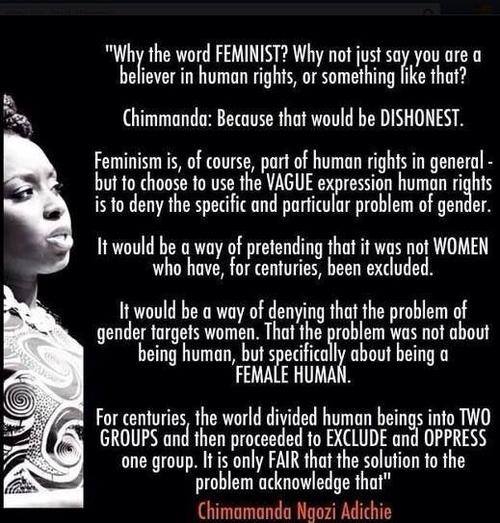
This quote from Chimamanda Ngozi Adichie is brilliant and powerful:

10614252_712472065496037_2212051519050840199_n

We have her talk, “We Should All Be Feminists” on our FAV Videos page.  If you haven’t seen it before, I highly recommend Chimamanda’s first amazing TED talk: The Danger of the Single Story:

Transcript:

0:11 I’m a storyteller. And I would like to tell you a few personal stories about what I like to call “the danger of the single story.” I grew up on a university campus in eastern Nigeria. My mother says that I started reading at the age of two, although I think four is probably close to the truth. So I was an early reader, and what I read were British and American children’s books.

0:38 I was also an early writer, and when I began to write, at about the age of seven, stories in pencil with crayon illustrations that my poor mother was obligated to read, I wrote exactly the kinds of stories I was reading: All my characters were white and blue-eyed, they played in the snow, they ate apples, and they talked a lot about the weather, how lovely it was that the sun had come out. (Laughter) Now, this despite the fact that I lived in Nigeria. I had never been outside Nigeria. We didn’t have snow, we ate mangoes, and we never talked about the weather, because there was no need to.

1:25 My characters also drank a lot of ginger beer because the characters in the British books I read drank ginger beer. Never mind that I had no idea what ginger beer was. (Laughter) And for many years afterwards, I would have a desperate desire to taste ginger beer. But that is another story.

1:43 What this demonstrates, I think, is how impressionable and vulnerable we are in the face of a story, particularly as children. Because all I had read were books in which characters were foreign, I had become convinced that books by their very nature had to have foreigners in them and had to be about things with which I could not personally identify. Things changed when I discovered African books. There weren’t many of them available, and they weren’t quite as easy to find as the foreign books.

2:14 But because of writers like Chinua Achebe and Camara Laye I went through a mental shift in my perception of literature. I realized that people like me, girls with skin the color of chocolate, whose kinky hair could not form ponytails, could also exist in literature. I started to write about things I recognized.

2:35 Now, I loved those American and British books I read. They stirred my imagination. They opened up new worlds for me. But the unintended consequence was that I did not know that people like me could exist in literature. So what the discovery of African writers did for me was this: It saved me from having a single story of what books are.

2:58 I come from a conventional, middle-class Nigerian family. My father was a professor. My mother was an administrator. And so we had, as was the norm, live-in domestic help, who would often come from nearby rural villages. So the year I turned eight we got a new house boy. His name was Fide. The only thing my mother told us about him was that his family was very poor. My mother sent yams and rice, and our old clothes, to his family. And when I didn’t finish my dinner my mother would say, “Finish your food! Don’t you know? People like Fide’s family have nothing.” So I felt enormous pity for Fide’s family.

3:42 Then one Saturday we went to his village to visit, and his mother showed us a beautifully patterned basket made of dyed raffia that his brother had made. I was startled. It had not occurred to me that anybody in his family could actually make something. All I had heard about them was how poor they were, so that it had become impossible for me to see them as anything else but poor. Their poverty was my single story of them.

4:12 Years later, I thought about this when I left Nigeria to go to university in the United States. I was 19. My American roommate was shocked by me. She asked where I had learned to speak English so well, and was confused when I said that Nigeria happened to have English as its official language. She asked if she could listen to what she called my “tribal music,” and was consequently very disappointed when I produced my tape of Mariah Carey. (Laughter) She assumed that I did not know how to use a stove.

4:49 What struck me was this: She had felt sorry for me even before she saw me. Her default position toward me, as an African, was a kind of patronizing, well-meaning pity. My roommate had a single story of Africa: a single story of catastrophe. In this single story there was no possibility of Africans being similar to her in any way, no possibility of feelings more complex than pity, no possibility of a connection as human equals.

5:20 I must say that before I went to the U.S. I didn’t consciously identify as African. But in the U.S. whenever Africa came up people turned to me. Never mind that I knew nothing about places like Namibia. But I did come to embrace this new identity, and in many ways I think of myself now as African. Although I still get quite irritable when Africa is referred to as a country, the most recent example being my otherwise wonderful flight from Lagos two days ago, in which there was an announcement on the Virgin flight about the charity work in “India, Africa and other countries.” (Laughter)

5:55 So after I had spent some years in the U.S. as an African, I began to understand my roommate’s response to me. If I had not grown up in Nigeria, and if all I knew about Africa were from popular images, I too would think that Africa was a place of beautiful landscapes, beautiful animals, and incomprehensible people, fighting senseless wars, dying of poverty and AIDS, unable to speak for themselves and waiting to be saved by a kind, white foreigner. I would see Africans in the same way that I, as a child, had seen Fide’s family.

6:34 This single story of Africa ultimately comes, I think, from Western literature. Now, here is a quote from the writing of a London merchant called John Locke, who sailed to west Africa in 1561 and kept a fascinating account of his voyage. After referring to the black Africans as “beasts who have no houses,” he writes, “They are also people without heads, having their mouth and eyes in their breasts.”

7:04 Now, I’ve laughed every time I’ve read this. And one must admire the imagination of John Locke. But what is important about his writing is that it represents the beginning of a tradition of telling African stories in the West: A tradition of Sub-Saharan Africa as a place of negatives, of difference, of darkness, of people who, in the words of the wonderful poet Rudyard Kipling, are “half devil, half child.”

7:31 And so I began to realize that my American roommate must have throughout her life seen and heard different versions of this single story, as had a professor, who once told me that my novel was not “authentically African.” Now, I was quite willing to contend that there were a number of things wrong with the novel, that it had failed in a number of places, but I had not quite imagined that it had failed at achieving something called African authenticity. In fact I did not know what African authenticity was. The professor told me that my characters were too much like him, an educated and middle-class man. My characters drove cars. They were not starving. Therefore they were not authentically African.

8:20 But I must quickly add that I too am just as guilty in the question of the single story. A few years ago, I visited Mexico from the U.S. The political climate in the U.S. at the time was tense, and there were debates going on about immigration. And, as often happens in America, immigration became synonymous with Mexicans. There were endless stories of Mexicans as people who were fleecing the healthcare system, sneaking across the border, being arrested at the border, that sort of thing.

8:53 I remember walking around on my first day in Guadalajara, watching the people going to work, rolling up tortillas in the marketplace, smoking, laughing. I remember first feeling slight surprise. And then I was overwhelmed with shame. I realized that I had been so immersed in the media coverage of Mexicans that they had become one thing in my mind, the abject immigrant. I had bought into the single story of Mexicans and I could not have been more ashamed of myself. So that is how to create a single story, show a people as one thing, as only one thing, over and over again, and that is what they become.

9:37 It is impossible to talk about the single story without talking about power. There is a word, an Igbo word, that I think about whenever I think about the power structures of the world, and it is “nkali.” It’s a noun that loosely translates to “to be greater than another.” Like our economic and political worlds, stories too are defined by the principle of nkali: How they are told, who tells them, when they’re told, how many stories are told, are really dependent on power.

10:11 Power is the ability not just to tell the story of another person, but to make it the definitive story of that person. The Palestinian poet Mourid Barghouti writes that if you want to dispossess a people, the simplest way to do it is to tell their story and to start with, “secondly.” Start the story with the arrows of the Native Americans, and not with the arrival of the British, and you have an entirely different story. Start the story with the failure of the African state, and not with the colonial creation of the African state, and you have an entirely different story.

10:51 I recently spoke at a university where a student told me that it was such a shame that Nigerian men were physical abusers like the father character in my novel. I told him that I had just read a novel called American Psycho — (Laughter) — and that it was such a shame that young Americans were serial murderers. (Laughter) (Applause) Now, obviously I said this in a fit of mild irritation. (Laughter)

11:29 But it would never have occurred to me to think that just because I had read a novel in which a character was a serial killer that he was somehow representative of all Americans. This is not because I am a better person than that student, but because of America’s cultural and economic power, I had many stories of America. I had read Tyler and Updike and Steinbeck and Gaitskill. I did not have a single story of America.

11:54 When I learned, some years ago, that writers were expected to have had really unhappy childhoods to be successful, I began to think about how I could invent horrible things my parents had done to me. (Laughter) But the truth is that I had a very happy childhood, full of laughter and love, in a very close-knit family.

12:16 But I also had grandfathers who died in refugee camps. My cousin Polle died because he could not get adequate healthcare. One of my closest friends, Okoloma, died in a plane crash because our fire trucks did not have water. I grew up under repressive military governments that devalued education, so that sometimes my parents were not paid their salaries. And so, as a child, I saw jam disappear from the breakfast table, then margarine disappeared, then bread became too expensive, then milk became rationed. And most of all, a kind of normalized political fear invaded our lives.

12:57 All of these stories make me who I am. But to insist on only these negative stories is to flatten my experience and to overlook the many other stories that formed me. The single story creates stereotypes, and the problem with stereotypes is not that they are untrue, but that they are incomplete. They make one story become the only story.

13:24 Of course, Africa is a continent full of catastrophes: There are immense ones, such as the horrific rapes in Congo and depressing ones, such as the fact that 5,000 people apply for one job vacancy in Nigeria. But there are other stories that are not about catastrophe, and it is very important, it is just as important, to talk about them.

13:44 I’ve always felt that it is impossible to engage properly with a place or a person without engaging with all of the stories of that place and that person. The consequence of the single story is this: It robs people of dignity. It makes our recognition of our equal humanity difficult. It emphasizes how we are different rather than how we are similar.

14:08 So what if before my Mexican trip I had followed the immigration debate from both sides, the U.S. and the Mexican? What if my mother had told us that Fide’s family was poor and hardworking? What if we had an African television network that broadcast diverse African stories all over the world? What the Nigerian writer Chinua Achebe calls “a balance of stories.”

14:33 What if my roommate knew about my Nigerian publisher, Mukta Bakaray, a remarkable man who left his job in a bank to follow his dream and start a publishing house? Now, the conventional wisdom was that Nigerians don’t read literature. He disagreed. He felt that people who could read, would read, if you made literature affordable and available to them.

14:55 Shortly after he published my first novel I went to a TV station in Lagos to do an interview, and a woman who worked there as a messenger came up to me and said, “I really liked your novel. I didn’t like the ending. Now you must write a sequel, and this is what will happen …” (Laughter) And she went on to tell me what to write in the sequel. I was not only charmed, I was very moved. Here was a woman, part of the ordinary masses of Nigerians, who were not supposed to be readers. She had not only read the book, but she had taken ownership of it and felt justified in telling me what to write in the sequel.

15:32 Now, what if my roommate knew about my friend Fumi Onda, a fearless woman who hosts a TV show in Lagos, and is determined to tell the stories that we prefer to forget? What if my roommate knew about the heart procedure that was performed in the Lagos hospital last week? What if my roommate knew about contemporary Nigerian music, talented people singing in English and Pidgin, and Igbo and Yoruba and Ijo, mixing influences from Jay-Z to Fela to Bob Marley to their grandfathers. What if my roommate knew about the female lawyer who recently went to court in Nigeria to challenge a ridiculous law that required women to get their husband’s consent before renewing their passports? What if my roommate knew about Nollywood, full of innovative people making films despite great technical odds, films so popular that they really are the best example of Nigerians consuming what they produce? What if my roommate knew about my wonderfully ambitious hair braider, who has just started her own business selling hair extensions? Or about the millions of other Nigerians who start businesses and sometimes fail, but continue to nurse ambition?

16:46 Every time I am home I am confronted with the usual sources of irritation for most Nigerians: our failed infrastructure, our failed government, but also by the incredible resilience of people who thrive despite the government, rather than because of it. I teach writing workshops in Lagos every summer, and it is amazing to me how many people apply, how many people are eager to write, to tell stories.

17:13 My Nigerian publisher and I have just started a non-profit called Farafina Trust, and we have big dreams of building libraries and refurbishing libraries that already exist and providing books for state schools that don’t have anything in their libraries, and also of organizing lots and lots of workshops, in reading and writing, for all the people who are eager to tell our many stories. Stories matter. Many stories matter. Stories have been used to dispossess and to malign, but stories can also be used to empower and to humanize. Stories can break the dignity of a people, but stories can also repair that broken dignity.

17:55 The American writer Alice Walker wrote this about her Southern relatives who had moved to the North. She introduced them to a book about the Southern life that they had left behind: “They sat around, reading the book themselves, listening to me read the book, and a kind of paradise was regained.” I would like to end with this thought: That when we reject the single story, when we realize that there is never a single story about any place, we regain a kind of paradise. Thank you. (Applause)

Raising Homemakers or Clipping Wings?

I joined the CBE – Christians for Biblical Equality group on Facebook and have gotten into the habit of checking in every day to see the interesting posts members share.  A couple days ago, one man, Erik, shared an article that had brought his wife to tears of shame and guilt that morning:

You’ve Trained Her in the “How” of Homemaking, Have You Trained Her for the “Why?” by Jennifer at Raising Homemakers.  This is a blog about clipping your daughters wings – training her to see her role in life as a subordinate to her husband whose sole work consists of cooking for and cleaning up after others.

Here are some highlights lowlights:

“If your husband were to come home, unexpectedly, right now… what would he find? A cared for home and family, or chaos and disorganization?”

Here was one excellent comment:  “... If you were at a paid job and weren’t doing the work that’s expected of you then your employer would be unhappy. So, depending on what you and your husband expect from your role at home, are you upholding your end?”

Exactly. Our husbands are gone all day, working for us and the children, sometimes doing work they don’t particularly enjoy, in conditions they may not find pleasant.   On the other hand, we are in the sanctuary of our homes, typically spending our time as we see fit.

Another reader wrote to me privately: “Am I doing my part? Sometimes yes, most times no.  Truly makes you take a step back and say if I was working at a real job, would I still be employed?” 

We must train our daughters that keeping their homes clean and orderly, working heartily as unto the LORD (Col. 3:23) is their reasonable service (Romans 12:1) and is necessary, that the Word of God be not blasphemed (Titus 2:5).


Although the intent of the author is clearly to encourage wives to put their best foot forward when it comes to caring for their home and husbands and “training” their daughters, the effect is quite the opposite.  Like Erik’s wife, most of us women feel the weight of impossible standards bearing down on us.  We can never do enough or be enough.  We feel judgment when our house is not perfectly tidy and our children are not perfectly behaved and our appearance isn’t perfectly put-together.  We also feel like we are losing ourselves when we don’t have any space in our lives to spend our time “as we see fit,” but are always tied to the responsibility of assisting and caring for others.  And on top of that, if we are not completely happy while trying to meet these impossible standards, we again feel like we’ve failed.

There are women who are naturally inclined to order and homemaking who could read this post and nod in agreement, without sensing the undercurrent of sexism and shaming.  But the truth is, we women come in a wide variety of personalities and giftings, and our value and worth does not come from where we land on that spectrum.  It comes directly from our Father, who imprinted us with His image so that we can display His glory as creative, life-giving people (whether that is in creating meals, sermons or spreadsheets…whatever our work may be).

crafty people maker

What I think the author gets wrong about homemaking, is that God does not command all women to be June Cleaver.  In fact, He doesn’t command any women to be June Cleaver.  God does not tell women that they are solely responsible for the laundry and meals.  The other side of that coin is that God does not tell men that they are off-the-hook when it comes to helping out with the household upkeep.  God tells both men and women to steward creation, but He leaves it up to each couple to decide how they are going to accomplish that in their own home and family.

Additionally, the author seems to be completely blind to her privileged position as a full-time homemaker.  Most families cannot survive on one income in today’s economy.  Yet the author makes it seem that the only way for a wife to be living in God’s will is to be keeping a clean and orderly home.

I would also object to the image of the husband as the disgruntled boss who inspects the home upon his arrival at the end of the day to see if you are holding up “your end”, as though marriage is merely an exchange of goods.  Excuse me for choosing to see my husband as my friend and partner in life – and as my co-warrior in ushering in God’s kingdom in our family and neighborhood.  At the end of the day, if work and child-care took precedence over the dirty dishes, there is nothing I appreciate more than family clean-up time.  What would take me two hours on my own can take half an hour when Logan and the kids are all helping me.  We are a team and we understand that we all need each other to pitch in and serve together.  In this way, we are also training our sons to take responsibility for their own messes and to appreciate that putting all of the homemaking responsibility on one person robs that person of pursuing what makes them truly human.  By dividing the work evenly, we all have at least a little bit of time each day to spend “as we see fit.”

It is imperative that we allow our daughters to be fully human – i.e. to dream and explore and discover; to follow their aspirations and giftings and to follow God’s prompting, even if that leads them into the workforce.  We must teach them to find their identity in God, not in their home or husband or career or any other category.  When we understand ourselves only in those categories and not in the light of God, we will lose sight of who we truly are.  Let us train allow our daughters to fly.


That’s my two-cents.  Here are some of my favorite comments in response to this post from the CBE Facebook community:

Deborah: Ok, maybe I’m jaded.  I work AND keep my home clean and orderly.  I really don’t see a reason to continue enabling bad habits in men of not being capable of both.  I teach my son how to keep his room clean, fold his clothes, and when he’s old enough, how to cook his own meals, babysit, and do his own laundry.  Because not doing that is to severely handicap him.  If he wants a maid, he can hire one, but I will make darn tootin’ sure he doesn’t think he’s going to marry one.

Joy:  The “real job” bit is offensive.  While supposedly elevating homemaking, she actually degrades it.

Beata:  “Our husbands are gone all day, working for us and the children…” – nowadays many women work outside the home too.  Why only women should clean, cook, etc.?

Bethany:  Another reader pointed out that this woman fails to recognize that it is often physically, mentally, and psychologically easier to go to work, with less demands, less headaches, less need to train your co-workers to be competent, and more immediate, measurable rewards (e.g. paychecks, health insurance, breaks, etc.).  The author responded by telling this woman to stop “making excuses” and get to work, because “God commands it” so it doesn’t matter if it’s not easy.  She tried to phrase it slightly more politely than that, but that was the essence of her response.  I was appalled.  Homemaking is valuable and, to a certain degree, necessary.  But it is not easy, and it is not always rewarding or lovable (very often, it’s the complete opposite).  To ignore this fact is disingenuous, especially from those who are attempting to elevate homemaking as a woman’s “highest calling” (barf).

Brian: Is there anything particularly wrong with a woman that wants to stay home and take care of the house and kids?

Bethany: No, not at all.  But to say it’s her only option and that God commands her to always have a clean house is false, and it makes a lot of women feel not only as if they’re failing at being mothers/wives/homemakers, but that they are failing at being Christians too.

Erik:  It is the pressure created by unrealistic expectations that is harmful.

Deb: Gak!  I guess single women have no worth, because there’s no one to clean up after.

Faith:  We taught both our daughters and sons to cook and do laundry…they taught their friends in college and tech school…Such skills are helpful to everyone.  We view the house as everyone’s responsibility.  We are each supposed to pick up after ourselves, wash dishes, cook, etc…Sometimes we do divide chores traditionally…but it is our choice to do it, not a Biblical mandate.

Faith:  What about training our daughters to be Kingdom people…seeking first the kingdom of God…taking the gospel to the ends of the earth, healing the sick, raising the daed…feeding the hungry and ministering to the widows, the orphans and strangers…caring for children and family is important…but so is the kingdom of God.

Mabel: southern Baptist seminary has homemaking classes for the women and theology classes for the men.

Ronda:  I am so sad to hear this about Southern but not surprised.  I am an alum but graduated when women at Southern could be theologians, apologists, pastors, evantelists, ethicists, counselors, etc.

Mabel: This article is NOT about if anyone wants to be a housewife, it is about telling ALL wives that’s what they should do and the reasons why.  It says we “MUST” train our “DAUGHTERS” as if sons don’t need to learn to keep a clean house.  It is all the women’s “role.”  She aslo accuses women of not doing their part, her answer to a reader’s question “am I doing my part” is “Sometimes yes, most times no.”  She shames women and accuses them of not doing their part “MOST TIMES.”

Billie: Do we want our sons to get married just to have someone to cook and clean for him?  That would be raising a very shallow child.

Bronwen: I’m a bit saddened by the implication that the only useful way to spend time with our kids is to “teach and train” them. Yep, that’s PART of a parent’s job…As a chaplain in a government school (in Australia) and as someone who has worked a lot with kids in churches, one of the things I hear most from kids is that they wish that a parent spent more time with them and listened to them.

Julie: My DH is from America.  Sometimes we have mused between ourselves, is the USA so devoted to slavery that, having lost black slavery, they must now create a new slave class to do all their cooking, cleaning and thankless chores for them?  It sure looks like male headship is less about exegesis and more about preserving male privilege and entitlement, no matter what.  Who knew that servitude could be spun to look so shiny, glossy and “godly?”

Joy:  Has perfect housekeeping become a bit of an idol?  I remember Martha and Mary had some tension over this.


Check out this great post from “Recovering from Biblical Manhood and Womanhood”: God is Not Your Boss

Thanks for visiting The Beautiful Kingdom Warriors!  Please “Like” our Facebook page!