Tag Archives: equality

God’s Vision for His Daughters

The following is a talk/sermon I gave in February at a ladies luncheon and in a service at our church.


I used to think that teenagers were the only ones who struggle with identity issues, as they are expected to be “finding themselves,” questioning authority, pushing boundaries, etc,  but I’ve discovered that the search for identity can continue beyond adolescence, and even be a lifelong journey.

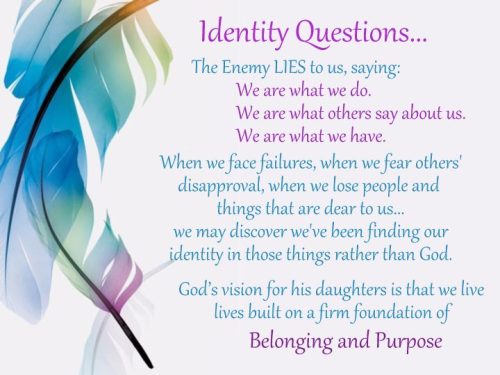
The reason we struggle so much with our identity is that the Enemy seeks to steal, kill and destroy us, constantly using lies that tell us to find our identity:

We are what we do.
We are what others say about us.
We are what we have.

As long as we are experiencing success and people are saying good things about us, or we are living comfortably and enjoying good relationships, we can feel OK.  But when we face failures, when others disapprove of us, when we lose people and things that are dear to us, then we may experience an identity crisis.  We may discover that we’ve been finding our identity in what we do, or in what others say about us, or in what we have.
001

We can be laid flat when an identity crisis comes, and may feel like the fool who built his house on sand instead of a firm foundation.  Or it can feel like we are standing face-to-face with a wall that doesn’t want to budge, and we have to push through by sheer will or just give up and walk away.  And that’s what many people do – they drift away from the Church or their faith when they lose their footing in one of these crises.

When I was in high school, one of my best friends became a Christian and I went through a Bible study with her about core doctrines of our faith. And then we went off to different colleges and she messaged me that she was doubting her faith.  I had no frame of reference for doubt, I had never had a single doubt in my 19 years of Christianity at that point.  So I had no idea how to meet her where she was.  She was having an identity crisis.  A couple years later, she died tragically, and I found myself having an identity crisis.  I was angry at myself for “letting” her drift from God.  I was angry at God for letting her die before I “fixed” her.  I didn’t walk away from my faith, but instead this was a catalyst for spiritual growth for me.  I learned that God was a loving Shepherd who pursues his lost sheep.  He didn’t need me to save my friend, so I lost my Savior complex.

This is what an identity crisis can do – it can be a time of spiritual growth as God chips a lie from the Enemy off our identity.  These crises are a natural and necessary part of our spiritual development as we mature and are sanctified more and more to be like Jesus.

God laid out a vision for his sons and daughters, so that we could live by the firm foundation of the identity that he intended for us.  Living in a fallen world, that vision is obscured by the lies of the Enemy.  But it is right here in Genesis chapter one and two.

002

One of the first aspects of our identity is that we bear the image of God. That means we are representatives of the character of God on earth.  We are the eyes and ears, hands and feet, and the voice of God.  As such, every voice matters in the church.  Every one of us has a unique aspect of his character to share with the church.
003

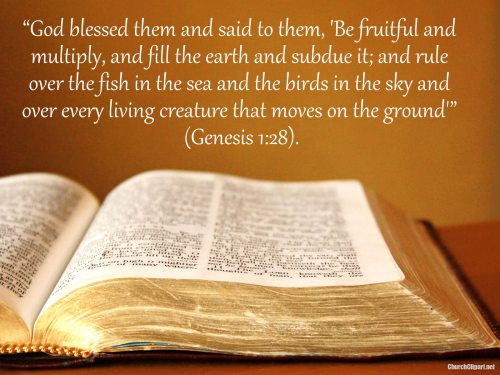
Before Jesus ascended into Heaven, he left his disciples with a Great Commission, to “go and make disciples of all nations, baptizing them in the name of the Father and of the Son and of the Holy Spirit, and teaching them to obey everything I have commanded you” (Matthew 28:18-20).  Here in Genesis, God lays out the first Great Commission – our mission to manifest God’s kingdom here on earth.
004

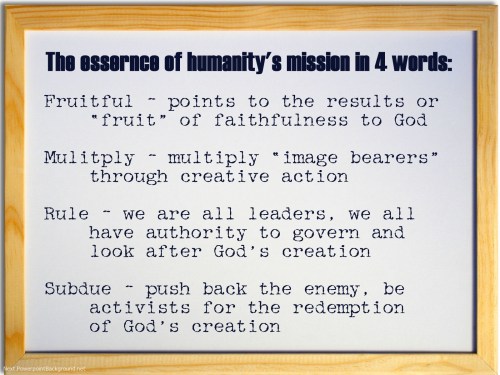
The essence of God’s mission for human beings can be boiled down to four words:

Fruitful – Jewish scholars decided that in order to fulfill this command, men and women should marry and have at least two children.  By this standard, Jesus failed, because he never married or had any children.  And if you divided the worlds’ population by married and unmarried, you’d discover that half are unmarried, and one in four couples struggle with infertility.  As we see in the perfect life of unmarried and fatherless Jesus, who demonstrated perfect image bearing for us, this command is not only about procreation, but goes along with the biblical theme of the “fruit” that comes from being a faithful witness.  A faithful life bears good fruit.  And Jesus never faltered, even when tempted by Satan to believe the same lies he tries to tempt us with.  Jesus always drew near to His Father and prayed for His Father’s will to be done.

Multiply – We multiply image bearers through creative action, as representatives of the character of our Creator God.  We must allow our imaginations to draw us into doing unlikely and beautiful ministry for God.  The Night to Shine is a great example of creative action that puts God’s loving character on display for the world to see and multiplies image bearers in the process.  In Jesus, the perfect Image Bearer, we see creativity on every page of the Gospels.  His stories and parables drew crowds.  His miracles never ceased to surprise.

Rule – God has given us authority over all Creation.  Again, this is a mission for both men and women, boys and girls to fulfill.  We are God’s eyes and ears, his hands and feet, and his voice in this world.  It is a position of authority to represent God.  Every one of us is a born leader in God’s kingdom.  That manifests through our different gifts, talents, and callings – and it looks like servanthood and humility, as our perfect image bearer Jesus demonstrated.  But we need to root our identity in that fact.  We are kings and queens!

Subdue – This is about pushing back against the lies and destruction of the Enemy to God’s good creation; to be activists for the redemption of his creation.  Jesus was not passive when he saw people hurting – he was moved by visceral compassion and then he acted to heal, to feed, to teach.  As God’s representatives, we too need to be moved to ACT.  We need to “Let our hearts be broken by the things that break the heart of God” ( as Bob Pierce said, the founder of World Vision and Samaritans Purse).  If we begin to imitate Jesus, the perfect Image Bearer, in small ways each day, our capacity to be fruitful, to multiply, to rule and to subdue will grow.

Not a small task!  This is the mission for all image bearers – male and female, young and old – to be fruitful, multiply, rule and subdue.  God knit each of you together while you were in your mother’s womb, giving you everything you need to accomplish the good works he planned for you to do (Ephesians 2:10)!  Often times we can get too comfortable and busy here in America, and are content to worship God, to spend time with God each day, to lead a “good” life, and we may miss that God has a MISSION for us to do!

That was the chapter one creation account.  The focus there was vertical, about the relationship between human beings and their Creator.  In chapter two, we see a horizontal focus, on how males and females relate to each other and function together as partners.
005

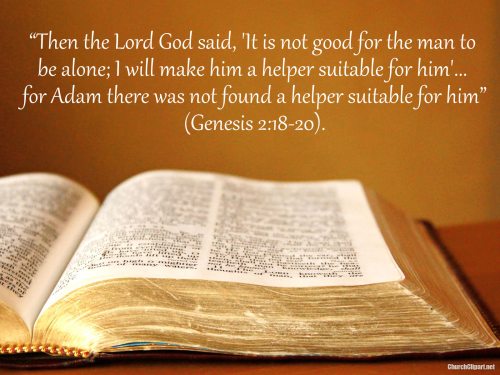
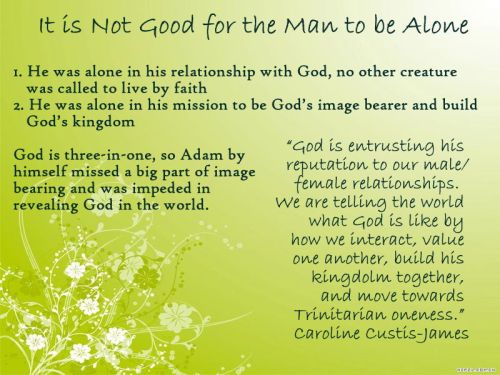
Not good for man to be alone –

  1. He was alone in his relationship with God, no other creation called to live by faith
  2. He was alone in his mission to be God’s image bearer and to build God’s kingdom

God is Trinitarian, three-in-one, so Adam’s aloneness meant he missed a big part of image bearing and was impeded in revealing God in the world.

“God is entrusting his reputation to our male/female relationships.  We are telling the world what God is like by how we interact, value one another, build his kingdom together, and move towards Trinitarian oneness” (Carolyn Custis-James).
006

If God is entrusting his reputation to our male/female relationships, we need to unpack what it means for women to be “suitable helpers.”

And here, I’m going to remind you that the Enemy attacks our identity with lies.  Lies that make us feel less-than, unworthy.  The Enemy tells us we “should” find our worth in our accomplishments, appearance, education, femininity or masculinity, occupation, race, spirituality, wealth, etc.  He lies to us, telling us we are what we do, we are what others say about us, we are what we have.

007

And these lies get ingrained in our psyches through SOCIALIZATION.

We live in a Fallen world, where the Enemy prowls around looking to steal, kill and destroy.  And he’s been very effective, even in spreading lies even in the church.

We are socialized to believe certain lies about our identities through three processes:

  1. Modeling (how we observe others behaving)
  2. Overt Instruction (how we were instructed to behave)
  3. Reinforcement (positive or negative responses to our behavior)

Then, our socialization results in cognitive lenses, like bifocals or rose-colored lenses, that impact the way we understand the world and ourselves.  The Apostle Paul says that now we see as through glass, in heaven we will see face to face.

Socialization is POWERFUL.  Through our cognitive lenses, we learn to associate or assign meaning to words in a process that happens nearly instantly, in one-seventh-of-a-millionth second.

I want to do an exercise with you.  I’ll say a few words, and I want you to pay attention to your immediate association.  CHURCH; WORSHIP; LEADER; WOMAN

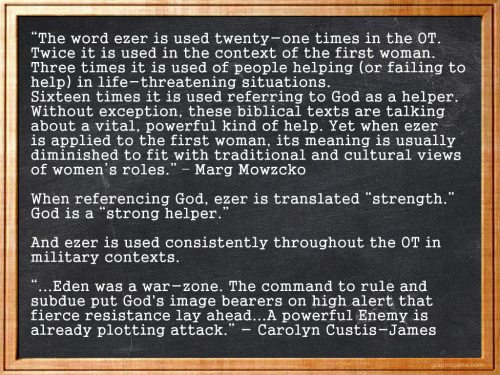
You may have thought “helper,” because every Bible translation you’ve ever read of Genesis 2:18 and 20 render the Greek word ezer there as “helper.”  The Holy Spirit inspired the word ezer to be used here to describe God’s daughters, so we want to understand it properly.  And sometimes, our modern English just doesn’t convey the same meaning as the original Hebrew.  This word ezer is a pretty striking example of this.
008

“The word ezer is used twenty-one times in the Old Testament. Twice it is used in the context of the first woman. Three times it is used of people helping (or failing to help) in life-threatening situations. Sixteen times it is used in reference to God as a helper.  Without exception, these biblical texts are talking about a vital, powerful kind of help. Yet when ezer is applied to the first woman, its meaning is usually diminished to fit with traditional and cultural views of women’s roles.” – Marg Mowzcko

Every instance where ezer occurs, it is in the context of warfare.  And the Garden of Eden is no exception.  God intends for his daughters to be a “strong help” in the war against the Enemy and in building his Kingdom!

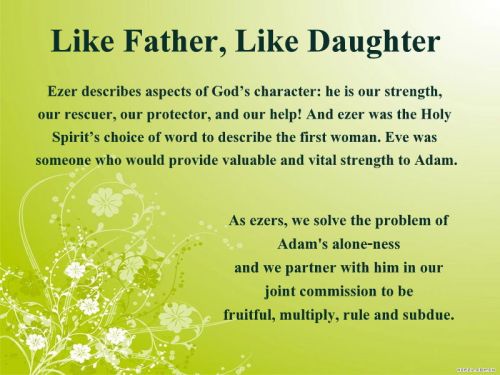
Similarly, the Hebrew word kenegdo that is translated “suitable” or “meet” actually means “corresponding to, signifying equality.  God has not created a subordinate assistant for Adam but rather, a strong equal.  Men and women are neither inferior nor superior to each other. Both bear the image of God, both share the mission of human authority over creation.
009

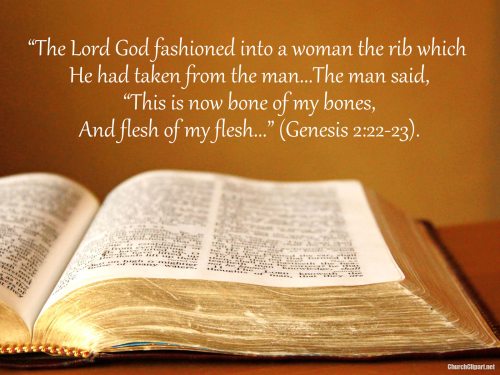
Our final passage doubles down on the equality of male and female:
010

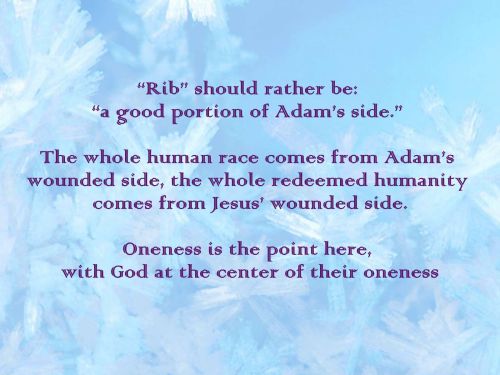
Like the translation of ezer, the word translated “Rib” here doesn’t actually refer to a bone, but means “good portion of Adam’s side.”  Some theologians have argued a strong case for this meaning that the first human was divided in two.

Oneness is the point here, with God at the center of their oneness.
011

So as we see in these Creation stories, our true identity is as image bearers, here in Appomattox to represent God’s character and mission.  As his representatives, we are at the center of what God is doing in Appomattox—not as spectators but as kingdom agents and as leaders responsible for what is going on around us.  We are God’s eyes and ears, his hands and feet, and his voice in the world.  We are ezer warriors, and as his representatives, we need to see the world through his eyes, love what he loves, grieve what he hates, and join his cause.

He gave us Jesus as the example of a perfect image bearer, showing us exactly how we are to be fruitful, multiply, rule and subdue.  Everywhere he went, Jesus was the embodiment of love, mercy and justice. We too must embody the gospel in our relationships and work.  And I believe this little army here today can be a catalyst for revival in Appomattox!

012


Thanks for visiting TBKW!  “Like” us on Facebook where we post articles from around the web everyday, dealing with gender issues in the Church and world!

I was reading Carolyn Custis-James’ book, “Half the Church” when I prepared this talk, and her influence is all over it.  I would highly recommend you read her book!

Best of Summer Link-Up

We have a lot of catching up to do, Beautiful Kingdom Warriors!  Once again, it has been a busy summer here in Vacationland.  Thank you for being patient and sticking with Becky and me even when our lives are overflowing with non-blog-related activity.  Every day, we post great links on our Facebook page, and I have just scrolled through to share my favorites here from July and August.  But first, feast your eyes on the scenery around my home in Maine.  Then you’ll understand why it’s such a popular destination!

~  On Biblical interpretation  ~
6 reasons 1 Timothy 2:12 is not as clear as it seems
“A broad principle we might derive from 1 Timothy 2:12 is “bad or bossy teaching is not permitted.”

Indispensible: Women Who Plant Churches “It’s hard to imagine a stronger affirmation of women as indispensable church planters than Paul gives the women of Philippi. Church planting efforts multiplied because he broke with tradition to partner with his sisters in Christ.  The mission Jesus entrusted to his church is demanding, so demanding that it requires a Blessed Alliance of men and women working together. In this challenging post-Christian world, we are learning afresh of God’s desire for the partnered ministry of women and men in seeing the gospel embodied and advanced through the planting of new churches. We must reclaim the biblical and apostolic conviction of the indispensability of women in church planting!

~  On how patriarchy hurts men and women  ~
How the Christian ‘masculinity’ movement is ruining men
“The Christian Bible paints for us a view of manhood that is much more complex than these simple stereotypes allow. For every biblical reference to warriors like Samson or Saul, we read of characters like young David, a harpist, who through no power of his own defeated a giant. We meet Simeon, known for patiently waiting decades to see God’s promise revealed. Jesus himself notably refused to fight back, even giving up his life and physical body in a history-making display of spiritual strength.  A closer reading suggests that the Bible’s heroes aren’t meant to be models of outward toughness but exemplars of inner fortitude. So why have so many Christians accepted secular standards of masculinity as the basis for biblical manhood?”

No, Focus on the Family, I do not want to civilize a barbarian
“I think our problem is a society that encourages men to be violent, not that women should be whatever-definition-Glenn-T.-Stanton-has-for-feminine so they can motivate men out of being a malignant cancer. If appreciating a woman’s opinion is life-changing, let men and boys, single and married, respect women and their opinions in every sphere of society – including in politics, in church, in the home, at work and in social settings.”

Why Donald Trump is Good for Evangelicals
“Kinder-gentler versions of manhood and calls for men to ‘man-up!’ and take charge that thunder from evangelical pulpits and appear in books addressing men merely situate evangelicals on the cultural manhood continuum. Such definitions are woefully inadequate and run the risk that men, like Trump, will take things too far. Worse still, they fail to offer men and boys the indestructible identity, dignity, meaning, and purpose that their Creator intended when he bestowed the imago dei on all his sons and daughters.”

Its Not OK, and We’re Not Alright
“Just because not everyone experiences the fallout of an oppressive system in the same way does not mean that the oppressive system does not exist. When someone reduces all the harm, damage, and trauma of purity culture down to something “weird” or calls our responses “melodramatic,” they are erasing us and dismissing our legitimate grievances. This happens because they have had the privilege of living in an oppressive system and not being significantly harmed by it.”

~  On abuse and protecting your children  ~
The Courage Conference – Lynchburg, VA   October 28-29
“Did you know that 1 in 4 women and 1 in 7 men will experience abuse in their lifetime, including those in church? And, for the last five years, child sexual abuse has been the number one reason Churches or Religious Organizations have ended up in court.  The Church is often the first place victims of abuse go to seek help and healing. If we are not educated and equipped to properly serve these hurting individuals, we can unintentionally neglect or even re-victimize them. This is why we created The Courage Conference. 

Black and White Bible, Black and Blue Wife –  A Review “Reading this book also requires a willingness to reconsider one’s view of marriage. This is no simple task because her story raises questions regarding deeply held beliefs about marriage roles, male headship, and female submission that many evangelical Christians consider sacred and nonnegotiable. Yet the “silent epidemic” of domestic abuse that concerns Tucker is so dangerous and life-threatening within Christian circles, and so easily concealed, we cannot afford to brush her off and refuse to listen.”

5 Phrases That Can Help Protect Your Child From Sexual Abuse
“That’s your vulva.”
“Stop.”
“No secrets.”
“Did you feel safe?”
“High five, wave, or hug?”

5 everyday ways to teach your kids about consent.
1. Ask for their consent often.
2. Teach them that their “no” matters.
3. Model to your child that “yes” can become “no” at any time.
4. Seek to understand.
5. Keep “regard” at the forefront of your mind.

~  On the complementarian vs. egalitarian debate  ~
Someone mansplain complementarianism to me (ormen, what is wrong with us?)
“Because ironically, the greatest argument against this elevated religious view of men—is men. We’ve created a historical body of work reprehensible enough to make Complementarianism laughable. If the abhorrent behavior of men is trying to make an argument for moral superiority, we ain’t looking’ that good, fellas. I think we need to make room at the table and the pulpit and the office, and realize that it’s been a long time coming and it’s a really good thing.” 

5 False Assumptions about Egalitarians
1. Egalitarians don’t respect Scripture.
2. Egalitarians are wishful thinkers when it comes to the Bible.
3. Egalitarians don’t understand complementarianism.
4. Egalitarians deny that men and women are different.
5. Egalitarians undermine the church.

History of Complementarianism – Part 1 and Part 2
TWW Commenters Weigh In On Complementarianism
A FUN read full of gems like this John Piper spin-off:

“If a complementarian man finds himself being taught by, or under the authority of a woman, I think he should endure it for a season.”

Mary Kassian Compares Women Who Teach Men in Church to Fornicators
“Kassian’s boundaries are difficult to follow since it appears that she finds loopholes for just about anything so long as she is doing it.”

safe_image

~  On sexism  ~
Are U.S. Millenial Men Just as Sexist as Their Dads?
“Taken together, this body of research should dispel any notion that Millennial men ‘see women as equals.'”

9 Non-Threatening Leadership Strategies for Women
Let’s finish this link-up with a bit of humor.  It’s funny because it’s true. 🙂

An egalitarian and a complementarian walk into a blog…

I noticed that our post, “The Theology of Empowering Women: Part 1,” which is a transcription of a Kris Vallotton sermon, gets a fair amount of traffic, so I was scrolling down taking a fresh look at it this morning and saw in the comments section this interaction I had with a complementarian.  I want to share it in its own post because it seems to cover a broad spectrum of differences of perspective between the two ideologies, and also the misconceptions that complementarians have of egalitarians.

Your commentary is flawed in several areas.

  • Thank you for your comment, Jed. Can you show us how? This is a transcription, not my own commentary. I welcome yours.:)

    • The first and most obvious is that the author seems to distinguish between the extent of inspiration of Paul’s writings and the writings recorded about Christ.

    • He never says anything about inspiration. He talks about context. Paul was writing letters to specific congregations with unique cultural contexts. He is not suggesting that Paul’s words were uninspired. His words were just what those churches needed to hear – the intended audience for his letters was narrow, not larger like the Old Testament books of law, etc.

    • To generally make Paul’s writings only temporary and cultural has the same effect as destroying their authority which is gained from their inspiration. If one can dismiss Paul’s teaching about headship as only cultural and because of male dominance then the impact of the headship teaching is destroyed.

    • Yes, absolutely. But I wouldn’t say that Paul’s teaching is destroyed…only an incorrect interpretation of his meaning. Which is a good thing, if you’re misunderstanding someone’s meaning, to come to a right understanding.

    • Of course, there is the rub. What did Paul actually mean? Did he mean what thousands of people, hundreds of commentators over centuries have taught, or did he mean what some recent reinterpretation, in my opinion, diminution, of his teaching is now propounded. Modern reinterpretation is not necessarily better, indeed it could be argued to be worse, than is traditional teaching. If women should now be elders, in spite of hundreds of years of other teaching, then inherent to that teaching is the assumption that all of those commentators and all of those men and women over the centuries have been wrong. That seems to me to be a bit bordering on, if not outright, egotistical. “We now know better than did all those poor uneducated, culturally enslaved, predecessors of ours.”

    • I believe that highly educated people can be predisposed to see something from a culturally socialized perspective. we have deeply ingrained beliefs that stem from our environment and what has been modeled/taught to us. I’m learning that to see an issue from another perspective takes humility, not pride. Here is an excellent explanation of how this happens:https://thebeautifulkingdomwarriors.wordpress.com/2014/06/20/bob-edwards-fascinating-discussion-on-the-origins-of-male-authority-in-the-church/

    • While I don’t have the time now to respond in detail, what I do see is that the question Pilate asked, “What is truth?’ is still very much with us. If when Eve was created God did not intend for her to be a “helpmate” (older English) to her husband, why did the author of Genesis write it that way. If the Holy Spirit inspires God’s word through human authors, then He knows the future and the cultures of the future. He gave a trans-cultural principle in the creation of Eve. She was a helper to her husband. That in itself does not define male dominance, but it does speak to the Christian husband/wife relationship. Sorry, don’t have time right now for more. I do see a very dangerous slippery slope away from truth and inspiration to re-definition from a modern cultural perspective.

    • JN, I really appreciate you taking time to interact with me. I understand your concern. I come from a complementarian background myself, interpreting the Bible through that lens for nearly 30 years, as well as through my seminary years. I have only been studying this issue for the past four years after I was baffled by a call from God to co-pastor with my husband. Here is an egalitarian explanation of our understanding of “helpmate” that I found to be very ‘helpful’:). Again, thank you so much for your comments. I am enjoying our conversation!http://newlife.id.au/equality-and-gender-issues/a-suitable-helper/

    • The following Stott commentary gives a deep sense of the Biblical intention of the husband/wife relationship. The stereotypical condemnation of those of us who see equal value but differing roles is unfair and consequently without merit. One needs only to look at the human body to see the differences. If biologically we are different then emotionally, sociologically and spiritually we are different. Why to women want to be men or women want men to become women, as seems to be the case with some feminists and even some Christian feminists? For husbands to fulfill their God-given responsibilities they must be different than their wives. This by definition is complementarian. I know the Stott comment is long but I believe it will be helpful to keep this discussion Biblical not so strongly cultural. There is much more to be said, but this is already too long.

      THE MESSAGE OF EPHESIANS. A Commentary by John Stott.
      Ephesians 5:21-33 Summary.

      Taking the husband first, what Paul stresses is not his authority over his wife, but his love for her. Rather, his authority is defined in terms of loving responsibility. To our minds the word ‘authority’ suggests power, dominion and even oppression. We picture the ‘authoritative’ husband as a domineering figure who makes all the decisions himself, issues commands and expects obedience, inhibits and suppresses his wife, and so prevents her from growing into a mature or fulfilled person. But this is not at all the kind of ‘headship’ which the apostle is describing, whose model is Jesus Christ. Certainly, ‘headship’ implies a degree of leadership and initiative, as when Christ came to woo and to win his bride. But more specifically it implies sacrifice, self-giving for the sake of the beloved, as when Christ gave himself for his bride. If ‘headship’ means ‘power’ in any sense, then it is power to care not to crush, power to serve not to dominate, power to facilitate self-fulfilment, not to frustrate and destroy it. And in all this the standard of the husband’s love is to be the cross of Christ, on which he surrendered himself even to death in his selfless love for his bride. Dr. Lloyd-Jones has a striking way of enforcing this truth, ‘How many of us’, he asks, ‘have realized that we are always to think of the married state in terms of the doctrine of the atonement? Is that our customary way of thinking of marriage?… Where do we find what the books have to say about marriage? Under which section? Under ethics. But it does not belong there. We must consider marriage in terms of the doctrine of the atonement.’
      As for the wife’s duty in the marriage relationship, it surprises me how unpopular this passage is among many women. When it is read at a wedding and it provokes a feminine outcry, I find myself wondering how carefully it has been read and in particular whether it has been read in its total context. Let me spell out five points which will, I hope, demonstrate that it is not the blueprint for oppression which many think, but rather a charter of genuine liberty.

      a). The requirement of submission is a particular example of a general Christian duty.
      That is, the injunction ‘wives submit’ (verse 22) is preceded by the requirement that we are to ‘submit to one another’ (verse 21). If, therefore, it is the wife’s duty as wife to submit to her husband, it is also the husband’s duty as a member of God’s new society to submit to his wife. Submissiveness is a universal Christian obligation. Throughout the Christian church, including every Christian home, submissiveness is to be mutual. For Jesus Christ himself is the paragon of humility. He emptied himself of his status and his rights, and humbled himself to serve. So in the new order which he had founded he calls all his followers to follow in his footsteps. ‘Clothe yourselves, all of you, with humility towards one another.’ (1 Pet.5:5). Should not the wife even rejoice that she has the privilege of giving a particular demonstration in her attitude to her husband of the beauty of humility which is to characterize all members of God’s new society?
      This is specially so when it is seen that her self-humbling is not coerced but free. It must have been very obvious in the ancient world. The wife had no status and few rights, as we have seen. Yet the apostle addresses her as a free moral agent and calls upon her not to acquiesce in a fate she cannot escape, but to make a responsible decision before God. It is this which ‘begins the revolutionary innovation in the early Christian style of ethical thinking.’ Voluntary Christian self-submission is still very significant today. ‘Jesus Christ demonstrates rather than loses his dignity by his subordination to the Father. When a person is voluntarily amenable to another, gives way to him, and places himself at his service, he shows greater dignity and freedom than an individual who cannot bear to be a helper and partner to anyone but himself. Ephesians 5 supports anything but blind obedience or the breaking of the wife’s will. Rather, this chapter shows that in the realm of the crucified Servant-Messiah, the subjects respect an order of freedom and equality in which one person assists another – seemingly by renouncing rights possessed, actually in exercising the right to imitate the Messiah himself…A greater, wiser, and more positive description of marriage has not yet been found in Christian literature.’
      ________________________________________
      The John Stott Bible Study is taken from The Message of Ephesians: God’s New Society. The Bible Speaks Today John Stott. Used by permission of Inter-Varsity Press UK, Nottingham. All rights reserved.

      If you would no longer like to receive our e-mail updates, please click here.

    • I think it is important to note that the earliest copies of Ephesians do not repeat the word “submit” in verse 22. Paul wrote in vs. 21 to all Christians to submit to one another, and goes on to describe what that would look like in marriage. There were also no verse numbers or titles when Paul wrote his letters, so vs. 21 and following were more clearly connected thoughts. The injunction, “wives submit” was edited later on and does not come from Paul. I agree with Stott’s commentary about mutual submission, which I think this passage in Ephesians is fleshing out.

      I would also like to say that I do not condemn complementarians. I respect your viewpoints and I understand your heart in the matter – you love Jesus! You love God’s Word! You are here talking with me because you care about truth. It would be unjust of me to think poorly of you and not give you the benefit of the doubt.

      And I don’t think the idea is to make men women and make women men. Feminism is about equality between men and women. Egalitarianism is a worldview that believes God’s heart on the matter of gender roles is that there is no more male or female, we are all one in Christ. Not that biologically we are not different, but spiritually God gives gifts and callings regardless of gender, and leadership in the Church is open to women.

    • No male nor female clearly is not a statement of redefinition of cultural roles or Paul would be denying himself. The matter of value is the issue. Men never were more valuable spiritually before the Lord, but you cannot read Scripture and not distinguish role differentiations. You have not Biblical basis to say that all Scripture was tainted by culture and is therefore invalid when the culture changes.

    • I never said Scripture was “tainted” by culture, or that it is invalid when the culture changes. I said you have to consider culture when you are interpreting the meaning of a particular passage. We all read Scripture through a cultural lens, interpreting according to our deeply ingrained cultural associations.

      What would Paul be denying himself of? I don’t think Paul’s spiritual authority came from his maleness. It came from God.

    • Paul cannot both say there is not difference in everything in one place and there is a difference in other aspects in another place.

    • There is the question that first bothered me as a complementarian. If male-only authority is the rule, then why are there so many exceptions to that rule throughout the Bible?

    • What exceptions? If you are referring to the female judge, she herself was reluctant to exert that authority. Almost every principle has a few exceptions. Is there ever a time to lie? The pretend beggars with worn clothes and dried bread lied. The mothers of Egypt lied when they hid their male babies. So, obviously there are exceptions to good principles.

      The clear historical teaching of Scripture is the male headship of the home. The male eldership in Israel. The male eldership in the church. Why does the modern feminist movement believe it has the right to contradict the Bible. Male leadership is not male dominance nor female subservience at its core, it is order. The human body has a head. The visible church in the world has a head (the group of male elders). Why does anyone think that what God prescribed in the Old Testament and described in the New Testament is less acceptable now because we have feminism demanding “equality.” There is no such thing as equality in function. Equal value, yes, but never equal function.

    • Here are some more exceptions: http://newlife.id.au/equality-and-gender-issues/the-propriety-of-women-with-authority/. This article talks more about N.T. female church leaders:http://godswordtowomen.org/pastors.htm. And this is an excellent post about women’s leadership in the early church:http://www.christianitytoday.com/ch/1988/issue17/1706.html.

      I would highly recommend reading this article by Dr. Walk Kaiser, former president of Gordon-Conwell Theological Seminary, on the Biblical teaching on women:http://www.cbeinternational.org/files/u1/resources/14-kaiser-pdf.pdf.

      And here is an article on Paul’s main point in Ephesians 5:21-33: http://newlife.id.au/equality-and-gender-issues/pauls-main-point-in-eph-5_22-33/.

      Also, this article on “Kephale and Male Headship in Paul’s Letters.: http://newlife.id.au/equality-and-gender-issues/kephale-and-male-headship-in-pauls-letters/

      I strongly disagree with you that Egalitarians (this is not a feminist movement) believe they have a right to contradict the Bible. People have had different views on many issues since the beginning of Christianity. Egalitarians are not demanding “equality” because of a new cultural viewpoint on the Bible, they are demanding equality because they strongly believe God’s design is not hierarchical, that hierarchy is a result of the fall. They are trying to work with God towards reconciling the world, abolishing the effects of sin. I am sharing these articles to demonstrate the Egalitarian perspective. It doesn’t come from an agenda but from an interpretation of Scripture. Both complementarians and egalitarians have a high view of Scripture. In fact, we have a whole lot in common. Just not the idea of male-only authority.

    • Dr. Walt Kaiser is a fine scholar. I however do not agree with his interpretation of the Genesis passage. Without that interpretation his extended arguments are much weaker, if indeed they can be maintained at all. The fact still remains that all the elders of the OT and the NT were men. All the description of responsibilities in the NT are for men. Paul does not say the elderess should be the wife of but one husband. He does say the elder should be the husband of one wife (technically, a one-woman man and not a one-man woman).

    • As you said, it comes down to interpretation. We can continue to go back and forth, but we are coming from very different perspectives and it is unlikely that either one of us is going to change our mind today. I was hoping more than anything to demonstrate that egalitarians are sincere followers of Jesus and that this is not a matter of rebellion towards God and His design. Jesus prayed that we would have a spirit of unity, and I believe that you and I can still affirm each other as brother and sister in Christ and go on with genuine love for each other despite our differences. I appreciate your interaction here on the blog and hope you continue to be a reader.

    • I have no problem with fellowship as open doors make such possible.

      What I do have a problem with is that there seems to be a willingness on the part of egalitarians to assume that we complementarians have a low regard for women. I don’t think that is fair nor do I think that women who are complementarians are in any way, for that reason, limiting themselves.

      The matter of headship is not only a Biblically correct thing, it is a freeing thing. As Christ is the head of the church, we are freed to respect his responsibilities toward us. As the husband is the head of the wife, she is freed to allow him his role. If his role is filled with love, it is not an onerous thing. It does bring order to the home as the head brings order to the body and as Christ being head brings order to the church body. If she “reverences” her husband, he will be strengthen and able to lead in a humble godly way as he should.

      But as you say, we will not likely persuade each other. Minds that are made up are hard to change.

    • I wholeheartedly agree that we shouldn’t assume negative things about other people. Egalitarians should not assume complementarians have a low view of women, and complementarians should not assume egalitarians have a low view of Scripture. Because you know what happens when you assume something? You make an “ass out of you and me.”:)

      Thanks again and God bless.

    • URW


      Please Follow our blog if you enjoy learning about gender issues in the Christian Church, and “Like” us on FB for related posts from around the web.

      Also, I had to Google “URW” – in case you are also unsure what that means, it is “You’re welcome.”  I appreciated having this very civil conversation with JN!