
Tag Archives: complementarian

January Link-Up

Here are the best of the best articles dealing with gender issues within Christianity that we have shared on our Facebook page this month.  I had to narrow it down to the posts that we marked with either “Fantastic!” or “Excellent!”.  If you want more, check our FB feed.  Happy reading!  🙂

The Junia Project – “No Representation and No Invitation: To Be Asked the Question”

At the end of the day, we simply want this: to be asked the question.

Rather than ushering us off to the nursery before learning that we have absolutely zero knack with or passion for children, or assuming our appropriate role is on the coffee or hospitality team before realizing that we can’t even boil water; ask us the appropriate questions before stuffing us into a mold that quite frankly doesn’t fit.

The questions are simple:

“What are your God-given, Spirit-breathed gifts?”
“What makes you come alive?”
“How can your great gifts meet a great need within the body and broader community?”

And then, perhaps even more importantly:

“What can we do to equip you, as an image bearer, to fulfill your calling; to optimize your gifts for the sake of the Kingdom? “

You can join The Junia Project on Saturday, February 14th for a half-day conference to celebrate women in leadership!  Check it out here.

Christianity Today – “My First Sexuality Sermon”

So maybe it’s time for a woman’s take on sexuality from the pulpit. But what should that be? Is it my place to talk about pornography to the men in my congregation? I’m not sure I feel comfortable with that. Or maybe it’s time to add a woman’s perspective? There have been voices lately that have introduced the possibility that lust is not unique to men. And pornography is not only viewed by men. So is it my task to admit to my own desires in this Sex Sermon? Male preachers have received a lot of flak lately for calling their wives “hot.” The complaint was over the sexualization of their wives and the way it made other women in the congregation feel. If I stood before my congregation and called my husband “hot,” the problem might be a little different. Regardless of how a woman looks, for a woman to be sexually interested is for a woman to be sexually interesting. As a pastor, I work very hard to be publicly sexually uninteresting.

CBE International – “A Partner, Not a Patriarch:  10 Types of Men to Marry”

Seems like every few days, the Christian blogosphere produces a new article on the 5, 7, or 10 people Christians should avoid marrying. Some lists are great, but others are patriarchal beyond the point of absurdity. So my husband, Tim, and I made our own list.

If you’re a woman looking for a partner, not a patriarch, here are some men to look for…

1.       Nobody

Jesus wasn’t married. Why should you be? Single Christian women have been changing the world for millennia!  ….

Rachel Heston Davis – “Strachan’s views on male leadership: It’s all about the women!  No, really!”

So women flourish in this system because their husbands engage in self-sacrifice, bless them, treat them gently, and die to their own wishes to benefit them.

You know what? None of that sounds particularly bad. And it seems accurate when held up against Ephesians 5:28, which tells husbands to “love their wives just as they love their own bodies.” Sounds like a prioritization of women’s needs to me.

But if you could pick a word to sum all that up, what would it be? Servanthood? Caring? Sacrifice?

Yet the word complementarians always, always, always return to, is “leadership.” Strachan says that men who don’t understand this system aren’t “virtuous leader[s].” The blog and Twitter posts he referenced from Gavin Peacock define complementarianism as husband “leader”ship in no uncertain terms.

Behance – “7 Ways to Combat Manterrupting”
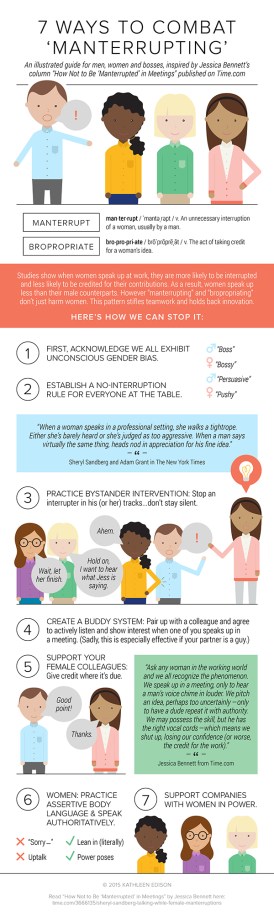
ff4bbd9d6494a7bcd22abf3740ca6e56

Fast Company – “How We Can Help Young Girls Stay Assertive”

Girls lose their voice for a variety of reasons—it’s mostly because of their self-esteem and is culture-based, says Martha Mendez-Baldwin, a psychologist who specializes in child and adolescent behavior, and an assistant professor of psychology at Manhattan College. Navigating the world between being children and women leave them unsure of how to act. When that uncertainty is met, combined with the pressure to fit in with peers and high expectations of parents, girls are often reluctant to assert themselves, she says.

In addition, girls receive tremendous pressure from society and media to adhere to a feminine role, says Linda Hoke-Sinex, a senior lecturer in the department of psychology and brain sciences at Indiana University in Bloomington, Indiana. The message is to be passive and nice—that it’s preferable to keep the peace than to speak up with an opinion that might be unpopular.

Nate Pyle – “Seeing a Woman: A conversation between a father and son”

There are two views regarding a woman’s dress code that you will be pressured to buy into. One view will say that women need to dress to get the attention of men. The other view will say women need to dress to protect men from themselves. Son, you are better than both of these. A woman, or any human being, should not have to dress to get your attention. You should give them the full attention they deserve simply because they are a fellow human being. On the other side, a woman should not have to feel like she needs to protect you from you. You need to be in control of you.

The Junia Project – “They Say the Church is Too Feminine”

Yes, this statement bothers me, because it shows how little we are actually evaluating the situation and because it is offensive, but most importantly it bothers me because  it is completely false.

The Barna Group has been studying Church trends over the last 20 years and they have found that women actually represent the biggest shift away from the Church. They also found that the gap between unchurched men and women is no longer a significant one. “It remains true that churchless people are somewhat more likely to be men than women, but the gap is not huge and has been steadily closing…the gap between men and women has plummeted from 20 points in 2003 to just 8 points currently.” And this is not just in protestant churches. Findings coming out of the Catholic Church do not look much different,according to the Association of Religion Data Archives.

All of this makes me want to ask those who claim that the Church is “too feminine” what churches they are going to. Are men really walking into churches and becoming overwhelmed with female presence? The idea that the church is “too feminine” goes against the majority of my experiences in church. In fact, as I visited churches on three continents over the last 6 years of my life, I have noticed that the majority of those churches presented the same experience to me, and it doesn’t come close to being feminine.

The Junia Project – “5 Reasons Not to Use Gender-Based Jokes in the Pulpit”

Don’t get me wrong, I understand the intention.

Humor is good. So is connecting with your audience by relating to real life experiences.

But there are ways to do that without using gender-based humor.

There are ways to do that that don’t deepen the gender brokenness, further entrench the stereotypes and, possibly, alienate people from the church and from a deeper walk with God.

In the end, we need to be creating meaningful venues where congregations can talk constructively about male/female relationships and partnerships. Maybe a place to start would be the content of this post. Agree? Disagree? Either way, it would be great to host a conversation in your church about it.

The bottom line is that until we figure out ways to take gender seriously in the church, the joke will be on us.

Christianity Today – “What Happens When We See Women Teach the Bible”

Sometimes I wonder how many women in the church have the gift of teaching, but will never use it, or even entertain the possibility of possessing it. When roughly 90 percent of evangelical pastors and 80 percent of evangelical seminarians are men, it can be hard for gifted women to find role models in the church. With such a void, do some women even consider the thought?

As a college student, I was confused about the direction of my call and the place of my gifts. At my church, women mostly occupied administrative positions. Even in my college parachurch organization, we rarely had a woman speak. Given the scarcity of female role models, I wasn’t sure where to turn.

However my life was forever changed when, in my early 20s, I attended the annual Passion conference, a popular worship and teaching gathering founded by pastor Louie Giglio. Beth Mooretook the stage, and though I was only vaguely familiar with her at the time, I won’t ever forget that moment. When she opened up her Bible, she taught the Word like I had never heard a woman teach it before. She spoke with power, competency, conviction, and most of all, anointing. I would never be the same again.

Book Review: A God I’d Like to Meet by Bob Edwards

I am excited to share a review of Bob Edward’s book, A God I’d Like to Meet, especially today as Amazon has dropped it’s Kindle price to $1.99 for the week.  You only have a few days to take advantage of this deal, and I HIGHLY recommend that you purchase this one!  Also, check out Edwards’ amazing blogs, God is Love, and Biblical Equality for Women and Men in the Christian Faith.  I first found Edwards through his blogs, and have been truly blessed by his knowledge and scholarly writing on the roots of Christian patriarchy and complementarianism (the ideology that God has ordained male-dominated authority over the Church and Christian homes).

41q4U+IK76L__BO2,204,203,200_PIsitb-sticker-v3-big,TopRight,0,-55_SX278_SY278_PIkin4,BottomRight,1,22_AA300_SH20_OU01_ CLICK HERE TO PURCHASE ON YOUR KINDLE FOR $1.99!!! 
THIS WEEK ONLY!

Let me share the “About” blurb from one of his blogs:

Bob Edwards lives with his wife and two children in Ontario, Canada. He holds degrees in Religious Education, Social Development Studies and Social Work. In 2013, he received the Delta Epsilon Chi award for intellectual achievement, Christian character and leadership ability, from the Association for Biblical Higher Education. Bob has been a Social Worker since 1996, providing psychotherapy in a variety of settings. He was the Director of Counseling Studies at a multi-denominational Bible College, teaching courses in Psychology, Sociology and Counseling. His hope is to share a vision of God’s impartial love towards women and men everywhere.

Bob is also the author of the best-selling book entitled, “Let My People Go: A Call to End the Oppression of Women in the Church, Revised and Expanded.”

“A God I’d Like to Meet” is an example of what Edwards does best: a scholarly dissection of Calvinist theology, demonstrating its roots in Plato’s philosophy, and the damaging effects that have resulted from reading the Bible from a worldly perspective.

Here is the description of the book from the dust jacket:

Throughout history, prominent theologians and church leaders have made sense of the Bible through the interpretive lenses of ancient Greek philosophy.

As a result, our traditional beliefs often portray God as an all-controlling deity that frowns on emotion and subjects women to male authority.

Throughout this book, the author explores the origins of these theological traditions, and seeks to restore a vision of God as depicted in the New Testament — a vision of God as love.

Calvinism is a prominent strain of Evangelical Christianity today, as noted in this New York Times article from January of this year. Notable Calvinists include Mark Driscoll, John Piper, and Tim Keller.  Calvin’s “Institutes” was required reading in my seminary Intro to Theology class.  Edwards’ insights were very eye-opening to me personally.  In answer to the question, What is Calvinism? Edwards writes,

Simply put, it is an interpretive framework that tells people what to look for in the Bible, where to look, and how they should make sense of what they find.  This interpretive framework consists of what Calvin referred to as “the principal matters” of “Christian philosophy” (p. 16)

A valuable aspect of Edwards’ writing is his background as a counselor.  He explains many psychological processes that impact the lens through which people understand their world.  In Chapter 1: Bad Religion, Bob says,

I’ve been a Social Worker and Psychotherapist for nearly twenty years now.  During this time, I’ve provided individual, family and group counseling to thousands of people.  Many of them have told me that they have difficulty believing in God.  Most of them have experienced horrific forms of abuse: physical, sexual, psychological, emotional and spiritual.  Many of them were told, at one time or another–often by well-meaning Christians–that the terrible things done to them or to their loved ones were either allowed or caused by the “Sovereign Will of God” (p. 6).

Edwards wraps up chapter one, where he has described how Christians have explained the problem of pain, with this paragraph:

We now have a picture of a God that is allegedly in control of everything, causes evil to befall humans because they (in their vileness) deserve it, or because we are expendable in the accomplishment of “the greater good.”  Of his servants, this God requires the death of self, and the rejection of what it means to be human.  In particular, human beings must apparently deny that they are sexual.  Historically this has led male leaders in the church to project blame for their vilified sexuality onto women.  This projection has led to the subjection of all women to male control.  I submit that this is a portrait of a God who is controlling, abusive, unethical, unloving and sexist.  Simply put, in the minds of many, this is not a God they would like to meet (p. 10).

This book is not a long, cumbersome read.  I couldn’t put it down once I started, and finished the book in two hours.  He explains how, in setting up “the principal matters of Christian philosophy” as an interpretive lens for the Bible, Calvin was facilitating “top-down processing,” and how “Rather than seeing new information objectively, human beings are strongly inclined to perceive and interpret the world around them in ways that confirm what they already believe” (a “psychological phenomenon known as ‘belief perseverance'”, p. 18).  A very brief explanation of the lens through which Calvin made sense of the Bible is through his high opinion of St. Augustine, who made sense of the Bible through his reading of the Greek philosopher, Plato.  in his 8th book of Confessions, Augustine wrote:

Simplicianus congratulated me that I had not fallen upon the writings of other philosophers, which were full of fallacies and deceit, “after the beggarly elements of this world,” whereas in the Platonists, at every turn, the pathway led to belief in God and his Word” (p. 21).

The rest of the book unpacks how this Platonic philosophy impacted St. Augustine’s and Calvin’s interpretation of Scripture, and thus how Calvinism “impacts the way some Christian leaders today understand, preach and practice Christianity” (p. 24).  Specifically, how Calvinism makes God responsible for evil (chapter 3), how Calvinism confuses emotion with sin (chapter 4), and how Calvinism leads to the subjugation of women (chapter 5).

Edwards leaves off with the redeeming message that “the distorting lens of Platonic philosophy can be removed from our perception of God.  When we remove this lens, I believe that we have an opportunity to see God in the way the biblical authors intended.  We are able to perceive that God is love” (p. 98).

If you are an Evangelical Christian, there is a good probability that you have come across Calvinist theology at some point, if not regularly in your faith community.  I emphatically encourage you to pick up this book for the low price of $1.99 and consider the implications of Edwards’ research into the roots of Calvinism.


Thank you for visiting The Beautiful Kingdom Warriors!  Please Follow us, Like us on Facebook, and come again!  God bless. 🙂

Did Kirk Cameron say that husbands have authority over the life of their wives?

I was browsing Netflix a couple weeks ago, looking for something to watch while I did bookwork, when I noticed Kirk Cameron’s 2013 film, “Unstoppable,” in which he addresses the problem of pain and suffering and how you can reconcile that with the idea of a loving and good God.  Out of curiosity, I hit play.

I’m not writing this post to critique the movie, but I do want to address Kirk Cameron’s comments about husbands and wives as he is sharing the Creation story.  I find his remarks problematic, and I would like to do my part to make sure there is something on the internet pointing this out.

Kirk sets up the movie with a heart-wrenching story about friends of his who lost their ten year old son to cancer after years of pain and grueling treatments.  A couple weeks before he died, the young boy asked his dad if he could fix him.  Holy cow, I’m crying again just thinking about this poor family.  I can’t bear it.

So Kirk asks the question, Where is God in the midst of tragedy and suffering?  And he begins to answer this question by going to the beginning of pain and suffering (the Fall), first describing the creation of Adam and Eve and the perfection of their life in the Garden.  Here is a short video in which Kirk explains why he goes back to the Garden of Eden in this film:

Around twelve minutes into “Unstoppable”, he is describing how God created man from dust and then he says,

Adam, he’s made of the earth (that’s what Adam means, it means dirt), and he’s not like any of the other creatures.  Not only is he made in the image of God, he is given authority to rule over every other creature.  He’s given privilege and authority to name every other living creature.  When you have authority to name something, that means you have authority over their life. 

After God makes Eve, Kirk goes on to say,

So now, man is no longer alone.  He has his woman, and the two of them are beautifully, perfectly designed to compliment one another.  They have become one flesh.  Adam says, “This is bone of my bone, flesh of my flesh.  She shall be called woman.”  He names her.
 

And then God gives them The Assignment, The Great Mission.  And that is, to be fruitful, multiply, have lots and lots of babies, fill the earth and subdue it.  Rule it, take dominion over all of God’s creation.

Adam had one job, and it was to tend and keep the Garden.  In other words, to cultivate and guard.  To beautify and  protect.  Well, if I said that to you, “Guard this.  Protect what has been entrusted to you,” the obvious question is, “From what?”  And this is the worst part of the story up to this point.

Adam is in the Garden, with his wife, the most precious thing in the Garden.  He is to be protecting her, beautifying her, doing his job.  And a serpent enters the Garden.  This is exactly what Adam should have been watching for.  He should have smelled him a mile away and ran to him and crushed his head the second he saw him.  Especially after he saw what he was doing to his wife!  This is the ultimate breakdown of a man’s responsibility.  This is a story of a man throwing his wife under the bus and using her as a guinea pig in the human experiment.  Remember, God had said to Adam, “the day you eat of this fruit, you will surely die.” (emphasis mine)

First of all, Kirk is not “shooting from the hip.”  The script has been carefully crafted and he is performing it, even though the effect is to seem off-handed and natural.  So when he gives special attention to clarify that naming something is in effect having authority over their life, and then breezes past the statement, “Adam named Eve,” the message is very loud and clear that Adam had authority over Eve’s life.

Did he?  Really?

Kirk Cameron is clearly understanding the Creation narrative through a complementarian/patriarchal lens, and is reading inherent roles into the text that simply aren’t there.  He believes there is an implicit authority given to men to rule over animals and women that is signified through the act of naming.  However, as Kirk states after Eve’s creation, God gives them both authority over the animals, although Eve was not there for their naming.  And the truth is, God named both the man and the woman Adam (human-being in Hebrew), and never told Adam to name his wife.

When God created mankind, he created them in the likeness of God.  He created them male and female and blessed them.  And he named them “Mankind” [adam] when they were created.  Gen. 5:1b-2.

God did not create a hierarchy of authority at Creation.  Adam and Eve are both given the same directive from God: “And that is, to be fruitful, multiply, have lots and lots of babies, fill the earth and subdue it.  Rule it, take dominion over all of God’s creation” (Kirk’s paraphrase of Genesis 1:28).  Kirk describes Adam’s “responsibilities” as “one job…to tend and keep the Garden.  In other words, to cultivate and guard.  To beautify and  protect.”  And then he extends those descriptions to Adam’s responsibility to Eve, “He is to be protecting her, beautifying her, doing his job.”  But that isn’t coming from the Bible.  That is coming from a complementarian patriarchal reading-into of the text.  God created Eve as Adam’s ezer-kenegdo (“strength-corresponding to” rather than the traditional mistranslation of “helper suitable to”) and gave both of them the authority to rule over creation, sans gender-specific roles.

In Marg Mowzcko’s article, A Suitable Helper, she says,

The whole purpose of the Creation of Eve narrative in Genesis 2:21-24 is to emphasise the equality of husband and wife.  To read it any other way is to miss the point and distort its meaning! . . . When Adam looked at his new partner he exclaimed that she was “flesh of my flesh and bone of my bone”!  A profound expression of equality.  There is no hierarchy here! But to further emphasise the point, verse 24 says that when a husband and wife join in marriage they become one flesh – a point which Jesus also highlighted (Matthew 19:4-5, Mark 10:6-7).  Men and women together are made in God’s image.  God’s ideal at creation was that the husband and wife be completely equal and rule over nature together (Genesis 1:26-28).  Complete gender equality is the Godly ideal we should be aiming for.

I could say so much more from watching Kirk’s film, but the concept of Adam having inherent authority over the animals and Eve because of naming them was a striking error that needed correction.

Blessings to you as you have dominion over Creation today! – and I would hope you do that by making the world a better place, reconciling things to the beauty and perfection of God’s original design.  Carry on, warriors!


Marg Mowzcko just posted this excellent article yesterday, relating directly to this issue of gender roles as understood from the Creation narrative: Kenegdo: Is the woman in Genesis 2 subordinate, suitable, or similar to the man?

I would also highly recommend this article by Bob Edwards: Must women keep silent?  1 Corinthians 14 – The Apostle Paul and the traditions of men.  He discusses how proponents of male-authority point to the pre-Fall Genesis account to support their views.

Don’t forget to “Like” our FB page if you haven’t done so already!  We post lots of articles pertinent to empowering women to find their callings as ezer-kenegdos alongside their brothers in Christ, and to raise awareness of areas where redemption work is needed.