
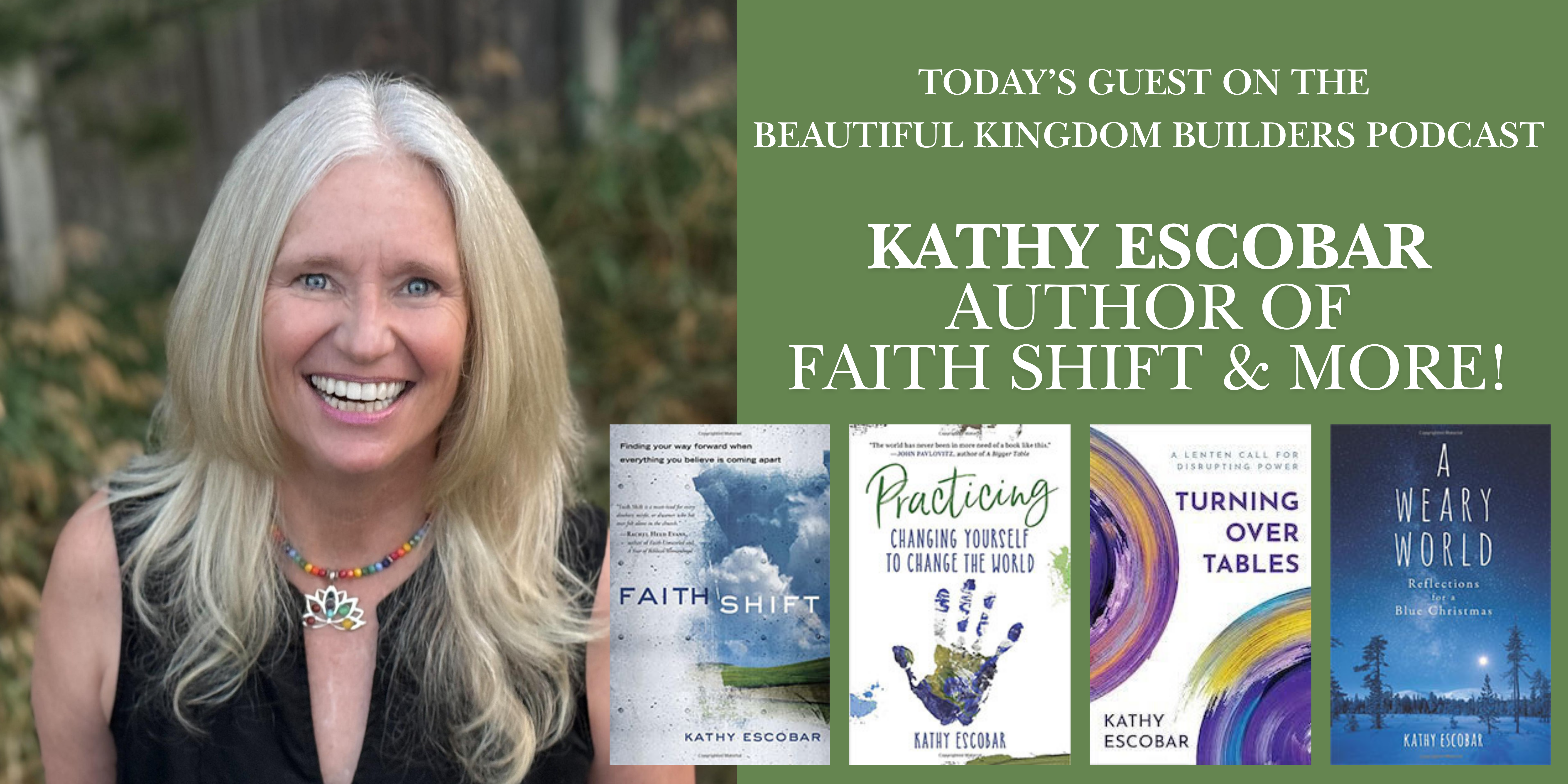
I’m so delighted to share this conversation that I had with Kathy Escobar, writer, pastor, advocate, speaker and spiritual director. You can find out more about Kathy’s work at KathyEscobar.com and find all of her books here.
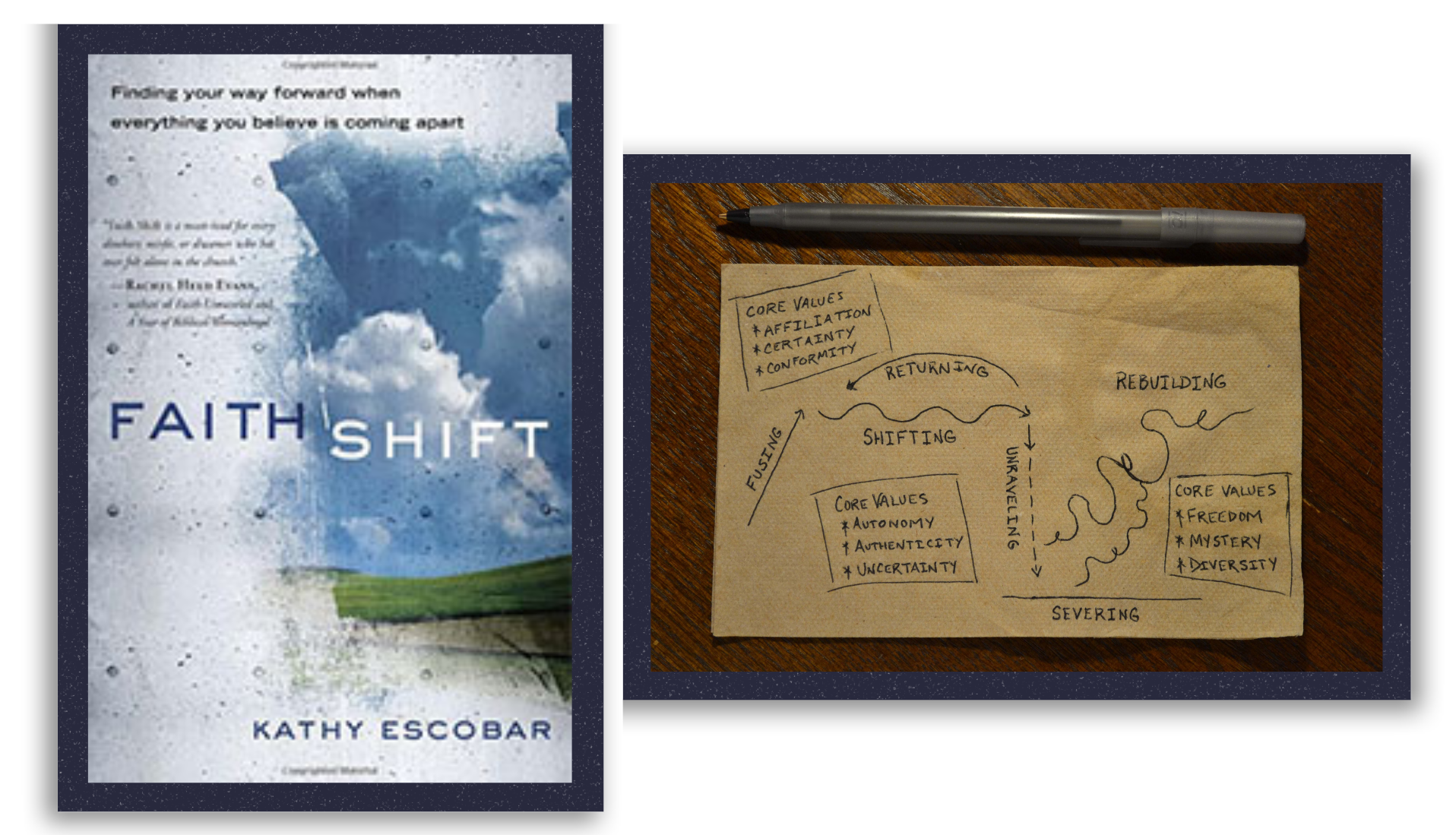
I read her book in 2016 and shared a review here on the blog exactly ten years ago. As I prepared to interview Kathy, I remembered the trend going around right now of sharing pictures of ourselves in 2016 and reflecting on how much we and our world have changed in that time. We’ve been through a lot, my friends. Kathy’s book, “Faith Shift”, is as relevant today as it was to me ten years ago, as I was grappling with the cognitive dissonance of spiritual trauma and deconstructing my conservative Baptist upbringing. We talk through all the stages of a faith shift together in this episode: Fusing, Shifting, Returning, Unraveling, Severing and Rebuilding (or Reimagining, if she could write it again today.) We talked about co-dependency and being a “Good Christian Woman” vs. an “Ex Good Christian Woman,” which I blogged about in 2015 here. We talked about embodiment and activism and finding church and ministry outside of evangelicalsm. It was such a fun conversation, and I know you’ll get a lot from it!
You can listen to our episode together on The Beautiful Kingdom Builders Podcast on YouTube, Spotify, Apple Podcasts, Amazon Music, or more! If you find our conversation helpful, please share it with a friend, rate and review, and subscribe so you never miss an episode!
TRANSCRIPT:
Ruth Perry (00:15)
My guest today is Kathy Escobar, a pastor, writer, advocate, speaker, and spiritual director. And on her website, she describes herself as a community cultivator and change catalyzer who believes in the power of human connection and that healthier people make healthier families, communities, and systems. Welcome, Kathy. Thank you for being here today.
Kathy Escobar (00:36)
it’s so fun. I’m so glad we get to hang out.
Ruth Perry (00:39)
You’ve written many beautiful books, but I wanted to bring you on to talk about this book, Faith Shift. I read this 10 years ago, And on the cover it has a blurb from Rachel Held Evans saying, “Faith Shift is a must read for every doubter, misfit or dreamer who has ever felt alone in the church.” And that was definitely me 10 years ago. And so I’m so grateful that I found your book and I’m grateful that here today.
And just thinking about how 10 years ago was 2016 and there’s that trend right now, people sharing pictures of themselves in 2016 and reflecting on how much the world has changed in one decade because we’ve seen the rise of MAGA and Christian nationalism and the Black Lives Matter movement and the Me Too movement. We’ve seen the erosion of our democracy and civil rights and now the scapegoating and oppression of immigrants and covering up the Epstein files. I mean, just so much for 10 years. so, And the church has just hemorrhaged people. I think people have been questioning their faith and walking away from their faith communities.
Kathy Escobar (01:36)
It’s a lot. It’s a lot.
Ruth Perry (01:46)
I think this last 10 years is a really important time for us to reflect on. And so first of all, I want to say kudos to you for writing such an important book.
Kathy Escobar (01:55)
I have to say like just you reading Rachel’s cover quote, it gave me chills. it is so, so special that we were connected all those years ago. And honestly, I attribute a lot of what happened with Faith Shift to Rachel and her support for the process and the book, but just more than anything, the process. I mean, that’s really what the material was about. And it is interesting because it’s 12 years now and then 10 years of kind of really this 2016 and 2026. a lot’s happened. And it’s interesting how it is more timeless than I thought.
Because you know, I knew when I wrote it there were people that were already, way past they had unraveled and were rebuilding and reimagining and then there are people just entering in the story and then that people would be entering into the story a few years later, but now we’re 12 years later and then there’s brand new people because of the way things have ramped up and I am so glad I would change a few things in there, very few on the whole.
The I really still stand behind, but I think what I love is that people can at least find some kindredness because it’s a hard process. And right now with so many people going, I can’t do this anymore. Like that was a few calls this morning of just setting up meetings. Like I’m done. I can’t go anymore. I can’t be part anymore. And just people wanting some support for that so that we’re not struggling so much through the because there’s a long line. You’re one of them who have done that work, you know, and now we’re here to hold the container for other people. And I’m glad that there is way more support now in 2026 than there was in 2014.
Ruth Perry (03:42)
When I came to your book, I was in a really broken place because my home church had gone through a split and my dad had been the senior pastor and my brother had been his associate pastor. And everybody in the church was like family to me. I just never could have imagined that they would treat us the way we were treated and the things that we experienced, it was really traumatic on multiple levels. And so I was reeling from that.
And then also, I had grown up complementarian and then God called me to be a pastor in 2010 when I was pregnant with my third child. And so I was going through all the cognitive dissonance of trying to figure that out. And so my faith was just really, you describe it as spiritual vertigo in your book. And that was exactly how I was feeling. It was a really, really painful season. And so when I came to your blog, and was reading your posts and then I discovered you had a book and I ordered this. It was like finding balm in Gilead. You gave me language and insight that helped me understand the season I was in and that helped me to persevere and make it through. And so just thank you from the bottom of my heart to you personally for that. And I do hope more people read your book.
Kathy Escobar (04:53)
That means so much and that’s exactly why I wrote it right there. always it was just like may it get into the hands of the people that need it the most and and just find ourselves in the story and that was always you know the language in there I kind of do have these movements of a faith shift and evolution of faith But it was like change the words change the way that change how it looks it doesn’t matter Just grab what you need for your story that’s gonna help you
Ruth Perry (05:22)
Before we talk about the book, can you tell us a little bit about your own personal faith background?
Kathy Escobar (05:27)
Yeah, so I was not raised in church and so that’s an interesting part because like I know what it was like before kind of going in on the system and so my family, my dad was a hippie in Northern California. My mom had gone through one marriage and married my dad and left him and so our whole our whole house was kind of I’d say super spiritual but not religious and so I would go to a Catholic church with my grandparents when I was visiting them and that was sweet but I was super lost and didn’t understand anything that was happening but somewhere along the line someone invited me to Vacation Bible School and I went and I was always hungry for spiritual connection always.
So I went and I prayed the prayer, didn’t do anything. You know, I didn’t have any structures. Then somewhere along the line, someone gave me this little white Bible. And I still have it in my memento box. And they just were like, read this and read John. And I don’t remember my exact age, but I was an avid reader really young. And it was probably late elementary, early middle school. And I was just super drawn to Jesus. I was. I thought Jesus was super cool. I loved that it was all the outcasts and the lepers and that part of it really I was drawn in and my family had a lot of chaos and so I felt that connection. I did. There was something about it.
So it was pretty pure, is the bottom line because I didn’t go to church. So I wasn’t systemized at It was real and I have a lot of journals like Dear God and Dear Jesus and I just was kind of kind like that Judy Blume book. You know, I was just reaching out for connection. And so I did end up going to an evangelical church in my high school years with my boyfriend at the time. Something did kind of happen. I just was more hungry for it. And that was kind of the entry into evangelicalism and so just started to go more started to listen to what they said and so.
For me, my background became being part of mainly evangelical churches, Calvary chapels. We went to the Vineyard for a little bit, those sort of attractional churches that were in the evangelical stream where women didn’t teach and lead, but it was like really fun to be part of. There was a lot of whiz bang and there was this thing happening of this is a way you can live your life. And I was really drawn to it because I didn’t have a lot of boundaries or I didn’t really have any certainty in my family. And I did feel a security in that system. So I was in that system for a chunk of years. I always kind of pushed against it because I went to Pepperdine University for my undergrad and I was one of the poorest people there. I drove up in my Datsun B210 1976. You know, there’s Ferraris and Mercedes and BMWs.
And I didn’t really get the Church of Christ thing because I wasn’t church, you know, I didn’t really get it. And then the girls in my Bible class were crying and saying, it’s so terrible, I can’t serve communion, they won’t let me do this, I can’t serve communion. I was looking at them going like, what’s your problem? Why are you there if they’re not letting you serve communion? And the irony is just probably about four or five years later, I was in churches like that with my husband.
Really there and that is strange thing for me. And so I always describe like a funnel, but there’s a funnel on both sides and one is like going up into the tightness of a funnel, like the base. And so I was in that system for a chunk of years, but it’s kind of always like pressing out on it. And then a big piece was bumping up into all kinds of things, primarily related to women, the LGBT community, the inerrancy of the Bible, things that just didn’t make sense to me. the system was saying, but this is what it says. And this is, you just don’t know cause you’re young in your faith. And I questioned myself.
I didn’t have some security, but I kept growing up. And when everything came apart for me, it was really was in 2006. I really describe it as the funnel out in now it’s this many years later. 20 years later and my funnel is way out. And I’m so glad and then I still have good things that are left and that’s the piece of Faith Shift is that there’s a way to reimagine and pursue a faith that has those values of mystery and diversity and freedom but the systems are just so terrible at helping us with that. So that’s kind of my background.
I am an ex-vangelical for sure but I’m not whereI grew up, you know, I kind of have this different foundation now, but it is wide and expansive and I’m so grateful I got out.
Ruth Perry (10:20)
In your first chapter in Faith Shift, you wrote, “Most Christians are taught that faith is defined by an event, salvation. After we get saved, we turn our energies to keeping faith, growing it, spreading it. The truth is growth and change are natural parts of our relationship with God. God invites us to be in motion, but often the faith systems we are a part of don’t. Our changes can feel threatening to those who are used to believing and behaving a particular way. A faith shift, what often feels like a failure or an end can actually be a doorway to something more, something bigger and truer.” That’s from chapter one, you titled, You’re Not Crazy, You’re Not Alone, which was excellent. So you had gone through that process, then of faith shifting that brought you to write this book. And who were you picturing as your readers?
Kathy Escobar (11:00)
Yeah. Well, I think the readers were the people that I was around circles with here in Denver. There was just this little covert group of people. A lot of them were in ministry, not everybody, and that were just asking these really good questions together. And we would sit here in the backyard around campfires and coffee shops and over dinner and just really talk about what we didn’t hold on to anymore. What does that mean?
And kind of this idea, I wrote a post about spiritual Jenga, if you start taking out core things that people said, you have to have, will the whole thing come down? So those kinds of things, and what does it mean if the whole thing comes down? What does it mean for my kids? What does it mean for myself? I put a lot into it. There’s a ton of grief related to these changes because we have lived a certain way. I had a lot built in my identity as a really good Christian and certainty, you know, in faith shift, I think we’ll probably talk a little bit more about those movements, but you know, in that fusing, like that initial thing of certainty and conformity and belonging and affiliate, like those things are so strong.
And so when they start to come apart, like who are we? And so that was really the people that were part of The Refuge community at the very beginning were huge. And also you started with Rachel’s quote is that I started writing in 2007. I started looking up stuff in 2006 when The Refuge started. We’re getting ready to have our 20 year birthday in April. And in 2006 and seven, I started meeting some other people in other places. We’re still friends and everybody has had a huge faith deconstruction and is I mean life in new ways. But we were connecting around the United States. I mean that’s how I met Rachel was writing and I met her in real life and we became friends and there were so many of us in that stream. And so by 2014, It was just a lot of people resonating with the same things.
There were lot of things out of the themes were always the same. And it was always, I used to be here. It’s not resonating anymore. What is available to me? Like is there life on the other side or is that part of my life completely done? And honestly, it feels so disorienting. That was the biggest theme by far was the disorientation of losing the things that we once had. And I think that ⁓ a piece of the conversations were always, I framed it in faith shift this way, but it was always what we were talking about is that’s when we lose our beliefs, then we lose the structures that support those beliefs, then we lose the relationships that are in those structures, and then we lose our identity.
And so that’s what everyone was talking about. Who am I now? And is it okay? Am I going to be okay? Was a huge piece. Am I going to be okay? Especially people, I didn’t have it as strong because I was in evangelicalism, but I wasn’t in fundamentalism. And so there were a lot of things about what’s going to happen to me eternally if I walk away from all those belief systems, am I going to burn in hell for the rest of my life? Like I told people they would. And you know, those kinds of things were really, really deep. And then I had more of the, who am I without it? Because I did get a lot out of that system. And, and some a lot of fear of just, what do I, if you don’t believe this, then what do you believe? And so that was a big piece of my process.
Ruth Perry (14:35)
Yeah. Yeah, your book, you name each of those stages. And if you don’t mind walking through the stages again and give us the name and then what’s going on in each stage of a faith shift.
Kathy Escobar (15:04)
Yeah, I’m glad to do that. And so, infusing, infusing is like our start.
It’s just our start and our start looks different. Mine was, when I was a kid, but it wasn’t born with it. Some people started with it in the womb. Some people were 30, you know, wherever it was, but it is that desire for the core values. There are certainty and conformity and affiliation. So like truth, knowing what this is, this kind of conforming to the norms of the group and then being part of something, what it feels like to be part. Most people all have that. That’s just part of it. But some people stay there.
I would say most people do probably go through a little bit of shifting and I describe that as a like wavy line where you just start to question some things. like hmm. It’s when you’re sitting in church and you’re like why are we singing that song? Could I be doing something better with my time? Is this what Jesus wanted? I don’t know if I agree with that thing the pastor just said that doesn’t make sense in real life or they’re talking about my kid right now when they’re talking about LGBT stuff, whatever it is it’s like rumbly is how I describe shifting and what happens is, I think a lot of people fuse and a lot of people rumble.
And then a stage in there of returning kind of just like an arrow back over, like, I don’t know, but I don’t have anywhere else to go. It’s familiar to me, it’s comfortable enough, whatever. And I think there’s a lot in that cycle of fusing, shifting, returning, and just kind of staying there. Then there’s some of us, where you’re definitely one, I’m definitely one, a lot of people listening, I’m sure are too.
The biggest thing on shifting, it’s in our control. It’s in our control. A lot of us hit a place where it’s no longer in our control. a bridge too far. It is too big of a violation in our core values. something that happens in our life. A lot of people I know, their faith shift started when they got divorced and how the church responded to them. In my situation, I had a traumatic event as a leader where horrible power things were revealed like Oz. It was like the curtain and it was so bad. It was just terrible. And I couldn’t not look at it. I could not close the curtain. That I would say is when we hit the next three, which all faith deconstructors really probably connect with the most. And that is unraveling. And it’s a free fall down, man. is not shifting does not describe it.
And we kind of struggle with the faith shift language a little bit, like that it wasn’t strong enough, you know, for what happened. But it is because it’s all a big shift in our lives and a transition. But unraveling is when it just really gets out of our control. And that’s what happened to me. Like once I saw I saw the inequity, I saw the terrible things that were being said about people on the margins. I saw consolidated power. Saw God card getting played all the time. I couldn’t unsee it. I couldn’t un-feel it. And it’s just like a free fall down. And in unraveling is a desire for uncertainty, authenticity, and autonomy.
Because it’s like, gotta figure out what I need and no one’s gonna tell me anymore. You know, those kinds of things. And in there, in unraveling, big, big ball of grief. And I already said the four things when we lose those beliefs and then structures, relationships and identity. It’s just unraveling. It’s just a bunch of grief. And then the bottom one, which when we were working on the project, my editors and I, and I never forget this conversation. We were trying to come up with different words about severing because the truth is some people really walk away from it all like they really do. I never fully severed. So when I kind of looked at the Faith Shift, Faith Evolution model I say to people, it’s on a napkin. It’s not the whole cross the bridge to Jesus thing. It’s a totally different model, but it is something you could just draw it your own way. I drew it this way to give a visual for it.
And so at the bottom is severing like people really do have to leave emotionally. And that’s where atheism, agnosticism and the one that I always leave room for is a true break from the old toxic system. And you need to detox and especially when you’re in spiritually abusive systems, you can’t just go to something new. It’s a spiritual bypass. You’re not going to make it. So you have to like cut and cleanse. And some people sever forever. And the part with the book was really leaving room for that. It’s very controversial. It’s not to me, because I see people do just fine if they sever. But there are people that want to rebuild or reimagine something else.
And so I will say a chunk of years now, I changed the language that’s in Faith Shift from rebuilding to reimagining. Whenever I’m with a group on this, I would use reimagine now instead of rebuilding because rebuilding was fine for then, but so much has changed and building something is also a lot of resistance to that for good reason. You’re just building something else that has to come down. But reimagining, really resonates and in reimagining it’s just like a bunch of like squiggly lines. And it’s not back here it’s like this way it’s forward and it’s squiggly and it’s messy and it’s up and down and all around but it’s a search the core values that guide reimagining slash rebuilding are a desire for greater mystery freedom and diversity in all the things so it’s a wider everything.
The thing I want to say about my editors is that when we were in the room workshopping this, they kept wanting to have an infinity model. And it didn’t leave room for severing and people don’t go back there. Like it doesn’t flow that way. And it was funny. We went round and round and I just kept saying, no, it doesn’t resonate with me or the people that I journey with. And then they finally throw their pens down. They’re like, okay, we’re really off on this, aren’t we? And I was like, yeah, I think so. I do. Because it’s just not people’s experiences.
And I’ve had multiple people tell me that if severing, wasn’t on there, they would have thrown the book away. They would have thrown the book away. They would have got that far and people need permission in themselves. They don’t need permission from me. They need permission in themselves to let that be and find out who we are separated from the system. I never fully separated my story because of The Refuge and we started it and I had a place to do stuff. So I came close, I thought about it, but I had the luxury kind of of being around a bunch of other people, reimagining together. But there’s so many that need that and I think that that’s the problem when we try and go well you’re just going through a faith and you’ll come back around and that’s just not how this works in most cases when we really unravel.
Ruth Perry (22:06)
I feel like I did sever, even though I’ve always maintained my relationships and my faith. I’ve reimagined it, but I severed from the need to people please. I had to sever from the codependency of the toxic system that I was in, especially in my closest relationships, where I had to learn that I had to have integrity and authenticity in doing what I felt was right, not doing what other people expected of me. And so in that way, I felt like the severing language was really impactful for me.
Kathy Escobar (22:32)
Yeah. I’m so glad. I’m so glad and it’s brave and it’s hard, but it’s so healthy. Like it is so healthy to detach and sever from toxic things. Like that’s not a stretch in the world.
Ruth Perry (22:50)
Yeah, that’s my next question for you actually is How, when people start rebuilding or reimagining their faith and going through this process, what do you see is healthier in their life than before?
Kathy Escobar (23:01)
Well, I always say this, I mean, and this is a bad stat, but in my experience, and I can say this because I can line up every single person I know, 100 % of the time, people are healthier and more free. And it’s one of my deep sadnesses, to be honest, because I’m mainly in the Christian tradition. And so for that many people spending that much time in that system, there should be a lot more freedom.
And so to have to go through this whole process of untangling for so many things to become a healthier, more freer person is very sad. What I’ve seen on the whole is people just really learn how to live more true to their truest true, which one of the worst toxic theology things that’s taught in my opinion is that, our heart is wicked above all things, that we can’t trust you’re nothing apart from Jesus.
You know that God is in control of everything and you’ve got to find your way into God’s will or if you’re out if anything bad in your life, then it’s not in alignment with God somehow. It’s so much power and control. And so it is healthy to leave those kinds of toxic abusive relationships. I think the health that I see is as we learn how to tell the truth more. We learn how to not be split. Like we’re not one thing on the inside that we’re like, and then outside we’re pretending like we’re doing fine because we just don’t have a safe place to be authentic.
So I think health is healing the split and everyone becomes more whole. I think the other piece is actually listening to our bodies. So a huge piece of evangelical fundamentalist Christianity is disembodiment and just being cut off from our bodies and that was a huge thing for me and so I couldn’t even tell you like what am I feeling?
What’s my feeling? I don’t know. I don’t even know because you have to find that feeling in your body. It’s not a head thing. You feel and where do you feel it in your body and just really being disconnected. And so I think what happens in the spaces of mystery and in the spaces of freedom to explore different spiritual practices, what works and doesn’t work instead of having to like buy into all of it. And freedom, like people really settle in to become healthier.
And I just feel it makes me want to cry because I, last night at our house of refuge, I’ve known some of those people since the beginning of The Refuge. And we’re still here meeting in our house. This is one piece of the work of The Refuge still is house of refuge. It’s every other Wednesday night at Collective Spiritual Conversations and I can’t even tell you the healing. It’s crazy what happened when everybody got out of the thing that they were so dedicated to. And it doesn’t mean there’s not still realities of mental health. There’s not still realities of struggles in this world. Nothing’s resolved because it’s the human experience. But it’s like everyone is not carrying that burden on top of those things anymore. And it’s so fun to see. I am amazed at something that has so much money and so much time and so much energy and so much culture and all those things just does not produce health. That’s what it is. It just doesn’t produce that many healthy people. And that’s a shame. That’s a shame.
It really is because it’s a lot of opportunity to put in really good stuff for people. The stuff that we really need and that is how to be more whole and authentic and secure and free and use your gifts freely and follow the deepest desires of your heart for the greater good in the world without control, someone controlling that. So there’s my long answer to that question.
Ruth Perry (26:36)
Yeah. I think between being a codependent people pleaser and just absorbing everybody else’s needs and then on top of that having the same disembodiment issue, I know that my work is embodiment healing that I need to do. So what do you recommend? Where do I start?
Kathy Escobar (27:20)
My gosh, well you know one thing is my friend Janelle Absramsey, she’s edited and written in a few different books. She’s a good friend of mine. We actually met through Faith Shift. She came to a Faith Shift processing party that we had. I did some of those in the early days just creating space to kind of walk through. We met there and she’s now the co-director of Brew Theology in Denver. And she just came to, we have a group at The Refuge called Reimagine on Sunday night, first Sunday night of the month, virtually. It’s one of our only like wide ⁓ on the weekend virtual groups. And it came out of a desire, honestly, our first year was related to church burnouts and freedom seekers and people that were just desiring something different. And then this last year we switched a little bit more to practical and soulful resourcing to navigate these turbulent times because what’s happening in the wider story right now in 2026. It’s been happening for 10 years, but it really has been happening long before that, but it’s illuminated the Christian nationalism thing, the double down, the misogyny.
It’s so deep and it really is rattling. Even people who have been in a pretty good place over the years just feel that wound opened and then new people feeling the wound and finding out. So Reimagine is about that like resourcing. So she came and she had a whole thing on embodiment and it was so good. I can send you at least the PDF because it has a bunch of resources and I think you would really, I think you’d really connect and she’s a pastor, a piece of the story. It’s okay for me to say this. Our multi-faith group that I’m part of, she joined, I’ve been part for 15 years, she joined a chunk of years ago after not being able to be ordained in the denomination that she grew up in. We ordained her.
It was incredible. It was so beautiful. There were like seven faiths. We had a beautiful service. I was part of helping curate it. And it was really one of the holiest things because she’s an incredible pastor. She’s an incredible pastor and we ordained her.
Ruth Perry (29:17)
Beautiful.
Kathy Escobar (29:33)
I knew it was one of the coolest multi-faith things that we did. We do a lot of cool things, but that was like way up in the books of one of the coolest things that we’ve done together in the time that I’ve been there.
Ruth Perry (29:43)
Yeah, patriarchy is pretty insidious in a lot of the church. And so that was one of the things that I really appreciated in your blog, I think more than your book. I don’t remember from the book if you addressed it as much, but in your blog, I really loved your post, Good Christian Woman versus Ex-Good Christian Woman. And I think I shared it with hundreds of people probably at the time. And so I just thought I would read
Kathy Escobar (30:08)
That was a long time ago, yeah.
Ruth Perry (30:11)
You made this bullet list of qualities of a good Christian woman. You said they:
rarely engage in conflict,
are terrible at saying no because it feels selfish,
know how to say the right things, do the right things to keep the peace,
continually strive, and I do mean strive, to be a better wife, better mother, better Christian,
live with a feeling that God is disappointed with us somehow.
feel a lot of shame for who we are and who we aren’t, but rarely say it out loud.
doubt our leadership, feelings, gifts, dreams.
dwell on the things we should be doing differently or better.
view anger as sin and always seek permission.
That’s so heavy.
Kathy Escobar (30:49)
It’s a lot. I love that post though. And you know what? It is one of my top posts ever. And that was from like, what year was that? It was a long time ago.
Ruth Perry (30:59)
Yeah, well, it probably was in 2014 or 2016 or so when I was reading your book, I’m guessing. And then you provided a better list. Ex-good Christian women are:
learning to show up in relationship instead of hiding,
engage in conflict instead of avoid it,
say no with less and less guilt and say yes more freely, more honestly,
tell the truth,
respect anger
are honest about shame,
live in the present,
are beginning to believe we are enough here and now,
open ourselves up to dreams and passions and living out what God is stirring up in us,
lead and love and live in all kinds of new ways with or without permission,
are discovering that God is much bigger than we were ever taught and loves us more than we ever knew.
What a much more beautiful picture of Christian womanhood, huh?
Kathy Escobar (31:52)
And honestly as you read those like so much is in there on embodiment honestly. Embodiment really is just being like that living through us. And so our being connected to the deepest parts of our soul and our bodies and like one thing instead of a bunch of fragmented things. That really is what to me embodiment is. And then moving in the world that way, showing up in rooms that way. Our back straight and our head held high, which is so hard when we were taught to just be up space, saying what we want and what we need. So like that to me is all embodiment. And so I love that list. I do still love it after all these years.
Ruth Perry (32:38)
How does a performance-based faith, like our early faith stage, create codependency in us, do you think?
Kathy Escobar (32:45)
Well, I have a lot of things written about our codependent relationship with God. so, the truth is, mean, honestly, it is kind of a setup because in codependence, you’re always striving to kind of be okay. That’s ultimately what it is. The definition for me for codependence is any pattern or anything that we do that makes us be okay. And when we don’t do it, we’re not okay.
And so, those basically have, you know, shame and self-worth and compliance and avoidance and control, like all these ways that we try and be okay. So, performance-based with God is pretty simple in those systems that you’re, talking about that a lot of people listening probably were part of. It’s just really is performance-based.
You’re evaluated for how you say things. You’re evaluated for what you look like. You’re evaluated for how you serve God. My whole thing is you just say a lot of God things, people think that it’s awesome. I was like, throwing in Bible verses does not mean anything. But to even the Christian world, they’re like, ⁓ that person you can trust, even though their life is not indicative of those Bible verses.
We value those kinds of things. And so I think that performance and then you really put in, economic security. There’s a lot of things that the lie of white supremacy, Christian supremacy, Bible supremacy, male supremacy, like those lies are really deep in us and they’re a huge part. And so in relationship with God, when we’re taught that we are okay if we do these things, if we believe these things or if we behave this way, whatever that looks like, it creates this cycle and I was in one for sure, because I am an adult child of an alcoholic, I know co-dependence. I still go to meetings, the Refuge House, the Refuge Recovery meeting twice a month, and it’s a great meeting because we’re all just trying to be healthier humans. That’s really what we’re trying to do.
But in my God season, it was just never feeling like I was enough, which is what most co-dependents feel. Never feeling like if I said the truth, what does that say about my faith? And then I’m in a less standing with God. And then constant trying to make sure that I’m proving my worth in the world.
First to God and then to other people. And so it is just a vicious cycle. And honestly, it’s an addiction. The way to break out of codependency is similar to other addictions. And it really takes being honest about these things and saying it’s not working. And when I look at it now, I mean, it’s so many years later, but it’s really sad, the setup with God.
To be in this constant cycle. It is an abusive relationship, the way that the theological constructs that people taught us about God and then the setup of what it meant to be part of that system. And so honestly, it’s like untangling from an abusive relationship. And I know that’s not on God. That’s not on God. That is on the people that taught us that. And so I do think it’s confusing because the people get so merged with who, with God.
They’re all tangled up and they were claiming God. And I think that was a big piece of the work for me was really trying to separate out. Like even though I was taught these things doesn’t mean that that’s who God is. And there are now especially being out of the system for 20 years this year. I can say it’s amazing to be in the multi-faith space and the inter spiritual so many different things progressive Christian like it doesn’t matter like across, there’s just a lot more out there than that very narrow system and I’m in awe all the time about that and how sad it is that we just have put God in the most narrow thing and then said this is the only way and you are measured against this standard.
Ruth Perry (36:50)
Yeah. And the certainty piece too of the early stage where we see everything so concretely one way or another. And is it growing to be a problem where if you start to feel a little dissonant about one little thing. Now, if you bring that up, you almost get ejected immediately, like written off. There is so much more control in these groups about who belongs, who’s in and who’s out. And so part of it too is they’re like forcing people into their faith shift, maybe a little prematurely at times, because they’re like, I’ve been ejected.
Kathy Escobar (37:23)
I know, I think you’re right, I do. I think now, when I talk to people, I’m like, do you like being there? Well, yeah, I do like being there. And like, but I’m troubled about this. And so just the best way to test it is just to see what happens when you ask a question and you push against or you disagree. That’s how you test what a system is made of.
And I have people that systems have done just fine, honestly, because healthy systems and they can do it. They might not love it, but those do tend to be more progressive, inclusive communities that can hold a much wider breadth of the mystery of faith and don’t have really strict doctrinal statements. They might say what they believe, but it’s just got a lot of room in it. And then I’ve had others, you know, they just, it was awful.
And so, and sometimes what’s hard is like, some people like get forced out by the system, but way more get forced out by just going, I can’t do this anymore. And then what happens is they stop going and no one cared, no one cared. And that is a very sad thing. I hear that story a lot. They just were like, I stopped going, no one cared. Or I said I couldn’t go anymore because my kid’s gay and I’m not gonna go to this church anymore that believes something different. It’s not right for me. I’m just using that one example. And then just nobody cares. I mean, it’s just that simple. The wheels of the machine just keep going and no one misses them. And you know, it’s just that I think it’s both ways. Like you have the system goes, you know what, if you believe that this is not a place for you. And you’re wrong.
And there’s just so many degrees of how the system sucks. I mean, basically, that’s kind of where I land. The system just sucks at nuance and it sucks at good transitions. Like it doesn’t know how to go, gosh, we honor that. This isn’t the place for that, but we honor that. How can we end something well? How can we celebrate what you’ve done here? It just never does it. Everyone just ends out on the outs of the system for the most part. I don’t have that many good stories of good transitions out.
Ruth Perry (39:47)
Something I’ve noticed, maybe you’ve noticed this too, is because my background was evangelical and we kind of got ejected when the church split. So we started going to evangelical churches further and further and further away. We eventually after a few years of doing this, we landed in a church, and it was great. But looking back, I can’t believe that I never, tried the Methodist Church in town or the Episcopal Church in town. I was just so in this, I gotta go to an evangelical church because they’re the true Christians. And I mean, that was years and years and years. And I’m finally now for two and a half years, I’ve been a clergy person in the United Methodist Church. But they invited me, I never reached out to them. I was still looking at evangelical churches. So what is that about? What do you think that is, Kathy?
Kathy Escobar (40:17)
Yeah. Love it. Yes. My gosh, I think because I totally agree with you. I love the Methodist Church. There’s different ones but ones that really like made it through this split that they had. And the Episcopal Church and I have a lot of UCC friends like the DOC. There’s some great denominations that I would agree with you. I knew they existed. I didn’t think that they were worth connecting to because I was taught that they weren’t the true believers basically.
I mean that was said overtly and in all the culture and this is where the real juice of Jesus is and so I just think that the mainline churches have so much good. I can see in the justice space, because I’m in the justice space here in lots of ways, in activism, like, I’m telling you, the main lines are out there. The multi-faith are out there in the streets across all faiths. And they all have their own, you know, degrees of progressivism and conservatism, but just tend to be so much more action and faith in action than evangelicalism.
And the evangelicals, frankly, are just not there, usually, in most of the circles. It’s not exclusive. I’m not going to say all, but by far, it’s a very very small percentage and it’s really interesting because there’s just something so off on that system’s ability to play with others and it’s just a closed system and it’s because what comes back to the beginning really there’s just a certainty that they’re right and everyone else is wrong.
And that is so sad. So I’m so happy that you have found a place there and I have seen this a lot, is this place where gifts are valued freely. And I know watching so many female leaders lead and be ordained, become deacons and elders and pastor all different roles, just really find their way in the right churches. And they just are never in evangelical churches. They just never are, for the most part. They just aren’t.
Ruth Perry (42:51)
Yeah. When I was in that culture too, another piece was fear of people outside of my group. I just had so much fear and that fear kept me from really loving people. I’m just trying to think too about the piece of grief that you talk about in faith shifting and then the freedom on the other side, it’s so worth it.
Kathy Escobar (43:11)
Yeah, yeah, and you know the thing about grief, it’s so important is that it really does, I’m still sad. I’m 20 years, and honestly the 20 year mark has kind of had me reflecting on a lot of things because it’s a big ritual, you know, it’s a celebration and I look back 20 years is a long time and I just remembered those early years and The Refuge is totally different than it is what started. It started as a like eclectic, kind of emerging faith community that was built on the 12 steps of recovery and the Beatitudes. But it also was more Jesusy and more evangelical-y then than it is now. I look back to old writing and things that I wrote, it was just a different place.
But I think that the grief for me, it doesn’t just go away just because we reimagine and that’s what probably is the best illustration to me of all of these is their cycles and so we touch on it. Like, I’m in a really good place, I don’t ever look back and long. I don’t paint pictures of Egypt. I don’t do any of that I did but I don’t anymore but it’s still sad for me and the saddest part out of everything for me is that in 20 years not that much has changed in the systems. And that is just, that’s a travesty. And because so many other things have evolved, cultures evolved.
We know so much more about brain science people. And we know so much more in 20 years. We have access to so much greater good. And it just has not translated to most evangelical fundamentalist church systems. So that is grief. I do feel it. And part of grief is anger. And you talked on the ex-Good Christian and the Good Christian side, I am mad. I’m not nearly as mad as I was in the early days. I was just like, look out, because I had never really in any of my systems or my family been able to express anger.
But I am really mad and sad that they influenced this many people and it’s this harmful. And that there’s a rise now, like I feel like we made a lot of progress, and now there’s a rise that’s, I don’t think it’s real, real, on the ground it doesn’t feel real, as real as what we see on social media, now in the national media, because of this administration, but, there’s not a groundswell on the ground for that. There are far more amazing Methodist churches and progressive things and activists and, you know, all the people on the ground, like really trying to build a better community. But it does feel really sad that these things are being propped up in such a clear way and that they’re being attached to our our system that said it was supposed to be church and state, honestly. And so I have a lot of grief about that and a lot of anger.
And I think we all do, not everyone, those that are struggling with it, it’s really tapping into that. So even though I’m not as tuned in to the feelings that I had all those years ago, I still have feelings. And I think that that’s of grief because grief has no rules, it’s waves, it’s not stages, it just comes in little waves. The waves right now are not these big waves that overwhelm me, but they do bubble up and it’s sad. It’s sad.
Ruth Perry (46:46)
Yeah. Yeah, it’s hard not to be overwhelmed right now.
Kathy Escobar (46:49)
Yeah, it is. And that’s why resourcing is so important. You know, we were talking about, embodiment and resourcing. We need tools to help us be healthy.
And those look different every person, but whatever are the tools that help us be really centered and grounded and clear. And that’s why healing in this process, that’s why I love the work that you’ve been doing for all these years, because I’ve been following you all these years. I’m not on social media a bunch, but I get things on my feed and there’s good stuff. And it’s resourcing, that’s what it is. And so it’s trying to support people, to be really supported. And I think, you know, so many things now are really related to regulating our nervous systems. And none of that was in church. Nothing was about that. It was kind of detaching and having some spiritual experience but we didn’t have like those ways to do things in the moment and really do it in our whole bodies.
And the other part about resourcing our kindreds. You know, that’s what this project is all about. That’s what you guys are all about. Is that we are with other people that go, my gosh, yes, this is me. And it’s really hard, but I’m not alone. I’m with other people and that’s where I think the juice of faith shift, finding your way into re-imagining and through the unraveling process of having kindreds is so important. And I think right now in 2026 and what we’re up against, which is hard, we have got to be with people who help us. Resourcing is we change states because of it.
And so we might move from dysregulated to, that’s resourcing. So people help us do that. The tools do too. And so we have to get out of our lives, things that just make it worse and get in our lives. Things, people that help us really change states to last. And I think more and more people are finding it, but I do think it’s really hard in the technology world right now.
I saw something from Scott Painter’s work. Do you know anything about it? Yeah, Scott the Painter. And there was just a thing on doom scrolling. And it was like in a shark and it’s like doom scrolling. Don’t do it. And so it was really good because there were all these things you could do.
Ruth Perry (49:01)
Yeah, Scott the painter.
Kathy Escobar (49:14)
and they are all amazing things. Just get outside, call a friend, read a book, eat an apple. I remember thinking those are none of the things that would be suggested in the old system that we were in. And they’re all so simple. That’s the other part of resourcing and of being more embodied and greater freedom, mystery, and diversity is it’s simpler, less complex. We don’t have to have this long list of things to be okay. That’s the breaking the codependency. It’s like we’re secure and free and it’s pretty simple and it’s enough.
And that is part of unraveling, honestly, is just getting rid of all the things that you don’t need so we can travel lighter. And I think more people are going, I cannot travel heavy in this season. My backpack needs to have the least amount of stuff in it, because it’s hard enough to walk to work right now.
Ruth Perry (50:10)
Yeah. That’s a good word. You give me a lot to chew on and you’ve encouraged my faith and my journey and I hope you ⁓ encourage a lot of others and I hope people do read your book, Faith Shift. Where else can they follow you on social media, Kathy? What are you doing?
Kathy Escobar (50:13)
Thank you so much. Well, the best thing definitely because I have a few projects after that one that people might like Practicing and I have A Weary World for Christmas holiday hard and Turning Over Tables is my newest one related to disrupting power and so that might really resonate with some people right now. The best thing to do is go to my website which is Kathy Escobar.com and then it has the links. I’m on Instagram and I’m on Facebook. I’m not the best over there.
Probably my best way to connect right now is through the website, but I do have a Substack. I started writing again last year more regularly and I’m working on a new project called New Ways for a New World, Life and Faith Beyond Binary’s Boxes and Borders. And so I’ve been writing in that stream right now and I’m really happy about it. feels good for me too because I think that’s the new conversation is how do we do this? New ways. We need new ways for a new world because the world has changed so much just since four years. Then you take eight, then you take ten. You know, it’s just changed so much. So yeah, just go over there and you’ll find all the links.
Ruth Perry (51:29)
Yeah. Kathy Escobar.com and thank you so much, Kathy. God bless you.
Kathy Escobar (51:37)
It was so fun hanging out with you
Want to never miss a post here? You can subscribe by email! If you’re on your computer, there is a widget on the righthand side of my page, under my picture and intro. If you are on your phone, scroll to the bottom of the page to find the widget.
You can also Subscribe to The Beautiful Kingdom Builders Podcast on YouTube, Spotify, Apple Podcasts, Amazon Music, or more! If you find our conversation helpful, please share it with a friend, rate and review, and subscribe so you never miss an episode! God bless!


 The Beautiful Kingdom Builders