
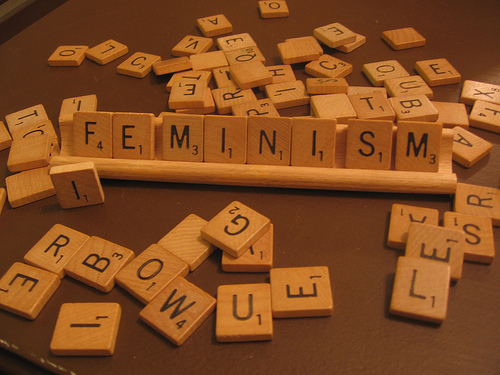
Yesterday, popular Christian blogger Matt Walsh wrote a post entitled, “Christian women: feminism is not your friend.” I recently subscribed to Matt’s blog because I’ve enjoyed several of his posts, which were humorous and smart. After reading this particular post, I felt compelled to respond. As a life-long Christian, I think I have a good understanding of Matt’s perspective. He’s clearly a great guy, husband, father, and a talented writer. I also deeply appreciate Matt’s passion for unborn children. All life is sacred; on that we agree 100%. What I’d like to add to the conversation is the perspective of a faithful believer who feels comfortable with the term “feminist.”
I am keenly aware of the negative reaction to that word among many Christians. As I was growing up, I heard horrible things about feminists and how they were wreaking havoc on our country’s values and heritage. In fact, a woman showing a back bone in her family, work and church relationships, or resistance to the status quo, was labeled a feminist, almost as though the term were synonymous with “bitch,” with the implication being that she was rebellious or sinful. The problem is, we are generally blind to where the status quo is nothing more than a cultural norm. It is a fact that we are more likely to come to our conclusions about issues according to the consensus of our peers, rather than through logic and critical thinking, as much as we believe we have been logical and critical. As much as Matt or I blog, it is likely that readers’ viewpoints will remain unchanged. You can see this from the comments under Matt’s post. Those who already agreed enjoyed his post, those who disagreed were agitated. It is in relationship that viewpoints shift. Therefore, it is very important that we get out of our comfort zones, meet and listen to people of differing perspectives, get to know them and where they are coming from, and honor them as individuals bearing the image of God. That is how our perspective grows and we gain a fresh understanding of our own beliefs as well as the beliefs of others.
So, let me respond to some of Walsh’s points about feminism. I believe they could be boiled down for simplicity’s sake to:
1. Reject the term “feminist” because on the spectrum of feminism there are extremists who advocate for the murder of innocent unborn children, and why would you want to be associated with that?
2. Christianity has always been pro-gender equality, as evidenced by a quote from Thomas Aquinas over 80o years ago.
3. Feminism is irrelevant now because women can vote and buy property. Feminists are no longer fighting for equal rights, they are redefining “what constitutes a ‘right’ and what constitutes ‘equality.'”
4. The pro-life movement is the only equal rights movement left in America – and their biggest opponents are feminists.
5. Men and women are equal in human dignity and intrinsic value, but are not the same because of genetic differences of maleness and femaleness that feminism rejects, which is ruining family stability.
1. Reject the term “feminist” because on the spectrum of feminism there are extremists who advocate for the murder of innocent unborn children, and why would you want to be associated with that?
If you follow this logic, you will reject the term “Baptist” because the extremist Westboro Baptists are hateful to homosexuals. There are over 1,400 Baptist denominations in the United States, with a wide spectrum of beliefs ranging from ultra-conservative, King James Only Fundamentalism to ultra-liberal American Baptists. The adjective “Baptist” does not adequately identify the Biblical interpretation or cultural norms of any given Baptist church. But I know a kind conversation with a Baptist would help you to understand their perspective. I am a Baptist and have been misjudged by others because of this term. So should I drop it? I also know I have misjudged others on a regular basis because of the adjectives used to describe them.
2. Christianity has always been pro-gender equality, as evidenced by a quote from Thomas Aquinas over 80o years ago.
Here is another quote from Thomas Aquinas that paints a different picture of women: “As regards the individual nature, woman is defective and misbegotten, for the active force in the male seed tends to the production of a perfect likeness in the masculine sex; while the production of woman comes from a defect in the active force or from some material indisposition, or even from some external influence.”–Thomas Aquinas, Doctor of the Church, 13th century
I certainly agree with Matt that Jesus Christ granted full equality to women, and I would also suggest that the stories of Old Testament and New Testament women leaders are remarkably counter-cultural, set in a strikingly patriarchal world. But Christianity also has a dark history of patriarchy, with centuries and centuries of teaching about the subordination of women.
Here are more quotes from theologians who have influenced Christianity:
“[For women] the very consciousness of their own nature must evoke feelings of shame.”–Saint Clement of Alexandria, Christian theologian (c150-215) Pedagogues II, 33, 22
“Woman is a temple built over a sewer.” –Tertullian, “the father of Latin Christianity” (c160-225)
“Woman was merely man’s helpmate, a function which pertains to her alone. She is not the image of God but as far as man is concerned, he is by himself the image of God.” – Saint Augustine, Bishop of Hippo Regius (354-430)
“The word and works of God is quite clear, that women were made either to be wives or prostitutes.” – Martin Luther, Reformer (1483-1546)
“Thus the woman, who had perversely exceeded her proper bounds, is forced back to her own position. She had, indeed, previously been subject to her husband, but that was a liberal and gentle subjection; now, however, she is cast into servitude.” –John Calvin, Reformer (1509-1564)
Here is an even longer list of similar quotes. It is clear to me that Christianity has an ugly history of sexism that cannot be covered up or ignored. It is something to examine and root out, as it is contrary to the example we have in Christ Jesus. Christian feminism that casts a light on sexism and patriarchy in the Church is good. Christ is cleansing his Bride of all her impurities and it is important to follow where the Spirit is leading. Many Christian leaders see the releasing of women into ministry as the next big awakening coming to Christianity.
3. Feminism is irrelevant now because women can vote and buy property. Feminists are no longer fighting for equal rights, they are redefining “what constitutes a ‘right’ and what constitutes ‘equality.'”
Let me tell you about a few of the relevant issues that Christian feminists are fighting. Did you know –
In the US (links here here and here):
- Women make up 51% of the US population – but only 20% of Congress
- 35 women have served as US governors compared to 2,319 men
- 71 countries in the world have had female presidents or prime ministers – but not the US
- US women continue to earn 77 cents to the dollar that men earn, but African- American women earn only 64 cents and Hispanic women make only 56 cents to the dollar.
- Women comprise 46% of the labor force, but 59% of workers making less than $8/hour
- The more education a woman has, the greater the disparity in her wages
- Women earned less than men in 99% of all occupations
- Women own 40% of all US businesses and employ 35% more employees than all the Fortune 500 companies combined
- The US is the only major industrialized nation without paid family leave
- Depression in women has doubled since 1970
- 38% of girls are molested before turning 18, 16% of boys
- Only 5% of child sexual abuse is reported to law enforcement
- 93% of sex offenders describe themselves as “religious”
- Rape survivors are more likely to suffer from depression, abuse alcohol and drugs, or contemplate suicide
- 70% of women in the workforce are mothers; yet we have no national paid leave child care or flex time policy
And here’s where it gets really important: Worldwide (links here here here here and here:
- Women represent 2/3 of the illiterate population
- In 33% of countries, daughters are not given equal access to school
- Girls receive less food, less medical care, are married off young, and start bearing children at a young age, affecting lifelong health
- There are 27,000,000 human beings living as slaves today
- The average age of trafficking victims is 12
- Only 1-2% of victims are rescued; 1 in 100,000 traffickers convicted
4. The pro-life movement is the only equal rights movement left in America – and their biggest opponents are feminists.
Last night, I was wondering what Matt Walsh would say about Affirmative Action. Funny enough, that’s what today’s post is about. I would highly recommend reading Amazing Grace by Jonathan Kozol, about the systemic discrimination, hopelessness and limited economic opportunities facing the people of the South Bronx. This was a life-changing book for me, and many of my political viewpoints were changed after reading this heart-wrenching book. Mostly, Kozol’s book gives an eye-opening snapshot of what he calls the punitive, blame-the-poor ideology that has swept our nation.
I do not agree with Matt that the pro-life movement is the only equal rights movement left in America. As much as I believe in the sanctity of unborn life, I am equally concerned about the sanctity of post-birth life. One of the primary reasons that women have abortions is because they cannot afford children and will receive little help. I am also thinking of immigrants, the homeless population, innocent civilian victims of “just wars”, unequal access to health care, lack of resources for single mothers, etc. To be a Christ follower is to be moved with compassion for the poor.
5. Men and women are equal in human dignity and intrinsic value, but are not the same because of genetic differences of maleness and femaleness that feminism rejects, which is ruining family stability.
One example of a cultural norm that feminists resist, is the trend of labeling qualities as feminine or masculine, so that there is shame for someone who holds qualities that are not typically designated to their gender. Shame is dehumanizing, thus to shame someone is to sin against them. Personalities are so complex that this tendency ends up hurting many, many men and women. Boys are bullied for “being a girl” or “being a sissy,” and girls are restricted from activities deemed unladylike. I believe this is an important issue to consider. How does our culture shame men and women who are not stereotypically masculine or feminine?
In an article entitled, “Embracing the Feminine Side of God” on the Red Letter Christian website yesterday , Tony Campolo said, “Not only do I love the feminine in Jesus, but the more I know Jesus, the more I realize that Jesus loves the feminine in me. In a day and age when so many women are trying to rediscover the side of their humanity that the world deems masculine, I find Jesus is helping me to appreciate those dimensions of me the world calls feminine.”
In Matt’s post, he says, “So I urge you: unbind yourself from the bondage of this term that’s become inexorably tied to a demonic dogma that obliterates the unity of the family, drives a wedge between a wife and her husband, and digs a giant chasm between a mother and her child.” Tell me if that doesn’t sound a little extreme, like Pat Robertson’s infamous characterization of feminism: “The feminist agenda is not about equal rights for women. It is about a socialist, anti-family political movement that encourages women to leave their husbands, kill their children, practice witchcraft, destroy capitalism and become lesbians.”
For those who consider themselves to be Christian feminists, this issue of “equal but different” is at the heart of the problem. The Bible is predominantly understood to designate specific roles according to gender, which restricts women from positions of authority in the home or church. Matt’s language describing feminine and masculine qualities makes me think he is coming from a complementarian perspective. An egalitarian perspective interprets Scripture to say that women are equally made in God’s image, equally gifted by the Holy Spirit with the same types of gifts as men, and are equally eligible for leadership if that is what God has called them to. It is a critical issue in the church and can be a contentious topic of discussion. All I can say is, from my own experience and studies, the egalitarian perspective has rung truer, and I am always excited to share my viewpoints with complementarians who haven’t really considered another perspective. I would recommend this article by theologian N.T. Wright as a good place to start as you consider another point of view.
I guess I’ll leave off here for now. I understand that as a blogger, it is smart to be controversial and keep people talking about and visiting your blog. Matt is really gifted in getting conversations going! Thank you for reading this and God bless.
Thanks for visiting The Beautiful Kingdom Warriors! Please “like” us on Facebook!


 The Beautiful Kingdom Builders