Category Archives: Ruth’s Posts

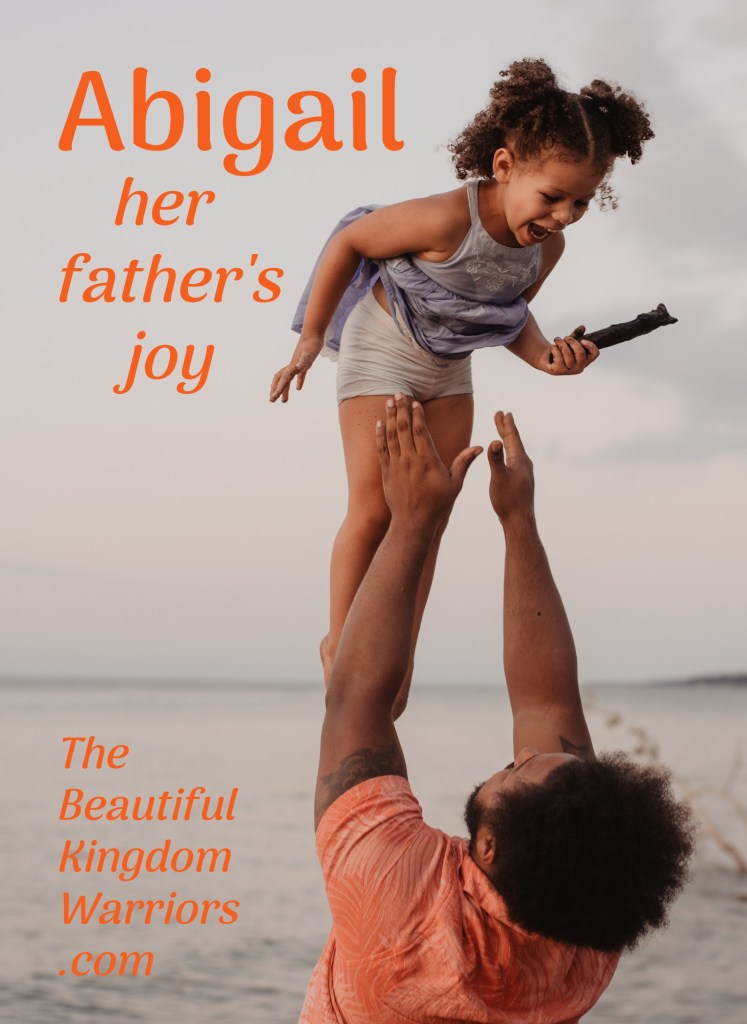
Her father’s joy – the story of Abigail

Photo by Emma Bauso from Pexels

One of my favorite women in the Bible is Abigail, whose story, told in 1 Samuel chapter 25, is full of rich meaning that can be applied to our own lives as disciples of Christ. I love Abigail’s story so much that I named my only daughter after her, hoping that my Abbey would have her same courage and wisdom when she is grown.

Let me tell you what I’ve learned about Abigail.

Abigail was raised “Beloved”:

I don’t know anything about Abigail’s family of origin, but I do know one thing: She was her father’s joy. And I believe she was raised “beloved.”

According to Scottish anthropologist James George Frazer in The Golden Bough, most Hebrew names were chosen for their spiritual significance. Abigail’s name is derived from two Hebrew words, ‘ab meaning “father” and gil meaning “to rejoice” or “be glad.” In contrast, her husband Nabal’s name means “foolish” or “senseless.” When used as an adjective, nabal refers to unethical and immoral people.

I believe Abigail’s name bears great significance in the story of her courage and daring, or rather, in the formation of her courage and daring. Because she was loved and delighted in as a child, Abigail would have been raised with secure attachment and a healthy self-esteem. She lived from an identity of wholeness and belonging.

According to attachment theory, the way that our early caregivers related to us greatly impacts our emotional development and future relationships. It shapes our understanding of independence and dependence, and of receiving and giving love and affection.

I highly recommend The Gottman Institute for relationship resources.

Knowing this about attachment, I believe that the attachment style we learned as children greatly impacts our relationship with God. God made us in his image, and we tend to return the favor, making God into the image of the men and women who raised us. This can either mean that we fear God or trust God, that we deep-down know we are loved by him, or never feel good enough.

In the Jesus Story Book Bible,Sally Lloyd-Jones describes God’s love beautifully: “You see no matter what, in spite of everything, God would love his children with a NeverStoppingNever Giving Up, Unbreaking, Always and Forever Love.”

Do you have a hard time believing that God loves you this way? If so, it is likely that you have healing work to do. (I wrote about “The Search for Identity: Healing Our Image of God and of Ourselves” here.)

I am convinced that Abigail was “living loved” and that is why she had the courage and strength to act as an agent of redemption in the Bible.

Abigail was more than a pretty face:

Like several Old Testament women, Abigail is described as beautiful (the Talmud lists her among the four most beautiful women in the world, with Rahab, Sarah and Esther). Unlike most other women in the OT, Abigail is also described as “intelligent” (NIV), or “clever” (NRSV), or “of good understanding” (KJV), as having “good (tov) understanding/intelligence (se.khel)” in 1 Samuel 25:3.

Solomon is described with the same Hebrew word (se.khel) in 2 Chronicles 2:12, as is Zechariah in 1 Chronicles 26:14, the Levites in 2 Chronicles 30:22, and Sherebiah in Ezra 8:18.

Abigail breaks the ancient patriarchal mold of being valued for her beauty and/or ability to bear sons. She is praised for her intellect and understanding, with the same language attributed to wise King Solomon, the priestly tribe, and the prophets Zechariah and Sherebiah!

Abigail was a prophetess:

Because of his foolishness, Nabal failed to appreciate who David was. But Abigail knew who David was. She spoke eloquently and prophetically about David and his future reign as king of Isreal.

Remarkably, her speech is one of the longest speeches of a woman recorded in the Old Testament! Her words have been preserved as Scripture, useful for our instruction (2 Timothy 3:16).

The Lord your God will certainly make a lasting dynasty for my lord, because you fight the Lord’s battles, and no wrongdoing will be found in you as long as you live…When the Lord has…appointed him ruler over Israel my lord will not have on his conscience the staggering burden of needless bloodshed or of having avenged himself…” (vs. 28-31).

The Talmud includes Abigail as one of seven Jewish women prophets, the other six being Miriam, Deborah, Hannah, Sarah, Huldah and Esther.

Abigail is praised for defying her husband:

You heard that right!

For those who believe in “biblical gender roles,” here is a Biblical example directly challenging the belief that a wife ought to “obey” her husband (don’t worry, I have a post in the works on submission, coming soon).

Abigail defied her husband, going behind his back because she knew he would not approve of her actions. She does not seem very concerned with her husband’s frail ego, either: “My lord should not pay attention to this wicked man Nabal. He simply lives up to his name! His name means ‘fool,’ and he is indeed foolish!” (vs. 25).

Despite defying her husband and saying negative things about him publicly, Abigail is commended for her actions. David recognized that Abigail was sent by God: “Praise be to the Lord, the God of Israel, who has sent you today to meet me. May you be blessed for your good judgment and for keeping me from bloodshed this day” (vs. 32-33).

After Nabal’s death, David rushed to marry Abigail. She became his third wife and bore David’s second son Chileab (2 Samuel 3:3). Her son is called Daniel in 1 Chronicles 3:1.

Abigail is in fact an ideal wife. She did not submit to her husband Nabal’s stupidity; rather she protected her husband and his interests. Which brings me to my next point:

Photo by ruskpp

Abigail is an ezer, a strong help:

Many patriarchal teachers emphasize that it is the man’s role to protect women (who they see as the weaker sex), and they insist this is God’s design. Yet there are numerous examples throughout the Bible of women protecting men that they must stubbornly overlook or ignore.

In addition to this story, where Abigail saves hundreds of innocent lives, in Judges 4, we have the story of Deborah and Jael helping the Israelites win the insurmountable foe of Sisera and the Canaanites; in Exodus 1:15-22, we have the Hebrew midwives bravely defying the order of the Egyptian pharaoh to kill male babies, at great danger to themselves; in Joshua 2 we have the story of Rahab hiding the spies; in Judges 9:50-57; 2 Samuel 11:21 “a certain woman” of Thebez kills Abimelech, leading to 45 years of national peace. There are more examples like this.

When God made Eve in the Garden of Eden, he said she was an ezer kenegdo for Adam (Genesis 2:18). Our English translations have “helper suitable” (NIV), “help meet” (KJV), “helper fit” (ESV), etc. for ezer kenegdo. Many take this to mean that Eve was made to help Adam in a subordinate role, as his assistant.

“Evidence indicates that the word ‘ezer originally had two roots, each beginning with different guttural sounds. One meant “power” and the other “strength” (from God’s Word to Women Word Study on Ezer Kenegdo). 

Other instances of ezer in the Old Testament, refer to God as a Israel’s helper in war. Certainly not a weak or subordinate help! I like the CEB translation of kenegdo – “perfect.” Eve is a strong help, perfectly suited to Adam, who declared her equality to him when he saw she was just like him, “bone of my bone, flesh of my flesh!”

Abigail was a strong help who protected her household from Nabal’s foolishness. She is an example of Biblical womanhood – an ezer kenegdo.

Abigail is a type of Christ:

Typology in Christian theology and Biblical interpretation refers to Old Testament events and persons that pre-figure Jesus Christ. For example, Jonah is a type of Christ for spending three days in the belly of the whale, pre-figuring Christ’s resurrection after three days in the grave.

I read an article by Heather Celoria where she breaks down the ways Abigail is a type of Christ, and it is quite beautiful:

In conclusion:

To me, the life of Abigail is a clear example of how God includes and honors women in his redemption plan. Unlike the patriarchal teachings of “Biblical manhood and womanhood” that would relegate women to assistant status, keeping us small and contained, Abigail shows us a better way. Following Abigail’s example, we too can function as a beloved children of God, strong helpers to others, and prophetic voices proclaiming who Jesus is to others. Abigail was a pre-figure of Christ’s redemption work as Servant King and Messiah, and is a lasting example of discipleship for us today.

_____________________________________________________________

I wrote a follow-up to this article, Abigail Sequel – What About Submission?

_____________________________________________________________

Sources:
Abigail: A Bible Woman with Beauty and Brains – Marg Mowzcko
Abigail: An Old Testament Type of Christ – Heather Celoria
Ezer Kenegdo – William Sulik on God’s Word to Women

And here’s a critical look at David’s part in this story:
Nice Flock of Sheep you got there – Scott McAndless

_____________________________________________________________

Thank you for visiting The Beautiful Kingdom Warriors! Our passion is to correct the errors and influence of patriarchal/complementarian Bible teachers. If you found this article helpful, would you share it with a friend?

On Facebook, we share articles and posts from around the web in order to spark dialogue on the issue of gender inequality in the Church and world. We hope you will join us there!

What inspires you most about Abigail? Let us know in the comments!

On being a bad feminist who tolerates all kinds of nonsense, but also having no patience for bad depictions of God’s love

bad feminist

Before I confess to being a bad feminist, I do watch feminist-approved shows as well. I’m a big Handmaid’s Tale fan, I watched Unorthodox early on in quarantine, and I’ve been watching Mrs. America on Wednesdays since that began.

But I can’t help how effective a ridiculous Hallmark movie can be at helping me unwind after a busy shift at work. I watch Hallmark Christmas movies year round.

And why wouldn’t I watch a show that repeatedly, time after time, manages to produce “the most dramatic season ever”? My husband will not watch The Bachelor with me. He is a better person than I am. In my experience, The Bachelor is people-watching at it’s most fascinating, a train-wreck that I just can’t look away from.

Has my feminist card been revoked yet?

It would seem, with my terrible taste in entertainment, that I would enjoy the Christian equivalent in written romance. Right? I thought so. But I thought wrong.

Last week, I woke up one day with my introvert battery completely toasted. So I picked up a novel, Francine River’s immensely popular Redeeming Love that had been handed down to me a few years ago; I neglected my housework and children (honestly, they’re old enough to feed and bathe themselves so I’m almost obsolete) and spent the entire day reading.

Aside from successfully recharging my introvert battery, I didn’t finish this book feeling good. It gnawed at me for the next several days. I kept mulling over and over how terrible the book actually was. As much as I can overlook in secular garbage TV, I could not forgive Francine Rivers for Redeeming Love.

I finally figured it out. Redeeming Love is supposed to be a metaphor for God’s love for us, by telling a “love” story about Christian patriarchy, presenting abusive coercion and control as godly male headship.

God’s love is so much better than the love described in Redeeming Love.  

I won’t summarize the plot, as I found that Samantha Fields did an excellent review series already, analyzing River’s disappointing writing chapter by chapter. I encourage you to read her reviews, especially if you have already read Redeeming Love. 

I will simply say, the main characters, Michael and Angel’s relationship dynamic resembles Power & Control rather than Equality, and it makes me so upset that Christians confuse abusive behavior with “spiritual headship”:


I was reminded this past week of another book, A God I’d Like to Meet: Separating the Love of God from Harmful Traditional Beliefs, by Bob Edwards. In his first chapter, Edwards introduces himself and why he’s writing this book:

I’ve been a Social Worker and Psychotherapist for nearly twenty years now. During this time, I’ve provided individual, family and group counseling for thousands of people. Many of them have told me that they have difficulty believing in God. Most of them have experienced horrific forms of abuse: physical, sexual, psychological, emotional and spiritual. Many of them were told, at one time or another–often by well-meaning Christians, that the terrible things done to them or to their loved ones were either allowed or caused by the “Sovereign Will of God.”

I understand the human tendency to want to come to grips with or understand life’s tragedies. This particular explanation for horror and suffering, however, evokes a crisis of faith for many. If God is good, why would he cause or allow such terrible things to happen to good people? One common answer to this question only serves to compound the problem. Some are told that God isn’t really allowing “bad” things to happen to “good” people, because deep down we are all truly “bad,” by nature.

Another common answer to the question of evil is also problematic. We’re told that God predetermines that people will do bad things to one another so that his good purposes can be accomplished on earth. At best, this second explanation is a classic case of thinking that the end justifies the means. As mentioned earlier, some of those “means” can be truly horrific (e.g. rape, child-abuse, ethnic cleansing). (pgs. 6-8)

This is exactly how Angel’s horrifying childhood abuse and trauma is treated in Redeeming Love, and Rivers over and over again describes Angel’s trauma-informed behavior as weakness, selfishness, and pride.

Bob Edwards’ book explains how Christian theologians, specifically Calvinists, have been influenced by ancient Greet philosophy, which has warped the way they view God. You probably could not find a Christian who would disagree with the statement that “God is love” (1 John 4:8), but how many Christians live as though they are a bug under the thumb of God?

Dualism, a hierarchy of spirit over body, denial of the free will of humanity and the doctrine of self-mortification; these are some of the philosophical principals that eventually led to formulation of the Gnostic heresy. Shockingly, they are also some of the alleged “principle matters of Christian philosophy” through which John Calvin encouraged all believers to make sense of the Bible. He derived them from Augustine, and Augustine derived them from the “books of the Platonists.” Rather than being a benchmark for Christian orthodoxy, St. Augustine’s theology appears more like a “union of Christian and pagan doctrines.”  (Edwards, pgs. 108-109)

Seen through the lenses of Platonic philosophy, the God of the Bible can appear to be an all-controlling entity that frowns on emotion and insists that men must exercise control over women. The implications of this theological perspective are significant. Evil, including human sin, is portrayed as “the will of God.” Salvation is irresistibly extended to a select few, while the majority of the human race is abandoned to inevitable damnation. Human emotion is confused with sin and must be “put to death.” Women, viewed as stimulating sinful feelings, must be strictly controlled by men. (pgs. 96-97).

This controlling, abusive, and sexist portrait of God reviles rather than attracts people to him. I would encourage you, if you’ve been taught a Calvinist theology, to examine your understanding of God.

All my life, I have known that God is love, and I have loved God deeply. Unlike Angel, I experienced very little trauma or abuse as a child. But I absorbed this Calvinistic portrait of God anyway, through doctrine. When I was thirty, I was going through a very painful time with a church split, parents divorcing, and husband unemployed, and in my brokenness, I was grasping to understand the problem of evil and the suffering of this world. I happened upon Brennan Manning’s sermons on YouTube, and wept as I learned of God’s UNCONDITIONAL, no-strings attached love for me.

I learned that I am Beloved, just as I am, and not as I should be, because nobody is as they should be. It sparked a faith shift that gave me the courage to unpack everything I had grown up believing about God and the Bible, and then to start reconstructing a faith that is informed by Jesus’ love, sacrifice, and grace.

Brennan Manning

As Manning says, “You will trust God to the degree that you know you are loved by him.” Knowing I was loved unconditionally gave me the freedom to ask God the “big questions,” to walk away from traditions that were harmful, and to embrace Egalitarian theology that placed women in their rightful place alongside their brothers in the Kingdom.

It is my constant prayer that Calvinists will come to know the unconditional, incomparable love of God, who sees each one of us in our brokenness and mess and calls us “Beloved.”


Thanks for visiting The Beautiful Kingdom Warriors! We’d be so honored if you shared this post with a friend. We’re on Facebook too, posting articles and images every day from around the web. Let us know what kinds of garbage TV you tolerate in the comments! 😉

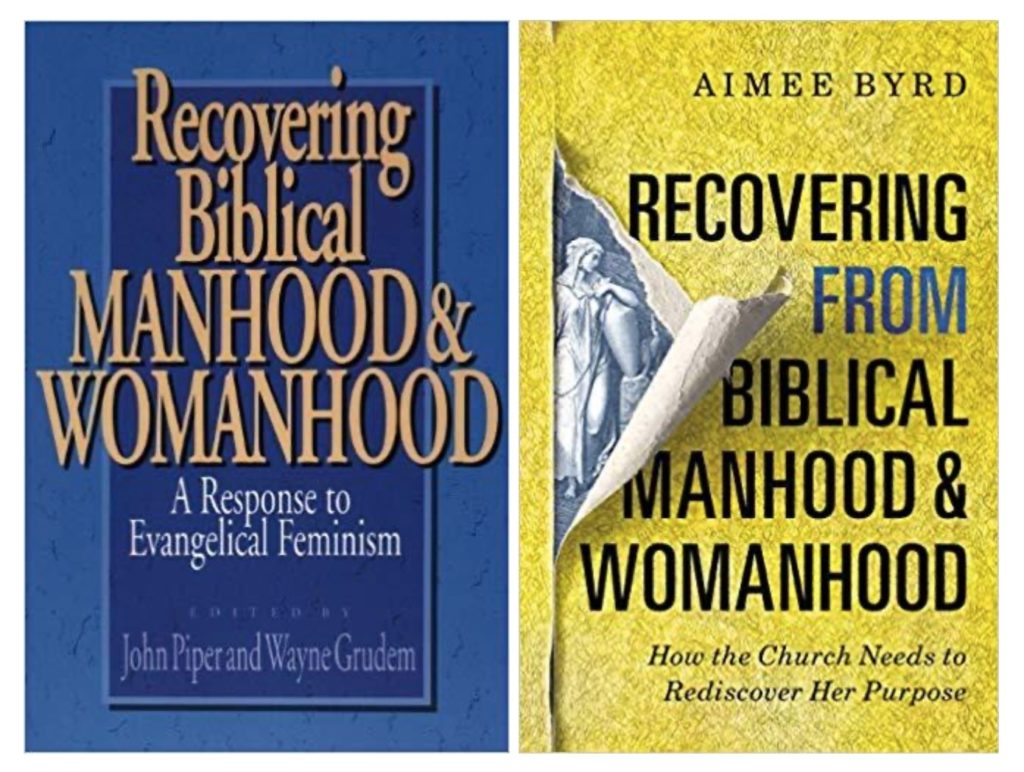
Recovering from Biblical Manhood & Womanhood by Aimee Byrd

aimee byrd

I was delighted to receive a copy of Aimee Byrd’s new book, Recovering from Biblical Manhood & Womanhood and devoured it this past week, underlining a full half of it! Byrd writes beautifully, with strong metaphors and challenging questions that keep the reader engaged. And her arguments are very strong and compelling. In her introduction, she emphasizes that this is neither a man-bashing book nor a women’s empowerment book. Her focus is critiquing the teachings of so-called “biblical manhood and womanhood” that are really cultural values rather than helpful guides to discipleship.

Aimee Byrd is coming from the perspective of the Reformed Orthodox Presbyterian Church, which is complementarian. While remaining faithfully within the confines of the creeds and doctrines of her denomination, she offers a complementarian framework that honors the contribution of women in Scripture and in ecclesial life today. Reading her book as an egalitarian, I was inspired by the Biblical examples of “gynocentric interruptions” (the female voice throughout the Bible’s narrative), and I loved her description of sibling relationships as the dynamic we are to have between men and women in the Church.

Byrd is directly challenging theaimee byrd recovering biblical harmful subjugation of women through the work of the Council on Biblical Manhood & Womanhood (CBMW) founded by Wayne Grudem and John Piper and other prominent complementarian pastors, and their definitive tome, Recovering Biblical Manhood & Womanhood. The CBMW view of manhood and womanhood is filtered strictly through a lens of authority and submission. She is especially critical of the heretical doctrine of the Eternal Subordination of the Son (ESS) they have peddled to enforce the subjugation of women.

As we’ve been taught to focus on aiming for biblical manhood and womanhood, we have missed the bigger picture of Christlikeness to which we are called. And we have lost aim of what the church is for: preparing us for eternal communion with the triune God. (pg. 26)

I underlined half of this book, but I will try to pull out some favorite quotes for you. Here are some from the chapter, “Why Not the Book of Boaz?” in which Byrd fleshes out the importance of “gynocentric interruptions”:

It teaches us different layers of different. We see how the female voice is needed in Scripture. This isn’t a criticism of the male voice. God put man and woman on this earth, and he intends to use both sexes in his mission. In Ruth men and women see that sometimes we need a different set of eyes to see the fuller picture. And what a beautiful picture it is. (pg. 54)

The church is using the same language as the secular world–whether we’re talking about equality and rights or borrowing the same Victorian-age gender tropes and then calling it ‘biblical.’ Their questions often revolve around what the women in the church are permitted to do. While there is certainly a place to talk about these things, there seems to be little talk about how the woman’s contribution is distinctly valued and how they can promote that in their leadership by listening to and investing in their women. The woman’s casserole is valued. The woman’s nursery duty is valued. The woman’s service in VBS is valued. Is her theoogical contribution valued? Is her testimony valued? Is her advice valued? When she shows initiative, discernment, and resolve, do you see someone who wants to give of herself in service in all these ways, or does that maker her less feminine in your eyes?

Gynocentric interruptions shouldn’t just be permitted; they should be promoted. The women’s voices–not only their casseroles and babysitting skills–are needed just as much as the men’s in the life of the church…This means they need to be fed from the depths of the Word and be satisfied. (pg. 70)

In the chapter, “Girls Interrupted,” Byrd shows how women were “tradents” of the faith, as we all should be as we testify to God’s redemption and Kingdom to others.

These women’s bravery, initiative, discernment, and resolve are models of faith for us all. Rahab’s faith led to the birth of our Savior, and both women’s actions foreshadow Jesus’ blessing on all nations. If we are to follow some of the hyper-masculinity and femininity teaching taught in some conservative circles, these women would look more rebellious than full of faith. (pg. 88)

In her chapter, “Why Our Aim Is Not Biblical Manhood and Womanhood,” Byrd says,

In Scripture we see women functioning as necessary allies in ways such as warning men to turn away from evil; acting as cobelligerents with men against evil enemis; mediating the Word of the Lord; giving wise instruction and counsel, collaborating in service to others; responding to God as examples of faithfulness; and influencing men from a gift of empathy and relatedness. (pg. 108 with Bible references in the footnotes)

The word complementarian has been hijacked by an outspoken and overpublished group of evangelicals who flatten its meaning and rob it of true beauty and complementarity. Complementarity presupposes difference but also communion through giving of the self in and through these differences. (pg. 124)

In her chapter, “What Church is For,” Byrd asks,

Why isn’t there more proactive training for pastors about how to minister to and better equip the women in their churches? How much interaction are they having with women academics or even popular female writers? Why are so many pastors so terribly unaware of the market of poor theology being sold to women in the form of ‘Bible studies’ and topical studies for women’s ministry?…pastors need to be asking themselves how they are preparing both the men and women for eternity through the proclamation of the word and the fruit of that ministry in their church. (pg. 145)

I won’t give any more away. I want you to get a hold of this book and read it for yourself. This is a powerful call to live as faithful witnesses to God’s Kingdom as we all strive for Christlikeness and sacrificial love. I am especially encouraged to read such a defense of the contributions of women in the Church from a complementarian woman. I highly recommend Byrd’s work to egalitarians and complementarians alike.

I’ll leave you with this video of Aimee describing her book and corresponding study:


Thanks for visiting TBKW blog! Subscribe to our email (in the column to the right) so you never miss a post! And “Like” us on Facebook, where we post articles every day from around the web on the topics of gender in the Church and world. Come again!