Category Archives: Ruth’s Posts

A Response to Girl Defined – Is Feminism Devoid of God???

Last month, a dear friend sent me this picture, which linked to this article, “Why Feminism and Christianity Can’t Mix”, by Kristen Clark:

11206008_837632299619184_8099788202025688119_n

That’s a pretty polarizing image that begs for a response, don’t you think?!

The blog Girl Defined has the tagline, “getting back to God’s design,” so my first impression was that Kristen Clark and The Beautiful Kingdom Warriors share a passion for the very same thing, and yet our primary messages are drastically different.  This is a testament to the diversity of thought within Christianity and how beliefs are shaped by personal experiences, relationships, community, cultures, socialization and more.  We are both sincere Christians, passionate for God’s Kingdom and God’s design to reign supreme.  We are also both defensive against what we perceive to be heresy that impedes God’s will.

Fundamentally, the difference between Kristen Clark’s and my ideology comes down to our respective Biblical interpretation of gender roles.  By “God’s design,” Kristen means that in the Genesis narrative, God created man to be “head” and woman to be man’s “helper.”  There is a hierarchy with God over Christ, Christ over men, and men over women and children.  Men have authority and women submit to men.  Though men and women are of equal value, their roles are different.  This is the teaching of complementarian (i.e. patriarchal) theology, which is explained thoroughly in this video by Pastor John Piper (one of the founders of the Center for Biblical Manhood and Womanhood.  Kristen links to a CBMW review of “Jesus Feminist” by Sarah Bessey in the comments section, with the explanation that she respects the theologians and writers on that site.), in which he says,

The intention with the word “complementarian” is to locate our way of life between two kinds of error: on the one side would be the abuses of women under male domination, and on the other side would be the negation of gender differences where they have beautiful significance. Which means that, on the one hand, complementarians acknowledge and lament the history of abuses of women personally and systemically, and the present evils globally and locally in the exploitation and diminishing of women and girls. And, on the other hand, complementarians lament the feminist and egalitarian impulses that minimize God-given differences between men and women and dismantle the order God has designed for the flourishing of our life together.
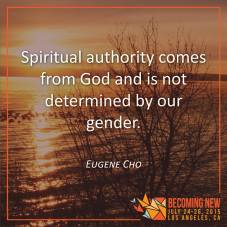
Egalitarianism in short.

Egalitarianism in short.

So Piper would lament feminism and egalitarianism (the Christian theology that God created man and woman equal, with shared authority; see this article or this one or this video, all from respected and notable theologians, for summaries of egalitarian theology) as ideologies that “dismantle God’s design.”  Often, egalitarians also identify as feminists due to the shared goal of demolishing patriarchy, which egalitarians see as a heresy in opposition of God’s design and will for humanity.  Egalitarians believe that God created man and woman in His image (literal translation of ezer being “corresponding strength” rather than “helper”), gave both authority over creation, and hierarchy came as a result of the curse in Genesis 3.  Throughout the Bible there are women functioning outside of complementarian gender roles, and in the New Testament we see the Holy Spirit falling on both men and women, and women serving alongside men in leadership in the early church.  Here is a good response to John Piper’s masculine view of Christianity.

While Christians have always held different views on many theological issues from the advent of the Church, it is common for complementarians to treat their view of gender roles as a critical aspect of the Gospel and to besmirch their egalitarian brothers and sisters with accusations of insincerity and rebellion. The Whartburg Watch wrote a post this year called, “Owen Strachan, CBMW, John Piper and David Platt: Gender Whackiness on the Rise” demonstrating this trend of elevating gender issues to be on par with the Gospel.
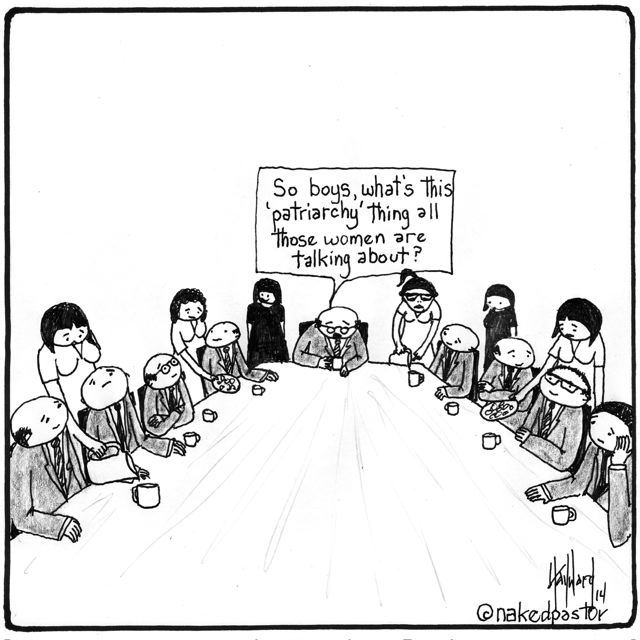
the-patriarchy (1)

But back to Kristen’s polarizing image and characterizations of feminism.  Is it true that at it’s root, feminism is devoid of God?  If so, why are so many Christians identifying as feminists?

First of all, it is true that “feminism wears many hats” and cannot be flatly defined, in the same way that Christianity comes in many forms, traditions and political leanings.  For example, Baptists.  There are over 1,400 Baptist denominations in the United States.  To some who hear the word “Baptist,” there is a visceral, biological response because of their negative experiences with Baptists, who can be judgmental, unloving and legalistic.  I have personally known Baptists to gossip, to be gluttonous and proud.  It can be controversial to bring up the topic of  Baptists.  It can be polarizing to identify yourself as a Baptist.  So it is probably best not to identify with that word.  Just call yourself a Christian!

See what I did there?  I could change “Baptists” to “Pentecostals,” or “Episcopalians,” “Methodists,” “Congregationalists,” or “Presbyterians” for the same effect.  And if I really did believe that Baptists were misguided and I wanted to deter others from becoming Baptists, I could utilize that tactic.  Playing word games doesn’t really prove anything.  The fact is, there are no perfect denominations, political parties, or social movements.  But there are lots of social activists making positive change in the world towards values that I believe are in line with God’s redemption work.  Christians can partner with environmentalists, humanitarians, economists, social workers, politicians, educators, health professionals, counselors, scientists, and even feminists, in the work of redeeming God’s creation to it’s pre-curse state.  A feminist, atheist, Democrat, you-fill-in-the-blank is a person created in God’s image and loved dearly by God…I personally couldn’t call any imago Dei “devoid of God.”  There is common grace among all of humankind.   And has the Bible already solved all of the world’s problems and restored us to God’s design and will for humanity?  Clearly there is much work to be done, and Christ has given us that work to do.  Do I agree on all issues that all feminists tout?  No.  Do I agree that patriarchy is from the curse and has no place in Christ’s redeemed Kingdom?  Yes.

Among many conservative Christians, the word “feminist” is spit out with disdain and horror.  Feminists are accused by conservative pundits and pastors of  ruining our country with their liberal agendas.  They are compared to militants who see their gender as superior – “feminazis.”  I am not familiar with the categorizations that Kristen uses to describe feminists.  Her primary attention goes to addressing “equality feminists” though, so that is what I would like to respond to.

Like Kristen, I was a complementarian for nearly thirty years.  I respected the same theologians and teachings that she points to in her writings.  I won’t go into detail about my change to egalitarianism, as I already posted that story here.  In short, it was at God’s prompting that I began reading about women in ministry and egalitarian theology, and I became convinced that the complementarian theology of gender roles was wrong.

I didn’t come to feminism through a desire to usurp the authority of men.  I came to egalitarianism (I believe through God’s direction) and some of my conservative Christian friends began cautioning me about the slippery slope that I was on, and began jokingly referring to me as a feminist.  Not because I was arguing for abortion rights or burning my bras, but because I was asking questions about gender roles in the Church.  “Feminist” is a slur in the context of my upbringing.  Looking back, I understand that this negative response can be a powerful deterrent to keep group members from challenging the status quo of patriarchy.  It didn’t take me long to adopt the title feminist, as I couldn’t shake it and I was becoming more and more impassioned to see change in the world for women who are marginalized and abused by systems of patriarchy.

Kristen Clark’s term, equality feminism, sounds to me like a euphemism for egalitarianism.  I believe she is using this term, which is considered deviant in conservative Christian circles, to paint egalitarianism in sinister terms.
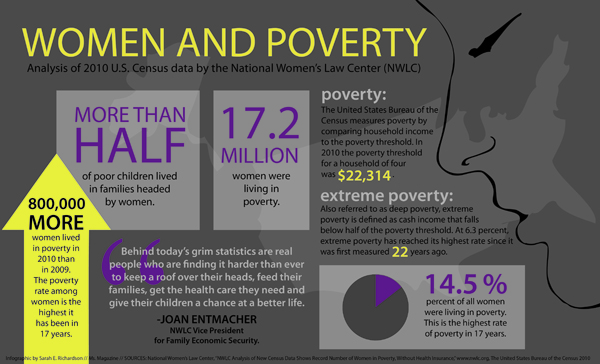
povertyI began to see that “fighting theological battles” (i.e. blogging) like egalitarianism vs. complementarianism is critical to liberating women and girls around the world who suffer the most from the systems of patriarchy and poverty and war, etc.  Becky and I share articles every day on our FB page detailing the horrors and injustices of the world’s most vulnerable inhabitants.  If it is feminist to care about these issues, then yes, I’m a feminist.  For important reference points on gender issues around the world, here are two excellent articles:

We need feminism – Rachel Held Evans
Christian Compassion or Complicity: The Abuse and Gendercide of God’s Daughters – Dr. Mimi Haddad
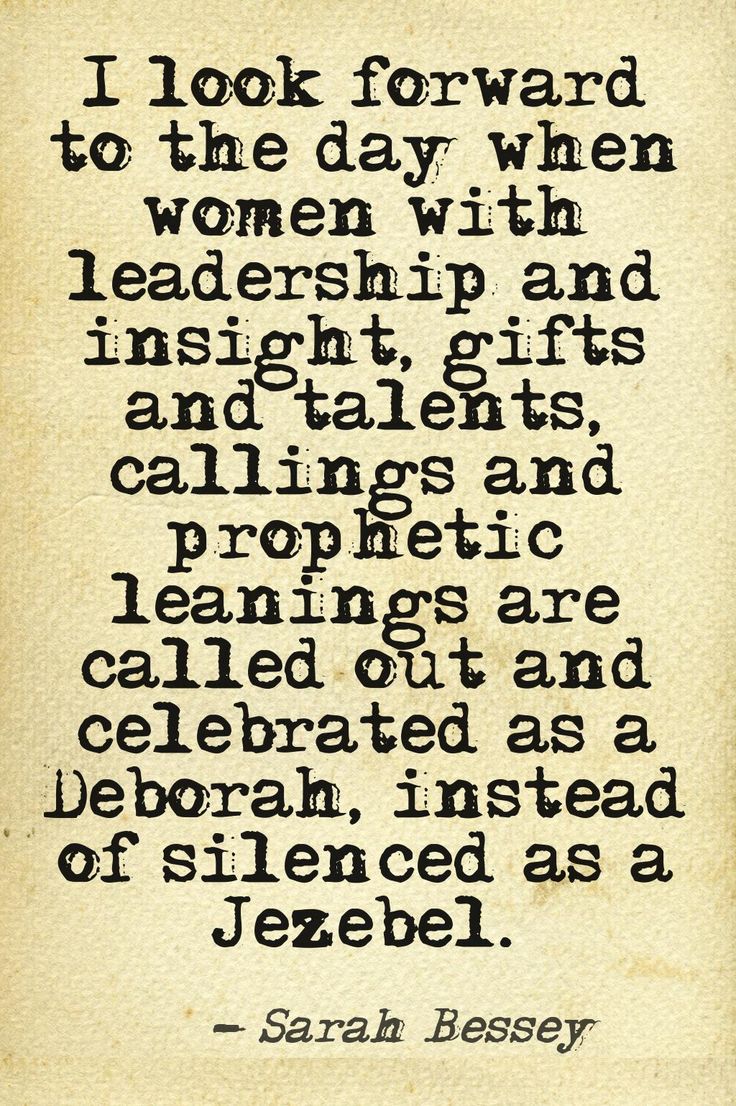
e4c2e61dc0186b4ebe317ab0bcc67f33And in thinking about the roots of feminism, which Kristen Clark says are devoid of God, it is a fact that many of the earliest feminists were Christians who were trying to improve the lives of impoverished, disenfranchised, suffering women and children of their day.  The blog Making a Track, by Rev. Jonathan Inkpin, celebrates the lives of early Christian feminists and is an excellent resource for learning about inspiring Beautiful Kingdom Warriors.

I am going to leave off with a comment that I found under Kristen Clark’s article from a wonderful Beautiful Kingdom Warrior who took the time to advise her Christian sisters in the better way, skipping right over the references to feminism (i.e. egalitarianism?) and getting to the heart of the matter–gender roles:

I too used to believe in the headship/submission form of marriage. But now, in my 50’s, I have changed my view. Please understand- I am in love with Jesus more than ever before, am pro-life, am a pastor’s wife, home school mom, been married to the same man for 27 years, teach Sunday school, and lead worship at our church. But I now believe that God created husbands and wives as equals, friends and co-heirs in the promises. After counseling many women who were verbally and sometimes physically abused by their Christian husbands, I studied the verses that cause so much pain. What I learned is this:

1) Eve was Adam’s helper, but this didn’t mean servant or maid. We don’t see Eve helping Adam by washing his clothes or cleaning his house; she was created to help Adam rule the world. As woman, she was given equal status as part of “mankind.” She had equal responsibilities and equal blessings. It appears that as salt is to pepper, peanut butter is to jelly, Eve was Adam’s Helper in that she helped to complete the set: man + woman = mankind. This was God’s beautiful, original design for husbands and wives.

2) At the fall, Eve was cursed, with all women, to be ruled by her husband. Ever since the curse, in nearly every society, women have been ruled by men. In some cultures, women are the legal property of their husbands and can be abused, sold, or even killed.

3) In the Old Testament, slavery is always mentioned as a curse, never part of the blessings for God’s people.

3) Jesus broke that curse, along with every other curse, at the cross. Christian women are now free- co heirs with men once again to enjoy all the blessings and promises of God.

4) In 1 Corinthians and 1 Timothy, Paul has many rules for women.  They are told to keep silent in church, wear head coverings or wear long
hair, and never teach a man. Paul says women “are commanded to be under obedience as also saith the law.” But why would Paul, who in Galatians says
that “Christ has redeemed us from the curse of the law,” and now “there is neither male nor female; you are all one in Christ Jesus,” and “if you are led
by the Spirit, you are not under the law,” now put women (half the church) under the law? I think Paul was trying to jolt these churches back into grace. This
makes sense considering how in 1 Corinthians 3:1-3 Paul tells the people that he can’t talk to them as Spirit filled believers; because of their carnal
behavior, he must speak to them as people still under the law.

5) In Philippians 4 and Romans 16, Paul mentions many women who were ministers, deacons, teachers, laborers, co-prisoners and co-workers for the Lord! These women were anything but silent. It seems these women broke the rules of 1 Corinthians and Paul was very happy for it! Why? Because they lived in grace, not legalism. Remember, the law kills but the Spirit gives life! It is for freedom that Christ set you free, do not be burdened again with the yoke of slavery!!

6) When Paul tells wives to submit, he tells husbands to love (agape) their wives. 1 Corinthians 13 tells us that agape love is patient, kind, and doesn’t demand its own way. This is, of course, the very heart of submission. So, in reality, Paul is telling husbands and wives not to demand their own way… submit to the desires of the other, just like Christians are supposed to act with all people at all times.

7) The husband is head of the wife, as Christ is head of the church… How is Christ our head? Is He demanding or patient? Is He angry or loving? As Christ gave us the example of how to agape love, husbands are to usher this kind of love into the marriage. They are the heads in that they are to be the model of agape love for their families. Nabal was “head” by being an angry, demanding
tyrant that no one could reason with (1 Samuel 25). Clearly God was not pleased with Nabal’s behavior!

Solomon, however, was “head” by not being demanding…. When his wife was tired and turned him away one night, Solomon didn’t throw a tantrum and demand his own way, he quietly turned and left. King Lemuel, husband to the Proverbs 31 woman, also ushered this Godly love into his marriage. His wife was an intelligent woman who pursued many interests during her lifetime. Lemuel gave her the freedom, one fellow human to another, to follow her creative desires. He was “head” by being respectful to her, considerate of her needs, and proud of her talents. She, in return, loved him dearly and did him no harm all the days of his life.

My advice to Christian women is to marry a man who will be a friend, not a ruler.

 Amen.

Thank you for visiting The Beautiful Kingdom Warriors!  Please “like” our Facebook page where we post articles every day regarding gender issues from around the world and the church.  God bless!

A Beautiful Kingdom Warrior’s Perspective on Race Relations in America

rosaparks

Becky and I began The Beautiful Kingdom Warriors this January as a place to empower Christian women and to host redemptive (redemption: n. the action of saving or being saved from sin, error, or evil) dialogue on gender issues within Christianity.  We chose to name our blog “The Beautiful Kingdom Warriors” because we believe that our role as Christians is to partner with God in the redemption of the world’s brokenness, restoring God’s kingdom on earth.  When God presented Eve to Adam in the Garden of Eden, it was as his “ezer kenegdo” (Genesis 2:18, 20; ezer appears throughout the Old Testament to describe God’s help in warfare – i.e. the Warrior bit).

A simplistic summary of the story of the world is: the Creation (all was good, according to God’s plan), the Fall (all is broken and in need of redemption), and God’s Redemption Plan (encompassing all aspects of God’s restoration of His creation to its’ pre-Fall perfection).  As Beautiful Kingdom Warriors, we are not only concerned with reversing the Genesis 3 curse of the subjugation of women, but of all aspects of brokenness in our world.

Approaching the new year, I do not want to move ahead on the blog without addressing racial reconciliation.  Between travelling for three weeks around Thanksgiving and the busy Christmas season at home, I have struggled to find the time or the words to share my heart on this issue.  This is not an easy post to “bang out.”  I am wrestling with my words, fighting to be helpful and redemptive, according to the vision of our blog.

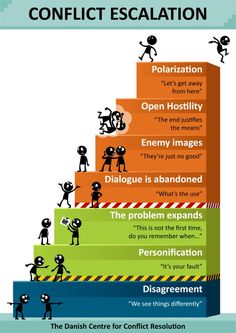
As the national debate on race relations reached fever pitch around Thanksgiving, I was sharing pertinent articles on Facebook and I received a private message saying, “Aren’t you worried about [my friends whose husbands are law enforcement officers]?”  I was a little taken aback, 07ff16ab8af9d0ae6728277d45ceeb61because of course I care about my friends and their amazing husbands!  But I hadn’t connected them to the protests.  I realized I hadn’t been viewing this as a “cops vs. protesters” issue–but many others were.  With a heavy heart, I have read posts (like this one and this one) that these friends have shared on Facebook.  I began to think about how we filter information through our particular lenses, and how conflict escalates in a predictable pattern, with an unfortunate but universal “us vs. them” rhetoric that polarizes people, forcing everyone to “choose sides.”  I firmly believe that reconciling race relations in our nation will be beneficial for everyone – especially our heroic men and women who put their lives on the line to protect and serve us and who are directly impacted and endangered by the heightened tensions and open hostility.  It is also beneficial for all when justice is served against police officers who have abused their authority.  Not even the Church is impervious to corruption, so it is too broad a statement to paint all police officers as “the good guys.”

The reality is that America has a long history of systemic racism and inequality that shackles poor black communities throughout our nation.  There are legitimate issues of injustice that need to be addressed and redeemed.  As Christians, we are commissioned to partner with God in making peace and mending brokenness.

About twelve years ago, I signed up to go to Tennessee to build a home with Habitat for Humanity over my spring break from Gordon College.  There ended up being twice as many students as spots on the bus, and an impromptu Racial Reconciliation trip was formed, for which I was picked at random.  That week in Washington D.C., we spent each day visiting Beautiful Kingdom Warriors fighting for their black communities.  We stayed at The Little White House, a center for racial reconciliation conversations.  We visited local pastors, Congressmen, a domestic violence shelter, a food pantry, a poorly funded school, an after-school program, a non-profit that collects school supplies for local children.  For the first time in my life, I was hearing from black people what it was like to be black in America (according to this article, typically only 1% of white peoples’ social networks are black).  I came back to Gordon and gave a speech in Convocation about my eye-opening experience.  I said that for the first time in my life, I learned that you don’t have to be a Republican to be a Christian (another polarizing “us vs. them” mentality)!  God taught me that it was okay to cross partisan lines and care about a “liberal” issue.

In seminary, I took a “Cross-Cultural Missions” class in which we read Jonathan Kozol’s heart-wrenching book, “Amazing Grace.”   This book grieved me so greatly.

Amazing Grace is Jonathan Kozol’s classic book on life and death in the South Bronx—the poorest urban neighborhood of the United States. He brings us into overcrowded schools, dysfunctional hospitals, and rat-infested homes where families have been ravaged by depression and anxiety, drug-related violence, and the spread of AIDS. But he also introduces us to devoted and unselfish teachers, dedicated ministers, and—at the heart and center of the book—courageous and delightful children. The children we come to meet through the friendships they have formed with Jonathan defy the stereotypes of urban youth too frequently presented by the media. Tender, generous, and often religiously devout, they speak with eloquence and honesty about the poverty and racial isolation that have wounded but not hardened them. Amidst all of the despair, it is the very young whose luminous capacity for love and transcendent sense of faith in human decency give reason for hope. (Source – Amazon description).

Over the years, I have continued to read articles and books about systemic racism in America.  The statistics can be overwhelming.  Currently:

  1. 27 percent of black Americans now live in poverty, a two percent increase since 2009.
  2. According to last month’s Bureau of Labor Statistics report, the unemployment rate for black Americans now stands at a staggering 14.1 percent, a figure well above the already high national unemployment rate of 8.3 percent.
  3. White Americans now have 22 times more wealth than black Americans, a figure that has nearly doubled during the recession. According to the Census, in 2010, media household net worth for whites totaled $110,729. For blacks, the figure was $4,995.
  4. From June 2009 to June 2012, real median annual household income for blacks fell 11.1 percent from $36,567 down to $32,498. The drop for whites was 5.2 percent and 4.1 percent for Hispanics.
  5. According to the Census, 26.4 percent of households who report receiving food stamp assistance are African American, despite the fact that black Americans constitute just 13 percent of the total population.
  6. A study by the AARP found that home foreclosure rates for African American borrowers over the age of 50 were almost double those of whites.
  7. High school graduation rates, which strongly influence income and job hiring, continue to vary widely by race. A recent study found the following on-time high school graduation rates: 91.8 percent of Asian students, 82 percent of whites, 65.9 percent of Hispanic students, and 63.5 percent of African American students. (Source)
10458156_759451730801016_7531055755288946931_n

“It’s hypocritical to criticize rioters without criticizing the long-standing and systemic injustices that produced the rioting.” Christena Cleveland

Here is a large quote from a New York Times opinion post from economist Joseph Stiglitz that demonstrates how the widening income gap is at the heart of the issue for black Americans:

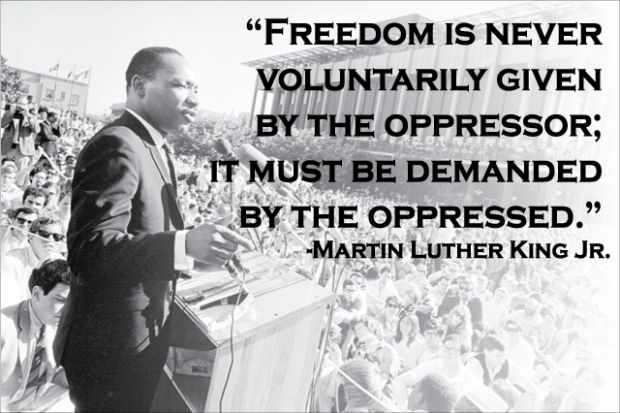
But Dr. King realized that the struggle for social justice had to be conceived broadly: it was a battle not just against racial segregation and discrimination, but for greater economic equality and justice for all Americans…In so many respects, progress in race relations has been eroded, and even reversed, by the growing economic divides afflicting the entire country.

The battle against outright discrimination is, regrettably, far from over: 50 years after the march, and 45 years after the passage of the Fair Housing Act, major United States banks, like Wells Fargo, still discriminate on the basis of race, targeting the most vulnerable of our citizens with their predatory lending activities. Discrimination in the job market is pervasive and deep. Research suggests that applicants with African-American sounding names get fewer calls for interviews. Discrimination takes new forms; racial profiling remains rampant in many American cities, including through the stop-and-frisk policies that became standard practice in New York. Our incarceration rate is the world’s highest, although there are signs, finally, that fiscally strapped states are starting to see the folly, if not the inhumanity, of wasting so much human capital through mass incarceration.  Almost 40 percent of prisoners are black.  This tragedy has been documented powerfully by Michelle Alexander and other legal scholars.

The raw numbers tell much of the story: There has been no significant closing of the gap between the income of African-Americans (or Hispanics) and white Americans the last 30 years. In 2011, the median income of black families was $40,495, just 58 percent of the median income of white families.

Turning from income to wealth, we see gaping inequality, too. By 2009, the median wealth of whites was 20 times that of blacks. The Great Recession of 2007-9 was particularly hard on African-Americans (as it typically is on those at the bottom of the socioeconomic spectrum). They saw their median wealth fall by 53 percent between 2005 and 2009, more than three times that of whites: a record gap. But the so-called recovery has been little more than a chimera — with more than 100 percent of the gains going to the top 1 percent — a group where, needless to say, African-Americans cannot be found in large numbers…

Despite rhetoric about the land of opportunity, a young American’s life prospects are more dependent on the income and education of his parents than in almost any other advanced country. And thus, the legacy of discrimination and lack of educational and job opportunity is perpetuated, from one generation to the next.

Given this lack of mobility, the fact that even today, 65 percent of African-American children live in low-income families does not bode well for their future, or the nation’s.

Men with just a high school education have seen enormous drops in their real incomes over the past two decades, a decline that has disproportionately affected African-Americans.

While outright race-based segregation in schools was banned, in reality, educational segregation has worsened in recent decades, as Gary Orfield and other scholars have documented.

Part of the reason is that the country has become more economically segregated. Poor black children are more likely to live in communities with concentrated poverty — some 45 percent do so, as opposed to 12 percent for poor white children, as the Economic Policy Institute has pointed out.

This summer, I read several articles detailing the history of racist legislation over generations in Ferguson (and similarly across our nation).  Legislation that has effectively ghettoized black communities.

Many of these explicitly segregationist governmental actions ended in the late 20th century but continue to determine today’s racial segregation patterns. In St. Louis these governmental policies included zoning rules that classified white neighborhoods as residential and black neighborhoods as commercial or industrial; segregated public housing projects that replaced integrated low-income areas; federal subsidies for suburban development conditioned on African American exclusion; federal and local requirements for, and enforcement of, property deeds and neighborhood agreements that prohibited resale of white-owned property to, or occupancy by, African Americans; tax favoritism for private institutions that practiced segregation; municipal boundary lines designed to separate black neighborhoods from white ones and to deny necessary services to the former; real estate, insurance, and banking regulators who tolerated and sometimes required racial segregation; and urban renewal plans whose purpose was to shift black populations from central cities like St. Louis to inner-ring suburbs like Ferguson. (Source)

White America has come up with a number of rationales for these enduring pockets of despair. An elaborate mythology has developed that blames it on a “culture of poverty” — holding the poor culpable for their poverty and letting our political and economic systems off the hook. A somewhat more enlightened view holds that whites simply fled areas like Ferguson — which had a population that was 99 percent white as recently as 1970 — because of personal racial animus, leaving them as hollowed-out, predominantly black “ghettos.”

But a study by Richard Rothstein, a research fellow at the Economic Policy Institute, comes to a very different conclusion. In his report, “The Making of Ferguson,” Rothstein details how throughout the last century a series of intentionally discriminatory policies at the local, state and federal levels created the ghettos we see today. (Source)

MLK_0

As Christians and Beautiful Kingdom Warriors, we should be concerned about income inequality and the insurmountable challenges that poverty places on black communities in our nation.  Throughout the Bible, “there are more than two thousand verses involving poverty, physical oppression and justice, and the redistribution of resources” (Jen Hatmaker, “Interrupted” pg. 19).  Here are some of the verses we find in the Bible about poverty:

If there is a poor man among your brothers in any of the towns of the land that the LORD your God is giving you, do not be hardhearted or tightfisted toward your poor brother. Rather be openhanded and freely lend him whatever he needs (Deuteronomy 15:7-8).

He saves the needy from the sword in their mouth; he saves them from the clutches of the powerful. So the poor have hope, and injustice shuts its mouth (Job 5:15-16).

“Because of the oppression of the weak and the groaning of the needy, I will now arise,” says the LORD. “Then I will protect them from those who malign them” (Psalm 12:5).

For he will deliver the needy who cry out, the afflicted who have no one to help. He will take pity on the weak and the needy and save the needy from death.  He will rescue them from oppression and violence, for precious is their blood in his sight (Psalm 72:12-14).

The poor are shunned even by their neighbors, but the rich have many friends. He who despises his neighbor sins, but blessed is he who is kind to the needy (Proverbs 14:20-21).

Speak up for those who cannot speak for themselves, for the rights of all who are destitute. Speak up and judge fairly; defend the rights of the poor and needy (Proverbs 31:8-9).

Woe to those who make unjust laws, to those who issue oppressive decrees, to deprive the poor of their rights and withhold justice from the oppressed of my people, making widows their prey and robbing the fatherless. What will you do on the day of reckoning, when disaster comes from afar? To whom will you run for help? Where will you leave your riches? (Isaiah 10:1-3).

“He defended the cause of the poor and needy, and so all went well. Is that not what it means to know me?” declares the LORD (Jeremiah 22:16).

“Now this was the sin of your sister Sodom: she and her daughters were arrogant, overfed and unconcerned; they did not help the poor and needy” (Ezekiel 16:49).

“Be merciful, just as your Father is merciful” (Luke 6:36).

“In everything I did, I showed you that by this kind of hard work we must help the weak, remembering the words the Lord Jesus himself said: ‘It is more blessed to give than to receive'” (Acts 20:35).

Listen, my dear brothers: Has not God chosen those who are poor in the eyes of the world to be rich in faith and to inherit the kingdom he promised those who love him? (James 2:5).

If anyone has material possessions and sees his brother in need but has no pity on him, how can the love of God be in him? Dear children, let us not love with words or tongue but with actions and in truth (1 John 3:17-18).

As a white American, I cannot understand what black Americans experience.  But I can listen.  And that is what I am urging you to do as well.  Let us not get caught up into taking sides in an “us vs. them” battle that will only lead to more violence and an escalation of conflict, but let us come alongside God in the work of reconciling the world to His perfect Kingdom.  Let us love our black brothers and sisters by listening to them, and lending our influence and privilege to the demolition of unjust power structures.

I will leave you with some powerful stories for your listening ears:

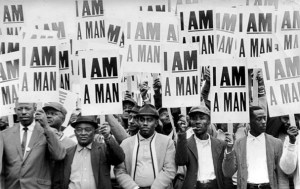
I am a man

“As we listen to Ferguson, we can learn from Ferguson – just as we learn from Montgomery and from South Africa. Many of the worst pits of oppression have later become the brightest beacons of hope. Some of the worst moments of injustice have sparked some of the greatest movements for justice. And those places known for acts of evil later inspire the world towards freedom a generation later – out of these places rise up people like Nelson Mandela and Rosa Parks.” – Shane Claiborne


Thank you for visiting The Beautiful Kingdom Warriors!  Please Follow our blog and “Like” us on Facebook, where we post lots of interesting articles from around the web dealing with gender issues in the Church.

Domestic Violence – Everyone is impacted and the Church needs to be making a difference

October is Domestic Violence Awareness Month.  TShirt_DomesticViolence542x600Becoming aware of the statistics is beyond sobering.  While gender-based violence is a worldwide problem, it is overwhelmingly present right here in our own backyard.  All month, I have been reading articles that shed light on the prevalence and realities of domestic violence, watching videos of survivors sharing their stories, noticing the purple ribbons in yards and trees as I drive here and there.

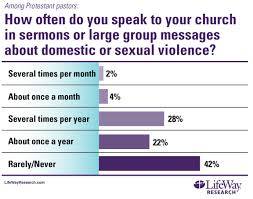
My heart is bleeding.  Every person is created in the image of God and is designed for dignity and shalom.  Violence of any kind dehumanizes others in a vile and evil way, and so I believe that Christians are called to advocate for domestic violence victims and survivors.  Not only is domestic violence as common among church-goers as the general population, but it is sadly missing from many Christians’ radars.

10653672_540932686036868_4005151008959911077_n

I remember the first time that I learned of the prevalence of domestic violence among Christian families.  I was in seminary taking a class called “Ministry to Women.”  Besides two other female seminary students, the others taking the class were the wives of male seminary students who could audit one class per semester for free.  Looking back, I am sad that the male students were not required to take this particular course, which would have illuminated the needs of nearly two thirds of their future congregations.  When our professor shared the statistics of domestic violence in the Church – how it is equal to domestic violence outside of the Church – I was shocked.  Then one of the wives told us that as an EMT, she couldn’t understand the coldness of her colleagues towards her until one of them explained that when they learned of her association to the seminary, they were thinking of the horrible domestic violence calls they had responded to in the dorms.  I was absolutely floored.

Jesus’ heart was for the powerless, and so should ours.  “The Spirit of the Lord is upon me, because he has anointed me to proclaim good news to the poor.  He has sent me to proclaim liberty to the captives and recovering of sight to the blind, to set at liberty those who are oppressed, to proclaim the year of the Lord’s favor” (Luke 4:17).
10527299_513457458784391_5215287369369355256_n
And so, in this post, I want to share what I have been learning and digesting this month.  In a Huffington Post piece from 2012, Soraya Chemaly says,

Globally and domestically, violence against women is pandemic. And it primarily happens in the context of the home. Women are the overwhelming targets of intimate partner and domestic violence. Everyone suffers. The women suffer long term social, emotional, physical and economic trauma. Their children, likewise — girls being more likely to become victims, boys abusers. Men who abuse are untreated, controlling, violent and stripped of their humanity. The societal costs are great: everything from increased poverty and homelessness to maternal mortality and expensive emergency health care provisions. The drain on economies is deep and clear. And last, but certainly not least, violence in the home is the surest predictor of violence at the state level, a tolerance for such violence reflecting a propensity for militarization and war. These violences are preventable.

In that same article, Chemaly shares 50 facts about domestic violence.  Here are a sampling:

  • Number of U.S. troops killed in Afghanistan and Iraq: 6,614
  • Number of women, in the same period, killed as the result of domestic violence in the US: 11,766
  • Number of people per minute who experience intimate partner violence in the U.S.: 24
  • Number of women who will experience partner violence worldwide: 1 in 3
  • Increase in likelihood that a woman will die a violent death if a gun in present in the home: 270 percent
  • Percentages of people killed in the U.S. by an intimate partner: 30 percent of women, 5.3 percent of men.
  • Estimated number of children, worldwide, exposed to domestic violence everyday: 10,000,000
  • Worldwide, likelihood that a man who grew up in a household with domestic violence grows up to be an abuser: 3 to 4 times more likely than if he hadn’t.
  • Percentage of U.S. cities citing domestic abuse as the primary cause of homelessness: 50
  • Percentage of homeless women reporting domestic abuse: 63
  • Percentage of homeless women with children reporting domestic abuse: 92
  • Percentage of women with disabilities who report violence: 40
  • Annual cost of domestic violence in the U.S. related to health care: $5.8 billion
  • Annual cost of domestic violence in the U.S. related to emergency care plus legal costs, police work, lost productivity: 37 billion dollars
  • Annual number of jobs lost in the U.S. as a result of intimate partner violence: 32,000
  • Average cost of emergency care for domestic abuse related incidents for women and men according to the CDC: $948.00 for women, $387 for men
  • Increase in portrayals of violence against girls and women on network TV during a five year period ending in 2009: 120 percent
  • Average number of times an abuser hits his spouse before she makes a police report: 35
  • No. 1 and No. 2 causes of women’s deaths during pregnancy in the U.S.: Domestic homicide and suicide, often tied to abuse
  • Number of women killed by spouses who were shot by guns kept by men in the home in the United States: 2 in 3
  • Percentage of rape and sexual assault victims under the age of 18 who are raped by a family member: 34
  • Number of women killed everyday in the U.S. by a spouse: 3+

A similar but much shorter list is BuzzFeed’s “11 Facts That Show How Widespread Domestic Violence Is.”  This is a great post to share on social media because it is short and eye-catching.  And The Center for Women and Families has a list of domestic violence stats here.

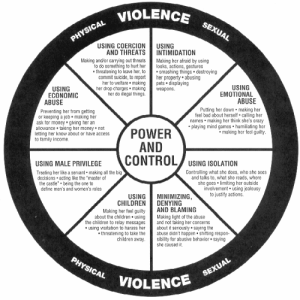
Physical violence is the most typical form of abuse associated with domestic violence, but abuse comes in many colors.  For instance, verbal abuse, sexual abuse, emotional abuse, etc.  The Power and Control Wheel (from the State of Delaware web page “Dynamics of Domestic Abuse”) is helpful in demonstrating this (go to the page for further descriptions):

power and control wheel

Justin and Lindsey Holcomb have a resource page on Moody Publishers linked from their book, “Is it my fault?” that I would encourage you to visit.  Their tab headings are “What is Domestic Violence?”“Understanding the Cycle of Abuse”, “Is This an Abusive Relationship?” , “Why Does He Choose to Abuse”, “How to Make a Safety Plan” and “God’s Grace for the Abused.”

On the Half the Sky Movement website, there is an excellent article explaining the impact of gender-based violence as the number one public health crisis for women throughout the world.  “To date, 603 million women live in countries where domestic violence is not outlawed and more than 2.6 billion live in countries where rape within marriage is not considered a crime.  Without  legal retribution, assailants rarely face consequences for their actions and the victims are less likely to report the abuse.  In some cases, women are concerned that they will  be the ones punished if they report the violence.  Other times rape and sexual assault are so stigmatized that the victim stays silent even if there are laws in place.”

I have been following several Christian blogs that exist to support Domestic Violence survivors and raise awareness.  Here is a sampling of articles so you can link to their pages:

TED Talks provides this excellent resource list of organizations combatting domestic violence, and I would recommend these talks. Stories of survivors:

silence unsafe relationship

Finally, I’m going to leave you with an article on The Gospel Coalition, in which Lindsey Holcomb offers seven helpful ways that the Church can reflect God’s heart for women at risk:

1. Stand with the vulnerable and powerless.  God calls his people to resist those who use their power to oppress and harm others (Jer. 22:3).

2.  Believe the women; don’t blame them.  Blaming victims for post-traumatic symptoms is not only misguided but also contributes to the victims’ suffering.  Research has proven that being believed and listened to by others are crucial to victims’ healing.

3.  Respond graciously, offering comfort, encouragement, and protection.  Also respond with tangible, practical care.  Spiritual and emotional support needs to be accompanied by actual deeds.

4.  Get informed and inform others about the prevalence of women at risk.  They can be found not only around the world but also right under our noses, in our cities and neighborhoods and in our churches and small groups.  The prevalence is staggering.

5.  Learn about the effects of sexual assault, domestic violence, and other forms of abuse.  The only thing more staggering than the prevalence of abuse toward women is the acute damage done to them.  Trauma is not only done to, but also experience by victims.  The internal and deeply personal places of a victim’s heart, will, and emotions need a clear application of the gospel of redemption, along with tangible expressions of love.

6.  Clearly communicate the hope and healing for victims that is found in the person and work of Jesus Christ.  Unfortunately, the message victims hear most often is self-heal, self-love, and self-help.  The church’s message is not self-help, but the grace of God.  Grace does not command “Heal thyself!” but declares “You will be healed!”  God’s one-way love replaces self-love and is the true path to healing.

7.  Get involved with the issue of violence against women.  This can include addressing the issue in small group settings, praying about it in corporate prayer, and working toward preventing abuse together with community and national organizations.


Thank you for visiting The Beautiful Kingdom Warriors.  Please Follow our blog, and “Like” us on Facebook.