
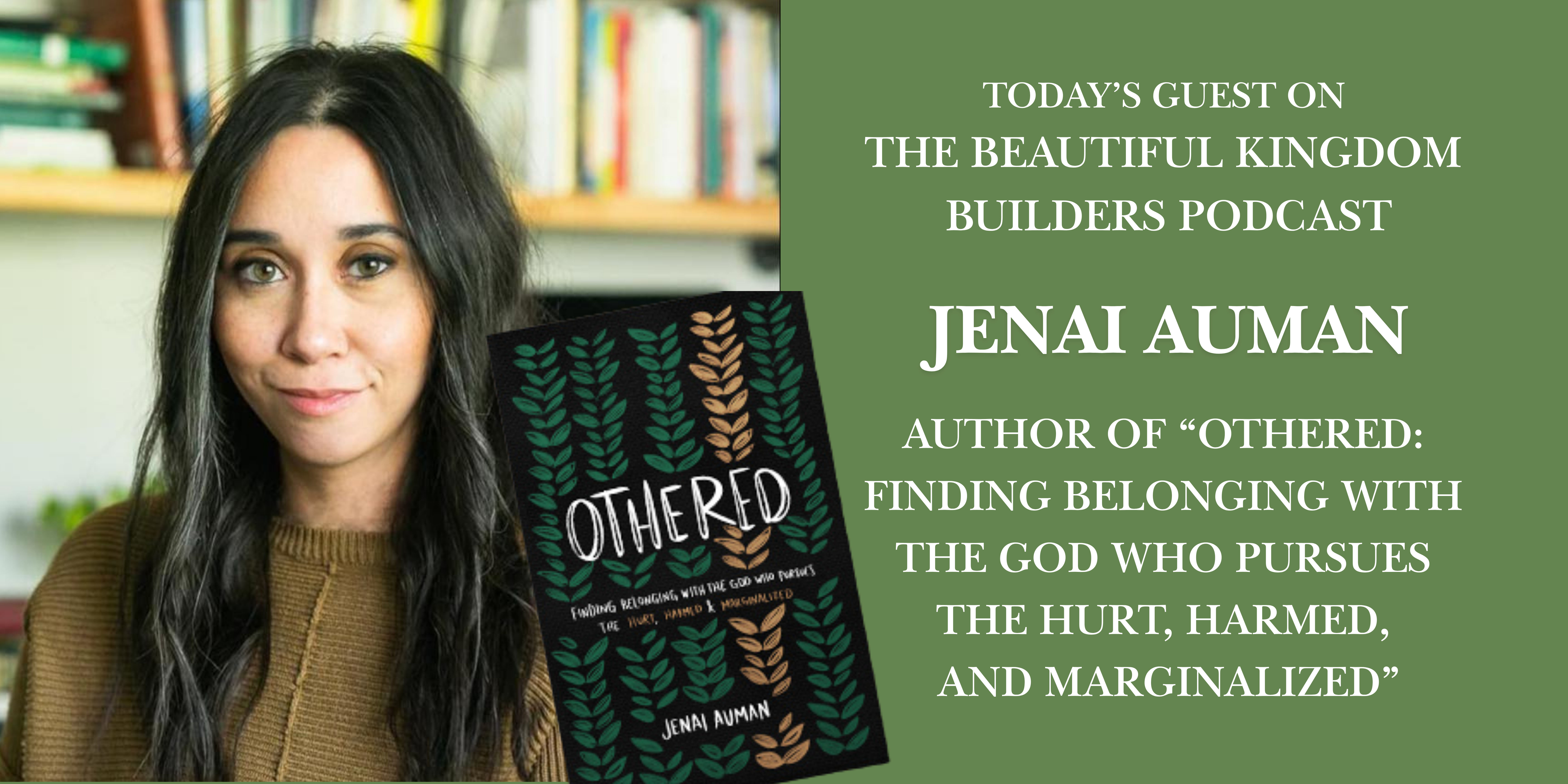
In this insightful interview, Jenai Auman discusses her book ‘Othered: Finding belonging with the God who pursues the hurt, harmed, and marginalized.’ She shares her personal journey as the daughter of an immigrant and surviving an abusive pastor as a church staff person. She explores the impact of trauma, and offers a trauma-informed perspective on healing, belonging, and systemic change within faith communities. This is a powerful resource for the hurting as well as those who are hoping to prevent and mitigate the effects of harm in their own church communities.
We talked about all kinds of behavior health science stuff, from family systems, to power dynamics, identity and group belonging, enmeshment, intersectionality, and to person-centered therapy. Be sure to follow me on a social media platform to catch reels from our convo with some of my favorite bits! In our conversation, Jenai mentioned the work of Kimberlé Crenshaw, Carl Rogers, and Henri Tajfel. She also mentioned her friend Rohadi Nagassar’s book, When We Belong: Claiming Christianity on the Margins and Paul Kingsnorth’s book, Against the Machine. And Jenai gives a great example of slowing down to care for the person in front of you from the newest, must-see Knives Out movie: Wake Up Dead Man.
Othered by Jenai Auman – https://amzn.to/4s4wBF0
Jenai’s website: bio.site/jenaiauman
Jenai’s Substack – Othered | Jenai Auman | Substack
Jenai’s Social Media: Instagram and Facebook
Please enjoy this important conversation on YouTube, Spotify, Apple Podcasts, Amazon Music, Substack, and more!
TRANSCRIPT:
Ruth Perry (00:15)
My guest today is Jenai Auman, the author of Othered: Finding Belonging with the God Who Pursues the Hurt, Harmed, and Marginalized. It was a fantastic book. I’ve listened to it two times on Audible, and I have to say your voice is like made for radio. It’s like butter. It’s beautiful. I was really glad I got Audible just to hear it in your voice. Your book explores how people are othered in church systems drawing on your experiences as a biracial Filipina American and from working in a toxic ministry environment. And your book offers a trauma informed path toward healing and belonging in God. It was fantastic. So thank you so much for being on the podcast today, Jenai!
Jenai Auman (00:56)
Thank you for having me Ruth, I’m so glad to be here.
Ruth Perry (00:58)
I resonated a lot with your book. I have spiritual trauma in my background from unhealthy church system that chewed up and spit my family out and kicked us while we were down. And so in my mind, your book is extremely important for Christians to read. I think it’s a sadly common story in the culture that we’re in for some reason, American Christianity. And I think one of the critiques that a lot of people feel with a book like yours is that it’s criticizing the church and they don’t understand that it’s coming from a place of deep love for the church and wanting the church to be what God wants it to be. And so how do you feel about that, Jenai?
Jenai Auman (01:35)
Yeah. Yeah, I, listen, I was a long time, even as a kid, I was a long time people pleaser. And even as a church staff member, I was a people pleaser to a fault, detrimental to my mental health. And I think a part of my healing journey, and I think that includes like, I did a lot of, you know, my own internal work before I wrote the book, that’s what I recommend for all people, do a lot of your own internal work before you write the book. I would say that I realized that you can please people all you want, especially in a church environment, and they will still subjugate you and subject you to horrible treatment.
I do care about loving people, certainly. I don’t know if you do Enneagram. I’m an Enneagram too. But I tell people I’m a two with teeth now because I needed my teeth to help me and to protect me. I’m okay with rustling a few feathers, but that’s also because I think that is a part of what it means to be the church. So I am critiquing the church by and large. I am also a part of the church.
And so some of the critiques are critiques of what I perpetuated. Some of the critiques are systems that I was a part of that I benefited from for a while until I couldn’t see it until it hurt me. And it was hurting me for probably longer than I acknowledged. And so now I’m okay. I understand if some people don’t like the book. I still think it is a part of the conversation. It’s not the entirety of the conversation. And I know that sometimes to make a more holistic, shalom-oriented community, you have to be willing to rustle a few feathers of the people in power. And I think I’m okay with that.
Ruth Perry (03:18)
Before we talk about your book, can you take us back and tell us about your background and your faith journey?
Jenai Auman (03:24)
Yeah, yeah, I tend to tell people I’m a spiritual weirdo in that I wasn’t raised in the church. I was feral as a child, meaning on Sundays we actually had like culverts and ditches in our front yard where I lived in the boonies. And I would be probably, I know we shouldn’t have done this, but playing in the ditches after it rained, skimboarding, doing you know, purely feral stuff as a kid and for that part of my childhood, I did love it. I Filipina. My mother is Filipina. She immigrated to Texas in the 80s and I was born in the 80s. And so I was baptized into the Catholic Church, which is a part of like Filipino cultural norms. My mom, I would say isn’t a practicing, she’s not a practicing Catholic. But baptizing your children is something that was very important to her. So she baptized me, baptized my brother. My dad, he was raised Southeast Texas. I don’t know if people know Southeast Texas very well. I mean, most people know Houston, which is where I am today. But I was born very close to the Louisiana border. And so what happens in that area, there are Catholic churches, but also Southern Baptist churches.
And also a lot of Pentecostal churches. And I’m talking about not only like the charismatic, sometimes you’d see somebody in a tambourine go around the sanctuary or something like that. But Pentecostal in the way of like they don’t cut their hair, they wear long skirts, things like that. So that is kind of the ecclesiological makeup of Southeast Texas. So I wasn’t raised in the church, but I was raised in an area where there were a lot of those three types of churches.
My dad, he had a beef with God. He had a beef with God since before I was born. So he was kind of culturally agnostic, vacillated between agnosticism and atheism. Sometimes he would say like there is no God or sometimes he would say, I don’t know if there’s a God. But antagonistic toward just the idea of God or toward anyone trying to pray over him or proselytize him. So that is my childhood. I remember my dad quoting Gandhi to me. I don’t even know when the first time I heard like the story of Noah in the ark, you know, and I feel like that’s a pretty standard church that kids learn about in Sunday school. I heard Gandhi and the quote was “I don’t have a problem with your Christ. I love your Christ. It’s your Christians that I have a problem with because they are so unlike your Christ.” My dad would quote stuff like that at me during elementary school. So a kind of strange cultural makeup. I think what I encounter in a lot of the deconstruction spaces or even the decolonization spaces is that a lot of people grew up evangelical. I grew up kind of adjacent to evangelical culture, but I wasn’t swimming in it.
When I opened the Bible for the first time, I didn’t know how to pronounce a lot of those words in the Bible, I didn’t know how to pronounce Isaiah and things like that. So I came to faith and I converted, I usually use the word converted. I think it’s less a Christian-ese. I came to faith, but I converted when I was 17. I kind of had like a traumatic, series of things that happened when I was later in my teens and at 17, I drove to the church that my grandmother was previously a part of and it really was kind of an effort to be close to her. Like she went to church every day. And so I thought I’ll go and I had lost her. She passed. And so I wanted to be near her. And so I drove to the church to be near her more so than to be near God at 17. So I converted to Christianity and I would say maybe, I don’t know, five years later, three, five years later, I had some semblance of like a trusting faith in the God of Christianity. So that’s kind of a, I guess a 30,000 foot view of my spiritual makeup.
Ruth Perry (06:55)
That’s interesting about your dad quoting Gandhi. in such a formative time of your life to have that perspective, then it gives you the lens when you are in the church of how the world is perceiving Christians, that maybe some people who are just always in that bubble aren’t even thinking about that on that wavelength.
Jenai Auman (07:13)
Yeah, I would say that my dad, you know, he deconverted probably in the 70s, maybe earlier than that. I don’t really know. He passed, I want to say 15 years or so ago. And my dad and I had a tumultuous relationship. So perhaps a lot of the reason why I didn’t listen to his advice was because I was actively rebelling against him. And so I know though, if he were here today, it would be the biggest, I told you so, you know? And it would be well deserved. I would get it. And in hindsight, I have a lot of empathy for what my dad suffered and weathered and how it was connected to his, like how his own wounds were connected to his church experience. yeah, I am, yeah, it’s such a full circle moment for sure.
Ruth Perry (07:55)
So your book is titled Othered. Can you tell us who are the othered?
Jenai Auman (08:00)
I didn’t want to name it an introduction. I wanted to name it an invitation. So the introduction is called An Invitation for the Othered. And I’ll just read the first few sentences. This book is for the othered, the abused, exiled, excommunicated, scapegoated, and marginalized, the misfits, the grieving, and the angry, the shunned and forsaken. This book is for those pushed out of faith communities and for those on the precipice of making the hard decision to leave. Or maybe you haven’t left at all, but you’re quietly existing on the margins because you’ve been hushed and bullied into falling in line after seeing too much. The words of this book are for you who do not know how you got here or what to do next.
So for me, the othered are the people who don’t fit or who have seen something in the cultural norms of the systems that they’re a part of and they no longer think that those norms are good for them at the very least or for the community by and large. And those norms usually aren’t good for people because it comes with abuse, because it comes with toxic relational dynamics. It comes with some sort of harm with racism or xenophobia or homophobia any any any harmful norm that is normal in a cultural system the othered or those who see it and are either actively resisting or trying to figure out what to do next or whether they feel free enough to resist so it’s a pretty broad category and I wanted it to be a broad category because I don’t think it’s just one particular group of people. It certainly includes those who’ve experienced spiritual abuse, but sometimes that language is not accessible to people. They haven’t quite named that experience for themselves or maybe they feel like spiritual abuse doesn’t name their experience. Maybe they would overtly call it racism or maybe they would over at which I would say racism, xenophobia, homophobia, trans, those things in the church are spiritual abuse. So I wanted it to be a broad term that invited many people who I think have a common experience, although it may look very differently from context to context.
Ruth Perry (10:11)
And can you share the moment when you first realized that that word described your experience in the church?
Jenai Auman (10:17)
I, like cognitively, I would say I believed pretty early on. I don’t think I use the word othered, but I remember in like talks and conversations, articulating specifically, I feel very other right now. And I kind of used the imagery of a table. Well, actually it was physically at a table. We were at a table with, it was me and my husband and then the six pastors who were pushing me out and thinking cognitively and I believe saying, this is not a round table conversation there’s one side of the table with the six of you and then another side of the table with my husband and I and so we are not there is not equal power here there is not equal value here I am other so it’s very early on that I latched on to being the other. And that is a long understood philosophical concept that other philosophers have studied for centuries. So I’m definitely not the one to coin that term. But as a title for the book, or just a title for people who have been harmed in churches in general, I would say about two years later I realized othered is a really broad and welcoming, kind of like an all-inclusive term for people who have just felt this sort of exile and ostracism from the church.
Ruth Perry (11:37)
How did your own experiences of being othered, both culturally and spiritually, shape your understanding of belonging and exclusion?
Jenai Auman (11:44)
Oh my gosh. so, Well, let me ask you, have you ever stepped into a room and you were like, I don’t fit here? How did you feel? What goes through your mind the moment you think I don’t fit here?
Ruth Perry (11:56)
You feel exposed and vulnerable and unsafe and not sure of how to proceed or maybe exit. It’s disorienting.
Jenai Auman (12:07)
Yeah, well, I would say I felt that feeling very early on in life. So I tell people whenever you have a parent who’s immigrated to the States, who doesn’t speak English as a first language, who barely spoke English by the time I was entering into kindergarten, Think about the time when you were entering kindergarten or elementary school. And you have your mom or a present parent who is explaining to you what it’s like to be in school, like what are the cultural norms of school? And so my dad by and large was not present in parts of my life. And so my mom was my primary caretaker for the early childhood. And I did not have a parent who could explain those cultural norms to me. So as far as being othered, being the daughter of an immigrant that’s like strike one, that was already a resource that I didn’t have. And so I from the from childhood would walk into rooms and not know what’s normal. I wouldn’t have been able to put the language to this but immediately trying to figure out how am I supposed to behave in this situation, what’s culturally acceptable? What’s what’s normal? What do I need to do?
And remember, like, I’m an enneagram two what do I need to do to get people to love me? And I don’t know what those things were. So yes, exposed, unsafe, vulnerable. That’s like the trinity of scary and afraid, like as a kid. And so I felt that at pretty young age. Obviously I grew up and I kind of found my teeth, figured out where my footing was. But still, would walk into situations. I’ll give you a, this is a funny anecdote. I’m a very tattooed woman and I wear Black. I have dark eyeliner on. I wouldn’t say I’m goth. I just like dark colors and I like this aesthetic.
And my husband is not this way. He is an Enneagram nine. He doesn’t know style. He’s just gonna wear the blue button up and the khakis to work as an engineer. Like that’s just what he’s going to do. And I remember the first few months at his job, maybe the first year at his job, I’d never met his coworkers until a Christmas party. And I, in my head kind of go through like, do I show up with like long sleeves, hide my tattoos at this, you know, professional Christmas party? Or do I just show up authentically? And I have chosen to show up authentically. And I think I surprised his coworkers. Like I clearly didn’t fit. And I thought, I think it’s funny now. I mean, it was like a harmless situation. And my husband came up to me later and he said, my coworker thought that I was married to someone. He was like, he wasn’t expecting you. And I was like, well, what, who was he expecting? And my husband told me Joe was expecting someone that looked like Laura Ingalls Wilder. And my husband was like, who is that? And I was cracking up and I’m a reader. So I know books. And I said, Little House on the Prairie. So they were expecting your wife to look like someone from little house on the prairie. And I show up tattooed with like almost a full sleeve and I love that. I love being weird now. Like I’ve embraced that part of myself.
And I think that is a part of belonging is learning to walk into these rooms where you don’t fit and maybe you don’t belong I know I don’t belong in certain cultural context now I know that I can walk into even a church even a church that says come as you are we welcome all parts of you; even a radically inclusive church I can walk in and still feel like I shouldn’t belong here, but I do belong to myself And so I have learned over the course of my life. that so often I abandoned myself and if you’ve read the book that you know this I abandoned myself and my preferences the things that make me laugh the things that delight me, but also my safety my sense of trust in myself trusting my gut I abandoned a lot of those things in order to belong in certain spaces. And so I think my experiences both in the church and out of the church have led me to this realization of like what it means to belong to myself, it means to have this inner sense of stability such that I trust my internal resources and I trust I have those internal resources that will say, hey girl, you need to leave, you are not safe here.
And so belonging, I think does include a people group. And I have that inner discernment that knows when I am truly welcomed into a space. And I have been in those spaces and I believe it’s beautiful. And when you know, you know that all of you is welcomed. I think all of us experience not fitting and we can either use those experiences as fear fuel to scare us into complicity or to compliance or obedience or it can be the inner well of wisdom that helps you better discern places that you want to be and show up and take up space in the future.
Ruth Perry (16:52)
Something I appreciated about your book, each chapter you give a biblical example of a character or a story that related to what you’re talking about. I know you talked a lot about how you related to the story of Joseph being betrayed in your personal story with your church trauma.
I’m a pastor and so I’ve been preaching through the lectionary for almost three years now. And this past Sunday, the text was from John chapter nine about the blind man who was a beggar and Jesus healed him with spitting in the dirt and creating a mud and sent him to the pool of Salome to wash. then instead of celebrating his entire community freaks out and they interrogate him basically. The neighbors don’t even recognize him anymore now that he’s healed. And the Pharisees keep saying, we know that you are a sinner or you were born in sin and we know that Jesus is not from God because we know from Moses. And they keep using the word we know, we know they’re so certain about their system. So I talked about systems in my sermon.
Could you explain to us, what does the word system even mean? What does it mean when you’re talking about a system and the church or in the church? And then how is othering a typical part of a church system?
Jenai Auman (18:06)
Hmm. Yeah, I am a seminarian. I’ve studied theology. I am not a biblical text scholar. So I usually leave that to my friends that I trust. But one thing that I learned from another friend, his name’s Rohadi, he wrote a book, When We Belong. And in his book, he mentions that there actually is a word for systems in the Bible. It’s the Greek word cosmos. And I think You can find it in Ephesians, “For our battle is not against flesh and blood, but against like the rulers and the principalities.” And there’s the word like the systems of the world. or the somewhere in there. And he says cosmos can be translated kind of as a system. I mean, the universe, the actual cosmos are a system, they’re systems of systems of inter like planets that rely on on gravity and proximity to one another.
And so whenever I talk about the word system, my undergrad is in behavioral health. And a part of my behavioral health science degree was learning about family systems. I thought I was going to become a licensed therapist, and that did not happen. But I do appreciate my education. And one of the things we learned in family systems is that everyone kind of has a role to play in a family system. And whenever there is some sort of harmful family dynamic or if there’s even an addiction within a family, you can’t just treat the person with the addiction. You actually have to treat the whole family because somehow, especially over the course of time, there are micro adjustments that people have made in their behaviors such that they’ve enabled a particular addiction or a particular behavior. It doesn’t even have to be an addiction.
For instance, if dad is never expected to do any of the housework and it’s falling all on mom or all on the other spouse or all on the kids and it’s wearing people down and like relationships are breaking down, well, the system needs to adjust because there have been micro adjustments over the course of years or decades that have allowed for this maladaptive behavior to foster. And so whenever I talk about systems in the church, I talk about something similar. Have you ever used family language of churches before?
Ruth Perry (20:14)
Absolutely, yeah.
Jenai Auman (20:15)
Yeah, and I would say in the same way a local congregation has adapted to certain behaviors. So you expect these certain folks to serve in the children’s department or the children’s ministry. You expect certain people to be preaching. You expect certain people to X, Y, and Z like be the ushers to pass out or distribute communion or take up the offering, whatever your norms in your congregation are, you have a certain family system happening. And my use of that language is that in toxic systems, there’s actually someone who’s dictating what the system looks like. They have a lot of the power that enables them to structure the system. And then people in power in a toxic system have none of the responsibility to execute the labor of the system.
And that is where I believe it gets toxic because you put a lot more undue stress. The load, the weight that everyone is shouldering and carrying is very unequal. And so when you have a lot of people that have a lot of responsibilities but no power to change the system, I would say that creates undue stress and lots of relational dynamics. There are fraught relationships. And so I tend to use the word system in that way, kind of in the family system way but for anyone who is familiar with, other like therapeutic modalities, there’s internal family systems. So, if you’re familiar, there’s the parts language of like a part of me feels this and a part of me feels like there’s just a lot of moving parts in a system, particularly in a local congregation.
Ruth Perry (21:49)
In your writing, you talk about how churches sometimes cause harm instead of offering refuge. Why do you think faith communities struggle to recognize when they are harming people?
Jenai Auman (22:00)
I think they struggle to recognize that they’re harming people because they haven’t done the work on the front end to acknowledge harm is eventually going to come. Like they haven’t done a lot of the proactive work of protecting the vulnerable. And when your cause of your organization, your mission statement or whatever is supposedly altruistic and someone is bringing forward an allegation that they were harmed under this organization and it goes counter to their mission statement and their mission statement is probably in their bylaws. It probably is how they drive donors and there’s a lot of reasons why a church would not want to help like foster repair.
And I will also say there are some churches, I believe, that are fostering repair. And I think a lot of them who are able to do that are acknowledging we needed to do work on the front end. Before there’s a crisis, you need to have a plan. Because if you try to construct a plan in the middle of a crisis, you’re going to hurt a lot of people. So many and I don’t subscribe to this anymore like the doctrine of original sin and we’re all sinful Like if you believe that then you should inherently believe that you’re gonna, even if accidentally even if unintentionally harm someone then have a game plan But those who I think there’s like an identity thing in churches again. It’s the family family dynamic of like, I’m a proud member of this church and almost proselytized to the degree of like bringing people into this church. What does that do to my identity when the leader of this church has caused a lot of harm? It not only hurts the organization, but the identity of every member of that organization. It’s almost too risky.
And usually in enmeshed systems where like identity and group think is so enmeshed. It’s hard to think that your altruistic, goodness, gospel driven mission could actually hurt someone and I think there are some people who do knowingly hurt others And I think they they also spiritually abuse their congregation in a way to manipulate them to perpetuate the hurt onto a particular victim. And also I think that there are churches that are unintentional about their hurt and they weren’t wise enough to do the proactive work on the front end to mitigate risk and actually center the vulnerable, center the poor in spirit, center the pure in heart, the peacemakers. They haven’t done the work of like, this is what it looks like for us to center these things. And I think it’s just easier to just sideline the hurt person instead of actually doing the work of changing the system.
Ruth Perry (24:29)
How does power factor into church systems and how can people with power other others?
Jenai Auman (24:34)
Well, and I think I mentioned this in the book, I don’t think I elaborated on it as much as I would have liked because of space, but power dynamics change and shift. So I do concede in the book that some pastors can also be spiritually abused. I think some people erroneously think that I’m always attacking pastors and that’s not necessarily the case. I think some pastors are spiritually abused by other pastors.
I also think that pastors, in a small church context, and I’m talking like very small church context, congregationally run, meaning they vote in and out and they decide your salary. I think the power dynamic shifts to a more social power. So whoever has the power to change the system, the power dynamic is in their favor. Whether that’s one man in a mega church or whether that is a handful of congregants who have the financial pull to make decisions and to vote someone in or out. Because I know there are different church systems that do things differently. Some pastors are appointed, some pastors found their own churches and it is built around them. Those are usually centered on the pastor. And then there are congregational situations where the congregation has full sway. And maybe not all of the congregation, but a few members of the congregation has full sway. So power dynamics change.
That’s why I love the work of Kimberlé Crenshaw. She’s a Black woman who’s, believe, a sociologist. She coined the term intersectionality. Intersectionality takes into account of different power dynamics among different groups. So for instance, there is this idea that intersectionality exists between the Black community and the white community. But you need intersectionality to acknowledge that the difference between men and their power and women. And that’s is women on both sides of the Black and white spectrum. so intersectionality takes into account all of these compounding identities of marginalization. And the more marginalized identities you have in a particular context, the more likely you are to be sidelined and ostracized. And so it’s not as the power dynamics change, they are intersectional.
For instance, women’s suffrage, in the early 20th century, late 19th century, I have been telling people that’s white women’s suffrage because women of color didn’t have the right to vote until much later, much later, not until like the Civil Rights Act. And so I tell folks like there was no intersectionality then it was really only white women who could vote because they didn’t see the intersection of race as an issue. And so power dynamics changed because the context changes.
And so it’s just important to learn and educate yourself more on power dynamics so that when you enter a new context, when I enter a specific space, I can kind of see who the power holders are and it gives me information on what I want to do with that. Do I feel safe here? Do I want to spend time here? And so, yeah, it’s so confusing and so complex that people study it. And I will say to anyone listening you can read about it and I write a little bit about it in the book.
Ruth Perry (27:40)
And on your substack. What is your substack?
Jenai Auman (27:42)
Yes, it’s jenaiauman.substack.com. It’s actually gonna get a rebrand soon. It’s gonna be a very fun rebrand. It’s like gentle and kind of orthodox, but then a little like spicy. I feel like that’s kind of the niche that I’ve kind of made for myself, but I do write a lot on sociological power dynamics and the politics of respectability, again, that is work done by Black women that I’ve learned from on the politics of respectability, how we all play the politics of respectability, and how I suspect that most people who don’t have very much power in their context don’t like playing the politics of respectability, but they feel like they have to. So yeah, I write quite a bit on that and I, yeah, I invite people to join me on Substack.
Ruth Perry (28:23)
So you’ve talked about how systems protect themselves rather than the wounded. What are some signs that a church culture has become more invested in self-protection than in healing?
Jenai Auman (28:33)
There’s this great work by a Psychologist named Carl Rogers, I don’t know if anyone’s familiar with him, but he coined the term person centered therapy Meaning what a particular person needs in their own therapeutic space like a client needs in their therapeutic space might be very different than what you as the therapist have been trained in or how you would maybe normally use one particular modality with a client, with this particular one, you may need to go a different direction because it’s not helpful. It doesn’t foster healing. It doesn’t matter that the other modalities have research on research about how they’re beneficial and adaptive and helpful 90 % of the time. If that’s not true for this person, you can’t go with the research, you go with the person. So I think in a church culture, they, they go off of numbers, kind of like research. This is what we’ve we’ve seen when we preach on this, we have less attendance, we know that people show up the most on Easter and Christmas. So like a lot of the decision making factors have to do with numbers, And that’s quantitative. I was an engineer early in college, obviously, I’m not an engineer anymore, but I retain some of it.
But I did quantitative analysis and that is strictly numbers. Like what do the numbers say? But healing for a person is qualitative. Person-centered therapy is a qualitative treatment. What is the quality of care look like for this person in front of me? And sometimes qualitative treatment is very costly. It is not profitable. It takes a lot of time. It takes a lot of energy. And I will also add, we live in a capitalistic society. So we have high emphasis on, you know, pick yourself up by your bootstraps. And we tend to devalue people who are unable to pick themselves up by their bootstraps, let alone acknowledging the fact that some people don’t have boots. And so qualitative care is very costly. It slows down the system.
I’m reading actually from a writer right now, his name is Paul Kingsnorth, and he has a book that recently came out called Against the Machine. And he talks about how the machinery of our societies, the mechanisms of industrialization of capitalism actually don’t see us as human. And when that machinery gets ingrained in the culture of the church, you see people who are hurting as obstacles that are in the way of the machinery of the church and slowing down to care for them is a problem. The recent Knives Out movie, what’s the name of that?
Ruth Perry (31:09)
Was it Wake Up Dead Man? Yeah.
Jenai Auman (31:11)
Yes, that one with Josh O’Connor as the priest and they’re trying to solve this mystery and he’s on the phone. I’m trying not to spoil it for anyone but he’s on the phone with someone who’s like chatty Kathy. And for anyone who has worked on a church staff, you know that those people exist. They’re just chatty. sometimes you enjoy it and sometimes they’re in the way from getting you back on track with the investigation. And then in the movie, this chatty Cathy hits Josh O’Connor’s character pretty hard with some real stuff and if you watch his face, it switches and he’s like, I need to care for this person. And Daniel Craig’s character, the detective is like, man, like we were solving a case and Josh O’Connor goes into another room to talk to this woman who’s going through something legitimate and real and cares for her.
Like caring for a person is costly when currency exists. I think money is made up. Money is a system we’ve created. But time is truly the only thing that we have and it’s dictated away. And he gave his time, his presence to a person, even if over the phone. And it cost him some time on the investigation. And I think some churches aren’t willing to take that time because whatever reason, whatever goal that they’ve created for themselves, not saying that an investigation for a dead person isn’t important, because it is, but caring for the person in front of you, I think that was like the most Jesus-like moment, like positive portrayal of Christianity in a long time, and especially from the Catholic Church. And so I think that is a good illustration of like why churches sometimes don’t care is because people are in the way rather than being viewed as people to love and human beings to care for.
Ruth Perry (32:52)
Yeah, I love that movie. And I do think the, if you think about it, the American church today does run like a business instead of like a family, even though families can be dysfunctional too. But I mean, we’ve become the temple system instead of being the harbor and the refuge for hurting people that drew so many people to early Christianity. And now we’re just hemorrhaging people and so many of them are walking away from their church experience with hurt and pain and it’s really heartbreaking to see that.
Jenai Auman (33:25)
Yeah, it really, it is, heartbreaking. But then I also know, number one, I don’t try to fix it. And I don’t try to fix anyone the book, but I also know like they’ve got to walk their own journey. And my hope for them is that they find something about themselves that they can reclaim along the way.
Ruth Perry (33:42)
Something that really often happens when someone has experienced harm or abuse and then they tell someone else and they expect to be heard. A lot of Christians have a very hard time believing allegations of abuse. Why is it easier to disbelieve allegations of abuse and othering and harm? And then when someone is disbelieved, how does that affect them?
Jenai Auman (34:06)
Hmm. Well, it’s kind of like going back to the machinery language. It’s easier to disbelieve them because nothing for the system changes. Like if I choose to say, I don’t believe you, then the system can keep going. There is actually a Polish psychologist, He’s a Polish Jew. His name’s Henri Tajfel. He was in the concentration camps or maybe prisoner of war camps, but he fought during World War II. And he survived. He came out of that experience. He decided he wanted to study in-group and out-group dynamics. And he eventually coined, I think with a student of his social identity theory, meaning how do we socially organize ourselves? And not only did he study that, but how can one particular in-group like Nazi Germany, hate another out group, like the Jewish people. And so he studied these things and how even the church was complicit. And a lot of it had to do with social identity, meaning who I am as a person is intrinsically tied to who this group is and how this group kind of congregates. Are you a sports person?
Ruth Perry (35:11)
I have a sports son, so I’m slowly learning.
Jenai Auman (35:14)
Okay, well, then we are not the people to be having this conversation, but I’ll use it as an example for people who are listening. I am not a sports person. I do not care. Like go without me. I will not feel like I’m missing out. If everyone in a group starts talking about a particular college sports, basketball, whatever, basketball does pique my attention a little bit. But other than that, I like go into my own happy place in my brain when that conversation happens.
Because I live in Texas people argue about sports in Texas, which is probably why I’m over it. When you are a diehard Cowboys fan and someone in your presence says something about the Cowboys negatively, like it is a fight because, and I think this is true, their identity as a human being, there is pride and a good pride. Or maybe a bad pride, I don’t know, behind the idea that I’m connected to this particular sports team. Such that there are people who have decked out their entire garages. They no longer park inside their garages in Texas because it’s become their man cave with their sports jerseys on the wall. I’m not even kidding. This is for real. And their identity is almost to a core personhood level, interconnected with being a particular sports fan or team fan.
I think something similar happens with the church. I think that’s how you get Christian nationalism. There’s something within the core of you that connects with this particular group identity, whether it’s the values they say that they value, whether it’s the sort of camaraderie that is established, how you laugh together, how you find quote unquote joy with one another, there there is an identity aspect. And to Henri Tajfel’s point, there was incredible identity among Nazi Germans. And if you’ve studied World War II documentaries or learned all about that stuff, you kind of know that Nazi Germany came out of a time when Germany was suffering after World War I, and then there was economic depression. And so they were trying to survive. Nazi Germany identity, I mean, it was formed for many reasons, but it was appealing for a lot of people. It provided them security in a way that they needed security.
And I think the church does something similar today. It provides a security for something within us that we need security for and so when somebody comes up with an allegation that challenges the group with whom we identify? They are not only challenging the system. Just by making the allegation it touches the people of the group, their insecurities because that thing that they so desperately cling to, it’s been destabilized by this allegation. And so it’s far easier to say, we don’t believe Emily anymore, or we don’t believe John because he’s not in unity with us. He proved that he was disloyal. That destroys a person. How much it destroys a person varies.
If a person has a strong support system outside of the church, I think that they have some stability. But if the church, if that group was their stability and they’ve been cast out, it is detrimental. It is detrimental to a person’s health. And that was the case for my family. Our families didn’t live close to us. Our church family had become what I would have called our found family. And to be disbelieved was to be annihilated. I didn’t know who I was anymore because that identity, again, it was an enmeshed identity that wasn’t healthy, had been taken away from me. And so it is detrimental, for sure.
Ruth Perry (38:51)
Your work is deeply trauma-informed. How did studying behavioral health and trauma shape the way you approach faith and spiritual healing?
Jenai Auman (38:58)
Well, I think it’s made me a space maker. So I’m not a clinical therapist, like I thought I would be. I love having a lot of friends who are clinical therapists, because I get to witness their wisdom. And then I am recipient of just this tremendous multitude of learning. And so even with my education, there’s so much I don’t know. But what I do know is that trauma is complex, again, person-centered. We all went through the pandemic together, but It’s affected us very differently. Some of us have very different like lungs now some of us have very different X, and Z now and so my education both in behavioral health, but also in seminary and Exegetical understanding it’s made me more spacious toward different perspectives. It’s made me less fundamental like you have to believe X Y and Z or if you don’t, then you’re not a true follower of like the best way of Jesus or whatever. I don’t do that anymore.
I understand now also that oftentimes because of trauma and wounds and the pain, if you don’t want to call it trauma, if you just say that you had a young adult experience, if you had a painful childhood, that religion and faith can be a stabilizing factor. It can not only be like a true essence faith, it can also be a coping mechanism. And so it’s just made me more spacious in understanding like there’s a lot that I don’t know. And perhaps the best gift I can give a person is not more information or education. It’s just to sit with them. And Ruth, that’s exactly what Jesus did. He just gave people wounded people his time and attention.
And so I actually realized that a lot of trauma information is found sometimes in just the way Jesus treated the marginalized and the oppressed and the wounded and the heat, like the people that needed healing. And so it’s just made me slow down and to resist the ways in which the machines of culture and the systems of culture have required that I speed up. Sometimes resistance is simply slowing down and paying more attention to the person in front of you.
Ruth Perry (41:01)
That’s so good. I know a lot of people, when they experience church harm, they feel like they have lost God in the process along with their institution. How do you help people disentangle God from their experience of church harm?
Jenai Auman (41:15)
Yeah, I think the how I would edit that question from like a trauma informed perspective is does that person want to disentangle God from their experience because they don’t need me telling them what they need to do or not do. I don’t feel like I need to defend God. That’s one thing that I’ve learned is God is so big (Also, not a man. So I try not to use he pronouns for God.) God is so big and so much more grand than we could ever realize. I don’t think God needs Jenai Auman from Southeast Texas to defend God when people are angry with God. So my question is really like, what do you want to do with your faith? What do you want to do? Like, where do you want to go?
And what do you want to process? Like as a friend, what do you want to process? We can process that. I had a friend come to me fairly recently asking me, hey, someone’s asked me to be a part of this group and X, Y, and Z. And I told her, I have opinions about this group. I’m not going to tell you what those opinions are. Again, person-centered. So I asked her, what sort of person do you want to become?
And could these people be a part of that? If you envision yourself living your best life or flourishing, what does flourishing look like for you? And what sort of people do you need around you to help you flourish? In the same way, I would ask like to your question, like your understanding of God is probably very informed by a particular worldview right now.
Like, what do you need to do to become the sort of person that you need to become? And if they want my opinion on a more expansive view of God, I’ll certainly give it to them. One of my professors, and he was quoting someone else, he said, you can’t teach someone theology in the middle of a storm. So if someone’s going through some stuff, like real life stuff.
You can’t try to throw deep theology that requires space to think about and process. You can’t give that to them because they don’t have space. They’re containing too much in their story. They don’t have space in their container for theology. And so my responsibility is just making space for them. And if there is one day space in their container to talk about theology, I certainly will do that, but I wouldn’t impress that upon them. That’s my perspective anyway.
Ruth Perry (43:30)
Yeah, no, I really appreciate that. That’s really good. I think for me, my very first really traumatic church experience was 15 years ago, For the past 15 years, I’ve read books and listened to people and gleaned things here and there and here and there. And I’ve learned to find my belonging within myself, like you talked about. And I’ve learned not to be so certain and fundamentalist about what I believe, but to have open hands because I’m probably wrong about things that I believe right now. And if God is love, then God loves me even in the areas that I’m wrong. And so a lot of those little pieces of my spiritual formation have healed over 15 years. But what I appreciate about your book is all the little lessons that have taken me 15 years to learn. You have in this little story, woven in with your personal story and with the Bible, just so much language that’s really helpful to heal. And so if anybody resonates with anything we’ve talked about today, I really encourage you to pick up by Jenai Auman and give give it a read. Listen to her read it to you on Audible. You’ll really appreciate that experience as well. And you have another book in the works, right?
Jenai Auman (44:45)
I do. I’m in the weird stage of what I want to do with it and how I want to write it. And I’m going slow. I’m also graduating seminary, in May. So part of me is like, girl, I need time. I need space. But again, it’s a part of my journey because of what I’ve experienced, I’m very active in activism spaces, social justice, because I have a mother who doesn’t speak English as a first language. And people look down on people who can’t speak English perfectly, I’ve learned since the Super Bowl, which is very frustrating for me. I am active in activism because of my lived experience, but how can you be active in activism and also like, it’s from that space within you where you become like a holistic activist. And so I’m kind of, I’m writing that book, but I’m also writing on Substack. I’m going to play with these ideas on Substack. I’m also on the internet and you can find me. I’m accessible. That’s how you and I found each other. So ⁓ I would love to connect with people. I am on Instagram too, but primarily heading over to Substack. Yeah.
Ruth Perry (45:39)
Yeah. I think it was what you wrote after the Super Bowl that I was like, I got to get her on my podcast. That was really good. And then I listened to your book and I’m just so grateful that you have spent this time with me this morning, Jenai, and that you’ve created this really excellent resource for people. And I hope that even if you don’t resonate at all with this language. I hope that you read it because you never know when you’re gonna be at odds with the system that you’re in. I mean, it’s a tenuous situation where you could be ejected at any point of departure from the social norms of that system. And it’s a really common experience, I think.
Jenai Auman (46:26)
Yeah, and again, I wrote it primarily for people who are trying to heal from this sort of thing. I’ve also wrote it for people who are walking with people and they don’t know how to navigate and you can read it along with them. And I think it’s a resource. I think it will be, unfortunately, timely for a while. I don’t think the issues of toxic systems and toxic churches is going to go away anytime soon. Although if it did, would be the biggest cheerleader. But yeah, I hopeful that it’s a resource for other people. I tried to write it to be a friend to others who didn’t have many friends in their lives.
Ruth Perry (47:01)
Well, you’re a beautiful person with a beautiful soul. Thank you so much for blessing others with your work, Jenai. God bless.
Jenai Auman (47:08)
Thanks
Please be sure to follow The Beautiful Kingdom Builders Podcast on your favorite platform: YouTube, Spotify, Apple Podcasts, Amazon Music, Substack, or more! Thank you for being a part of this important conversation today, and God bless you.




 The Beautiful Kingdom Builders