
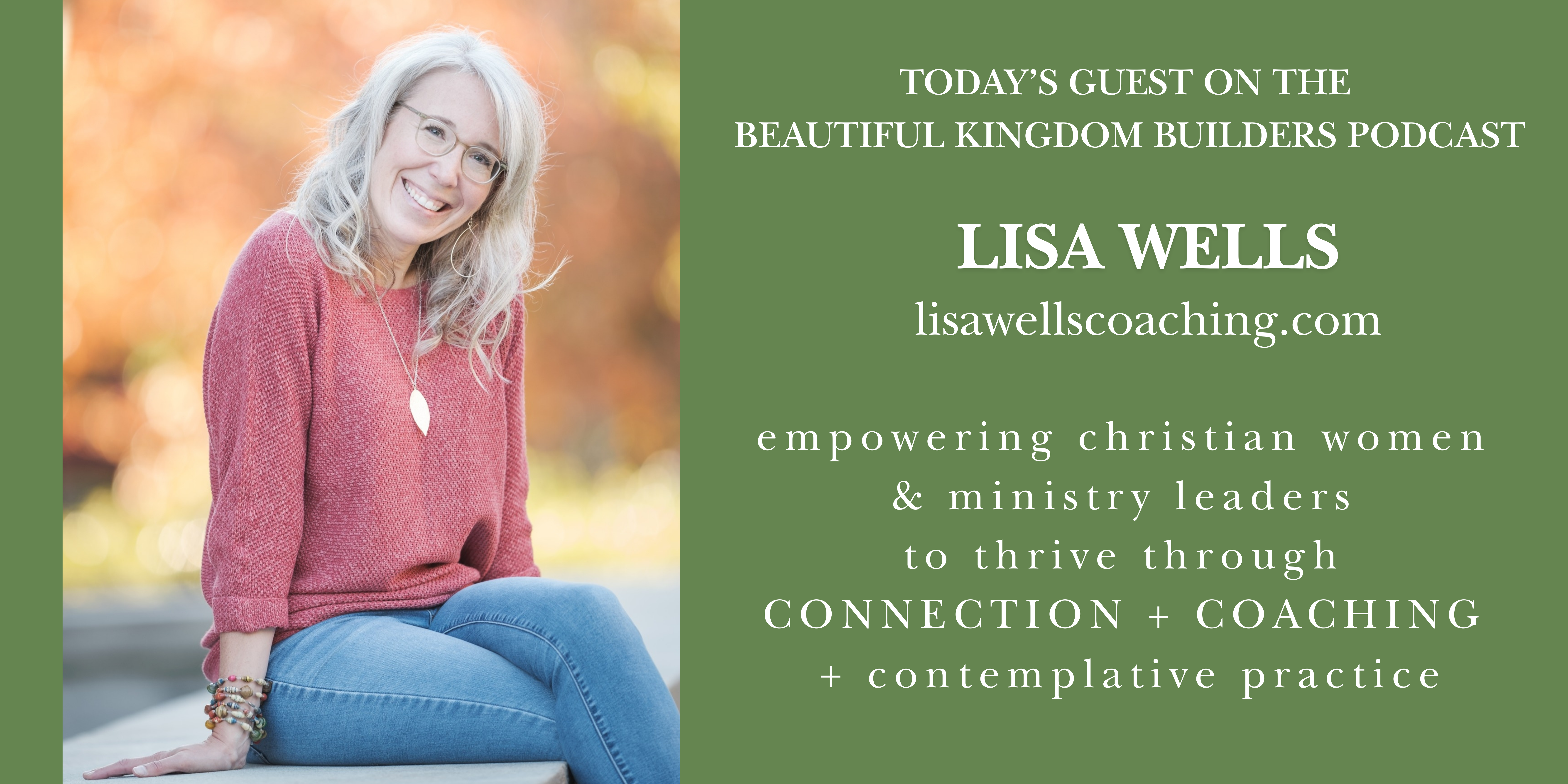
My guest this week is my friend and former pastor, Lisa Wells! In this beautiful and vulnerable conversation, we explored Lisa’s journey through ministry, the challenges she faced, and her growth as a leader. We discussed the impact of complementarianism in her life, the importance of community, and the healing that comes from navigating difficult experiences. Lisa shares how Ignatian Spirituality and contemplative imagination played a particularly powerful role in her healing journey. It was a painful season that led Lisa to coaching herself and she has a passion for serving women now in their healing journeys. Stay to the end to hear what Lisa has recently learned in her doctorate program about the unique stressors of pastors’ wives and women in ministry. If you’re in that boat and struggling, it is no wonder.
Lisa is a very gifted and wise coach (I can personally attest to this as a recipient of her holy listening and prodding). You can request a free call with Lisa to explore coaching for yourself on her website: lisawellscoaching.com
Lisa also provides options for group coaching, “married in ministry” support, and group contemplative practice.
In our conversation, I mention this article: Stages of Faith–A Map for the Spiritual Journey as a helpful resource for those who have hit a spiritual “wall” and are in a stage of falling apart, doubting, questioning, sinking, etc. This stage is precipitated by a crisis and is very painful, and unfortunately, most churches are not safe or equipped to meet people in this stage of their faith, which adds to the pain and isolation of this experience.
You can listen to our conversation on The Beautiful Kingdom Builders Podcast on YouTube, Spotify, Apple Podcasts, Amazon Music, or more! If you find our conversation helpful, please share it with a friend, rate and review, and subscribe so you never miss an episode!
TRANSCRIPT:
Ruth Perry (00:15)
I am so delighted to have my very dear friend Lisa Wells on the podcast today. Welcome, Lisa.
Lisa (00:23)
Thank you. I’m so glad to be here.
Ruth Perry (00:25)
Lisa was one of my pastors, for five or six years in Maine, and a close friend and now she’s my coach. And so I’m just really excited to talk with you today about your faith journey, about your walk with the Lord and the different seasons of ministry that you’ve been in, what it’s like to be a person in ministry as a woman.
The different expectations and obstacles and hardships you faced because of that. And then also just the good things that the Lord has done in your life through your ministry. And so let’s just dive in first going back about little Lisa. Where do you come from, Lisa? What has your journey with the Lord been like in those formative years?
Lisa (01:08)
Yeah, thank you. I’m so glad to be here and I’m so proud of you launching this podcast. Thank you so much for the invite. What a treat. So little Lisa, you know, the truth is I’m still getting to know her and still befriending her, but kind of some facts about her journey. I was born into a home that my mom was Catholic, but not really practicing. My dad was agnostic.
And so I was baptized Catholic, but my parents didn’t go to church for the first year of my life, didn’t really have an active faith. And then they moved and the house they moved into, their neighbors had been praying for them before they moved in, had been mowing their lawn and taking care of their yard. And so they just went over to say thank you when they moved in and that began a relationship. And that’s when both my parents came to what they call like their personal faith decision.
So from one years old on, I was raised in a family that really prioritized faith. And we were at church every time the doors were open. I went to a Christian school. I really said my first yes to Jesus around the age of four after coming home from Sunday school. just being in Christian school and being in church every time the doors were open, I had a lot of opportunity to learn about the person of Jesus, and I always felt drawn to him, always. I loved hearing his word expounded. I loved being in spaces where he was being worshiped and talked about.
And all of those environments were complementarian. And so my initial kind of understanding of what faith in Jesus is about was pretty gendered. And I was just aware as a young one that there were roles and opportunities that were available to me and there were roles and opportunities that weren’t available to me. As we moved from Rochester, New York to Columbus, Ohio when I was in middle school, that was kind of a hard transition. Middle school is a hard time to start over socially and in a new community that was tricky, but they had a youth group that was really important for me.
I ended up feeling really connected and called there and my first ministry role was the intern. I became a youth ministry intern and I just loved getting like this up close and personal vision and view of the nuts and bolts of daily ministry was really fun for me. I’m so grateful to my youth pastor and his wife for creating that role and allowing me to fill it. And I have these memories during high school, again, Christian high school, where I would have these study hall periods and I was doing word studies in scripture. I bought this Bible that had a Hebrew and Greek lexicon, it was giant. It was way too big. But I just felt so excited to dig in and really understand the word and explore it for myself.
I remember my first awareness of my calling into ministry happened at a church service and I was sitting in the auditorium and I could see my youth pastor and his wife, they were talking to somebody, they were close enough that I could really see the conversation unfold, but not close enough that I could hear anything. And I watched as my youth pastor’s wife really was probably the most animated in that conversation and was, just reaching out to this person and really being a pastoral presence to them. And I remember looking at her and thinking, that’s what I want to do. And I think I had that recognition because that was the most pastoral, interaction that I had seen from a female and it just felt like, okay, there is a path to utilize pastoral gifts. It just happens to be by being married to a pastor. So I made that decision then that I was gonna try to pursue ministry through being married to somebody in ministry.
After I graduated high school, I wanted to kind of spread my wings a little bit, try a different church community. And I had a friend from high school who was going to a church plant in Columbus. And he invited me along. And that’s where I met my husband who was currently working as a pastor. I didn’t target him, though one might think I would.
It’s like, hey, there’s my opportunity. But, you know, we just, started a friendship and as things unfolded, you know, really got excited about being in a relationship together and got married. Unfortunately, that church was not very healthy. So we had to extract ourselves from that situation very early into our marriage. And we ended up.
a little bit north where my husband was going to seminary anyway. And that’s where I started kind of my academic journey. Ended up going to undergrad at the same school where he was doing seminary and studied religion and philosophy and absolutely loved that. And at that point all of my ministry involvement was volunteer or it was alongside things that he had been doing. But the more I had experiences in those environments, the more I thought, okay, yes, ministry is what I want to do.
We had the opportunity to go more of an academic route. Dan, for a while, was thinking about getting a PhD, and I thought about furthering my education in that same direction, but neither one of us felt drawn to the academy the same way we felt drawn to the church. So we ended up getting involved in several church plants in Ohio and loved being a part of church communities from the ground up. What a gift that is to really kind of, build things and see what unfolds from that.
So we had the opportunity to become church planters and I remember being very affirmed when we did a very intense four-day interview that involved a lot of personality inventories and profiling and that kind of thing. And I remember learning that I had the most common Myers-Briggs personality type as what most pastors have. And I felt like, okay, like maybe.
There’s something to this that isn’t just the sidekick, right? E.N.F.J. Yeah, yeah, what’s yours?
Ruth Perry (07:31)
What is your Myers-Briggs?
cool!
I’m an INFP and Logan is the exact opposite. He is an ESTJ. What is Dan? Do you remember? Yeah. So between Logan and I, we got it all covered,
Lisa (07:41)
Okay.
He’s an INFP. He’s an INFP too. Yeah. Yeah. That’s so funny.
I love it. Yeah. So that was so affirming and you know, that’s what started our church planting journey is going through that assessment process and being confirmed to church plant, at which point we moved to Maine and that’s where I met you. rest is history.
Ruth Perry (08:09)
That’s right. That’s right. I’m kind of curious to know. I feel like my parents were first generation. Well, actually, they had both gone to church, but they became born-again Christians as and they had that fire of the Lord in them. And I kind of wonder if that’s where I got my love for the church that I hear in your story too, as a very young person. Do you think having
new to the faith parents influenced your love for the church in that way.
Lisa (08:39)
It probably did. That’s such a great lens on it. I’ve never thought of it that way. But yeah, they weren’t nominal. They really loved the Lord and loved being with people who loved the Lord. And yeah, there’s something to that.
I’m thinking of a Donald Miller quote in his book, Blue Like Jazz. He describes watching a jazz musician play jazz piece on the street. And this person’s just their eyes are closed and they’re so one with the music and up until that point I guess Donald Miller didn’t like jazz he said sometimes have to watch somebody love something in order to learn how to love it yourself There’s something to that.
Ruth Perry (09:24)
I’m also thinking about you seeing that pastor’s wife ministering and that that was how you came to imagine yourself in ministry. And for me, I grew up in the church and loved the church with the same kind of fervor that you did as a child and always imagined myself serving God in some capacity, but I had only seen women as missionaries or as And so I went to college to be a musician.
Lisa (09:49)
Wow, yes.
Ruth Perry (09:50)
And you, you’re a musician, you have that jack of all trades in your ministry toolbox. I feel like women are asked to do so much in the church that we wide set of skills that serve the church really well.
And then I’m thinking about how you seem like someone who does everything with excellence. Like that’s a core value to you. Is that true, Lisa?
Lisa (10:14)
That is so interesting, Ruth, because I have had such a journey in the last handful of years, probably five years, with allowing myself to be less excellent. There is something, wow, really tricky about excellence because it can become an end in itself, right, trying to seek that. And it can become idolatrous, I think, you know, where it becomes yeah, maybe not just an end in itself, but a means for like self-glorification and needing to be approved, needing to be affirmed.
And there’s something so just deliciously delightful about giving oneself the permission to be flawed, to be okay, something without being excellent at it. Yeah, I think excellence drove me for a my ministry life and it’s been sweet for the last five years to find a softer way. Excellence can be really a harsh master and a demanding master to kind of just soften into the reality that I’m limited, I’m flawed has been such a gift.
Ruth Perry (11:31)
And as a woman in a complementarian denomination, the excellence piece, I think, comes from wanting to be taken seriously and be valued and accepted for your gifts and the value that your gifts have to the building up of the church. And it’s not inherently there. And so the striving for perfection is one of those costs that we pay for being in a patriarchal system.
So we need to learn to have grace and to undo that piece. But it has probably also served you well.
Lisa (12:03)
It has, it has, right, like most things, upside and a downside. Yeah.
Ruth Perry (12:08)
So when I met you, we had gone through a lot of church hurt and we were living in Boothbay, Maine. And the church that you and Dan planted was in Topsham, Maine called North Harbor Community Church. But we met at an ecumenical Bible study first. A friend of mine, Melissa, brought me to Collette Pekar’s Bible study at the Seventh Day Adventist Church in Brunswick.
And you were participating in it so I got to know you as a peer and as a friend before I started attending your church. And coming from a pastor’s family myself I’ve always had more of a peer perspective on pastors and pastor’s wives and pastor’s families and understood that they’re not a commodity. They’re human beings.
Lisa (12:53)
Yes.
Ruth Perry (12:54)
I’m kind of curious about when you came and you started church planting and you probably had a lot of high expectations for what God was going to do through you and through your family. What was the honeymoon period like? Let’s start there.
Lisa (13:01)
Before the crash and burn? Yes. Let’s start at the honeymoon period. Yeah. The honeymoon phase. It’s interesting. I’ve been reflecting a lot on how God utilizes even our weaknesses, right? To help us and help others. It’s just a miracle how he weaves such goodness out of all things.
The honeymoon period I think for church planting, at least for me as a church planter, really had a lot to do with I held myself in really high esteem and I thought you know the thing that Maine hasn’t seen yet is Dan and Lisa Wells. Like that’s what Maine needs you know is Dan and Lisa in ministry.
And I look back on that and I think, honey, there was just a lot of hubris. And I think to a certain extent, when you’re starting something, anything entrepreneurial, right? Not to say that church is a business, but that spirit of starting something from scratch, there does need to be a high level of belief in yourself, in the outcome you’re going for.
You know, we, had been through that assessment. And so we had the backing of a denomination. This wasn’t just us, making up that we were ready to do this. Others had affirmed that for us as well. And so that honeymoon period really is just marked by that high belief of God’s doing something and we’re going to go there and join God in whatever God is doing.
And so, I look back on that time fondly, almost like the early parenting stages, when there’s just, you don’t know what you don’t know, but because of that, all is good. I do look back on it fondly and, the connections that I made. I don’t know how North Harbor drew the people that it drew, but we had such an incredible group of people whose roots ran deep with the Lord. They were open to true community with each other. They were okay with being inventive of like, all right, let’s try church a little differently. What might that be like? And so it was just a lot of fun to serve with people like that.
That’s right about the time when I was discovering, too, my excitement for kids ministry, which is so funny also because, I told the Lord in my heart, OK, I’ll do this. I’ll church plant. I’ll go serve in ministry alongside my husband. But, don’t have me in these stereotypical pastor’s wives roles. I’m not going to learn how to play the organ. I’m not going to be in kids ministry and come to find out.
I really, really got passionate and excited about kids ministry and youth ministry. That’s something that kind of marked the beginning of that journey too, is just this awareness and understanding that our kids are the church as well. They’re not our future church, they’re our present church and their experiences matter, their faith journeys matter. And so how to show up to them and minister to them as if that’s true, because it is was all part of that journey for me too.
Ruth Perry (16:10)
Well, as a family that was drawn to North Harbor, I’ll tell you that the kids ministry was a big piece of that because we had already seen a lot of unhealthy church environments and really wanted a safe place where my kids would learn a orthodox, beautiful picture of Jesus Christ. And your passion made the ministry at North Harbor superb. And also I love to see how everybody banded together to serve in kids ministry. You had so many volunteers and everybody was taking their ministry really seriously because you trained them really well.
Lisa (16:43)
Yes.
Ruth Perry (16:48)
To be in service at North Harbor. You did safety training. You did like a vision for what ministry to children is all about. And you taught theology to your volunteers. And so everything was well organized and missional and built for impact. And it has impacted my children. All of my children had that foundation. And I’m just really grateful to you, Lisa, for all that you poured into kids ministry at North Harbor, thank you so much.
Lisa (17:16)
Wow, thank you so much Ruth. I mean, one person can’t do it, right? I can share the vision, I can rally the troops, but if people aren’t willing to use their actual time, their actual bodies, their actual resources to do the work, it can’t be done. So yeah, I was blown away with how many people said yes to being on the inside of that journey. It was a beautiful time.
Ruth Perry (17:40)
And that team spirit wasn’t just in kids ministry, it was also in had rotating worship teams, you had different people preaching. It wasn’t just Dan up there all the time. I loved it when you preached, Lisa, you were always excellent. And I just loved hearing all the different voices and all the different people participating together. And then they had the technical team was just excellent in managing. You had to set up a church in a school building every Sunday and tear it down and leave everything in perfect spotless condition all the time. And you had just created this well-oiled machine that worked together to glorify the Lord and it was really beautiful. And so all the little pieces of North Harbor, it was really attractive for us as a young family, even as a family with a lot of church hurt.
It did feel like a safe place and a really diverse place that celebrated people’s gifts and gave people a place to contribute to the work of the church. It was unique. It was really cool. And so I’m just really grateful that we got to be a part of North Harbor for a while. We were there, five or six years before we moved here to Virginia. And I was heartbroken to leave. That was really painful because I felt like your family, all the other families at North Harbor, they were like family to me when we left. And so that was a pretty big grief to leave North Harbor.
Lisa (19:03)
Yeah, that was a hard goodbye. Thank you for saying all of that. It’s beautiful to experience something you love through the eyes of someone else, you know? So yeah, thank you for that little trip down memory lane.
Ruth Perry (19:20)
I do want to talk to you more for the Beautiful Kingdom Builders audience. I think a lot of people come to my page because they are women coming from complementarian backgrounds and they’re trying to find the freedom to use their gifts in the church and to fulfill their callings that God has given to them. And so I do want to hear more from you about your experience as a woman in ministry as you’re deconstructing your complementarian background. Tell me more about how you’ve grown in that area, Lisa.
Lisa (19:49)
Yeah, think, I mean, I was very staunchly complementarian for quite a long time. I, when I had a reorientation to faith as an older teenager, I had the opportunity to be baptized by a mentor of mine who’s female and I requested not to be. I thought that it would be better to be baptized by the male pastor. And I look back on that now with grief. know,
It’s so common that we end up repeating the patterns that we were given as kids until we look at them in a more thoughtful way. so, yeah, I think honestly, getting married to my husband, who is an egalitarian, was a big part of what started to open my eyes, which is so ironic, right? Because I was inhabiting this role as married to a pastor in a way that was limiting to me at first, and it ended up being the very thing that broke those limits.
And then also study, I ended up going on to John Carroll University in Cleveland and getting a Master of Arts in Religious Studies, and now I’m enrolled in a doctoral program at Gordon-Conwell in spiritual formation for ministry leaders. The more I read, the more I look at the witness of scripture, it’s just very clear that there has always been. It’s not a recent addition. Since the beginning of the human family, since the beginning of the church, there has always been a very clear invitation to women to use their gifts just like there is to men.
And I have been personally so impacted by the stories in the gospels of Jesus interacting with women. A couple of the ones that kind of rise to the top for me are the story of Mary and Martha. I have such a heart for Martha. She, in John 11, has a statement of faith that is right up there with the declaration of Peter in sharing the identity of Christ, right? You are the Messiah. And I’ve heard so many sermons over my life on Jesus’s declaration to Peter that on this rock I will build my church, right? When Peter says that Jesus is the Messiah.
But I don’t think I’ve ever heard a sermon on Martha’s declaration. And it’s the same, essentially, right? She’s saying you’re the Messiah. You’re the one who is to come. so, yeah, I just have such a heart for her, especially with the Luke passage and how she’s been tsk, tsked into, a better homemaker, a hospitality provider kind of role. And there’s just so much more going on in that passage than people have sometimes given her credit for. So I love that interaction. I also have been deeply impacted, especially in the last handful of years, by the Jairus passage that is sandwiching the woman with the hemorrhage.
Goodness, as someone who has three girls who have struggled, and that’s been part of my journey too. It’s been a really impactful part of my journey actually. I really have been so ministered to by Jairus’ faith and the faith of his wife. By the way that Jesus prevents the crowds from witnessing the little girl’s healing, right? It’s just Jairus, his wife and his three disciples that get to see that. Such a affirmation from Jesus that sometimes even in a religious leaders family there are certain things that are only need to know. And even if you’re living in a fishbowl in ministry Jesus sees all the hidden, all the inner, all of the stuff that feels too tender and too painful, he sees that and he’s willing to heal in private if that’s what we need.
And he’s willing to not heal in private if that’s what we need. think about the woman with the hemorrhage and how right in the middle of the Jairus story, she interrupts their journey and he’s willing to be interrupted and not only to allow power to go out from him to heal her, but he essentially hands her a microphone and he refuses to let her just slink away into the dark corners where she must have been living for the last 12 years. And she gets to say the why and the how of her healing.
So stories like that have been really powerful for me in appreciating that Jesus didn’t just invite women tangentially to be a part of the team. He saw them in their individual humanity and gave them an opportunity to be the fullest version of who they are. And that’s the work that I get to do now as a coach, which is such a gift.
Ruth Perry (24:39)
Before we talk about your coaching, I don’t know what you want to share about how you and Dan came to leave North Harbor after, how many years was it that you were in ministry at North Harbor?
Lisa (24:50)
It was 18 years.
Ruth Perry (24:52)
After 18 years. We moved away in 2017 and so far I’ve been able to get back to Maine once a year to see my family that’s there. And I went to worship one time when North Harbor was outside during COVID And I went to North Harbor when they were in a little church in Topsham. So I’ve kind of got to see North Harbor now and then and hearing from you and Dan that you struggling. I don’t know what you want to share on a public podcast, but whatever you want to share about how you and Dan ended up coming to leave North Harbor.
Lisa (25:30)
Thank you, Ruth. Yeah, it is still a story that I hold close to my heart and my chest because it involves my kids, right? But I can share just in general terms. They’ve given me permission to do that. So COVID, I mean, being a church leader through COVID was really, really hard. We were meeting in a school, so that was obviously not available to us. Even when people kind of went back to public services, masked and that kind of thing, like we were just not allowed back into the space, which makes total sense and was challenging. So we were online for a while, and then as you said, we met outside for a whole summer, which was really beautiful and kind of a wonderful way to have a sense of place as a church in Maine, you know, to meet on a beach. So that was really cool. And then, yeah, we found a temporary spot and then from there ended up moving into a lease of a smaller building. But that was just it was a lot of transition.
We ended up we had a staffing change that wasn’t very popular right in the early stages of COVID. And that was really hard. We had some people leave over that. But I think what was most challenging is the family dynamics that we were navigating at home. Having kids that were teens in the heart of COVID was really challenging. They were facing a lot of struggles that we were not honestly very prepared as parents to help them through.
Additionally, the way that Dan and I were handling the stress of the struggles at home, along with the stress at church with all these transitions and, you know, staffing changes and location changes and all the financial changes that happen when, you know, people leave. It was really, really hard and we did not have a very well developed tool belt for how to handle that stress and so my MO was to just try to get tighter with control and push everything through and we’re gonna make it and it’s gonna be okay and sometimes when there’s too much of a pushing and tightness, this desire to rein in the control, it can really backfire. And for sure, I can appreciate how it did not help the dynamics at home.
So yeah, we just got to a place where it was like crisis after crisis after crisis and we felt like we were at the end of our natural reserves and we needed to really shut everything else down except for what was most important, kind of like our bodies do, when we’re triaging some critical injury, It’s like all the non-essential things just get let go and it’s the survival that gets prioritized.
And so, Dan’s decision to resign really was that. It was the decision that our kids needed to come first, our own mental health needed to come first. Like many seasons of suffering, it illuminates how there are, certain things that were never really working well, but because situations were, a little lighter or, circumstances were less chaotic, those things didn’t come to light, right?
But once we right in the heart of this real life or death struggle for our family, all of our maladaptive coping skills just came right to the surface. And so, yeah, there were just a lot of things that we needed to work on that being in ministry while working on those would not have been fair to the people we were serving, certainly not to our kids and definitely not to ourselves and the Lord.
So, divesting ourselves from that role, right, of being in ministry leadership, definitely for Dan, because at that point he was the paid staff member. I was not in a paid staff role at that time, but still was very involved, in the ministry of the church. So stepping away from that was really, really hard, really, really hard. I think part of it was the identity crisis that it precipitated, because, when you see yourself in a role, that is aligned with your employment and then that employment is no longer there. It’s like, well, who am I? Am I still this person who’s been called to ministry?
I think another thing that made it really challenging is when you’re a person in ministry and you need to leave your church for any reason, those people are not just the people you’re serving professionally. Your parishioners often become your dear friends. And to extract myself from the very relationships that I needed at that point for support and love and care, that was really challenging. I felt like in the middle of it, I lost my family. And I’m sure they felt a sense of loss too and probably lose family in the middle of everything.
So just hurt, a lot of hurt and some of it was for sure unavoidable, but it doesn’t make it any easier to walk through, right? And then for our kids, grieving the loss of a church family for them.
Yeah, there was so much hard about that season. I remember being incredibly angry, with God because I felt like I had this narrative in my head, which is such bad theology, but it’s just what I was living with in the in the back of my mind, this narrative in my head that if I was faithful, that my family would be OK. And I was living in the middle of a family that was not okay, in a major way.
And I felt so disoriented by that, so angry at the Lord because it felt like, here we moved to Maine to start this church and it was, a sacrificial journey in some ways. In other ways, it was, really filling our cup more than emptying it. But when I looked back and I thought, if this ends up costing me my family? It felt so tenuous. Everything felt like it was falling apart. And the deep anguish that comes from not only not being at home with your church family, but not being at home in the same way with your biological family.
And then to add on that, not feeling at home in this identity and this faith that I had built for decades, not knowing is God even good? It was really, really hard and yeah, kind of a dark night.
Ruth Perry (32:22)
I’m so sorry, Lisa. That’s so heavy. And I think people even who haven’t been in ministry, I think that’s a relatable experience. It sounds like you hit a wall. And there’s this article that describes the book, The Critical Journey. And I send it to people whenever they’re like, I’m in this really dark spot. What can I do?
It’s a summary of the book, The Critical Journey, and it just describes what that wall experience is like. I’ve read that like 80 % of Christian churches are made up of people who haven’t gotten to that stage in their faith yet. And so their faith is still just very clear. hasn’t really been tested. And so when people do come to that wall experience, is so disorienting and painful and everything goes black or just gets really foggy and you just, you don’t know which way to go.
And the church doesn’t know how to respond to people in that situation. And so people do just leave. Maybe you could help us out with a little bit of insight into how your family got out of that. What was the process past that experience, Lisa?
Lisa (33:29)
That’s such a good question. Thank you for that. And thank you for naming what I think a lot of us experience in church circles, which is that there’s really good intent there, but there’s not always safety. And so for us to be able to hold this experience that, I want this to be the safest place, right?
But the version of me before all of this real struggle and trial was just not able to be present with other people’s suffering the same way. And so, yeah, I don’t hold that against anyone, but it’s just, it’s just true. Yeah, thank you for naming that.
Okay, how did we make it through? Still happening. There’s so much that is just, I don’t even know the word Ruth, I feel like relief, so much relief on this side of those events, but for sure the healing is still occurring. So I’ll kind of point to a couple of things that were key in the beginning and then maybe we can talk about how those are still unfolding for me.
In the very year that we walked away from professional ministry at the church we had planted, I signed up for certification through my coaches program. So I had found Dr. Edie Wadsworth with Life Mentoring School. She’s out of Tennessee and her program had been really helpful to me for learning tools that I didn’t know I didn’t know. Really important kind of basic human flourishing things that I just never learned. Things like how to manage my thoughts.
Scripture talks about this, right, about meditating and what is true and what is noble and what is good. It talks about renewing our minds, taking thoughts captive. But I loved all those scriptures, but I don’t think I understood the how of how to do that. And so, mindset management was a huge blessing to me when I started learning how to not just accept and go along with every thought that popped into my head, right?
And then also alongside that, and this was probably even more powerful for me, is learning emotional regulation and emotional processing tools. These are things that now we teach our kindergartners in public school systems with different kinds of emotional regulation, emotional processing curricula, but I never had that right and so I I didn’t know how to really be with my own emotions what I had learned from the church was how to not trust my emotions because they’re fickle and really, I needed to trust the facts, right?
So it was all about like replacing a lie with truth, which for sure truth is important. But what I never knew before I started this coaching journey is that our feelings do tell the truth. It’s what they tell the truth about. That’s what people sometimes are looking to them to tell the truth about circumstances. They don’t tell the truth about circumstances, but they do tell the truth about what we believe, about how we are experiencing something.
And so to be able to learn how to sit with anger, to learn how to sit with grief, and to befriend it actually, not to push it or control it or resist it. So that was really powerful. And then there were some other action taking tools that were also powerful from that coaching program. So I was just like, I need more of this. So I signed up to become certified and in certification, it was a deeper dive into all of those skills.
And so that came in clutch when I to walk out my faith and live with integrity as everything around me was burning. Being able to talk to myself with compassion, being able to sit with the rage and the despair, those were priceless skills. So that was one way that I was able to support myself that ended up blessing my family as well, going through that certification program and becoming a coach.
And then also, at the same time, I signed up for a program called A Retreat at Home through the Ignatian Spirituality Partnership of Maine. So I mentioned that I had gone to grad school in Cleveland at a school called John Carroll. That is a Jesuit school. That is where back in the early 2000s, I was first introduced to Ignatian spirituality. And I did my first eight-day silent retreat and was hooked.
Ignatian spirituality emphasizes something called imaginative contemplation of scripture. Which is where we use our imaginations to experience the person of Christ in Scripture. And it’s interesting, even though I knew Scripture really well coming from a very churched and Christian school background, I found that I was much more acquainted with Paul than I was with Jesus.
And in that time at John Carroll, I spent more time in the Gospels than I had ever spent before. I mean, just falling in love with the Jesus that is presented there. mean, what’s not to love? The power, the compassion, the speaking truth to power, all of that, I was gobsmacked by it.
And so this practice of imaginative contemplation where I was imagining these Gospel encounters that Jesus has. And I was, you know, either a character in the story in my imagination, or I was an unnamed character, or I was hovering over everything in a narrator perspective. But it gave me personal encounters with Jesus that I had never had up until that point in my more evangelical approach to scripture, which is for me anyway was more focused on study, which I still love and think is amazing and have wonderful experience with too. But this was just, it was involving my emotions. It was involving my imagination. It was involving this other part of my
And so doing that retreat at home and having daily experiences of imaginative contemplation was really important. When families are struggling, and parents are just playing whack-a-mole with crises, it’s just so critical that we are being poured into, that we are receiving in some way. And this practice of coming to Jesus broken, angry, bitter, all the things and just letting Him love me through what transpired in that practice of imaginative contemplation is life-changing.
I had a couple of experiences in particular, one that kind of really rises to the top, that Jesus just really served me and loved me in my hour of greatest need. So there is John 1 where just past the passage that everyone’s familiar with about “In the beginning was the Word and the Word is with God.” Right after that, Jesus calls his disciples. And there’s this interaction between Jesus and a couple of John the Baptist’s disciples. Because John points Jesus out, this is the one that I’ve been telling you about, the one who’s sandals I’m not worthy to untie, and they get curious and follow him as Jesus is going on his way and he turns around and he asks them, what do you want?
That’s amazing. Like just to let that question stand on its own and to ask it of myself as if Jesus were asking it of me. What do I want? And that was so powerful to sit with that and also to imagine it and imagine them answering it, right? And they do, they answer it and they say, we want to see where you’re staying. Where are you staying? And he says, come and see.
And in my imagination, it didn’t stop there. I was like, well, where would he have led them after that? So I’m picturing this whole thing unfold. And our imaginations are not Scripture. This is not divinely inspired in the same way that Scripture is. However, it was so personally meaningful to me because as I followed Jesus to where he was going and where he invited me to come and see.
He took me to this janky 70s apartment building where he was living on the bottom floor in this little apartment. And I followed him in and he gestured for me to sit down at this kitchen table. And he went, this is all wordless now. He went to the kitchenette and he started cooking. And I just sat at that kitchen table and he was cooking and I could start to smell what was being cooked. It smelled so delicious. And I kind of just felt myself like melt back into the chair. And then when the food was ready, he brought it over and he served me and he just sat with me while I ate.
And I just lost it when I told my spiritual director about that encounter. Because at that time it was at the height of everything going wrong. My kids seemed like we couldn’t go four days without some sort of major crisis scenario. And I was trying to buckle down and control. Dan was as well. We were both not our best selves, not our best parenting selves. And we were so exhausted.
And for Jesus to cook for me in the middle of that when I felt like everybody needed something from me at all times and there was never enough for me for him to just say with his actions, no words, I see you, I love you, let me cook you dinner. It just felt like love in a way that no propositional truth could have met me or communicated to me. So that practice of imaginative contemplation,
I actually now lead a group that practices this. We meet a couple times a month and the group is called Come and See from that passage in John 1. It’s just that’s continued to be formative for me.
So yeah, there’s the spiritual formation piece, to my healing, my feeling loved and treasured and not forgotten or discarded. You know, one of the lies that I was repeating over myself as things were all going wrong was that this is such a waste. This whole church plant was such a waste. And not only did it not amount to anything for Dan and I, it ended up hurting our kids.
And I think that imaginative experience at the table was the first time that I began to really receive His love. And gosh, there’s so much goodness and beauty that he can bring out of the worst possible scenarios. And when I was able to receive his goodness and his love and his provision for me in the middle of all of that is when I started to maybe kind of release that narrative that everything had been a waste.
And I look back on it now, our kids are doing so much better. Dan and I are both practicing ministry in a new way. Me as a coach and he as a spiritual director, we’re both in this spiritual formation program, doctor ministry program. There’s just so much good that God is bringing out of that time.
I do remember going to my coach in the middle of, just the struggling time in this certification program and my family’s, bleeding out. And I was basically questioning, can I even do this? And I was coming to her just basically saying, I don’t think I have the time management skills or the willingness to be visible or all the things that you need in order to thrive as a coach.
And she asked me some thoughtful questions. We got down to the place that I felt like I wasn’t sure that going through what we’ve been through and really stepping away from this church that we planted, I wasn’t sure that I had anything positive to give. Because here we had walked away from ministry and now I’m trying to help people in ministry? And she basically helped me question that and said, what do you have? Which is a question that Jesus asks to the disciples at the feeding of the 5,000, right? When they’re like, we don’t have enough. And he says, what do you have?
And I told her, said, I have a place in me that has been hollowed out by suffering. A place where I invite other women to come and be sad or be angry or be afraid. And to have that space held for them where they can just be honest about where they actually are. And that that ends up being the first glimmer of hope and healing sometimes. And she smiled and she said, that’s what people need. They don’t need a coach with great time management skills or who does everything with excellence. We need a place to be welcomed when we’re struggling, a place to be honest about what hurts, to dare to hope that maybe, just maybe not everything is wasted.
Ruth Perry (47:02)
There’s so much I want to respond to, Lisa. Oh my goodness. Man, it’s just such a beautiful picture of God’s redemption that He turned this thing that was so ugly and so hard into your new calling and your new ministry. And it’s just so beautiful. I’m also thinking about how often when we are broken open by something, that’s where God’s light comes in and God’s love comes in. And so these times of brokenness, we can look back and be grateful for them that they were actually a gift because of the redemption and the healing that we received through that. And in all the ways that we didn’t know we needed.
And I’m thinking about when you were going through your certification to be a coach and you offered some free coaching and I took you up on that offer. I had no idea what coaching was. And I don’t remember if we did it one time or two times, but for me, just having that conversation, you helped me to work through my imposter syndrome and my self-doubt and all the reasons I would give myself for not doing more with the Beautiful Kingdom Builders so that I had the courage to step out in faith and start this podcast. And so I need to thank you for that, Lisa.
Lisa (48:19)
Wow.
Ruth Perry (48:20)
I signed up for your group coaching. You have a monthly group coaching right now. And it’s just started in January. So it’s only been two times and both times I came to the group meeting, not knowing that I needed something just completely disembodied from what my life experience is, that’s one of the things that I feel is a carryover from growing up female in complementarianism because we do just cut off all our own needs. We’re focused on meeting everybody else’s needs. And even though I started this process of detangling from patriarchy 15 years ago, I’m still learning all the ways that it’s still in here ⁓ and just needing that push from you to have the courage to do this. And so thank you for that. And I just want to hear more about what your heart is for your ministry and coaching now.
Lisa (48:56)
Yeah, thank you so much and praise God. I’m so happy that any space I created for you ended up resulting in this. I mean, this is such a gift, what you’re doing. Thank you.
So I coach everybody and anybody, but really my focus of my outreach is focused on Christian women and specifically Christian women in ministry and in leadership roles. And that really comes from so much experience myself on that path. And so I feel like I can speak to people who are working through some of the challenges and some of the joys of being in ministry and what that can mean for our own personal faith and well-being.
I feel like one of the things that encapsulates what I do is really teaching people how to speak to themselves the way Jesus speaks to them. I think it is a lost area of discipleship. That very often we focus on, especially in church planting, it’s all about reaching the unreached, obviously very important. It’s all about this outward external focus on growth.
And what I’m discovering is that there’s a lot of people currently in the church and currently leading the church who have not fully embodied and integrated and aligned with the methods of Jesus in how they lead themselves and others. So if the way that we talk to ourselves would not sound at home in the mouth of Jesus, then we shouldn’t be using those words and those tones.
And just from my own personal experience, again, this whole idea of excellence and perfectionism, it’s actually something that plagues women in ministry leadership in particular to have a very high standard of expectations, not only externally, but internally. And so when we’re not allowed to be human, when we don’t allow ourselves to make mistakes.
Really, we just are encouraging a bifurcation of public and private life because nobody doesn’t make mistakes. We all make mistakes, right? And so what that perfectionism does is it forces a very harsh disparity between public and private. And then there’s so much shame that can thrive in all the private hidden places about the ways that we do fail and the ways that we do, miss the mark, which is what sin actually means.
So it’s just my honor and pleasure to get to help, specifically women in ministry, really learn how to use the voice and the tone and the words of Jesus as they speak to themselves. You know, we talked earlier about befriending the little version of me. There’s been so much healing and goodness that has come from that.
And so many of us, even in ministry, are expecting the fruit of the kingdom of God, but using the methods of the accuser, being really hard on ourselves, being really hard on others. Jesus says, like house divided against itself, a kingdom divided against itself will not stand. So I love doing this work of helping women really just gain the skill and then the practice of treating themselves the way Jesus treats them.
Ruth Perry (52:27)
It felt really holy, the times that I’ve experienced your coaching, just your skill at listening really well and digging into the issues, under the issues, and also just being seen by somebody. I think in our culture, we’re just all moving too fast, but as Christians who are called to love our neighbors. The practice of seeing people and just being present to them is really beautiful. And I think that’s what the church needs more of. And so where can people find your website and where are you on social media, Lisa?
Lisa (53:02)
Yeah, I’m on Facebook and Instagram at Lisa Wells Coaching and my website is lisawellscoaching.com and I would love to hear from your listeners. Reach out.
Ruth Perry (53:12)
I recommend they do. Yeah. And I thank you for all your time today, Lisa. Is there anything else you’d like to share before we say goodbye?
Lisa (53:20)
Yes, actually. I would love to talk a little bit about some research that I’ve done recently connected to my doctor ministry program. I took a class called Ministering to Women in Pain, and that class was incredible. And we each had the opportunity to choose a topic for research. And I chose the topic of loneliness and isolation in clergy spouses.
And it was so raw reading this research that had been done. Clergy spouses are an understudied population, but the studies that are out there do show some significant stressors that people married to clergy face. And it’s interesting because, I think this came through in my story. I certainly felt a calling to ministry. So my role in the church was not simply, mediated by my connection to Dan. And yet my connection to Dan did impact how I related to my role, how I related to the church body. So there were still some overlap there in how that all played out.
And so as I did this research, the stressors that really just kind of jumped off the page for me were obviously social isolation. That was a primary one. Perfectionistic expectations, that pressure for excellence always and boundary ambiguity was another one.
Then we’ve got some of the more contextual stressors of financial pressure and mobility, so moving from community to community. I know that depending on what denominational affiliation you have and what the requirements are for moving or what the compensation packages look like, those last two can really vary very widely from ministry family to ministry family.
But those first three, the social isolation, the perfectionistic expectations, and the boundary ambiguity are really in common among almost all clergy spouses. And the impact of those is particularly challenging for women because of some of the stresses that we hold even just as members of society. Some of the expectations that we hold, right, in the home and in the workplace and in third spaces in our communities, how our voices are welcome or not welcome.
So, I started to really peel back and look at what does the research say about what it means to carry a role that doesn’t have a job description. You know, there’s no professional development available to clergy spouses because it’s not a profession.
When the church goes through really challenging times, very often the person who’s employed as the pastor has some sort of network, whether it’s denominational or just other local pastors but the pastor’s spouse very often doesn’t have those connections, or at least not in the same way.
So it kind of amps up the struggle that they’re facing. So the social isolation can also be impacted by power dynamics. Well-meaning, relational connection that’s happening in the church is a layered reality because anything that we share about our kids, about our marriage, about our own faith and our own doubt and our own misgivings things that can come back and impact our spouse’s employment. So being very guarded sometimes about what we’re willing to share.
The social isolation of being left to do childcare duties during late night meetings or weekend responsibilities. If there’s kids in the home, that often is an intense reality for women who are married to pastors or women who are pastors who are married. They’re often expected to carry two full-time responsibilities.
And gosh, the fuzzy boundaries that really spoke to me too. This idea that is the church purchasing my husband’s attention and availability? And does that mean that he can’t turn off? Is the church purchasing my attention and availability? And does that mean that I can’t say no? Really just holding the complexities of these roles and trying to support now as a coach, as someone who is designing environments for women in ministry leadership, really just holding space for women to, first of all, unburden, say what’s true, talk about how these multiple stressors are impacting them in their actual physical bodies, their health, their mental health, their well-being.
We talked a little bit earlier about how we talk to ourselves. That’s where those perfectionistic expectations really come into play. You know, if we’re not allowed to be fallible, to have things that we wish we would do differently and not being able to be real with people about that can be really isolating and really challenging.
So as I’ve done that research, I just want to share with your audience, if you are a woman married to a pastor or if you are a woman pastor, it makes so much sense why so much of the role that you’re in, so much of the responsibilities and the challenges that go with that feel heavy sometimes. And part of my heart as a coach is to come alongside and give women opportunity to process that, to be seen, to be heard, to meet other women in ministry leadership who are also seeking a deeper connection with God and themselves and with others.
So I just wanted to make sure that research was something that I got to share a little bit with the people who listen to your podcast because it’s something that I wasn’t aware of as a pastor’s spouse and even as someone that was in ministry myself, Irrespective of my marriage.
It just, it’s a lot to carry and we need each other. We need support. So that’s something that I’m so privileged and honored to be able to provide as a coach. So thank you so much for this conversation and for asking these thoughtful questions and giving me space to share. It’s been a treat.
Ruth Perry (59:51)
It’s been amazing. mean, your research, how fascinating. That’s really valuable that you’ve looked into that and now you’re meeting that need. So thank you, Lisa, for being generous with your time today and many blessings to you in your ministry to women. God bless.
Lisa (1:00:08)
Thank you, Ruth, you too.
If you enjoyed this episode, please Subscribe to The Beautiful Kingdom Builders Podcast on YouTube, Spotify, Apple Podcasts, Amazon Music, or more! God bless!


 The Beautiful Kingdom Builders