
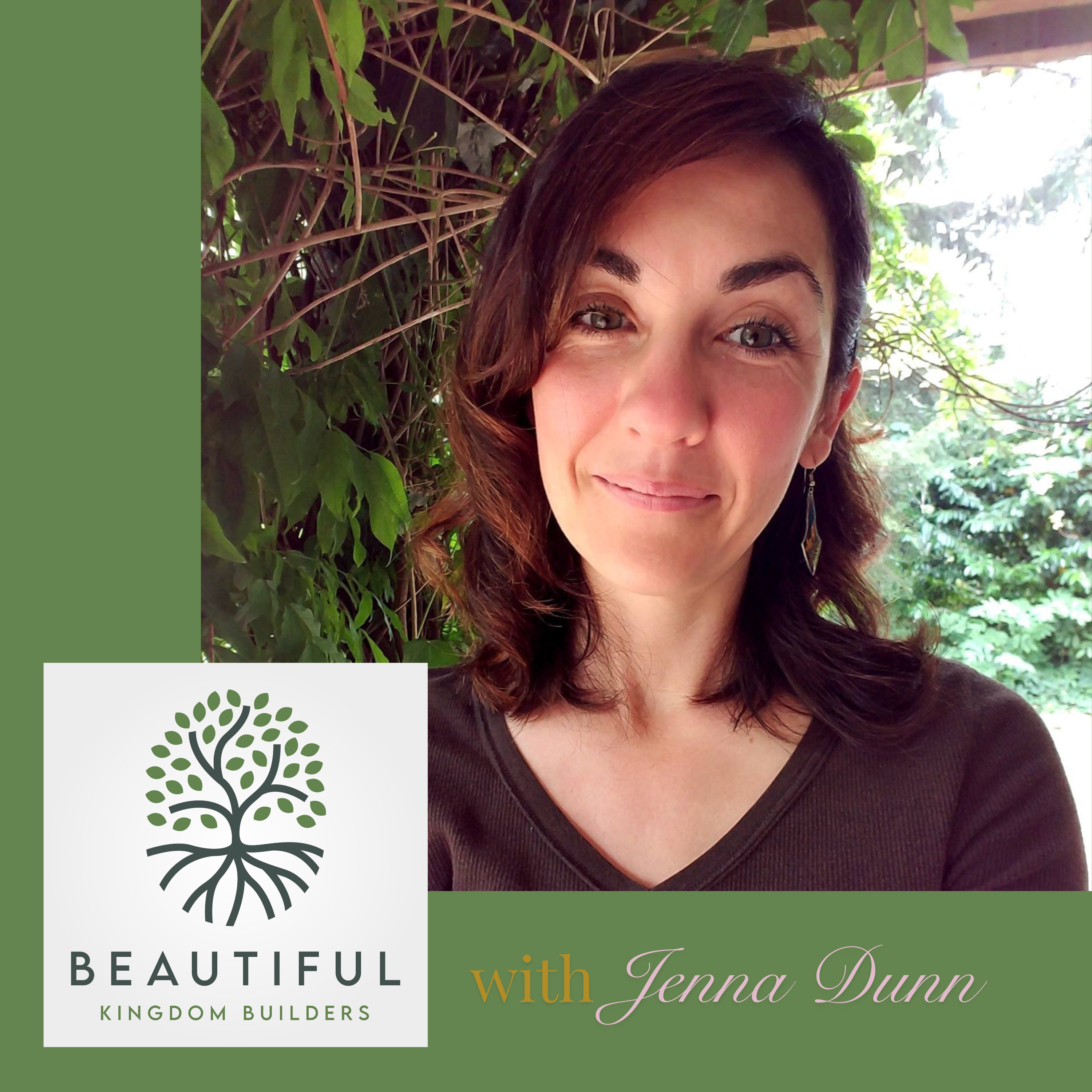
In this episode, Jenna Dunn, writer and theologian at Ezer Bible, describes her personal journey out of complementarian theology and the toll that patriarchal bible interpretation and church culture took on her faith and marriage. You can follow Jenna’s ministry on Facebook, Instagram, YouTube, and more! I hope to have more conversations with Jenna in the future about the Bible and interpreting it through an egalitarian lens. Here is the video of our interview, and you can listen to it on your favorite podcasting platforms.
TRANSCRIPT:
Ruth Perry (00:15)
My guest today is Jenna Dunn, who has a ministry called Ezer Bible. You can find her website at ezerbible.com, E-Z-E-R-B-I-B-L-E.com. And if you scroll down to the bottom of the homepage, there are links to all of her social media.
I wanted to explain briefly that word, ezer. In Genesis 2:18, God says, he made an ezer, a helper, for the man. In English, the word helper can mean someone of a subordinate status. But if you look at the other places where ezer occurs in the Bible, it mostly refers to God, who is our help. So certainly not a subordinate help, but rather a strong help.
Jenna and I talk about the toll that Complementarian Theology took on her faith and her marriage. And we talk about her love for the Bible, even though reading it through a patriarchal lens almost cost her her faith. I hope you enjoy this conversation with Jenna Dunn and follow her Ezer Bible ministry.
Ruth Perry (01:14)
Well, tell me more about your background. So you live in Oregon? Is that where you’re from?
Jenna Dunn (01:18)
Yeah, yeah, I’ve lived in Oregon my whole life. I was not really raised in the church. I used to go to the church a little bit. Like as a teenager, I went to a Baptist church, but, when I got married, my husband’s family was very involved in Calvary Chapel. And so for a long time we were Calvary Chapel people and he became a pastor. He went to the Bible college.
Calvary Chapel has like a Bible college in Arizona. And you know, he read systematic theology, the Wayne Grudem stuff, you know, in Bible college. And then we started a church. And I mean, if you’re familiar with Calvary Chapel, you probably kind of know.
Ruth Perry (01:50)
Yeah. So I’m thinking it’s charismatic. I don’t really know much about Calvary
Jenna Dunn (02:02)
It’s like a charismatic Baptist church. It’s not reformed, but it’s complementarian. And it’s a little political, at least ours was.
Ruth Perry (02:12)
Is Calvary Chapel, is that the one that the Jesus Movement sprang out of? Okay.
Jenna Dunn (02:19)
Yeah. So, I mean, there’s some really neat things about that, the origin of that movement. Like I do like that origin story, but I think what Calvary Chapel has become is much more similar to like the Southern Baptist Convention or like the Reformed Complementarian Movement.
Ruth Perry (02:22)
Yeah.
Jenna Dunn (02:41)
Most the people in Calvary Chapel are reading a new King James Version Bible, not an ESV Bible. But they very much listen to teachers of the Complementarian Reformed Movement. And I remember, that was always like a point of contention is there would be certain Bible teachers or leaders who were Reformed and it’s like, well, we’re not Reformed. So, you know, trying to figure out like where the theology lined up, but…
but definitely that commonality of holding to, you know, complementarian theology or the idea of gender roles and women not being in leadership. And I think, once you accepted that viewpoint, it opens you up for some of the more extreme Christian patriarchy ideas. So in the church context, I was in, it wasn’t a part of our church’s belief system, but I was still exposed to the Pearls. So like I have Created to be His Help Meet. That was a book that was given out to all the women, not from the church leadership, but just from somebody going to the church. you meet a nice homeschool family and like they give out these materials. I was also exposed to
a lot of Mark Driscoll type teaching. And the pastor that ended up coming in and kind of being the lead pastor was an Acts 29? is it? Yeah, the pastor was trained through that. And he quoted Mark Driscoll a lot. So there was that influence. I remember my ex-husband
Ruth Perry (04:00)
It’s 29. Yeah, Mark Driscoll was one of the founders of that. Yeah.
Jenna Dunn (04:15)
like going to a men’s leadership retreat at Mark Driscoll’s church and it, you know, like Voddie Baucham. We were very adjacent to some of these more extreme things. And, and I was always, I’ve always been more like inclined towards theology. I read it, you know, like I go and look up these people and like, I read it and I’m like, whoa, these ideas are, you know.
Ruth Perry (04:24)
Yeah.
Jenna Dunn (04:35)
I just, it was, it’s a weird position to be in because I, I do like actually listen. Like if I go to church, I listened to what the person says and, and I read my Bible and in some ways I had more theology training or a Bible training than the men in leadership around me in Calvary Chapel. Like usually the pastors don’t actually have very much seminary training. They’re just charismatic men who I don’t know, there may be mentored a little bit by older pastors.
Ruth Perry (05:00)
They are called and God equipped them. That’s all they needed.
Jenna Dunn (05:05)
Yeah, and you’re not really in a position as a ministry wife to change anything, so. I did that for over a decade and I was very unhappy for like the last five years and it did slowly tear apart my marriage. There’s a lot of ideas within Complementarian Theology that are really unhealthy for couples and for families. And then I think if you add to that, there’s ideas in our culture, right? So like even though
My ex-husband didn’t really embrace, like he was just not a theology person. He just was like, I just love people and he didn’t think about it. But he also didn’t understand that like the things that we were a part of were problematic. Like he just didn’t see it. And, you know, it caused a lot of conflict. Like it was just very hard on our relationship to navigate that and not have the same understanding.
But I think a lot of good has come from it because it forced me to learn the Bible really well. I always had a message prepared. I always had like in my, the Bible I used at the time, I had seven passages bookmarked and I’ve made a Bible study guide about that, but there’s seven verses starting with Romans 16 that I would break down, This is what the Bible actually says about women in ministry and about men and women. And I was always kind of ready.
And I think, I had convinced my ex-husband and he was kind of just, you know, we kind of had this understanding, he would open the door for me, given the chance. Like if there was a chance I could convince other people in leadership that this is what the Bible really taught. Then, you know, he wanted to see me be able to do that. But he also encouraged me to just pray and And, you know, things change slowly. And so we stayed in this really unhealthy church structure for probably way too long and just kind of hoped that like, people would change, you know, but I, I don’t really recommend people stay in those types of environment. It’s, it’s tempting too, cause you’re like, well, these people all believe the Bible and they love Jesus. So they’ll figure it out, you know, but it, just, it’s a hard,
Ruth Perry (07:08)
Yeah.
Jenna Dunn (07:11)
It’s a hard mindset to bring people out of. But the good of it in my life is just what I’ve learned over the years. I was really influenced by so many amazing theologians and Bible teachers. When I started Ezer Bible, I was really influenced by Is it Carolyn Kustis James? I read Half the Church and it was the best thing I ever read. mean, it was like water in the desert for me. just, she was so brilliant. And I was really influenced by Rachel Held Evans. This was like a lot of women over the years that I just found people online to learn from and to learn what the Bible actually says was better to me than to just leave a sort of toxic mindset and just not believe anymore, which, you know, was the initial path, but when God brought me back to Him and I began healing, was mostly through learning what Scripture actually says. That’s far better than just saying, I don’t want anything to do with that over there. Sometimes I tell people I left Christianity. I walked away from God over one Bible verse. There was this one thing I could not accept and it made me so angry.
First Corinthians 14 with the whole women are to be silent where Paul’s quoting the oral law or quoting the law, “As the law says “. In my Bible at the time, which I think was, the new King James, it has a footnote to Genesis three 16 as if that’s the law that it’s quoting from. That was what I was being taught about that, that Paul is saying that women are to be silent in church. And I just couldn’t, dismiss that and be like, that’s just cultural. And, you know, I just don’t like Paul. I just couldn’t accept that the Bible said that. So it was kind of a final straw moment for me where I was like, I know I’m technically a pastor’s wife, but I just, was sort of a closet atheist for a while. I I walked away from God and I remember at that time in my life being in the position I was, was actually easier. Like if I kind of thought atheism was true, I still cared about people. I remember a few times people would ask me to pray for them and I was like, well, yeah, that’s fine. It helps them. I still wanted to help people, but I didn’t really believe that.
the way the Bible had been presented to me and that understanding of God could possibly be true and I didn’t want to be a part of it and I just thought that’s ridiculous that God would silence women and that.
Ruth Perry (09:30)
What was the emotional journey of that, of losing your faith? What was that like?
Jenna Dunn (09:37)
Yeah, think that there was really so much behind that. Like I had gone through years and years of hurt and being sidelined in the church and I had a very, very traumatic birth experience with my fourth son. And I had been exposed to all kinds of toxic ideas. I had a lot of things that happened.
But was like, that was the final straw. And I think that there was really a lot of wounds and things underneath that. But I do remember just throwing the Bible across the room and just, I just stopped reading my Bible for a while. And I was very mad at God about that one verse. But you know, years later, I did eventually come back to God through that verse. What God showed me about that verse was so healing for me. So I’m…
I’m glad to have what I think is the proper interpretation of that section of scripture and a better understanding of Paul.
Ruth Perry (10:23)
Yeah. Did God reveal it to you in some way that you weren’t anticipating? How did that come about?
Jenna Dunn (10:37)
Um, yeah, I just remember I had read like different interpretations of it. I’m always researching things, who knows? But at one point I remember reading these quotes about what some of the beliefs were about women. You know, like there’s a quote outside of the Bible, but about women not knowing anything but the use of their distaff and about it would be better for the words of scripture to be burned than to be entrusted to a woman. There’s some different quotes that float around in the teachings of the rabbis.
And I remember seeing a quote that was… It literally said, the voice of a woman is filthy nakedness. And when I did a word study on 1 Corinthians 14:36, it says, the voice of a woman is shameful. And I looked up the word shameful and it was the same word as like filthy. And I was like, wow, that’s really similar.
you know, to say that a woman’s voice is filthy, it really sounds like Paul’s quoting this Jewish oral statement or some kind of slogan or, you know, he’s quoting this idea and then rebuking it. So like, that’s the thing that was so healing for me is like, Paul’s not agreeing with that. He’s rebuking that idea. And then you see that combined with how affirming he is.
Ruth Perry (11:53)
Yeah.
Jenna Dunn (11:59)
And how he’s partnering with women in his work. It made the whole Bible more consistent. Like now I see a more cohesive picture of Paul where he’s affirming female leaders and calling them coworkers and co-laborers. And I’m like, okay, that’s a Paul that I can understand. And then also the strength of his rebuke, like to actually, you know, be like, you men, you think that the Bible came from you. You think the word of God came from you, but it came to us all, you know, it’s actually a really strong rebuke. And so I find that really comforting, like Paul’s on my side.
But yeah, It was a process. I was mad at God for a long time. I was really in a bad place for several years. I kind of came back to God and I was still a pastor’s wife and I was still in an unhealthy situation. I tried to make the most of it, but you know, it was really hard on my marriage. It was really hard to raise my kids in that environment.
I have some really sad stories about women who I was very close to that, I saw them go a different direction. I saw them embrace a more strict legalistic form of Christianity. You know, there’s women I know who I watched their marriages just turn very ugly, People that I even knew before we were saved, before we got involved in ministry, there’s people I was friends with. And so to see the fruit of complementarian theology play out in people’s lives and marriages and how they parent their kids, I have a pretty strong aversion to some of those ideas. And I also just think it’s such an incredibly twisted way to read the Bible. I think it imposes this framework on to Scripture that just makes it really difficult for people to understand the Bible.
Ruth Perry (13:48)
Yeah, that’s one of the hardest things for me. I appreciate so much of my upbringing. I grew up Baptist and there’s so much that I appreciate and I definitely always met God in the churches I’ve been involved in and I appreciate the sincerity of the faith I’ve seen, but I have also seen so much dysfunction and so much spiritual abuse and harm.
And it’s hard, the experience of starting to awaken to the dysfunction, the toxicity of the theology. Talk to me about that experience of your relationships in Calvary Chapel. How were they impacted by your journey away from that culture and that theology?
Jenna Dunn (14:28)
I think you could probably imagine like in a small town, if there’s a couple that’s the pastor and the pastor’s wife and they go through a divorce, It was just it was a nightmare. mean, I was just kind of trying to do things in the least dramatic way possible. Like, as quiet as possible. didn’t want it to harm my children. Like, I just didn’t want there to be rumors, that my kids would hear. My kids were, you know, all their friends were in the church. And, you know, like the church was our family. And, you know, those people that we had birthday parties and baby showers and people that we had known for years and years.
I actually had to work together with my ex-husband to be like how can we make this the least traumatic possible? And I really thought that they would have him stay in ministry because he was more like the administrative pastor. He did all of the the building projects and maintenance and sound equipment set up and like that type of stuff. He wasn’t like the guy in front. He wasn’t like the teaching pastor. But it was a pretty unhealthy leadership dynamic. The church I go to now is a Four Square Church, and a few Sundays ago they had a new pastor and pastor’s wife that they were installing is what they call it in four square but so they were this couple was like gonna start being in ministry and it was, I literally still cry about it. I cried during that service. I came home and cried because it was so healthy. Like everybody in the church promised to pray for the people that are leaders, pastors, and their families. They said, we’re going to pray for you. We’re going to support you. And like, make sure you put your marriage first. Make sure you take care of your kids first. And it was so beautiful to see like the community sort of rally behind these people that were willing to dedicate their lives to serving.
Just the recognition of the toll that that takes on your family. But we care about you first, not just what we can get from you. We’re not gonna put you on a pedestal. You’re just like us, but you’re willing to do this. And it was so beautiful. And that was not my experience at all being in ministry It was very toxic. And we were so afraid to let people know that we were struggling in our marriage or in our family. We didn’t, have support and, yeah, it’s like, it’s just completely different. I’d say there was like a lot of bullying. So like I remember one man that was a leader for a while, they ended up moving away, but it was like his wife was too domineering, right? So was like he was kind of made fun of, like, your wife wears the pants. None of these women were trying to control anything, but it was just like the men had to be a certain, have a certain sort of traditional masculine vibe about them. And so there was some bullying that happened if they weren’t and the main teaching pastor was very much like the guy in charge and everybody else is a yes man. And, you know, we were very afraid of not being able to pay our rent and not be able to pay our bills if we stepped out of line. So yeah, that’s basically what happened is we were forced into a position of of just having to be like, yes, okay, but this is not good. And if you’re the weak link, if you show weakness or they know that you’re struggling in your marriage, they’re gonna turn against you. It’s like you’re the sick chicken in the flock and they’re gonna pick you to death. So it’s like, you can’t show that weakness when you’re in a team like that. I very much identify when I hear people talk about what happened at Mars Hill. Like there’s people that were involved in leadership there and they talk about what that felt like. it just, was so, it was similar to the dynamic of what we were involved with.
Ruth Perry (18:08)
Yeah. My family, my dad was a senior pastor and my brother was his associate pastor and then my family attended the church and they had this big conflict erupt. And it was like, the church just kicked us while we were down. It was just like that. It was like, oh my God, this is so much worse than it had to be. And I’m just so frustrated that Christians aren’t the most loving, caring people. It makes me so mad.
Jenna Dunn (18:42)
Yeah, yeah, it’s weird to see those dynamics and you know, I kind of imagine that in the healthier churches, know, part of what besides there’s sort of being a system of checks and balances so that there’s not just like one main guy that’s the whole everything’s around that guy, you know, but I think in some of the healthier churches, it’s like you do see like the husband and wife ministry teams and you see women in positions of leadership so that they can provide like perspective of like what things are like for women in the church.
I remember saying that at one time I was like, well, if I was struggling, where would I get help? Like all of the leadership are all men and I don’t want to talk to them about that. They’re like, be like, oh, so and so’s wife. And I’m like, yeah, but she’s not in a position to change anything. The wives have to support their husbands. Like I knew, how many times I was in a leadership meeting and I knew that they did not want me to open my Bible and to say something that contradicted what they were saying. Like I know to stay in my place and not make my husband look bad. They don’t want me to lead or to be interested in theology or to have the right answer or to help them. They actually just want me to stay quiet and play my part.
And it was always hard for me because I knew what God wanted me to do. I feel like God called me to be a teacher. Like I actually would find myself in situations where we’re having a two hour long meeting about this topic and I know the answer and I could very easily show you in scripture and it would just end this meeting and we would just all be on the same page. But it was like, that was not what they wanted from me. And I didn’t want to risk my, you know, it’s sad. I wish I…hindsight I wish I would have been more willing to risk my reputation or my standing or whatever like even if it caused a huge problem I mean my life fell apart anyways like staying quiet didn’t serve me either you know so I wish I would have had more courage
Ruth Perry (20:34)
Well, it takes so long to undo all of the toxic teaching that we’ve absorbed and learned. I’ve been doing the Beautiful Kingdom Builders page for a long time. And just recently I’m finding my own voice in personal relationships with other people. Or pursue my own goals apart from my husband and stop waiting for my husband to be the ministry person that I support. It really takes a lot of time, even as your eyes are opening decades before, it still takes time to undo that cultural conditioning that we received.
Jenna Dunn (20:55)
Yes. Yeah, for sure. Yeah, I think I bought the domain name Ezer Bible, like, 2012. I mean, so that’s how long ago I’ve been, not doing this. And it’s because of the mindset hurdles that I’m up against. So, I started my business and all of the same issues that I was having just in my relationship with God were manifest in my business. So I’m like, why am I struggling so much as a small business owner? I’m chronically undercharging, devaluing my time, devaluing myself. I just came across so much personal problems, because of my background. I just really can’t, can’t, you know, let God fully heal me from like some of these really toxic mindsets.
And I think too, when I go back and read some of the stuff I was writing during that time for probably five years, most of the things I wrote, if I read it now, it’s not the voice I want to put out there. That’s not how I want to sound. Cause what it is, is like, I’m, I’m talking or writing from a place of feeling really inferior, trying to prove myself, right? Like trying to say I actually know something about the Bible. I know something about theology and this is why you should listen to me. And, you know, God isn’t asking me to do that, but I just feel like I know the person I was when I was a Calvary Chapel ministry wife, I felt…so disempowered and so not worthy and like my voice didn’t matter and nobody would want to learn from me or hear from me. They just wanted this silent role, a supportive role. And I just thought who am I to think I know something about the Bible or who am I to challenge complementarian theology? I felt just really inadequate and it’s been so hard to overcome that.
Like there has been growth in that area, but I think that’s kind of why I don’t put myself out there. I put my voice out there. I do more with my marketing. And I think that that’s kind of helped me warm up to the idea of like, I have something to teach. But yeah, it was so hard to start kind of moving forward in my gifting just because of how some of those mindsets had. influence me and I think too sometimes I have a voice in my head like I can imagine the objection already without even anybody hearing my ideas I know the voice of these men that come against the ideas that I have. I’m very aware of the other side. I’ve read a lot of complementarian literature I understand all their arguments and positions and And that’s a good thing, because I can refute those objections. But yeah, I very much understand the mindset and there’s so many people who shut down women. so I feel shut down sometimes even without even sharing my idea. I’m like, I’m going to write this and I’m like, I already can hear the objections and the way that they would shut me down if I share this. I was really active. ⁓
Ruth Perry (24:07)
I would really encourage you, Jenna, to please use your voice. I’m really impressed and amazed by all that you’ve just shared in this short conversation. I think you definitely have a gifting and a calling from God. And part of the challenge of being a woman that grew up in these complementarian spaces is giving yourself permission to follow that because nobody else is going to. And so you have to just take that leap of faith and you are going to have pushback.
But honestly, I think the complementarian men are not trolling the internet as much as we fear and they’re really easy to block or to just like not approve their comment. Like it’s just, you can protect your space.
Jenna Dunn (24:39)
Thank you. Yeah, I see women with a lot of comments and interaction online. I see it’s not as bad as I think. I think I used to be really active. I would debate things with people on Reddit. And so Reddit used to be very anonymous. And so some of the people representing a very reformed comp view were really harsh.
Ruth Perry (24:59)
Bye. They’re the worst.
I mean, even if you’re not being mean, people can still read the tone of your whatever you write and whatever tone they’re hearing in their head. You can’t control that. You just have to like put the message that the Lord has on your heart out there. And it’s not going to be for everybody. if it only reached one person, I feel like you’ve made an impact that matters. So I would encourage you.
Jenna Dunn (25:20)
Yeah.
Ruth Perry (25:35)
to go ahead and be courageous. And I think that it would be really meaningful and fulfilling to you to start putting your work out there. I would listen to your podcast and I’ll share your articles. I’m excited for you.
Jenna Dunn (25:35)
Thank you. Yeah.
Yeah, think I’m going to spend some time this upcoming year focused on developing as our Bible. I definitely over overthink. You know, I overthink a lot.
Ruth Perry (25:59)
Yeah, have you done any enneagram work?
Jenna Dunn (26:01)
What? Yeah. I’m like an INFP. Yeah.
Ruth Perry (26:08)
The enneagram numbers are one through nine and you strike me as number five.
Jenna Dunn (26:13)
yeah yeah yeah, the number one. I’m like a f-
Yeah. What are you?
Ruth Perry (26:18)
I said, you strike me as a five, but I’m a five also, yeah.
Jenna Dunn (26:21)
I think I was a four, but I… Yeah. Yeah, I think so.
Ruth Perry (26:24)
You might have a five wing, but the four part of you would be the more sensitive part. Like for me, I don’t really care if people disagree with me. I’m okay with like online interactions and I actually really enjoy listening to people and reading people who disagree with me. But I think part of that is just my personality is I’m the observer and I enjoy observing people.
Jenna Dunn (26:34)
Yeah, people are interesting for sure. Yeah, no, I am very sensitive and like I think about things a lot and I really take things to heart and like I will sit on an idea for years sometimes before I share it. So yeah.
Ruth Perry (26:49)
Yeah. Yeah, absolutely. Me too. I’m an INFP also. And I don’t feel like I ought to podcast number one, I feel like I have the most annoying voice in the world who would want to like listen to this voice. I don’t know. So I just would I had the idea. So I mentioned it to people and everybody tells me that’s a great idea. So now I feel like I have to try it. But personally, I wouldn’t do it. I have imposter syndrome. I would rather just keep reading other people and thinking about other people’s thoughts. But I do feel like I’ve had this platform on the Beautiful Kingdom Builders page and you can’t really have nuanced conversations when you’re sharing a meme or an article. And I just want to host longer conversations with people that just show that you can be a Christian that loves God and loves the Bible, but you’re not a gun-toting, militaristic, and anti-CRT. You don’t have to subscribe to all of that. You don’t have to believe in penal substitutionary atonement. There’s other ways to be Christian that I feel are more faithful to Jesus.
Jenna Dunn (27:53)
Yeah, it’s so true. And it’s so important to hear other people’s stories. I really do love the medium of podcasting. Like I listen to a lot of podcasts. And some of my favorite Christian ones are just like people sharing their stories.
Ruth Perry (28:26)
Why do you feel like a Beautiful Kingdoms Builder podcast is beneficial to the church?
Jenna Dunn (28:32)
Yeah, so I think it’s such a gift for women just to have a place to share their stories, like just to have their voices heard. I kind of believed I had to like build that all myself. Like I need to somehow earn the right to have my story heard and that’s how I learned web design. Like I was like, I wanna…build a website. But I always had that in the back of my mind that I was going to do Ezer Bible.
So it’s like I went down this whole other path of like, now I have a whole business building websites for people. And I do a lot on the internet. I do all kinds of marketing. But doing it for myself, for my calling has had a lot of obstacles. And I think that a lot of people would never be able to do that. I mean, it takes a ton of time to learn everything, to build your own platform. I love that the internet exists and women can build their own platform, but not everybody’s going to be able to do that. it would be great if there was more places women could just share what God’s showing them and share their stories and share their testimonies. Because if you’re coming out of a context like I was…you’re really feeling like your voice doesn’t matter already, right? And so just the fact that there’s platforms where they’re like, hey, you know, we actually do care about your experiences. We want to know, what following God has been like for you and what God has shown you. I mean, that’s huge. I mean, you just basically holding the microphone up to women and being like, we care about what you’re experiencing and we want to hear from you. Like your voice matters. I think that’s a huge thing. And so
I was going to ask you what prompted the change from Beautiful Kingdom Warriors to Builders.
Ruth Perry (30:09)
The warrior’s name came from Carolyn Custis James. A friend and I, Becky Buck, started the page 10 years or more ago. And we were thinking about the word ezer that it doesn’t just mean helper, it means like a strong help. And then it’s frequently used in the context of military. So like we’re in this battle.
to bring God’s kingdom, which would look like flourishing for all and peace and joy and like the fruit of the spirit and all these things, like building a Christianity. But the, well, see the building part came later in my thought as I’m thinking less about fighting battles, because I’m really tired of culture war. I don’t want to be a culture warrior. But that was so deeply embedded in me 15 years ago.
Jenna Dunn (30:54)
Yeah.
Ruth Perry (30:59)
that warrior seemed like a good name. But now I want to be a part of building something beautiful. Because we’re ambassadors, we’re builders, There is the spiritual warfare aspect of life. But really, the battle is God’s. And I just want to be a part of building a more beautiful Christianity, because I’m really…disappointed in the Christianity that I was formed in.
I know so many people who have walked away from their faith because of the culture warring and the politics and the bad theology and the subjugation of women and the racism and all these things. And I just want to say you don’t have to walk away. There’s a better Christianity that you could be a part of.
Jenna Dunn (31:46)
Wow. Yeah. Yeah, I think about some of the positions that I’ve taken more recently and I’m like, I hope that that focusing on theology or what the Bible really says isn’t just another turnoff for people. Because I’ve known Christians I’ve really cared about over the years who have more of like a shepherd’s heart for people or their…
maybe like more prophetic, they’re, just, they don’t get into theological discussions and they don’t understand half the things I want to talk about. They don’t know the terminology or the different people who wrote whatever books, but they just really love people and they just really have God’s heart for people. And they care about reconciliation or they care about seeing people grow in the Lord. And they don’t geek out about
the Bible or theology like I do and I’m always like, I really want to make sure I keep those people close to me so they keep me in line and I don’t go off in this whole other direction that’s not people focused, right? Because at end of the day, that’s what matters, you know. But yeah, I do think that, you know, that’s a really beautiful change to make it about building the kingdom and being a part of building the kingdom. I was really interested
in that because when I first found the Beautiful Kingdom Warriors, I was very much like, ooh, warriors. And I also was so influenced by the idea. I mean, like, I got like an ezer tattoo. Like, that’s how much ezer was like. And on my muscles, I’m like, it was. It was because I was, I had been influenced and seen so many women’s lives influenced by the ideas.
Ruth Perry (33:16)
Yeah! That was a mind-blowing revelation, learning what AIDS are meant.
Jenna Dunn (33:30)
that are represented by Created to Be His Help Meet and that idea that a woman being ezer means she’s subordinate and then to like see the truth about that in scripture was wow such a radical shift and so yeah I really I really bought into that identity of like being like I’m an ezer like that’s super freeing and healing for me
Ruth Perry (33:53)
Yeah, it is a long process, healing and unlearning and relearning. I think for me, really started, the domino started falling away from my early faith formation about 15 years ago. And 15 years, that’s a long time, almost all of my adulthood.
Jenna Dunn (34:11)
Yeah.
Ruth Perry (34:11)
Or not really, no, that’s because I’m 44 now, so I’m like late 20s. Just really when my home church went through all that conflict and it impacted my family and we experienced a lot of abusive behavior towards us and shunning. And it was just really painful. And then all the little dominoes started falling. And the first thing that I noticed was if the women in this church had any say, this is not how this would be handled.
Jenna Dunn (34:39)
Yeah.
Ruth Perry (34:41)
And then I started wondering why don’t the women have any say? It doesn’t really make sense. And so that was the thing that for me, but I’ve just, last year, I finally went and did some EMDR therapy because over 15 years of me learning new things and working on all of this, I was still carrying the wounds and they were still wide open and painful and
Jenna Dunn (34:45)
Yeah.
Ruth Perry (35:05)
Just going through that EMDR therapy last year was really transformational.
Jenna Dunn (35:09)
Wow.
Ruth Perry (35:10)
And I think maybe that that’s where now I’m getting the I’ll try a podcast courage. I don’t know. I’m not as scared anymore.
Jenna Dunn (35:15)
Yeah. Yeah.
Yeah, I think sort of gathering together women especially, but also I know when I think about like the strategy behind Ezer Bible, I didn’t want to make it just for women because if I see a Christian man that’s like actually teaching the Bible like the right way and like is understanding how important the voice of women is and how important women are to building the church. That’s actually so beneficial. I don’t like the idea of men and women are against each other. It’s actually just there’s men and women that are a part of the kingdom and it is a very supportive, helpful… I think about all the women that Paul was partnering with. They wouldn’t have been able to accomplish what the early church accomplished without those partnerships.
I had noticed if I say patriarchy, like I almost don’t want to use that term anymore because I talk to many people who when they hear me say patriarchy, they think I’m saying something against men. And like to me, patriarchy doesn’t mean men, men and women hold up patriarchy. I’m not saying anything negative about men. So it’s like to me that the divide should be the people over there that support patriarchy and then the people that are building the kingdom and following Jesus and laying down their lives and serving and submitting to each other. so but yeah, it’s an interesting thing because I think as soon as you try to bring men like I just was so comfortable talking about talking to women you bring men into it. I think there’s just this default that women will just back down and let men lead like there’s just our culture has conditioned us to be like, there’s a man in the room. Okay, I’ll shut up now and just see what he says. How do you get women to participate and to leave behind that sort of cultural conditioning? That’s something I think about a lot. But yeah, I really am super excited that you’re gonna do a podcast. And I hope that that ends up being something that more women…
you know, will start sharing.
Ruth Perry (37:11)
Is Four Square, that’s the denomination that Amy Semple McPherson founded, right?
Jenna Dunn (37:17)
Yeah, You know, it’s weird. There was a four-square church in the small city that I was a ministry wife in, and I had friends that… Even some of the leadership team had been raised in the Four Square Church. And so it’s weird to me. I’m like always wondering, why did they adopt this view of male and female gender roles and male-only leadership, if that was their background? But that particular Four Square Even though…their denominational belief system included women in ministry. They didn’t actually practice it. There wasn’t any women in ministry that I saw. Maybe the pastor’s wife was a little bit more outspoken than in other faith traditions, but they didn’t really practice what they believed, right? But the Four Square Church, now that I’m in a bigger city, actually the city I’m in, there’s so many good churches. Like there’s also a denomination here called Open Bible.
And it’s a bunch, it’s usually a husband, wife, pastor team. And I went to a few of those and like, I just cry. Like a woman gets up front and starts preaching. I just start crying. It’s just beautiful. I don’t know how to explain it. It’s not about one person. There’s a team of people. They take turns teaching. People take turns doing worship and. They just make decisions together as a team and there’s not like women defaulting to male leadership. The women share what they think and it’s just really healthy. I’m still blown away about it, I guess.
Ruth Perry (38:37)
Yeah, I’m glad you found that church.
Jenna Dunn (38:39)
Yeah.
Ruth Perry (38:40)
And I’m glad I met you, Jenna. This is so nice. We’re friends now.
Jenna Dunn (38:42)
I’m glad I met you too. Yeah, I am happy too.
Ruth Perry (38:47)
Thank you so much, Jenna. You shine the light of God from your whole being and everything you’ve shared has been really beautiful and impactful. And I feel like God has definitely gifted you.
Jenna Dunn (38:58)
Thank you. Thank you so much.
Ruth Perry (39:02)
So if you need encouragement, I’m encouraging you. Take the risk, do it, because I love it. I love it. I feel like you’re a beautiful soul.
Jenna Dunn (39:06)
Aww, that means a lot. Thank you so much. Yeah.
Ruth Perry (39:13)
So keep on keeping on, Jenna. You’re doing great.
Jenna Dunn (39:16)
All right, you too. Thank you so much, Ruth.
Ruth Perry (39:18)
Thank you.
Thanks for following TBKB Podcast! A new episode will drop every Wednesday. Be sure to subscribe on your favorite platform! Next week, we’ll hear from my missionary friend Scott Harris. God bless! Have a very Merry Christmas!!


 The Beautiful Kingdom Builders