
This fall, my friend Scott Harris invited me to join him in Reimagining Faith: A Journey Toward Shalom, a ten week small group offered by Peace Catalyst International. The group was facilitated by Bryan Carey, along with his colleague Mercy Aiken, and my favorite thing was the international and denominational diversity among those participating, which led to really rich and profound conversations about the materials we were reading and watching together. I highly recommend everyone visit Peace Catalyst International to learn more about their mission and opportunities to engage with them, and utilize the resources they have on their website for peacebuilding efforts in the local church.
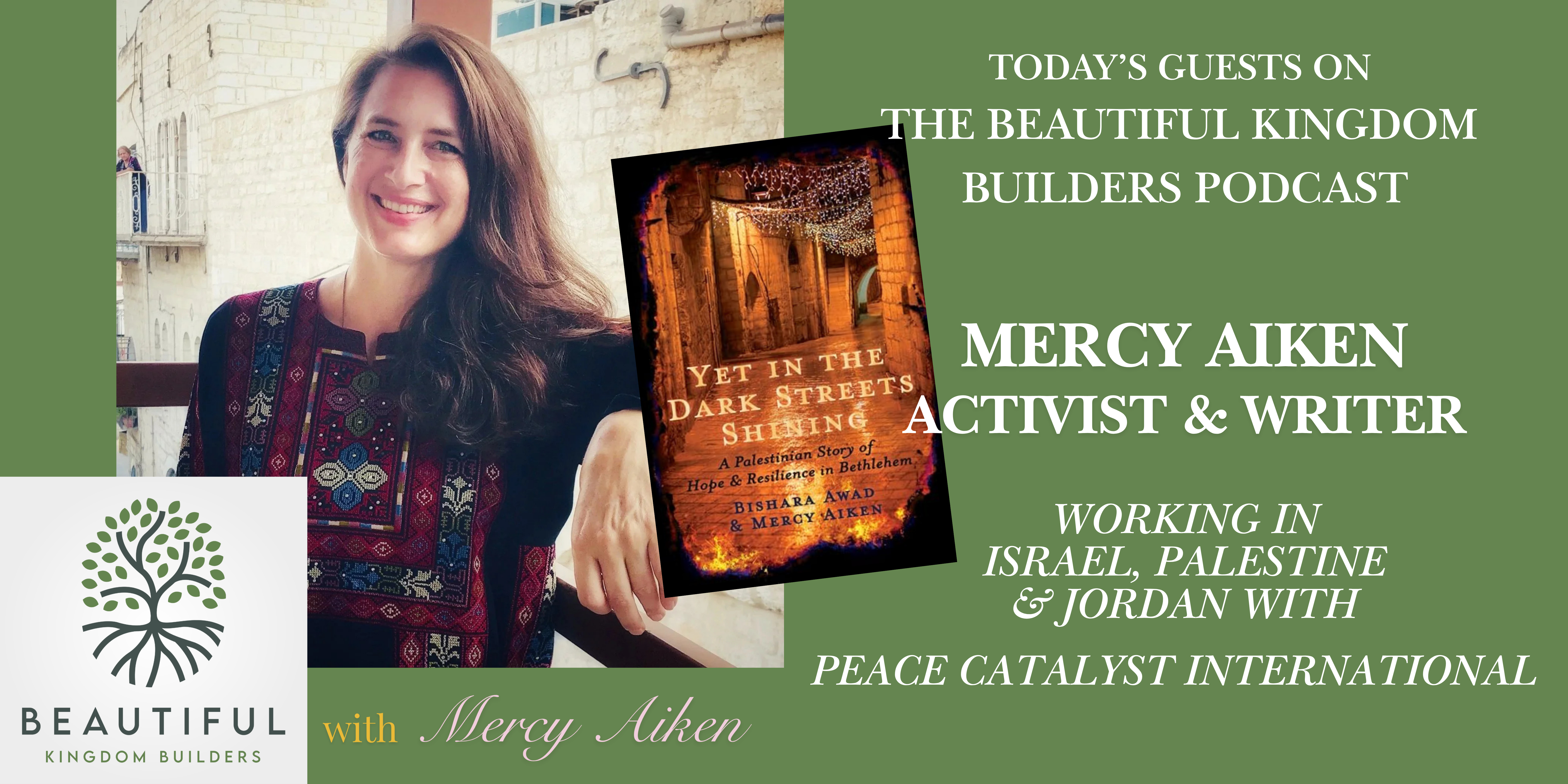
I was very delighted that Mercy Aiken accepted my invitation to a conversation about her work with Peace Catalyst International in the Middle East. Mercy has lived and worked for many years in Israel and Palestine and now Jordan. We talked about how her faith has evolved and how she understands peace, justice, and Christian responsibility today. She shares how personal relationships across the separation wall have shaped her perspective of the conflict, and challenges listeners to center love, equality, mercy, and truth in conversations about Israel and Palestine.
Follow Mercy Aiken on Facebook, Instagram, and Substack
Buy her book, Yet in the Dark Streets Shining as well as Elias Chacour’s Blood Brothers.
Thomas Merton: “Be human in this most inhuman of ages. Guard the image of man, for it is the image of God.”
You can find this episode of The Beautiful Kingdom Builders podcast on YouTube, Spotify, Apple Podcasts, Amazon Music, Substack, and more!
TRANSCRIPT:
Rev. Ruth Perry (00:15)
My guest today is Mercy Aiken. She is with Peace Catalyst International. And she’s lived many years now in Israel and Palestine. And you’re in Jordan now, is that right?
Mercy Aiken (00:25)
Yes, that’s right.
Rev. Ruth Perry (00:27)
Just working to be a peacemaker with a really wonderful organization and leading pilgrimages in the Middle East and educating people and having really difficult conversations. And so I’m really grateful that you came on the Beautiful Kingdom Builders today to talk about your work and about your faith. Thank you, Mercy.
Mercy Aiken (00:44)
Thank you so much, Ruth. It’s a pleasure to be here.
Rev. Ruth Perry (00:47)
I always like to start just hearing people’s story, where they came from, what their faith background is, how they were raised, and a little bit about how their faith has grown or expanded or changed over their lifetime. So can we start with hearing about your life, Mercy?
Mercy Aiken (01:02)
Sure. I was raised as a Christian in the bottom of the Grand Canyon by parents who became Christians during the Jesus movement. So my father was from Long Island and grew up in the Presbyterian context. And my mother was from Seattle, Washington and grew up as a Catholic. My mother was the poster flower child of all flower children. She wasthe image, the archetype. And she was living in San Francisco in Hayed Ashbury in 1969. And she had a powerful encounter with Jesus, the little mission group that had moved there with an outreach to the hippies. And she moved into a Christian commune. And she just had this very powerful, transformative experience with God.
And so she eventually led my father to the Lord, like she met him later and led him to the Lord. They had me and they moved down in the bottom of the Grand Canyon. So I was raised, I was raised a very strange way. You know, I mean, I was raised listening to all of this Jesus Jesus music, like from the seventies. you might be familiar with some of it, but artists like Keith Green and Love Song and like the Marinapa praise and Andre Crouch and just a lot of a lot of that type of music. and and my parents both became very evangelical. I would say we were in more of a Pentecostally, charismatic, type of tradition. So we believed in the power of the Holy Spirit and all that.
But we lived down in the Grand Canyon. So we didn’t have church to go to, most of the year anyway. So every night my dad would pull out a guitar and we would sing Christian songs around the the table and, read little Bible passages. And we basically had our own little church services every night. There wasn’t really any preaching. It was more just singing and maybe with a little bit of scripture. But I would say that really, really, really shaped me. It was so foundational for me. It was so organic and it was so real. And all of that within the context of the beauty of the canyon and encountering God through nature also.
We had a little creek in our front yard and we would just swim, in the cold water and lay out on the rocks and climb around on the cliffs and play and met hikers from all over the world. We had a lemonade stand by the side of the trail, my brother and sister and I, and slept outside almost every night looking at the stars. So I would just say all of this, having to hike everywhere we went, all of this I think gave me a different perspective.
Then whenever we would come out, my dad had a four-month furlough off in the winter. So we would go to the South Rim sometimes, or sometimes we would go and do mission work and other things in Mexico. So yeah, I just had a very unusual childhood, homeschooled part of the time, real school part of the time, went to real church part of the time. but it I would say it put a very strong, solid foundation of faith in my heart.
That was strong enough to withstand and endure the real doubts that I began to have when I became a young adult. because I had I had known the love of God, I think in such a pure way that was true and organic and wasn’t like handed to me through some type of formula and wasn’t too, I don’t want to say messed up by the church because the church provides so much goodness, but it can also sometimes provide traumatic experiences for people that make them walk away from faith. And so I didn’t have that quite as much. Yeah.
Rev. Ruth Perry (04:22)
That sounds so idyllic. My parents were also Jesus Movement converts. And we listened to all that beautiful music and my dad played the guitar and the faith was so alive in my childhood. And I did have some of those traumatic church experiences, but because my parents’ faith was so alive and authentic and real that it was a wonderful foundation for my own faith.
So that’s really cool. And I’m really jealous that you just got to play in the Grand Canyon.
Mercy Aiken (04:50)
O my gosh. I look back on it even when I was telling about it and I’m like, what life am I even talking about? it just, it’s so precious. It’s always there. Like in my mind is a place that I can go, but it feels so distant in a way. But actually I should backtrack because there was trauma for sure. Because all right, now that I know your parents also were saved within that movement, there was a lot of like imminent eschatology of like, immediate return of Christ. And I’m old enough that I remember being worried about 1988 or being told he was coming back in 1988, and a lot of worry about being left behind in the rapture and impending you know, one world governments of abuse, and you know, all of those types of things did traumatize me for sure.
And some of the missionaries that we worked with in Mexico would have been very much focused on these types of narratives. And so I think my parents didn’t even realize maybe the extent to which some of that stuff went deep into my soul and and really, really scared me. Like I remember we used to we we usually hiked out of the canyon, but sometimes we flew out on the helicopter and we had helipad in our front yard. And I remember times like flying out in the helicopter and I’d be looking out over all the little side canyons.
Wondering about where I could run and hide and how I might be able to live off the land when the beast and the Antichrist came along. So I definitely was scarred by all of that. And I think it was a lot of the extreme fear mongering position of very wrathful and like not very hopeful. It didn’t feel to me very hopeful.
I felt so much love from God, just on my own. when I’m playing in the creek and laying out under this bright blue sky and just feeling the peace of it and the sunshine and the running water. And it just went into my soul and I knew that that was God. But then I had to reconcile that with some of these other very catastrophic, very difficult to understand, terrifying images and visions of God, which made me reject Christianity as a young teenager, actually.
Rev. Ruth Perry (06:49)
Wow. Yeah, I would love to hear more about that. What started to create that cognitive dissonance for you and that doubt.
Mercy Aiken (06:56)
Well, we would always be singing all these songs about Jesus’ great victory in church. Like, he’s done this great victory, celebrate, praise the Lord, he triumphed, like this type of language a lot. And then it would like shift gears where it’s like, everything’s hanging by a thread. And everyone would be sobbing and like praying for God to do something because th there was no victory, really, like in the world. Everything was going to hell in a handbasket, including all of our neighbors, and I was really troubled by wondering what happened, for example, to all the native peoples who had lived in the Grand Canyon way before we did.
Because when I would be exploring around, I would sometimes come across potsherds and ruins of old homes, from the ancestral peoples of the Pueblo peoples. So the ancestors of like the Hopi and the Zuni Pueblo peoples who lived down in the canyon. They used to be called Anasazi, which was a Navajo term for them meaning ancient enemy. Well we don’t even say Navajo anymore. We say Dine. A lot of these terms have changed. But we called them the Anasazi. And I would think, well they never got to hear about Jesus.
So what happened to them, and it was like this, I would hear different things from different adults. Some would tell me one thing, some would tell me another. And the fact that we were doing a lot of mission work where our missionary friends in Mexico were working very hard to save people, many of whom were Catholics, like they were trying to, you know. And it’s like, my gosh, you have to get this so exactly right. So are Catholics not saved? Well what about my grandparents that, you know, my mom’s whole family? Like one of my aunties is a nun.
And you know, my parents again, they would have had a bit of more of a lighter touch with this, but I took it very seriously as a child. And so I remember one day I decided I was gonna figure it all out. I was about 16 years old and I was gonna figure it out. And it was we were on the South Rim where we were going to school, you know, for my dad’s four-month furlough in the winter.
And I decided to take a walk in the woods behind our house, and I was gonna figure out what I believed. I was gonna summon every ounce of logic that I had, and I was gonna figure it out, and I was gonna come home knowing. So, these grandiose intentions, I walk out into the ponderosa pine forest, and I’m and I’m thinking specifically about what is happening, what happens to the Anasazi, what happens to all these people who grow up in India as Hindus.
Where is John Lennon right now? Like these are the questions that are on my mind. And so, but I was specifically thinking about these like quote, unreached people or people that lived before, never had access to gospel at all. And I began to think, okay, if God is going to torment everybody eternally if they don’t accept Jesus Christ as their savior.
And this is the only way that you can avoid this default setting. all humanity is on this default setting, and there’s one way to avoid it. It’s having getting access to this information, which is very kind of exclusive, kind of bound by time and space, not very accessible for a lot of people. And that was my struggle. And so I was thinking about it and I was like, if this is really
what God wanted, He would have surely found a way to communicate this message, warning everybody of what was at stake, just out of his compassion. I’m told he’s a loving God and a compassionate God, and I believe that is true. So he would have just anybody with an ounce of compassion would do this. They would put they would work the warnings into like nature itself. Like there would be things that would illustrate this. You would be able to know.
By looking at, I don’t know, the way the plants grow, or the cycle of the seasons, or the stars, or something would show people this, and people would have been able to come to this conclusion somehow everywhere, that this is what’s at stake and this is how you avoid it. it just seemed far too arbitrary that it would depend on something that happened 2,000 years, you know, again, so constrained by space and time. And so when I had this epiphany, I was like, my gosh.
Christianity can’t be true then. It’s not true. Because God wouldn’t do that. And I remember feeling like simultaneously relieved and also simultaneously terrified because once the logic of that clicked into place, I couldn’t undo it. And so I went back home now with this heavy burden of well, Christianity isn’t true. Oh my gosh.
Beautiful songs we sang about Jesus and how I felt his love as a child. What was all that then? And I guess maybe God isn’t even real. So I went home and I remember we’re sitting having dinner and I tell my parents, well, I don’t know if I’m a Christian. I think I’m an agnostic. And my mother said, Okay, that’s fine. That’s healthy to question your beliefs, but you still have to come with us to church.
And she just kind of let it low. Like no one went into a tither about it. So I was just sort of left on my own to like grope my way through for the next few years. And I would often go to sleep feeling terrified. Like, well, what if it still is true? Like, what if, against all sense of logic and what seems to me to just be basic ethics or morals?
What if that still, in spite of everything that I’ve concluded, what if I’m wrong and Jesus is gonna come back this year or tomorrow or who knows? The rapture’s gonna happen and I’m gonna get left behind. Then I’m gonna have to fight the beast and all those fears that I still had from my childhood. Like they would come and like they would torment me a bit. Yeah. So I lived that way for a few years until I went off to college.
And when I was in college, I just felt the Lord drawing me. I remember later reading C.S. Lewis, and he talked about how he felt so hounded by God that he couldn’t get away from him. The holy hound of heaven, that imagery. And he was like, he did not want to become a Christian. He said he was the most reluctant convert in all of England. And I had that same type of experience. God was just after me. I could hear his breath in the back of my ear, I could not get away from God.
And finally some friends of mine in campus, this was my freshman year. They were going to FCA, Fellowship of Christian Athletes. And they were like, Come, and I’m like, Well, I’m not really into FCA, I was never super sportsy type, but I was like, All right, I’ll just go, whatever. And I walked in, and it was just a beautiful FCA chapter. There was just such a beautiful move of the Holy Spirit that was going on at this time. And I walked right in. They were singing one of these old Maranatha songs that I remembered from my childhood when I walked in, and I just immediately started crying.
And I was like, I don’t know how to make sense. There’s a lot of things I don’t know how to make sense of, but I know that you’re real. And I know that all I’ve ever really wanted is you. And I don’t want to live without you. And you know, when the Lord makes himself real to you, he’s real. You can’t deny it, you know? And I had one of these incredibly powerfully transformative experiences as a college freshman that yeah, just completely upended my life. I turned into the biggest Jesus person you ever met, you know, within the period of just a few weeks, I just surrendered my life fully back to the Lord and I put all these other questions on the shelf and I was just like, I don’t know how to make sense of it. I’ll make sense of it at some other point in my life, maybe. But all I know is that Jesus is real.
Rev. Ruth Perry (14:06)
I had a friend that passed away my senior year of college and she had told me her freshman year that she was doubting her faith. And then for all those years, I’d never I wouldn’t talk to her about faith when we saw each other. But I had that same point of view where if she doesn’t express that Jesus Christ is Lord and Savior of her life, she’ll burn in hell forever. And so then when she died,
Mercy Aiken (14:26)
Yeah. Yeah.
Rev. Ruth Perry (14:28)
I felt like I had damned her to hell personally by never doing my job of proselytizing her again. And
Mercy Aiken (14:35)
Right. Yeah.
Rev. Ruth Perry (14:36)
I had that same epiphany of God as the hound of heaven. After I had been angry with myself and angry with God for a while, I had that same image of God loved my friend Eliza so perfectly and so much better than I ever did. Cause I let fear and you know things stop me from loving my friend well.
But God loved her perfectly. And so it was just that reimagining who God is and who God’s character is, and recognizing that, God’s love, the way that we understand that eternal conscious torment, it doesn’t make sense with saying that God is love. I just talked with Brad Jersak this season, and he said that, getting saved with that frame of the gospel is like having a gun to your head and it’s a hostage s situation. It’s not, I wanna follow Jesus and let Jesus be Lord of my life. It’s like I don’t wanna burn in hell forever.
Mercy Aiken (15:24)
Right. Yeah.
Yeah. And that was still a big part of the residual that I had to deal with for years. After coming back to the Lord, it was his love that established me as a child. It was his love that brought me back. But there was always all this other baggage. And when you read the Bible at a surface level, it seems like, well, this is clearly what the Bible says. Jesus is talking about it all the time. So it’s a bitter pill, but I just have to swallow it.
So I became this obnoxious person. I forced my friends to get saved. And they weren’t, I forced them to say prayers. Because I took that very seriously. It was very serious. from my teenage years and my childhood. It was never something that I could ignore or look away from. It was always something that weighed very, very heavily on me. I just couldn’t bear it.
I could not bear looking at the world and knowing the destiny of so many people around me and also feeling so much pressure to somehow disrupt they’re all on this default setting and like disrupt as many as possible from that. And then years, would go by and I loved my Bible. I just loved my Bible. I loved reading scripture. After I had this experience with the Lord.
To use Pentecostal terminology, I was baptized in the Holy Spirit and I was so in love with my Bible. I would sit there on the rim of the canyon and read it and I’d be like, this is so good. I would just kiss it. I would just spontaneously kiss it. That’s how much reverence I had for scripture. And so as I’m going through scripture, I would occasionally see things like, Well, the wicked will cease to exist. They will just be utterly, they will just be gone. They will disappear. They will be as though they had never existed at all. And I would read those verses in the Psalms and some places you see that, especially in the Old Testament scriptures.
I would get flutterings of great hope because, well, that’s so much better of a deal than knowing that they’re like screaming in agony forever and ever. but then there were also some verses that I would come across that would say, like, As in Adam all die, so in Christ all will be made alive, or Jesus Christ the savior of all men, especially those who believe. These mysterious statements, that are peppered throughout the New Testament.
And I would always look down on the the footnote of my NIV study bible, which went the one that I had kissed many times, which would say, Well, all here doesn’t mean all because it couldn’t possibly because we know that all these other people are, going to be, you know, it would use other verses. We’d use the other verses about judgment and the the verses that appeared to be talking about hell, as primary. Like, like these other hopeful verses have to be interpreted under the light of these other verses. Like these are the truest ones. We have to make sense of these underneath this. And one day it just occurred to me, like, what if I just flip that?
And what if these judgment verses have to be made sense of in light of these more victorious scriptures? Well, that’s a different way to read the Bible, but why can’t I? The more I began to think about it, well, that actually honors this victorious Christ that we’re always singing about. And it honors the love of God, it honors the wisdom of God, it honors the power of God.
None of these things with the other views, there was always something where God’s hand was tied in some way or, something that was very difficult to like, okay, well, what if the purpose of the ages really is to reconcile all things unto Christ? And all these judgment scriptures have to be understood in light of that. And this is the trajectory that things are moving towards because of the power of the cross and what Jesus Christ did for us. And so that became something that began to settle within my framework as,
That makes sense to me. And then I found out that there was a lot of early Christians who actually taught it that way. A lot of the patristic fathers, the Cappadocian fathers, the Alexandrian school, and also others throughout church history who also taught that. So I was not alone. It wasn’t like I was some outlier who would come up with this new way to see things.
But it was born through years of agonizing and praying and fasting and weeping and everything. To understand God, because that was really the heart of the question is who are you, God? What are you actually like? You know? Who really are you? The main thing that I want in my short life is to know you. There’s nothing more precious that I could do with my time on earth than to know you as you are, that was the burning desire of my heart. and it still is.
Rev. Ruth Perry (19:46)
It’s beautiful. It’s sad to me, that that is the gospel that we preach primarily here in the Western world, is that you’re either saved or you’re condemned. And it does make God so much bigger to imagine that Jesus is powerful to save all and that all can be restored and redeemed and healed, and how much God’s love is for all in that picture of the gospel.
Mercy Aiken (20:10)
Yeah.
Rev. Ruth Perry (20:10)
So I just did a ten week class with Peace Catalyst International called Reimagining Faith. And the first class that we did was about shalom. Can you talk about what shalom means?
Mercy Aiken (20:22)
Yes. I was in that class with you. In case our readers don’t know, I was helping Bryan, Bryan Carey was really leading it. I was kind of sidekicking with him. Shalom is the restoration of wholeness. I mean, it’s much more than I’m not fighting with you, you’re not fighting with me, or I feel peaceful inside and calm or whatever, but it’s all the integrated pieces fitting together as they were designed so that there is this wholeness and there is this flowing together and there is this unity in every part of the body or of creation or of my soul or of my relations or of humanity, whatever how what between me and God, whatever it’s working as it was functioned to.
And thus there is life flowing out of it. There’s abundance, there is rest, there is everything that is needed. That’s really the larger image of what shalom is.
Rev. Ruth Perry (21:13)
Yeah, and just imagining that this is what Christ is going to restore. So then you begin to instead of having this bifurcated faith where there’s good versus evil, there’s the saved versus the condemned, and everything is in black and white, or you have to pick a side or something, you can see that God cares about everybody and we’re all interconnected, we all belong to each other, that when healing occurs in one the ripple effect of that, you just care so much about your neighbor with this vision of the gospel that
all will be made well and all will be restored.
Mercy Aiken (21:51)
Yeah.
Rev. Ruth Perry (21:52)
And also the part that we’re working towards that in partnership with God. As the body of Christ continuing his earthly ministry of redemption and salvation. And so something that you’ve been really involved in in your work is building peace in the Middle East. Like no small task, huh?
Mercy Aiken (22:10)
That sounds so pathetic, like I’m terrible at my job.
Rev. Ruth Perry (22:14)
Yeah, come on, Mercy.
Mercy Aiken (22:15)
Honestly,I feel like that type of language is almost just too grandiose, even for just the simple grassroots type of salt and light and presence and advocacy and learning and loving and listening andb ecoming patient and becoming humble and becoming brave and bold and taking risks and being stretched and challenged and rejected. I mean, all of it. It’s just all part of this bigger package. I don’t even feel comfortable calling myself a peacemaker or peace builder because I feel like I’m just so not very good. I’m not I mean, I try.
But that’s my heart. That is my heart and intention. And I’m grateful to be connected with a lot of other people who that is their heart and intention also. And I think that in that space we can create little pockets of beauty in the midst of just agonizing experiences that so many people are going through here. maybe I’m just feeling a little sad about it. I today it’s just, you know, it’s it’s very, very painful what is happening here in this region.
I spent years living, well, coming and going from Bethlehem, which is in the occupied Palestinian territories, just a few miles outside of Jerusalem, where I spent time volunteering at Bethlehem Bible College and getting to know a lot of Muslim refugees, Palestinian refugees who lived in refugee camps on either side of the Bible college.
One behind and one right across the street. observing Palestinian life and experience up close with both the Christian community and then also the refugee community. These were the two communities that I was closest to, Muslim refugees and Palestinian Christians. And in both of these cases, the Bible college and these two camps, were right at the edge of the Israeli separation wall had big military gate and a big watchtower just right down the street from the Bible college. Palestinian Christians are always studying the Sermon on the Mount and the Beatitudes. They really are, they are wrestling deep with how do I love my enemy in this context that just keeps going on and on and on and on.
If you’re in any type of long term situation where it’s not like you’re forgiving one abusive thing that happened in the past, but it’s ever present, ongoing, and increasing. What does that look like in a context like that? And is that the only thing that we’re supposed to emphasize or do? Or are there other things that we need to emphasize or do to be faithful, to the gospel of the kingdom?
Especially when there’s theological issues that are involved. And it’s very complicated because there’s so many factors that are woven into this particular situation. But I would see that Palestinian Christians studying the Sermon on the Mount and then you would hear the noises of clashes going on outside the street in front of the Bible college, and boffs of tear gas would come rolling in through the windows, and we would have to close the windows.
And cancel class, everyone would need to wait till the gas went down enough and everyone would leave and go home and life was just disrupted all of the time. There was no ability to even just plan and flow or have any type of normal life, just one disruption nonstop after the other. So that was my experience with Palestinians, Muslim refugees and Palestinian Christians. And then I began to know other Palestinians in other contexts as well.
And then after about months of that, I finally got up the courage to start going more to the other side of the wall and beginning to also meet Israelis and build relationship with them too. That becomes even more difficult, when you’re in this one situation, which is hard enough to bear, and then kind of stretching yourself out to this other situation. But I spent years doing that and trying to carry stories back and forth from one group to the other because these are groups that don’t get to mix with each other.
The Palestinians that I lived with were not allowed, by and large, to ever go into Jerusalem or the Israeli side. Many of them had never been. Some of them had been born in Jerusalem where that’s where their family was from, but they had never been in, or maybe just once, to pray at the Church of the Holy Sepulchre or at Al-Aqsa Mosque, or just walk around the old city and enjoy things that I was able to do freely as an American, a visitor to their land, and this is their homeland, and I’ve seen more of it than them.
And then I would go to the other side and Israelis would say, You’re living with Palestinians, isn’t that terrible and scary? And I’d be like, No, actually. And I’d said, why don’t you come and see? I’ll show you. no, they would kill me. I’m a Jew. And I’d be like, no, they won’t. They won’t. and so I ended up through the years, I was able to host Jewish friends from the United States and also some of my friends from Israel who were able to come over and just see, like quietly, not by and large, one person was a little ostentatious, but most of them were very respectful and kind of sober because they wanted to see and learn.
And then to the Palestinians, I could tell them, because many of them had had no experience with Israelis other than as soldiers. That was their only encounter with them. So they did not know Israeli Jews as like regular human people. All they knew them as were soldiers or settlers who were violent and who were oppressing them. And so I would be able to tell them about, things that were happening with Israelis or Israelis who were really working hard for justice. And they weren’t they weren’t working for a phony peace. They were working for real justice. They understood what was happening and they were doing everything they could to advocate for and to educate and to move the needle within their context.
And I remember telling one Palestinian about that and she started crying. She bent down and started wiping away tears because she didn’t know. I told her about someone who had just gone to jail because they refused to join the Israeli army. Now these are not the majority of Israelis, especially now. Things have changed so much after October seventh, it’s a different world. These are my memories from before October seventh. Could almost say, what was it before October seventh and what is it now? \
Because on one hand, for Palestinians, it’s just more of the same trajectory. It’s just faster and heavier than it was before. And happening on more fronts at the same time. And but this is what they have always been going through and always been living under. But yeah, it’s it’s very, very polarized now. Yeah, it’s a different world now.
Rev. Ruth Perry (28:27)
Have they had their results from the election? Has that been finalized or is it still up in the air?
Mercy Aiken (28:34)
No, I think they’re still trying to cobble together a coalition. I haven’t looked at their news yet. I was looking at our election results, but I know that the last I saw, and I’m sure it’s gonna be a while, what happened? The way that they work, their government works, it’s not just like one party or the other, it’s like lead parties and then you cobble together coalitions with smaller parties and then you have a majority in the Knesset.
And Netanyahu’s Bloc did not get enough to get the majority. But the opposition group, actually, if they would take the Arab bloc, there’s Palestinian citizens of Israel. They have their own whole life and story and situation, which was also very interesting to learn about. But they came out in droves to vote, which often many of them don’t because they’re so disenfranchised from the system.
But this time they came out in droves and they got enough seats, like they got enough points or whatever that they, if the opposition, the other Jewish parties would partner with them, they could put the government in. They could put a new government in right now that would oust Netanyahu. But there’s so many of these other smaller party factions within this opposition block that have sworn they will never work with Arabs at all.
Thus, that is their red line. nope, we could win, we could oust Netanyahu if we would just work with them, but we won’t. At least right now. So that’s one thing that we can pray for. That they would see reason to that.
Rev. Ruth Perry (29:54)
Yeah.
Mercy Aiken (29:54)
You know? That they would see the wisdom in that. And that they would see that that could actually be a very, very good thing, that that could actually be would help Israel become what it says it is, a democracy. it could be a small step towards healing the land. Otherwise Netanyahu’s gonna find a way to get back into power. He might pull some of these other opposition groups over onto his block. So yeah, these are just things to hold in prayer.
Rev. Ruth Perry (30:19)
Well, like most American Christians, I always wanted to go to the Holy Land and I was supposed to go study at Bethlehem Bible College, my junior year of college. And a week or two before I was gonna fly over and be there for a semester, there was a bombing near the school and my college canceled our program. And I was so sad. And so I’ve never been, but I’ve also just never been aware of the plight of the Palestinian Christians or even thought of Palestinians as Christians. We don’t even talk about that, this is the birthplace of Jesus Christ.
Mercy Aiken (30:53)
Right. I know. I remember how shocked I was when I found out about them years before I ever went over there. Like you, I didn’t know anything about it. I would have had a very, I would say, normal sort of evangelical Christian Zionists. It was just in the air we breathe, we supported Israel, of course. There’s no question about that. And Palestinians were invisible. They were just non existent.
Except this word, I don’t even what that means, which I experienced when I told my church that I was gonna go to Palestine. There were several people that thought I was going to Pakistan, because Palestine is just so largely invisible. Have you ever read Blood Brothers by Elias Shakur? I will suggest that to you and to your audience if they’re interested in learning more about Palestinian Christians. Blood Brothers is the book. Elias Shakur is the author, he’s a priest from the Galilee. I believe he was Maronite or Melkite. I can’t remember if he’s Maronite or Melkite, but he’s from one of these Eastern Catholic denominations.
And he just shares his story of as a small boy what he experienced in 1948, the founding of the state of Israel, and how that was experienced by his community and by so many other communities and what we now call the Nakbah. But when he wrote this story, he did not even use that word. Although it was probably used, maybe it was edited out or something. I don’t know. But yeah, I won’t give too much away. I’ll just say it’s a really beautiful book. It was so stunning to me because until I read that book, I had never realized that there were Palestinian Christians.
Well, of course there were Palestinian Christians. This is where Christianity was born. This is where all the holy sites, this is where all the holy stories happened. There were always people of faith here, proud about that, that they lived in the land where that happened. And they weren’t maybe their ancestors were Jews, but they’re not Jews now. I mean, they, became Christian and their identities morph and change and over 2,000 years, what somebody was classified, their ancestors were classified as, they could be classified as something totally different. But that doesn’t mean that they’re not the indigenous people of the land and some of the descendants of the first church, the Palestinian Christians.
And then I wrote a book too. I don’t know if I mentioned that to you. I’m gonna just grab one right now. This is a book I wrote. It’s called Yet in the Dark Streets Shining. a companion book to Elias Shakur’s book. This is a book written in the voice of Bashar Awad. I wrote it with him. It’s the founder of Bethlehem Bible College. And so, like Elias Shakur, he was about the same age. He was a little boy in 1948 living in Jerusalem, another Palestinian Christian story.
And his family ended up in the occupied territories. And so he had a different experience than Elias Shakur, who became a citizen of Israel because he remained up in the north. So it’s two different Palestinian stories who ended up in, two different geographic locations within their homeland, different types of experiences, but how their faith in Christ and their commitment to Christ and his gospel and his ways, how that shaped and informed how they lived or th how they live because they’re both still alive. So a lot of people say this is a really nice companion story to Blood Brothers. And I love it when people read both of them together.
Rev. Ruth Perry (34:00)
I will definitely read those and I’m excited to read Yet in the Dark Street Shining. Good job, Mercy.
Mercy Aiken (34:07)
Thank you.
Rev. Ruth Perry (34:07)
What would you say to Western Christians about God’s heart for Israel and Palestine? Does God need all these things, like puzzle pieces, to come together so that the end times will align and Jesus will return? What is going on here in Israel and Palestine?
Mercy Aiken (34:22)
That’s a viewpoint that I would have grown up being taught and would have more or less accepted, although it was always confusing and there were always different charts and different explanations and timelines that were offered by people. I don’t believe that anymore, honestly. I hope that’s not too shocking. I’ve probably already shocked your listeners with everything else I’ve talked about. So this is probably no more or less shocking than anything else.
I believe the Christian world, we have to be very careful with the Jewish people because of the intense discrimination, persecution, hatred, scapegoating, anti-Semitism culminating in the Shoah of Christian Europe, of the Christian world. So that is part of our heritage as
As Christians. And we need to continue to own that, be aware of it, repent of it, and be sensitive to that when we’re engaging with our Jewish brothers and sisters. On the other hand, it’s almost like the opposite side of the coin of anti-Semitism, which I grew up with, when you have Jewish people on this special pedestal as though they’re different than everybody else. There’s almost this spooky spiritual quality about them, this mystical aura, this extra sense of belovedness or differentness that makes them different than everybody else.
And I’ve actually talked with Jews about that. They find that also anti-Semitic because in either case, you’re not looking at Jews as normal human beings, like everybody else. They’re just like everybody else. It sounds so silly to even say that. But in the Christian world, because there have been these two extremes, I think people tend to jump from one polar end to the other, like, Jews aren’t extra special. Oh, they’re horrible then, or whatever, from one to the other. Or shame on me, I had this terrible view. No, they’re extra special. And so they jump over here.
And I think that until we can really get that resolved, and I think we also need to resolve the fact that I think we’ve tried to atone for anti-Semitism by engaging in another type of hatred of Palestinians. And so Islamophobia, anti-Palestinian racism, which is a new term that some groups have come up with and are beginning to name as such anti-Palestinian racism as a very specific type of racism, a very specific type of, I would say theological racism.
And I find it interesting that both Jews and Palestinians, the people most closely connected to the land of Christ and the people of Christ most closely connected to the Bible story, are both subject to an unusual level of theological racism used against them with the Bible as the logic. So the Bible has been weaponized against both of these people. And the Bible’s been weaponized against many other peoples as well. I mean we could talk a long time about that. not so much us white folks though. Now has the Bible ever been weaponized? No, we’ve weaponized the Bible. We like we’ve done this.
And I try to imagine what it would feel like to be on the receiving end of having the Bible weaponized against me because of my something I cannot help, like the color of my skin or the parents, or my last name, or the religion that I was born into. Things that you cannot help whatsoever. And here we have a gospel that says God loves the world. God loves all. We are made in the image of God.
I love the quote from Thomas Merton where he says, be human in this most inhuman of ages. Guard the image of man, for it is the image of God. Guard it, like reverence it. How we treat each other and how we treat those who are deemed the easiest to scapegoat, those are probably the very ones that we will have to answer the most to when we stand before the Lord.
When lo and behold, just like he told us, he will say, I identify with those people, and what you did to them, you did to me. What if he’s really serious about that? And what if that applies to a lot of the situations that we’re looking at now and a lot of the humans? It’s the humans, the people around us who are beloved by Jesus. So when I look at Israel-Palestine, I’m convinced, people say this is an intractable conflict.
And on one level it is, but I think if we can wind things back to these basic values of essential human rights for everybody, equality for everybody under the same law, love, forgive all of these things work. And there is no reason that these things cannot work in Palestine and Israel. They just have to be applied.
The people in Palestine and Israel, whether they know it or not, they need the rest of the world to help them do this. Otherwise, it’s just going to continue. And when I say them, I don’t mean to imply that it’s two equal sides who are fighting and they just can’t get along, poor dears. It really is a massive imbalance of power. You were talking about the longest running military occupation.
In modern history that the Palestinians have lived under now for decades and decades and decades. And we’re talking about the flouting of the laws and norms of the rules-based international order that was created after World War Two, in part to protect and put a bulwark against the very atrocities that we saw happen in World War II. Let’s talk about, you know, Hitler, Stalin, these things that happen. And so the nations came together and said, You know what? People can’t just do these things anymore without consequence.
And I think that’s good. I think that’s a movement to goodness. That’s a movement that’s closer to the heart of how God wants us to live and be on the earth. So when these things are continually flouted when it comes to the case of the Palestinians, like somehow Israelis get special privileges to flout all of that because why? Well, because we love them extra special.
Again, so it goes back to this sense of we need to treat Israeli Jews like anybody else, any other nation. And if there’s any significance beyond that, that’s beyond my understanding right now. I personally don’t believe so, but I don’t know everything that’s in the heart of God. You know, I do that the church that has been there from the beginning, which is represented in Palestinian Christians and Middle Eastern Christians.
This body should be far more loved and recognized by the body of Christ. They have much wisdom, they have much to teach us. They have suffered in the crucible. And they’re more Christ-centered in their theology than most of the preaching that I hear going on anywhere behind major pulpits in the United States. So deeply Christ-centered.
And so that would be the other thing I would say. We have to return to the Christ-centeredness. Jesus is the fulfillment of scripture. This is where I would say, I don’t tend to put the modern nation-state of Israel with any type of theological significance because I believe Jesus is the fulfiller of the scriptures. This is how we as Christians read it. I mean, this is the historical traditional, this is what the writers of the New Testament saw. This is what the early church saw.
This is the foundation of our faith. This is what Christianity is, that Jesus Christ is the fulfillment of all of this, is what Jesus himself also believed about himself. The road to Emmaus. He teaches that from the law and the prophets and throughout all of the scriptures, they were all testifying of him. He is the fulfillment of it all. And I believe that Jesus has been decentered by this intense focus on Israel, which I would ultimately have to put that in the category of
idolatry because it’s something that is being so much energy is being given to it that is instead of Christ. It’s mixed somehow people will mix it with Christ, but it’s not the true Jesus centered because it usually ultimately comes down to about that nation, which is secular.
Let’s re-center ourselves in Jesus Christ. It’s the only hope for the church. It’s the only hope for us moving forward. If we want to be peacemakers, if we want to build his kingdom, if we want to shine his light, his love. We have allowed a lot of political positionings to distract us so much from the beauty of our gospel and the beauty of our faith and the message that we find in the Bible.
Rev. Ruth Perry (42:11)
Amen. That was beautifully and powerfully said. And I’m just thinking about how, when you’re raised in the church in America, you’re handed a worldview. And they’re like, this is the Christian worldview. But it’s like a box. And then one thing, hell, you have a question. Your whole entire identity and your belonging is at stake. And so it’s very scary. And saying that Palestine matters to God. That’s breaking from this worldview that we’re handed. But
Mercy Aiken (42:38)
Yeah.
Rev. Ruth Perry (42:39)
I think that we really need to challenge any theological idea that doesn’t honor the value and love of God for our neighbors. And I’m part of the United Methodist Church now, and John Wesley had three simple rules for Christians: do good, do no harm, and stay in love with God.
Mercy Aiken (42:57)
Beautiful.
Rev. Ruth Perry (42:58)
And nobody can say that harm hasn’t been done to Palestinians.
Mercy Aiken (43:01)
So much harm. I mean, what we’re looking at in Gaza is horrific, but people have no idea the decades and decades and decades of oppression and harm that Palestinians have lived under. They have borne under it far more patiently than many Americans would. If Americans think Palestinians are violent, I would really like to see what Americans would do if they were living under a situation like what the Palestinians are. I’m sorry, that was a digression from what you were saying.
Rev. Ruth Perry (43:26)
That’s not a digression at all. It’s important for us to face that reality. And I always think of the quote by Bob Pierce: Let your heart be broken by the things that break the heart of God. That we ought to have a tender heart for all of our neighbors. And who is my neighbor? It’s everyone. Every human being matters to God. And we don’t have to choose sides. We can love people. I think that that’s an important word.
And I think we’ve run out of time, Mercy. But I wanna give you the last word before we sign off and tell us where people can follow you and who else we ought to be listening to. And just whatever you wanna say to end our conversation today.
Mercy Aiken (44:02)
Okay, thank you. Well, I’m in Amman, Jordan. You can find me on Facebook, you can find me on Instagram and Substack. Just look for my name. I think I’m the only Mercy Aiken that’s out there. M-E-R-C-Y-A-I-K-E-N. We’ve got lots of wonderful small groups that we lead through Peace Catalyst, as Reverend Ruth mentioned, she was one of them. So please feel free to come and check that out.
I’m leading a pilgrimage to the Holy Land in the spring, if anybody would like to come. It’s going to be in March. So, ahla wasalan, welcome. Yeah, you’re welcome to come to Jordan if you want to also see what God is doing here.
Just closing with when you said we don’t take sides, and I’m like, yes, I just want to echo that and I want to say, the side that we take is the side of love and the side of justice and the side of mercy and truth and equality and fairness and justice and love. That’s the side we take. And so if we’re not sure where to land on an issue, I think kind of hold it up against those things and ask the Lord to show you.
Rev. Ruth Perry (45:04)
Sounds like the Sermon on the Mount. So we should all go read that today. Well, thank you so much, Mercy. God bless.
Mercy Aiken (45:08)
Yeah. God bless you too. Nice talking with you, Ruth.
Did you enjoy this episode? Please subscribe, rate or review us on YouTube, Spotify, Apple Podcasts, Amazon Music, Substack, and more! Your support means the world. God bless!


