
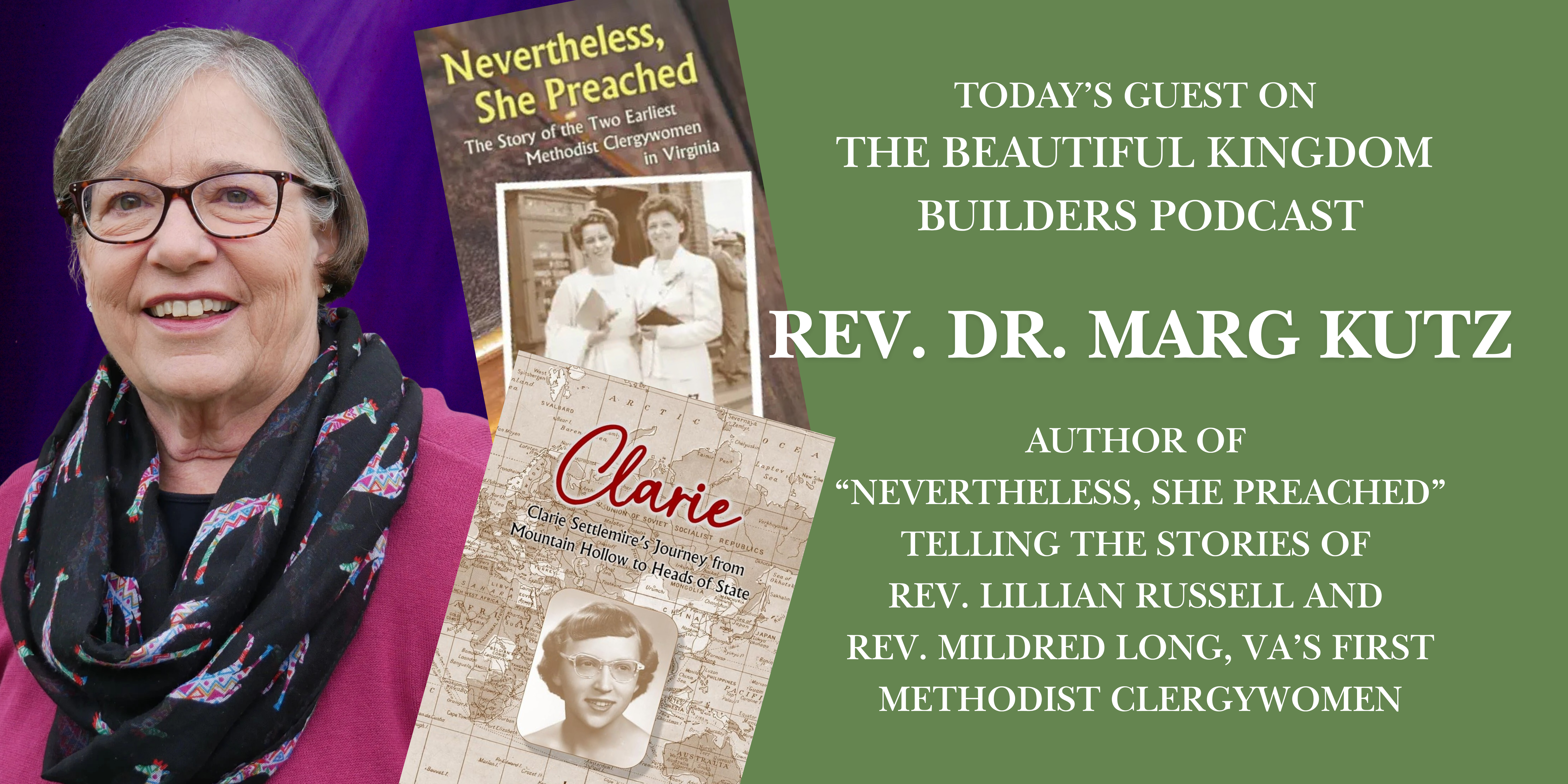
I was delighted to talk with my Virginia United Methodist Church candidacy mentor, Rev. Dr. Marg Kutz, about her book “Nevertheless, She Preached“, which tells the story of the two first Virginia Methodist clergywomen and all of the obstacles and barriers they smashed in their ministry, paving the way for women to come after them. Marg herself was in the next generation of clergywomen and broke many barriers in her 39 years of pastoral ministry.
Marg’s process of researching and writing the book alone was fascinating to hear about. The Virginia UMC historical records say very little about the contributions and milestones of Rev. Lillian Russell and Rev. Mildred Long in their years of ministry, so it was really important for Marg to take her insider knowledge and experience to fully flesh out their contributions and the impact they had on their denomination.
Our conversation is saturated with stories that will amaze you. If you would like to have Marg speak with your church or book group, please contact her through her website, Nevertheless She Preached. She just released a brand new book about a Western Pennsylvania clergywoman, Clarie Settlemire. You can purchase her books here.
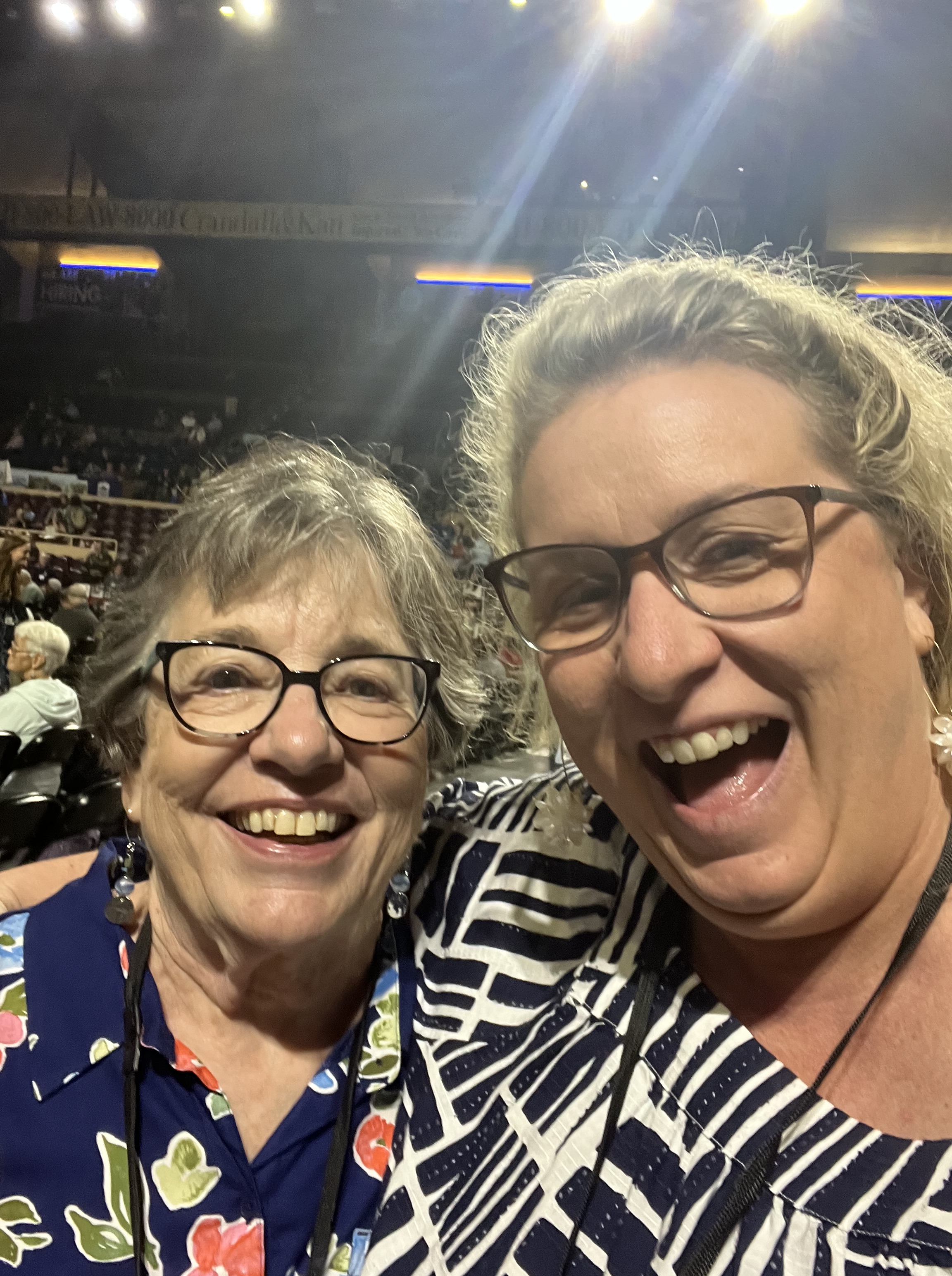
Here’s a snapshot of us at the 2025
VA UMC Annual Conference–
Please enjoy this episode of The Beautiful Kingdom Builders podcast on YouTube, Spotify, Apple Podcasts, Amazon Music, Substack, and more!
TRANSCRIPT:
Ruth Perry (00:16)
My guest today is Reverend Dr. Margaret Kutz, a retired elder in the Virginia Conference of the United Methodist Church and my mentor for the VAUMC candidacy process. Welcome, Marg.
Marg (00:27)
Thank you. Thanks for having me this morning, Ruth.
Ruth Perry (00:30)
I’m delighted to have you. And I am so honored that they gave you as a mentor to me. In our conversation today, we’re going to talk about the book you wrote, “Nevertheless, She Preached” about the two earliest clergy women in the Virginia Conference their story and all of the barriers that they overcame in ministry. But one thing that really stood out to me as I was reading it and as I’ve known you just for a little bit and I’m new to United Methodist Church, I feel coming from the Baptist Church, which is so far behind even where the Methodist Church is, it’s been so amazing to me to just feel the lack of barriers. So I’m just really grateful reading this story, how far the UMC has come since not that many decades ago.
Marg (01:11)
Yes. Right? Yeah, it is good.
Ruth Perry (01:15)
Before we talk about your book, I don’t want you to jump to the parts of your story in your book, but can you take me back through your story, your faith journey as a child and into when you were called to ministry.
Marg (01:30)
I come from a large family. I have four brothers and two sisters, so there were seven of us. And my mother wanted us to grow up in the church, so she made sure we got to Sunday school when we were little. And then as we got older, that we also went to worship. So I had that early upbringing in the church. And I always liked church. I liked being there. There was a time in about sixth grade that I wanted to go to Sunday school, but I didn’t want to go to worship. So I went through that period about six months, but by and large, I enjoyed going.
And my earliest memory is really of, I was about three and I just remember having a conversation with God. So I guess, at the time I didn’t really know what I was doing. So I think that’s pretty significant if your earliest memory is of God. There must be some kind of path for you.
And then I was set on being a missionary. I felt called to be a teaching missionary in Africa and that didn’t happen because I met and fell in love with a man that wasn’t going to work with. So instead, I went to seminary and then became a pastor and did that for 39 years. And I eventually did become a teaching missionary in Africa, but it took me till 65 to do that. That’s another story for another day.
My ministry really comes through that call to missionary work, because then when it looked like it wasn’t going to work, then what was I called to, to sort of clarify that. And so the local church pastor felt like a fit. And I began to meet on campus some other women who were pastors. And that became more of a reality. In addition, in my own home church, there was one other person who came out of that congregation who went to seminary and went on to be ordained. And that was a woman named Clarie Settlemire. And I just finished a book about her. So I had that model as well. Somebody that was about a generation older than me, 17 years older than me, who had gone into the ministry, finished college and seminary and out of this little rural place that we both were from. And so that was a strong emphasis and for me as well.
Ruth Perry (03:27)
Can you tell my audience a little bit about struggle you had deciding between to the mission field and marriage to your husband?
Marg (03:36)
I can do that. We dated for some time and then we were engaged had the wedding, the date planned all of reconcile the two. So I just postponed the wedding and felt that was unfair. So then I gave the ring back. So it broke the engagement. And then I was a school teacher at the time. I finished college and was teaching school, because both the Peace Corps and the Mission Board said, get some experience in United States first teaching and then come back to us and apply again. So I was in the process of doing that.
I remember it was a morning and it was a snowy day, which it is in Western Pennsylvania. And I was driving to school and I heard an audible voice that said, “Marry Bob.” And I thought for sure it was coming from the back seats. Of course there was nobody there. And that’s the only time I’ve heard an audible voice from God. I felt nudgings and had calls in my sleep and such, but that was the first time in the daytime I heard that. So I waited two weeks, did the pros and the cons, and it just felt like, this is stupid. It just doesn’t make any difference. So I called Bob and said, you know, I had this, he said, well, I’ve been trying to tell you that for two years. So that was in February. We were married April 1st that year.
You know, once we got that sorted out, because we knew we cared about each other and wanted to spend the rest of our lives together, but I just couldn’t reconcile the other. So then I still had to figure out, so I did this, God, now what happens? And like I say, it was really in seminary that that became clearer to me that that’s what I was to do. And so did that. We’re married and still married, we’re coming up on 54 years. And we have two kids and four grandchildren.
Ruth Perry (05:14)
I love that story so much. And I thought as I was reading your book, Nevertheless She Preached, both and Mildred Long were unmarried. And it’s kind of sad that that was necessary for them to fulfill God’s call in their lives. And then I think there are a lot of challenges now for women to manage both a call from God and a family, we don’t have to regret that we didn’t have that opportunity either.
Marg (05:38)
It’s interesting to me, Ruth, that for a male clergy, it’s an asset to be married and In fact, a lot of churches don’t want to take a man who’s never been married. That just seems rather strange to them. So that’s an asset for them. But for women, it’s better to never married, no children. That worked better. And I would say it’s probably still very similar to that actually. Churches still prefer a man’s coming to be married with children and a woman not to have so many with family. So many commitments gets in a way.
Ruth Perry (06:09)
Can you introduce us to Reverend Lillian Russell and where she came from and how she came be a minister?
Marg (06:16)
Okay. Lillian was from Richmond and her family was really active in the church. I mean, that they sort of lived and breathed their church. So she grew up in that and, after she preached one time, a minister in the area said he had seen her do things with the youth. So a lot of youth would come and she would speak to them. And so he said, would you speak at my church? And she did. And then she was asked to speak at a revival. And that was going to be, you know, four or five sermons in a row to do that. And she did that at age 17 and people loved it because here was this teenage girl, petite little thing. I don’t know that Lily never weighed more than 120 pounds and she had this voice and this presentation, something to say.
So then she started being invited a lot and she became a full-time evangelist. Well, she wasn’t officially that, but she really was an evangelist in the Methodist church. And had preached for 17 years all over Virginia, Maryland, West Virginia, Pennsylvania, North Carolina, and she never drove. So her family had to support her in all of this and take her places and such. And I don’t know that she ever felt like she was going to pastor a local church, but there was a shortage of ministers with the war and she got a call from her district superintendent to go to a little church in Petersburg and to be the pastor there. She learned later that she sent there because they thought the church was going to close and they didn’t really want to waste that on a man.
So they gave it to this little petite evangelist, Lillian, to do it. Well, she stayed and she stayed and she stayed. She did her whole career there and the church grew and it became a really a vital church. Now they grew in numbers and in ministry and in passion for Christ. It was quite a ministry that she had there. And they came to absolutely love her.
Ruth Perry (08:03)
And then what is Mildred Long’s story?
Marg (08:07)
Mildred, came from a large family as did Lillian, but I think that wasn’t terribly unusual back then for people to have larger families before birth control and such. But Mildred came out of North Carolina and was looking for work and found a job at the mills in Dan River. And so she went to work there and they had it all set up for women to come in and have special places for them to live. And it was really interesting to learn more about that. I could have done three chapters on that, just the life there. And I think that really shaped her a lot. She was there for several years. And then somebody there spotted in her potential and they actually paid for her to go to college. So she dropped out of work with the Dan River mills and, and went back to college and she never quite finished. I couldn’t get all of the story on that, but my guess it had something to do with the war and things that were going on in her family, some deaths and that sort of thing. Anyways, so she came back to work at the mills and while she was there, she was real involved in the local church there and did a whole variety of things. Pastors there seemed to be really open to her knowing lots of things. she did that and she was noticed by her pastor, I think, not the district superintendent.
So he started a new church and then he asked Mildred to help him with that. And so he said, you know, as I move into another church, a logical person to appoint to this church plant, they didn’t call it that back then, but this church plant would be Mildred Long. So she got an appointment there. It was there about two years and then she got an appointment to another church. You know, people just began to see her ability. Now they were very different from each other, Ruth. They were both strong and Lillian could be fierce, but Mildred was fierce. And she ruffled some feathers. Lillian tended to sort of calm things, but Mildred was more likely to confront things. And their friendship meant a lot to them because they were the same age, born the same year, but Lillian was about 10 years in experience ahead of Mildred. So Mildred leaned on Lillian’s experience and they became friends through all of that. they were the only two.
Ruth Perry (10:12)
Do you feel you have anything in common with Lillian or Mildred, Marg?
Marg (10:16)
You know, I connected more with Mildred. There was a, I don’t know, there was a spiritual, both innocence and powerhouse in Lillian that I really admired, but I don’t see in myself. There was fierceness and a determination in both of them, but the way it got acted out in Mildred, I think, was more like how I acted out. A little more upfront.
Ruth Perry (10:37)
So you knew of them when you were coming into ministry and you had contacted them, which you write about, they actually retired the year that you were ordained, is that correct?
Marg (10:48)
They retired a couple years after I was ordained. I think in 79 and I was ordained in 77. So yes, two years. But I had never met them. And I wanted to get together of the clergy at conference for lunch. So I looked to see who all the clergy women were. I think there were five of us. so I asked, this was all written, know, and typed. And it was when we had carbon paper behind it. So it wasn’t, I shot an email out to them, but actually, you know, typed up a letter and sent it out to women to invite them. And it was Mildred that responded back to me and said that she had talked to Lillian and they decided not to come, that they really hoped that our experience would be different from theirs. And they didn’t want their experience to color or influence our own experience.
So I was sorry about that. Because at the time I was sort of peeved. then as I look back, particularly as I researched for this book, I was really sorry that I didn’t know them. And I think it really would have made a difference for all of the clergy women at that time to have known them, even if we had to hear their stories and all the things that happened to them. Once they retired, they sort of set it aside. They were interviewed by a woman, Kathy Morgan, who wrote the history of the United Methodist Women’s Society in Virginia. It was just a little booklet. So it’s maybe 50 pages, if it’s even that. And she had two pages on Mildred and Lillian. And how she did that was she interviewed them by mail. So she wrote them a letter with some questions and then they wrote back with their And they talked as if nothing of any consequence, there wasn’t wasn’t any blowback or pushback on them of any consequence. And I think that by that time they had gotten to the point was like, just letting this go. I don’t need to carry this banner anymore about the prejudice. But it was there. It was clearly there when you read their history. They may not have said it, but they lived it.
Ruth Perry (12:43)
You wrote your book in the genre of historical fiction, which was so beautiful because it really captured not just the facts of what happened, but the emotion and the impact in a really powerful way, I think, and really beautifully captured the culture of their age. Just the little particular things about their own personalities that I think wouldn’t have been conveyed as well, as So I really appreciated your approach to writing the book. And you said in the introduction, that God led you to write this through a dream. Can you tell me about that?
Marg (13:16)
This time I was retired and I had been thinking about writing my own story. People had encouraged me to do that. And so I was sort of thinking about that. Well, I have time now that I’m retired, maybe I could do this. I had a dream and the dream was to tell the story of Lillian Russell and Mildred Long. I mean, it was just plain and I knew even when I was having it that this was from God and that I was going to do this.
And I knew nothing about writing. I did learn that I’m not a good writer. But critique groups helped me tremendously. They were very patient with me. I was definitely the worst writer in the group. And they just sort of brought me in. The first chapter became the first three chapters. And then the first of those chapters, I took to the group three times. And the third time I said, now, when I say make these edits, you want me to bring it back to you again? And they said, no, they were tired of it. Move on. And I had started it as sort of a biography and then I didn’t like it. So then I made it biography combined with historical fiction. And the group said, you got to make up your mind. You can’t write a book that’s both. It’s got to be one or the other. And like you said, as I got to know the women, I wanted people to know them as people and not just the facts of their life. So that’s the reason I made it fiction so I could tell the conversations.
And oftentimes it would be either something I read or something that somebody told me in interview about them, either something that happened or a trait they had in their personality. And then I would create a scene or a story that would help convey that rather than just to write it in a paragraph or in a sentence. And that was fun to think about that. OK, so I know this about them. Like I know that Lillian Russell had to appear before the committee. So what must that have been like? What did people wear? Where would they have been? How would she be feeling? What was going on? And I could sort of refer back to my own experience as part of it, because even though I was a generation behind them, my experience, particularly early on in those first five to 10 years, was almost identical to theirs. Things had not changed much at all in that time period. And then they changed rapidly in the 70s and 80s with the women’s movement.
But up until then, really my experience was very similar to theirs. So I could fall back on my own experience and think about how I felt and what happened and what I saw in the men, either obvious or subtle.
Ruth Perry (15:35)
You clearly worked very hard, and I think you wrote excellently. I was just talking college minister in a previous episode and she quoted GK Chesterton, “Anything worth doing is worth doing poorly.” But I don’t think you did it poorly at all. I think it’s amazing and I really enjoyed reading it.
Marg (15:39)
Thank you. Yeah. I hear what you’re saying though. Yeah.
Ruth Perry (15:55)
I mean, their story is so important.
Marg (15:57)
It is, it is. And I think what makes the book interesting is them. It’s not the way I told it. It’s them. They were amazing people. And I came to what I felt sort of know them, you know, through all of this. And there were times, I remember one night my critique group met about 45 minutes from where I live. And on the north side of Richmond, and I live in the south side.
And so as I was coming back home, I was thinking about this because one of the men in the group said, as he was critiquing, they would read 10 pages and tell you what they thought. And he sort of pushed the paper back. He said, look, you don’t have a lot to work with here. So if this is going to be good, it’s got to be written really well. And it’s not. He said, I was like…
Ruth Perry (16:40)
Brutal!
Marg (16:44)
It was brutal. So when I went home that night, I was driving home talking to God saying, you know, these people deserve a really good book. So either I need to get out of the way for somebody else to write it, or I need to get out of the way for you to help me write it. So help me with this, God, if you really want me to do this, help me, because I want this to be a good book for them, because, you know, they really do deserve this. So it’s just a sort of a conversation, you know, if you I don’t know how people pray and listen to God, but I felt like God was trying to tell me how she was informing me and was sort of, listen harder and wait longer. Because I’d be like, why don’t I just do that and then to go forward with it. And she was saying to me, wait a little longer and listen a little harder. And then as I thought about it, I thought, that is true.
Because sometimes what the critique people tell me is exactly what I was thinking when I was writing it but I didn’t stop writing long enough to stop and listen and then to write as I was directed. So I thought God really is directing me in this. I’m just moving forward too fast and not listening enough. I don’t pretend that this is the Bible, but but it did cause me to think, I wonder what it’s like for the Bible writers, particularly like Paul or even the gospel writers telling a story. And we think about them being directed by God. And I just wondered if they had critique groups, you other disciples, you know, sort of this is what I remember how it happened. And maybe you should add this so the reader will see this. And so anyways, just thinking about how God has led people to write all kinds of things over the years from the heights, you know, the Bible to historical fiction and how that works. So I think God still words that are inspired by God, whether they be sermons or books or poems or hymns.
Ruth Perry (18:27)
Absolutely. Part of my own experience now in the United Methodist Church is that I came in completely blind. I knew nothing about polity. I knew some Wesleyan theology because I had already been licensed in another Wesleyan denomination. But I was brand new to all of the language of the Methodist Church, the structure, the politics of it, and it was very overwhelming coming in. So was grateful that they gave me mentors to help. But can you give a little bit of a crash course on the process of becoming a clergy person in the Methodist Church?
Marg (19:01)
So it starts with the local church. And if the person feels a nudging or a call, he or she talks to the pastor. And there’s some resources they can use, some books and such, to sort of walk through it. And if the pastor feels person has thought it through adequately, and it might take a week, it might take two years, and working through some of the resources.
Then has the person go before what’s called the Staff Parish Relations Committee. It’s sort of the personnel committee at the local church. And then they recommend or not recommend for the next step. And if they do recommend, then it goes to the church’s charge conference, which is sort of a group of their leaders. And if they recommend, then the next level, so now it’s done by the local church, the person who knows that person best.
And then it goes on to the district level, which is what the district superintendent overseas. And if they are approved for that, and there’s a lot of papers to write and interviews, and so it’s a long process for that, then they can recommend them for ordination. I guess it’s consecration and becoming a provisional member. When I came in, was ordination as a deacon and probationary membership. And now it’s provisional, but what’s the other? not a deacon anymore.
Ruth Perry (20:12)
Associate.
Marg (20:14)
Yes, associate. And when they’re brought into provisional membership, then they still cared for by the district, but then they’re eligible to be recommended to the annual conference. And then ultimately they’re on by a clergy session. So all the ministers in the conference vote on who gets to come in. And if they’re voted in, then they’re ordained and brought into full membership.
It’s quite a process, as you know. So there’s that polity side, but then there’s a whole education piece, know, with college and seminary or lay licensing school and all those in addition to this approval process through the ranks.
Ruth Perry (20:40)
So it’s good, they definitely equip their ministers, which is great. So and very affirmed in their local church their gifts were obvious had opportunities to local pastors that supported them. But what were some of the barriers that they started to encounter as wanted go through the steps of increasing their status in the United Methodist Church.
Marg (21:14)
Along with that, I found out through reading newspaper articles and Mildred was more likely to tell some of her story and as she was being interviewed, Lillian a little less so, but you could tell from they came through. For instance, when Lillian was appointed to the first church, it was because they thought she was going to close it.
And then when she went to seek some kind of status, because then she was just lay supply, which means at any moment that she could be out of there. There was no guarantee or security really in that position. So as she sought to have some level of status beyond lay supply, she needed to appear before the district committee. And what I read was that she was in the Richmond district and she was approved in a Rappahannock district. Now that didn’t make any sense because you would always be approved by your home district. And then they have the pastors listed for each of the districts, she was listed in the Richmond district. But the newspaper said that she was approved in the Rappahannock. So this is just one case that I did some investigation. And without the newspaper article, I wouldn’t have known any of this had happened.
But with that, then I went to a retired minister named Raymond Wren, who had been around then and knew Lillian Mildred. And at this point, he was over a hundred years old, but he had a really, really good memory. And so he talked to me about that. He didn’t know so much the particular stories of Lillian Mildred, although he knew of them and had met them. But he said, tell me who two district superintendents were. And I told him, and he said, yes.
So she had to leave her district to go to another district in order to find a district superintendent who would even allow her to appear before his committee. So she did, she was approved. And I remember going through those ropes young woman. And so again, I was able to sort of describe her experiences based on my own, how the men were, how their behavior was, what her response was, or trying to read the room. When I first came in, they wanted the minister’s wives to come with them for the interview. Now that just seems archaic now.
But that was standard then and my husband did go with me when I was first interviewed on the district for a deacon So when Lillian went she would have taken her father And her father was a big deal on the district, but now they’re on a different district. They’re not on the home district So he didn’t carry quite as much weight there as he had But just trying to navigate all of that as a young woman.
It was quite remarkable what she did and quite disappointing how the church was, just how much more it had to grow. I also found out, Ruth, that even though it was in the Discipline, it was not enforced. It was sort of like, well, you know, not all of us are on board with you girls, so you can go to this district because this DS thinks it’s okay to have a girl in ministry.
So there were some of that and that was happening in Mildred when she wanted to be brought into full connection, ordained an elder and brought into full connection. She was on one district. I think she was still in Danville then I’m not sure. But anyways but then she had to move and this was something she had written had shared in an interview for a newspaper article. That’s where I read that. The bishop moved her to a different district.
And my take on it was when she couldn’t get the DS to allow her to come and appear before the district committee, that Mildred probably called the bishop. That would be my guess, knowing what I know about Mildred. And the bishop said, let me move you this year. So she moved to a different district where the bishop knew there would be a district superintendent with who more amenable. So they didn’t enforce the rules. They just sort of worked around them because it was a boys club.
They didn’t want to come at each other. They wanted to do the right thing, but they didn’t want to hurt each other. So they just found other ways to do it. It was really hard for Lillian and Mildred and other women in the days that I came in to feel supported by the hierarchy. It just wasn’t there. The very first appointment I had when superintendent called me to tell me where I was going.
It was Round Hill and I said, well, where is that? He said, get a map and look it up. huh. So then he talked a little bit about it and then not much. And, cause I had been out of town and he said, I’ve been trying to call you. And this is, know, before voicemail and all that long time ago. and, and I said, well, I was in California. You shouldn’t travel during appointment season.
And I thought to myself, I didn’t even know there was an appointment season. But see, these were things that the men knew because they mentored each other. the women were totally kept out of those kinds of things. So I was scolded for that. And then he said, glad I’m going off the cabinet this year because I don’t ever want to have to appoint another woman again.
Yeah. So there were district superintendents, even though we were in there as, when I came in being eligible for Deacon, Elder and full connection, just all the rights and privileges the men had the district superintendents for not kept in line with the, with the same book that we all shared and they made a commitment to when they were ordained that they would support and uphold that Book of Discipline. And they, didn’t, and they weren’t held accountable to it. And the people that suffered were a lot of people, but
I was aware of the clergy women as separate as a result of that. The first district I went on was the Winchester district and Lee Schaefer was the district superintendent there. And he was brand new in that position. And I found out that really he made my appointment. He was invited as the new district superintendent to come in and sit on some of the appointment things. And, this is a story. They thought they were all done.
Now they use laptops, but then they had books, their appointment books. And so everybody had closed it up and Bishop Goodson said, well, I guess that’s it. Because it was long, know, our long arduous project process. And the district superintendent, the outgoing retiring district superintendent from that district raised his hand said, Bishop, I still have one church without a pastor. So they don’t open up their books. And so at that point, they’re thinking about appointing somebody that’s retired because it looks like everybody’s taken. And it was Lee Schaefer that says, Bishop, where’s Margaret Kutz gone? And he said, well, she’s going to go to Graham Road part time. And I was going to be part time there because they didn’t want me working after dark. It was just one of those things that’s like when the streetlights come on, all the kids and the associate pastor have to come inside because they’re not allowed out.
Anyways, so I was going to be part-time at a church because I couldn’t be out night and was going to my senior pastor told me a nice guy, but he told me said I don’t know really what I think about women in ministry, but my wife thinks it’s a good idea. So I thought I’d give it a chance. Anyways, so I knew there wasn’t going to be a lot of support there. So when Lee Schaefer found out where I was appointed part-time, he said, well, what about her? No, they would never take a woman. He said, well, let’s ask them.
So they called and they gave him a choice, apparently. I figured one was dead and the other one was nearly dead, or me. I don’t know if that really was true, but anyways, probably two retired people or me. And they said, well, we’ll take that woman. It was the president of the local bank that was chairing the committee, Mr. Cooley. As I came to know him, I thought I can see him being open to that. So that’s how I got that appointment. My district superintendent who supposedly made the appointment. I was the only woman he’d ever appointed and he didn’t want to have to do it again. Hard to believe, isn’t it?
Ruth Perry (28:21)
It really is. So at the end, the last few chapters of this book, you share pieces of your own journey you talk about a minister and pregnant and some of the terrible things that people thought about that, that they didn’t want to see someone behind the pulpit and know that they had done it.
Marg (28:32)
Yeah. Yeah. Yes, you can just tell she did it. And there’s teenagers in the congregation and they’ll know she did it. You know, that and women are naughty.
Ruth Perry (28:38)
and just archaic ideas. So I was thinking about Lillian being posted at a church that they thought only had about two years before it would close. And the idea of the glass cliff that oftentimes when an organization is sinking, that’s when they give a woman an opportunity. And it’s not just an opportunity to lead, but it’s also kind of like putting the woman in a scapegoat position where they can criticize her and blame her. Yeah.
Marg (29:07)
See, we told you. Yes, yeah, we told you. I remember one time I went to a district superintendent saying, I’d like to be considered as a church planter, know, a pastor who would be particularly trained to start new churches. I always thought that a lot of work, but I thought it would be a lot of fun. And he said, I don’t know. He said, you know, we had a woman try it and it didn’t go well. When I knew who she was, I’d went on to seminary with her and a fine minister, really gifted. Anyways, and I said, So if you ever have a male minister try to start a church and fail and he said, yes. And I said, well, what are you going to do if you can’t ask men and you can’t ask women? He was like, Because he’d do such a broad brush for women and a little tiny hair brush for the man. So there was all of that, what you’re talking about send her to the place that is almost impossible. And then say, see, we told you not only that she can’t do it, any of her kind can’t do it. The whole broad brush thing.
Ruth Perry (30:04)
So can you tell me a little bit about the 1979 annual conference how that was a pivotal of mantle passing between Lillian and Mildred and future generations?
Marg (30:13)
Mm-hmm. Mm-hmm. Lillian Mildred born the same year, but they didn’t come into ministry the same year because Lillian was the head of Mildred. But they retired the same year, 1979. They were both 65 and retired in 1979. And so when I went back and looked The Advocates of the historical records, the magazine for the annual conference, I looked at what was going on that year. And it really was a pretty big year for several levels, but the year that they retired should have been noted that the two earliest clergy women are retiring and there was of course nothing. But then it listed the people that were ordained that year. And that was also the year that they elected delegates to general and jurisdictional conference.
So it tends to be a really heated session, very competitive and the way it works and you have caucuses that, you know, supporting different people and And the clergy women were just trying to figure out how to influence that vote. We hadn’t quite figured it all out yet, but we did eventually. And truly we changed the face of General Conference from the Virginia side totally. And did it for some years, which really puzzled and frustrated other people who thought they knew how to do this. But anyways, we came up with a different strategy and overcame the biases.
So that year people were contesting for General Conference and they needed one more delegate from Virginia for General Conference. You had to have a majority, but there were three that were elected on the last vote. Usually they reduced how many were needed to elect as they went on. They were trying to wrap up annual conference. They would say, okay, now you only have to have so many to be elected.
So these were these three people. One of them was Jim Turner, the guy that told me, you know, I’m glad I don’t have to point another woman. But anyways, he was elected to General Conference. But the person that really stood out for me was Leigh and Teen Kelly. She was an African American woman, a whole generation older than me. She was just a year younger than my mother. And Leigh and Teen, and she was ordained the same night I was, you know, in order, Kelly and then Kutz.
But anyways, Leontine Kelly, then she went on not only to represent Virginia at General Conference, but she went on and was elected a bishop. She was not elected from the Southeast. They would not elect her. So she got on a plane out of, out of North Carolina and, flew to a place out West. can’t remember now the name of the city where they were having their own. jurisdictional conferences they were all held at the same time. And she was elected there. These people didn’t even know her.
But they knew of her and she went from group to group, you know, and introduced herself, talked about they asked her questions. And so when it was time to vote, they voted for this woman who had just showed up at their jurisdictional conference. It was it was truly an act of God, truly an act of God. So so there was that with Lillian teen Kelly and they probably didn’t even know her. And then Cynthia Corley was ordained that night and she was the first
female district superintendent appointed in Virginia and in the whole Southeast. There were three of them appointed the same year. So she was one of the three first. And none of us knew that this was how it was going to play itself out. But you know, Elisha asked for a double portion of Elijah’s. And I think that was what it was. It was two of them and they both gave a double portion. And here we had two history making things happening as they passed that mantle. So you think about the power that they carried in their mantle. And when they passed it on, the power that then was spread and shared with the, what do you call your blog, the peaceful kingdom kind of thing.
Ruth Perry (33:47)
Yeah, the beautiful kingdom.
Marg (33:48)
Beautiful kingdom. and they they became part of that. So lots of times we are part of what the Spirit’s doing and have no idea Have no idea that what I’ve what we done and they didn’t know they were retiring. They didn’t know they were doing anything, but they did. And the spirit took that and wrapped it up, their mantle up, parted the waters, and through they came.
Ruth Perry (34:11)
Praise God. And then you were the first woman that served on the Board of Ordination. Can you describe what that experience was like, Marg?
Marg (34:20)
It was really hard. It was really hard. The only time in my life that I actually had allergic reaction to anxiety was there. Something had happened in one of the interviews that was totally wrong and it happened to a friend of mine and as a result of that she wasn’t approved and they had there was.
confidential information that wasn’t true, confidential information that wasn’t true that they went and intentionally told each of the committees before she got there. So each time that she went into one of the interview committees, they confronted her with something that was none of their business. It was confidential and wasn’t true. And then they wondered why she came across as sort of angry and she wasn’t approved. And
I wanted so much, because she was a friend in particular, but it was awful that I couldn’t help her. And I didn’t know how to do it. It was so much bigger than me. I remember leaving, going back to my room, they had a birthday party for one of the guys and they wanted me to bring in a cake and they one of Dolly Parton’s songs. And it was the whole thing was just, you know, the men are hooting and.
with this old guy that I don’t know, he’s celebrating his 70th birthday or something. Anyways, because I was young, so everybody seemed old to me then. So there was all this guy stuff going on, and I was just carrying this burden for my friend. And I remember going up to my room and crying and calling her after I knew that she had been informed to apologize to her that I didn’t know how to make it right. And then I went directly from there to a clergywoman’s retreat.
And every time I tried to tell the story, I couldn’t breathe. I had to stop talking. Like I said, was the first time I’ve had an allergic reaction like that. I was just closed up and I couldn’t talk. I was made mute.
So that was the worst thing that happened, but it was difficult. We didn’t require inclusive language then. In fact, most of the guys didn’t know what it was. But if somebody came through, a candidate came through and they had used inclusive language in their paper, I just thanked them for it. I said, I noticed you did that and just want to let you know I appreciate that. And some of the other guys on my interview team would apologize for me.
And I said, you don’t have to apologize for me. If they used it, clearly they appreciate it. So you don’t have to say anything, you know? But by the time I left, I had made a motion to require inclusive language in all papers. So I thought, OK, this is a test to how well I did here, see if this passes. And the chair said, Margo, I really want this to pass. I think you need to make it recommend rather than require. I said, mm-mm. I’m going with require.
Let’s just see what happens. And it was approved, not unanimously, but it was approved to require inclusive language on all papers. And I thought, okay, I have come and I found a place for myself and I’ve made a difference and now I’m leaving. I’ve been here seven years and I’m going to leave. But that was an affirmation that I’ve done a few things right anyways. Had earned some crud on the board.
Ruth Perry (37:11)
Where do you see that Virginia needs to continue advancing in their inclusion and treatment of women and minorities? And where do you think we need to improve?
Marg (37:21)
Mm-hmm. I do think that ethnic women in particular really need some attention. There was a time when we had very few Korean pastors, male or female, in the conference. And then just a whole lot came to the board of ordained ministry. And my thinking was that we needed to look to see what God was doing to say, you know, why are all these Koreans coming out? Why is God sending them to the Virginia conference?
And is there supposed to be a specialized ministry that we’re supposed to be doing? Because also a lot of Koreans were moving to Virginia. But instead of doing that, they tried to find a way for them to fit into what we already have. You know, how do we how do we appoint them? Well, let’s just point them with no bias, just as if they’re Anglo. Let’s just move forward with that. So there was no preparation for the pastors nor for the congregations because I think they thought the best way to avoid bias is to pretend there isn’t any. And so it was really difficult. And the women really struggled because in their own Korean culture, they were a step behind the women, I would say, in the United States in terms of recognition. So they had their own bias coming out of their own culture. And then coming into the church and being both female and Korean, they were really hurting and felt really invisible. So that one, and I also think Hispanic and African-American.
The race issue becomes secondary every time another one comes up. So when it women and, you know, race came second and then other things happen. Now it’s LGBTQ and then race is second. And so we’ve made great strides and with women and some ethnic groups and certainly great strides with LGBTQ plus, but we still have a ways to go, I think, with our ethnic groups. the women’s movement has notoriously been about white women. And we need to change that. And I think the women need to come together and the white women need to sort of shut up and do more listening to our sisters who are Black, Latino, Asian, and listen to what they have to say and see if there’s some way that we can back them up and help.
Ruth Perry (39:31)
So on Wednesday, I was participating in a Zoom talk about your book that you were invited to do at the conference. And it was striking that no men signed up to participate and hear from you. Have you experienced a lot of feeling ignored or accepted by your male colleagues or has that mostly been a marginal experience for you?
Marg (39:52)
I think, no, there have been some that have read the book and most of them are acquaintances. So I think they read it as much because a friend of theirs wrote it. But I’ve been invited to a lot of groups to speak about the book, know, women’s circles are, but it’s all always either been the whole church, the whole congregation, like on a Sunday morning, or it’s been just a women’s group. have yet to be invited to a men’s group.
I was invited to one clergy group and I asked, it was Drew Colby that did this and I asked Drew if he would do it. I wanted to see what happened. And so he brought them together. had not read the book, but anyways, it was a good discussion. That’s the only one I’ve had, but that was because I asked somebody to do it.
Somehow history, just history, which is really history that the white men write. And I don’t mean anything against white men, but that’s just sort of the reality that we live in. That that’s for everybody. But then if you have Black history, that’s only for Blacks to hear about. And if you have women’s history, that’s just for women to hear about it. But we need to hear the whole history.
I don’t know what you do with that, Ruth.
Ruth Perry (40:52)
Absolutely. Well, I think calling it out is a place to start and just bringing awareness that we need to listen to each other.
Marg (41:00)
Mm-hmm.
Ruth Perry (41:00)
I was kind of sad towards the end of the book reading about Lillian and Mildred’s retirement years. Lillian especially seemed very lost without her ministry. And just the contrast between their retirement and your own retirement, you’ve never stopped. You’re still going, going, going, and you’ve had amazing opportunities. Can you tell us about the school in Africa that you, and you finally made it to your missionary dream.
Marg (41:25)
Yeah. I heard the call at 18 and finally at 65 was there. So when I was at a church in Williamsburg, Wellspring in the 1990s, we sponsored two of the Lost Boys of Sudan. It was actually the year 2000. And then when I moved from Williamsburg over to another appointment near Richmond in 03, kept my relationship with them, but particularly with one of them named Angelo. And it was amazing what he did with his life. He got his GED and his associate’s degree and his bachelor’s degree and eventually his master’s degree. He got married and he and Stephanie have three children. And so there was all these things that he had accomplished, but one of the things he always wanted to do was to reach back. He always wanted to go back home and help the people there.
And he knew that he was saved. He would say this, I would say for a purpose bigger than myself. And he knew that it was about helping the people in South Sudan. So we organized a team and then it became a committee and then it became a nonprofit. And for a while it was part of the conference and now it’s not, it’s a separate nonprofit. And the idea was to start a school. And so we hired somebody over there to do it it just wasn’t getting done. wasn’t getting done. And I just knew that I needed to go and I know nothing about this. So I don’t know why I thought I was the person that needed to go there, but I did and went with a good friend. Well, she wasn’t a good friend at the time. I barely knew her, Bev Neeland. We’re good friends now, but she and I went together with Angelo. He stayed two weeks and then we stayed almost three months while we were there. And we went back to his home community called Roombaek and the director was there. His name was Philip.
And what’s amazing, Ruth, is that we were in Roombaek for a week and the Monday of the second week we were in a classroom teaching. Now, no human being can do that. That’s the thing of God, because people would say, well, how did you do that? I said, I have no idea. We just showed up and God did the rest. So there I was teaching in Africa, finally.
And I’ve had people say, wasn’t that like sort of a glorious angel singing, moment, you know, with that happening. And I said, no, was so freaking hot. The sweat was just dripping off my chin. I didn’t feel any angels at all. It was fun, you know, but it was really hot. Yeah, too hot to know the angels. It felt more like, I think angels like air-dishing. I think it’s the other end that likes the heat. But anyways, but it was, to me, I guess the phrase that kept coming back to me was, God remembered. Well, it’s sort of like, of course God remembered, but to me it was like, God remembered that word to me. Anyways, it was powerful for me in that sense, that all those years that God honored that, all I had to do was show up and that God gave me an opportunity to teach.
We taught for awhile and then we hired some teachers and they were way better than us, partly because they could understand them and teachers could understand the students. And then we set about setting up a school, you know, doing what we needed to do. Set that up and then we came back home so we could raise money to pay the teachers that we had just hired. And now this school is called Bukloi, which in the native language of Dinka, it means yes, we can. We started with about 35 students and now we have over 700. And it’s considered one of the best schools in South Sudan and one of the largest.
Ruth Perry (44:46)
Wow.
Marg (44:48)
Yeah, pretty amazing. And I’m totally out of it now. I mean, I, you know, continue to support it, but I’m on on the border. I don’t go anymore. I made my last trip when they celebrated their 10th anniversary when they began. But there were many years where we had enough to pay people for a month if we spent everything we have. So we did. We just spent it all and just hope the next month somehow more money would come in to pay the teachers again for another.
Ruth Perry (44:49)
Congratulations, that’s amazing.
Marg (45:15)
We had months that we didn’t have enough and we paid the teachers what we could and told them we probably will never make this up because we’re running really tight. But they hung in there and they stayed with us. And we still have, I think, one teacher from that very beginning time. Maybe two, I think it’s just one now. Pretty amazing.
Ruth Perry (45:33)
Marg, can you put your mentor hat on and speak to young women like myself who are starting out in ministry and give us some of your best from your decades in ministry ahead of us?
Marg (45:44)
If this is what you’re called to do, there is no greater life than you can live to do this. I mean, there’s times that it’s just frustrating and demoralizing and makes you angry. But in the end, it’s amazing what God lets us do. I think about that we get to proclaim the good news of Jesus to people who are sitting there and listening. And we get to do that.
And then when we visit people, they open up their lives to us and tell us things that we get to enter into people’s stories and to walk with people through all of that. It’s to me, it’s just such a wonderful privilege. Certainly it comes with all the challenges and but but to never lose sight of the beauty of what we do and a power of it. Not just political power, but spiritual power and the life power. That’s what I would say, Ruth
Ruth Perry (46:32)
Where can people find information about your fiction?
Marg (46:38)
Okay, I have a website called neverthelessshepreached.net .com and dot org were taken. I got dot net. Nevertheless, she preached dot net and you can get a hold of me through that and I’d be glad to speak with your group. If you want me to do it in person, I can do that or I could do it via zoom or whatever. I have had some book clubs read the book and then I would come in. I’m in a book club and I think it’s wonderful to be able to have the author come in and be able to ask questions and share stories and such with that person. So anyways, I’d be glad to do that or speak to a group of those like me to do that.
Ruth Perry (47:14)
Thank you so much for all the time that you’ve spent with me. I think you were to be my mentor for a year and a half, and we spoke monthly. And you were just always so generous and encouraging and uplifting. And always felt affirmed in my calling by you. And I can’t tell you how and impactful that was for me. And so thank you for that.
And I just want to give you the last word before we sign off.
Marg (47:38)
Praise be to God, we worship an amazing God.
Ruth Perry (47:42)
Amen. Thank you so much for coming on the podcast today Reverend Marg.
Marg (47:47)
Okay, thank you Ruth. And you are an amazing pastor, very gifted, and you have much to contribute to the the reign of God.
Ruth Perry (47:55)
Aw, thank you. Blessings to you.
Did you enjoy this episode? Please subscribe, rate or review us on YouTube, Spotify, Apple Podcasts, Amazon Music, Substack, and more! Your support means the world. God bless!


 The Beautiful Kingdom Builders