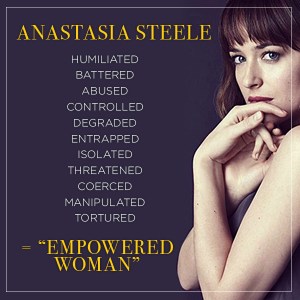
Today is the long-anticipated release of 50 Shades of Grey in American theaters. As I work on this post, people are sitting in theaters being entertained by an abusive relationship in which a woman is battered, degraded, coerced and tortured under the guise of “romance.”
TBKW firmly stands against the dehumanization of God’s children, in any form. Here are some excellent articles on the topic of this cinematic blight on society:
The campaign was started by women from Stop Porn Culture, the National Center on Sexual Exploitation, and the London Abused Women Centre in Canada. It’s inspired by 50 Shades Is Abuse, an effort begun nearly three years ago by Natalie Collins, a British advocate for domestic violence victims. She and other activists worry that the flick will send women the message that being stalked, controlled, and manipulated by a significant other is sexy and romantic.
There are cultural, psychological, and even physiological reasons why some women gravitate toward threatening “heroes” or violent sexual fantasies. Women’s bodies respond to perceived sexual threat by becoming physically aroused. It’s a defense mechanism to minimize injury if they are assaulted.4 Knowing this may help us understand how fiction that celebrates sexual violence could be an easy way for inexperienced teens or exhausted moms to experience a bit of a tingle. Yet, this age-old storytelling medium has played a crucial role in promoting an unhealthy view of sexuality and relationships, one that has been passed down from a dysfunctional, and often violent, patriarchal past. In a blog post titled “The Brain on Lust,” Sharon Hodde Miller, a PhD candidate at Trinity Evangelical Divinity School, explains that “whenever you learn something new, your brain changes, both physically and chemically. As that new information is stored, your brain creates new neural pathways and strengthens old ones…The more you use certain neural pathways, the stronger they become, whereas others weaken with lack of use.”5
In other words, our minds are, in the most literal sense, moldable. The more time we spend thinking about something (hours submersed in romance novels featuring domineering or abusive heroes), and the more our associations are reinforced (domineering men are sexy, and relationships with them will lead to happy endings), the stronger those neural pathways become. Just like pornography, romance novels can rewire our brains, overwriting reality with unhealthy fantasies that we increasingly associate with pleasure.
The researchers assert this analysis show that Fifty Shades of Grey depicts emotional abuse “in nearly every interaction” between the central couple…
The study concludes:
Despite the pervasive abuse patterns we uncovered in our analysis, popular reviews have suggested the book is liberating for women’s sexuality, providing women with an “opportunity” to openly experience erotica in an otherwise hyper-repressed culture.54 Our analysis did not set out to unravel the validity of the popular claim that the book is liberating for women’s sexuality. However, what our analysis sheds light on is the following: While Anastasia is depicted as experiencing “pleasure” during some of the couple’s sexual interactions, our analysis shows she is simultaneously confused and terrified that she will be hurt in such interactions, and she yearns for a “normal” relationship; in addition, Anastasia’s consent in the sexual activities is coerced through the use of alcohol and intimidation/pressure.
The reality is that if you take away the glamour, “Fifty Shades” is just a sensationalized lie, telling women that they can, and should, fix violent and controlling men by being obedient and devoted, and that, somehow, this is romantic.
Ahead the highly anticipated film’s release, there’s a growing outrage aimed at 50 Shades of Grey. Last week, GOODwrote about a campaign called 50 Dollars Not 50 Shades, in which domestic abuse activists are urging people to donate $50 to women’s shelters in lieu of purchasing a movie ticket. They feel that the book’s lead romantic interest Christian Grey is often “extremely controlling, possessive, and forceful.”
The Christian conversation on “porn” has (in the main) these aspects:
Purity: viewing defiles the person looking.
Addiction: people get addicted to viewing and so it becomes treated as a medical disorder.
The redemption narrative: (mostly) men sharing their stories of moving from sin (watching “porn”) to redemption (no longer watching “porn”)
Neuroscience/Intimacy: After Dr William Struthers (neuroscientific theologian) wrote a book covering the ways viewing pornographic content affects the brain and communicated the solution as greater intimacy, this is regularly talked about and he is the go to person Christians usually quote or invite to talk about “porn”.
Though all of the above can be part of the issue, I would suggest of greater significance are the following layers underpinning the spectrum of pornographies:
A gendered analysis: this is about men consuming women. Man as subject, woman as object.
Industry: people make vast sums of money from selling pornographic material. Viewers are groomed into harder and harder core porn, in order to bring financial benefit to (mainly) white men.
Power: as we’ve seen in the latest power plays of The Sun around Page 3, pornographic material is more about power than it is about any sort of meaningful sexual experience.
The broken lives: the (mostly) women who are groomed, used, abused and discarded by the industry.
LUNDY BANCROFT ON DOMESTIC VIOLENCE IN POPULAR CULTURE
This is such an insightful and important series of videos. I’m linking to Part 1 of 7.
2. It glorifies violence against women. Last year a researcher from the University of Michigan did a study on the effects of Fifty Shades of Grey on women readers. It showed that women who read the books (it is actually a trilogy) were 25 percent more likely to have an abusive partner; 34 percent were more likely to have a partner who stalked them; and 65 percent were more likely to engage in binge drinking.
Just as there is a link between violent video games and violent behavior in teen boys, this study showed that women who read graphic porn novels tend to gravitate toward the types of abusive relationships depicted in books like Fifty Shades. The study also showed that these women were more likely to have eating disorders. (Interestingly, the dominant male character in Fifty Shades carefully controls his girlfriend’s eating habits.)
I would hate to see this much-needed dialogue turn into a debate about BDSM between consenting couples, which the church has no business policing, and not about the real issue at hand: what abuse looks like in real life. Given the number of people in the BDSM community who say this series misrepresents what it’s all about, it’s a dialogue worth having.
A reign of God perspective on sexual desire sees that we are embodied beings given a gift by God which is to be used with discernment, wonder and joy. As we engage with this gift well, we become the true humans that God had always designed us to be.+
Will we react to the issues around sexuality in our world with simple moral outrage or will we rather seek to engage with, relate to and speak into a world that is broken and needs restoration?
Here’s the problem: by our disproportionate outcry, we in the Christian culture are subconsciously conveying that WOMEN seeking out indecent content are so much more disgusting than MEN doing the same.
The message we send with our selective displeasure, even implicitly, is that sexual materials aimed solely at WOMEN are a greater shame than those designed for mixed or male audiences. We’re saying that audiences of female BDSM fans deserve more scorn and judgment than male audiences entering porn stores, watching (often sexually-exploited) women online or just “being boys.”
THE pattern is striking. Men who are eventually arrested for violent acts often began with attacks against their girlfriends and wives. In many cases, the charges of domestic violence were not taken seriously or were dismissed.
This seems so wrong to share after all the others. This is just for fun – I was laughing hysterically all the way through!
As I am finishing up, I just saw my friend post this fantastic note on Facebook (food for thought as you encounter this book and movie in your community):
I just submitted this letter online to Hannaford via this link and encourage others who share my concerns to do the same. Thank you!:
I love our ___ Hannaford. The staff could not be more helpful, friendly, or efficient. Our family of 8 shops there 2 – 3 times a week, and we almost always fill 2 large carts. While checking out recently with my kids, however, I was extremely shocked and disappointed to see that “Fifty Shades of Grey” was being sold at the check-out. Not only is it a XXX book, but it depicts the most unhealthy kind of relationship. This book glorifies dating violence and abuse. As a store that promotes healthy choices, I fail to understand why it would sell such dangerous garbage. I have many friends who feel similarly and I have encouraged them to contact you about this important matter as well. Thank you for your consideration and prompt action. Sincerely, ______
Like my wonderful friend and the authors and speakers in these links, let’s be brave and courageous Beautiful Kingdom Warriors as we speak up for the dignity and worth of every human being.
October is Domestic Violence Awareness Month. Becoming aware of the statistics is beyond sobering. While gender-based violence is a worldwide problem, it is overwhelmingly present right here in our own backyard. All month, I have been reading articles that shed light on the prevalence and realities of domestic violence, watching videos of survivors sharing their stories, noticing the purple ribbons in yards and trees as I drive here and there.
My heart is bleeding. Every person is created in the image of God and is designed for dignity and shalom. Violence of any kind dehumanizes others in a vile and evil way, and so I believe that Christians are called to advocate for domestic violence victims and survivors. Not only is domestic violence as common among church-goers as the general population, but it is sadly missing from many Christians’ radars.
I remember the first time that I learned of the prevalence of domestic violence among Christian families. I was in seminary taking a class called “Ministry to Women.” Besides two other female seminary students, the others taking the class were the wives of male seminary students who could audit one class per semester for free. Looking back, I am sad that the male students were not required to take this particular course, which would have illuminated the needs of nearly two thirds of their future congregations. When our professor shared the statistics of domestic violence in the Church – how it is equal to domestic violence outside of the Church – I was shocked. Then one of the wives told us that as an EMT, she couldn’t understand the coldness of her colleagues towards her until one of them explained that when they learned of her association to the seminary, they were thinking of the horrible domestic violence calls they had responded to in the dorms. I was absolutely floored.
Jesus’ heart was for the powerless, and so should ours. “The Spirit of the Lord is upon me, because he has anointed me to proclaim good news to the poor. He has sent me to proclaim liberty to the captives and recovering of sight to the blind, to set at liberty those who are oppressed, to proclaim the year of the Lord’s favor” (Luke 4:17).
And so, in this post, I want to share what I have been learning and digesting this month. In a Huffington Post piece from 2012, Soraya Chemaly says,
Globally and domestically, violence against women is pandemic. And it primarily happens in the context of the home. Women are the overwhelming targets of intimate partner and domestic violence. Everyone suffers. The women suffer long term social, emotional, physical and economic trauma. Their children, likewise — girls being more likelyto become victims, boys abusers. Men who abuseare untreated, controlling, violent and stripped of their humanity. The societal costs are great: everything from increased poverty and homelessness to maternal mortality and expensive emergency health care provisions. The drain on economiesis deep and clear. And last, but certainly not least, violence in the home is the surest predictor of violence at the state level, a tolerance for such violence reflecting a propensity for militarization and war. These violences are preventable.
A similar but much shorter list is BuzzFeed’s “11 Facts That Show How Widespread Domestic Violence Is.” This is a great post to share on social media because it is short and eye-catching. And The Center for Women and Families has a list of domestic violence stats here.
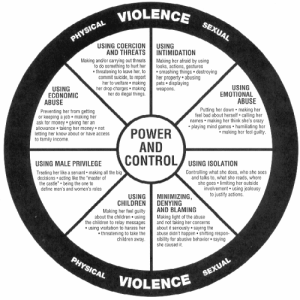
Physical violence is the most typical form of abuse associated with domestic violence, but abuse comes in many colors. For instance, verbal abuse, sexual abuse, emotional abuse, etc. The Power and Control Wheel (from the State of Delaware web page “Dynamics of Domestic Abuse”) is helpful in demonstrating this (go to the page for further descriptions):
On the Half the Sky Movement website, there is an excellent article explaining the impact of gender-based violence as the number one public health crisis for women throughout the world. “To date, 603 million women live in countries where domestic violence is not outlawed and more than 2.6 billion live in countries where rape within marriage is not considered a crime. Without legal retribution, assailants rarely face consequences for their actions and the victims are less likely to report the abuse. In some cases, women are concerned that they will be the ones punished if they report the violence. Other times rape and sexual assault are so stigmatized that the victim stays silent even if there are laws in place.”
I have been following several Christian blogs that exist to support Domestic Violence survivors and raise awareness. Here is a sampling of articles so you can link to their pages:
Finally, I’m going to leave you with an article on The Gospel Coalition, in which Lindsey Holcomb offers seven helpful ways that the Church can reflect God’s heart for women at risk:
1. Stand with the vulnerable and powerless. God calls his people to resist those who use their power to oppress and harm others (Jer. 22:3).
2. Believe the women; don’t blame them. Blaming victims for post-traumatic symptoms is not only misguided but also contributes to the victims’ suffering. Research has proven that being believed and listened to by others are crucial to victims’ healing.
3. Respond graciously, offering comfort, encouragement, and protection. Also respond with tangible, practical care. Spiritual and emotional support needs to be accompanied by actual deeds.
4. Get informed and inform others about the prevalence of women at risk. They can be found not only around the world but also right under our noses, in our cities and neighborhoods and in our churches and small groups. The prevalence is staggering.
5. Learn about the effects of sexual assault, domestic violence, and other forms of abuse. The only thing more staggering than the prevalence of abuse toward women is the acute damage done to them. Trauma is not only done to, but also experience by victims. The internal and deeply personal places of a victim’s heart, will, and emotions need a clear application of the gospel of redemption, along with tangible expressions of love.
6. Clearly communicate the hope and healing for victims that is found in the person and work of Jesus Christ. Unfortunately, the message victims hear most often is self-heal, self-love, and self-help. The church’s message is not self-help, but the grace of God. Grace does not command “Heal thyself!” but declares “You will be healed!” God’s one-way love replaces self-love and is the true path to healing.
7. Get involved with the issue of violence against women. This can include addressing the issue in small group settings, praying about it in corporate prayer, and working toward preventing abuse together with community and national organizations.
Thank you for visiting The Beautiful Kingdom Warriors. Please Follow our blog, and “Like” us on Facebook.
The Beautiful Kingdom Builders is a place for redemptive dialogue about gender, justice, abuse and healing in the Christian faith. Begun as a place to empower Christian women and girls to find our callings, TBKB has grown to conversations about all aspects of Christian faith and culture. Join us in building a more beautiful Christianity.
Find TBKB Podcast on your favorite podcast platform and YouTube, and follow us on Facebook, Instagram, Threads, Substack, Bluesky and TikTok!