Tag Archives: Christianity

January Link-Up

Here are the best of the best articles dealing with gender issues within Christianity that we have shared on our Facebook page this month.  I had to narrow it down to the posts that we marked with either “Fantastic!” or “Excellent!”.  If you want more, check our FB feed.  Happy reading!  🙂

The Junia Project – “No Representation and No Invitation: To Be Asked the Question”

At the end of the day, we simply want this: to be asked the question.

Rather than ushering us off to the nursery before learning that we have absolutely zero knack with or passion for children, or assuming our appropriate role is on the coffee or hospitality team before realizing that we can’t even boil water; ask us the appropriate questions before stuffing us into a mold that quite frankly doesn’t fit.

The questions are simple:

“What are your God-given, Spirit-breathed gifts?”
“What makes you come alive?”
“How can your great gifts meet a great need within the body and broader community?”

And then, perhaps even more importantly:

“What can we do to equip you, as an image bearer, to fulfill your calling; to optimize your gifts for the sake of the Kingdom? “

You can join The Junia Project on Saturday, February 14th for a half-day conference to celebrate women in leadership!  Check it out here.

Christianity Today – “My First Sexuality Sermon”

So maybe it’s time for a woman’s take on sexuality from the pulpit. But what should that be? Is it my place to talk about pornography to the men in my congregation? I’m not sure I feel comfortable with that. Or maybe it’s time to add a woman’s perspective? There have been voices lately that have introduced the possibility that lust is not unique to men. And pornography is not only viewed by men. So is it my task to admit to my own desires in this Sex Sermon? Male preachers have received a lot of flak lately for calling their wives “hot.” The complaint was over the sexualization of their wives and the way it made other women in the congregation feel. If I stood before my congregation and called my husband “hot,” the problem might be a little different. Regardless of how a woman looks, for a woman to be sexually interested is for a woman to be sexually interesting. As a pastor, I work very hard to be publicly sexually uninteresting.

CBE International – “A Partner, Not a Patriarch:  10 Types of Men to Marry”

Seems like every few days, the Christian blogosphere produces a new article on the 5, 7, or 10 people Christians should avoid marrying. Some lists are great, but others are patriarchal beyond the point of absurdity. So my husband, Tim, and I made our own list.

If you’re a woman looking for a partner, not a patriarch, here are some men to look for…

1.       Nobody

Jesus wasn’t married. Why should you be? Single Christian women have been changing the world for millennia!  ….

Rachel Heston Davis – “Strachan’s views on male leadership: It’s all about the women!  No, really!”

So women flourish in this system because their husbands engage in self-sacrifice, bless them, treat them gently, and die to their own wishes to benefit them.

You know what? None of that sounds particularly bad. And it seems accurate when held up against Ephesians 5:28, which tells husbands to “love their wives just as they love their own bodies.” Sounds like a prioritization of women’s needs to me.

But if you could pick a word to sum all that up, what would it be? Servanthood? Caring? Sacrifice?

Yet the word complementarians always, always, always return to, is “leadership.” Strachan says that men who don’t understand this system aren’t “virtuous leader[s].” The blog and Twitter posts he referenced from Gavin Peacock define complementarianism as husband “leader”ship in no uncertain terms.

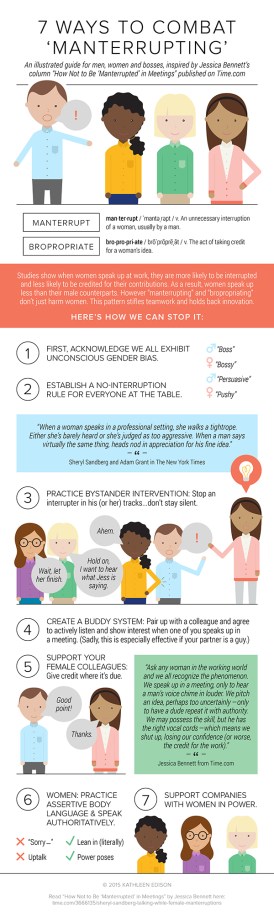
Behance – “7 Ways to Combat Manterrupting”
ff4bbd9d6494a7bcd22abf3740ca6e56

Fast Company – “How We Can Help Young Girls Stay Assertive”

Girls lose their voice for a variety of reasons—it’s mostly because of their self-esteem and is culture-based, says Martha Mendez-Baldwin, a psychologist who specializes in child and adolescent behavior, and an assistant professor of psychology at Manhattan College. Navigating the world between being children and women leave them unsure of how to act. When that uncertainty is met, combined with the pressure to fit in with peers and high expectations of parents, girls are often reluctant to assert themselves, she says.

In addition, girls receive tremendous pressure from society and media to adhere to a feminine role, says Linda Hoke-Sinex, a senior lecturer in the department of psychology and brain sciences at Indiana University in Bloomington, Indiana. The message is to be passive and nice—that it’s preferable to keep the peace than to speak up with an opinion that might be unpopular.

Nate Pyle – “Seeing a Woman: A conversation between a father and son”

There are two views regarding a woman’s dress code that you will be pressured to buy into. One view will say that women need to dress to get the attention of men. The other view will say women need to dress to protect men from themselves. Son, you are better than both of these. A woman, or any human being, should not have to dress to get your attention. You should give them the full attention they deserve simply because they are a fellow human being. On the other side, a woman should not have to feel like she needs to protect you from you. You need to be in control of you.

The Junia Project – “They Say the Church is Too Feminine”

Yes, this statement bothers me, because it shows how little we are actually evaluating the situation and because it is offensive, but most importantly it bothers me because  it is completely false.

The Barna Group has been studying Church trends over the last 20 years and they have found that women actually represent the biggest shift away from the Church. They also found that the gap between unchurched men and women is no longer a significant one. “It remains true that churchless people are somewhat more likely to be men than women, but the gap is not huge and has been steadily closing…the gap between men and women has plummeted from 20 points in 2003 to just 8 points currently.” And this is not just in protestant churches. Findings coming out of the Catholic Church do not look much different,according to the Association of Religion Data Archives.

All of this makes me want to ask those who claim that the Church is “too feminine” what churches they are going to. Are men really walking into churches and becoming overwhelmed with female presence? The idea that the church is “too feminine” goes against the majority of my experiences in church. In fact, as I visited churches on three continents over the last 6 years of my life, I have noticed that the majority of those churches presented the same experience to me, and it doesn’t come close to being feminine.

The Junia Project – “5 Reasons Not to Use Gender-Based Jokes in the Pulpit”

Don’t get me wrong, I understand the intention.

Humor is good. So is connecting with your audience by relating to real life experiences.

But there are ways to do that without using gender-based humor.

There are ways to do that that don’t deepen the gender brokenness, further entrench the stereotypes and, possibly, alienate people from the church and from a deeper walk with God.

In the end, we need to be creating meaningful venues where congregations can talk constructively about male/female relationships and partnerships. Maybe a place to start would be the content of this post. Agree? Disagree? Either way, it would be great to host a conversation in your church about it.

The bottom line is that until we figure out ways to take gender seriously in the church, the joke will be on us.

Christianity Today – “What Happens When We See Women Teach the Bible”

Sometimes I wonder how many women in the church have the gift of teaching, but will never use it, or even entertain the possibility of possessing it. When roughly 90 percent of evangelical pastors and 80 percent of evangelical seminarians are men, it can be hard for gifted women to find role models in the church. With such a void, do some women even consider the thought?

As a college student, I was confused about the direction of my call and the place of my gifts. At my church, women mostly occupied administrative positions. Even in my college parachurch organization, we rarely had a woman speak. Given the scarcity of female role models, I wasn’t sure where to turn.

However my life was forever changed when, in my early 20s, I attended the annual Passion conference, a popular worship and teaching gathering founded by pastor Louie Giglio. Beth Mooretook the stage, and though I was only vaguely familiar with her at the time, I won’t ever forget that moment. When she opened up her Bible, she taught the Word like I had never heard a woman teach it before. She spoke with power, competency, conviction, and most of all, anointing. I would never be the same again.


Imago Dei Resources

This past weekend, Becky and I (and our fabulous co-horts, Lisa Wells and Amy St. John) were privileged to lead our church’s women’s retreat.  The vision for the retreat came to Becky last year and through much prayer and many, many hours of planning, coordinating, etc., she saw her vision come to fruition in a beautiful way.

Becky chose the topic of living imago dei (as image bearers of God), and early in the summer in one of our leaders meetings, I was chosen to teach a session Saturday morning and preach Sunday morning.  So I started the absorption phase of teaching and wanted to share the resources with you that were helpful to me this summer as I prepared.  I’ll share my Saturday morning in another post soon.  There is a link to purchase these books on Amazon if you click on the pictures.

made for more

The first book I came across was “Made for More: An Invitation to Live in God’s Image” by Hannah Anderson, which happened to turn up on my Facebook newsfeed the day before I was heading off on vacation, so I purchased it on my Kindle.  It was providential, because I actually had time to read it!  In this interview, Hannah explains that she wrote the book because she observed the struggle that many Christian women were having “to find fulfillment in their roles and family structures alone,” and the sheer majority of women’s Bible studies are framed entirely around gender so that essentially, we are being taught “that sanctification means becoming a certain type of woman, not being conformed to Christ’s image.”  The book explores how living imago dei means finding our supreme source of identity and existence “from Him and through Him and to Him” (Acts 17).  Hannah includes an excellent study guide in the indexes that could be used for group study or individuals.  I highly recommend this book.

designed for dignity

When I finished “Made for More,” Becky loaned Richard Pratt’s “Designed for Dignity” to me with the promise that it would be one of those rare, life-changing books.  Pratt is Professor of Old Testament at Reformed Theological Seminary, but he writes deep theological truths “with great humility, simplicity, and honesty” (Steve Brown quote on the back of the book).  The book is essentially about realizing your full potential to live out God’s image by living with dignity, and by bringing glory to God.  Each chapter develops a different aspect of living with dignity, as the Bible reveals what it is to be human, and there is a concluding paragraph with study questions for each chapter, enhancing personal or group study.  Unlike Hannah Anderson’s book, this one was not geared specifically to women and it was helpful to frame the dialogue on living imago dei apart from gender.  Another high recommendation.

mans search for meaning

I came across this book on the used bookstore porch and picked it up for a whopping 25 cents.  I vaguely remember hearing a reference to Frankl’s writing in a Tim Keller sermon, so I was curious.  The first half of this short book describes Frankl’s horrifying experiences as a Jewish prisoner in four concentration camps, including Auschwitz and Dachau (two profoundly moving stops my brother and I made during our backpacking tour in 2002).  As a doctor of psychiatry, Frankl was able to study the mental condition of his fellow prisoners, as well as his own stages of shock, distress, numbness, etc.  He observed that man could live with dignity despite his circumstances if he had a meaning to cling to, and post-war, he developed a new school of psychiatry called logotherapy, which the American Journal of Psychiatry called “the most significant thinking since Freud and Adler.”  On the back of book, it reads “A profound revelation born out of Dr. Frankl’s years as a prisoner in Auschwitz and other concentration camps, logotherapy is a modern and positive approach to the mentally or spiritually disturbed personality.  Stressing man’s freedom to transcend suffering and find a meaning to his life regardless of his circumstances, it is a theory which, since its conception, has exercised a tremendous influence upon the entire field of psychiatry and psychology.”

I couldn’t put “Man’s Search for Meaning” down!  Frankl’s description of suffering in concentration camps was so riveting, and the shorter second part describing logotherapy was equally fascinating.  Towards the end, Frankl says, “As logotherapy teaches, there are three main avenues on which one arrives at meaning in life.  The first is by creating a work or by doing a deed.  The second is by experiencing something or encountering someone; in orther words, meaning can be found not only in work but also in love….Most important, however, is the third avenue to meaning in life:  even the helpless victim of a hopeless situation, facing a fate he cannot change, may rise above himself, may grow beyond himself, and by so doing, change himself.  He may turn a personal tragedy into a triumph.”

In addition to those books, I also found the following sermons and articles helpful in thinking through living imago dei.  This sermon, “Healing Our Image of God and Ourselves,” by Brennan Manning, was probably more influential than any other resource I turned to, as it crystalized the message of living in the image of God with the emphasis on God’s love for us:

And also Henri Nouwen’s beautiful sermon series on The Life of the Beloved (please pardon the long intro and breaks in between his 8 short sermons):

Finally, “Ex Good Christian Women” is a fantastic article by Pastor Kathy Escobar that discusses how women are hurt and enslaved by the cultural constraints on what it means to be a “good Christian woman.”  Her descriptions of “good Christian women” and “ex-good Christian women” struck a nerve with the retreat ladies.

I’ll share how these resources came together into a talk on living imago dei soon. 🙂


Thanks for visiting The Beautiful Kingdom Warriors!  Don’t forget to follow our blog and “Like” us on Facebook!

Book Review: Red Letter Revolution

Last June, my husband Logan and I attended a church conference in the Philadelphia area.  The speaker that most inspired and excited us was Shane Claiborne, sharing about his ministry with The Simple Way among Philly’s poorest and most vulnerable people.  Here is a similar talk on YouTube.  If you watch it, be prepared to weep at the end.  So powerful.

189633_10150107557746371_1596726_n

After his talk, we headed back to his table and bought three books: The Irresistible Revolution: Living as an Ordinary Radical, Common Prayer: A Liturgy for Ordinary Radicals, and Red Letter Revolution: What if Jesus Really Meant what He Said?.  We got back to Maine and were thrust into a stressful, hectic summer season.  Between work, parenting small children, and getting our house ready for the market, I was only sleeping 5 hours a night for months and months on end.  Although I couldn’t find time to read Claiborne’s books, I was watching his YouTube videos while I was working.  I’m telling you, this is the Christianity that I want!  Claiborne’s life has the distinct aroma of Jesus about it.

Red Letter Christians

When we went to spend two weeks with family over Christmas, I jumped on the opportunity to finally read one of his books.  I had grabbed Red Letter Revolution and practically devoured it.  This book is co-written with Tony Campolo and is formatted as a discussion between Shane and Tony regarding a movement they are trying to spark for a Christianity that images Christ, giving prominence to the red letters  of the Bible.

In this essential manifesto, best-selling authors Shane Claiborne and Tony Campolo envision issue after contemporary issue in direct light of the Bible’s “red letters.”  The result is a startling look at contemporary Christianity and an inspirational reawakening to the gravity of the words and deeds of Jesus…Red Letter Revolution is a timely call back to the true, radical fundamentals of Christianity.  [dust jacket description]

First thing that jumps out at you when you open this book, is four pages of “Praise for Red Letter Revolution,” from the likes of Bono, President Jimmy Carter, Archbishop Desmond Tutu, Eugene Peterson, Phyllis Tickle, etc.  The Contents page shows a division of the book into three parts: Red Letter Theology (On History, Community, the Church, Liturgy, Saints, Hell, Islam and Economics), Red Letter Living (On Family, Being Pro-Life, Environmentalism, Women, Racism, Homosexuality, Immigration, Civil Disobedience, and Giving), and Red Letter World (On Empire, Politics, War and Violence, National Debts, the Middle East, the Global Church, Reconciliation, Missions, and Resurrection), and a Conclusion: A Vision for A Red Letter Future.  This book is jam-packed with Claiborne and Campolo’s thoughts on how Jesus’ words should impact the way we view contemporary issues facing the church and world.  And frankly, much of what they say is in direct contrast to Western Christianity’s cultural stances.

Whenever the word “evangelical” is used these days, a stereotype comes to mind.  Whether or not that image is justified can be debated, but there is little argument that the word “evangelical” conjures up an image of Christians who are anti-gay, anti-feminist, anti-environmentalist, pro-war, pro-capital punishment, and conservative Republican. [Intro: pg. XI.]

Although Shane and Tony come from different generations, different perspectives on community and politics, etc., they have found a similar passion for “taking action to stop wars, defy unjust political structures that oppress the poor, speak out for the oppressed who have no voice, and endeavor in general to change society into something more like what God wants for it to be” (pg. XIII).  This book is an “invitation to join a movement that is about demonstrating God’s goodness to the world” (pg. 9).

I probably could have highlighted this entire book.  I tried to restrain myself to underlining only the most pivotal sentences, but I still marked up every page.  There are also lots of stars and check marks in my margins.  I thought for TBKW blog, I would summarize their chapter on women.  This book is valuable for framing a Christ-like perspective on all contemporary issues, but I need to narrow my review or it will turn into its own book! 🙂

Tony begins this discussion by saying that the roles that women can play in church life is one of the most divisive issues among evangelicals, Anglicans and Roman Catholics.  Tony says denying women the right to be preachers and teachers is diminishing their dignity and thus dehumanizing women.  Red Letter Christians point out that Jesus affirmed women.

He invited Mary, the sister of Lazarus, to sit with his male disciples and study the Torah (Luke 10:38-42).  He broke societal expectations when he sat alone with a Samaritan woman and conversed with her on religious issues (John 4:4-26).  He broke rabbinical law when a woman who was menstruating touched him (Matthew 9:20-22).  The author of Galations makes it clear that “in Christ” the religious hierarchy differentiating men and women has been abolished (3:28). [pg. 107]

Shane points out that the Scriptures are full of women prophets, leaders and disciples.  “Ministry is a matter of call and gifting, not gender, and it would be a great disgrace if we lost half our gifted leaders in the church because we misread a few texts” (pg. 108).

Our brother Ben Witherington has said it well: “It was the original curse, not the original blessing that was pronounced in the following form-‘your desire will be for your husband and he will lord it over you.’  The effect of the Fall on human relationships is that ‘to love and cherish’ became ‘to desire and to dominate,’ which entailed unilateral submission of females to males, something that was never God’s original creation plan. [pg. 109]

You wont find a single statement in Genesis 1-2 about the silence or subordination of women to men.  Eve is simply the necessary compliment and suitable companion to Adam.  What you will find are statements making clear the inadequacy of the man without woman who is the crown of creation, for the text says ‘it is not good for man to be alone.’  Patriarchy is not an inherently good thing, an inherently God thing, and it should not be repristinized and set up as a model for Christian ministry.” [Ben Worthington quote continued in Notes: pg. 264-265.  Here is the link to his full article.]

Shane and Tony make a really excellent point in this chapter – men and women are both fully human.  Jesus was at times “feminine”, i.e. weeping, and also “masculine,” i.e. flipping tables.  These cultural norms limit our full humanity.  “In our cultural value system, we have divided up human traits between the sexes and consequently have denied each sex a part of its humanity” (pg. 110).

Shane and Tony give full support to women being leaders in the church.  They cite the partition in the ancient temple that had divided Gentiles and women from the Jewish men being broken down by Christ (Ephesians 2:14).  Philip’s three daughters are acknowledged as being prophetesses, i.e. preachers (Acts 21:8-9).  In Romans, Paul writes about Adronicus and Junia, a man and a woman, as fellow apostles.  In Ephesians 4:11, there is no indication that the gifts of the Spirit are allotted according to gender.  “Paul tells all Christians–and that includes women–that not to exercise the gifts that are within them is to negate what God wills (I Timothy 4:14)” (pg. 112).

Tony also shares how his mother was a wonderful storyteller and had always wanted to be a preacher, but because she could not, she lived out her calling through him.  “I find it sad that she had to live out her desire to be a preacher through her son because she was not allowed to live it out herself, and it is partly because of what happened to my mother that I am a strong advocate of women being preachers and teachers in the church” (pg. 113).  Here is an interview in which Tony goes into more detail on his views of women in leadership and the story of his mother.

Tony and Shane describe themselves as male feminists, and acknowledge that sexism runs deep in our culture.  “We have an oppressive cultural value system that forces women to think that they are supposed to conform to a society-prescribed weight and have a particular sized bust…In America, women are conditioned to think that they have to look twenty-three forever” (pg. 113).  They link the sexualization and objectification of women as the root of sex trafficking.  “We have to deal with the ugly reality that our society is indoctrinating men with evil concepts of what should turn them on sexually” (pg. 115).

The issues get even more complex globally.  In extreme cases, women are mistreated, or even tortured by being forced to undergo female circumcision.  We must know that these things matter to God.  How women are treated is as important to God as how men are treated.

And while we’re at it, we might also say that the wages that women get paid matter to God too.  Women do so much of the work and get so little of the money and credit…Four in ten businesses worldwide have no women in senior management and that women earn less than men in 99 percent of all occupations.  [pg. 116 – 10 Suprising Statistics on Women in the Workplace]

It’s probably needless to say, but I HIGHLY RECOMMEND this book!!!  I was so fired up after reading it.  Let’s join the Red Letter Christians in revolutionizing Western Christianity to a more Christ-like reality!  Give this book a read and see if some of your perspectives aren’t challenged.  Change is good, my friends!

REDLETTERFRONTPAGE