
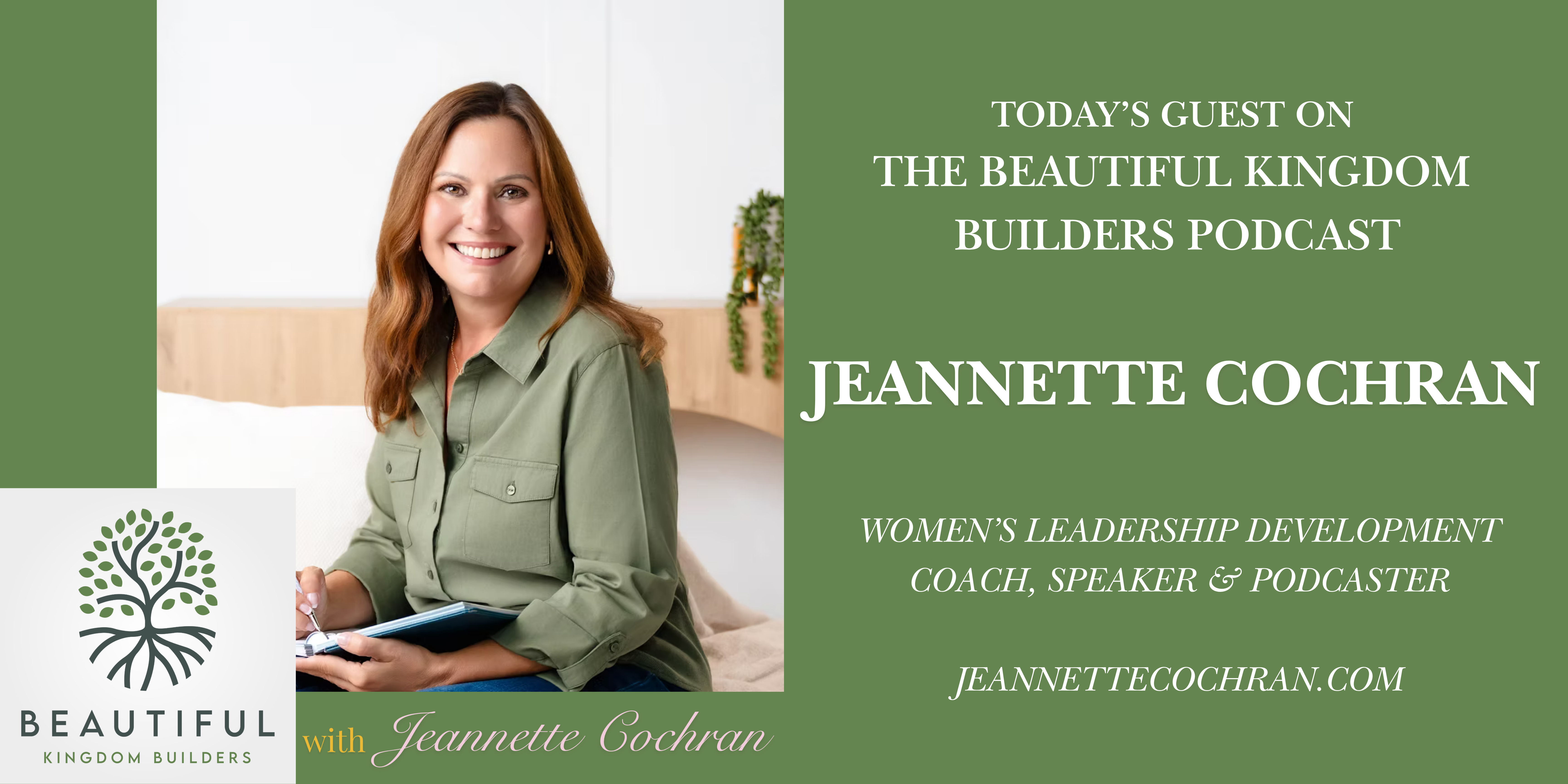
In this episode, Jeanette Cochran shares her journey from conservative Christian upbringing to becoming an executive pastor for twenty years, and now a leadership coach for other women in ministry. In our conversation, she discusses the impact of limiting beliefs on women in faith communities, the nature of leadership, and how spiritual practices can empower women to lead fully in their calling.
You can learn more about Jeannette’s ministry at jeannettecochran.com and also follow her on Facebook, Instagram, and Linkedin.
I’ve been listening to Jeannette’s excellent podcast, Empowered to Lead, for a few years now and highly recommend you subscribe! You can find it on Apple Podcasts, Spotify, and YouTube, as well as other places.
Please enjoy this episode of The Beautiful Kingdom Builders podcast on YouTube, Spotify, Apple Podcasts, Amazon Music, Substack, and more!
TRANSCRIPT:
Rev. Ruth Perry (00:16)
My guest today is Jeanette Cochrane, a leadership coach, former executive pastor and speaker, who has spent decades helping women reclaim their God-given authority and break free from limiting beliefs that have held them back. Her ministry focuses on spiritual formation, leadership development and dismantling the inner narratives that keep women from living fully in their calling. I’ve been listening to Jeanette Cochran’s podcast, Empowered to Lead, for many years myself and learning a lot from her. And I’m just delighted that you would come on my podcast today. Thank you so much, Jeanette.
Jeannette Cochran (00:49)
Well, thank you for having me, Ruth. I’m thrilled to be here and this conversation is something that I’m passionate about and always enjoy talking about.
Rev. Ruth Perry (00:58)
Well, before we dive into talking about the limiting beliefs that women hold coming from Christian upbringing, can you start by telling us more about yourself and your own faith background?
Jeannette Cochran (01:10)
Sure. I am in Maryland. I was a pastor at a local church here, a multicultural church. I was served as the executive pastor there for 20 years. Previous to that, I was the children’s pastor. I am married. I have three adult children and two granddaughters that I adore. And many years ago, I would have said that I kind of stumbled into pastoral leadership. Because it took me several years into my journey to realize that I had always been gifted and called to be a pastor. But I was like many of us, I was raised in a very conservative, very traditional, patriarchal Christian church, and we didn’t have women pastors.
And we didn’t have women deacons or elders or ministry directors, anything. It was all done by the men. And so I loved Jesus very much, but I never saw myself as a pastor because I also am very feminine, right? I love getting dressed up, doing my hair, doing my nails. I love all the female things. So being a pastor was a very male thing to me. And it wasn’t until my young 20s when my husband and I found a local church in our area, and it was fortunately a much healthier church and began to open my eyes to different belief systems in within the Christian faith, very orthodox. They were very committed to scripture. And one of those things was this was a church that had women in what they called their leadership council, many would call elders or trustees.
And women were allowed to preach, and women were allowed to do all of the things. Now, granted, we didn’t have a ton of women leaders, but women were allowed to do that. And so eventually I felt called into ministry and went to seminary and began to study for myself what the scriptures say about women and leadership and came to a completely different understanding and realized that in the gospel, in the redemption of Jesus, that God is trying to right what went wrong at the fall. And this separation and divide and limiting women is a result of sin. And as followers of Christ, we’re called to live into the new creation, into the redemption of all people and all things. And so that means that men and women are called to lead together.
So on this side of my journey, I can look back and I can see who I was as a leader and as a young person and realized this was always my path. I just could not hear God’s voice because it took me a while to realize that this was even an option before I realized that this is what I was created to do.
Rev. Ruth Perry (03:56)
I think it’s so interesting how powerful representation is for young people growing up in the church. If you don’t see someone that looks like you, then you don’t even imagine that path for yourself. What do you think that’s about?
Jeannette Cochran (04:09)
Absolutely. And also having people speak into your life. I was discipled as a teenager in the church, and I know that there were young men that the leaders would look at and say, I see leadership in you. I see that you could be a pastor. I never even had anyone in my church say that I was a leader. I was almost 25 years old before I had another Christian look at me and say, You’re a leader. And so I never saw myself as a leader. Now, those who know me today would say that seems kind of ludicrous. But in fact, much of what was in me oftentimes was seen kind of rebellion or pushing the limits.
And I definitely had that in me, but really if that had been developed, it would have been a leadership skill because I was very inquisitive. I I wasn’t one that wanted to follow the rules just for following the rules. I asked a lot of questions. Even in my friend group, I was influential in what we would do or the activities that we were involved in. I had influence.
But no one developed that and called that leadership. So it wasn’t until I was a young adult that I began being invited into leadership development paired with discipleship and understanding how to live as a Christian leader. And so I had a lot of undoing. And I think that’s why I’m passionate and called to this work today, because over many years, as I stepped into leadership, I began to kind of peel back the layers, right?
I think we first step into becoming a leader and we own who we are, but along the way there are lots of layers that God strips away to help us start to recognize things that we’ve internalized that are not in alignment with who we are in Christ, that are not in alignment with who we are as leaders. And so we have to peel that away so that we can step more fully into who God has called us to be. And to have the kingdom impact that he wants us to have.
Rev. Ruth Perry (06:14)
When you realize that your gifts hadn’t been called out and recognized growing up, what was the emotional feeling of that realization? And then also what was it like to then try to catch up?
Jeannette Cochran (06:26)
Such a good, such a good question. Because I know as I talk to women, a lot of them feel behind, like we’ve missed something. And so honestly, yes, at first when I first started awakening to my call, there were times where I would look back and I would think, I wonder what my life would have been if.
Because I also started college later in my life. I went to seminary later in my life. And so I did sit with that for a while. And I eventually came to the position of letting that go and realizing I not only realizing, but believing. The path that I walked was exactly the path that I was supposed to walk.
Because I am who I am today, and I can do the work that I do today exactly because of those experiences. And so I also know that the scripture says that nothing happens that is completely outside the hand of God. Now that that doesn’t mean God was happy about it or God caused it, but He saw what was happening, and that, you know, all of those things that happened to us, God redeems for his good. And so it’s because I grew up in a very conservative fundamentalist Christian environment that I understand how fundamentalists believe and think. I can have those conversations. I can reach back and I can say, you know, you can love scripture and you can be committed to the authority of the Bible.
And be an egalitarian and realize that men and women are called to live and lead in mutuality. I can have those conversations because I walked that path. And so I believe that all of that learning, though some of it was hard, was a part of bringing me to where I am today.
Rev. Ruth Perry (08:12)
Yeah. Can you tell me more about what is leadership? What are those gifts like and what is your leadership gifting in particular?
Jeannette Cochran (08:20)
I would say leadership is just influence. That’s a definition that many people say, but it it really is. It’s influence. And so what we have to realize is we can lead people astray if we’re influencing them in the wrong direction. We sometimes influence people without even realizing we’re influencing them. So leadership is influence.
And developing that influence so that you are intentional and you are leading and living from your values and moving people and your life in an intentional direction is really important. And we lead from who we are. So this is why I believe pairing leadership development with spiritual formation, with theological education is so important because you’re gonna lead from what you believe, you’re gonna lead from who you are, you’re gonna lead from the practices that you have placed in your life and how you’re leading yourself is how you’re gonna show up. So we’re all called to lead ourselves. When you look at the gospels, I think that’s what we see that Jesus did.
With those who were closest to him with the twelve, which I will say also remember that the disciples of Jesus did include women. They’re the the gospels tell us that there were women that were traveling with them, that Mary sat at the feet of Jesus. And that means that she was a learner, she was a disciple. So Jesus was developing those around him not to just be followers, but to be followers that would then go and become leaders. And so as a follower of Christ, I believe that everyone has some leadership potential that we are called to develop so that we are ushering in the kingdom of God. And sometimes we can mistakenly think that leadership in the church is just for a select few. It’s just for the pastors or maybe the elders.
But we are all called to lead. We are all given the Spirit of God. And sometimes God calls you to lead in the marketplace. Sometimes God calls you to lead in education. Wherever you go, you should show up as who you are in Christ with your gifts and leading yourself first so that you are an example of what the kingdom of God is. And then using those gifts in order to further God’s kingdom wherever he’s placed you. So I believe that each of us has leadership that we’re supposed to be developing. And then God calls us to use that in different places within our life.
Rev. Ruth Perry (10:51)
So what what are your particular leadership giftings in pastoral ministry, Jeanette?
Jeannette Cochran (10:57)
Well, I would say my leadership gifts, I am a visionary. I am a high extrovert and I’m creative. And so I do tend to gravitate towards those leadership roles, and I do well where we are envisioning, creating new initiatives and building teams, I’m definitely a people person. So bringing people around and developing them and helping them to find their place on the team and then empowering them to go. And in some respects, that may be why as a young person I didn’t really always fit the mold for what the women were doing. I’m not good at, you know, things like cooking.
I’m not good at the the typical like homemaking roles, although it is important to me. You know, I’m a a wife and a mother and and my home environment is important to me. I’ll just but I’ll just say I’m not great at that. I’m not great at hospitality. I I look to others to help me develop those kinds of gifts. And so my gifts do tend to be more in developing other people, casting vision, teaching and helping the community to figure out where is God calling us to go and move together in the same direction. And because of that, I need people around me who like to implement. So I’ve been known to start ministries and be really excited about it. But then once they get up and they’re running, I want to hand them off to someone else. That’s what I did again and again in my church.
I want to hand them off to somebody that’s really good at creating the systems and keeping things maintained and helping, you know, people to keep moving forward. I want to move on to something new. And so my my gifts oftentimes do show up in areas that are more like entrepreneurship, where you’re creating something new, you’re getting it going, you’re inviting people in, and then you’re developing them so that you can hand that ministry off. To the next leader who’s gonna take it to that next level.
Rev. Ruth Perry (13:03)
Can you describe how you decided to transition from being a pastor to being a coach?
Jeannette Cochran (13:09)
Yeah, that was such a hard decision. And God really was developing this in me for I want to say a decade because early on, I didn’t really have a desire to develop women. I wasn’t really focused on women’s leadership development. In fact, many of the women’s ministry initiatives that I saw happening around me, I wasn’t as interested in. in large part because a lot of oftentimes women’s ministry is not focusing on leadership and growth and impact.
You know, in in many churches and sometimes in our own church for for women, they have women’s teas. And for the men, they are talking about, you know, how to lead your in the marketplace or how to lead in the church. And that’s not not to diminish tea. I love tea. I love conversations with women. But there weren’t a lot of places where women were talking about leadership, where women were talking about goals, where women were talking about having an impact.
And so for a long time I didn’t feel called to that. And then over the years, as I was leading as an executive pastor, and I was in an egalitarian church where women could lead at all levels, but there’s a bit of a twist to that because our church was a part of a denomination, the Evangelical Free Church, that did not welcome women into all levels of leadership, where women were not allowed to be ordained, where they believed that the office of pastor and of elder was only for men. But because it is a denomination where there was freedom for the churches to operate how they wanted to, we had made that distinction. And we did have women pastors and women functioning as elders.
And they were fine with that. They were fine. They knew that, and they were fine with that. But they were clear that they were not going to change their position on ordaining women. And so, in that structure, I really was not welcomed into a lot of the conversations as an executive pastor. So there was an executive pastor network within our denomination. And I actually attended one year.
And there were a few men that welcomed me into the conversation, but most of the men there, although they were kind, I feel like they didn’t know what to do with me. It was almost like, why are you here? And so I never went back. Because frankly, I was busy. I was leading a growing church.
My church was at the time was larger than many of the men in that executive pastor’s network. And so I had a lot of work to do. I had a lot of people to care for. I had staff to develop. And so I realized: why am I gonna spend three days, fly across the country, go sit in settings where I’m not gonna gain anything from it because I had work that God had called me to do and I needed to do it. So I never went back.
And so that was my first kind of awakening where I felt God saying, Jeanette, I’ve called you to this role not just to develop your leadership, but because there are women that are in really difficult situations in churches where I have called them. And they are trying to figure out how to navigate that. They’re trying to figure out how to connect their calling with the scriptures. And so over time I began God saying, I have work for you to do that is beyond your own church and is for the kingdom of God. And so in those years, I started then speaking out. I started a blog. I eventually started my podcast, all with the idea of just sharing to women.
Different ways of understanding the Bible. Then over time I felt God really showing me that I couldn’t hold both. I had to choose one or the other because it was too much. And so I eventually came to the realization that God was calling me to let my church pastoring go. And I loved my church. I loved the people at my church. And so that was really a hard decision. I loved my team.
But I knew that to be faithful to what God was calling me to meant that I had to spend more time on reaching people beyond my congregation. And so I did that in December of 2024 was when I officially resigned. We also had a an outreach center there, the Community Hope Center, that I launched during COVID with a small team there at my church that had.
Taken off. And so I was developing leaders to take that over so I could let that go. And that also was particularly hard because that was a vision that God had given our church and had given me deeply decades before it started. And so when God brought that to fruition and it was developed and serving thousands of people, and I had to kind of hand that baby over.
But if you see kind of a theme here, that’s who God has created me to be, to give me a vision and to start it. And then eventually God has always called me to hand it over. He did that in my children’s ministry. He did that in my executive pastoral role. He did that at the Community Hope Center. And now I’ve got this new vision that quite frankly, Ruth, I don’t know how it’s all gonna play out.
I don’t have a clear pathway. I just knew I needed to trust God and let go of what I was holding on to tightly so that I had open hands to embrace what he had for me in this new season. And God is opening doors and done amazing things. And one of the things that I love along the way is the incredible women that I’ve met with leadership gifts and some of those women that
I just have been humbled and honored to even walk with them because they have incredible, incredible gifts. Gifts of preaching, women who are brilliant, way smarter than me. And as I have been coaching them, coming to find out that they’re some of them have been caught in churches for decades where their gifts have been minimized and sidelined. And that’s not to say.
That God hasn’t used their gifts, but they are recognizing that they have teaching and preaching and leadership gifts that need to be unleashed beyond just the children’s ministry or the women’s ministry. That it needs to go beyond that so that the whole church can benefit from the wisdom and the messages, the influence that God has given them the revelation, quite frankly, from the Spirit of God that lives in them because they have the Holy Spirit and the gifting. And so it’s been such an honor to place such a small role even in their lives because some of those women are doing incredible things and are way more influential than I am today. And I I applaud that. I salute that because that’s what we need in this next generation of women leaders.
Rev. Ruth Perry (20:13)
That’s amazing. And I’m just so thankful just for the little bit of your work that I’ve experienced by listening to your podcast. Your content is always really wonderful and really helpful. And maybe I need to look into some more coaching with you, Jeanette. I would love to be empowered to lead.
Jeannette Cochran (20:31)
I would love that.
Rev. Ruth Perry (20:32)
I’m thinking about what a process it’s been for myself from the time that God called me to become a pastor. And I was in a conservative Christian denomination and family. And so I didn’t have that empowered support in ministry and in that process. And I found a lot of the learning and growing online, like how I found your podcast. But it’s been wild to me, just even in the last few years, the revelations I’ve had about my imposter syndrome and about still feeling like I need to follow my husband in ministry and kind of branching off from that and going into my own path and exploring doors as they open for me without my husband. You know, it’s been really interesting for me. Can you talk to my audience about the limiting beliefs that women inherit in our conservative Christian families and churches?
Jeannette Cochran (21:21)
Yes, that is so common what you have expressed. Because when we internalize things for so much of our life, especially for those of us who grew up in conservative Christianity, our most formative years were spent giving us a description of what a biblical woman is. And in those circles, oftentimes a faithful biblical woman always stands behind another man, whether that man is her husband or a pastor, and when we’re young, our fathers. And so even when we know, when we come to this understanding of what the Bible says, it can take a while before we start to realize that some of the things that are causing us to doubt our voice or to doubt the gifts that God has given us.
Are because we’re just so used to being the the person that’s second in line. We’re so used to softening our voice or hedging the way we speak instead of showing up and now it I’m not suggesting that we show up arrogant, but to just show up confident in who we are, that we have gifts.
And those gifts have been given by God. And therefore we can trust that the spirit that is developing those gifts is going to use those gifts. And sometimes it shows up just in the way we carry ourselves. It can show up in the way that we hesitate to say what we think.
It can show up in the way that we maybe give more weight to someone else’s opinion, even though at first we had a really strong opinion, and then we get someone else’s opinion and we think, well, maybe I should defer to them. And a lot of times that really is just coming to this place of learning to trust that the wisdom that I have and the gifts that I have are enough. They’re enough to go forward and to do the work that God has called me to do.
And, you know, fortunately for me, my husband has never felt called to ministry. So I didn’t have to worry about that. In fact, most of the time, or I should say, full-time ministry, he was clear that my wife is called to pastoral ministry, I am not. And he was always very encouraging and was very supportive. He saw my gifts. And he believed that I had something to offer. And so we didn’t really have that tension at home. In fact, our marriage really operated very egalitarian. And now we used a lot of the complementarian language early in our marriage, but we operated egalitarian.
So when I came into that understanding and when my husband came into that understanding, we really didn’t have to change the way that we operated. And so I didn’t really have that. But I do think that for many women, it can be years of conversations with their spouse. I think, just over time, just starting to understand where are the the places that we aren’t feeling as confident and then exploring why is that. And sometimes it’s just because it’s new. We’ve never done it before. And you know, for women.
I do think it’s important to say that we have to actually learn to recognize what happens in our body and in our nervous system when we start to step out in new directions. Because for so much of history, women who stepped out of line, who stepped out of what was socially acceptable, it was dangerous in some situations, right? When you look at the scriptures, you see that that women could be ostracized from the community and then they economically could not take care of themselves, or physically, we physically could not did not have the might and the power to protect ourselves. And so in much of human history and in culture, it was dangerous.
And for those of us who grew up in very traditional fundamentalist Christianity, it might have been a different kind of dangerous, but it also was dangerous sometimes to speak up, to say what you thought, or to just even take leadership. Am I stepping in a direction that I’m I’m not supposed to is this out of God’s will? And you might have been criticized or you might have been marginalized. Or for some women, you know, we’re still hearing the stories today in some Christian communities, there is abuse taking place. So I share that to say sometimes when we say, Well, I’ve got something in me that I need to fix, you know, I’ve got imposter syndrome. What I want us to understand, some of the way that we respond, that our nervous system responds and our thoughts play out, is completely normal.
Because we are now, we’re in a place where many of us were like, it is safe. It is safe to use our gifts. We’ve even been invited to use our gifts, but we have to recognize this is a departure from the past. And so we have to start to recognize where we may be holding back and start to dismantle some of those beliefs, learn to regulate our nervous system and step more fully and confidently in that peace into those areas that God is calling us to lead.
Rev. Ruth Perry (26:29)
A few years ago I read a biography of Eugene Peterson and I read Phillip Yancey’s autobiography the same winter. And I just remember being blown away because I thought they were both so ambitious. And I had never really thought about ambition within Christian ministry. I just felt like you were called and gifted and you serve. Service is the driving force, is what I would think.
And I would try to explain as I was talking about these books with people, and I just could never remember the word ambition. It was like I was allergic to it. And I think that I was allergic to ambition. And I did look down on it a little bit growing up Christian, where I don’t think it was positively reinforced unless I was ambitious to serve others. And so how do we undo that kind of formation from our childhood where we peel back the onion layers and we recognize that there’s something about the way that we are that isn’t authentic to who God made me to be. It’s something I’ve picked up because of my cultural conditioning.
Jeannette Cochran (27:31)
I think ambition is such a big issue, particularly for women. And the Bible does not say that ambition is bad. It says that selfish ambition is bad. And so we do need to ask ourselves: where is that ambition coming from? Like what is it that we want to do? Is it that we want to make a name for ourselves? Is it is it that we want to hoard resources and live in a a big mansion and you know have jets and planes? And you know, we see that happening in some Christian circles. And I think that needs to be questioned.
Rev. Ruth Perry (28:08)
Yeah.
Jeannette Cochran (28:09)
And and so both men and women have ambition and probably at different levels. And I think it comes back to what has God gifted us for and what has God called us to. And but I think the unfortunate thing is in so much of the theology and teaching for women is we have been taught and conditioned to question our motives all the time.
Always question our motives more than the the men and the boys. And I’ll and I’ll say give an example. So just this was just recently. I heard a podcast of a man and a woman speaking, and it was a complementarian church that believed that women should not be pastors, and the woman was making the statement.
That women can lead, but they shouldn’t be pastors. And she said if a woman wants to be a pastor, she really needs to ask herself why? What are her motives? Why does she want that platform? Which, you know, I could say, okay, that’s a great question. But why do we not say that to the men when they want to be pastors? Right? Well, we don’t. We go, wow, God must be calling you. You want to give your life to Jesus. That’s fantastic.
But in many situations, if women want that, the question is, you must have ulterior motives. And so we’re constantly given this teaching and this feedback that causes us to question our motives. And so whenever we want something that seems big or that’s gonna put us out in the limelight, like we’re gonna be seen by others. They may criticize us.
The first thing that’s gonna happen is we are gonna question ourselves. And I think the question that we need to ask ourselves is: okay, is God calling me to this? Do I feel a stirring that these are gifts that I have that I wanna use? And what is it for? Is it because I want to advance God’s kingdom? Is it because I want people to know Jesus? Is it because I want to love and serve and give to people? If so, go for it. Be ambitious.
Who can look at the Apostle Paul and say the Apostle Paul was not ambitious? In fact, you could look at Jesus and say, Jesus was ambitious. Jesus had a plan. He knew what he was called to. He knew how long he needed to stay somewhere. And he was like, hey, to his to his followers, no, we can’t stay here because I got other places to go and preach the gospel. He had an ambition for God.
And so instead of squelching that and stifling that in our women and our young girls, we need to develop that. We just need to help them make sure that they have the tools to explore that with the spirit. Make sure that they are learning scripture, make sure that they’re learning how to pray, how to listen to God. Develop those spiritual formation tools so that that ambition can be directed by the Holy Spirit.
But I think what we do is as soon as we see ambition in women, we start to question it and assume that it’s coming from ego, that it’s coming from a bad place. Instead of saying, hey, you’ve got ambition, that’s fantastic. Let’s talk about that. Let’s develop that for Jesus because the kingdom of God has a lot of work to do. We have a big world and we’re called to go. So let’s use that ambition in the right direction.
Rev. Ruth Perry (31:23)
I think what you said about the nervous system is really important too. Can you talk more about how our nervous system is connected to our calling and our ability to serve God?
Jeannette Cochran (31:33)
Absolutely. So it is so interesting if you look at neuroscience and how the brain works and what science is really affirming is really very similar to many of the ancient spiritual practices and what earlier Christians engaged in order to really find their centering in God and find peace and to really grow as a person. And so I really have connected much of what neuroscience has said to some of the ancient spiritual practices. So some of those practices would be centering prayer, lectio divina, even just sitting quietly and
Breathing deeply and resting, like that resting in the spirit of God, trying to be aware of God’s presence and connecting through our breath. And you know, when I was growing up, those kinds of practices were considered evil, like they were gonna lead you astray. And what I know today is that’s actually not true because we are whole beings.
God created us not just with a spirit, but with a body and a mind. And so much of what science is showing is doing very similar practices. They’re just pulling the God part out. And so I say, no, let’s engage those practices and let’s actually integrate our faith. Let’s realize that when we sit in silence and we notice our breath, what we’re doing is we’re sitting quietly in the presence of God. Right? Even when you think about the word breath, pneuma is in scripture, Spirit. There is also the word Yahweh, right, in the Hebrew. It was the name that God told Moses was his name. When when Moses is sent to Pharaoh.
And Moses says, but before I go, they’re gonna ask me who sent me, so who are you? And the name that God gives is Yahweh. And if you say that in the Hebrew, it’s actually pronounced with just the consonants. It’s actually the sound of breathing. That is the name of God. That’s the name that God gave to Moses. And so if you think about that, when we say the name of God in Hebrew, we’re just breathing. And so it’s almost the sense that to breathe is to say the name of God. To be alive is to acknowledge God, whether we know we’re acknowledging God or not. If we have breath in our lungs, we are acknowledging God. And so that’s where I say some of these modern practices that people are engaging in and finding peace and finding stillness, finding stress relief, I would argue they may not know that they’re sitting in the presence of God, but that’s what they’re doing.
And so I teach women and Christians to engage these practices with their heart and mind open, that they are engaging in the presence of God, that they are opening their whole self up to the Spirit of God to be calmed, to let the Spirit have more reign within them than the flesh. That’s what Paul says. He says we’re called to intentionally to put off the flesh and put on the spirit.
To not be led by our flesh, but to be more and more led by the Spirit of God. And so many of these ancient practices that in much of our Christian communities, especially I think in much of evangelicalism, have been lost, are practices that do that. They help us to rest our whole body, our nervous system in the presence of God, allow the Spirit of God to connect our mind and our heart, and open us up to be able to receive, I believe, more of God’s peace, more of God’s freedom, and more of revelation of God so that we can then move in our day with the spirit directing us more than the flesh directing us.
Rev. Ruth Perry (35:36)
That’s so powerful. Thank you so much for talking about that with us. So people can follow you. Your podcast is Empowered to Lead. Your website is Jeanette Cochrane with two N’s and two Ts dot com. And I’ll link these in the show notes. And how else can people engage with your ministry now?
Jeannette Cochran (35:54)
Well, thank you for asking. I would love if people would find me on Instagram. I’m on Instagram at Jeanette.cochran and send me a direct message, say hello, check out my podcast. I love to engage and get to know people who are listening and have these conversations and just really help more and more women and men find the truth of scripture and find ways that we can more fully utilize our gifts and lead together in mutuality for the good of God’s kingdom. And I’m grateful for this conversation. I’m grateful for the opportunity to meet incredible women like yourself, Reverend Ruth, doing the work that you’re doing. So thank you for what you do as well.
Rev. Ruth Perry (36:38)
Well, I’m incredibly grateful to you and to the many lessons you’ve taught me. I think good theology is so important and everything I’ve ever heard on your podcast is so grounded in scripture and in good theology and is helpful and I just highly recommend your work. And you can also come and speak and do trainings in person as well. So if you’re a ministry leader with a congregation that would benefit from having Jeanette. Then do reach out and thank you so much for being here today. Let me give you the last word before we sign off.
Jeannette Cochran (37:10)
Well, thank you again, Ruth, and thank you for your ministry. And just for those who are listening, I just wanna encourage men and women that we should all be developing our gifts to the fullest. Because we don’t want to end our life without having developed every ounce of potential that God has given us for the kingdom of God. And so that’s what I’m passionate about helping to empower everyone to lead, but especially to empower women to lead. So thanks for this opportunity.
Rev. Ruth Perry (37:41)
Thank you, God bless.
Did you enjoy this episode? Please subscribe, rate or review us on YouTube, Spotify, Apple Podcasts, Amazon Music, Substack, and more! Your support means the world. God bless!


