

“I have come that they may have life and that they may have it more abundantly.” – Jesus
On New Year’s Eve, Naghmeh Abedini (who we posted about here and here) shared this exhortation on her facebook page:
The full message says,
Happy New Year! May this be the year that the daughters of the Most High and the church rise up in one accord and say “Enough is Enough.”
May this be the year that we discover who we truly are in Jesus and that the knowledge of His Great Love for us sets us free and brings much healing to us and to the body of Christ.
I implore you church leaders to stand up for the abused and oppressed and say that it is not acceptable for daughters of the King to be used and abused in such a way . I implore you church leaders to stand up and keep leaders and heads of families accountable and say in one accord that it is not acceptable for those who call themselves Christians to be in such bondage to pornography, adultery, control and abuse. I implore you church leaders to bring back the discussion and the importance of repentance. I implore you church leaders to call the church to repentance and that we would turn from our wicked ways, and turn to God.
May this be the year that as the church of our Lord and Savior Jesus Christ we show the world what a true model of marriage looks like and that many would see the light and beauty of Jesus in our transparency and brokenness and that many would be saved.
Love you all! We serve a mighty King and He is in control.
❤

Amen! May it be so!!
Naghmeh links to an article by Gary Thomas, “Enough is Enough,” in which he denounces the abuse many women face in Christian marriages. For instance, he says,
Another woman told me about putting up with her husband’s appalling behavior for over forty years. I was invited to look in her face, see the struggle, see the heroic perseverance, but also be reminded that counsel has consequences. So when I talk to a young woman in her third year of marriage and it’s clear she’s married to a monster, and someone wants to “save” the marriage, I want them to realize they are likely sentencing her to four decades of abuse, perhaps because of a choice she made as a teenager. When these men aren’t confronted, and aren’t repentant, they don’t change.
Jesus said what he said about divorce to protect women, not to imprison them. Divorce was a weapon foisted against women in the first century, not one they could use, and it almost always left them destitute if their family of origin couldn’t or wouldn’t step up.
How does it honor the concept of “Christian marriage” to enforce the continuance of an abusive, destructive relationship that is slowly squeezing all life and joy out of a woman’s soul? Our focus has to be on urging men to love their wives like Christ loves the church, not on telling women to put up with husbands mistreating their wives like Satan mistreats us. We should confront and stop the work of Satan, not enable it.
Physical, emotional, sexual, psychological and financial abuse are a silent epidemic in our country and around the world. In the comments under Naghmeh’s post, she elaborates to say she believes that 70% of Christian wives are living with one form of abuse or another in their marriages.
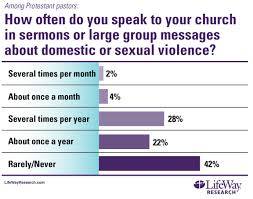 Unfortunately, most pastors are unequipped to respond appropriately to abuse. My husband and I went through seminary and hardly heard a word about domestic violence in our classes. Because women suffer in silence, trying trying trying to pacify their controlling husbands with submissive and meek obedience, pastors may never hear anything from a woman until she is reaching hopelessness and desperation. And he will likely encourage her to do more, be more, suffer more for the sake of saving her marriage. He will not understand the psychological impact of living in an abusive relationship for years. He may bring both in for couple’s counseling, without personal expertise in abuse, and further damage the woman through treating this as a marriage issue rather than as the husband’s sin.
In conservative churches, where headship and submission are taught, women can be subjected to abusive relationships with no hope of relief. Men have full reign to lord authority over their wives, controlling them rather than living as one with them. The stigma of divorce leads to shunning of women who leave abusive marriages, and traditional gender roles leave women financially dependent on their spouse, unable to leave without a way to make a living. The teaching that headship and submission image the relationship of Christ and the Church leads husbands and wives to strive harder to achieve cultural constructs of gender roles rather than becoming more the individuals that God created them to be.
In Rachel Held Evan’s post, “Is patriarchy really God’s dream for the world?”, she says,
If scripture is not enough to convince you that patriarchy is a result of sin, you need only look at the world to observe its effects.
- Worldwide, women ages fifteen to forty-four are more likely to be maimed or die from male violence than from cancer, malaria, traffic accidents, and war combined.
- Every 9 seconds, a woman in the US is assaulted or beaten. Around the world, at least one in every three women has been beaten, coerced into sex or otherwise abused during her lifetime. I wish I could say that all complementarians categorically condemn female submission to male violence, but John Piper has said that, in order to model godly submission, a woman may need to quietly “endure verbal abuse for a season” or “getting smacked one night” before “seeking help from the church.” (He says nothing about contacting authorities). Similarly, in Created to Be His Help Meet, Debi Pearl advises a woman whose husband pulled a knife on her to “stop complaining” and focus instead on not “provoking” her husband’s anger. This is destructive advice and reveals something of an assumption that the preservation of male hierarchy is more important than preservation of a woman’s dignity.
- At least 3 million women and girls are enslaved in the sex trade.
- Study after study shows that societies characterized by the subjugation of women are more violent, more impoverished, and more unjust than societies that empower women. In their excellent book Half the Sky, Nicholas Kristof and Sheryl WuDunn argue that “in this century the paramount moral challenge will be the struggle for gender equality in the developing world.” Empowering women increases economic productivity, reduces infant mortality, contributes to overall improved health and nutrition, and increases the chances of education for the next generation. Several studies from UNICEF suggest that when women are given control over the family spending, more of the money gets devoted to education, medical care, and small business endeavors than when men control the purse strings. Similarly, when women vote and hold political office, public spending on health increases and child mortality rate declines. Many counterterrorist strategists see women’s empowerment as key to quelling violence and oppression in the Middle East, and women entering the workforce in East Asia generated economic booms in Malaysia, Thailand, and China. (You can find all of these studies cited and analyzed in Half the Sky, which I highly recommend.)
- And as I noted on Tuesday, surveys show that couples who describe their marriage as “egalitarian” are more likely to classify it as a happy one than those who describe their marriage as “traditional.” In some cases, the differences are significant. (Dennis J. Preato presented a paper summarizing several of these studies at the 2004 Evangelical Theological Society Meeting, which you can read here.)
Interestingly, John Piper discussed the unhappy dynamic of much of his marriage in October. Piper is one of the most influential proponents of complementarian theology (the belief that God designed strict gender roles for men and women), co-founding The Council on Biblical Manhood and Womanhood and The Gospel Coalition, a massive coalition of churches which holds complementarian ideology as a core aspect of their beliefs. In my experience and observation, couples that treat each other as equals (whether they are complementarian or egalitarian) are far happier than couples that function as a hierarchy with the husband at the top.
 I truly believe that mutual submission between husbands and wives is the correct Biblical teaching. Giving husbands authority over households rather than all living under the authority of Christ as equals leads to unhealthy and ungodly dynamics and often, abuse.
If your marriage is emotionally destructive and you need to establish boundaries as you work toward healing, here are some resources:
Immediate Help:
National Domestic Violence Hotline: 1-800-799-7233. Crisis help or to develop a safety plan.
Family Renewal Shelter: 1-253-475-9010 (24-hour crisis line) or 1-888-550-3915 (toll free). A Christian resource for crisis help and assistance developing a safety plan.
American Association of Christian Counselors
Support Resources:
Document the Abuse: Assists women who fear for their safety in developing an Evidentiary Abuse Affidavit.
Women’s Law: Provides state-specific legal information and resources.
VINE (Victim Information and Notification Everyday): Allows crime victims to obtain timely and reliable information about criminal cases and the custody status of offenders.
Lighthouse Network: 1-877-562-2565. Assists individuals and their loved ones in finding effective treatment for drug, alcohol, psychological or emotional struggles, 24/7.
Books:
The Emotionally Destructive Marriage: How to Find Your Voice and Reclaim Your Hope – Leslie Vernick
Why Does He Do That? Inside the Minds of Angry and Controlling Men – Lundy Bancroft
Other:
The Emotionally Destructive Marriage: Free resource page
Self Centered Spouse: Series of blogs by Brad Hambrick
A Cry for Justice: A blog addressing the needs of the evangelical church to recognize and validate the reality of abuse in the Christian home.
Myths about Domestic Violence
Thanks for visiting the Beautiful Kingdom Warriors! Please Follow us and Like us on Facebook!


 A couple days ago, the Hidden Brain podcast had a fascinating episode on how sexism affects women in leadership. You can listen to it

 The Beautiful Kingdom Builders