Tag Archives: Christianity

Book Review: The Road Back to You

Today is launch day for a very exciting book, a collaboration of author Ian Cron and Enneagram expert Suzanne Stabile.  “The Road Back to You: An Enneagram Journey to Self-Discovery” explains this ancient personality typing system and how using the Enneagram can help you to understand yourself and others better, leading to greater compassion and empathy, and deeper, healthier relationships.  In addition, understanding yourself better is key to growing in relationship with God.

A big part of my life is listening to podcasts, as I work alone and enjoy having “adult conversations” to keep me company.  I started listening to Luke Norsworthy’s podcast last year.  He interviews fascinating Christian authors, pastors, activists and theologians.  In one of his conversations with Richard Rohr, they chatted about the Enneagram and later that night, I Googled “Enneagram” and read through The Enneagram Institute’s site.  Then this summer, he did a podcast with Suzanne Stabile and Ian Cron about their upcoming book and podcast.  I have since been listening each week as they interview guests about their Enneagram number.  I jumped at the opportunity to read an advance copy of their book and share this review with you.

In the first chapter, Ian Cron describes his introduction to the Enneagram in seminary when he came across a Richard Rohr book, and his professor’s adamant rejection of its credibility.  Later on, after burning out in pastoral ministry and finding a spiritual director, Brother Dave, to help put the pieces of his life back together, they discussed using the Enneagram together.

“It’s too bad your professor discouraged you from learning the Enneagram,” Br. Dave told me. “It’s full of wisdom for people who want to get out of their own way and become who they were created to be.” “What does ‘getting out of your own way’ entail?” I asked, knowing how many times I’d wanted to do just that in my life but didn’t know how. “It has to do with self-knowledge. Most folks assume they understand who they are when they don’t,” Br. Dave explained. “They don’t question the lens through which they see the world—where it came from, how it’s shaped their lives, or even if the vision of reality it gives them is distorted or true. Even more troubling, most people aren’t aware of how things that helped them survive as kids are now holding them back as adults. They’re asleep.”

“What we don’t know about ourselves can and will hurt us, not to mention others,” he said, pointing his finger at me and then at himself. “As long as we stay in the dark about how we see the world and the wounds and beliefs that have shaped who we are, we’re prisoners of our history. We’ll continue going through life on autopilot doing things that hurt and confuse ourselves and everyone around us. Eventually we become so accustomed to making the same mistakes over and over in our lives that they lull us to sleep. We need to wake up.”

“Working with the Enneagram helps people develop the kind of self-knowledge they need to understand who they are and why they see and relate to the world the way they do,” Br. Dave continued. “When that happens you can start to get out of your own way and become more of the person God created you to be.”

trbty-4
I wrote a post in March of 2015 about my journey to finding healing from codependcy.  I experienced church and family trauma and I was in a similar broken place that Ian Cron describes.  I didn’t have a spiritual director like Br. Dave to guide me, but God did provide spiritual guides both in the flesh and in books and on the interwebs that helped me find my footing again.  I share that story and links that were helpful in the post.  If I had read “The Road Back to You” at that time, I would have included this resource.  I have personally experienced the change in my relationship with God as I understand myself and others better.  I feel unconditional love and acceptance from God.  In reading my old post, I see how my personality has always been an Enneagram 9, but I was unhealthy and now I am more self-aware.  I have a deeper understanding of my healing.

I believe that churches would be healthy and productive and safe if only there was more self-awareness in parishioners.  Ian and Suzanne always repeat on their podcasts that their passion for sharing the Enneagram is in seeing compassion grow. In reading the chapters explaining the nine types, I was blown away as I recognized myself, my husband, my children, my relatives and friends.  I see clearly where my work needs to be done to be a healthier, safer person.  I see where the behavior of others stems from, which gives me a greater ability to be gracious and forgiving and also to communicate with them in a meaningful way.

I don’t want to give away too much about this book.  I just want to urge you to buy a copy or request that your church or library purchase a copy.  Pass along “The Road Back to You” website to your pastor and friends.  Listen to Ian and Suzanne’s podcast on your commute or while you work.  This is an important resource for spiritual development and will bear much good fruit in your life if you use it as a spiritual discipline.

Here are the links one more time:

To purchase a copy: https://smile.amazon.com/Road-Back-You-Enneagram-Self-Discovery/ (using Smile.Amazon.com gives you an opportunity to give back to a cause that is important to you.  If you’d like, you can choose “North Harbor Community Church” – my church in Maine).

The Road Back to You website: http://theroadbacktoyou.com/


Thank you for visiting The Beautiful Kingdom Warriors!  We are all about having redemptive dialogue about gender equality in the Church and world.  Please “Like” our Facebook page, where we post articles from around the web related to this mission.

Guest Post: The Way Through the Waves

It is an honor and a pleasure to share this sermon from Zoë Faith Reyes, our sister in Christ and in community at North Harbor Community Church in midcoast Maine.  In the weeks leading up to Easter Sunday, the teaching team at North Harbor did a series called A Peace of Suffering.  If you are interested in listening to the entire series, you can do so here.  It was profoundly helpful to look closely at the topic of suffering as a church family.  And in the spirit of The Beautiful Kingdom Warriors’s mission to empower women and girls to pursue their callings and develop their spiritual gifts for the building of God’s Kingdom, we wanted to offer Zoë as an example of a woman using her gift of teaching to greatly bless her church family.  Enjoy her sermon!


FullSizeRender (3)

Zoe’s San Fransisco Team on top of a windy hill

The Way through the Waves
A Peace of Suffering – Part 6

I recently read an article about one of my favorite topics, Resilience, the capacity to recover quickly from difficulties. Almost as an aside, the article mentioned that research has shown that people who are members of faith communities regularly demonstrate stronger resilience. At the same time, I was feeling heavy with the weight of trials and sufferings that I felt that the members of my own faith community [including myself] were undergoing. “How?!” I wondered. “What is it about people in faith communities that enables them to be more resilient? How can I tap into that capacity? How can I offer that power to my brothers and sisters of faith??” With these burning questions weighing on my mind, I entered into a dark and beautiful journey into the world of pain.

For one, I have to admit, “I hurt.” I can’t begin to preach at my community as if I have it all together, am above this fray, I have to admit the hurt in my body, mind, heart and soul. Any outsider might assess my “suffering” differently, but Pain is Pain. If I worry about those external assessments, I might belittle or glorify my pain, but both approaches only help me avoid actually dealing with it. And as attractive as avoiding pain seems, I can not forget the worst pain I ever experienced. When I went into labor with my second child and attempted a VBAC, his heart rate indicated he was in distress. Due to my history and his present condition, I was whisked away for an emergency C-section, which required an emergency administration of general anesthetic. They struck a needle into the back of my hand and it felt like a freight train had tunneled into my hand and up my arm instead. The feeling that effectively took all pain and other feeling away was easily the most excruciating physical pain I have ever known. So I neither can, nor am I sure I want to remove all pain from my life.

For two, I know YOU hurt, and I hurt for you. I hate that in my helplessness, I can not shoo away your chronic pain; make the world treat you with the love and respect you deserve; erase the trauma from you past; bring back the people you have loved and lost; I may not even be able to get through the walls you’ve erected to keep anyone from knowing you are in pain and in need of help in the first place. And there’s despair in that. Despair is when you feel like tomorrow will be no different from today, or in other words, despair is the absence of hope. I have known despair all too well, far too many times. AND, so many times when I have faced my despair, I have found hope. Hope is a learned skill, learned in the context of relationship. I am learning to hope as I experience life in community.

I want to get vulnerable and share with you out of my own darkness and despair to share a picture of where despair can lead to hope, how I have time and again found peace in my suffering.

When I was in college, I co-lead a mission team to San Francisco where we fed the homeless, worked with AIDS victims; painted a mission outpost; and played with and shared love with inner city kids. Both the prep work in the year leading up to the trip and the week itself were sleepless and exhausting, but miraculously I had strength to get through each day with gusto. Until the last day, that is. On the last day, in the climax of my leadership success, one of our team members informed me that he was taking off to hang out with a friend in the city. I told him he could not, we were there on a TEAM trip. He scoffed at me and left anyway.

In a recent sermon at our church, Will Truesdell talked about our self-talk when we’re in the midst of suffering. My self-talk went something like this: “How dare he show such disregard for our team unity! I can not be held responsible for the danger he is going to get himself into in the city – he is so going to get lost on the subway!! How dare he show such disrespect for this trip’s purpose! How dare he show such disrespect for me! Why is he just abandoning me like this?!” I was feeling intense fury and disdain. Depression is sometimes defined as “anger turned inwards,” and that was exactly what I started experiencing. My anger at this guy quickly turned into, “I am a failure! I am failing my team. I am failing at ministry. I am failing myself. I am failing God.”

I prayed for help. And things got . . . worse. I felt profoundly powerless. I had no strength left. And that feeling was even scarier than my familiar feelings of depression. I could not stop crying. I could not move my body. I could not get low enough to the ground. I could not respond when I heard people asking where I was. I could not respond when people found me and asked what was wrong. I could not move when they had no time left to be patient because we had to go. I felt trapped inside a body I was too small and meager to maneuver. Friends eventually found me and carried me into a car, which carried me across the Bay to our destination. As we drove, I continued to be inconsolable. I felt as abandoned by God as by the guy who had ditched us. I felt a sense of exclusion from their concern.

Psalms 69:1-3 says: “Save me, O God, for the waters have come up to my neck. I sink in deep mire, where there is no foothold; I have come into deep waters and the flood sweeps over me. I am weary with my crying; my throat is parched. My eyes grow dim with waiting for my God.”

I resonated strongly with that Psalm. I think the disciples also would have resonated with the Psalm the night they were in the boat on the stormy sea, just after Jesus had fed 5,000 people with a small portion of loaves and fishes. Take a minute to read Matthew 14:22-33.

They were in the middle of their ministry, in the middle of the night, in the middle of the sea, in the middle of a great storm, and Jesus was NOT there. He’s sent them on ahead of himself. Scripture says they were, “far from land, and the wind was against them.” I think they must have felt they were far from HOPE.

In the 4th [last] watch of the night [3-6am], “they had begun to despair of deliverance.” And just as their hope is nearly completely gone, they look out into the waves and think they see a ghost. They cry out in fear. Like my night in San Francisco, a bad night just got way worse.

But it’s not a ghost. It is Jesus. And Jesus replies to their cries with words of comfort. Literally translated, His words would come out something like, “Have courage, I AM; don’t be scared away.” Our biological responses to fear are: fight, flight, or freeze. But Jesus asks the disciples to choose another way. He asks them to instead Face their fear. He invites them to be present, even in this dark and scary moment.

In a sense, Peter does obey. He is not scared away. Instead, he stays. And he gets curious. He says, “if it’s really you, ask me to come to you on the water.” Jesus replies, “come.” And Peter steps out into the darkness, into the water, into the storm.

What if we got curious about our suffering and
stepped into it instead of running or fighting it away?

And so, Peter walks on water, just like Jesus, until the wind picked up and delivered a full sensory assault to Peter. Hebrews 12:2 says to “fix our eyes on Jesus,” but in this moment, Peter. Just. Can’t. He experiences a failure of faith and courage, which threatens his life and his ego, and he begins to drown.

So here’s the PIVOTAL moment:
Will Peter deny or embrace his inability to endure this suffering??

When I was in San Francisco, I thought the success of our trip was on my own shoulders. BUT, I could not bring the trip to a successful end. I could not hold the team together. In that moment, I couldn’t even speak.

In Peter’s moment, he cries out, “Lord, save me.” Peter embraces his suffering. In other words, Peter incorporates his pain, his death, his insufficiency into himself. HE OWNS IT.

Here, when Peter says, “Lord,” he’s using a word that means, “he to whom a person or thing belongs.” He is confessing a submissive belonging. He is expressing that he belongs to Jesus; not to himself, not to the fear, not to the waves.

The word “save” here is “sozo” in the original text. That word means “to keep safe, to protect, to restore, to make whole, to make complete.” In other words, Peter is saying, “I alone am not sufficient, I am not enough. Complete my courage. Complete my faith. Complete my strength. Make us ONE. Weave us together. Pursue our peace.”

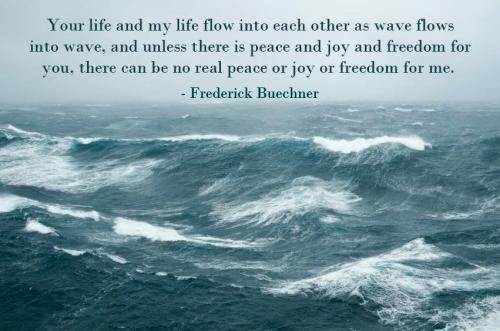
Etty Hillsum, a Jew who ultimately died in a Nazi concentration camp came to realize that
to exclude death [and I would add “failure” or “pain”] from life is to sacrifice a complete life.”

Shalom, Peace, is:
The webbing together of God and man with all creation
to create universal flourishing and wholeness.
~Cornelius Plantinga

In other words, Shalom is Completeness, made whole-ness.
It is integration instead of exclusion.
It is integration of death into life;
you into me;
peace into suffering.

When Peter cries out, “Lord, save me,” he is owning his suffering and crying out for PEACE.

Jesus replies, “Oh you of little faith, why did you doubt?” In the church, we can use the “little faith” phrase to imply that good Christians shouldn’t be so bogged down by suffering or grief, if they had more faith, “this” wouldn’t be such a problem. But I wonder . . . what was Peter doubting? Maybe Peter doubted that Jesus made him able to walk on the water in the first place, that Jesus would see it through until they reached each other, that Jesus, with his presence, would help him suffer the storm.

Maybe Peter doubted that the whole point of any of this mess was not that Peter get to walk on water, but to join with Christ and together endure their suffering. Maybe Peter doubted that the whole point of all of this crazy life with Christ was LOVE.

I hadn’t been doing the good work in San Francisco the whole time. As we had prepared, chose the team, did the work in the city . . . I had thought that serving Jesus through meeting Him in the people we served was the goal. But I was too blind to see that He was also the archer. He was powering the work. His love was making it possible for us to show love to people in San Francisco.

**His love made a way for us, for me, to enter into his love. **

I humbly suggest that maybe I have some guesses about what Jesus thinks Peter was doubting, and what that tells us. But I don’t think it is inconsistent with what is said elsewhere. In Matthew 11:28-30, Jesus says:

“Come to me, all you that are weary and are carrying heavy burdens, and I will give you rest. Take my yoke upon you, and learn from me; for I am gentle and humble in heart, and you will find rest for your souls. For my yoke is easy, and my burden is light.”

And in 2 Corinthians 12: 9-10, Paul conveys God’s message to him:

“My grace is sufficient for you, for power is made perfect in weakness.” So, I will boast all the more gladly of my weaknesses, so that the power of Christ may dwell in me. Therefore I am content with weaknesses, insults, hardships, persecutions, and calamities for the sake of Christ; for whenever I am weak, then I am strong.

Jesus doesn’t calm the storm in this instance, nor does he necessarily exert power over the elements that cause suffering. He comes under the storm and weathers it with the disciples. He is Emmanuel, God with us.

Jesus gets Peter back into the boat. Eventually, the storm dies down. And the disciples declare, “Truly you are the Son of God.” In Mark’s version of this account (Mark 6:45-52), he points out, “They were completely astounded because they had not understood about the loaves. Instead, their hearts were hardened “ ~Mark 6:51-52. A hardened heart is one covered with thick skin, callused, made dull, having lost the power of understanding. People who have calluses aren’t born that way. They are people who have grown tough skin because of a wound or significant friction, they’ve had to toughen up to just get through, to survive. And that thick skin is hard to cut through to do the true wound-healing. “Just surviving” impairs understanding. When Jesus fed the 5,000, as Dan preached about in the last sermon series, He was filling a gap in the disciples capacity and in their faith. Here, he is doing the same thing again in a much more visceral way [point by Manny Reyes.]

“True omnipotence may not be found in a distant and separate power over something or someone, but rather in the intimate experience of being wounded for and with.”
~Gerald May, Dark Night of the Soul, p. 197

As Dan has pointed out in previous sermons in this series, to Suffer, from the latin, means “to bear from below.” Instead of exerting power over here, Jesus suffers with and for his disciples.

“True omnipotence may not be found in a distant and separate power over something or someone, but rather in the intimate experience of being wounded for and with.”

Back to me in San Francisco, trapped in my powerlessness . . . the car I was in arrived at our destination, and I was pulled out, not ready to enter the house with the group, but stood outside alone with Manny on the edge of an hilltop, in the night, in the middle of a rushing wind. And in the middle of that full sensory assault of wind and darkness, I experienced God’s quiet, gentle words to me, “Be still. I AM.” With those words, I could feel His comfort and have the courage to listen on to what else He had to say to me. He didn’t speak to the situation. He didn’t make that guy suddenly appear and apologize. But He did assure me that I was not alone. I was not “fired” from serving Him. Manny would be my partner in service – as he was already demonstrating as he held me in that moment that he would be able to hold me in the ministry God had laid out for us in the future.  But most importantly, He showed me Emmanuel, God WITH us, was there to stay with me for the journey. And that truth diminished my other fears and concerns, of which that dude would be one of the least.

This story out on the water looks to me like a microcosm of the greater story of the gospels: God on high saw the people He loved suffering, so He entered into their lowliness in order to be with them, to endow strength into them so that they might endure. This story and my story are both miniature incarnations, Christ manifesting His presence to save. When Jesus entered into their suffering, spoke into their fear, and saved Peter. He is softening hard hearts.

I think an exoskeleton, like the shell on a turtle, the skeleton on the outside, is a good picture for a hardened heart. When Jesus suffers with and for the disciples and for us, He cuts through thick callused skin dulling our senses, healing the leprosy of the heart and making us vulnerable. He completes our incomplete courage with His own strength. In our unification, He builds a new skeleton within us. We are transformed into a creature with an endoskeleton, flexible and durable, not safe, but saved, completed.

Transformed,
we are better equipped to weather the rest of the storm, and most importantly,
we are not alone.

I originally shared this message on Palm Sunday, the day when the church remembers Jesus, who knew that His betrayal, denial, and death were coming, entering into Jerusalem in a coronation parade. Knowing all that He knew, he allowed the people to sing Hosana over Him, as the King of the Jews. I wouldn’t have. I, who do what I can to exclude death and failure and pain and betrayal from my life, would have been infuriated with those people with palm branches waving their praises, knowing they would turn on me in a matter of days. But he integrates his death into his life, the betrayal into the praise, because he IS life enlarged. AND he does it all for the sake of LOVE, so that we could join him – through our pain – and also integrate death into our life for full, durable, thriving life – which is to say life with him.

PS 77: 19 Your way was through the sea, / Your path, through the mighty waters.

No fear can hinder now the love that has made a way into his love.

Hosanna to the Prince of Peace.


zoe reyes

Zoë Faith Reyes was born and raised in the church in Houston, Texas. She has B.A.’s in Philosophy and English from Westmont College and a Masters in Social Work from California State University East Bay. Zoe has done mission work in Tecate and Reynosa, Mexico; Sewanee, Tennessee; Houston and Galveston, Texas; Kingston, Jamaica; San Francisco, California; and Kandy, Sri Lanka. She has worked for seven nonprofits, including Project Peace which she co-founded and for which she was a founding board member and CEO. She is currently serving as mother for Sofia (5) and Daniel (2); wife for Manuel Reyes; steward for a small bit of earth in Brunswick, Maine; Community Development Director for North Harbor Community Church; and photographer for Zoe Reyes Photography. If she has done anything of worth in this life, it is a result of the power of Christ in her, and to the glory of God.

Book Review: Faith Shift by Kathy Escobar

Oh man, oh man, do I love me some Kathy Escobar!Faith-Shift

I started reading Kathy’s blog a couple years ago, and I was hooked.  I don’t have too many blogs that I read EVERY.POST.THEY.EVER.POST.  But I wouldn’t miss anything from Kathy!  Her stuff is pure gold.

In late 2014, she published a book, “Faith Shift: Finding Your Way Forward When Everything You Believe is Coming Apart”.  I had it on my wish list for a long time, finally purchased it with birthday money in September, and FINALLY had a chance to read it a couple weeks ago.  I devoured it.

“Faith Shift” is a book of hope for “spiritual refugees, church burnouts, and freedom seekers.”  In it, Kathy maps out stages of a faith shift, giving language to the painful experience of fundamentally changing from a faith that is certain and features strong affiliation and conformity with your faith community, to a faith that is freer, more mysterious and diverse.

Kathy’s stages, Fusing-Shifting-Returning or Unraveling-Severing-Rebuilding, resonated deeply with my own experiences over the past several years, as well as my long-time love of stage theory and psychology.  In Evangelical Christianity, there is a skepticism with secular fields of psychology, sociology, etc.  There is a push towards Biblical Counseling rather than listening to liberal, humanistic psychobabble.  I made sure to read the two negative reviews of “Faith Shift” on Amazon to see what concerns others may have with this book, and they were primarily along those lines.

If I hadn’t been so focused on becoming a missionary or church musician when I went to college, I probably would have studied psychology.  In hindsight, I realize I hadn’t even considered other pathways to ministry because of the complementarian church culture that I was raised in.  Deep down, I wanted to do Kingdom work.  The only women I had seen doing Kingdom work (that was OK and celebrated in my tradition) were missionaries, musicians, and Women’s Bible Study authors and speakers.  Oh, and let’s not forget mothers, the hands that rock the cradles.

During my freshman year at Gordon College, I took Psych 101 as an elective and loved it.  A lot of my college education is a blur now, but I remember what I learned in that entry-level Psychology class.  So I made sure to take the Psychology elective offered when I was in seminary.  We read a book by James Fowler, “Stages of Faith: The Psychology of Human Development and the Quest for Meaning“.  This is one of my favorite books from my seminary education.  Fowler maps faith development in similar ways as Kathy, from assimilation and certainty to “the wall” to a more open, gracious, loving perspective on faith and others.  In a similar vein, I often send an article to friends by Rich Vincent, “Stages of Faith: A Map for the Spiritual Journey“, when I feel they are struggling and need some perspective that they are in process, that it will all turn out OK.  Shorter and easier to read than a book!

As much as I have appreciated Stage Theory and how Christian authors have related this theory to faith development, I could never personally relate to the middle stage, “the journey inward,” or “the wall,” the season of doubt.  My faith had been strong and sure most of my life.  My Fusing stage lasted about 28 years, I would say, and Affiliation, Certainty and Conformity describe those years beautifully.  There were bumps in the road, like when I was afraid that my faith would not mature if I continued to have a “perfect” life, so I prayed for hardship.  Soon one of my best friends died at age 21 and I felt responsible and walked through a deep depression.

Then some more bumps came.  Pretty traumatic ones.  My home church chewed my family up and spit us out (at least that’s what it felt like).  I was rejected by the people who were so much a part of my identity.  My “perfect” family was imploding. God called me (a complementarian!) to pastoral ministry.  I began reading about women in ministry and was warned about the “slippery slope” that I was on.  My affiliation, certainty and conformity were being compromised!

I was Shifting and I didn’t know it.  I wanted people to be real (Authentic), I was baffled to learn that my favorite theologians had said misogynistic, sexist things while I was beginning to see God’s vision for equality and partnership between the sexes, which led me to be uncomfortable with authority figures (Autonomy), and I felt like I needed to study EVERYTHING.FOR.MYSELF (Uncertainty), while again, being real about my struggles and weaknesses–no more projection of perfection.  I became an Ex-Good-Christian-Woman (my FAVORITE Kathy Escobar post!!!).

The way that Kathy writes is utterly gracious.  She never categorizes any part of a faith journey as bad, or better than, or wrong, or anything.  She just lays it out.

Are you experiencing this?  Here is some language to help you understand.
You are not going crazy and you are not alone.   

There was a profound change in the way that I saw God a few years ago while I was watching Brennan Manning preach on YouTube.  I wept as he poured out God’s love and grace in his message that God loves us just as we are, not as we should be.  I have always believed that God is love.  But I think Affiliation, Certainty and Conformity were chains that kept me from experiencing God as love.  There were always rules and expectations and pressures and systems that kept me in check, that made God’s love seem conditional.

Because God’s love is unconditional, I can ask questions without fear or guilt.  I utterly Severed from my Fused faith as I let Brennan Manning confer a God of grace and freedom to me.  I am Rebuilding my faith around this new understanding and am seeing things through this new lens.  I expect to make mistakes and to be a work in progress.  I am full of gratitude to God for being bigger than any box that I had ever put Him in, for loving me and pursuing me and holding me safe.

And I am thankful for Kathy Escobar’s writing and this book in particular, that has helped me to understand my faith development and trust that change is a natural part of being in relationship with God.  Kathy closes “Faith Shift” by saying,

Trust the path ahead, even though you aren’t sure exactly where it will take you.  You’re not lost.  In fact, you’re on a road toward a bigger, better relationship with God, others, and yourself that will continue to develop.

The world doesn’t need more fear-filled, insecure Jesus followers.  It needs more peace-filled, secure ones.  It doesn’t need more people deciding who’s in and who’s out on earth and in eternity.  It needs more men and women who are passionate about drawing everyone toward the love of God.

Throughout the years, I have seen over and over again how this path leads to new beginnings, not endings, if we just keep walking.

______________________________________________________

Thank you for visiting TBKW!  If you are interested in “Liking” us and learning more, we post articles on our Facebook page everyday, dealing with the good, the bad and the ugly news regarding women’s place in the world and Church.