
Forgive to Live

As Becky and I dove into unchartered territory with this blog (unchartered at least for us – it is very fun to find like-minded bloggers out there on the world-wide-interwebs!), we were very excited to have a place to flesh out ideas regarding our role as ezers standing alongside our brothers in spiritual warfare, “piercing darkness with light.”  Our primary goal with TBKW blog is to facilitate dialogue on what that looks like as we each find our own calling in God’s Kingdom.  We seek to inform, reflect, create a space for conversation, and mostly, we seek to empowerWe want to lift other women up into the good deeds that God has prepared for them to do (Ephesians 2:10).  I believe that an important piece in achieving that purpose is in offering resources for spiritual growth.  I thought I should mention that as some of our posts haven’t been along the lines of gender equality and may seem out of place.  With that said, here’s another spiritual formation tool for you!
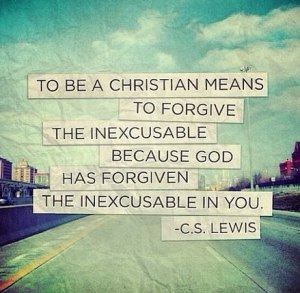
Christian-Forgiven-Quotes

The Bible study I attend has been working through Margaret Feinberg’s “Wonderstruck” study, which has been so good!, and this week we discussed the final chapter on forgiveness.  Our leader, Pastor Collette Pekar, introduced a book that she described as one of two “life-altering” books she has read (and Collette is well read!).  It is…
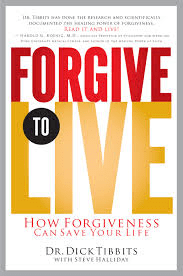
Forgive to Liveforgivetolive.net

On the website, you can read Chapter 1:
http://www.forgivetolive.net/aboutBook/excerpt.asp
and you can take a quiz to assess where you are on your forgiveness journey: http://www.forgivetolive.net/aboutBook/journey.asp 

And this is high praise: “Dr. Tibbits has done the research and scientifically documented the healing power of forgiveness. Read it and live!” – Harold G. Koenig, M.D., Associate Professor of Psychiatry and Medicine, Duke University Medical Center, and author of The Healing Power of Faith.

Collette has taught from this book and passed out a handout that she developed, which summarizes the process of forgiveness as outlined in Forgive to Live.  She gave me permission to share her handout here:

Choosing a Larger Frame

The goal of forgiveness is not to forget.
The goal of forgiveness is to remember in a different way.

1. Focus on what is true from both points of view.
– What important details do you consistently leave out when you tell this story to others?
– In what specific ways would the offender’s account of this incident differ from your own?
– In what specific ways might your own actions have contributed to this incident?

Be completely honest with yourself
as you look for distortions in how you tell your story.
The more accurately you recall the offense,
the less hurtful it will become.
“The truth will set you free.” (John 8:32)

2. Develop empathy for the person who hurt you.
What positive qualities have you observed in the offender on other occasions?
– What do you know about this person’s background and present circumstances that might explain what happened?

Pray for the person who offended you.
“Father, forgive them,
for they don’t know what they do.” (Luke 32:34)

3. Develop humility about your own need for forgiveness.
How have you also hurt others?  Have you ever needed to be forgiven of an attitude or action of equal gravity?
– When you sought forgiveness, was it granted?
– Is the offender any less loved by God or deserving of forgiveness than you are?

“Forgive as the Lord forgave you.” (Colossians 3:13)

4.  Revise your story so it accurately reflects the power and the grace of God.
– What does this event look like from God’s perspective?  Ask Him.
– What else is still true and good about your life?  What has the offender NOT taken from you?

“Whatsoever things are good, pure, and lovely,
think on these things.” (Philippians 4:8)

– What is the largest frame you can imagine for this story?
– What are the possible ways that God can use it for good in your life or in the lives of others?
– How can God use this to help you grow personally?
– How can God use this to help you bring glory to His reputation?
– How can God use this to help you encourage others?

Imagine telling this story
after you’ve been in heaven for 10,000 years.
“He makes all things beautiful in His time.” (Ecclesiastes 3:11)

5. Recommit to your decision to forgive each time the memory returns.
– What truths do you already know that you’ll need to remember when this painful memory returns?

Forgiveness is not an event, but is a process.  It takes time.
When resentment resurfaces you can call upon the principles of
reframing that you have already chosen and practiced.
The more you forgive, the easier forgiving will become.

You are never more like Jesus
than when you are choosing to forgive.

The Logical Fallacy of “Equal but Subordinate”

I just finished reading this post over at Wordgazer’s Words, and had to share.  Very thoughtful argument from an egalitarian in response to the Center for Biblical Manhood and Womanhood’s 2006 article “Relationships and Roles in the New Creation,” which asserts that headship/submission of the genders will continue in the afterlife.

Here’s the link.  Please read!

Searching Where It Cannot Be Found

looking for love
 
I love this Henri Nouwen quote from The Return of the Prodigal Son (Nouwen’s insights into Rembrandt’s painting of the same name):

Searching Where It Cannot Be Found

“At issue is the question: ‘To whom do I belong? To God or to the world?’ Many of my daily preoccupations suggest that I belong more to the world than to God. A little criticism makes me angry, and a little rejection makes me depressed. A little praise raises my spirits, and a little success excites me. It takes very little to raise me up or thrust me down. Often I am like a small boat on the ocean, completely at the mercy of its waves. All the time and energy I spend in keeping some kind of balance and preventing myself from being tipped over and drowning shows that my life is mostly a struggle for survival: not a holy struggle, but an anxious struggle resulting from the mistaken idea that it is the world that defines me.

“As long as I keep running about asking: ‘Do you love me? Do you really love me?’ I give all power to the voices of the world and put myself in bondage because the world is filled with ‘ifs.’ The world says: ‘Yes, I love you if you are good-looking, intelligent, and wealthy. I love you if you have a good education, a good job, and good connections. I love you if you produce much, sell much, and buy much.’ There are endless ‘ifs’ hidden in the world’s love. These ‘ifs’ enslave me, since it is impossible to respond adequately to all of them. The world’s love is and always will be conditional. As long as I keep looking for my true self in the world of conditional love, I will remain ‘hooked’ to the world — trying, failing, and trying again. It is a world that fosters addictions because what it offers cannot satisfy the deepest craving of my heart.

” ‘Addiction’ might be the best word to explain the lostness that so deeply permeates contemporary society. Our addictions make us cling to what the world proclaims as the keys to self-fulfillment: accumulation of wealth and power; attainment of status and admiration; lavish consumption of food and drink, and sexual gratification without distinguishing between lust and love. These addictions create expectations that cannot but fail to satisfy our deepest needs. As long as we live within the world’s delusions, our addictions condemn us to futile quests in ‘the distant country,’ leaving us to face an endless series of disillusionments while our sense of self remains unfulfilled. In these days of increasing addictions, we have wandered far away from our Father’s home. The addicted life can aptly be designated a life lived in ‘a distant country.’ It is from there that our cry for deliverance rises up.

“I am the prodigal son every time I search for unconditional love where it cannot be found. Why do I keep ignoring the place of true love and persist in looking for it elsewhere? Why do I keep leaving home where I am called a child of God, the Beloved of my Father? I am constantly surprised at how I keep taking the gifts God has given me — my health, my intellectual and emotional gifts — and keep using them to impress people, receive affirmation and praise, and compete for rewards, instead of developing them for the glory of God. Yes, I often carry them off to a ‘distant country’ and put them in the service of an exploiting world that does not know their true value. It’s almost as if I want to prove to myself and to my world that I do not need God’s love, that I can make a life on my own, that I want to be fully independent. Beneath it all is the great rebellion, the radical ‘No’ to the Father’s love, the unspoken curse: ‘I wish you were dead.’ The prodigal son’s ‘No’ reflects Adam’s original rebellion: his rejection of the God in whose love we are created and by whose love we are sustained. It is the rebellion that places me outside the garden, out of reach of the tree of life. It is the rebellion that makes me dissipate myself in a ‘distant country.’

“Looking again at Rembrandt’s portrayal of the return of the younger son, I now see how much more is taking place than a mere compassionate gesture toward a wayward child. The great event I see is the end of the great rebellion. The rebellion of Adam and all his descendants is forgiven, and the original blessing by which Adam received everlasting life is restored. It seems to me now that these hands have always been stretched out — even when there were no shoulders upon which to rest them. God has never pulled back his arms, never withheld his blessing, never stopped considering his son the Beloved One. But the Father couldn’t compel his son to stay home. He couldn’t force his love on the Beloved. He had to let him go in freedom, even though he knew the pain it would cause both his son and himself. It was love itself that prevented him from keeping his son home at all cost. It was love itself that allowed him to let his son find his own life, even with the risk of losing it.

“Here the mystery of my life is unveiled. I am loved so much that I am left free to leave home. The blessing is there from the beginning. I have left it and keep on leaving it. But the Father is always looking for me with outstretched arms to receive me back and whisper again in my ear: ‘You are my Beloved, on you my favor rests.’ “

You can purchase your own copy of this book here.

Image credit