
On today’s “Ask Pastor John” episode, posted here, John Piper* is asked why so many single missionaries are women (80-85% of all single missionaries), and Piper responds that he doesn’t really know, but has a couple opinions, that are in short:
Single missionaries by and large would prefer to be married. Proposing marriage falls on men, so the type of man that is single because he lacks the courage to propose marriage also lacks the courage to become a missionary, which takes grit, courage and strength.
One thing I agree with, is that missions work takes grit, courage and strength. However, I have different opinions than Piper on this phenomenon of single women going into missions. Mine are,
- Conservative evangelical women who are gifted in leadership and teaching may only be permitted to use those gifts on the mission field.
- Conservative evangelical men who are gifted in leadership and teaching may use those gifts anywhere, and are often funneled into local ministry as young men and so do not need to look so hard for opportunities to lead.
My opinions come from personal experience as a young woman who aspired to be a missionary, and as an approaching-middle-aged woman who has been thinking and reading about gender issues in the Church for several years now.
I grew up in a pastor’s family, and my father loved missionary work so he was always planning missions trips and inviting missionaries to come to our church, where we would personally host them in our home. I remember as an 8 year old hearing about Amy Carmichael‘s missionary work in India in a Sunday School lesson. I am not someone who remembers every detail of my life, so a snapshot like this is usually significant, an a-ha! moment in my identity formation. Amy Carmichael is my earliest hero.
My family also spent three years living in Bolivia and Paraguay, South America, working in a boarding school for missionaries and filling in for missionaries on furlough in jungle and city locations. We met many single missionaries, all female except for four males (two of which were dismissed for molesting children).


Having been raised in the Conservative Baptist denomination, I never saw women in pastoral leadership. No one ever told me that with my leadership in the youth group and award winning speech contest record, that I could be a pastor one day. If a young man had demonstrated these qualities, he would have been invited to preach and been encouraged to pursue pastoral ministry in his schooling. When it was time for me to go to college, I only thought about two options – music ministry or missionary work. These were the only leadership roles that I had ever seen women in, and it was the entire scope of my imagination for my own life.
I had great love for God’s Kingdom and wanted to participate in bringing God’s redeeming work to the world. I studied music in college because I felt that was my spiritual gifting. And then I went to seminary and started out with a missions degree, but let my aunt and uncle talk me into a more ‘practical’ degree that could be used anywhere, Educational Ministries. I fell in love with my husband, a former missionary to Romania, and imagined us working overseas together. I was devastated when this didn’t come to pass, as it was my entire identity. I was going to be a missionary. I couldn’t imagine how I could use my gifts for God here in the USA.
One day, God had to out-right spell it out to me in an audible voice: “Ruth, I want you to co-pastor with your husband.” Logan had been talking about church planting, and I was saying, “OK, whatever,” but feeling zero passion personally about being involved in a church plant. I knew I would be relegated to babysitting and cooking and would be left out of the dreaming, teaching, leading part of ministry. Now I understand that dreaming, teaching and leading are aspects of my God-given design for co-dominion with my husband (Genesis 1:28).
I began reading voraciously about women in ministry. God began introducing us to couples who co-pastor. It was an exciting and enlightening time. It was also hurtful to realize that I had catching up to do in preparation for pastoral ministry, because I had never been guided as a young person towards leadership.
For the first time, I began to see how women in the Bible were leading all along. I began to learn about women pastors in the USA. At one time, there were more female Baptist pastors than male. However, they were serving in rural, impoverished churches while men had more desirable positions in cities and east coast towns. As rural towns became more prosperous, denominations began tightening their belts on women in ministry so that men could take their churches. Our own church in Maine had a history of female pastors generations ago. There has been a steady move away from allowing women in ministry in recent decades. It was not that long ago, 1987, that the Council on Biblical Manhood and Womanhood was founded, and it was in 2000 that the Southern Baptist denomination stopped endorsing women’s ordination.
Of course, another avenue for women in ministry was mission work. On the field, women could teach and lead even the [non-white] men. There are aspects of classism, sexism and racism intersecting with the issue of women’s ordination. While women may not teach men in wealthy, white, Western churches, their work in Africa, Latin America or Asia is admired. Women may not preach in many of our churches, but a visiting missionary woman may “share” her experiences on the field with her sending church, sometimes even from behind the pulpit.
I would be remiss to not point out that Jesus never married before beginning his ministry, and Paul taught us to remain single for the sake of the Gospel (1 Corinthians 7:7-38). Too often, marriage is placed on a pedestal and given too much importance in the Evangelical tradition. Certainly, married couples can work together as a “Blessed Alliance” for the sake of the Gospel. But young people do not need to be married to serve the Lord. And I would guess that 80-85% of single people serving the Lord right here in the USA are male.
Let me share some more resources for further reading on women in ministry on the mission field and in local congregations.
Missiologist Jenny Rae Armstrong wrote a powerful piece about our privileged Western cultural perspective on womanhood and gender roles in this piece, “On Being a Woman After God’s Own Heart.”
Founder of Youth With a Mission, Loren Cunningham, believes women should serve in ministry alongside men. Here is a short video from the YWAM website:
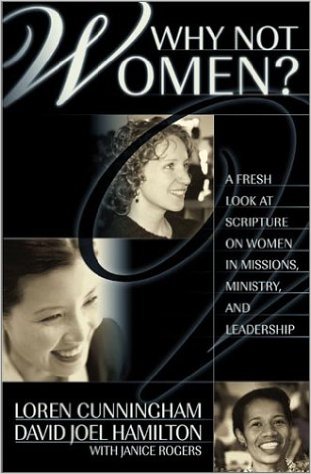
You can purchase “Why Not Women?” here.
Here are a couple articles on the History of Women in Missions, Women in Mission: A Protestant Tradition.
I saw this astute comment on the Desiring God FB post: 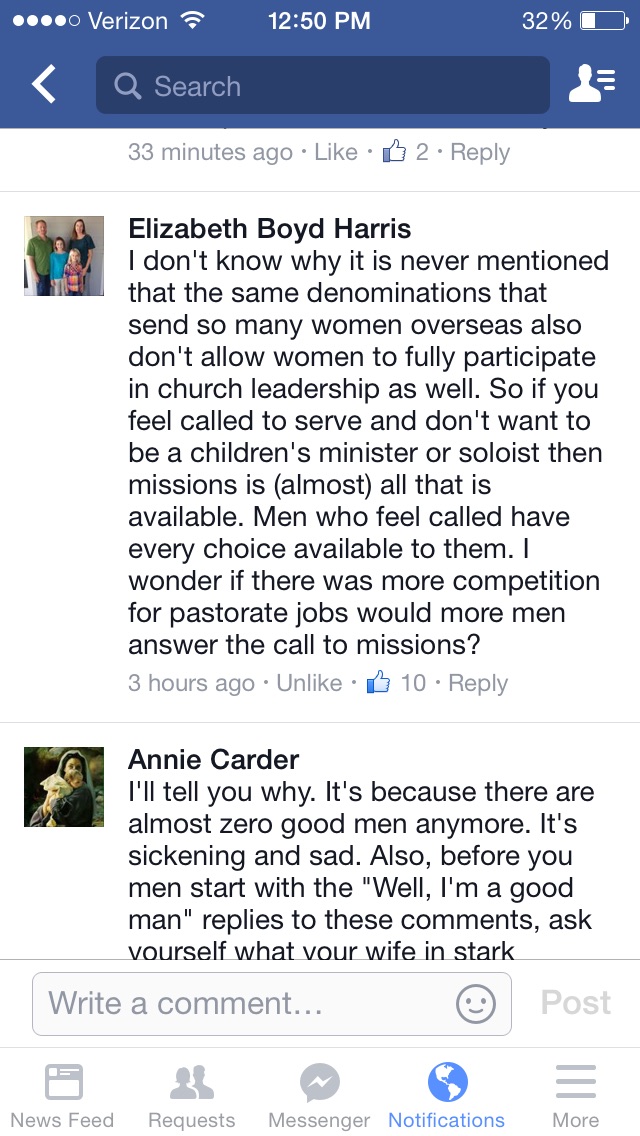
God has gifted all of us for Kingdom work, and churches should be empowering the Priesthood of all Believers rather than setting a few up in a hierarchy of power in the Church. We should be guiding all of our church family to uncover their giftings and callings and make room for them in our congregations. It is a waste not to use each person to their full potential.
*John Piper is a pastor, theologian and co-founder of the complementarian organizations, The Council on Biblical Manhood and Womanhood, The Gospel Coalition, and Desiring God. He is an influential force in conservative, reformed, fundamentalist evangelicalism, with a large following. On Facebook, he has 438,000 followers, 879,000 on Twitter, and his writings and sermons reach millions around the world.
Here are some rebuttals from Egalitarians to Tweets and sermons Piper has produced recently:
In 2012, John Piper said that Christianity had a “masculine feel” and Ben Witherington responded to his address with this excellent article: “John Piper on Men in Ministry and the Masculinity of Christianity.”
Spiritual Sounding Board tried to decipher some of Piper’s strange tweets and shared a particularly disturbing tweet. Zack Hunt has written on The Monstrous God of John Piper.
Sojourners Magazine includes John Piper in their great article on Kissing Sexist, Racist Christianity Goodbye.
John Piper is not at the fore-front of this post by Tim Fall, but he is in the background and Fall’s piece is great, so you should check it out. Silencing Women – the guaranteed way for men to stay in control.
Jory Micah responded to another Ask John episode about egalitarians and complementarians dating in this post.
Thanks for visiting The Beautiful Kingdom Warriors! We have a Facebook page where we share posts from around the web everyday dealing with women in ministry, gender violence, Beautiful Kingdom Warriors who inspire, etc.





 The Beautiful Kingdom Builders
The ending quote was: “My advice to Christian women is to marry a man who will be a friend, not a ruler.” Why must it be *either/or*? Why not marry a man who will be a friend AND a ruler. After all, earthly marriage is the very image of the ultimate marriage which is between God and His bride, the church. God is our ruler AND our friend. Works beautifully. He, laying down His life for His bride, edifying His bride, lifting her up, purifying her, etc. While ruling the union with love, truth, grace, and strength… while she sees Him worthy of her love, trust, respect, service (help) and submission. Why not allow the earthly image God created (human marriage) truly reflect the ultimate heavenly reality? That’s the way it was designed by Him after all.
Nancy is quoting a pastor’s wife, Andrea, who had commented on the Girl Defined article and then I pasted her words at the end of my post. After years of counseling Christian women in abusive marriages, she began to study the Bible to better understand God’s design for gender roles, and came to the conclusion that God designed men and women to be equals. My initial response to Nancy was to share a link to this excellent article by Bob Edwards to learn more about the origins of the headship/submission marriage model:
Seeing Male Authority as God’s Design: Where Did This Idea Come From?
Edwards shows us how Plato influenced Augustine, who influenced Calvin, who influences complementarian theologians today, like John Piper. The pipeline of patriarchy in Christian scholarship. Many are unaware of the Platonic lens that they are reading their Bible through, and the inferences these gender teachings come from rather than clear Biblical directives. I highly recommend reading more of Bob and his wife Helga’s work!
Egalitarians believe that husbands and wives are created equal and are both called to love and submit to their spouse. This involves treating each other respectfully, helping each other, trusting each other and all the other “one another” directives that Paul gives to all believers. In the Ephesians 5 passage that pastors often teach “Men need respect, women need love” from, it is all part of a larger section that involves instructions to love one another and submit to one another, “…wives to their husbands” (the verb “submit” does not occur in verse 22 as a directive to wives but the idea is linked from the earlier verse saying “submit to one another”).
In the creation narrative, God created mankind (both man and woman) in His image and gave both dominion and authority over creation. “Help” is an inadequate translation of the Hebrew word ezer, as it connotes a subordinate position in our English language but more literally means something like “counterpart” God is often referred to as Israel’s ezer throughout the Old Testament, and is clearly not a subordinate in relationship to His people. It is in the curse in Genesis 3 that the Bible says men will rule over their wives. As Carolyn Custis James says, “Patriarchy is the cultural backdrop of the Bible–not the message of the Bible.”
Love this image from Amber D’Ann Picota
Another word that is misunderstood in English is kephale, translated “head.” The problem with this translation is that “head” has more than one meaning. In modern English, we hear “head” and immediately think “CEO,” “boss,” or “authority.” But in ancient Greek, kephale did not connote authority. On a body, the head did not appear to have any use except as the place where we put food, the source of life. In ancient Greek culture, husbands were the “head” in the sense that their households were completely dependent financially and socially on the patriarch, just as a body is dependent on the head to receive food. The body metaphor also teaches mutuality rather than authority/submission because every part of the body is dependent on each other, and directives come straight from the head, who is Christ, and is not channeled from one part to another. Jesus is our “umbrella” and women have direct communication and covering from our Messiah, not from any male human. Marriage is often elevated as the glue of the Church but in fact, Paul teaches us not to marry for the sake of the Gospel.
There is a great podcast on mutuality in marriage by Nick and Allison Quient that I recommend checking out:
Split/Frame of Reference Podcast: Episode 4: Ephesians 5:18-33, Mutual Submission, and the Mystery of Marriage
And an article by Egalitarian scholar Marg Mowczko that I link to all the time on women as ezers:
A Suitable Helper (in Hebrew)
As Nancy points out, it is a common teaching in complementarian
Um, no.
churches that Christian marriage is meant to mirror a heavenly relationship between Christ and His Church, so that the world can better understand the Gospel with this tangible metaphor. We are taught by complementarian pastors that wives’ submission to their husband and to “Biblical gender roles” point the secular world to the Good News. But the early Church was striking to ancient secular society as counter-cultural by defying patriarchal gender roles. In a society where women were property, Christian husbands treated their wives as equals and loved their wives as their own bodies. Women were elevated to equality in the early Christian Church and ministered alongside the men. The modern conservative Christian Church has swung back to patriarchal teachings in reaction to the growing egalitarian values of our Western culture, who now look at the Church and do not see anything “good” in the way Christian women are subjugated.
Here are the “Biblical gender roles” for women that are actually in the Bible:
25 Biblical Roles for Biblical Women – Marg Mowczko
And an excellent article from Kristen Rosser:
Is Marriage Really an Illustration of Christ and the Church?