Tag Archives: Book Review

The Ragamuffin Gospel: Chapter 1 – Something is Radically Wrong

As I promised on our Facebook page, we will blog ragamuffin gospelalong with our small group discussions of Brennan Manning’s book, “The Ragamuffin Gospel,” Amazon’s number one best-seller under the category of Christian Discipleship.  Now is the perfect time to pick up a copy – it is on sale!  Last April, I blogged about listening to Brennan Manning’s sermons during Lent and how I was impacted by his message of God’s unconditional love.  You can read that post here.  Our group is meeting the first and third Fridays of the month, slowly discussing “The Ragamuffin Gospel” chapter by chapter.  So April 3rd we talked about chapter 1, “Something is Radically Wrong.”
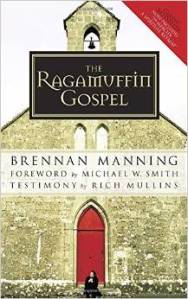
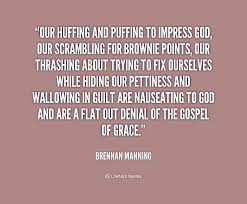
This chapter in a nutshell is talking about American Christianity’s tendency to talk grace but walk works.  We preach a Gospel of grace – “the total sufficiency of the redeeming work of Jesus Christ on Calvary” (pg. 15) – but our lives tell a different story.  We have “twisted the gospel of grace into religious bondage and distorted the image of God into an eternal, small-minded bookkeeper” (pg. 16).  We are all striving, striving, striving for approval from God and from our faith communities, emphasizing personal effort over grace.  There are different classes of Christians, where some are given special status because of their works and charisma while others are ignored altogether for their ordinariness.  We hide our darker side from each other and live in a constant state of “existential guilt…[and] Sooner or later we are confronted with the painful truth of our inadequacy and insufficiency.  Our security is shattered and our bootstraps are cut” (pg. 17).

GUILTragamuffin guilt 1
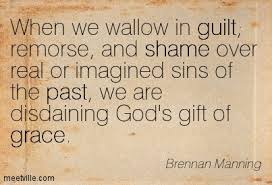
This was the word that we danced around the most in our conversation, and I have been keenly aware of its presence in conversations with others over the past week.  Guilt is a huge issue for men and women alike, but from a woman’s perspective, I see how guilt has become a perpetual state of being for many of us.  Yet our feeling of guilt–that we are not doing enough as Christians, as parents, as spouses, as family members, as employees, as citizens of the world–is a blatant rejection of the gospel of grace.  The solution is to admit our “shadow side” and accept that there is nothing we can earn by works.  All is a gift.  We must find our identity in our acceptance and love from God and not in how we perform.  Manning expresses this beautifully in this quote from page 25:

When I get honest, I admit I am a bundle of paradoxes.  I believe and I doubt, I hope and get discouraged, I love and I hate, I feel bad about feeling good, I feel guilty about not feeling guilty.  I am trusting and suspicious.  I am honest and I still play games.  Aristotle said I am a rational animal; I say I am an angel with an incredible capacity for beer.

To live by grace means to acknowledge my whole life story, the light side and the dark.  In admitting my shadow side, I learn who I am and what God’s grace means.  As Thomas Merton put it, “A saint is not someone who is good but who experiences the goodness of God.”

The gospel of grace nullifies our adulation of televangelists, charismatic superstars, and local church heroes.  It obliterates the two-class citizenship theory operative in many American churches.  For grace proclaims the awesome truth that all is gift.  All that is good is ours, not by right, but by the sheer bounty of a gracious God.  While there is much we may have earned–our degree, our salary, our home and garden, a Miller Lite, and a good night’s sleep–all this is possible only because we have been given so much: life itself, eyes to see and hands to touch, a mind to shape ideas, and a heart to beat with love.  We have been given God in our souls and Christ in our flesh.  We have the power to believe where others deny, to hope where others despair, to love where others hurt.  This and so much more is sheer gift; it is not reward for our faithfulness, our generous disposition, or our heroic life of prayer.  Even our fidelity is a gift.  “If we but turn to God,” said St. Augustine, “that itself is a gift of God.”  My deepest awareness of myself is that I am deeply loved by Jesus Christ and I have done nothing to earn it or deserve it.
ragamuffin guilt 2

Let me leave this post with a few more quotes:

“Justification by grace through faith” is the theologian’s learned phrase for what Chesterton once called “the furious love of God.”  He is not moody or capricious; He knows no seasons of change.  He has a single relentless stance toward us: He loves us.  He is the only God man has ever heard of who loves sinners.  False gods–the gods of human manufacturing–despise sinners, but the Father of Jesus loves all, no matter what they do” (pg. 20).

The kingdom is not an exclusive, well-trimmed suburb with snobbish rules about who can live there.  No, it is for a larger, homelier, less self-conscious caste of people who understand they are sinners because they have experienced the yaw and pitch of moral struggle (pg. 23).

As a sinner who has been redeemed, I can acknowledge that I am often unloving, irritable, angry, and resentful with those closest to me.  When I go to church I can leave my white hat at home and admit I have failed.  God not only loves me as I am, but also knows me as I am.  Because of this I don’t need to apply spiritual cosmetics to make myself presentable to Him.  I can accept ownership of my poverty and powerlessness and neediness (pg. 23).

Never confuse your perception of yourself with the mystery that you really are accepted (pg. 28).

Often I have been asked, “Brennan, how is it possible that you became an alcoholic after you got saved?”  It is possible because I got battered and bruised by loneliness and failure; because I got discouraged, uncertain, guilt-ridden, and took my eyes off Jesus.  Because the Christ-encounter did not transfigure me into an angel.  Because  justification by grace through faith means I have been set in right relationship with God, not made the equivalent of a patient etherized on a table” (pgs. 30-31).

Book Review: “Undiluted” by Benjamin L. Corey

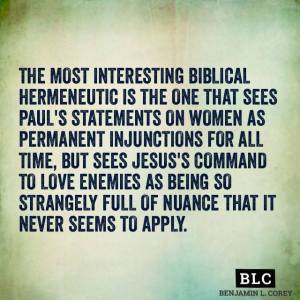
I read this book in October and have meant to review it on the blog, but have been consumed with life transitions (also the case for Becky, a busy working mother who is expecting number 3!).  It’s really hard to conceptualize blog posts when your brain is overloaded with learning a new job, facing big life decisions, caring for children, and trying to make radical self-care a priority (i.e. sleeping normal human being amounts).  But Benjamin L. Corey (I’ll just use BLC for the rest of this review) posted this pic on FB this week and I LOVED it and it has inspired me to meet you here for a little book talk:

10517497_658162560996319_3212269662040844471_n

As usual, BLC does not shy away from controversy, as you can see in the comments if you click on the pic and go to the original FB post.  I agree 100% with his observation and was encouraged to see him make such a bold, public statement.

When Becky and I started this blog, I realized I didn’t know anything about blogging and that got me into reading blogs in a very big way.  I found BLC’s blog, formerlyfundie.com, and also his podcast with Matthew Paul Turner, That God Show, sometime early last year and have been learning a lot from him regarding pacifism, enemy love, living a life that displays God’s love to the disenfranchised and hurting, etc.  I appreciate his perspective on current issues in American Christianity and regarding the harmful aspects of fundamentalist culture.

I also discovered that we have a few things in common:  BLC lives in Maine, is a Gordon-Conwell alum, and we have a some mutual friends.  Logan and I have been able to meet BLC and his wife on a couple of occasions.  I am always thrilled to make new friends, but especially am happy to meet some local Progressive Christians in a state that is #1: the most unchurched state in our country, and #2: churches here are typically very fundy or very liberal.  There is a desperate need for Christians to examine our culture and why it is that our neighbors are not recognizing Jesus in our lifestyles.

In addition to being a two-time Gordon-Conwell graduate, he is currently working on a Ph.D. in Missiology from Fuller Theological Seminary.  His writing has appeared on various platforms including HuffPost, Red Letter Christians, Sojourners and Evangelicals for Social Action.

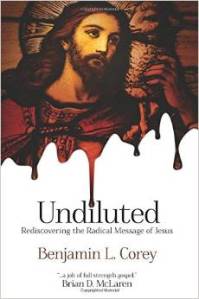
So that brings me to BLC’s book, “Undiluted” (click on image for link to Amazon).

download

Here is the description as it appears on Amazon:

Are you ready to begin experiencing an undiluted Jesus?

Benjamin Corey confronts our vision of Jesus head-on, asking the hard question: Is what we see and hear in the modern church all there is to the message of Jesus… or is there a more radical side to Jesus than we have been led to believe?

Get ready to encounter a Jesus that is determined to turn over the tables of a stale, ineffective and boring gospel that seeks to escape from the world instead of transforming it.

This radical Jesus and His message…

  • Invites us to reorient our lives not on Christian religion, but on the person of Jesus
  • Calls us to live out faith in the context of authentic community with others, instead of isolation
  • Includes the excluded and invites the outcast to have a seat at the table
  • Responds to enemies with a radical, unexplainable love

Undiluted will invite you to step out of your comfort zone and into a process of rediscovering the radical, counter cultural, and life-changing message of Jesus. As you do, you’ll discover a more vibrant faith as you embrace an undiluted Jesus and His radical message!

What I most appreciate about this book is its autobiographical presentation.  BLC takes us on the journey of his spiritual transformation from fundamentalist to progressive, with all of the highs, lows and traumas along the way.  I was able to relate to so many of his experiences, coming from a similar background and going through a similar faith shift in my adulthood.

One of the most unfair assessments of progressive Christianity is that it dilutes God’s Truth in an effort to be culturally relevant.  BLC demonstrates throughout his book that peeling away the layers of American Christian culture actually undiluted his faith in Christ rather than weakening it.  When there are rigid, prescribed positions on all issues, as is the case in very conservative churches, there is little room for examination, humility and debate.  You cannot even consider other points of view.  This dehumanizes people whose experiences and knowledge have led them to differing positions than your own, as you do not even give them the gracious gift of a listening ear.  You are always approaching conversations as a battle to be won, rather than seeing the nuance of complex issues and differing points of view.

I am not personally throwing my hat in the Progressive Christian ring (yet).  But I am deeply appreciative of BLC and others sharing their experiences as Christians of my generation, examining the strengths and weaknesses of the Christian culture that we grew up in, and doing their best to be faithful witnesses of Jesus Christ to their neighbors and the world.  I would encourage you to pick up a copy of “Undiluted”, check out FormerlyFundie.com, and let me know what you think in the Comments.


Thanks for visiting The Beautiful Kingdom Warriors!  Please “Like” us on Facebook if you’d like to read interesting articles from around the web dealing with gender issues.

Book Review: A God I’d Like to Meet by Bob Edwards

I am excited to share a review of Bob Edward’s book, A God I’d Like to Meet, especially today as Amazon has dropped it’s Kindle price to $1.99 for the week.  You only have a few days to take advantage of this deal, and I HIGHLY recommend that you purchase this one!  Also, check out Edwards’ amazing blogs, God is Love, and Biblical Equality for Women and Men in the Christian Faith.  I first found Edwards through his blogs, and have been truly blessed by his knowledge and scholarly writing on the roots of Christian patriarchy and complementarianism (the ideology that God has ordained male-dominated authority over the Church and Christian homes).

41q4U+IK76L__BO2,204,203,200_PIsitb-sticker-v3-big,TopRight,0,-55_SX278_SY278_PIkin4,BottomRight,1,22_AA300_SH20_OU01_ CLICK HERE TO PURCHASE ON YOUR KINDLE FOR $1.99!!! 
THIS WEEK ONLY!

Let me share the “About” blurb from one of his blogs:

Bob Edwards lives with his wife and two children in Ontario, Canada. He holds degrees in Religious Education, Social Development Studies and Social Work. In 2013, he received the Delta Epsilon Chi award for intellectual achievement, Christian character and leadership ability, from the Association for Biblical Higher Education. Bob has been a Social Worker since 1996, providing psychotherapy in a variety of settings. He was the Director of Counseling Studies at a multi-denominational Bible College, teaching courses in Psychology, Sociology and Counseling. His hope is to share a vision of God’s impartial love towards women and men everywhere.

Bob is also the author of the best-selling book entitled, “Let My People Go: A Call to End the Oppression of Women in the Church, Revised and Expanded.”

“A God I’d Like to Meet” is an example of what Edwards does best: a scholarly dissection of Calvinist theology, demonstrating its roots in Plato’s philosophy, and the damaging effects that have resulted from reading the Bible from a worldly perspective.

Here is the description of the book from the dust jacket:

Throughout history, prominent theologians and church leaders have made sense of the Bible through the interpretive lenses of ancient Greek philosophy.

As a result, our traditional beliefs often portray God as an all-controlling deity that frowns on emotion and subjects women to male authority.

Throughout this book, the author explores the origins of these theological traditions, and seeks to restore a vision of God as depicted in the New Testament — a vision of God as love.

Calvinism is a prominent strain of Evangelical Christianity today, as noted in this New York Times article from January of this year. Notable Calvinists include Mark Driscoll, John Piper, and Tim Keller.  Calvin’s “Institutes” was required reading in my seminary Intro to Theology class.  Edwards’ insights were very eye-opening to me personally.  In answer to the question, What is Calvinism? Edwards writes,

Simply put, it is an interpretive framework that tells people what to look for in the Bible, where to look, and how they should make sense of what they find.  This interpretive framework consists of what Calvin referred to as “the principal matters” of “Christian philosophy” (p. 16)

A valuable aspect of Edwards’ writing is his background as a counselor.  He explains many psychological processes that impact the lens through which people understand their world.  In Chapter 1: Bad Religion, Bob says,

I’ve been a Social Worker and Psychotherapist for nearly twenty years now.  During this time, I’ve provided individual, family and group counseling to thousands of people.  Many of them have told me that they have difficulty believing in God.  Most of them have experienced horrific forms of abuse: physical, sexual, psychological, emotional and spiritual.  Many of them were told, at one time or another–often by well-meaning Christians–that the terrible things done to them or to their loved ones were either allowed or caused by the “Sovereign Will of God” (p. 6).

Edwards wraps up chapter one, where he has described how Christians have explained the problem of pain, with this paragraph:

We now have a picture of a God that is allegedly in control of everything, causes evil to befall humans because they (in their vileness) deserve it, or because we are expendable in the accomplishment of “the greater good.”  Of his servants, this God requires the death of self, and the rejection of what it means to be human.  In particular, human beings must apparently deny that they are sexual.  Historically this has led male leaders in the church to project blame for their vilified sexuality onto women.  This projection has led to the subjection of all women to male control.  I submit that this is a portrait of a God who is controlling, abusive, unethical, unloving and sexist.  Simply put, in the minds of many, this is not a God they would like to meet (p. 10).

This book is not a long, cumbersome read.  I couldn’t put it down once I started, and finished the book in two hours.  He explains how, in setting up “the principal matters of Christian philosophy” as an interpretive lens for the Bible, Calvin was facilitating “top-down processing,” and how “Rather than seeing new information objectively, human beings are strongly inclined to perceive and interpret the world around them in ways that confirm what they already believe” (a “psychological phenomenon known as ‘belief perseverance'”, p. 18).  A very brief explanation of the lens through which Calvin made sense of the Bible is through his high opinion of St. Augustine, who made sense of the Bible through his reading of the Greek philosopher, Plato.  in his 8th book of Confessions, Augustine wrote:

Simplicianus congratulated me that I had not fallen upon the writings of other philosophers, which were full of fallacies and deceit, “after the beggarly elements of this world,” whereas in the Platonists, at every turn, the pathway led to belief in God and his Word” (p. 21).

The rest of the book unpacks how this Platonic philosophy impacted St. Augustine’s and Calvin’s interpretation of Scripture, and thus how Calvinism “impacts the way some Christian leaders today understand, preach and practice Christianity” (p. 24).  Specifically, how Calvinism makes God responsible for evil (chapter 3), how Calvinism confuses emotion with sin (chapter 4), and how Calvinism leads to the subjugation of women (chapter 5).

Edwards leaves off with the redeeming message that “the distorting lens of Platonic philosophy can be removed from our perception of God.  When we remove this lens, I believe that we have an opportunity to see God in the way the biblical authors intended.  We are able to perceive that God is love” (p. 98).

If you are an Evangelical Christian, there is a good probability that you have come across Calvinist theology at some point, if not regularly in your faith community.  I emphatically encourage you to pick up this book for the low price of $1.99 and consider the implications of Edwards’ research into the roots of Calvinism.


Thank you for visiting The Beautiful Kingdom Warriors!  Please Follow us, Like us on Facebook, and come again!  God bless. 🙂