
My guest on the podcast today is Bob Edwards, MSW. Bob holds degrees in Religious Education, Social Development Studies and Social Work. Bob has been a Social Worker since 1996, providing psychotherapy, and he was the Director of Counseling Studies at a multi-denominational Bible College, teaching courses in Psychology, Sociology and Counseling. Bob and his wife, Helga Edwards, MSW, have a ministry together called Awake Deborah, in which they use their gifts and training to help people experience freedom and wholeness in their lives and relationships. Helga Edwards has many helpful teachings posted on her YouTube channel, and they had a podcast together at awakedeborah.podbean.com
Bob is another friend I’ve made in my fifteen years long online search for beautiful examples of Christianity. I asked Bob to explain social conditioning for the podcast because it was revolutionary for me to learn from him how this process had contributed to my own patriarchal worldview, and has been impactful in my healing from that. I’m so excited to share this episode with you all today and hope you find it enlightening and beautiful.
Here is the YouTube video I referenced in our conversation: The Origins of Male Authority in the Church, in which Bob describes the process of social conditioning at greater length, and draws historical examples of theologians interpreting the Bible through patriarchal cognitive lenses.
I wrote detailed notes from his video in this post: Bob Edwards’ Fascinating Discussion on the Origins of Male Authority in the Church.
Other works I’d like to recommend from Bob and Helga Edwards:
I read Bob’s excellent book, A God I’d Like to Meet: Separating the Love of God from Harmful Traditional Beliefs, in 2014, and reviewed it here. Edwards’ book explains how Christian theologians, specifically Calvinists, have been influenced by ancient Greek philosophy, which has warped the way they view God. You probably could not find a Christian who would disagree with the statement that “God is love” (1 John 4:8), but how many Christians live as though they are a bug under the thumb of God? This is a really helpful book especially for those who have experienced spiritual trauma or abuse and are looking to heal their image of God.
I also really enjoyed reading Bob’s work of historical fantasy, Keeper of Relics which imagined a harshly matriarchal ancient world in which a young woman challenged oppressive tradition.
Bob and Helga together wrote The Equality Workbook: Freedom in Christ from the Oppression of Patriarchy to help readers identify and remove patriarchal bias from Bible translations. They demonstrate that patriarchy is a human tradition rooted in prejudice and they help women recover from the harmful effects of patriarchy.
Bob is currently working on a series called God Decolonized, exploring historical examples of people in power using the Bible to justify oppression and exploitation. I’m currently reading Issue 3, in which he threads the link from Puritan theocracy to Christian nationalism today. Some of the Puritan quotes are distressingly hateful!
If you enjoy this episode, please Subscribe to The Beautiful Kingdom Builders podcast on your favorite platform, rate and review it, and share it with a friend! Every little bit of encouragement helps! You can watch our episode on YouTube or find it on Spotify, Apple Podcasts, Amazon Music, and more! Here is the video of our podcast recording:
TRANSCRIPT:
Ruth Perry (00:16)
Today’s conversation is one that feels deeply personal to me because we’re talking about something most of us don’t even realize is happening inside us, socialization, and more specifically gender socialization and how it shapes the way we see the world, the church, and even scripture itself. My guest is Bob Edwards, a social worker and psychotherapist with degrees in Religious Education, Social Development Studies, and Social Work.
Bob has been practicing since 1996, and formerly served as Director of Counseling Studies at a multi-denominational Bible college where he taught psychology, sociology, and counseling. And he and his wife, Helga Edwards, also a social worker, lead a ministry called Awake Deborah, where they help people experience freedom and wholeness in their lives and relationships.
In this episode, Bob helps us understand how the norms of our culture get inside us, how they become automatic, invisible lenses through which we interpret everything. We talk about how patriarchal socialization can shape the way we read the Bible, the split-second judgments our brains make before even aware of them, and the real spiritual and emotional cost when people, especially women, are told their God-given gifts don’t belong.
I’m grateful especially that Bob was willing to have this conversation as he is dealing with long COVID since 2021. We kept our conversation brief to accommodate his health limitations. But if you want to learn more about this topic, there is a link to an older and much longer teaching from Bob on this topic in the show notes and on my blog, thebeautifulkingdombuilders.com. This is a conversation about unlearning, about healing, and about removing some of the stones that have stood in the way of people fully walking toward Jesus.
Ruth Perry (02:12)
Thank you so much for being on the podcast today, Bob. Let’s just dive right in. My first question for you is what is socialization generally and gender socialization specifically?
Bob Edwards (02:15)
Okay, well, socialization is really the process by which groups convey their norms to its members. You know, there’s lots of examples we could think of, everyday examples. One would be table manners, you know. When I was growing up, in our household we learned that when you cut your food you held your fork in your left hand.
But then you had to switch to the right hand before you ate the food. Apparently that was in etiquette books from the 1920s and the 1950s. yeah, Another everyday example of socialization is just like rules of the road. North America, you drive on the right. And Great Britain, drive on the left.
And maybe there was a reason for it at one point, but it’s just a custom and gender socialization relates to how different, you know, each gender functions in a social group, what the norms are, norms and customs for that gender.
Ruth Perry (03:20)
How does that socialization process happen?
Bob Edwards (03:23)
Yeah, well there’s essentially three processes that happen. One is overt instruction. So like I mentioned the etiquette books, you’ll be instructed how to function in a society. The other is role modeling, where people just act as if certain things are true, certain things are a given.
And the third process is really called reinforcement. So if you do what the group expects of you, there’s different ways you can be rewarded. And if you don’t do what the group expects of you, there’s different ways you can be punished is probably the best way to say it. You know, if I would eat with the wrong hand, for example, one of the adults at the table would give me the look, you know. And the look is a form of reinforcement. And if you drive on the wrong side of the road, you’re likely to get immediate feedback from your environment of a variety of kinds, from natural consequences to law enforcement. So, yeah, those are essentially the three processes that help us be socialized into a group’s set of norms.
Ruth Perry (04:28)
So your group will socialize you and then how does that become internalized?
Bob Edwards (04:32)
Yeah, that’s a good question. So at some point, these external messages, we take ownership of them ourselves. And really, you can tell when that has happened by how you feel when you see somebody eating with the wrong hand. If it’s like I see a person taking a bite and the fork is still in their left hand and it feels wrong to me, then I know that I’ve internalized that. What used to be an external message is now something that’s coming from within.
Ruth Perry (05:01)
How does this create a cognitive lens which affects our automatic perception?
Bob Edwards (05:05)
Yeah, so it’s interesting. Psychologists refer to it as automatic appraisal. So it’s like, again, the example of the fork in the wrong hand. My experience will be that I just see that as wrong. You know, I just I’m watching it and it’s wrong. And it feels to me that the wrongness is coming from outside. But in reality, the sense of wrongness is coming from inside. It’s coming from the norms that I’ve internalized through the socialization process. And so in a way it affects how we’re interpreting the world around us constantly. You know, it’s just like a mental lens is another way of saying it that interprets everything that we see. And we think we’re just seeing the world as it is, but in reality we’re seeing the world as we’ve been socialized to see it, if that makes sense.
Ruth Perry (05:55)
It does well. So then how does that impact our view of the world around us more specifically?
Bob Edwards (06:00)
Well that’s, yeah, so it’s interesting. You know, with this driving example, I was just watching a clip recently of, I’m like a motorsports enthusiast. My dad used to sponsor races and stock cars and things like that when I was growing up, so that’s always been a part of my life.
And I remember when I was quite young, was in the mid 70s, and we went to see a drag race because he sponsored a drag racer back then. And there was a big deal about one of the drivers named Shirley Maldowney. So don’t know if you’ve heard of her, but she won the Top Fuel Drag Racing Championship which is sort of the highest level of competition three times and drove this beautiful pink dragster and at the time I didn’t realize why that was such a big deal but she was the first woman that was allowed to compete like women were banned from the sport they weren’t legally licensed and she really broke through that and so she’s kind of a hero of mine for doing that. It’s interesting that whole subculture, that drag racing motorsport subculture, they would look at men and see drag racers, people who can drive well and they would just look at women and think, nope, that’s not for you. You can’t do that.
And it becomes a little bit more serious in other cultures, although in a similar way. For example, Saudi Arabia didn’t allow women to period, until I think it was 2018. And there’s a province in Afghanistan currently where women are banned legally from driving, can’t get licenses. you know, the reasoning given for that is that they’re taught religiously that women are incapable of learning the skill of driving a vehicle. And in Saudi Arabia, they thought it was mixing genders for women to drive in a way that would lead to moral corruption.
So, you know, and, unfortunately we have things like that in our culture as well. We have, you know, women can drive, thankfully, but there’s lots of things in some churches that women can’t do. And most of those things are related to teaching, preaching, and leadership. And people have these lenses. And I don’t think they understand that they have these lenses many times. And I don’t think they know where they came from either. But they just look at women and think, you know, things come to mind like servant, helper, right? We’ve heard that term help meet, which is sort of bad English translation of something in Genesis. That language in Hebrew and even later in Greek just isn’t there. It’s an English invention. And these things really impact men and women every day in the Church and in the world.
Sometimes people look at the Bible and they think they see this gender hierarchy. But if you look very carefully at the text, especially in its original languages and context, the hierarchy isn’t coming from the text. It’s coming from the person who’s reading it. It’s coming from their cognitive lenses. It’s coming from their gender socialization.
Ruth Perry (09:18)
I relate to all of that because I was raised in a patriarchal culture. I’m assuming that most people are. And so for the first 30 years of my life, I read the Bible through a patriarchal lens. And it just made sense. It made so much sense that that was how the world worked and that that’s what God meant. And so, yeah, I can totally get how that happens.
You’ve talked about these automatic responses with our cognitive lens, how quickly it happens. Can you explain how quickly we draw these conclusions?
Bob Edwards (09:49)
Sure, yeah, for us it feels instant. So we don’t recognize that the meaning is coming from our lenses at all. We think we’re just seeing the world as it is. But we’re really not. We’re seeing the world as we’ve been socialized to see the world.
And I remember I was reading one neuropsychology text many years ago and the time was measured in millionths of seconds. So actually I think it was a fraction of a millionth of a second that our brain assigns those meanings. In fact it’s called stimulus coding. And one of the reasons we don’t realize it’s coming from inside is because it happens so quickly.
But also because it’s subconscious. We don’t do it on purpose. Our brains do it automatically, subconsciously, and almost instantly. So, it’s tricky.
Ruth Perry (10:39)
So that an example of that then would be seeing a woman behind the pulpit and just immediately saying no.
Bob Edwards (10:45)
Yeah, I’ve seen that, unfortunately, where I was at a Bible college teaching for many years. And there was an occasion at a chapel where a woman was speaking and teaching and preaching and to men and women. And one of the male students from a denomination that is very patriarchal just stood up and walked out and you know spoke to him afterwards and that was his reaction to seeing a woman teaching men. And that was very eye opening to me. And of course then there are so many other denominations represented who didn’t have that reaction because that wasn’t part of their training, it wasn’t part of their socialization.
Yeah, and when I was teaching there, you know, I saw and heard a lot of things that really broke my heart, to be honest with you. Women who felt called to express their spiritual gifts, which come from God, right? Like our spiritual gifts come from God, they don’t depend on anything from us. At least of all our gender, you know, that’s not where the power of God, the love of God, the grace of God comes from. We’re just the vessel, We’re clay vessels and all that grace and love and spiritual power comes from God. yeah, women were being told by some of their male classmates that their call to ministry must come from the devil.
That was one of the worst things I think I heard. And they got reinforcement, like negative reinforcement sometimes from their peer group anytime they would try to express their gifts. And I remember praying about that because it was so disturbing to me. And you know, God, what do we do with this?
And I had this really powerful vision while I was praying. It was so vivid, know, it kind of like I was dreaming, but I was awake. And I saw Jesus with his arms open, inviting all these women to come to him, you know, and on the path to Jesus were all these sharp stones and the women were cutting their feet on these sharp stones and some were still limping towards him. Sorry.
But others left the path altogether and were just sitting down bleeding in tears. And so in that experience I just ask God, what can I do?
I haven’t thought about this in a while, sorry. It’s like when I think about it I relive it.
He just said, Bob, you can remove some of the stones. Just start picking up stones. Right? And so, you know, I said, okay, yeah, I will do my best. I don’t do it perfectly. But God helping me, that’s what I feel like He’s asked me to do, you know, is to remove the stones. So, know, Helga and I have done that together. That’s my wife and I try to do that, again by example and through teaching, you know, and through encouragement. yeah, I felt like God really met me there, gave me some direction.
Ruth Perry (13:53)
What a powerful vision and what a powerful calling. That was a calling from God and you’ve certainly been fulfilling it. And you’ve moved some stones for me, Bob, that I’m really grateful for because it’s quite the process trying to unlearn that conditioning. And I didn’t realize just how powerful my background was in my life until I encountered
Bob Edwards (14:05)
Thank God. Yeah, for sure.
Ruth Perry (14:16)
your work about conditioning and I’m really grateful. I’m going to share a YouTube video in the show notes where you talk about this in length and you go into different theologians who and translating scripture through a patriarchal cognitive lens. And that’s just really important for us to know how does awareness of our socialization and our cognitive lenses weaken or strength and our faith, do you think Bob?
Bob Edwards (14:40)
Well, So I do want to touch on one of those theologians, you know, because it’s been so prolific in his writing and his influences, Saint Augustine. And he’s very open in Confessions, he writes something called Confessions, about the influence of Neoplatonism on his theology. And he had a mentor named Ambrose who introduced him to this.
So he had a role model that embraced it and then he had instruction, you know, and he got all kinds of positive reinforcement for choosing this path. And he says that he made sense of the Bible and God through the lens of this ancient Greek philosophy. And unfortunately, that particular ancient Greek philosophy is extremely patriarchal.
And just to give you, for instance, when he read Genesis, where Adam says of Eve, this is bone of my bones, flesh of my flesh, you know, meaning, at last somebody like me, right? Somebody comparable to me. Augustine didn’t see it that way. And he writes about this in one of his letters and says, so here we see woman stands for flesh.
Therefore the man must stand for the spirit. Therefore, just as the flesh must be subordinate to the spirit, women must be subordinate to men.” So that’s what he saw when he read that passage. But that’s not what the passage says. That’s not what’s there. But he evidently didn’t recognize his lens, which is so often the case.
And so you ask like, can it does this strengthen or weaken our faith when we explore these things? And I mean, for me, it was a tremendous encouragement to my faith because some like our culture is is fallen. Like humanity has fallen into sin and it is our cultures are are filled with injustices and biases and prejudice and fear and a felt need for control. And we can project that onto the Bible, start calling things like that God’s will. Sometimes we’re even seeing that today, even at a national level, things we’ve seen in the church and been speaking out against, now seeing in government.
But when we do this kind of work, right, with humility and prayer and study, we can begin to peel away these layers of bias, prejudice and injustice that are those sharp stones that stand between us and God. So I do believe it can strengthen our faith and I think it’s God’s work.
Ruth Perry (17:03)
Amen. Thank you so much for being faithful to that calling, you and your wife.
Bob Edwards (17:07)
I’m so thankful
I could be and I’m glad I could do this today. Thanks so much for having me.
Ruth Perry (17:13)
God bless.
Bob Edwards (17:14)
God bless you too.
If you enjoy this episode, please Subscribe to The Beautiful Kingdom Builders podcast on your favorite platform, rate and review it, and share it with a friend! Every little bit of encouragement helps! You can watch our episode on YouTube or find it on Spotify, Apple Podcasts, Amazon Music, and more!





 The Beautiful Kingdom Builders
The ending quote was: “My advice to Christian women is to marry a man who will be a friend, not a ruler.” Why must it be *either/or*? Why not marry a man who will be a friend AND a ruler. After all, earthly marriage is the very image of the ultimate marriage which is between God and His bride, the church. God is our ruler AND our friend. Works beautifully. He, laying down His life for His bride, edifying His bride, lifting her up, purifying her, etc. While ruling the union with love, truth, grace, and strength… while she sees Him worthy of her love, trust, respect, service (help) and submission. Why not allow the earthly image God created (human marriage) truly reflect the ultimate heavenly reality? That’s the way it was designed by Him after all.
Nancy is quoting a pastor’s wife, Andrea, who had commented on the Girl Defined article and then I pasted her words at the end of my post. After years of counseling Christian women in abusive marriages, she began to study the Bible to better understand God’s design for gender roles, and came to the conclusion that God designed men and women to be equals. My initial response to Nancy was to share a link to this excellent article by Bob Edwards to learn more about the origins of the headship/submission marriage model:
Seeing Male Authority as God’s Design: Where Did This Idea Come From?
Edwards shows us how Plato influenced Augustine, who influenced Calvin, who influences complementarian theologians today, like John Piper. The pipeline of patriarchy in Christian scholarship. Many are unaware of the Platonic lens that they are reading their Bible through, and the inferences these gender teachings come from rather than clear Biblical directives. I highly recommend reading more of Bob and his wife Helga’s work!
Egalitarians believe that husbands and wives are created equal and are both called to love and submit to their spouse. This involves treating each other respectfully, helping each other, trusting each other and all the other “one another” directives that Paul gives to all believers. In the Ephesians 5 passage that pastors often teach “Men need respect, women need love” from, it is all part of a larger section that involves instructions to love one another and submit to one another, “…wives to their husbands” (the verb “submit” does not occur in verse 22 as a directive to wives but the idea is linked from the earlier verse saying “submit to one another”).
In the creation narrative, God created mankind (both man and woman) in His image and gave both dominion and authority over creation. “Help” is an inadequate translation of the Hebrew word ezer, as it connotes a subordinate position in our English language but more literally means something like “counterpart” God is often referred to as Israel’s ezer throughout the Old Testament, and is clearly not a subordinate in relationship to His people. It is in the curse in Genesis 3 that the Bible says men will rule over their wives. As Carolyn Custis James says, “Patriarchy is the cultural backdrop of the Bible–not the message of the Bible.”
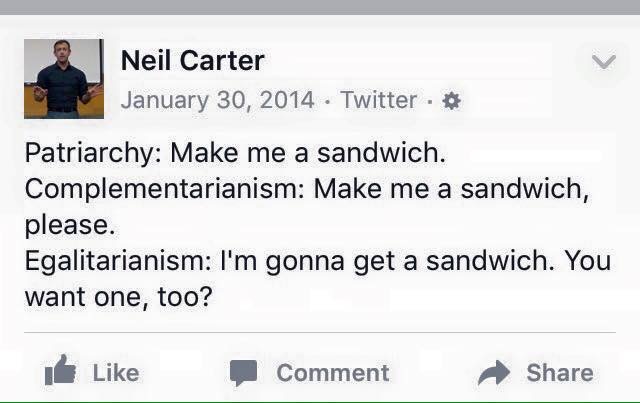
Love this image from Amber D’Ann Picota
Another word that is misunderstood in English is kephale, translated “head.” The problem with this translation is that “head” has more than one meaning. In modern English, we hear “head” and immediately think “CEO,” “boss,” or “authority.” But in ancient Greek, kephale did not connote authority. On a body, the head did not appear to have any use except as the place where we put food, the source of life. In ancient Greek culture, husbands were the “head” in the sense that their households were completely dependent financially and socially on the patriarch, just as a body is dependent on the head to receive food. The body metaphor also teaches mutuality rather than authority/submission because every part of the body is dependent on each other, and directives come straight from the head, who is Christ, and is not channeled from one part to another. Jesus is our “umbrella” and women have direct communication and covering from our Messiah, not from any male human. Marriage is often elevated as the glue of the Church but in fact, Paul teaches us not to marry for the sake of the Gospel.
There is a great podcast on mutuality in marriage by Nick and Allison Quient that I recommend checking out:
Split/Frame of Reference Podcast: Episode 4: Ephesians 5:18-33, Mutual Submission, and the Mystery of Marriage
And an article by Egalitarian scholar Marg Mowczko that I link to all the time on women as ezers:
A Suitable Helper (in Hebrew)
As Nancy points out, it is a common teaching in complementarian
Um, no.
churches that Christian marriage is meant to mirror a heavenly relationship between Christ and His Church, so that the world can better understand the Gospel with this tangible metaphor. We are taught by complementarian pastors that wives’ submission to their husband and to “Biblical gender roles” point the secular world to the Good News. But the early Church was striking to ancient secular society as counter-cultural by defying patriarchal gender roles. In a society where women were property, Christian husbands treated their wives as equals and loved their wives as their own bodies. Women were elevated to equality in the early Christian Church and ministered alongside the men. The modern conservative Christian Church has swung back to patriarchal teachings in reaction to the growing egalitarian values of our Western culture, who now look at the Church and do not see anything “good” in the way Christian women are subjugated.
Here are the “Biblical gender roles” for women that are actually in the Bible:
25 Biblical Roles for Biblical Women – Marg Mowczko
And an excellent article from Kristen Rosser:
Is Marriage Really an Illustration of Christ and the Church?