How Culture Shaped My Own Perspective

On Monday, I posted How Culture Shapes Our Perspective. Tonight, I thought I’d briefly share how my own life has been impacted by the culture of my community.

I grew up in a traditional, conservative Baptist home with loving parents and three awesome brothers.  My dad was a pastor and my mom homeschooled us and volunteered countless hours in service to the church.  If you count my childhood, I was a complimentarian for nearly thirty years.  By that, I mean that I believed that it was God’s design for men to be the heads of their households and for wives to submit to their husbands’ leadership.  For many complimentarians, there is a distinction between women preaching and teaching (OK) and women in leadership (NOT OK), but for most, women should not teach men, as this would be a position of authority.

IMG_3158

I was a naturally easy-going and compliant child and young adult, and was a classic people pleaser.  This particular quality made me admirable in my Christian community.  But I was also a natural leader among my peers in the church, and at Gordon College, I held many leadership positions in student ministries.  Looking back at my college days, I am grateful for three women, two were seminary students and one was a professor, who took my under their wings and discipled me.  While I was in seminary, I led a Christian fellowship on a non-Christian campus.  I felt like I had fallen into my calling, as I mentored young leaders and taught Bible lessons and grew the ministry.  That’s when my complimentarian views first conflicted with my personal life.  What if this ministry was a church?  Would I be restricted from leadership because of my gender?  I still wasn’t brazen enough to make such a bold shift in perspective, although this was the first time I asked the question.

IMG_3167

After seminary and a few years of married life and lay-ministry in a Baptist church, there was a period of conflict that tore the church apart.  My family was caught in the cross-fire, and I again wondered about women in leadership when I thought about some of the mature believers in the church who had no voice or influence in resolving the conflict, simply because they were women.

IMG_3173

About three years ago, I was watching Beth Moore’s Bible study, The Inheritance, when I had a lighting-bolt sensation that God was telling me I was called to co-pastor with my husband.  We had been talking about Logan planting a church, and I was excited to partner with him, but not really sure how I would be involved.  Deep down, I wanted to be alongside him in ministry, not looking on from courtside.  When I felt called to pastoral ministry, I was one part convinced that I had heard from God, and one part confused and embarrassed.  When men feel called to ministry, it is cause for great celebration, but for me, it was cause for shame and doubt.  I began studying the topic of women in ministry and very soon was convinced that not only are women free to participate in leadership, but also that it was never God’s design for women to be in submission to men’s leadership.   The message of the Bible is that hierarchy is not God’s design but came into being after the fall, and that participating in God’s kingdom on earth means women are a part of the royal priesthood, today.   God created both man and woman in His image and gave them the order to have dominion, together.  There will certainly not be a hierarchy of believers in heaven, and God’s kingdom is already available to us today.  I felt confident that God had prepared good works for me to do, and to accept the charge, I would have to challenge my complimentarian roots.

IMG_3161

One of the ways God has bolstered my confidence in my calling is by bringing Logan and me into community with other egalitarians (those who believe in equal power in the church for men and women) and several couples that co-pastor together.  Community is a powerful influence.  The greatest support has come from my husband, who looks forward to co-pastoring with me.  To change perspective on women in ministry is to rock the boat, if you come from a complimentarian community like myself.  But for me, it has brought freedom to follow the fullness of my giftings and calling.

Let me leave you with a link to an excellent blog post that describes the difference between being a Good Christian Woman and an Ex Good Christian Woman.  She draws some great comparisons that I deeply identified with!  Ex Good Christian Women by Kathy Escobar.

Until next time,
Peace and Blessings  –  Ruth

Image credit – pictures snapped by Ruth, coming home from church on Sunday.

How Culture Shapes Our Perspective

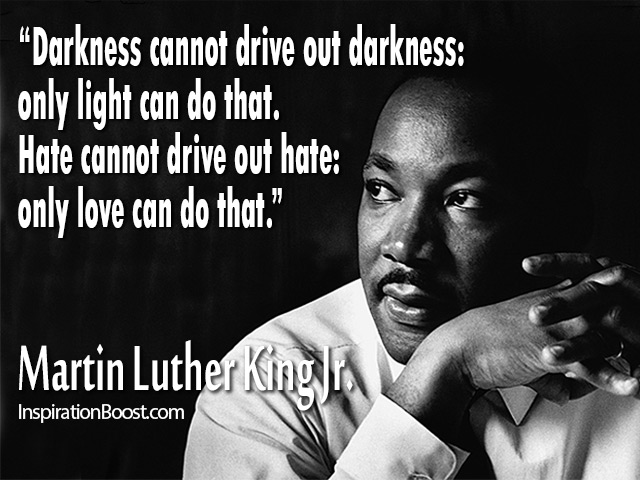
Martin-Luther-King-Jr-Famous-Quotes

In honor of Martin Luther King, Jr. Day, I’ve been watching archived news broadcasts of MLK in which he eloquently explained his philosophy of nonviolent civil disobedience to incite change, and his hopes for dramatic legislature that would make segregation illegal and pave the way for equal rights for all in the USA.  One of his core beliefs was that to be passive in the face of injustice was just as bad as participating in it.  When the Montgomery Bus Boycott began in response to Rosa Parks’ imprisonment for refusing to give up her seat on her bus, MLK was instantly a nationally-known figure for the Civil Rights movement.  His impact in our country and world was extraordinary.  I read an excellent article today about his efforts to aid in justice in Africa, as countries were seeking independence from the bonds of colonization.  Truly one of the greatest Americans ever!

Something that has long interested me is how our culture shapes our perspective on things.  Today, I was thinking about the white Americans who resisted the Civil Rights movement.  For generations, inequality was a reality that was never questioned.  Before the Emancipation Proclamation, preachers were declaring slavery to be a Biblically justifiable order of things.  Frankly, we are often blinded by our cultural norms to see God’s heart on the issue.  When it comes to dehumanizing an entire race of people, created in God’s Image, it is impossible today to see how anyone could justify that.  But perhaps there are cultural norms in our day and age by which many in the church are blinded to God’s heart.

More often than not, our beliefs and perspectives come from those we are in community with.  Our faith community, friendships, family, local and state community and country at large.  I think it is fair to assume that we all generally believe we have the ‘correct’ view on things, but are often blind to how our community has influenced our viewpoint.  When it comes to Biblical interpretation, if we are not wrestling with differing perspectives than our own and testing them to see if they are right, we may wrongly assume that our personal viewpoint is correct.

Please join this topic of conversation!  What are some current aspects of American culture at large and your closer communities that influence your perspective on Biblical Womanhood?

Image Credit

Am I too much? Am I not enough?

In a society where it is the unspoken rule that women work full time but have an immaculate home full of food made from scratch and well behaved children, the risk of falling short is inevitable. There comes a point in trying to make the impossible possible where we just burn out, and the lie of not being enough comes to be known as a truth in the depths of our soul. And it stings.

There is also an unspoken rule in some evangelical circles that women are welcome in ministry and dialogue as long as they are not too much. I know that myself and some of my girlfriends who have offered biblical solutions to ministry problems have been shot down simply because the solution was coming from a female. How can a female who is supposed to be submissive to men in leadership be correct? Plus, she may be having “that time of the month” so her perspective will be emotional and irrational. Yep. I have believed those lies of being too much and it has taken a lot of therapy and Holy Spirit to begin to unravel them.

So what do we do? What are our options? How do we dispel these lies? We begin by repentance for our unbelief. When we choose to hear the voice of the accuser over the Voice Of Truth we have slipped into unbelief and unbelief is sin. Let’s flesh that out.

When we think back to the Fall in Genesis, Satan grabs Eve by first posing a question that causes her to doubt God’s heart for her.

Now the serpent was more crafty than any other beast of the field that the LORD God had made. He said to the woman, “Did God actually say, ‘You shall not eat of any tree in the garden’?”

This question implies that God is holding out on her. She then chooses to engage in the dialogue. Sometimes it is most wise to call a spade a spade and walk away. How often do we choose to engage in a dialogue with the accuser that plants the seeds of doubt that grow into unbelief in our lives? Eve acts on the premise that God is holding out on her. She believes the lie that God doesn’t fully love her and know what is best for her. And so she must take matters into her own hands to control her own destiny. She acts on unbelief. And because of her unbelief the world is plunged into sin. Sin that oozes into the cracks of who we are and distorts the core of who we are as image bearers. Unbelief destroys.

I feel like I must make the distinction between questioning and unbelief. To question is to pose a thought we don’t have an answer for and I believe questioning things is totally healthy. Look at Job, David, Isaiah, and other prophets. They question God on many things. God knows that we are finite in our being. And as finite beings why wouldn’t we have questions for an infinite God? After all, we are humans not puppets.

However when we allow the questions to give way to doubts that make us not believe in God being who He says and Him doing what He says He will do, we have let the crippling sin of unbelief take root in our hearts and it will choke us to death. Unbelief makes us bitter and cynical. So if you find yourself in a season of unbelief, critical thoughts and words, anger, bitterness, and/or cynicism, I encourage you, dear sister, to ask yourself what lies am I believing? Where in my life do I have an unbelieving heart? Do I need to ask Jesus to forgive me for choosing to believe, live out of, and act on lies instead of truth?

Now, here is where I would shut down with crippling guilt. So if you are feeling dumped on and guilty, this next word is for you. There is a massive difference between conviction and condemnation. Conviction causes us to see how much God loves us and desires for us to be fully His. It helps us call sin for sin. Sin left not dealt with will destroy us. Sin takes what God intended for us to be and twists and bends and distorts until what was meant to be holy is unholy. And what is unholy cannot be with God. So He provides conviction when we sin to get us back on track to spur us on to hope that He is who He says He is and will finish the good works He has made in us before the foundation of the world. Conviction leads to seeing God for who He is and seeing us for who we are and if needed asking God to forgive us and believe His Truth which then gives us hope to act to live out our story in God’s story.

Condemnation is not from God. Condemnation makes us look at our sin and feel hated. Condemnation makes us feel unlovely. It makes us feel beyond the reach of love. It makes us feel shame that makes us want to hide just like Adam and Eve wanted to hide after they sinned in the garden. It talks down to us and tells us there is no hope so why bother. If you feel any of these things that is the voice of Satan the accuser. “There is therefore now no condemnation for those who are in Christ Jesus.” Romans 8:1

So if you are feeling like you are too much and not enough, know that you are not alone. The only way we can begin to change is to let Christ change us from the inside out. To let Him expose areas of unbelief in our lives. Will you let Him? Will you let Him then love on you? Really love on you. You don’t have to bring anything or be anything or do anything for Him to love you. Just be in Him and let His truth that you are beautiful and intricately made and so loved wash over you today. Live out of his abundant love today. And when you begin to hear the whispers of the accuser I dare you to boldly shut him down. Don’t engage. Instead speak truth to yourself and leave no room for doubt. I know I struggle with this deeply and as we move forward into discussing more about what it means to be submissive, a feminist, and a minister of the gospel to a dying world all from a biblical perspective we must start here. At the beginning where sin entered the world so we can be aware of the pitfalls as we seek to redemptively engage in difficult conversations. That a spirit of nasty criticism and anger and unkind words come from unbelief and sin and if we want to dialogue in love it’s going to take believing in a big and sovereign and good and just and loving God that will stop at nothing to make right the wrongs and heal our wounds from sin and His divine purpose for women in His kingdom alongside His men co-warrioring to spread His light and love throughout the world. I’m ready! Are you?