Category Archives: Book Review

Finding Healing from Codependency

There is a proverb that says, “I went up to the rooftop to find relief from my pain, and saw that all the other houses were on fire.”  I have learned over time just how true this is.  Even those who appear the most put-together are dealing with pain, symptomatic of the brokenness of our world.  We all need healing and restoration to God’s intended fullness of life for His beloved children.

You are God's delight

We live in a fallen world and are socialized from a tender age to believe many lies about who we are and what we should be and do.  Our parents may have the best intentions to protect us from these lies, but there are lies deeply embedded in their own psyches.  We strive to attain cultural standards of ideal womanhood and manhood in ways that can be contradictory to God’s plan and design for our lives.  We are all hurt by messages that are antithetical to the Good News that Jesus has redeemed His creation and we can live a life of wholeness and abundance.  In John 10:10, Jesus says,

The thief comes only to steal and kill and destroy; I have come that they may have life, and have it to the full.

I read this post last week about how Christian girls and women are socialized to be codependent doormats in the name of “biblical womanhood.”  The author says,

Most materials and sermons I got from Christians in my girlhood emphasized that the only way a girl or woman could be pleasing to God was to be a doormat to other people. Meaning, many hallmarks of codependency are present in this teaching, such as:

  • It is biblical or good for a girl or woman to be passive

  • Getting one’s needs met is selfish; showing or feeling anger is wrong and un-Christian

  • One should always care about other people’s feelings, needs, and wants more than one’s own

I was reminded of one of my favorite posts of all time, “Ex Good Christian Women” by Kathy Escobar.  She shares two lists of qualities present in “Good Christian Women” and “Ex  Good Christian Women” that are spot on.  She says,

“Good Christian Women”

  • rarely engage in conflict
  • are terrible at saying “no” because it feels selfish
  • know how to say the right things, do the right things, to keep the peace
  • continually strive–and i do mean strive–to be a better wife, better mother, better christian
  • live with a feeling that God is disappointed with us somehow
  • feel a lot of shame for who we are and who we aren’t (but rarely say it out loud)
  • doubt our leadership, feelings, gifts, dreams
  • dwell on the things we should be doing differently or better
  • view anger as sin
  • always seek permission

“Ex Good Christian Women”

  • are learning to show up in relationship instead of hiding
  • engage in conflict instead of avoid it
  • say “no” with less-and-less guilt and say “yes” more freely, more honestly
  • tell the truth
  • respect anger
  • are honest about shame
  • live in the present
  • are beginning to believe we are “enough”–here, now
  • open ourselves up to dreams & passions & living out what God is stirring up in us
  • lead & love & live in all kinds of new ways, with or without permission
  • are discovering that God is much bigger than we were ever taught & loves us more than we ever knew
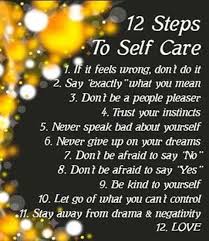
Self-care-steps

Oh, how I relate to these posts.  I was raised in a patriarchal church culture that negatively impacted my understanding of God’s will for my life.  I was a poster girl for these ideal qualities:  being always sensitive to the needs and feelings of others (while being completely out of touch with my own needs and feelings), deferring to others (while not developing my own gifts of leadership), a helper (who could never ask others for help), an empathetic listener (who was always stoic and would never open up about my own emotions).  I always believed that I was living up to “biblical” ideals of femininity and God’s design for women.  I now understand that many of the cultural messages I received about “biblical womanhood” were actually lies and were stealing, killing and destroying me rather than giving me an abundant and full life in Christ.

Codependency is “the disease of the lost self.”  When you are arranging your life around the thoughts, feelings and needs of others, you completely lose touch of your own identity.  Another phrase to describe this is “people-pleasing.”  I have slowly found healing and have found my own voice through many years of reading.  Here are the books that have had tremendous impact in my life, leading me away from codependency and towards fullness and finding my identity in Christ as a beloved daughter, just as I am (listed in the order that I read them):
prodigal god

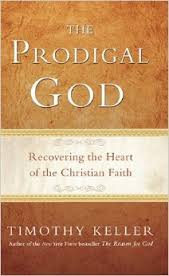
Logan’s cousin who ministers in a homeless shelter in Philadelphia gave us a copy of Tim Keller’s book, “The Prodigal God” when we were visiting over Christmas five or six years ago.  I read it aloud to Logan as we drove back to Maine, and my mind was blown away with a new understanding of this parable.  We are taught “The Parable of the Prodigal Son,” but really Jesus was telling a story of two brothers whose hearts were in the same condition, one who broke all the rules and one who obeyed them all with the expectation of receiving something in return.  Jesus’ story demonstrates that both were loved by their Father with a prodigal (i.e. extravagant, generous, lavish, etc.) love.  This book began to chip away the performance, works-based religion that I was living.  I recognized my similarity to the second brother who was obeying all the rules on a conditional basis.  “I do for you…what will you do for me?”
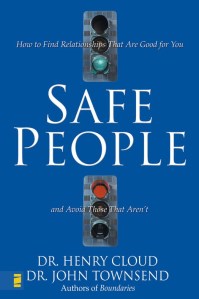
safe-people

Around the same time, my church family was in turmoil and conflict, and I was hurting deeply because church has always been my second home and I was facing rejection and shunning that was traumatic beyond words.  I don’t remember how I found this book…but I do remember devouring it and buying copies for everyone in my family.  I had always been a trusting and open person and was for the first time realizing that there were toxic people in the church who could be abusive, controlling and manipulative.  “Safe People” describes characteristics of emotionally healthy/unhealthy individuals.

boundaries“Boundaries” taught me even better that in the name of loving others, I had drawn very loose boundaries in my life, allowing the needs of others to trump my own needs.  I was always saying “no” to myself and “yes” to others, with no limitations to what I would give up for others.  I had to learn that there are personal property rights around my physical, mental and emotional boundaries.  I do not owe other people control over my choices, feelings, thoughts, and words.  I do not need to feel selfish or guilty for saying “no” to taking others’ responsibilities on myself.
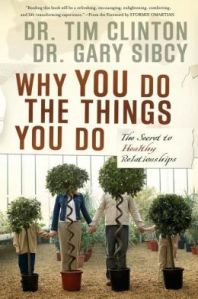
why you do the things you do book

I picked up this book, “Why You Do The Things You Do”, from my niece’s pile of books she brought home with her from college one holiday break.  This book taught me that there are two questions we all come into the world asking:  Am I worthy of love?  and Can I trust others to meet my needs?  According to our first relationships as helpless infants and into childhood, we internalize answers to these questions that affect us for the rest of our lives.  Using research and data, the authors describe four primary patterns of relating to others that stem from our upbringing in our family of origin.  In reading this book, I learned about myself and others in a powerful way, and there is  a lot of helpful information on “emotional coaching” for your own children.
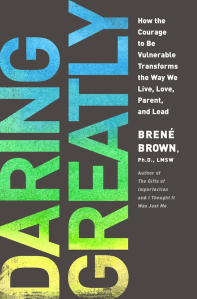
daringgreatly_final525-resized-600

A couple years ago, I went through a phase of listening to several TED Talks every day while I was working, which introduced me to the amazing Vulnerability and Shame talks by Brene Brown.  So when I saw that she had written a book to share her research and findings in a comprehensive message of how to “live wholeheartedly”, I ordered it immediately, and then couldn’t put it down!  I learned to be kind to myself, to show up in life rather than cower behind insecurities and fear.  I learned priceless lessons on teaching worthiness to my children.  I learned how shame will keep you living small while vulnerability will not make your life perfect, but it will make your life great.

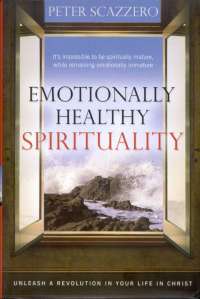
I know that it was God who directed me to EHS-bookCollette Pekar’s Tuesday morning Bible study.  While these books and many other videos and articles online have helped me to find healing from codependency, it was being in small group with a wise counselor who helped me to verbalize and process the things I was learning about healthy relationships that really made the greatest impact.  I cannot encourage you enough to find fellow warriors to pursue healing with.  One fall, our group read this book together by Peter Scazzero.  He demonstrates that we bring the dysfunctional patterns of our family of origin into our adult life despite our “new life” in Christ, and there is work to be done to shed the lies that keep us from living in an emotionally healthy spirituality.  In learning to do the work of chipping away these issues and in learning healthy habits of caring for yourself, you will begin to experience an abundant life!

It is our hope here at The Beautiful Kingdom Warriors that we will be a help to you in your spiritual journey, as we journey together.  Please add your recommendations for healing from codependency and other family of origin issues in the comments!  And “Like” us on Facebook for regular posts on gender issues in the world and in Christianity.  Thank you for stopping by!

Book Review: “Undiluted” by Benjamin L. Corey

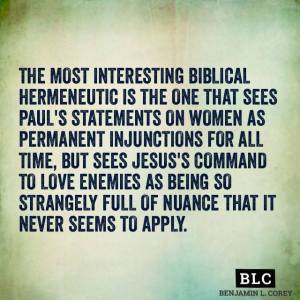
I read this book in October and have meant to review it on the blog, but have been consumed with life transitions (also the case for Becky, a busy working mother who is expecting number 3!).  It’s really hard to conceptualize blog posts when your brain is overloaded with learning a new job, facing big life decisions, caring for children, and trying to make radical self-care a priority (i.e. sleeping normal human being amounts).  But Benjamin L. Corey (I’ll just use BLC for the rest of this review) posted this pic on FB this week and I LOVED it and it has inspired me to meet you here for a little book talk:

10517497_658162560996319_3212269662040844471_n

As usual, BLC does not shy away from controversy, as you can see in the comments if you click on the pic and go to the original FB post.  I agree 100% with his observation and was encouraged to see him make such a bold, public statement.

When Becky and I started this blog, I realized I didn’t know anything about blogging and that got me into reading blogs in a very big way.  I found BLC’s blog, formerlyfundie.com, and also his podcast with Matthew Paul Turner, That God Show, sometime early last year and have been learning a lot from him regarding pacifism, enemy love, living a life that displays God’s love to the disenfranchised and hurting, etc.  I appreciate his perspective on current issues in American Christianity and regarding the harmful aspects of fundamentalist culture.

I also discovered that we have a few things in common:  BLC lives in Maine, is a Gordon-Conwell alum, and we have a some mutual friends.  Logan and I have been able to meet BLC and his wife on a couple of occasions.  I am always thrilled to make new friends, but especially am happy to meet some local Progressive Christians in a state that is #1: the most unchurched state in our country, and #2: churches here are typically very fundy or very liberal.  There is a desperate need for Christians to examine our culture and why it is that our neighbors are not recognizing Jesus in our lifestyles.

In addition to being a two-time Gordon-Conwell graduate, he is currently working on a Ph.D. in Missiology from Fuller Theological Seminary.  His writing has appeared on various platforms including HuffPost, Red Letter Christians, Sojourners and Evangelicals for Social Action.

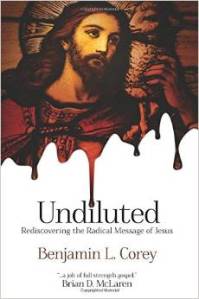
So that brings me to BLC’s book, “Undiluted” (click on image for link to Amazon).

download

Here is the description as it appears on Amazon:

Are you ready to begin experiencing an undiluted Jesus?

Benjamin Corey confronts our vision of Jesus head-on, asking the hard question: Is what we see and hear in the modern church all there is to the message of Jesus… or is there a more radical side to Jesus than we have been led to believe?

Get ready to encounter a Jesus that is determined to turn over the tables of a stale, ineffective and boring gospel that seeks to escape from the world instead of transforming it.

This radical Jesus and His message…

  • Invites us to reorient our lives not on Christian religion, but on the person of Jesus
  • Calls us to live out faith in the context of authentic community with others, instead of isolation
  • Includes the excluded and invites the outcast to have a seat at the table
  • Responds to enemies with a radical, unexplainable love

Undiluted will invite you to step out of your comfort zone and into a process of rediscovering the radical, counter cultural, and life-changing message of Jesus. As you do, you’ll discover a more vibrant faith as you embrace an undiluted Jesus and His radical message!

What I most appreciate about this book is its autobiographical presentation.  BLC takes us on the journey of his spiritual transformation from fundamentalist to progressive, with all of the highs, lows and traumas along the way.  I was able to relate to so many of his experiences, coming from a similar background and going through a similar faith shift in my adulthood.

One of the most unfair assessments of progressive Christianity is that it dilutes God’s Truth in an effort to be culturally relevant.  BLC demonstrates throughout his book that peeling away the layers of American Christian culture actually undiluted his faith in Christ rather than weakening it.  When there are rigid, prescribed positions on all issues, as is the case in very conservative churches, there is little room for examination, humility and debate.  You cannot even consider other points of view.  This dehumanizes people whose experiences and knowledge have led them to differing positions than your own, as you do not even give them the gracious gift of a listening ear.  You are always approaching conversations as a battle to be won, rather than seeing the nuance of complex issues and differing points of view.

I am not personally throwing my hat in the Progressive Christian ring (yet).  But I am deeply appreciative of BLC and others sharing their experiences as Christians of my generation, examining the strengths and weaknesses of the Christian culture that we grew up in, and doing their best to be faithful witnesses of Jesus Christ to their neighbors and the world.  I would encourage you to pick up a copy of “Undiluted”, check out FormerlyFundie.com, and let me know what you think in the Comments.


Thanks for visiting The Beautiful Kingdom Warriors!  Please “Like” us on Facebook if you’d like to read interesting articles from around the web dealing with gender issues.

Book Review: A God I’d Like to Meet by Bob Edwards

I am excited to share a review of Bob Edward’s book, A God I’d Like to Meet, especially today as Amazon has dropped it’s Kindle price to $1.99 for the week.  You only have a few days to take advantage of this deal, and I HIGHLY recommend that you purchase this one!  Also, check out Edwards’ amazing blogs, God is Love, and Biblical Equality for Women and Men in the Christian Faith.  I first found Edwards through his blogs, and have been truly blessed by his knowledge and scholarly writing on the roots of Christian patriarchy and complementarianism (the ideology that God has ordained male-dominated authority over the Church and Christian homes).

41q4U+IK76L__BO2,204,203,200_PIsitb-sticker-v3-big,TopRight,0,-55_SX278_SY278_PIkin4,BottomRight,1,22_AA300_SH20_OU01_ CLICK HERE TO PURCHASE ON YOUR KINDLE FOR $1.99!!! 
THIS WEEK ONLY!

Let me share the “About” blurb from one of his blogs:

Bob Edwards lives with his wife and two children in Ontario, Canada. He holds degrees in Religious Education, Social Development Studies and Social Work. In 2013, he received the Delta Epsilon Chi award for intellectual achievement, Christian character and leadership ability, from the Association for Biblical Higher Education. Bob has been a Social Worker since 1996, providing psychotherapy in a variety of settings. He was the Director of Counseling Studies at a multi-denominational Bible College, teaching courses in Psychology, Sociology and Counseling. His hope is to share a vision of God’s impartial love towards women and men everywhere.

Bob is also the author of the best-selling book entitled, “Let My People Go: A Call to End the Oppression of Women in the Church, Revised and Expanded.”

“A God I’d Like to Meet” is an example of what Edwards does best: a scholarly dissection of Calvinist theology, demonstrating its roots in Plato’s philosophy, and the damaging effects that have resulted from reading the Bible from a worldly perspective.

Here is the description of the book from the dust jacket:

Throughout history, prominent theologians and church leaders have made sense of the Bible through the interpretive lenses of ancient Greek philosophy.

As a result, our traditional beliefs often portray God as an all-controlling deity that frowns on emotion and subjects women to male authority.

Throughout this book, the author explores the origins of these theological traditions, and seeks to restore a vision of God as depicted in the New Testament — a vision of God as love.

Calvinism is a prominent strain of Evangelical Christianity today, as noted in this New York Times article from January of this year. Notable Calvinists include Mark Driscoll, John Piper, and Tim Keller.  Calvin’s “Institutes” was required reading in my seminary Intro to Theology class.  Edwards’ insights were very eye-opening to me personally.  In answer to the question, What is Calvinism? Edwards writes,

Simply put, it is an interpretive framework that tells people what to look for in the Bible, where to look, and how they should make sense of what they find.  This interpretive framework consists of what Calvin referred to as “the principal matters” of “Christian philosophy” (p. 16)

A valuable aspect of Edwards’ writing is his background as a counselor.  He explains many psychological processes that impact the lens through which people understand their world.  In Chapter 1: Bad Religion, Bob says,

I’ve been a Social Worker and Psychotherapist for nearly twenty years now.  During this time, I’ve provided individual, family and group counseling to thousands of people.  Many of them have told me that they have difficulty believing in God.  Most of them have experienced horrific forms of abuse: physical, sexual, psychological, emotional and spiritual.  Many of them were told, at one time or another–often by well-meaning Christians–that the terrible things done to them or to their loved ones were either allowed or caused by the “Sovereign Will of God” (p. 6).

Edwards wraps up chapter one, where he has described how Christians have explained the problem of pain, with this paragraph:

We now have a picture of a God that is allegedly in control of everything, causes evil to befall humans because they (in their vileness) deserve it, or because we are expendable in the accomplishment of “the greater good.”  Of his servants, this God requires the death of self, and the rejection of what it means to be human.  In particular, human beings must apparently deny that they are sexual.  Historically this has led male leaders in the church to project blame for their vilified sexuality onto women.  This projection has led to the subjection of all women to male control.  I submit that this is a portrait of a God who is controlling, abusive, unethical, unloving and sexist.  Simply put, in the minds of many, this is not a God they would like to meet (p. 10).

This book is not a long, cumbersome read.  I couldn’t put it down once I started, and finished the book in two hours.  He explains how, in setting up “the principal matters of Christian philosophy” as an interpretive lens for the Bible, Calvin was facilitating “top-down processing,” and how “Rather than seeing new information objectively, human beings are strongly inclined to perceive and interpret the world around them in ways that confirm what they already believe” (a “psychological phenomenon known as ‘belief perseverance'”, p. 18).  A very brief explanation of the lens through which Calvin made sense of the Bible is through his high opinion of St. Augustine, who made sense of the Bible through his reading of the Greek philosopher, Plato.  in his 8th book of Confessions, Augustine wrote:

Simplicianus congratulated me that I had not fallen upon the writings of other philosophers, which were full of fallacies and deceit, “after the beggarly elements of this world,” whereas in the Platonists, at every turn, the pathway led to belief in God and his Word” (p. 21).

The rest of the book unpacks how this Platonic philosophy impacted St. Augustine’s and Calvin’s interpretation of Scripture, and thus how Calvinism “impacts the way some Christian leaders today understand, preach and practice Christianity” (p. 24).  Specifically, how Calvinism makes God responsible for evil (chapter 3), how Calvinism confuses emotion with sin (chapter 4), and how Calvinism leads to the subjugation of women (chapter 5).

Edwards leaves off with the redeeming message that “the distorting lens of Platonic philosophy can be removed from our perception of God.  When we remove this lens, I believe that we have an opportunity to see God in the way the biblical authors intended.  We are able to perceive that God is love” (p. 98).

If you are an Evangelical Christian, there is a good probability that you have come across Calvinist theology at some point, if not regularly in your faith community.  I emphatically encourage you to pick up this book for the low price of $1.99 and consider the implications of Edwards’ research into the roots of Calvinism.


Thank you for visiting The Beautiful Kingdom Warriors!  Please Follow us, Like us on Facebook, and come again!  God bless. 🙂