
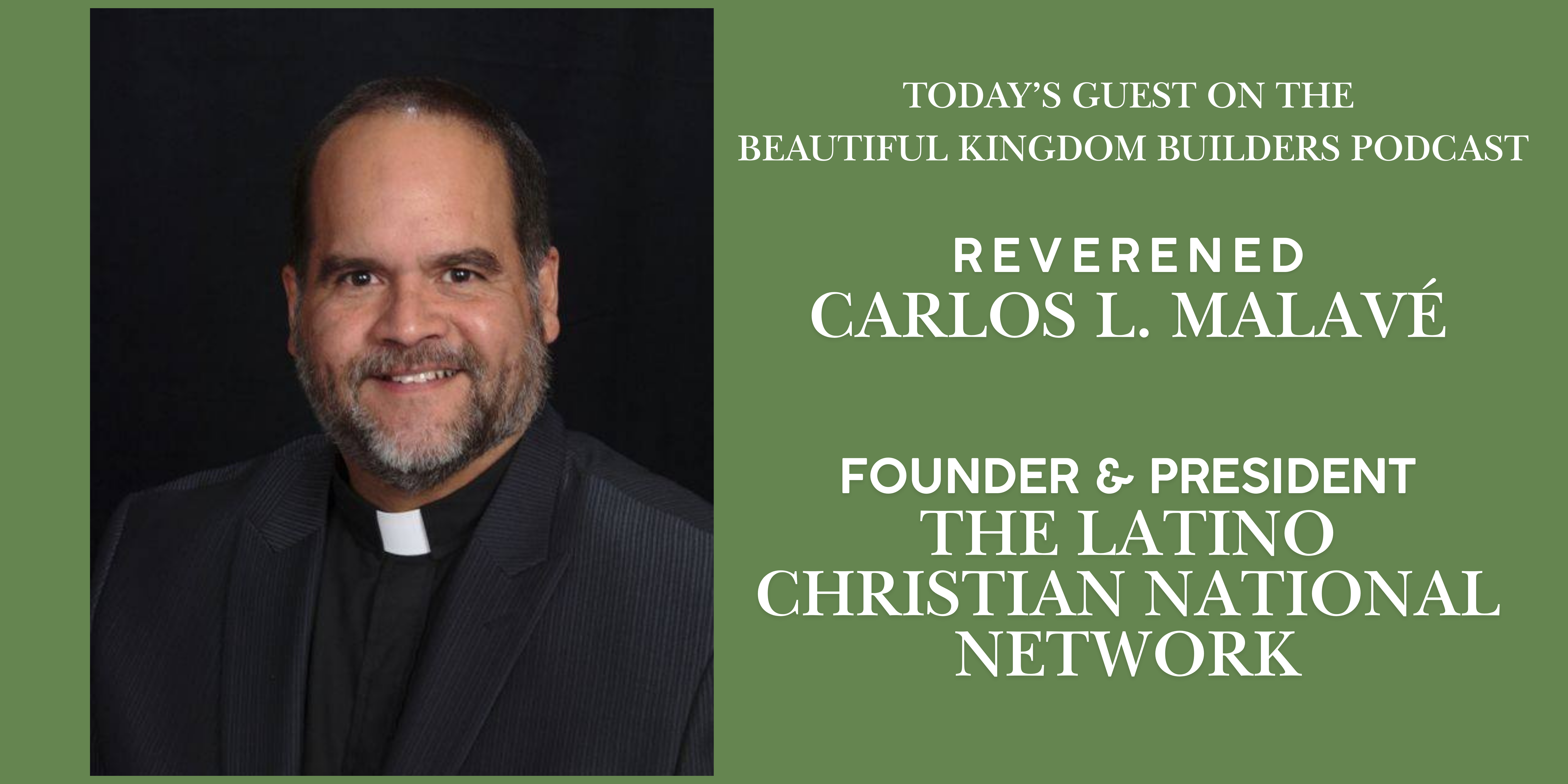
When I started my podcast, my hope was to amplify voices whose message is needed by the Church today. I am overwhelmed with gratitude for my friend, Rev. Carlos Malavé after our conversation about the current inhumanity and cruelty our immigrant neighbors are facing.
This conversation explores the intersection of immigration and spirituality, emphasizing the need for compassion and understanding towards immigrants. Rev. Malavé shares personal stories and insights on the contributions of immigrants in the church and U.S., the impact of current immigration policies, and the church’s responsibility to advocate for justice and mercy. The discussion highlights the psychological trauma faced by immigrant communities and calls for prayer and action to support those affected by immigration enforcement.
Rev. Malavé is the founder and President of The Latino Christian National Network, advocating for immigration reform and humane immigration policies. You can find resources and more information about his organization’s work at LCNN.org. You can find Rev. Malave on Facebook and Instagram.
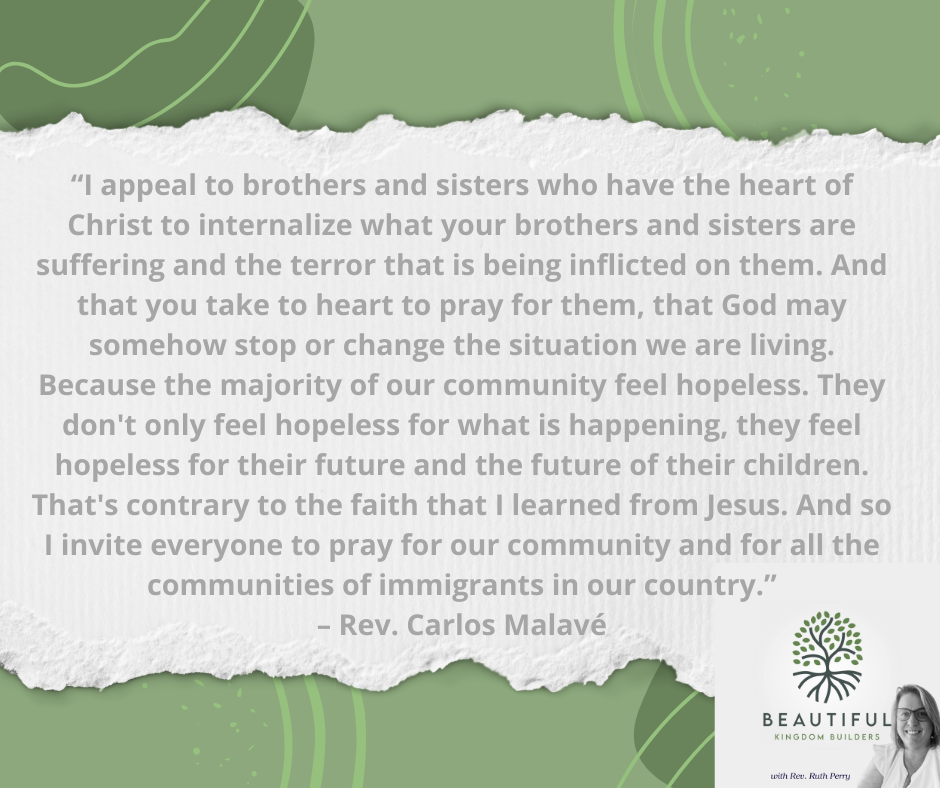
I was especially moved when I ask Rev. Malavé how we can support his work, he asked sincerely for our prayers:
Please help me spread this important conversation by sharing this post or a link to my podcast from your favorite platform, YouTube, Spotify, Apple Podcasts, Amazon Music, or more! Thank you for taking the time to listen. My apologies for the technical difficulties with the video recording. Thankfully, you should not notice anything on the audio platforms, but after twenty minutes, Rev. Malavé’s video cut out.
TRANSCRIPT:
Ruth Perry (00:15)
Our topic today is immigration enforcement, and not just as a pressing political topic, but as a deeply spiritual one. This is a conversation about people, not just policy, and what love of neighbor looks like on the issue of immigration. And I’m honored today to be joined by Reverend Carlos Malavé, founder and president of the Latino Christian National Network. Reverend Malavé brings both a national leadership lens and a pastoral lens to this conversation. Carlos and I are both pastors in the same region of Virginia. And we’ve been meeting weekly for two years in a lectionary group, so he’s a friend of mine. Thank you so much for being on the Beautiful Kingdom Builders podcast today, Carlos.
Carlos L (00:58)
Ruth, it’s really an honor to be with you in this capacity. Obviously, you mentioned we know each other in all the other different places, but I’m very excited. First place for you and the podcast, and I look forward to continue to hear good things about how you succeed in reaching out to people with good messages and obviously also I look forward to engage with you in this critical conversation. And I like the way you put it, that it’s not just about policy, but it’s also about people, about human beings and how what is happening affect the lives of real people.
Ruth Perry (01:36)
I keep thinking about how to start a conversation and I just keep coming back to Jesus’ teaching about the two greatest commandments being love God and love your neighbor as yourself and that if you follow those commands you will fulfill all of the law. But like the expert in the law, a lot of us want to justify ourselves in who we love and I think it’s easiest for Christians to love our neighbors on a micro level, the ones that we personally know and are in relationship with. And then that doesn’t always naturally extend to people we don’t know. And so I wanted to start on that micro level with you today, Carlos, because I know you on a personal level. You’re my friend. And I know you as a very proud and loving husband, father, and grandfather. And so I wanted to ask you, what are your hopes for your Latino family in America?
Carlos L (02:24)
Thank you. That’s a very personal question, Ruth. And I really appreciate it to go to that level. I’ll answer your question, but let me preface it by saying this that happened to me three days ago, four days ago, my son, my middle son, his name is Josh. He has my three grandkids, the only three grandkids I have. And he sent me a text message a few days ago and saying, do you want to make an investment in your grandchildren? And I was beginning immediately to wonder, okay, what is he going to ask? And then he asked, would you be willing to pay for the passports for the three children? And that took me aback.
Obviously, he’s a teacher. He doesn’t have a large salary and so on. And sometimes he come and he knows that I can do it. I want to do everything I can for my grandchildren, so he knows the spot. But he did took me aback. And because the reason he said is I want to have a passport for them because I’m even wondering if at some point they will be or I will be racially profiled. And I want to have a proof that they are citizens. That really took me aback.
And so let me add to say that most of my ministry, and especially my ministry that has to do with national issues and so on, it’s informed by my family in this particular case with my grandkids. And so when I engage in my ministry and my work, to large extent, everything I do, I do it with them in the back of my mind. And I really truly think about this all the time. I am committed and I want to do whatever I can to help create an environment, a country where when I leave, I will know that my grandchildren will be in a place that it’s nurturing, that respect them and where they can thrive as human beings. Honestly, that’s in my mind all the time. I need to do everything I can to give my grandchildren the opportunity to thrive and to really experience life to the fullness, like John 10:10 tells us.
Ruth Perry (04:40)
Because I am called to love my neighbors as I love myself, I want for your family, Carlos, what I want for my family. And then I’m also thinking about how our Latino American immigrants are our Christian siblings in the faith largely. And even immigrants from other parts of the world, we’re talking about our siblings. And so familial love when we talk about immigration is so important, I think.
Carlos L (04:47)
Thank you.
Yeah, this is one of the most important things we must keep in mind when we think about the situation with immigrants and immigration in our country. Something that we know is true for a long time now is that the influx of immigrants, not only Latino, but all kind of immigrants from Africa and Asia in our country, in the US.
One thing that that has done for us is to revitalize the life of the church. To the extent that I am one who believe, and my belief is not just based on my hunches, but it’s based on data, on hard data, to believe that engine behind the church today, it’s immigrants.
To the point that we know that it is the immigrant church, the one that is keeping alive the church. Because we know that for the most part, the church is decreasing in membership. So we can see very clearly that from the mainline churches. But now we even have data that says that even the evangelical and the Pentecostal churches are not growing and are slowing in their growth considerably, but the only ethnic group or group of Christians and people who are growing are Latinos. And that is true for evangelicals and Pentecostals too, for major mainline and also, the Catholic Church. I mean, the reason why the Catholic Church is still alive and strong in our country is because of the large, large numbers of immigrant Catholics who are coming to this country.
So immigrants are the, as I said before, the life and the engine of the Church today, and to large extent, it’s the future of the Church also.
Ruth Perry (06:46)
How is immigration enforcement different today than it has been in the past? And how are Latino Americans experiencing that expansion of ICE and Border Patrol that’s happening?
Carlos L (06:57)
That’s a very good question Ruth and I have so many folks who who lean towards more fundamentalist, conservative side and many of them who are my brothers and sisters that tend to support the policies that are promoted by the Republican party. They remind me all the time, say, you look at the facts and you will notice that during the Obama administration, we had a larger number of people that were, deported. The Obama administration deported a larger number of people. I really haven’t gone there and looked for the numbers that they talk about four million people. I don’t know, it’s not actually the truth or not, it could be.
And I have no issue with the fact that the Obama administration deported, let’s say, four million people. The truth is that we, me and other Christian leaders who are working today with immigrants, we don’t oppose the upholding of our laws and the deportation of people that come to our country in a way that it’s not necessarily legal. We’re not against that.
The truth is that what we’re seeing today is a far cry from what we believe should be the heart of this country and who we are. And so the interesting thing when they tell me that is that if the Obama administration deported four million people, we didn’t even notice. We didn’t even notice. They uphold the law, they did what they need to do, and that’s it. But today is a whole different situation. And so this is where the big problem is.
It’s not necessarily that we don’t believe that we should uphold our laws and protect our borders, which we should do. But it is how the current administration is conducting, how it is implementing and the policies they are using and the attitude that they’re using, which I could talk for a long time, but it’s simply degrading the humanity of our brothers and sisters. And so that is the big, big difference.
And let me add that I mean, we should have never come to this point. I mean, what is happening in our country, it is really, really tragic. The way we are dehumanizing human beings, our brothers and sisters, and we should not have come to this point. Why do I say that? I say that because for almost 30 years, people like me and other leaders, many, people in our country, not only Christians, but all kinds of leaders have been advocating and asking our government, our federal government to enact immigration reform so that we can deal in an orderly way, in a kind and merciful way with the reality that we have living among us millions of people who have made this country their home and they have children and live here and are contributing to our economy, contributing to our culture, are contributing to the life of the church. And so we’ve been asking for 30 years, can the government do something to fix this?
And I have to tell you, because it is true, there has not been the political will, not when we had Democratic administration nor when we have Republican administrations. And so it has not happened. And we’ve been advocating for that for 30 years. And so when we see what is happening today, it is devastating to us because we ask can we come to this place? How are we being so barbaric in the way that we treat this neighbors of ours that are contributing to the life of this country? We should do better. And I think we can do better. But that’s not where we are at this point.
Ruth Perry (10:42)
You and I both pastor in a rural community in the Bible Belt. And so I’m kind of curious how this issue feels different to you as a pastor rooted in local ministry versus your work on the national stage and how those two different ministries inform each other.
Carlos L (10:57)
Yeah, thank you for this question Ruth. May tell you two things about that. One is that the area where we live, I mean, you know the area better than me, but there’s not a large presence of immigrants in this area. The presence we have is primarily Latinos. We barely have immigrants from other other areas or countries. So you will find here and there Latinos in our area, but they’re not that present. And so I think that fact has to do with the very little that our church members know about that culture and that community. They don’t necessarily, in a daily basis, have to deal with people who are different. And so our region, our area is pretty much homogeneous, more or less. I mean, obviously we do have people who are African-Americans, but the largest sector of people here are white Americans.
And so one thing that I’ll say about that and I have given thought to this and even share with a few people is that when it comes to understanding an issue like immigration, the members of our church are so disconnected from that reality and from the needs, the challenges, the daily life of immigrants that they are very ill prepared to really think about what does it mean to be an immigrant. The other aspect inside of that is that I find, and I say this with all respect, it’s just my analysis. And that is that most people in our region, they live well. They have the daily challenges that most of us have, family challenges and maybe some financial challenges, some of them. But for the most part, people in our area live well. They are, I don’t know, middle class. Some of them have a little more than middle class, but they live well. They don’t have big, big issues in their lives. Many of them have land. They have their nice house that they have for generations. And they have built a life that it’s a nice life.
They just deal with some of the daily challenges that we all do, but they live well. And so in a way, this is my perception, they’re very disconnected from the realities of people who live in poverty, who have to face poverty, or people who are immigrants and come from other countries and have the very particular challenges that they have. So when they think about this issue or even when they speak about this issue, they are analyzing it and speaking from a very privileged position and they don’t understand what these people are going through. They don’t necessarily understand the true politics of it, the whole human situation of people moving because of all the the problems they face in their country. All that, they kind of alien to that. And they simply make up their minds and give opinions based on what they watch in the 6 p.m. news on TV. And especially they listen or watch some particular very biased news in TV.
Ruth Perry (14:16)
Yeah, I think that’s true. I want you to keep your pastor cap on for a moment and let’s speak then to the church in our community and the broader church in America. Beyond the teaching of Jesus to love our neighbors as we love ourselves, what are some other teachings in Scripture that tell Christians how we ought to think about immigrants?
Carlos L (14:21)
Okay. I think that when we look particularly at the Old Testament, I mean, I’m not the person, Ruth, that can quote you verses from top of my head, neither in English, neither in Spanish either. But when you look at the Old Testament, you look at the Psalms, even when you look at Leviticus and some other passages from the scriptures.
I appreciate that you quote the New Testament because I mean, from my perspective, Jesus could not be more clear on this. But even when we look to many, many passages in the Old Testament, we see again and again, particularly also the prophets, calling the people of Israel to task when it comes to welcoming the strangers in the midst.
And so we have this very well-known text, again, which I cannot quote for you, but basically that says, when a stranger come into your doors, into your town, into your home, treat them as you will treat one of your own. And that is the general sense of the Old Testament, that we must see ourselves as one human family.
And let me add something here that I thought about sharing with you before. And that is that before I talk and I said that I do believe we need to uphold our laws and we need to protect our voters. The faith, the kind of faith that I have and the faith that that I have learned from Jesus, teach me that borders are things that one day we will get rid of. And the reason why one day we will get rid of borders is because God has no borders. Because for God, we are all members of his loving human family that he loves.
And so if we go to the bottom line and you ask me about borders, I don’t believe in borders. I mean, I do believe in the sense that I’m a citizen of this country and I need to uphold the laws and I cannot pick and choose laws. I need to abide by all of them, but I don’t believe in borders. I believe that we must learn slowly and progressively to see each other as just one human family.
And let me go a little bit even deeper. I believe we can ask the question, why do we have borders? The reason why we have borders is because we want to protect our power and we want to protect our economy. And so for us, our power and our economy are more important than our fellow human beings. That’s what we protect.
And so let me finish by saying then that the reason I don’t believe in borders is because I believe that we must work towards a humanity where all resources are shared equally, where everyone has access to live the life that Jesus desired for all of us. And one day, hopefully, we will get rid of all divisions and all borders, physical borders that divide humanity.
Because that’s coming. It’s just that we resist it. We want to resist it. We rather keep living separate. But one day, the gospel, I believe, says, we will all live together without borders. I happen to believe that. And so I happen to have that mindset. Other brothers and sisters of mine, for some reason, want to perpetuate those divisions. But God will get rid of those divisions one day, one way or another.
Ruth Perry (17:58)
Yeah, I agree with you. I’m thinking about how God created the world and he loves the world and he’s provided enough for everybody. He’s the Great Provider. We live with abundance, but we allow people to hoard it and we allow poverty and we allow systems of oppression and we allow a lot through this scarcity mindset and fear and greed rather than living in the faithful trust that God has provided enough for everybody. And so
Carlos L (18:22)
Yeah, yeah, no, that’s completely, that’s completely true. I’m sorry to interrupt you Ruth, that’s so true. And then let me ask one little aspect of this, and that is that somehow some people think that immigrants to this country are taking advantage of the system. That is not true. That is categorically not true. The contributions that immigrants make to this country are far beyond what they receive. If we talk about the economy, taking the economic contributions of the Latino members of our country, it’s just mind-boggling.
The economic capacity and the contributions that we as Latino, just talking about Latino, not about others, make to this country is just huge. And then one other little point, and that is that even immigrants who are undocumented in our country, they are making huge contributions to our economy, not only by even the taxes that they pay and even the contributions they make to social security, the majority of them that they will never collect. They’re just contributing that to the system. But also the economic capacity and what the buying power that they have. And so the contributions we make to the economy of our country, if we just look at that aspect, it’s just huge.
Ruth Perry (19:46)
In 2023, immigrants contributed $652 billion in taxes, including $90 billion from undocumented immigrants.
Carlos L (19:54)
Wow, there’s the number.
Ruth Perry (19:55)
And then we’ve also 5% of our armed forces are immigrants who cannot vote, but they’re willing to lay down their lives for our country. And we have 7 million jobs that need to be filled by people, but we’re going to deport 13 million people instead. And we don’t think that that’s going to hurt our economy? I think it’s just one way that misinformation is not only hurting our Latino American neighbors, but it’s also hurting all of us.
Carlos L (20:20)
Yeah, and we saw, I mean, for the last several months, in places throughout the center of our country, I’m trying to think of states here like Idaho, Montana, all those states, there’s been a pushback from farmers with the administration because they are losing the manpower to run their farms and the processing plants for chicken or beef or animals or whatever. They have been alarmed of how they are losing the workers to sustain their their industries. And so it’s been a great concern for many, many farmers throughout the country.
Ruth Perry (20:59)
Another bit of misinformation that I hear all the time is this immigration enforcement push for mass deportation is about safety and that they’re just removing the worst of the worst, but then their own data shows that less than 5 % of those that are being detained are violent criminals. And most of supposed crimes that guilty of might be just their immigration status. And then so people say, well, they should just come the right way. But can you explain how that phrase doesn’t really match the reality of our immigration system?
Carlos L (21:31)
Yeah, thank you Ruth for asking that. That’s one of the most sensitive questions for me and for us. Because, and I can tell you, I’ll tell you two quick stories, real people. I will not name names, but I’ll give you insights into this. There is, one Latino Christian national leader, whom I know personally, who for years has been a very vocal and strong supporter of this administration and of our president. At this point, he doesn’t know what to do. And he’s trying to keep the dance that he doesn’t offend the administration because he supported them, but he’s been very quiet for the last six, seven months because he doesn’t have the face to talk to his people and accept the reality that you just described. Interestingly enough, tomorrow evening, this person has invited pastors from Minneapolis to meet with him. I don’t know what he’s going to share with them.
But because I know already know that many of them are pushing back on him because he keeps supporting what is happening. And then the other other story is of a pastor in Minneapolis. I don’t know if you know, but you probably know that we went with two other leaders to Minneapolis two weeks ago and had the opportunity to spend two days with pastors there. It was a powerful, powerful experience going to Minneapolis.
And so there is one pastor there who is doing an incredible work. He has converted his church into a distribution center for groceries primarily. And to this point, I think he has served probably 30,000 families already who are primarily Latinos, but also Somalis and other members of other communities of immigrants, who are so scared to death to come out of their houses. And his whole church is converted basically to a distribution center and he has probably 900 volunteers from the community, mostly white, who are there working in organizing all this distribution of food to people.
But my point with this is that even this pastor, I heard him say a few days ago, and I was so grieved by this, because he said, and I’m very respectful now, mentioned the president, this is not what the president said he was going to do. He said he was going to deport criminals.
Hey, when I heard that, Ruth, I don’t know what I thought because I was so, so upset. Because I believe that we knew from the very beginning that this was coming. And somehow people just want to have made believe or I don’t know what they’re thinking that they thought that this is not coming. This is coming. This was coming. This was very clear from the very beginning.
And I think if I heard well what you mentioned, Ruth, one of the saddest parts of this is that they are not only deporting and focusing on all people, very little of criminals, which we are fine. If they deport criminals, that’s fine. Perfectly fine.
But that what we see now, which is worse, is the racial profiling. And even this pastor, who actually, by the way, he also supported the administration and the president. Now he has a change of heart, at least in what it has to do with this issue. He has even used the words ethnic cleansing. And he has to explain, he used those words, even was interviewed by CNN.
And he used those words and he has to explain what he mean by that. But the reality and the truth is that what we’re seeing simply and truly is that particularly the Latino community, also communities like the Somalis, the administration is just going after people who have a particular color skin, they speak particular languages.
And those are the people that they raiding and those are the people that they are deporting. So it is really tragic that in our country, we have a decision from the Supreme Court that truly support racial profiling. That was tragic that the Supreme Court made that decision. And we are seeing that every day, every day in the streets of our country.
Let me just mention one quick thing and this is that this week we were praying for the Haitian community in Springfield, Ohio because we knew that the administration has removed the protection, what is called TPS, temporary protection status. They have removed that from the Haitian community. And so in Springfield, Ohio, we know that there are probably 10, 12,000 Haitians who are living there. And why we know this? Well, we know this because we learned this in the election cycle because they became the mock of many in our country, that particular community. And so the administration removed the protection. And on February 4, we knew that ICE was getting ready to begin the push in Springfield, Ohio to begin to remove 10,000 Haitians. And with the rhetoric, they are saying that it was perfectly fine for them to go back to Haiti because Haiti is fine, it’s safe.
The only thing you can do about that is just laugh. Who can say that Haiti is a safe place to live? And they are ready to send these families back to the mayhem that regrettably is happening in Haiti. Thanks God that a judge, a federal judge, stopped that for now. We don’t know what’s going to happen, but at least for now, the court order is protecting Haitians in Springfield, Ohio and anywhere else we have large Haitian communities in Miami area and southern Florida and so on.
Ruth Perry (27:27)
In many ways, our country has enticed people to immigrate and then we have a convoluted system where they’re coming the right way. But the process can take decades and a lot of money. And ICE is targeting people when they’re at their court appointments, going through the process. They’ve removed the legal status of 1.6 billion immigrants last year or million. 1.6 million.
And it’s clearly people are not paying attention or they’re not seeing that aspect if they think that everything is above board. Because ICE is clearly working unconstitutionally, we’re denying people due process, detaining people illegally. And as Christians, we ought to be morally outraged, but we’re the demographic most likely to support this.
Carlos L (28:13)
Yeah, that is heartbreaking. I mean, it’s heartbreaking because many people find between the sword and the rock. That’s how the saying goes, between the sword and the rock. Because if they don’t present themselves to the courts, they can very easily, immediately be deported. But then if they go to the court doing the right thing, then their rights are violated right there and they are deported. I mean, that’s one of the most heartbreaking experiences that we have seen, how people who want to play the right way and want to abide to laws in this process are being played around with and their lives have no meaning. And the fact that they want to abide by the law doesn’t mean anything to the administration; that is really, really sad.
Ruth Perry (28:57)
I think it’s important information for Christians to know that this is a massive financial boon for the private prison industry that is profiting off of these detentions. The CEO of the GEO group said that “This is an unprecedented opportunity.” And the CEO of CoreCivic said “This is truly one of the most exciting periods in my career with the company.” And then Palantir is another private prison industry that’s profiting right now. And they were all funding Trump’s campaign.
And Christians were obviously not noticing all the white supremacy language, the great replacement theory, a white supremacy theory. It’s a fear that white people will become the minority in our country. But that’s racism. It shouldn’t be a part of the Christian worldview. We should see the dignity and the value of every human life, not their skin tone.
Carlos L (29:47)
Yeah.
Ruth Perry (29:48)
And so I think that this is impacting the church’s witness. And it’s contributing to the decline in Christianity. You know, we’ve seen 40 million people leave the church in the last 25 years, and they cite hypocrisy and bigotry as two of the primary reasons for leaving Christianity. And I saw recently Dr. Robert Jones from the Public Religion Research Institute said that he cannot phrase a question about immigration enforcement too horrifically for evangelical Christians to not support it or to change their position on the issue. How do you think Christian support for ICE and mass deportation is hurting the church’s witness?
Carlos L (30:24)
I’ll answer your question, Ruth. Let me just quickly go back to a point that I wanted to make on the previous question. And that is that we know that our country in the past, I mean, we have a very imperfect country. There is no perfect country in the world. But we have done a lot of good. Even with the things that we failed as a country, we have done a lot of good to the world throughout years and years. And so the whole thing about immigration has been one of the light spots of our country because we have been for years a welcoming country that out of our, I want to believe, out of our kind hearts, we have provided opportunity for people all over the world who are living in dire circumstances because of many, many different issues. And we have opened the doors of our country to provide people with opportunities to rebuild their lives and in the way of rebuilding their lives, making contributions to our country.
And so we have been known because of that. And the best symbol for that we know is the Statue of Liberty in the entrance of New York. It symbolizes what we have been through our years and years and years. And so now we come full circle. We come full circle where we have completely closed our borders. We’re not even accepting refugees.
We’re going, we have gone farther. We have now more than 75 countries in the world that we don’t allow people to come here or make it so difficult for people to come here, even as visitors. And so we are taking a position where we are alienating ourselves from the world. That’s not what the U.S. have been. That’s not what we have been. We have been a beacon to the world and we have been a blessing to the world.
And so now we’re just making a full circle and closing ourselves to the world. And I don’t know how that can be a benefit to our country. Going back to your question, the question about the church. This is something that my response in part to your question has to do with younger generations. And that is that I can fully understand why we are losing young people in the church. I can fully understand why our younger generations are giving back to the church. And that is simply because we, we taught them how we as Christians are loving and merciful people who welcome everyone.
But I don’t know, we have some kind of a niche now, what is happening to us, even what is happening to the church, where we kind of forgot who we were or somehow we have a change of heart. And so the younger generations look at the church and they basically say, I don’t want to be part of that. For two reasons, one, because those who were Christians, are saying that was not what we were taught. And even those who are not Christian are saying, why do we, want to be part of something like that.
Because the truth Ruth is that even though we’re sinners and we say of ourselves we’re sinners, there’s a lot of good in our hearts. And even someone who might not know Jesus and is not a member of a church, even that person know, they know good from bad. They know what is to be a decent human being. They know what is to be someone who care for the dignity of people. And they are not seeing that in how our country is behaving today. And they’re not even seeing that in the church witness today. And so no, it’s not surprised to me why we’re losing young people in the church.
It’s simply because they cannot swallow what they see today in the church. They want nothing to do with that. So we have a lot of work to do. We have a lot of work to do to repair the damage that we have done to the witness of the church. And that is not going to be repaired in a short period of time.
It’s going to take 20, 25, 30, 40 years to repair the damage that we’re doing to the gospel of Jesus Christ and the witness of the church. And it’s, it’s on us. It’s on us.
Ruth Perry (34:46)
Yeah, I keep thinking about Jesus separating the righteous from the unrighteous in Matthew 25. And he’s identifying himself with the least of these, the people who are hungry, the poor, the thirsty, the sick, the imprisoned, and the stranger. And the righteous say, when were you a stranger? And we welcomed you as he’s inviting them into heaven. And then as he’s dismissing the unrighteous, they ask, when were you a stranger? And we didn’t welcome you.
And I feel like it’s so important for pastors to preach this message today to their churches because this is what Jesus taught about Judgment Day. This is the teaching directly from Jesus about how we should treat people. And we should be keeping our mind on this, on things above, not on things below. And what is of greatest eternal value to God? It’s human beings, our neighbors. It’s not our 401k or our taxes or our borders or the things that may feel like pressing issues to us in this time, but we have to come back to what’s of eternal value. It’s our neighbors. It’s the least of these in our community. We ought to have so much love for our neighbors that we rise up when we see injustice instead of being the force behind it, supporting it.
Carlos L (36:00)
Yeah, I wrote yesterday, I sent an email to a group of pastors in Minneapolis, and in my message, I did quoted Matthew 25. And the reason I quoted Matthew 25 was because I told them that my ministry, what I do and the way in which I and our network are relating to them is because of Matthew 25 and I mentioned to them there’s going to be one day when Jesus is going to call us into task and the Matthew 25 says some will be in one side, in the right side and the other will be in the left and I mentioned to them I didn’t brag about this I know I’m going to be in the right side.
But I mentioned to them, I want to be in the right side. I want to be among those who Jesus says to come and enter into the kingdom because you did the right thing. Because you did the right thing. it’s not been mistaken. To do the right thing is to do what Jesus told us in Matthew 25. I mean, there’s so many of my fellow pastors and leaders today who, they don’t know what to do with that text. They rationalize it. They explain it in some ways. Some of them even say this just only applied to the church. We’re talking about Christians here. That’s not true. That’s not true. We will have to give an account of what we did with what we knew was true.
And because Jesus not only taught that but Jesus lived that way. So it’s unmistakable what is the truth in regards to how do we live together as human beings. And I want to be on the right side. And so that’s everything I do. It’s because of that because I don’t want to risk that.
Ruth Perry (37:46)
How can people support the Latino Christian National Network, Carlos, and your work?
Carlos L (37:51)
Thank you for asking that, Ruth. You can go to our website. It’s LCNN.org. LCNN.org. And you can go there and look at the things that we are doing. We have resources there. The website obviously is in English for the most part. And we have resources in English for churches to use primarily in the area of immigration, some other areas too, but primarily in the area of immigration. You’re talking financially, yeah, they can contribute financially. They can do that right there. But God is blessing us. And so I’m not saying that we do need funding, but if someone wants to partner with us, everybody’s welcome to do that.
But the most important thing and here, this is not cliché. Sometimes I think we use this as cliché. I’m not going to use this as cliché. Pray with us. Pray with us. I think that’s the most important thing we can do today. You know why? Because, and this is, I think, very important. Because our community, the Latino community, is living in terror.
Many of them, they don’t even dare to go to the market or you know I saw yesterday in social media, something that it was so sad. And this is a young man who is a US citizen, but he’s come from a Latino community, from a Latino family. And he works in a restaurant. And the only thing he does in the restaurant is that he care for the door. The door is locked. And he’s only there looking that there’s no ICE agents around and when clients come, he opened the door for clients and then he closed the door again so people could come and get the food. That was heartbreaking.
Let me tell you one more thing and I hope that I can come back again to prayer. And that is that it’s trauma. Because of the terror that has been inflicted in our community. There is a lot of psychological and spiritual trauma that this is causing on people. We know for a fact that in 10 years, 15 years, we will have to deal with the trauma inflicted in our young people today. And immigrants, young people who are citizens of our country and happen to be daughters and sons of immigrants, they are traumatized and they’re going to bring that trauma to their twenties and so on. And so that is something that we will have to deal with. So as you can see, Ruth, that’s why I say we need to pray.
Yes, there are many things we need to do to address all these issues. But let’s begin with praying. As we know, if I’m talking to someone right now, Ruth, who is a believer, and these days I’m kind of going back to use the word and the phrase born again Christian. If we’re talking to a born again Christian, someone that has the heart of Christ. I appeal to brothers and sisters who have the heart of Christ to internalize what your brothers and sisters are suffering and the terror that is being inflicted on them and that you take to heart to pray for them, to pray that God may somehow stop or change the situation we are living because that’s what is happening with our community is that honestly Ruth, the majority of our community feel hopeless. They feel hopeless. They don’t only feel hopeless for what is happening, they feel hopeless for their future and the future of their children.
That’s not, that’s not what I as a born-again Christian, which I consider myself a born-again Christian, what I harbor in my heart. That’s contrary to the faith that I learned from Jesus. And so I invite everyone to pray for our community and for all the communities of immigrants in our country.
Ruth Perry (41:32)
And I hope people will look you up on social media and follow you, Reverend Malavé. On Facebook, Carlos L. Malavé. On Instagram, you’re Rev Malavé. Check out lcnn.org. And also follow other Latino voices, because I think that loving our neighbors starts with listening well, listening to understand and not to defend ourselves and our own perspective on things. But we can expand our perspective if we learn to listen to our neighbors and love them well.
And I’ve been thinking about, as you’re talking about the terror and the trauma that our Latino Christian siblings in the faith are experiencing right now. When my family moved to Bolivia, I was nine years old. And one of my first memories there is some women suspected of pickpocketing on the bus and the police dragged them off and just began beating them in the street, denying them due process, being militarized and violent there. And it was a traumatic experience for me at nine years old. And I never would have imagined that I would see something like that here in America.
But as I’ve listened well to my Christian siblings and others, know, black and brown bodies here in America have been treated like that systemically, historically all along. And so we need to learn to listen to our neighbors well. And we ought to be grieved by that as Christians and we ought to be fighting for justice. Do you have any last words you’d like to share with us, Carlos, before we sign off?
Carlos L (43:00)
Thank you again for this opportunity to share with you today and to be able to share with your audience. And I encourage everybody to continue supporting Ruth’s Podcasts because I know your faith will be enhanced and even challenged. And that’s a good thing.
And so I appreciate this opportunity. And just last thing I’d like to say is to my brothers and sisters who are listening to us, please open your heart. Open your heart to the Spirit of God and ask for wisdom. If there’s one thing that I pray today and I invite and encourage my fellow leaders and pastors is let’s seek wisdom. Let’s seek wisdom together.
Wisdom that comes from above. I often feel that we have lost a sense of wisdom. But even worse than that, that we have exchanged God’s wisdom for the wisdom of the world. And we will be, as we are right now, in deep troubles if we rather follow the wisdom of the world, the worldly wisdom, and not the wisdom that comes from the Holy Spirit.
That’s my prayer for all of you who listen to open your heart to the Word of God that even comes directly to us through the wisdom that the Holy Spirit brings to us. Thank you, Ruth.
Ruth Perry (44:20)
Thank you so much, Carlos. God bless.
Carlos L (44:22)
Amen.
If you enjoyed this episode, please Subscribe to The Beautiful Kingdom Builders podcast on your favorite platform, rate and review it, and share it with a friend! Every little bit of encouragement helps! You can watch our episode on YouTube or find it on Spotify, Apple Podcasts, Amazon Music, and more!
Find Rev. Carlos Malave on Facebook, Instagram, and at lcnn.org.


 The Beautiful Kingdom Builders